Remembering the Syphilis Study in Tuskegee

This guest post is by Dr. Susan Reverby, the Marion Butler McLean Professor Emerita in the History of Ideas and Professor Emerita of Women’s and Gender Studies at Wellesley College. This year she is a fellow at the Project on Race and Gender in Science and Medicine at the Hutchins Institute for African and African American Research at Harvard University. Reverby is most recently the author of the multiple prize winning book, Examining Tuskegee: The Infamous Syphilis Study and its Legacy and the historian whose work on immoral U.S. led research in Guatemala in the late 1940s led to a federal apology in 2010. She is currently completing her latest book, The Revolutionary Life of Brother Doc: A 20th Century White Man’s Tale (University of North Carolina Press, 2020).

Conspiracy theories and myths, medical and otherwise, often reflect ways to cope with racism in its multiple nefarious forms.   Many such tales focus on destruction of the black body: from the fears that Church’s chicken, now Popeye’s, put something in their frying that caused Black men to become sterile to the beliefs in South Africa that the HIV virus was spread by false vaccinations funded by the C.I.A. and British intelligence. Did you hear the one about the U.S. government letting hundreds of black men in and around Tuskegee, Alabama with syphilis not get to treatment that went on for four decades between 1932 and 1972?  Or that the government actually gave the men the syphilis and you can see it in the photographs, especially if you cannot differentiate between a blood draw and an injection?

Photograph of Participant in the Tuskegee Syphilis Study

Centers for Disease Control: Venereal Disease Branch. (ca. 1953). Photograph of Participant in the Tuskegee Syphilis Study. Image from https://catalog.archives.gov/id/824612

Only the fact that the government tried to make sure the men who already had late latent syphilis did not get treatment for forty years is true among these tales, and horrendous enough. Now we have to consider the meaning given to this Study over the nearly fifty years since it became widespread public knowledge.

The exposure of the Study came at the end of the modern Civil Rights era and after the medical community was beginning to acknowledge that even the “good guys” did immoral work. Along with the unethical studies at Willowbrook [1] and the Jewish Chronic Disease Hospital [2], the experiment in Tuskegee led to the federal Belmont Report [3] and the modern era of institutional review boards and regulations surrounding informed consent.

Kenan Thompson Hugh Laurie

King, D. R. (Director).  (2006, October 28). Modern Medicine: Hugh Laurie/Beck [Television series episode].  In L. Michaels (Producer), Saturday Night Live. New York, NY: NBC.

For many in the health care community and general public the words “Tuskegee” became symbolic of racism in medical research and care, making its way into popular culture in songs, plays, poems, rap, and cultural imagination.   In 2006, Hugh Laurie (T.V.’s irascible Dr. House) hosted Saturday Night Live and played the wife in a skit with patient Kenan Thompson. When the doctor offers care to Thompson, Laurie and Thompson both look at one another and yell “We know what this is: Tuskegee, Tuskegee, Tuskegee.” Others have done academic studies that prove and disprove that it is the memory of Tuskegee that keeps African American patients from seeking care or participating in research trials.  What we do know is that the subtle, and not so subtle, forms of racism create an aura of distrust that affects the kind of health care African Americans both seek and receive whether they know the details of what happened half a century ago or not.

So can there be another Tuskegee?  If by this question we mean the misrepresentation in informed consent, the danger of scientific hubris, and the misuse of patients of color:  probably in some form. Just as importantly, we need to ask what meaning is given to these experiences once they become public? How can the health care and public health communities create what historian Vanessa Northington Gamble calls “trustworthiness.”  It is the meaning of the study in Tuskegee that needs to be assessed, taught and considered. For it is this meaning that reverberates long after the men caught in its grasp wandered in the medical desert for 40 years, and long after any knowledge of its facts actually fade.

Join Susan Reverby along with moderator Aletha Maybank and Monique Guishard for our panel on February 26th, Could Tuskegee Happen Today?, addressing the history and legacy of the study and why it remains relevant today.

Footnotes

[1] J.D. Howell, R.A.Haywood, “Writing Willowbrook, Reading Willowbrook: The Recounting of a Medical Experiment. In: J. Goodman, A. McElligott and L. Marks, eds. Using Bodies: Humans in the Service of Medical Science in the 20th Century (Baltimore: Johns Hopkins University Press, 2003), pp. 190-213.

[2] Barron H. Lerner, “Sins of Omission—Cancer Research without Informed Consent,” New England Journal of Medicine 351 (2004): 628-630.

[3] Office of the Secretary, The Belmont Report: Ethical Principles and Guidelines for the Protection of Human Subjects of Research, April 18, 1979.

#ColorOurCollections 2019: Here Comes the Sun

Are you ready? Our fourth annual #ColorOurCollections week kicks off today! From February 4th through the 8th, libraries, archives, and other cultural institutions are showcasing their collections in the form of free coloring sheets. Follow #ColorOurCollections on Twitter, Instagram, Facebook, and other social media platforms to participate. If you’re a cultural institution, share your own coloring sheets to our website, colorourcollections.org.  And if you’re looking for pages to color you can join in too, by following the social media hashtag. Be sure to visit the #ColorOurCollections website for free, downloadable coloring books created for the campaign.

fb_1200x630-0110md

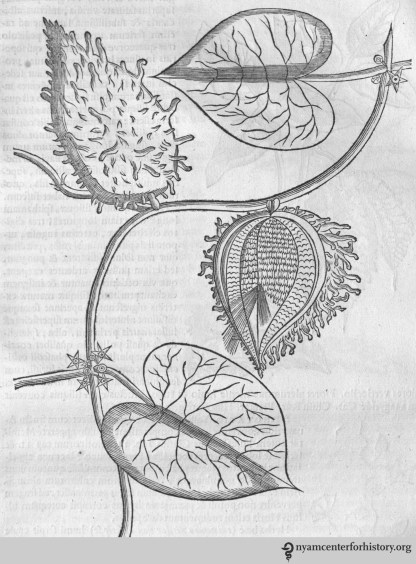
Last year our coloring pages took their cues from the ocean, but this year’s especially cold January had us running to our botanicals.  Here, we found a respite from the cold in the pages of Willem Piso’s natural history of Brazil, the vibrant cacti of Johannes Burman’s eighteenth-century volumes on American plants, and the always evergreen pines of the early and important herbal, the Hortus Sanitatis, or Garden of Health.

The earliest illustrations in this year’s coloring book come from a French edition of the Hortus Sanitatus, first published in Mainz in 1485. The woodblocks used to make the book’s many illustrations of plants and animals were reused many times to depict different species. In some cases, fantasy takes over entirely, as with a pair of images depicting male and female mandrakes.

pruss_ortussanitatis_1497_mandrakes_watermark

Source: Verard, Antoine. Des herbis & tabulae… (1500).

Athanasius Kircher was also no stranger to fantasy, and his levitating lily pad, from his illustrated guide to China published in 1667, is no exception. Kircher, a Jesuit, never travelled to China, but relied on accounts by his fellow Jesuits for source material for his book. Kircher promised that his travelogue would distinguish between the real and the unreal, but offered illustrations of a number of incredible sights, including winged tortoises and this flower with a face, who graces this year’s coloring book cover:

Kircher_China_1667_lilypad_watermark.jpg

Source: Kircher, Athanasius. Athanasii Kircheri e Soc. Jesu China…(1667).

Other images this year were taken from the herbal of the Dutch botanist, Johannes Burman, published between 1755–1757. Burman studied under Herman Boerhaave at Leiden, and qualified in 1728 as a doctor of medicine. He later replaced Frederick Ruysch as Professor of Botany in Amsterdam, and was responsible for the botanical garden there. Many of the illustrations in Burman’s Plantarum Americanarum were drawn by the French botanist and artist Charles Plumier (1646–1704). The flowering plant plumeria was named in his honor.

burman_plantarumamericanum_1755_plumeria_watermark

Source: Burmann, Johannes. Plantarum Americanarum. (1755–1757).

Finally, two additional coloring images come from Willem Piso and Georg Markgraf’s astonishing Historia naturalis Brasiliae, published in 1648. The book contains 446 remarkable woodcuts illustrating local flora and fauna, and comprises the most important seventeenth-century catalog of zoology, botany and medicine in Brazil. The woodcuts are based on an original collection of paintings and sketches, now lost; many of these original depictions were likely done by Markgraf himself. Selected pages from the book are digitized here.

piso_brazil_1648_unknownplant_watermark

Piso, Willem & Laet, Joannes de. Historia naturalis Brasiliae. (1648).

We can’t wait to see what you’re coloring from our collections—and from others!  Don’t forget to share your work and use the hashtag #ColorOurCollections on social media.


Winter/Spring 2019 Upcoming Events

Happy New Year! After finishing off a wonderful array of programming for 2018, we’re looking forward to the events we have in store for 2019, and hope you are too!

Our winter/spring programming begins on January 26 with our Bibliography Week lecture, “‘The Horrors of My Secret Toil’: What Frankenstein Demands of Curators”, with speaker, Elizabeth Denlinger. She will consider Mary Shelley’s fictional experiment with dead bodies and their place in the scientific world of Shelley’s time, as well as exploring the ethical implications of making a spectacle of human bodies — in the novel, in movies, and in exhibitions.

Please join the Academy on January 30 for the “Tenth Annual History of Medicine and Public Health Night, Part I“. This special evening of selected short talks will address varied topics in the history of medicine and public health from milk pasteurization to the eradication of rinderpest in East Africa.

fb cover_828x315 0116md

February 4-8 is Color Our Collections Week! Begun by the Academy Library in 2016, Color Our Collections Week brings you free coloring sheets based on materials in our Library as well as other cultural institutions from around the world. Users are invited to download and print the coloring sheets via the website www.colorourcollections.org and share their filled-in images with hashtag #ColorOurCollections.

Who is remembered, commemorated, and forgotten? Join us on February 6 for “Remembering the Dead“, a Germ City event where activist and artist Avram Finkelstein and essayist Garnette Cadogan consider the complicated social and institutional responses to infectious disease with the Tenement Museum’s David Favaloro.

The “Tuskegee Study of Untreated Syphilis” was an unethical medical research study conducted by the U.S. Public Health Service on hundreds of African-American men from 1932-1972. “Could Tuskegee Happen Today?”, the inaugural event in the Academy’s Race & Health series, to be held on February 26, will share first-person accounts from survivors, combined with expert perspectives and audience discussion, to address the history and legacy of the study and why it remains relevant today. 

On April 3, we will be presenting “Facing the Future: Predicting and Preparing for Disease Outbreaks“. At this Germ City event, science reporter Sonia Shah will speak with experts Dr. Amy Fairchild, Dr. Larry Madoff, and Lauren Flicker about how prepared we are for future pandemics.

Save the date for April 11, our annual Celebration of the Library: “How the Voice Made Us Human”! This year’s speaker is award-winning journalist and author of As Nature Made Him John Colapinto, who will discuss his current book project on the history of the voice.

Lastly, be on the lookout: newly-added dates for our incredibly popular walking tours on Roosevelt Island and Ellis Island are coming soon!

Check back here for special guest posts by some of our speakers in the coming months, and we hope to see you soon!

If you’d like all this information in handy brochure form, click here.