Skip to primary content
Skip to secondary content

Books, Health and History

The New York Academy of Medicine

Books, Health and History

Main menu

  • Home
  • About
  • Support the Library
  • Links and Resources
  • Calendar
  • Past Events
    • Festival of Medical History
      • Schedule
      • Participants
      • Post-Festival Survey
    • Performing Medicine Festival
      • Schedule for the Performing Medicine Festival
    • The LaGuardia Report at 70
      • Participants: Marijuana & Drug Policy Reform in New York—The LaGuardia Report at 70
    • Vesalius 500
      • Schedule for Art, Anatomy, and the Body: Vesalius 500
      • Participants: Art, Anatomy, and the Body: Vesalius 500
    • Innovation in Digital Publishing
      • Digital Publishing – Are the best things in life free?
      • Digital Publishing – Open Access
      • Digital Publishing – Experimentation
      • Digital Publishing – Communities

Monthly Archives: April 2025

Seeing Helps Believing: Bringing Together Museums and Libraries 

Posted on April 30, 2025 by nyamhistory
Reply

By Anthony Murisco, Public Engagement Librarian  
  

The French Quarter is at the heart of New Orleans. This area is known for its unique architecture. A blend of traditions from its former colonizers, France and Spain, bred a new style. Fires and other calamities since the 18th century may have destroyed most of the original buildings, but a distinct style remains in the neighborhood. 

Following the Louisiana Purchase in 1803, New Orleans experienced an influx of people from other states, eager to seize new opportunities. Louisiana and, of course, New Orleans were now part of the United States of America. New rules brought forth new laws. Under the rule of their new country’s leaders, medicine, for one, could only be practiced and administered by licensed professionals.  
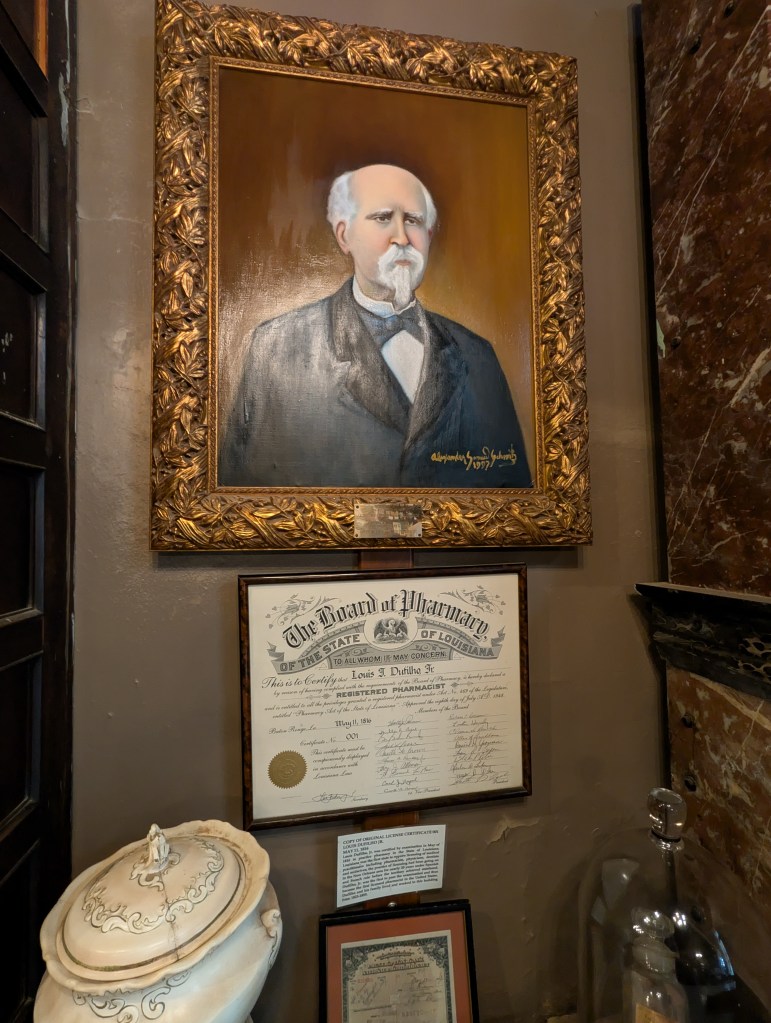
A portrait of Dufilho with his certification under it.

The Board of Pharmacy of the new state of Louisiana granted its first certificate to Louis J. Dufilho Jr. in May of 1816. Dufilho was not only the first Louisianan to do this but also the first licensed pharmacist in the entire United States. In 1823, he and his family came to the French Quarter to establish their pharmacy. From 1823 until 1855, Dufilho served the people of this fast-growing American port.  

In April of 2025, over 200 years later, a group of us gathered outside a building on a hot New Orleans day. Although the building was going through a brief period of routine touch-ups, it still stood out. A sign with a mortar and pestle declares “Le Pharmacie Française,” with a sign below indicating that this is indeed the “Historical Pharmacy Museum.”  
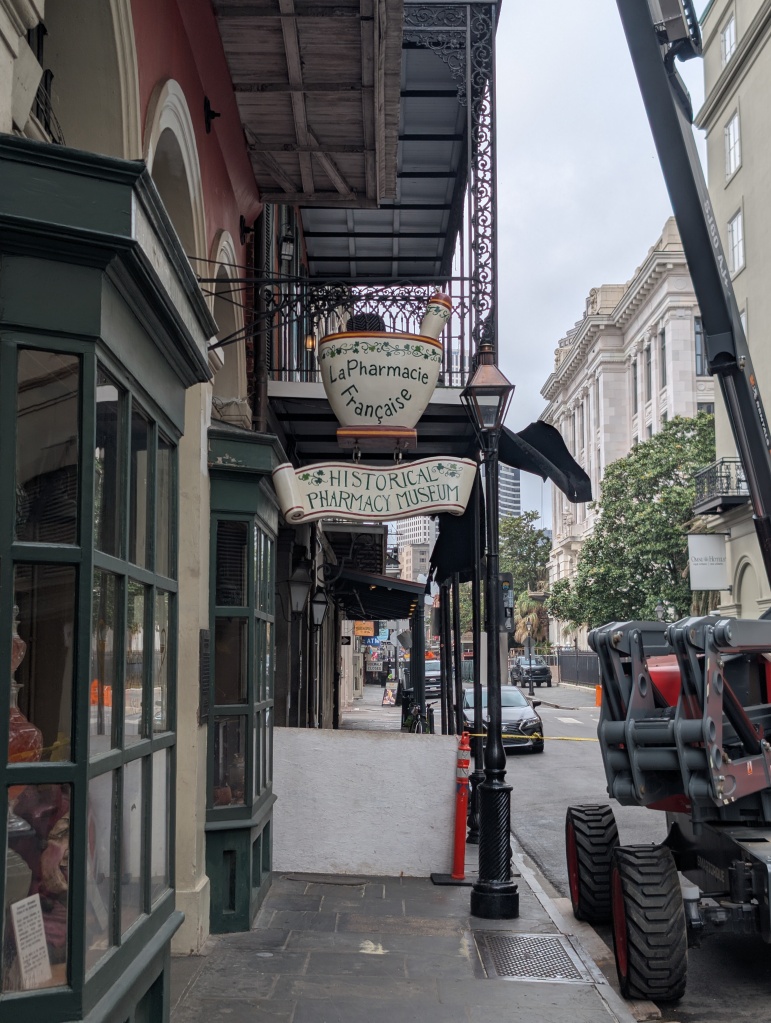
The entrance to the Historical Pharmacy Museum, as described in the text.

This is the home of the New Orleans Pharmacy Museum at 514 Chartres Street. We were welcomed not only by our tour guide but also by a giant soda fountain from 1855. The decommissioned soda pump still holds the necessary ingredients needed to make proper medicinal concoctions. Before the tour officially started, we were allowed to roam and explore the first floor. New Orleans’ early relationship to the history of a pharmacy was about to be unspooled for us. Our packed crowd consisted of residents from many different states and an entire family from Ireland.  
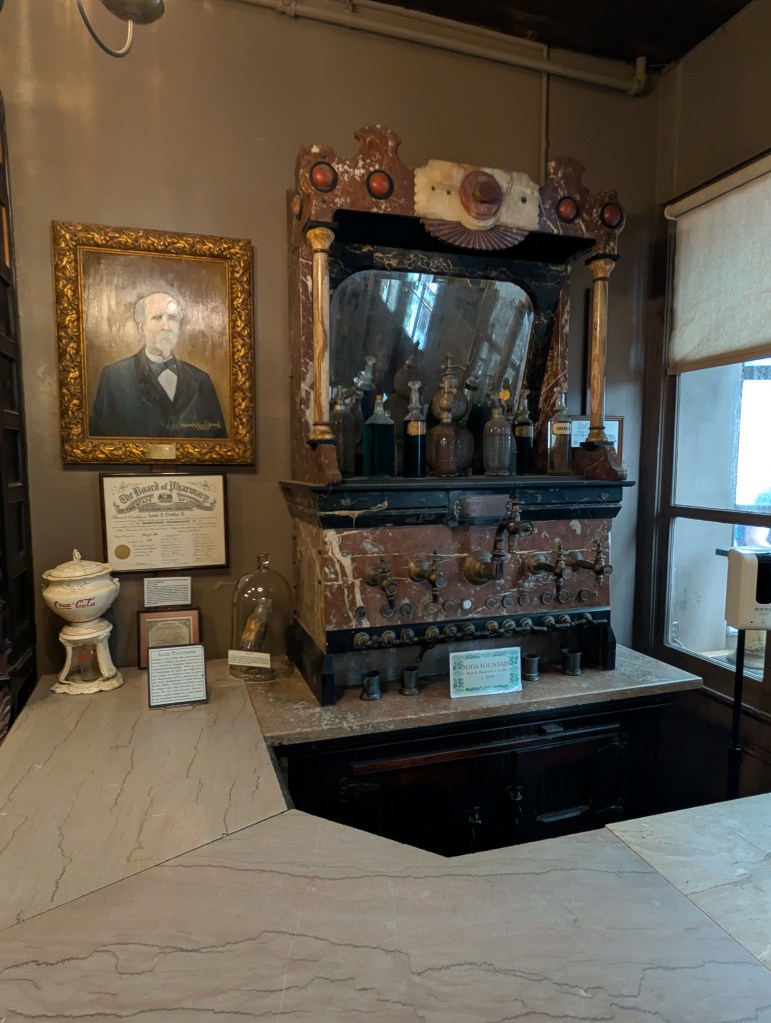
The 185X soda fountain.

There are two types of tours available here: a self-guided tour, complete with a text guide to help you understand the collection, or a group tour led by a tour guide. The historian we were fortunate enough to have as our tour guide helped bring the sights we were seeing to life. It has been proven that creating an engaging lesson increases the likelihood of retaining that knowledge.  

The Pharmacy Museum doesn’t shy away from the realities of the early pharmacy industry. What could easily come across in a sensationalized manner—to engage visitors or promote clicks—is given context. The way they present their material fosters a dialogue with what we know now. In 2018, the Museum even commissioned local artist Kate Lacour to create an illustrated guide to items from their permanent collection. Do No Harm reminds us not to scoff at earlier treatments; the goal has always been healing.  

The title page of Do Not Harm by Kate Lacour.

During my visit, something struck me about seeing physical copies of the items I had previously read about. I have seen countless advertisements and trade cards discussing the wonders of Lydia E. Pinkham’s treatments, and now some items were in front of me!

From our digital trade card collection, "Yours for Health Lydia E. Pinkham."
From our digital trade card collection, “Yours for Health, Lydia E. Pinkham.”

This harmony between museums and libraries furthers understanding. The item that I read about is authentic, and that item, which I see before my very eyes, has a history we can explore inside a book.  

At the end of the tour, our guide asked us to look at the slate floor we had been on the whole time. She informed us that the floor has not changed since Dr. Dufilho and his family resided there, some 200 years ago! She left us with this thought so that we could think about all those who had also set foot in the building over the years. Knowing what we learned about the evolution from house to historical building, for what purposes had these people come the way that we had? 

Jars of treatments. At the bottom, an old sign says "This hospital is for the poor. Only residents of Orleans parish will be admitted."

As we approach summer, with vacation and/or time off approaching, take a moment to think about what you might want to learn more about. Whether you’re visiting an entirely different country, a different state, or even staying local and opening a book, there are plenty of stories waiting to be shared.  

An exhibit labeled "African American Pharmacy in Early to Mid 20th Century New Orleans." Different objects are there including a mortar and pestle and a map of the African American pharmacies.

References: 

Lacour, Kate. Do No Harm. Antenna Press, 2018. 

Posted in History of medicine, History of public health, public engagement | Tagged anatomy, historical collections, history, louisiana, medicine, new-orleans, public health, rare books, travel, United States | Leave a reply

Library Catalog

Click here to search our collections.

Enter your email address to follow this blog and receive notifications of new posts by email.

Subscribe

RSS Feed RSS - Posts

Twitter Updates

Tweets by nyamhistory

Categories

  • Academy history
  • Announcements
  • Bibliography
  • Collections
  • Conservation
  • Digital publishing
  • Events
  • guest post
  • History of medicine
  • History of public health
  • public engagement
  • Uncategorized

Tags

  • #ColorOurCollections
  • ads
  • advertisements
  • anatomy
  • Andreas Vesalius
  • art
  • Art and the Body: Vesalius 500
  • book conservation
  • books
  • coloring
  • coloring book
  • cookbooks
  • digitization
  • Eating Through Time
  • event
  • food
  • Food 2015
  • food history
  • guest post
  • health
  • historical collections
  • historic recipes
  • history
  • history of medicine
  • illustration
  • Item of the Month
  • manuscripts
  • medicine
  • morbid anatomy
  • national poetry month
  • new york academy of medicine
  • New York City
  • poem
  • poetry
  • public health
  • rare books
  • recipes
  • The Knick
  • Vesalius 500
  • William H. Helfand Fellowship

Meta

  • Create account
  • Log in
  • Entries feed
  • Comments feed
  • WordPress.com

Archives

  • April 2025
  • March 2025
  • February 2025
  • January 2025
  • December 2024
  • November 2024
  • September 2024
  • August 2024
  • June 2024
  • May 2024
  • April 2024
  • March 2024
  • February 2024
  • December 2023
  • November 2023
  • July 2023
  • June 2023
  • May 2023
  • April 2023
  • March 2023
  • February 2023
  • January 2023
  • December 2022
  • November 2022
  • October 2022
  • September 2022
  • August 2022
  • July 2022
  • June 2022
  • May 2022
  • April 2022
  • March 2022
  • February 2022
  • January 2022
  • December 2021
  • October 2021
  • September 2021
  • August 2021
  • May 2021
  • April 2021
  • March 2021
  • February 2021
  • January 2021
  • December 2020
  • November 2020
  • October 2020
  • September 2020
  • July 2020
  • May 2020
  • April 2020
  • February 2020
  • January 2020
  • December 2019
  • November 2019
  • October 2019
  • September 2019
  • August 2019
  • July 2019
  • June 2019
  • May 2019
  • April 2019
  • March 2019
  • February 2019
  • January 2019
  • December 2018
  • October 2018
  • September 2018
  • August 2018
  • July 2018
  • June 2018
  • May 2018
  • April 2018
  • March 2018
  • February 2018
  • January 2018
  • December 2017
  • November 2017
  • October 2017
  • September 2017
  • August 2017
  • July 2017
  • June 2017
  • May 2017
  • April 2017
  • March 2017
  • February 2017
  • January 2017
  • December 2016
  • November 2016
  • October 2016
  • September 2016
  • August 2016
  • July 2016
  • June 2016
  • May 2016
  • April 2016
  • March 2016
  • February 2016
  • January 2016
  • December 2015
  • November 2015
  • October 2015
  • September 2015
  • August 2015
  • July 2015
  • June 2015
  • May 2015
  • April 2015
  • March 2015
  • February 2015
  • January 2015
  • December 2014
  • November 2014
  • October 2014
  • September 2014
  • August 2014
  • July 2014
  • June 2014
  • May 2014
  • April 2014
  • March 2014
  • February 2014
  • January 2014
  • December 2013
  • November 2013
  • October 2013
  • September 2013
  • August 2013
  • July 2013
  • June 2013
  • May 2013
  • April 2013
  • March 2013
  • February 2013
  • January 2013
  • December 2012
  • November 2012
  • October 2012
  • September 2012
  • August 2012
The New York Academy of Medicine
Blog at WordPress.com.
  • Subscribe Subscribed
    • Books, Health and History
    • Join 727 other subscribers
    • Already have a WordPress.com account? Log in now.
    • Books, Health and History
    • Subscribe Subscribed
    • Sign up
    • Log in
    • Report this content
    • View site in Reader
    • Manage subscriptions
    • Collapse this bar
 

Loading Comments...