The French Quarter is at the heart of New Orleans. This area is known for its unique architecture. A blend of traditions from its former colonizers, France and Spain, bred a new style. Fires and other calamities since the 18th century may have destroyed most of the original buildings, but a distinct style remains in the neighborhood.
Following the Louisiana Purchase in 1803, New Orleans experienced an influx of people from other states, eager to seize new opportunities. Louisiana and, of course, New Orleans were now part of the United States of America. New rules brought forth new laws. Under the rule of their new country’s leaders, medicine, for one, could only be practiced and administered by licensed professionals.
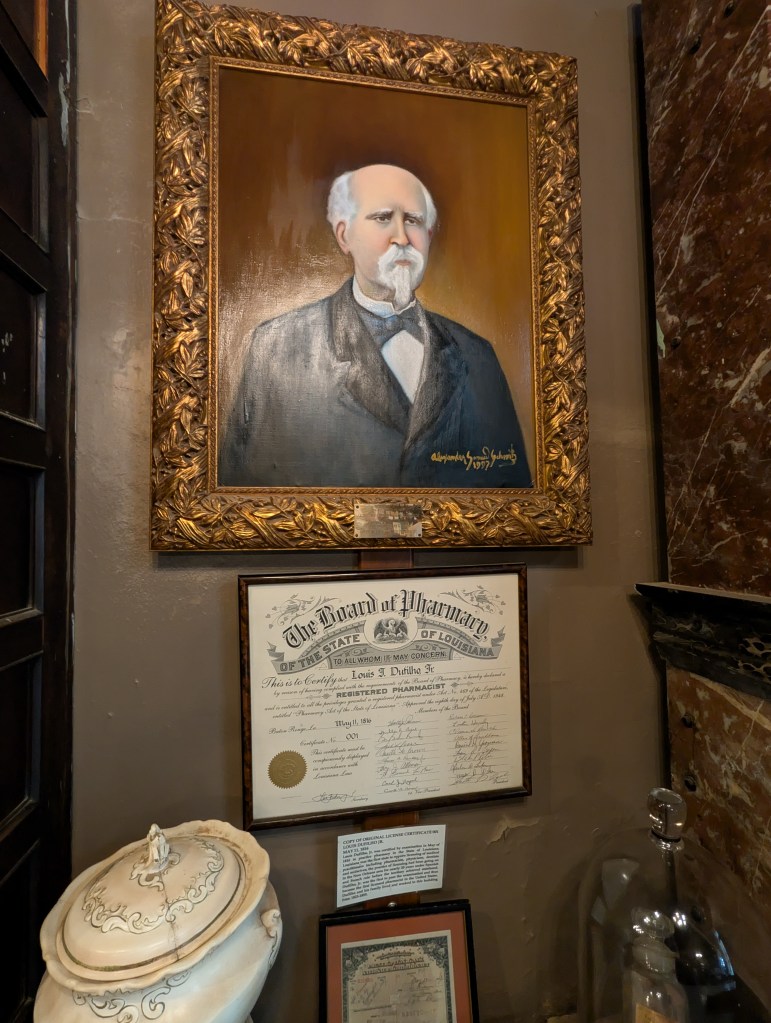
The Board of Pharmacy of the new state of Louisiana granted its first certificate to Louis J. Dufilho Jr. in May of 1816. Dufilho was not only the first Louisianan to do this but also the first licensed pharmacist in the entire United States. In 1823, he and his family came to the French Quarter to establish their pharmacy. From 1823 until 1855, Dufilho served the people of this fast-growing American port.
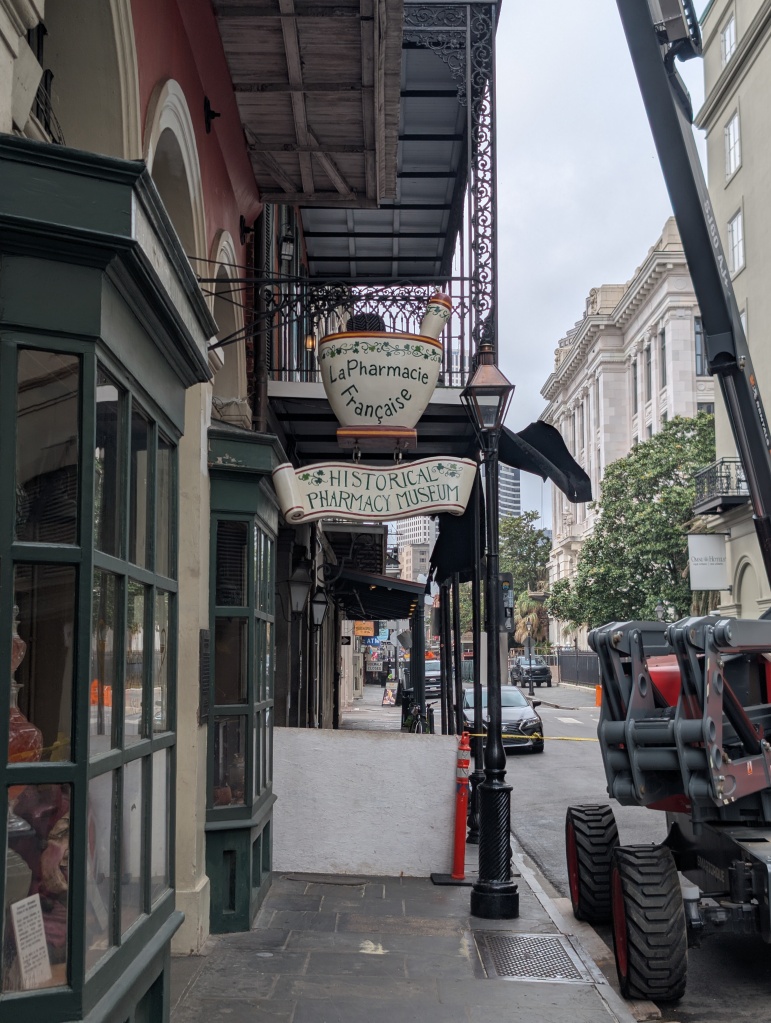
In April of 2025, over 200 years later, a group of us gathered outside a building on a hot New Orleans day. Although the building was going through a brief period of routine touch-ups, it still stood out. A sign with a mortar and pestle declares “Le Pharmacie Française,” with a sign below indicating that this is indeed the “Historical Pharmacy Museum.”
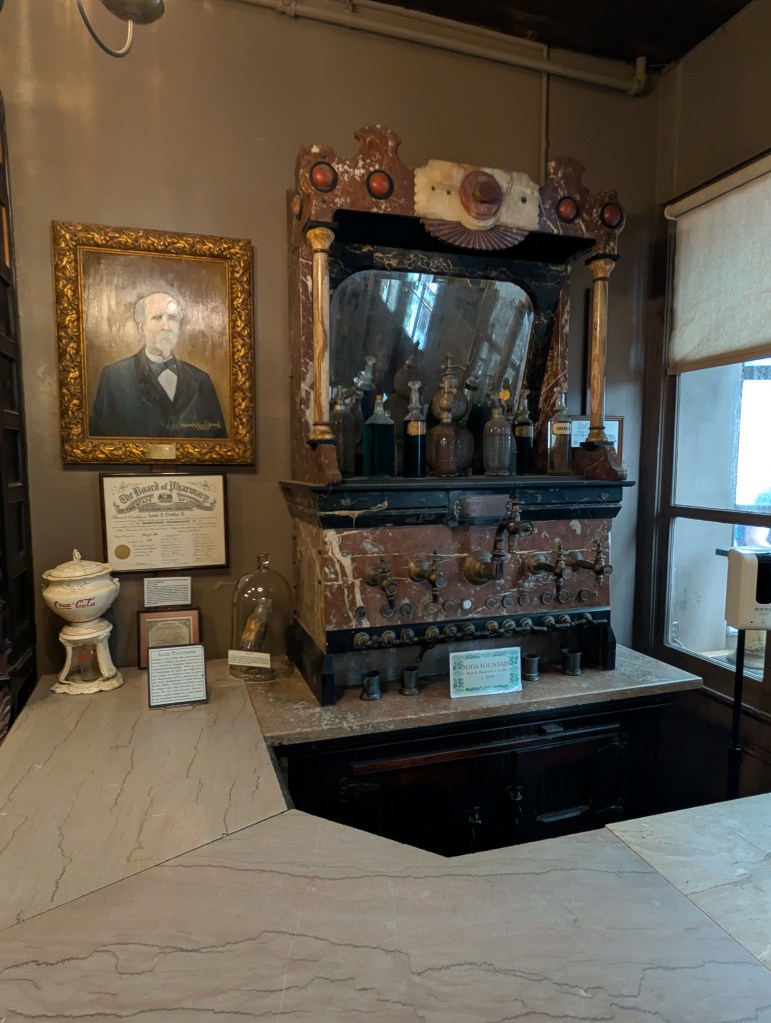
This is the home of the New Orleans Pharmacy Museum at 514 Chartres Street. We were welcomed not only by our tour guide but also by a giant soda fountain from 1855. The decommissioned soda pump still holds the necessary ingredients needed to make proper medicinal concoctions. Before the tour officially started, we were allowed to roam and explore the first floor. New Orleans’ early relationship to the history of a pharmacy was about to be unspooled for us. Our packed crowd consisted of residents from many different states and an entire family from Ireland.
There are two types of tours available here: a self-guided tour, complete with a text guide to help you understand the collection, or a group tour led by a tour guide. The historian we were fortunate enough to have as our tour guide helped bring the sights we were seeing to life. It has been proven that creating an engaging lesson increases the likelihood of retaining that knowledge.
The Pharmacy Museum doesn’t shy away from the realities of the early pharmacy industry. What could easily come across in a sensationalized manner—to engage visitors or promote clicks—is given context. The way they present their material fosters a dialogue with what we know now. In 2018, the Museum even commissioned local artist Kate Lacour to create an illustrated guide to items from their permanent collection. Do No Harm reminds us not to scoff at earlier treatments; the goal has always been healing.
During my visit, something struck me about seeing physical copies of the items I had previously read about. I have seen countless advertisements and trade cards discussing the wonders of Lydia E. Pinkham’s treatments, and now some items were in front of me!
From our digital trade card collection, “Yours for Health, Lydia E. Pinkham.”
This harmony between museums and libraries furthers understanding. The item that I read about is authentic, and that item, which I see before my very eyes, has a history we can explore inside a book.
At the end of the tour, our guide asked us to look at the slate floor we had been on the whole time. She informed us that the floor has not changed since Dr. Dufilho and his family resided there, some 200 years ago! She left us with this thought so that we could think about all those who had also set foot in the building over the years. Knowing what we learned about the evolution from house to historical building, for what purposes had these people come the way that we had?
As we approach summer, with vacation and/or time off approaching, take a moment to think about what you might want to learn more about. Whether you’re visiting an entirely different country, a different state, or even staying local and opening a book, there are plenty of stories waiting to be shared.
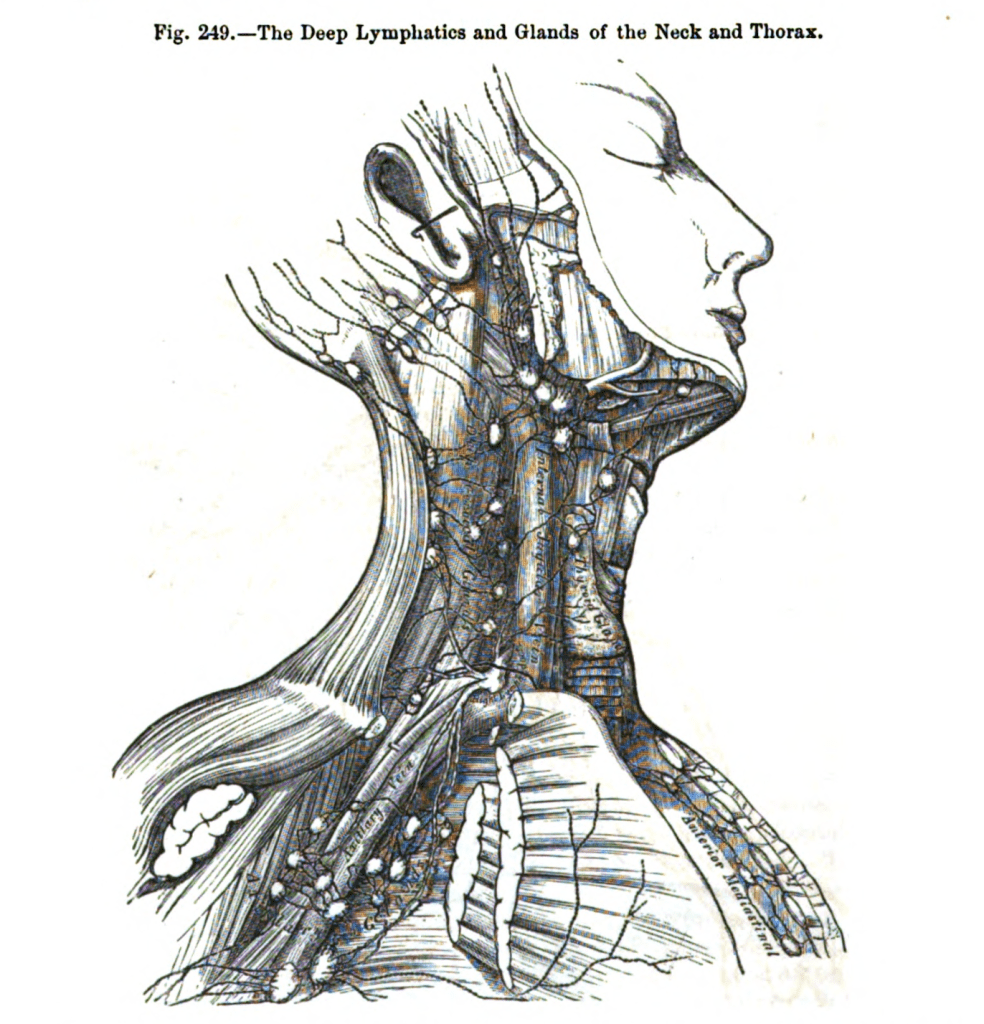
Anatomy, Descriptive and Surgical was first published in 1858. The author, Dr. Henry Gray, had intended to create an “accurate view of anatomy” for students and practitioners, for the application of practical surgery. This work was to be an inexpensive textbook from the mind of the celebrated wunderkind, who had already been published, celebrated, and named a Fellow of the Royal Society by the age of only 25.
Illustration From 2nd American Edition of Anatomy…
For the illustrations, Gray re-teamed with Dr. Henry Vandyke Carter, another anatomist/surgeon who was a skilled anatomical artist. Their previous collaboration had been Gray’s 1854 book, On the Structure and Use of Spleen. The new work was to be their biggest collaboration yet. Unfortunately it was also their last: Gray died in 1861 of smallpox, contracted from caring for his nephew. Before his passing, he had completed a second edition of his Anatomy that corrected minor mistakes and added illustrations by a Dr. Westmacott.
Illustration From 2nd American Edition of Anatomy…
Since its original publication in 1858, the book succeeded in both its original purpose and became culturally synonymous with the profession. Descriptive and Surgical Anatomy became a key text, although now the title was shortened to Gray’s Anatomy, both easier to say and in honor of the author. Editions of the book were not just for professionals either. It became part of the Western canon. For example, performance artist Spalding Gray used the title for his one-man piece, later a Steven Soderbergh film, in which he muses on his options after being diagnosed with a rare ocular disease.
The title has never gone out of print. The key textbook even adapted with technology. Back in 2005, as the 39th edition of Gray’s Anatomy was set to be published, one could purchase a virtual edition for an additional $60. At the same time, another Gray—or rather, Grey—would take over the cultural context….
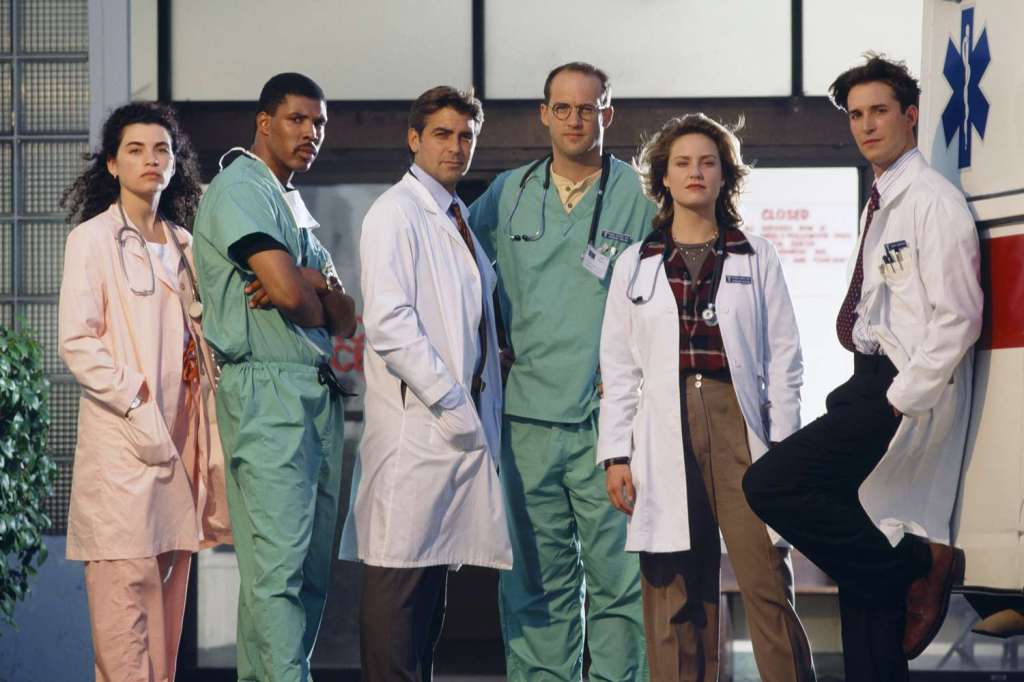
There was no shortage of doctors on television. ER (1994–2009) was created by writer Michael Crichton. Although he never obtained his medical license, Crichton had graduated with his MD from Harvard Medical School. Crichton first scripted ER in the 1970s with the idea of making it a film. It reflected the rotations he took part in. When it was filmed in 1994 as a two-hour television pilot, not much was changed. During his short-lived medical career, he had become disenchanted with how corporate he believed medical care had become. ER is set in the fictional, financially tight, Cook County General Hospital in Chicago. Crichton’s mind-set comes through in some of his other work, including the (also) hospital-set, body-snatching horror film, Coma.
ER set a gold standard for hospital dramas. Crichton believed that for the first time on television they provided “realism” of what things were like an emergency room. Subsequent hospital television would have to do something different. This led to a more stylized approach as it went on for Chicago Hope (1994–2000). Scrubs (2001–2010) was different in that it was a comedy that mixed in the reality of the job. Then there were the countless unsuccessful rip-offs that couldn’t find their own unique voice, lasting one season or less. Plus, for early seasons, ER had up and coming actor George Clooney as part of their cast. He would go on to be one of the biggest names in Hollywood.
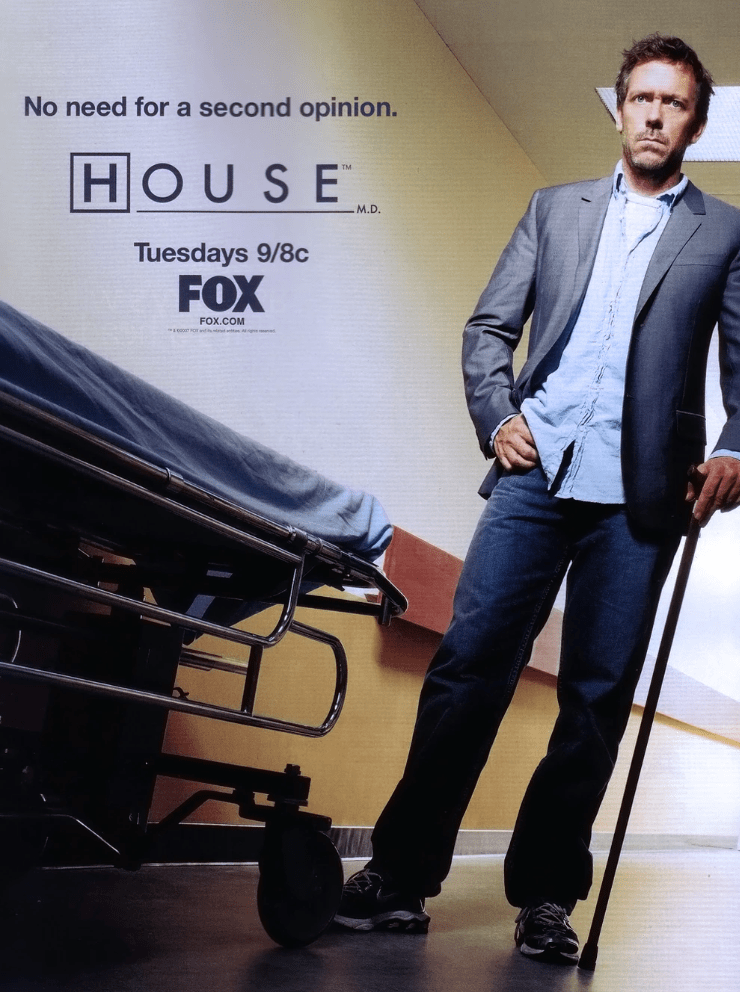
House, MD premiered in 2004 on FOX and starred British actor Hugh Laurie as the titular, misanthropic doctor. Creator David Shore looked to Sherlock Holmes as inspiration for his character. House gave his patients and viewers a methodical approach to his diagnoses, which were, more often than not, some rare disease, disorder, or occurrence. House had managed to give the medical yet another new take.
In 2005, ABC didn’t show much confidence in their latest pilot. It was another medical drama. They couldn’t even agree on a name: Complications, Surgeons, Miss Diagnosis, Grey’s Anatomy, it didn’t matter. They believed nothing they could top ER, which was still a ratings and critical juggernaut ten years in. But they were riding high after successfully rolling out two dramas in the last year, Desperate Housewives and Lost.
First-time creator Shonda Rhimes believed she had a show that would once again break a hospital-set mold. She tended to associate hospitals with “good things.” It was the place where they would “fix” you. Rhimes understood that there had to be a balance between that sentiment and the real lives that those who worked there had. “They’re just people at work.”
With those intentions in mind, executive producer Peter Horton tried to keep it looking “real.” He wanted the characters to look worn out; it’s a tough job! He wanted them to be unglamorous, with little to no make-up. This is most evident in the first episode. They found that even getting real-looking scrubs on the actors wouldn’t make for must-see tv, so they pivoted to it the reality rest on the emotional heft of being in a hospital. The remaining eight episodes of the abbreviated first season reflected that.
Those who worked on the show were skeptical. “It’s doctors with teenage dialogue,” Thomas Burman, a special effects makeup artist recalled thinking. Initial reviews were mixed, including people stating that the show needs “a brain.” Entertainment Weekly had reservations but overall found it enjoyable. ABC could take a loss if this, in their eyes, “generic” mid-season replacement (never a good sign in television terms) fizzled out.
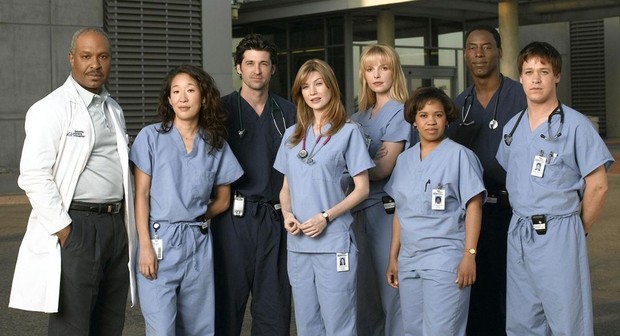
On March 27th, 2005, the first episode of Grey’s Anatomy, “A Hard Day’s Night,” premiered at 10pm, following a season two episode of Desperate Housewives. Audiences were introduced to the main character and narrator, Meredith Grey (Ellen Pompeo), as she and her intern cohort endured their first 48 hours at Seattle Grace. Meredith’s voiceovers give context and comfort. (Coincidentally, a different Gray, Henry Gray, offered a similar “welcoming tone” in the earlier editions of his Anatomy, according to Bill Hayes’s The Anatomist. Unlike Meredith Grey’s, Henry Gray’s voice was taken out of later editions.) Meredith continues to narrate today, 20 seasons in. The episode was the most-watched mid-season premiere in years.
The fresh faces of the season one cast of Grey’s Anatomy
Over the course of the next few weeks, the fervor for Grey’s Anatomy only grew. It was originally only intended to have a four-week run in the coveted post Housewives Sunday slot. ABC kept it for the rest of the season. It would air on Sundays again for the second season, which was even bigger, including a whopping 27 episode order. The stars including Pompeo, Sandra Oh, Katherine Heigl, and Chandra Wilson experienced career highs. There was a career resurgence of 80s teen heartthrob, Patrick Dempsey. Grey’s Anatomy also added to the cultural vernacular! “McDreamy,” Grey’s name for her on-again, off-again lover, Dr. Derek Shepherd (Dempsey), changed the 80’s “Mc-” critique of capitalism to something (or someone) that is craved.
Two years into its run, Andrew Holtz, MPH, wrote a book on the intricate science featured on House, MD. Seeing the success of the other popular doctor show, he wrote The Real Grey’s Anatomy in 2010.As a faculty member, he was given the opportunity for intimate access to the lives of medical students and the patients in care at Oregon Health and State University (OHSU). Grey’s Anatomy was used as the framework to show what reality is like and what a fictional show gets right—or gets wrong. Holtz apologized to fans who were seeking more in-depth analysis of their favorite program.
In the introduction to Holtz’s book, a fourth-year resident laments, “None of them have bags under their eyes…. That is so far away from the reality of interns.” As accurate to “reality” as the show wants to be, especially Peter Horton’s original concerns on their glamour, Grey’s Anatomy is first and foremost a consumer product. Justin Chambers, who played original intern Alexander Karev, notes that “we need to be appointment television every week.” This is why you have event episodes, like the season two, post—Super Bowl bomb scare two-parter, and why difficult surgeries go hand in hand with the complicated interpersonal conflicts the characters go through. It’s art! The show employs medical advisers, and writers work with the objective to only tell stories that have a recorded case. From there, they can tell the story however they want, even if it makes those advisers “roll their eyes” or “pull their hair out”! Real medical terminology has to be learned by the actors, which sometimes is harder for them than a whole monologue.
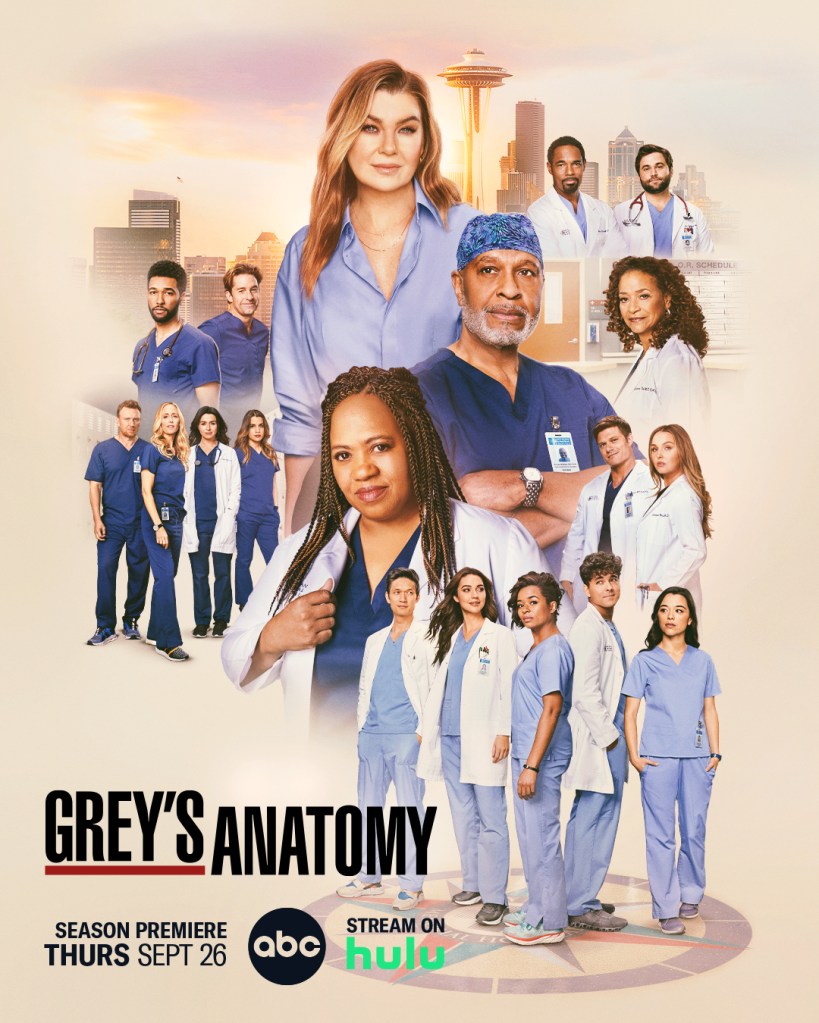
Current Grey’s Anatomy promotional Image courtesy of ABC.
Grey’s Anatomy continues to be popular as it enters twenty years on air and will conclude its 21st season sometime in May 2025. We know it continues to be one of the most watched shows. Are doctors part of this audience too?
Doctors mention they may get the occasional real-life question that they see stemming from the show. In 2013 Cosmopolitan offered a q+a with a GP, Dr. Emma Wilding, who was asked about some of the more “out there” instances. She was happy to oblige.
Author Eric Berger looked into the television doctor effect for Annals of Emergency Medicine and concluded that while the occasional patient misunderstanding may occur, the show served to open up a dialogue between doctor and patient. If we’re to continue to fight misunderstanding and create personable communication between medicine and people, perhaps having the staff of Seattle Grace—or as it was renamed, Grey Sloan Memorial—as our allies benefits everyone.
We’re right in the middle in what’s known as the “season of giving.” Technically, this is a term used by philanthropic organizations to describe the last two months of the year. Often, it’s done for the purposes of a tax-deductible write-off at the end of the year. This may not be the only reason; it’s also just a generous way to give back to the community.
The 1958 edition of Giving USA by the American Association of Fund-Raising Counsel.
Let’s explore some homemade gifts from the NYAM Library’s cookery collections, and look also at “the gift of life”: blood.
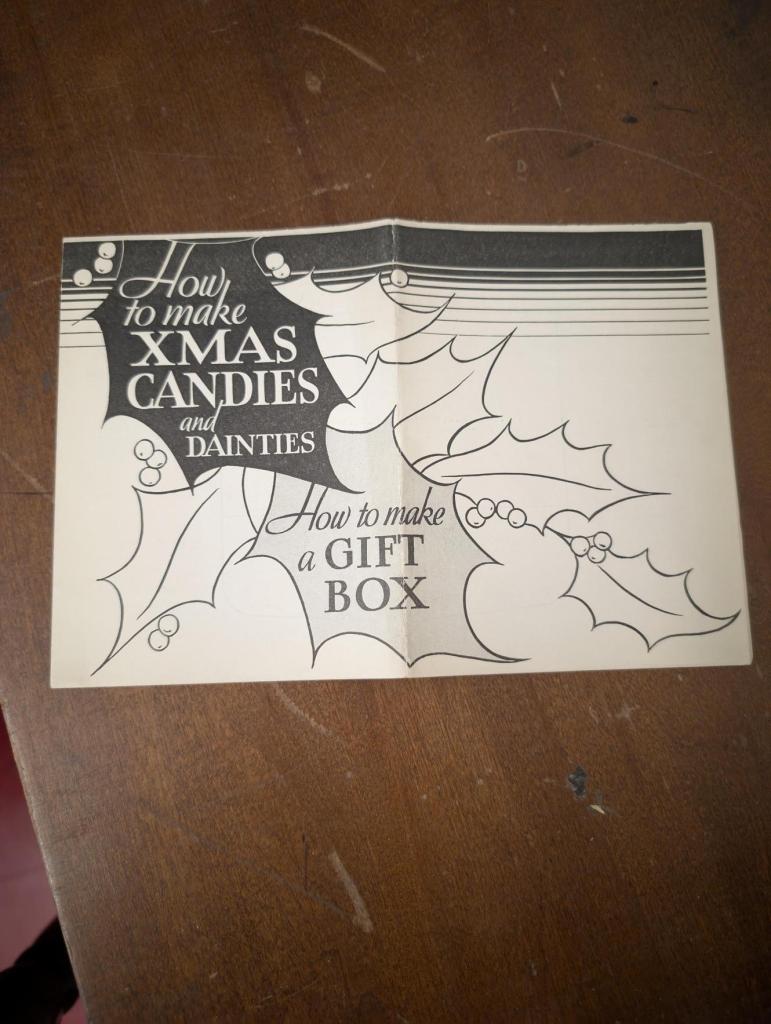
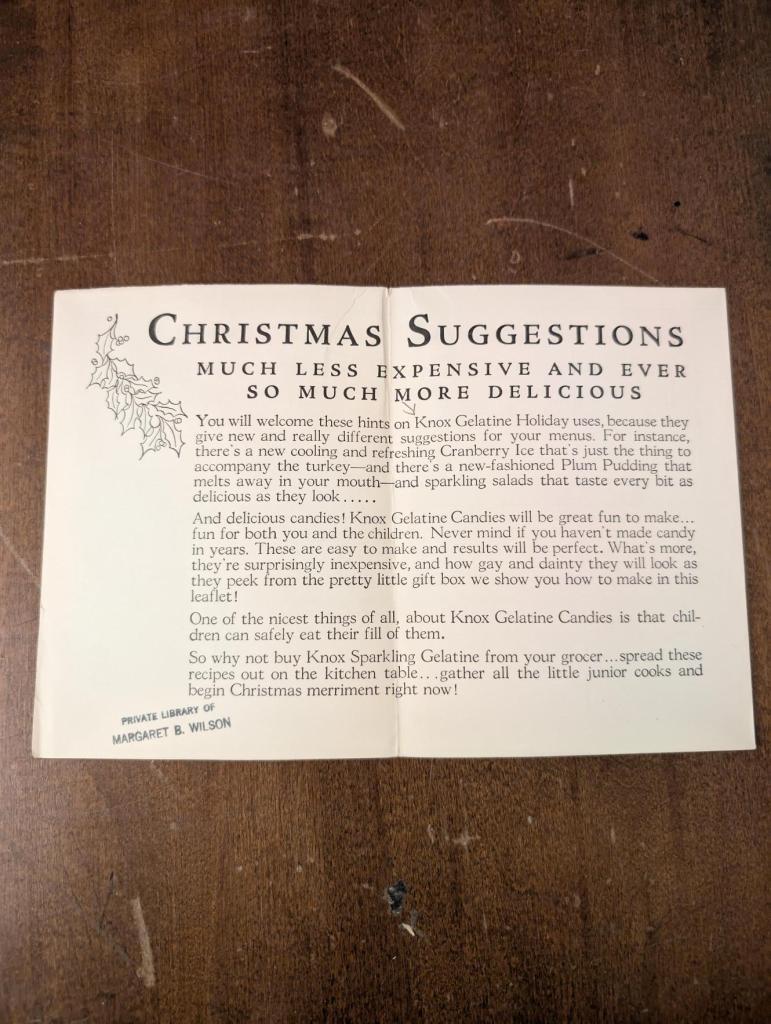
At this time of year, holidays lead to gifts being exchanged! Most gifts don’t have to be huge. In fact, the Knox Gelatine Company believes that there are some presents “much less expensive and ever so much more delicious.” They invite you and your “little junior cooks” to bake one of their recipes to give this holiday season. You can follow a reusable pattern to make gift boxes for these candies. Make as many as you want!
Knox also gifts you with some relaxation; they’ve offered up three different menu options for what to serve on Christmas and New Year’s. You still must find recipes for most of the meals they suggested, but they do include recipes for a few dishes. If you’ve managed to give yourself ample time to prepare, you find that the company is offering to send you a free copy of one of their cookbooks. Perhaps the rest of the recipes can be found there.
Knox isn’t the only company with an opinion on home-baked presents. Betty Crocker says, “A gift you bake is a gift from the heart.” In this case, she is talking about her “Stir-N-Roll Mince Pie.” You may want to reserve this hearty dish for dear loved ones, as the woman on the advertisement does. There’s even the suggestion to add apples for a fruitier, more seasonal dish. Betty then gives you instructions for exactly how to wrap the mince pie. She reminds you that by giving this dish, you may be giving away one of your pie pans. Otherwise, use a cardboard one!
Betty isn’t done with gift suggestions yet. On the back, you can follow a recipe for “Cherry Cordial Chiffon Cake.” A stipulation is to “make only with Sofstasilk [cakeflour] and Wesson oil.” Who knew an advertisement could be so delicious? Once again, she shares how to present the baked gift. Betty calls it a “glamorous cover for a glamorous cake!”
While these gifts don’t cost as much as a tax-deductible donation, there are some gifts that you can give that are free. They might just save a life too.
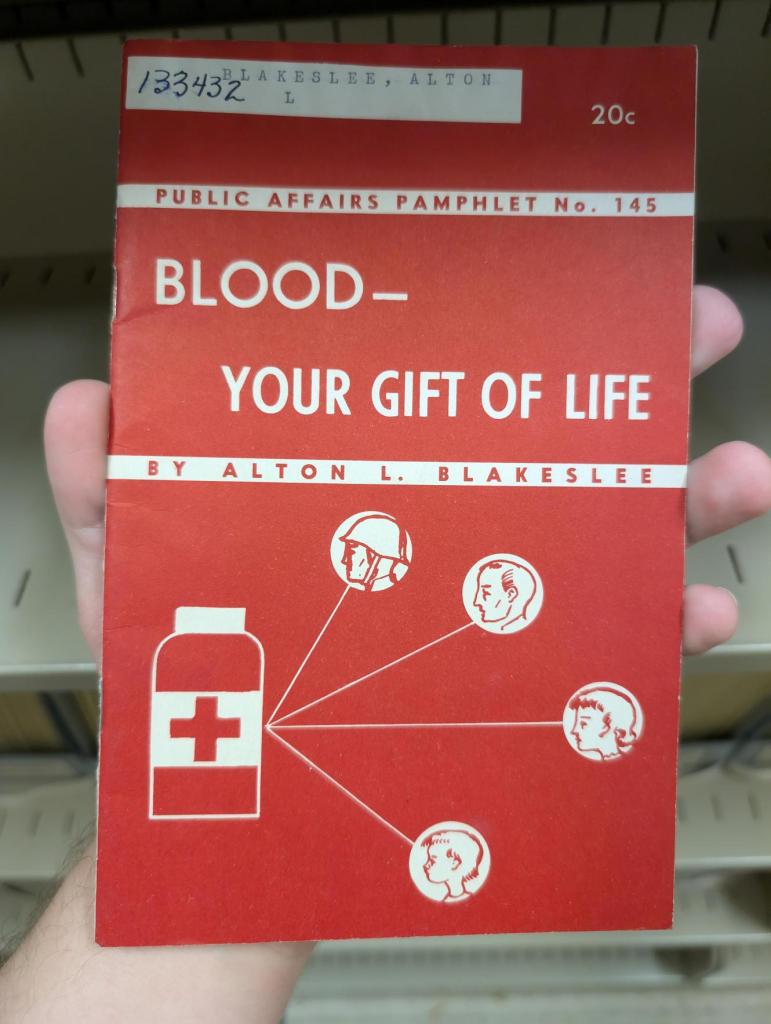
Alton L. Blakeslee, a science writer for the Associated Press, was brought on by the American Red Cross, to plead their case through a 1951 pamphlet, “Blood—your gift of life.” We were a year into America’s involvement in the Korean War. Our soldiers overseas needed the most crucial “life-saving medicine,” blood.
Blakeslee writes that Americans are lucky. The American Red Cross set up an “efficient, working” system of donation centers and organizations that safely allow us to donate blood.
Having that healthy supply of blood allowed doctors and hospitals to provide care for the sick and those otherwise in need. Unfortunately, need has “skyrocketed” due to the overseas conflict. Now a stockpile was urgent, to be a ready line of defense.
The pamphlet explains why blood is important, for those who may not think about it too much. It’s true, we do take it for granted. Blood is described as not only the “magic gift” of our lives, indeed “the river of life.”
Blood donations can only come from other people. Blakeslee explains that a “normal person” should have around 12 to 13 pints of blood in their body. That fact helps sell the idea of giving a pint or two for the stockpile. He also waxes poetically on what he refers to as our “miracle fluid,” reminding us again that we have the possibility to help save others with no harm to ourselves.
If you’re wondering how your blood can make an impact, he included a chart. Considering eight pints of blood in all, that amount can help eight different people; those same eight pints can be used to make various lifesaving blood products that would help thirty or more people! Your one (or two) pints can make a difference.
Going through the history of blood donation, Blakeslee clears up some misconceptions. This includes the idea that people cannot receive blood from different races. This was just three years after President Truman ended segregation in the armed forces, in 1948, while the American Red Cross gave up the practice of segregating blood by race only the year before, in 1950. Blakeslee offers a little bit of humor on the situation by saying it won’t “give the recipient…. any of the giver’s characteristics.” He goes on to say blood from a happy person wouldn’t make a “grump” any happier.
Blakeslee believes that the gift of giving is a reward into itself. That is and will always be true. Thanks to support from generous donors, in 2024 the American Red Cross is sometimes able to provide something in exchange for your time and blood. They put out a press release this past August declaring an emergency. The record setting temperatures that the United States had been experiencing made collecting more difficult. They say that at least 100 drives had been affected, while the demand for a large blood supply is still constant. During the summer drought, they offered gift cards. Right now, from December 16th into the new year, you can get a long-sleeve shirt with a snowman graphic. Sometimes you’ll get a cookie that really hits the spot. Just remember that blood donation is a great cause!
What you would see on RedCross.org this holiday season.
Expanding your mind during the “season of giving” may help you choose what to gift this year. Whether it’s for your family or another’s, gifts don’t have to be extravagant. It’s the thought that counts.
From all of us at the New York Academy of Medicine Library, we wish you a happy and healthy holiday season!
This Summer, the NYAM Library hosted our first-ever Public Engagement Intern. Rebecca is about to enter her second year as a Library Science student at Pratt. As part of her internship, she was asked to produce a blog post on a topic of her own choosing. If you are a library science graduate student interested in an internship at our library, be sure to look out for calls on our social media channels.
As the New York Academy of Medicine’s Library Public Engagement Intern, I’ve had the incredible opportunity and privilege to work with the library’s collection. Inspiration can strike anywhere in the library’s vast holdings, but it struck me when I stumbled across some wheat-free recipe pamphlets among the cookery items in the collection, one of many subject strengths of the NYAM Library. The number of wheat-free pamphlets and recipes in the collection, all dating from 1917 and 1918, piqued my interest. I was intrigued and eager to learn more about why so many of these pamphlets might be in the collection, as they reminded me of current day online recipe blogs. Were people in 1918 cutting wheat because of dietary restrictions or to follow the latest fad diet? Digging deeper into the collection would reveal the answer.
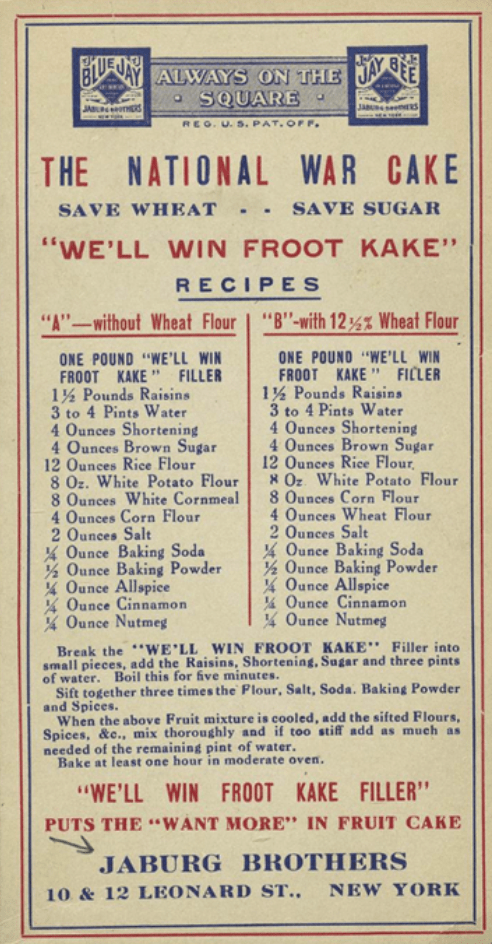
While I didn’t find any recipe books on the South Beach, Paleo, or Keto diets in the collection, I found plenty of recipe pamphlets urging citizens to conserve wheat, sugar, meat, fats, and milk (Wilson et al., 1917). I found pamphlets and posters encouraging Americans to conserve wheat to increase exports to Allied countries, and British ones encouraging their citizens to cut out wheat due to the decreased production. These pamphlets and recipe books were clearly of great historical importance, but is there a reason why the library collected so many specific pamphlets on rationing wheat? For answers I turned to the collection where I found all these pamphlets: the Margaret Barclay Wilson Collection of Books on Foods and Cookery.
Margaret Barclay Wilson: Fellow of the New York Academy of Medicine, Professor of Home Economics and Head of the Physiology and Hygiene Department at Hunter College, Honorary Librarian at Hunter College, Doctor of Medicine, friend of Andrew Carnegie, and pioneer and expert in food economy, there is no shortage of accolades for the remarkable Dr. Wilson (Tanzer, H. 1948). In 1929 Dr. Wilson generously donated her collection of over 4,000 works of cookery and nutrition to the NYAM Library. Her collection contains many items dealing with food rationing because she was commissioned by the British government to prepare a report on how to deal with food shortages caused by World War I. The government was interested in any and all ways to combat these shortages. For wheat shortages that included, finding alternatives to wheat, encouraging people to reduce and ration the use of wheat, and regulating the production and use of wheat. Dr. Wilson prepared a report on the use of flour in the making of bread, which was used to mitigate the ongoing wheat shortage change the laws regarding the use of flour in making bread. As she also served as a member of the advisory council of the New York City Health Department from 1915 to 1917, where she prepared papers on food economy for circulation by the department, her collection on food rationing includes items from both the US and abroad (Tanzer, H. 1948).
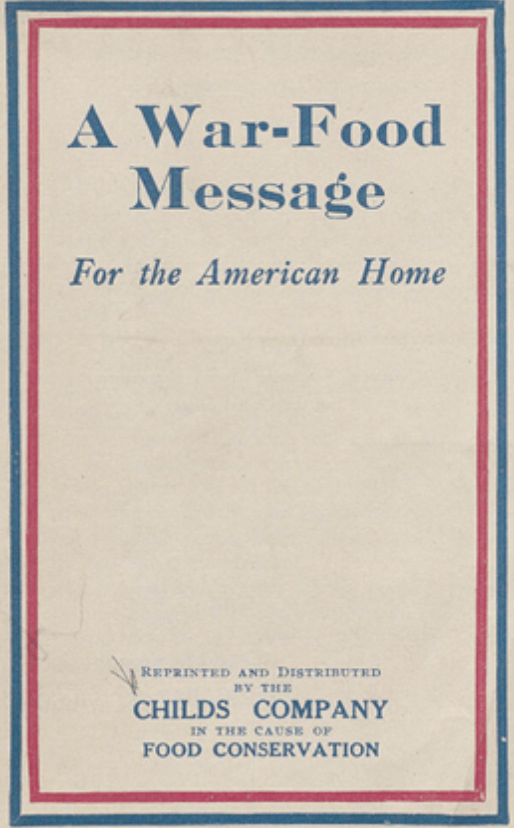
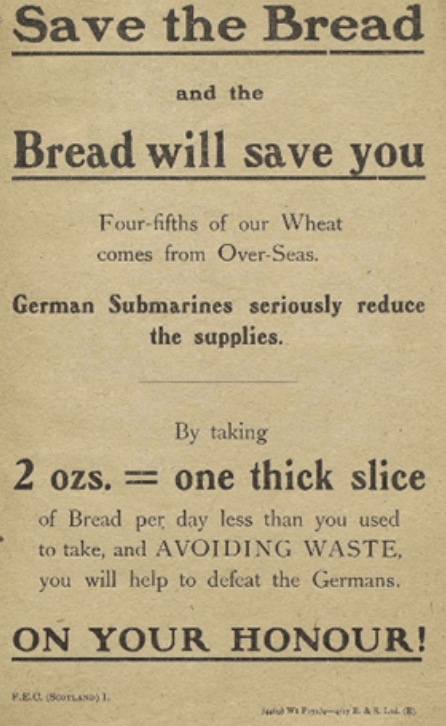
The governments of the allied forces and various other organizations detailed the best methods for rationing wheat and other target food groups. Rationing was encouraged through various means: having one wheatless meal a day, eating less cake, pastries, and pie, using bread scraps in cooking, replacing bread with other carbohydrates such as potatoes, and fully or partially replacing wheat in recipes (Haskin, 1917) (National Wholesale Grocers’ Association of the United States, 1917). Through a series of pamphlets, cookbooks, and posters, citizens and patriots were encouraged to save two ounces of bread per person per day lest rationing become mandatory (F.E.C. (Scotland), 1917) (J., 1917). Many of these books and pamphlets appealed directly to women as they controlled 90% of the food consumption of America. One recipe book even begins with a letter from Herbert Hoover, head of the US Food Administration for the war effort and future US president, appealing directly to American women to pledge themselves to the food conservation cause (Haskin, 1917).
The war had already caused a global food shortage, and America’s allies, including the United Kingdom and France, were relying more than ever on imports of wheat (F.E.C. (Scotland), 1917). America was one of the exporters, expected to make up almost half of the necessary supply (Chaddock, 1917). But between the dwindling surplus from the good harvest years of 1914 (the first year of the war, of which 37% of the yield was exported) and 1915, and a barely sufficient harvest in 1916, the projected harvest for 1917 would not be enough (Chaddock, 1917). The wheat was not safe as it was shipped across the Atlantic since shipments were susceptible to attack by German U Boats (F.E.C. (Scotland), 1917). If the US government could convince people to conserve one pound of wheat flour per week, 133,000,000 bushels of wheat would be saved (National Wholesale Grocers’ Association of the United States, 1917). The New York State Food Commission, Bureau of Conservation even decreed that for every pound of wheat flour the seller also had to sell a pound of authorized wheat flour substitute (New York (State) & United States Food Administration, 19). The main strategy to conserve wheat, however, was to publish tested recipes that cut out or cut back on wheat with flour alternatives recommended by the US Food Administration (Royal Baking Powder Company, 1918). Baking at home was proclaimed a national duty (Chance et al., 1917).
My research inspired me to try my hand at one of these war time recipes. I had no shortage to choose from. These recipes advised the reader to forgo white flour completely and fully or partially substitute whole wheat flour and bread flour with many other flours and ingredients. These replacements included corn meal, oat flour, barley flour, oatmeal, graham flour, rye flour, boiled and mashed potatoes (sweet or white), buckwheat flour, hominy, cooked rice, breadcrumbs, tapioca, and maize flour. While I was tempted by some intriguing sounding recipes like “Spider Corn Bread” (Derouet, 1917), “Eggless, Milkless, Butterless Cake” (Royal Baking Powder Company, 1918), “Cornmeal and Prune Fluff” (New York City Food Aid Committee, 1917), “Date and Hominy Gems” (Neil, 1917), “Virginia Spoon Bread” (Chaddock, 1917) or “Invalid Pudding” (Chance et al., 1917), I ultimately decided to go with a more familiar recipe to ensure I could easily source the ingredients and didn’t need to procure any additional kitchen equipment.
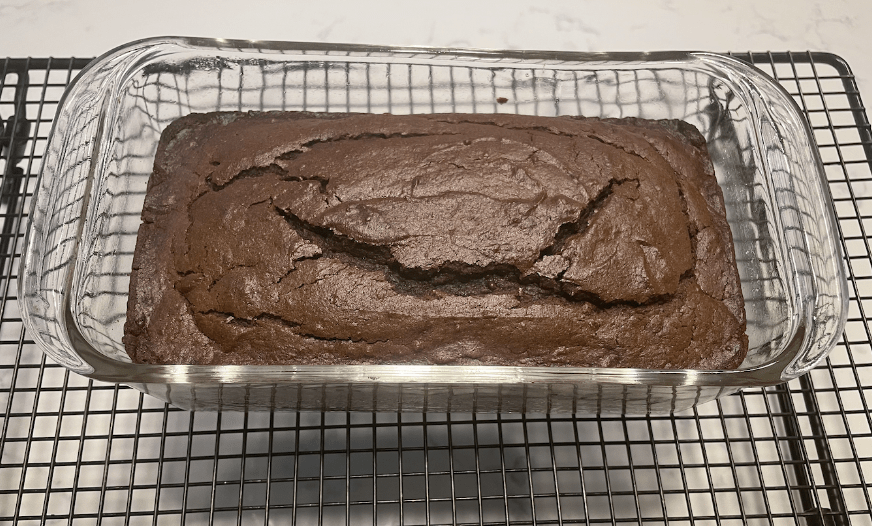
As I am not only “rationing wheat to support the war effort” but must stick to a gluten-free diet for health reasons, I had to find a recipe that was not only wheat-free, but also gluten-free (without wheat, barley, or rye). Many of the recipes only reduced wheat, instead cutting it out completely, or substituted rye or barley flour, and so were not truly wheat- or gluten-free. Luckily there are many recipes available in the collection, so I still had plenty of options that were both wheat-free and gluten-free. One pamphlet, published by the Royal Baking Powder Company, had several suitable recipes to choose from. The pamphlet, titled “Wheatless Recipes,” was published in New York. On the cover it quotes the US Food Administration and calls to “let all who can go without wheat.” All the recipes on the page above fit the criteria, but I’m going to stick to the classic Chocolate Cake because its wheat substitution is unique. This recipe substitutes a mix of oat/rice/barley flour and mashed potatoes for wheat flour.
I was extremely pleased with how the cake came out; it is a bit dense, almost like a pound cake, which I guess is to be expected due to the inclusion on mashed potatoes. Even 4 teaspoons of baking powder were not enough to make this recipe light and fluffy. Also, since the recipe calls for only one cup of brown sugar, it is not super sweet. If you prefer your desserts on the less-sweet side, this is perfect for you, but if you have more of a sweet tooth, like me, you can serve it with frosting or ice cream.
I had fun asking my family and friends to try the cake and ask if they could identify what was different about the cake. Many mentioned it wasn’t very sweet and that it was dense, but no one could guess I used oat flour and mashed potatoes instead of wheat flour. If you try this or any of the other recipes, let us know how they turn out!
The Associate Alumnae of Hunter College, Lewinson, R., Hahn, E. A. (Ed.). (1946, January). Margaret Barclay Wilson A.B., M. Sc., M. D., Sc. D. The Alumnae News.
This upcoming weekend marks New York City’s annual Pride Parade. The parade and the events surrounding it help make NYC’s celebration of pride the largest in North America, as well as one of the biggest in the world. It will also mark the 55th anniversary of the Stonewall Riots, a defining moment in gay rights history. From June 28th until July 3rd, 1969, the community fought for their existence. These riots helped LGBTQIA+ individuals be seen and heard on a larger scale than ever before.
Stonewall has come to symbolize a turning point in gay rights. Before that pushback event, the struggle had seemed like an uphill battle. That was one reason that gay people came together for solidarity and advocacy.
The Daughters of Bilitis began in 1955 with a mission to bring lesbians together. Under the guise of a poetry club, named after a fictional contemporary of Sappho, they began with just a few members. What started in San Francisco quickly grew to other parts of the country. By 1958, a dedicated meeting space was even opened in New York City.
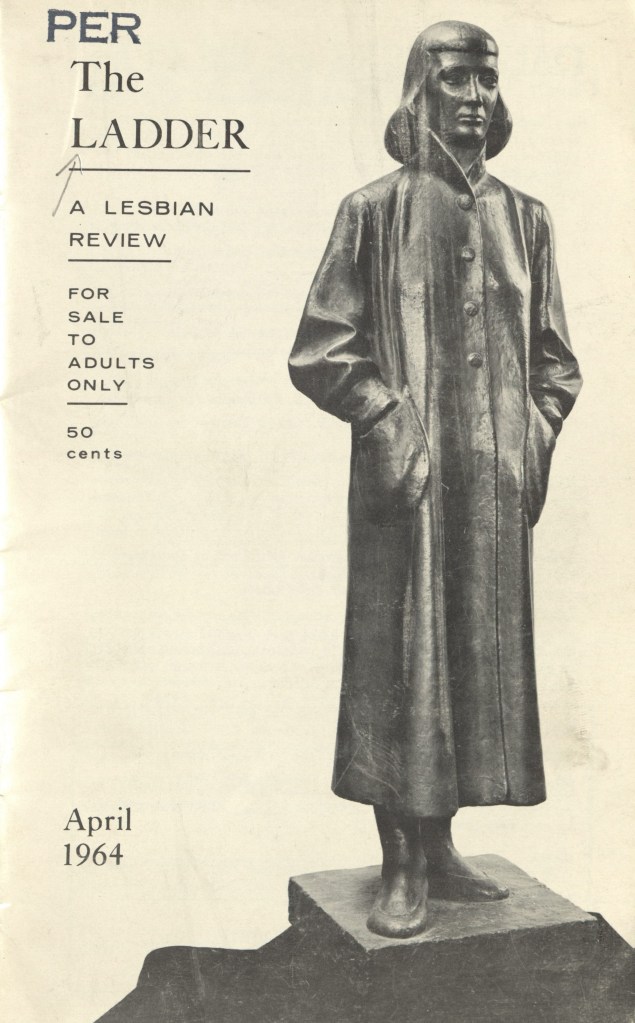
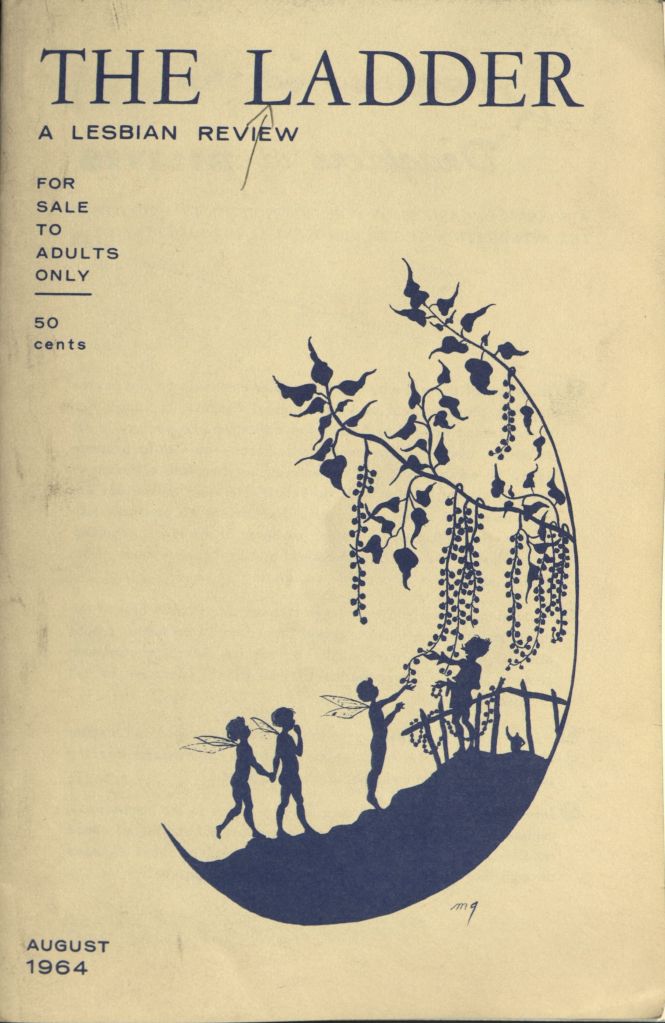
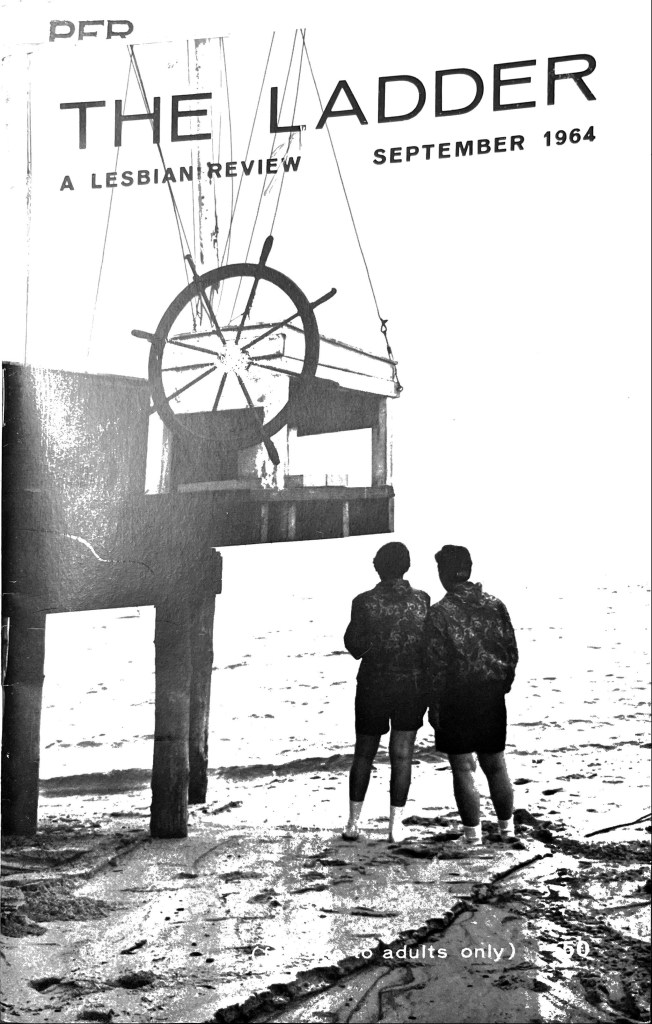
The Ladder was the Daughters’ monthly publication, begun in 1956. There you could find short stories, poetry, personal essays, book reviews, and anything else that dealt with women who loved women. One of their more bustling sections was the letters to the editors where women from all over the country could weigh in on issues. More on this later!
Issues usually began with the Daughters’ mission statement. Broken into four points that the group had decided were important, they sought to take back the narrative of their lives. They used personal stories and experiences with experts in the medical, psychological, and sociological fields to push back against social oppression. And they had enough of a reach to do so! It made sense that they were going to respond to a 1964 report by their New York City neighbors, the New York Academy of Medicine.
In May 1964, NYAM’s Committee on Public Health adopted a report on homosexuality, and published it in the July issue of the Academy’s Bulletin. The Committee had its own thoughts on the “problem.” The report labeled the homosexual as an “emotionally disturbed individual who has not acquired a normal capacity to develop satisfying heterosexual relationships” and stated that these problems may have begun in early childhood. Not only did these conclusions further demonize those who were already living on the fringe of society, but they made those involved in their upbringing culpable too.
[In 2022, NYAM President Judith A. Salerno, disavowed the report. As the organization looked back on its 175th anniversary, she felt it was only just to “be accountable for our actions—and also for our inactions throughout our history.” It is a tenet of a historical collection that we believe to move forward, we must look at the past.]
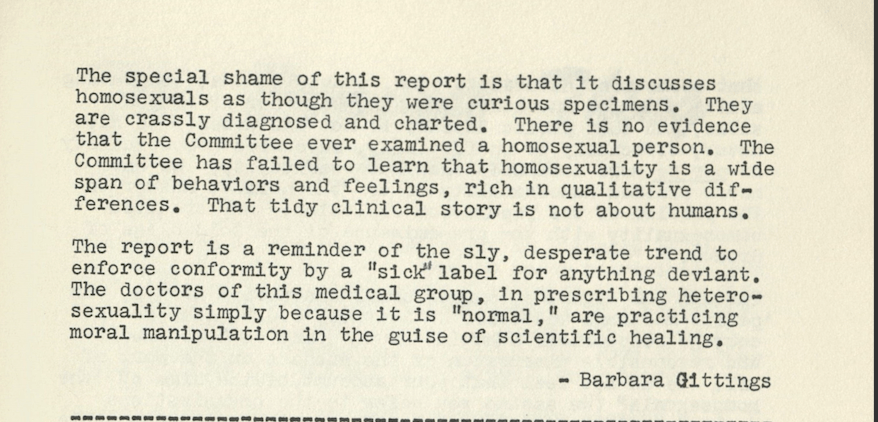
The Editorial column for the August 1964 issue brought the issue to the fore. With a footprint all over the country, they couldn’t be sure that all their readers had seen the report. Editor Barbara Gittings wanted them to know: it is out there.
Could this professional opinion change how you were looked at? “That tidy clinical story is not about humans,” Gittings reminded her readers, even as she assured them not to worry too much. The Academy’s report did not tell the stories that the real people who write and read the magazine could. Regular readers are told of the “moral manipulation” on the part of those who had never met a homosexual.
After addressing those she feels are the most important—the readers—she turns to the “Gentlemen” of the Committee on Public Health. Gittings’ editorial included her June 13th letter to NYAM and asked them to reconsider what they wrote. She called out the “misleading statements” about the Daughters of Bilitis and other gay organizations. Gittings even extended an invitation to attend their annual convention, on June 20th of that year. The Daughters wanted them to see what the organization was about. The invitation went unanswered.
The Daughters of Bilitis officially disbanded in 1970 amidst the larger social upheaval of gay rights and the larger second wave of feminism. The Ladder was published until it was discontinued in 1972.
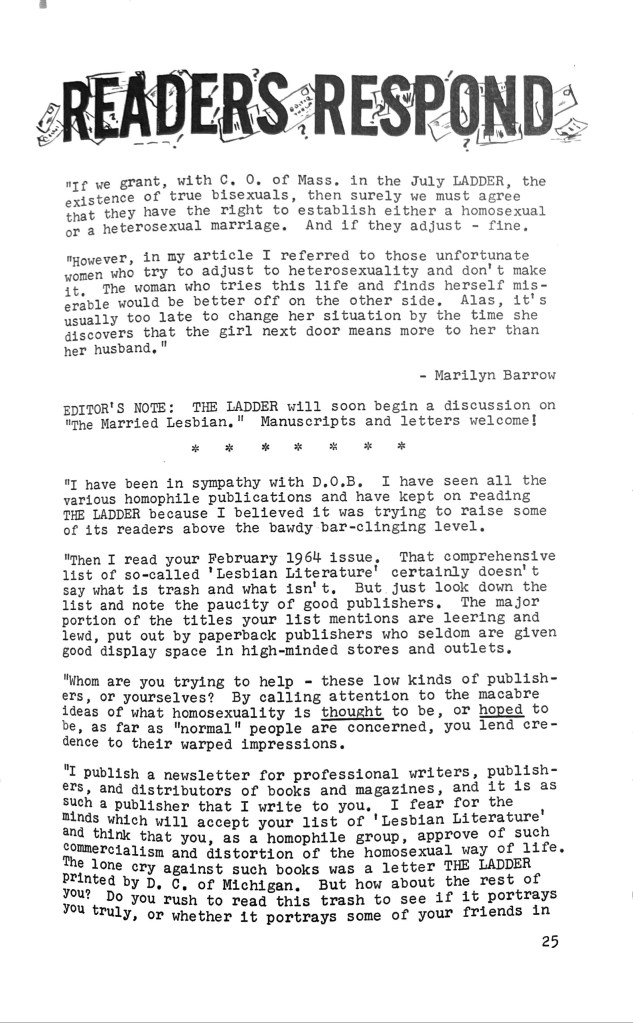
While it was around, The Ladder provided one of the only outlets for gay women to be seen or to see themselves. They didn’t have to agree with everything that the magazine published. And if they didn’t see what they wanted to, they weren’t afraid to ask for it. This brings us back to the letters section, “Readers Respond.”
The September 1964 issue’s letters section was dominated by a long, anonymous letter from a New York publisher, tired of what she perceived as the overwhelming amount of “leering and lewd” lesbian literature. But her tone then changes dramatically, ending with an aspiration: “I hope you don’t mind my frankness or my anger, but I think it’s about time that lesbians came out of the shadows to prove their lives are not filled with cobwebs but that they are genuine human beings as worthy of love, respect, and the good life as anyone else!”
We needed Pride more than ever back then. This is why we still celebrate it now.
Each year Furman University, located in South Carolina, offers a three-week May term, where students are encouraged to take experiential courses that build on their academic interests and take them in new directions. Inspired by programs bringing medical students into museums, undergraduate students have been coming to New York to focus on the skills of observation and communication since 2017.
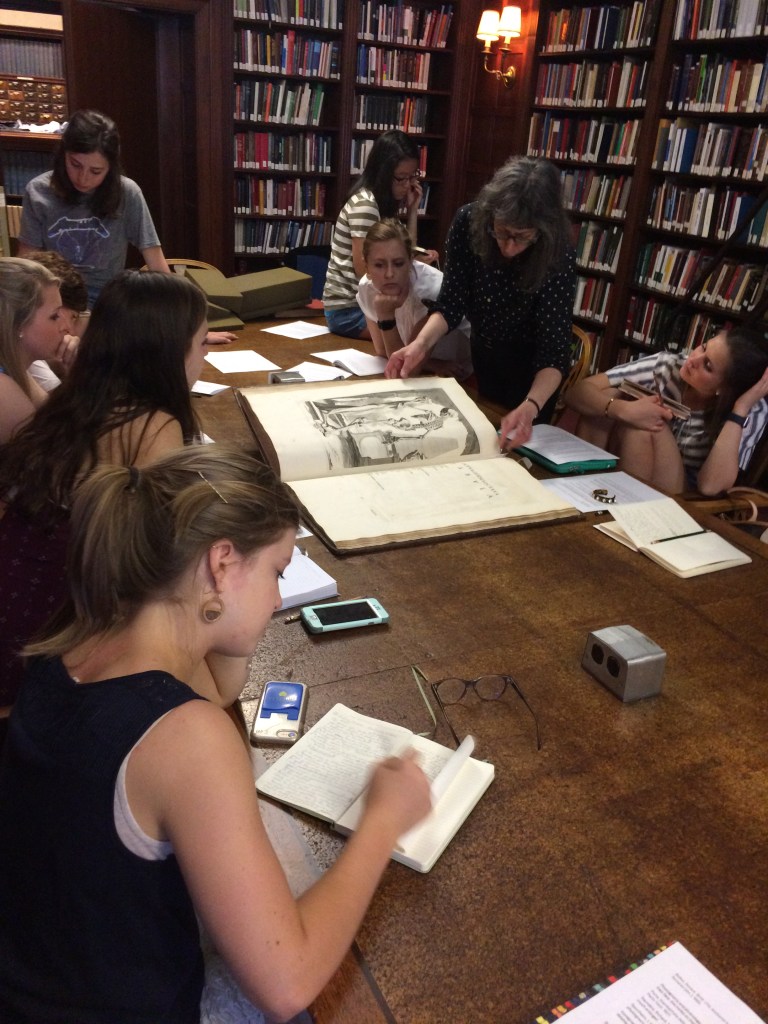
The first class session from the first year the class was taught, back in 2017.
Many of the students are on track for medical careers. This course, “The Art and Science of Observation,” is designed to use art as a “rehearsal space” for interpreting complex, sometimes contradictory visual information; by talking through the processes of looking, students can become better aware of their biases, the ways they reach conclusions, and learn to be more comfortable with differences of opinion.
Two of this year’s students looking at the 1491 edition of Heinrich Louffenberg’s Versehung des Leibes, an illustrated guide to health composed in 1429.
One of the challenges is helping students understand the constructed nature of images, especially when they seem “realistic” or “factual.” Our visits with Arlene Shaner in the Library of the New York Academy of Medicine have been instrumental in breaking down the pretense of objectivity, even in medical and scientific illustration.
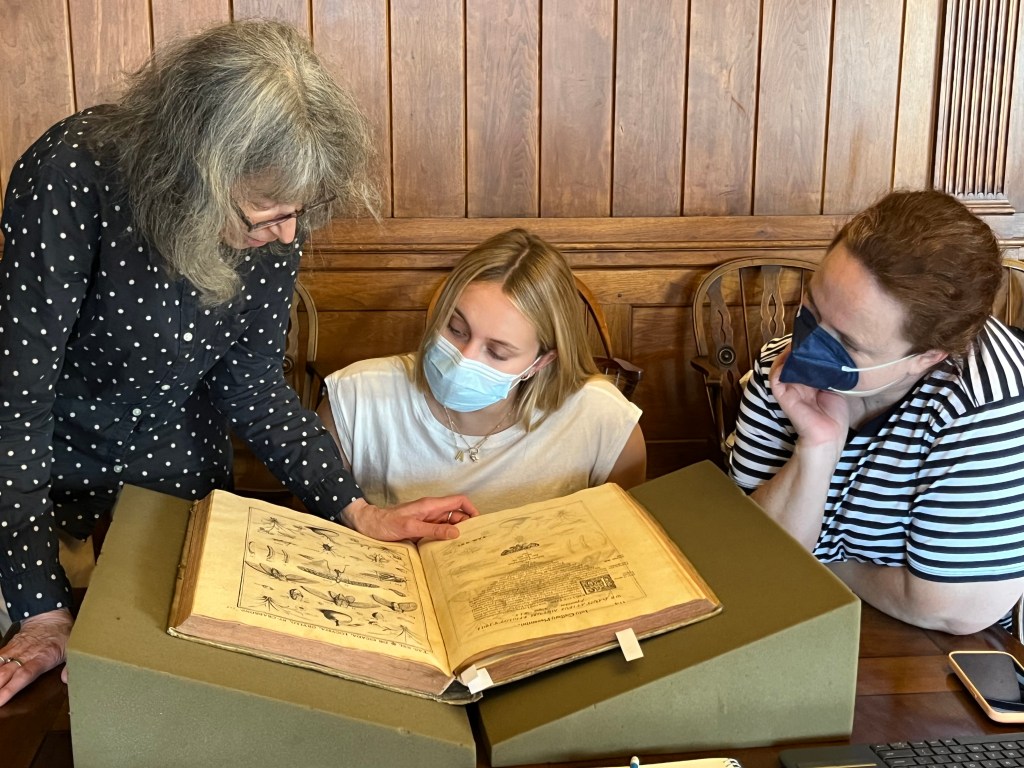
Historical Collections Librarian Arlene Shaner (L) and Professor Sarah Archino (R) looking at Giulio Casseri’sDe vocis… from 1601 with a student.
Our program is fortunate enough to visit the library three times during the May course. During the first two meetings, students trace a history of illustrated medical and scientific texts, learning under Arlene’s guidance about how print technology, art, circulation, and scientific understanding have unfolded over the centuries. Moving from Vesalius to 20th-century popular media, our students understand from first-hand experience how information has been created, copied, and circulated, especially in a pre-digital world.
Medical historian Bert Hansen meets with the class each year in a special session to talk about medical prints and caricatures.
At our third meeting, students enjoy being able to work directly with books from the collection. They choose a text and then select an image – or a small set of images – to analyze. The students deconstruct the image to consider its materiality, audience, and integration with text. This helps construct a better understanding of how one book can signify a larger system of learning and intellectual history.
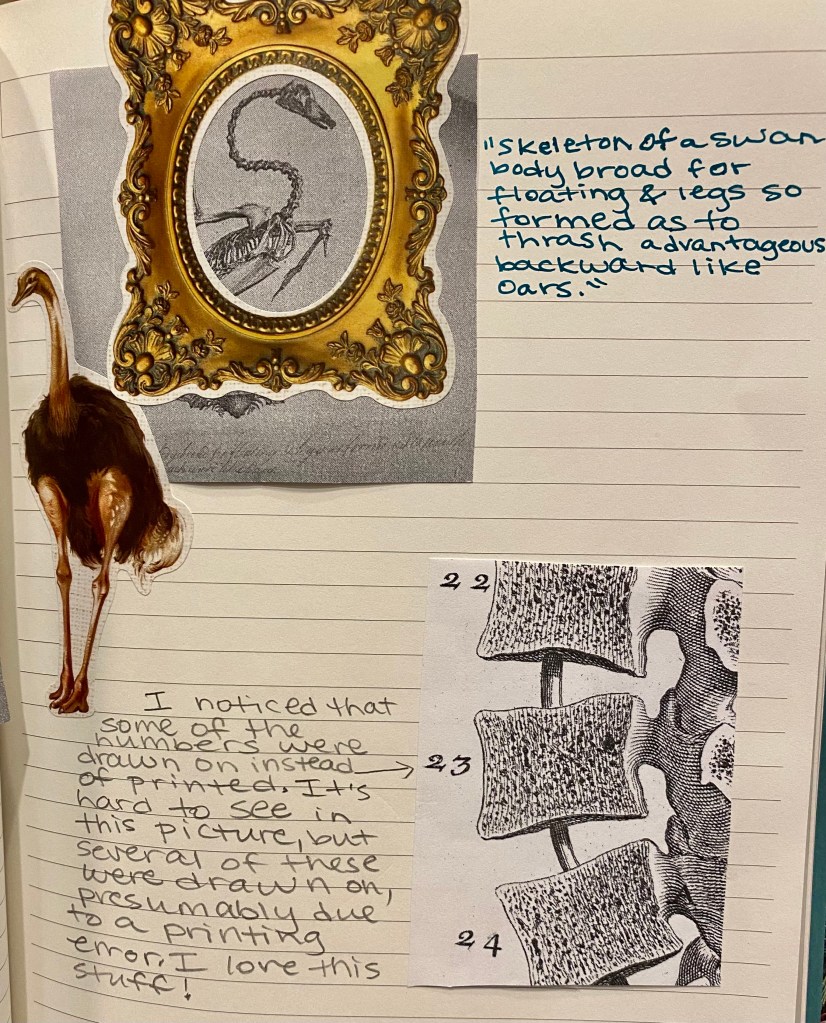
A 2022 student’s detailed notes about the book she chose to study closely.
A few examples of student work reveal how they interpret this assignment – from those who transform their notes into a visual scrapbook (material which then found its way into a senior’s ceramics project), to analyses that consider the text’s original function and audience – be it a neurological surgeon of the 16th century or a family doctor on the 19th-century American frontier.
Part of a student project from 2022.
Our visits to the library are always a highlight of our time in New York, in no small part thanks to the wealth of resources, the accessibility of this collection, and the enthusiastic guidance and insight of Arlene Shaner. We look forward to working together in the future!
One of the 2022 students working with her book, the first American edition of George Spratt’s Obstetric Tables, with its many lift the flap images, published in 1850.
If you are interested in bringing your own class for research within our collection, please reach out to library@nyam.org.
Each year, the New York Academy of Medicine Library is proud to host visits from students across all different disciplines. From graduating medical students to those studying the culinary arts, the history of public health is surprisingly encompassing and intertwined. Our Historical Collections Librarian, Arlene Shaner, chooses different materials for each group visit. She considers who is coming, what they are studying, and what they might like to see. The display that Arlene curates for the visitors reflects how they might want to use the collection for their work. These displays include not just books but posters, pamphlets, and other assorted ephemera.
In a previous guest post, Dr. Evelyn Rynkiewicz, Assistant Professor at the Fashion Institute of Technology, shared why she enjoys bringing her “Disease Ecology in a Changing World” class to the library. While teaching design and business students at FIT, she hopes to instill science literacy and curiosity within them. At the end of the course, they are assigned creative research projects. The students choose a disease to study and make their own unique presentation to help inform the public.
We are excited to once again present submissions from Dr. Rynkiewicz’s class, which visited the Library on October 24th, 2023. We also present images, some items from our own collection, others from elsewhere, that may have sparked their imagination for this project. While we would love to include all the submissions that we received, we are limited to what we can show on a blog post. If there happens to be a student art show in your area, you should check it out. You never know what you are going to see!
Alluring pictures can draw lots of attention. An image can tell a story without the need to read the words attached. We live in a globalized society where visual signs speak louder than the written word. This is a bit of the thought process behind any kind of campaign, public health especially. We still see these kinds of efforts today!
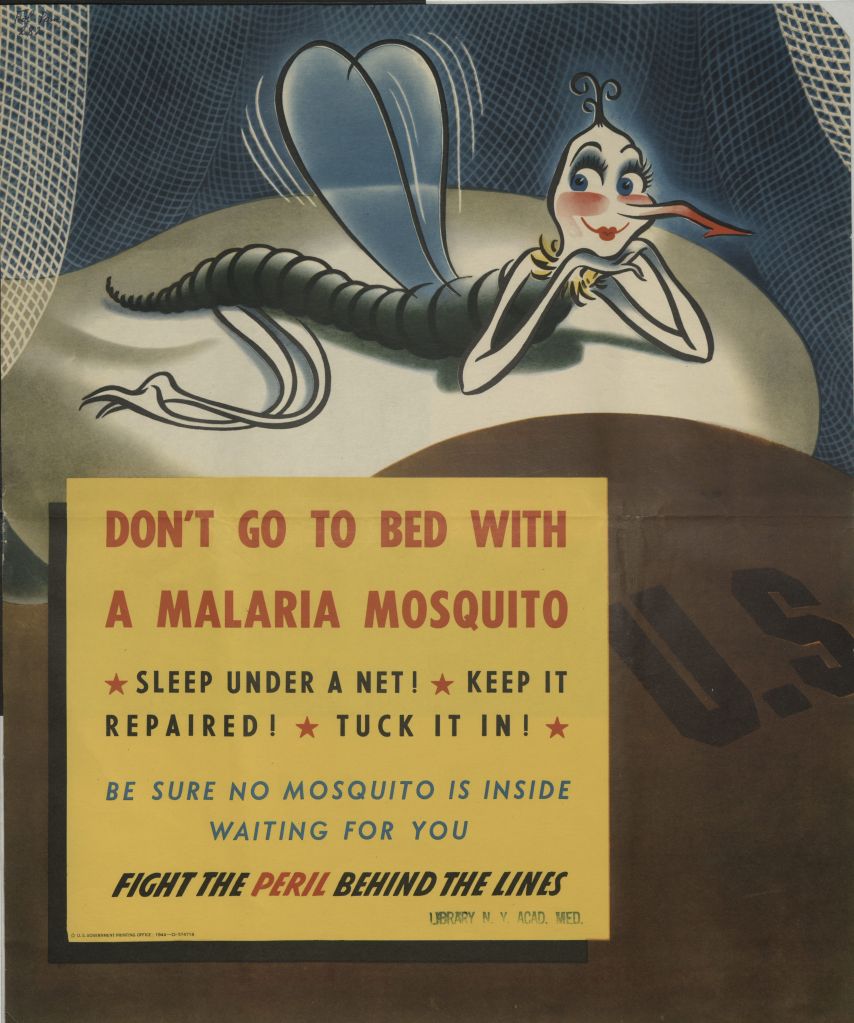
Theodore Geissel, in his pre “doctor” days, helped bring public service announcements to life in these posters. You could tell from his unique artistry that he was a gifted storyteller. These pictures were not only eye-catching but served an important purpose. This poster comes from a series directed towards soldiers fighting overseas during World War II that were designed by different artists.
Just by looking at Laelani Sawicki’s (second year, Illustration major) poster for rabies, you can guess where it’s going…
Cordyceps have gotten a bad rep lately. Fear not, The Last of Us viewers! In Jada Arroyo’s (second year, Illustration major) poster set, their misconception is cleared up.
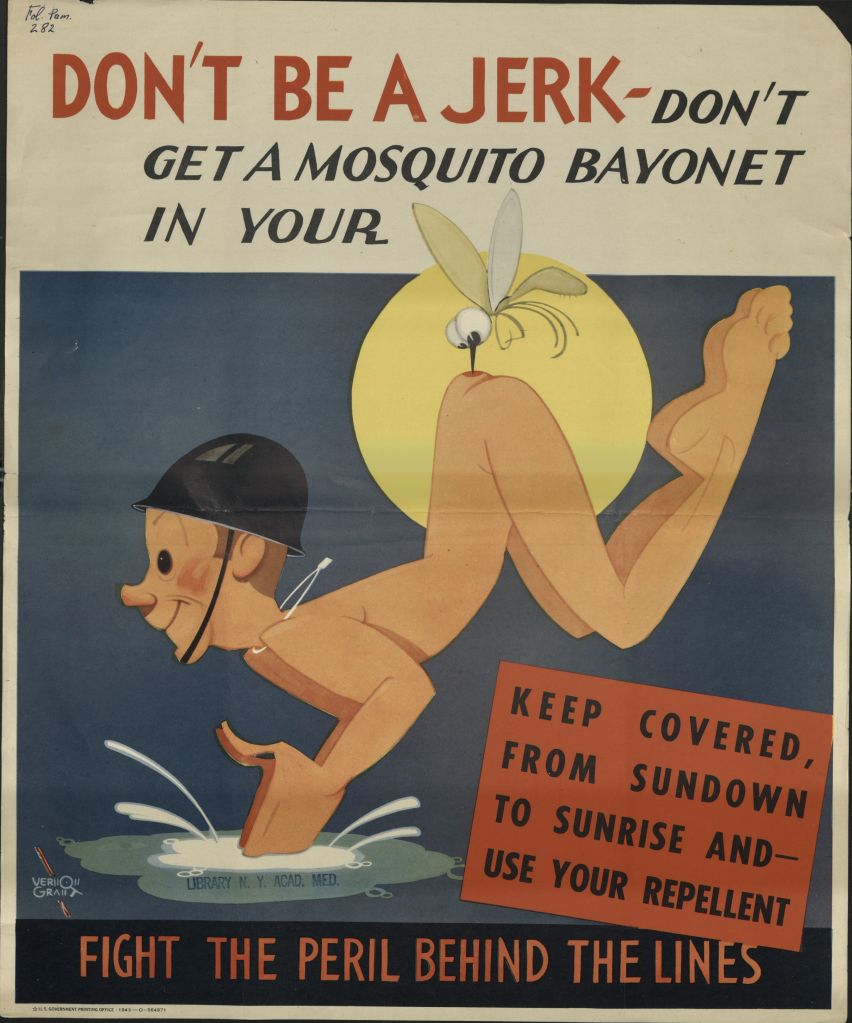
These public health posters were even allowed to get away with raunchier, more risqué content! Vernon Grant, creator of Rice Krispies’ Snap, Crackle, and Pop, made this poster for part of the same malaria prevention campaign.
To convey the importance of recognizing chronic wasting syndrome in wild game, Amaryllis Arroyo (second year, Illustration) went with their own provocative image.
(You can see more of Amaryllis’ work at @amartist27)
Fashion and activism reached a pinnacle with the yellow Livestrong bracelets of the mid-2000’s. You couldn’t go anywhere without seeing them, despite little marketing. The slogan itself, “Live Strong,” said all one needed to know. So simple and yet, so fashionable.
Kenneth Cole created a provocative ad campaign in 2005 called “We All Have AIDS.” The ads promoted a T-shirt, where all sales proceeds would be donated to fight the AIDS epidemic. Cole’s idea for the campaign came from the idea of “solidarity.” It was to ease the stigma surrounding the disease and fight preconceived notions. To fight the disease, physically and socially, we would all have to come together.
Students Chaea Im (first year, Fashion Design major) and Kylie Smith (first year, Fashion Marketing major) used tees as their canvas.
Chaea (above) focused efforts on polio awareness while Kylie (below) speaks on the lack of access for worldwide rabies vaccination.
Haute couture can also be used to convey a message. Alexander McQueen even referenced Charles Darwin’s “On the Origin of Species” on his 2009 runway! The models were fitted with heels based on an armadillo, gifting us the “armadillo heel.”
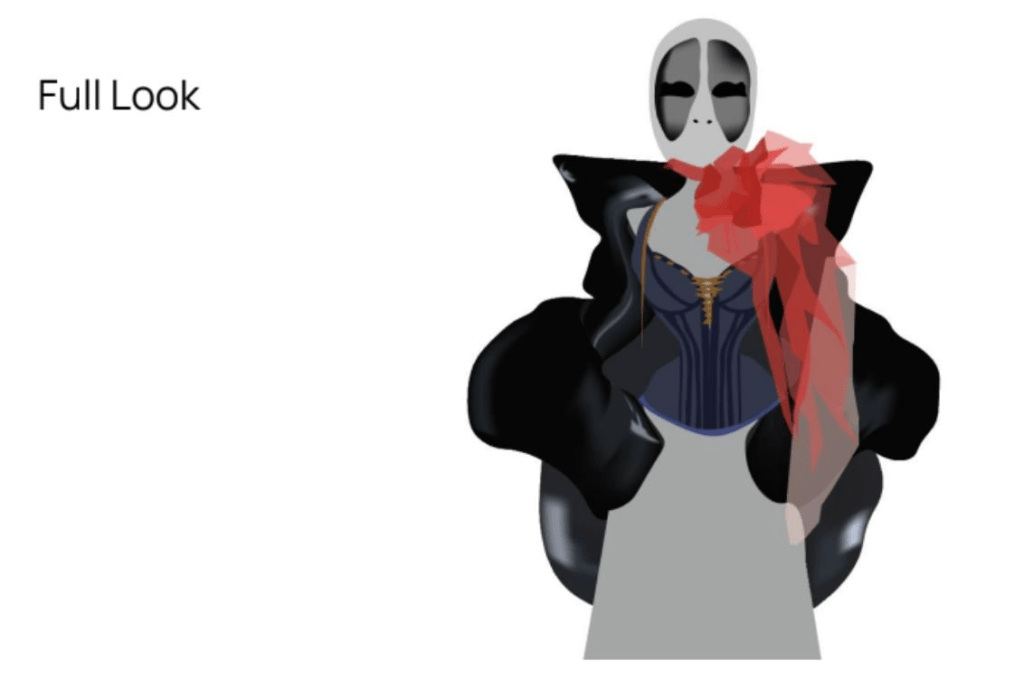
To convey information about tuberculosis through fashion, Charlie Sue Birznieks (third year, Communications Design major) mocked up garments to echo the physical effects of this respiratory bacterial infection. It takes form through a “blood choker, bone crushing corset, suffocating puffer jacket, and full-face respirator mask.”
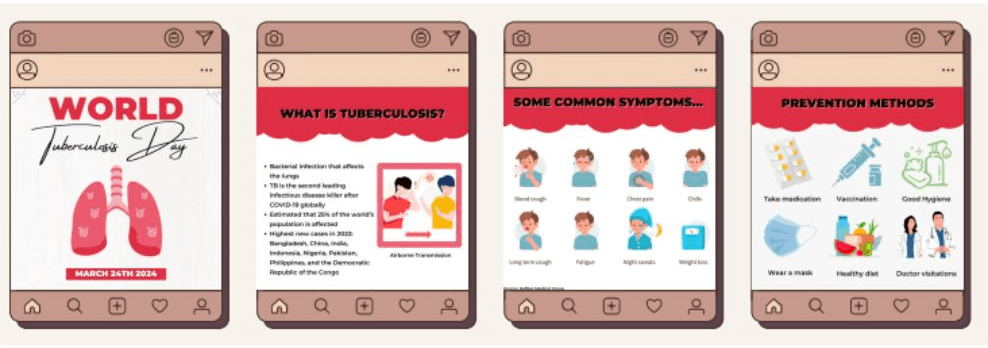
The biggest way information, and unfortunately, disinformation, disseminates these days is through the internet. We can combat the negative by being sure to amplify knowledge from verified and reputable sources. Some of us may remember infographics shared during the early days of the COVID-19 pandemic.
This project by Valerie See (fourth year, Cosmetics and Fragrance Marketing major) breaks down important information to share during World Tuberculosis Day. These images would go a long way to spreading awareness while linking back to a credible source.
That does not mean we shouldn’t share our own, lived experiences! There’s a great deal to learn from first-hand accounts. Audrey Cahill (second year, Illustration major) shows us what a social media timeline might have looked like in the 14th century during the time of the plague!
We once again thank Dr. Rynkiewicz and her students for allowing us to share their work. If you are interested in bringing your own class, please reach out to library@nyam.org.
On February 14th we observe Valentine’s Day, a day that has come to signify and celebrate all the love in our lives. Some may take loved ones out to dinner, some buy gifts, and some may even do a grand gesture, like ask for their lover’s hand in marriage.
St. Valentine was a 3rd-century Roman priest, maybe even a bishop, who ministered to those persecuted by the church. It was believed that he delivered messages to lovers who had been torn apart. The Feast of St. Valentine was introduced in the late 5th century to commemorate his decapitation, on February 14th. While his end doesn’t sound romantic, we can see how future lovers had come to admire the man.
Back in 1853, the New York Times first questioned how the modern Valentine’s Day came to be. They concluded that it was an “antiquarian problem” that would likely “never be solved.” They must’ve realized how funny that sounds in the age of information, so they revisited this inquiry in 2017 and once again in 2023. Two theories were brought forth to go along with the holiday’s namesake.
The first one credits Geoffrey Chaucer. In his 14th-century poem, “Parlement of Foules,” Chaucer namechecks “St. Valentine’s Day” and speaks of how on this special day, a bird will choose their mate. That sounds a little like the holiday that we celebrate. His words eventually trickled into the English lexicon, as many whom Chaucer inspired began to note the holiday.
The alternative look further back to the ancient Roman fertility festival of Lupercalia. This is where men and women paired off. Well, with wine free flowing, the occasion tended to get a bit wilder. The Christian church came and cleaned that up, but it remained a coupling ritual.
From these traditions we can see the rough sketches of the holiday we’ve come to know. By the time the New York Times originally investigated, it had already become a “greeting card” holiday. The writer mentions the “symbols and paraphernalia of Cupids, hearts, and love letters,” associated with the day. What would they make of the holiday aisles and celebrations of our era?
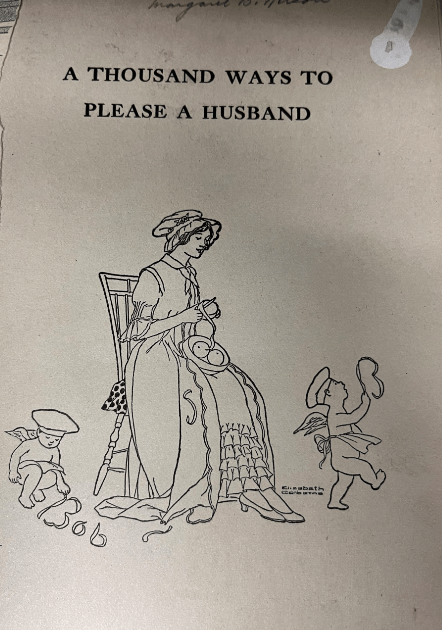
We have previously looked inside the narrative homemaker books starring “Bettina.” In A Thousand Ways to Please a Husband, she juggles the first year of marriage to “Bob.” Later volumes would see her raising a family, and even teaching her own daughter how she can begin to train for her own home one day. Books like these were often given as gifts to brides or brides-to-be. The dedication page offers hope for those who may not feel like they can handle this society-given duty.
The narrative, illustrations, and the recipes that ended every chapter make the book charming. As stated in the previous blogpost, the gender politics within have not aged well. Bettina doesn’t seem to ever catch a break! Left home alone, she’s the one making sure the house continues to function. This is even before the kids, Robin and Sue, come into the picture.
In …Husband we get a look at the couple’s first Valentine’s Day as husband and wife. Flowers seem to be the only item that Bob gave–though, to be fair, they are called “lovely” and “brilliant.” Bettina apologizes for not making more of a big deal, as if it was only on her to do so!
She tells how she had spent most of the afternoon at a luncheon with friends. When she mentions the décor, Bob seems to mock all the hearts and red by calling it “Valentine’s Day with a vengeance.” She assures him that it was “lovely,” as she serves up the steak dinner that she had just thrown together.
An interior image of Bettina baking for Bob.
Years later, in A Thousand Ways to Please a Family, we join Bettina at the Valentine’s Day luncheon she is cohosting with her friend, Alice. The guests are taken to Alice’s guest room. No talk of romance is present: she talks of the furniture, the furnishings, and the paint which covers “a multitude of sins.” As the two hosts move to the kitchen, Alice laments what once was. She asks, “What is Valentine’s Day in our lives, now?” They eventually move on to their menu of heart-shaped foods.
We want to bring back those lost feelings of Valentine’s Day! In honor of the rather unromantic circumstances our female characters found themselves in, this year we are providing a gift; four recommendations from a genre perfect for Valentine’s Day, romance! Romance as a genre has roots back to ancient Rome (again!) while the first romance book, Pamela; or, Virtue Rewarded, was published in 1740 by English author Samuel Richardson.
The softcover paperbacks that we’ve come to associate with romance novels came out of the late 60’s/early 70’s. Almost instantly, they were a hit amongst female readers. Despite this, derogatory labels and preconceived notions have kept romance books hidden away. They were treated almost like scarlet letters. After years of consistently making up a large part of book sales, romance novels and authors have only now begun to command the respect they deserve. Romance often provides their readers with some of the most diversity featured on a bookshelf.
So, this one is for Bettina, Alice, and anyone else on this Valentine’s Day. We present a librarian’s recommendation for some romance novels. This trio of books have all come out, in the United States, in the last year or two and all of them feature main characters or romantic partners who are medical professionals. The link will direct you to WorldCat but should be available at your local public library!
Anatomy of A Meet Cute by Addie Woolridge. As if being the new hire isn’t hard enough, Sam somehow manages to insult one of her fellow doctors. Great—this is just what she needs. In order to get the board to agree to her new proposal, she’s going to have to make some new allies quick. Maybe she can apologize to Grant and get him on board. And maybe they’ll find out they have more in common than they think….
The Plus One by Mazey Eddings. Indira has just moved back in with her brother after she caught her boyfriend cheating on her. Her brother is about to get married and his best friend Jude is also staying with him. Jude has spent the last few years as a doctor traveling the world tending to humanitarian crises. Despite their mutual love, Indira and Jude have always hated each other. Somehow their forced wedding attendance, as a fake couple, has them rethinking some of these strong feelings.
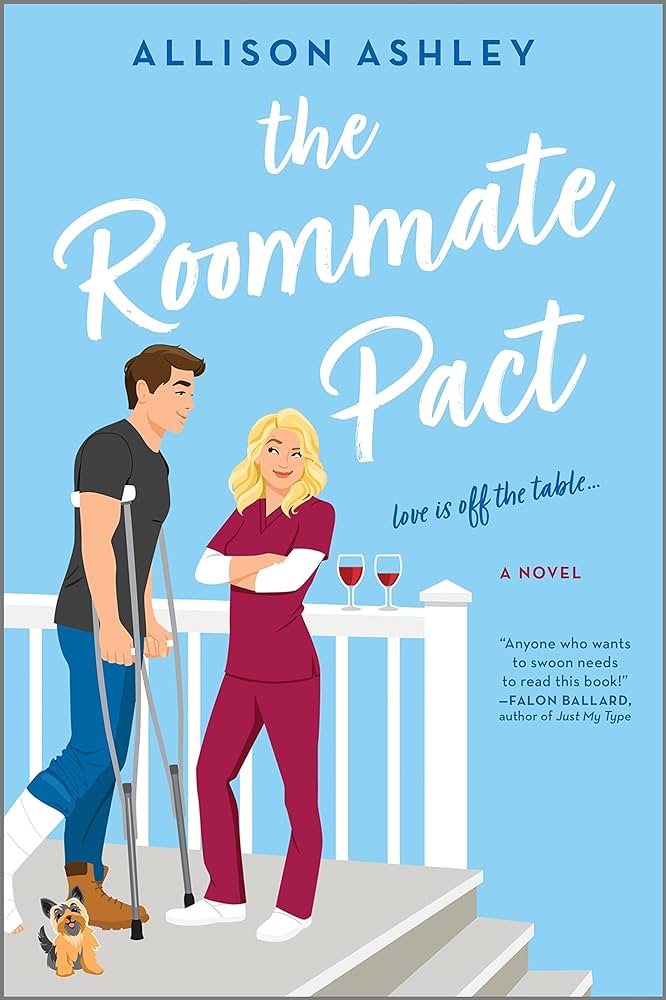
The Roommate Pact by Allison Ashley. Claire and Graham are too busy for romantic relationships. That’s why they get each other. One night they make a drunken pact to get married and take care of one another if they are both single at forty. When Graham injures himself, the two realize it’s more than Claire’s expertise as an ER nurse that he needs.
Weaver, Louise Bennett, and Helen Cowles Le Cron. A Thousand Ways to Please a Family with Bettina’s Best Recipes. N.Y., A.L. Burt company, 1922.
Weaver, Louise Bennett, and Helen Cowles Le Cron. A Thousand Ways to Please a Husband with Bettina’s Best Recipes. New York, Britton Publishing Company, 1917.


































 Books, Health and History
