Have You Heard of Dr. Rebecca Lee Crumpler?

by Anthony Murisco, Public Engagement Librarian

On February 8th, 2021, the city of Boston was celebrating in a big way. For Dr. Rebecca Lee Crumpler’s 190th birthday, the city had decided to declare the entire day in her honor. Despite this high honor, many still do not know who she is.  
 
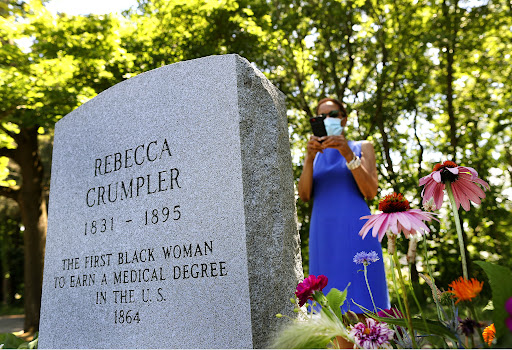
The largest newspaper in Boston, The Boston Globe, introduced readers to the local hero’s story in February 2020. At the time, Crumpler and her second husband, Arthur, were buried in an unmarked grave. Noting the significance of Crumpler, the first Black female doctor in the United States, the local Hyde Park Historical Society teamed up with the Friends of the Hyde Park Library to raise money for a proper headstone.

Courtesy of The Boston Globe

A follow-up in July of the same year informed the readers of a ceremony held to unveil the memorial. It also helped give a little more insight into the life of Dr. Crumpler; born Rebecca David in 1831, she was raised in Pennsylvania by her aunt. While growing up, she was shown what it meant to be a caretaker as she saw her aunt provide care for those in their neighborhood. She left for Charlestown, Massachusetts, and married her first husband, Wyatt Lee, in 1852. From working as a nurse from 1852–1860 for various doctors and their letters of recommendation, she was accepted into the New England Female Medical College. 
 
In the middle of her schooling, her husband passed away from tuberculosis. She graduated in 1864 as the first Black woman in the United States to do so, as well as the only Black woman to graduate from New England Female Medical College before it merged with another medical school in 1873. The following year, she married Arthur Crumpler. They settled and spent the rest of their lives in Hyde Park, a neighborhood in south Boston. In her 1883 book, A Book of Medical Discourses: In Two Parts, Dr. Crumpler opens with a dedication; “To Mothers, Nurses, and all who may desire to mitigate the afflictions of the human race, this book is prayerfully offered.” The Boston Globe article mentions how she faced plenty of adversity in her profession, including white pharmacists who refused to fill scripts signed by her. Despite all of this, nothing could stop her from helping the people who needed her.  

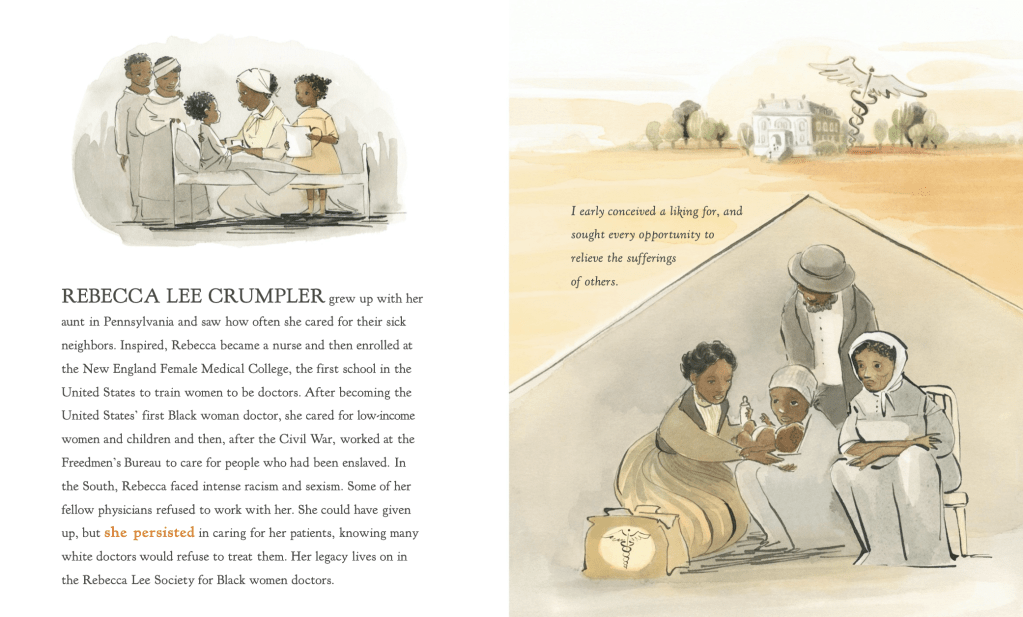
From Finding Rebecca by Shani Mahiri King and illustrated by Nicole Tadgell

Rewriting History 

It wasn’t her own education, in the very same area where Crumpler once walked, that taught Boston University Medical School student Dr. Melody McCloud about this pioneer. Rather it was when, freshly graduated, she moved to Atlanta, Georgia, around 1981. There she learned about Dr. Crumpler and the Rebecca Lee Society, an organization made up of Black female physicians. Speaking on Crumpler and other forgotten physicians, McCloud told the Boston Globe, “There are a lot of accomplishments of Blacks that are left out of the history books.” 

In her 2013 book, Hidden Figures: The American Dream and the Untold Story of the Black Women Mathematicians Who Helped Win the Space Race, writer Margot Lee Shetterly coined the titular term. The “hidden figures” in her story are three Black women, Mary Jackson, Katherine Johnson, and Dorothy Vaughan, who were instrumental in bringing the first astronauts into space. Despite being crucial to the team, they were hardly spoken of. Shetterly uncovered the story through talking to those who were there. From Johnson, she learned of Jackson; through Jackson, she got to Vaughan. The stories are passed down through the people who lived it and with the help of communities like the Rebecca Lee Society. With Shetterly’s help, Hidden Figures has been able to inspire others. It was even made into a movie! What can we do to these other “hidden” heroes? 
 
In 2020 national attention was given to the Crumplers’ Hyde Park memorial thanks to NBC Nightly News. Since then, Dr. Crumpler and her accomplishments are being recognized more and more. Symposiums are now being held in her honor, the first being at Boston University School of Medicine in conjunction with her 190th birthday. She also began popping up in an unlikely place: children’s picture book biographies. 
 
Her Own Image 

Writers and illustrators have become masterful in non-fiction storytelling for kids. . Some of these books are storytime staples. The illustrations bring history and people back to life. Can it be done for someone who has no surviving pictures?

A quick Google search of “Rebecca Lee Crumpler”

If you were to do an image search for “Rebecca Lee Crumpler,” you’d get some results. Unfortunately, none of these is the woman you are looking for! Despite commercial photography coming of age during her lifetime, any images of her have been lost to time. She is often mistakenly identified as other Black women, including Mary Eliza Mahoney. Boston University’s student-run newspaper made this mistake in its coverage of Dr. Rebecca Lee Crumpler Day, and eventually retracted and rectified its error, one of the few to do so.

From The Daily Free Press

Given the absence of portraits, how can you project this person?  

Alexandra Boiger has showed us the lives of many historical and contemporary women as the illustrator of Chelsea Clinton’s She Persisted series. For She Persisted in Science, Boiger was able to pictorialize Crumpler’s life based on her research on the “physical and emotional” state of those at the time. Boiger told the Library, via e-mail, that she was “always trying to balance the harshness of the time with the heart and love of the people and Dr. Rebecca Lee Crumpler herself.” Her images succeed in showing the care that, as Crumpler herself wrote, she was striving for.

From She Persisted in Science by Chelsea Clinton and illustrated by Alexandra Boiger

Shani Mahiri King’s 2024 book Finding Rebecca is both an ode to Crumpler and an act of research. From studying Crumpler and the lives of 19th-century Black Americans, he worked with his illustrator, Nicole Tadgell, to show us how she may have lived. Tadgell herself is an accomplished illustrator with a slew of historical picture books under her belt. King paired his own findings with the direct words of Crumpler from Medical Discourses, not only to tell her story but to inspire others.

From Finding Rebecca by Shani Mahiri King and illustrated by Nicole Tadgell

King believes that more history is just waiting to be uncovered: hidden figures, histories, legends, all ready to have their stories told. The book ends with a call to action: “You too are a historian, you too are an author, and you too can help teach all of us about people who should be more famous than they are.”

References:  

“Changing the Face of Medicine | Rebecca Lee Crumpler.” Nih.gov, 3 June 2015, cfmedicine.nlm.nih.gov/physicians/biography_73.html. Accessed 26 Feb. 2025. 

Clinton, Chelsea. She Persisted in Science. Penguin, 1 Mar. 2022. 

Crumpler, Rebecca Lee. A Book of Medical Discourses, in Two Parts. 1883. Boston, Cashman, Keating, printers, collections.nlm.nih.gov/catalog/nlm:nlmuid-67521160R-bk. 

Jonas, Anne. “Boston Honors Rebecca Lee Crumpler Day — First Black Woman in the US to Receive Medical Degree.” The Daily Free Press, 8 Feb. 2021, dailyfreepress.com/2021/02/08/boston-honors-rebecca-lee-crumpler-day-first-black-woman-in-the-us-to-receive-medical-degree/. Accessed 26 Feb. 2025. 

King, Shani Mahiri. Finding Rebecca. Tilbury House Publishers and Cadent Publishing, 15 Oct. 2024. 

MacQuarrie, Brian. “Gravestone Dedicated to the First Black Female Medical Doctor in the US .” BostonGlobe.com, The Boston Globe, 17 July 2020, http://www.bostonglobe.com/2020/07/17/metro/gravestone-dedicated-first-black-female-medical-doctor-us/. Accessed 26 Feb. 2025. 

Rechtoris, Mary. “Hidden Figures’ Margot Lee Shetterly: How Writing Is a Lot like E-Discovery.” Relativity, 16 Jan. 2020, http://www.relativity.com/blog/hidden-figures-margot-lee-shetterly-how-writing-is-a-lot-like-e-discovery/. Accessed 26 Feb. 2025. 

Sweeney, Emily. “Fundraising Effort Underway in Hyde Park to Honor Dr. Rebecca Lee Crumpler, First Black Woman to Earn Medical Degree in US.” BostonGlobe.com, The Boston Globe, 10 Feb. 2020, http://www.bostonglobe.com/2020/02/10/metro/fundraising-effort-underway-hyde-park-honor-dr-rebecca-lee-crumpler-first-black-woman-earn-md-degree-us/. Accessed 26 Feb. 2025. 

Researching Neuropsychiatry and Veterans Hospitals During the 1930s at the New York Academy of Medicine 

By Dr. Michael Robinson, National Army Museum Research Fellow, University of Birmingham (UK), and the Library’s 2024 Paul Klemperer Fellow in the History of Medicine 

I spent one month working in the New York Academy of Medicine’s magnificent library and reading room in the autumn of 2024. This residency enabled me to look at a host of materials dedicated to the treatment of mentally ill American Army veterans of the First World War during the Great Depression (1929–1939). I undertook this research hoping to utilise the USA as an important comparative case study on my current research project dedicated to mental illness and British Great War veterans during the 1930s. By examining mental breakdown and psychiatric medical care during this decade, this research seeks to reveal the delayed traumatic after-effects of war service on ex-service personnel and the potential for additional psychosocial determinants to influence mental ill-health.  

I first became interested in the American experience of post-First World War disability and mental healthcare owing to its regular appearance in the archival records of Britain’s Ministry of Pensions, the government agency responsible for distributing veterans’ pensions and medical care. During the inter-war period, British policymakers regularly cited the US experience of veteran after-care as a deterrent and a case study to avoid replicating. They actively held up the US system as being unfairly exclusive, costly, and liberal owing to its incremental but costly expansion of veteran rights and facilities. Britain significantly reduced its liability on behalf of veterans during the 1920s and 1930s, including the closure of most veterans’ hospitals. Veterans’ medical care in Britain was primarily outsourced to broader public health facilities, the civilian welfare state, and the charity sector.  

By contrast, the US witnessed increased state liability, including a vast financial outlay in funding exclusive Veterans Administration (VA) hospitals and medical facilities. In 1936, owing to the two nations’ inversed approaches to veteran care, one Ministry of Pensions official described the UK and US responses as being of ‘opposite extremes.’1 The primary purpose of my time at the NYAM was to better understand why the British and US systems were the complete inverse of one another. I also sought to appreciate how these contrasting policy trajectories and medical infrastructures affected the lives of mentally ill veterans.  

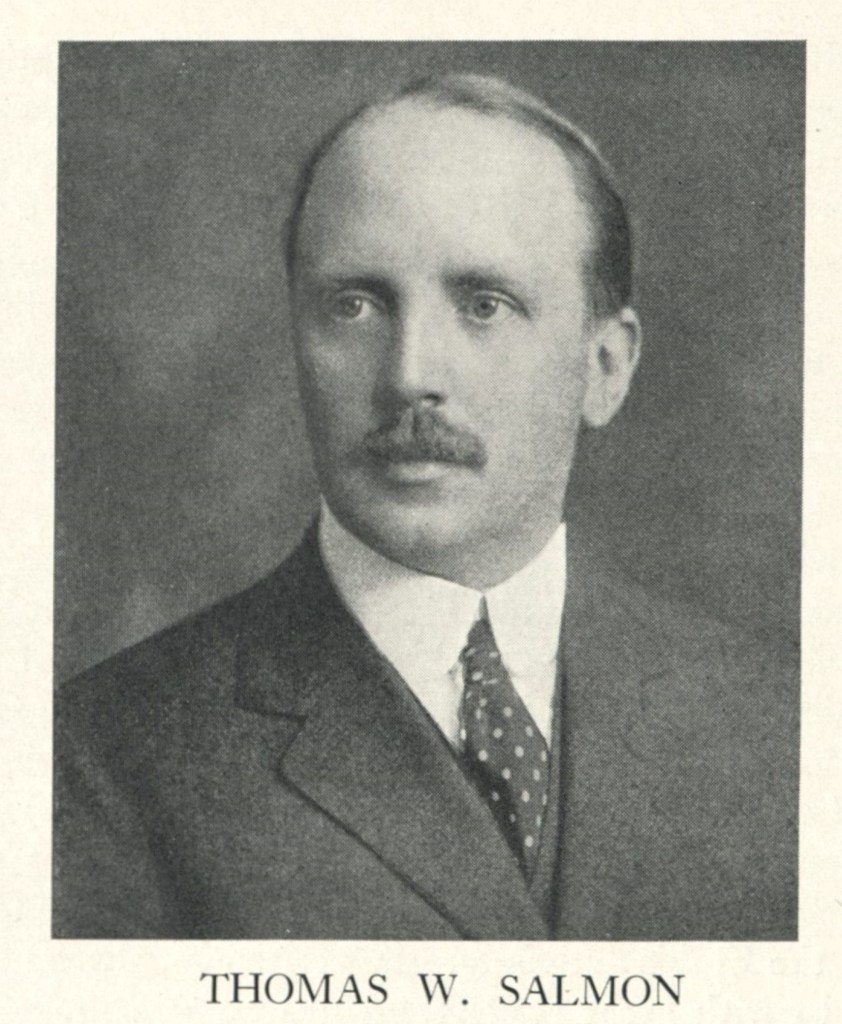
Portrait of Thomas Salmon, from History of the Interurban Clinical Club 1905-1937, edited by David Riesman (1937).

This comparative approach first led me to NYAM records relating to Dr. Thomas Salmon (1876–1927). For those unfamiliar, Salmon was the American Expeditionary Forces’ chief consultant in psychiatry during the First World War. Before this important role, following the country’s entry into the global conflict in 1917, Salmon visited England to study how it dealt with mental wounds during the war to help inform his country’s approach.2 As a leading figure in the US National Hygiene Movement before and after his war service, the records of Salmon’s war experience reflect a relatively progressive military medical official. He regularly stressed the environmental causes of soldiers’ breakdown. In short, Salmon was more inclined to blame combat neurosis and stress on the dehumanising and brutalising effects of war service than citing faulty hereditary genetics, as was more apparent amongst British military officials. This more empathetic outlook continued into Salmon’s advocacy on behalf of veterans following his return to America. Unlike the more reclusive and disillusioned Dr. Charles Myers, the British Army’s leading psychiatric official, Salmon advocated for healthcare and welfare on behalf of the mentally disabled First World War veterans during the initial post-war years. Described by his biographer as a successful ‘spokesman for veterans,’ the force of Salmon’s personality and his effective collaboration with the American Legion help explain why the American mentally ill veteran stopped being admitted into larger public mental hospitals.3 Instead, the US Federal Government established exclusive medical facilities for veterans from the early 1920s onwards.  

Salmon died unexpectedly whilst sailing near Long Island in 1927. Reflecting his prestige amongst his contemporaries, the National Committee for Mental Hygiene, an advocacy organization founded in 1909 by Clifford W. Beers, set up the Salmon Committee on Psychiatry and Mental Hygiene at the New York Academy of Medicine in 1931.4 Regardless, the exclusive medical infrastructure he had helped establish continued to cater to mentally ill First World War veterans into the 1930s. In stark contrast to Britain’s minuscule and dwindling psychiatric infrastructure, the VA provided seventeen neuropsychiatric facilities across its national network of forty-nine hospitals. It offered 10,633 beds for mental ailments, marking a 467% increase over 1921’s availability. The number of beds would be set to increase for the rest of the decade.5 With this exclusive federal medical care program for veterans, the VA published its Medical Bulletin journal throughout the 1930s. Pouring through these issues reveals a lively forum of VA medical officials discussing the continued difficulties of treating veterans during this period.  

Regarding neuropsychiatry—I was struck by how hospital superintendents, nurses, vocational trainers, and social workers regularly articulated a holistic approach to mental healthcare. They cited the psychosocial determinants of health outside of hospital walls. This includes, for example, the detrimental impact of unemployment and poverty on an individual’s mental and bodily health, the emasculating stigma attached to male mental illness, and the potential for harmful self-medication practices such as alcoholism.  

United States Veterans’ Bureau Medical Bulletin (1931), a collection of articles by VA staff and associates dedicated to all aspects of veteran after-care. These various scans come from volume 7.

The materials I reviewed at the NYAM provide a complex and nuanced picture of the post-war treatment of mentally ill World War One veterans. On the one hand, they give an image of an expansive, caring and financially generous veterans’ system. On the other hand, however, they provide comparatively little insight into the personal perspectives of veteran patients to verify the progressive narrative offered by medical officials. In addition, contemporary medical journals reveal increasing resentment from American citizens regarding the spiralling costs of veteran medical care with little in return in terms of cure and recovery.6 This counter-narrative also appears worthy of further research.  

Before arriving in New York, I was unsure how exactly the USA would fit into my larger project of Great War veterans during the Great Depression. However, my time at the NYAM proved incredibly rewarding by revealing how fascinating and unique an American case study is. I look forward to continuing this research into 2025. 

Notes: 

1 Nineteenth Annual Report of the Ministry of Pensions, 1935-1936, 33. 

2 For a write-up of Salmon’s observations and recommendations, see Thomas Salmon, The care and treatment of mental diseases and war neuroses (“shell shock”) in the British Army (War Work Committee of the National Committee for Mental Hygiene, 1917). 

3 E. D. Bond, Thomas W. Salmon: Psychiatrist (W. W. Norton & Co, 1950), 160. 

4 For more information on the Salmon Committee on Psychiatry and Mental Hygiene and its records that are held in the NYAM, see https://www.nyam.org/library/collections-and-resources/archives/finding-aids/ARN-0006.html/ [last accessed 18 November 2024]. 

5 E. O. Crossman and Glenn E. Myers, ‘The neuropsychiatric problem in the US Veterans’ Bureau,’ Journal of the American Medical Association, vol. 94, no. 7 (1930), 473–478. 

6 For example, see the Crossman and Myers article cited above. 

Sinking Our Teeth into a Poem

by Anthony Murisco, Public Engagement Librarian

As the April showers (hopefully) dwindle down, out come May flowers. The passage of the month means the conclusion of April’s celebrations, including National Poetry Month, and the commencement of the festivities of May, including National Dental Care Month. We’re going to combine both, with a poem by a dental care worker.

Anterior teeth model from Ash & Sons Catalogue (1886)

John Thomas Codman (d. 1907) was the an active speaker at various dental gatherings. He was also one of the more prolific writers on dentistry. But he wrote about more than teeth and dental issues. Dr. Codman’s writing appeared in mass market publications and he wrote about the co-op community he belonged to in the 1894 book, Brook Farm, Historic and Personal Memoirs.
 

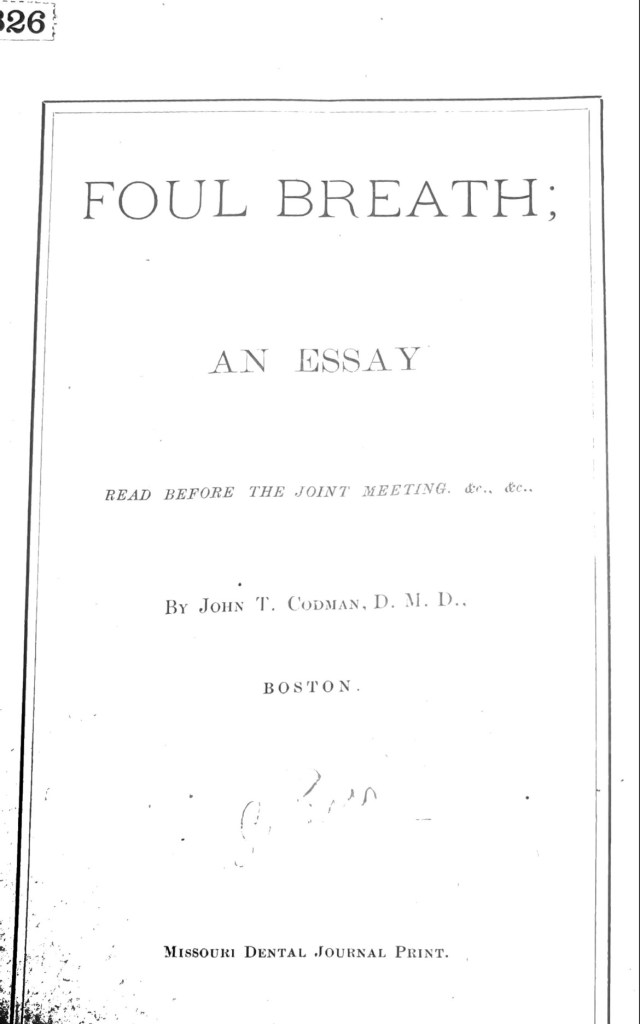
Codman broke a sensitive issue when he wrote his essay, “Foul Breath.” When speaking on the problem, he hinted at dentistry’s higher involvement with the human body; “I cannot but think that the neglect is occasioned by want of that knowledge of its primary causes, and a lack of general knowledge of the relation of all the organs, one to another, that work together for the sustenance and maintenance of the life and health of all of our corporate frames.” His words call for a well-rounded, holistic approach to the whole profession. Really, who knew one could wax so poetic about bad breath?  

Well, if you were at the 1866 meeting of the American Dental Association, you would know. In the Doric Hall of the State House in Boston, Dr. Codman welcomed the guests with a poem encompassing the birth and battles fought by our nation. It includes dental puns and nods to popular attractions in Boston. He even manages to add in a few pop culture references!

Today we bring you a slightly abridged version of this welcome poem

The Dentists’ Welcome.

Welcome, ye knights of the forcep and plugger,
The Bay State invites, embrace her and hug her;
Her arms are outstretched, and her years not so few,
That her check might mantle with blushes anew;
The friends of her dear sons from near and from far,
To her impulses pure, how welcome they are.

So, friends, from the West take a chair and sit down,
In the capitol old of this capital town;
In the hall where the “assembled wisdom” meet,
When the winter comes in with its flying sleet,
And leave only when the tubers begin to grow,
And shoots of the corn are too old for the crow.

‘Ecod, what is that which hangs high in mid air?
My professional friend, no wonder you stare;
‘Tis the ghost of a fish, long salted and sold,
But never like Hamlet’s, shall its tale unfold;
‘Tis a pity, for if he was minded to blow,
And tell all he knows of the actions below,
The “lately Departed” would wriggle and squeak,
And some heads, like curs’ tails, be drooping and weak;
He’d prove to us all what we know not before,
That men could be made of nothing but jaw.

Ye friends from the East, as ye trod the rotunda,
Saw yet the battle-flags rent all asunder?
Uncover! Bow low! For those stains are of blood
Of the martyrs that fell by field and by flood.
Ah! Could but th enote of the trumpet again
Awake the departed by hill and by plain,
And turn back the tide of the nation’s great day,
With the blot on its banner of slavery, say,
Who would sound it? Lives there such a man now?
Then shrivel his muscles and wrinkle his brow;
His right arm be palsied and dried up by his tongue,
In lines most accursed let his name be sung.

Rest, martyrs, the sound of battle is o’er,
And your feet tread soft on the Elysian shore.

Ye who come from North, Easy, South, and “far West,”
Our programme is ready, so join in with zest.
Here’s Liberty’s “cradle,” where the babe was rocked,
Such a naked little thing that the nurse was quite shocked.
She has grown pretty large since that time you’ll say,
And larger still grows with the flight of each day.
New members she’s had, and as everyone knows,
The president adds daily V. toes and V. toes.

There’s Breed’s hill, called Bunker’s where the boys had a fight,
What there is left of it, just a very small mite,
With a big pile of stones on it, so it shan’t blow away,
And to commemorate a sort of Bull Run in its day,
Only the bull didn’t run on that eventful morn,
And the Yankee boys’ pluck took the bull by the horn.

Here’s Harvard beyond, the famed “seat of learning”
For lads who are able to keep the torch burning;
The poor must digest what the schoolmaster teaches,
Driven in at the head and seat of the breeches.

Here’s Agassiz’s museum of fishes and bones,
With birds, beasts and reptiles, plants, skeletons, and stones,
And many other things that deserve your attention,
As the auctioneer says, “too numerous to mention.”

Here’s the Natural History, with molusks and “crusty”
Pickled snakes done in bottles, and specimens musty;
Here’s a good chance to “compare” the jaw-bones of owls,
With the dodo and eagle, and all sorts of fowls;
Here you can sit on a “rush-bottom” and study with ease
Whether the walrus eats pork, or the elephant cheese;
Here’s molar teeth, to pull would take forceps immense,
Got up, like the drama, at unlimited expense.

But now let us hasten, the mastodon waits;
Just imagine the creature wearing two pair of skates,
Gliding about on thick ice in the river;
Should the cold climate his carcase make shiver,
The Yankees might “guess” that his heartiest shake
Was a touch of the long-remembered earthquake.
Here’s the footprints of birds, tremendous “Shanghies,”
That could life young pigs high and dry from their sties,
And swallow them whole, spite of any protest,
With paving stones plenty to make them digest.

We’ll look at the Hospitals, City and State;
Should fortune be right, or unfortunate fate,
We need not the privilege seek for or beg
Of seeing the surgeon “make a hand of a leg.”
If Paddy could jest thus, why can’t I declare
That oft a broken arm is a humerus affair.

‘Twould take paper and ink by the ton, more’s the pity,
To tell all the wonders to be seen in our city;
So I shan’t do it, but let you explore for yourselves,
And lay up your treasures on memory’s fair shelves.

Then there’s the serious part, the weighty discussion,
The clash of ideas in serious concussion;
The din of the clinic with twenty filled chairs,
And the usual amount of splitting of hairs.
There is delegate 1, with wisdom erratic,
And delegate 2, with mallet automatic;
Like Uriah Heep, here’s a chair that can tumble
From dignified straight-back to posture most “’umble;”
But to make the thing equal, and state it right fair,
The owner is sure to set a “heap” by his chair.

…………………

My welcome is most done—it’s no welcome that tires–
And I fear that I keep you from other desires.

And now for a breath of the saltiest sea air,
A dip and a splash in Venus’ deep lair;
The steamer is ready, we wait not the oar,
Strike up, sweetest music,– away goes the shore!

Now let the gay laugh grow louder and louder,
As sweet on the nostril comes smell of the chowder;
Here’s filling to put in—there’s plate-work enough here
To last a smart dentist to the end of the year.
Success to him, say I, he fortune can win
Whose filling, in spite of the water, stays in.

With great hopes for our future, for peace while we stay,
May the star of the dentist mount high into day,
Is my wish; so, therefore, to part in good cheer,
One little conundrum I’ll venture just here.
Why is the dentist, when fishing, I pray,
Engaged in the trade he follows each day?
Can’t guess it, you say, you slyest of vulpines–
Because he, no double, will pull out some skull-pins.

A short little poem from another dentist, Dr. Ferguson.

Some of Dr. Codman’s other writings can be found in our collection. You can also find there’s a lot of poetry written by medical professionals. To see for yourself, contact library@nyam.org for an appointment.

References:  
“John Thomas Codman Brook Farm collection,” Harvard Library,https://hollisarchives.lib.harvard.edu/repositories/24/resources/3381, accessed April 30, 2024. 

Codman, John T. Foul Breath. Boston, 1879. 

Codman, John Thomas. Welcome poem: to the members of the American Dental AssociationBoston : Wright & Potter, 1866.

Combatting Tuberculosis in America After its Microbial Discovery 

By Sean Purcell, The Media School, Indiana University-Bloomington and the Library’s 2023 Helfand Fellow 

Mr. Purcell completed his Fellowship residency in the summer of 2023 and will present his research by Zoom on Thursday, December 7 at 4 p.m. (EST). To attend his talk, “A Portrait of Tuberculosis (as a Young Microbe): Representing Consumption at the Turn of the Twentieth Century,” register through NYAM’s Events page. 

I spent a month over the spring and summer looking through the New York Academy of Medicine Library collections, working towards a mixed methods dissertation, titled The Tuberculosis Specimen: The Dying Body and its Use in the War Against the “Great White Plague.” I came to the library with an interest in the visual culture surrounding tuberculosis at the turn of the twentieth century, and in my research, I have cast a wide net, looking at an array of images, from doctors’ portraits to children at play, from histological samples to photographs of wet specimens. 

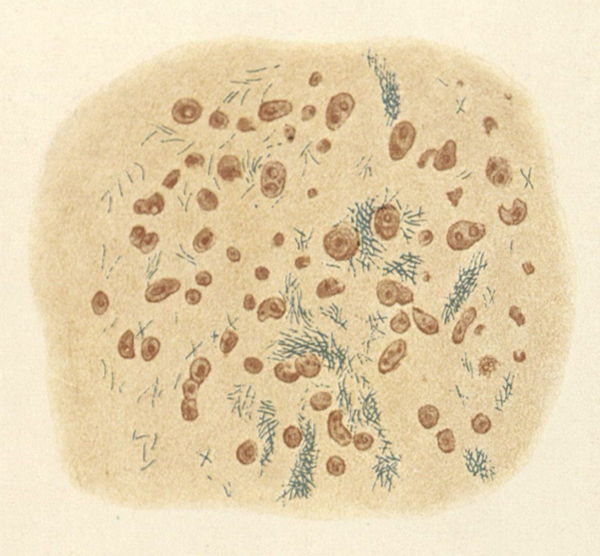
The turn of the twentieth century saw major shifts in the public, professional, and governmental interventions against tuberculosis. Robert Koch’s 1882 essay on the microbial cause of the disease led to a broad shift in how medical professionals and the lay public understood and combatted the disease. Koch had figured out a process to isolate the bacteria in laboratory animals and used a series of chemical baths to stain Mycobacterium tuberculosis a bright blue (fig. 1). Seeing the bacteria clear as day under the microscope helped move germ theory forward, and forced doctors and health worker to reconsider how to treat a disease that was, prior to Koch’s essay, considered a constitutional malady. The period after Koch’s essay saw the rise of public health interventions against the disease and the popularization of the tuberculosis sanatorium. 

Figure 1. An illustration of Mycobacterium tuberculosis. From Aetiology of Tuberculosis, 1890, Robert Koch.  

The most influential figure in the burgeoning sanatorium movement was Edward Livingston Trudeau. A doctor who had sought a cure for his own tuberculosis in upstate New York, Trudeau built his own laboratory and sanatorium, the Adirondack Cottage Sanatorium, in 1880 (figs. 2 & 3). This institution became a central fixture in the decades to come, as it was equipped with research facilities, and published its public-facing journal for tuberculous patients, The Journal of Outdoor Life.  

Figure 2. The most reproduced image from the Adirondack Sanatorium, showing the first cottage where patients were treated. From A history of the National Tuberculosis Association; the anti-tuberculosis movement in the United States, 1921, Adolphus S. Knopf.  
Figure 3. A view of the facilities at Trudeau’s Adirondack Sanatorium. From A history of the National Tuberculosis Association; the anti-tuberculosis movement in the United States, 1921, Adolphus S. Knopf. 

While Trudeau’s sanatorium was the most prominent institution, it was far from the only one. Many for-profit institutions opened their doors during this period, in addition to the development of publicly funded sanitaria in certain states. Assisting the larger, long-term treatment facilities, some cities and hospitals adopted a dispensary system, where tuberculous patients could get assistance and medicine within an urban space.  

These dispensaries served patients, but also sought to teach the urban poor lessons on hygiene. Doctors and public health workers reeled at the dusty, ill kept living conditions of the urban poor, and argued that improper sputum management, poor ventilation, and dark living conditions were contributing to tuberculosis infections in American cities (figs. 4 & 5). While ideas regarding the “healing air” of a specific environment were becoming out of fashion for tuberculosis practitioners in the early 1900’s, most doctors argued that tuberculous patients should get away from the polluted and uncirculated air common to urban environments (figs. 6 & 7).  

Figure 4. An exhibit showing the unhealthy living conditions of the working poor. The caption reads: “Type of tenement house room as first seen by Department of Health Nurse. Man is ill with Tuberculosis. Baby is ill with Scarlet Fever. Others are in danger of infection. Family is destitute.” From “Album of photographs of exhibits by various departments of the City of New York, Royal S. Copeland, Commissioner, and various health agencies,” 1921.  
Figure 5. An exhibit showing the interventions of a public health nurse. The caption reads: “Same room after nurse has performed her duties. Man has been removed to Sanatorium. The baby has been removed to hospital. Financial aid has been obtained and landlord has been induced to paint room. Instruction has been given to mother in personal hygiene, cleaning up, order, proper diet.” From “Album of photographs of exhibits by various departments of the City of New York, Royal S. Copeland, Commissioner, and various health agencies,” 1921. 
Figure 6. A day camp run by Bellevue Hospital where patients could spend time outdoors on a boat. From New York City’s Institutions for the Tuberculous: Clinics, Sanatoria, Preventoria, Day Camps and other Agencies, 1926, The Tuberculosis Sanatorium Conference of Metropolitan New York. 
Figure 7. Tuberculous patients were instructed to spend as much time as possible outside, no matter the weather. From Pulmonary tuberculosis, its modern and specialized treatment, 1907, Albert Philip Francine.  

The fight against tuberculosis in this period saw a collection of different interventions, and the New York Academy of Medicine’s library offers a unique glimpse into the work of scientists and medical professionals who were trying to fight the disease. My time here as a Helfand fellow has been a boon to this research because of the library’s extensive collections, much of which has not been digitized. 
 
References:  
Feldberg, Georgina D. Disease and Class: Tuberculosis and the Shaping of Modern North American Society. (New Brunswick: Rutgers University Press, 1995). 

Koch, Robert. “Aetiology of Tuberculosis.” Translated by T. Saure. Transactions of the Massachusetts Medical Association. (New York: William R. Jenkins, 1890).  

Koch, Robert. “Die Ätiologie der Tuberculose.” In Gesammelte Werke von Robert Koch, 1:446–54, 467–565. (Leipzig: Verlag Von Georg Thieme, 1912). 

The Healing Power of Art and Community: Viewing the AIDS Quilt at 36 

By Paul Theerman, Director 

The first panel of the AIDS quilt was put together in 1987—this year the Quilt is 36 years old! 

Image courtesy of National AIDS Memorial.

The AIDS Quilt was the brainchild of gay activist Cleve Jones. A protégé of Harvey Milk, the San Francisco city supervisor murdered in 1978, Jones honored Milk’s life and service with candlelight marches through the city. For the 1985 march he saw the ravages that AIDS was making in the gay community and asked that marchers write the names of friends lost to AIDS on posters. Placed on a wall, the posters resembled a quilt; by 1987 the names had been captured in fabric, a traditional way of memorializing people and events. The NAMES Project AIDS Memorial Quilt was born.  

Cleve Jones, activist and founder of the quilt, in front of a panel. Image taken from Wikipedia.

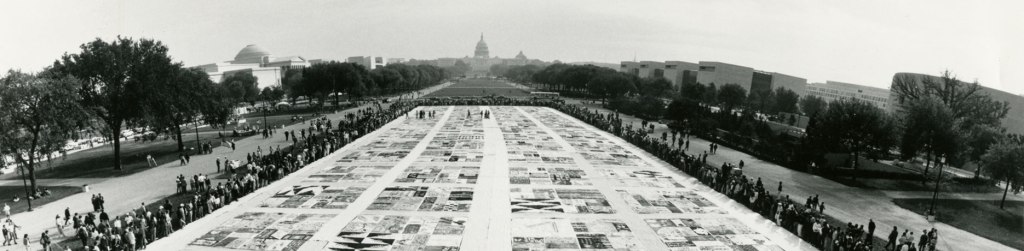
The quilt was first displayed on the National Mall in Washington, DC, on October 11, 1987, and contained 1,920 names—a dramatic demonstration of the terrible effects of the disease, only a few years after it came to public notice. At the quilt’s October 1996 display, it covered the entire Mall and was the last time that the whole quilt could be displayed at once. In the years since the quilt began, it has been exhibited throughout the world, often in connection with World AIDS Day on December 1. Today the quilt contains almost 50,000 panels, representing 110,000 individuals. The National AIDS Memorial in San Francisco is responsible for the quilt, mounts special efforts to address the presence of HIV/AIDS in the Black and Native American communities, and shares the quilt online

An image of the quilt being displayed in Washington, DC around 1987. Image taken from National AIDS Memorial. 
Advertising the digitization of the quilt from National Aids Memorial, as per their website.

This year, the New York Academy of Medicine is proud to host a portion of the AIDS quilt for World AIDS Day on December 1. We’ll reveal the quilt at our Celebration of the Library on November 29 and exhibit it in the Academy Building throughout December. We hope you can join us to view this sober but also hopeful reminder of how disease devastates communities, and how communities respond, through art, with remembrance and resilience. 

A panel from the AIDS quilt at the National Building Museum used as part of Wikimedia Commons.

_______ 

References  

“The History of the Quilt,” The National AIDS Memorial, https://www.aidsmemorial.org/quilt-history,  accessed November 20, 2023.