Have You Heard of Dr. Rebecca Lee Crumpler?

by Anthony Murisco, Public Engagement Librarian

On February 8th, 2021, the city of Boston was celebrating in a big way. For Dr. Rebecca Lee Crumpler’s 190th birthday, the city had decided to declare the entire day in her honor. Despite this high honor, many still do not know who she is.  
 
The largest newspaper in Boston, The Boston Globe, introduced readers to the local hero’s story in February 2020. At the time, Crumpler and her second husband, Arthur, were buried in an unmarked grave. Noting the significance of Crumpler, the first Black female doctor in the United States, the local Hyde Park Historical Society teamed up with the Friends of the Hyde Park Library to raise money for a proper headstone.
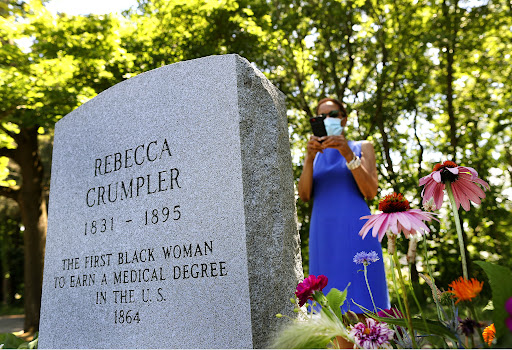
Courtesy of The Boston Globe

A follow-up in July of the same year informed the readers of a ceremony held to unveil the memorial. It also helped give a little more insight into the life of Dr. Crumpler; born Rebecca David in 1831, she was raised in Pennsylvania by her aunt. While growing up, she was shown what it meant to be a caretaker as she saw her aunt provide care for those in their neighborhood. She left for Charlestown, Massachusetts, and married her first husband, Wyatt Lee, in 1852. From working as a nurse from 1852–1860 for various doctors and their letters of recommendation, she was accepted into the New England Female Medical College. 
 
In the middle of her schooling, her husband passed away from tuberculosis. She graduated in 1864 as the first Black woman in the United States to do so, as well as the only Black woman to graduate from New England Female Medical College before it merged with another medical school in 1873. The following year, she married Arthur Crumpler. They settled and spent the rest of their lives in Hyde Park, a neighborhood in south Boston. In her 1883 book, A Book of Medical Discourses: In Two Parts, Dr. Crumpler opens with a dedication; “To Mothers, Nurses, and all who may desire to mitigate the afflictions of the human race, this book is prayerfully offered.” The Boston Globe article mentions how she faced plenty of adversity in her profession, including white pharmacists who refused to fill scripts signed by her. Despite all of this, nothing could stop her from helping the people who needed her.  

From Finding Rebecca by Shani Mahiri King and illustrated by Nicole Tadgell

Rewriting History 

It wasn’t her own education, in the very same area where Crumpler once walked, that taught Boston University Medical School student Dr. Melody McCloud about this pioneer. Rather it was when, freshly graduated, she moved to Atlanta, Georgia, around 1981. There she learned about Dr. Crumpler and the Rebecca Lee Society, an organization made up of Black female physicians. Speaking on Crumpler and other forgotten physicians, McCloud told the Boston Globe, “There are a lot of accomplishments of Blacks that are left out of the history books.” 

In her 2013 book, Hidden Figures: The American Dream and the Untold Story of the Black Women Mathematicians Who Helped Win the Space Race, writer Margot Lee Shetterly coined the titular term. The “hidden figures” in her story are three Black women, Mary Jackson, Katherine Johnson, and Dorothy Vaughan, who were instrumental in bringing the first astronauts into space. Despite being crucial to the team, they were hardly spoken of. Shetterly uncovered the story through talking to those who were there. From Johnson, she learned of Jackson; through Jackson, she got to Vaughan. The stories are passed down through the people who lived it and with the help of communities like the Rebecca Lee Society. With Shetterly’s help, Hidden Figures has been able to inspire others. It was even made into a movie! What can we do to these other “hidden” heroes? 
 
In 2020 national attention was given to the Crumplers’ Hyde Park memorial thanks to NBC Nightly News. Since then, Dr. Crumpler and her accomplishments are being recognized more and more. Symposiums are now being held in her honor, the first being at Boston University School of Medicine in conjunction with her 190th birthday. She also began popping up in an unlikely place: children’s picture book biographies. 
 
Her Own Image 

Writers and illustrators have become masterful in non-fiction storytelling for kids. . Some of these books are storytime staples. The illustrations bring history and people back to life. Can it be done for someone who has no surviving pictures?

A quick Google search of “Rebecca Lee Crumpler”

If you were to do an image search for “Rebecca Lee Crumpler,” you’d get some results. Unfortunately, none of these is the woman you are looking for! Despite commercial photography coming of age during her lifetime, any images of her have been lost to time. She is often mistakenly identified as other Black women, including Mary Eliza Mahoney. Boston University’s student-run newspaper made this mistake in its coverage of Dr. Rebecca Lee Crumpler Day, and eventually retracted and rectified its error, one of the few to do so.

From The Daily Free Press

Given the absence of portraits, how can you project this person?  

Alexandra Boiger has showed us the lives of many historical and contemporary women as the illustrator of Chelsea Clinton’s She Persisted series. For She Persisted in Science, Boiger was able to pictorialize Crumpler’s life based on her research on the “physical and emotional” state of those at the time. Boiger told the Library, via e-mail, that she was “always trying to balance the harshness of the time with the heart and love of the people and Dr. Rebecca Lee Crumpler herself.” Her images succeed in showing the care that, as Crumpler herself wrote, she was striving for.
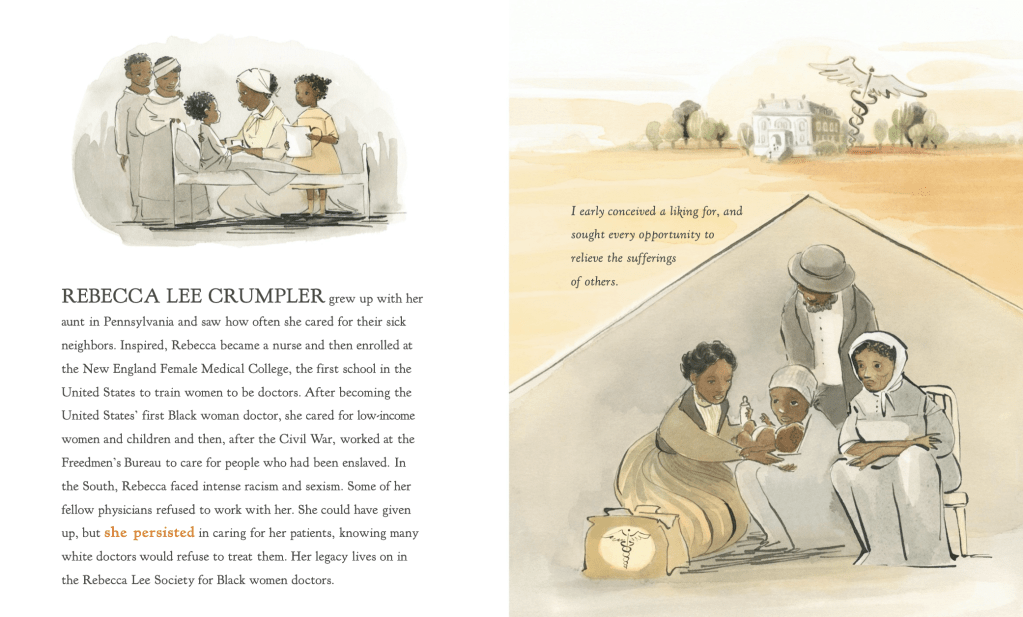
From She Persisted in Science by Chelsea Clinton and illustrated by Alexandra Boiger

Shani Mahiri King’s 2024 book Finding Rebecca is both an ode to Crumpler and an act of research. From studying Crumpler and the lives of 19th-century Black Americans, he worked with his illustrator, Nicole Tadgell, to show us how she may have lived. Tadgell herself is an accomplished illustrator with a slew of historical picture books under her belt. King paired his own findings with the direct words of Crumpler from Medical Discourses, not only to tell her story but to inspire others.

From Finding Rebecca by Shani Mahiri King and illustrated by Nicole Tadgell

King believes that more history is just waiting to be uncovered: hidden figures, histories, legends, all ready to have their stories told. The book ends with a call to action: “You too are a historian, you too are an author, and you too can help teach all of us about people who should be more famous than they are.”

References:  

“Changing the Face of Medicine | Rebecca Lee Crumpler.” Nih.gov, 3 June 2015, cfmedicine.nlm.nih.gov/physicians/biography_73.html. Accessed 26 Feb. 2025. 

Clinton, Chelsea. She Persisted in Science. Penguin, 1 Mar. 2022. 

Crumpler, Rebecca Lee. A Book of Medical Discourses, in Two Parts. 1883. Boston, Cashman, Keating, printers, collections.nlm.nih.gov/catalog/nlm:nlmuid-67521160R-bk. 

Jonas, Anne. “Boston Honors Rebecca Lee Crumpler Day — First Black Woman in the US to Receive Medical Degree.” The Daily Free Press, 8 Feb. 2021, dailyfreepress.com/2021/02/08/boston-honors-rebecca-lee-crumpler-day-first-black-woman-in-the-us-to-receive-medical-degree/. Accessed 26 Feb. 2025. 

King, Shani Mahiri. Finding Rebecca. Tilbury House Publishers and Cadent Publishing, 15 Oct. 2024. 

MacQuarrie, Brian. “Gravestone Dedicated to the First Black Female Medical Doctor in the US .” BostonGlobe.com, The Boston Globe, 17 July 2020, http://www.bostonglobe.com/2020/07/17/metro/gravestone-dedicated-first-black-female-medical-doctor-us/. Accessed 26 Feb. 2025. 

Rechtoris, Mary. “Hidden Figures’ Margot Lee Shetterly: How Writing Is a Lot like E-Discovery.” Relativity, 16 Jan. 2020, http://www.relativity.com/blog/hidden-figures-margot-lee-shetterly-how-writing-is-a-lot-like-e-discovery/. Accessed 26 Feb. 2025. 

Sweeney, Emily. “Fundraising Effort Underway in Hyde Park to Honor Dr. Rebecca Lee Crumpler, First Black Woman to Earn Medical Degree in US.” BostonGlobe.com, The Boston Globe, 10 Feb. 2020, http://www.bostonglobe.com/2020/02/10/metro/fundraising-effort-underway-hyde-park-honor-dr-rebecca-lee-crumpler-first-black-woman-earn-md-degree-us/. Accessed 26 Feb. 2025. 
Researching Neuropsychiatry and Veterans Hospitals During the 1930s at the New York Academy of Medicine 

By Dr. Michael Robinson, National Army Museum Research Fellow, University of Birmingham (UK), and the Library’s 2024 Paul Klemperer Fellow in the History of Medicine 

I spent one month working in the New York Academy of Medicine’s magnificent library and reading room in the autumn of 2024. This residency enabled me to look at a host of materials dedicated to the treatment of mentally ill American Army veterans of the First World War during the Great Depression (1929–1939). I undertook this research hoping to utilise the USA as an important comparative case study on my current research project dedicated to mental illness and British Great War veterans during the 1930s. By examining mental breakdown and psychiatric medical care during this decade, this research seeks to reveal the delayed traumatic after-effects of war service on ex-service personnel and the potential for additional psychosocial determinants to influence mental ill-health.  

I first became interested in the American experience of post-First World War disability and mental healthcare owing to its regular appearance in the archival records of Britain’s Ministry of Pensions, the government agency responsible for distributing veterans’ pensions and medical care. During the inter-war period, British policymakers regularly cited the US experience of veteran after-care as a deterrent and a case study to avoid replicating. They actively held up the US system as being unfairly exclusive, costly, and liberal owing to its incremental but costly expansion of veteran rights and facilities. Britain significantly reduced its liability on behalf of veterans during the 1920s and 1930s, including the closure of most veterans’ hospitals. Veterans’ medical care in Britain was primarily outsourced to broader public health facilities, the civilian welfare state, and the charity sector.  

By contrast, the US witnessed increased state liability, including a vast financial outlay in funding exclusive Veterans Administration (VA) hospitals and medical facilities. In 1936, owing to the two nations’ inversed approaches to veteran care, one Ministry of Pensions official described the UK and US responses as being of ‘opposite extremes.’1 The primary purpose of my time at the NYAM was to better understand why the British and US systems were the complete inverse of one another. I also sought to appreciate how these contrasting policy trajectories and medical infrastructures affected the lives of mentally ill veterans.  

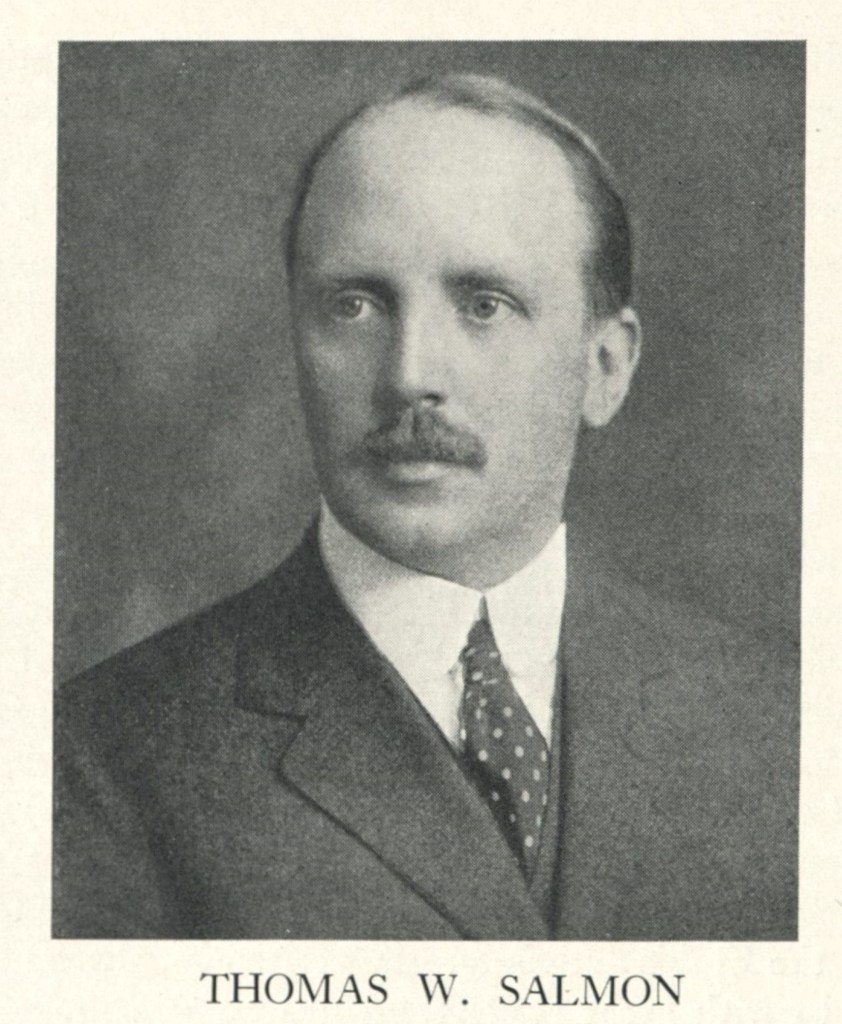
Portrait of Thomas Salmon, from History of the Interurban Clinical Club 1905-1937, edited by David Riesman (1937).

This comparative approach first led me to NYAM records relating to Dr. Thomas Salmon (1876–1927). For those unfamiliar, Salmon was the American Expeditionary Forces’ chief consultant in psychiatry during the First World War. Before this important role, following the country’s entry into the global conflict in 1917, Salmon visited England to study how it dealt with mental wounds during the war to help inform his country’s approach.2 As a leading figure in the US National Hygiene Movement before and after his war service, the records of Salmon’s war experience reflect a relatively progressive military medical official. He regularly stressed the environmental causes of soldiers’ breakdown. In short, Salmon was more inclined to blame combat neurosis and stress on the dehumanising and brutalising effects of war service than citing faulty hereditary genetics, as was more apparent amongst British military officials. This more empathetic outlook continued into Salmon’s advocacy on behalf of veterans following his return to America. Unlike the more reclusive and disillusioned Dr. Charles Myers, the British Army’s leading psychiatric official, Salmon advocated for healthcare and welfare on behalf of the mentally disabled First World War veterans during the initial post-war years. Described by his biographer as a successful ‘spokesman for veterans,’ the force of Salmon’s personality and his effective collaboration with the American Legion help explain why the American mentally ill veteran stopped being admitted into larger public mental hospitals.3 Instead, the US Federal Government established exclusive medical facilities for veterans from the early 1920s onwards.  

Salmon died unexpectedly whilst sailing near Long Island in 1927. Reflecting his prestige amongst his contemporaries, the National Committee for Mental Hygiene, an advocacy organization founded in 1909 by Clifford W. Beers, set up the Salmon Committee on Psychiatry and Mental Hygiene at the New York Academy of Medicine in 1931.4 Regardless, the exclusive medical infrastructure he had helped establish continued to cater to mentally ill First World War veterans into the 1930s. In stark contrast to Britain’s minuscule and dwindling psychiatric infrastructure, the VA provided seventeen neuropsychiatric facilities across its national network of forty-nine hospitals. It offered 10,633 beds for mental ailments, marking a 467% increase over 1921’s availability. The number of beds would be set to increase for the rest of the decade.5 With this exclusive federal medical care program for veterans, the VA published its Medical Bulletin journal throughout the 1930s. Pouring through these issues reveals a lively forum of VA medical officials discussing the continued difficulties of treating veterans during this period.  

Regarding neuropsychiatry—I was struck by how hospital superintendents, nurses, vocational trainers, and social workers regularly articulated a holistic approach to mental healthcare. They cited the psychosocial determinants of health outside of hospital walls. This includes, for example, the detrimental impact of unemployment and poverty on an individual’s mental and bodily health, the emasculating stigma attached to male mental illness, and the potential for harmful self-medication practices such as alcoholism.  

United States Veterans’ Bureau Medical Bulletin (1931), a collection of articles by VA staff and associates dedicated to all aspects of veteran after-care. These various scans come from volume 7.

The materials I reviewed at the NYAM provide a complex and nuanced picture of the post-war treatment of mentally ill World War One veterans. On the one hand, they give an image of an expansive, caring and financially generous veterans’ system. On the other hand, however, they provide comparatively little insight into the personal perspectives of veteran patients to verify the progressive narrative offered by medical officials. In addition, contemporary medical journals reveal increasing resentment from American citizens regarding the spiralling costs of veteran medical care with little in return in terms of cure and recovery.6 This counter-narrative also appears worthy of further research.  

Before arriving in New York, I was unsure how exactly the USA would fit into my larger project of Great War veterans during the Great Depression. However, my time at the NYAM proved incredibly rewarding by revealing how fascinating and unique an American case study is. I look forward to continuing this research into 2025. 

Notes: 

1 Nineteenth Annual Report of the Ministry of Pensions, 1935-1936, 33. 

2 For a write-up of Salmon’s observations and recommendations, see Thomas Salmon, The care and treatment of mental diseases and war neuroses (“shell shock”) in the British Army (War Work Committee of the National Committee for Mental Hygiene, 1917). 

3 E. D. Bond, Thomas W. Salmon: Psychiatrist (W. W. Norton & Co, 1950), 160. 

4 For more information on the Salmon Committee on Psychiatry and Mental Hygiene and its records that are held in the NYAM, see https://www.nyam.org/library/collections-and-resources/archives/finding-aids/ARN-0006.html/ [last accessed 18 November 2024]. 

5 E. O. Crossman and Glenn E. Myers, ‘The neuropsychiatric problem in the US Veterans’ Bureau,’ Journal of the American Medical Association, vol. 94, no. 7 (1930), 473–478. 

6 For example, see the Crossman and Myers article cited above.