Preservation Week Quiz

By Christina Amato, Book Conservator

In recognition of Preservation Week, NYAM conservators have prepared a quiz. The following mystery objects are used in the NYAM Gladys Brooks Book and Paper Conservation Lab. Prove your preservation moxie by choosing which description best matches each item.

Image 1:
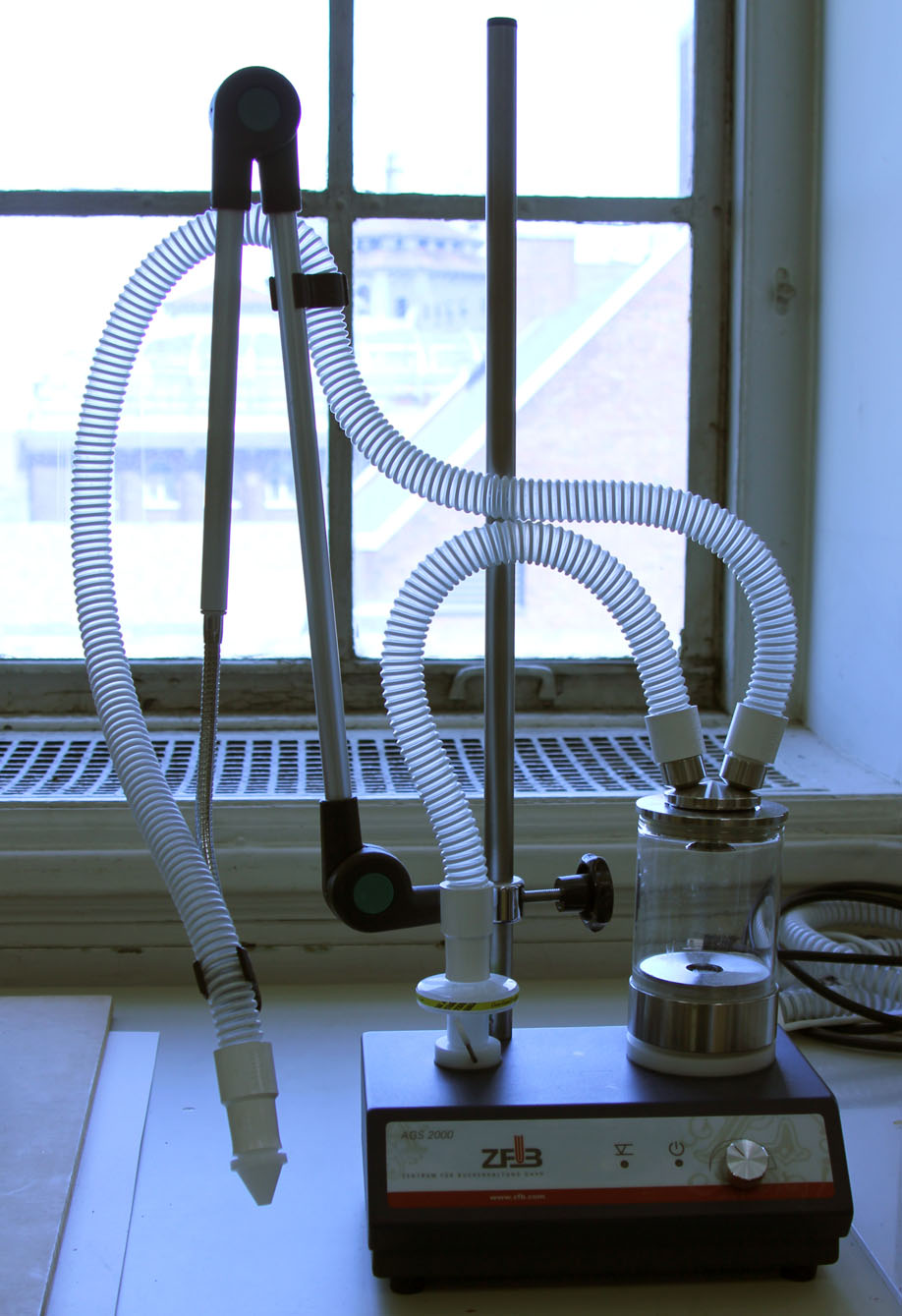
Image 1a.  Pest remediation instrument. The small nozzle can reach into the gutters of books, and capture crawling insects and larva via suction. They are whisked into the clear chamber, where they will peacefully expire in the oxygen deprived environment.

b.   Nebulizer. The clear chamber is used to heat water, and the resulting steam can be directed very precisely with the small nozzle onto areas that require humidification (such as crumpled paper or vellum.) The chamber can also be filled with a dilute adhesive, which can be used to consolidate flaking media.

c.   Airbrush. The clear chamber is filled with dilute paint, usually watercolor or acrylic, and is used to tone cloth or Japanese paper for repairing books. It is also frequently used with leather dye to tone calf or goatskin.

Image 2:
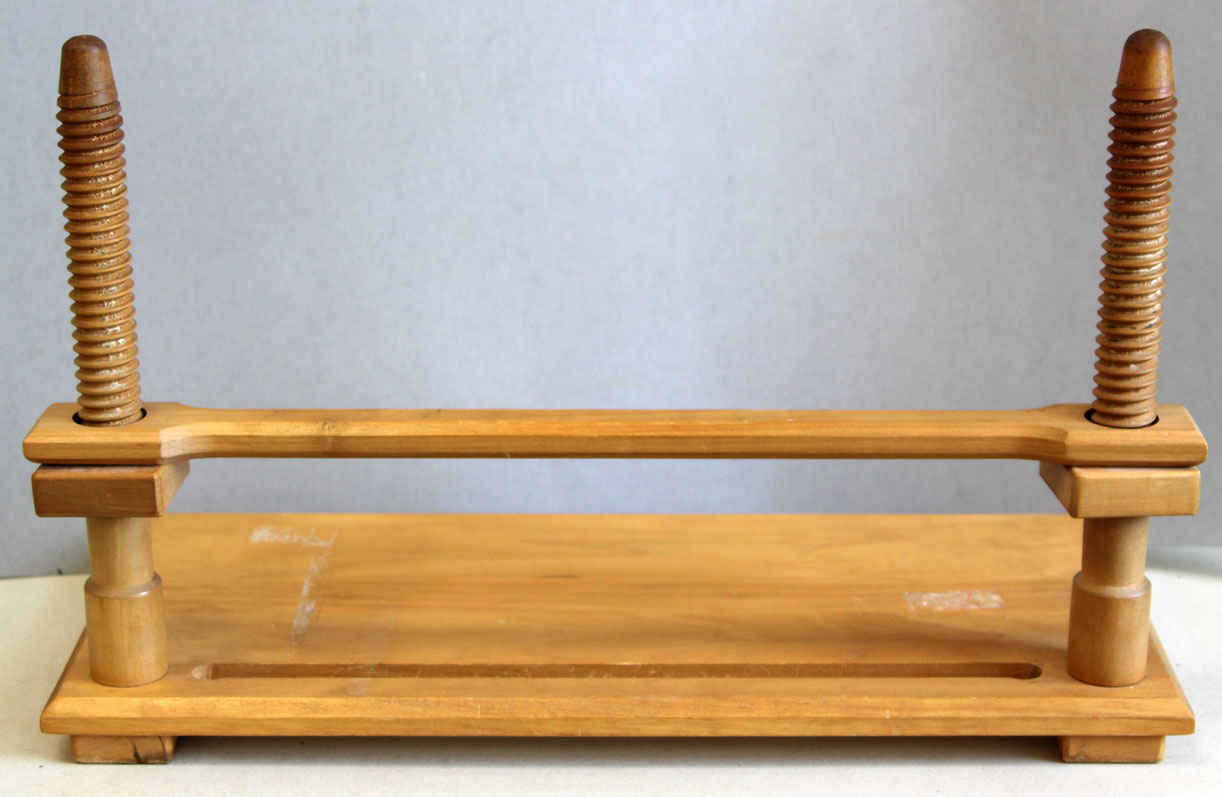
Image 2

a.   Sewing frame. Books are occasionally completely disbound and resewn in the lab.  Cord, or linen “tape”, is pulled taut from the horizontal  bar to the base, and books are sewn onto the cords.

b.   Parchment stretching frame. Crumpled parchment is humidified, and attached to the frame using specialized clips. The horizontal bar is slowly raised until the parchment is taut, where it is left to dry.

c.   Traction device. Long hours spent stooped over a bench can lead to a host of orthopedic insults. Conservators are wise to take a few minutes every day to “stretch out on the rack.”

Image 3:
Image 3

a.   Pamphlet binder. Pamphlets are passed between the jaws of this device, which affixes the pages together with stainless steel tackets.  The jaws can be adjusted to accommodate pamphlets of varying thicknesses.

b.   Tape dispenser. Specialized mending tape is applied to torn pages when fed through the jaws. Can also be used with duct tape.

c.   Leather paring device.  A two-sided razor blade is attached to the top jaw; pieces of leather are passed through the jaws, until the desired thickness is reached.  It is often necessary to thin out leather quite a bit before using it to repair a book.

Image 4:
Image 4

a.   Pest Remediation Dome. Books that have been infected with insects can be placed inside the dome. Oxygen is gradually pumped out of the dome, gently suffocating any insects within.

b.   Incubator. Conservators in the Gladys Brooks Book and Paper Conservation lab are world renowned for their hand processed silk thread, which is used in a variety of conservation applications. Silk worms are lovingly and painstakingly raised in the dome from larva, until they are ready to be harvested.

c.   Humidity dome and suction table. Paper or vellum that requires humidification, for flattening, for example, can be placed inside the dome, where the humidity is gradually increased until the desired level is reached. Beneath the dome is a suction table; it can be used to force solvents through a piece of paper, for stain reduction and other applications. 

Image 5:
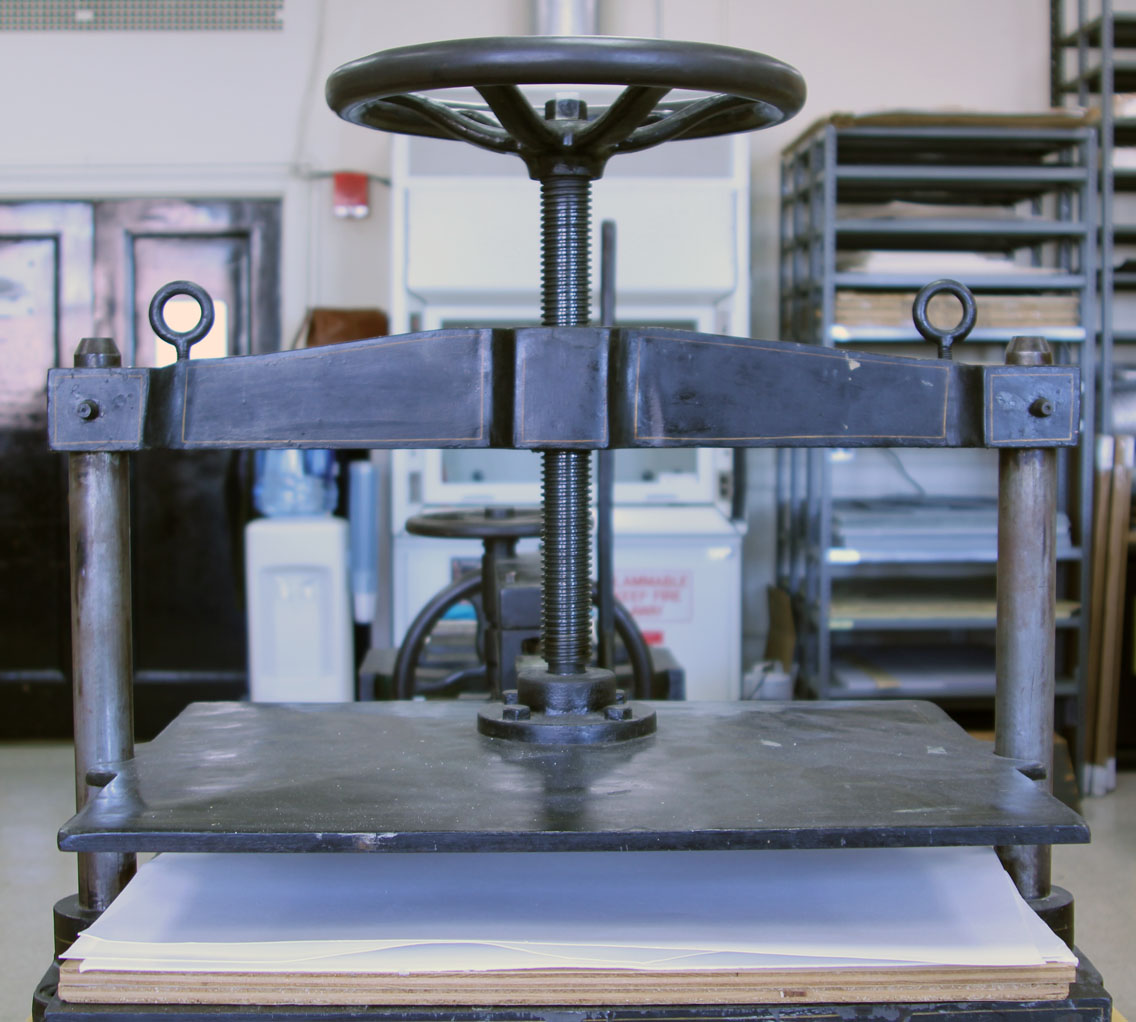
Image 5

a.   We don’t actually know. We saw it at Restoration Hardware, and thought it looked cool.

b.   Book Press. This is used to apply pressure to books, after treatment, to prevent warping during drying. It can also be used to flatten single sheets of paper.

c.   Book truck. Books are held in place underneath the platen; the truck can then be safely driven around the lab. The large wheel at the top is used for steering. 

Answers:

1. b         2.  a        3. c         4. c         5. b

Scoring:

5 out of 5: Preservation Superstar! Congratulations! You are tapped into the pulse of preservation!

4 out of 5: Preservation B Lister: Not bad! You have a generally solid understanding of preservation!

3 out of 5: Preservation Dilettante: You know a little about preservation, but could stand to step it up.

2 out of 5: Preservation Novice: It sounds like preservation isn’t your strongest suit but there’s hope yet.

1 out of 5: Preservation Rookie: Things are not looking so good for you, preservation-wise.

0 out of 5: Preservation Lightweight: At least there’s nowhere to go but up.
Modeling History: Making a Stiff-Board Parchment Binding with a Slotted Spine

This post comes from the 2012 Gladys Brooks conservation intern, Morgan Adams. Morgan is currently interning in the Thaw Conservation Center at the Morgan Library & Museum

As the 2012 Gladys Brooks intern I had the pleasure of working with Senior Book Conservator Anne Hillam on a model of a stiff-boards parchment binding with a slotted spine, a style seen commonly in Italian bindings of the 16th-17th centuries.

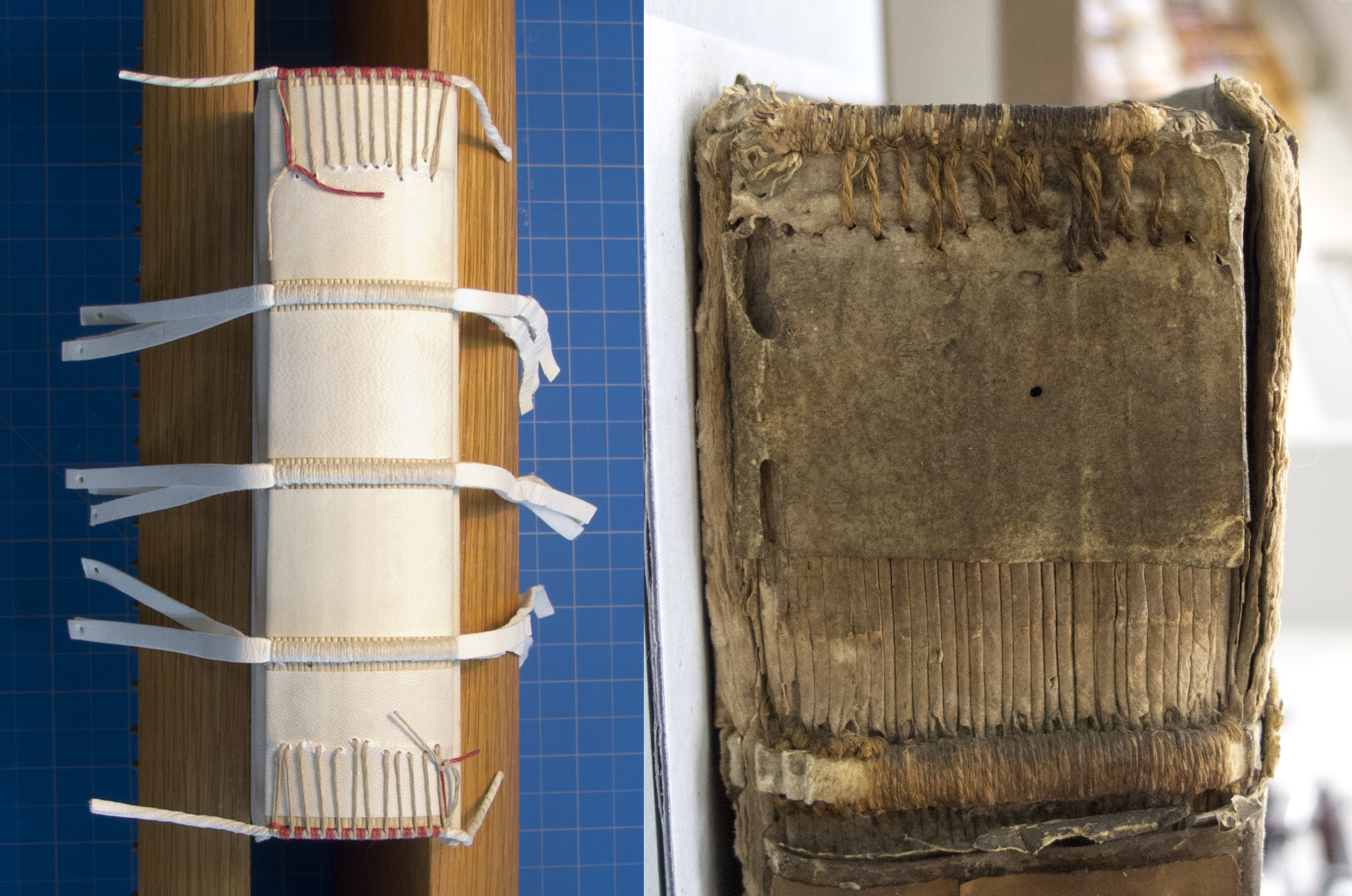
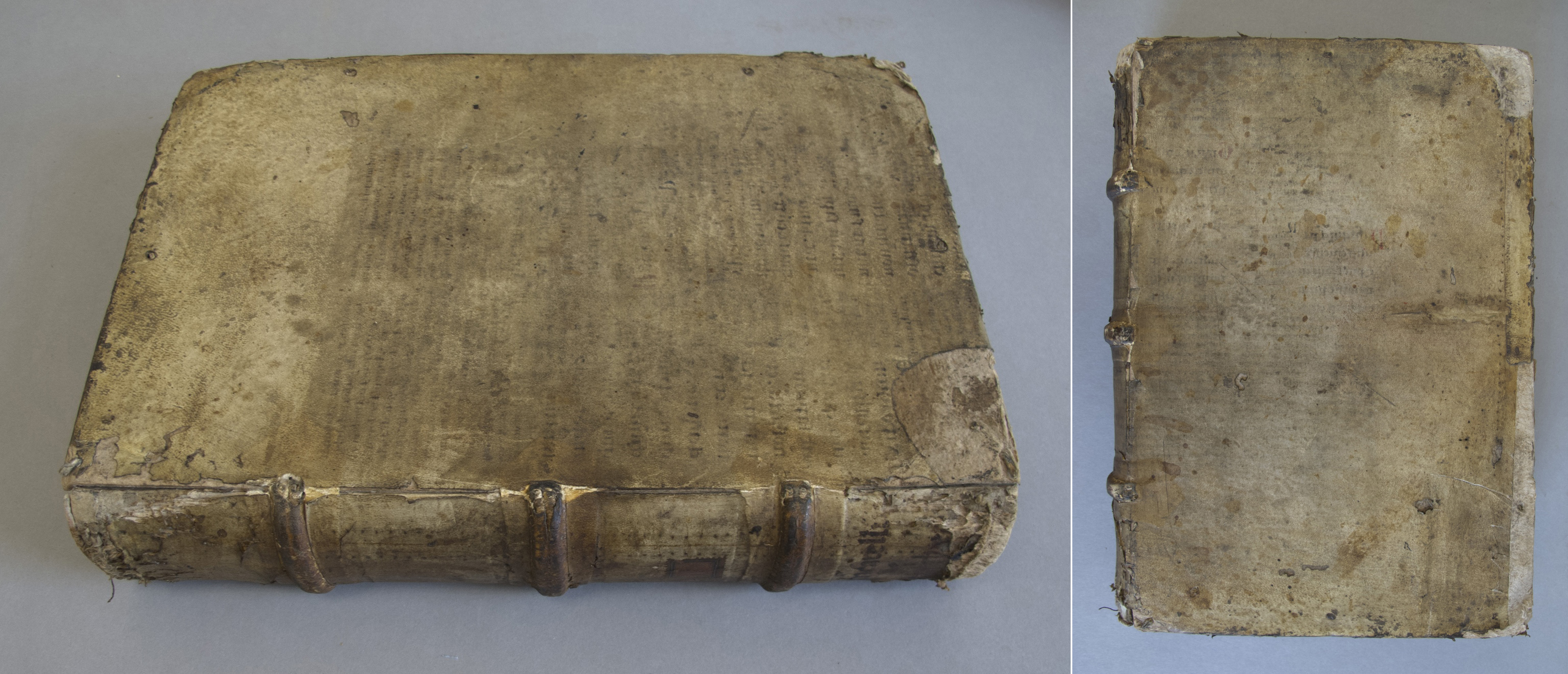
An example of a stiff-boards parchment binding with a slotted spine from the NYAM collection: Trincavello, De differentiis febrium, Venice, 1585. Left: Back cover and spine. Right: Front cover.

An example of a stiff-boards parchment binding with a slotted spine from the NYAM collection: Trincavello, De differentiis febrium, Venice, 1585. Left: Back cover and spine. Right: Front cover.

A unique feature of this binding is the juxtaposition of the parchment and alum-tawed skin used to cover the book’s spine. Slots cut in the parchment across the spine reveal the alum-tawed skin patches covering the sewing supports. It is a combination with structural as well aesthetic advantages: The alum-tawed skin provides the flexibility necessary to conform to the raised sewing supports, while the parchment provides a more durable surface to protect the bulk of the spine.

Trincavello (1585): Detail of spine showing the alum-tawed skin patch adhered over sewing support. The original color of the patch can be seen where the parchment is split along the shoulder of the spine.

Trincavello (1585): Detail of spine showing the alum-tawed skin patch adhered over sewing support. The original color of the patch can be seen where the parchment is split along the shoulder of the spine.

To prepare for this binding, we made detailed examinations of six books printed in Venice between 1508 and 1585 in the NYAM special collections. In conjunction with Sylvia Pugliese’s study of this binding style at the National Library Marciana in Venice, we selected material and structural features that exemplified the binding style. These features are highlighted in the images below, which show the steps of the binding process and the finished model.

The text block is sewn on three laminated alum-tawed supports.

The text block is sewn on three laminated alum-tawed supports.

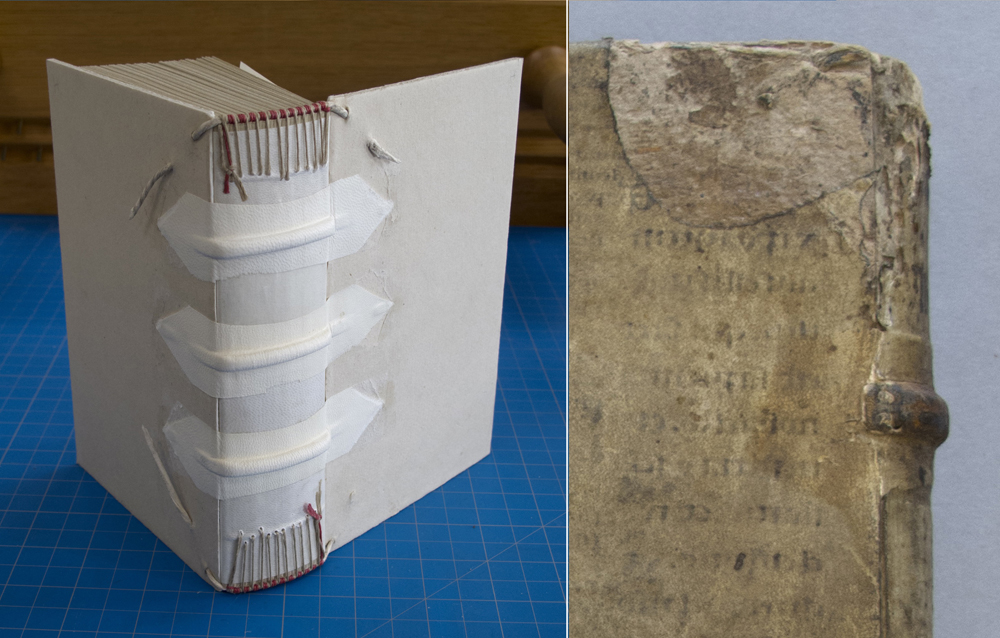
Left: The text block is rounded and backed and the spine is lined with parchment. Endbands are sewn through the spine lining on twisted alum-tawed skin supports.

Left: The text block is rounded and backed and the spine is lined with parchment. Endbands are sewn through the spine lining on twisted alum-tawed skin supports. Right: Galen, Omnia quae extant in Latinum sermonem convsera, Venice, 1556, detail of the spine showing an endband, parchment spine lining, and one sewing station.

Left: Endbands seen from above. Right: Galen (1556) detail of the front bead endband sewn in red and white thread.

Left: Endbands seen from above. Right: Galen (1556) detail of the front bead endband sewn in red and white thread.

Left: The sewing supports are laced into the boards and then covered in alum-tawed skin patches. The endband cores are also laced into the boards. Right: Trincavello (1585), detail showing the "arrow-point" shaping of the alum-tawed skin patch underneath the parchment and the endband core that has been laced through the board and trimmed off flush with the board.

Left: The sewing supports are laced into the boards and then covered in alum-tawed skin patches. The endband cores are also laced into the boards. Right: Trincavello (1585), detail showing the “arrow-point” shaping of the alum-tawed skin patch underneath the parchment and the endband core that has been laced through the board and trimmed off flush with the board.

A template is prepared for cutting the slots in the parchment. The binding is now ready to be covered.

A template is prepared for cutting the slots in the parchment. The binding is now ready to be covered.

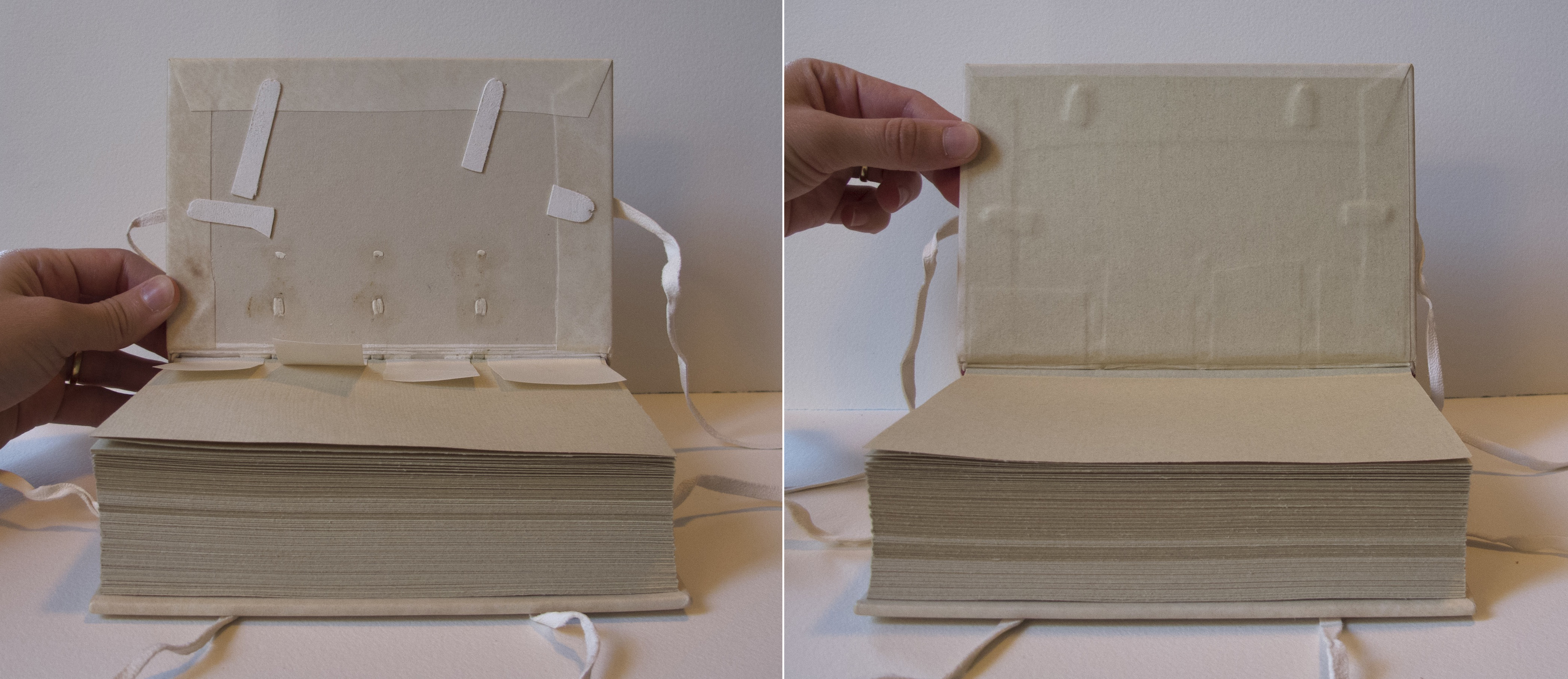
After the parchment cover is adhered, ties are laced through the boards at the fore-edge, head and tail. The parchment spine linings are adhered to the interior face of the board and the endsheet is pasted down.

After the parchment cover is adhered, ties are laced through the boards at the fore-edge, head and tail. The parchment spine linings are adhered to the interior face of the board and the endsheet is pasted down.

Trincavello (1585), The surface of the pastedown reveals the ends of ties formerly  laced through the board.

Trincavello (1585), The surface of the pastedown reveals the ends of ties formerly laced through the board.

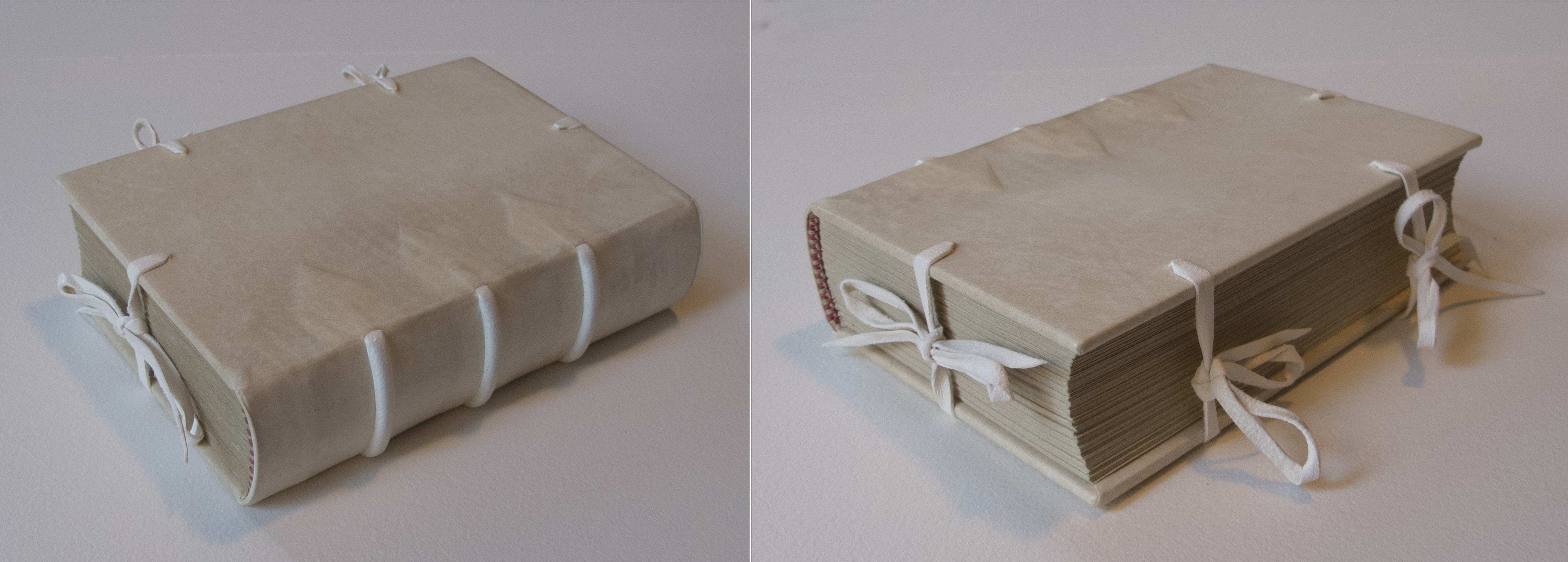
Finished model, complete with ties on fore-edge, head, and tail.

Finished model, complete with ties on fore-edge, head, and tail.

[1] Sylvia Pugliese, “Stiff-Board Vellum Binding with Slotted Spine: Survey of a Historical Bookbinding Structure,” in Papier Restaurierung – Mitteilungen der IADA, Vol. 2 (2001), Suppl., S. 93-101.

Looking for that je ne sais quoi : the conservation of Les Oeuvres d’Ambroise Paré

By Christina Amato, Book Conservator

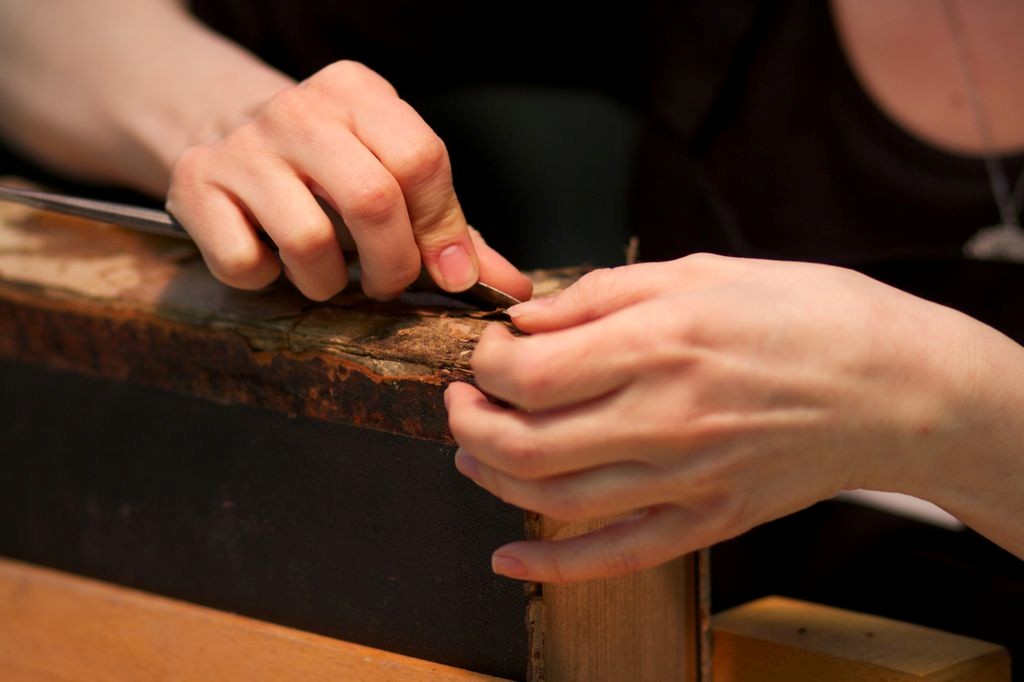
NYAM conservator Christina Amato removes a damaged and ill-suited spine from a 1633 copy of Paré’s Les Oeuvres d’Ambroise Paré/

NYAM conservator Christina Amato removing a damaged and ill-suited spine from a 1633 copy of Paré’s Les Oeuvres d’Ambroise Paré

Many books come through the Gladys Brooks Book and Paper Conservation lab, and often they receive minimal stabilization, or are rehoused in new boxes or folders. Occasionally one comes through that is in need of an entirely new binding, and requires some research before getting started.

quarterviewlesoeuvres

Les Oeuvres d’Ambroise Paré, before treatment. Click to enlarge.

This copy of Paré’s Les Oeuvres d’Ambroise Paré came to the lab in rather sorry shape; it is a 17th century book that had been rebound at some point in its past. The new binding, or cover, was clearly made centuries after the book was created, and was damaged to the extent that handling the book was very difficult.  The usual practice in conservation is to use as many of the original parts as possible when repairing a book; in this case, however, the binding was not only heavily damaged, but inappropriate, so the decision was made to make a new binding for the book.

What kind of binding would be appropriate for a 17th century French book? Beyond historical appropriateness, we had to consider the functionality of the new binding as well. It is a rather large, heavy book; what would be best for a book of this size? How often would this book be used? How would it be stored?

We began with the first question of historical appropriateness. We are lucky to have access to the library’s rare book collection, and were able to find other books from the same time period and location, and study their bindings.  We also made use of our large collection of books about binding history, researched other libraries on-line bindings databases, and talked to colleagues.

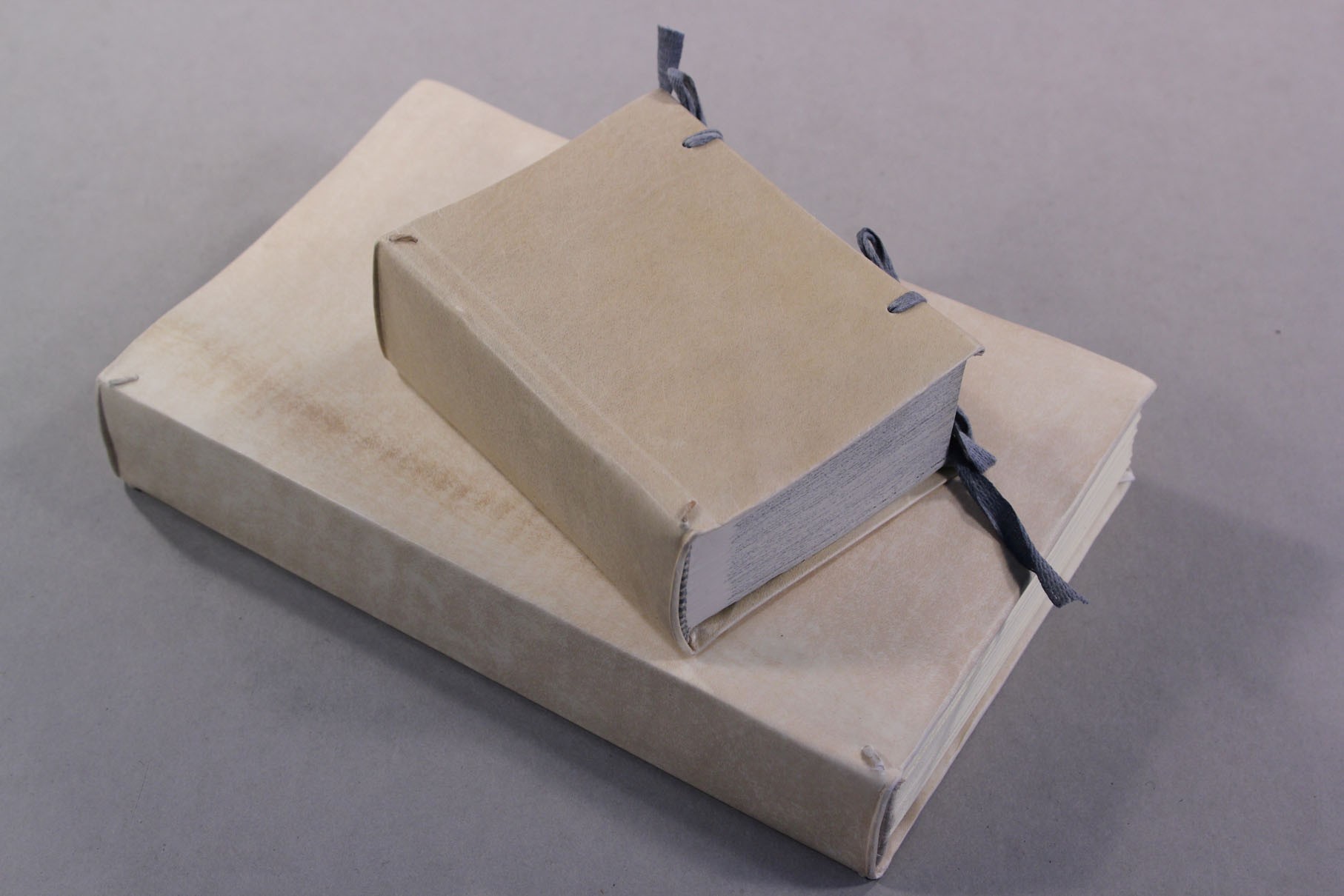
Models of "semi-limp vellum" bindings

Models of “semi-limp vellum” bindings. Click to enlarge.

With these things in mind, we decided to explore the possibility of making a variation of what is called a “semi-limp vellum” binding.  Such bindings are commonly used in conservation, for their historical appropriateness and functionality.  With a little digging, a picture started to emerge for us of a typical French, 17th century vellum binding.  We did not find a lot of details about how these bindings were made, however.  It was very helpful to make a few small models before tackling the original book, to work out these details, and try variations to understand differences in functionality.

With all the knowledge we acquired from these models, and from our research, we can now approach this treatment with confidence. Les Oeuvres d’Ambroise Paré will have a well-thought out new binding which is faithful to its time period, and will protect it well, for years to come. Check back to read about the final stages of treatment and see pictures of the book in its new binding.

On Teeth, Tools, and Boxes

By Anne Hillam, Conservator

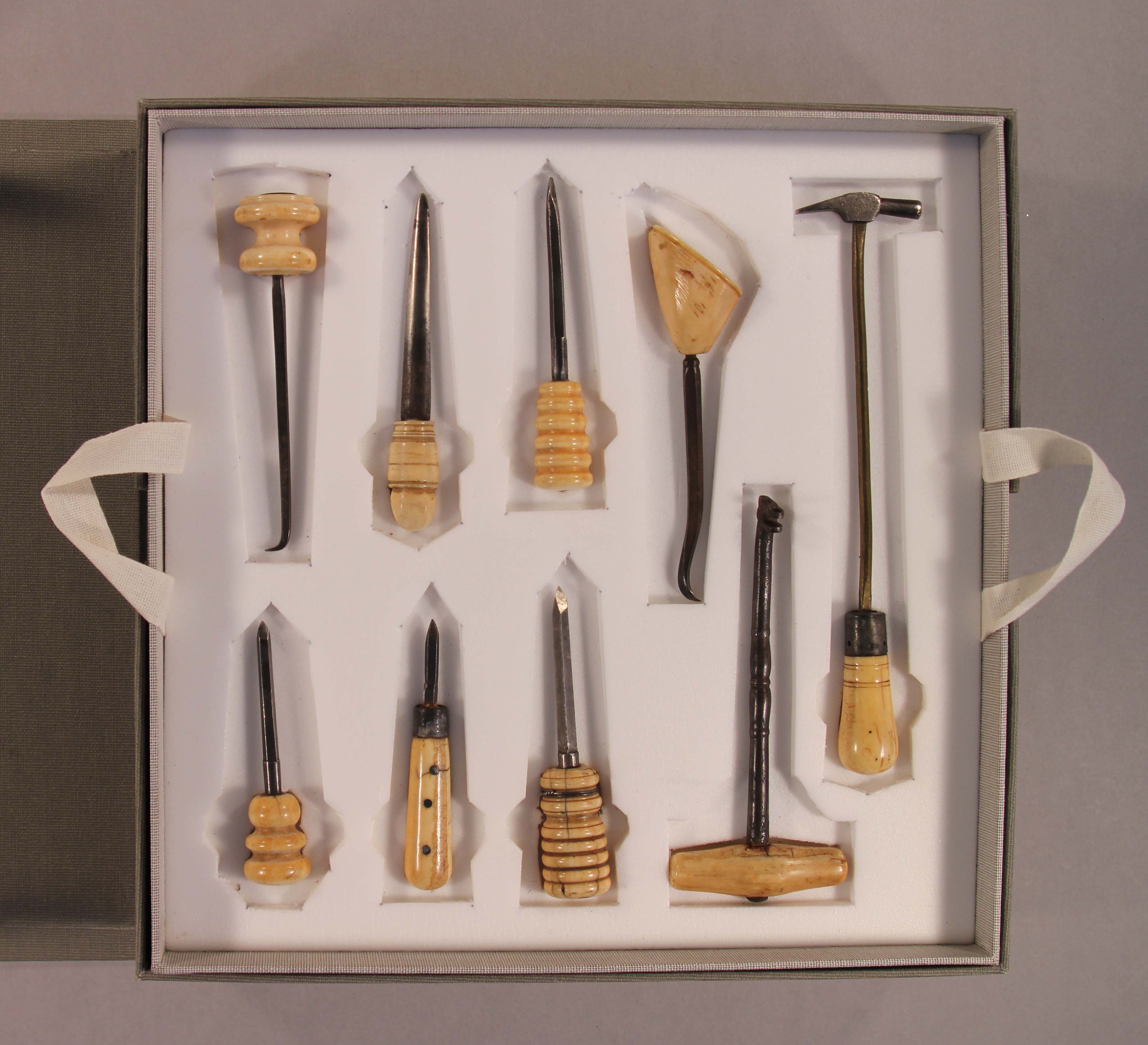
Following a recent upgrade of the heating, ventilation and air conditioning system in the special collections storage facilities at NYAM, the Gladys Brooks Book & Paper Conservation Laboratory received a group of artifacts associated with George Washington for stabilization:  (1) a plaster-cast facsimile of George Washington’s lower denture (the original, which is made of hippopotamus ivory, is currently on loan to Mount Vernon through June of 2013), and (2) a collection of dental tools (constructed out of hand-forged metal and bone and/or ivory) made and used by Washington’s dentist, Dr. John Greenwood (1760 – 1819).

plaster-cast facsimile of George Washington’s lower denture

Facsimile of Washington’s lower denture

9 ivory-handled dental instruments in custom fit tray

Greenwood’s ivory tools

++++++++++++++++++++++++++++++++++++++++++++++++++++++++++++++++++++++++++++++++++++++
Proper housing is an important element in the overall preservation of any artifact.  By protecting objects from improper handling and adverse environmental conditions (including light, water, dust, and pollutants), boxes and other types of protective enclosures — especially when made using pH neutral and chemically inert materials – can add decades to the life of an artifact.

In this case, the conservator’s custom-made boxes allow for easy access and display of the objects during tours and exhibitions.  Interior trays easily lift out of the structural exterior boxes, preventing the need to touch the objects themselves.

Facsimile denture in custom-made clamshell box

Custom-made box housing facsimile denture

If you take a close look at the denture, you will see engravings. They were made by Dr. Greenwood and read:  “This was Great Washingtons Teeth” and “First one made by J. Greenwood,” accompanied by the date 1789.  Several of the tools also carry an engraved message (albeit a slightly more ominous one):  ”[D]on’t touch these instruments.”  Thanks to their new box, it is now easy to honor Dr. Greenwood’s wish!

Close up of Washington's lower denture showing engraving saying "This was Great Washingtons teeth"

Original denture with engraving

The tools and the denture facsimile are all beautifully made and are now securely housed and preserved among NYAM’s special collections.  You can arrange for a tour to see the Drs. Barry and Bobbi Coller Rare Book Reading Room and some of NYAM’s many treasures by contacting history@nyam.org.

– The Gladys Brooks Book & Paper Conservation Laboratory

Fore-edge painting lecture and workshop

Fore-edge of book fanned to reveal fore-edge painting of William HarveyWe are thrilled about the upcoming Guild of Book Workers‘ events to be hosted at NYAM. Fore-edge painter Martin Frost is giving a lecture on October 19th and teaching a workshop on October 20th.

Seen at left, the NYAM copy of De Arthritide by John Booth, 1805, features a fore-edge painting of William Harvey.

For more information about either event or to register, please email newyork@guildofbookworkers.org.