Tracing the Transmission of Early Modern Recipe Knowledge in the New York Academy of Medicine Library

By Sheryl Wombell, University of Cambridge, and the Library’s 2024 Audrey and William H. Helfand Fellow.

In seventeenth-century Europe, knowledge about health and healing was shared with family, friends, and acquaintances. In the case of printed books, wider audiences were reached. A significant subset of these communications took the form of recipes: sets of instructions telling one how to make something. These might be instructions for making medicines in the home, with a range of ingredients from the inexpensive and easily sourced, to the rare and exotic products available due to expanding trade. Or they could be instructions to make culinary formulations, which were interpreted as having an impact on the body’s condition due to the lasting influence of the ancient theory of the four humours. Individual recipes, which could be as short as a line or as long as tens of pages, were gifted, traded, and passed around early modern social networks.

A letter penned by the courtier and privateer Sir Kenelm Digby, likely to Sir Richard Grenville, 1st Baronet of Kilkhampton, demonstrates the mobility of recipes in the mid-seventeenth century.i In it, Digby thanks Grenville for sending him a recipe for ‘Sir Walter Rawleys great Cordiall’ but questions its provenance:

I beleive th[a]t it came from me, for it agreeth word for word with my Receipt that I had out of his owne originall book written with his owne hand; & whereof I made at one time as much as stood mee in above 500 [pounds] sterling; & stored the Court, Citty, & Country with it; But I add to it, the Magistery of Rubies, of Emeralds of granales of amethystes, of Saphyres, of each halfe an Ounce to the proportion that you sayth, also, magestery of Crabbs Eyes [3 oz], of Crabbs Clawes [2 oz]; of Contra yarva stone [1 oz], of snakweed of Virginia, of Contra yarva root, of each halfe an Ounce and of Tincture of gold made by spirite of Honey [1 oz]; and I finde this much more efficacious.

The circular path of recipes that Digby describes – when a recipe he believes to be his own is unwittingly returned to him – is testament to the lively early modern traffic in recipe dissemination and collection.
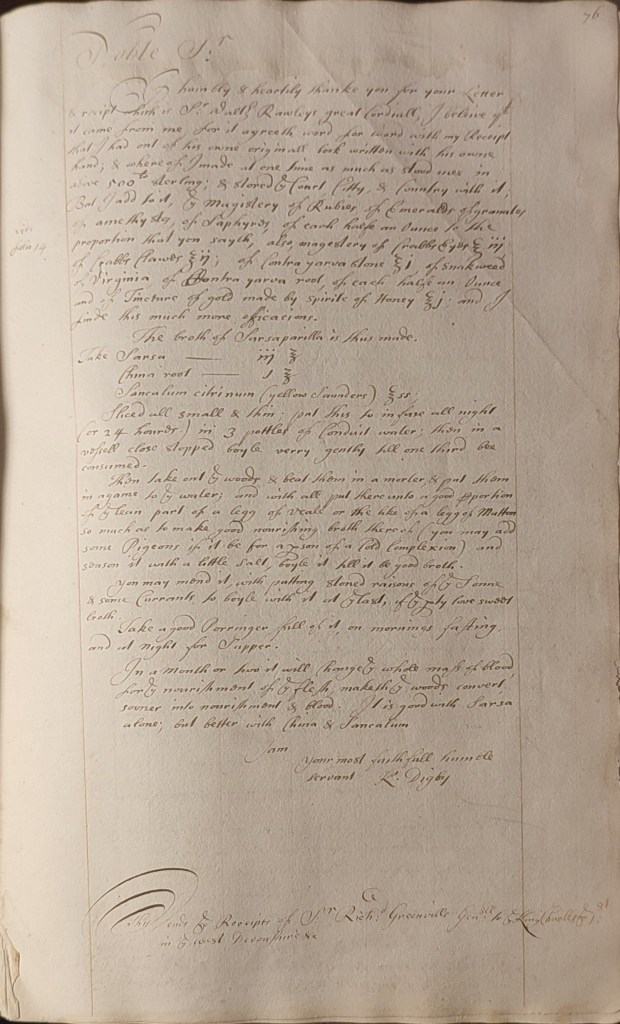
Fig. 1: Copy of a letter from K. Digby in MS ‘Old Doctor 1690’, f. 76, New York Academy of Medicine Library.

Manuscript collections of recipes survive in archives around the world, and the New York Academy of Medicine Library holds a rich cache of such volumes. Thanks to winning their Helfand Fellowship in 2024, I had the privilege of spending five weeks on a close reading of the early modern medical recipe collections at NYAM. This research forms part of my PhD project, which looks at the mid-seventeenth century production, management, and transmission of knowledge about health and healing amongst exiled and mobile elites, including Digby. While my work to date had focused on three key media – printed medical books, manuscript recipe collections, and consultation letters – somewhat in isolation from each other, at NYAM I had the time and resources to explore the relationships between these formats.

One such connection was the integration of transcribed letters into larger manuscript collections. Digby’s letter, for example, was copied into a large bound volume of recipes, letters, and transcriptions from printed books titled ‘Old Doctor 1690’. But in handling the manuscripts I was also confronted with material traces of transmission. In another manuscript, for example, is a recipe for ‘Costiveness to help’, that is, how to relieve constipation. Next to the instructions are two small, shiny blobs of dried red sealing wax. While this is not conclusive evidence that the recipes on the page were copied into a letter, it does indicate that the notebook lay open while a letter was sealed – and likely written – in its vicinity. Through this tiny physical sign, we learn something of the co-presence of writing and collecting practices across the distinct but interrelated media of letters and recipe books.

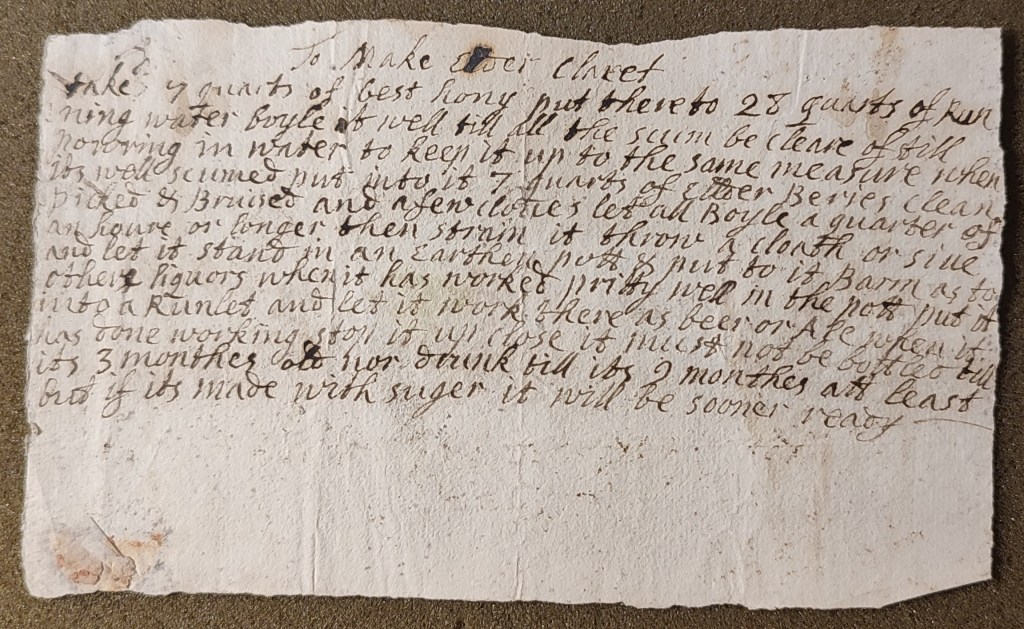
The objects of transmission themselves also appear in these recipe collections. A notebook belonging to Owen Salesbury holds a loose paper slip with instructions ‘To Make Elder Claret’ and sent ‘To Mrs Longford att her hous in Wrexham’. Folded slips could be enclosed in a larger letter, or they could constitute the entire missive. The inclusion of the address on this example suggests the latter. The contents of the slip were not transcribed into the body of the notebook but containing it within the bound volume preserved its knowledge. We don’t know precisely how or when a slip sent – or intended to be sent – to a Mrs Longford ended up in Salesbury’s manuscript, but it offers further evidence of the close connections between ephemeral letter formats and the more durable objects of recipe collections.
Spending time in the NYAM Library’s collections allowed me to get to grips with evidence of early modern recipe transmission. While digitised surrogates of manuscripts have been invaluable in my research, handling these collections has enriched my analysis by bringing their material qualities – size, varying durability, the spatial relationships between their contents, and signs of use – to the fore.

Further Reading:

Ken Albala, Food in Early Modern Europe (London: Bloomsbury Academic, 2003).

James Daybell, The Material Letter in Early Modern England: Manuscript Letters and the Culture and Practice of Letter-Writing, 1512–1635 (Basingstoke: Palgrave Macmillan, 2012).

Elaine Leong, Recipes and Everyday Knowledge: Medicine, Science, and the Household in Early Modern England (Chicago and London: University of Chicago Press, 2018).

Alisha Rankin, ‘Recipes in Early Modern Europe,’ Encyclopedia of the History of Science (2023), https://doi.org/10.34758/fvw2-w336.

Valentine’s Day Cards from NYAM

by the NYAM Library Team

On February 14th we observe Valentine’s Day!

Our previous blog posts on this commercial holiday highlighted both cards created for Valentine’s Day as well as trading cards from our collection. At the close of the 19th century, improvements in printing allowed for cheaper goods and paper cards for friends, lovers, and families to send written sentiments.

These early cards varied from caricatures of their subjects and beautifully drawn miniscule script, to what we now think of as Valentine’s Day cards – humorous or sentimental acknowledgements.

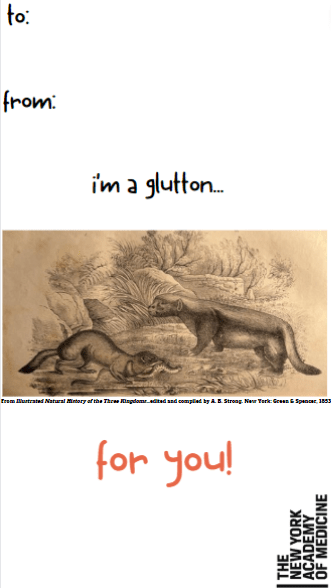
To celebrate this year, we have created six of our own Valentine’s Day cards featuring images from our collections. One is for the celebration of the popular Galentine’s Day, a celebration of friendship.

Feel free to print out and share with your loved ones!

From Sei sparsam!… by Anny Wothe (Leipzig, 1900.)
From Historiæ animalium... by Conrad Gessner (Zurich, 1551.)
From Illustrated Natural History of the Three Kingdoms…edited and compiled by A. B. Strong (New York, 1853.)
From De motu cordis et aneurysmatibus… by Giovanni Maria Lancisi (Neapoli, 1738.)
From Ryzon Baking Book compiled and edited by Marion Harris Neil (New York, 1917.)

The Long Haul of Disability Advocacy

By Logan Heiman, Digital Collections Manager

The United Nations has observed December 3 as International Day of Persons with Disabilities since 1992. The 30th annual observance of this day comes at a time when disability has gained renewed salience in the midst of the COVID-19 pandemic. A subset of the approximately 50 million Americans infected with COVID-19 experience what some call “long COVID,” which the United States Department of Health and Human Services defines as having the following symptoms, among others: 

  • Tiredness or fatigue 
  • Shortness of breath or difficulty breathing 
  • Headache 
  • Difficulty thinking or concentrating (sometimes known as “brain fog”) 
  • Chest pain 

In guidance issued in the summer of 2021, the U.S. Department of Health and Human Services Office of Civil Rights defined long COVID as a disability under the Americans with Disabilities Act, the Rehabilitation Act of 1973 (Section 504), and the Patient Protection and Affordable Care Act (Section 1557). Though firm numbers have yet to be produced, medical specialists believe that between 750,000 and 1.3 million Americans languish under the debilitating effects of long COVID such that they are unable to return to the workforce full-time. This phenomenon has prompted disability activists like Fiona Lowenstein, Hannah Davis, and Imani Barbarin to describe the COVID-19 pandemic as “one of the largest mass disabling events in modern history.”  

The emergence of long COVID as a significant and potentially long-enduring affliction for millions around the world has further fueled questions about comprehensive tracking of long COVID cases;, the capacity of hospitals, disability benefits administrations, and workplaces to meet the needs of long COVID patients; and how to successfully move into a post-pandemic phase. Long COVID has also spurred on the efforts of disability activists to bring attention to the obstacles long COVID patients will face going forward as they seek to participate in the workforce, receive accommodations in educational institutions, and secure proper care within medical systems that sometimes write off the symptoms of long COVID sufferers as “psychological.” 

COVID-19 and its potential to create a generation of people with disabilities carries echoes of the long-term impact of the polio epidemic. Like its COVID counterpart, post-polio syndrome (PPS) was not well understood and drew little interest from the medical and scientific communities for much of the late 19th and 20th centuries. After the rollout of the polio vaccine in the 1950s, polio largely disappeared from the industrialized world with the neurological effects of PPS not appearing in many polio survivors until the 1970s and 1980s. Best estimates of the number of polio survivors with PPS were thought to fall between 81,000 and 184,000 in 2006. Although the polio epidemics that raged throughout the 20th century led to summer camps for children with polio such as Camp Sea Haven on Plum Island in Massachusetts and rehabilitation centers, similar support and advocacy had not materialized for PPS patients whose symptoms were met with skepticism within the medical community.

PPS eventually did come to receive some legitimacy and attention from scientists and medical professionals culminating in the 1994 gathering of the leading polio researchers in the world organized by the National Institutes of Health (NIH) and the New York Academy of Sciences. However, recognition of the condition‘s importance may have come too late to generate an increase in new lines of research. As disability historians like Lennard J. Davis of the University of Illinois at Chicago point out, grassroots advocacy must often be joined with intensive lobbying and political will before disabled populations see the changes they need.  

For those suffering with long COVID, their advocacy early on in the COVID-19 pandemic offers signs of hope for action within medical circles to produce research and resources for post-COVID recovery and treatment. Advocacy groups like LongCOVIDSOS document their symptoms online and organize meetings with officials from the World Health Organization (WHO) in a sign that the world’s leading public health bodies are paying attention to the impact of long COVID across the globe. And in February 2021, NIH announced Congress’s allocation of $1.15 billion for a long COVID research initiative.  The impact of chronic illness and disability on potentially millions of people worldwide will be an important area of focus for the medical community, governments, and activists well beyond the COVID-19 pandemic.