The Art of Anatomy with the Art Students League

By Arlene Shaner, Historical Collections Librarian

In July 2023, artist and teacher Dan Thompson brought a group of students to the Library’s Drs. Barry and Bobbi Coller Rare Book Reading Room. The students were here in New York for a week-long workshop organized by the Art Students League, “Musculoskeletal Gross Anatomy for the Figurative Artist.” We looked at anatomical atlases dating from the early 16th through the mid-20th centuries. Viewing items from our collection—like the first two images here—and engaging with the students made up the first day of the workshop. The balance took place in the Weill Cornell Medicine anatomy lab, where students worked directly with cadavers.

From Nouveau recueil d’ostéologie et de myologie…, 1779, by Jacques Gamelin

As the course description explains, “This course presents the study of anatomy as a convergence between anatomical and structural drawing. Motivated students of representational art will have unparalleled opportunities for developing detailed anatomical knowledge through their work in Cornell College of Medicine’s anatomy lab, where they will explore the complexities of the body through the study of prosections and cadavers. Prosections are specially prepared human anatomical specimens, wrapped in a damp preservative, as well as plastinated specimens, which allow for the study of deeper and more isolated anatomical structure. Through laboratory drawing, participating students will become more familiar with the manner of interlocking deeper forms—forms which are not typically clear on anatomical models (due to the haphazard ways that art school skeletons are wired together). Ultimately, students will work towards achieving greater anatomical clarity and validity in their drawing studies, which will be applied to creating higher quality figurative work in the visual arts, from a finer appreciation of human construction.”

From Anatomie du gladiateur combattant…, 1812, Jean-Galbert Salvage

Dan teaches at the New York Academy of Art and I have hosted Dan’s New York Academy of Art students here for several years; I first hosted his workshop for the Art Students League in the summer of 2022. This year Dan invited me to visit Weill Cornell’s anatomy lab with the workshop class so that I could gain a deeper understanding of how he teaches with human specimens and watch students make their own drawings and sculptures from cadavers, prosections, and plastinated specimens. Being in the anatomy lab was, for me, a transformative experience, as I had never had the opportunity to see actual cadavers and specimens and think about their relationship to images from historical texts that I share with classes when they visit. 
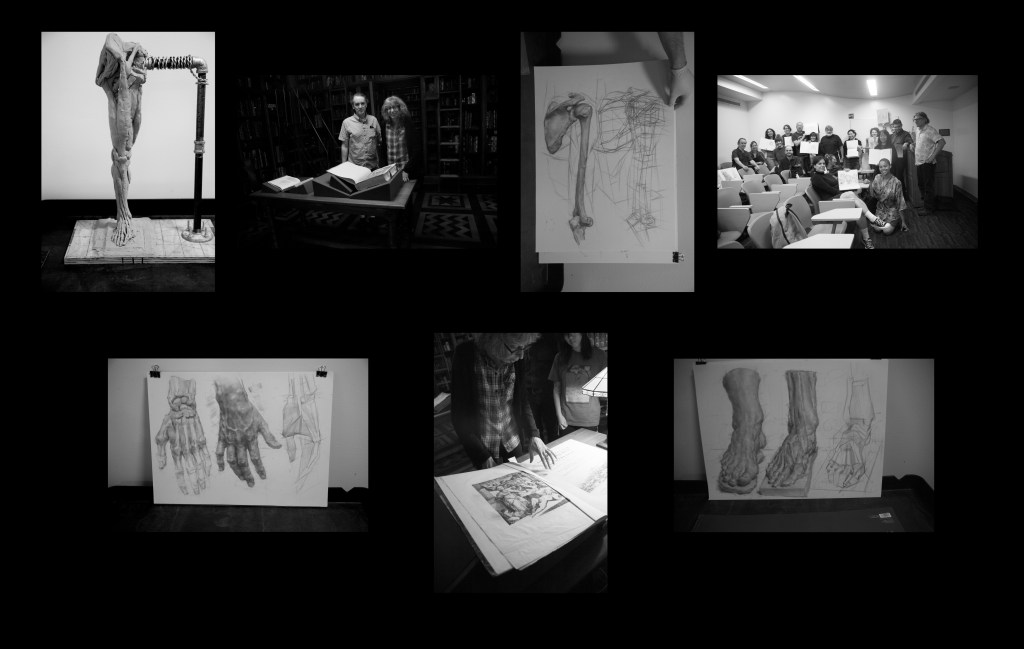
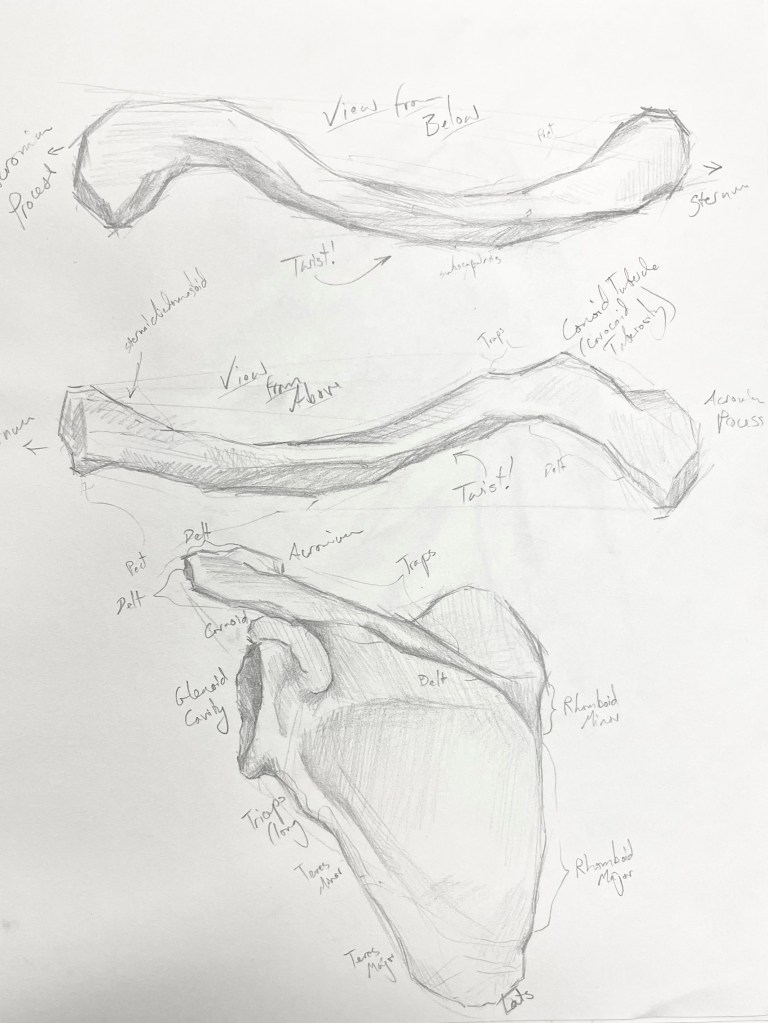
Workshop participant Karina Fuhrman shared images from the visit to the rare book room. The drawings were done by Dan Thompson and the sculpture was done by Karina during her time in the dissection lab.

After the class had ended, I asked if the students would be willing to send their work to me so that we could share it with a broader audience. Many sent images, and it is a privilege to be able to show some of those here.

Artist: Alan Lee
Artist: Anna Charuvastra
Artist: Chalice Mitchell
Artist: Eva Avenue
Artist: Jae Park
Artist: Kristin duCharme
Artist: Renee Wang

Classes from many local institutions regularly visit the rare book room to engage with materials from our collections. Dr. Evelyn Rynkiewicz, who teaches at FIT, has brought her class “Disease Ecology in a Changing World” more than once. After their 2022 visit, she wrote a blog post about the experience, which you can find here.   
 
If you are interested in bringing your class to the New York Academy of Medicine Library, please reach out to ashaner@nyam.org.
A Summer Script for Relaxation

by Anthony Murisco, Public Engagement Librarian

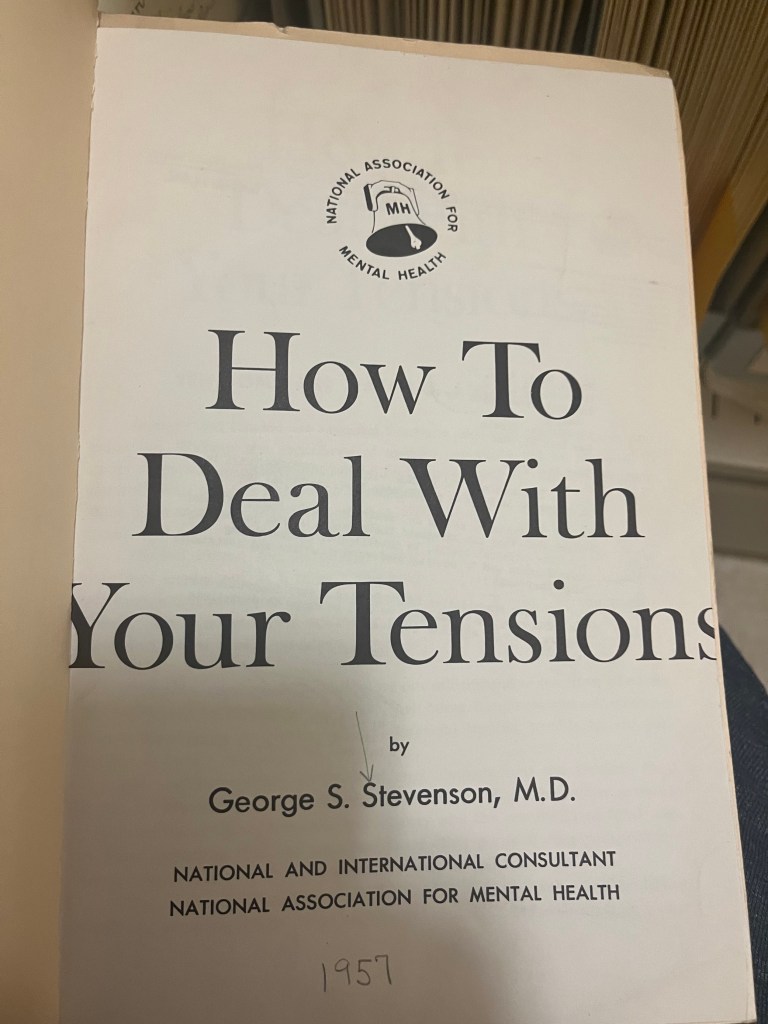
Relaxation is just what the doctor ordered! Specifically, Dr. George S. Stevenson of the National and International Association for Mental Health. In his book, How to Deal with Your Tensions (1957), he says that “anxiety and tension” are essential parts of being alive. If we did not experience these feelings, we wouldn’t be equipped to manage the high or low-intensity situations we experience day to day.  It is indeed an anxious time. We face threats such as climate change and the spread of misinformation. Writing in 1957, Dr. Stevenson spoke of real high tensions his society faced, “While it is true that we live today under pressure of intense competition, economic uncertainty, and the possibility of war…” Stevenson continued, “our ancestors faced other perils of equal magnitude.” It is important to realize each generation has its own struggles. 

The title page of How To Deal With Your Tensions by George S. Stevenson, MD. It carries the seal of approval from the National Association for Mental Health. The emblem for that is a large bell with MH inscribed on it.

Dr. Stevenson produced eleven tenets for dealing with our feelings. These range from “Talk It Out” to “Shun the ‘Superman’ Urge’ to “Give the Other Fellow A Break.” We know these ideas but hearing them prescribed feels different.

One of Stevenson's tips. This says "7. Shun the "Superman" Urge" and features a balding man with glasses and a pipe wearing a costume similar to Superman. His hands are at his sides in classic Superman fashion.

The two that we want to focus on are #2, “Escape for a While,” and #11, “Schedule Your Recreation.” His ideas of escape are not necessarily jetting off to an island vacation! You can find escape by “[losing] yourself in a movie or a book or a game.” Even a “brief trip or change of scene” can make you feel relaxed. Public parks are beautiful places to go for a stroll. 

Scheduling recreation is sometimes hard—especially for an adult. When  we are younger, we get scheduled vacation. The summer is ours! As adults, we have more responsibilities. As Dr. Stevenson mentioned, we don’t have to schedule a week-long trip! We can buy tickets in advance to the latest blockbuster or art-house film. We can schedule an hour or two before bed to transport ourselves with the help of a book. 

Another of Stevenson's steps is "11. Schedule your recreation." This image features a woman making a ship in a bottle. She stands next to an array of tools while she places a tiny tool into the bottle. It looks as though she has almost finished the project.

This summer we asked, “How are you recharging?” We want to hear what recreation and relaxation you have been taking part in. Dr. Stevenson has spoken of the benefits but so have others. 

In 1924, Joseph Ralph, a psychologist and psychoanalyst, declared that he had found the fountain of youth. It was not in some unobtainable secret cave, and he was not going to keep it to himself. The secret to still being young was electronic relaxation, a method of inducing tension.

The title page of "The Man Who Stopped Growing Old." This features a portrait of the subject, Jason Ralph. It identifies him as well as his profession of psychologist and psycho-analyst.

Ralph declared that the secret to eternal youth lived in the cell’s protoplasm. Through wear and tear, the protoplasm becomes weak, causing us to age. The agent responsible was not our physicality but instead our mental conflicts. Our intense emotional reactions cause the protoplasm inside the cells to harden. If hardened, they can no longer provide us with the energy we need. He deduced that this is why we acted “older.”  By creating tension, Ralph believed the protoplasm was being stretched and worked out like a muscle.

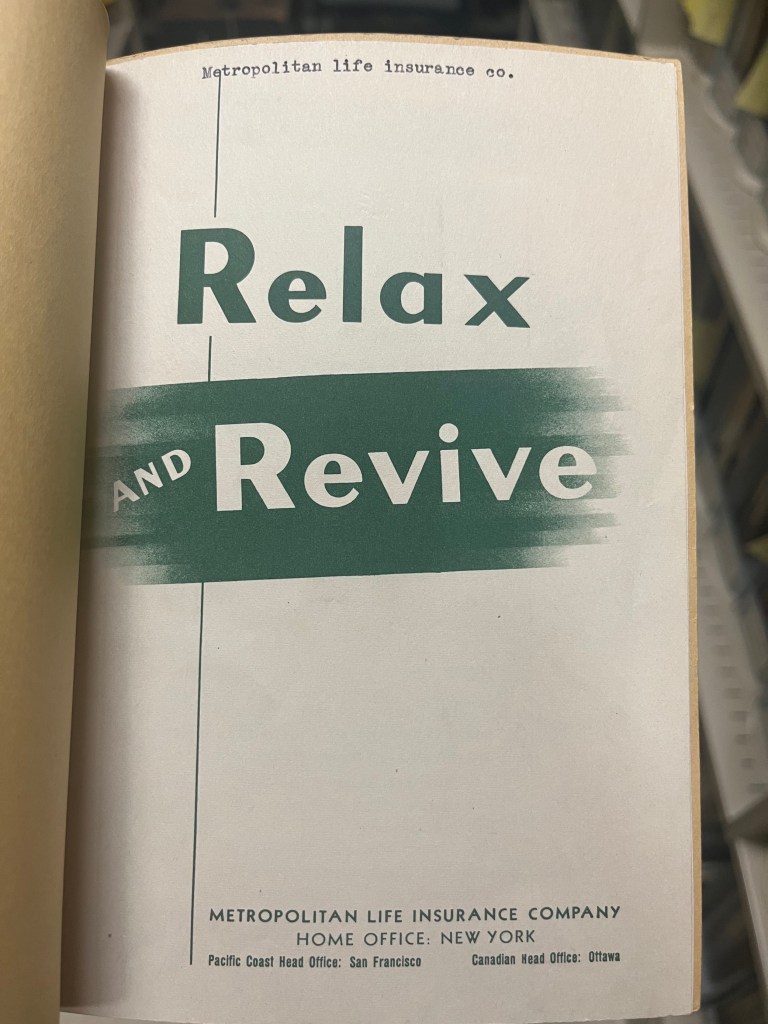
Even your insurance company wants you to relax! Metropolitan Life Insurance gave advice in their pamphlet “Relax and Revive.” In comparing the body to the mechanical machines, we use daily, they remind us that “extra care avoids shutdowns.”

The title page for Relax and Revive by Met Life. The font is turquoise.

Whether we get a day, a whole weekend, or the entirety of a season, it’s important to carve out time for yourself. As Met Life put it, “How you use your precious hours of leisure is of the greatest importance in keeping yourself fit, and in fighting the good fight on the home front.” To take care of what you need to take care of, you have to start with yourself.

Like Dr. Stevenson, the insurance company wanted you to figure out what works best for you. Besides the typical ways we think of recreation, the pamphlet stated that perhaps just sitting there is what works for you! “Maybe idleness is your recreation. That’s all right too.”

An image of a man showing the fish that he and his son caught to his neighbor. The two adult men are separated by a fence. The boy has climbed the fence to proudly speak with his dad.

While we all may have ideas of what recreation is, it looks different for all. We wanted to share how people have been relaxing so far this summer. We’ve gotten pictures, postcards, and stories from fellow NYAM staff, friends, family, and patrons. We thank everyone for their responses so far.

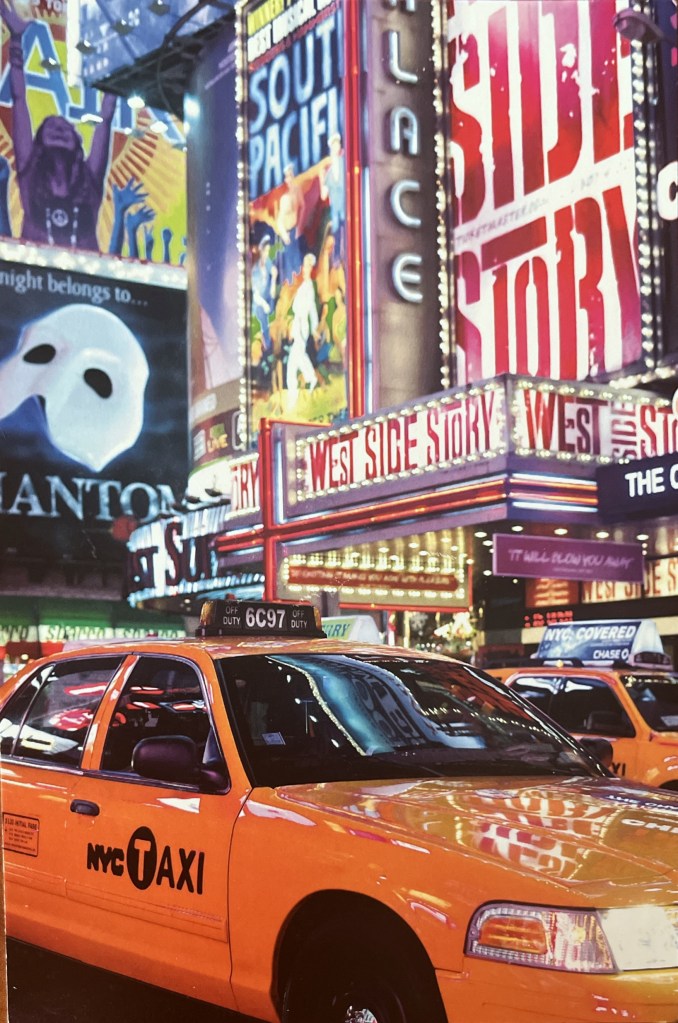
The staff here at NYAM filled out beautiful New York City—centric postcards. They relayed their goals for the summer, which included personal goals (vacations, exercise, spending time with family and pets, and of course, recovery), as well work goals (planning notable events, organizing office space, and remembering to respond to emails on time).

A colorful illustrated postcard of times square. The iconic yellow taxi rides through the street. Marquees for Broadway productions illuminate the sky. They are Phantom of the Opera, West Side Story, Hair, and South Pacific.

We even got a response from a friend of a famous 100-foot-tall ape…

A response that reads "This summer I am climbing the Empire State Building with a giant gorilla."

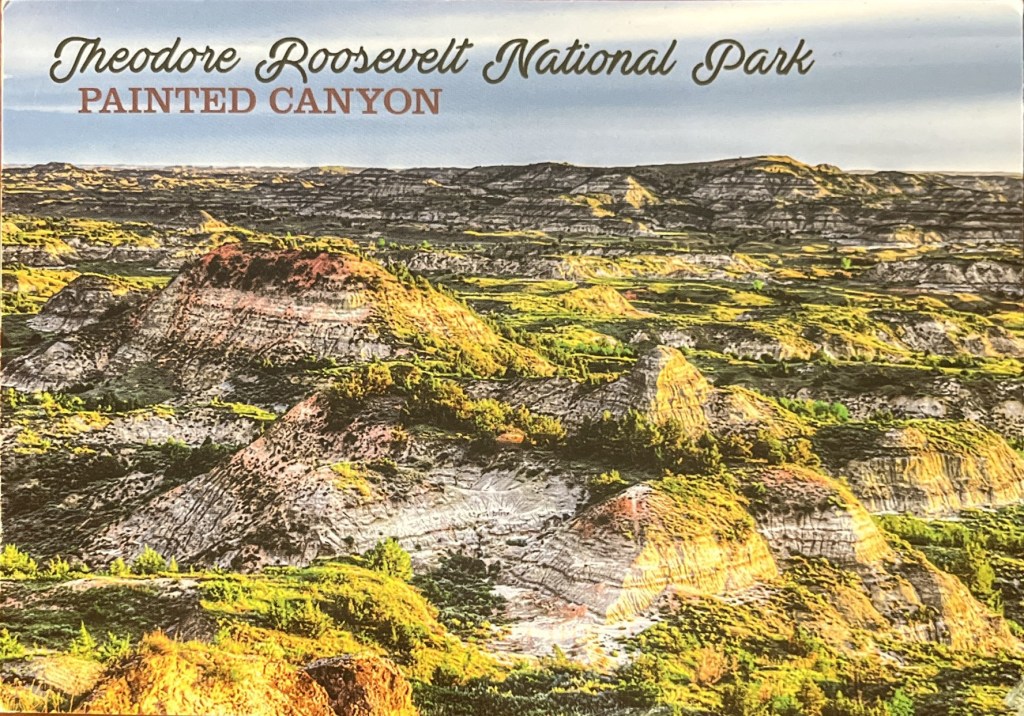
Parks are always fun to visit during the summer. This one comes from Theodore Roosevelt National Park in North Dakota, one of 63 with that distinction.

A scan of a postcard from Theodore Roosevelt National Park. This shows the Painted Canyon. The canyon appears very yellow.

Indiana seems like a popular destination this summer. Three of our postcards come from different parks there.

Rachel visited Wolf Park and talked about the different wildlife she saw there, including foxes, turtles, and of course, wolves! She mentioned how the park gave her tips on how to help the wildlife there and in the larger environment.

A scan of a postcard from wolf Park. Three wolves are howling to the left. There is another wolf who is howling to the right,.

Megan went on a trip to Turkey Run State Park in Indiana where she went on a hike for her recent birthday. She loved being in nature with her sister and best friends.

A scan of a postcard from Turkey Run State Park. It shows a walking bridge surrounded by green trees.

Our Historical Collections Librarian sent a postcard from a road trip she took. One of her stops brought her to the Indiana Dunes National Park. There she got to walk along the Lake Michigan Shoreline!

A scan of a postcard from Indiana Dunes National Park. It is the shoreline of Lake Michigan. The sun is setting right in the middle.

One of our patrons, Dr. Sharon Packer, sent us these photos from Bearsville, New York. The pictures remind us of the beauty and therapeutic power of relaxing in our natural environment. For those in a big city, it’s nice to get away for a bit. We are lucky to live only a train ride away from such different scenery. There also looks to be delicious home cooking! Both making and eating are perfect relaxation practices.

A photo with a blooming pink flower in frame. Behind it is a small, shy brown dog looking at the camera.
A delicious looking quiche that is set in front of a red barn. The quiche has cut scallions on top.

We don’t want to scare you; the summer is not over yet! With that, we are still collecting postcards and pictures.

Postcards/letters can be sent to:
Attn – NYAM Library
The New York Academy of Medicine
1216 Fifth Avenue
New York, NY 10029

Or you can always e-mail us at: librarysocial@nyam.org.
We look forward to hearing from you! And more importantly, we hope you are having a relaxing summer.

A large pink flower is in focus.

References:
Harris, Antron. The Man Who Stopped Growing Old : Joseph Ralph, Psychologist and Psycho-analyst, Discoverer of the Electronic Relaxation Method of Mental and Physical Rejuvenation. B.F. Tibby, 1924.

Metropolitan Life Insurance Company. Relax and Revive. Metropolitan Life Insurance Company, 1920?.

Stevenson, George S. How to Deal with Your Tensions. National Association for Mental Health, c1957.

Hello, Summer!

By Anthony Murisco, Public Engagement Librarian

As we pass the longest day of the year, we arrive at summer!  

We began our celebration of the summer with the annual Museum Mile Festival on Tuesday, June 13th. Each year, all the cultural institutions along 5th Avenue get together to highlight what we have to offer. Think of it as a block party for museums! The stretch starts around 85th Street with The Met and ends at 110th with The Africa Center.  
 
This year the Museum Mile Festival celebrated its 45th anniversary. It also happened to be the 100th birthday of our neighboring institution, The Museum of the City of New York! From where we were set up, we could hear the titular song from the new musical “New York, New York” in observance. 

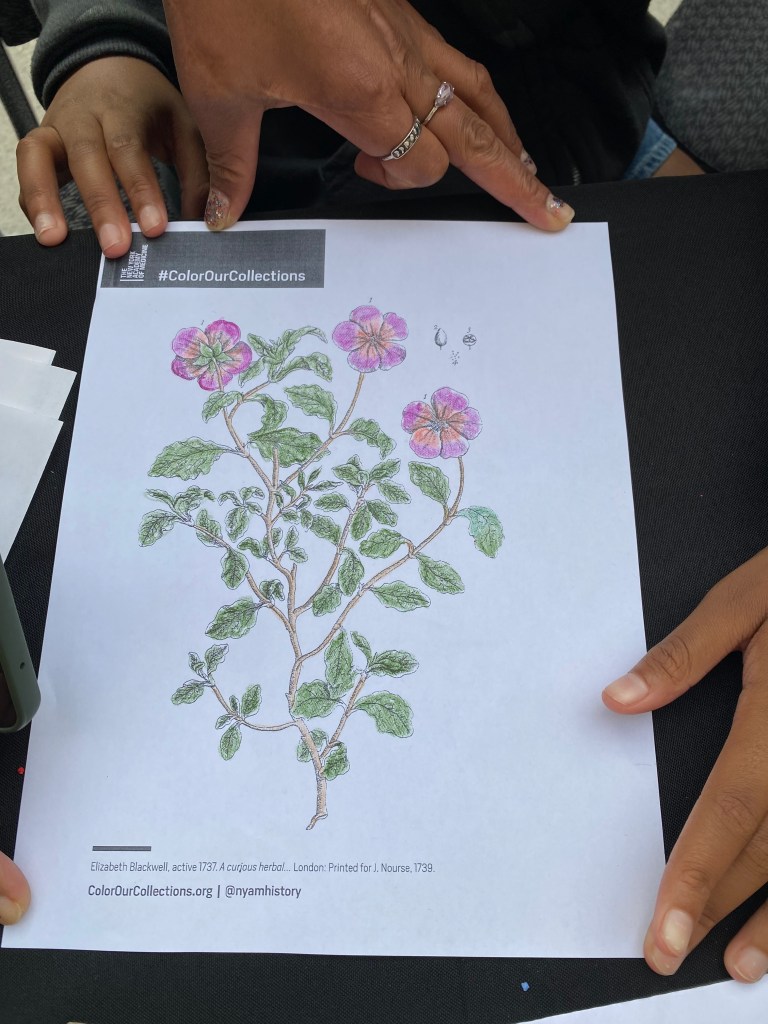
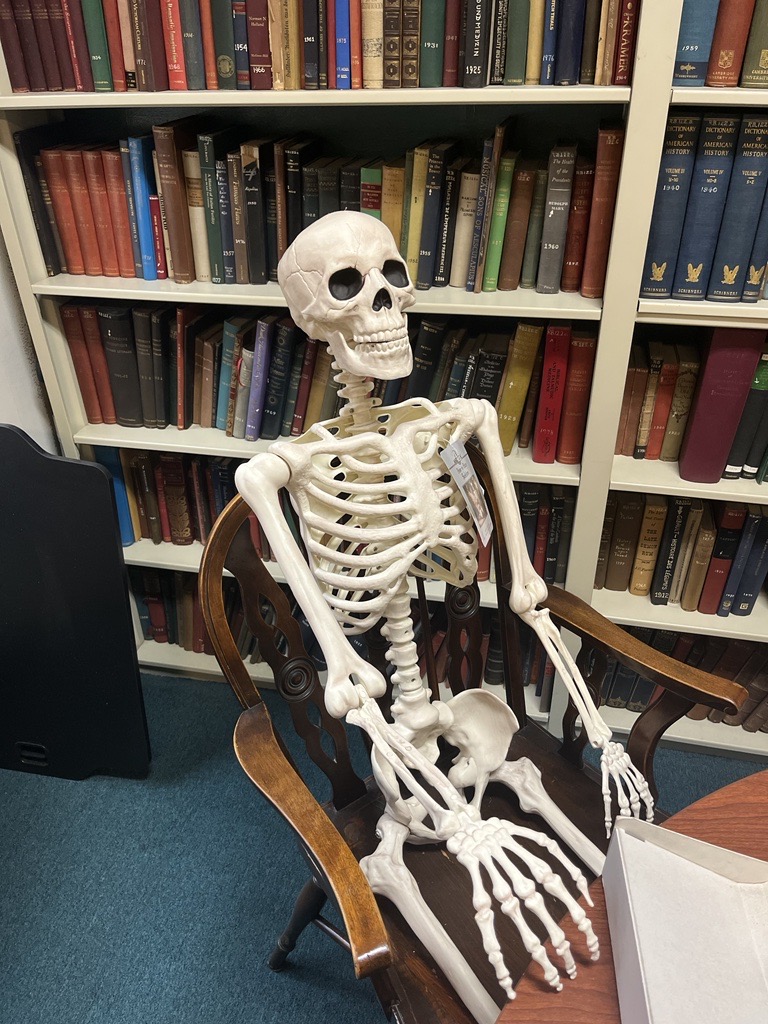
NYAM’s table was set up outside 103rd Street right across from Central Park. Our set-up highlighted the treasures from our collection with replicas of assorted pamphlets. This included a photo-op with our new skeletal employee. There were plenty of crayons on hand for visitors to engage in sheets from our Color Our Collections coloring books. Sidewalk chalk was on offer to decorate the closed city streets.  

The NYAM Team enjoyed talking with the passers-by. These encounters gave us ideas on how best to invite the community through our doors to engage with our organization. A reminder that throughout the year on the first Monday of every month at 12 pm (holidays excepted), we offer tours of our library highlighting a portion of the collection. While we understand it may not be possible for some to attend, we continue to look for other ways to highlight our rich holdings.  

For some, the Museum Mile Festival is their unofficial kick-off to summer. Others wait for the official start on the day of the summer equinox. Students may celebrate on the last day of classes when their summer vacation starts. 

While not all of us get that traditional summer vacation, the season brings to mind the need for some real relaxation. Whether it be lying by the beach, going for a run in the park, or seeing your favorite baseball team play, we each have our own ideas of what it means to take it easy. It could be a tropical vacation that’s been on your calendar for months, or a day trip you take with friends out East to a winery. One doesn’t have to spend time lamenting a lost youth!  

Some like to relax by swimming. We’ve previously investigated tips and tricks to make your swimming more artful or, the proper scientific form. Others visit different places. Our blog has also shared what happens when the God of love needs some rest and relaxation. It goes to show that if they need it, we do too. 
Here at NYAM, we want to hear how you are spending this leisure time. Send us a postcard detailing what you’ve been up to in your downtime or  some photos or videos (no faces please!) at librarysocial@nyam.org or the New York Academy of Medicine, 1216 Fifth Avenue, New York, NY 10029 (Attn: Library). We’re excited to see what you are up to!  

Throughout the summer we hope to share with you what others have been doing. We need to recharge once in a while. Your relaxation tips might inspire others! You never know what may lie in your own backyard.  

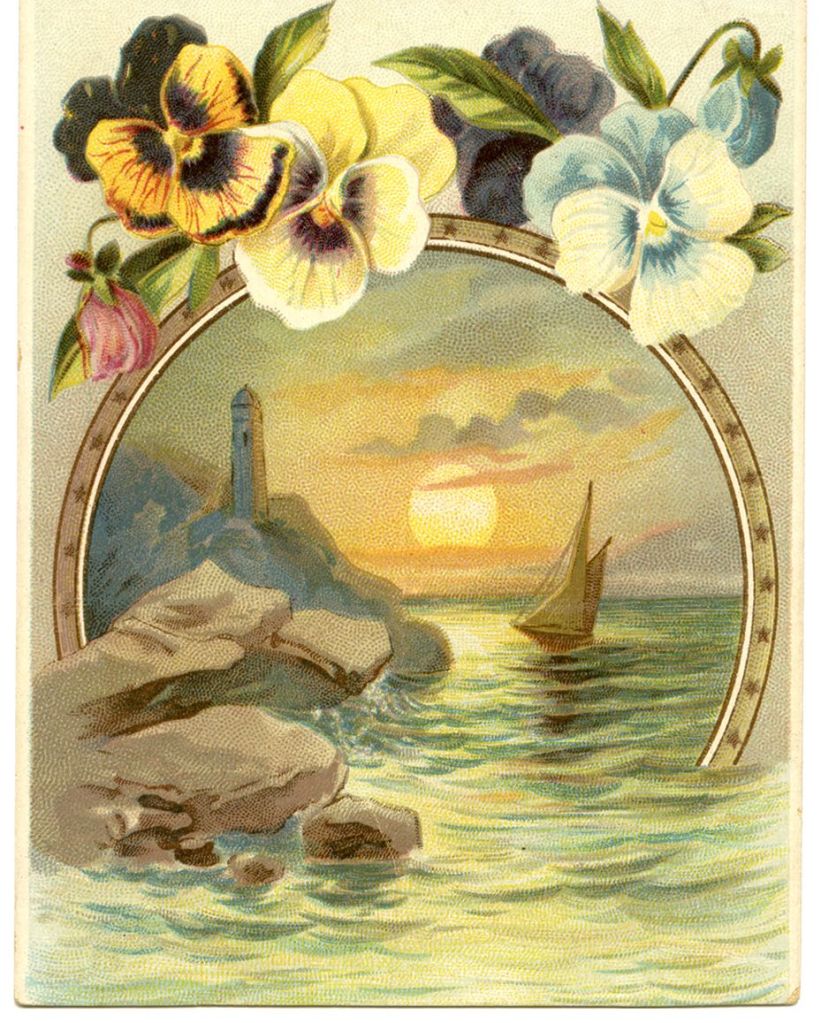
(Enjoyed the colorful, illustrated images? They come from our William H. Helfand Collection of Pharmaceutical Trade Cards collection which is available to view online!)

May 2023 NYAM Library Wrap-Up

By Anthony Murisco, Public Engagement Librarian

May brought us flowers and a lot to celebrate on social media!

Throughout the month of May we observed Mental Health Awareness Month. This included sharing information and graphics from the National Alliance on Mental Illness. On May 11, we observed National Children’s Mental Health Awareness Day. Kids often imitate adult behavior. Passing down healthy habits, including ones related to mental health, is imperative!

A colorful illustration of a group of kids. They are in front of a door. One boy is tying roller skates. A blonde haired girl is running to another boy who is riding a fake horse with a cowboy hat.

The popularity of Star Wars continues to this day. Just after the movie’s premiere in the late 1970’s, President Carter and the National Immunization Program asked the film’s two droids, R2-D2 and C-3PO, to star in a campaign promoting immunization. A television commercial and a poster were made for this, with the latter in our collection.

The Star Wars droids are asking parents of Earth to immunize their children in this printed PSA.

School nurses are some of the first healthcare workers that children meet. On May 10th we celebrated them. National School Nurses Day invites us to thank these caregivers. This photograph from Health Work in the Schools by Ernest Bryant Hoag and Lewis M. Terman shows a school nurse in action.

A black and white image. Caption reads "School nurse recording pulse and temperature in an open-air class."

Who better than to help us celebrate Mother’s Day and Women’s Health Week than the Roman goddess of women’s health, Juno. She made her appearance in 1950 at the Cleveland Health Museum, helping to explain how the female body worked.

A photograph of the transparent Juno statue from the side. Juno is a life-size woman.

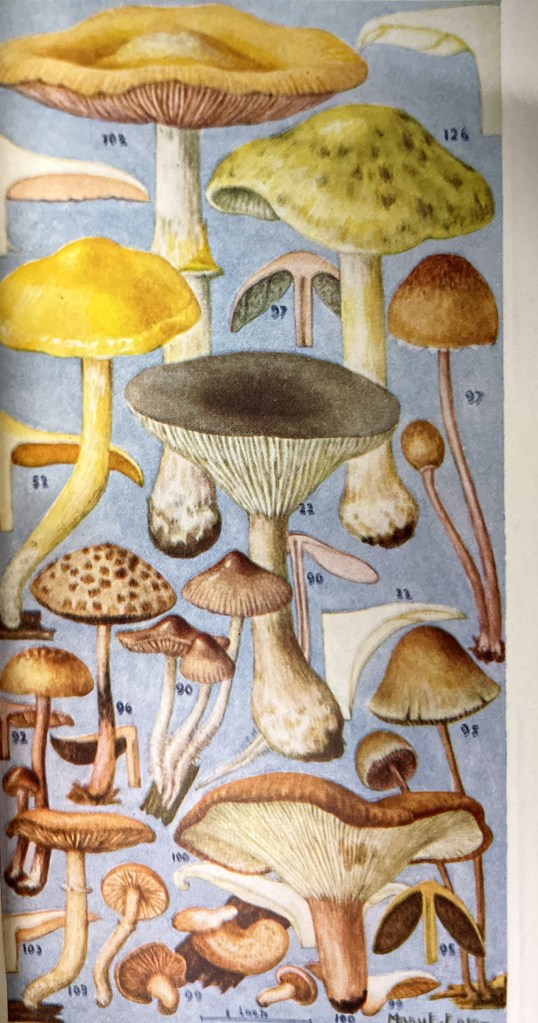
Do you like foraging for your food? Then you probably celebrated National Mushroom Hunting Day on May 17th. The Field Book of Common Gilled Mushrooms by William S. Thomas helps you identify which you can eat and which you cannot!

A colorful illustration of various mushrooms.

World Goth Day happened on May 22nd. The macabre is at the forefront of this often-misunderstood subculture. We showed off some of the many skeletons in our collection, including this from The Last Will and Testament of Basil Valentine by Basil Valentine.

A skeleton stands on a platform.

One of New York City’s prominent bridges, The Brooklyn Bridge, celebrated its 140th birthday on May 24th. It appears on a card from our William H. Helfand Pharmaceutical Trade Card collection promoting Lydia E. Pinkham’s Vegetable Compound.

The front side of the trading card. A drawing of the "East River Bridge" is front and center with ships sailing around it. Lydia E. Pinkham's Vegetable compound is a featured banner in the middle of the bridge.

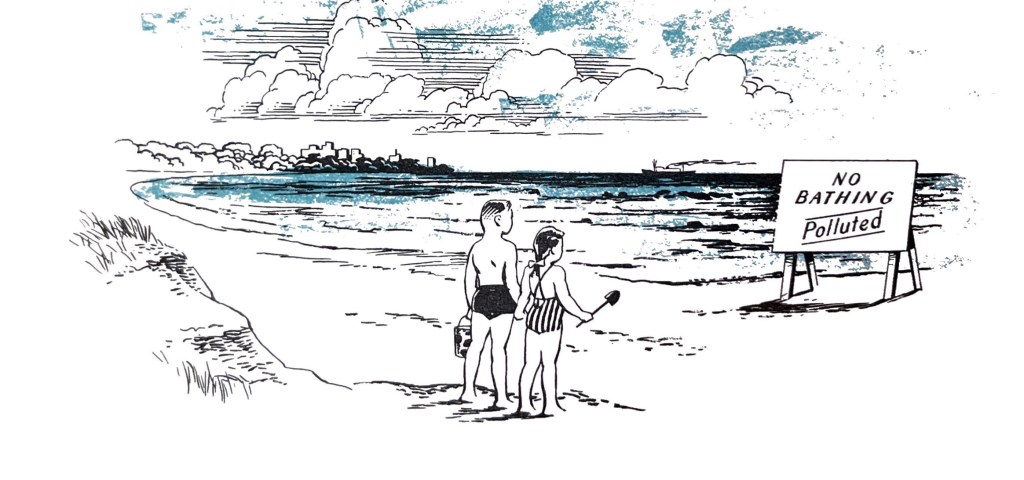
International Plastic Free Day on May 25th seeks to have at least one day without single-use plastics. The day usually falls around Memorial Day, a long weekend often spent enjoying picnics, the beach, or hiking, all occasions tempting us to be wasteful. To keep on enjoying, we need to squash the usage of these products.

An illustration of two beach-goers unable to go to the beach. A sign reads "No Bathing. Polluted."

Throughout the month, artists used the hashtag and prompt #MerMay as a creative inspiration signaling mermaids and mermen. Towards the end of the month, we shared another image from the Helfand Trade Card collection, this one featuring the aquatic folk using Ayer’s Hair Vigor to attract sailors.

Four mermaids are applying hair tonic. In the background a fifth mermaid is approaching a ship.

Finally, we are counting down the days until Museum Mile Festival 2023! On Tuesday, June 13th, cultural institutions along Museum Mile on 5th Avenue will be celebrating with extended hours, giveaways, and a look inside the collections. The NYAM Library will be set up at 103rd and 5th—come visit us!

The New York Academy of Medicine Library posts updates like this throughout the week. We can be found online over at Facebook, Instagram, and Twitter. Check back here or on our social media for more chances for a look inside our collection!

A skeleton sits in a chair. They are surrounded by old books.

Speaking For Themselves: Mental Health Memoirs

By Anthony Murisco, Public Engagement Librarian 

Since 1949, May has been recognized in the United States as Mental Health Awareness Month. The National Association for Mental Health, now Mental Health America, set up the month of educational events to clear up misconceptions about mental health and provide resources to those who need them.  

The knowledge of public health is always changing. What may have been taken as fact years ago is not necessarily the truth now. This is true for understanding mental health, or formerly, mental hygiene.  


From November 8th to 15th in 1912, the National Committee for Mental Hygiene and the Committee on Mental Hygiene of the New York State Charities Aid Association hosted a conference at the College of the City of New York. These two organizations brought together some of the leading minds on the subject. This was a relatively new idea. Modern understanding of psychiatry had begun less than a hundred years earlier.  

The goal of this conference was what the public could do regarding their own mental health. They came up with six tenets. 

While worded harshly in today’s terms, these suggestions try to offer a compassionate understanding of mental illness. The fourth, “Speak and think of insanity as a disease and not as a crime,” stands out as something we continue to struggle with today.  
 

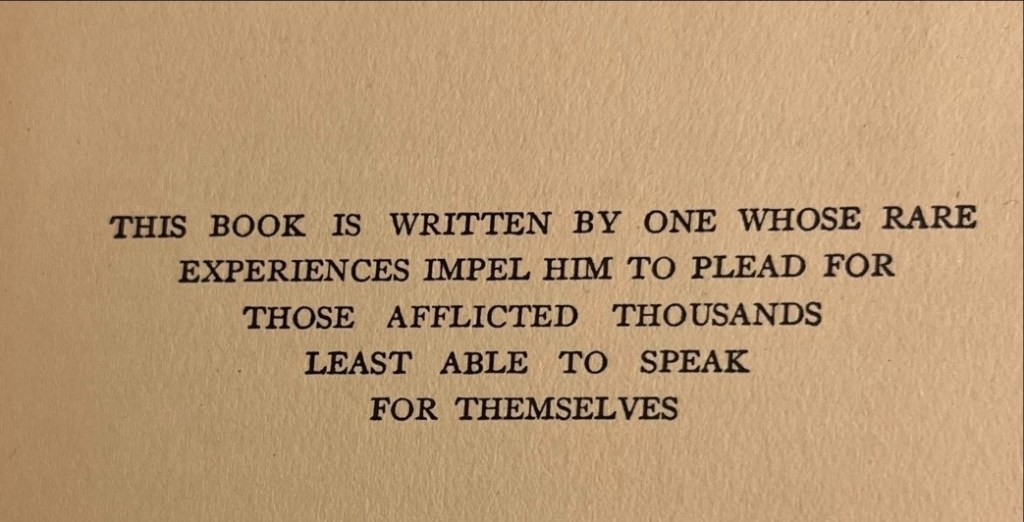
One of the forefathers of the mental health awareness movement would not be considered a traditional mental health expert. Clifford Whittingham Beers was born in 1896. Mental illness ran in his family. He himself served several stints in mental institutions. Upon the cruel treatment inflicted upon him at these hospitals, he went on to write a memoir on the subject. In A Mind That Found Itself, he writes of the degradation that he and his fellow patients were subject to. This memoir was key to providing a voice for those who were afraid to speak of their own illness. In 1909 Beers founded the organization now called Mental Health America.  
 

From the first edition of A Mind That Found Itself.

Since the publication of Beers’ book, several writers have explored their own experience. These mental health memoirs offer both guidance and companionship to those who also suffer. They provide maps for those who care about those who may be suffering and allows a peek inside minds that many cannot comprehend.  

Some of these authors bring humor to their reflections.  Two funny people wrote about their own struggles. Kevin Breel is a Canadian comedian. He also suffers from depression. His memoir, Boy Meets Depression, allows readers into the mind of someone who experienced the mental illness early on in life. Sara Benincasa is known for being a comical blogger. Her own memoir Agorafabulous! reveals her fight with depression as well as agoraphobia, the fear of leaving one’s house.  

Graphic memoirs allow us to see with the author’s vision. In dealing with mental health, we get to experience dark visions or the physical manifestation of anguish.  


The Hospital Suite by John Porcellino starts off with a hospitalization. After his illness, Porcellino’s health didn’t get better. His brief stint had taken a toll on his mental health. He writes about the experience of his recovery from an obsessive-compulsive episode. Porcellino is candid about his struggles and his fears of his bouts recurring. 


Ellen Forney was diagnosed with bipolar disorder before her thirteenth birthday. Afraid of stunting her creativity, she seeks treatment that will help her fulfill her potential. She begins to look at other artists who have suffered from mental illness. Finding all minds are different, she wonders what’s going to be best for her. Forney takes us on her personal highs and lows in Marbles. 


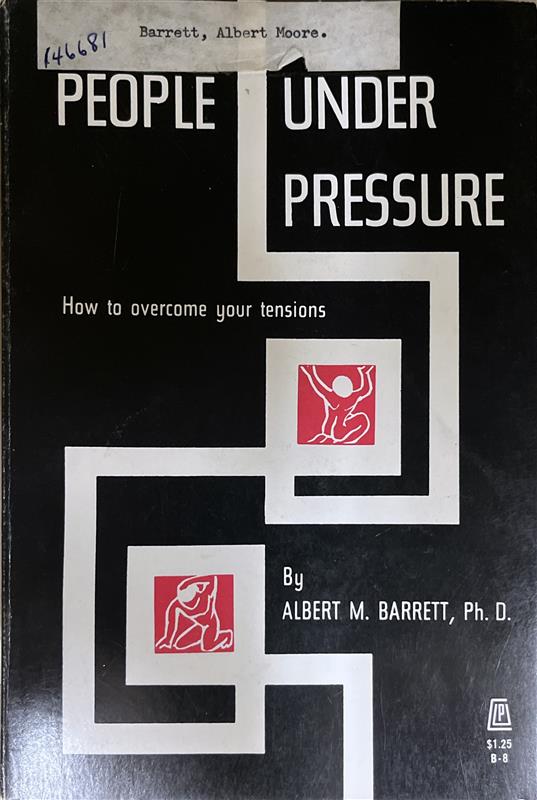
Towards the end of his work on the epidemic of mental fatigue and pressure, People Under Pressure, Albert M. Barrett, MD, offered a sympathetic take on mental health challenges. For fifteen years prior to his 1960 publication, he worked alongside counselors and therapists. Barrett urges us to consider a different point of view. He writes, “For no man is an island, and the relief we provide other human beings will reflect itself in our own peace of mind.” Compassion is vital towards greater public health. 
 
 
References: 

Barrett, Albert M. People under Pressure. College and University Press, 1960.  

Benincasa, Sara. Agorafabulous!: Dispatches from My Bedroom. William Morrow Paperbacks, 2013.  

Breel, Kevin. Boy Meets Depression: Or Life Sucks and Then You Die Live. Harmony Books, 2015.  

Clifford, Beers W. A Mind That Found Itself; an Autobiography. Longmans, Green, and Co., 1908.  

Forney, Ellen. Marbles: Mania, Depression, Michelangelo, & Me: A Graphic Memoir. Gotham Books, 2012.  

National Committee for Mental Hygiene, and State Charities Aid Association (N.Y.). Committee on Mental Hygiene. Proceedings of the Mental Hygiene Conference and Exhibit at the College of the City of New York…. Committee on Mental Hygiene of the State Charities Aid Association, 1912.  

Porcellino, John. The Hospital Suite. Drawn & Quarterly, 2014.  

FIT Visits the NYAM Library

By Dr. Evelyn Rynkiewicz, Assistant Professor of Ecology,. Department of Science and Mathematics at the Fashion Institute of Technology, State University of New York.

My name is Dr. Evelyn Rynkiewicz, I am a professor of ecology at the Fashion Institute of Technology. I teach a course there called “Disease Ecology in a Changing World,” and my background and research is in disease ecology of coinfecting parasites in mice. I wanted to present a course like this for FIT students because diseases are something that affect all of us, everyone has experience being sick, and because emerging infectious diseases are a growing global issue (even before the Covid-19 pandemic, which is of course still impacting us). The challenge in teaching science courses at FIT is that our students mainly have majors in the design and business fields, not in the sciences, so I try to make the course material relate to their backgrounds and experiences as much as possible, to make the content more relevant to them. I also want to increase science literacy in my students, making them comfortable reading, understanding, and talking about science in their personal and professional lives.

I learned about the New York Academy of Medicine Library after seeing the “Germ City” exhibit at the Museum of the City of New York. I got in contact with the Historical Collections Librarian, Arlene Shaner, who set up a visit to show me some of the materials she thought would relate to my course. I was blown away! I knew my students would love to see these historical documents. These materials highlight not only the art and history of how scientists and the public interacted with diseases through time, but also show how intertwined social, economic, and political issues are with how society’s experiences of disease.

Our class took a field trip to the NYAM Library and was shown an array of material; from Hooke’s book on microscopy, Edward Jenner’s work describing his development of the first vaccine, to posters and leaflets used from WWII to the present day to inform people about diseases such as malaria, HIV, or tuberculosis. I am always excited to see what students find interesting from this visit. Many enjoyed seeing the graphic design and illustrations used in the posters, such as those by Dr. Seuss and Keith Haring. Others picked up on how women and marginalized groups were often those who did a lot of the work caring for sick and infected people. Some just liked seeing the historical materials related to New York and being able to see how their home was impacted by diseases in the past.

One of the main assessments for the course is a creative research project where students choose a disease to study and then make a presentation with something creative related to that disease that would help someone learn more about it. I encourage the students to think about how they could use their skills learned from their major and apply it to this topic. The field trip to the NYAM Library provides the initial inspiration for this. I am always so proud and surprised at what they come up with!

Here are some of the things they created:

A drawn movie poster. The fake film is called Dengue Island. The artist, Arriana Tan is credited as the filmmaker. A drawing of a giant  brown mosquito hovers over a small community.

Arriana Tran, a Fashion Business Management major, created a movie poster. Inspired by the warnings her parents shared with her on the risk of becoming infected with Dengue in her parent’s home country of the Philippines.

A malaria testing and monitoring kit. The left of the image is the packaging mock-up. The right lists what would be included; an insect net, spray, educational material, and the tests. It also gives ordering instructions.

Packaging Design major Ethan Wolfsberg designed a malaria testing and monitoring kit that would be able to be used in remote areas that are heavily impacted by this disease. A real-life version would be made in languages appropriate for the area. 

An image of a globe surrounded by various people of different color, size, and shape. On the globe is says "PrEP."

To reduce the stigma of taking PreP, Francis Lavery, also a Fashion Business Management major, made an image that emphasizes that this treatment is appropriate for everyone.

A paper doll. The bald character is wearing a green shirt and blue pants.

Illustration major Leia Garrette wanted to visually show how infection with the agent of Lyme Disease impacts all parts of the body. She created a paper doll where each layer illustrated a different system (e.g. muscles, nervous system) accompanied by an explanation of how each is affected by the infection.

A flyer that reads "Spread Help, Not Disease!" it talks about a theoretical Zika virus support group.

This flyer was created by Sarah Sepulveda from Fashion Business Management. Her plan was for a support group for parents worried about or impacted by Zika virus. There was a focus on Brazil where the outbreak was especially significant in 2016.

Once again, a huge thanks to Arlene and the others at NYAM for their help and insight. I look forward to more collaboration!

Sayings As Mad As A March Hare

by the NYAM Library Team

Before the written word, we relied on our stories being passed down orally. These tales were meant to explain and justify the mysteries of the world around us. Fables, folksongs, and myths are examples of these. Our common superstitions act as bite-sized versions of this folklore.

While every month has its sayings , March is known specifically for two. “Beware the ides of March,” comes from a line in Shakespeare’s Julius Caesar. Rome’s dictator hears these words from a mysterious oracle on the day that he was assassinated. Through the years the saying has trickled down into our collective lexicon. It warns of caution towards the middle of March; the Ides fall on the 15th.

A bust of Julius Caesar from In Spite of Epilepsy.. (1913) by Matthew Woods.

The other common saying is “March comes in like a lion and out like a lamb.” It’s included in various compendiums of popular superstitions without any specific origin. It makes sense, though, that after the destruction of crops by killing frost, the fresh fertility of the land brings to mind an innocent animal. Lambs have long had religious symbolism for innocence and these animals were also a sign of luck. The first lamb of Spring meant good fortune, specifically if it faced you. If it was caught looking away, that was thought less lucky . After this yearly demise of crops, “luck” was needed. Previously March had been known as “boisterous” month in the Middle Ages, as well as the “windy” month in the revolutionary calendar of the first French republic.

A lion from volume two of George Shaw's General Zoology (c. 1800-1826).
From volume two of George Shaw’s General Zoology (c. 1800-1826)

Academic, teacher, and author Dr. Frank Clyde Brown started to accumulate folklore related to his state of North Carolina. On the advice of the American Folklore Society, he created the North Carolina Folklore Society in the early 1910s. He collected state-specific stories, songs, and tales from about 1910 to 1940. When he died in 1943, the collection became known as the Frank C. Brown Collection of North Carolina Folklore.

Brown’s collection was published almost twenty years after his death as Popular Beliefs and Superstitions from North Carolina. Upon its publication, the work is believed to have been the “first general work along comparative lines” of specifically American proverbs.
Included in this collection is a longer saying, “If March comes in like a lion, it will go out like a lamb. If March comes in like a lamb, it will go out like a lion.” For the most part, we don’t hear the second sentence anymore. Our predecessors believed in explanations for all of life’s occurrences and often arrived at the answer of balance: if a month began with a storm, surely it would end brightly and sunny! Perhaps for snappier flow, lines needed excision.

A lamb and two ewes from Sheep, Swine, and Poultry by Robert Jennings (1864).
From Sheep, Swine, and Poultry… by Robert Jennings (1864).

That’s not to say that these sayings are not around anymore! Nor does it negate their kernels of truth, some based on observed early science. We still circulate many of these whether it be in the water cooler at work or shared on social media. It is important to place these within context. We now know that they are not to be taken as facts but rather as what was once believed to be facts.

The cover of Popular Superstitions by Charles Platt (1925). It features a black cat in the middle of a horseshoe, in the middle of the number 13.
The cover of Popular Superstitions by Charles Platt (1925).

As the dreaded ides of March draw near, we offer up a few more of these sayings from the Brown Collection to celebrate the month:

-A thunderstorm in March indicates an early spring.
-A windy March and a rainy April make a beautiful May (Also, March winds and April showers bring forth May flowers).
-The first thunderstorm in March wakes up the alligators.
-Fog in March; Frost in May.
-The better the hunter you are, and the more you know about wild things, the surer you are that all rabbits turn to “he-ones” in March.
-If you plant seeds on St. Patrick’s Day, they will grow better.
-A dry March never begs bread.
-Frost never kills fruit in March, no matter how full the tree blooms.

And for those hoping for a fruitful March, I leave you with
-To make cabbage seed grow, sow them in your night clothes on March seventeenth.

Purple skunk cabbage from The Vegetable Materia Medica by William P.C. Barton (c.1817-1819).

References

Brewer, Ebenezer Cobham. Brewer’s Dictionary of Phrase and Fable. Rev. by Ivor H. Evans. New York: Harper & Row, c1970.

Hand, Wayland D. (ed.). The Frank C. Brown Collection of North Carolina Folklore Volume VI: Popular Beliefs and Superstitions from North Carolina. Durham: Duke University Press, 1964.

Hand, Wayland D. (ed.). The Frank C. Brown Collection of North Carolina Folklore Volume VII: Popular Beliefs and Superstitions from North Carolina. Durham: Duke University Press, 1964.

Hole, Christina (ed.). Encyclopaedia of Superstitions. London : Hutchinson, 1961.

Platt, Charles. Popular Superstitions. London : H. Jenkins, Ltd., 1925.

Highlighting NYAM Women in Medical History: Sara Josephine Baker, MD, DrPh

By Hannah Johnston, Library Volunteer

This the first entry in our series on female New York Academy of Medicine (NYAM) Fellows and their contributions to society. Please also see our biographical sketch of Mary Putnam Jacobi, the first female Fellow.

A pioneer in public health and champion of preventative medicine, New York Academy of Medicine Fellow Dr. Sara Josephine Baker (1873–1945) had a significant impact on the landscape of maternal and infant health outcomes in the early twentieth century in New York City. Throughout her long career as a physician and health inspector, Baker introduced and supported numerous measures to reduce maternal, infant, and child mortality and morbidity, particularly in immigrant and low-income communities within the city. Her work saved countless lives and had substantial influence within the larger structure of medicine and public health in New York and beyond.[1] Baker and her career were exceptional in many ways, but in particular, she engendered greater public trust in the medical profession by encouraging greater reliance on doctors while still allowing for and expecting continued trust in other sources of knowledge.

Portrait as director of the Bureau of Child Hygiene

Portrait of Sara Josephine Baker. In S. Josephine Baker, Fighting for life (1939). NYAM Collection.

Baker, who was often referred to affectionately as “Dr. Jo,” earned her medical degree from the Women’s Medical College at the New York Infirmary, which was founded by early female physicians Elizabeth and Emily Blackwell.[2] Following her graduation, she began practicing in New York while serving as a medical inspector for the New York Life Insurance Company and as a part-time medical examiner for the city. In 1907, she was appointed Assistant Commissioner of Health, and by the following year was named the first director of the Bureau of Child Hygiene.[3]

Baker_FightingForLife_1939_MyFirstStaff_watermark

The doctors and nurses of the Bureau of Child Hygiene in 1909. In S. Josephine Baker, Fighting for life (1939). NYAM Collection.

Among Baker’s chief concerns as director were those regarding the high infant mortality and morbidity rates in the city, especially in communities with low rates of access to sanitary medical care. In her 1939 autobiography Fighting for Life, she noted the high rates of infant blindness, illness, and deaths in the city, and attributed them to overreliance on the unqualified advice of neighbors and friends as well as a lack of sanitation of spaces and materials.[4] In 1913 she wrote a pamphlet for new mothers, in coordination with the New York Milk Committee, titled “Talks with Mothers,” instructing them on how to best prevent these and other issues, as well as urging them to consult with medical professionals whenever possible.[5] Additionally, Baker lamented high rates of infant, child, and maternal mortality in New York. Many of her public health and preventative care efforts were directed toward lowering these mortality rates, particularly by improving access to pasteurized milk and sanitary medical care. Sanitation was not Baker’s sole focus, however; she marveled at how babies living in tenements seemed to be doing better than foundlings living in sanitary hospitals, and concluded that “personal care from a maternally minded mother” was as important for a baby’s survival as sanitation.[6] She then implemented a program where “tenement mothers” fostered foundlings from the hospital, which led to a drastic drop in the mortality rate among these babies — from 50% to 33% generally, and from 100% to 50% among “hopeless cases.”[7]

A firm believer in social medicine, Baker formed her opinions and efforts regarding public health around the needs and circumstances of the communities she served. Her commitments to serving immigrant and low-income communities can be clearly seen in her considerations of the practice of midwifery in the city and of the needs of working mothers. Despite feeling that midwives in the U.S. were largely “very clumsy [practitioners] indeed who had got into the profession as [amateurs] and stayed in to make a living,” Baker recognized that many women, especially those who had grown up in countries where midwives were more widely respected and utilized, were uncomfortable with the “American” practice of (male) physician-attended birth.[8] Positing that without midwives women might put themselves at further risk by seeking the help of unqualified neighbors and friends before seeking a doctor (if they could even afford to), Baker became focused on implementing a system to regulate the practice of midwifery in the city to ensure higher standards of care. This stance put her at odds with many of her peers, and in Fighting for Life, she described a “hot discussion” with her colleagues at the New York Academy of Medicine over the matter.[9] In order to ensure the well-being of infants whose mothers were in the workforce, a common occurrence particularly in low-income households at the time, Baker developed the Little Mothers League to educate older children on the proper care of infants. Since older daughters were often tasked with caring for their siblings while their parents worked, Baker believed it was important to ensure that everyone caring for babies was prepared to do so. The education girls received from the Little Mothers League, Baker reasoned, also had the positive side effect of larger-scale understanding of the proper care of children, as the “Little Mothers” shared their new expertise with their parents, friends, and communities.[10]

Sara Josephine Baker’s long, wide-ranging, and impressive career saw significant improvements in the well-being of mothers and children in New York City and beyond. Aside from her efforts to improve the care of infants, she championed preventative healthcare for toddlers and school-aged children and mothers, and was instrumental—twice—in catching the first known asymptomatic carrier of typhoid, “Typhoid Mary” Mallon.[11] By the time she retired in New Jersey with her partner Ida Wylie and their friend Louise Pearce in the mid-1930s, New York City had the lowest urban infant mortality rate in the United States.[12] Sara Josephine Baker’s social and preventative approach to medicine engendered greater and more widespread public trust in medical professionals while respecting the need for other sources of knowledge and care, and made New York City a healthier place.

References

[1] Manon Parry, “Sara Josephine Baker (1873-1945),” American Journal of Public Health 96 No. 4 (2006), pp. 620–621.

[2] Ibid.

[3] Ibid.

[4] Sara Josephine Baker, Fighting for Life (New York, NY: The Macmillan Company, 1939), 116–119, New York Academy of Medicine Library, New York, NY, Special Collections, Call No. WZ 100 B168 1939, Film 8865 no. 5.

[5] Sara Josephine Baker, “Talks with Mothers” (New York, NY: The New York Milk Committee, for the Babies’ Welfare Association of New York City, 1913), New York Academy of Medicine Library, New York, NY, Pamphlet Collection, Box 97, Call No. 115239.

[6] Baker, Fighting for Life 119–121.

[7] Ibid. 120.

[8] Ibid. 112.

[9] Ibid. 114.

[10] Ibid. 132–137.

[11] Parry.

[12] Ibid.

Sir William Osler: A Bibliophilic Benefactor

Osler_watermark

Photograph of William Osler. Osler, W., & Pollard, A. W. (1923). Incunabula medica: A study of the earliest printed medical books 1467–1480. Oxford: Bibliographical Society. NYAM Collection. 

December 29, 2019, marks the centenary of the death of Sir William Osler (1849–1919), arguably the most important and most loved physician of his era. Osler received his medical degree from MGill University in 1872, and joined the medical faculty there in 1874. A decade later he moved to Philadelphia to chair the department of Clinical Medicine at the University of Pennsylvania, and in 1889 he was one of the founders of the Johns Hopkins Hospital, serving as its first Physician-in-Chief and as the first professor of medicine at the newly opened medical school. In 1905, he left the United States to become the Regis Professor of Medicine at Oxford, a position he held for the rest of his life. An accomplished teacher of clinical medicine, Osler established the medical residency program at Hopkins and made sure that students had ample opportunity to interact with patients at the bedside. His textbook, The Principles and Practice of Medicine, first published in 1892, appeared in multiple editions and was the standard textbook of internal medicine for decades. (National Library of Medicine, 2013).

Osler was also an extraordinary collector and lover of books, and in addition to amassing the collection that became the Osler Library of the History of Medicine at McGill University, he bestowed gifts on both his friends and on institutions. The Library of The New York Academy of Medicine has him to thank for two of its most treasured items.

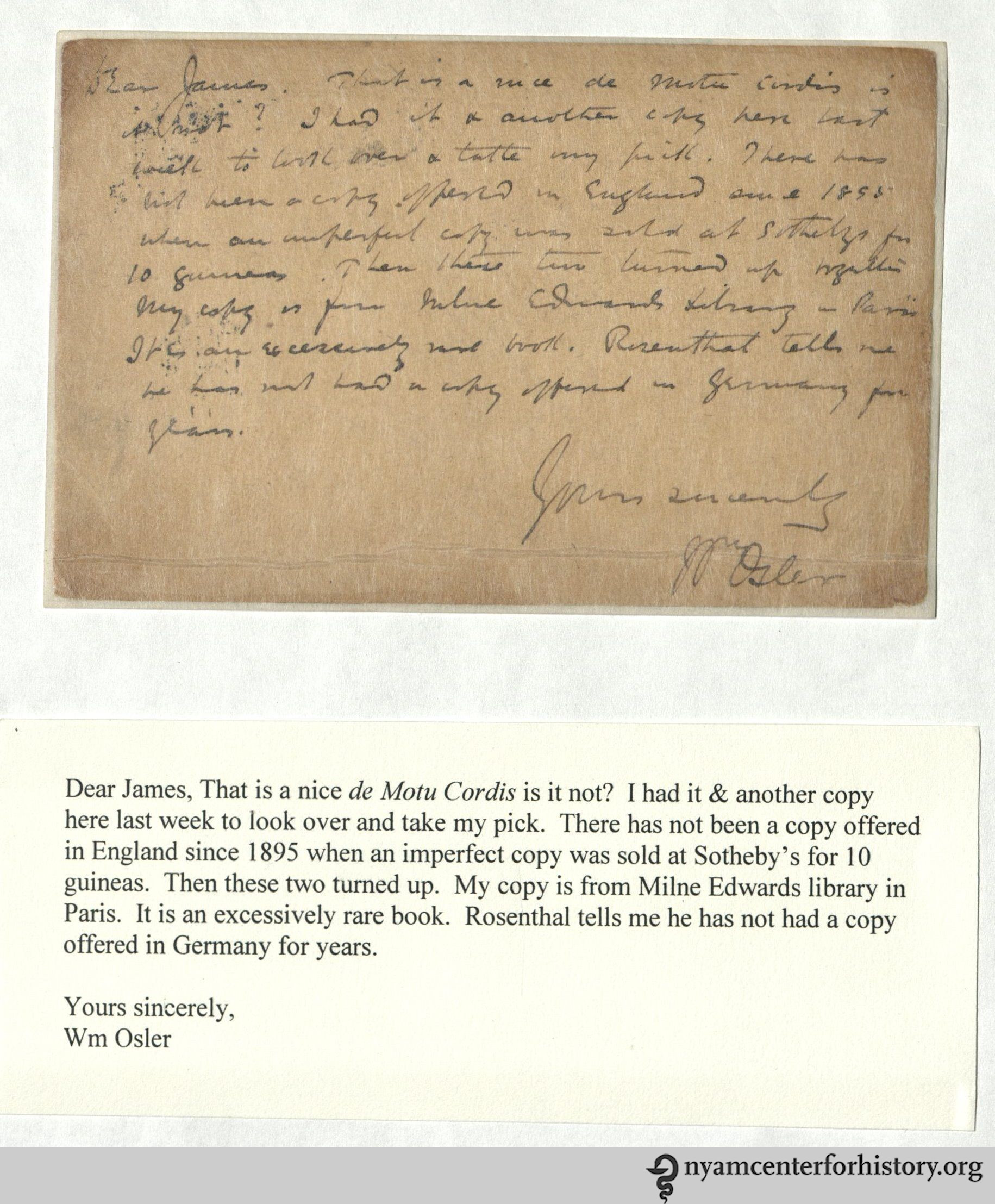
Late in February of 1906, Osler sent a postcard to Walter Belknap James (1858–1927), along with a copy of William Harvey’s 1628 De motu cordis, the text in which Harvey describes the circulatory system and the motion of the heart and the blood. Harvey’s work, probably the most important text in the history of physiology, was notoriously difficult to find. In the Bibliotheca Osleriana, Osler recounts his hunt for a copy of the book:

Feb. 17, 1906; I had been looking for a copy for nearly ten years.  Pickering and Chatto sent one to-day, which they had bought for £30 at the sale of Dr. Pettigrew’s library. Though a poor copy, measuring only 7 3/8 x 5 3/8 inches, I took it.  Feb. 19, two days later, they sent me another (this one) from the library of Milne Edwards… I took it too, and passed on the other to Dr. Walter James who gave it to the Library of the Academy of Medicine, New York. (Osler, Francis, Hill, & Malloch, 1929, p. 4)

As can be seen in the image of the postcard below, Osler marketed this copy to James rather differently:

Dear James, That is a nice de Moto Cordis is it not? I had it & another copy here last week to look over and take my pick. There has not been another copy offered in England since 1895 when an imperfect copy was sold at Sotheby's for 10 guineas. Then these two turned up. My copy is from Milne Edwards library in Paris. It is an excessively rare book. Rosenthal tells me he has not had a copy offered in Germany for years. Yours sincerely, Wm Osler

Postcard to Walter Belknap James from William Osler, February 1906. NYAM Collection.

Good copy or not, the gift of the Harvey definitely enhanced the Library’s holdings, and was joined later in the 20th century by a second copy of the 1628 edition when Robert Levy gave his library of books by and about William Harvey to the Academy Library.

Harvey_1628_watermark

Title page. Harvey, W. (1628). Exercitatio anatomica de motu cordis et sanguinis in animalibus Guilielmi Harvei. Francofurti: Sumptibus G. Fitzeri. NYAM Collection.

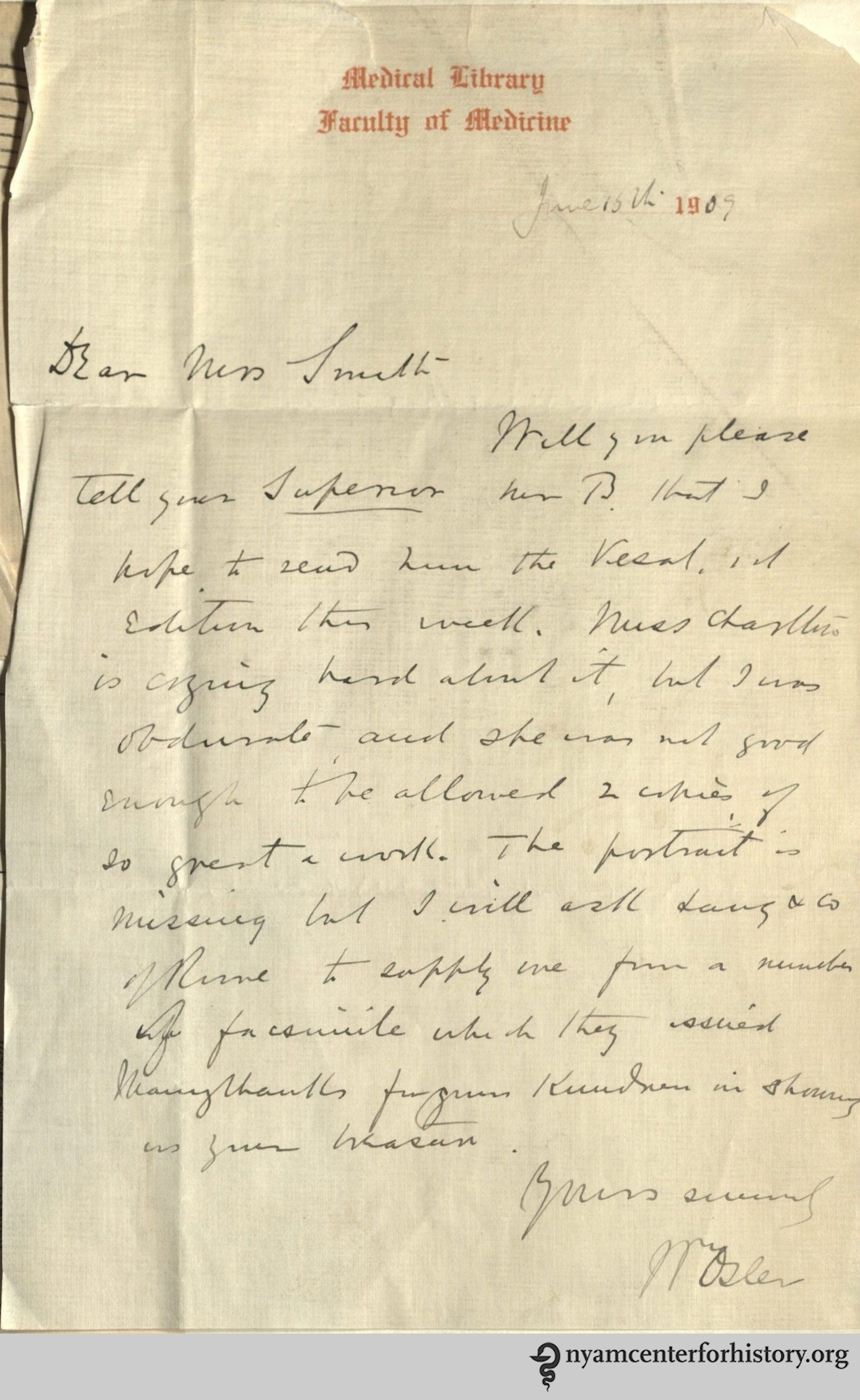
In 1909, Osler again made a gift to the Academy’s collections. On June 16th, Osler sent Laura Smith, who worked in the library, a note relaying the following information: “Will you please tell your Superior, Mr. B [John Browne, the Academy’s librarian] that I hope to send him the Vesalius first edition this week.”

WOtoLauraSmith_96.16.1909_watermark

Letter from William Osler to Laura Smith, June 16th, 1909. NYAM Collection.

Osler had recently given a second copy of the 1543 edition of De humani corporis fabrica, Andreas Vesalius’ groundbreaking work on anatomy, to McGill, and decided that their other copy should make its way to the Academy, even going so far to say in his letter to Miss Smith that while Miss Charlton (of McGill) was “crying hard about it,” Osler was “obdurate and she was not good enough to be allowed 2 copies of so great a work” (personal communication, June 16th, 1909).

In the Bibliotheca Osleriana, Osler writes that he had in his possession at one time or another six copies of the Fabrica, also giving them as gifts to the Boston Medical Library Association; the Medical and Chirurgical Faculty, Baltimore; the Medical Department at the University of Missouri; and to his friend Llewelys Barker, who was professor of anatomy at the University of Chicago, as a wedding present. (Osler, Francis, Hill, & Malloch, 1929).

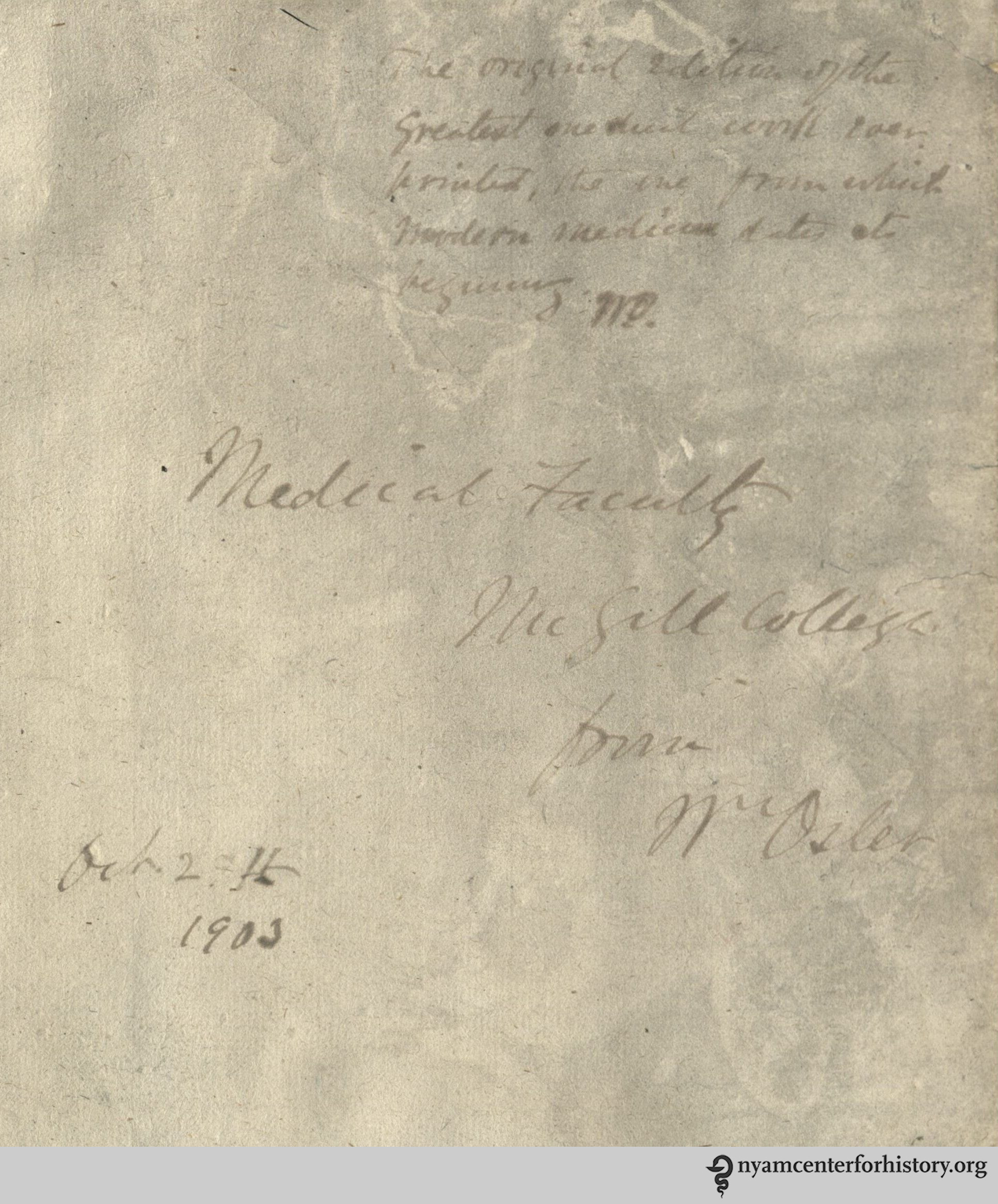
The Library’s copy still displays the inscription Osler wrote on the free endpaper of this copy when he gave it to McGill in 1903, “The original edition of the greatest medical work ever printed, the one from which modern medicine dates its beginning. W. O.”

Vesalius1543_WOinscription_watermark

Osler’s inscription on endpaper in De humani corporis fabrica (1543). NYAM Collection.

Our copy also retains the bookplates that track its movement from McGill to New York:

Vesalius_WObookplates_watermark

Bookplates in the 1543 edition of De humani corporis fabrica. NYAM Collection.

The Academy soon acquired two other copies of the 1543 Vesalius, one from the Edward Clark Streeter Collection and the other from Dr. Samuel Lambert, as well as two copies of the 1555 second edition. In fact, editions of Vesalius and related works soon became a major research strength of the collection, continue to be heavily used by readers, and are frequently shared with visiting groups and classes.

As 2019 draws to a close, the Library is grateful to its many friends and donors, who, following the spirit of Sir William Osler, continue to enrich our collections today. One hundred years later, the memory of Osler’s generosity reminds us that these books still matter.  Generations of earlier readers held the Osler copies of the Harvey and Vesalius in their hands over the course of hundreds of years before they finally landed on our shelves. It is a privilege to be able to continue to share them.

 References

National Library of Medicine. (2013). William Osler: Biographical overview. Retrieved from https://profiles.nlm.nih.gov/spotlight/gf/feature/biographical-overview

Osler, W., Francis, W. W., Hill, R. H., & Malloch, A. (1929). Bibliotheca Osleriana: A catalogue of books illustrating the history of medicine and science. Oxford: At the Clarendon Press.


The Women’s Field Army: A Precursor to the American Cancer Society

By Carrie Levinson, Reference Services and Outreach Librarian

On November 7, The New York Academy of Medicine had its Annual Discourse, where Dr. Otis W. Brawley, Bloomberg Distinguished Professor of Oncology and Epidemiology at Johns Hopkins University, delivered a fascinating talk on cancer disparities and the status of anti-cancer efforts in the United States. Part of his message was that, while there are differences in diverse populations, increased awareness leads to better outcomes.

Educating the public about cancer, its symptoms, and its treatment was also of great concern to the members of the American Society for the Control of Cancer (ASCC), an organization founded in 1913 with ten doctors and five laypeople, when the disease was not widely talked about and had high mortality rates. The organization’s mission was to bring the looming specter of cancer out of the shadows and into the light, and to do that, they wrote numerous articles in both popular periodicals and academic journals, produced their own bulletin, Campaign Notes, and recruited doctors around the United States to educate patients (American Cancer Society [ACS], 2019).

While these efforts helped, they only involved about 15,000 people across the country by 1935 (ACS, 2019). In 1936, the new campaign was born to get volunteers to help spread vital information: the Women’s Field Army. The ASCC specifically recruited women “because the types of cancer that strike women hardest—cancer of the uterus and breast—may be cured in seventy per cent of the cases if taken in time” (New York City Cancer Committee [NYCCC], 1936).

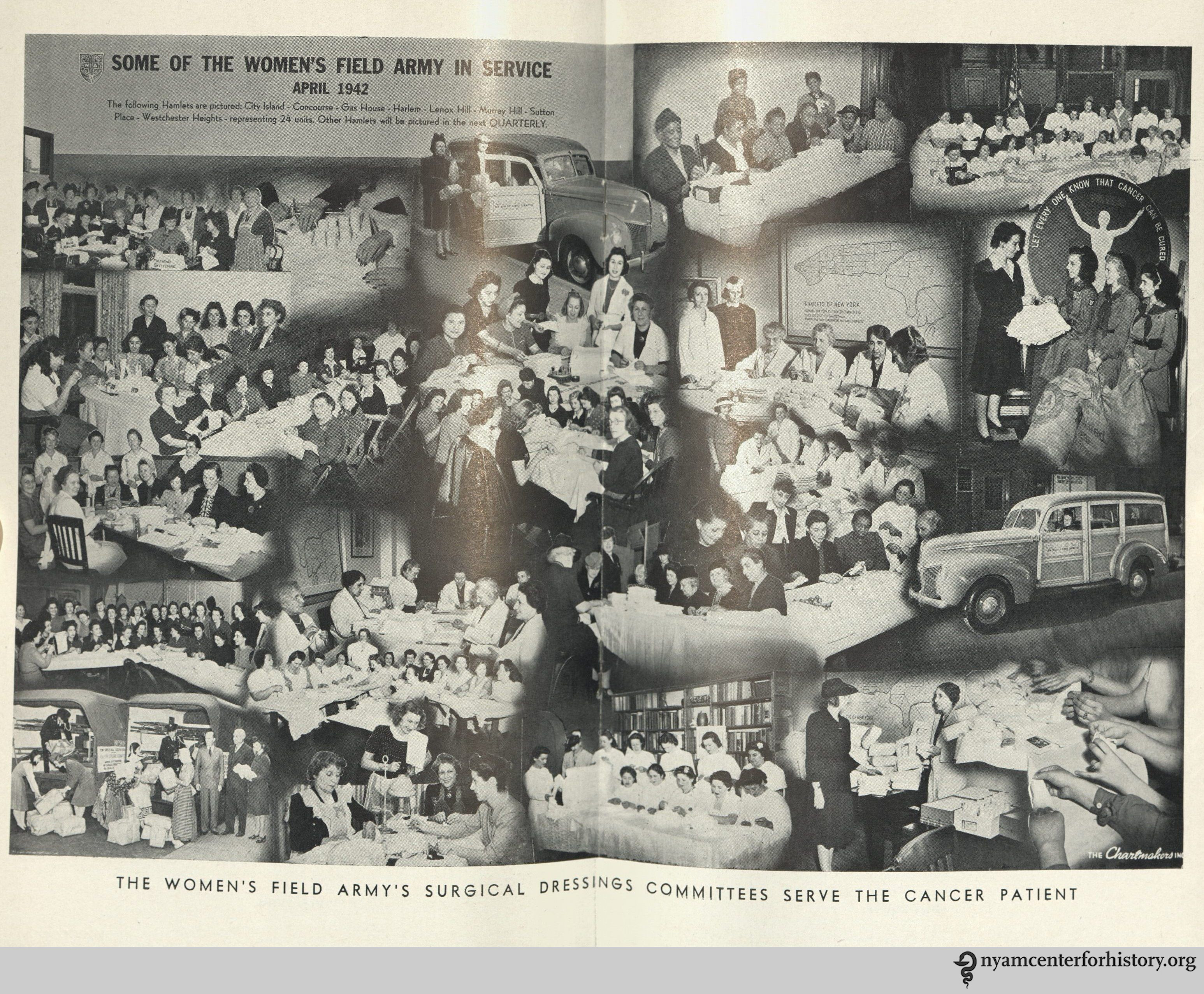
ASCCC_HospitalServiceProgramOfTheWomensFieldArmy_1942_April1942_watermark

Some of the Women’s Field Army in Service, April 1942. American Society for the Control of Cancer (1942). Hospital service program of the Women’s Field Army: The American Society for the Control of Cancer, Inc. [Pamphlet]. New York, NY: Author.

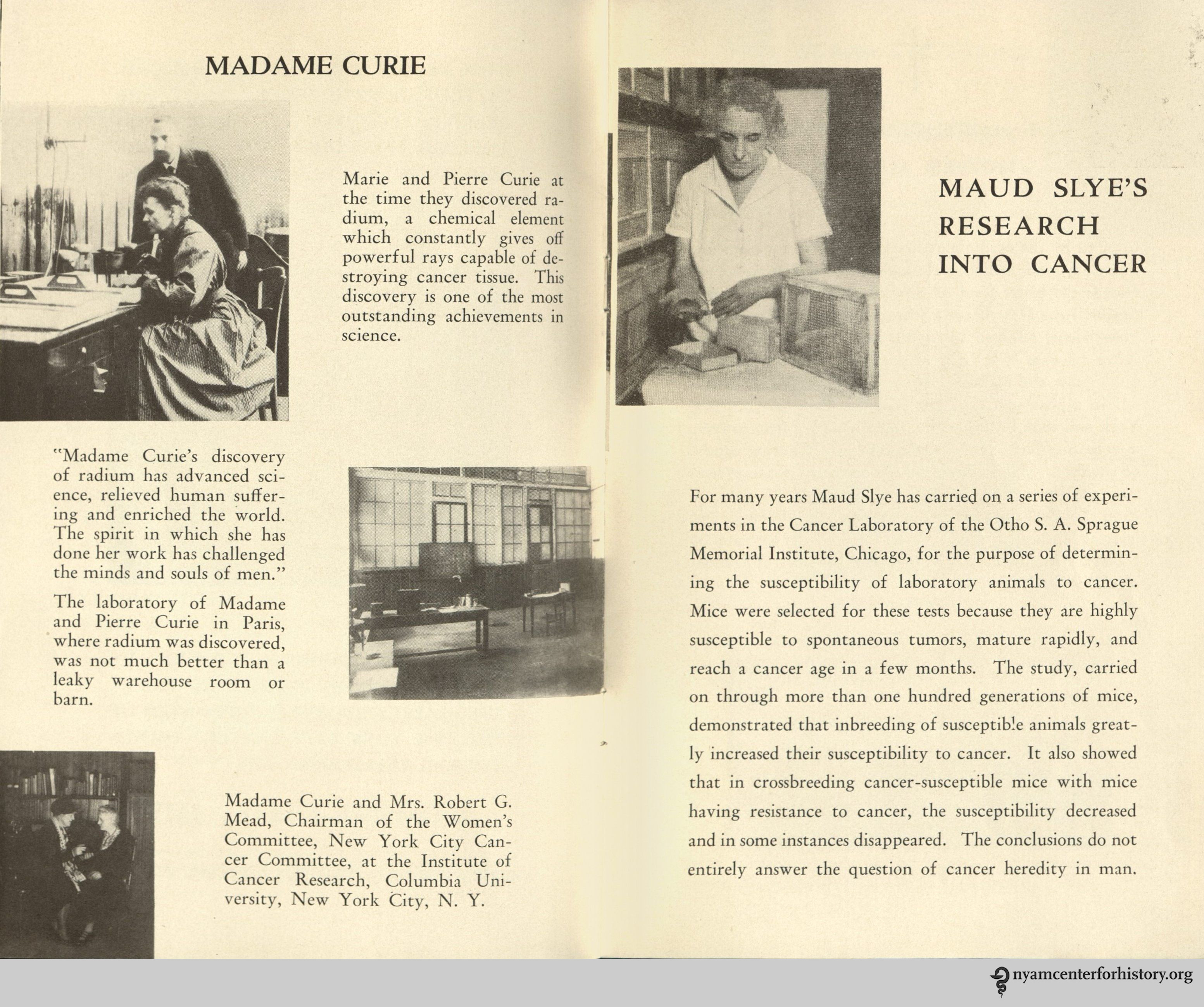
Among other educational literature, the ASCC produced pamphlets promoting the Women’s Field Army. One item from 1936, used to recruit members, tells the story of a woman who started to suspect she might have cancer based on the New York City Cancer Committee’s materials, such as billboards, subway cards, and editorials in the newspaper (NYCCC, 1936). After learning more and eventually receiving the treatment she needs, she joins the Women’s Field Army so that she, too, can be a “crusader in the fight against cancer.” Other pages in the pamphlet emphasize the critical role that various women have played in helping others receive the care they need, from Maud Slye’s cancer research to Dr. Elizabeth Hurdon, founder of the Marie Curie Hospital in London (NYCCC, 1936).

NYCCC_ForAllWomen_1936_MadameCurieMaudSlye_watermark

Short descriptions of Marie Curie’s and Maud Slye’s research. New York City Cancer Committee (1936). For all women: Presented by the Women’s Field Army of the American Society for the Control of Cancer [Pamphlet]. New York, NY: Author.

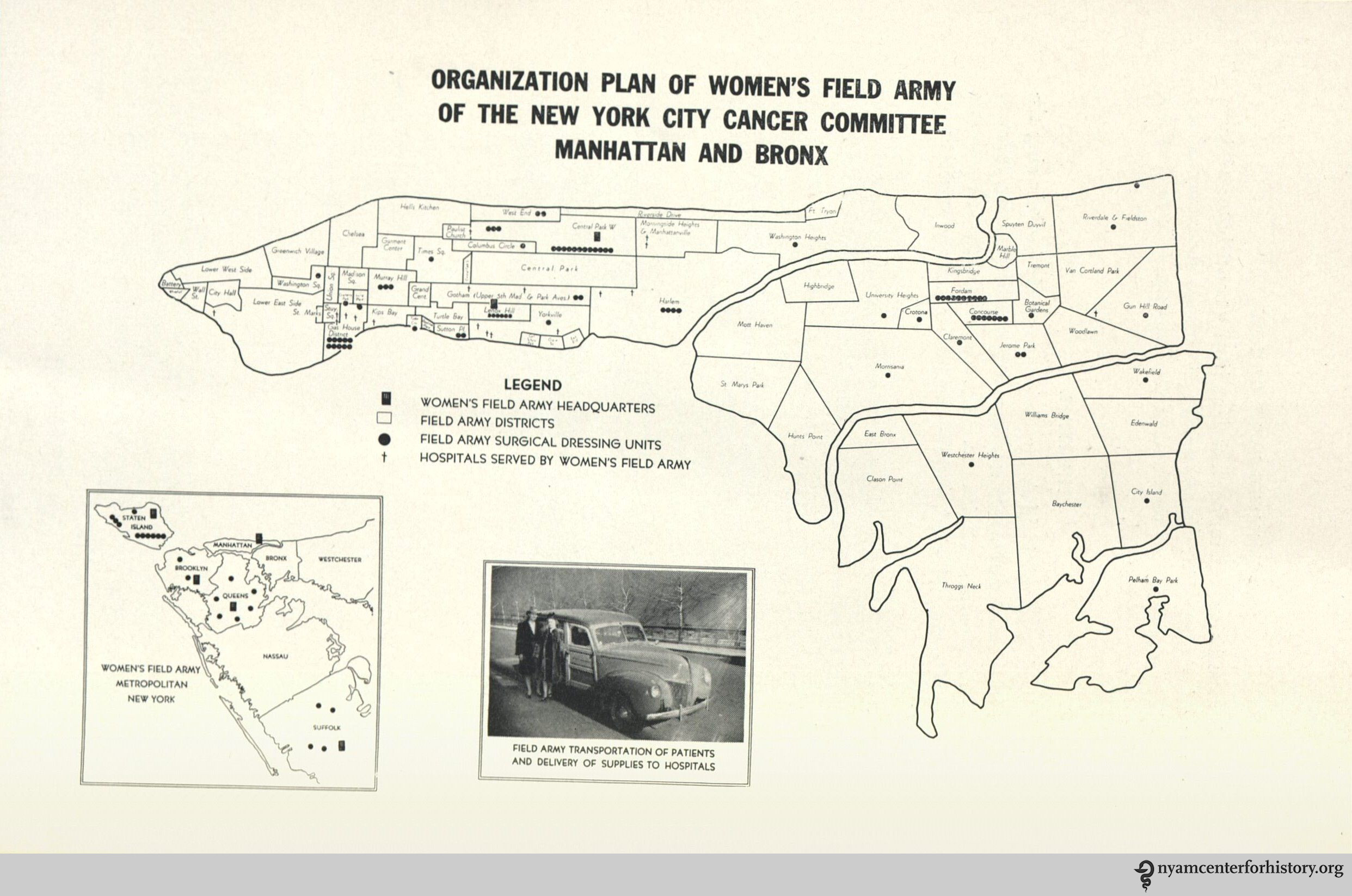
A wartime NYCCC pamphlet encourages different divisions of the Women’s Field Army to set up hospital service programs as a part of the War Service Program, and describes their challenges and triumphs. The preparation and use of surgical dressings and bandages, which the Women’s Field Army determined were greatly needed, are explained in detail, from production to transportation (American Society for the Control of Cancer, 1942).

NYCCC_ForAllWomen_1936_OrganizationPlan_watermark

Map of the organization plan of the NYC Cancer Committee divisions of the Women’s Field Army. American Society for the Control of Cancer (1942). Hospital service program of the Women’s Field Army: The American Society for the Control of Cancer, Inc. [Pamphlet]. New York, NY: Author.  NYAM Collection.

Divisions and programs like Women’s Field Army greatly expanded cancer awareness; the organization is credited with increasing the number of individuals involved in cancer control from 15,000 to at least 150,000 in three years (ACS, 2019). Although the American Society for the Control of Cancer changed direction after World War II (you may know it better now as the American Cancer Society) and the Army no longer exists, it serves as an important reminder of how a group of determined volunteers can change the way we think of, and treat, cancer—or indeed any disease—today.

References

American Cancer Society (2019). Our history. Retrieved from https://www.cancer.org/about-us/who-we-are/our-history.html

American Society for the Control of Cancer (1942). Hospital service program of the Women’s Field Army: The American Society for the Control of Cancer, Inc. [Pamphlet]. New York, NY: Author.

New York City Cancer Committee (1936). For all women: Presented by the Women’s Field Army of the American Society for the Control of Cancer [Pamphlet]. New York, NY: Author.