Researching Neuropsychiatry and Veterans Hospitals During the 1930s at the New York Academy of Medicine 

By Dr. Michael Robinson, National Army Museum Research Fellow, University of Birmingham (UK), and the Library’s 2024 Paul Klemperer Fellow in the History of Medicine 

I spent one month working in the New York Academy of Medicine’s magnificent library and reading room in the autumn of 2024. This residency enabled me to look at a host of materials dedicated to the treatment of mentally ill American Army veterans of the First World War during the Great Depression (1929–1939). I undertook this research hoping to utilise the USA as an important comparative case study on my current research project dedicated to mental illness and British Great War veterans during the 1930s. By examining mental breakdown and psychiatric medical care during this decade, this research seeks to reveal the delayed traumatic after-effects of war service on ex-service personnel and the potential for additional psychosocial determinants to influence mental ill-health.  

I first became interested in the American experience of post-First World War disability and mental healthcare owing to its regular appearance in the archival records of Britain’s Ministry of Pensions, the government agency responsible for distributing veterans’ pensions and medical care. During the inter-war period, British policymakers regularly cited the US experience of veteran after-care as a deterrent and a case study to avoid replicating. They actively held up the US system as being unfairly exclusive, costly, and liberal owing to its incremental but costly expansion of veteran rights and facilities. Britain significantly reduced its liability on behalf of veterans during the 1920s and 1930s, including the closure of most veterans’ hospitals. Veterans’ medical care in Britain was primarily outsourced to broader public health facilities, the civilian welfare state, and the charity sector.  

By contrast, the US witnessed increased state liability, including a vast financial outlay in funding exclusive Veterans Administration (VA) hospitals and medical facilities. In 1936, owing to the two nations’ inversed approaches to veteran care, one Ministry of Pensions official described the UK and US responses as being of ‘opposite extremes.’1 The primary purpose of my time at the NYAM was to better understand why the British and US systems were the complete inverse of one another. I also sought to appreciate how these contrasting policy trajectories and medical infrastructures affected the lives of mentally ill veterans.  
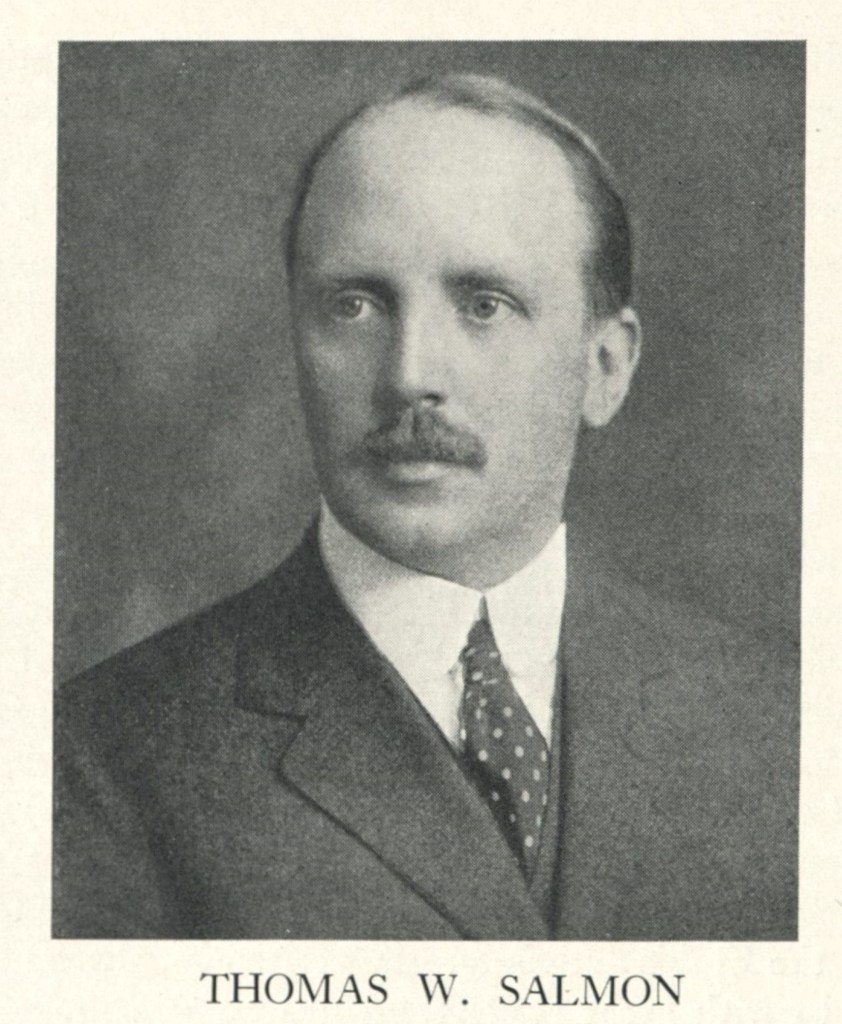
Portrait of Thomas Salmon, from History of the Interurban Clinical Club 1905-1937, edited by David Riesman (1937).

This comparative approach first led me to NYAM records relating to Dr. Thomas Salmon (1876–1927). For those unfamiliar, Salmon was the American Expeditionary Forces’ chief consultant in psychiatry during the First World War. Before this important role, following the country’s entry into the global conflict in 1917, Salmon visited England to study how it dealt with mental wounds during the war to help inform his country’s approach.2 As a leading figure in the US National Hygiene Movement before and after his war service, the records of Salmon’s war experience reflect a relatively progressive military medical official. He regularly stressed the environmental causes of soldiers’ breakdown. In short, Salmon was more inclined to blame combat neurosis and stress on the dehumanising and brutalising effects of war service than citing faulty hereditary genetics, as was more apparent amongst British military officials. This more empathetic outlook continued into Salmon’s advocacy on behalf of veterans following his return to America. Unlike the more reclusive and disillusioned Dr. Charles Myers, the British Army’s leading psychiatric official, Salmon advocated for healthcare and welfare on behalf of the mentally disabled First World War veterans during the initial post-war years. Described by his biographer as a successful ‘spokesman for veterans,’ the force of Salmon’s personality and his effective collaboration with the American Legion help explain why the American mentally ill veteran stopped being admitted into larger public mental hospitals.3 Instead, the US Federal Government established exclusive medical facilities for veterans from the early 1920s onwards.  

Salmon died unexpectedly whilst sailing near Long Island in 1927. Reflecting his prestige amongst his contemporaries, the National Committee for Mental Hygiene, an advocacy organization founded in 1909 by Clifford W. Beers, set up the Salmon Committee on Psychiatry and Mental Hygiene at the New York Academy of Medicine in 1931.4 Regardless, the exclusive medical infrastructure he had helped establish continued to cater to mentally ill First World War veterans into the 1930s. In stark contrast to Britain’s minuscule and dwindling psychiatric infrastructure, the VA provided seventeen neuropsychiatric facilities across its national network of forty-nine hospitals. It offered 10,633 beds for mental ailments, marking a 467% increase over 1921’s availability. The number of beds would be set to increase for the rest of the decade.5 With this exclusive federal medical care program for veterans, the VA published its Medical Bulletin journal throughout the 1930s. Pouring through these issues reveals a lively forum of VA medical officials discussing the continued difficulties of treating veterans during this period.  

Regarding neuropsychiatry—I was struck by how hospital superintendents, nurses, vocational trainers, and social workers regularly articulated a holistic approach to mental healthcare. They cited the psychosocial determinants of health outside of hospital walls. This includes, for example, the detrimental impact of unemployment and poverty on an individual’s mental and bodily health, the emasculating stigma attached to male mental illness, and the potential for harmful self-medication practices such as alcoholism.  

United States Veterans’ Bureau Medical Bulletin (1931), a collection of articles by VA staff and associates dedicated to all aspects of veteran after-care. These various scans come from volume 7.

The materials I reviewed at the NYAM provide a complex and nuanced picture of the post-war treatment of mentally ill World War One veterans. On the one hand, they give an image of an expansive, caring and financially generous veterans’ system. On the other hand, however, they provide comparatively little insight into the personal perspectives of veteran patients to verify the progressive narrative offered by medical officials. In addition, contemporary medical journals reveal increasing resentment from American citizens regarding the spiralling costs of veteran medical care with little in return in terms of cure and recovery.6 This counter-narrative also appears worthy of further research.  

Before arriving in New York, I was unsure how exactly the USA would fit into my larger project of Great War veterans during the Great Depression. However, my time at the NYAM proved incredibly rewarding by revealing how fascinating and unique an American case study is. I look forward to continuing this research into 2025. 

Notes: 

1 Nineteenth Annual Report of the Ministry of Pensions, 1935-1936, 33. 

2 For a write-up of Salmon’s observations and recommendations, see Thomas Salmon, The care and treatment of mental diseases and war neuroses (“shell shock”) in the British Army (War Work Committee of the National Committee for Mental Hygiene, 1917). 

3 E. D. Bond, Thomas W. Salmon: Psychiatrist (W. W. Norton & Co, 1950), 160. 

4 For more information on the Salmon Committee on Psychiatry and Mental Hygiene and its records that are held in the NYAM, see https://www.nyam.org/library/collections-and-resources/archives/finding-aids/ARN-0006.html/ [last accessed 18 November 2024]. 

5 E. O. Crossman and Glenn E. Myers, ‘The neuropsychiatric problem in the US Veterans’ Bureau,’ Journal of the American Medical Association, vol. 94, no. 7 (1930), 473–478. 

6 For example, see the Crossman and Myers article cited above. 
Mental Health in the Metropolis: The Midtown Manhattan Study

By Paul Theerman, Associate Director, Center for the History of Medicine and Public Health

How can we improve urban health? That is one of the missions of the New York Academy of Medicine, and a question public health professionals have been asking for decades. One of the landmark urban health studies, Mental Health in the Metropolis: The Midtown Manhattan Study, was published more than half a century ago.1 The study was intended to be a deep and exhaustive look into the mental health of residents in one of the most urban environments in the country, Midtown Manhattan. In many ways it was to be a model of the state of urban health throughout the country.2 And it was shaped by the medical experience of World War II.

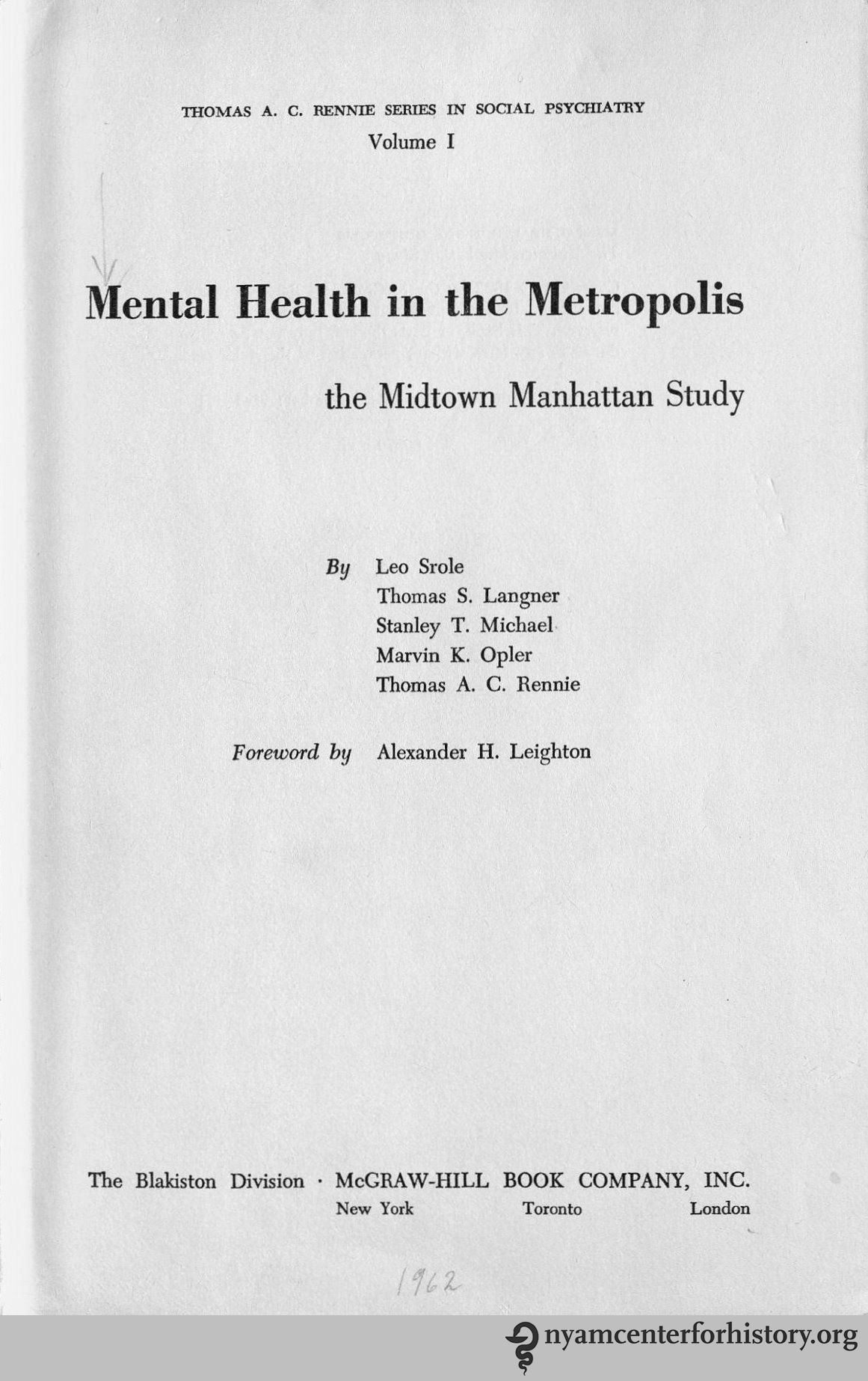
Title page of Mental Health in the Metropolis, 1962.

Title page of Mental Health in the Metropolis, 1962.

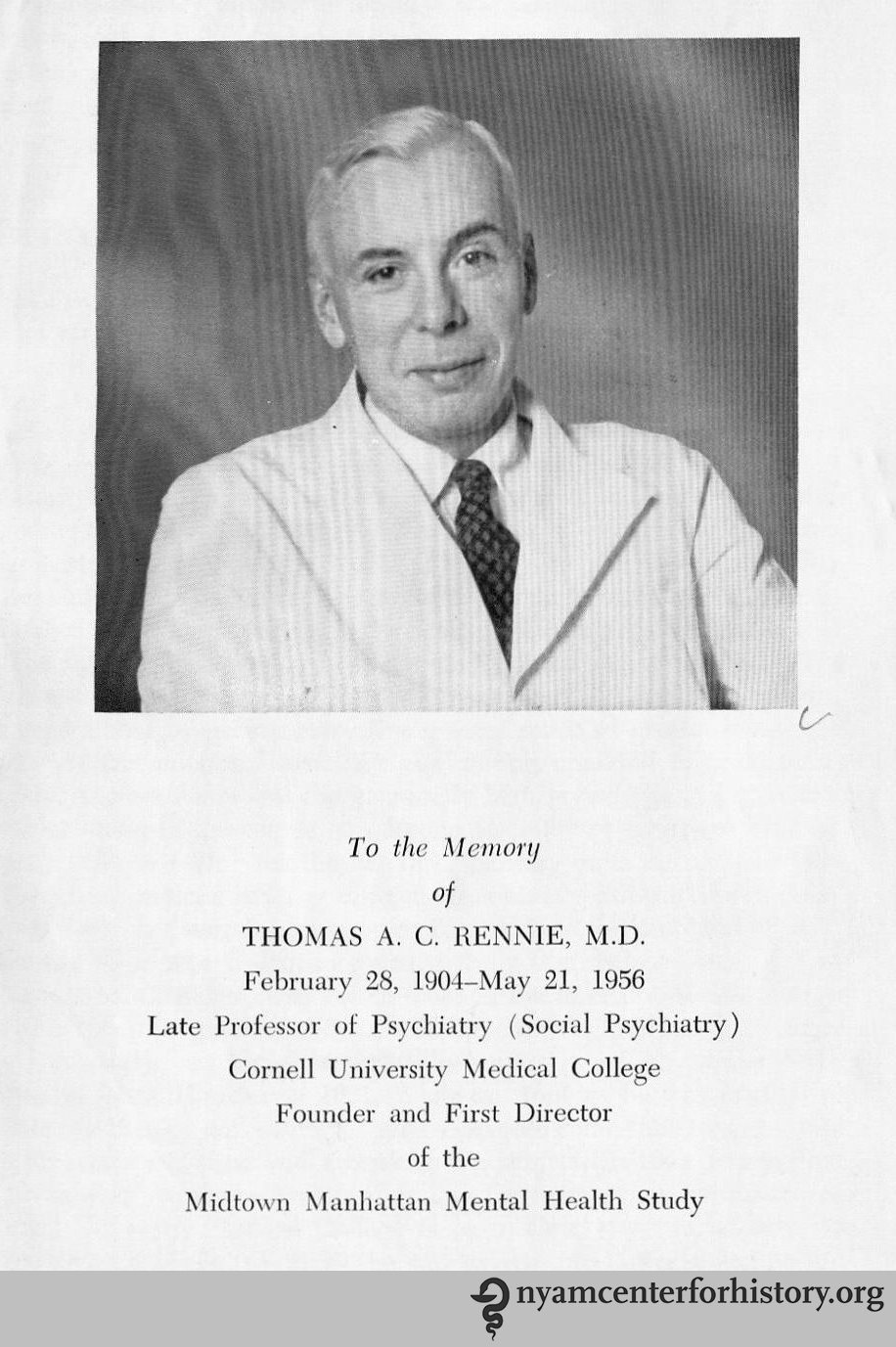
Many veterans developed mental illnesses over the course of the war. Dr. Thomas A. C. Rennie, associate professor of psychiatry at Cornell University Medical College, saw many cases directly. He organized rehabilitation services for veterans during the war, and in 1944 published When He Comes Back and If He Comes Back Nervous.3 This booklet was followed by Mental Health and Modern Society,4 a professional discussion of the effects of war on society. In his war and postwar experience, Rennie encountered many people suffering from mental difficulties, and concluded that the long and extended psychoanalytic approach would never treat them effectively, for lack of time and resources.

Dedication of Mental Health in the Metropolis to Thomas A. C. Rennie.

Dedication of Mental Health in the Metropolis to Thomas A. C. Rennie.

Instead, Rennie began to look at the relationship between mental health and the social community.5 In the process he created a new field—social psychiatry. In 1950, he was appointed the first professor of social psychiatry at Cornell, arguably holding the first position of this kind anywhere in the United States.6 He conceived the Midtown study this same year, and launched it in 1952. Upon Rennie’s sudden death from a cerebral hemorrhage in mid-1956, the program was continued by Dr. Alexander Leighton, a colleague, medical sociologist, and psychiatrist at Cornell. The study ended in 1960, with publication of its results in 1962.7 It was a large undertaking; overall, the project utilized the services of some 200 people.

What did the study look like? In the words of the lead author, sociologist Leo Srole of SUNY Medical Center Brooklyn (SUNY Downstate), “An investigation focused upon Midtown can, in a special sense, be likened to an intensive case study. Here a community, rather than an individual, is the case.”8 Mental health was investigated as an outcome of community function and dysfunction, as much as or even more so than of the individual. That community was studied along many lines: age, sex, marital status, socioeconomic status, “generation-in-the-U.S.,” and various frames of origination: rural or urban, nationality, and religious affiliation. Researchers also assessed access to and outcomes of mental health and psychiatric care by surveying community residents and treatment workers. Their work seemed to show that Midtown held large numbers of untreated ill individuals, most of whom still functioned at an acceptable level. But definitive results were difficult to come by, and more studies were called for.

Correspondence between sick-well ratios for 12 socioeconomic status strata, reported in 4 groups, with highest SES marked “1” and lowest “12”. The “sick-well” ratio is found by comparing the numbers of “impaired” persons in a particular grouping, with the number of “well” persons. Two other rankings lie between these designations: “mild symptom formation” and “moderate symptom formation.” Mental Health in the Metropolis, Figure 5, p. 231. Click to enlarge.

Correspondence between sick-well ratios for 12 socioeconomic status strata, reported in 4 groups, with highest SES marked “1” and lowest “12”. The “sick-well” ratio is found by comparing the numbers of “impaired” persons in a particular grouping, with the number of “well” persons. Two other rankings lie between these designations: “mild symptom formation” and “moderate symptom formation.” Mental Health in the Metropolis, Figure 5, p. 231. Click to enlarge.

Mental Health in the Metropolis was the report of a large and complex analysis, marrying the different disciplines of psychiatry and sociology to understand and address medical problems using social means. As such it was a child of the war—the war that created mass problems, and suggested ways towards solving them. And it was the harbinger of studies to come.

References

1. Authored by Leo Srole, Thomas S. Langner, Stanley T. Michael, Marvin K. Opler, and Thomas A. C. Rennie, volume 1 in the Thomas A. C. Rennie Series in Social Psychiatry (New York: Blakiston Division, McGraw-Hill, [1962]).

2. Mental Health in the Metropolis, p. 338. The precise boundaries of the study area were not disclosed for reasons of confidentiality; it was described as “more or less midway up the length of Manhattan Island,” bounded by the business district, two major thoroughfares, and a river, and “almost wholly residential in character,” with 175,000 inhabitants (p. 72, and fn 14). Using the name “Midtown” to describe this community was surely inspired by the famous “Middletown” studies of Muncie, Indiana, done by Robert Staughton Lynd and Helen Merrell Lynd, and published in 1929 and 1935.

3. With Luther E. Woodward: New York: The National Committee for Mental Hygiene, [c1944].

4. Also with Luther E. Woodward: New York: Commonwealth Fund, 1948.

5. He was not the first to explore this connection, of course, and he profited from his work with Adolf Meyer of The Johns Hopkins Medical School from 1931 to 1941, Oskar Diethelm, “Thomas A. C. Rennie, February 28, 1904 — May 21, 1956,” Cornell University Faculty Memorial Statement, https://ecommons.cornell.edu/handle/1813/17813, accessed March 18, 2016.

6. Mental Health in the Metropolis, pp. viii.

7. Mental Health in the Metropolis, pp. 336–37.

8. Mental Health in the Metropolis, p. 28.

Treating Mad Men: Harry Levinson’s Men, Management, and Mental Health

By Paul Theerman, Associate Director, Center for the History of Medicine and Public Health

Image courtesy of AMC.

April 5 saw the return of Mad Men for the conclusion of its television run. The show, of course, evokes the work world of 50 years ago: its style and flair, as well as its misogyny and racism, its messiness and dysfunction. To address that dysfunction, psychologist Harry Levinson would apply a strong dose of medicine.

In an era of paternalist corporate life and long-term employment, managers increasingly saw the workplace as a nexus for in human health, with corporate consequences. Industrial psychologists began championing the idea of organizational health. The result of good management, organizational health led directly to individual health, both physical and mental; healthy workers built successful companies.

Title page of Men, Management, and Mental Health, 1962.

Title page of Men, Management, and Mental Health, 1962. Click to enlarge.

One of the first of these psychologists was Harry Levinson (1922–2012). His Men, Management, and Mental Health (1962)1 portrayed the workplace as anything but a neutral space. A native of New York and trained at Emporia State University (B.S., 1943; M.S., 1947) and the University of Kansas (Ph.D., 1952), he became associated with the Menninger Foundation of Topeka. There, with a grant from the Rockefeller Brothers Fund, he founded the Division of Industrial Mental Health.2 For Men, Management, and Mental Health, he conducted almost 1,000 interviews and made site visits to more than 40 work locations at a Kansas power company over the course of 2 years. Levinson and his team delved deeply into the workings of the company, considering specific examples of tension and conflict, using case studies to flesh out his theories, and, as he put it, “specifying more fully our conception of mental health.”3

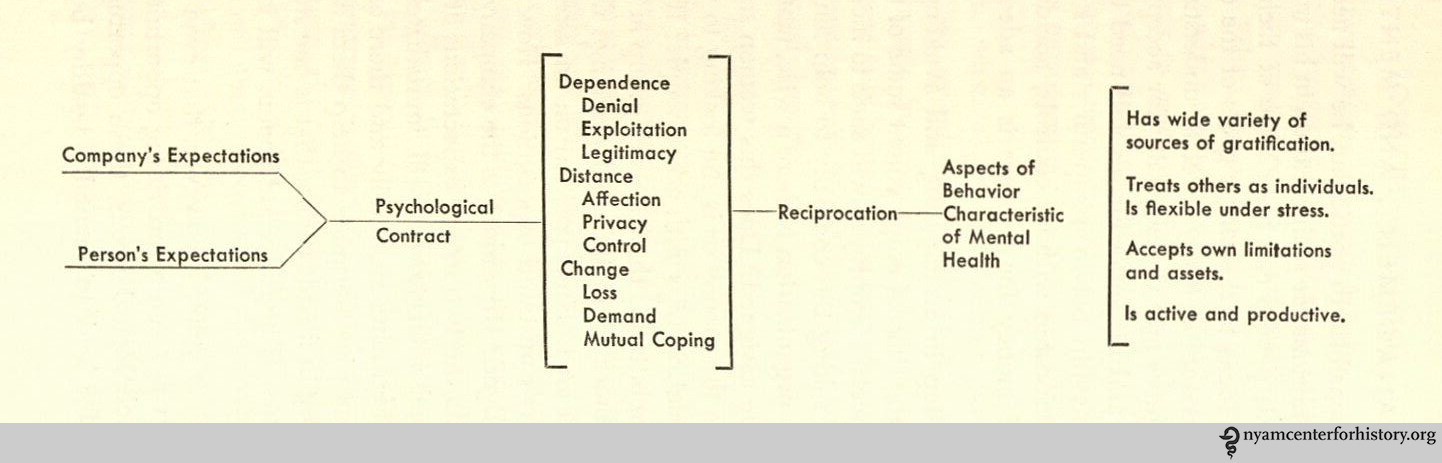
In his work, Levinson brought to bear the full panoply of psychoanalytic theory. He saw in the workplace the playing out of dependency needs and transference mechanisms; he traced the clash of rivalries, and viewed conflicts as arising out of deep psychological wells. Yet all this was comprehensible in terms of the psychoanalytical view of human nature. Chief among Levinson’s insights was that workers wanted, or even needed a psychological contract in addition to a labor contract, not based on specific rewards for services, but rather on such intangibles as security, job growth, mutual respect, and fairness. He called the bundle of these concerns “reciprocation” and held they were crucial for organizational success—and for the mental health and physical safety of employees.4

Chart on page 159 of Men, Management, and Mental Health, , showing the key concepts of the psychological contract and reciprocation.

Chart on page 159 of Men, Management, and Mental Health, showing the key concepts of the psychological contract and reciprocation. Click to enlarge.

True to his psychoanalytical training, he saw executives and managers as having crucial roles, which he put into medical terms. When working well, the executive was “diagnostic, remedial, and preventive.” When failing, he was “iatrogenic”: illness-causing! Finally, he maintained that mental health was not a humanitarian add-on in American business, but an integral part of “getting the job done.” American management needed to move beyond psychological manipulation: “psychological understanding cannot fail.”5

In the late 1960s, Levinson joined Harvard Business School and Harvard Medical School, and founded The Levinson Institute, a consulting firm and his base until the early 1990s. He wrote numerous books and introduced workplace concepts familiar to this day, among them the employee assistance program, performance feedback, and coping with loss in workplace change.6

How would Harry Levinson deal with Don Draper? For Levinson, the most important goal is alleviating workplace stress, which Don does through alcohol—as well as other outlets. Levinson’s means were solidarity and leadership, with the aim of re-establishing a creative balance. How well Draper would have responded to this message is up for grabs: my guess is that he’d be out the door!

References

1. Harry Levinson, Charlton, R. Price, Kenneth J. Munden, Harold J. Mandl, and Charles M. Solley, Men, Management, and Mental Health (Cambridge, MA: Harvard University Press, 1962).

2. Levinson, Men, Management, and Mental Health, p. viii.

3. Levinson, Men, Management, and Mental Health, Appendix 1, “Research Team Operations,” pp. 173–82, quotation from page 179.

4. Levinson, Men, Management, and Mental Health, passim, but for those terms, see pp. 21 and 122.

5. Levinson, Men, Management, and Mental Health, chapter 10, pp. 157–72.

6. See also Diana Gordick, “Leader Speak: A Conversation with Harry Levinson,” The Consulting Psychologist: Spotlight on Consulting Issues, http://www.apa.org/divisions/div13/Update/2003Fall/Spotlight2Fall2003.htm. Accessed April 2, 2015.