Syphilis, or the French Disease

By Rebecca Pou, Project Archivist

To celebrate National Poetry Month, we are sharing a poem from our collection each week during April.
Portrait of Fracastorius from Homocentrica, Venice: 1538.

Portrait of Fracastorius from Homocentrica. Venice, 1538.*

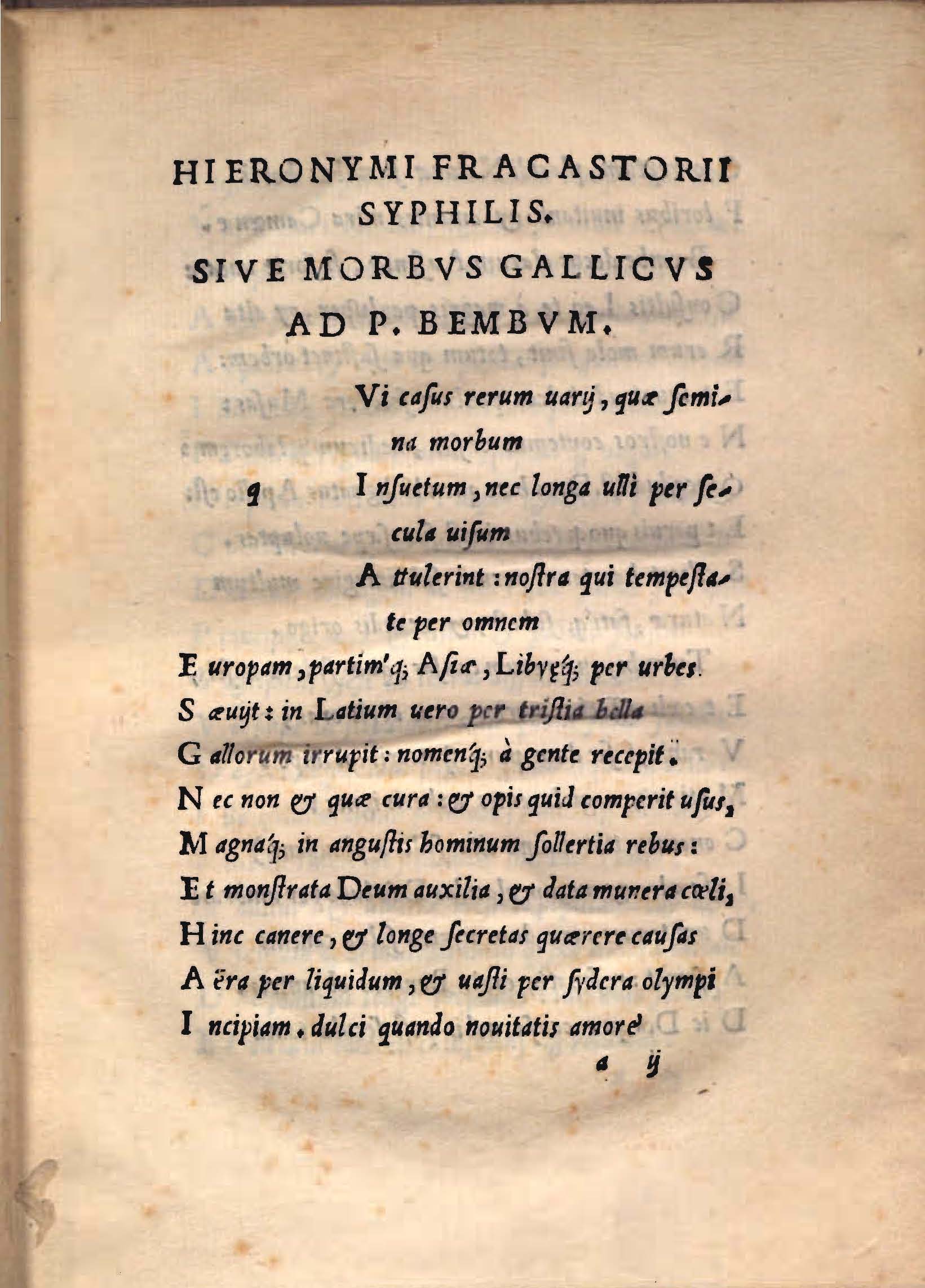
Syphilis seems like an unlikely topic for a poem, yet it is the subject of an important and popular work. Syphilis, or the French Disease, was first published in 1530. At that time, syphilis was new to Europe and spreading fast. To the Italians it was the “French disease,” to the French the “Italian disease,” with many other countries blaming one another for bringing the infection to their citizens. Written in Latin by the multi-faceted Italian physician and poet Fracastorius, the poem was translated into many languages, reflecting the great desire to understand this disease. Our collection holds multiple editions, including the original, pictured above, and several English versions (this post features two English translations – one is pictured below and another as the excerpts).
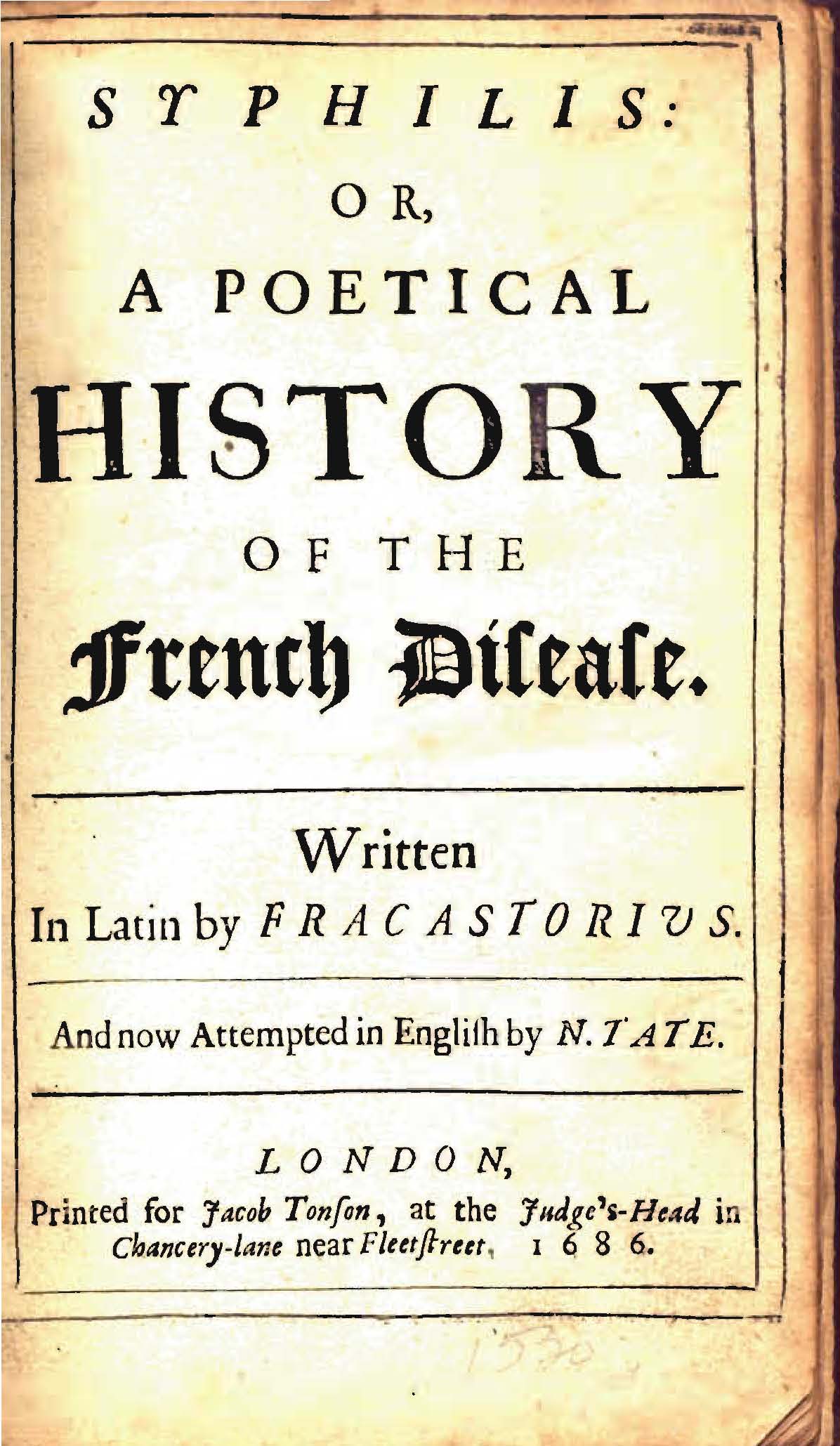
In the poem, which is broken into three parts, we learn of the disease and some popular treatments of the time, including mercury and the plant remedy guaiac. We also read the tale of a shepherd named Syphilus, supposedly the first person afflicted with the disease, which was his punishment for spurning the sun. Excerpts from each of the poem’s books, taken from William Van Wyck’s translation, are below.

Book 1

Within the purple womb of night, a slave,
The strangest plague returned to sear the world.
Infecting Europe’s breast, the scourge was hurled
From Lybian cities to the Black Sea’s wave.
When warring France would march on Italy,
It took her name. I consecrate my rhymes
To this unbidden guest of twenty climes,
Although unwelcomed, and eternally.
………………
O Muse, reveal to me what seed has grown
This evil that for long remained unknown!
Till Spanish sailors made west their goal,
And ploughed the seas to find another pole,
Adding to this world a new universe.
Did these men bring to us this latent curse?
In every place beneath a clamorous sky,
There burst spontaneously this frightful pest.
Few people has it failed to scarify,
Since commerce introduced it from the west.
Hiding its origin, this evil thing
Sprawls over Europe
………………

Albrecht Durer's woodcut of a syphilitic man.

Albrecht Durer’s woodcut of a syphilitic man, 1496.*

Book 2

Soon is repaired the ruin of the flesh,
If lard be well applied that’s good and fresh,
Or dyer’s colors of a soothing power.
If some poor soul, impatient for the hour
Of sweet release, should find too slow this cure,
And yearning for a quicker and more sure,
Then stronger remedies without delay
Shall kill this hydra another way.
………………
All men concede that mercury’s the best
Of agents that will cure a tainted breast.
To heat and cold sensitive’s mercury,
Absorbing the fires of the this vile leprosy
And all the body’s flames by its sheer weight…
………………

Book 3

An ancient king had we, Alcithous,
Who had a shepherd lad called Syphilus.
On our prolific meads, a thousand sheep,
A thousand kine this shepherd had to keep.
One day, old Sirius with his mighty flame,
During the summer solstice to us came,
Taking away the shade from all our trees,
The freshness from the meadow, coolth from breeze.
His beasts expiring, then did Syphilus
Turn to this horror of a brazen heaven,
Braving the sun’s so torrid terror even,
Gazing upon its face and speaking thus:
‘O Sun, how we endure, a slave to you!
You are a tyrant to us in this hour.
………………
The sun went pallid for his righteous wrath
And germinated poisons in our path.
And he who wrought this outrage was the first
To feel his body ache, when sore accursed.
And for his ulcers and their torturing,
No longer would a tossing, hard couch bring
Him sleep. With joints apart and flesh erased,
Thus was the shepherd flailed and thus debased.
And after him this malady we call
SYPHILIS, tearing at our city’s wall
To bring with it such ruin and such a wrack,
That e’en the king escaped not its attack.
………………

* From Van Wyck, William. The sinister shepherd: a translation of Girolamo Fracastoro’s Syphilidis; sive, De morbo gallico libri tres. Los Angeles, 1934.

Modeling History: Making a Stiff-Board Parchment Binding with a Slotted Spine

This post comes from the 2012 Gladys Brooks conservation intern, Morgan Adams. Morgan is currently interning in the Thaw Conservation Center at the Morgan Library & Museum

As the 2012 Gladys Brooks intern I had the pleasure of working with Senior Book Conservator Anne Hillam on a model of a stiff-boards parchment binding with a slotted spine, a style seen commonly in Italian bindings of the 16th-17th centuries.

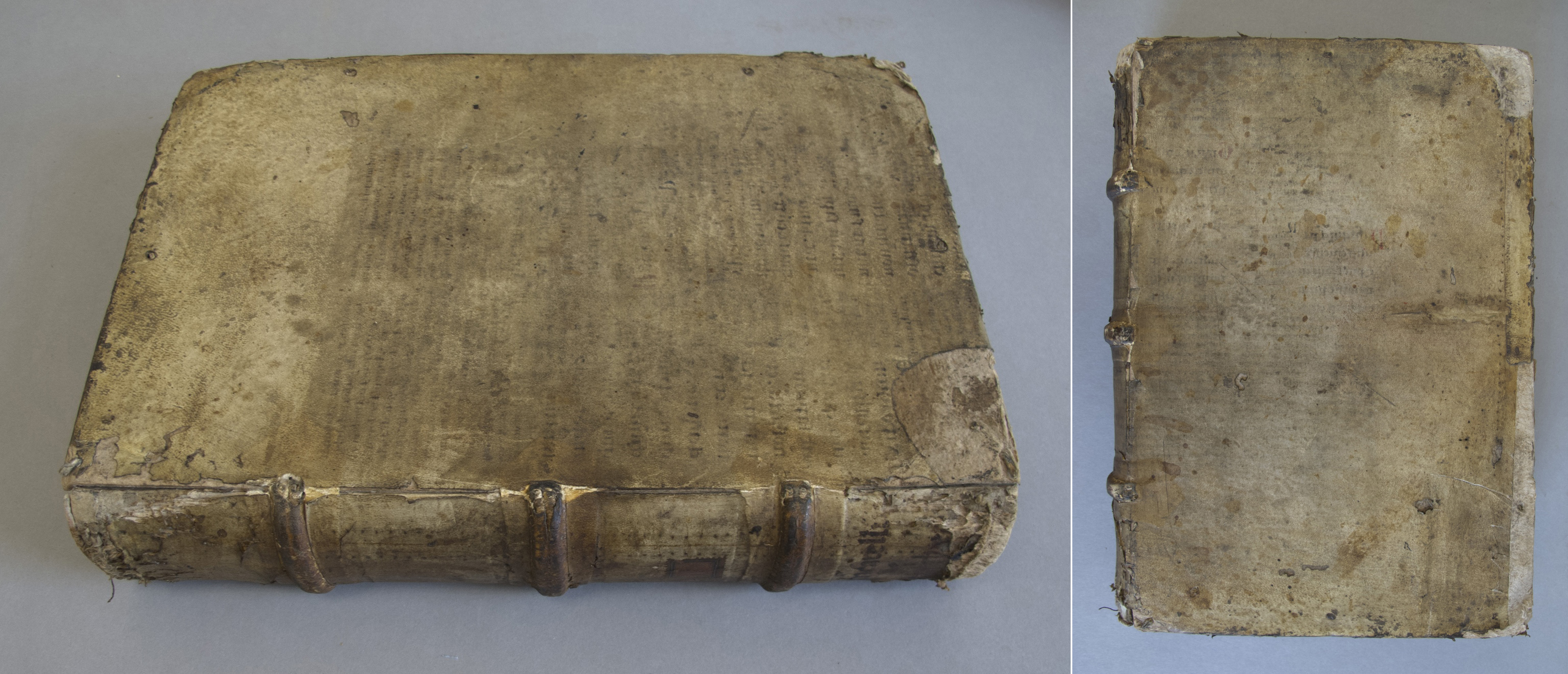
An example of a stiff-boards parchment binding with a slotted spine from the NYAM collection: Trincavello, De differentiis febrium, Venice, 1585. Left: Back cover and spine. Right: Front cover.

An example of a stiff-boards parchment binding with a slotted spine from the NYAM collection: Trincavello, De differentiis febrium, Venice, 1585. Left: Back cover and spine. Right: Front cover.

A unique feature of this binding is the juxtaposition of the parchment and alum-tawed skin used to cover the book’s spine. Slots cut in the parchment across the spine reveal the alum-tawed skin patches covering the sewing supports. It is a combination with structural as well aesthetic advantages: The alum-tawed skin provides the flexibility necessary to conform to the raised sewing supports, while the parchment provides a more durable surface to protect the bulk of the spine.

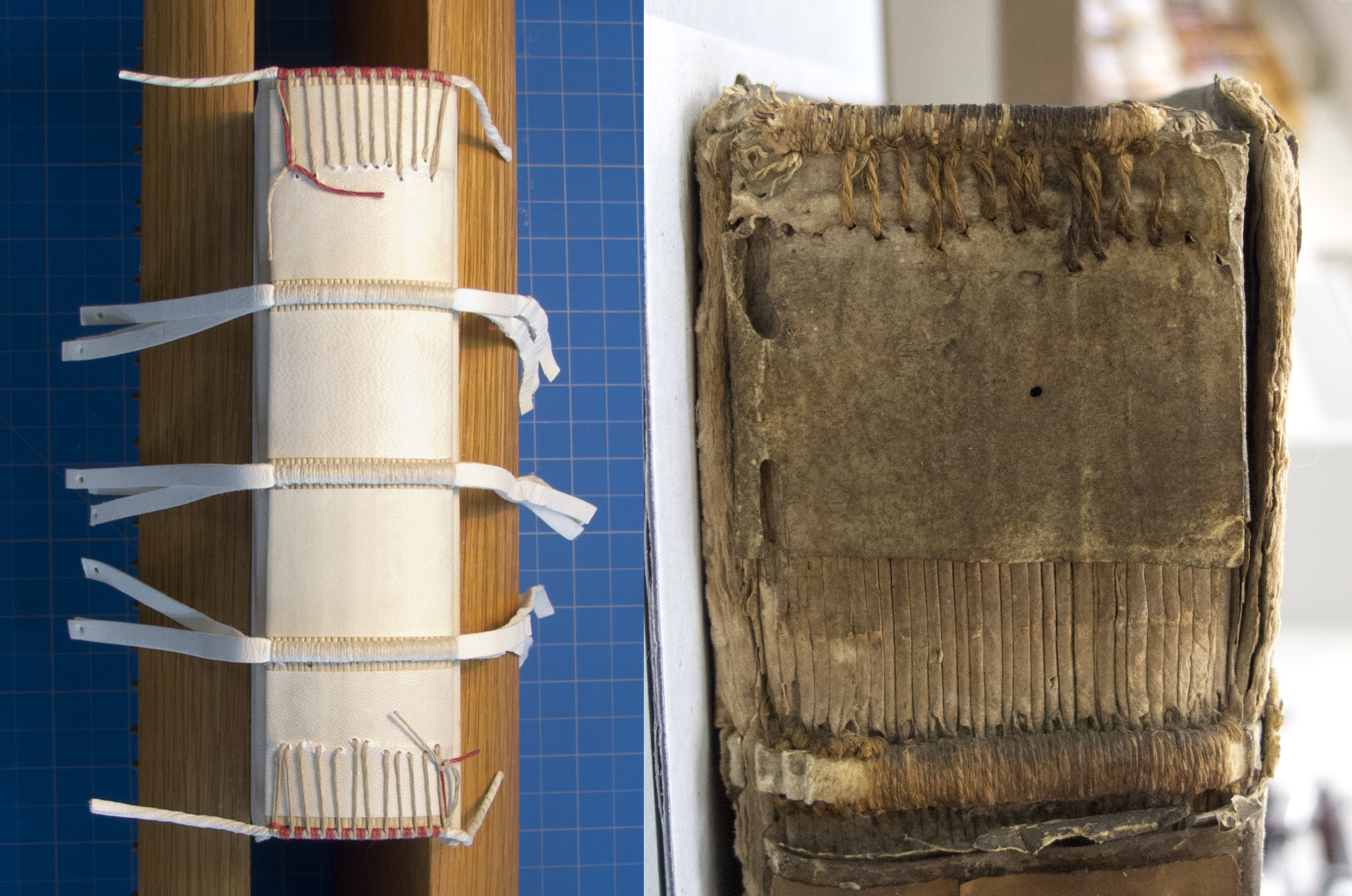
Trincavello (1585): Detail of spine showing the alum-tawed skin patch adhered over sewing support. The original color of the patch can be seen where the parchment is split along the shoulder of the spine.

Trincavello (1585): Detail of spine showing the alum-tawed skin patch adhered over sewing support. The original color of the patch can be seen where the parchment is split along the shoulder of the spine.

To prepare for this binding, we made detailed examinations of six books printed in Venice between 1508 and 1585 in the NYAM special collections. In conjunction with Sylvia Pugliese’s study of this binding style at the National Library Marciana in Venice, we selected material and structural features that exemplified the binding style. These features are highlighted in the images below, which show the steps of the binding process and the finished model.

The text block is sewn on three laminated alum-tawed supports.

The text block is sewn on three laminated alum-tawed supports.

Left: The text block is rounded and backed and the spine is lined with parchment. Endbands are sewn through the spine lining on twisted alum-tawed skin supports.

Left: The text block is rounded and backed and the spine is lined with parchment. Endbands are sewn through the spine lining on twisted alum-tawed skin supports. Right: Galen, Omnia quae extant in Latinum sermonem convsera, Venice, 1556, detail of the spine showing an endband, parchment spine lining, and one sewing station.

Left: Endbands seen from above. Right: Galen (1556) detail of the front bead endband sewn in red and white thread.

Left: Endbands seen from above. Right: Galen (1556) detail of the front bead endband sewn in red and white thread.

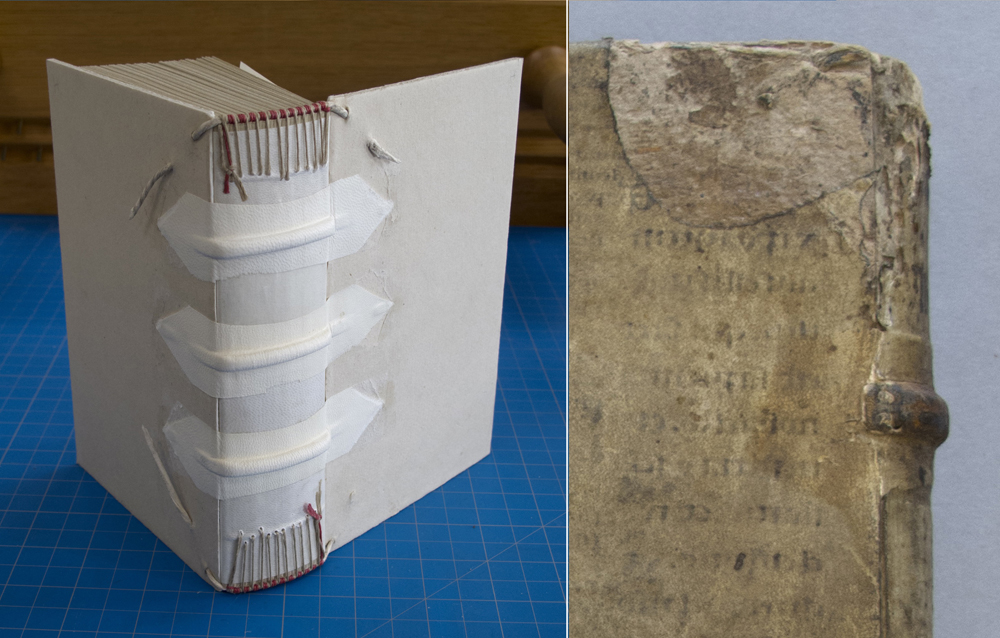
Left: The sewing supports are laced into the boards and then covered in alum-tawed skin patches. The endband cores are also laced into the boards. Right: Trincavello (1585), detail showing the "arrow-point" shaping of the alum-tawed skin patch underneath the parchment and the endband core that has been laced through the board and trimmed off flush with the board.

Left: The sewing supports are laced into the boards and then covered in alum-tawed skin patches. The endband cores are also laced into the boards. Right: Trincavello (1585), detail showing the “arrow-point” shaping of the alum-tawed skin patch underneath the parchment and the endband core that has been laced through the board and trimmed off flush with the board.

A template is prepared for cutting the slots in the parchment. The binding is now ready to be covered.

A template is prepared for cutting the slots in the parchment. The binding is now ready to be covered.

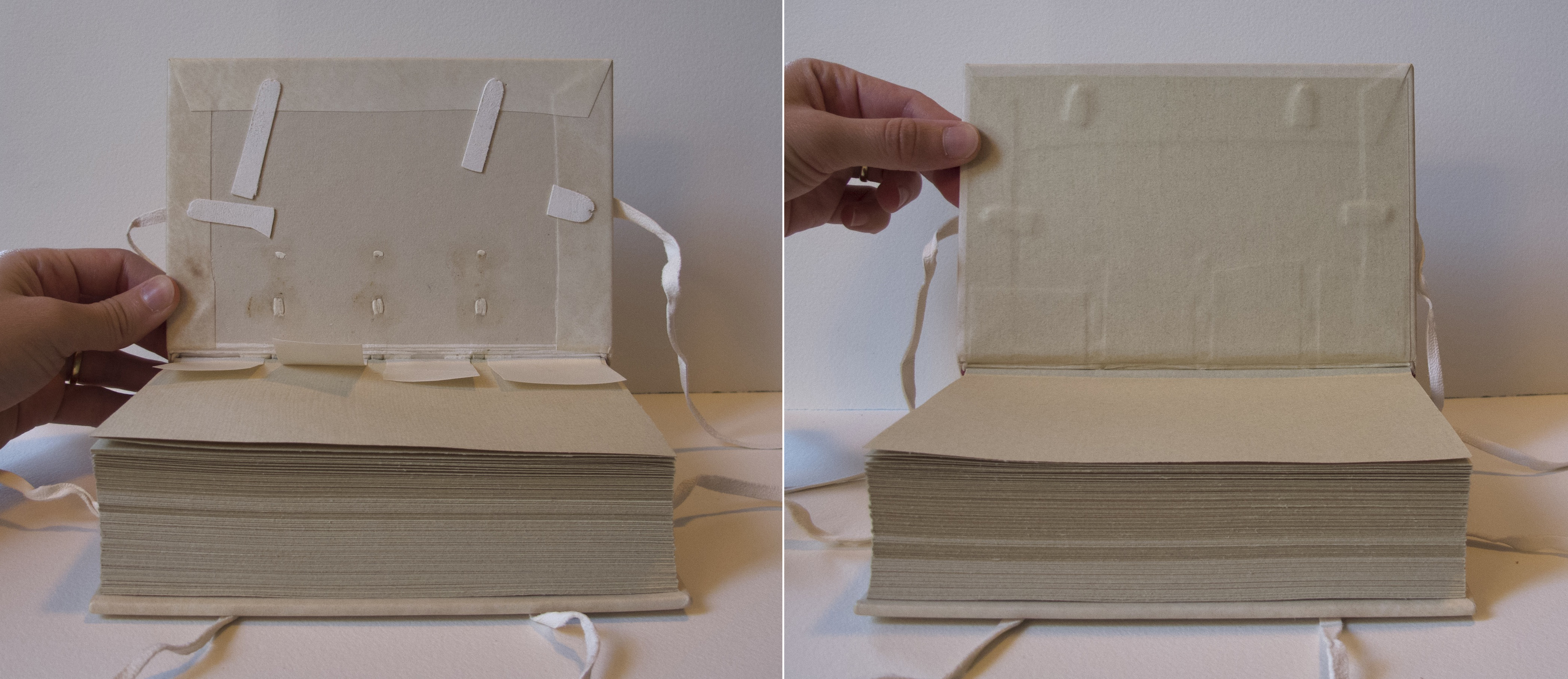
After the parchment cover is adhered, ties are laced through the boards at the fore-edge, head and tail. The parchment spine linings are adhered to the interior face of the board and the endsheet is pasted down.

After the parchment cover is adhered, ties are laced through the boards at the fore-edge, head and tail. The parchment spine linings are adhered to the interior face of the board and the endsheet is pasted down.

Trincavello (1585), The surface of the pastedown reveals the ends of ties formerly  laced through the board.

Trincavello (1585), The surface of the pastedown reveals the ends of ties formerly laced through the board.

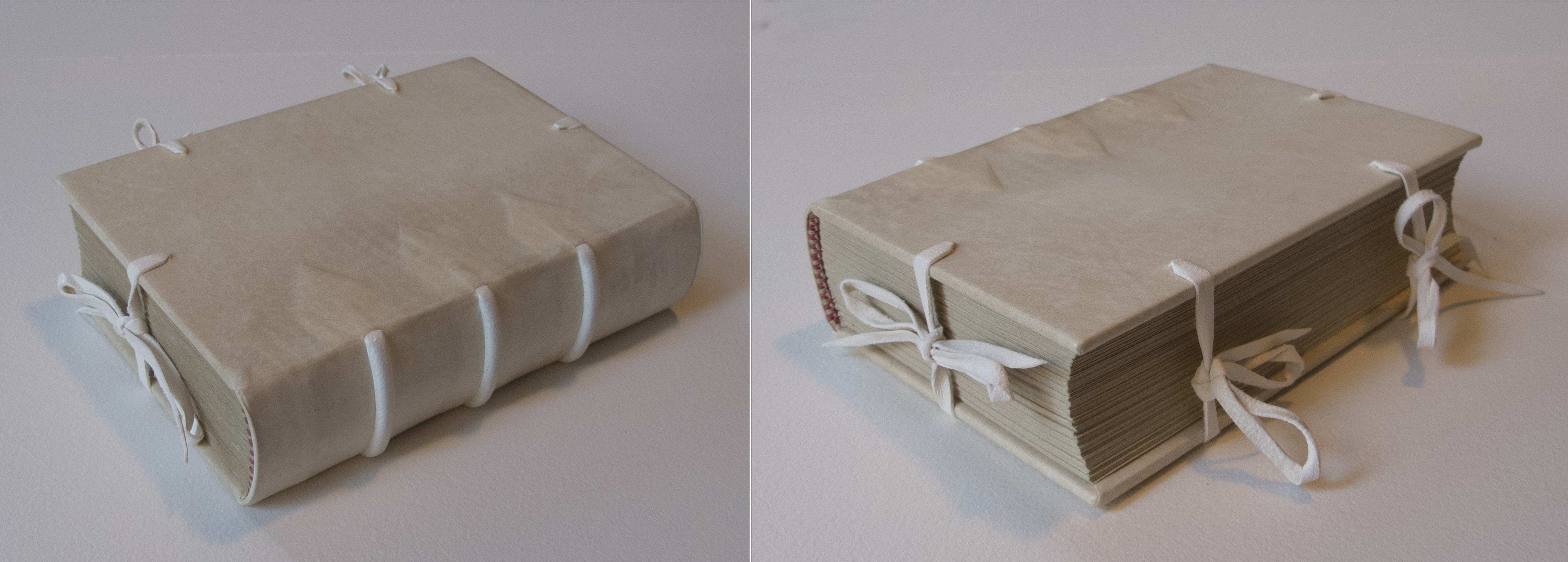
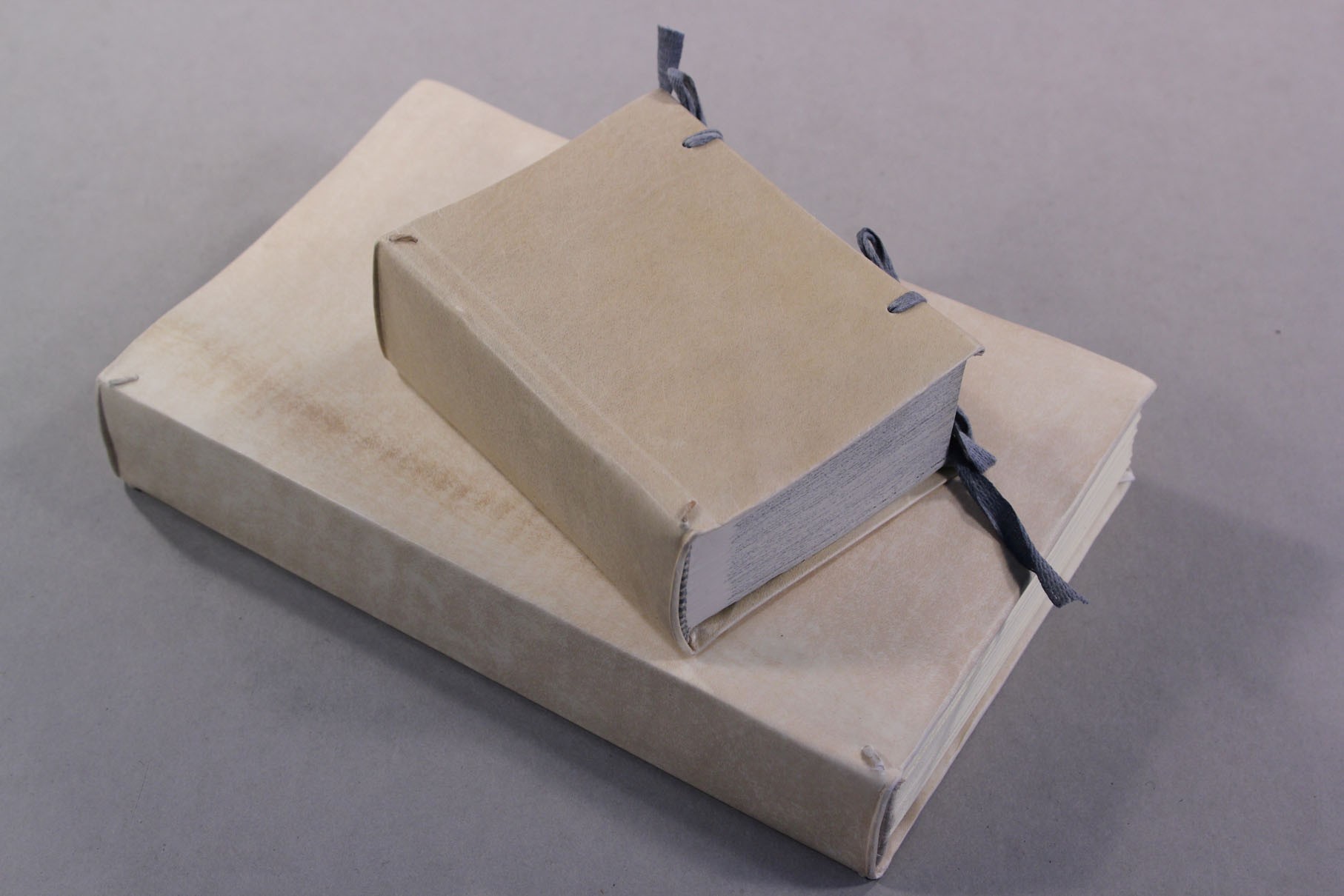
Finished model, complete with ties on fore-edge, head, and tail.

Finished model, complete with ties on fore-edge, head, and tail.

[1] Sylvia Pugliese, “Stiff-Board Vellum Binding with Slotted Spine: Survey of a Historical Bookbinding Structure,” in Papier Restaurierung – Mitteilungen der IADA, Vol. 2 (2001), Suppl., S. 93-101.

Brain Awareness Week

By Lisa O’Sullivan, Director

Ambroise Paré, The brain and nerves of the head and neck, p134, Les Oeuvres

Ambroise ParéThe brain and nerves of the head and neck, p134, Les Oeuvres

This week is Brain Awareness Week, a global campaign to celebrate the brain and increase awareness of brain research. Treating the brain has a long history; trepanning, or trepanation, is one of the oldest known surgical procedures.

The brain featured in today’s post comes from Les Oeuvres d’Ambroise Paré, currently being treated in our conservation laboratory. The work was the culmination of the 16th century French barber-surgeon’s long and successful career, which saw him become royal surgeon for a number of French kings.

Les Oeuvres d’Ambroise Paré was first published in 1575, and was subsequently expanded in multiple new editions. It was groundbreaking on a number of levels, written in the vernacular French, rather than Latin, it included not only anatomical depictions and descriptions of procedures, but illustrations of the instruments used in surgery, many of which Paré had modified or developed himself.

Looking for that je ne sais quoi : the conservation of Les Oeuvres d’Ambroise Paré

By Christina Amato, Book Conservator

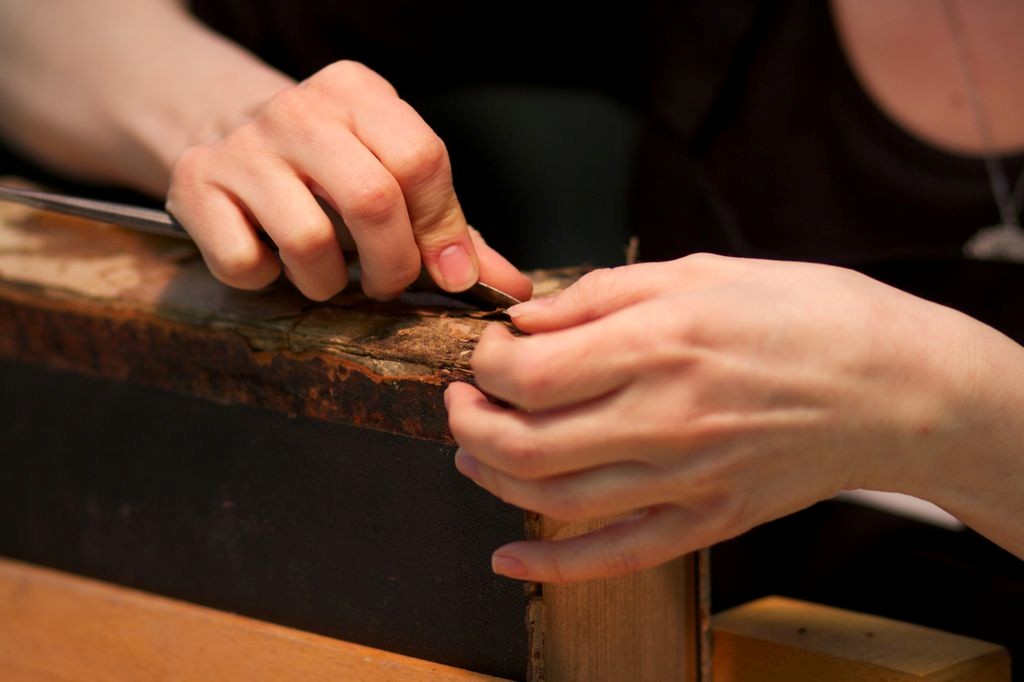
NYAM conservator Christina Amato removes a damaged and ill-suited spine from a 1633 copy of Paré’s Les Oeuvres d’Ambroise Paré/

NYAM conservator Christina Amato removing a damaged and ill-suited spine from a 1633 copy of Paré’s Les Oeuvres d’Ambroise Paré

Many books come through the Gladys Brooks Book and Paper Conservation lab, and often they receive minimal stabilization, or are rehoused in new boxes or folders. Occasionally one comes through that is in need of an entirely new binding, and requires some research before getting started.

quarterviewlesoeuvres

Les Oeuvres d’Ambroise Paré, before treatment. Click to enlarge.

This copy of Paré’s Les Oeuvres d’Ambroise Paré came to the lab in rather sorry shape; it is a 17th century book that had been rebound at some point in its past. The new binding, or cover, was clearly made centuries after the book was created, and was damaged to the extent that handling the book was very difficult.  The usual practice in conservation is to use as many of the original parts as possible when repairing a book; in this case, however, the binding was not only heavily damaged, but inappropriate, so the decision was made to make a new binding for the book.

What kind of binding would be appropriate for a 17th century French book? Beyond historical appropriateness, we had to consider the functionality of the new binding as well. It is a rather large, heavy book; what would be best for a book of this size? How often would this book be used? How would it be stored?

We began with the first question of historical appropriateness. We are lucky to have access to the library’s rare book collection, and were able to find other books from the same time period and location, and study their bindings.  We also made use of our large collection of books about binding history, researched other libraries on-line bindings databases, and talked to colleagues.

Models of "semi-limp vellum" bindings

Models of “semi-limp vellum” bindings. Click to enlarge.

With these things in mind, we decided to explore the possibility of making a variation of what is called a “semi-limp vellum” binding.  Such bindings are commonly used in conservation, for their historical appropriateness and functionality.  With a little digging, a picture started to emerge for us of a typical French, 17th century vellum binding.  We did not find a lot of details about how these bindings were made, however.  It was very helpful to make a few small models before tackling the original book, to work out these details, and try variations to understand differences in functionality.

With all the knowledge we acquired from these models, and from our research, we can now approach this treatment with confidence. Les Oeuvres d’Ambroise Paré will have a well-thought out new binding which is faithful to its time period, and will protect it well, for years to come. Check back to read about the final stages of treatment and see pictures of the book in its new binding.

Rare Book Reading Room naming

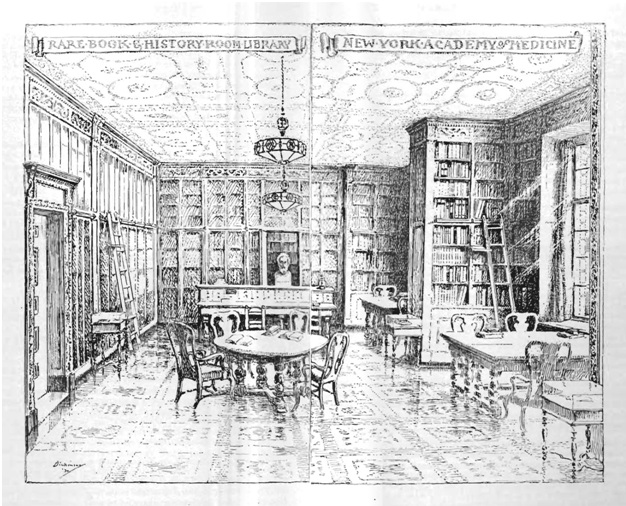
 Pen sketch of the Rare Book Room

Robert Latou Dickinson sketch of the Rare Book Room on its opening in 1933, from the NYAM Annual Report, 1933

Thanks to the generosity of the Samuel J. and Ethel LeFrak Charitable Trust and The Samuel J. and Ethel LeFrak Charitable Foundation, Inc., our Rare Book Reading Room is being named in honor of Drs. Barry and Bobbi Coller. The Drs. Coller are both active users and supporters of our historical collections and long term friends to the Rare Book Room.

The gift will be used to upgrade the care of our rare book collections in the Reading Room and support the development of the Center for History of Medicine and Public Health. Our thanks go to the LeFrak family for their support.