Food Tips from the Fairies

By Rebecca Pou, Project Archivist
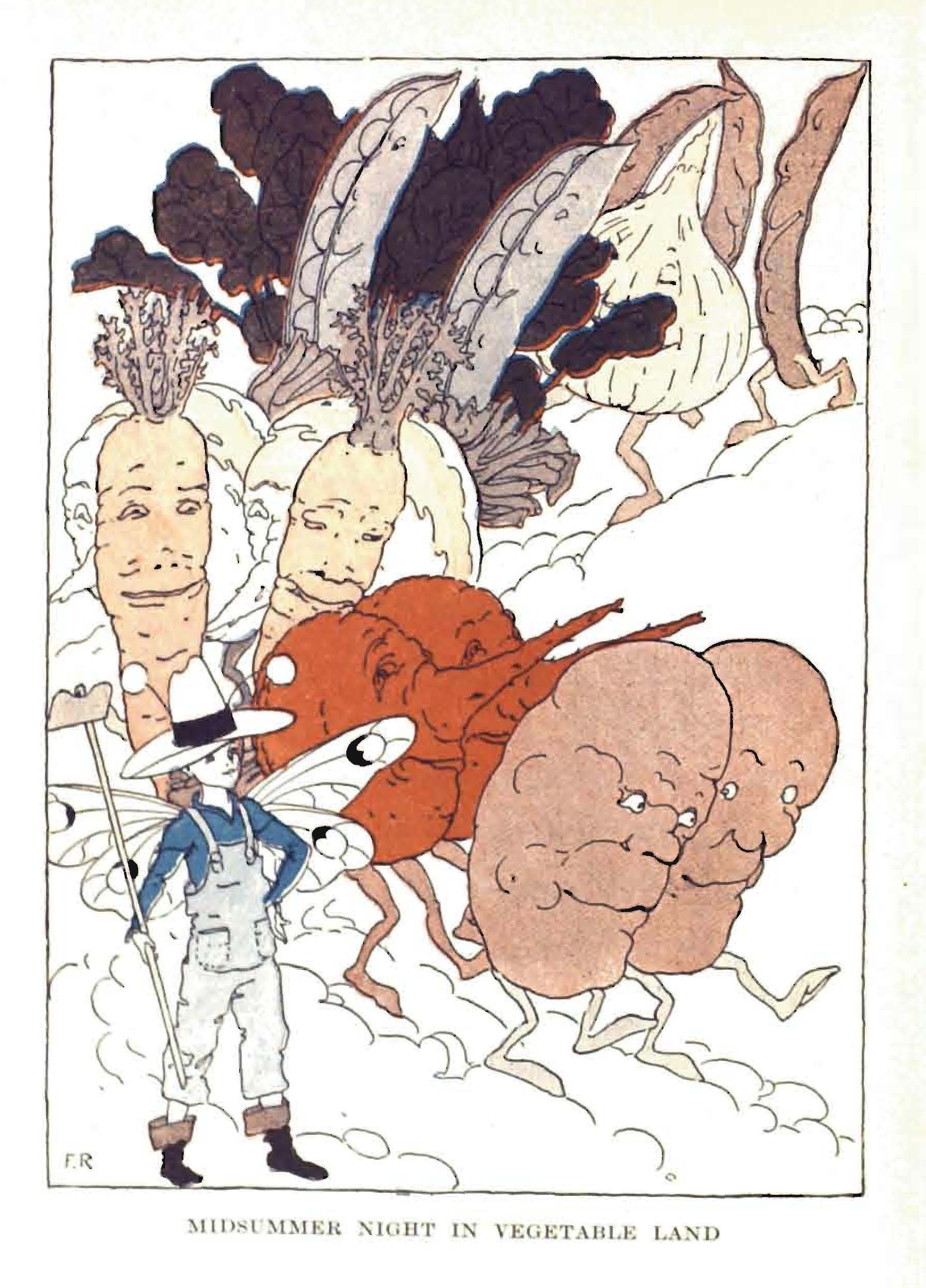
Pairs of vegetables (potatoes, beets, carrots, etc.) marching down a path with a fairyToday we are celebrating Food Day, “a nationwide celebration and movement toward more healthy, affordable, and sustainable food.” Concerns about good food, and encouraging children to enjoy it, are nothing new. In 1921, Dr. Beatrice Slayton Herben’s Jack O’Health and Peg O’Joy: A Fairy Tale for Children included jingles written by students of Public School 15 in New York City such as:

“Sing a song of coffee, rich foods and cakes,
these will make sick children with bad stomach-aches
Sing a song of clean milk, butter, fruit and bread,
these will make strong children with their cheeks all red”

In the story, a succession of health-conscious fairies teach Jack and Peg to follow good health habits throughout the day. They learn to brush their teeth, comb their hair, drink plenty of water, get a good night’s rest, and, of course, eat nutritious food.

When Peg despairs at the thought of a life without cake, the eat-clean-food fairies reassure her that she may have cake after eating fruits and vegetables, but “be careful not to eat too much.” In fact, the fairies tell her, even the fairy queen eats a special cake, made from mist and decorated with stars, which is made just once a year.

Fairies bringing cake to fairy queen

The foods promoted in the book include fresh fruits, carrots, potatoes, spinach, and lima bean soup —all nutrient-dense foods that support health, in line with Food Day’s recommendations.

Many of the lessons in Jack O’Health and Peg O’Joy, are featured in today’s Food Day celebrations. Beyond promoting a healthy diet, Food Day also calls attention to the broader context of food production, such as the environmental impact of farming and food and farm workers’ rights. Learn more about Food Day’s priorities here.

To celebrate Food Day, NYAM, Mt. Sinai, and El Museo del Barrio have organized a Healthy Food Walking tour, highlighting a number of establishments in our neighborhood. These include: Lane Farmer’s Market, Pure Food, Champignon Cafe, Mt. Sinai Greenmarket, El Aquila, El Paso Restaurant, and East Harlem Cafe. The next time you are at NYAM or in the neighborhood, visit these businesses for a healthy bite. The eat-clean-food fairies would be proud.
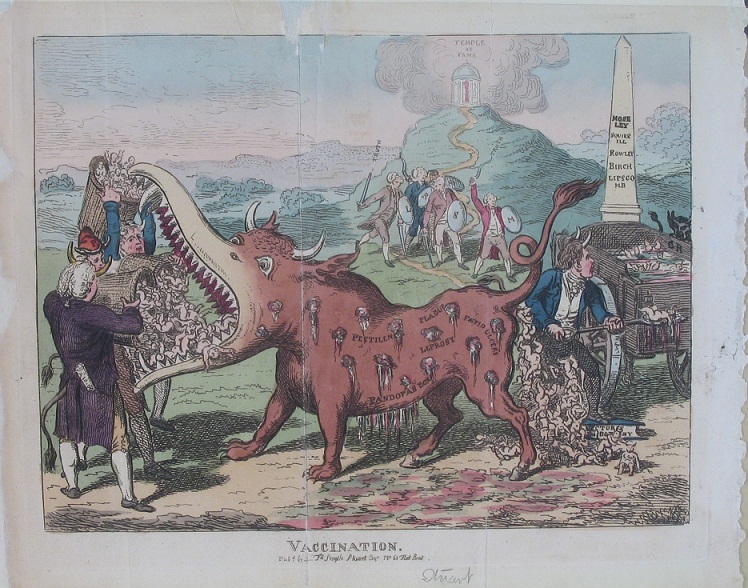
Mad Cows and Caricatures

By Lisa O’Sullivan, Director

Image of monster being fed infants and excreting them with horns.

Charles Williams caricature c.1802.

This early anti-vaccination caricature shows a monster being fed baskets of infants and excreting them with horns. In the background, four prominent anti-vaccine campaigners, Benjamin Moseley, Robert Squirrell, William Woodville and William Rowley, approach with “swords of truth”. This unusual colored version of the print was originally bound as a frontispiece to the 3rd edition of William Rowley’s 1805 Cow-pox inoculation no security against small-pox infection: with above 500 proofs of failure. One of Rowley’s “above 500 proofs of failure” was the case of a boy whose face, Rowley claimed, was assuming the character of a cow.

Vaccination Williams detail

Horned baby

Next week we look forward to welcoming Mark Largent to explore more recent controversies about childhood vaccination as part of our history of medicine series. Register for this free October 17 event here.

The Sex Side of Life

By Rebecca Pou, Project Archivist

September 30-October 6, 2012 is Banned Books Week, an annual event that celebrates the freedom to read and calls attention to books than have been banned or challenged. While Banned Books Week was first celebrated in 1982, printed matter was being censored long before that, as shown in a collection here at NYAM. In the Mary Ware Dennett Case Collection, one finds a controversy surrounding a small pamphlet and the resulting rally against its suppression.

This small collection centers on Mary Ware Dennett (1872-1947) and the case against her. She wrote a pamphlet titled The Sex Side of Life, which explained human reproduction to children.
Title from front cover of the "Sex Side of Life" pamphlet

First published as an article in the Medical Review of Reviews in 1918, it was later distributed as a pamphlet. The pamphlet was endorsed by doctors, churches and social organizations, but its forthright description of human sexuality was not wholly well-received. The pamphlet was deemed obscene by the Post Office in 1922 and in 1928, Dennett was tried by a federal grand jury and found guilty of distributing obscene materials through the mail. A Mary Ware Dennett Defense Committee was organized under the American Civil Liberties Union and the conviction was overturned in 1930.

Our collection was created by the well-regarded medical illustrator Dr. Robert Latou Dickinson, fellow of The New York Academy of Medicine, friend to Mary Ware Dennett and member of the defense committee. Dr. Dickinson was also responsible for the diagrams shown in the pamphlet. Materials include copies of The Sex Side of Life, correspondence, clippings, printed matter, typed and manuscript notes and the Appellant’s Brief from the U.S. vs. Mary Ware Dennett case. To learn more or visit the collection, please contact the staff of the Drs. Barry and Bobbi Coller Rare Book Reading Room by emailing history@nyam.org.

On Teeth, Tools, and Boxes

By Anne Hillam, Conservator

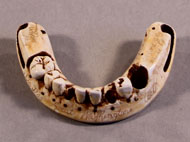
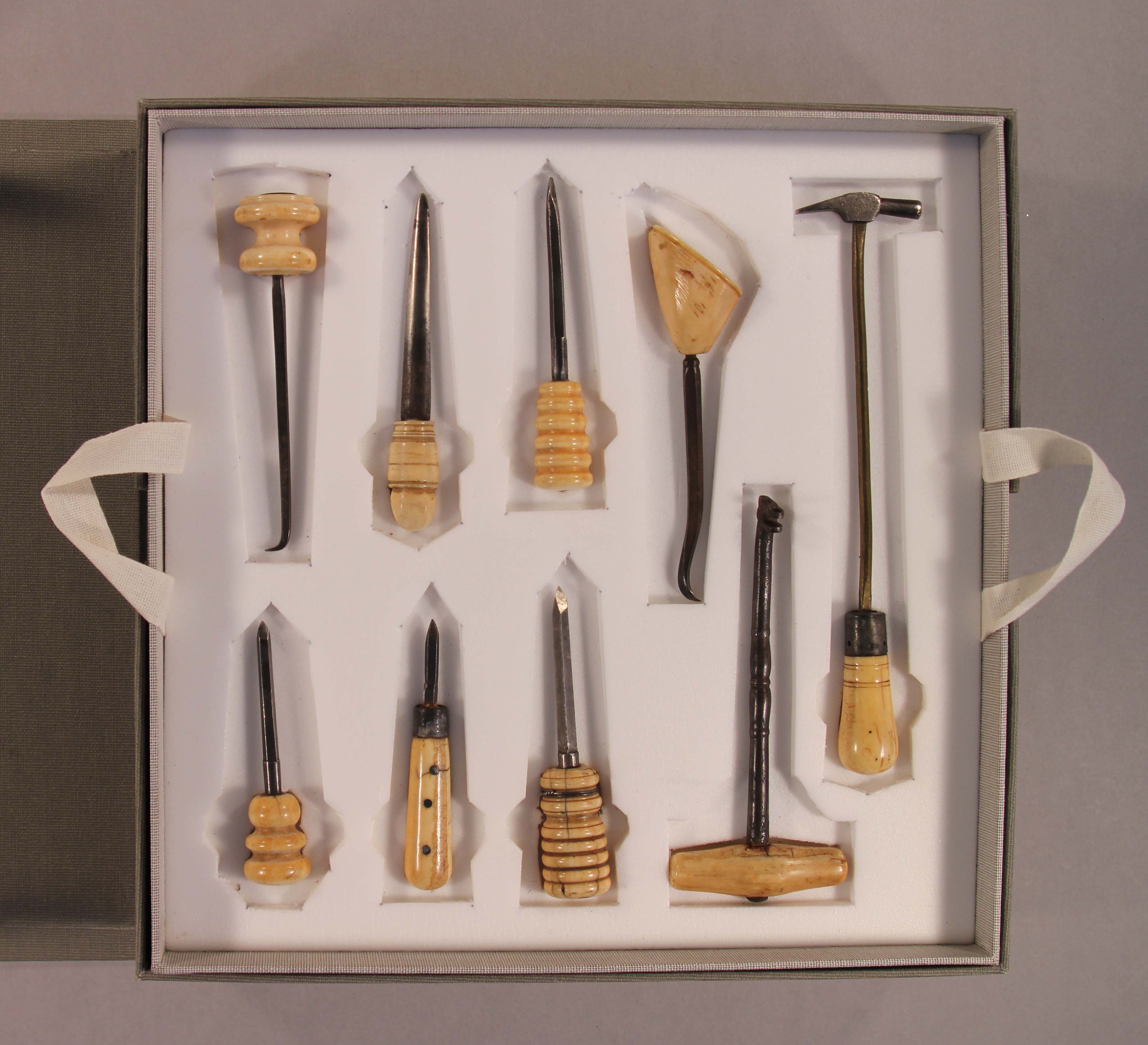
Following a recent upgrade of the heating, ventilation and air conditioning system in the special collections storage facilities at NYAM, the Gladys Brooks Book & Paper Conservation Laboratory received a group of artifacts associated with George Washington for stabilization:  (1) a plaster-cast facsimile of George Washington’s lower denture (the original, which is made of hippopotamus ivory, is currently on loan to Mount Vernon through June of 2013), and (2) a collection of dental tools (constructed out of hand-forged metal and bone and/or ivory) made and used by Washington’s dentist, Dr. John Greenwood (1760 – 1819).

plaster-cast facsimile of George Washington’s lower denture

Facsimile of Washington’s lower denture

9 ivory-handled dental instruments in custom fit tray

Greenwood’s ivory tools

++++++++++++++++++++++++++++++++++++++++++++++++++++++++++++++++++++++++++++++++++++++
Proper housing is an important element in the overall preservation of any artifact.  By protecting objects from improper handling and adverse environmental conditions (including light, water, dust, and pollutants), boxes and other types of protective enclosures — especially when made using pH neutral and chemically inert materials – can add decades to the life of an artifact.

In this case, the conservator’s custom-made boxes allow for easy access and display of the objects during tours and exhibitions.  Interior trays easily lift out of the structural exterior boxes, preventing the need to touch the objects themselves.

Facsimile denture in custom-made clamshell box

Custom-made box housing facsimile denture

If you take a close look at the denture, you will see engravings. They were made by Dr. Greenwood and read:  “This was Great Washingtons Teeth” and “First one made by J. Greenwood,” accompanied by the date 1789.  Several of the tools also carry an engraved message (albeit a slightly more ominous one):  ”[D]on’t touch these instruments.”  Thanks to their new box, it is now easy to honor Dr. Greenwood’s wish!

Close up of Washington's lower denture showing engraving saying "This was Great Washingtons teeth"

Original denture with engraving

The tools and the denture facsimile are all beautifully made and are now securely housed and preserved among NYAM’s special collections.  You can arrange for a tour to see the Drs. Barry and Bobbi Coller Rare Book Reading Room and some of NYAM’s many treasures by contacting history@nyam.org.

– The Gladys Brooks Book & Paper Conservation Laboratory

Why Grey Literature?

By Danielle Aloia, Special Projects Librarian

The Academy started producing the Grey Literature Report in 1999 to fill the gaps in peer-reviewed journal articles and published books in the public health research literature. In general, grey literature publications are non-conventional, fugitive, and sometimes ephemeral publications. They may include, but are not limited to the following types of materials: fact sheets, technical reports, white papers, statistical reports, market research, workshop summaries, and dissertations. Most grey literature is freely accessible through the World Wide Web. Produced by foundations, think-tanks, advocacy groups, government agencies, and academic institutions, it often offers timely, statistical analysis for state-of-the-art research.

In May 2012, NYAM launched the new Grey Literature database in order to make it easier for researchers and policymakers to find the information they need. It was no longer enough to index the most current grey literature, but also important to be able to find past reports related to a specific topic. In this way, users are able to see policies that were in place in 1999 and how they have changed over time.

Grey literature offers a unique perspective to the research community because government agencies and think tanks produce these reports on topics that effect policy and the people who implement that policy. Grey literature is also timely because it is not subject to a long or peer-reviewed publishing process. For instance, the morning the U.S. Supreme Court made the deciding vote on the Affordable Care Act (ACA) their report was available online at 10:15 am. This report lays out the reasons for the decision as well as the options states have for implementing the changes.

Reactions, commentaries, and reports about how the recent ACA decision affect their constituents can come from a variety of perspectives. These commentaries are not easily findable using traditional search methods. Searching Google can be daunting and cumbersome. A simple search for “Affordable Care Act Supreme Court” results in over 7 million hits most of which are news sources. The same search in the Grey Literature Database yields 12 results that have to do with the potential outcome of the ruling for states, people, and the country, mainly written by prominent think tank organizations.

Screenshot of search for "affordable care act supreme court" in the Grey Literature database

Search results from the Grey Literature Report include materials that are not available through normal, commercial distribution channels.

A time-saving feature of the database is the ability to bookmark a search or subscribe to it as an RSS feed. The results will dynamically update every time new items are added, which is every 2 months. You can bookmark the Grey Literature search above and re-execute it in September to see the most current results added automatically. An RSS feed will alert you as new items are added.

The new database allows users to comment on a specific item, like the Supreme Court report on the ACA decision, as well as share it through Facebook or Twitter. It is now easier than ever to spread the word about the latest grey literature.

Some search features include sorting options, publisher and subject limits, and date limits.

We hope you will take the opportunity to explore the database, use the new features, and share with your friends. You may also contact us at greylithelp@nyam.org to learn more, send comments, or make recommendations. We would be happy to answer your questions.

Processing a Hidden Collection: Alexander E. MacDonald papers and photographs, 1869-1906

By Erin Albritton, Head of the Gladys Brooks Book & Paper Conservation Laboratory

From the congestion, decay, stench and pestilence of Five Points to the rolling pastures and sweeping Hudson vistas uptown, life in 19th century New York was markedly different than it is today. For the mentally ill, the contrast between life then and now is even starker. The NYAM Library’s archival collection of Dr. Alexander E. MacDonald’s papers opens a window into this fascinating and somewhat grim world.

Spread of photographs, clippings, and other documents from MacDonald Papers

Sample items from the collection.

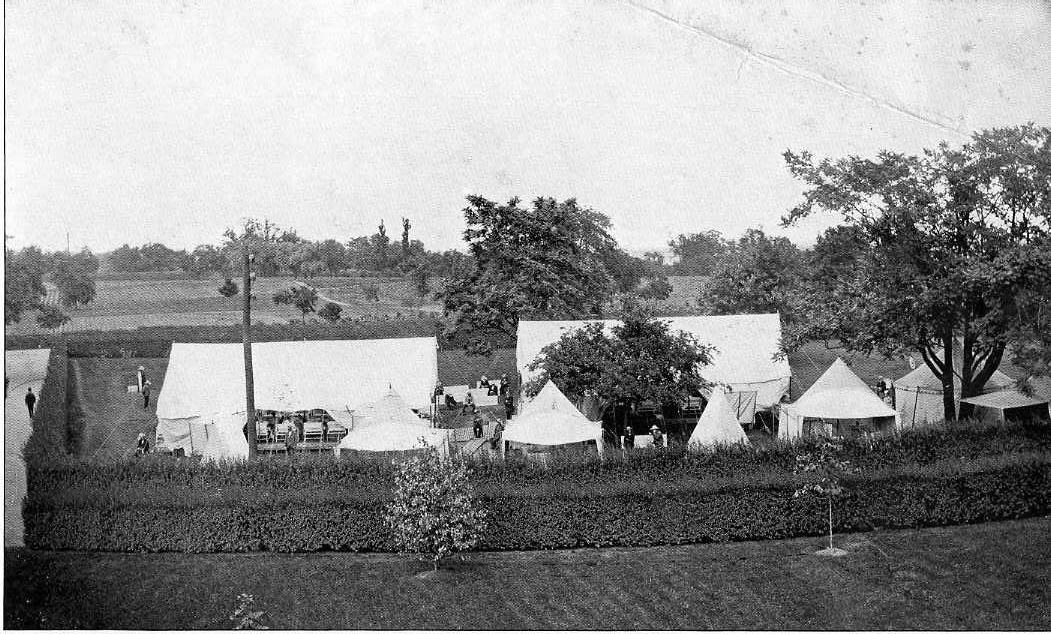
Purchased in 2005, the materials in this collection cover the period in Dr. MacDonald’s life from 1869 to 1906, concerning most especially his tenure as Superintendent of the New York City Asylum for the Insane, Ward’s Island (which later became the Manhattan State Hospital) and as General Superintendent of the New York City asylums. The collection, which is 8.5 linear feet, includes correspondence and personal diaries, manuscripts, photographs, printed pamphlets and reports, legal documents and press clippings. Taken together, these materials paint a picture of day-to-day life in the asylums at a time when firmly entrenched draconian attitudes towards the treatment and care of mentally ill patients were just beginning to change. As a case in point, Dr. MacDonald (who was also a Fellow of the New York Academy of Medicine) is credited with establishing an outdoor tent treatment for asylum patients suffering from tuberculosis – a novel method that garnered accolades worldwide. Photographs, articles and notes on the subject are included in this extensive archive.

Black and white photograph of tent city and grounds from a New York psychiatric facility dated 1901

Tent city for tuberculosis patients, 1901.

The Alexander E. MacDonald papers have now been processed and were minimally stabilized and rehoused in the Gladys Brooks Book & Paper Conservation Laboratory. For more information or to make an appointment to use the collection, contact the Rare Book Room at (212) 822-7313 or history@nyam.org. The finding aid is available by request. To see where Dr. MacDonald’s Asylum for the Insane once stood, take a walk on the Ward’s Island pedestrian bridge at 103rd Street across the Harlem River to Ward’s Island Park, where you will now find playing fields, bike paths and a scenic waterfront.

2011-2012 Helfand Fellow

Earlier this year we were delighted to host artist and scholar Cindy Stelmackowich as our 2011-2012 Helfand Fellow. Cindy was kind enough to share her thoughts on the Fellowship, and how it fits into her research trajectory.

“Receiving the 2011-2012 Helfand Fellowship in the History of Medicine has wonderful meaning to me, on both personal and professional levels. In fact, the opportunity to conduct research in the Rare Book Room at the New York Academy of Medicine completes a circle for me; its rich holdings have been pivotal to my development as a scholar.

Antoine Toussaint de Chazal, Maladies du Poumon [Lung cancer, lung cysts], 1829-1935, lithograph, 15 x 7.5 inches, pl. ll. in Anatomie pathologique du corps humain by Jean Cruveilhier. (Paris 1829-1835).


Arriving to New York from Canada for the residency at the Rare Book Room in March and April 2012 was not the first time I had an extended stay in New York City. After I finished an M.A. in Art History in 1999 from Carleton University in Ottawa, I moved to New York and worked in a contemporary gallery in SoHo as a curatorial assistant. Visiting galleries and exhibitions was a daily activity for me. Featured at The New York Public Library at this time was an exhibition entitled Seeing is Believing – a wonderful exhibition that focused on the ways illustrations were essential in spreading new scientific and medical ideas. I was hooked! I knew at that moment that not only did I now want to complete a Ph.D, but I needed to see and learn more about the illustrations and rare books I was exposed to in that exhibition. The exhibition labels noted that a number of the medical books were from the collection of the Rare Book Room at the New York Academy of Medicine. Off I went to find this treasure-trove of a library on Fifth Avenue. Needless to say, I continued to consult The Rare Book holdings at the New York Academy of Medicine while writing my dissertation on nineteenth-century anatomical atlases; no scholarly attention had previously been conducted to analyze this specific group of important medical publications and visual diagrams.

It was thereby very heartening to receive the 2011-2012 Helfand Fellowship at a time when I had finished my dissertation and am happily preparing a book manuscript on anatomical and pathological atlases. At the end of my residency in April 2012, I presented a public presentation on my research entitled Picturing Pathology: Morbid Anatomy Diagrams, Pathological Atlases and Disease 1800–1840. This paper examined how pathological ideas were embedded in new types of visual representations and newly re-ordered types of anatomical textbooks. It focused on the complex web of interconnections among disease, the body and visual representation; how aesthetic strategies, visual codes and rhetorical tropes attempted to represent key pathological concepts, discoveries and models of perception as visual diagrams became crucial to this young discipline of pathology.

The two images included in this posting represent the new types of visual imagery that emerged within medicine at the beginning of the nineteenth century in France and Britain as new systems of pathology were developing. Doctors used these innovative pathological illustrations to teach medical students how to identify signs of morbidity and disease. The desire for precise diagrams based on minute dissections of diseased tissues was of great interest to both surgeons and medical students; physicians began to either commission artists to execute detailed diagrams to add to their novel publications or spent years executing drawings of their findings. Renowned for his artistic skill as well as his anatomical knowledge, Sir Robert Carswell for example, executed the drawings in his 1838 folio-sized atlas entitled Pathological Anatomy: Illustrations of the Elementary Forms of Diseasehimself, and, as an expert lithographer, personally transferred the drawings to stone for the lithographs used in the atlas.

Robert Carswell, Neoplasms of the peritoneum, the stomach, the kidneys, the portal vein and the lung, 1832, lithograph, 13.8 x 9 inches, plate III., in Pathological Anatomy. Illustrations of the Elementary Forms of Disease by Robert Carswell. (London 1832-1838).

My scholarly interest in  these early pathological manuals outline how the dead body was initially made into a working pathological object by the profession. Central to this work is a close analysis of the visual languages of this specific archive of pathological diagrams. In this regard, I am interested in how art – its grammar, forms, aesthetic strategies – articulated and represented pathological concepts, discoveries and models of perception in the young field of pathological anatomy. This study examines the aesthetic theories that informed the dissection diagrams’ languages of representation; such as the Western art historical models and academic techniques in the art schools where anatomical illustrators were trained. Furthermore, my project will examine the myriad of representational techniques that encoded these unique images so that the various types of morbid specimens appeared as systematic, encyclopedic collections of disease.

Thank you once again to Bill and Audrey Helfand for creating and endowing this Fellowship at the New York Academy of Medicine, and to the librarians and staff in the Rare Book (Arlene Shaner and Rebecca Pou) for making my residency fruitful and enriching.

In 2012-2013, Cindy will be a Postdoctoral Fellow with the “Situating Science Strategic Knowledge” Cluster group at University of King’s College and Dalhousie University in Halifax. Her most recent publication, “The Instructive Corpse: Dissection, Anatomical Specimens and Illustration in Early-Nineteenth Century Medical Education,” will appear in a special September 2012 issue of Spontaneous Generations: A Journal for the History and Philosophy of Science devoted to “Visual Representation and Science.” You can view some of Cindy’s artistic investigations here.