The LaGuardia Report: Exploration of a Chronic Issue in American Drug Policy

On May 1 and 2, The New York Academy of Medicine and the Drug Policy Alliance co-hosted a conference, The LaGuardia Report at 70. Featuring more than 25 speakers, including historians, policy experts, political figures, and community organizers, the conference provided a forum to understand the state of marijuana regulation and enforcement in New York and to see the current debates in the context of over a hundred years of public policy fights around drugs and drug regulation in the United States.

For the conference, we created a small exhibit featuring facsimiles of materials from the New York Academy of Medicine’s Committee on Public Health Relations archive, as well as the original 1944 report. We are pleased to share the images with you on our blog.

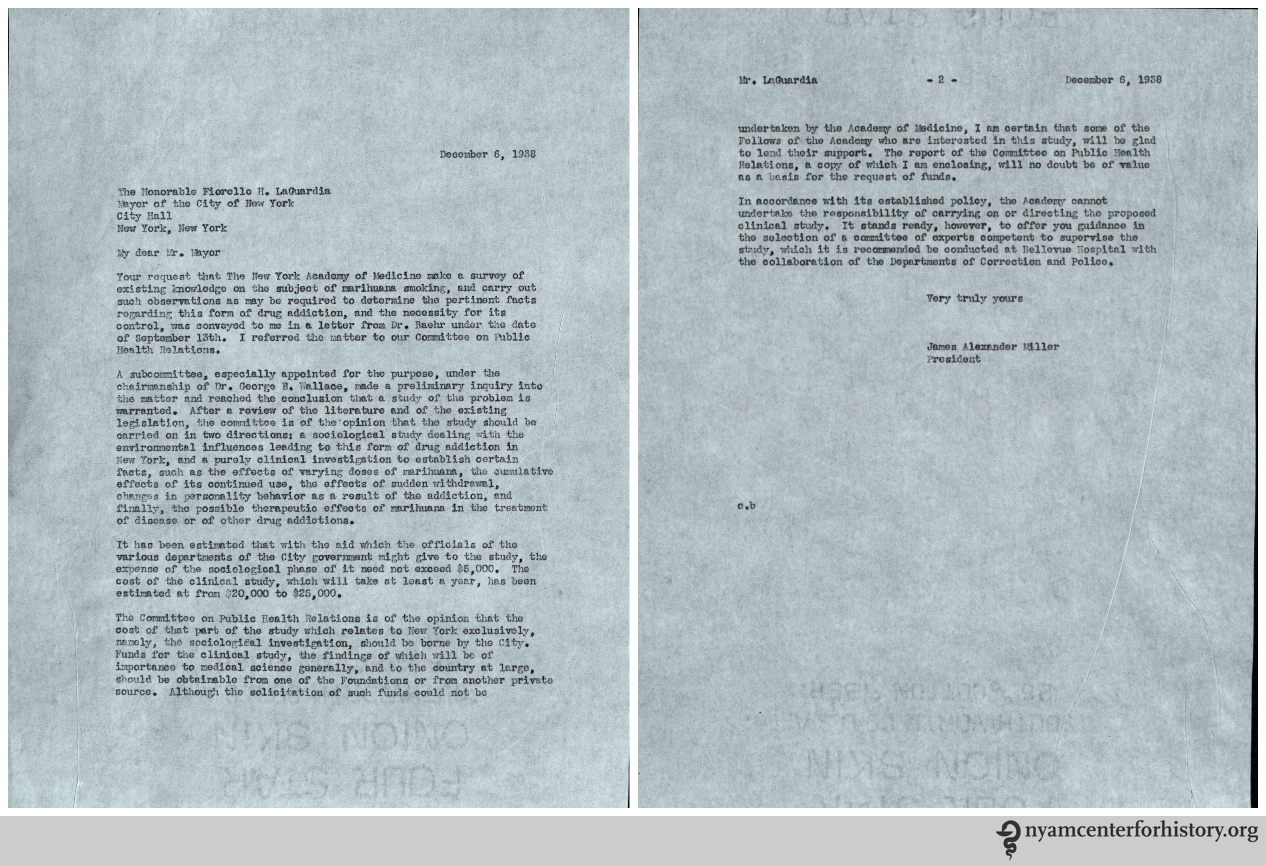
LettertoMayor_merged_watermark

In 1938, at the request of Mayor Fiorello LaGuardia, The New York Academy of Medicine’s Committee on Public Health Relations formed a subcommittee to study marijuana use in New York City. As you can see in this letter to Mayor LaGuardia from the Academy’s president, James Alexander Miller, M.D., the subcommittee determined a more extensive study was necessary. They recommended two approaches, a sociological study of marijuana use in the city and a clinical investigation of its physiological and psychological effects. (Click to enlarge.)

In the sociological study, six police officers acted as social investigators. They ventured into places where marijuana might be available and socialized with people in order to find out who was using marijuana and how it was being distributed. Olive J. Cregan was one of the investigators. This page from her report describes some of her interactions, including one in a speakeasy that she called “the worst dive I have ever seen.” While they learned a great deal about marijuana use in the city, one of the study’s conclusions was that “the publicity concerning the catastrophic effects of marihuana smoking in New York City is unfounded.”

In the sociological study, six police officers acted as social investigators. They ventured into places where marijuana might be available and socialized with people in order to find out who was using marijuana and how it was being distributed. Olive J. Cregan was one of the investigators. This page from her report describes some of her interactions, including one in a speakeasy that she called “the worst dive I have ever seen.” While they learned a great deal about marijuana use in the city, one of the study’s conclusions was that “the publicity concerning the catastrophic effects of marihuana smoking in New York City is unfounded.”

This report from the clinical team gives a sense of the reputation marijuana had at the time of the study, a view that the study eventually countered. There was great concern about marijuana’s potential for addiction and its role in crime. The study found little basis for its bad reputation.   (Click to enlarge.)

This report from the clinical team gives a sense of the reputation marijuana had at the time of the study, a view that the study eventually countered. There was great concern about marijuana’s potential for addiction and its role in crime. The study found little basis for its bad reputation. (Click to enlarge.)

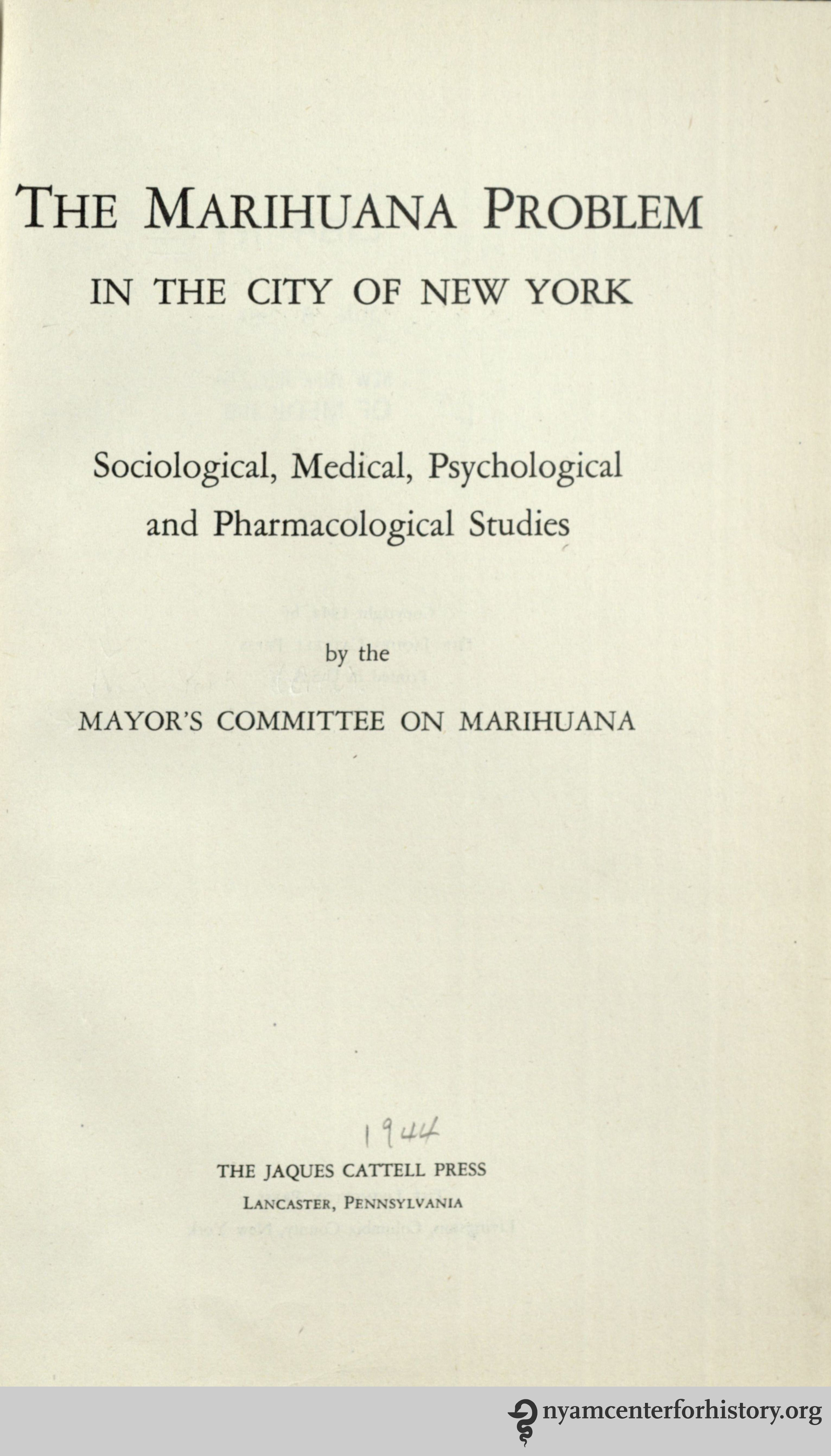
LaGuardiaReportTP_watermark

The LaGuardia report, formally titled The Marihuana Problem in the City of New York, was published in 1944.

Celebrate Preservation Week, April 26–May 3, 2014

PreservationWeekIn 2010, the American Library Association (ALA) created Preservation Week to bring attention to the millions of items in collecting institutions that require care. Sponsored by the ALA’s Association of Library Collections and Services and partner organizations, it was designed to inspire the preservation of personal, family, and community collections of all kinds, as well as library, museum, and archive collections. The goal is also to raise awareness of the role libraries and other cultural institutions can play in providing ongoing preservation information.

What will you do to celebrate Preservation Week? Here are a few ideas.

1. Write a disaster plan for your institution, if it doesn’t have one already. If it doesn’t, you are not alone. According to a 2004 study, 78% of public libraries and 73% of academic libraries do not have an emergency plan or staff to carry it out. (Read more about it here.)

Get ahead of the game—here are some places to start:

2. Learn more about caring for your private collection materials.

Facsimile denture in custom-made clamshell box

Custom-made box for a facsimile of George’s Washington’s lower denture.

3. Make sure your collection materials are correctly housed. 

  • There are several posts about creating enclosures in our blog that you can peruse:

o Creating a box for a facsimile of George Washington’s lower denture.

o On re-housing our diploma collection.

o And be sure to check out our Item of the Month blog for May 2014, which features an introduction to enclosure basics.

  • A variety of custom enclosures are available from the following vendors:

o Archival Products (of particular note is the Academy folder, named after the New York Academy of Medicine)

o Talas

o Hollinger Metal Edge

4. Find a conservator. Of course, we don’t recommend undertaking conservation treatments unless you are a trained conservator. AIC (The American Institute for Conservation for Historic and Artistic Works) provides a searchable listing of conservation professionals working in specialties ranging from books and paper to objects and textiles. You can search by specialty or by zip code.

5. Attend a Preservation Week event. Click here for an event map and list of speakers.

Preservation week happens only once a year, but collections need constant care. We hope the above can help you get started, or serve as a reminder of the importance of preservation.

Read more about Preservation Week.

Marijuana Regulation: The LaGuardia Report at 70 (Item of the Month)

By Paul Theerman, Associate Director, Center for the History of Medicine and Public Health

Medical and recreational marijuana regulation is undergoing a sea change right now, the reworking of a drug regulation regime that goes back at least 75 years. Debates about the drug are not new, however; the New York Academy of Medicine found itself in the middle of the political discussion back in the 1930s and 40s and is now taking a look at this history.

For a hundred years, from the published attestation of the medical use of Cannabis by William Brooke O’Shaughnessy in 1839, medical marijuana use increased and came more and more under medical regulation.  Discussions around regulation usually sounded two concerns: first, that the material be unadulterated and eventually physician-prescribed, and second, that potential benefits could be seen to outweigh harms. For from the beginning, many demonized marijuana use; early on, some went so far as to lump it in with opiates and their abuse.

By 1930, the United States established the Federal Bureau of Narcotics, with increased central control as the goal and Harry J. Anslinger as the willing head. In 1937, over the objections of the American Medical Association, he had pushed through the Marihuana Tax Act. An indirect means of control—as the state governments had most authority to control medicine and drugs directly—it was in fact very effective in criminalizing marijuana. Imposing annual licensing fees on producers and prescribers, it also called for a transfer fee of $1.00 per ounce to registered users, such as physicians, but $100.00 per ounce to unregistered ones—the vast majority. This tax structure was laid down in an era when average American incomes were about $2,000 a year. And indeed, $2,000 was the amount of the fine that could be imposed, along with up to five years in jail, with seizure of the drug as well. The first dealer convicted under the act received a sentence of four years in Leavenworth Penitentiary!

The title page of The Marihuana Problem in the City of New York.

The title page of The Marihuana Problem in the City of New York.

New York Mayor Fiorello LaGuardia was skeptical of the reasons behind this stringent control. In 1938, he commissioned a report from the New York Academy of Medicine on marijuana use. With the study supported by the Commonwealth Fund, the Friedsam Foundation, and the New York Foundation, an expert panel of researchers considered “The Marihuana Problem in the City of New York” (as their report was ultimately titled) from the viewpoint of sociology, psychology, medicine, and pharmacology. Their work continued for six years.

The report ran 220 pages, and La Guardia’s own foreword summarized the results:

I am glad that the sociological, psychological, and medical ills commonly attributed to marihuana have been found to be exaggerated insofar as the City of New York is concerned. I hasten to point out, however, that the findings are to be interpreted only as a reassuring report of progress and not as encouragement to indulgence[!]

Anslinger was furious and denounced the report, and, as painstaking and factual as it was, it had little effect on marijuana decriminalization. Eventually, the Supreme Court found the Marihuana Tax Act of 1937 unconstitutional on grounds of self-incrimination, in a suit raised by Timothy Leary in 1969. The next year, Congress passed the Controlled Substances Act, which placed marijuana in Schedule I, the most highly controlled category, used for drugs that have no currently accepted medical use and are considered liable for abuse even under medical supervision. It remains there today.

On May 1 and 2, the New York Academy of Medicine, partnering with the Drug Policy Alliance, is mounting a day-and-a-half-long conference, “Marijuana & Drug Policy Reform in New York—the LaGuardia Report at 70.” Historians and drug policy experts will gather to consider the report and its effects, look at the “drug wars” over the last century, and survey the policy landscape of the near future. Please join us; the conference is free. View the full schedule and participant information. Register here.

The Origins of “Sweat”

Guest blogger Bill Hayes, author of The Anatomist and the forthcoming Sweat: A History of Exercise, will present our 2014 Friends of the Rare Book Room Lecture, “Writing the Body,” on April 23 at 6pm. Register here.

Most of my writing has dealt in one way or the other with medical history and the human body. I don’t exactly know why or how to explain this. I don’t come from a family of doctors or scientists, for instance. But from an early age, I had a keen interest in the body. This has not changed. Sometimes I think I’m still in that stage you see babies in where they are endlessly fascinated with their own limbs. I am over 50 now, so I don’t see myself growing out of it. I look at the human body as an amazing machine and try to figure out how things work.

From the book Medico-Mechanical Gymnastics by Gustaf Zander, 1892

From the book Medico-Mechanical Gymnastics by Gustaf Zander, 1892

If I had excelled in the sciences in school, I might have gone on to become a doctor. But frankly, I didn’t even do well—I barely passed high school biology—whereas writing came easily. I followed that path instead. My interest in the body has led me to write about the science of sleep (my first book, Sleep Demons); the history of human blood (Five Quarts); and, in my last book, The Anatomist, the story behind the classic 19th-century anatomy text Gray’s Anatomy. For this, I spent a year studying anatomy alongside first-year medical students. I went from never having seen a cadaver to doing full cadaver dissection, trying to get a feel for what the original Henry Gray had done.

After finishing the book, I had time on my hands and spent hours working out at a gym. I began running again; I went to yoga classes; I swam. I got into the best shape I’d ever been in. Exercise and I had had a long history by this point, yet the notion that exercise itself might have a history—that there could be such a thing—never occurred to me until one afternoon at the gym.

I don’t recall the exact date but do know it was a cardio day, a cardiovascular workout, about six years ago. At the gym, I tend to go old school; the original StairMaster has long been my cardio machine of choice, both because it makes you sweat like nothing else and it gives you a certain psychological lift. Standing atop a StairMaster, one is a good four feet taller, allowing the illusion that you are Lord and Master of the Gym—like Sigourney Weaver when she mans the robotic killing machine in the second Aliens. You feel like you could conquer anything.

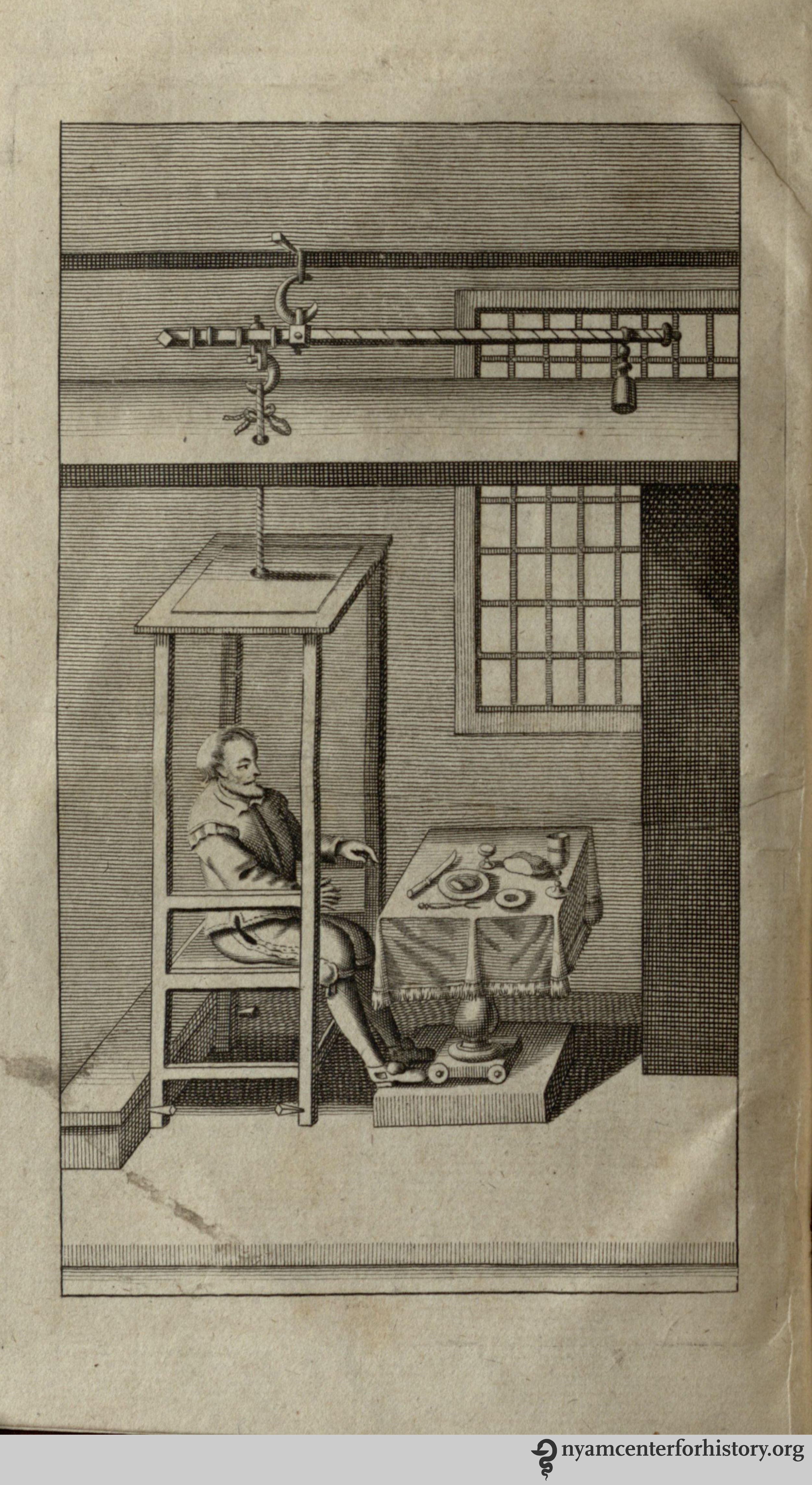
Santorius weighing himself for a metabolism experiment after eating a meal. From Medicina statica: being the aphorisms of Sanctorius, 1720. Click to enlarge.

I climbed up and punched in my usual program—Fat Burner, Level 15, 25 minutes. I arranged my towel and bottle of water, and thumbed in my iPod earphones. My finger found the machine’s START button, that small green circle, so powerfully endowed; each time you press it is a chance to wipe the slate clean and absolve yourself of somatic sins. Yet for some reason, I hesitated a moment on this particular day. I took in the scene before me—men and women of all ages and races, lifting weights, back-bending over giant rubber balls, fitting themselves into torturous-looking apparatuses, pulling themselves up on chin-up bars, dutifully doing sit-ups—and a thought popped into in my head: How did we all end up here? If one were to trace a line backward in time, where would one land?

I stood there and thought about this for a long while then pressed clear, took up my towel and water and climbed back down. What I did next was pure reflex: I went to the library. Little did I know at the time: the journey to write my next book, a history of exercise titled Sweat, had started.


Wrapping Up Our Performing Medicine Festival

By Lisa O’Sullivan, Director, Center for the History of Medicine and Public Health

Thanks to everyone who joined us on Saturday, April 5 for our Performing Medicine Festival, celebrating the intersections of music, dance, and theater with health and medicine.

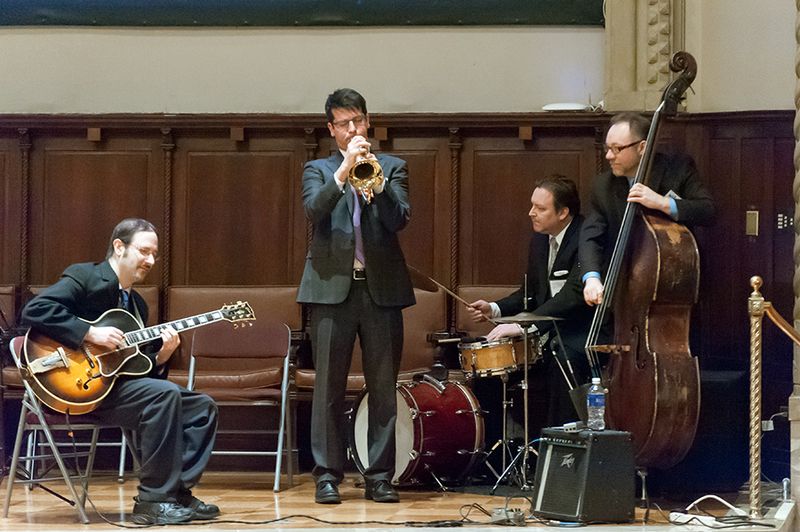
Dr. Daniel Caplivski, center, and medical musicians from Mount Sinai. Photo: Charles Manley.

Dr. Daniel Caplivski, center, and medical musicians from Mount Sinai. Photo: Charles Manley.

In the morning, medical musicians from Mount Sinai’s Icahn School of Medicine demonstrated how chamber music and jazz can improve medical students’ and physicians’ abilities to listen to their patients.

Then, Dr. Richard Kogan, clinical professor of psychiatry at Weill Cornell Medical College and artistic director of the Weill Cornell Music and Medicine Program, demonstrated his virtuosity as a pianist and physician. He explored the mental life of Robert Schumann with an extraordinary performance of “Carnaval” and incisive commentary on historical understandings of the connections between madness, creativity, and genius.

Dr. Richard Kogan. Photo: Charles Manley.

Dr. Richard Kogan. Photo: Charles Manley.

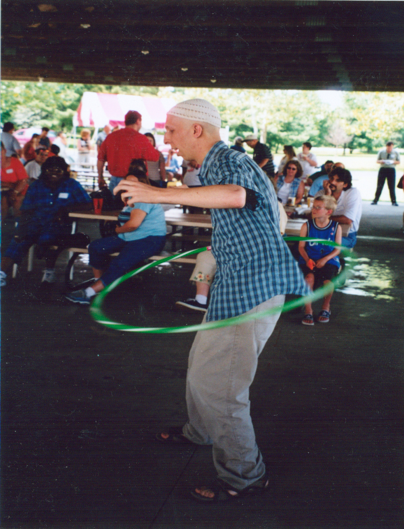
The afternoon focused on the patient experience, beginning with Brian Lobel’s humorous and touching performance about his changing responses to his experiences as a cancer patient, cancer survivor, performer, and educator, and featuring his prowess with a hula hoop. Then David Leventhal and Pamela Quinn of Dance for PD® and PD Movement Lab explored how dance can tell stories about health, identity, and illness and help people with Parkinson’s find community, beauty, and movement.

Pamela Quinn and David Leventhal of Dance for PD. Photo: Charles Manley.

Pamela Quinn and David Leventhal of Dance for PD®. Photo: Charles Manley.

The day ended with the performers in discussion with Dr. Danielle Ofri, editor-in-chief of the Bellevue Literary Review, with topics ranging from the connections between physicians and music to questions about how to embed the arts in hospitals.

Throughout the day, behind-the-scenes tours introduced visitors to the work of our book and paper conservators and to collection highlights with a musical theme.

Save the date! On October 18, we will hold our second-annual Festival of Medical History and the Arts, this time in celebration of the 500th anniversary of the birth of anatomist Andreas Vesalius. The day will be another extravaganza of lectures, performances, workshops, and demonstrations exploring art, anatomy, and the body. Keep an eye out for updates and details over the summer.             

View more photographs from the day-long event on our Facebook page.

Welcome to Performing Medicine

Header for Performing Medicine FestivalOur spring 2014 festival, Performing Medicinetakes place tomorrow, April 5, 2014, from 11:00 a.m. to 6:00 p.m.at the New York Academy of Medicine. We will explore the interrelationships of medicine, health, and the performing arts at this day-long festival of actors, dancers, doctors, and musicians. Register here through today, April 4, for reduced admission.

Performers will include Dr. Richard Kogan on the mental life of famous composers; Brian Lobel and his comedic adventures as a cancer patient; David Leventhal and Pamela Quinn on dance and Parkinson’s disease with DANCE FOR PD® from Mark Morris Dance Group/Brooklyn Parkinson Group; the medical musicians of Mount Sinai on the art of listening; and musical interludes from Weill Cornell’s Music and Medicine Initiative.

Throughout the day there will be guided behind-the-scenes tours of our Dr.s Barry and Bobbi Coller Rare Book Reading Room and Gladys Brooks Book & Paper Conservation Laboratory. Spaces are limited to 20 people per tour; make sure to get your tickets soon!

This is the first of two festivals in 2014 exploring the connections between medicine, health, and the performing and visual arts. In the fall our main festival, Vesalius 500: Art and the Body, will celebrate the 500th anniversary of the birth of Andreas Vesalius and the impact of his De Humani Corporis Fabrica or The Fabric of the Human Body. Like our 2013 festival, the day will feature multiple strands of programs, performances, workshops and interactive events.

BALL & Other Funny Stories About Cancer

This guest blog is an excerpt from the ending of BALL & Other Funny Stories About Cancer, a 70-minute stage performance by Brian Lobel about illness and the changing body over time originally produced in 2003.

This is one of several posts leading up to our day-long Performing Medicine Festival on April 5, 2014, which will explore the interrelationships of medicine, health, and the performing arts. Brian Lobel will perform this and four other monologues at the event. Register for the festival here.

By Brian Lobel

Brian Lobel

Brian Lobel

But what do I win? Lance Armstrong got the Tour De France, speaking gigs, and a ghost writer named Sally Jenkins (who I’m pretty sure never had testicular cancer), everyone else gets all this wisdom and depth that only derive from cancer, and what do I get? If I wasn’t going to become a better person because of all of those procedures then I sure as hell better win some kind of competition.


Competition. I need to be a hero. A role model. A SURVIVOR! I was actually considering sports, which I hadn’t done since my leg surgery in fourth grade. And, P.S., I still hate sports. I still hate to compete. Maybe ballroom dancing. Yeah, ballroom dance is going to become an Olympic sport. I dance. I have nice posture. Ooh, cancer survivor turned Olympic gold medalist —that would definitely make the ticker on CNN. Cancer survivor turned Olympic gold medalist—hah, not even Lance Armstrong has an Olympic gold medal! You can’t just survive cancer anymore. I know that I will never be the best role model or ideal survivor—but I will die trying.

July 1, 2002. Indiana University-Purdue University Indianapolis Hospital Stem Cell Transplant Reunion Picnic. For all of my doctors and nurses a chance to reflect, to reunite with their former patients, and to share in the blessings of life, family, and community. I was three days finished with my stem-cell transplantation process and ready to kick some ass. The day was bright and sunny—as saccharine-sweet and sentimental as the day any cancer-survivor picnic should be. We all gathered in the park—about five miles from the Indianapolis Speedway—and we celebrated. We celebrated living.

The Indiana University-Purdue University Indianapolis Hospital Stem Cell Transplant Reunion Picnic Hula Hoop Contest. For the kids. Eight un-ironic, cute little daughters of stem-cell transplant patients (who I’m sure were once upon a time frozen at International Cryogenics Incorporated) versus Brian Lobel, the world’s most competitive cancer survivor. A race to the finish, a fight to the death. Winner take all: a Coleman folding lawn chair. They were nothing. The world needed to see who the real cancer survivor turned hula hoop champion was…and so, I hula-d.

If it was a title that Lance Armstrong would never hold, I would hold it, and so I focused, intensely, passionately.

My hips began to twirl on their own and my mind began to flash back over the last eight months…boring, endless, depressing, near defeating…The support, the love, the compassion… The hundreds of people who didn’t make mention in this cancer story because they were beautiful, and perfect, and caring, and kind.

Most of the crap I hate about cancer is story after story after story about people supporting and loving each other with cancer. But I think that’s because, to me, it all seems so obvious. But I do feel indebted to those people. Even those people who said obscene things to me like “But thank God you have a good cancer” or “Your spirit will get you through it,” had enough love in their hearts to attempt to connect with me because they cared. Regardless of the messed up way they demonstrated their compassion. They supported me enough so that I could survive cancer and write a story about balls, tubes, and masturbation. I’m sure they’re proud. I thought of my parents, my family, my doctors, and my cohort in struggle. If there were words to describe them or the love I feel towards them, I would share those words with you. Everyone should experience even a little bit of that love in their life…

FOCUS BRIAN. DAMMIT. Don’t give in to that mushy, sentimental bull. You’ve got a match to win. The DJ spoke over the microphone. “OK girls, um, and boy. You’re doing great out there. Now it’s time to take a big step to your right.” DON’T FALL BRIAN. STAY UP, STAY FOCUSED. Four girls lost their hula hoops when they stepped to the right, but mine stayed snugly around my hips…and again my mind began to wander…

Eight months. Gone. Like that. One day, I was studying and living and dancing and hugging and experiencing, and then cancer. The path back to normalcy would be a long and tedious one. I could see years into the future and see how my scars still haunt me, how the smell of saline still reminds me of the hospital, and how people consistently wonder at my healthy appearance and comment, “You look so good, Brian,” thereby never allowing me to forget how sick I really was, and how much everyone around me worried.

“Are you training for the Tour de France?” “How’s the cycling going?” “Hey Brian, where’s your bike?!” Actual jokes, challenges…Well, what was I going to accomplish with my new lease on life? I felt the need to compete, to succeed, and to become this ideal cancer survivor that gets so so so much wisdom. Take my wisdom! Just give me eight months back! I want to be able to walk down the street without thinking Oh, don’t die now, Brian, that would be really uninspiring to everyone, and I want to be able to look at a pimple on my body and not think it’s a melanoma. I did not realize this was a life sentence.

BRIAN. BRIAN. WHAT ARE YOU DOING? FOCUS!!!

Another girl down, and then there were three. I looked into their devil eyes, and saw straight into their struggle-free life. Ooh, how nice. How cute. As I instilled the fear of God into their eyes, their hula hoops soon followed suit and fell with perfect synchronicity. And then there was one. “OK you two…now let’s see you clap those hands.”

WIN. CLAP. CLAP. WIN. CLAP.

Brian Lobel at the hula hoop contest.

Brian Lobel competing in the Indiana University-Purdue University Indianapolis Hospital Stem Cell Transplant Reunion Picnic Hula Hoop Contest.

WIN BRIAN. CLAP. WIN. CLAP. WIN. And then it happened. I let go. Not of my hula hoop, which was still twirling with ease around my body, but of my drive to be something I wasn’t. I wasn’t someone who would let my life be defined by my illness. If cancer didn’t define who I was, then the pressure of Lance Armstrong-like success or masculinity would never even apply. I would never be Lance Armstrong. I would never be an athlete or a competitor, or an inspirational speaker. I would just be me. And that was, surprisingly, OK. It’s weird, as soon as I let go, my life became simpler, less complicated somehow. I was going to live for me, for Brian Lobel as I really was—quirky, awkward, unathletic, unmasculine, sexy-as-hell One-Ball Lobel—and I was happy.

And it fell. My hula hoop fell. What? That wasn’t supposed to happen. I was supposed to be victorious. I was supposed to learn to love myself and to learn that winning doesn’t matter, and then I was supposed to win anyway. That’s how it ends, right? I don’t win and I don’t die? What? I competed, I tried, and I failed. And I guess that’s me.

I sulked back, completely unsettled, to the picnic table. Where would I go from here? Where does anyone go from here? The DJ came over to whisper something in my ear. The little girl who won the hula hoop contest didn’t clap her hands, and was disqualified. I won. (The news sets in slowly.) The eight-year-old girl who won the hula hoop contest forgot to clap her hands. I won. That cheating, lying, eight-year-old who stole the hula hoop championship from me forgot to clap her hands. And so, the 2002 Indiana University-Purdue University Indianapolis Hospital Stem Cell Transplant Reunion Picnic Hula Hoop Championship was won by Brian Lobel, by default. And that’s good enough for me. I don’t know what’s better, beating cancer or beating an eight-year-old girl in a hula hoop contest.


History of Medicine Roundtable & Reception

Calling all graduate students and early career professionals working in history of medicine and public health in the NY region. Please join us for an evening roundtable and reception to gather, mix, and collaborate on the evening of Thursday, April 10, 2014.

Our program will begin at 6 pm with an introduction to The New York Academy of Medicine’s Center for the History of Medicine and Public Health and its resources, followed by a series of short presentations by professors, archivists, and curators in the New York City area, and an open table discussion about access to materials and opportunities for collaboration.

Please join us afterward for a wine and cheese reception and a tour of the Academy and its collection. RSVP to 212-822-7301 or smoloney@nyam.org.

10APRIL2014NYAMevent


The Healthful Art of Dancing

By Johanna Goldberg, Information Services Librarian

This is one of several posts leading up to our day-long Performing Medicine Festival on April 5, 2014, which will explore the interrelationships of medicine, health, and the performing arts. Register for the festival here.

Dr. Luther Halsey Gulick (1865–1918), best known today as a father of basketball, was an ardent physical education educator and promoter. In 1903, he became the New York City public schools’ first director of physical education, a position he held for 10 years. He may have been one of the busiest men in the city; while holding the position, he co-founded the Campfire Girls with his wife, founded several physical education associations, wrote five books, and served as president of the Playground and Recreation Society of America.1

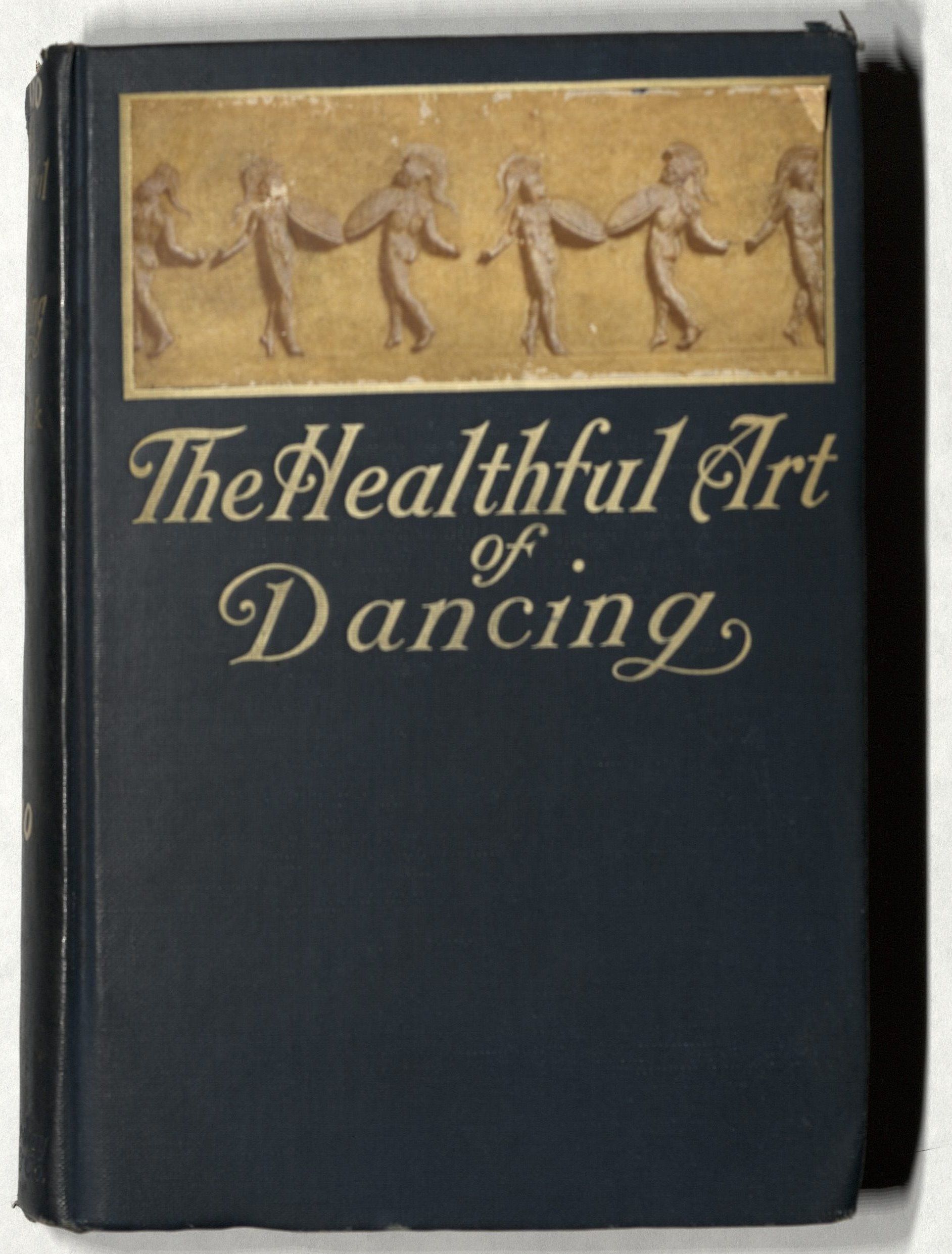
The Healthful Art of Dancing

The Healthful Art of Dancing

In his 1910 book, The Healthful Art of Dancing, Gulick devoted a chapter to dance in education. Average New York City children, wrote Gulick, spent “Five hours a day in the schoolroom, and then the crowded, ill-ventilated tenement or apartment house, with perhaps a game of tag or hop-scotch or jump-rope in the midst of the hubbub and dirt of the street.”2 In 1905, a partnership with the Girls’ Branch of the Public Schools Athletic League allowed schoolgirls the same opportunity as boys: “Interesting and helpful recreation that would have a real part in their lives outside of school hours.”2

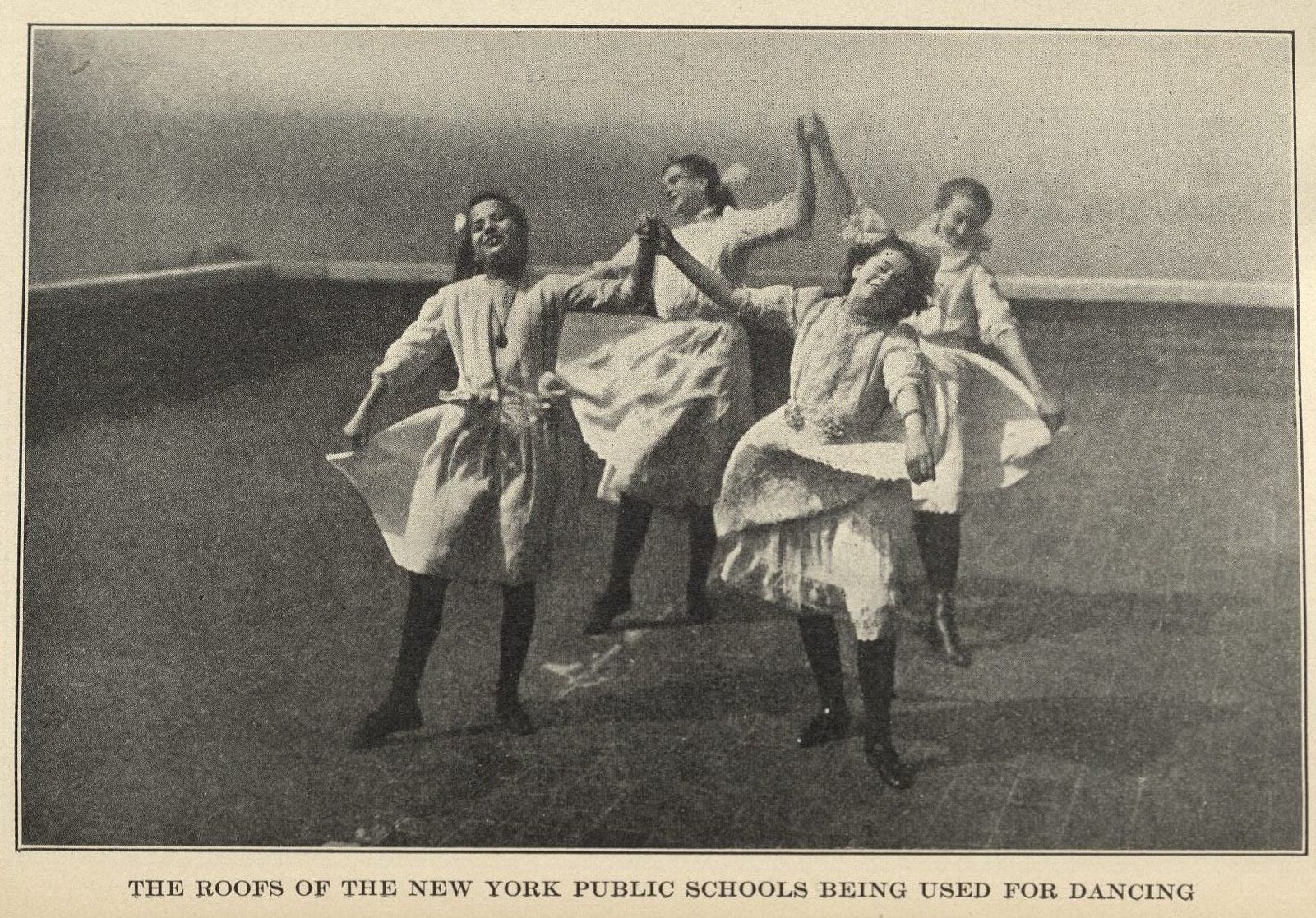
So began after-school folk dance classes for girls on city school rooftops, in gymnasiums, and in school basements. After one year of the program, 2,000–3,000 students were participating.2 Gulick paints an evocative picture:

These classes come after school. The roof playground, high above the chimneys and dangling clotheslines of the neighborhood, is a favorite place for them, unless the weather forbids. There is a piano up there that can be rolled out, and clean open air and sunshine—good things in New York—are all about.2

"The roofs of the New York Public Schools being used for dance," a photograph from The Healthful Art of Dancing. Click to enlarge.

“The roofs of the New York Public Schools being used for dance,” a photograph from The Healthful Art of Dancing. Click to enlarge.

He goes on to describe the students’ enthusiasm:

One has to see [the dances] to get an idea of the kind of spell they possess for the children—how every muscle of their bodies responds accurately and eagerly to the exhilarating, well-cadenced rhythm of the music; how the dancers move back and forth, gliding, hopping, or tripping, crossing and recrossing, now fast, now slow, according to some intricate scheme at which an outsider can only stare in wonder.2

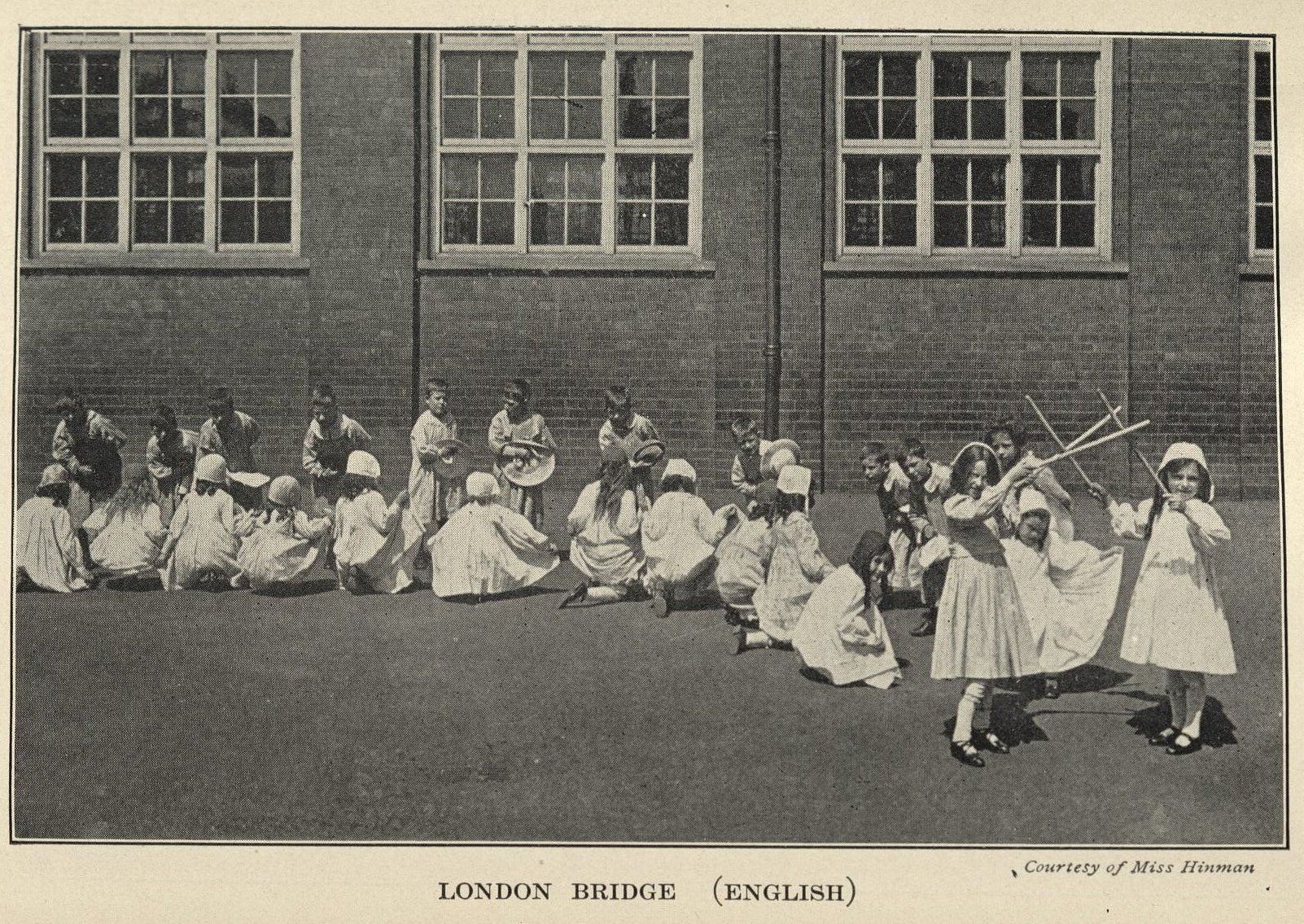
"London Bridge," a photograph in The Healthful Art of Dancing. Click to enlarge.

“London Bridge,” a photograph in The Healthful Art of Dancing. Click to enlarge.

And this joy did not end at school:

The noisy, crowded street and the dingy tenement will be happier places because of the healthy, full-blooded rhythm that still pulsates through their bodies—and their souls, too; for it means that they have a new feeling about life; it is ‘the little white bird’ that is going to keep on singing in their hearts.2

On the Lower East Side? Visit the Luther Gulick playground and dance in his honor.

References

1. Winter, T. (2004). Luther Halsey Gulick: Recreation, physical education and the YMCA. infed.org. Retrieved February 25, 2014 from http://infed.org/mobi/luther-halsey-gulick-recreation-physical-education-and-the-ymca/

2. Gulick, L. H. (1910). The Healthful Art of Dancing. New York: Doubleday, Page & Company. Available at http://books.google.com/books/about/The_healthful_art_of_dancing.html?id=6o0ZAAAAYAAJ

Music and Medicine: Thoughts on a G-String

This is one of several posts leading up to our day-long Performing Medicine Festival on April 5, 2014, which will explore the interrelationships of medicine, health, and the performing arts. Register for the festival here.

Guest blogger Dr. Danielle Ofri, editor-in-chief of the Bellevue Literary Review, will moderate the closing panel discussion at the event. This essay was originally published in The Lancet and is reposted with permission.

By Danielle Ofri

Danielle Ofri. Credit: Joon Park

Danielle Ofri. Credit: Joon Park

The moment has finally arrived. After three years of sweating through etudes, scales, and Suzuki practice books, my teacher utters the words that every cello student yearns to hear: “It’s time to start the first Bach suite.”

It started on a lark, really, when I asked my daughter’s first violin teacher how to coax a child to practice. She casually commented that the best thing is to see a parent practice. I hailed the nearest taxi and promptly purchased a cello. I started lessons, applying the same brute-force approach I’d acquired in medical school—playing the assigned notes over and over again until they were seared in my memory like the Krebs’ cycle and the 12 cranial nerves.

I added cello to the chores of my life—caring for patients, teaching, writing, and editing. But over the three years, an unexpected transformation occurred. Far from being a chore or a parental device to influence my daughter’s propensity to practice, cello turned out to be something that I genuinely wanted to do each night, almost to the exclusion of all else. Newspaper reading shrunk to cursory glances. Phone calls were avoided. Medical journals slipped to the subterranean level of the reading pile. Journal subscriptions lapsed.

I still love my “day job,” taking pleasure in teaching students and connecting with patients, but I have to be honest that, at this point in my career, the sense of growth has remained at a relatively steady state. With music, however, the intellectual challenges develop in ways that are new and surprising to me. The trajectory of learning, of frustration, and of accomplishment for the beginning musician has more in common with the intellectual vibrancy of life as a beginning medical student. I find that I am more driven to enhance my musical skills than I am my medical skills, although I certainly don’t wish the latter to falter.

As I continued to pursue the cello in the evenings, hospital-corridor conversations during the day revealed musicians hidden in all sorts of unlikely clinical corners: the pathologist who played violin, the ER doctor who was an accomplished cellist, the clinic director who played saxophone, the student who’d flipped a coin between Juilliard and medical school, the anesthesiologist who studied flute at the Eastman School of Music before “retiring” to a more practical career, the pulmonary fellow whose legendary beer-chugging habits masked a prodigious violin repertoire. Was this just a matter of uncovering a common hobby by making the effort to look, or might there be some intrinsic connection between?

I knew there was a doctors’ orchestra here in New York City, and as I started poking around I learned that there were others in Boston, Houston, Los Angeles, and Philadelphia. There was also one in Europe, one in Jerusalem, one in Australia; even a World Doctors’ Orchestra.

Was this merely because most doctors grew up in middle-class homes conducive to music lessons? I searched other professions, and uncovered one lawyers’ orchestra in Atlanta. But I couldn’t find a single accountants’ orchestra, or architects’ orchestra, or engineers’ orchestra. There wasn’t any orchestra made up of Wall Street executives, computer programmers, government officials, or direct marketers.

There have been writings about the relation between medicine and the listening aspects of music, but nothing on the playing of music. Why do so many doctors pursue music? Why does the orchestra of doctors in Boston (the Longwood Symphony) receive audition inquiries on a daily basis?

Mark Jude Tramo, a neurologist, songwriter/musician, and director of The Institute for Music and Brain Science at Harvard and Massachusetts General Hospital, feels that “there is overlap between the emotional and social aspects of relating to sick patients and communicating emotion to others through music. Some would speculate that there is [also] an overlap between aptitude for science, which most premeds major in, and for music.”

Lisa Wong—violinist, pediatrician, and president of the Longwood Symphony Orchestra—speaks for the many who came to medicine after years dedicated to serious musicanship. “The music we create builds in us an emotional strength, sense of identity, and sense of order. Then it is given away—we play for others, we play in ensembles. We come to medicine and it is the same thing. The giving, the service—in music and medicine—is a natural connection.”

Michael Lasserson, a British double-bass player, retired family physician, and founder of the European Doctors’ Orchestra, speaks from the perspective of the dedicated amateur. Although he was raised in a family of professional musicians, it was clear rather early on that he was headed for medicine rather than the stage. But, “music never lets you go,” he says. And it is more than just a hobby to make one a happier doctor. “It is a means whereby one is lifted away from the essential loneliness of clinical decision-making and action, into a world of a common enthusiasm and endeavor as the group searches for the beauty of sound [and] the composer’s intent, and those few hours have what can only be described as a healing function.”

There is also the risk-taking that offers parallels between medicine and music. It takes a certain amount of fortitude to slice open a patient’s abdomen with a scalpel. No less is required to take on Mahler’s seventh or the late Beethoven string quartets. “We hurl ourselves with suicidal courage against the commanding heights of the repertoire,” Lasserson says, hoping just to “touch the hem of that greatness”, though he acknowledges that sometimes, for the amateur, “miming skills will come to the fore.”

I debate this every night as I approach that single precious hour of energy after all the childcare has been completed and before exhaustion forces me to bed. Do I read that groundbreaking clinical trial that will surely impact my practice? Do I work on that unfinished book chapter? Do I read the newspaper and catch up on world events? Do I organize the entropy of my desk? Do I exercise for 30 minutes as I routinely exhort my patients to do?

Unfailingly, the answer is “none of above.” No matter how tired I am, no matter how much neuronal lint has accumulated throughout the day, I tighten the hairs on my bow and dig the end-pin of the cello into my rutted carpet. As I start to work on my assigned music for the week, I find myself focusing ever more narrowly on a single page, a single line, a single measure—even a single note.

Temperamentally, this is the exact opposite of life in the hospital, in which I feel pelted by ringing phones, needy patients, impossible schedules, irritating bureaucracies, and a cacophony of meaningless minutiae. It is a glorious relief, instead, to struggle for—and occasionally achieve—precisely the right note. But then, there is a step even beyond that. The note doesn’t have to merely be right—it also has to be beautiful.

Beauty is not something that gets much shrift in medicine. Other than the experimental design of a classic study that might be referred to as “elegant,” there isn’t much in medicine that falls into the category of beauty. Beauty is inherently unpragmatic—it doesn’t enhance efficiency, increase productivity, earn a grant, or cure a patient. Maybe it is this lack of beauty that drives doctor–musicians to struggle to draw some into their lives via music.

But perhaps there is indeed something in medicine that is related to beauty. After all, medicine is about life—the wriggling, sensual, bodily aspects of being alive. This is not something that can be said about engineering, law, or accounting. Although being alive—and being sick—can frequently be unpleasant, it never ceases to be miraculous. That miraculousness—and the privilege of doctors to be part of it—is a beauty in itself.

Willa Cather once said, “Novelists, opera singers, even doctors, have in common the unique and marvelous experience of entering into the very skin of another human being.” The beauty of entering the very skin of another human being is how many musicians describe the emotional experience of playing music. And for many, it is the striving to achieve that—almost more than the attainment—that offers the most pleasure. As we physicians strive to achieve the best for our patients in the messy, corporeal world of clinical medicine, we work to enter that very skin of another human being, and perhaps—with luck—we can touch the hem of that greatness.

Touching the hem is about all I can aspire to, but that’s enough. I’m willing to grovel for that. The sheet music of the first Bach suite appears straightforward—two pages of evenly spaced notes in the key of G. No intricate timing, no double-sharps, no key shifts, no clef shifts, no fancy ornamentation. But as anyone who as ever tussled with Bach knows, that simplicity is ruthlessly deceptive. “One measure at a time,” my teacher has instructed me. “It needs to be completely memorized. Expect to put in about a year on this.” This is said without irony.

Week after week, month after month, I tiptoe gingerly through the music. The melodic phrases are simultaneously simple and horrifically complex. But when I’ve survived a measure and can play several notes in sequence, the beauty is astounding—the type of beauty that really does take the breath away. I haven’t made it to the hem yet, and may never. But that’s okay. It’s all in the reaching.