Thank You! Festival of Medical History and the Arts Wrap-Up

By Lisa O’Sullivan, Director, Center for the History of Medicine and Public Health

Whew!

Our first Festival of Medical History and the Arts was a great success; more than 1,000 people attended and responded enthusiastically to our mix of talks, demos, films, etc. Now that we have had a chance to draw breath, here are a few details from the day:

It’s hard to pick highlights, although of course Dr. Oliver Sacks speaking about his intellectual influences and the patients who inspired his Awakenings was hugely exciting for all of us. We are grateful to Dr Sacks and all the speakers who came and shared their knowledge.

Our guest curators did an amazing job. Lawrence Weschler’s Wonder Cabinet started with a (big) bang, a banjo-accompanied cosmic/neuronal slapdown, and ended with fascinating insights from Riva Lehrer into how an artist’s body can affect her art and her anatomy teaching. In between, spectators had the chance to get a glimpse into the experience of having an epileptic fit; share anatomical adventures; and witness some cringe-inducing treatments suffered by monarchs through the ages.

The cosmic/neuronal smackdown.

The cosmic/neuronal smackdown. Photo by Amy Hart.

Joanna Ebenstein’s Morbid Anatomy presentation of 12(!) talks throughout the day were standing-room only, forcing us to move to a larger room, which filled up just as quickly. The day started with Mexican traditions around death, took a detour to human zoos, wax anatomical models, medical library pleasures, memento mori, and skull theft before ending with the little-discussed practice of bookbinding with human skin.

Sigrid Sarda gives a medical wax moulage demonstration.

Sigrid Sarda gives a medical wax moulage demonstration. Photo by Amy Hart.

Our conservation team prepared a wonderful exhibit of models demonstrating development of the book over time (no human skin involved), as well as a whimsical look at the life of miniature books. We put highlights from our collections on display, and welcomed visitors to our conservation laboratory. Meanwhile, visitors could learn the art of making anatomical wax moulage and see Gene Kelly struggle with combat fatigue.  And the after party cocktails and cartoons were just the things needed to wind down after the long day.

Cocktails and cartoons at the after party.

Cocktails and cartoons at the after party. Photo by Amy Hart.

With so many people, some events did fill up. Particular apologies to those who couldn’t make it on a behind-the-scenes tour. With such overwhelming demand, we’re planning to make them a much more regular feature, so if you missed out you’ll get another chance at a future event. Our two anatomical workshops were also full; for those of you in New York, we are investigating offering courses on a more regular basis, so please let us know if you are interested!

A tour of the Gladys Brooks Book & Paper Conservation Laboratory. Photo by Amy Hart.

A tour of the Gladys Brooks Book & Paper Conservation Laboratory. Photo by Amy Hart.

Pictures from the day are up on our Facebook page, and winners of the caption competition and the raffle will be announced soon.  Meanwhile, keep an eye out for more details of our Performing Medicine mini-fest, coming in the spring. Hope to see you then, if not before for some of our stand-alone events!
Shadow Journals: The Story of Medical Advertising (Part 2 of 3)

Today we have part two of a guest post written by David Herzberg, Ph.D., who will present “The Other Drug War: Prescription Drug Abuse and Race in 20th-Century America” on Tuesday, October 22. Read part one here and part three here.

This story of medical journal advertising is typically cast as what historians call a “declension narrative,” a tale whose main arc tracks a decline from the honorable virtues of past generations to the immoral venality of today. In this telling, commerce and marketing slowly colonized the therapeutic endeavor, transforming from the noble pursuit of health into an untrustworthy, buyer-beware precinct of the larger consumer culture.

But this story can also be told very differently.

After all, there had always been advertisements in the medical journals, and subscribers had always been able to see them—they had no librarians to slice-and-dice for them. Subscribers read the articles in the context of having also seen the ads.

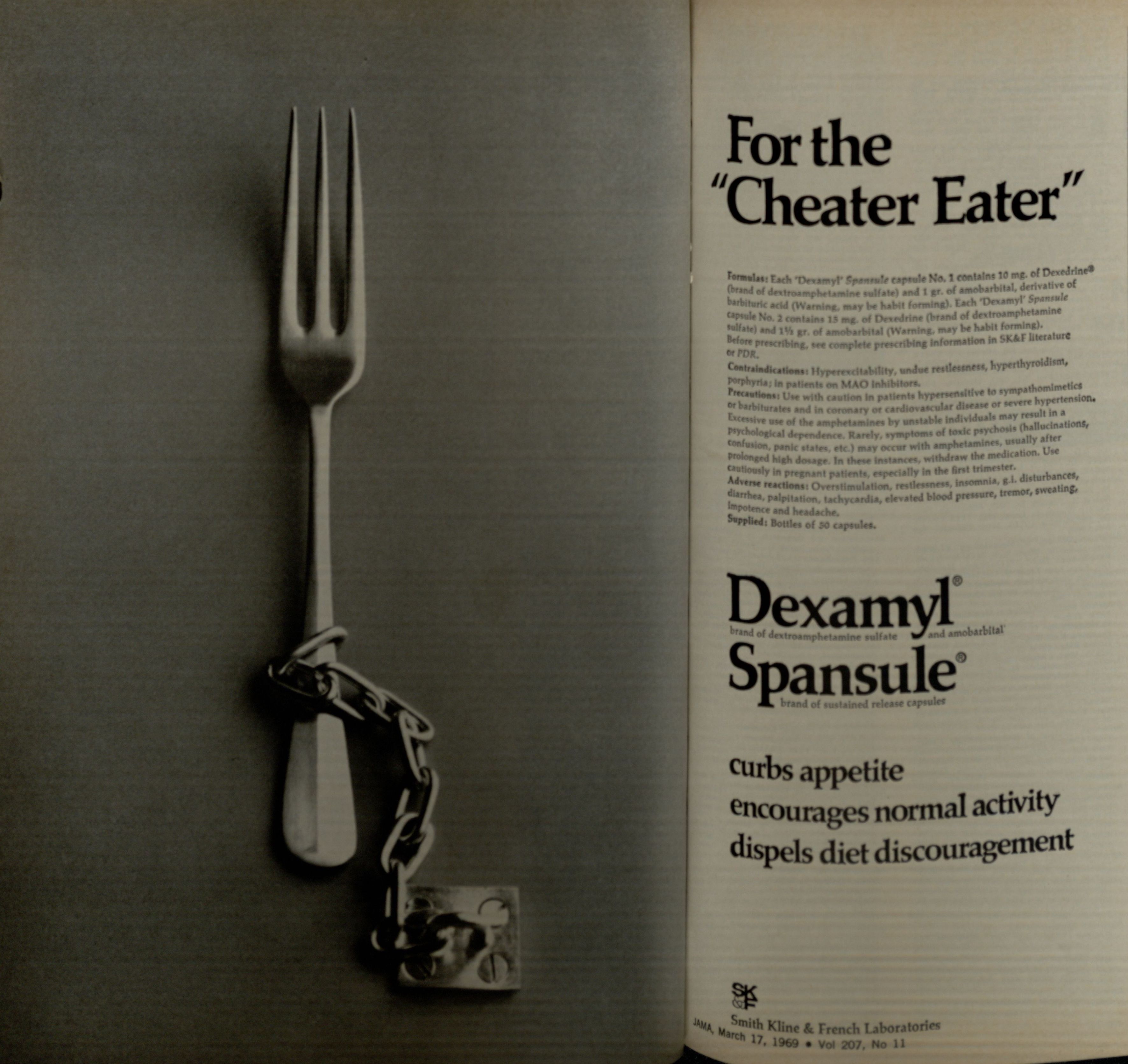
From JAMA, volume 207, number 11 (March 17, 1969)

“For the ‘Cheater Eater.'” From JAMA, volume 207, number 11 (March 17, 1969). Click to enlarge.

What might they have drawn from the experience of flipping through the unexpurgated journals? Well, historians have had a field day analyzing the messages of particular ads or particular articles. But the overall structure of the journals also sent its own message. When subscribers flipped past the bundle of advertisements before the table of contents to the ad-free material within, they saw to their satisfaction that commerce had been carefully contained where its self-interested values would not contaminate the real work of medicine—the empirical pursuit of truth, the professional sharing of new ways to alleviate illness and suffering, etc.

And yet, as historians have repeatedly demonstrated, commerce, especially the pharmaceutical kind, had long been a powerful force in medicine. From Parke-Davis’ hyping of cocaine in the 1880s, to Smith Kline French’s careful orchestration of research on amphetamine in the 1930s and 1940s, to Carter Product’s “launching” of minor tranquilizer Miltown with a public relations campaign worthy of a Hollywood starlet, drug companies and their marketing departments are ubiquitous in the history of medicine if you look for them. Their influence was only heightened, ironically, by their loud protestations that their marketing campaigns had no influence on physicians’ therapeutic decisions—doctors, they said, were obviously far too smart and well educated to be swayed by Madison Avenue gimmickry. Few physicians were inclined to argue with such logic, and so the marketing hoopla remained paradoxically below the radar, relatively free of scrutiny or regulatory oversight.

From JAMA, volume 207, number 10 (March 10, 1969). Click to enlarge.

“A sleeping pill for night squawks.” From JAMA, volume 207, number 10 (March 10, 1969). Click to enlarge.

From this perspective, we might all have breathed a sigh of relief when the 1950s rolled around and medical journals finally came clean, giving advertisements the pride of place they had long ago earned and beginning the process by which Americans would come to recognize, and grapple with, the centrality of commerce in their medical system. It is no accident that formal regulatory control of medical advertisements was finally given to the FDA less than a decade later.

Shadow Journals: The Story of Medical Advertising (Part 1 of 3)

Today we have part one of a guest post written by David Herzberg, Ph.D., who will present “The Other Drug War: Prescription Drug Abuse and Race in 20th-Century America” on Tuesday, October 22. Read part two here and and part three here.

It’s a historian’s nightmare: librarians spent the better part of a century diligently cutting out and throwing away some of the most important parts of the journals they received each week before binding and shelving them. Precious historic material—capstone work by some of the nation’s brightest and most creative minds—was destroyed by the very people devoted to preserving it, and destroyed only more thoroughly because of those peoples’ good intentions and zealous work ethic. Why would they have done such a terrible thing?

This is no hilariously nerdy horror movie. It really did happen all across America for most of the 20th century. As far as I can tell, the New York Academy of Medicine stood almost alone in deciding—who knows why—not to rip out the advertisements in their medical journals. We owe them sincere thanks for this.

From JAMA, volume 204, number 4 (April 22, 1968)

“‘Deprol helps brighten the depressed patient’s world.” From JAMA, volume 204, number 4 (April 22, 1968). Click to enlarge.

It’s pretty clear why most librarians cut out the ads, and it wasn’t just to preserve space on their shelves. Back in the day, the medical profession prided itself on being insulated from crass commercialism, and major journals like the Journal of the American Medical Association not only insisted on approving each advertisement, it also lumped together all the ads in an easily removable bunch before and after the main body of the journal. Ads were thus clearly identifiable as separate and unrelated to the pristine knowledge housed in the journal’s interior. Why would a good medical librarian save them?

We all know what happened next. Sometime during the consumer culture revolution of the 1950s, when commerce stopped being crass and instead became a beacon of liberty in the fight against communism and a practical organizing principle of most American institutions, consultants advised the American Medical Association to embrace journal advertising. Ads began to proliferate, and they became bigger, more colorful, and ever more dependent on emotionally charged images to convey the kinds of before-and-after miracles of Madison Avenue. Then, one day, they broke out of their quarantine and began to appear in between articles throughout the journal. Advertising became so ubiquitous, and so important, that a separate “Index of Advertisers” was provided in the back of JAMA to help readers locate the ads just like the table of context helped them locate the articles. In a sense, the ads became a shadow journal alongside the articles, providing more digestible (and typically more optimistic) reports from the cutting edge of medicine.

JAMA_11-22-65_Vol194No8

Triavil: Tranquilizer-antidepressant for the anxiety/depression complex.” From JAMA volume 194, number 8 (November 22, 1965). Click to enlarge.

It was only a matter of time until ads became so thoroughly enmeshed that it was no longer possible to cut them out without also removing parts of articles. Librarians continued to try, however: as late as the 1970s and 1980s, they diligently sized up each page and sliced out whatever advertising they could. Those decades are especially frustrating for historians, if you ask me. We can see the appetite-whetting first and last page of, say, an eight-page mega-advertisement on Valium and “the modern man,” but the meat of the sandwich was long ago pilfered.

Winsome Fetal Skeletons Bearing Scythes: Monro’s Traité d’ostéologie of 1759: Guest post by Morbid Anatomy

A note from the Center for the History of Medicine & Public Health: This is the last post in Morbid Anatomy‘s guest series leading up to our Festival of Medical History and the Arts. If you’ve enjoyed these posts as much as we have, don’t despair! Tomorrow’s event holds a full day of lectures and activities from Morbid Anatomy, Lawrence Weschler, and the Center. We hope you can make it! See the full schedule here.

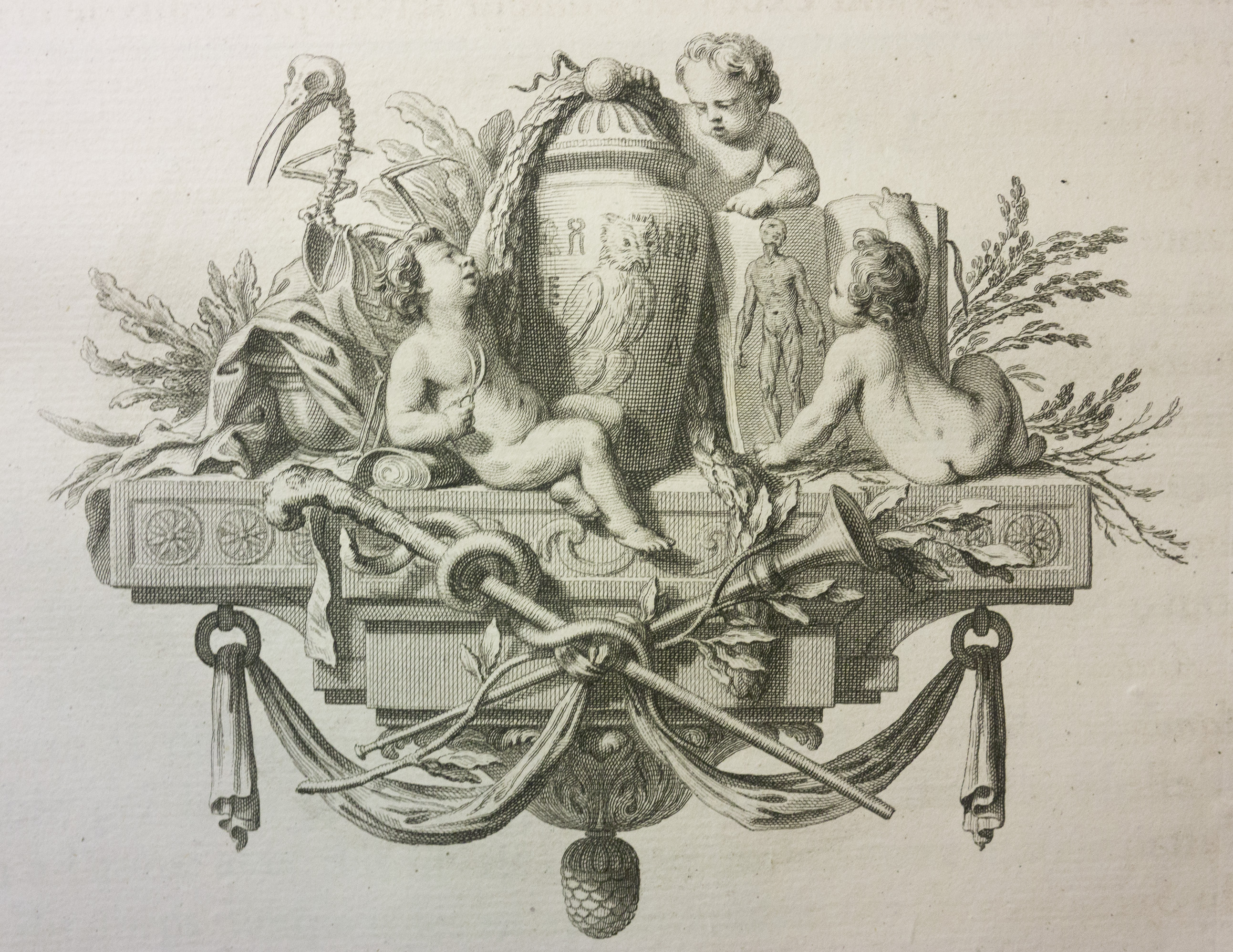
FrontispieceThe NYAM rare book collection holds a gorgeous copy of the first French edition of Alexander Monro’s (1697–1767) celebrated Traité d’ostéologie (or “Anatomy of Bones”). Monro was trained in London, Paris, and Leiden before going on to become the first professor of anatomy at the newly established University of Edinburgh. It was under his leadership, and that of his successors, that the school went on to become a renowned center of medical learning.

Monro originally published this book without images, thinking them unnecessary after William Cheselden’s lavishly heavily-illustrated Osteographia, or the anatomy of the bones of 1733 (more on that book at this recent post). The very fine copperplates you see here were added to the French edition by its translator, the anatomist Jean-Joseph Sue (1710–1792).

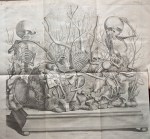
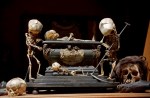
My favorite image in the book is a kind of memento mori–themed tableau morte of winsome, scythe-bearing fetal skeletons enigmatically arranged in a funereal landscape (images 1–3). I also love the frontispiece in which a group of plump putti proffer anatomical atlases and dissecting tools under the oversight of a skeletal bird (above).

This post was written by Joanna Ebenstein of the Morbid Anatomy blog, library and event series; click here to find out more. All images are my own, photographed at the New York Academy of Medicine.

17th Century Anatomical Striptease: Guest Post by Morbid Anatomy

Tab VI

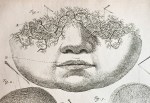
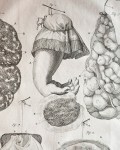
Another series of most wonderful and enigmatic anatomical illustrations in the New York Academy of Medicine historical library collections are to be found in De humani corporis fabrica libri decem, tabulis XCIIX aeri incisis … exornati … Opus posthumum and Tabulae anatomicae (Venice, 1627) by Adriaan van de Spiegel (1578–1625), Giulio Cesare Casserio (1533–1616), and Daniel Bucretius (d. 1631). In this complex effort, van de Spiegel produced the text; Casserio commissioned the plates (for his own unrealized work); and the whole was published through the editorial offices of Bucretius, after both van de Spiegel and Casserio had died.

Tab XVI

These illustrations are described beautifully by Michael Sappol in the exhibition text for his National Library of Medicine exhibition  “Dream Anatomy” where he placed them under the header “Show-off Cadavers” and described them thusly:

The emergence of anatomical illustration in the period 1500-1750 coincided with a larger phenomenon, a new definition of personhood that was performed at court, in salons, coffeehouses, country estates, theaters, marketplaces, and at court. Inevitably anatomists took up, commented on, and played with, the contemporary obsession with self-fashioning and individuality—it was an era of manners, wit, foppishness, and coquetry. In the works of Giulio Casserio, John Browne and Pietro da Cortona, the illustrated anatomy book is a stage featuring posing, prancing cadavers. Animated with an exuberant vitality, the corpses perform an anatomical show for the reader’s gaze.

The images in this post are from the Tabulae anatomicae and show the anatomized body engaging in a sort of exuberant anatomical striptease. All images are drawn from the National Library of Medicine’s brilliant online exhibition Dream Anatomy; click on the exhibition name to see more!

Tab XV

Michael Sappol will be both speaking and screening films from the National Library of Medicine as part of the October 5th NYAM Festival of Medical History & the Arts; more on that here. Hope very much to see you there!

This post was written by Joanna Ebenstein of the Morbid Anatomy blog, library and event series; click here to find out more.

“Artist of Death” Frederik Ruysch at NYAM: Guest Post by Morbid Anatomy’s Joanna Ebenstein

Ruysch1

1720 frontispiece to Opera Omnia, 1721.

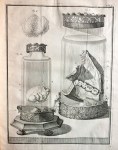
My very favorite figure operating at the intersections of art and medicine–and probably the most bizarre to the modern eye–is Dutch anatomist, artist, preparator, and early museologist Frederik Ruysch (1638-1731). A pioneer in the art of preserving the human body, he was famed for his uncannily life-like and imaginative human preparations (i.e. bits of bodies preserved for study) which he achieved through a combination of injections of colored wax and a secret alcohol-based preservation formula. He is best remembered today for his lavish memento mori-themed tableaux utilizing real human fetal skeletons and other bits of human remains (see images 15-18) which are beautifully explained by Steven Jay Gould in his book Finders, Keepers: Eight Collectors:

Ruysch made about a dozen tableaux, constructed of human fetal skeletons with backgrounds of other body parts, on allegorical themes of death and the transiency of life… Ruysch built the ‘geological’ landscapes of these tableaux from gallstones and kidneystones, and ‘botanical’ backgrounds from injected and hardened major veins and arteries for “trees,” and more ramified tissue of lungs and smaller vessels for ‘bushes’ and ‘grass.’

The fetal skeletons, several per tableau, were ornamented with symbols of death and short life–hands may hold mayflies (which live but a day in their adult state); skulls bemoan their fate by weeping into ‘handkerchiefs’ made of elegantly injected mesentery or brain meninges; ‘snakes’ and ‘worms,’ symbols of corruption made of intestine, wind around pelvis and rib cage.

Quotations and moral exhortations, emphasizing the brevity of life and the vanity of earthly riches, festooned the compositions. One fetal skeleton holding a string of pearls in its hand proclaims, ‘Why should I long for the things of this world?’ Another, playing a violin with a bow made of a dried artery, sings, ‘Ah fate, ah bitter fate.’

Rusych showcased his thousands of human preparations in his own cabinet of curiosities visited by medics and philosophers, as well as members of the aristocracy and royalty. Here, one could see not only his fantastic tableaux, but also his imaginative human specimens in glass jars, preserved organs, exotic birds, butterflies and plants. Ruysch published several lavishly illustrated guides to his cabinet; in image 1, above, you can see an allegorical view of his museum as depicted in a frontispiece to his Opera Omnia, 1721.

Very sadly, none of Ruysch’s astonishing tableaux are known to exist today, and are only known to us through book illustrations. One can get a sense of what the real thing probably looked like, however, in image 19, a contemporaneous 17th fetal skeleton tableau emblazoned with a memento-more-themed Virgil quote; this photo was featured in my recent exhibition The Secret Museum, on which you can find out more here. You can also still see visit many of Ruysch’s wet preparations in collections such as the St. Petersburg Kunstkammer (which has 916 of them), Museum Bleulandinum in Utrecht, and the Anatomisch Museum LUMC in Leiden.

All of these images, save the photo, are drawn from the exceptionally rich Ruysch holdings of the NYAM Historical collections. Hear more about Frederick Ruysch at the October 5th Festival of Medical History & the Arts, when Daniel Margoscy will speak on “The Anatomy of the Corpse: Ruysch, Descartes, and the Problem of Wax.”

This post was written by Joanna Ebenstein of the Morbid Anatomy blog, library and event series; click here to find out more.

“Physica Sacra,” Johannes Jacob Scheuchzer, 1731 : Guest Post by Morbid Anatomy’s Joanna Ebenstein

Image

Greetings.

My name is Joanna Ebenstein; I run a blog called Morbid Anatomy as well as the related Morbid Anatomy Library—an open-to-the-public research collection in Brooklyn, New York—and the Morbid Anatomy Presents series of lecture and workshops. All of these projects aim to explore the intersections of art and medicine, death and culture, with a particular focus on historical medical collections and libraries.

In the run-up to NYAM’s October 5th Wonder Cabinet and Medical History Festival (which I am co-curating), I have been invited to write a series of guest posts in which I will report on the treasures and curiosities I find in my explorations of NYAM’s excellent rare book and historical collections. In this, the first of that series, I would like to focus one of my favorite books—and one of the most enigmatic books of all time—Johannes Jacob Scheuchzer’s 4-volume high baroque extravaganza of art, science, mysticism, and all worldly knowledge, Physica Sacra.

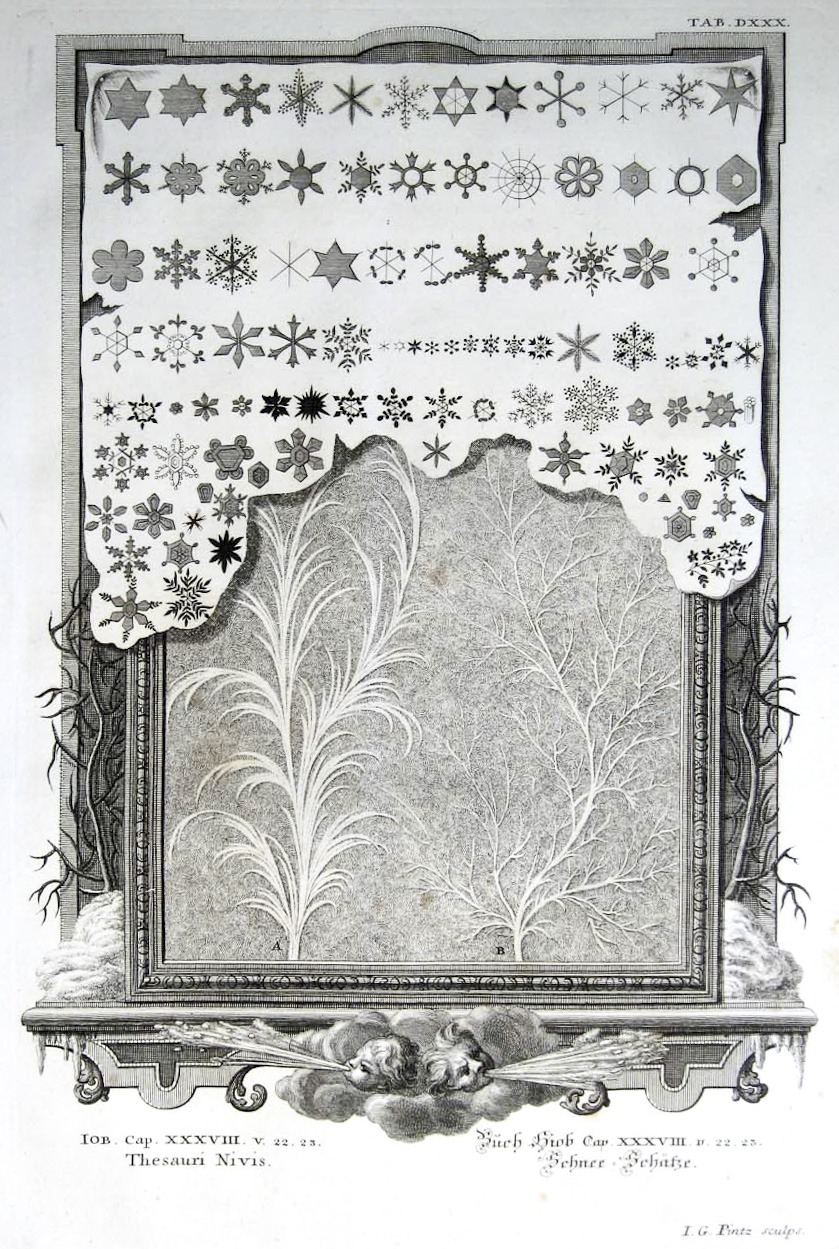
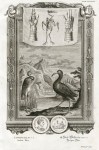
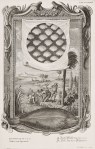
NYAMsacra7Originally published in 1731, this bizarre large-scale book features over 700 copper plate engravings. With a fine balance of careful observation and allegorical imagination, these depict—in frames each more fanciful than the last—such scenes as: lamenting fetal skeletons with the motto “homo ex humo” (‘man from the ground’, or ‘dust’); a variety of anatomical views of the human body projected on drapery or foregrounding mysterious landscapes; birds in biblical landscapes augmented by baffling cyphers; comparative snowflakes with the text “thesauri nivis” or “treasures of snow”; and much more.

These images serve as an excellent reminder that our views of science—and particularly the study of the human body—have changed over time. As explained by Martin Kemp and Marina Wallace in their book Spectacular Bodies:

The purpose of anatomical images during the period of the Renaissance to the 19th century had as much to do with what we would call aesthetic and theological understanding as with the narrower interests of medical illustrators as now understood . . . . They were not simply instructional diagrams for the doctor technician, but statements about the nature of human beings as made by God in the context of the created world as a whole . . . they are about the nature of life and death. . . .

I have not been able to find too much about this book in English, though my friend—and Wonder Cabinet speaker—Daniel Margócsy has promised a future lecture on the topic. In the mean time, Christie’s Auction House has a helpful entry on the book that explains that Johann Jakob Scheuchzer (1672–1733)—a Swiss doctor and natural scientist—”planned the Physica Sacra as an explanation of and a commentary on the Bible on natural-scientific grounds. He himself oversaw the illustrations which were largely based on his own natural history cabinet or on other famous European cabinets of rare specimens.”

Scheuchzer’s work also inspired an art exhibit at the University of Massachusetts—Dartmouth in 2007/8: “Science, Religion, Art.”  The organizers note that:

a lifelong scholar, Scheuchzer’s pursuits of knowledge were wide-ranging and diverse, from science to medicine to paleontology. Like many scientists of the late 17th and early 18th century, Scheuchzer held to the belief that the Old Testament was a factual account of the history of the earth. . . . In a period before public museums, Scheuchzer presented a seductive view of an imaginary world, viewed through lush frames depicting secondary symbols, plants, animals, heads and other objects, providing the viewer rich material for an inspired vision of the interaction between the natural and the divine powers.

Below are just a very few of my favorite images from the book, some that I photographed from the original, and others coming from the set of almost half of the 737 images from the book (!!!) so kindly provided by greyherbert’s amazing Flickr stream; you can see them all by clicking here.

Stay tuned for more posts in the days and weeks to come!

Joanna Ebenstein, Morbid Anatomy
Guest post # 1

Festival of Medical History & the Arts

We are excited to announce our first all-day extravaganza, co-curated by Lawrence Weschler, Morbid Anatomy, and the Center, and featuring esteemed speakers, artists workshops, behind-the-scenes tours, and more. Please check the Festival of Medical History & the Arts page and schedule for more information.

save the date Oct 5

For your viewing pleasure

This Wednesday’s 2013 New York Academy of Medicine Gala featured the following video on the Center for the History of Medicine and Public Health. If you would like to learn more about our work or visit us in person, please email history@nyam.org and library@nyam.org.