There is Death in the Pot

By Johanna Goldberg, Information Services Librarian

While in the stacks recently, we came across this intriguing cover.

DeathinthePot-cover


How can you not open the book? The title page did not disappoint.

DeathinthePot-titlepageFood adulteration was a dangerous problem in 19th-century London. In 1820, chemist Fredrick Accum wrote A Treatise on Adulterations of Food and Culinary Poisons, the first book of its kind to attempt to expose the dangers of the food, water, and beverage supply.¹

Among many other practices, Accum cautioned against alum in the bread supply, used to make bread whiter; fraudulent peppercorns, made of lintseed, clay, and a small bit of Cayenne; vinegar laced with sulphuric acid; red lead used to color cheese; and beer mixed with a poisonous narcotic plant, cocculus indicus.² Forty years after the book’s publication, Parliament passed the Food Adulteration Act.¹

The Royal Society of Chemistry’s Library and Information Centre offers an excellent online exhibit on the life and times of Accum (including a career-ending scandal involving mistreatment of library books). Learn more here.

Edit: A reader recognized the artwork as that of Berkeley King and kindly provided us with the following image of the cover of Accum’s Plans of the Gas Works in London, which King also designed.

AccumPlansoftheGasWorksinLondon


1. The fight against food adulteration. (n.d.). Retrieved May 16, 2013, from http://www.rsc.org/education/eic/issues/2005mar/thefightagainstfoodadulteration.asp

2. Accum, F. (1820). A treatise on adulterations of food, and culinary poisons exhibiting the fraudulent sophistications of bread, beer, wine, spirituous liquors, tea, coffee, cream, confectionery, vinegar, mustard, pepper, cheese, olive oil, pickles, and other articles employed in domestic economy, and methods of detecting them. London: Longman, Hurst, Rees, Orme, and Brown.

For your viewing pleasure

This Wednesday’s 2013 New York Academy of Medicine Gala featured the following video on the Center for the History of Medicine and Public Health. If you would like to learn more about our work or visit us in person, please email history@nyam.org and library@nyam.org.

Acne Can Be a Social Handicap

By Johanna Goldberg, Information Services Librarian

This is the second in an intermittent series of blogs featuring advertisements from medical journals. You can find the first here.

The ads below come from two dermatology journals—the first five from the Journal of Investigative Dermatology and the last from the International Journal of Dermatology—and span nearly two decades. They promise not only a better quality of life through medical intervention, but also show cultural standards of work, social interaction, and beauty.

1955: We love the cartoon depictions of each gendered occupation, barefoot sailor and all.

1955: We love the cartoon depictions of each gendered occupation, barefoot sailor and all.

1955: Only people with perfect skin drink martinis.

1955: Only people with perfect skin drink martinis.

1955: Why do these “adolescents” look 40+?

1955: Why do these “adolescents” look 40+?

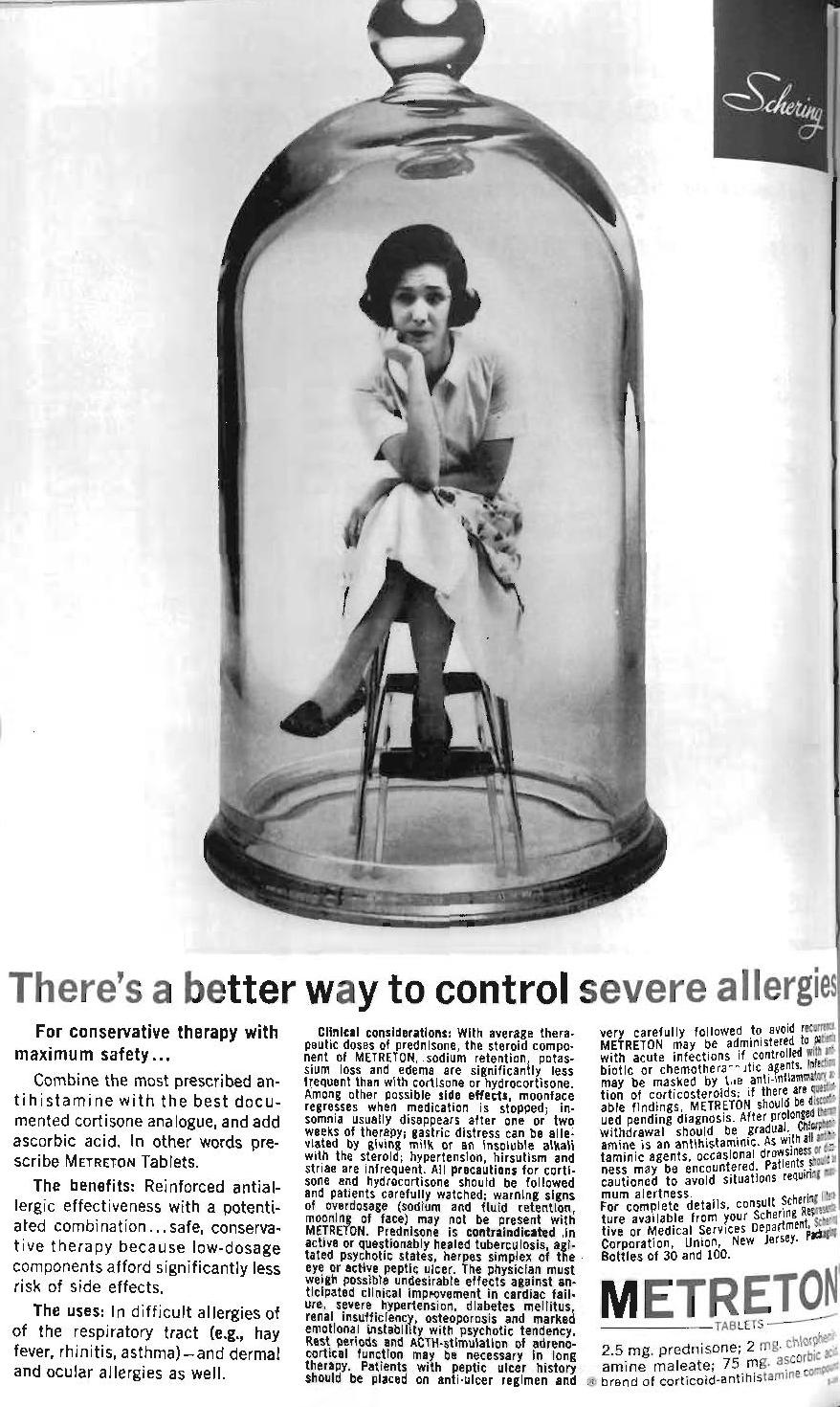
1963: Probably coincidentally, this ad appeared the same year The Bell Jar was published.

1963: Probably coincidentally, this ad appeared the same year The Bell Jar was published.

1963: Grenz rays are a mild form of radiation widely used from the 1940s–1970s to treat inflammatory skin diseases. While some practitioners still use Grenz rays, evidence of their efficacy remains limited.1,2

1963: Grenz rays are a mild form of radiation widely used from the 1940s–1970s to treat inflammatory skin diseases. While some practitioners still use Grenz rays, evidence of their efficacy remains limited.¹,²

1973: Nothing like nudity to convince doctors to recommend a medicated powder.

1973: Nothing like nudity to convince doctors to recommend a medicated powder.


1. Lindelöf, B., & Eklund, G. (1986). Incidence of malignant skin tumors in 14,140 patients after grenz-ray treatment for benign skin disorders. Archives of Dermatology, 122(12), 1391–1395.

2. National Institute for Health and Care Excellence (NICE). (2010, March 30). Grenz rays therapy for inflammatory skin conditions (interventional procedures consultation). Guidance/interventional procedures. Retrieved April 24, 2013 from http://www.nice.org.uk

An Elegy on the Death of a Mad Dog

By Rebecca Pou, Project Archivist

To celebrate National Poetry Month, we are sharing a poem from our collection each week during April.

Our last poem, An Elegy on the Death of a Mad Dog, is by Oliver Goldsmith (1730-1774). Our Rare Book Room contains an Oliver Goldsmith Collection, which includes 112 editions of his novel The Vicar of Wakefield, along with many of his other works. Most of the collection was donated by Mrs. Alberta Clay, the daughter of NYAM’s first director, Linsly R. Williams, M.D., in 1942.

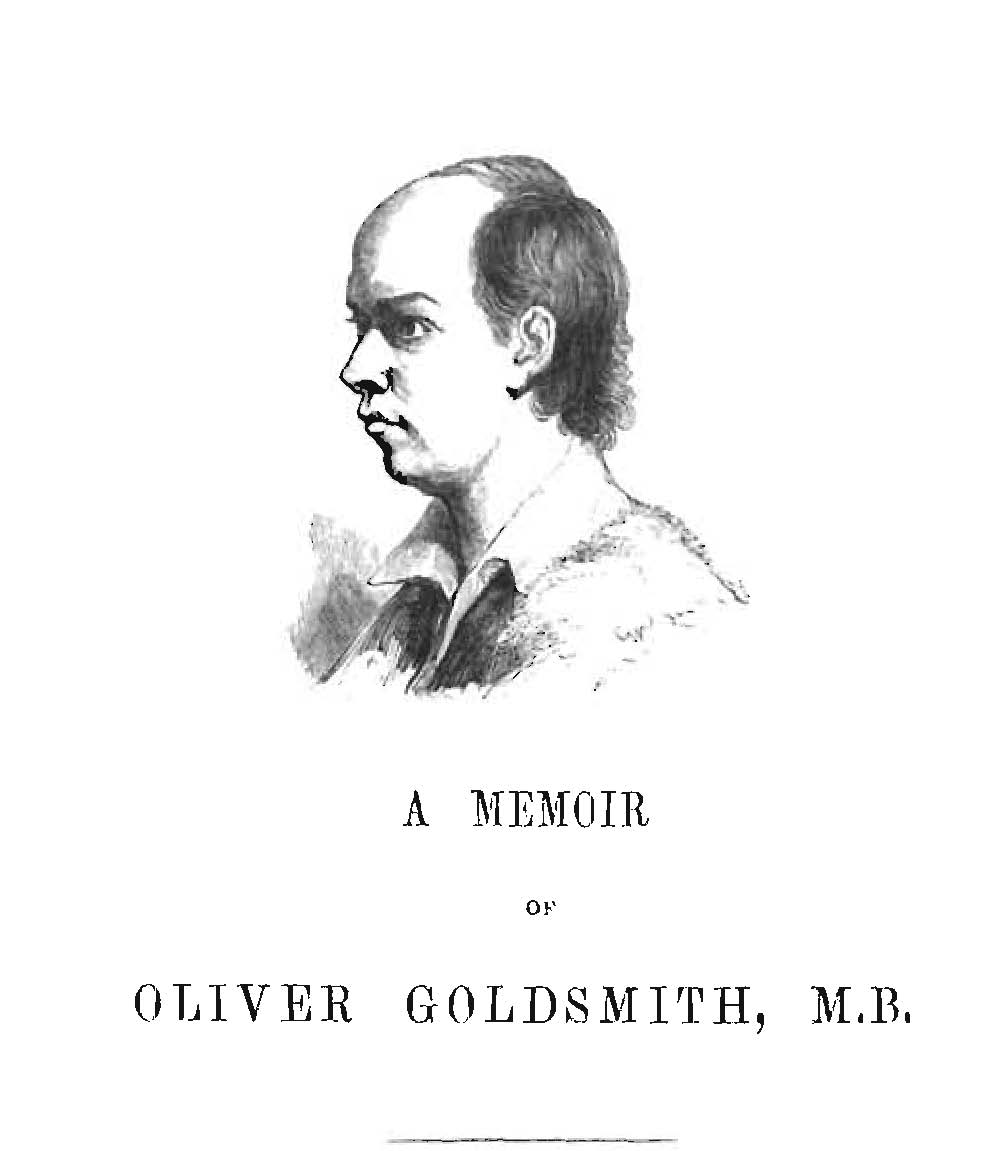
Goldsmith port_1863Oliver Goldsmith may seem to be a bit out of place in a medical collection, but NYAM has an interest in works of literature by and about physicians. Before establishing himself as an essayist, poet, and novelist, Goldsmith attempted a career in medicine. Goldsmith studied medicine in Edinburgh and Leyden, although it is not certain he ever received his medical degree. In London, he worked for a time as an apothecary’s assistant and a physician, but ultimately he devoted himself to writing. Still, despite his questionable credentials, Goldsmith was considered a doctor and often attributed as “Oliver Goldsmith, M.B.”

An Elegy on the Death of a Mad Dog is found in The Vicar of Wakefield, where the Vicar asks his son to recite it, and in collections of Goldsmith’s works and poetry. This version and the images are from The Poetical Works of Oliver Goldsmith, M.B. from 1863.

Goldsmith Mad dog 1863

An Elegy on the Death of a Mad Dog

Good people all, of every sort,
Give ear unto my song ;
And, if you find it wondrous short –
It cannot hold you long.

In Islington there was a man
Of whom the world might say,
That still a godly race he ran –
Whene’er he went to pray.

A kind and gentle heart he had,
To comfort friends and foes ;
The naked every day he clad –
When he put on his clothes.

And in that town a dog was found :
As many dogs there be ;
Both mongrel, puppy, whelp, and hound,
And curs of low degree.

This dog and man at first were friends ;
But, when a pique began,
The dog, to gain some private ends,
Went mad, and bit the man.

Around, from all the neighbouring streets,
The wondering neighbours ran ;
And swore the dog had lost his wits,
To bite so good a man.

The wound it seem’d both sore and sad
To every christian eye ;
And, while they swore the dog was mad,
They swore the man would die.

But soon a wonder came to light,
That show’d the rogues they lied :
The man recover’d of the bite ;
The dog it was that died.

Sources:

“Oliver Goldsmith.” Concise Dictionary of British Literary Biography. Vol. 2. Detroit: Gale Research, 1992. Biography In Context. Web. 24 Apr. 2013.

“Oliver Goldsmith.” Encyclopædia Britannica. Encyclopædia Britannica Online Academic Edition. Encyclopædia Britannica Inc., 2013. Web. 25 Apr. 2013.

Syphilis, or the French Disease

By Rebecca Pou, Project Archivist

To celebrate National Poetry Month, we are sharing a poem from our collection each week during April.

Portrait of Fracastorius from Homocentrica, Venice: 1538.

Portrait of Fracastorius from Homocentrica. Venice, 1538.*

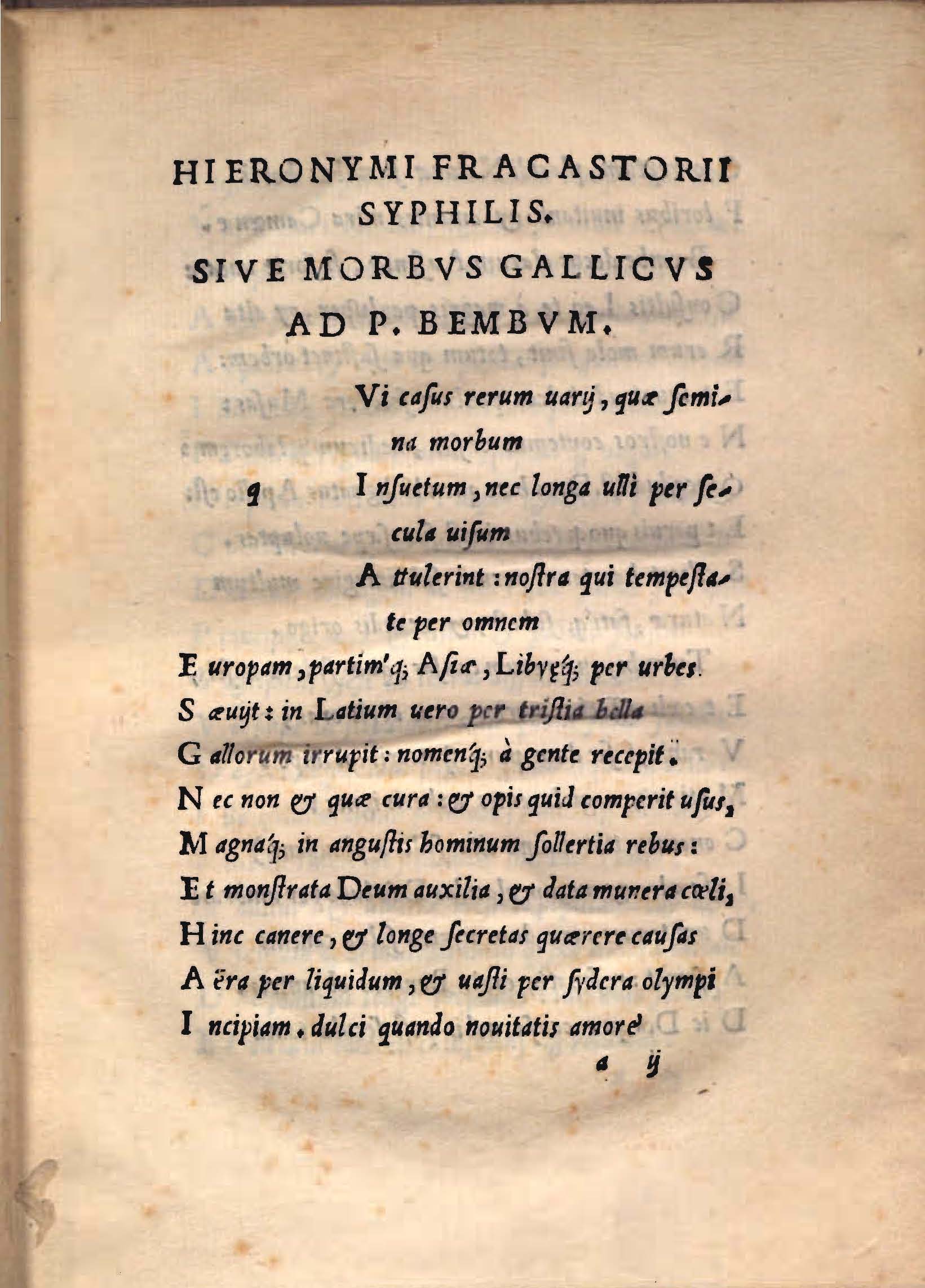
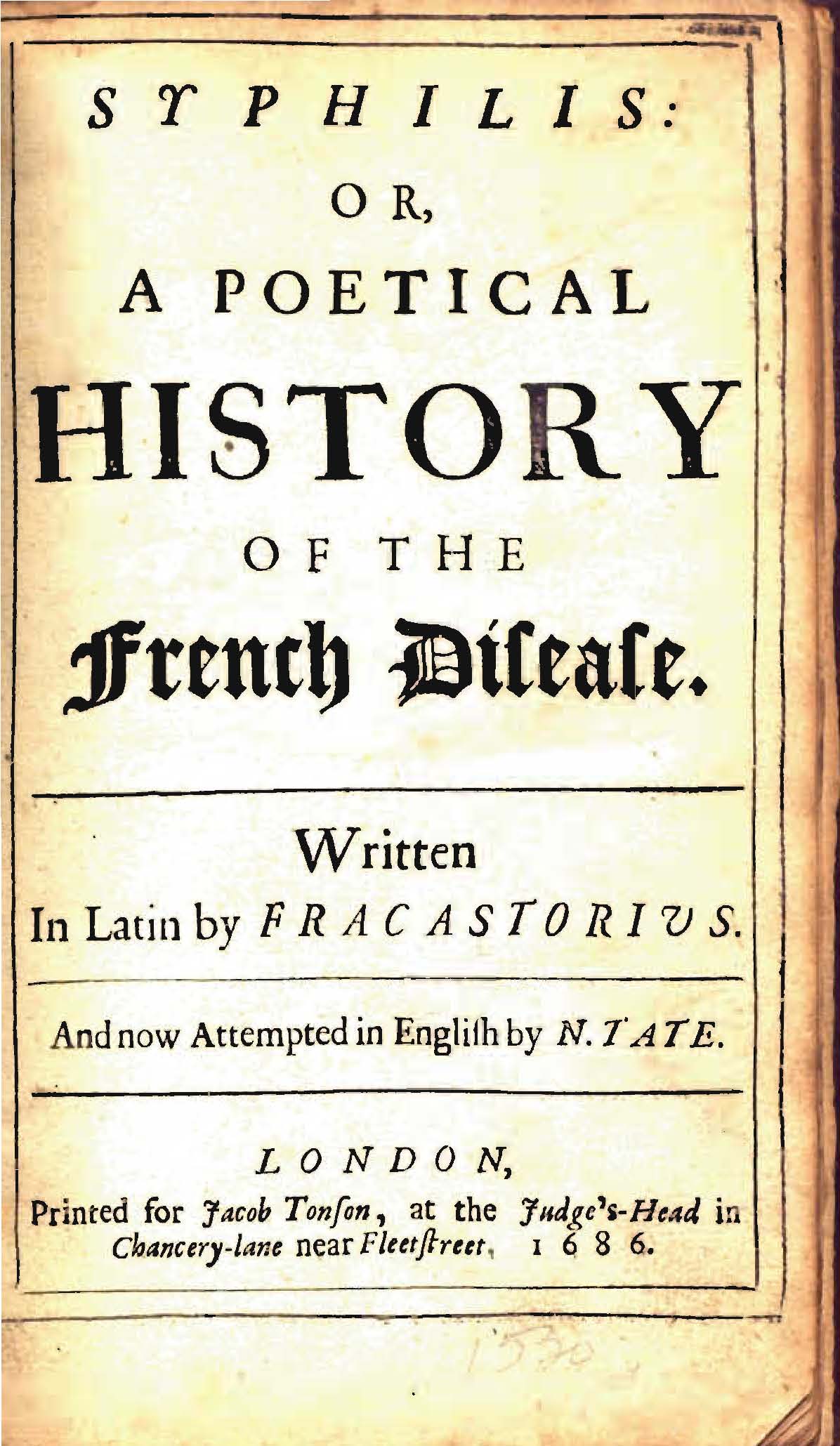
Syphilis seems like an unlikely topic for a poem, yet it is the subject of an important and popular work. Syphilis, or the French Disease, was first published in 1530. At that time, syphilis was new to Europe and spreading fast. To the Italians it was the “French disease,” to the French the “Italian disease,” with many other countries blaming one another for bringing the infection to their citizens. Written in Latin by the multi-faceted Italian physician and poet Fracastorius, the poem was translated into many languages, reflecting the great desire to understand this disease. Our collection holds multiple editions, including the original, pictured above, and several English versions (this post features two English translations – one is pictured below and another as the excerpts).

In the poem, which is broken into three parts, we learn of the disease and some popular treatments of the time, including mercury and the plant remedy guaiac. We also read the tale of a shepherd named Syphilus, supposedly the first person afflicted with the disease, which was his punishment for spurning the sun. Excerpts from each of the poem’s books, taken from William Van Wyck’s translation, are below.

Book 1

Within the purple womb of night, a slave,
The strangest plague returned to sear the world.
Infecting Europe’s breast, the scourge was hurled
From Lybian cities to the Black Sea’s wave.
When warring France would march on Italy,
It took her name. I consecrate my rhymes
To this unbidden guest of twenty climes,
Although unwelcomed, and eternally.
………………
O Muse, reveal to me what seed has grown
This evil that for long remained unknown!
Till Spanish sailors made west their goal,
And ploughed the seas to find another pole,
Adding to this world a new universe.
Did these men bring to us this latent curse?
In every place beneath a clamorous sky,
There burst spontaneously this frightful pest.
Few people has it failed to scarify,
Since commerce introduced it from the west.
Hiding its origin, this evil thing
Sprawls over Europe
………………

Albrecht Durer's woodcut of a syphilitic man.

Albrecht Durer’s woodcut of a syphilitic man, 1496.*

Book 2

Soon is repaired the ruin of the flesh,
If lard be well applied that’s good and fresh,
Or dyer’s colors of a soothing power.
If some poor soul, impatient for the hour
Of sweet release, should find too slow this cure,
And yearning for a quicker and more sure,
Then stronger remedies without delay
Shall kill this hydra another way.
………………
All men concede that mercury’s the best
Of agents that will cure a tainted breast.
To heat and cold sensitive’s mercury,
Absorbing the fires of the this vile leprosy
And all the body’s flames by its sheer weight…
………………

Book 3

An ancient king had we, Alcithous,
Who had a shepherd lad called Syphilus.
On our prolific meads, a thousand sheep,
A thousand kine this shepherd had to keep.
One day, old Sirius with his mighty flame,
During the summer solstice to us came,
Taking away the shade from all our trees,
The freshness from the meadow, coolth from breeze.
His beasts expiring, then did Syphilus
Turn to this horror of a brazen heaven,
Braving the sun’s so torrid terror even,
Gazing upon its face and speaking thus:
‘O Sun, how we endure, a slave to you!
You are a tyrant to us in this hour.
………………
The sun went pallid for his righteous wrath
And germinated poisons in our path.
And he who wrought this outrage was the first
To feel his body ache, when sore accursed.
And for his ulcers and their torturing,
No longer would a tossing, hard couch bring
Him sleep. With joints apart and flesh erased,
Thus was the shepherd flailed and thus debased.
And after him this malady we call
SYPHILIS, tearing at our city’s wall
To bring with it such ruin and such a wrack,
That e’en the king escaped not its attack.
………………

* From Van Wyck, William. The sinister shepherd: a translation of Girolamo Fracastoro’s Syphilidis; sive, De morbo gallico libri tres. Los Angeles, 1934.

The Craniad

By Johanna Goldberg, Information Services Librarian

To celebrate National Poetry Month, we are sharing a poem from our collection each week during April.

In 1817, the work of two fathers of phrenology, Franz Joseph Gall and Johann Gaspar Spurzheim, inspired poetry.

As explained by authors Francis Jeffrey and John Gordon in the preface of The Craniad: Or, Spurzheim Illustrated. A Poem in Two Parts:

“It is not our intention to conduct our readers through all the delightful mazes of the Craniologic paradise. We shall give them a bird’s-eye view of this garden of intellectual sweets; but should they feel disposed to examine every object minutely, they can leave the point of view which we have chosen for them, descend, and lose themselves, at leisure, in the charming confusion of the romantic labyrinth.”

Here is an excerpt from this “bird’s-eye view,” emphasizing the view of the poets (and their inspiration) that the shape of our heads and brains determine our futures—our criminality, careers, and guilt or innocence in a court of law.

Why do men fight,—and steal,—and cheat,—and
lie,—
String crime on crime, till strung on ropes they die?
“ Because within and on their skulls are found,
“ First known to Gall’s and Spurzheim’s tact pro-
found,
“ Organs, which mark the cause with obvious case,
“ Nature is sick, and crime is her disease.
. . .
To one thing more than others, not inclined—
Some think that education forms the mind.
Hence view we talents every day misplaced ;
Great public situations, too, disgraced !

Hnce [sic] have we preachers in our courts of law,
And lawyers in the pulpit—that’s a flaw.
We’ve some physicians who should nurses be,
And tend on those from whom they take a fee.
We’ve barbarous bungling surgeons, now and then,
Fit only to be barbers’ journeymen ;
Poor paltry puling poets,–who, Lord knows,
Should try to learn to write some decent prose.
Horse-jockies sometimes sit in Parliament !
On jockeying there, by dangerous habits bent,
Whilst many a genius lives by grinding knives,
And many a dunce without a genius thrives.
. . .
When Barristers learn Craniology,
Closer examinations we shall see ;
They then can make each witness shew his skull,
To see if ‘twill his evidence annul,
And if there’s evidence that this is so,
They’ll render it more evident, we know.
And poor unhappy criminals may then
Get leave to feel the skulls of jury-men ;
And when a man’s indicted for a rape,
His neck may then be saved by its own shape.
. . .
Behold a new employment for the blind,
With sense of tact so wondrously refined.
Let them be Craniologers, have schools,
In which succeeding blind may learn their rules ;
Let them have rank and titles with the great,
Be called, “ Prime Craniologers of state.
Such intellectual feelers, of the land,
Would form a useful, and important band ;
They could correct all errors in our courts,
And wavering doubts decide by their reports.”

Brain Awareness Week

By Lisa O’Sullivan, Director

Ambroise Paré, The brain and nerves of the head and neck, p134, Les Oeuvres

Ambroise ParéThe brain and nerves of the head and neck, p134, Les Oeuvres

This week is Brain Awareness Week, a global campaign to celebrate the brain and increase awareness of brain research. Treating the brain has a long history; trepanning, or trepanation, is one of the oldest known surgical procedures.

The brain featured in today’s post comes from Les Oeuvres d’Ambroise Paré, currently being treated in our conservation laboratory. The work was the culmination of the 16th century French barber-surgeon’s long and successful career, which saw him become royal surgeon for a number of French kings.

Les Oeuvres d’Ambroise Paré was first published in 1575, and was subsequently expanded in multiple new editions. It was groundbreaking on a number of levels, written in the vernacular French, rather than Latin, it included not only anatomical depictions and descriptions of procedures, but illustrations of the instruments used in surgery, many of which Paré had modified or developed himself.

Valentines for a Valentine

By Arlene Shaner, Acting Curator and Reference Librarian for Historical Collections

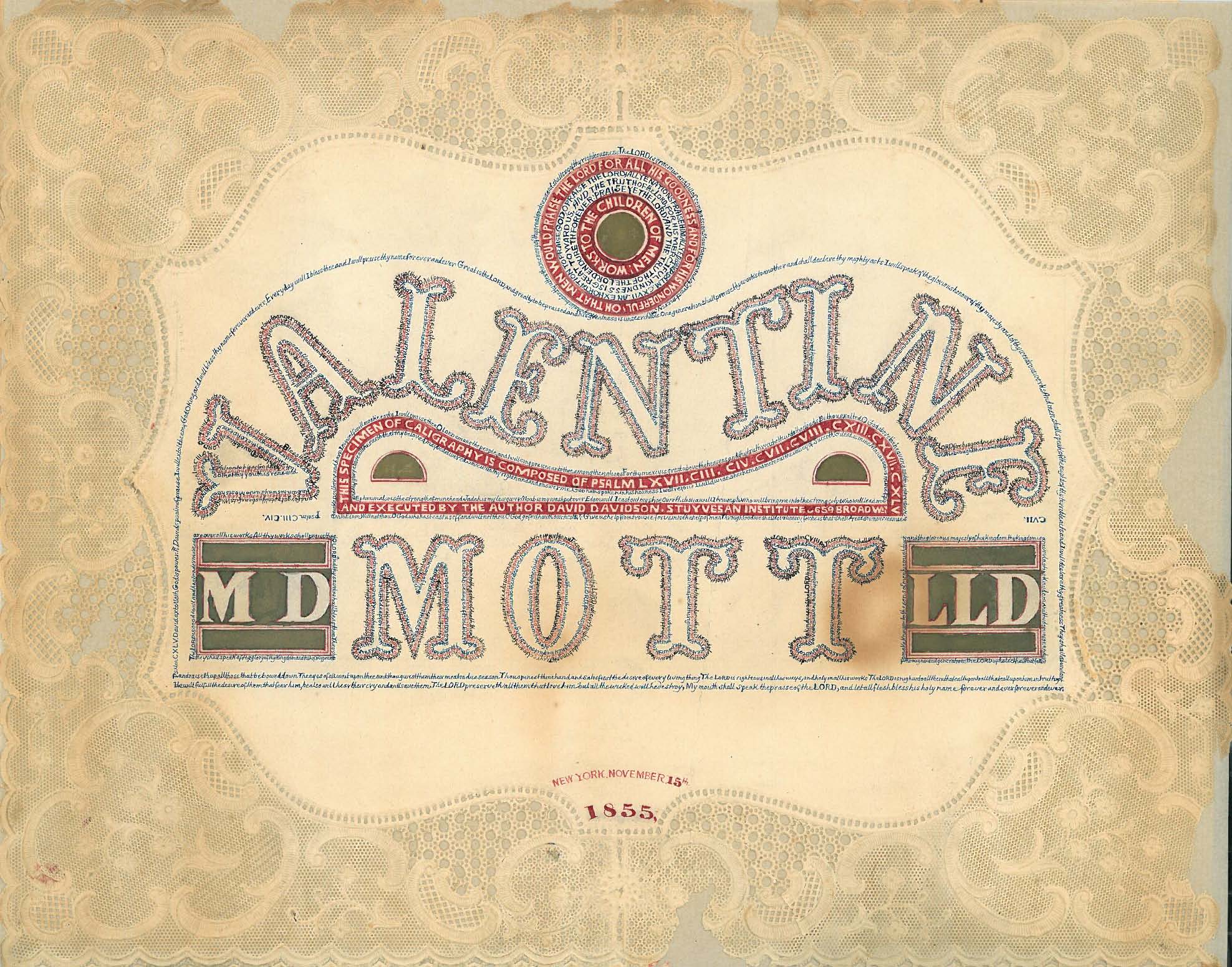
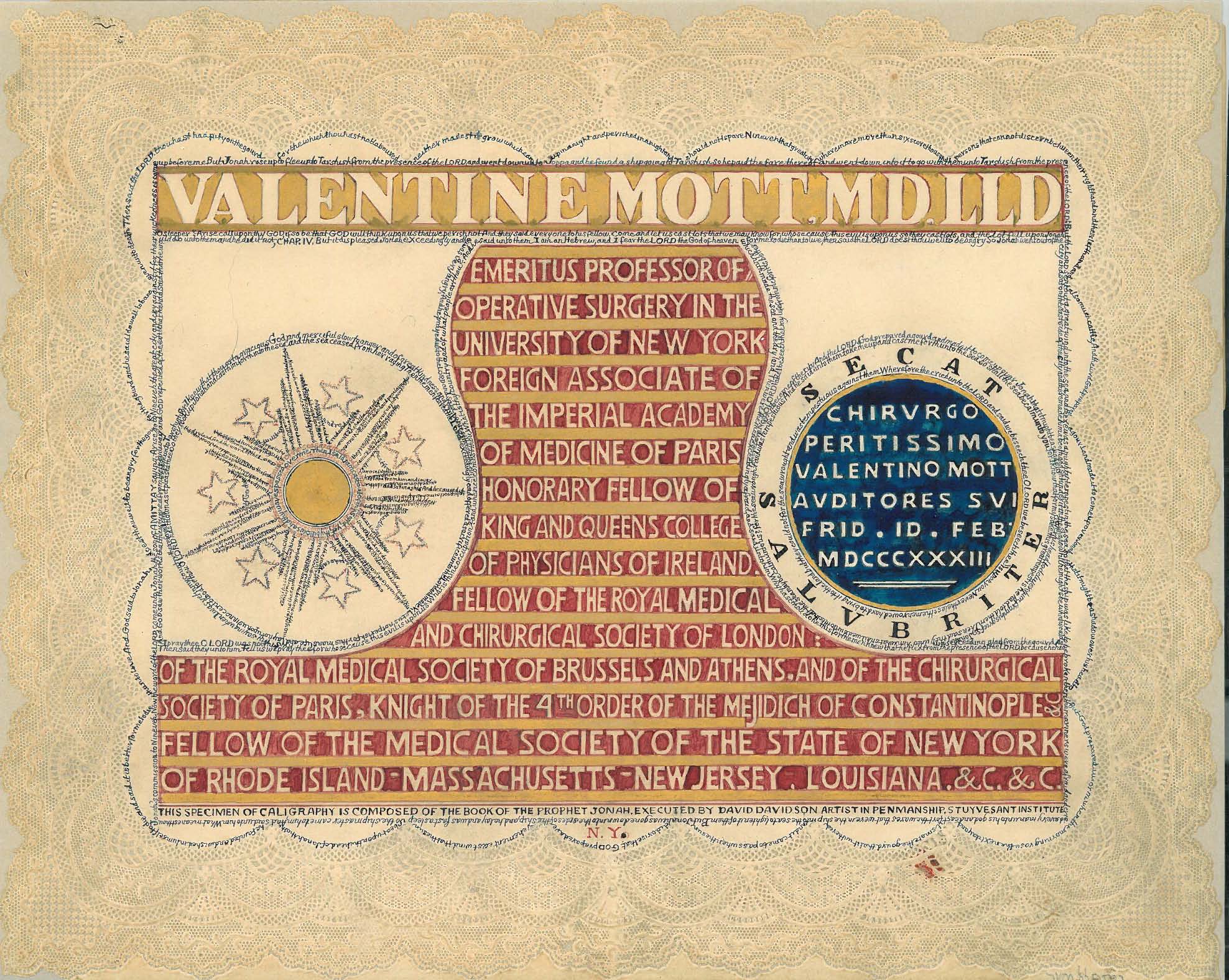
In honor of Valentine’s Day, these two “valentines” seemed appropriate items from our collection to share this week.

Micrography valentine for Valentine Mott

Valentine 1. Click to enlarge and marvel at the minuscule script.

Dr. Valentine Mott

Dr. Valentine Mott

Pioneer American surgeon Dr. Valentine Mott (1785-1865), NYAM’s third president (1849), was the recipient of these two examples of micrography, created by David Davidson. Mott was born in Glen Cove, Long Island, and attended medical school at Columbia College. As a student, he also trained under a cousin, Dr. Valentine Seaman. After receiving his degree in 1806, he sailed to Europe, where he studied with Sir Astley Cooper in London, and then spent time in Edinburgh. When he returned to New York in 1809, he began to lecture in operative surgery at Columbia. By 1811, he had been appointed a professor of surgery, and in 1818 he was the first doctor to successfully perform surgery on the innominate artery, two inches away from the heart, to repair an aneurysm in the right subclavian artery. His patient survived for 26 days before succumbing to a secondary infection. For the rest of his career, he divided his time between the United States and Europe, serving on the medical faculties of the Rutgers Medical College, Columbia’s College of Physicians & Surgeons, the University Medical College and the Medical Department of New York University, and performing an extraordinary number of surgical procedures.

Micrography valentine for Valentine Mott

Valentine 2.

Aside from the charming but obvious play on Mott’s name and the tenuous connection to his surgery on the innominate artery, there is nothing on these “valentines” that explains why Davidson chose to make them. Davidson remains a bit of a mystery himself. Born in Russian Poland in 1812, he immigrated first to England and then to the United States, where he settled on the Lower East Side for awhile before moving on to Baltimore and finally to Boston. Davidson describes himself as an “Artist in Penmanship” at the Stuyvesant Institute on one of the valentines, and he was the creator of a number of different micrographic specimens, including portraits of famous figures and renderings of important buildings. Micrography, the art of using miniscule script to create abstract shapes or representations of objects, is a Jewish art form that dates back to the tenth century. In micrography, the writing itself is so small that the words themselves are not apparent except under close examination. Davidson is credited as one of the first practitioners of micrography in the United States. Various sacred writings were used in the execution of micrography, and for some of his creations Davidson used Hebrew texts, but for these two valentines he used English versions of the Book of Jonah and of a number of Psalms.

Hot Springs: Respite for the brain-weary and infirm

By Johanna Goldberg, Information Services Librarian

Blizzards, cold weather, and short days call for vacations to warmer climes.

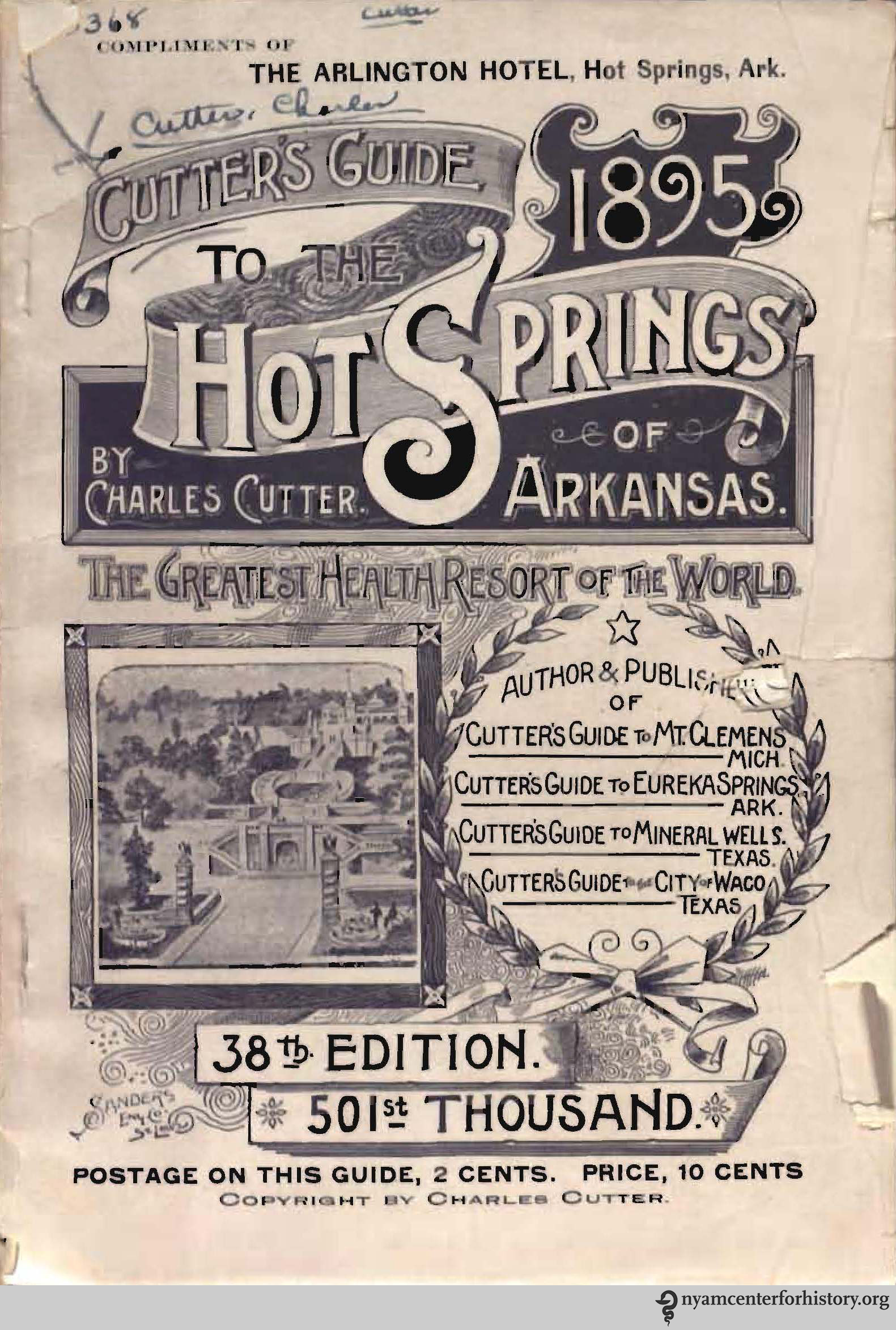
Fortunately, our collection contains a large number of items relating to balneology, the science of baths and bathing, including pamphlets from hot spring resorts across the United States from the late 1800s and early 1900s. Even if we can’t really get away, we can take a virtual trip to a warm soak thanks to these guides.

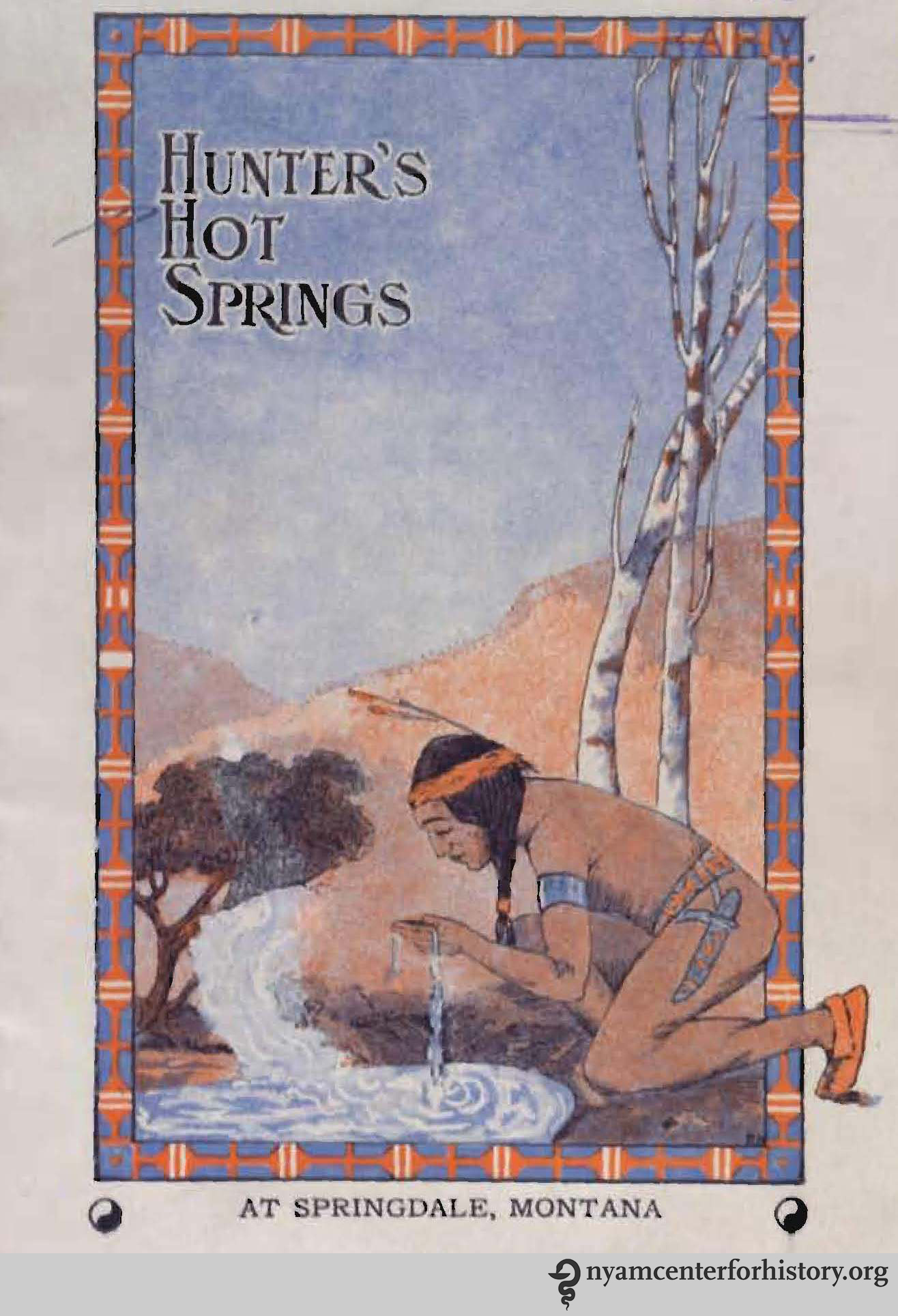
Some of the content in these pamphlets has not aged well, due to both medical progress (no one today could claim that a hot spring could cure syphilis) and political correctness (Hunter’s Hot Springs’ view of Native Americans is appalling by today’s standards). But they offer a unique look into how these destinations marketed themselves using the medical claims and social mores of the era.

Arrowhead Hot Springs

“Here the brain-weary may forget a busy world, the seeker after pleasure find it unalloyed with vice, and all, with their loved ones, secure under the watchful care extended to guests night and day.”

Cutter’s Guide to the Hot Springs of Arkansas

“The following diseases are successfully treated, the failure to cure being the exception; where a perfect cure is not effected, a benefit is experienced by all where the waters are properly used: Rheumatism, Gout, Scrofula, Paralysis, Neuralgia, Ozena, Catarrh, Sore Throat, Syphilis—acquired or hereditary, in its different forms—Asthma, Gravel, Diseases of the Kidney and Bladder, Eczema, Psoriasis, Uticaria, Impetigo, Prurigo, Rupia, Chronic Ulcers, Glandular Enlargements, Ring Worm, Migraine or Sick Headache, Enlarged Tonsils, Menstruation Troubles, and Sterility. This is a long list, yet the truth is not half told. Not a week passes but some remarkable cures are effected where all hope of recovery had been abandoned before a visit to these Springs had been concluded upon.”

Cincinnati Sulpho-Saline Springs and Bath House

“Cincinnati is in fact positively the only place where mineral water, fresh from mother earth, can be employed for the restoration of the sick to health and vigor, where all the advantages of a great city can be enjoyed at the same time.”

Hunter’s Hot Springs at Springdale, Montana

“The fact that the Indian of untutored mind should be able to appreciate the value of thermal springs may strike us at first as strange and inconsistent. But the Indian, and particularly the Indian of the wilds unchanged by contact with the whites, lived very close to Nature and learned many of her secrets.”

El Paso de Robles Hot and Cold Sulpher Springs

“On the skin of an average-sized adult there are about seven million pores—seven million little sewer outlets—which are discharging vents of twenty-eight miles of connecting tubes or pipes—through which a large proportion of effete, worn-out débris of the human body, and noxious, poisonous substances, as I have just proved, are cast out from the animal economy . . . The large quantity of bi-carbonate of soda and of sulphur in these waters washes out all these obstructions from the mouths of these millions of little sewers, and after a few days’ bathing leaves the skin almost as smooth as satin.”

Which vacation destination would you pick?

English Gingerbread Old and New

Food historian Stephen Schmidt wrote today’s post, which includes findings from research he conducted at NYAM last summer. The post was originally posted on the Recipes Project blog.

Food writers who rummage in other people’s recipe boxes, as I am wont to do, know that many modern American families happily carry on making certain favorite dishes decades after these dishes have dropped out of fashion, indeed from memory. It appears that the same was true of a privileged eighteenth-century English family whose recipe book now resides at the New York Academy of Medicine (hereafter NYAM), under the unprepossessing label “Recipe book England 18th century. In two unidentified hands.” The manuscript’s culinary section (it also has a medical section) was copied in two contiguous chunks by two different scribes, the second of whom picked up numbering the recipes where the first left off and then added an index to all 170 recipes in both sections.

The recipes in both chunks are mostly of the early eighteenth century—they are similar to those of E. Smith’s The Compleat Housewife, 1727—but a number of recipes in the first chunk, particularly for items once part of the repertory of “banquetting stuffe,” are much older. My guess is that this clutch of recipes was, previous to this copying, a separate manuscript that had itself been successively copied and updated over a span of several generations, during the course of which most of the original recipes had been replaced by more modern ones but a few old family favorites dating back to the mid-seventeenth century had been retained. Among these older recipes, the most surprising is the bread crumb gingerbread. A boiled paste of bread crumbs, honey or sugar, ale or wine, and an enormous quantity of spice (one full cup in this recipe, and much more in many others) that was made up as “printed” cakes and then dried, this gingerbread appears in no other post-1700 English manuscript or print cookbook that I have seen.

And yet the recipe in the NYAM manuscript seems not to have been idly or inadvertently copied, for its language, orthography, and certain compositional details (particularly the brandy) have been updated to the Georgian era:

25 To Make Ginger bread

Take a pound & quarter of bread, a pound of sugar, one ounce of red Sanders, one ounce of Cinamon three quarters of an ounce of ginger half an ounce of mace & cloves, half an ounce of nutmegs, then put your Sugar & spices into a Skillet with half a pint of Brandy & half a pint of ale, sett it over a gentle fire till your Sugar be melted, Let it have a boyl then put in half of your bread Stirre it well in the Skellet & Let it boyle also, have the other half of your bread in a Stone panchon, then pour your Stuffe to it & work it to a past make it up in prints or as you please.
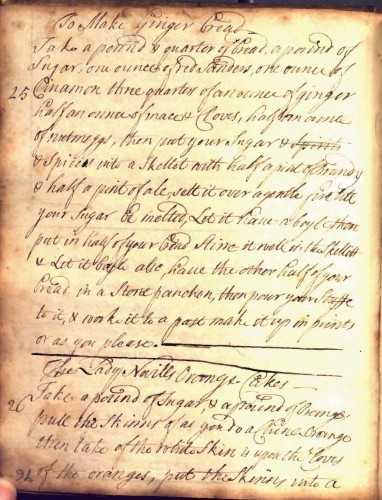
Eighteenth-century recipe book, England.

Eighteenth-century recipe book, England.

From the fourteenth century into the mid-seventeenth century, bread crumb gingerbread was England’s standard gingerbread (for the record, there was also a more rarefied type) and, by all evidence, a great favorite among those who could afford it—a fortifier for Sir Thopas in The Canterbury Tales, one of the dainties of nobility listed in The Description of England, 1587 (Harrison, 129), and according to Sir Hugh Platt, in Delightes for Ladies, 1609, a confection “used at the Court, and in all gentlemens houses at festival times.” Then, around the time of the Restoration, this ancient confection apparently dropped out of fashion. In The Accomplisht Cook, 1663, his awe-inspiring 500-page compendium of upper-class Restoration cookery, Robert May does not find space for a single recipe.

The reason for its waning is not difficult to deduce. Bread crumb gingerbread was part of a large group of English sweetened, spiced confections that were originally used more as medicines than as foods. Indeed, the earliest gingerbread recipes appear in medical, not culinary, manuscripts (Hieatt, 31), and culinary historian Karen Hess proposes that gingerbread derives from an ancient electuary commonly known as gingibrati, whence came the name (Hess, 342-3). In England, these early nutriceuticals, as we might call them today, gradually became slotted as foods first through their adoption for the void, a little ceremony of stomach-settling sweets and wines staged after meals in great medieval households, and then, beginning in the early sixteenth century, through their use at banquets, meals of sweets enjoyed by the English privileged both after feasts and as stand-alone entertainments.

Through the early seventeenth century banquets, like the void, continued to carry a therapeutic subtext (or pretext) and comprised mostly foods that were extremely sweet or both sweet and spicy: fruit preserves, marmalades, and stiff jellies; candied caraway, anise, and coriander seeds; various spice-flecked dry biscuits from Italy; marzipan; and sweetened, spiced wafers and the syrupy spiced wine called hippocras. In this company, bread crumb gingerbread, with its pungent (if not caustic) spicing, was a comfortable fit. But as the seventeenth century progressed, the banquet increasingly incorporated custards, creams, fresh cheeses, fruit tarts, and buttery little cakes, and these foods, in tandem with the enduringly popular fruit confections, came to define the English taste in sweets, whether for banquets or for two new dawning sweets occasions, desserts and evening parties. The aggressive spice deliverers fell by the wayside, including, inevitably, England’s ancestral bread crumb gingerbread.

As the old gingerbread waned, a new one took its place and assumed its name, first in recipe manuscripts of the last quarter of the seventeenth century, and then in printed cookbooks of the early eighteenth century. This new arrival was the spiced honey cake, which had been made throughout Europe for centuries. It is sometimes suggested that the spiced honey cake came to England with Royalists returning from exile in France after the Restoration, which seems plausible given the high popularity of French pain d’épice at that time—though less convincing when one considers that a common English name for this cake, before it became firmly known as gingerbread, was “pepper cake,” which suggests a Northern European provenance. Whatever the case, Anglo-America almost immediately replaced the expensive honey in this cake with cheap molasses (or treacle, as the English said by the late 1600s), and this new gingerbread, in myriad forms, became the most widely made cake in Anglo-America over the next two centuries and still remains a favorite today, especially at Christmas.

By the time the NYAM manuscript was copied, perhaps sometime between 1710 and 1730, molasses gingerbread was already ragingly popular in both England and America, and evidently the family who kept this manuscript ate it too, for the second clutch of culinary recipes includes a recipe for it, under the exact same title as the first. Remembering the old adage that the holidays preserve what the everyday loses, I will hazard a guess that the old gingerbread was made at Christmas, the new for everyday family use.

150 To Make Ginger Bread

Take a Pound of Treacle, two ounces of Carrawayseeds, an ounce of Ginger, half a Pound of Sugar half a Pound of Butter melted, & a Pound of Flower. if you please you may put some Lemon pill cut small, mix altogether & make it into little Cakes so bake it. may put in a little Brandy for a Pepper Cake

Recipe book England 18th century.

Recipe book England 18th century.

An interesting question is why the seventeenth-century English considered the European spiced honey cake sufficiently analogous to their ancestral bread crumb gingerbread to merit its name. It may have been simply the compositional similarity, the primary constituents of both cakes being honey (at least traditionally) and spices. Or it may have been that both cakes were associated with Christmas and other “festival times.” Or it may have been that both cakes were often printed with human figures and other designs using wooden or ceramic molds. Or it may possibly have been that both gingerbreads had medicinal uses as stomach-settlers. In both England and America, itinerant sellers of the new baked gingerbread often stationed themselves at wharves and docks and hawked their cakes as a preventive to sea-sickness. (Ship-wrecked off Long Island in 1727, Benjamin Franklin bought gingerbread “of an old woman to eat on the water,” he tells us in The Autobiography.) One thinks at first that the ginger and other spices were the “active ingredients” in this remedy, and certainly this is what nineteenth-century American cookbook authors believed when they recommended gingerbread for such use. But early on the remedy may also have been activated by the treacle. Based on the perhaps slender evidence of a single recipe in E. Smith, Karen Hess proposes that the first English bakers of the new gingerbread may have understood treacle to mean London treacle (Hess, 201), the English version of the ancient sovereign remedy theriac, a common form of which English apothecaries apparently formulated with molasses rather than expensive honey. I have long wondered what, if anything, this has to do with the English adoption of the word “treacle” for molasses (OED). Perhaps a medical historian can tell us.

Works Cited

Harrison, William. The Description of England. New York: Dover Publications, Inc., 1994

Hess, Karen. Martha Washington’s Booke of Cookery. New York: Columbia University Press, 1981.

Hieatt, Constance and Sharon Butler. Curye on Inglysch. New York: Oxford University Press, 1985.

“Treacle, I. 1. c.” The Compact Oxford English Dictionary. 2nd ed. 1991.

Stephen Schmidt is the principal researcher and writer for The Manuscript Cookbooks Survey, an online catalogue of pre-1865 English-language manuscript cookbooks held in the U. S. repositories, which will launch in early 2013. He is the author of Master Recipes, a 940-page general-purpose cookbook, was an editor of and a principal contributor to the 1997 and 2006 editions of Joy of Cooking, has contributed to The Oxford Companion to American Food and Drink and Dictionnaire Universel du Pain, and has written for Cook’s Illustrated magazine and many other publications. A resident of New York City, he works as a personal chef and a cooking teacher and hopes soon to complete Lemon Pudding, Watermelon Cake, and Miracle Pie, a history of American home dessert.