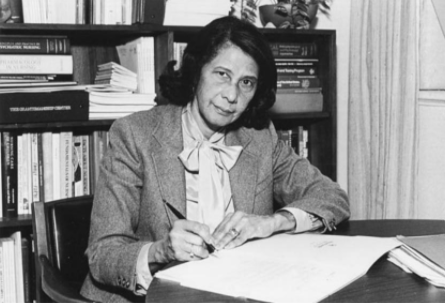
How I Spent My Summer Vacation

by Anthony Murisco, Public Engagement Librarian

Labor Day is now behind us. This can only mean one thing for the students of New York City: It’s time for school to start again. The first day of school creeps up differently in other parts of our country. As a former public-school student from Long Island, I always think of Labor Day as the last day of freedom. Even if you have a day or two before the actual start, those hours are spent shopping, cramming in that reading list, and getting into the school mindset once again.  
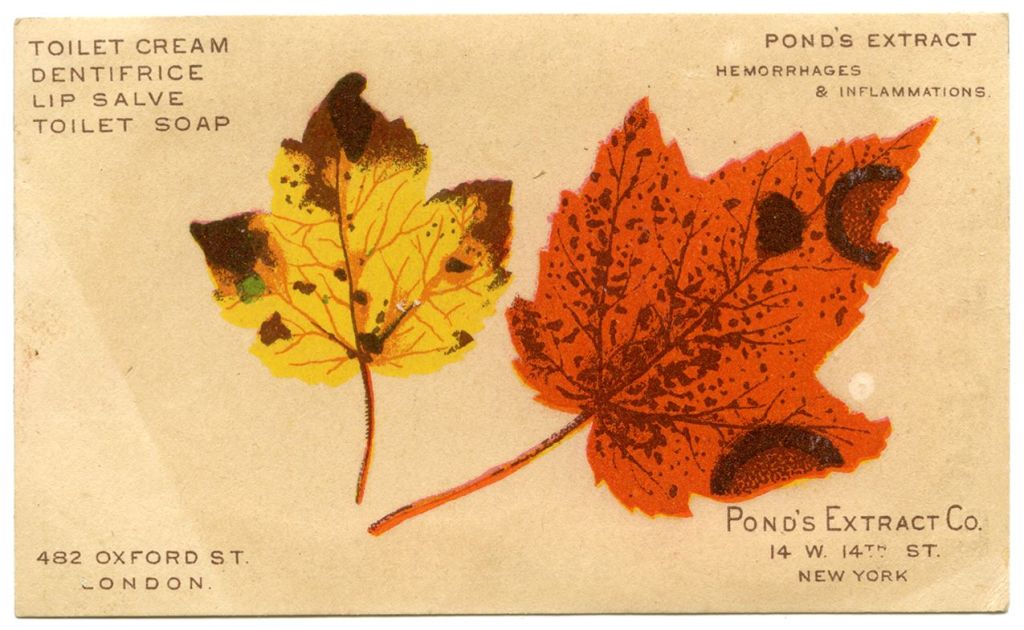
Autumnal leaves featured on a Pond’s Extract Co. trade card.

Whether it comes from a friend you haven’t seen all summer or as part of an assignment, one of the classic questions on the first day of school is always “How did you spend your summer?” In honor of the students attending classes for the first time this week, I wanted to share my own summer experience at California Rare Book School in Los Angeles.  

Since 2005, the California Rare Book School, CalRBS for short, has been able to provide professional development to those interested in rare and historical work. Their courses serve a wide array of needs of those interested in information science, whether library professionals, museum curators, or rare book collectors. All are invited to apply. The project is headed by the Department of Information Studies at the School of Education and Information Studies over at UCLA.

Joe Bruin, UCLA’s Mascot

Most of the CalRBS courses take place at the UCLA Campus, though the school is looking to expand. During this summer, a few courses were offered online, one in Mexico, and another in Brooklyn in conjunction with Booklyn. One course this summer even took place at The Huntington!

At The Huntington

There are no prerequisites, and you don’t need to be affiliated with a library or university to apply. I met fellow students ranging from recent college graduates to lifelong learners and university librarians to rare book dealers. It’s a diverse group of individuals!  
 
Each course only accepts twelve students. The small class sizes allow for better discussion and further involvement with the material. Your cohort is together from about 9am-5pm for the entire week. Don’t worry, there’s plenty of time for networking with the book aficionados from the other courses during the breaks or the various after-hours events.  

Students are expected to attend the entire week. Be punctual! You’re expected to complete the assigned readings before class and participate in discussions. Different courses have different expectations. 

In my course, “Pop Bibliography,” we were also expected to complete a final project. Building on what we had learned throughout the week, we were to inspect a tome from popular culture and look at it through a “pop bibliographic” lens.  
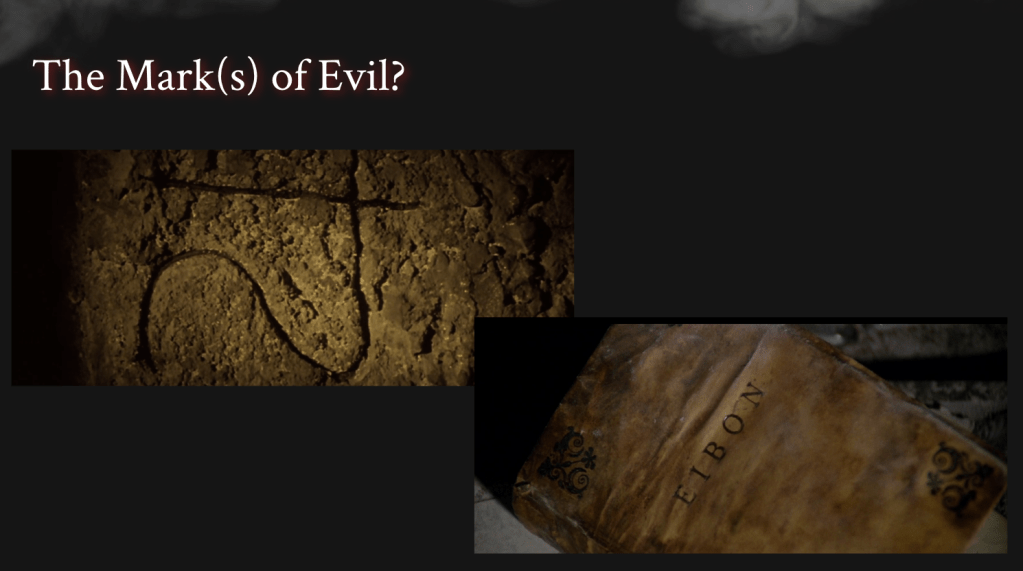
A slide from my final project on the book of Eibon from Lucio Fulci’s The Beyond (1981)

As someone with a background in Culture Studies, I was excited to see Pop Bibliography on the menu this past summer. I’ve immersed myself in pop culture as far back as I can remember. Adding bibliography into the mix was just combining my two favorite things! 

“Pop Bibliography” concerns the study of book history through a popular lens. We were looking at why old, dusty, or mystical books are made to look as they do in the media we consume. How did matters end up with this way? And what are we to make of the fetishization of books in our current culture?  
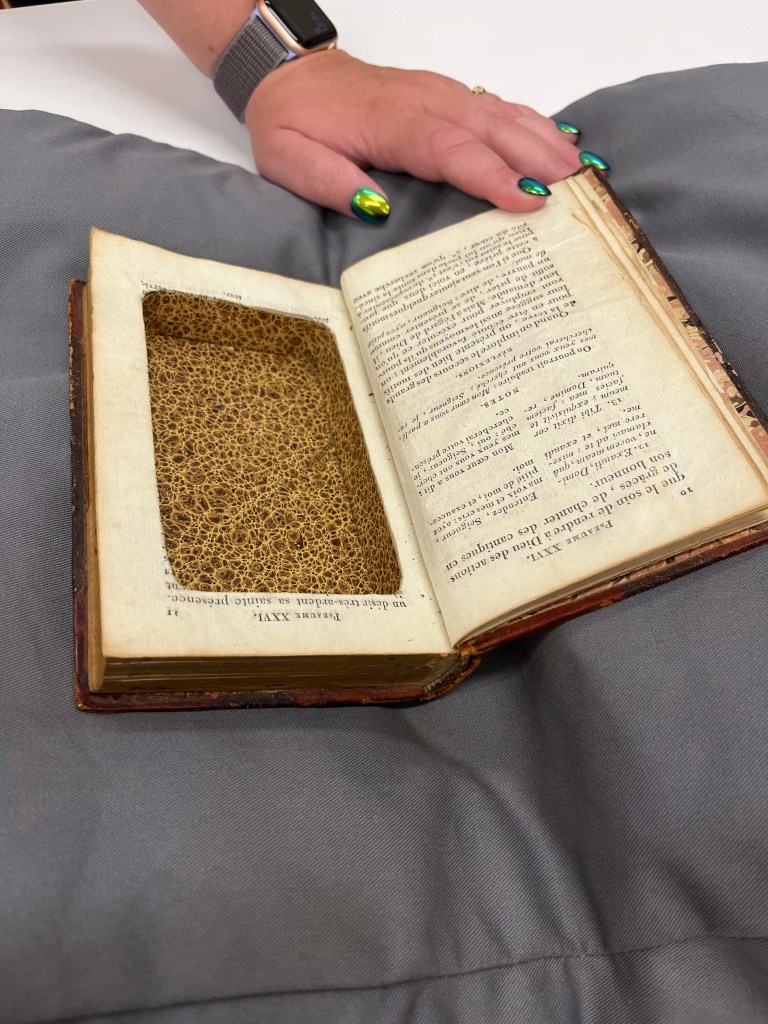
The course instructor, Allie Alvis, is the curator of special collections over at the Winterthur Library. That library has a fantastic online presence. You may have seen their social media accounts, Book Historia, where Allie provides an up-close look at rare books. Showing the items in this format opens them up to a whole new audience. Some viewers may have never seen an illuminated manuscript handled before. Allie even had one of their videos go viral about the myth of using white gloves to handle rare material.  

Not only did Allie have an exciting schedule of topics prepared for us, but they invited outside speakers as well!

Prop-maker, collector, and historian Michael Corrie shared items and stories behind some of the screen’s various literature.  

Michael with a print page from Gary Ross’ Pleasantville (1998).

We got to listen and speak to game designer, Josh Sawyer, talk about the Peabody-award-winning game he directed, Pentiment. The story concerns a 16th-century illuminator caught up in a murder mystery plot. Beautiful and highly researched, accurate text abounds.  

There were also a few class trips! We were treated to a look at some of the holdings over at The Getty with the associate curator of manuscripts, Larisa Grollemond. We got to see authentic Middle Age binding as well as rebound manuscripts.

A whole day was spent over at The Huntington. First, we looked inside their exhibit, “Remarkable Works, Remarkable Times,” where we were treated to iconic pieces from their collection, including an Ellesmere manuscript of Chaucer’s The Canterbury Tales. Joel Klein, the Molina Curator for the History of Medicine and Allied Sciences, gave us a presentation of various materials. This included the recently acquired (or reacquired) Vesalius book, De humani corporis fabrica. After recent coverage we felt as if we were being introduced to a celebrity! Afterwards the rest of the RBS students joined our class for a presentation by Magali Rabasa on radical publishing in Latin America. We got to see how the same book was reworked by the different presses, leading to different expressions of the material object.  
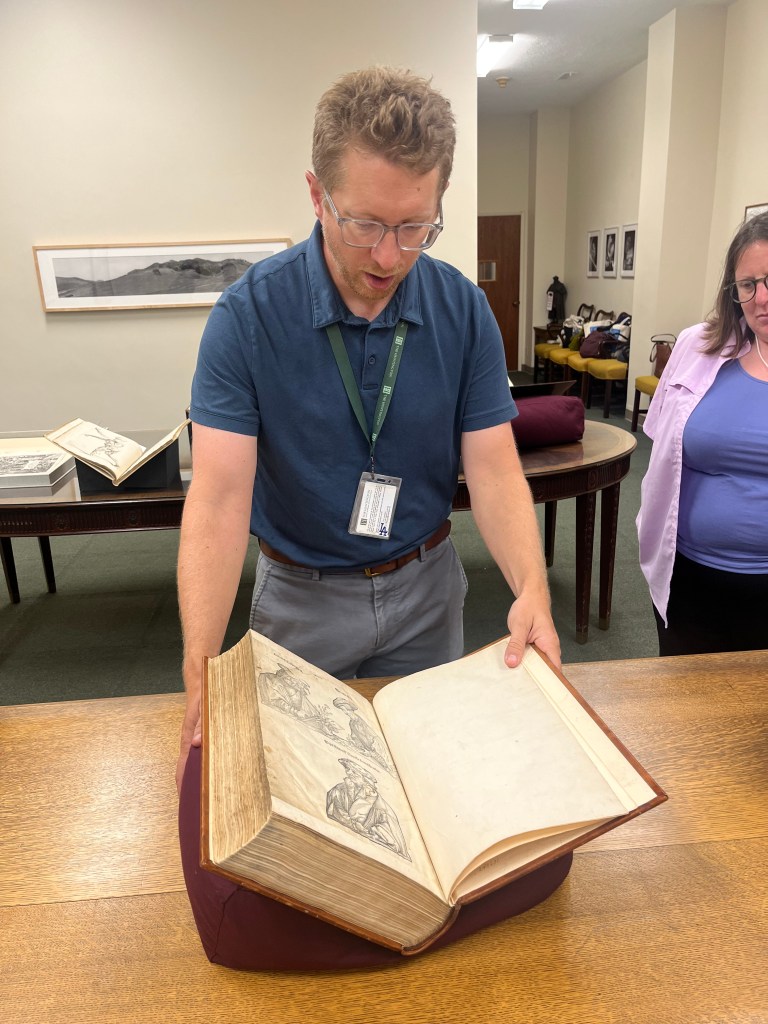
As we were on the campus, we got a glimpse at some of the items in the UCLA Special Collections. Jet Jacobs, Head of Public Services, Outreach and Community Engagement, brought us on a tour.  
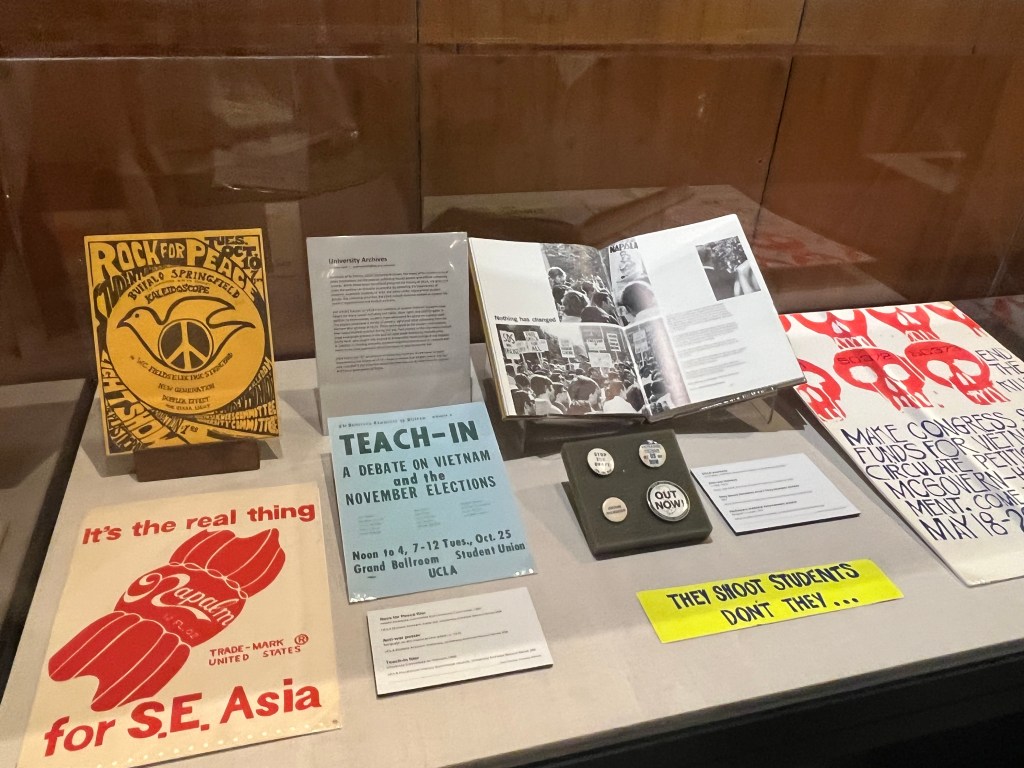
Although our focus was on Western material, Devin Fitzgerald, Curator of Rare Books and History of Printing, as well as a specialist in East Asian book history, gave us a chance to look at items printed in China, Japan, and Korea. 

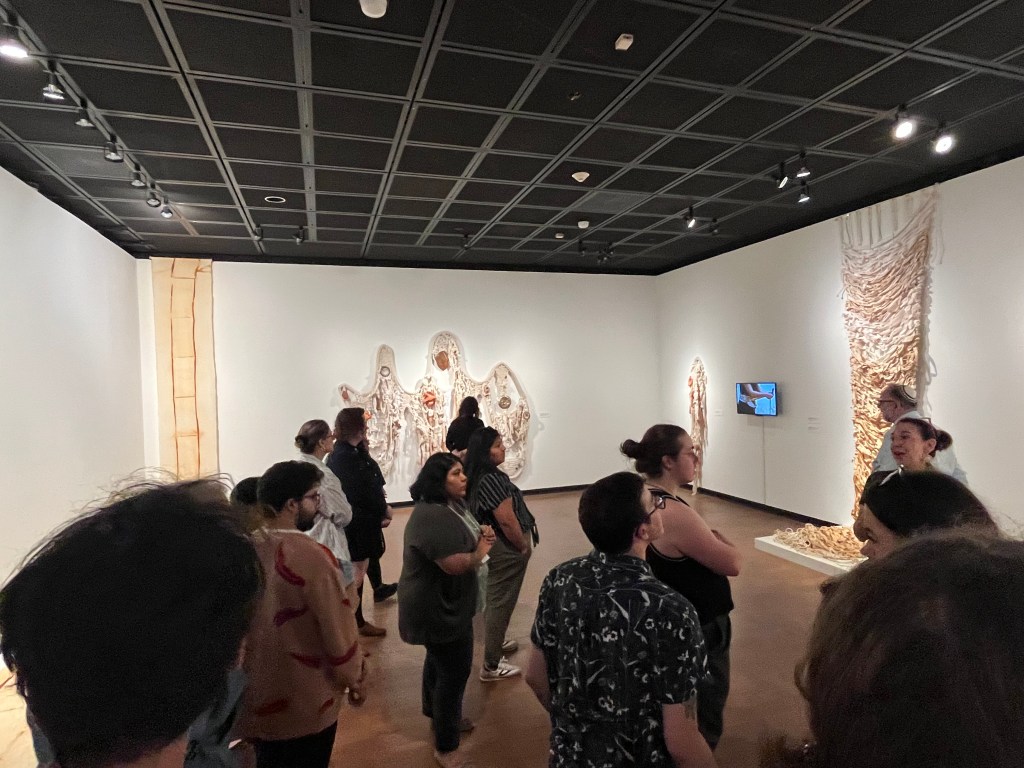
We ended our week with a department-wide celebration at the Fowler Museum at UCLA. They gave us a special tour of their latest exhibit, Sangre de Nopal/Blood of the Nopal. This exhibition teaches visitors about the Indigenous origins of cochineal, a particular red dye that was developed and first used by the Zapotec peoples. The exhibit featured work by Tanya Aguiñiga and Porfirio Gutiérrez

I will admit that I was surprised how wiped out I was by the end of the week. I hadn’t been in a grad school class in a few years. College was even further away. Nine-to-five learning is quite a workout for your brain. Then you must go back to your room to do the readings for the next day, or perhaps a small assignment. Working on the final project takes time that you need to budget for too. I won’t deny the intensity of the program, but those who enroll will feel highly rewarded afterwards. There’s a reason why it’s going to celebrate twenty years in 2025. A huge thank you to Allie Alvis, Robert D. Montoya, Sean Pessin, and Liza Mardoyan. I am looking forward to seeing what classes are going to be offered next year!  

Replica of the Book of the Dead from the classic Brendan Fraser film, The Mummy (1999; Sommers).

Whether we realize it or not, a lot of our first glimpses of “rare” or “old” books come from popular culture. For one, the Walt Disney animated canon is full of them. Before we get to the animation and songs, we see those mighty books open. Our first taste of public health is no exception. How many future doctors first heard of Gray’s Anatomy through the wordplay of the long-running nighttime soap, Grey’s Anatomy? What about those who were inspired by seeing the young Doc McStuffins perform exams on her stuffies?  

Despite being noted as a type of populism, there is a merit to studying and immersing yourself in popular culture. Culture critic Richard Dyer sees the work as a “battleground between progressive, subversive and conservative meanings.” That idea may make sitting through reruns of a Housewives franchise with your friends a little more palatable.  
 
References:  
Nowak, Samuel. “Popular Is Political Richard Dyer Talks to Samuel Nowak about Popular Culture, University and Politics.” Interviews, Museum of Contemporary Art in Krakow, Jan. 2012, en.mocak.pl/popular-is-political-richard-dyer-talks-to-samuel-nowak-about-popular-culture-university-and-politics. Accessed 04 Sept 2024.  

April 2023 NYAM Library Wrap-Up

by Anthony Murisco, Public Engagement Librarian

It’s not an April Fools that we’ve been busy this month—busy on social media, that is!

April is National Poetry Month. In 1996, the Academy of American Poets started the celebration to honor the underdog genre of literature. Each Wednesday we went through Charles G. Farnum’s poetry in Medicine Could Be Verse: Humorous Poems Mainly About the Profession. Specifically, we looked at the poems that dealt with the feelings of being ill. With the warmer springtime weather in New York City this month, perhaps “Hay Fever” proved too topical.

The first week of April, we celebrated National Public Health Week. Defined by the American Public Association, public health is “the health of people and the communities where they live, learn, work, and play.” Each weekday brought about a new tip on how to keep yourself and your communities healthy.

Tip 1: Check in with your own physical health.
Tip 2: Focus on your mental health

From Health and Happy Days by Grace T. Hallock (1954).


Tip 3: Stay up to date with your immunizations.

Scan of the pamphlet Recommended Procedures for Immunization put out by the Illinois Department of Public Health.

Tip 4: Stay active!
Tip 5: Don’t forget to rest.

A view of lakeside living from The Lakeside Haven of Rest guide.

Leading up to Earth Day on 4/22, we celebrated our home planet with books focusing on Jurassic geology, the importance of turtles, and even a 16th century love-letter to the mountains. We shone a spotlight on one of the formative pieces of literature in the Earth Day movement, Silent Spring by Rachel Carson. She wrote about the toxic effects of pesticides on our whole planet. Deemed controversial for the time, her findings led to an environmental revolution.

A scan of the first chapter of Silent Spring with artwork by Louis and Lois Darling.

The last week of April coincided with National Library Week. We looked at a book advocating the freedom to read in prison, a classic image of our library and librarians from circa 1956,  and a 1911 map of the libraries of Manhattan.

A map showcasing all of the libraries in the borough of Manhattan, circa 1911.

If you’d like to engage more with our library collection, and see all the images in these series, follow us! The New York Academy of Medicine Library can be found online over at Facebook, Instagram, and Twitter.

We also offer tours on the first Monday of every month at 12pm, no appointment necessary! For this and further opportunities to visit, please check this blog and our social media.

Cooking Our Collection: Pi Day 2023

By Anthony Murisco, Public Engagement Librarian

My name is Anthony Murisco. I am the Public Engagement Librarian here at NYAM. A few weeks back, we celebrated Pi Day by baking a couple of pies. I wanted to share my own experience.

For those who may not know or need a refresher, Pi is a mathematical constant. The symbol π, the Greek letter for P, represents the ratio of the circumference of a circle to its diameter. The ratio will always be π. When written out, π is approximately 3.14. π is an irrational number, whose decimal form continues forever, which is why a shorter form is used. Hence March 14, 3/14, is known as Pi Day.

Pi Day is a celebration of all things mathematical as well as that certain baked good. Pi and pie not only share a name but are both circular. While the holiday may have earlier origins, the first recorded celebration was heralded by physicist Larry Shaw in 1988. When discussing the “mysteries of pi” with a colleague, he realized the irrational number has some rationality to it! In an effort to make learning math fun, he conducted the first Pi Day celebration with his class. The event, now celebrated by math enthusiasts all over, includes reciting the value of π to as many decimal places as one can, a real memorization challenge, and of course, pie tasting.

An illustrated image of chef's working in a kitchen in a hotel.
From The encyclopædia of practical cookery (1898) by Theodore Francis Garrett

What better way to celebrate than by baking a pie? This year, this was my task. The New York Academy of Medicine Library has a plethora of recipe books, some more than 200 years old. A selection of these books has been shared before, on social media, in this very blog, and even on our digital exhibition. Here was one of the first attempts of our staff making a dish!

After searching through several books and finding only savory recipes, our Historical Collections Reference Librarian, Arlene Shaner, discovered what I was looking for. In the 1824 edition of The Virginia house-wife lay a recipe for simply “Apple Pie.”

An advertisement payed for by The Apple Growers of America. A blonde woman is holding up an apple. The caption reads "For weight control... a tasty appetite-appeaser."

Mary Randolph first published The Virginia Housewife in 1824. Its popularity led to several editions and reprints. The Virginia housewife, or Methodical Cook was the first of its kind, a published manual of recipes and housekeeping tips that would later surge and create an industry. This was the perfect book to make a pie from.
Title page of the 1824 edition of The Virginia house-wife by Randolph.

The book featured three different recipes. Only one specified that it was a pie. Arlene predicted that the second recipe was for pie filling. She is an experienced baker. She went with that one. I had never baked a pie before. I didn’t want to do anything wrong. I stuck with Randolph’s “Apple Pie.”

I looked at the recipe to make a list of ingredients. Apples. Cloves. It called for “powdered sugar.” And rose water. I stopped by my local pop-up market and got four large red delicious apples. Each looked almost double the size of a single apple. Surely this would be enough! Powdered sugar and whole cloves were easy to get. It wasn’t on my list but, I opted for a pre-made crust. While I know that pre-made is not ideal, I had never made a crust before. I would have needed even further directions! If store-bought is fine for Ina Garten, it would be good enough for me. The rose water ended up being the most elusive ingredient in my neighborhood. After several failed shopping trips, I contemplated looking up replacements. I ended up finding rose water downtown at a hip chain grocery store.

Having never baked like this before, I tried to stick exactly to the recipe. The years of doing mail-in meal services will do that to you! Without the exact measurements, I was left a little confused—how would I know how much to use?

Three recipes from page 152. Apple Pie. Baked Apple Pudding. A Nice Boiled Pudding cuts off at the end.
Two of the pie recipes. Notice how the second is not specifically stated as a pie!

The Virginia House-wife and other older cookbooks are not specific with their instructions. There’s a notion that you have some culinary instinct if you are reading it. The recipes are a supplement to your knowledge. Randolph did not foresee someone like me, a beginner, taking on the challenge.

During the filling of the crust, I noticed, two apples in, that I should have gotten more apples. I’ve seen pies filled before with an arrangement of the fruit, a kind of beautiful Busby Berkeley dance. This was not my case. Still, I used what I had! While the apples didn’t fill the pie completely, it wasn’t as empty as I had feared.

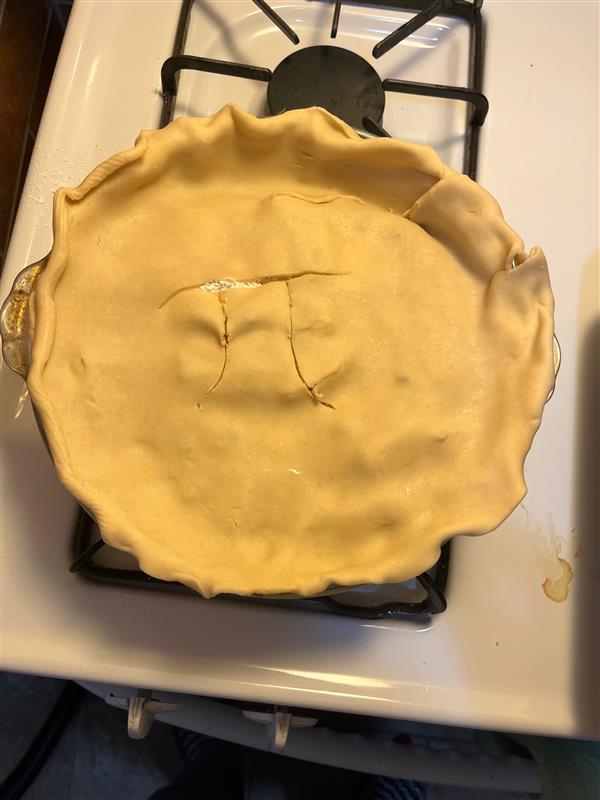
The pie completed before it was baked. On top is the pi symbol carved in.
Ready to be baked!

When I discussed my experience with Arlene, she told me that the powdered sugar I used was the wrong ingredient. Powdered sugar today is not the same as it was then. In the past, you would get a loaf of sugar, scrape off what you needed, and “powder” the cake that way. It was more akin to granulated sugar today. Modern-day powdered sugar, or confectioners’ sugar, quickly dissolves and tends to absorb the moisture. Though the pie tasted good, I had given it a different spin. I think that may have been Randolph’s goal. She doesn’t want to tell you exactly how to bake or cook, she just gives you some general directions.

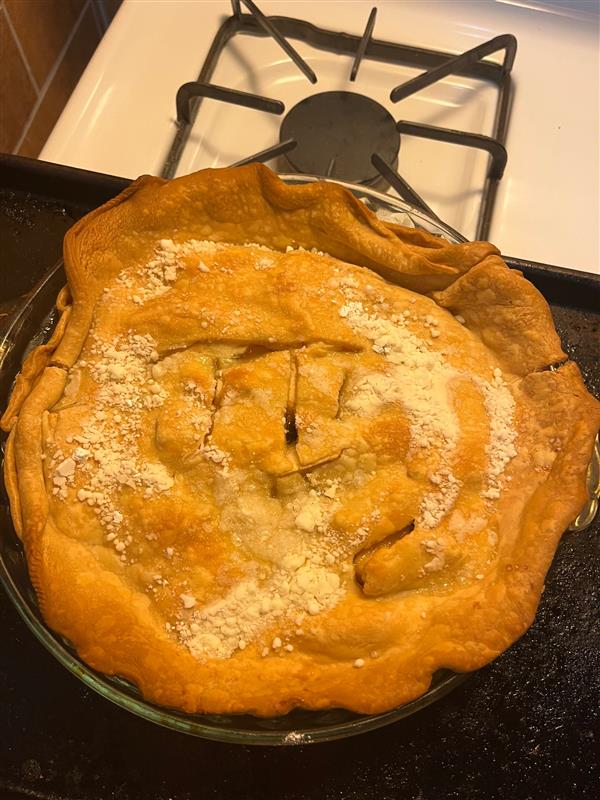
The finished product.

While it may not have looked the best, that didn’t matter. The pie I made was tasty. The powdered sugar dried up some of the apples. I also put too many cloves. This led to quite a spicy taste.

Since 2020, Dr. Rachel Snell, a historian, has been working her way through The Virginia house-wife. Using two editions, 1824 and 1838, she created “The Virginia Housewife Project” to explore the recipes while investigating ideas of domesticity and the history of each recipe. I wish I had seen her blog prior to making the pie, so I could have prepared a little more!

I hope to be able to share more of these recipes in the future. In the meantime, please check out our digital collection of cookbooks. Maybe something will inspire a course for your dinner tonight!

A piece of Arlene's baked apple pudding pie.
A piece of Arlene’s finished baked apple pie.


References:

Berton, Juston. “Any way you slice it, pi’s transcendental,” San Francisco Chronicle (11 March 2009) https://www.sfgate.com/science/article/Any-way-you-slice-it-pi-s-transcendental-3169091.php, accessed 27 March 2023.

Randolph, Mary. The Virginia house-wife. Washington : Davis and Force, 1824.

Snell, Rachel A. “The Virginia House-wife Project” https://virginiahousewifeproject.com/, accessed 27 March 2023.

Valentine’s Day Cards from NYAM

by the NYAM Library Team

On February 14th we observe Valentine’s Day!

Our previous blog posts on this commercial holiday highlighted both cards created for Valentine’s Day as well as trading cards from our collection. At the close of the 19th century, improvements in printing allowed for cheaper goods and paper cards for friends, lovers, and families to send written sentiments.

These early cards varied from caricatures of their subjects and beautifully drawn miniscule script, to what we now think of as Valentine’s Day cards – humorous or sentimental acknowledgements.

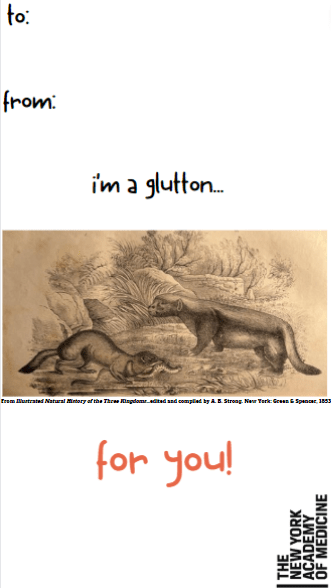
To celebrate this year, we have created six of our own Valentine’s Day cards featuring images from our collections. One is for the celebration of the popular Galentine’s Day, a celebration of friendship.

Feel free to print out and share with your loved ones!

From Sei sparsam!… by Anny Wothe (Leipzig, 1900.)
From Historiæ animalium... by Conrad Gessner (Zurich, 1551.)
From Illustrated Natural History of the Three Kingdoms…edited and compiled by A. B. Strong (New York, 1853.)
From De motu cordis et aneurysmatibus… by Giovanni Maria Lancisi (Neapoli, 1738.)
From Ryzon Baking Book compiled and edited by Marion Harris Neil (New York, 1917.)

Color Our Collections 2023

by the NYAM Library Team

Today we conclude our week-long celebration of Color Our Collections 2023.

Each February, fellow libraries, archives, museums, and other cultural institutions showcase their collections through these free, downloadable coloring books. About a hundred new books are gathered at ColorOurCollections.org for your continued enjoyment any time during the year. Previous years are also available, almost 800 coloring books in all! Please continue to use the hashtag #ColorOurCollections to show us your work.

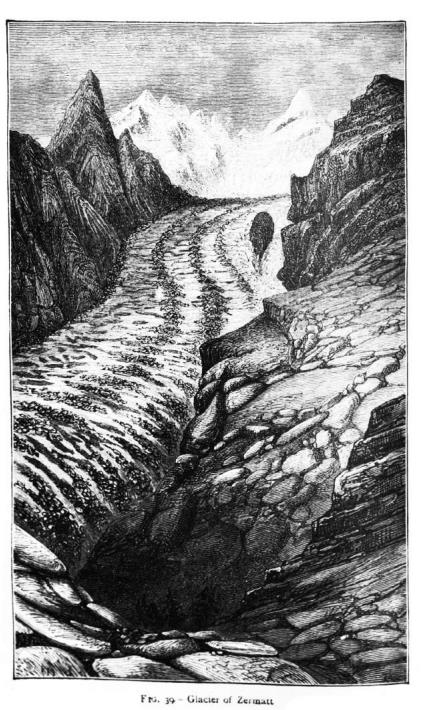
This year, NYAM’s coloring book deals with Climate Change. The images showcase those animals, vegetation, and natural regions that are most vulnerable.

Below we’ve selected a few of the images that you’ll find in this year’s edition.

Typis Montis… from Mundus Subterraneus by Athanasius Kircher (Amsterdam, 1665.)
Glacier of Zermatt from Physiography by Thomas Henry Huxley (London, 1905.)
Polar Bears and Seals from The Polar World by Georg Hartwig (London, 1869).
Branched Coral from The Universe by Félix-Archimède Pouchet (London, 1902)
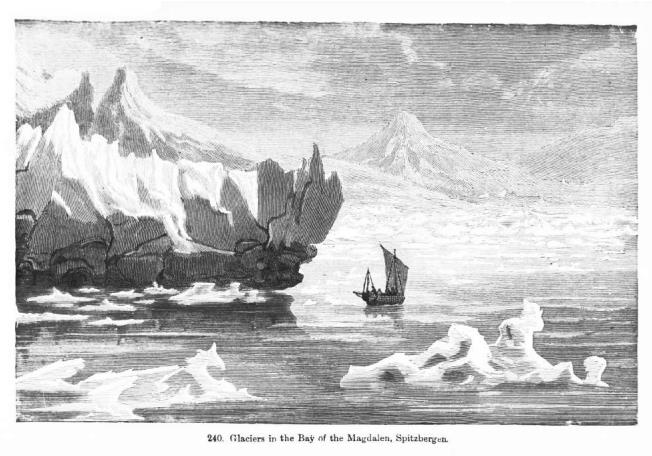
Glaciers in the Bay of the Magdalen, Spitzbergen from The Universe by Félix-Archimède Pouchet
(London, 1902).

For hundreds of more coloring books, don’t forget to check our previous Color Our Collections!

‘Sick and In Prison’: Airborne Disease and Prison Reform in the career of John Howard (1726–1790) 

By Dr. Paul E. Sampson, Assistant Professor of History, The University of Scranton 

2020 Audrey and William H. Helfand Fellow in the History of Medicine and Public Health 

Over the course of the past year, I have had the privilege of spending four weeks researching in the spectacular rare book collection of the Library of the New York Academy of Medicine. My book project is entitled “Ventilating the Empire: Environmental Machines in Britain, 1700–1850” and comprises a scientific and social history of ventilation in Britain and the British empire during the long eighteenth century, roughly 1688 to 1815. By examining the design and deployment of ventilating machines in slave and naval ships, prisons and public buildings, I ask how devices designed to protect human beings from environmental hazards became a means of dividing British society along class and racial lines.  

Text Box

The primary subject of my research has been the life and career of prison reformer John Howard (1726–1790). I examine Howard’s career through the context of his work on “Jail Fever” (AKA typhus) which contemporary physicians and medical experts understood as an airborne disease. I argue that a key feature of Howard’s celebrity was his perceived invulnerability to airborne diseases. In addition, his influence helped to shift the discourse of prison reform away from overall institutional sanitation and towards methods intended to control the hygiene and morality of individual prisoners. 

For those unfamiliar, John Howard was a noble-born, intensely religious man who was appointed sheriff of Bedfordshire in 1773. One of his duties was to inspect local prisons. Unlike many of his genteel contemporaries, he took this job seriously. He was appalled by the conditions of the prisons in Bedfordshire, and to spur reform and gather ideas for improvement, he made a series of lengthy tours to visit as many prisons as he could throughout the British Isles and continental Europe. His first published book, The State of the Prisons in England and Wales (1777), detailed his visits to dozens of county jails and bridewells (workhouses), including careful notes of the fees charged to prisoners, their daily workload, the prison diet, and the overall sanitation.  

One of the primary goals of Howard’s travels was to find the best means of preventing the spread of disease. By the 1750s, prisons were increasingly perceived as public health hazards. The filthy and diseased condition of prisoners in London’s Newgate prison became a public scandal after the Lord Mayor and 56 others died of jail fever in the weeks following an audience with prisoners. Following the contemporary etiology of fever, the outbreak was attributed to the “putrid effluvia” exhaled in the breath of sick prisoners that had imparted a “poisonous quality” to the air in the courtroom.1 By 1774, Howard had achieved celebrity status by helping to author the “Act for Preserving the Health of Prisoners in Gaol.” This act stated that jail fever was caused by the “want of cleanliness and fresh air” and mandated that all interior walls and ceilings be scraped and white-washed annually and “constantly supplied with fresh air, by means of hand ventilators or otherwise.”2  

However, in the wake of this achievement, Howard’s attitudes about preventing fever had begun to shift. During his tours of European prisons, he was puzzled that he rarely encountered “jail distempers” there. To explain the disparity between these and disease-ridden English institutions, Howard developed a theory of jail fever based entirely on his own “experience.” He argued that prisoners could only be infected if privation, filth, and personal intemperance weakened them enough for the contagion to take hold. Young and healthy convicts who were used to “vigorous exercise” quickly became infected due to the “sudden change of diet and lodging” that “so affects the spirits of new convicts, that the general causes of putrid fevers exert an immediate effect on them.” As a counter-example, Howard pointed to himself. During his first tours, he wrote, he had attempted to avoid breathing in contagion by “smelling to vinegar… and changing my apparel…constantly and carefully.” A few years later, however, he wrote that he “entirely omitted” such precautions. In his opinion, the real protection against infection were his habits of “temperance and cleanliness” as well as the power of “divine providence.”3 

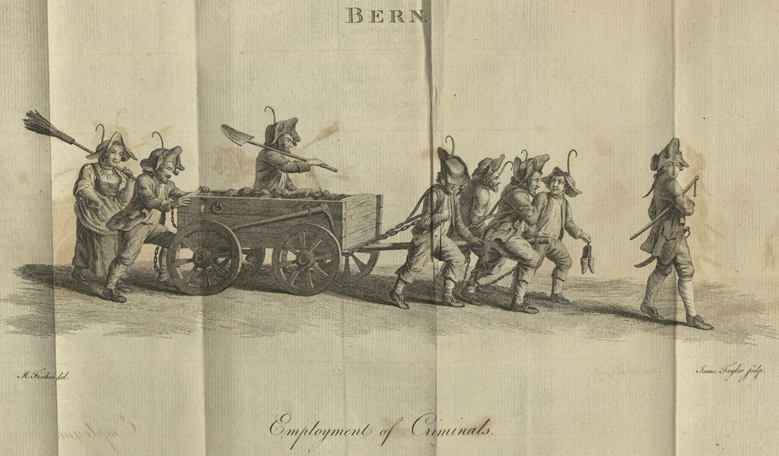
Image 2: Howard was keenly impressed by the prison regime in Bern, Switzerland. Howard wrote that the city was “one of the cleanest I have seen” and included illustrations of the employment of male and female prisoners as street cleaners. Note the iron collars with hooks affixed to the prisoners’ necks to deter escape attempts.  
“Employment of Criminals” and “Employment of female Criminals,” in John Howard. The State of the Prisons in England and Wales. 2nd. Ed. (Warrington: T. Cadell, 1780) 109–10. Images courtesy of the New York Academy of Medicine Library. 
 

By the time the second edition of State of the Prisons came out in 1780, Howard had visited hundreds of disease-ridden institutions and avoided contracting a serious infection. While friends privately cautioned him against such continual risk-taking, Howard’s superhuman invulnerability to disease had become a key feature of his celebrity.4 Celebratory poems about Howard became, in the estimation of two literary scholars, “nearly ubiquitous in the 1780s and 1790s” as poets from Erasmus Darwin to William Cowper celebrated his arduous travels and selfless virtue.5 William Hayley’s 1780 Ode, Inscribed to John Howard attributed Howard’s “matchless fame” to his “valor’s adventr’ous step” through “malignant cells” where “fierce contagion, with affright, repels.”6

Image 3: George Romney’s study for a never-completed painting of John Howard visiting a prison or lazaretto. Howard is the figure standing defiantly on the far left.  
George Romney, John Howard Visiting a Lazaretto (1790–95). Courtesy of the Museum of Fine Arts, Boston, MA. 
 

This vision of Howard as a heroic and invincible figure appeared in numerous prints and lithographs and was captured evocatively in an unfinished work by famed painter George Romney, who depicted a defiant Howard striding confidently into scenes of melodramatic suffering and disease.7  

Despite his reputation, Howard wasn’t able to evade contagion forever. While travelling through southern Ukraine in the winter of 1790, Howard contracted a serious fever and died two weeks later.8 Notwithstanding his untimely death, Howard’s emphasis on invigorating labor, self-regulation, and instilling personal hygiene in convicts exerted an enormous influence. By the heyday of the modern penitentiary in the mid-nineteenth century, Howard was lauded as the founder of “prison science.”9 While jails designed during Howard’s life reflected the eighteenth-century emphasis on eliminating effluvia via ventilation, their nineteenth-century successors focused instead on insuring that each inmate was placed in solitary confinement and given a strict regimen of work and moral instruction.10  

In my larger project, I argue that this is partially due to a shifting locus of responsibility for preventing airborne disease. The attention of reformers shifted from the condition of the institution to the character of the individual, who became responsible for his or her own cleanliness and ventilation. To briefly illustrate this point, I will conclude with a quotation written several years after Howard’s death by naval health reformer Gilbert Blane: 

Those only whose duty leads them to consider the subject, are aware how much the welfare of the human species depends on ventilation and cleanliness; and no one could render a greater service to his fellow creatures, than to impress on their minds the necessity of cultivating them as moral and religious duties.11 


1. See, for example: John Pringle, Observations on the Nature and Cure of Hospital and Jayl-Fevers (London: A. Millar, 1750); “Account of the Fatal Assize,” CLA/035/02/049, Gaol Committee, 1750–1755, Notes on Ventilating Newgate, London Metropolitan Archives.

2. Act for Preserving the Health of Prisoners in Gaol and Preventing the Gaol Distemper, 1774, 14 Geo. III, c. 59.

3. John Howard, The State of the Prisons in England and Wales 2nd. Ed. (Warrington: T. Cadell 1780) 430–31.

4. Thomas Taylor, Memoirs of John Howard (London: John Hatchard, 1836) 386–87.

5. Gabriel Cervantes and Dahlia Porter, “Extreme Empiricism: John Howard, Poetry, and the Thermometrics of Reform,” The Eighteenth Century, 57:1 (Spring 2016): 97.

6. William Hayley, “Ode, Inscribed to John Howard” (Boston: J. White et. al. 1795 [1780]).

7. George Romney, John Howard Visiting a Prison or a Lazaretto, 1790–95, courtesy of the Museum of Fine Arts, Boston, MA.

8. John Aikin, A View of the Life, Travels, and Philanthropic Labours of the Late John Howard (Boston: J. White et. al., 1794) 120–25.

9. William Hepworth Dixon, John Howard and the Prison World of Europe, 2nd ed. (London: Jackson and Walford, 1850) 1.

10. Robin Evans, The Fabrication of Virtue: English Prison Architecture 1750–1840 (London: Cambridge UP, 1982) 104–114; Michael Ignatieff, A Just Measure of Pain (London: Penguin, 1978) 3–14.

11. Gilbert Blane, “Letter to John Hippisley,” in Observations on the Diseases of Seamen (London: 1799): 614–15.

The Long Haul of Disability Advocacy

By Logan Heiman, Digital Collections Manager

The United Nations has observed December 3 as International Day of Persons with Disabilities since 1992. The 30th annual observance of this day comes at a time when disability has gained renewed salience in the midst of the COVID-19 pandemic. A subset of the approximately 50 million Americans infected with COVID-19 experience what some call “long COVID,” which the United States Department of Health and Human Services defines as having the following symptoms, among others: 

  • Tiredness or fatigue 
  • Shortness of breath or difficulty breathing 
  • Headache 
  • Difficulty thinking or concentrating (sometimes known as “brain fog”) 
  • Chest pain 

In guidance issued in the summer of 2021, the U.S. Department of Health and Human Services Office of Civil Rights defined long COVID as a disability under the Americans with Disabilities Act, the Rehabilitation Act of 1973 (Section 504), and the Patient Protection and Affordable Care Act (Section 1557). Though firm numbers have yet to be produced, medical specialists believe that between 750,000 and 1.3 million Americans languish under the debilitating effects of long COVID such that they are unable to return to the workforce full-time. This phenomenon has prompted disability activists like Fiona Lowenstein, Hannah Davis, and Imani Barbarin to describe the COVID-19 pandemic as “one of the largest mass disabling events in modern history.”  

The emergence of long COVID as a significant and potentially long-enduring affliction for millions around the world has further fueled questions about comprehensive tracking of long COVID cases;, the capacity of hospitals, disability benefits administrations, and workplaces to meet the needs of long COVID patients; and how to successfully move into a post-pandemic phase. Long COVID has also spurred on the efforts of disability activists to bring attention to the obstacles long COVID patients will face going forward as they seek to participate in the workforce, receive accommodations in educational institutions, and secure proper care within medical systems that sometimes write off the symptoms of long COVID sufferers as “psychological.” 

COVID-19 and its potential to create a generation of people with disabilities carries echoes of the long-term impact of the polio epidemic. Like its COVID counterpart, post-polio syndrome (PPS) was not well understood and drew little interest from the medical and scientific communities for much of the late 19th and 20th centuries. After the rollout of the polio vaccine in the 1950s, polio largely disappeared from the industrialized world with the neurological effects of PPS not appearing in many polio survivors until the 1970s and 1980s. Best estimates of the number of polio survivors with PPS were thought to fall between 81,000 and 184,000 in 2006. Although the polio epidemics that raged throughout the 20th century led to summer camps for children with polio such as Camp Sea Haven on Plum Island in Massachusetts and rehabilitation centers, similar support and advocacy had not materialized for PPS patients whose symptoms were met with skepticism within the medical community.

PPS eventually did come to receive some legitimacy and attention from scientists and medical professionals culminating in the 1994 gathering of the leading polio researchers in the world organized by the National Institutes of Health (NIH) and the New York Academy of Sciences. However, recognition of the condition‘s importance may have come too late to generate an increase in new lines of research. As disability historians like Lennard J. Davis of the University of Illinois at Chicago point out, grassroots advocacy must often be joined with intensive lobbying and political will before disabled populations see the changes they need.  

For those suffering with long COVID, their advocacy early on in the COVID-19 pandemic offers signs of hope for action within medical circles to produce research and resources for post-COVID recovery and treatment. Advocacy groups like LongCOVIDSOS document their symptoms online and organize meetings with officials from the World Health Organization (WHO) in a sign that the world’s leading public health bodies are paying attention to the impact of long COVID across the globe. And in February 2021, NIH announced Congress’s allocation of $1.15 billion for a long COVID research initiative.  The impact of chronic illness and disability on potentially millions of people worldwide will be an important area of focus for the medical community, governments, and activists well beyond the COVID-19 pandemic. 
 

Celebrating National Hispanic Heritage Month: Dr. Ildaura Murillo-Rohde, PhD, RN, FAAN

By Logan Heiman, Digital Collections Manager

September 15 marks the beginning of National Hispanic Heritage Month, which celebrates the cultures, traditions, heritage, and achievements of those in the United States who trace their roots to Spain and the Spanish-speaking countries of Latin America. At the New York Academy of Medicine, we are celebrating the accomplishments and contributions of Hispanic Americans to medicine and public health in the United States. According to survey data compiled by the National Center for Health Workforce Analysis in 2018, more than 10% of registered nurses in the United States identified as Hispanic, Latino, or Spanish. Contrast this with Ildaura Murillo-Rohde’s remarks about the paucity of representation in Washington, DC, for Hispanic nurses early in her career: “I saw that I was the only Hispanic nurse who was going to Washington to work with the federal government, review research and education grants, etc. There was nobody else. I looked behind me and thought: ‘Where are my people?’”

Ildaura Murillo-Rohde, PhD, RN, FAAN (1920–2010). National Association of Hispanic Nurses.

Ildaura Murillo-Rohde (1920–2010) was a Panamanian American nurse, academic, and health policy advocate who championed of the unique health care needs of Hispanic populations. Murillo-Rohde earned a nursing diploma from the Medical and Surgical Hospital School of Nursing in San Antonio, Texas, before obtaining an undergraduate degree in the teaching and supervision of psychiatric nursing from Teachers College, Columbia University, in 1953. Upon graduation, she joined Bellevue Psychiatric Hospital, working with patients diagnosed with “Puerto Rican syndrome,” the name for a condition first used to describe traumatized Puerto Rican soldiers in the Korean War. Wayne County General Hospital’s Psychiatric Division in Michigan then recruited her before she returned to New York to open Elmhurst General Hospital’s first psychiatric division in Queens. In 1971 she became the first Hispanic nurse to earn a PhD from New York University.

Throughout her career Murillo-Rohde maintained a strong commitment to growing the ranks of Hispanic nurses. Informed by her experience as a reviewer of federal research and education grants, she also sought to boost the number of policy experts advising lawmakers on the health care concerns of Hispanic communities. In the 1970s, Murillo-Rohde was an active member of the American Nurses Association (ANA), where she mounted a two-year-long effort to include the Ad Hoc Committee of the Spanish-Speaking/Spanish Surname Nurses’ Caucus in the ANA’s administrative structure. In 1975, with a group of about 15 nurses, Murillo-Rohde formed the National Association of Hispanic Nurses (NAHN) after the ANA rejected attempts to formally recognize the caucus.

Murillo-Rohde in the 1970s. Barbara Bates Center for the Study of the History of Nursing, MC 172.

Since its inception, NAHN has worked broadly to improve health care delivery and outcomes for the Hispanic community in the United States. Today, the organization sponsors an award for distinction in nursing scholarship, research, and practice, as well as a scholarship for Hispanic students enrolled in nursing programs that lead to licensure.

NAHN also publishes Hispanic Health Care International, featuring research and scholarship on issues of import to US and international Hispanic populations. Judith Aponte, a 2012 NYAM Fellow and Associate Professor of Nursing at Hunter College, is a former editor-in-chief of HHCI.

Beyond her role as founder and first president of NAHN, Murillo-Rohde was an expert on psychotherapy, marriage, and family therapy, and served in several roles in academic administration, including Dean of the College of Nursing at SUNY Downstate Medical Center. Murillo-Rohde’s influence was felt internationally as well through her appointment as WHO’s psychiatric consultant to the Guatemalan government, establishing a pilot program to train personnel in psychiatric care. She further served as Permanent UN Representative to UNICEF for the International Federation of Business and Professional Women. Murillo-Rohde passed away in her native Panama in 2010 at the age of 89.

References

1. Aponte, Judith. School of Nursing at Hunter College, City University of New York, 2021. http://www.hunter.cuny.edu/nursing/faculty/judith-aponte

2. Brush, Barbara & Villarruel, Antonia (2014). “Heeding the Past, Leading the Future.” Hispanic Health Care International. 12. DOI: 10.1891/1540-4153.12.4.159.

3. Feldman Harriet, PhD, RN, FAAN, et al. Nursing Leadership: A Concise Encyclopedia. 2nd ed., Springer Publishing Company, 2011, p. 393.

4. Ildaura Murillo-Rohde Papers, Barbara Bates Center for The Study of The History of Nursing, School of Nursing, University of Pennsylvania.

5. Portillo, Carmen. “25 and Counting.” Minority Nurse Magazine. 30 Mar. 2013. https://minoritynurse.com/25-and-counting/

6. U.S. Department of Health and Human Services, Health Resources and Services Administration, National Center for Health Workforce Analysis. 2019. Brief Summary Results from the 2018 National Sample Survey of Registered Nurses, Rockville, Maryland. https://data.hrsa.gov/DataDownload/NSSRN/GeneralPUF18/nssrn-summary-report.pdf

John Locke’s Copy of The Secret Miracles of Nature and the NYAM Library

By Hannah Johnston, Library Volunteer

In a 1581 copy that The New York Academy of Medicine Library holds of Levinus Lemnius’s De Miraculis Occultis Naturae (or The Secret Miracles of Nature), one can find a tiny signature. Inscribed on the top right corner of the inside cover, in small but unmistakable handwriting is “John Locke.”[1] The famous philosopher and physician himself, who passed away sitting in his library in 1704, owned—and maybe read— this fascinating book of “secret miracles”; over three hundred years later, the book made its way to NYAM. Locke’s De Miraculis presents an exciting opportunity to examine how some of the Library’s most interesting possessions find their way here, but also gives us a way to learn what De Miraculis in particular can tell us about Locke.

Lemnius_DeMiraculis_1581_JohnLockesignature_watermark

John Locke’s signature can be seen at the very top right corner of our 1581 De Miraculis. NYAM Collection.

John Locke collected many books. By the end of his life, his collection was large in size and diverse in its subjects, consisting of over three thousand books on hundreds of topics.[2] There is a relative wealth of scholarship on Locke’s library, but perhaps the most extensive work is The Library of John Locke by John Harrison and Peter Laslett.[3] This particular copy of De Miraculis is catalogued in the 1971 edition of their work.[4]

Locke’s De Miraculis was a first edition copy, published in Latin in 1581 in Antwerp.[5] It is one of 35 of Locke’s books published in that city, and one of over one thousand published in Latin. It is one of 101 books which Harrison and Laslett list as focusing on “bibliography”; topics range from medicine and magic to hygiene and geography.[6]

De Miraculis is an important book in its own right, but is also known as one of the works from which the incredibly popular seventeenth-century sex manual Aristotle’s Masterpiece pulled much of its content.[7] Aristotle’s Masterpiece co-opted sections of De Miraculis which dealt with the mechanisms of pregnancy, maternal imagination, and monstrous births, among other topics. The Masterpiece is not listed in the catalog of Locke’s books (though this does not necessarily mean he never owned a copy); as an English physician in possession of many books on medicine, midwifery, and anatomy, it is plausible to assume that he could have come across the Masterpiece, first published in 1684.[8] Regardless, Locke’s ownership—and likely readership—of the Masterpiece’s source material certainly adds layers to our understanding of the famous philosopher.

Though it would be nearly impossible to know the entirety of this book’s journey—who owned it, whether and how it was read—from Locke’s library to ours, we do know some of its more notable stops along the way. The signature on the inside front cover is common among books owned by Locke, who did not frequently make other annotations in books he owned.[9] It is likely that De Miraculis was a later acquisition of Locke’s, and could have been over one hundred years old when he acquired it.[10] Nothing is known of where or how Locke got the book. It is probably a part of the “Masham moiety” of Locke’s library, the section of the library that was left in the possession of the Masham family at the manor house at Otes, which housed Locke’s library for much of his life. The Masham moiety accounts for most of the works which exist outside of the Bodleian Library at Oxford University in the United Kingdom.[11]

Lemnius_DeMiraculis_1581_EdwardDowdennote_watermark

Edward Dowden’s inscription in the 1581 version of De Miraculis. NYAM Collection.

It is likely that the book remained at Otes at least until “[the] Masham line became extinct” in 1776. At some point during the end of the 18th century, it would have been moved to Holme Park by the Palmer family. It could have remained there until around 1890, when Locke scholar A. C. Fraser deemed the Locke collection at Holme Park “dispersed.”[12] Around the early 20th century, Locke’s De Miraculis was acquired by Irish poet Edward Dowden, who died in 1913 and left an inscription confirming Locke’s ownership of the book inside the front cover. It was acquisitioned by the NYAM Library in May 1929, and has remained here ever since.

Examining Locke’s ownership of this copy of De Miraculis can provide us with quite a bit of insight into how he may have viewed his world. This book can show us what kinds of books Locke felt were worth owning, what kind of information he had at his disposal, and how he may have interpreted that information. Perhaps more fascinating, however, is how Locke’s signature has allowed us to trace much more of this book’s journey than we might have been able to otherwise. As one of only “a score or two” of the books from the Masham moiety which are extant and whose locations are known, a tiny signature makes this copy of De Miraculis rather remarkable. [13]

Special thanks go to Dr. Hannah Marcus for recognizing John Locke’s signature, and to Dr. Felix Waldmann for his wealth of knowledge on the library and life of John Locke.

References

[1] Levinus Lemnius, De miraculis occultis naturae, libri IIII. Item De vita cum animi et corporis incolumitate recte instituenda, liber unus. Illi quidem jam postremùm emendati, & aliquot capitibus aucti: hic verò nunquam antehac editus…. (Antwerp, Belgium: Ex Officina Christophori Plantini, 1581), New York Academy of Medicine Library, New York, NY.

[2] John Harrison and Peter Laslett, The Library of John Locke (Oxford, UK: The Clarendon Press, 1971).

[3] Ibid.

[4] Ibid. 171.

[5] Lemnius.

[6] Harrison and Laslett 18–20.

[7] Mary Fissell, “Hairy Women and Naked Truths: Gender and the Politics of Knowledge in ‘Aristotle’s Masterpiece,’” The William and Mary Quarterly 60 No 1, “Sexuality in Early America,” Jan 2003, 43–74.

[8] Harrison and Laslett 11.

[9] Harrison and Laslett 39.

[10] Ibid. 35–36, 171. Harrison and Laslett speculate that alphabetical suffixes indicate later acquisitions in their examination of Locke’s pressmark system.

[11] Ibid. 57.

[12] Ibid. 55–61.

[13] Ibid. 61.