Hello, Summer!

By Anthony Murisco, Public Engagement Librarian

As we pass the longest day of the year, we arrive at summer!  

We began our celebration of the summer with the annual Museum Mile Festival on Tuesday, June 13th. Each year, all the cultural institutions along 5th Avenue get together to highlight what we have to offer. Think of it as a block party for museums! The stretch starts around 85th Street with The Met and ends at 110th with The Africa Center.  
 
This year the Museum Mile Festival celebrated its 45th anniversary. It also happened to be the 100th birthday of our neighboring institution, The Museum of the City of New York! From where we were set up, we could hear the titular song from the new musical “New York, New York” in observance. 

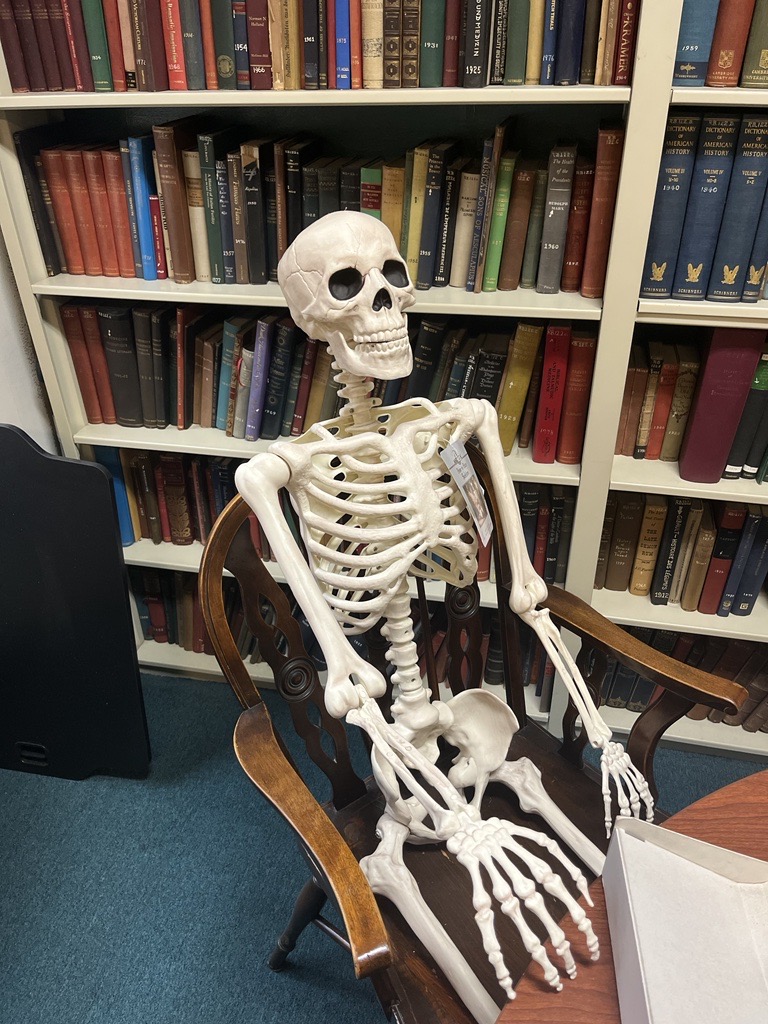
NYAM’s table was set up outside 103rd Street right across from Central Park. Our set-up highlighted the treasures from our collection with replicas of assorted pamphlets. This included a photo-op with our new skeletal employee. There were plenty of crayons on hand for visitors to engage in sheets from our Color Our Collections coloring books. Sidewalk chalk was on offer to decorate the closed city streets.  

The NYAM Team enjoyed talking with the passers-by. These encounters gave us ideas on how best to invite the community through our doors to engage with our organization. A reminder that throughout the year on the first Monday of every month at 12 pm (holidays excepted), we offer tours of our library highlighting a portion of the collection. While we understand it may not be possible for some to attend, we continue to look for other ways to highlight our rich holdings.  
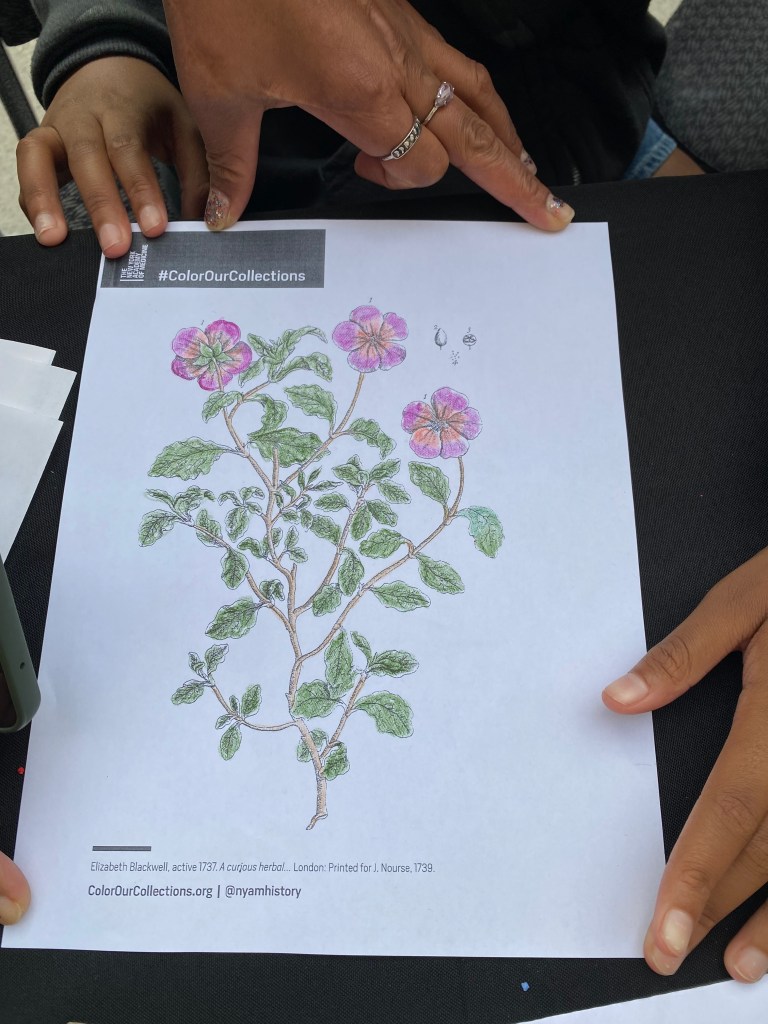
For some, the Museum Mile Festival is their unofficial kick-off to summer. Others wait for the official start on the day of the summer equinox. Students may celebrate on the last day of classes when their summer vacation starts. 

While not all of us get that traditional summer vacation, the season brings to mind the need for some real relaxation. Whether it be lying by the beach, going for a run in the park, or seeing your favorite baseball team play, we each have our own ideas of what it means to take it easy. It could be a tropical vacation that’s been on your calendar for months, or a day trip you take with friends out East to a winery. One doesn’t have to spend time lamenting a lost youth!  

Some like to relax by swimming. We’ve previously investigated tips and tricks to make your swimming more artful or, the proper scientific form. Others visit different places. Our blog has also shared what happens when the God of love needs some rest and relaxation. It goes to show that if they need it, we do too. 

Here at NYAM, we want to hear how you are spending this leisure time. Send us a postcard detailing what you’ve been up to in your downtime or  some photos or videos (no faces please!) at librarysocial@nyam.org or the New York Academy of Medicine, 1216 Fifth Avenue, New York, NY 10029 (Attn: Library). We’re excited to see what you are up to!  

Throughout the summer we hope to share with you what others have been doing. We need to recharge once in a while. Your relaxation tips might inspire others! You never know what may lie in your own backyard.  
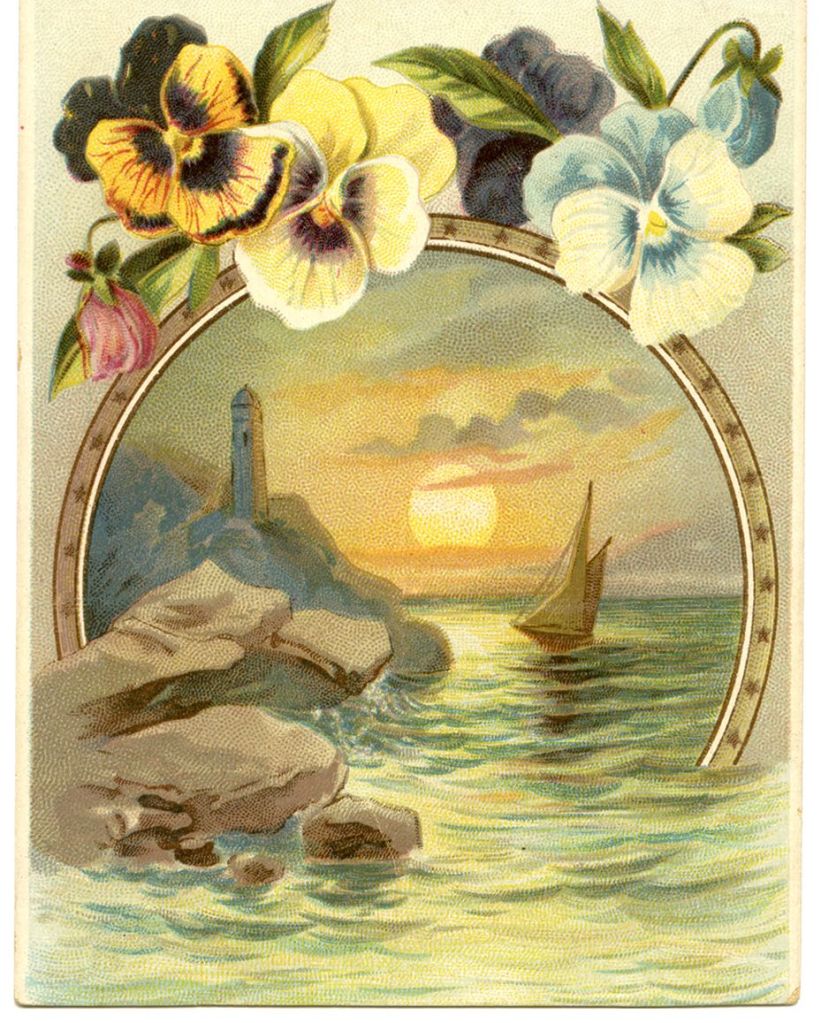
(Enjoyed the colorful, illustrated images? They come from our William H. Helfand Collection of Pharmaceutical Trade Cards collection which is available to view online!)

May 2023 NYAM Library Wrap-Up

By Anthony Murisco, Public Engagement Librarian

May brought us flowers and a lot to celebrate on social media!

Throughout the month of May we observed Mental Health Awareness Month. This included sharing information and graphics from the National Alliance on Mental Illness. On May 11, we observed National Children’s Mental Health Awareness Day. Kids often imitate adult behavior. Passing down healthy habits, including ones related to mental health, is imperative!

A colorful illustration of a group of kids. They are in front of a door. One boy is tying roller skates. A blonde haired girl is running to another boy who is riding a fake horse with a cowboy hat.

The popularity of Star Wars continues to this day. Just after the movie’s premiere in the late 1970’s, President Carter and the National Immunization Program asked the film’s two droids, R2-D2 and C-3PO, to star in a campaign promoting immunization. A television commercial and a poster were made for this, with the latter in our collection.

The Star Wars droids are asking parents of Earth to immunize their children in this printed PSA.

School nurses are some of the first healthcare workers that children meet. On May 10th we celebrated them. National School Nurses Day invites us to thank these caregivers. This photograph from Health Work in the Schools by Ernest Bryant Hoag and Lewis M. Terman shows a school nurse in action.

A black and white image. Caption reads "School nurse recording pulse and temperature in an open-air class."

Who better than to help us celebrate Mother’s Day and Women’s Health Week than the Roman goddess of women’s health, Juno. She made her appearance in 1950 at the Cleveland Health Museum, helping to explain how the female body worked.

A photograph of the transparent Juno statue from the side. Juno is a life-size woman.

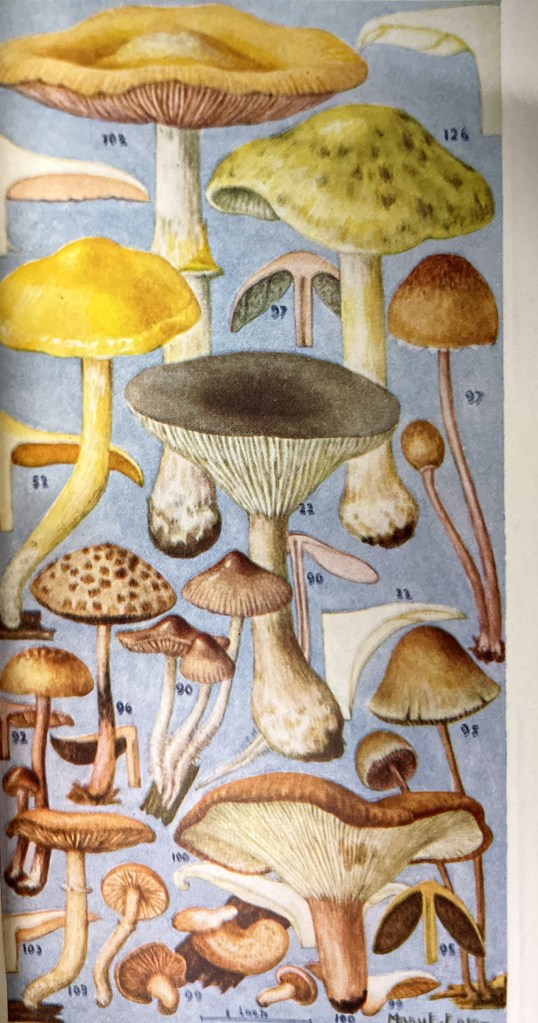
Do you like foraging for your food? Then you probably celebrated National Mushroom Hunting Day on May 17th. The Field Book of Common Gilled Mushrooms by William S. Thomas helps you identify which you can eat and which you cannot!

A colorful illustration of various mushrooms.

World Goth Day happened on May 22nd. The macabre is at the forefront of this often-misunderstood subculture. We showed off some of the many skeletons in our collection, including this from The Last Will and Testament of Basil Valentine by Basil Valentine.

A skeleton stands on a platform.

One of New York City’s prominent bridges, The Brooklyn Bridge, celebrated its 140th birthday on May 24th. It appears on a card from our William H. Helfand Pharmaceutical Trade Card collection promoting Lydia E. Pinkham’s Vegetable Compound.

The front side of the trading card. A drawing of the "East River Bridge" is front and center with ships sailing around it. Lydia E. Pinkham's Vegetable compound is a featured banner in the middle of the bridge.

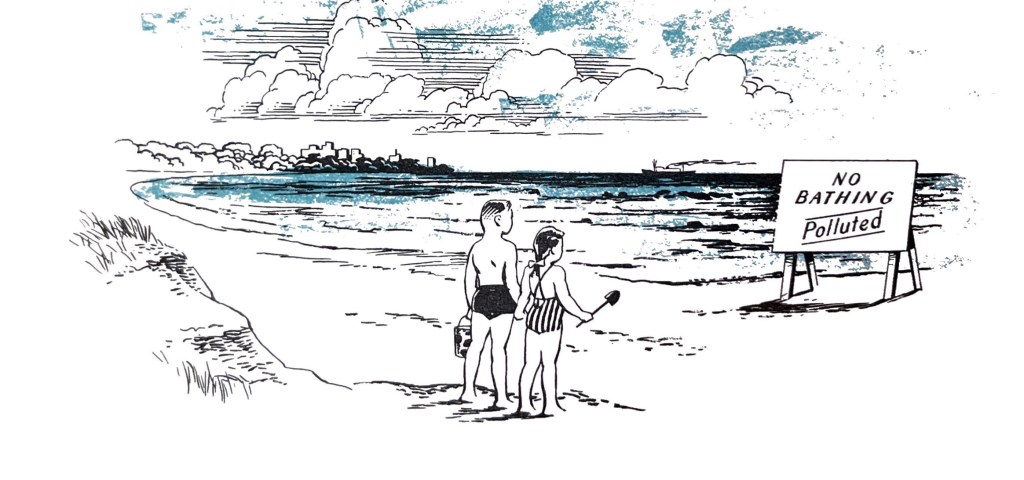
International Plastic Free Day on May 25th seeks to have at least one day without single-use plastics. The day usually falls around Memorial Day, a long weekend often spent enjoying picnics, the beach, or hiking, all occasions tempting us to be wasteful. To keep on enjoying, we need to squash the usage of these products.

An illustration of two beach-goers unable to go to the beach. A sign reads "No Bathing. Polluted."

Throughout the month, artists used the hashtag and prompt #MerMay as a creative inspiration signaling mermaids and mermen. Towards the end of the month, we shared another image from the Helfand Trade Card collection, this one featuring the aquatic folk using Ayer’s Hair Vigor to attract sailors.

Four mermaids are applying hair tonic. In the background a fifth mermaid is approaching a ship.

Finally, we are counting down the days until Museum Mile Festival 2023! On Tuesday, June 13th, cultural institutions along Museum Mile on 5th Avenue will be celebrating with extended hours, giveaways, and a look inside the collections. The NYAM Library will be set up at 103rd and 5th—come visit us!

The New York Academy of Medicine Library posts updates like this throughout the week. We can be found online over at Facebook, Instagram, and Twitter. Check back here or on our social media for more chances for a look inside our collection!

A skeleton sits in a chair. They are surrounded by old books.

Speaking For Themselves: Mental Health Memoirs

By Anthony Murisco, Public Engagement Librarian 

Since 1949, May has been recognized in the United States as Mental Health Awareness Month. The National Association for Mental Health, now Mental Health America, set up the month of educational events to clear up misconceptions about mental health and provide resources to those who need them.  

The knowledge of public health is always changing. What may have been taken as fact years ago is not necessarily the truth now. This is true for understanding mental health, or formerly, mental hygiene.  


From November 8th to 15th in 1912, the National Committee for Mental Hygiene and the Committee on Mental Hygiene of the New York State Charities Aid Association hosted a conference at the College of the City of New York. These two organizations brought together some of the leading minds on the subject. This was a relatively new idea. Modern understanding of psychiatry had begun less than a hundred years earlier.  

The goal of this conference was what the public could do regarding their own mental health. They came up with six tenets. 

While worded harshly in today’s terms, these suggestions try to offer a compassionate understanding of mental illness. The fourth, “Speak and think of insanity as a disease and not as a crime,” stands out as something we continue to struggle with today.  
 

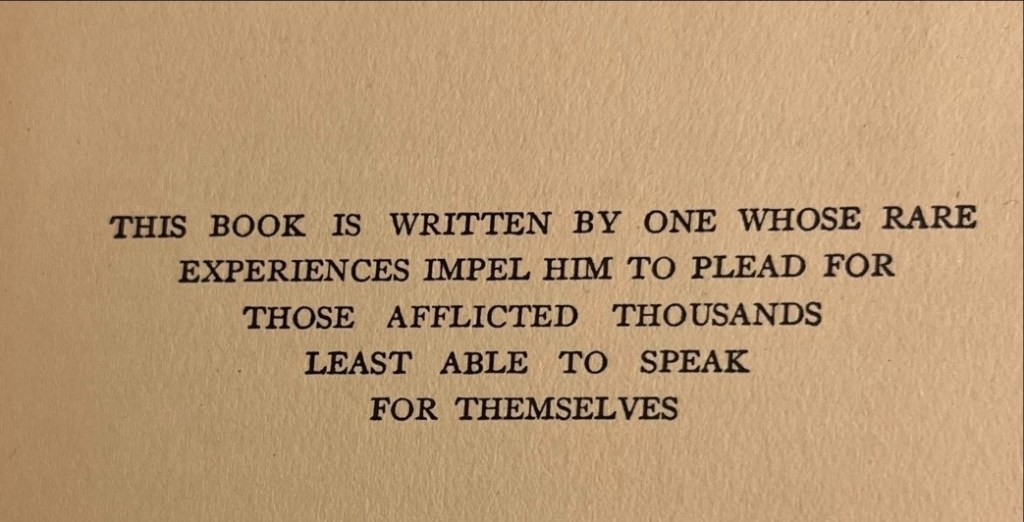
One of the forefathers of the mental health awareness movement would not be considered a traditional mental health expert. Clifford Whittingham Beers was born in 1896. Mental illness ran in his family. He himself served several stints in mental institutions. Upon the cruel treatment inflicted upon him at these hospitals, he went on to write a memoir on the subject. In A Mind That Found Itself, he writes of the degradation that he and his fellow patients were subject to. This memoir was key to providing a voice for those who were afraid to speak of their own illness. In 1909 Beers founded the organization now called Mental Health America.  
 

From the first edition of A Mind That Found Itself.

Since the publication of Beers’ book, several writers have explored their own experience. These mental health memoirs offer both guidance and companionship to those who also suffer. They provide maps for those who care about those who may be suffering and allows a peek inside minds that many cannot comprehend.  

Some of these authors bring humor to their reflections.  Two funny people wrote about their own struggles. Kevin Breel is a Canadian comedian. He also suffers from depression. His memoir, Boy Meets Depression, allows readers into the mind of someone who experienced the mental illness early on in life. Sara Benincasa is known for being a comical blogger. Her own memoir Agorafabulous! reveals her fight with depression as well as agoraphobia, the fear of leaving one’s house.  

Graphic memoirs allow us to see with the author’s vision. In dealing with mental health, we get to experience dark visions or the physical manifestation of anguish.  


The Hospital Suite by John Porcellino starts off with a hospitalization. After his illness, Porcellino’s health didn’t get better. His brief stint had taken a toll on his mental health. He writes about the experience of his recovery from an obsessive-compulsive episode. Porcellino is candid about his struggles and his fears of his bouts recurring. 


Ellen Forney was diagnosed with bipolar disorder before her thirteenth birthday. Afraid of stunting her creativity, she seeks treatment that will help her fulfill her potential. She begins to look at other artists who have suffered from mental illness. Finding all minds are different, she wonders what’s going to be best for her. Forney takes us on her personal highs and lows in Marbles. 


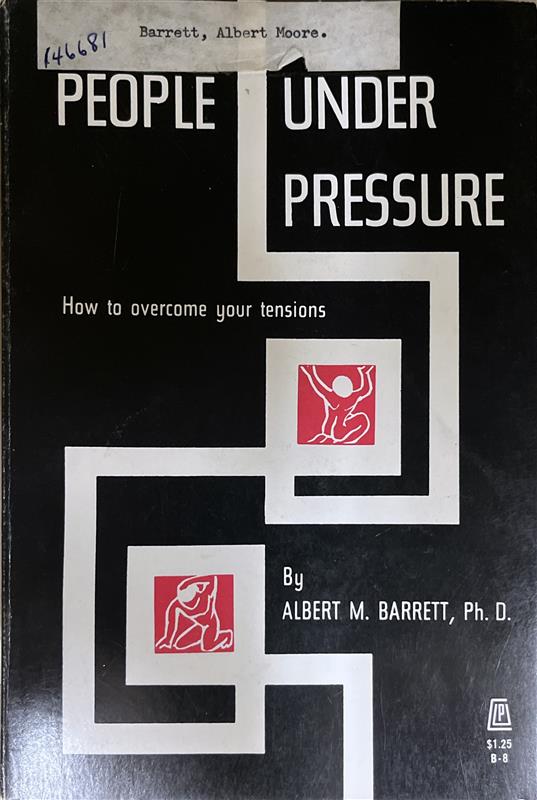
Towards the end of his work on the epidemic of mental fatigue and pressure, People Under Pressure, Albert M. Barrett, MD, offered a sympathetic take on mental health challenges. For fifteen years prior to his 1960 publication, he worked alongside counselors and therapists. Barrett urges us to consider a different point of view. He writes, “For no man is an island, and the relief we provide other human beings will reflect itself in our own peace of mind.” Compassion is vital towards greater public health. 
 
 
References: 

Barrett, Albert M. People under Pressure. College and University Press, 1960.  

Benincasa, Sara. Agorafabulous!: Dispatches from My Bedroom. William Morrow Paperbacks, 2013.  

Breel, Kevin. Boy Meets Depression: Or Life Sucks and Then You Die Live. Harmony Books, 2015.  

Clifford, Beers W. A Mind That Found Itself; an Autobiography. Longmans, Green, and Co., 1908.  

Forney, Ellen. Marbles: Mania, Depression, Michelangelo, & Me: A Graphic Memoir. Gotham Books, 2012.  

National Committee for Mental Hygiene, and State Charities Aid Association (N.Y.). Committee on Mental Hygiene. Proceedings of the Mental Hygiene Conference and Exhibit at the College of the City of New York…. Committee on Mental Hygiene of the State Charities Aid Association, 1912.  

Porcellino, John. The Hospital Suite. Drawn & Quarterly, 2014.  

April 2023 NYAM Library Wrap-Up

by Anthony Murisco, Public Engagement Librarian

It’s not an April Fools that we’ve been busy this month—busy on social media, that is!

April is National Poetry Month. In 1996, the Academy of American Poets started the celebration to honor the underdog genre of literature. Each Wednesday we went through Charles G. Farnum’s poetry in Medicine Could Be Verse: Humorous Poems Mainly About the Profession. Specifically, we looked at the poems that dealt with the feelings of being ill. With the warmer springtime weather in New York City this month, perhaps “Hay Fever” proved too topical.

The first week of April, we celebrated National Public Health Week. Defined by the American Public Association, public health is “the health of people and the communities where they live, learn, work, and play.” Each weekday brought about a new tip on how to keep yourself and your communities healthy.

Tip 1: Check in with your own physical health.
Tip 2: Focus on your mental health

From Health and Happy Days by Grace T. Hallock (1954).


Tip 3: Stay up to date with your immunizations.

Scan of the pamphlet Recommended Procedures for Immunization put out by the Illinois Department of Public Health.

Tip 4: Stay active!
Tip 5: Don’t forget to rest.

A view of lakeside living from The Lakeside Haven of Rest guide.

Leading up to Earth Day on 4/22, we celebrated our home planet with books focusing on Jurassic geology, the importance of turtles, and even a 16th century love-letter to the mountains. We shone a spotlight on one of the formative pieces of literature in the Earth Day movement, Silent Spring by Rachel Carson. She wrote about the toxic effects of pesticides on our whole planet. Deemed controversial for the time, her findings led to an environmental revolution.

A scan of the first chapter of Silent Spring with artwork by Louis and Lois Darling.

The last week of April coincided with National Library Week. We looked at a book advocating the freedom to read in prison, a classic image of our library and librarians from circa 1956,  and a 1911 map of the libraries of Manhattan.

A map showcasing all of the libraries in the borough of Manhattan, circa 1911.

If you’d like to engage more with our library collection, and see all the images in these series, follow us! The New York Academy of Medicine Library can be found online over at Facebook, Instagram, and Twitter.

We also offer tours on the first Monday of every month at 12pm, no appointment necessary! For this and further opportunities to visit, please check this blog and our social media.

FIT Visits the NYAM Library

By Dr. Evelyn Rynkiewicz, Assistant Professor of Ecology,. Department of Science and Mathematics at the Fashion Institute of Technology, State University of New York.

My name is Dr. Evelyn Rynkiewicz, I am a professor of ecology at the Fashion Institute of Technology. I teach a course there called “Disease Ecology in a Changing World,” and my background and research is in disease ecology of coinfecting parasites in mice. I wanted to present a course like this for FIT students because diseases are something that affect all of us, everyone has experience being sick, and because emerging infectious diseases are a growing global issue (even before the Covid-19 pandemic, which is of course still impacting us). The challenge in teaching science courses at FIT is that our students mainly have majors in the design and business fields, not in the sciences, so I try to make the course material relate to their backgrounds and experiences as much as possible, to make the content more relevant to them. I also want to increase science literacy in my students, making them comfortable reading, understanding, and talking about science in their personal and professional lives.

I learned about the New York Academy of Medicine Library after seeing the “Germ City” exhibit at the Museum of the City of New York. I got in contact with the Historical Collections Librarian, Arlene Shaner, who set up a visit to show me some of the materials she thought would relate to my course. I was blown away! I knew my students would love to see these historical documents. These materials highlight not only the art and history of how scientists and the public interacted with diseases through time, but also show how intertwined social, economic, and political issues are with how society’s experiences of disease.

Our class took a field trip to the NYAM Library and was shown an array of material; from Hooke’s book on microscopy, Edward Jenner’s work describing his development of the first vaccine, to posters and leaflets used from WWII to the present day to inform people about diseases such as malaria, HIV, or tuberculosis. I am always excited to see what students find interesting from this visit. Many enjoyed seeing the graphic design and illustrations used in the posters, such as those by Dr. Seuss and Keith Haring. Others picked up on how women and marginalized groups were often those who did a lot of the work caring for sick and infected people. Some just liked seeing the historical materials related to New York and being able to see how their home was impacted by diseases in the past.

One of the main assessments for the course is a creative research project where students choose a disease to study and then make a presentation with something creative related to that disease that would help someone learn more about it. I encourage the students to think about how they could use their skills learned from their major and apply it to this topic. The field trip to the NYAM Library provides the initial inspiration for this. I am always so proud and surprised at what they come up with!

Here are some of the things they created:

A drawn movie poster. The fake film is called Dengue Island. The artist, Arriana Tan is credited as the filmmaker. A drawing of a giant  brown mosquito hovers over a small community.

Arriana Tran, a Fashion Business Management major, created a movie poster. Inspired by the warnings her parents shared with her on the risk of becoming infected with Dengue in her parent’s home country of the Philippines.

A malaria testing and monitoring kit. The left of the image is the packaging mock-up. The right lists what would be included; an insect net, spray, educational material, and the tests. It also gives ordering instructions.

Packaging Design major Ethan Wolfsberg designed a malaria testing and monitoring kit that would be able to be used in remote areas that are heavily impacted by this disease. A real-life version would be made in languages appropriate for the area. 

An image of a globe surrounded by various people of different color, size, and shape. On the globe is says "PrEP."

To reduce the stigma of taking PreP, Francis Lavery, also a Fashion Business Management major, made an image that emphasizes that this treatment is appropriate for everyone.

A paper doll. The bald character is wearing a green shirt and blue pants.

Illustration major Leia Garrette wanted to visually show how infection with the agent of Lyme Disease impacts all parts of the body. She created a paper doll where each layer illustrated a different system (e.g. muscles, nervous system) accompanied by an explanation of how each is affected by the infection.

A flyer that reads "Spread Help, Not Disease!" it talks about a theoretical Zika virus support group.

This flyer was created by Sarah Sepulveda from Fashion Business Management. Her plan was for a support group for parents worried about or impacted by Zika virus. There was a focus on Brazil where the outbreak was especially significant in 2016.

Once again, a huge thanks to Arlene and the others at NYAM for their help and insight. I look forward to more collaboration!

Cooking Our Collection: Pi Day 2023

By Anthony Murisco, Public Engagement Librarian

My name is Anthony Murisco. I am the Public Engagement Librarian here at NYAM. A few weeks back, we celebrated Pi Day by baking a couple of pies. I wanted to share my own experience.

For those who may not know or need a refresher, Pi is a mathematical constant. The symbol π, the Greek letter for P, represents the ratio of the circumference of a circle to its diameter. The ratio will always be π. When written out, π is approximately 3.14. π is an irrational number, whose decimal form continues forever, which is why a shorter form is used. Hence March 14, 3/14, is known as Pi Day.

Pi Day is a celebration of all things mathematical as well as that certain baked good. Pi and pie not only share a name but are both circular. While the holiday may have earlier origins, the first recorded celebration was heralded by physicist Larry Shaw in 1988. When discussing the “mysteries of pi” with a colleague, he realized the irrational number has some rationality to it! In an effort to make learning math fun, he conducted the first Pi Day celebration with his class. The event, now celebrated by math enthusiasts all over, includes reciting the value of π to as many decimal places as one can, a real memorization challenge, and of course, pie tasting.

An illustrated image of chef's working in a kitchen in a hotel.
From The encyclopædia of practical cookery (1898) by Theodore Francis Garrett

What better way to celebrate than by baking a pie? This year, this was my task. The New York Academy of Medicine Library has a plethora of recipe books, some more than 200 years old. A selection of these books has been shared before, on social media, in this very blog, and even on our digital exhibition. Here was one of the first attempts of our staff making a dish!

After searching through several books and finding only savory recipes, our Historical Collections Reference Librarian, Arlene Shaner, discovered what I was looking for. In the 1824 edition of The Virginia house-wife lay a recipe for simply “Apple Pie.”

An advertisement payed for by The Apple Growers of America. A blonde woman is holding up an apple. The caption reads "For weight control... a tasty appetite-appeaser."

Mary Randolph first published The Virginia Housewife in 1824. Its popularity led to several editions and reprints. The Virginia housewife, or Methodical Cook was the first of its kind, a published manual of recipes and housekeeping tips that would later surge and create an industry. This was the perfect book to make a pie from.

Title page of the 1824 edition of The Virginia house-wife by Randolph.

The book featured three different recipes. Only one specified that it was a pie. Arlene predicted that the second recipe was for pie filling. She is an experienced baker. She went with that one. I had never baked a pie before. I didn’t want to do anything wrong. I stuck with Randolph’s “Apple Pie.”

I looked at the recipe to make a list of ingredients. Apples. Cloves. It called for “powdered sugar.” And rose water. I stopped by my local pop-up market and got four large red delicious apples. Each looked almost double the size of a single apple. Surely this would be enough! Powdered sugar and whole cloves were easy to get. It wasn’t on my list but, I opted for a pre-made crust. While I know that pre-made is not ideal, I had never made a crust before. I would have needed even further directions! If store-bought is fine for Ina Garten, it would be good enough for me. The rose water ended up being the most elusive ingredient in my neighborhood. After several failed shopping trips, I contemplated looking up replacements. I ended up finding rose water downtown at a hip chain grocery store.

Having never baked like this before, I tried to stick exactly to the recipe. The years of doing mail-in meal services will do that to you! Without the exact measurements, I was left a little confused—how would I know how much to use?

Three recipes from page 152. Apple Pie. Baked Apple Pudding. A Nice Boiled Pudding cuts off at the end.
Two of the pie recipes. Notice how the second is not specifically stated as a pie!

The Virginia House-wife and other older cookbooks are not specific with their instructions. There’s a notion that you have some culinary instinct if you are reading it. The recipes are a supplement to your knowledge. Randolph did not foresee someone like me, a beginner, taking on the challenge.

During the filling of the crust, I noticed, two apples in, that I should have gotten more apples. I’ve seen pies filled before with an arrangement of the fruit, a kind of beautiful Busby Berkeley dance. This was not my case. Still, I used what I had! While the apples didn’t fill the pie completely, it wasn’t as empty as I had feared.

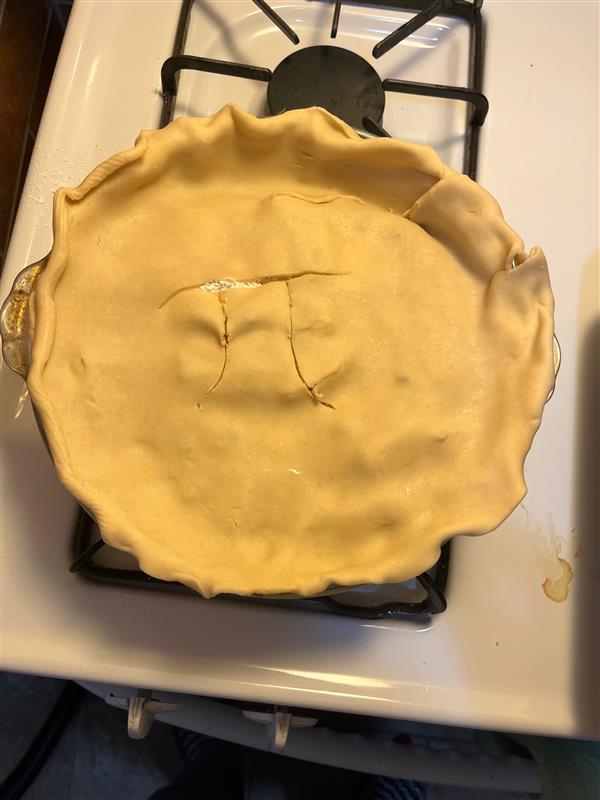
The pie completed before it was baked. On top is the pi symbol carved in.
Ready to be baked!

When I discussed my experience with Arlene, she told me that the powdered sugar I used was the wrong ingredient. Powdered sugar today is not the same as it was then. In the past, you would get a loaf of sugar, scrape off what you needed, and “powder” the cake that way. It was more akin to granulated sugar today. Modern-day powdered sugar, or confectioners’ sugar, quickly dissolves and tends to absorb the moisture. Though the pie tasted good, I had given it a different spin. I think that may have been Randolph’s goal. She doesn’t want to tell you exactly how to bake or cook, she just gives you some general directions.

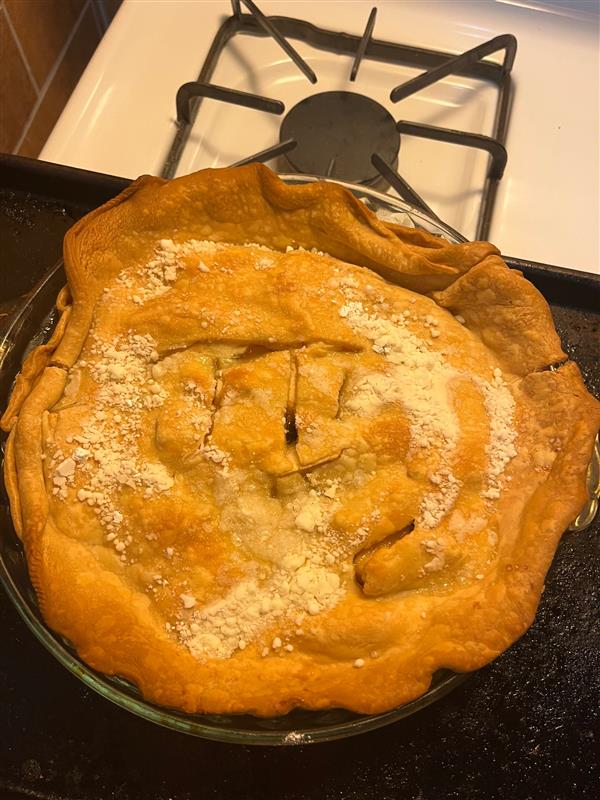
The finished product.

While it may not have looked the best, that didn’t matter. The pie I made was tasty. The powdered sugar dried up some of the apples. I also put too many cloves. This led to quite a spicy taste.

Since 2020, Dr. Rachel Snell, a historian, has been working her way through The Virginia house-wife. Using two editions, 1824 and 1838, she created “The Virginia Housewife Project” to explore the recipes while investigating ideas of domesticity and the history of each recipe. I wish I had seen her blog prior to making the pie, so I could have prepared a little more!

I hope to be able to share more of these recipes in the future. In the meantime, please check out our digital collection of cookbooks. Maybe something will inspire a course for your dinner tonight!

A piece of Arlene's baked apple pudding pie.
A piece of Arlene’s finished baked apple pie.


References:

Berton, Juston. “Any way you slice it, pi’s transcendental,” San Francisco Chronicle (11 March 2009) https://www.sfgate.com/science/article/Any-way-you-slice-it-pi-s-transcendental-3169091.php, accessed 27 March 2023.

Randolph, Mary. The Virginia house-wife. Washington : Davis and Force, 1824.

Snell, Rachel A. “The Virginia House-wife Project” https://virginiahousewifeproject.com/, accessed 27 March 2023.

Sayings As Mad As A March Hare

by the NYAM Library Team

Before the written word, we relied on our stories being passed down orally. These tales were meant to explain and justify the mysteries of the world around us. Fables, folksongs, and myths are examples of these. Our common superstitions act as bite-sized versions of this folklore.

While every month has its sayings , March is known specifically for two. “Beware the ides of March,” comes from a line in Shakespeare’s Julius Caesar. Rome’s dictator hears these words from a mysterious oracle on the day that he was assassinated. Through the years the saying has trickled down into our collective lexicon. It warns of caution towards the middle of March; the Ides fall on the 15th.

A bust of Julius Caesar from In Spite of Epilepsy.. (1913) by Matthew Woods.

The other common saying is “March comes in like a lion and out like a lamb.” It’s included in various compendiums of popular superstitions without any specific origin. It makes sense, though, that after the destruction of crops by killing frost, the fresh fertility of the land brings to mind an innocent animal. Lambs have long had religious symbolism for innocence and these animals were also a sign of luck. The first lamb of Spring meant good fortune, specifically if it faced you. If it was caught looking away, that was thought less lucky . After this yearly demise of crops, “luck” was needed. Previously March had been known as “boisterous” month in the Middle Ages, as well as the “windy” month in the revolutionary calendar of the first French republic.

A lion from volume two of George Shaw's General Zoology (c. 1800-1826).
From volume two of George Shaw’s General Zoology (c. 1800-1826)

Academic, teacher, and author Dr. Frank Clyde Brown started to accumulate folklore related to his state of North Carolina. On the advice of the American Folklore Society, he created the North Carolina Folklore Society in the early 1910s. He collected state-specific stories, songs, and tales from about 1910 to 1940. When he died in 1943, the collection became known as the Frank C. Brown Collection of North Carolina Folklore.

Brown’s collection was published almost twenty years after his death as Popular Beliefs and Superstitions from North Carolina. Upon its publication, the work is believed to have been the “first general work along comparative lines” of specifically American proverbs.
Included in this collection is a longer saying, “If March comes in like a lion, it will go out like a lamb. If March comes in like a lamb, it will go out like a lion.” For the most part, we don’t hear the second sentence anymore. Our predecessors believed in explanations for all of life’s occurrences and often arrived at the answer of balance: if a month began with a storm, surely it would end brightly and sunny! Perhaps for snappier flow, lines needed excision.

A lamb and two ewes from Sheep, Swine, and Poultry by Robert Jennings (1864).
From Sheep, Swine, and Poultry… by Robert Jennings (1864).

That’s not to say that these sayings are not around anymore! Nor does it negate their kernels of truth, some based on observed early science. We still circulate many of these whether it be in the water cooler at work or shared on social media. It is important to place these within context. We now know that they are not to be taken as facts but rather as what was once believed to be facts.

The cover of Popular Superstitions by Charles Platt (1925). It features a black cat in the middle of a horseshoe, in the middle of the number 13.
The cover of Popular Superstitions by Charles Platt (1925).

As the dreaded ides of March draw near, we offer up a few more of these sayings from the Brown Collection to celebrate the month:

-A thunderstorm in March indicates an early spring.
-A windy March and a rainy April make a beautiful May (Also, March winds and April showers bring forth May flowers).
-The first thunderstorm in March wakes up the alligators.
-Fog in March; Frost in May.
-The better the hunter you are, and the more you know about wild things, the surer you are that all rabbits turn to “he-ones” in March.
-If you plant seeds on St. Patrick’s Day, they will grow better.
-A dry March never begs bread.
-Frost never kills fruit in March, no matter how full the tree blooms.

And for those hoping for a fruitful March, I leave you with
-To make cabbage seed grow, sow them in your night clothes on March seventeenth.

Purple skunk cabbage from The Vegetable Materia Medica by William P.C. Barton (c.1817-1819).

References

Brewer, Ebenezer Cobham. Brewer’s Dictionary of Phrase and Fable. Rev. by Ivor H. Evans. New York: Harper & Row, c1970.

Hand, Wayland D. (ed.). The Frank C. Brown Collection of North Carolina Folklore Volume VI: Popular Beliefs and Superstitions from North Carolina. Durham: Duke University Press, 1964.

Hand, Wayland D. (ed.). The Frank C. Brown Collection of North Carolina Folklore Volume VII: Popular Beliefs and Superstitions from North Carolina. Durham: Duke University Press, 1964.

Hole, Christina (ed.). Encyclopaedia of Superstitions. London : Hutchinson, 1961.

Platt, Charles. Popular Superstitions. London : H. Jenkins, Ltd., 1925.

Valentine’s Day Cards from NYAM

by the NYAM Library Team

On February 14th we observe Valentine’s Day!

Our previous blog posts on this commercial holiday highlighted both cards created for Valentine’s Day as well as trading cards from our collection. At the close of the 19th century, improvements in printing allowed for cheaper goods and paper cards for friends, lovers, and families to send written sentiments.

These early cards varied from caricatures of their subjects and beautifully drawn miniscule script, to what we now think of as Valentine’s Day cards – humorous or sentimental acknowledgements.

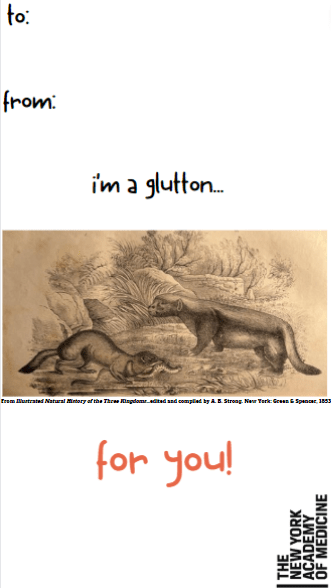
To celebrate this year, we have created six of our own Valentine’s Day cards featuring images from our collections. One is for the celebration of the popular Galentine’s Day, a celebration of friendship.

Feel free to print out and share with your loved ones!

From Sei sparsam!… by Anny Wothe (Leipzig, 1900.)
From Historiæ animalium... by Conrad Gessner (Zurich, 1551.)
From Illustrated Natural History of the Three Kingdoms…edited and compiled by A. B. Strong (New York, 1853.)
From De motu cordis et aneurysmatibus… by Giovanni Maria Lancisi (Neapoli, 1738.)
From Ryzon Baking Book compiled and edited by Marion Harris Neil (New York, 1917.)

Color Our Collections 2023

by the NYAM Library Team

Today we conclude our week-long celebration of Color Our Collections 2023.

Each February, fellow libraries, archives, museums, and other cultural institutions showcase their collections through these free, downloadable coloring books. About a hundred new books are gathered at ColorOurCollections.org for your continued enjoyment any time during the year. Previous years are also available, almost 800 coloring books in all! Please continue to use the hashtag #ColorOurCollections to show us your work.

This year, NYAM’s coloring book deals with Climate Change. The images showcase those animals, vegetation, and natural regions that are most vulnerable.

Below we’ve selected a few of the images that you’ll find in this year’s edition.

Typis Montis… from Mundus Subterraneus by Athanasius Kircher (Amsterdam, 1665.)
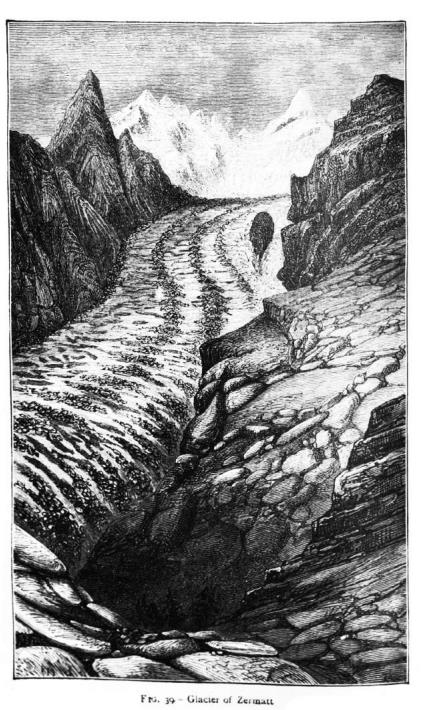
Glacier of Zermatt from Physiography by Thomas Henry Huxley (London, 1905.)
Polar Bears and Seals from The Polar World by Georg Hartwig (London, 1869).
Branched Coral from The Universe by Félix-Archimède Pouchet (London, 1902)
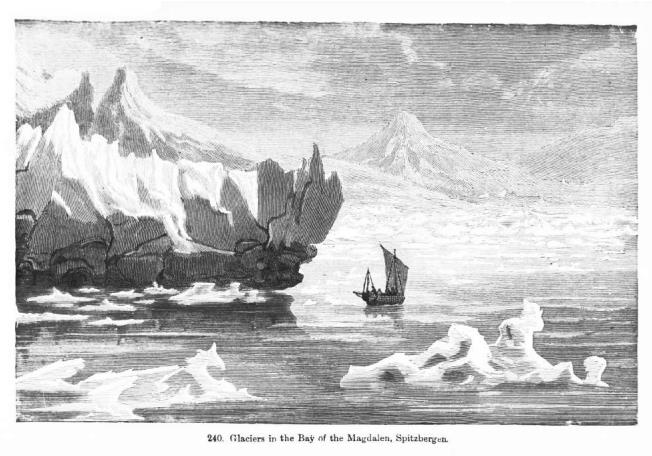
Glaciers in the Bay of the Magdalen, Spitzbergen from The Universe by Félix-Archimède Pouchet
(London, 1902).

For hundreds of more coloring books, don’t forget to check our previous Color Our Collections!

Down the Rabbit Hole with The Year of the Rabbit

by Anthony Murisco, Public Engagement Librarian

This past Sunday, January 22, brought in the celebration of Lunar New Year. It marked the beginning of the Year of the Rabbit.

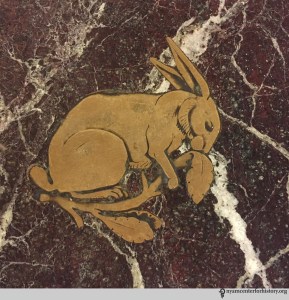
A bronze rabbit nibbling a leaf as shown on the NYAM floor.

The lobby of the New York Academy of Medicine features artwork of animals that have contributed to the advancement of the science of medicine, close to Aesclepius, the Greek god of healing. This brass image of a rabbit nibbling an herb is found in the floor, and the pair of rabbits is in the ceiling. Rabbits were said to be beloved by Venus, the Goddess of Love. Due to their aptitude for procreation and abundant litter, their presence was believed to be a remedy for sexual dysfunction. This may be the earliest usage of their symbolic fertile nature.

Two rabbits as shown on our ceiling.

Let’s look at the Year of the Rabbit in Asian cultures.

The traditional story tells of the Jade Emperor who wants to find a way to measure time. The animals line up and race for a spot in this measurement. Along the way, there is a bit of trickery and double-crossing that some of these animals engage in to ensure they end up at the finish line. For others, it was kismet that brought them to the end.

Taken from De quadrupedib.’ digitatis viviparis libri… (1637)

As the story goes, the rabbit came in fourth place thanks to their resourcefulness with a little bit of empathy from an overhead friend. The dragon had seen the rabbit struggling on a log in the middle of the water and decided to give a little wind to bring them ashore.

Although the story originated in China, variations of the tale are found throughout Asia featuring animals native to those regions. In Vietnam, for example, the cat takes the place of the rabbit. In different countries, different creatures represent this year.

The Year of the Rabbit is said to be more subdued than the previous one, the Year of the Tiger. In Chinese mythology, the rabbit was one of the smaller animals vying for a place with the Emperor. Only careful planning on their part let them make it to the end. So the year is one of caution and playing it close!

While the rabbit waited for the log to move, it was a gust of wind above from the Dragon that luckily brought them to the finish line. The Year of the Rabbit is also said to be one of luck.

Turning to the Western world, we also link rabbits and luck with the rabbit’s foot, which is lucky for us and unlucky for them!

Taken from Food In History by Reay Tannahill (1973)

A long-held tradition in Western culture is saying “Rabbit rabbit rabbit,” or some variation, on the first day of each month. Some say this must be done first thing in the morning, while others are a little lenient as long as it is said sometime during the day. Fortunes that it may provide include luck, good health, and accruement of wealth.

Maybe it is no coincidence that the year of the rabbit and the year of the cat are one. Rabbits were seen as familiars (or assistants) to witches as often as felines! Legends involving Witch Rabbits casting spells also provide ways to negate bad luck, by turning the pockets of a cursed clothing item inside out or kissing the sleeve of the accursed animal. Witches were also known to moonlight as rabbits to spy on townsfolk.

Taken from Animals with Human Faces by Beryl Rowland.

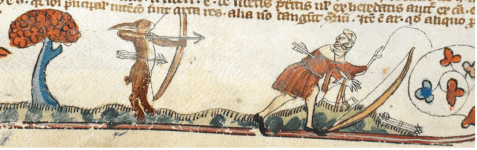
Due to the timid and small nature of the creature, rabbits were used to emasculate soldiers. Just as rabbits burrow away to escape, so too did cowards. Medieval art used the animal to showcase traitors and those who had fled battle. The art above showcases two of these rabbit/soldiers who are paying for their cowardice.

Timid animals taking revenge! From the Medieval manuscripts blog.

Other medieval artists, perhaps early humorists, took it upon themselves to subvert the rabbit trope and instead showcased the creatures as killing machines. Perhaps this is where Monty Python’s killer rabbits came from!

Taken from our digital collection of William H. Helfand Collection of Pharmaceutical Trade Cards.

The story of the rabbit’s quest to the zodiac as well as its place in various cultures showcase the multitude of tales that we never consider when looking at the creature. Or maybe we are just content, as this young girl is, with cuddling up to the furry animal.

May your Year of the Rabbit (rabbit rabbit) be fruitful!

References:

Brown, Mabel Webster. “Art and Architecture of the Academy of Medicine’s New Home” Medical Journal & Record. 1st December 1926, 729-734.

Jackson, Eleanor (16 June 2021). “Medieval killer rabbits: when bunnies strike back” Medieval manuscripts blog. https://blogs.bl.uk/digitisedmanuscripts/2021/06/killer-rabbits.html, accessed 23 January 2023.

Hand, Wayland D. (ed.). The Frank C. Brown Collection of North Carolina Folklore Volume VII: Popular Beliefs and Superstitions from North Carolina. Durham: Duke University Press, 1964.

Rowland, Beryl. Animals with Human Faces. Knoxville: The University of Tennessee Press, 1975.

Runeberg, Arne. Witches, Demons and Fertility Magic; Analysis of their Significance and Mutual Relations in West-European Folk Religion. Helsinki: Societas Scientiarum Fennica, 1947.

Tannahill, Reay. Food in History. New York : Stein and Day, 1973.