What Is Health Literacy?

By Johanna Goldberg, Information Services Librarian

In a 1940 pamphlet from our collection, “Give the Doctor a Break: The Low-Down on Group Practice and ‘Sickroom Charm’,” Floyd Burrows, M.D., advocates for the continued importance of the general practitioner, writing:

“There is an art in establishing prompt obedience to directions; in obtaining the wholehearted cooperation of a patient; in imparting and in getting adopted useful health information and instruction; in winning the confidence of frightened children; in understanding comprehensively the discouraging problems of the aged, while sympathetically ministering to them; in entering strange homes and quickly achieving a commanding confidence among those present in one’s ability to cope successfully with any emergency which has arisen.”

Dr. Burrows likely never heard the term “health literacy” during his lifetime. But in this excerpt, he lays down aspects of health literacy—clear explanations to patients to improve their compliance, imparting medical knowledge—as a significant part of a physician’s job.

October is Health Literacy Month. In 2000, the United States Department of Health and Human Services (HSS) defined health literacy as “the degree to which individuals have the capacity to obtain, process, and understand basic health information and services needed to make appropriate health decisions,” issues of note in 1940 that remain prominent today.

In 2010, the Office of Disease Prevention and Health Promotion of the HSS released the National Action Plan to Improve Health Literacy. Citing a George Washington University publication, it estimates the costs of health illiteracy at $106 to $236 billion dollars annually, representing an increase in hospital visits, a decrease in preventive care, and poor chronic disease management.

As the National Action Plan states, “The greatest opportunities for reducing health disparities are in empowering individuals and changing the health system to meet their needs.”

The New York Academy of Medicine Library plays a role in boosting health literacy, in part through the Junior Fellows program. Together, NYAM’s Library and Office of School Health Programs teach New York City middle and high school students to conduct secondary health research and develop independent projects on health topics. They learn how to find and evaluate health information and build a vocabulary necessary for understanding complex public health issues. The 2012-2013 class of Junior Fellows will start their research in early November. You can read about successes of last year’s Fellows here.

A 2011-2012 Junior Fellow shares her research.

For a more in-depth explanation of health literacy, visit this National Network of Libraries of Medicine webpage.
Mad Cows and Caricatures

By Lisa O’Sullivan, Director

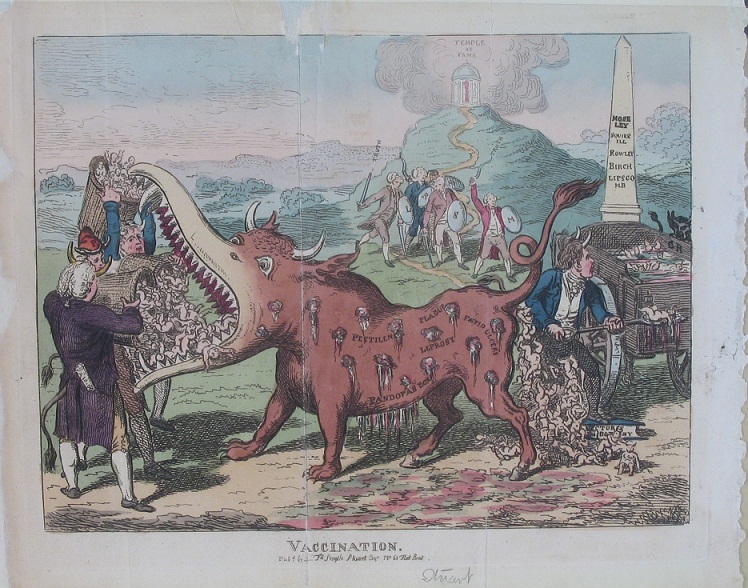
Image of monster being fed infants and excreting them with horns.

Charles Williams caricature c.1802.

This early anti-vaccination caricature shows a monster being fed baskets of infants and excreting them with horns. In the background, four prominent anti-vaccine campaigners, Benjamin Moseley, Robert Squirrell, William Woodville and William Rowley, approach with “swords of truth”. This unusual colored version of the print was originally bound as a frontispiece to the 3rd edition of William Rowley’s 1805 Cow-pox inoculation no security against small-pox infection: with above 500 proofs of failure. One of Rowley’s “above 500 proofs of failure” was the case of a boy whose face, Rowley claimed, was assuming the character of a cow.

Vaccination Williams detail

Horned baby

Next week we look forward to welcoming Mark Largent to explore more recent controversies about childhood vaccination as part of our history of medicine series. Register for this free October 17 event here.

NYC History of Medicine Events in October — Hildebrandt, Tresch, Largent, and Warner

By Lisa O’Sullivan, Director

This month sees an exciting line up of history of medicine (and science) events in NYC. In fact, almost a festival. Hope to see you at some or all…

On October 10, NYAM’s Malloch lecture series begins with an exploration of the practice of anatomy under the Third Reich, with Dr Sabine Hildebrandt discussing the impact and legacy of the 1933-1945 period. More details here.

At the NYPL’s Cullman Center, John Tresch discusses his new book “The Romantic Machine” on October 11. Tresch explores the connections between Romanticism and industrialization in Paris after Napoleon, drawing on examples from art, literature, opera, scientific discoveries, and technological advancements. Find details here.

On October 17, Mark Largent is appearing at NYAM to discuss his new book “Vaccine: The Modern American Debate”. In it he explores the history of the vaccine-autism debate and argues that it obscures a constellation of concerns held by many parents.  More details here.

And on Oct 18 the A.C. Long Health Sciences Library at Columbia will host Prof. John Harley Warner, who will speak on “The Image of Modern Medicine: Professional Identity, Aesthetic Belonging and the American Doctor, 1880-1950.” Prof. Warner focuses on the visual choices that American physicians made in representing their profession, their work, and themselves during 1880’s through the 1940’s. Details here.

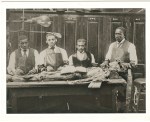
Click for larger size (possibly disturbing) images from Prof. Warner’s work with James Edmonson, Dissection.


University of Pennsylvania School of Medicine, Philadelphia, 1895. European-American dissecting teams (left) and African-American teams (right) were racially segregated after the medical student body at the University of Pennsylvania was integrated. DHMC

More upcoming events can be found on our Calendar. Please feel free to get in touch at please email history@nyam.org if you have an event you would like to see featured.

The Sex Side of Life

By Rebecca Pou, Project Archivist

September 30-October 6, 2012 is Banned Books Week, an annual event that celebrates the freedom to read and calls attention to books than have been banned or challenged. While Banned Books Week was first celebrated in 1982, printed matter was being censored long before that, as shown in a collection here at NYAM. In the Mary Ware Dennett Case Collection, one finds a controversy surrounding a small pamphlet and the resulting rally against its suppression.

This small collection centers on Mary Ware Dennett (1872-1947) and the case against her. She wrote a pamphlet titled The Sex Side of Life, which explained human reproduction to children.
Title from front cover of the "Sex Side of Life" pamphlet

First published as an article in the Medical Review of Reviews in 1918, it was later distributed as a pamphlet. The pamphlet was endorsed by doctors, churches and social organizations, but its forthright description of human sexuality was not wholly well-received. The pamphlet was deemed obscene by the Post Office in 1922 and in 1928, Dennett was tried by a federal grand jury and found guilty of distributing obscene materials through the mail. A Mary Ware Dennett Defense Committee was organized under the American Civil Liberties Union and the conviction was overturned in 1930.

Our collection was created by the well-regarded medical illustrator Dr. Robert Latou Dickinson, fellow of The New York Academy of Medicine, friend to Mary Ware Dennett and member of the defense committee. Dr. Dickinson was also responsible for the diagrams shown in the pamphlet. Materials include copies of The Sex Side of Life, correspondence, clippings, printed matter, typed and manuscript notes and the Appellant’s Brief from the U.S. vs. Mary Ware Dennett case. To learn more or visit the collection, please contact the staff of the Drs. Barry and Bobbi Coller Rare Book Reading Room by emailing history@nyam.org.

The Changing Face of Aging Across America

By Arlene Shaner, Acting Curator and Reference Librarian for Historical Collections

A photography exhibit by NYAM Fellow Jeffrey M. Levine, M.D., is on display through September 21, 2012 at the National Arts Club (15 Gramercy Park South). The exhibit, The Changing Face of Aging Across America, is the first stop in a year-long tour of these images, which will be shown in six teaching hospitals around the country.

3 women carrying a banner saying "Granny Peace Brigade"

Granny Peace Brigade in Times Square. Photo: Jeffrey M. Levine, M.D.

Dr. Levine is a gerontologist and wound care specialist with a longstanding interest in photography. He has studied at the Art Students League, the International Center for Photography and the School of Visual Arts. For the past two decades he has been documenting the experience of aging in America through photographs that celebrate the activities and communities of aging individuals, but also remind us of the many challenges faced by this population, our largest growing demographic.

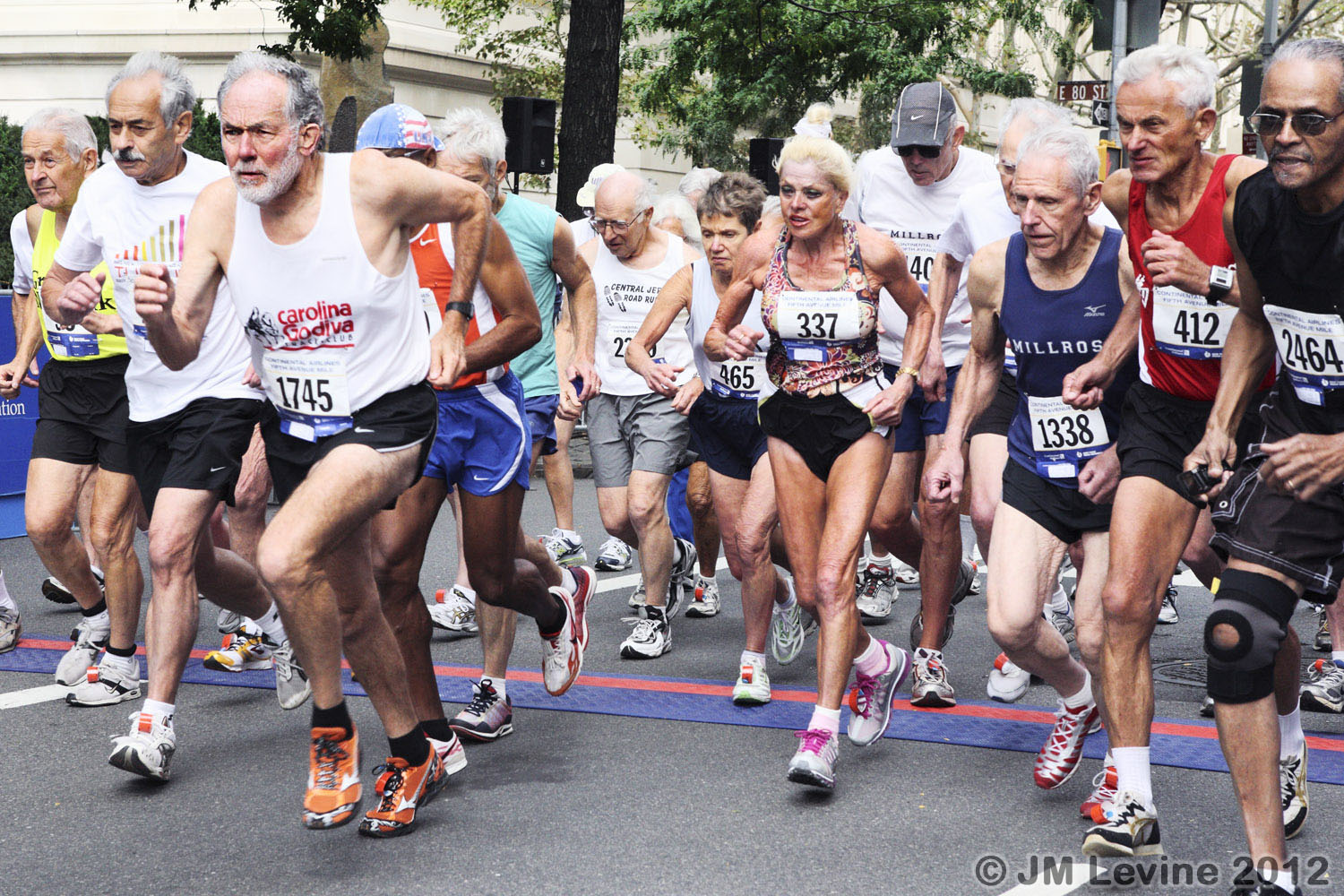
Group of runners running in the Over 70 Race

Runners in the Over 70 Race on Fifth Avenue. Photo: Jeffrey M. Levine, M.D.

An earlier exhibit of Dr. Levine’s photographs, Aging Through a Physician’s Lens, was displayed in the Presidents Gallery at NYAM in 2009.

On Teeth, Tools, and Boxes

By Anne Hillam, Conservator

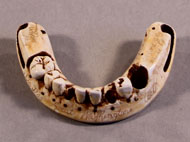
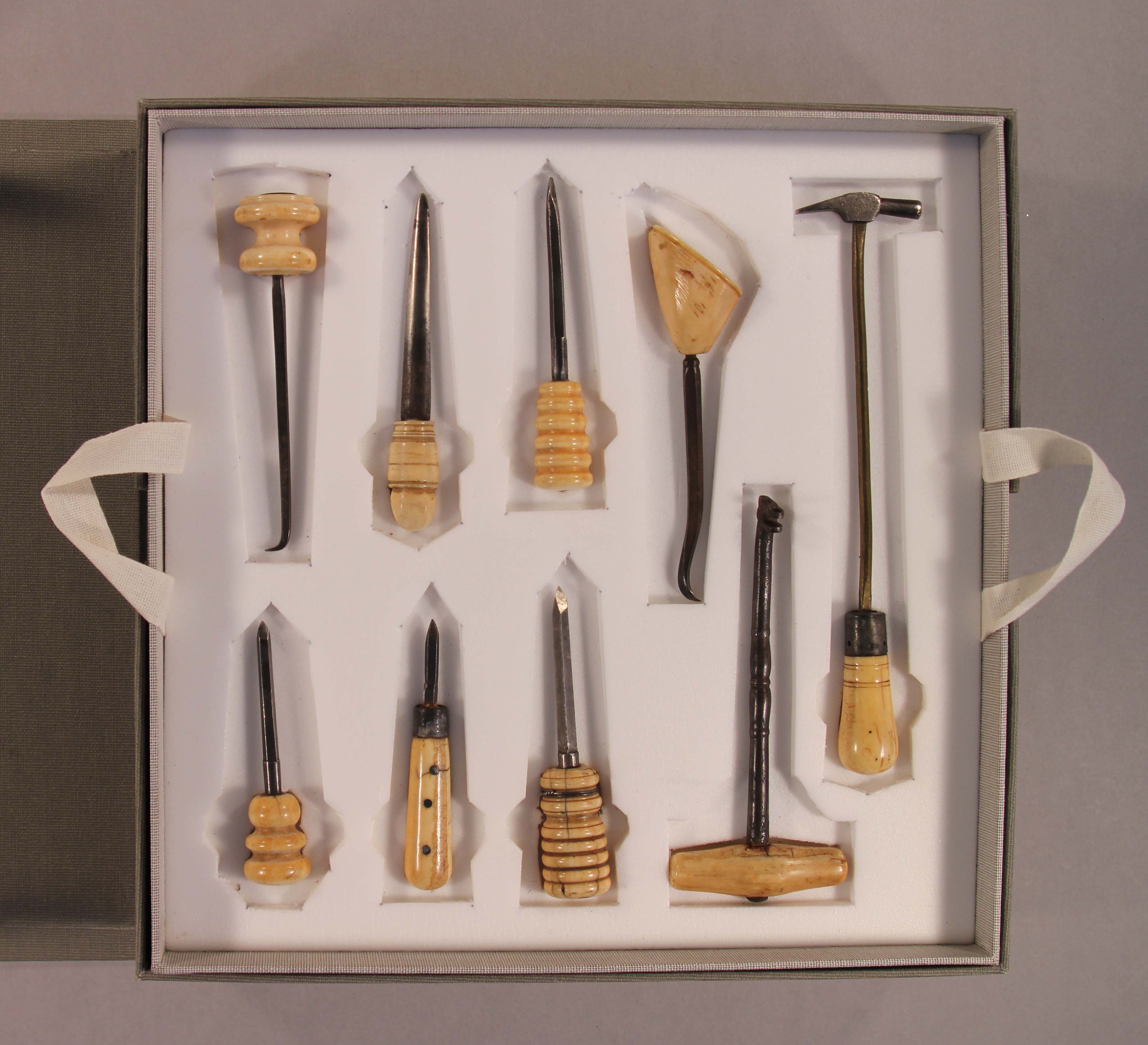
Following a recent upgrade of the heating, ventilation and air conditioning system in the special collections storage facilities at NYAM, the Gladys Brooks Book & Paper Conservation Laboratory received a group of artifacts associated with George Washington for stabilization:  (1) a plaster-cast facsimile of George Washington’s lower denture (the original, which is made of hippopotamus ivory, is currently on loan to Mount Vernon through June of 2013), and (2) a collection of dental tools (constructed out of hand-forged metal and bone and/or ivory) made and used by Washington’s dentist, Dr. John Greenwood (1760 – 1819).

plaster-cast facsimile of George Washington’s lower denture

Facsimile of Washington’s lower denture

9 ivory-handled dental instruments in custom fit tray

Greenwood’s ivory tools

++++++++++++++++++++++++++++++++++++++++++++++++++++++++++++++++++++++++++++++++++++++
Proper housing is an important element in the overall preservation of any artifact.  By protecting objects from improper handling and adverse environmental conditions (including light, water, dust, and pollutants), boxes and other types of protective enclosures — especially when made using pH neutral and chemically inert materials – can add decades to the life of an artifact.

In this case, the conservator’s custom-made boxes allow for easy access and display of the objects during tours and exhibitions.  Interior trays easily lift out of the structural exterior boxes, preventing the need to touch the objects themselves.

Facsimile denture in custom-made clamshell box

Custom-made box housing facsimile denture

If you take a close look at the denture, you will see engravings. They were made by Dr. Greenwood and read:  “This was Great Washingtons Teeth” and “First one made by J. Greenwood,” accompanied by the date 1789.  Several of the tools also carry an engraved message (albeit a slightly more ominous one):  ”[D]on’t touch these instruments.”  Thanks to their new box, it is now easy to honor Dr. Greenwood’s wish!

Close up of Washington's lower denture showing engraving saying "This was Great Washingtons teeth"

Original denture with engraving

The tools and the denture facsimile are all beautifully made and are now securely housed and preserved among NYAM’s special collections.  You can arrange for a tour to see the Drs. Barry and Bobbi Coller Rare Book Reading Room and some of NYAM’s many treasures by contacting history@nyam.org.

– The Gladys Brooks Book & Paper Conservation Laboratory

Fore-edge painting lecture and workshop

Fore-edge of book fanned to reveal fore-edge painting of William HarveyWe are thrilled about the upcoming Guild of Book Workers‘ events to be hosted at NYAM. Fore-edge painter Martin Frost is giving a lecture on October 19th and teaching a workshop on October 20th.

Seen at left, the NYAM copy of De Arthritide by John Booth, 1805, features a fore-edge painting of William Harvey.

For more information about either event or to register, please email newyork@guildofbookworkers.org.

Snakes in Medicine: Slippery Symbolism

By Lisa O’Sullivan, Director

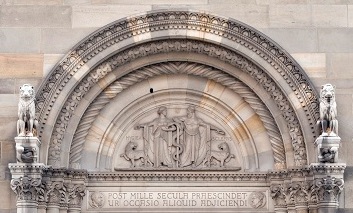
Image of Hygieia and Asclepius with staff and snake between them, accompanied by dogs, representing watchfulness.

Bas-relief of Hygeia and Asclepius overlooking our main entrance on 103rd St. Our 1926 building features numerous emblems and mythological figures associated with medicine. In this figure, father and daughter have the figure of the staff and snake between them, and are accompanied by dogs, representing watchfulness.

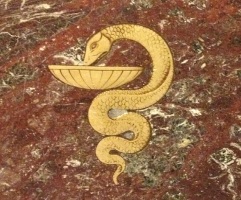
The snake in our blog header is a reference to Hygieia, the Greek goddess of health, cleanliness, and sanitation. Hygieia was often symbolized by a snake drinking from a bowl and was shown in sculptures and images with a serpent entwined around her. Her father was Asclepius, the god of medicine, generally depicted carrying a staff with a snake coiled around it. Snakes were introduced in Asclepian temples across the classical world, for use in healing rituals, and have remained associated with medicine in many ways since that time.

Brass snake inlaid on foyer floor

Our snake in-situ on our foyer floor, one of a series of inlaid figures with a connection to the practice of medicine over time.

As Walter J. Friedlander describes in his 1992 The Golden Wand of Medicine, the staff of Asclepius remained the primary symbol of medicine in the West until the 16th century, when examples of the caduceus began to be associated with medicine. The caduceus shows two snakes entwined around each other and a central staff, often with wings, and was associated with the god Hermes, especially as a symbol of commerce and trade. It was only in the late 19th century that the caduceus began to be widely accepted as a symbol of medicine. Friedlander suggests that this emerged in part from the use of the caduceus as a printer’s mark by medical publishers.

A wooden caduceus symbol shown in NYAM rare book reading room

A caduceus symbol in the NYAM rare book reading room

Most significant for the use of the caduceus as a medical symbol in the 20th century was the United States Army’s General Order Number 81, July 17, 1902. Included in its new regulations concerning army uniforms was the instruction that the new Medical Department insignia would be a gold or gilt caduceus. Subsequent arguments about the symbolism of the caduceus interpreted its elements in medical terms. For example, the rod represented power, the wings intelligence and activity, and the serpents wisdom and healing. Others argued that its use should be understood more in the traditional sense associated with Hermes, symbolizing a noncombatant messenger or envoy.

Despite initial objections to the appropriation of the symbol, the caduceus is now widely used as a symbol of medical practice, while Hygieia’s bowl continues to be particularly associated with the practice of pharmacy.

Why Grey Literature?

By Danielle Aloia, Special Projects Librarian

The Academy started producing the Grey Literature Report in 1999 to fill the gaps in peer-reviewed journal articles and published books in the public health research literature. In general, grey literature publications are non-conventional, fugitive, and sometimes ephemeral publications. They may include, but are not limited to the following types of materials: fact sheets, technical reports, white papers, statistical reports, market research, workshop summaries, and dissertations. Most grey literature is freely accessible through the World Wide Web. Produced by foundations, think-tanks, advocacy groups, government agencies, and academic institutions, it often offers timely, statistical analysis for state-of-the-art research.

In May 2012, NYAM launched the new Grey Literature database in order to make it easier for researchers and policymakers to find the information they need. It was no longer enough to index the most current grey literature, but also important to be able to find past reports related to a specific topic. In this way, users are able to see policies that were in place in 1999 and how they have changed over time.

Grey literature offers a unique perspective to the research community because government agencies and think tanks produce these reports on topics that effect policy and the people who implement that policy. Grey literature is also timely because it is not subject to a long or peer-reviewed publishing process. For instance, the morning the U.S. Supreme Court made the deciding vote on the Affordable Care Act (ACA) their report was available online at 10:15 am. This report lays out the reasons for the decision as well as the options states have for implementing the changes.

Reactions, commentaries, and reports about how the recent ACA decision affect their constituents can come from a variety of perspectives. These commentaries are not easily findable using traditional search methods. Searching Google can be daunting and cumbersome. A simple search for “Affordable Care Act Supreme Court” results in over 7 million hits most of which are news sources. The same search in the Grey Literature Database yields 12 results that have to do with the potential outcome of the ruling for states, people, and the country, mainly written by prominent think tank organizations.

Screenshot of search for "affordable care act supreme court" in the Grey Literature database

Search results from the Grey Literature Report include materials that are not available through normal, commercial distribution channels.

A time-saving feature of the database is the ability to bookmark a search or subscribe to it as an RSS feed. The results will dynamically update every time new items are added, which is every 2 months. You can bookmark the Grey Literature search above and re-execute it in September to see the most current results added automatically. An RSS feed will alert you as new items are added.

The new database allows users to comment on a specific item, like the Supreme Court report on the ACA decision, as well as share it through Facebook or Twitter. It is now easier than ever to spread the word about the latest grey literature.

Some search features include sorting options, publisher and subject limits, and date limits.

We hope you will take the opportunity to explore the database, use the new features, and share with your friends. You may also contact us at greylithelp@nyam.org to learn more, send comments, or make recommendations. We would be happy to answer your questions.