Earlier this year we were delighted to host artist and scholar Cindy Stelmackowich as our 2011-2012 Helfand Fellow. Cindy was kind enough to share her thoughts on the Fellowship, and how it fits into her research trajectory.
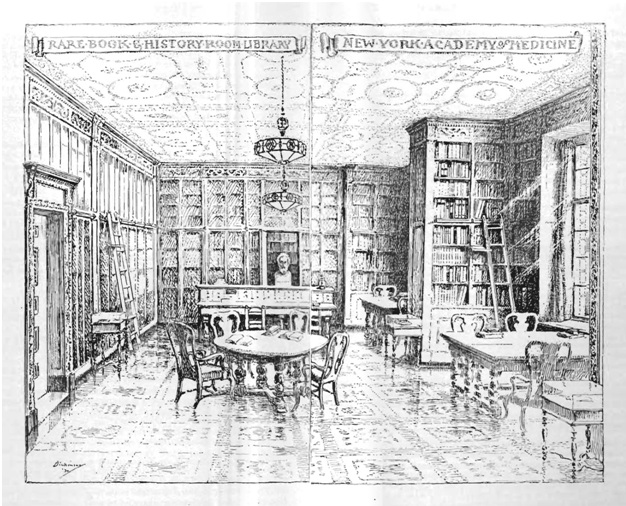
“Receiving the 2011-2012 Helfand Fellowship in the History of Medicine has wonderful meaning to me, on both personal and professional levels. In fact, the opportunity to conduct research in the Rare Book Room at the New York Academy of Medicine completes a circle for me; its rich holdings have been pivotal to my development as a scholar.

Antoine Toussaint de Chazal, Maladies du Poumon [Lung cancer, lung cysts], 1829-1935, lithograph, 15 x 7.5 inches, pl. ll. in Anatomie pathologique du corps humain by Jean Cruveilhier. (Paris 1829-1835).
Arriving to New York from Canada for the residency at the Rare Book Room in March and April 2012 was not the first time I had an extended stay in New York City. After I finished an M.A. in Art History in 1999 from Carleton University in Ottawa, I moved to New York and worked in a contemporary gallery in SoHo as a curatorial assistant. Visiting galleries and exhibitions was a daily activity for me. Featured at The New York Public Library at this time was an exhibition entitled
“Seeing is Believing” – a wonderful exhibition that focused on the ways illustrations were essential in spreading new scientific and medical ideas. I was hooked! I knew at that moment that not only did I now want to complete a Ph.D, but I needed to see and learn more about the illustrations and rare books I was exposed to in that exhibition. The exhibition labels noted that a number of the medical books were from the collection of the Rare Book Room at the New York Academy of Medicine. Off I went to find this treasure-trove of a library on Fifth Avenue. Needless to say, I continued to consult The Rare Book holdings at the New York Academy of Medicine while writing my dissertation on nineteenth-century anatomical atlases; no scholarly attention had previously been conducted to analyze this specific group of important medical publications and visual diagrams.
It was thereby very heartening to receive the 2011-2012 Helfand Fellowship at a time when I had finished my dissertation and am happily preparing a book manuscript on anatomical and pathological atlases. At the end of my residency in April 2012, I presented a public presentation on my research entitled Picturing Pathology: Morbid Anatomy Diagrams, Pathological Atlases and Disease 1800–1840. This paper examined how pathological ideas were embedded in new types of visual representations and newly re-ordered types of anatomical textbooks. It focused on the complex web of interconnections among disease, the body and visual representation; how aesthetic strategies, visual codes and rhetorical tropes attempted to represent key pathological concepts, discoveries and models of perception as visual diagrams became crucial to this young discipline of pathology.
The two images included in this posting represent the new types of visual imagery that emerged within medicine at the beginning of the nineteenth century in France and Britain as new systems of pathology were developing. Doctors used these innovative pathological illustrations to teach medical students how to identify signs of morbidity and disease. The desire for precise diagrams based on minute dissections of diseased tissues was of great interest to both surgeons and medical students; physicians began to either commission artists to execute detailed diagrams to add to their novel publications or spent years executing drawings of their findings. Renowned for his artistic skill as well as his anatomical knowledge, Sir Robert Carswell for example, executed the drawings in his 1838 folio-sized atlas entitled Pathological Anatomy: Illustrations of the Elementary Forms of Diseasehimself, and, as an expert lithographer, personally transferred the drawings to stone for the lithographs used in the atlas.

Robert Carswell, Neoplasms of the peritoneum, the stomach, the kidneys, the portal vein and the lung, 1832, lithograph, 13.8 x 9 inches, plate III., in Pathological Anatomy. Illustrations of the Elementary Forms of Disease by Robert Carswell. (London 1832-1838).
My scholarly interest in these early pathological manuals outline how the dead body was initially made into a working pathological object by the profession. Central to this work is a close analysis of the visual languages of this specific archive of pathological diagrams. In this regard, I am interested in how art – its grammar, forms, aesthetic strategies – articulated and represented pathological concepts, discoveries and models of perception in the young field of pathological anatomy. This study examines the aesthetic theories that informed the dissection diagrams’ languages of representation; such as the Western art historical models and academic techniques in the art schools where anatomical illustrators were trained. Furthermore, my project will examine the myriad of representational techniques that encoded these unique images so that the various types of morbid specimens appeared as systematic, encyclopedic collections of disease.
Thank you once again to Bill and Audrey Helfand for creating and endowing this Fellowship at the New York Academy of Medicine, and to the librarians and staff in the Rare Book (Arlene Shaner and Rebecca Pou) for making my residency fruitful and enriching.
In 2012-2013, Cindy will be a Postdoctoral Fellow with the “Situating Science Strategic Knowledge” Cluster group at University of King’s College and Dalhousie University in Halifax. Her most recent publication, “The Instructive Corpse: Dissection, Anatomical Specimens and Illustration in Early-Nineteenth Century Medical Education,” will appear in a special September 2012 issue of Spontaneous Generations: A Journal for the History and Philosophy of Science devoted to “Visual Representation and Science.” You can view some of Cindy’s artistic investigations here.


 An invitation from our good friends at the

 Books, Health and History