Tracing the Transmission of Early Modern Recipe Knowledge in the New York Academy of Medicine Library

By Sheryl Wombell, University of Cambridge, and the Library’s 2024 Audrey and William H. Helfand Fellow.

In seventeenth-century Europe, knowledge about health and healing was shared with family, friends, and acquaintances. In the case of printed books, wider audiences were reached. A significant subset of these communications took the form of recipes: sets of instructions telling one how to make something. These might be instructions for making medicines in the home, with a range of ingredients from the inexpensive and easily sourced, to the rare and exotic products available due to expanding trade. Or they could be instructions to make culinary formulations, which were interpreted as having an impact on the body’s condition due to the lasting influence of the ancient theory of the four humours. Individual recipes, which could be as short as a line or as long as tens of pages, were gifted, traded, and passed around early modern social networks.

A letter penned by the courtier and privateer Sir Kenelm Digby, likely to Sir Richard Grenville, 1st Baronet of Kilkhampton, demonstrates the mobility of recipes in the mid-seventeenth century.i In it, Digby thanks Grenville for sending him a recipe for ‘Sir Walter Rawleys great Cordiall’ but questions its provenance:

I beleive th[a]t it came from me, for it agreeth word for word with my Receipt that I had out of his owne originall book written with his owne hand; & whereof I made at one time as much as stood mee in above 500 [pounds] sterling; & stored the Court, Citty, & Country with it; But I add to it, the Magistery of Rubies, of Emeralds of granales of amethystes, of Saphyres, of each halfe an Ounce to the proportion that you sayth, also, magestery of Crabbs Eyes [3 oz], of Crabbs Clawes [2 oz]; of Contra yarva stone [1 oz], of snakweed of Virginia, of Contra yarva root, of each halfe an Ounce and of Tincture of gold made by spirite of Honey [1 oz]; and I finde this much more efficacious.

The circular path of recipes that Digby describes – when a recipe he believes to be his own is unwittingly returned to him – is testament to the lively early modern traffic in recipe dissemination and collection.
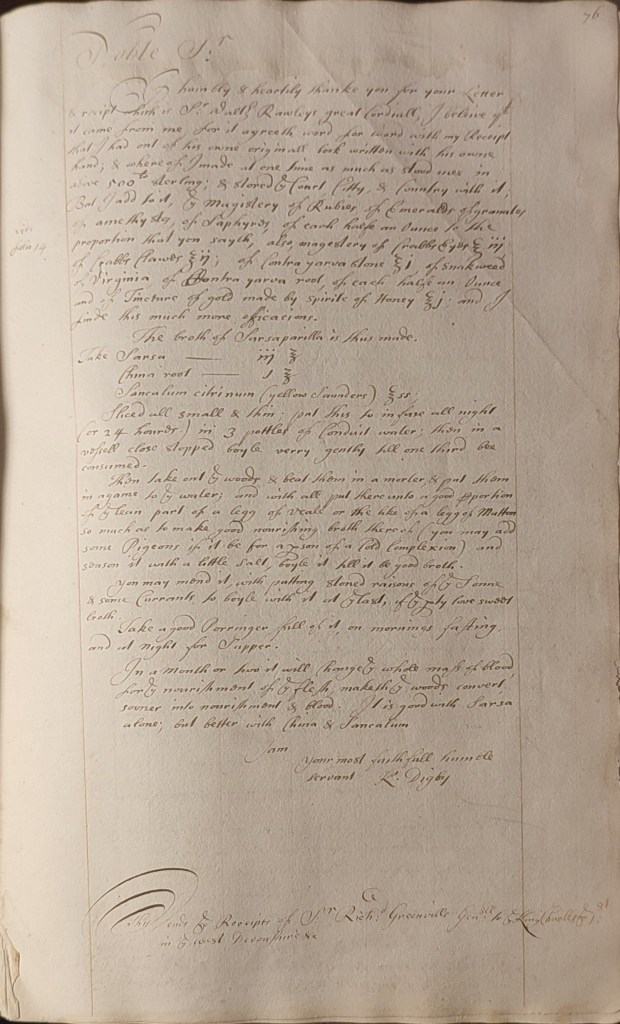
Fig. 1: Copy of a letter from K. Digby in MS ‘Old Doctor 1690’, f. 76, New York Academy of Medicine Library.

Manuscript collections of recipes survive in archives around the world, and the New York Academy of Medicine Library holds a rich cache of such volumes. Thanks to winning their Helfand Fellowship in 2024, I had the privilege of spending five weeks on a close reading of the early modern medical recipe collections at NYAM. This research forms part of my PhD project, which looks at the mid-seventeenth century production, management, and transmission of knowledge about health and healing amongst exiled and mobile elites, including Digby. While my work to date had focused on three key media – printed medical books, manuscript recipe collections, and consultation letters – somewhat in isolation from each other, at NYAM I had the time and resources to explore the relationships between these formats.

One such connection was the integration of transcribed letters into larger manuscript collections. Digby’s letter, for example, was copied into a large bound volume of recipes, letters, and transcriptions from printed books titled ‘Old Doctor 1690’. But in handling the manuscripts I was also confronted with material traces of transmission. In another manuscript, for example, is a recipe for ‘Costiveness to help’, that is, how to relieve constipation. Next to the instructions are two small, shiny blobs of dried red sealing wax. While this is not conclusive evidence that the recipes on the page were copied into a letter, it does indicate that the notebook lay open while a letter was sealed – and likely written – in its vicinity. Through this tiny physical sign, we learn something of the co-presence of writing and collecting practices across the distinct but interrelated media of letters and recipe books.

The objects of transmission themselves also appear in these recipe collections. A notebook belonging to Owen Salesbury holds a loose paper slip with instructions ‘To Make Elder Claret’ and sent ‘To Mrs Longford att her hous in Wrexham’. Folded slips could be enclosed in a larger letter, or they could constitute the entire missive. The inclusion of the address on this example suggests the latter. The contents of the slip were not transcribed into the body of the notebook but containing it within the bound volume preserved its knowledge. We don’t know precisely how or when a slip sent – or intended to be sent – to a Mrs Longford ended up in Salesbury’s manuscript, but it offers further evidence of the close connections between ephemeral letter formats and the more durable objects of recipe collections.
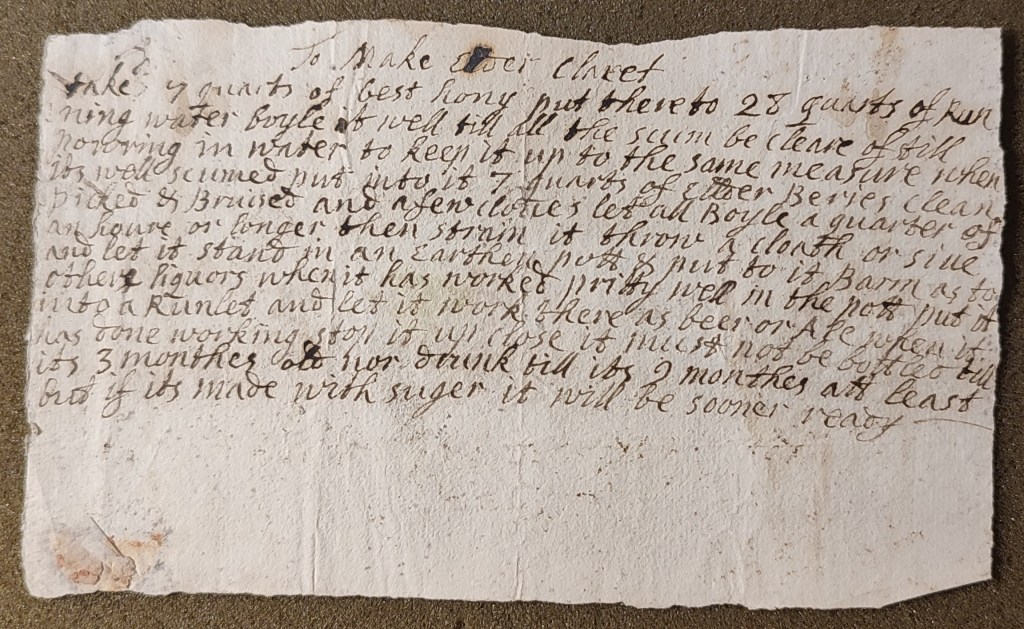
Spending time in the NYAM Library’s collections allowed me to get to grips with evidence of early modern recipe transmission. While digitised surrogates of manuscripts have been invaluable in my research, handling these collections has enriched my analysis by bringing their material qualities – size, varying durability, the spatial relationships between their contents, and signs of use – to the fore.

Further Reading:

Ken Albala, Food in Early Modern Europe (London: Bloomsbury Academic, 2003).

James Daybell, The Material Letter in Early Modern England: Manuscript Letters and the Culture and Practice of Letter-Writing, 1512–1635 (Basingstoke: Palgrave Macmillan, 2012).

Elaine Leong, Recipes and Everyday Knowledge: Medicine, Science, and the Household in Early Modern England (Chicago and London: University of Chicago Press, 2018).

Alisha Rankin, ‘Recipes in Early Modern Europe,’ Encyclopedia of the History of Science (2023), https://doi.org/10.34758/fvw2-w336.

Apply for Our 2020 Fellowships

We’re pleased to announce that our two annual fellowships are open to applications!

nyam_rbr_106

The Drs. Barry and Bobbi Coller Rare Book Reading Room, where our fellowship recipients will conduct their research.

The Academy Library offers two annual research fellowships, the Paul Klemperer Fellowship in the History of Medicine and the Audrey and William H. Helfand Fellowship in the History of Medicine and Public Health, to support the advancement of scholarly research in the history of medicine and public health. Fellowship recipients spend a month in residence conducting research using the library’s collections.

Applications for our fellowships are being accepted now through late August for fellowships that may be used at any time during 2020.

Preference in the application process will be given to those whose research will take advantage of resources that are uniquely available at the Academy, individuals in the early stages of their careers, and, for the Helfand Fellowship, applications which include an emphasis on the use of visual materials held within the Academy’s collections and elsewhere. Applicants should provide information in their proposals about the collection items they plan to use, either by including a bibliography of resources they intend to consult or discussing those items in detail in the context of the application essay. Changes in the Library that are scheduled to take place beginning in the second half of 2019 will impact applicants whose projects rely heavily on 19th and 20th century serial literature or on monographs published during the second half of the 20th century. 

Applications are due by the end of the day on Friday, August 23, 2019. Letters of recommendation are due by the end of the day on Monday, August 26, 2019. Applicants will be notified of whether or not they have received a fellowship by Monday, October 4, 2019.

Prospective applicants are encouraged to contact Arlene Shaner, Historical Collections Librarian, at 212-822-7313 or history@nyam.org with questions or for assistance identifying useful materials in the library collections.

Click on their names to read blog posts about their projects from our most recent fellowship recipients, Matthew Davidson (Klemperer) and Tina Peabody (Helfand).

We look forward to hearing all about your projects!

Apply for our 2017 Research Fellowships

Does a one-month residence in The Drs. Barry and Bobbi Coller Rare Book Reading Room, immersed in resources on the history of medicine and public health, sound like a dream come true?

Rare book room

The Drs. Barry and Bobbi Coller Rare Book Reading Room

The Academy Library offers two annual research fellowships, the Paul Klemperer Fellowship in the History of Medicine and the Audrey and William H. Helfand Fellowship in the History of Medicine and Public Health, to support the advancement of scholarly research in the history of medicine and public health. Fellowship recipients spend a month in residence conducting research using the library’s collections.

Applications for our fellowships are being accepted now through late August for fellowships that may be used at any time during 2017.

Preference in the application process is given to early career scholars, although the fellowships are open to anyone who wishes to apply, regardless of academic status, discipline, or citizenship. While both fellowships are for researchers engaged in history of medicine projects, the Helfand Fellowship emphasizes the role of visual materials in understanding that history.

Applications are due by the end of the day on Friday, August 26, 2016. Letters of recommendation are due by the end of the day on Monday, August 29, 2016. Applicants will be notified of whether or not they have received a fellowship by Monday, October 3, 2016.

Prospective applicants are encouraged to contact Arlene Shaner, Historical Collections Librarian, at 212-822-7313 or history@nyam.org with questions or for assistance identifying useful materials in the library collections.

Apply for our 2016 Research Fellowships

Are you working on a history of medicine project that would be enhanced by spending a month mining our collections?

NYAM Library, Rare Book Room photos by Amy Hart © 2012We are now accepting applications for the Paul Klemperer Fellowship in the History of Medicine and the Audrey and William H. Helfand Fellowship in the History of Medicine and Public Health. Each fellow receives a stipend of $5,000 to support travel, lodging, and incidental expenses for a flexible period between January 1, 2016 and December 31, 2016. Fellows are expected to spend at least four weeks in New York City, working at The New York Academy of Medicine. Besides completing a research project, each fellow will be expected to make a public presentation at the Academy and submit a final report.

Both fellowships are designed to support researchers who can demonstrate how an opportunity to immerse themselves in our rich holdings will enhance their work. Preference in the application process is given to early career scholars, although the fellowships are open to anyone who wishes to apply, regardless of academic status, discipline, or citizenship. While both fellowships are for researchers engaged in history of medicine projects, the Helfand Fellowship emphasizes the role of visual materials in understanding that history.

The application deadline is Monday, August 17, 2015. Letters of recommendation must be received by Friday, August 21, 2015. Fellowship recipients will be notified by Thursday, October 1, 2015.

Perspective applicants are encouraged to contact Arlene Shaner, Reference Librarian for Historical Collections, at 212-822-7313 or history@nyam.org with questions or for  assistance identifying useful materials in the library collections.