Preservation Week Quiz

By Christina Amato, Book Conservator

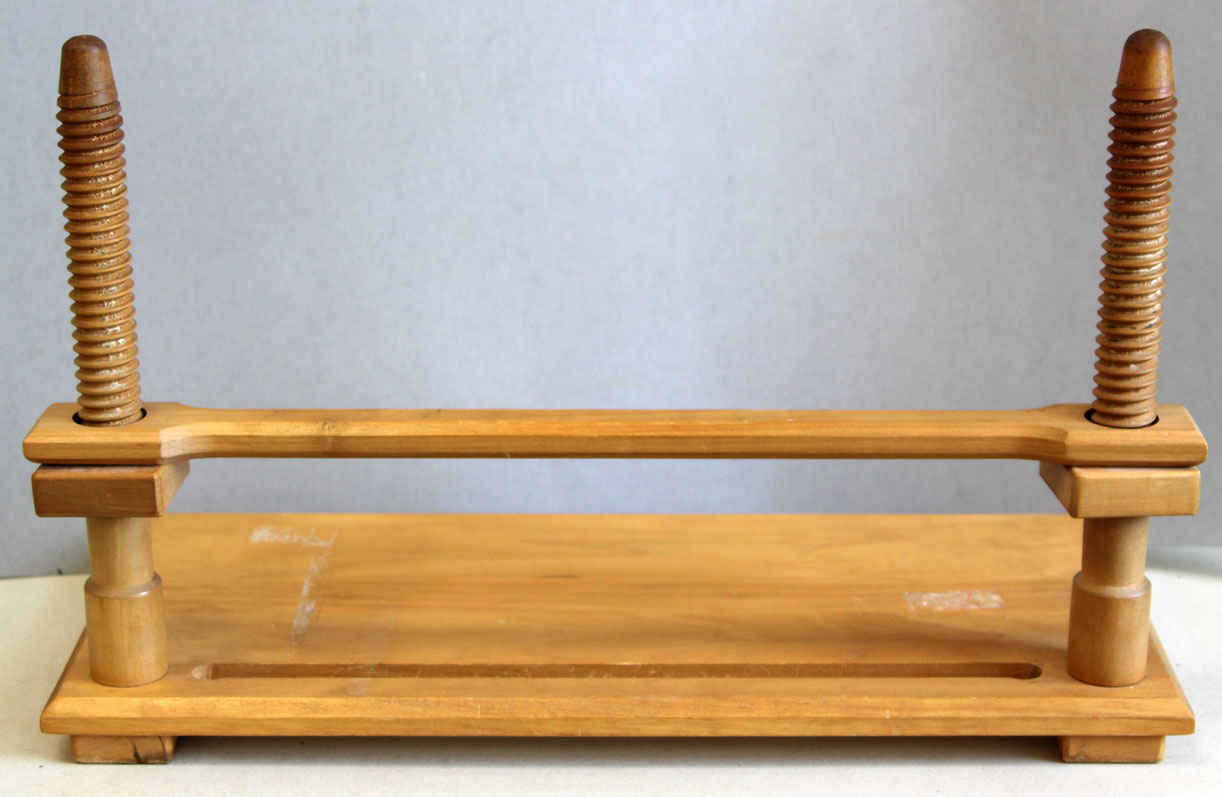
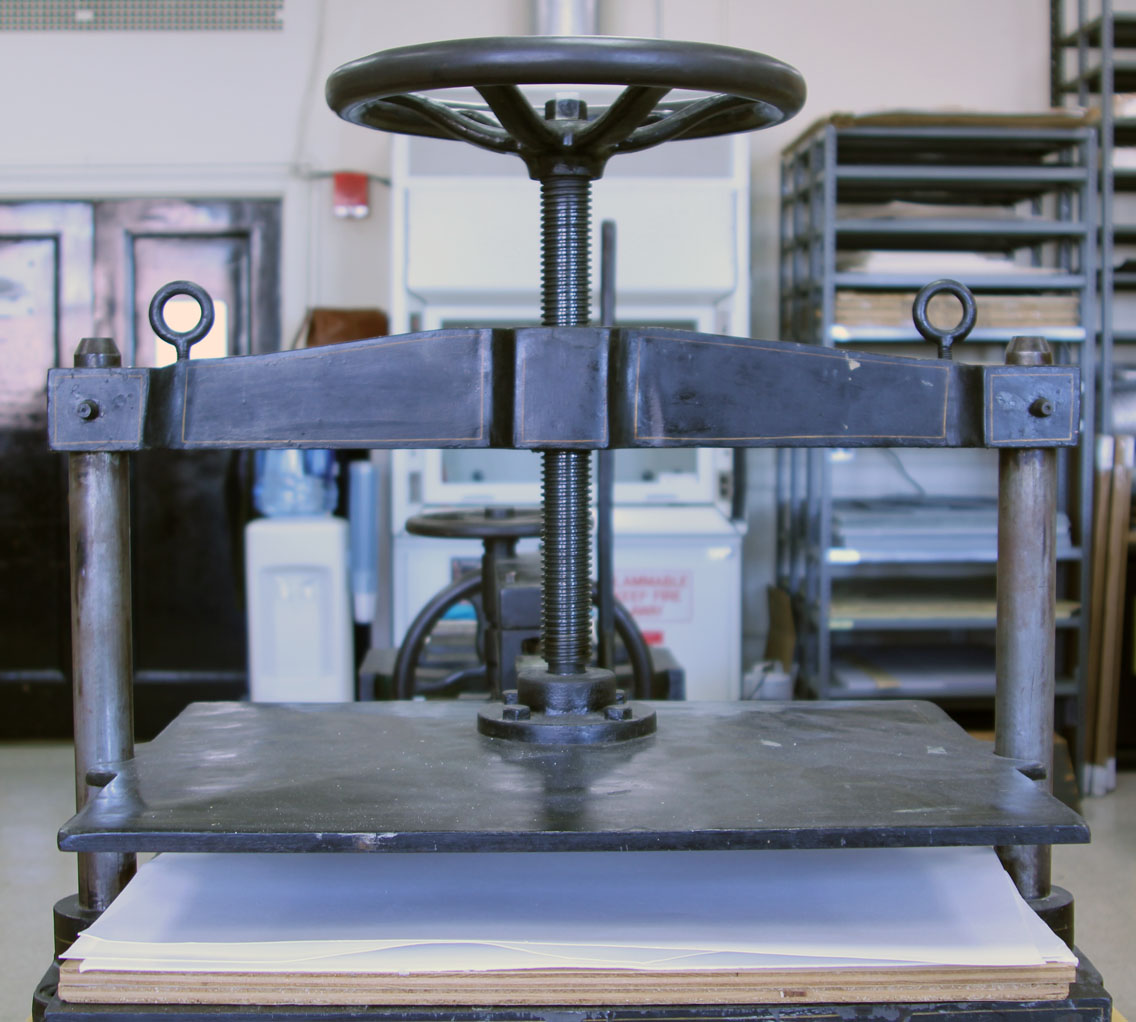
In recognition of Preservation Week, NYAM conservators have prepared a quiz. The following mystery objects are used in the NYAM Gladys Brooks Book and Paper Conservation Lab. Prove your preservation moxie by choosing which description best matches each item.

Image 1:
Image 1a.  Pest remediation instrument. The small nozzle can reach into the gutters of books, and capture crawling insects and larva via suction. They are whisked into the clear chamber, where they will peacefully expire in the oxygen deprived environment.

b.   Nebulizer. The clear chamber is used to heat water, and the resulting steam can be directed very precisely with the small nozzle onto areas that require humidification (such as crumpled paper or vellum.) The chamber can also be filled with a dilute adhesive, which can be used to consolidate flaking media.

c.   Airbrush. The clear chamber is filled with dilute paint, usually watercolor or acrylic, and is used to tone cloth or Japanese paper for repairing books. It is also frequently used with leather dye to tone calf or goatskin.

Image 2:
Image 2

a.   Sewing frame. Books are occasionally completely disbound and resewn in the lab.  Cord, or linen “tape”, is pulled taut from the horizontal  bar to the base, and books are sewn onto the cords.

b.   Parchment stretching frame. Crumpled parchment is humidified, and attached to the frame using specialized clips. The horizontal bar is slowly raised until the parchment is taut, where it is left to dry.

c.   Traction device. Long hours spent stooped over a bench can lead to a host of orthopedic insults. Conservators are wise to take a few minutes every day to “stretch out on the rack.”

Image 3:
Image 3

a.   Pamphlet binder. Pamphlets are passed between the jaws of this device, which affixes the pages together with stainless steel tackets.  The jaws can be adjusted to accommodate pamphlets of varying thicknesses.

b.   Tape dispenser. Specialized mending tape is applied to torn pages when fed through the jaws. Can also be used with duct tape.

c.   Leather paring device.  A two-sided razor blade is attached to the top jaw; pieces of leather are passed through the jaws, until the desired thickness is reached.  It is often necessary to thin out leather quite a bit before using it to repair a book.

Image 4:
Image 4

a.   Pest Remediation Dome. Books that have been infected with insects can be placed inside the dome. Oxygen is gradually pumped out of the dome, gently suffocating any insects within.

b.   Incubator. Conservators in the Gladys Brooks Book and Paper Conservation lab are world renowned for their hand processed silk thread, which is used in a variety of conservation applications. Silk worms are lovingly and painstakingly raised in the dome from larva, until they are ready to be harvested.

c.   Humidity dome and suction table. Paper or vellum that requires humidification, for flattening, for example, can be placed inside the dome, where the humidity is gradually increased until the desired level is reached. Beneath the dome is a suction table; it can be used to force solvents through a piece of paper, for stain reduction and other applications. 

Image 5:
Image 5

a.   We don’t actually know. We saw it at Restoration Hardware, and thought it looked cool.

b.   Book Press. This is used to apply pressure to books, after treatment, to prevent warping during drying. It can also be used to flatten single sheets of paper.

c.   Book truck. Books are held in place underneath the platen; the truck can then be safely driven around the lab. The large wheel at the top is used for steering. 

Answers:

1. b         2.  a        3. c         4. c         5. b

Scoring:

5 out of 5: Preservation Superstar! Congratulations! You are tapped into the pulse of preservation!

4 out of 5: Preservation B Lister: Not bad! You have a generally solid understanding of preservation!

3 out of 5: Preservation Dilettante: You know a little about preservation, but could stand to step it up.

2 out of 5: Preservation Novice: It sounds like preservation isn’t your strongest suit but there’s hope yet.

1 out of 5: Preservation Rookie: Things are not looking so good for you, preservation-wise.

0 out of 5: Preservation Lightweight: At least there’s nowhere to go but up.

Syphilis, or the French Disease

By Rebecca Pou, Project Archivist

To celebrate National Poetry Month, we are sharing a poem from our collection each week during April.

Portrait of Fracastorius from Homocentrica, Venice: 1538.

Portrait of Fracastorius from Homocentrica. Venice, 1538.*

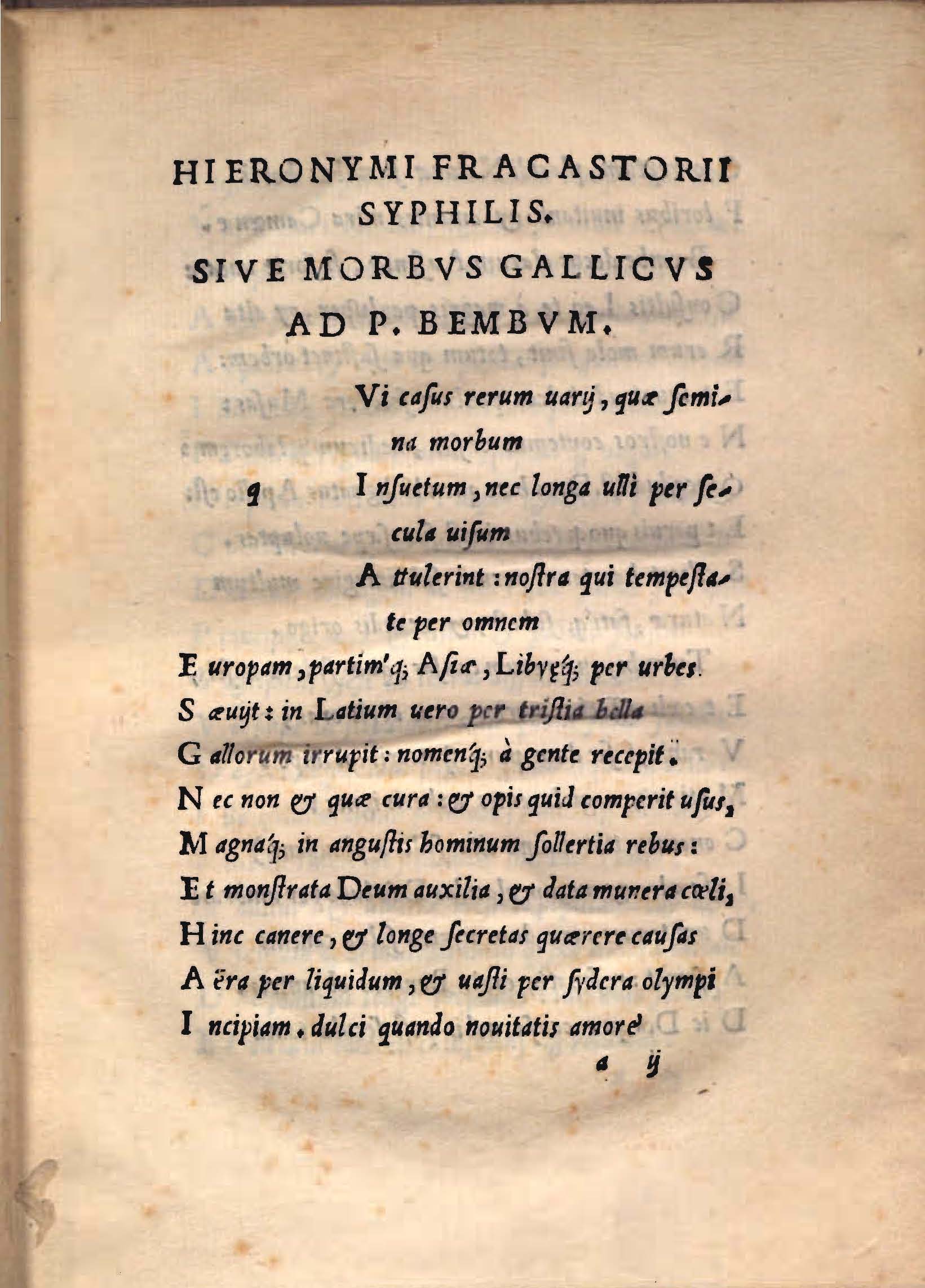
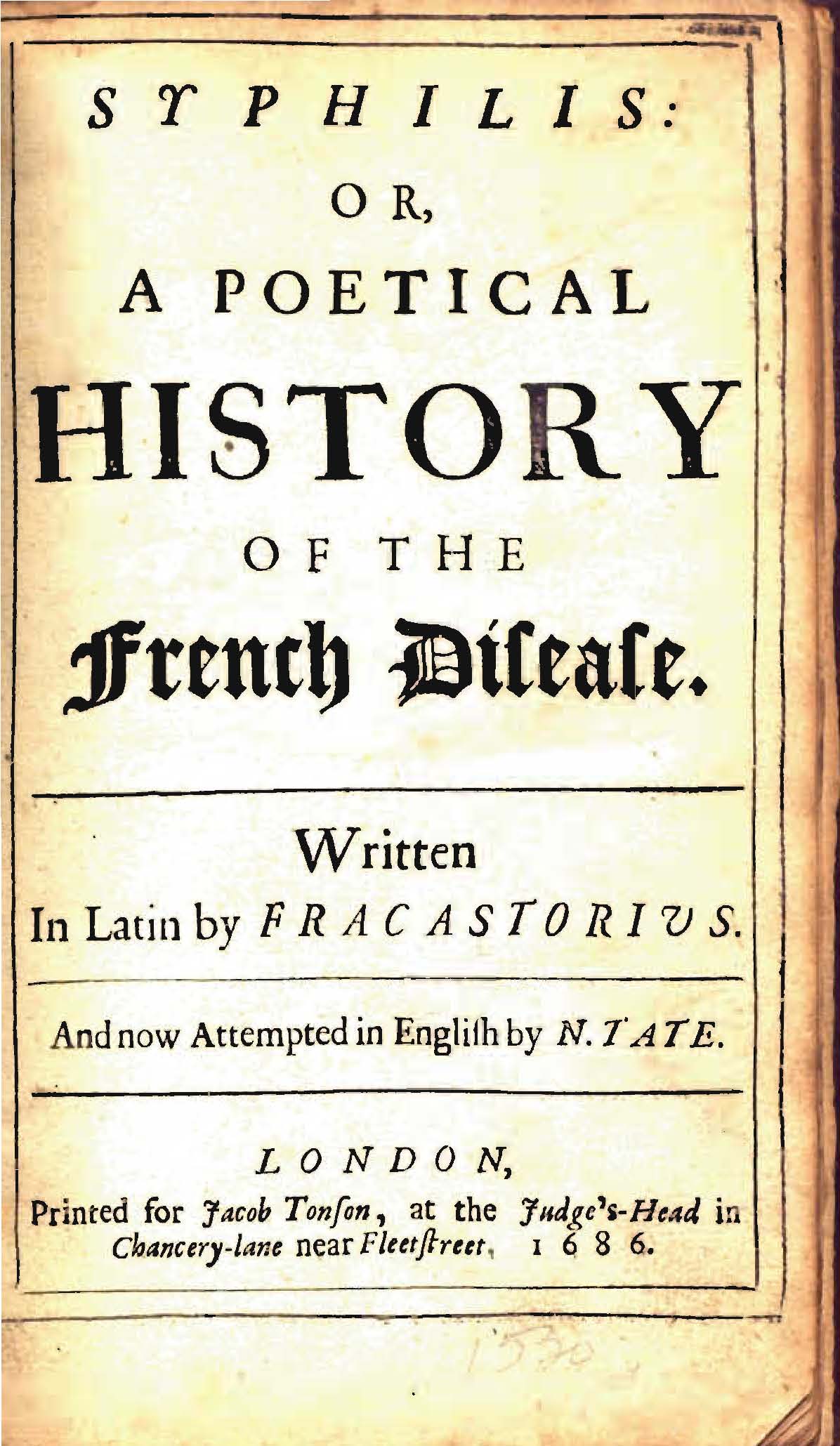
Syphilis seems like an unlikely topic for a poem, yet it is the subject of an important and popular work. Syphilis, or the French Disease, was first published in 1530. At that time, syphilis was new to Europe and spreading fast. To the Italians it was the “French disease,” to the French the “Italian disease,” with many other countries blaming one another for bringing the infection to their citizens. Written in Latin by the multi-faceted Italian physician and poet Fracastorius, the poem was translated into many languages, reflecting the great desire to understand this disease. Our collection holds multiple editions, including the original, pictured above, and several English versions (this post features two English translations – one is pictured below and another as the excerpts).

In the poem, which is broken into three parts, we learn of the disease and some popular treatments of the time, including mercury and the plant remedy guaiac. We also read the tale of a shepherd named Syphilus, supposedly the first person afflicted with the disease, which was his punishment for spurning the sun. Excerpts from each of the poem’s books, taken from William Van Wyck’s translation, are below.

Book 1

Within the purple womb of night, a slave,
The strangest plague returned to sear the world.
Infecting Europe’s breast, the scourge was hurled
From Lybian cities to the Black Sea’s wave.
When warring France would march on Italy,
It took her name. I consecrate my rhymes
To this unbidden guest of twenty climes,
Although unwelcomed, and eternally.
………………
O Muse, reveal to me what seed has grown
This evil that for long remained unknown!
Till Spanish sailors made west their goal,
And ploughed the seas to find another pole,
Adding to this world a new universe.
Did these men bring to us this latent curse?
In every place beneath a clamorous sky,
There burst spontaneously this frightful pest.
Few people has it failed to scarify,
Since commerce introduced it from the west.
Hiding its origin, this evil thing
Sprawls over Europe
………………

Albrecht Durer's woodcut of a syphilitic man.

Albrecht Durer’s woodcut of a syphilitic man, 1496.*

Book 2

Soon is repaired the ruin of the flesh,
If lard be well applied that’s good and fresh,
Or dyer’s colors of a soothing power.
If some poor soul, impatient for the hour
Of sweet release, should find too slow this cure,
And yearning for a quicker and more sure,
Then stronger remedies without delay
Shall kill this hydra another way.
………………
All men concede that mercury’s the best
Of agents that will cure a tainted breast.
To heat and cold sensitive’s mercury,
Absorbing the fires of the this vile leprosy
And all the body’s flames by its sheer weight…
………………

Book 3

An ancient king had we, Alcithous,
Who had a shepherd lad called Syphilus.
On our prolific meads, a thousand sheep,
A thousand kine this shepherd had to keep.
One day, old Sirius with his mighty flame,
During the summer solstice to us came,
Taking away the shade from all our trees,
The freshness from the meadow, coolth from breeze.
His beasts expiring, then did Syphilus
Turn to this horror of a brazen heaven,
Braving the sun’s so torrid terror even,
Gazing upon its face and speaking thus:
‘O Sun, how we endure, a slave to you!
You are a tyrant to us in this hour.
………………
The sun went pallid for his righteous wrath
And germinated poisons in our path.
And he who wrought this outrage was the first
To feel his body ache, when sore accursed.
And for his ulcers and their torturing,
No longer would a tossing, hard couch bring
Him sleep. With joints apart and flesh erased,
Thus was the shepherd flailed and thus debased.
And after him this malady we call
SYPHILIS, tearing at our city’s wall
To bring with it such ruin and such a wrack,
That e’en the king escaped not its attack.
………………

* From Van Wyck, William. The sinister shepherd: a translation of Girolamo Fracastoro’s Syphilidis; sive, De morbo gallico libri tres. Los Angeles, 1934.

Modeling History: Making a Stiff-Board Parchment Binding with a Slotted Spine

This post comes from the 2012 Gladys Brooks conservation intern, Morgan Adams. Morgan is currently interning in the Thaw Conservation Center at the Morgan Library & Museum

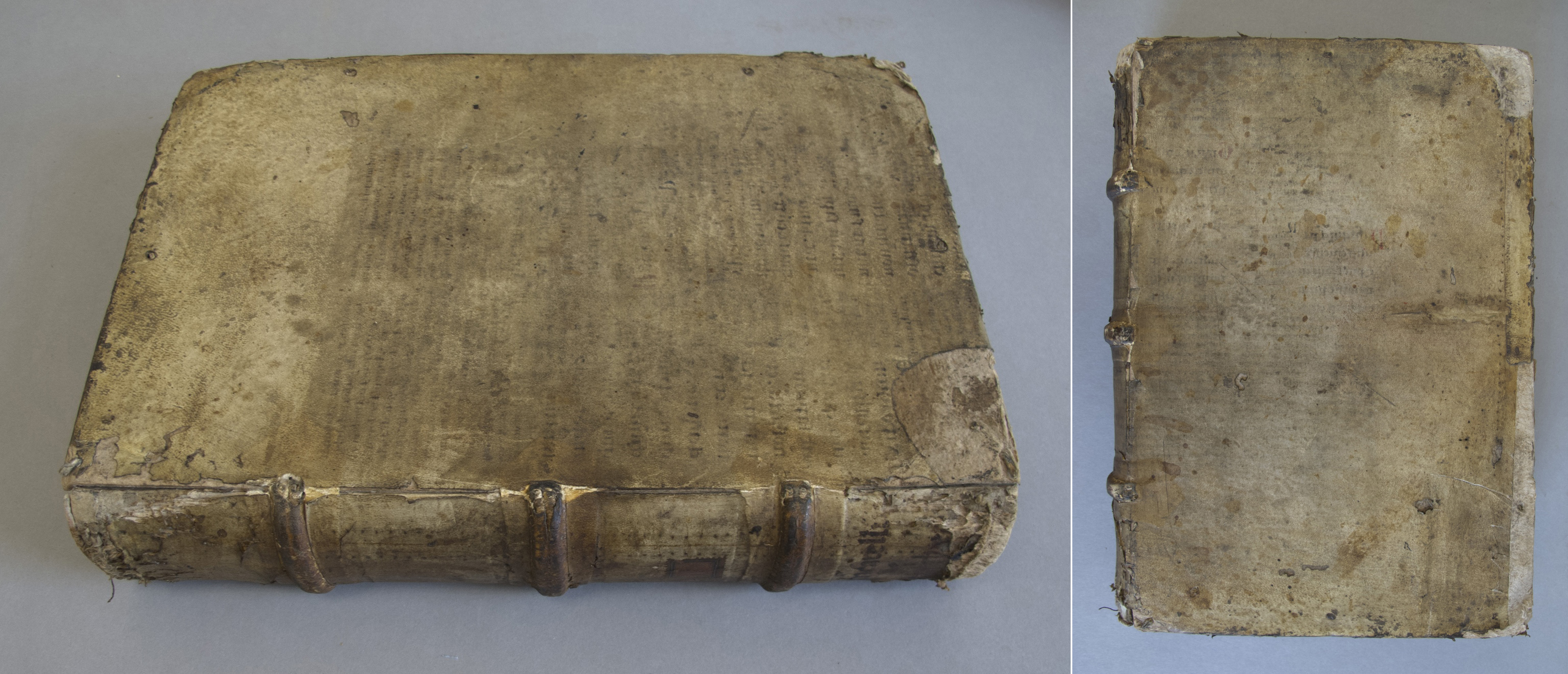
As the 2012 Gladys Brooks intern I had the pleasure of working with Senior Book Conservator Anne Hillam on a model of a stiff-boards parchment binding with a slotted spine, a style seen commonly in Italian bindings of the 16th-17th centuries.

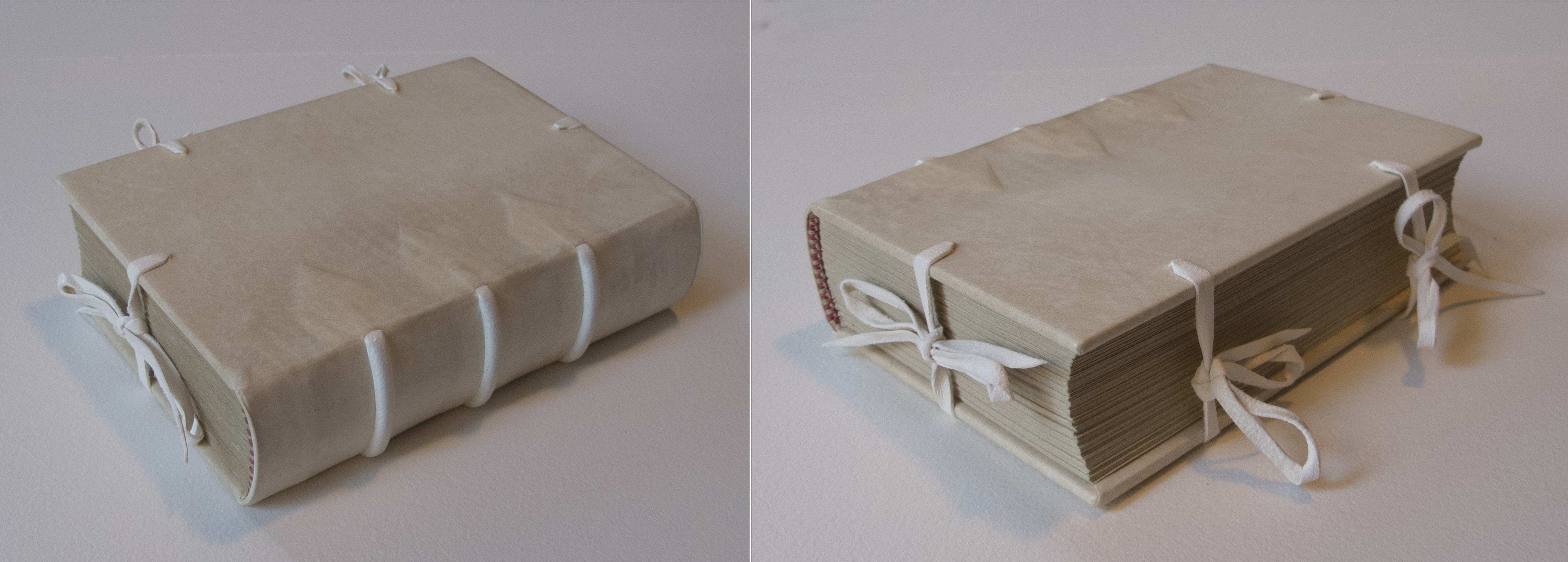
An example of a stiff-boards parchment binding with a slotted spine from the NYAM collection: Trincavello, De differentiis febrium, Venice, 1585. Left: Back cover and spine. Right: Front cover.

An example of a stiff-boards parchment binding with a slotted spine from the NYAM collection: Trincavello, De differentiis febrium, Venice, 1585. Left: Back cover and spine. Right: Front cover.

A unique feature of this binding is the juxtaposition of the parchment and alum-tawed skin used to cover the book’s spine. Slots cut in the parchment across the spine reveal the alum-tawed skin patches covering the sewing supports. It is a combination with structural as well aesthetic advantages: The alum-tawed skin provides the flexibility necessary to conform to the raised sewing supports, while the parchment provides a more durable surface to protect the bulk of the spine.

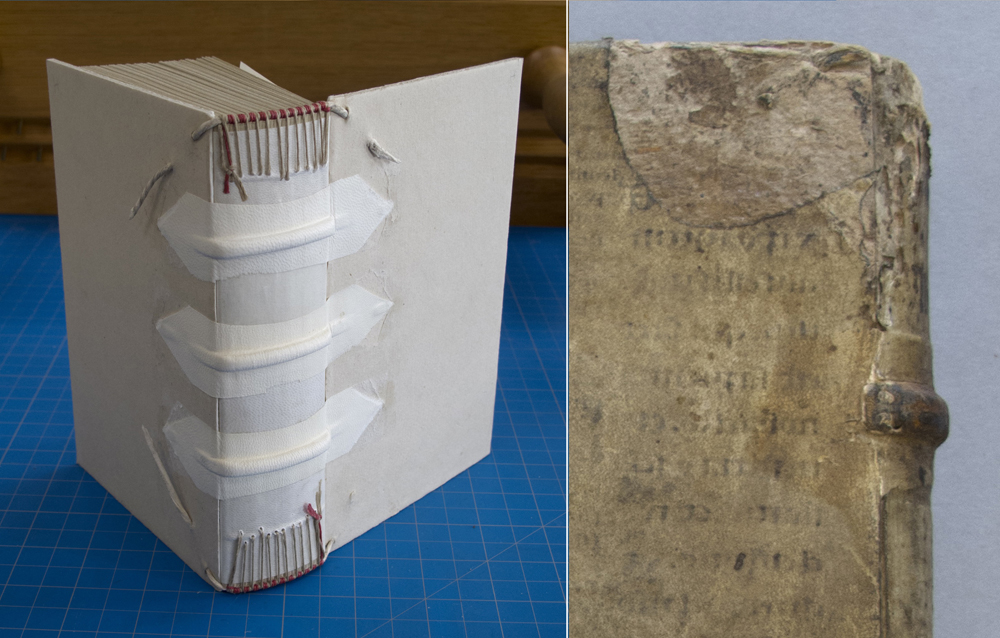
Trincavello (1585): Detail of spine showing the alum-tawed skin patch adhered over sewing support. The original color of the patch can be seen where the parchment is split along the shoulder of the spine.

Trincavello (1585): Detail of spine showing the alum-tawed skin patch adhered over sewing support. The original color of the patch can be seen where the parchment is split along the shoulder of the spine.

To prepare for this binding, we made detailed examinations of six books printed in Venice between 1508 and 1585 in the NYAM special collections. In conjunction with Sylvia Pugliese’s study of this binding style at the National Library Marciana in Venice, we selected material and structural features that exemplified the binding style. These features are highlighted in the images below, which show the steps of the binding process and the finished model.

The text block is sewn on three laminated alum-tawed supports.

The text block is sewn on three laminated alum-tawed supports.

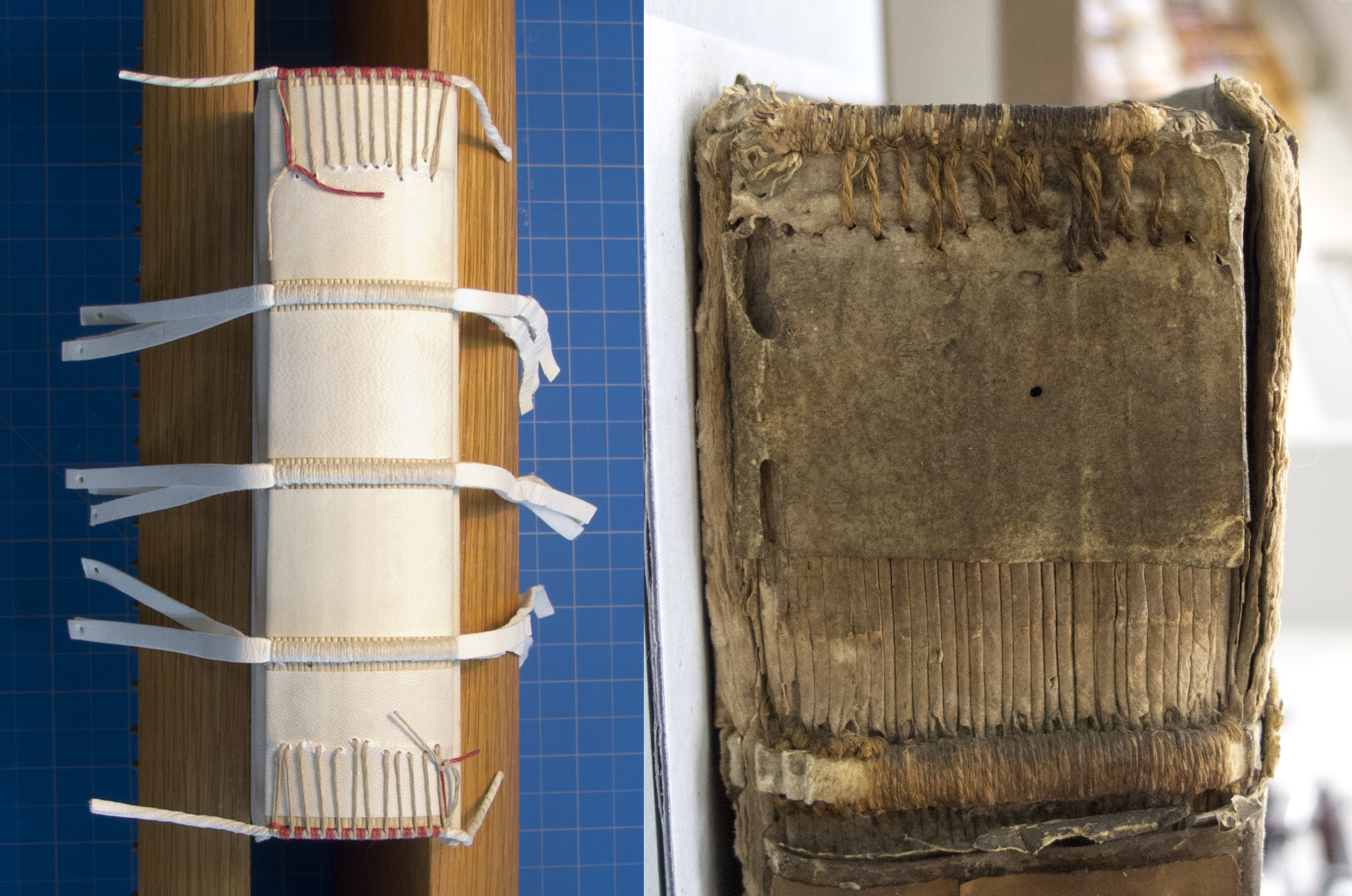
Left: The text block is rounded and backed and the spine is lined with parchment. Endbands are sewn through the spine lining on twisted alum-tawed skin supports.

Left: The text block is rounded and backed and the spine is lined with parchment. Endbands are sewn through the spine lining on twisted alum-tawed skin supports. Right: Galen, Omnia quae extant in Latinum sermonem convsera, Venice, 1556, detail of the spine showing an endband, parchment spine lining, and one sewing station.

Left: Endbands seen from above. Right: Galen (1556) detail of the front bead endband sewn in red and white thread.

Left: Endbands seen from above. Right: Galen (1556) detail of the front bead endband sewn in red and white thread.

Left: The sewing supports are laced into the boards and then covered in alum-tawed skin patches. The endband cores are also laced into the boards. Right: Trincavello (1585), detail showing the "arrow-point" shaping of the alum-tawed skin patch underneath the parchment and the endband core that has been laced through the board and trimmed off flush with the board.

Left: The sewing supports are laced into the boards and then covered in alum-tawed skin patches. The endband cores are also laced into the boards. Right: Trincavello (1585), detail showing the “arrow-point” shaping of the alum-tawed skin patch underneath the parchment and the endband core that has been laced through the board and trimmed off flush with the board.

A template is prepared for cutting the slots in the parchment. The binding is now ready to be covered.

A template is prepared for cutting the slots in the parchment. The binding is now ready to be covered.

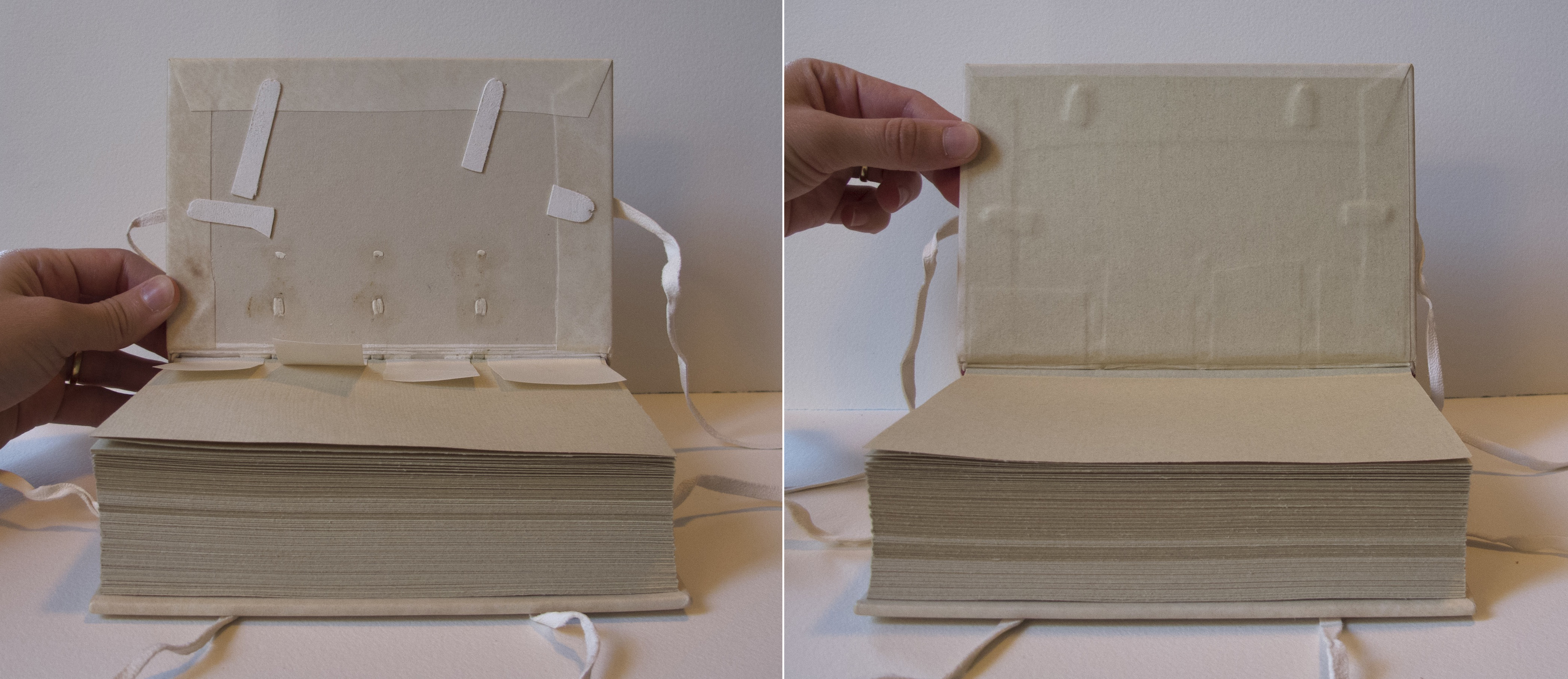
After the parchment cover is adhered, ties are laced through the boards at the fore-edge, head and tail. The parchment spine linings are adhered to the interior face of the board and the endsheet is pasted down.

After the parchment cover is adhered, ties are laced through the boards at the fore-edge, head and tail. The parchment spine linings are adhered to the interior face of the board and the endsheet is pasted down.

Trincavello (1585), The surface of the pastedown reveals the ends of ties formerly  laced through the board.

Trincavello (1585), The surface of the pastedown reveals the ends of ties formerly laced through the board.

Finished model, complete with ties on fore-edge, head, and tail.

Finished model, complete with ties on fore-edge, head, and tail.

[1] Sylvia Pugliese, “Stiff-Board Vellum Binding with Slotted Spine: Survey of a Historical Bookbinding Structure,” in Papier Restaurierung – Mitteilungen der IADA, Vol. 2 (2001), Suppl., S. 93-101.

Brain Awareness Week

By Lisa O’Sullivan, Director

Ambroise Paré, The brain and nerves of the head and neck, p134, Les Oeuvres

Ambroise ParéThe brain and nerves of the head and neck, p134, Les Oeuvres

This week is Brain Awareness Week, a global campaign to celebrate the brain and increase awareness of brain research. Treating the brain has a long history; trepanning, or trepanation, is one of the oldest known surgical procedures.

The brain featured in today’s post comes from Les Oeuvres d’Ambroise Paré, currently being treated in our conservation laboratory. The work was the culmination of the 16th century French barber-surgeon’s long and successful career, which saw him become royal surgeon for a number of French kings.

Les Oeuvres d’Ambroise Paré was first published in 1575, and was subsequently expanded in multiple new editions. It was groundbreaking on a number of levels, written in the vernacular French, rather than Latin, it included not only anatomical depictions and descriptions of procedures, but illustrations of the instruments used in surgery, many of which Paré had modified or developed himself.

Biblioclasts & Bibliosnitches Beware

By Arlene Shaner, Acting Curator and Reference Librarian for Historical Collections

Dr. Henry Pelouze de Forest's bookplate

Dr. Henry Pelouze de Forest’s bookplate

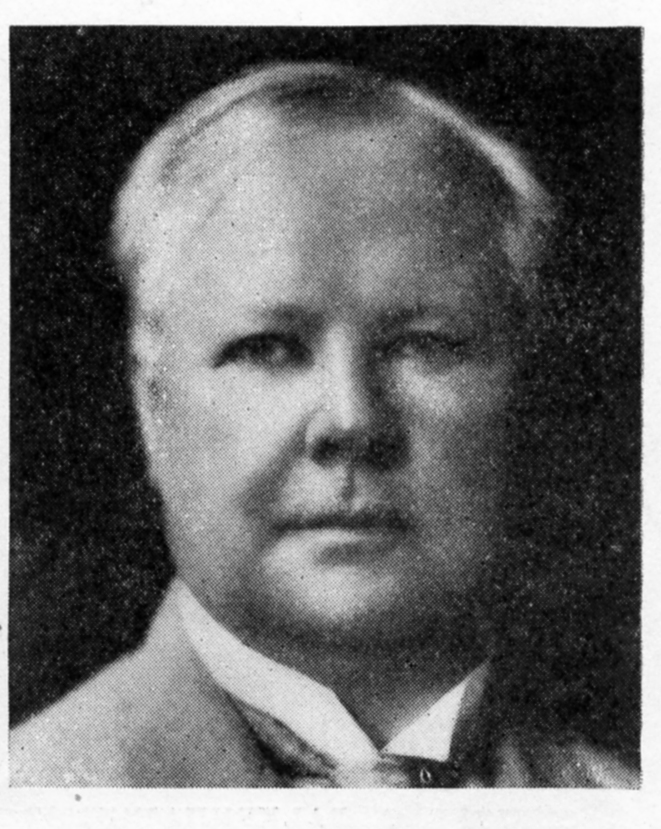
Book owners, even generous ones, worry about what might happen to their books if they loan them to others who might not treat them with the same degree of care. Dr. Henry Pelouze de Forest, a lover of books and of bookplates, had this “Caudal Bookplate,” meant to be inserted at the end of a book, made as a warning to unscrupulous borrowers in 1933. De Forest (1864-1948) graduated from Cornell in 1884 and from Columbia’s College of Physicians and Surgeons in 1890. He was associate professor of obstetrics at the Post-Graduate Hospital and Medical School from 1903 to 1921, but is probably best remembered today for his interest in personal identification. While working as a surgeon for the New York City Police Department (1902-1912), he established what is said to be the first fingerprint file in the United States and invented a dactyloscope for fingerprint examination.

Dr. Henry Pelouze de Forest

Dr. Henry Pelouze de Forest *

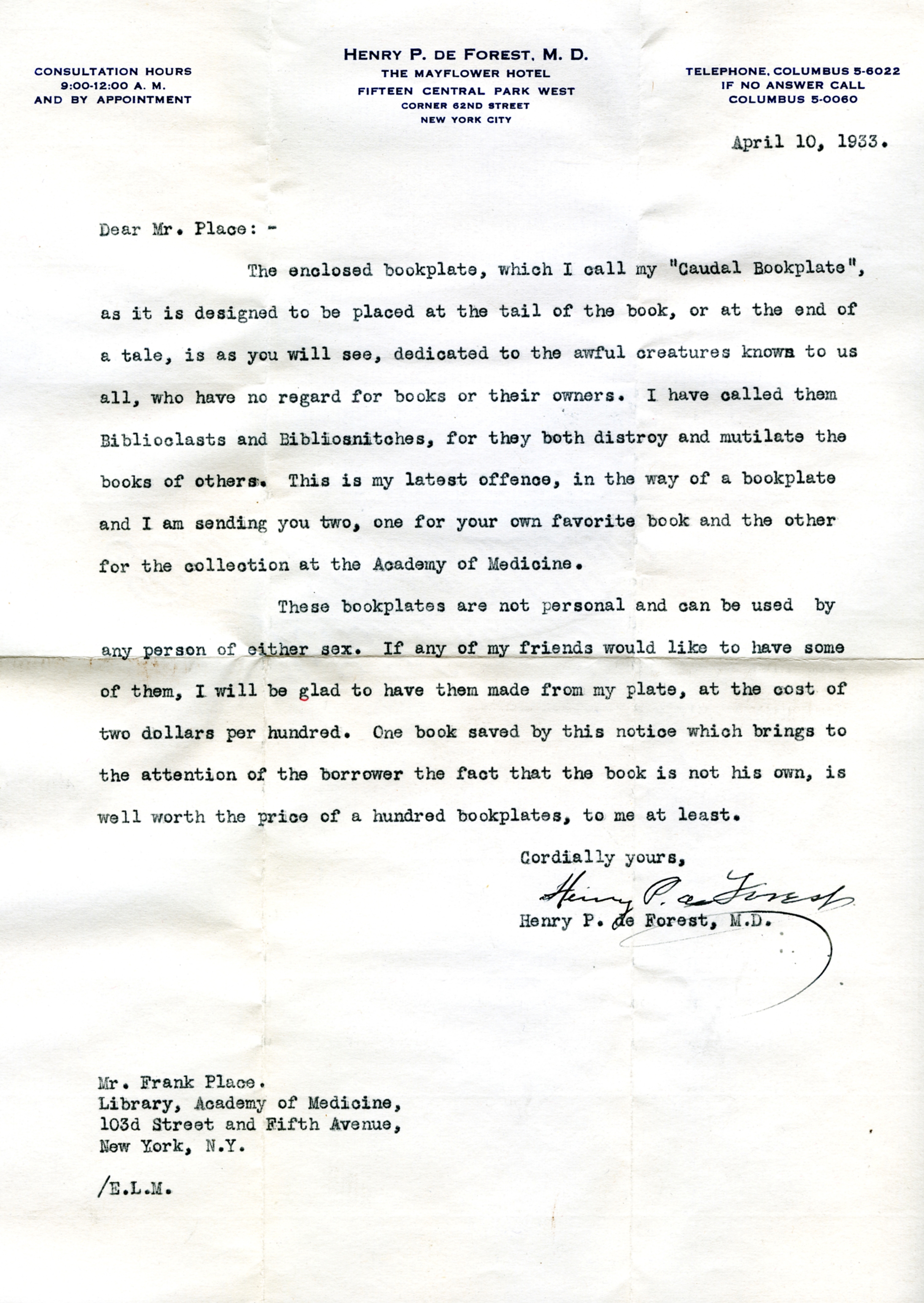
De Forest had several bookplates made for his own books and he sent examples of them to Frank Place, who was a librarian here at NYAM. Place collected bookplates and we have three small loose-leaf notebooks full of those he received both as gifts and by sending copies of ours in trade. This bookplate and its accompanying letter were found in the first of those small volumes. We’ll never know how many of de Forest’s friends took advantage of his offer to print up extra batches of his poetic plea that borrowers mind their manners.

Letter from Henry Pelouze de Forest to NYAM librarian Frank Place.

Letter from Henry Pelouze de Forest to NYAM librarian Frank Place. Click to enlarge.

* From the Columbia Alumni News 22:18 (Feb. 13, 1931), p. 10.

Looking for that je ne sais quoi : the conservation of Les Oeuvres d’Ambroise Paré

By Christina Amato, Book Conservator

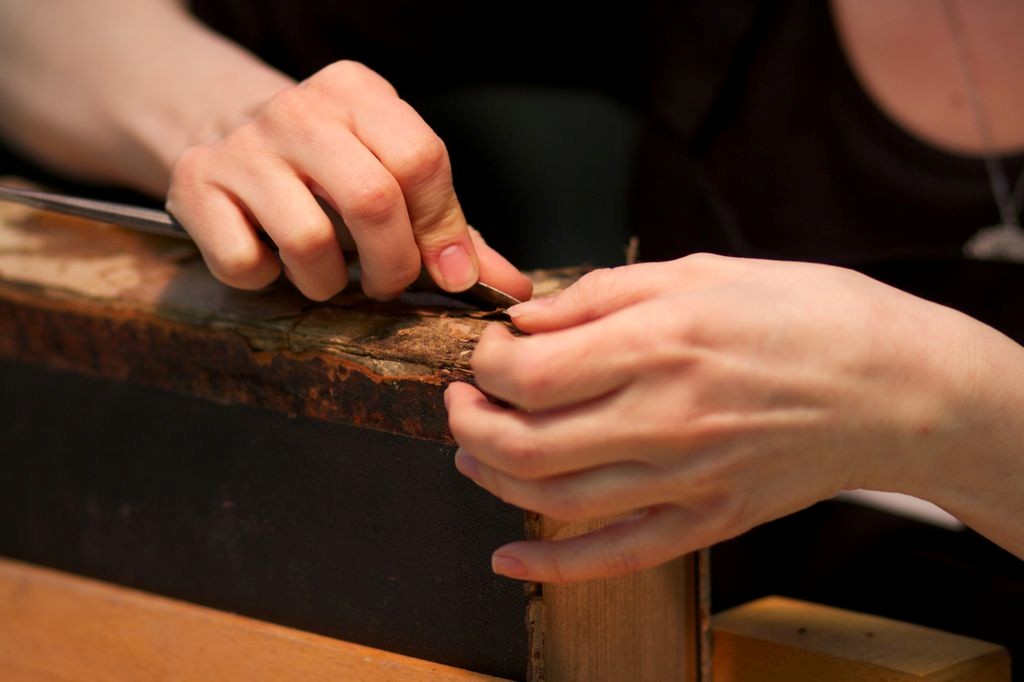
NYAM conservator Christina Amato removes a damaged and ill-suited spine from a 1633 copy of Paré’s Les Oeuvres d’Ambroise Paré/

NYAM conservator Christina Amato removing a damaged and ill-suited spine from a 1633 copy of Paré’s Les Oeuvres d’Ambroise Paré

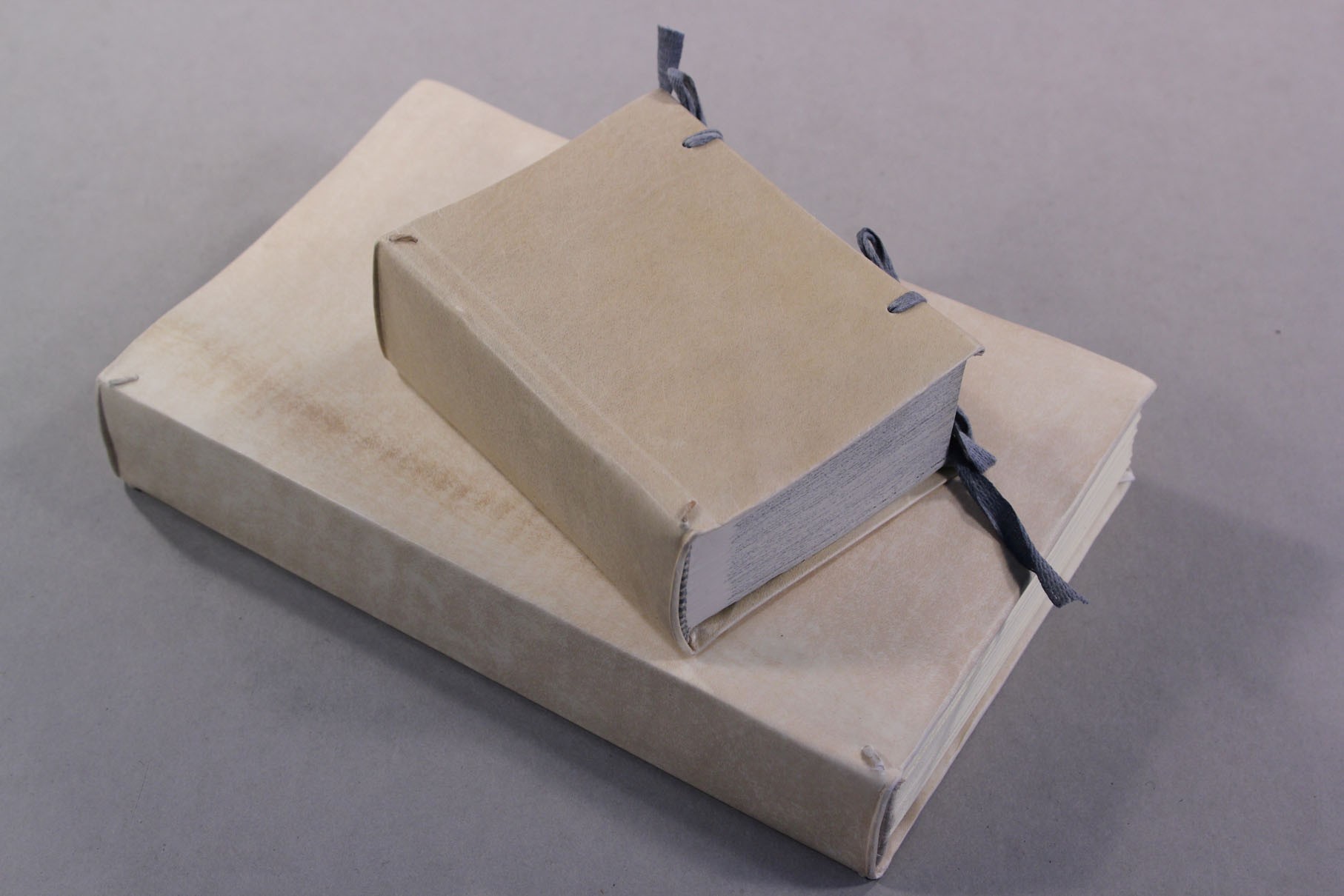
Many books come through the Gladys Brooks Book and Paper Conservation lab, and often they receive minimal stabilization, or are rehoused in new boxes or folders. Occasionally one comes through that is in need of an entirely new binding, and requires some research before getting started.

quarterviewlesoeuvres

Les Oeuvres d’Ambroise Paré, before treatment. Click to enlarge.

This copy of Paré’s Les Oeuvres d’Ambroise Paré came to the lab in rather sorry shape; it is a 17th century book that had been rebound at some point in its past. The new binding, or cover, was clearly made centuries after the book was created, and was damaged to the extent that handling the book was very difficult.  The usual practice in conservation is to use as many of the original parts as possible when repairing a book; in this case, however, the binding was not only heavily damaged, but inappropriate, so the decision was made to make a new binding for the book.

What kind of binding would be appropriate for a 17th century French book? Beyond historical appropriateness, we had to consider the functionality of the new binding as well. It is a rather large, heavy book; what would be best for a book of this size? How often would this book be used? How would it be stored?

We began with the first question of historical appropriateness. We are lucky to have access to the library’s rare book collection, and were able to find other books from the same time period and location, and study their bindings.  We also made use of our large collection of books about binding history, researched other libraries on-line bindings databases, and talked to colleagues.

Models of "semi-limp vellum" bindings

Models of “semi-limp vellum” bindings. Click to enlarge.

With these things in mind, we decided to explore the possibility of making a variation of what is called a “semi-limp vellum” binding.  Such bindings are commonly used in conservation, for their historical appropriateness and functionality.  With a little digging, a picture started to emerge for us of a typical French, 17th century vellum binding.  We did not find a lot of details about how these bindings were made, however.  It was very helpful to make a few small models before tackling the original book, to work out these details, and try variations to understand differences in functionality.

With all the knowledge we acquired from these models, and from our research, we can now approach this treatment with confidence. Les Oeuvres d’Ambroise Paré will have a well-thought out new binding which is faithful to its time period, and will protect it well, for years to come. Check back to read about the final stages of treatment and see pictures of the book in its new binding.

English Gingerbread Old and New

Food historian Stephen Schmidt wrote today’s post, which includes findings from research he conducted at NYAM last summer. The post was originally posted on the Recipes Project blog.

Food writers who rummage in other people’s recipe boxes, as I am wont to do, know that many modern American families happily carry on making certain favorite dishes decades after these dishes have dropped out of fashion, indeed from memory. It appears that the same was true of a privileged eighteenth-century English family whose recipe book now resides at the New York Academy of Medicine (hereafter NYAM), under the unprepossessing label “Recipe book England 18th century. In two unidentified hands.” The manuscript’s culinary section (it also has a medical section) was copied in two contiguous chunks by two different scribes, the second of whom picked up numbering the recipes where the first left off and then added an index to all 170 recipes in both sections.

The recipes in both chunks are mostly of the early eighteenth century—they are similar to those of E. Smith’s The Compleat Housewife, 1727—but a number of recipes in the first chunk, particularly for items once part of the repertory of “banquetting stuffe,” are much older. My guess is that this clutch of recipes was, previous to this copying, a separate manuscript that had itself been successively copied and updated over a span of several generations, during the course of which most of the original recipes had been replaced by more modern ones but a few old family favorites dating back to the mid-seventeenth century had been retained. Among these older recipes, the most surprising is the bread crumb gingerbread. A boiled paste of bread crumbs, honey or sugar, ale or wine, and an enormous quantity of spice (one full cup in this recipe, and much more in many others) that was made up as “printed” cakes and then dried, this gingerbread appears in no other post-1700 English manuscript or print cookbook that I have seen.

And yet the recipe in the NYAM manuscript seems not to have been idly or inadvertently copied, for its language, orthography, and certain compositional details (particularly the brandy) have been updated to the Georgian era:

25 To Make Ginger bread

Take a pound & quarter of bread, a pound of sugar, one ounce of red Sanders, one ounce of Cinamon three quarters of an ounce of ginger half an ounce of mace & cloves, half an ounce of nutmegs, then put your Sugar & spices into a Skillet with half a pint of Brandy & half a pint of ale, sett it over a gentle fire till your Sugar be melted, Let it have a boyl then put in half of your bread Stirre it well in the Skellet & Let it boyle also, have the other half of your bread in a Stone panchon, then pour your Stuffe to it & work it to a past make it up in prints or as you please.
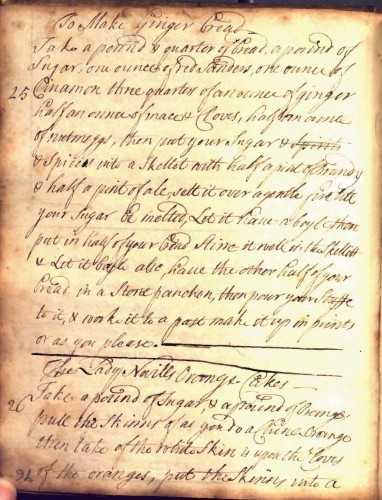
Eighteenth-century recipe book, England.

Eighteenth-century recipe book, England.

From the fourteenth century into the mid-seventeenth century, bread crumb gingerbread was England’s standard gingerbread (for the record, there was also a more rarefied type) and, by all evidence, a great favorite among those who could afford it—a fortifier for Sir Thopas in The Canterbury Tales, one of the dainties of nobility listed in The Description of England, 1587 (Harrison, 129), and according to Sir Hugh Platt, in Delightes for Ladies, 1609, a confection “used at the Court, and in all gentlemens houses at festival times.” Then, around the time of the Restoration, this ancient confection apparently dropped out of fashion. In The Accomplisht Cook, 1663, his awe-inspiring 500-page compendium of upper-class Restoration cookery, Robert May does not find space for a single recipe.

The reason for its waning is not difficult to deduce. Bread crumb gingerbread was part of a large group of English sweetened, spiced confections that were originally used more as medicines than as foods. Indeed, the earliest gingerbread recipes appear in medical, not culinary, manuscripts (Hieatt, 31), and culinary historian Karen Hess proposes that gingerbread derives from an ancient electuary commonly known as gingibrati, whence came the name (Hess, 342-3). In England, these early nutriceuticals, as we might call them today, gradually became slotted as foods first through their adoption for the void, a little ceremony of stomach-settling sweets and wines staged after meals in great medieval households, and then, beginning in the early sixteenth century, through their use at banquets, meals of sweets enjoyed by the English privileged both after feasts and as stand-alone entertainments.

Through the early seventeenth century banquets, like the void, continued to carry a therapeutic subtext (or pretext) and comprised mostly foods that were extremely sweet or both sweet and spicy: fruit preserves, marmalades, and stiff jellies; candied caraway, anise, and coriander seeds; various spice-flecked dry biscuits from Italy; marzipan; and sweetened, spiced wafers and the syrupy spiced wine called hippocras. In this company, bread crumb gingerbread, with its pungent (if not caustic) spicing, was a comfortable fit. But as the seventeenth century progressed, the banquet increasingly incorporated custards, creams, fresh cheeses, fruit tarts, and buttery little cakes, and these foods, in tandem with the enduringly popular fruit confections, came to define the English taste in sweets, whether for banquets or for two new dawning sweets occasions, desserts and evening parties. The aggressive spice deliverers fell by the wayside, including, inevitably, England’s ancestral bread crumb gingerbread.

As the old gingerbread waned, a new one took its place and assumed its name, first in recipe manuscripts of the last quarter of the seventeenth century, and then in printed cookbooks of the early eighteenth century. This new arrival was the spiced honey cake, which had been made throughout Europe for centuries. It is sometimes suggested that the spiced honey cake came to England with Royalists returning from exile in France after the Restoration, which seems plausible given the high popularity of French pain d’épice at that time—though less convincing when one considers that a common English name for this cake, before it became firmly known as gingerbread, was “pepper cake,” which suggests a Northern European provenance. Whatever the case, Anglo-America almost immediately replaced the expensive honey in this cake with cheap molasses (or treacle, as the English said by the late 1600s), and this new gingerbread, in myriad forms, became the most widely made cake in Anglo-America over the next two centuries and still remains a favorite today, especially at Christmas.

By the time the NYAM manuscript was copied, perhaps sometime between 1710 and 1730, molasses gingerbread was already ragingly popular in both England and America, and evidently the family who kept this manuscript ate it too, for the second clutch of culinary recipes includes a recipe for it, under the exact same title as the first. Remembering the old adage that the holidays preserve what the everyday loses, I will hazard a guess that the old gingerbread was made at Christmas, the new for everyday family use.

150 To Make Ginger Bread

Take a Pound of Treacle, two ounces of Carrawayseeds, an ounce of Ginger, half a Pound of Sugar half a Pound of Butter melted, & a Pound of Flower. if you please you may put some Lemon pill cut small, mix altogether & make it into little Cakes so bake it. may put in a little Brandy for a Pepper Cake

Recipe book England 18th century.

Recipe book England 18th century.

An interesting question is why the seventeenth-century English considered the European spiced honey cake sufficiently analogous to their ancestral bread crumb gingerbread to merit its name. It may have been simply the compositional similarity, the primary constituents of both cakes being honey (at least traditionally) and spices. Or it may have been that both cakes were associated with Christmas and other “festival times.” Or it may have been that both cakes were often printed with human figures and other designs using wooden or ceramic molds. Or it may possibly have been that both gingerbreads had medicinal uses as stomach-settlers. In both England and America, itinerant sellers of the new baked gingerbread often stationed themselves at wharves and docks and hawked their cakes as a preventive to sea-sickness. (Ship-wrecked off Long Island in 1727, Benjamin Franklin bought gingerbread “of an old woman to eat on the water,” he tells us in The Autobiography.) One thinks at first that the ginger and other spices were the “active ingredients” in this remedy, and certainly this is what nineteenth-century American cookbook authors believed when they recommended gingerbread for such use. But early on the remedy may also have been activated by the treacle. Based on the perhaps slender evidence of a single recipe in E. Smith, Karen Hess proposes that the first English bakers of the new gingerbread may have understood treacle to mean London treacle (Hess, 201), the English version of the ancient sovereign remedy theriac, a common form of which English apothecaries apparently formulated with molasses rather than expensive honey. I have long wondered what, if anything, this has to do with the English adoption of the word “treacle” for molasses (OED). Perhaps a medical historian can tell us.

Works Cited

Harrison, William. The Description of England. New York: Dover Publications, Inc., 1994

Hess, Karen. Martha Washington’s Booke of Cookery. New York: Columbia University Press, 1981.

Hieatt, Constance and Sharon Butler. Curye on Inglysch. New York: Oxford University Press, 1985.

“Treacle, I. 1. c.” The Compact Oxford English Dictionary. 2nd ed. 1991.

Stephen Schmidt is the principal researcher and writer for The Manuscript Cookbooks Survey, an online catalogue of pre-1865 English-language manuscript cookbooks held in the U. S. repositories, which will launch in early 2013. He is the author of Master Recipes, a 940-page general-purpose cookbook, was an editor of and a principal contributor to the 1997 and 2006 editions of Joy of Cooking, has contributed to The Oxford Companion to American Food and Drink and Dictionnaire Universel du Pain, and has written for Cook’s Illustrated magazine and many other publications. A resident of New York City, he works as a personal chef and a cooking teacher and hopes soon to complete Lemon Pudding, Watermelon Cake, and Miracle Pie, a history of American home dessert.


Skulls and Surgery

By Lisa O’Sullivan, Director

Row of plaster cast skulls

Plaster casts of skulls held in the NYAM Rare Book Reading Room, some showing signs of trepanation.

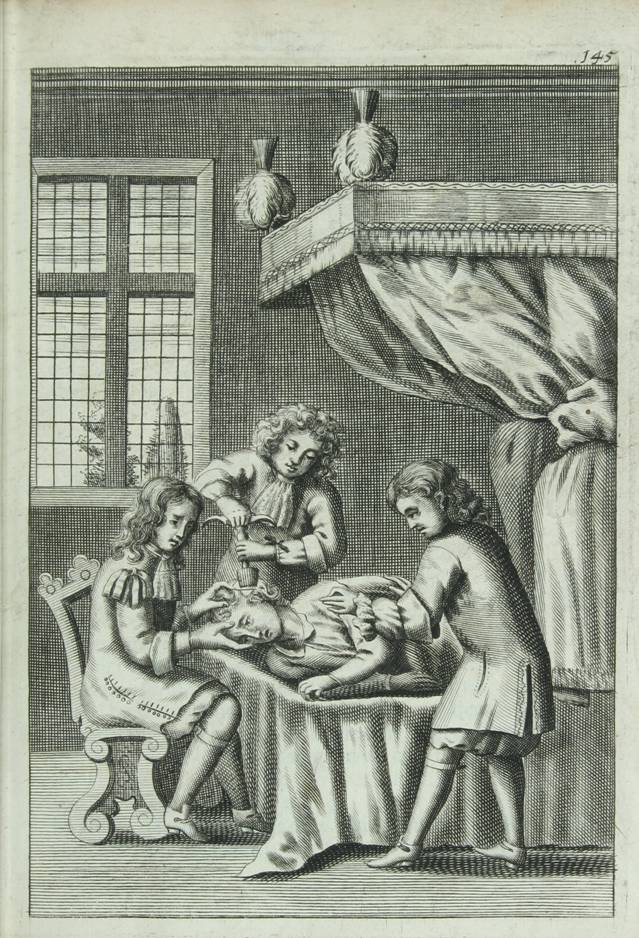
The practice of trepanning, or trepanation, which involved making a hole in the skull, is one of the oldest known surgical procedures. Skulls with holes have been found from the Neolithic period, and the technique continued to be practiced by cultures across the world. The surgeries relieved swelling of the brain and skulls showing bone regrowth indicate that the treatment was survived by many.  The reasoning behind such surgeries changed over place and time, and included questions of spiritual possession, convulsions, fractures and infections.

On Thursday, December 6, the fascinating history of such surgical procedures and the development of surgery, neuroanatomy and the other neurosciences will be explored by Dr. Eugene S. Flamm at the Augustus C. Long Health Sciences Library at the Columbia University Medical Center in a richly illustrated talk “Neurosurgery Before Neurosurgery.”

Image shows trepanning operation

John Browne, A Compleat Discourse of Wounds (London, 1678)

Dr. Flamm is the Jeffrey P. Bergstein Professor and Chairman of the Dept. of Neurosurgery at the Albert Einstein College of Medicine. He is an active researcher and clinician with in interest in cerebrovascular neurosurgery and spinal cord injury. Dr. Flamm is also an ardent book collector, the President of the Grolier Club, a NYAM Fellow and supporter and author of, among other works, From Skulls to Brains: 2500 Years of Neurosurgical Progress, which features many books from the NYAM collection.

More details about the event can be found here. Enquiries about From Skulls to Brains can be directed to NYAM at history@nyam.org.

In Pursuit of Pure, White, and Deadly

We were lucky enough to have the “Candy Professor,” Samira Kawash, visit the library earlier this year. She generously wrote the following post for us about the book she used in her research.

Poster with text "Sweet delicious but deadly" and image of man eating ice cream cone surrounded by different foods containing sugar.

Anti-sugar poster. Courtesy of the National Library of Medicine.

A few years ago, we started hearing that our current epidemic of obesity might be due to the rapid increase in consumption of high fructose corn syrup (HFCS) since the 1970s. The sharp upturn in both overweight and HFCS certainly suggest some relation, but what is the cause? Some have pointed to the excess calories, others to excess sugar, and some believe it is actually the fructose in HFCS that makes it uniquely “obesegenic.” Are sugar calories, or fructose calories, somehow different from other kinds of calories? Increasingly, advocates of the “carbohydrate hypothesis” are saying, yes, it’s the carbs, or the sugars that are making us not only fat, but sick as well: blame diabetes, heart disease, arthritis, and allergies on too much sugar.

I’m writing a book about the social history of candy, so of course I’m interested in these attacks on sugar. And one thing I’ve learned is that these worries about refined sugar are not new. In particular, back in the 1970s there was a wave of “sugar-phobia” that produced a raft of popular anti-sugar literature like William Duffy’s Sugar Blues. Food historians who have studied this period emphasize one especially influential book by a British biochemist named John Yudkin that summarizes and interprets scientific evidence implicating sugar in a broad range of diseases. So I definitely wanted to get my hands on this book, published as Pure, White and Deadly in Britain in 1972 and as Sweet and Dangerous in the U.S. the next year.

For months, I have been searching high and low for this book. The libraries I normally use didn’t have it. Google tantalized me with a “snippet” but coyly withheld the digitized (and still copyrighted) text. Could I buy a copy? Amazon could only tell me that it’s out of print; nowhere did there seem to be a used volume for sale at any price. And it turns out I’m not the only one who is trying to get their hands on this book. Bookfinder.com’s “Bookfinder Report 2012: Out-of-print and in Demand” ranked Pure, White and Deadly as the 5th most sought after out-of-print book.

And then I found Pure, White and Deadly, in the catalog of the New York Academy of Medicine Library. An email and a subway ride later, the book was in my hands. I couldn’t have been more excited with this uncovered treasure, and I was so thankful for the welcome and assistance offered by the library staff.

I’ve since learned that the NYAM library has been pulling this book off the shelf quite frequently at the request of all sorts of researchers and scholars. I doubt whoever acquired this volume back in the 1970s could have predicted its resurgent interest nearly a half century later. Thanks to the NYAM library, I and many others have been able to read this fascinating and provocative book.

About the author: Samira Kawash’s book on the social history of candy in the United States, titled In Defense of Candy, will be published by Faber and Faber in Fall 2013.

The Sex Side of Life

By Rebecca Pou, Project Archivist

September 30-October 6, 2012 is Banned Books Week, an annual event that celebrates the freedom to read and calls attention to books than have been banned or challenged. While Banned Books Week was first celebrated in 1982, printed matter was being censored long before that, as shown in a collection here at NYAM. In the Mary Ware Dennett Case Collection, one finds a controversy surrounding a small pamphlet and the resulting rally against its suppression.

This small collection centers on Mary Ware Dennett (1872-1947) and the case against her. She wrote a pamphlet titled The Sex Side of Life, which explained human reproduction to children.
Title from front cover of the "Sex Side of Life" pamphlet

First published as an article in the Medical Review of Reviews in 1918, it was later distributed as a pamphlet. The pamphlet was endorsed by doctors, churches and social organizations, but its forthright description of human sexuality was not wholly well-received. The pamphlet was deemed obscene by the Post Office in 1922 and in 1928, Dennett was tried by a federal grand jury and found guilty of distributing obscene materials through the mail. A Mary Ware Dennett Defense Committee was organized under the American Civil Liberties Union and the conviction was overturned in 1930.

Our collection was created by the well-regarded medical illustrator Dr. Robert Latou Dickinson, fellow of The New York Academy of Medicine, friend to Mary Ware Dennett and member of the defense committee. Dr. Dickinson was also responsible for the diagrams shown in the pamphlet. Materials include copies of The Sex Side of Life, correspondence, clippings, printed matter, typed and manuscript notes and the Appellant’s Brief from the U.S. vs. Mary Ware Dennett case. To learn more or visit the collection, please contact the staff of the Drs. Barry and Bobbi Coller Rare Book Reading Room by emailing history@nyam.org.