Have You Heard of Dr. Rebecca Lee Crumpler?

by Anthony Murisco, Public Engagement Librarian

On February 8th, 2021, the city of Boston was celebrating in a big way. For Dr. Rebecca Lee Crumpler’s 190th birthday, the city had decided to declare the entire day in her honor. Despite this high honor, many still do not know who she is.  
 
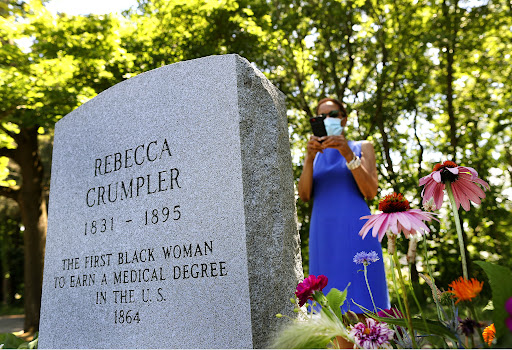
The largest newspaper in Boston, The Boston Globe, introduced readers to the local hero’s story in February 2020. At the time, Crumpler and her second husband, Arthur, were buried in an unmarked grave. Noting the significance of Crumpler, the first Black female doctor in the United States, the local Hyde Park Historical Society teamed up with the Friends of the Hyde Park Library to raise money for a proper headstone.

Courtesy of The Boston Globe

A follow-up in July of the same year informed the readers of a ceremony held to unveil the memorial. It also helped give a little more insight into the life of Dr. Crumpler; born Rebecca David in 1831, she was raised in Pennsylvania by her aunt. While growing up, she was shown what it meant to be a caretaker as she saw her aunt provide care for those in their neighborhood. She left for Charlestown, Massachusetts, and married her first husband, Wyatt Lee, in 1852. From working as a nurse from 1852–1860 for various doctors and their letters of recommendation, she was accepted into the New England Female Medical College. 
 
In the middle of her schooling, her husband passed away from tuberculosis. She graduated in 1864 as the first Black woman in the United States to do so, as well as the only Black woman to graduate from New England Female Medical College before it merged with another medical school in 1873. The following year, she married Arthur Crumpler. They settled and spent the rest of their lives in Hyde Park, a neighborhood in south Boston. In her 1883 book, A Book of Medical Discourses: In Two Parts, Dr. Crumpler opens with a dedication; “To Mothers, Nurses, and all who may desire to mitigate the afflictions of the human race, this book is prayerfully offered.” The Boston Globe article mentions how she faced plenty of adversity in her profession, including white pharmacists who refused to fill scripts signed by her. Despite all of this, nothing could stop her from helping the people who needed her.  

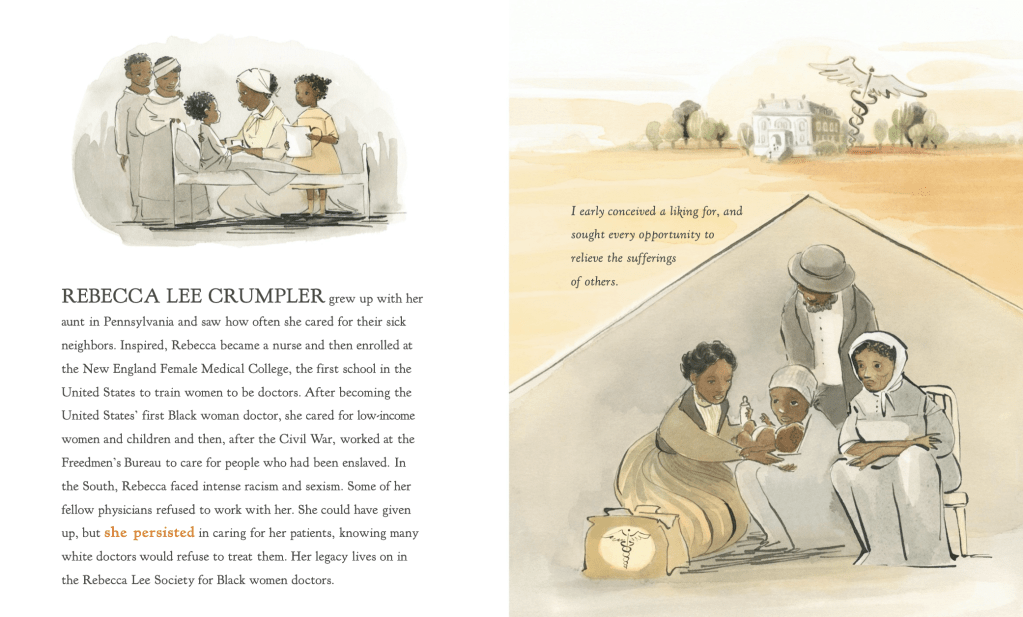
From Finding Rebecca by Shani Mahiri King and illustrated by Nicole Tadgell

Rewriting History 

It wasn’t her own education, in the very same area where Crumpler once walked, that taught Boston University Medical School student Dr. Melody McCloud about this pioneer. Rather it was when, freshly graduated, she moved to Atlanta, Georgia, around 1981. There she learned about Dr. Crumpler and the Rebecca Lee Society, an organization made up of Black female physicians. Speaking on Crumpler and other forgotten physicians, McCloud told the Boston Globe, “There are a lot of accomplishments of Blacks that are left out of the history books.” 

In her 2013 book, Hidden Figures: The American Dream and the Untold Story of the Black Women Mathematicians Who Helped Win the Space Race, writer Margot Lee Shetterly coined the titular term. The “hidden figures” in her story are three Black women, Mary Jackson, Katherine Johnson, and Dorothy Vaughan, who were instrumental in bringing the first astronauts into space. Despite being crucial to the team, they were hardly spoken of. Shetterly uncovered the story through talking to those who were there. From Johnson, she learned of Jackson; through Jackson, she got to Vaughan. The stories are passed down through the people who lived it and with the help of communities like the Rebecca Lee Society. With Shetterly’s help, Hidden Figures has been able to inspire others. It was even made into a movie! What can we do to these other “hidden” heroes? 
 
In 2020 national attention was given to the Crumplers’ Hyde Park memorial thanks to NBC Nightly News. Since then, Dr. Crumpler and her accomplishments are being recognized more and more. Symposiums are now being held in her honor, the first being at Boston University School of Medicine in conjunction with her 190th birthday. She also began popping up in an unlikely place: children’s picture book biographies. 
 
Her Own Image 

Writers and illustrators have become masterful in non-fiction storytelling for kids. . Some of these books are storytime staples. The illustrations bring history and people back to life. Can it be done for someone who has no surviving pictures?

A quick Google search of “Rebecca Lee Crumpler”

If you were to do an image search for “Rebecca Lee Crumpler,” you’d get some results. Unfortunately, none of these is the woman you are looking for! Despite commercial photography coming of age during her lifetime, any images of her have been lost to time. She is often mistakenly identified as other Black women, including Mary Eliza Mahoney. Boston University’s student-run newspaper made this mistake in its coverage of Dr. Rebecca Lee Crumpler Day, and eventually retracted and rectified its error, one of the few to do so.

From The Daily Free Press

Given the absence of portraits, how can you project this person?  

Alexandra Boiger has showed us the lives of many historical and contemporary women as the illustrator of Chelsea Clinton’s She Persisted series. For She Persisted in Science, Boiger was able to pictorialize Crumpler’s life based on her research on the “physical and emotional” state of those at the time. Boiger told the Library, via e-mail, that she was “always trying to balance the harshness of the time with the heart and love of the people and Dr. Rebecca Lee Crumpler herself.” Her images succeed in showing the care that, as Crumpler herself wrote, she was striving for.

From She Persisted in Science by Chelsea Clinton and illustrated by Alexandra Boiger

Shani Mahiri King’s 2024 book Finding Rebecca is both an ode to Crumpler and an act of research. From studying Crumpler and the lives of 19th-century Black Americans, he worked with his illustrator, Nicole Tadgell, to show us how she may have lived. Tadgell herself is an accomplished illustrator with a slew of historical picture books under her belt. King paired his own findings with the direct words of Crumpler from Medical Discourses, not only to tell her story but to inspire others.

From Finding Rebecca by Shani Mahiri King and illustrated by Nicole Tadgell

King believes that more history is just waiting to be uncovered: hidden figures, histories, legends, all ready to have their stories told. The book ends with a call to action: “You too are a historian, you too are an author, and you too can help teach all of us about people who should be more famous than they are.”

References:  

“Changing the Face of Medicine | Rebecca Lee Crumpler.” Nih.gov, 3 June 2015, cfmedicine.nlm.nih.gov/physicians/biography_73.html. Accessed 26 Feb. 2025. 

Clinton, Chelsea. She Persisted in Science. Penguin, 1 Mar. 2022. 

Crumpler, Rebecca Lee. A Book of Medical Discourses, in Two Parts. 1883. Boston, Cashman, Keating, printers, collections.nlm.nih.gov/catalog/nlm:nlmuid-67521160R-bk. 

Jonas, Anne. “Boston Honors Rebecca Lee Crumpler Day — First Black Woman in the US to Receive Medical Degree.” The Daily Free Press, 8 Feb. 2021, dailyfreepress.com/2021/02/08/boston-honors-rebecca-lee-crumpler-day-first-black-woman-in-the-us-to-receive-medical-degree/. Accessed 26 Feb. 2025. 

King, Shani Mahiri. Finding Rebecca. Tilbury House Publishers and Cadent Publishing, 15 Oct. 2024. 

MacQuarrie, Brian. “Gravestone Dedicated to the First Black Female Medical Doctor in the US .” BostonGlobe.com, The Boston Globe, 17 July 2020, http://www.bostonglobe.com/2020/07/17/metro/gravestone-dedicated-first-black-female-medical-doctor-us/. Accessed 26 Feb. 2025. 

Rechtoris, Mary. “Hidden Figures’ Margot Lee Shetterly: How Writing Is a Lot like E-Discovery.” Relativity, 16 Jan. 2020, http://www.relativity.com/blog/hidden-figures-margot-lee-shetterly-how-writing-is-a-lot-like-e-discovery/. Accessed 26 Feb. 2025. 

Sweeney, Emily. “Fundraising Effort Underway in Hyde Park to Honor Dr. Rebecca Lee Crumpler, First Black Woman to Earn Medical Degree in US.” BostonGlobe.com, The Boston Globe, 10 Feb. 2020, http://www.bostonglobe.com/2020/02/10/metro/fundraising-effort-underway-hyde-park-honor-dr-rebecca-lee-crumpler-first-black-woman-earn-md-degree-us/. Accessed 26 Feb. 2025. 

Researching Neuropsychiatry and Veterans Hospitals During the 1930s at the New York Academy of Medicine 

By Dr. Michael Robinson, National Army Museum Research Fellow, University of Birmingham (UK), and the Library’s 2024 Paul Klemperer Fellow in the History of Medicine 

I spent one month working in the New York Academy of Medicine’s magnificent library and reading room in the autumn of 2024. This residency enabled me to look at a host of materials dedicated to the treatment of mentally ill American Army veterans of the First World War during the Great Depression (1929–1939). I undertook this research hoping to utilise the USA as an important comparative case study on my current research project dedicated to mental illness and British Great War veterans during the 1930s. By examining mental breakdown and psychiatric medical care during this decade, this research seeks to reveal the delayed traumatic after-effects of war service on ex-service personnel and the potential for additional psychosocial determinants to influence mental ill-health.  

I first became interested in the American experience of post-First World War disability and mental healthcare owing to its regular appearance in the archival records of Britain’s Ministry of Pensions, the government agency responsible for distributing veterans’ pensions and medical care. During the inter-war period, British policymakers regularly cited the US experience of veteran after-care as a deterrent and a case study to avoid replicating. They actively held up the US system as being unfairly exclusive, costly, and liberal owing to its incremental but costly expansion of veteran rights and facilities. Britain significantly reduced its liability on behalf of veterans during the 1920s and 1930s, including the closure of most veterans’ hospitals. Veterans’ medical care in Britain was primarily outsourced to broader public health facilities, the civilian welfare state, and the charity sector.  

By contrast, the US witnessed increased state liability, including a vast financial outlay in funding exclusive Veterans Administration (VA) hospitals and medical facilities. In 1936, owing to the two nations’ inversed approaches to veteran care, one Ministry of Pensions official described the UK and US responses as being of ‘opposite extremes.’1 The primary purpose of my time at the NYAM was to better understand why the British and US systems were the complete inverse of one another. I also sought to appreciate how these contrasting policy trajectories and medical infrastructures affected the lives of mentally ill veterans.  

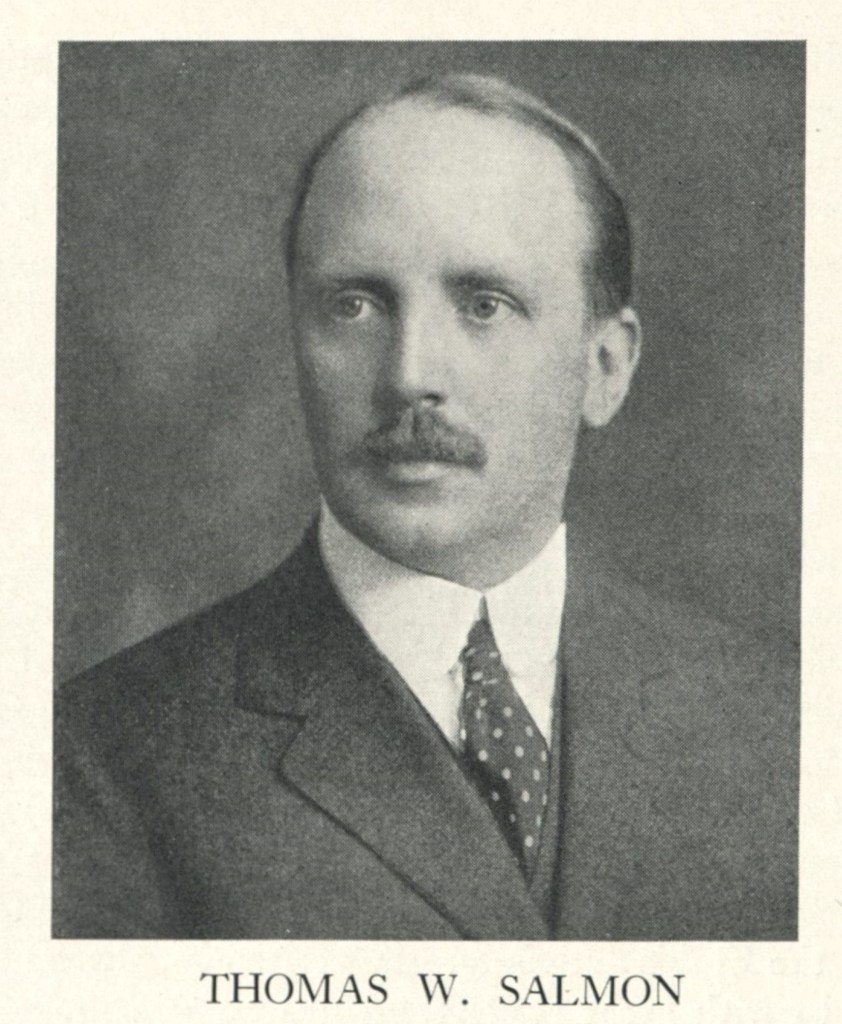
Portrait of Thomas Salmon, from History of the Interurban Clinical Club 1905-1937, edited by David Riesman (1937).

This comparative approach first led me to NYAM records relating to Dr. Thomas Salmon (1876–1927). For those unfamiliar, Salmon was the American Expeditionary Forces’ chief consultant in psychiatry during the First World War. Before this important role, following the country’s entry into the global conflict in 1917, Salmon visited England to study how it dealt with mental wounds during the war to help inform his country’s approach.2 As a leading figure in the US National Hygiene Movement before and after his war service, the records of Salmon’s war experience reflect a relatively progressive military medical official. He regularly stressed the environmental causes of soldiers’ breakdown. In short, Salmon was more inclined to blame combat neurosis and stress on the dehumanising and brutalising effects of war service than citing faulty hereditary genetics, as was more apparent amongst British military officials. This more empathetic outlook continued into Salmon’s advocacy on behalf of veterans following his return to America. Unlike the more reclusive and disillusioned Dr. Charles Myers, the British Army’s leading psychiatric official, Salmon advocated for healthcare and welfare on behalf of the mentally disabled First World War veterans during the initial post-war years. Described by his biographer as a successful ‘spokesman for veterans,’ the force of Salmon’s personality and his effective collaboration with the American Legion help explain why the American mentally ill veteran stopped being admitted into larger public mental hospitals.3 Instead, the US Federal Government established exclusive medical facilities for veterans from the early 1920s onwards.  

Salmon died unexpectedly whilst sailing near Long Island in 1927. Reflecting his prestige amongst his contemporaries, the National Committee for Mental Hygiene, an advocacy organization founded in 1909 by Clifford W. Beers, set up the Salmon Committee on Psychiatry and Mental Hygiene at the New York Academy of Medicine in 1931.4 Regardless, the exclusive medical infrastructure he had helped establish continued to cater to mentally ill First World War veterans into the 1930s. In stark contrast to Britain’s minuscule and dwindling psychiatric infrastructure, the VA provided seventeen neuropsychiatric facilities across its national network of forty-nine hospitals. It offered 10,633 beds for mental ailments, marking a 467% increase over 1921’s availability. The number of beds would be set to increase for the rest of the decade.5 With this exclusive federal medical care program for veterans, the VA published its Medical Bulletin journal throughout the 1930s. Pouring through these issues reveals a lively forum of VA medical officials discussing the continued difficulties of treating veterans during this period.  

Regarding neuropsychiatry—I was struck by how hospital superintendents, nurses, vocational trainers, and social workers regularly articulated a holistic approach to mental healthcare. They cited the psychosocial determinants of health outside of hospital walls. This includes, for example, the detrimental impact of unemployment and poverty on an individual’s mental and bodily health, the emasculating stigma attached to male mental illness, and the potential for harmful self-medication practices such as alcoholism.  

United States Veterans’ Bureau Medical Bulletin (1931), a collection of articles by VA staff and associates dedicated to all aspects of veteran after-care. These various scans come from volume 7.

The materials I reviewed at the NYAM provide a complex and nuanced picture of the post-war treatment of mentally ill World War One veterans. On the one hand, they give an image of an expansive, caring and financially generous veterans’ system. On the other hand, however, they provide comparatively little insight into the personal perspectives of veteran patients to verify the progressive narrative offered by medical officials. In addition, contemporary medical journals reveal increasing resentment from American citizens regarding the spiralling costs of veteran medical care with little in return in terms of cure and recovery.6 This counter-narrative also appears worthy of further research.  

Before arriving in New York, I was unsure how exactly the USA would fit into my larger project of Great War veterans during the Great Depression. However, my time at the NYAM proved incredibly rewarding by revealing how fascinating and unique an American case study is. I look forward to continuing this research into 2025. 

Notes: 

1 Nineteenth Annual Report of the Ministry of Pensions, 1935-1936, 33. 

2 For a write-up of Salmon’s observations and recommendations, see Thomas Salmon, The care and treatment of mental diseases and war neuroses (“shell shock”) in the British Army (War Work Committee of the National Committee for Mental Hygiene, 1917). 

3 E. D. Bond, Thomas W. Salmon: Psychiatrist (W. W. Norton & Co, 1950), 160. 

4 For more information on the Salmon Committee on Psychiatry and Mental Hygiene and its records that are held in the NYAM, see https://www.nyam.org/library/collections-and-resources/archives/finding-aids/ARN-0006.html/ [last accessed 18 November 2024]. 

5 E. O. Crossman and Glenn E. Myers, ‘The neuropsychiatric problem in the US Veterans’ Bureau,’ Journal of the American Medical Association, vol. 94, no. 7 (1930), 473–478. 
6 For example, see the Crossman and Myers article cited above. 

Tracing the Transmission of Early Modern Recipe Knowledge in the New York Academy of Medicine Library

By Sheryl Wombell, University of Cambridge, and the Library’s 2024 Audrey and William H. Helfand Fellow.

In seventeenth-century Europe, knowledge about health and healing was shared with family, friends, and acquaintances. In the case of printed books, wider audiences were reached. A significant subset of these communications took the form of recipes: sets of instructions telling one how to make something. These might be instructions for making medicines in the home, with a range of ingredients from the inexpensive and easily sourced, to the rare and exotic products available due to expanding trade. Or they could be instructions to make culinary formulations, which were interpreted as having an impact on the body’s condition due to the lasting influence of the ancient theory of the four humours. Individual recipes, which could be as short as a line or as long as tens of pages, were gifted, traded, and passed around early modern social networks.

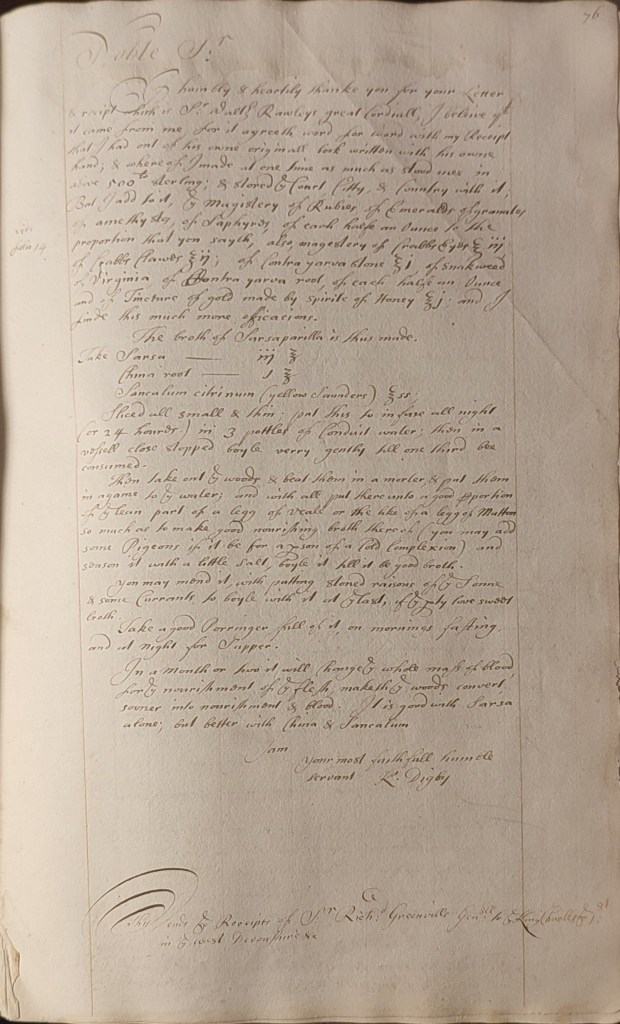
A letter penned by the courtier and privateer Sir Kenelm Digby, likely to Sir Richard Grenville, 1st Baronet of Kilkhampton, demonstrates the mobility of recipes in the mid-seventeenth century.i In it, Digby thanks Grenville for sending him a recipe for ‘Sir Walter Rawleys great Cordiall’ but questions its provenance:

I beleive th[a]t it came from me, for it agreeth word for word with my Receipt that I had out of his owne originall book written with his owne hand; & whereof I made at one time as much as stood mee in above 500 [pounds] sterling; & stored the Court, Citty, & Country with it; But I add to it, the Magistery of Rubies, of Emeralds of granales of amethystes, of Saphyres, of each halfe an Ounce to the proportion that you sayth, also, magestery of Crabbs Eyes [3 oz], of Crabbs Clawes [2 oz]; of Contra yarva stone [1 oz], of snakweed of Virginia, of Contra yarva root, of each halfe an Ounce and of Tincture of gold made by spirite of Honey [1 oz]; and I finde this much more efficacious.

The circular path of recipes that Digby describes – when a recipe he believes to be his own is unwittingly returned to him – is testament to the lively early modern traffic in recipe dissemination and collection.

Fig. 1: Copy of a letter from K. Digby in MS ‘Old Doctor 1690’, f. 76, New York Academy of Medicine Library.

Manuscript collections of recipes survive in archives around the world, and the New York Academy of Medicine Library holds a rich cache of such volumes. Thanks to winning their Helfand Fellowship in 2024, I had the privilege of spending five weeks on a close reading of the early modern medical recipe collections at NYAM. This research forms part of my PhD project, which looks at the mid-seventeenth century production, management, and transmission of knowledge about health and healing amongst exiled and mobile elites, including Digby. While my work to date had focused on three key media – printed medical books, manuscript recipe collections, and consultation letters – somewhat in isolation from each other, at NYAM I had the time and resources to explore the relationships between these formats.

One such connection was the integration of transcribed letters into larger manuscript collections. Digby’s letter, for example, was copied into a large bound volume of recipes, letters, and transcriptions from printed books titled ‘Old Doctor 1690’. But in handling the manuscripts I was also confronted with material traces of transmission. In another manuscript, for example, is a recipe for ‘Costiveness to help’, that is, how to relieve constipation. Next to the instructions are two small, shiny blobs of dried red sealing wax. While this is not conclusive evidence that the recipes on the page were copied into a letter, it does indicate that the notebook lay open while a letter was sealed – and likely written – in its vicinity. Through this tiny physical sign, we learn something of the co-presence of writing and collecting practices across the distinct but interrelated media of letters and recipe books.

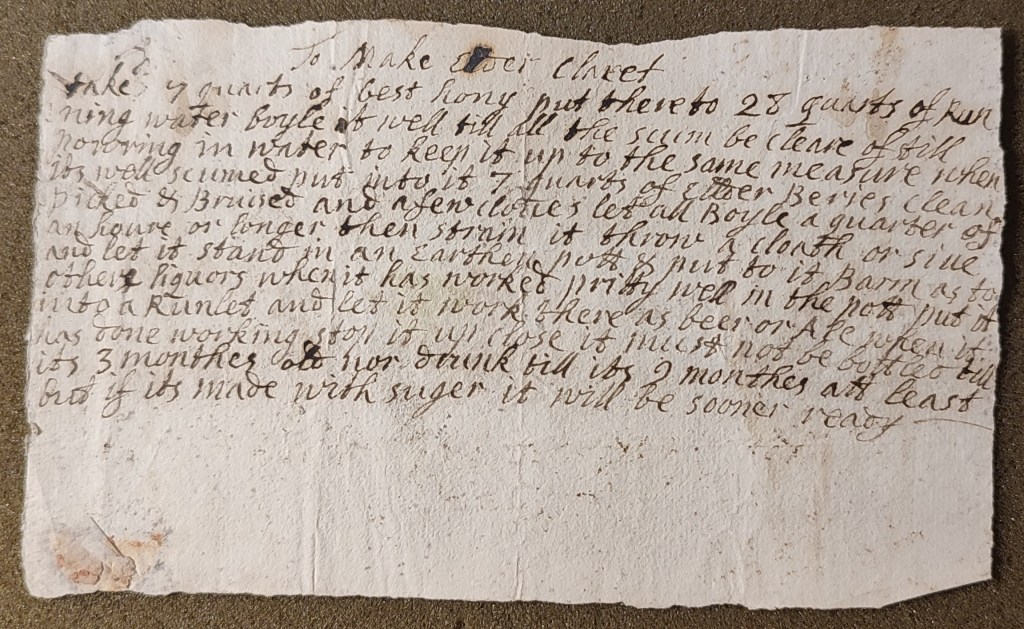
The objects of transmission themselves also appear in these recipe collections. A notebook belonging to Owen Salesbury holds a loose paper slip with instructions ‘To Make Elder Claret’ and sent ‘To Mrs Longford att her hous in Wrexham’. Folded slips could be enclosed in a larger letter, or they could constitute the entire missive. The inclusion of the address on this example suggests the latter. The contents of the slip were not transcribed into the body of the notebook but containing it within the bound volume preserved its knowledge. We don’t know precisely how or when a slip sent – or intended to be sent – to a Mrs Longford ended up in Salesbury’s manuscript, but it offers further evidence of the close connections between ephemeral letter formats and the more durable objects of recipe collections.

Spending time in the NYAM Library’s collections allowed me to get to grips with evidence of early modern recipe transmission. While digitised surrogates of manuscripts have been invaluable in my research, handling these collections has enriched my analysis by bringing their material qualities – size, varying durability, the spatial relationships between their contents, and signs of use – to the fore.

Further Reading:

Ken Albala, Food in Early Modern Europe (London: Bloomsbury Academic, 2003).

James Daybell, The Material Letter in Early Modern England: Manuscript Letters and the Culture and Practice of Letter-Writing, 1512–1635 (Basingstoke: Palgrave Macmillan, 2012).

Elaine Leong, Recipes and Everyday Knowledge: Medicine, Science, and the Household in Early Modern England (Chicago and London: University of Chicago Press, 2018).

Alisha Rankin, ‘Recipes in Early Modern Europe,’ Encyclopedia of the History of Science (2023), https://doi.org/10.34758/fvw2-w336.

Presentations Announced for the Fifth Annual History of Medicine Night: Insights from the Early Modern Period

The New York Academy of Medicine’s Section on History of Medicine will hold the “Fifth Annual History of Medicine Night: Insights from the Early Modern Period” on March 11 from 6:00 pm–7:30 pm at NYAM, 1216 Fifth Avenue at the corner of 103rd Street. Register to attend here.
RBR shelfPresenters will address historical topics relating to medicine with a focus on the Early Modern period.  This year’s presenters are:

Barbara Chubak, MD
Urology Resident (PGY-5), Montefiore Medical Center
“Imagining Sex Change in Early Modern Europe”

Jeffrey M. Levine, MD
Assistant Clinical Professor of Medicine and Palliative Care
Icahn School of Medicine at Mount Sinai
“A Fresh Look at the Historiated Initials in the De Humani Corporis Fabrica”

John E. Jacoby, MD, MPH
Assistant Clinical Professor of Medicine and Pediatrics
Icahn School of Medicine at Mount Sinai
“On the Life of Dr. Robert Levett: The Philosophy of Primary Care”

Nina Samuel, PhD
Center for Literary and Cultural Research
University of Berlin
“The Art of Hand Surgery”

Michelle Laughran, PhD
Associate Professor of History
Saint Joseph’s College of Maine
“The Medical Renaissance among Three Plagues: Epidemic Disease, Heresy and Calumny in Sixteenth-Century Venice”

Sharon Packer, MD
Assistant Clinical Professor of Psychiatry and Behavioral Sciences
Icahn School of Medicine at Mount Sinai
“Epidemic Ergotism, Medieval Mysticism & Future Trends in Palliative Care”

Part two of this lecture series, “History of Medicine Night: 19th– and 20th-Century Stories,” will take place on May 6, 2015.

Who Becomes a Medical Doctor in New York City: Call for Papers

RBR deskThe New York Academy of Medicine’s Section on History of Medicine is pleased to announce “Who Becomes a Medical Doctor in New York City: Then and Now—A Century of Change” to be held on December 11, 2014 from 6:00 pm–7:30 pm. The event will take place at the Academy, located at 1216 Fifth Avenue at the corner of 103rd Street.

We are inviting all those interested in presenting to submit an abstract with one aspect of how individuals were selected, or excluded from, the study of medicine in New York City over time. These might include, but need not be limited to, decisions based on academic qualification, race, sexual orientation, ethnicity, economics, and country of origin. The influence of career expectations for the profession and social and cultural factors motivating individuals to become a medical doctor may also be considered.

Note the following submission requirements:

  • Applications must include an abstract, with a 250-word maximum, and this form.
  • Abstracts must be submitted no later than October 30, 2014

The time allotted for presentation is 12 minutes with an additional 3 minutes for questions/discussion. Papers selected for presentation will be determined by a committee of History of Medicine Section members and staff of The New York Academy of Medicine.

Abstracts should be submitted electronically to Suhani Parikh at sparikh@nyam.org.  Questions may be directed to Suhani via email or phone (212-419-3544).

History Night Presentations Announced

The New York Academy of Medicine’s Section on History of Medicine will hold the “Fourth Annual History of Medicine Night – Part One: Spotlight on New York” on February 6 from 6:00 pm–7:30 pm at NYAM, 1216 Fifth Avenue at the corner of 103rd Street. Register to attend here. A second evening of presentations is being planned for spring.

RBR deskThe night will feature the following presentations, as described by the speakers:

“Psychiatric Criminology in the Eugenic Era: The New York Police Psychopathic Laboratory, 1915-1929”
Sara Bergstresser, M.P.H., Ph.D., Columbia University, Bioethics

“First, I explore the historical background of North American and European psychiatry, criminology, and eugenics in the nineteenth century, including threads of early convergence. Next, I examine the development of eugenic psychiatry and its intersections with eugenic criminology, with a particular emphasis on New York State in the early twentieth century. I then present a case study from that time period, which is based primarily on materials from the archives of the New York Police Psychopathic Laboratory. I go on to argue that in this case the workings of psychiatric criminology were more eclectic and uncertain than they may otherwise appear based on broad descriptions of the eugenic era.”

“Not for Self but Others: The Presbyterian Hospital Goes to War”
Pascal J. de Caprariis, M.D., Lutheran Medical Center

“On March 11, 1940 the U.S. Surgeon General reached out to Presbyterian Hospital’s medical board president to develop a military hospital to support US troops in an eventual war. Structured to receive patients from combat areas and follow American troops throughout war, it was to provide complex medical and surgical care over the course of three years and two months abroad.”

“The Cancer Education Campaigns in Progressive Era New York City: The Role of Women”
Elaine Schattner, M.A., M.D., F.A.C.P., Weill Cornell Medical College

“At the start of the 20th century, myths about cancer’s causes and treatments were widespread. Fear of the disease—and of inept surgeons—was rampant. Many afflicted fell prey to hoaxers selling bogus salves, patent medicines and painless “cures.” In April 1913, a prominent New York City surgeon and gynecologist, Dr. Clement Cleveland, invited a group of well-to-do ladies, bankers and physicians to his home. They heard from statisticians and public health specialists, and considered what might be done to reduce cancer’s mounting toll. The group met formally again in June 1913 at the Harvard Club in New York City. They formed the American Society for the Control of Cancer (ASCC), which three decades later became the American Cancer Society.”

“A Diagnosis of Philanthropy: Carnegie and Rockefeller and the Medical Profession”
Catherine (Katia) Sokoloff, Sarah Lawrence College

“Through exploring the evolving interests of Andrew Carnegie and John D. Rockefeller during the Progressive Era, this paper unearths how these philanthropists and their advisers facilitated and funded the writing of the infamous Flexner Report in 1910. The report, also called Bulletin Number Four, exposed the inadequacies of medical schools and catalyzed dramatic education reforms.”

“Organizing Orthopaedic Societies in New York City in the 1880s: The New York Orthopaedic Society, the New York Academy of Medicine Section of Orthopaedic Surgery and the American Orthopaedic Association”
Jonathan B. Ticker, M.D., College of Physicians and Surgeons, Columbia University

“After the seventh general meeting of the New York Orthopaedic Society (NYOS) on January 4, 1886, steps were taken to merge NYOS into a section of the New York Academy of Medicine (NYAM). Thus, on January 29, 1886, NYOS adjourned and the NYAM Section of Orthopaedic Surgery began. On January 29th, 1887, the chairman of the Section and 15 others “[met] and [discussed] the organization of a national orthopaedic society.” This led to the founding of the American Orthopaedic Association (AOA).”

History Night: Call for Papers

RBR desk

The New York Academy of Medicine’s Section on History of Medicine is pleased to announce its Annual History of Medicine night to be held on February 6, 2014 from 6:00 pm–7:30 pm. The event will take place at the Academy, located at 1216 Fifth Avenue at the corner of 103rd Street.

We are inviting all those interested in presenting to submit a narrative on a historical subject relating to medicine for consideration.

Note the following submission requirements:

  • Applications must include an abstract, with a  500-word maximum, and this form
  • Abstracts must be submitted no later than January 15, 2014

The time allotted for presentation is 12 minutes with an additional 3 minutes for questions/discussion. Papers selected for presentation will be determined by a panel of History of Medicine Section members.

Abstracts should be submitted electronically to Donna Fingerhut at dfingerhut@nyam.org.  Questions may be directed to Donna via email or phone (212-419-3645).

Rehousing the Diploma Collection

Today’s post was written by the 2013 Gladys Brooks Conservation Intern, Caroline Evans.

The diploma collection at The New York Academy of Medicine contains over eight hundred certificates, diplomas, seals and proclamations granted by universities, professional societies and institutions across a wide geographical span. The items in the collection range from the mid-eighteenth century up to the late twentieth century. The diplomas were the subjects of a major collections care project carried out in the Gladys Brooks Book and Paper Conservation Lab by Caroline Evans (summer intern), with the assistance of Emily Moyer (Collections Care Assistant) and Allie Rosenthal (volunteer).

Piles of diplomas to be sorted, cleaned, and housed.

Piles of diplomas to be sorted, cleaned, and housed.

While most of the earlier diplomas are printed or written on parchment and display elaborate calligraphy, many of the later items in the collection are printed on paper. The diplomas can provide a glimpse into the changing methods of printing during this period, as well as into the preservation needs of flat paper—in some cases, for instance, some of the ink in the signatures had begun to flake, and seals on parchment were cracked. In addition to dry cleaning the diplomas and making the appropriate efforts to stabilize each of these items, we constructed folders and housing for each diploma or seal before sorting them by size, date, and granting institution.

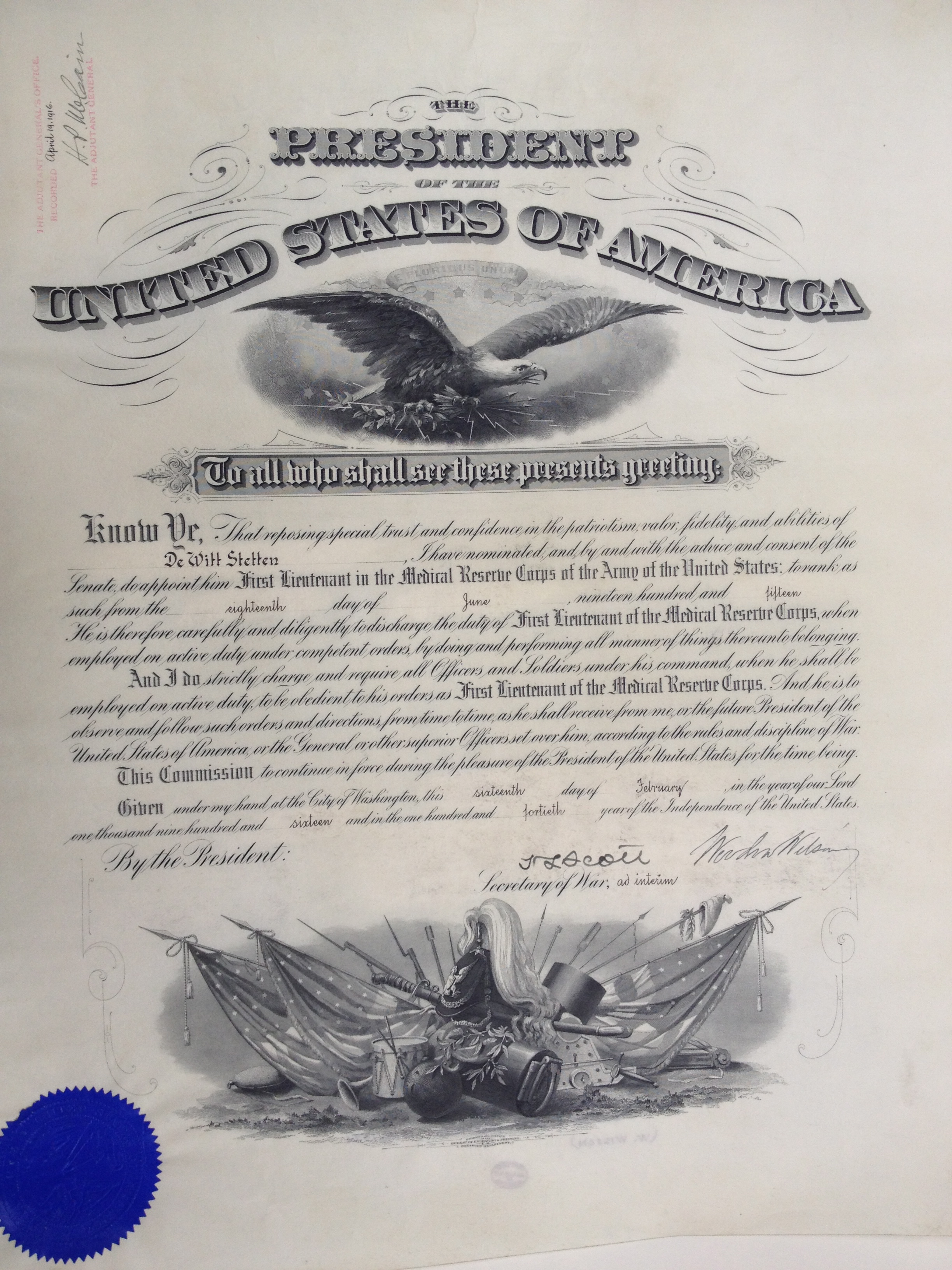
Over the course of this undertaking, some gems emerged—documents significant to the history of the Academy and to the history of medicine. Among these are certificates nominating and appointing military ranks to fellows of the Academy and other doctors serving in wartime. In addition to signatures from the “Secretary of War”, many of these documents boast signatures from various Presidents of the United States. Indeed, while sorting through the collection, we encountered wartime documents—appointments or commendations thanking military doctors for their service—with signatures from Presidents Abraham Lincoln, Andrew Jackson, Andrew Johnson, Herbert Hoover, William Howard Taft, Woodrow Wilson, and Warren G. Harding, to name a few.

Certificate signed by Woodrow Wilson.

Certificate signed by Woodrow Wilson.

Certificate signed by Andrew Johnson.

Certificate signed by Andrew Johnson.

Certificate signed by Abraham Lincoln.

Certificate signed by Abraham Lincoln.

Occasionally found tacked onto the back of certificates and acknowledgments of service were documents indicating the intersection of military service and medical research—for example, a letter from Walter Reed Hospital to a soldier encouraging him to participate in a study on the effect of injections of yellow fever. There are also a significant number of female medical professionals whose successes and contributions to the field of medicine and women’s health are commemorated in the collection. Some of these awards and diplomas are dated as early as the nineteenth century.

Photographs of Howard and Edith Lilienthal attached to a certificate

Photographs of Howard and Edith Lilienthal attached to a passport.

The diploma collection contains items printed in French, Portuguese, Hungarian, Latin, Hebrew and Arabic that display a variety of design styles.  One particularly beautiful certificate from 1945 was granted by the Société Impériale de Médecine de Constantinople, written in Arabic on thin paper with gold leaf.

Certificate in Arabic with gold ornament

Certificate in Arabic with gold ornament

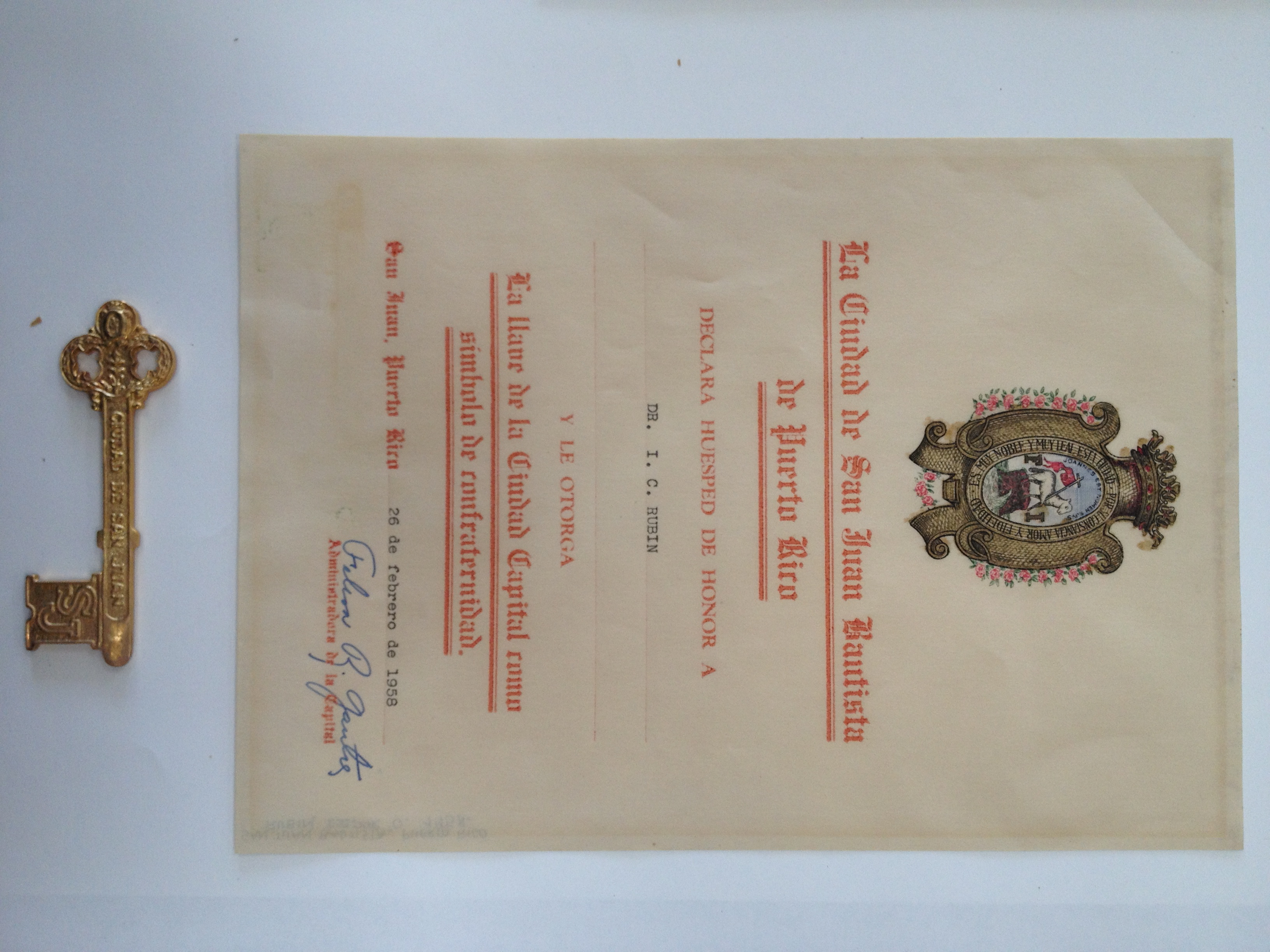
Key to the City of San Juan Batista, granted to Isidor Rubin.

Key to the City of San Juan Batista, granted to Isidor Rubin.

Some more recent certificates are printed in color, with hand-colored borders and modern, stylized type. The diplomas on paper were a special challenge to clean and house, as many of the papers had become brittle or were adhered to acidic backings. This allowed the aspiring conservators interning and volunteering in the lab ample practice with paper repair. Diplomas printed on vellum provided their own challenges, however, as humidity fluctuations over time caused some of the works to curl and stretch, obscuring and fading labels and printed text.

Repairing paper certificates in the conservation lab.

Repairing paper certificates in the conservation lab.

These challenges, in addition to the diverse languages present in the collection, necessitated some additional investigation for the creation of new labels for each item. In the end, though, the lab was able to create a location guide with the identifying information for each sorted, cleaned, and re-housed object, so that the diploma collection will be accessible well into the future.

A certificate and seal, re-housed.

A certificate and seal, re-housed.

Remmelin’s Dissectible Cosmic Anatomical Extravaganza: Guest post by Morbid Anatomy

Johan Remmelin (1583–1632) was town physician of Ulm and Plague physician of Augsberg. He was also the man behind both the concept and the original drawings (engraved by Lucas Kilian) for the ingenious moving-parts anatomical extravaganza Catoptrum microcosmicum, published in 1619, with numerous editions in many languages thereafter.  NYAM has both the 1619 and a 1639 edition in its rare book collection

title

This astounding book—in which flaps of paper can be drawn back to virtually dissect the human body—features a heady blend of the anatomical, the theological, and the metaphysical, beautifully expressing the worldview of Natural Philosophy, that precursor to science, which oversaw investigations into the human body in the early modern era. In this worldview, God and man, metaphor and the encountered world, were indivisible; the human being was the microcosm of all creation, so to understand the secrets of the human body would be to know the mind of God. Accordingly, as explained by Martin Kemp and Marina Wallace in their book Spectacular Bodies:

The purpose of anatomical images during the period from the Renaissance to the nineteenth century had as much to do with what we would call aesthetic and theological understanding as with the narrower intentions of medical illustration as now understood. . . .They were not simply instructional diagrams for the doctor technician, but statements about the nature of human beings as made by God in the context of the created world as a whole [as well as] the nature of life and death. . . .

It should not be surprising, then, that the dissectible humans herein are inextricably entwined with images of Jesus Christ (image 9,17); memento mori mottos (16) and imagery (images 12, 17); allusions to God and the angels (image 1); and even the head of the devil, serving as a kind of fig leaf covering the female sex organs in one instance (image 2). There are also numerous biblical references, including a serpent slithering through a human skull holding a branch from the tree of knowledge in its mouth (image 13), lest we forget that original sin introduced death and disease into our world in the first place; without it, we would still be luxuriating in Eden with no need for medicine, or, by extension, books such as this one. The book also contains the occasional inadvertent (?) eroticism, as the peeling back of obscuring layers brings you, in a sort of pre-modern striptease, to the unveiled sexual organs below (image 14 and 15).

If you page through all of the images below, you will get a sense of the carnivalesque exuberance and dynamism of this book; you can also virtually dissect them yourself by clicking here, or here, compliments of The Hardin Library of The University of Iowa, which was also a source for much of the factual content of this piece.

This post was written by Joanna Ebenstein of the Morbid Anatomy blog, library and event series; click here to find out more. All images are my own, photographed at the New York Academy of Medicine.