“A Passionate Statistician”: Florence Nightingale and the Numbers Game

In conjunction with its exhibit, “Extraordinary Women in Science & Medicine: Four Centuries of Achievement,” the Grolier Club is holding a symposium on October 26, 2013, to which all are welcome. The exhibition and symposium explore the contributions of 32 women, one being Florence Nightingale, to science and medicine. The exhibition features NYAM’s copy of one of Nightingale’s statistical charts. In today’s blog post, Natasha McEnroe, director of London’s Florence Nightingale Museum, explains their significance.

Florence Nightingale. Reproduced by courtesy of the Florence Nightingale Museum.

Florence Nightingale. Reproduced by courtesy of the Florence Nightingale Museum.

The Victorians loved nothing better than to measure and classify, trying to discover natural laws through the data they recorded, and Florence Nightingale (1820-1910) was no exception in sharing this general enthusiasm. Having gained celebrity status from her nursing work at the infamous Barracks Hospital at Scutari, the British base hospital in the Crimean War (1853-1856), Nightingale returned to England with her health permanently broken down. Determined that the appalling treatment of the soldiers during the war should not be repeated, she spent the rest of her life conducting a political campaign for health reform from her bedroom. One of the ways her campaigning was groundbreaking was in the use of statistics.

Reproduced by courtesy of the Florence Nightingale Museum.

St Thomas’ Hospital, London, home of the Nightingale Training School for nurses. Reproduced courtesy of the Florence Nightingale Museum.

Nightingale’s love of mathematics was apparent from an early age and was an interest  encouraged by her father, who took the responsibility of educating his daughters into his own hands. Her parents’ social circle brought the young Nightingale into contact with many of the most brilliant minds of the age, including Charles Babbage, whose own passion for numbers (and not a little pedantry) is shown in a letter to Alfred Tennyson in response to the poem The Vision of Sin:

‘In your otherwise beautiful poem, one verse reads,
Every moment dies a man,
Every moment one is born.

…If this were true, the population of the world would be at a standstill. In truth, the rate of birth is slightly in excess of that of death. I would suggest that the next version of your poem should read:
Every moment dies a man,
Every moment 1 1/16 is born.
Strictly speaking, the actual figure is so long I cannot get it into a line, but I believe the figure 1 1/16 will be sufficiently accurate for poetry.’

Just weeks after her return from the Crimean War in 1856, Nightingale secured a Royal Commission from Queen Victoria investigating the health of the British Army. Nightingale herself was involved in every step of the Commission’s investigations, working with the statistician William Farr to illustrate graphically that more British troops died of disease during the war than in battle. Farr encouraged Nightingale to compare statistics on mortality rates of civilians with that of soldiers, showing that whether at war or at home, soldiers demonstrated a higher mortality rate.  He wrote to Nightingale, “This I know…Numbers teach us whether the world is ill or well governed.”  Nightingale pioneered what is now called evidence-based healthcare and in 1858 she was the first woman elected to the Royal Statistical Society.

Chart from Florence Nightingale’s A contribution to the sanitary history of the British army during the late war with Russia (London, 1859)

Chart from NYAM’s copy of Florence Nightingale’s A contribution to the sanitary history of the British army during the late war with Russia (London, 1859).

A devout woman, Nightingale saw statistics as having a spiritual aspect as well as being the most important science, and believed statistics helped us to understand God’s word. Influenced by the ethos of Victorian vital statistics, her greatest legacy can be seen in improved public health, reformed nursing education, and in her innovative polar area graphs and other work in statistics. In Nightingale, this most eminent of Victorians, we can see the combination of the two great passions of her age—a compulsion to classify and a desire to improve by reform. What made Nightingale remarkable were the personal qualities of fierce intelligence and energy that enabled her to pursue these passions with the immense determination for which she was famed.

Thank You! Festival of Medical History and the Arts Wrap-Up

By Lisa O’Sullivan, Director, Center for the History of Medicine and Public Health

Whew!

Our first Festival of Medical History and the Arts was a great success; more than 1,000 people attended and responded enthusiastically to our mix of talks, demos, films, etc. Now that we have had a chance to draw breath, here are a few details from the day:

It’s hard to pick highlights, although of course Dr. Oliver Sacks speaking about his intellectual influences and the patients who inspired his Awakenings was hugely exciting for all of us. We are grateful to Dr Sacks and all the speakers who came and shared their knowledge.

Our guest curators did an amazing job. Lawrence Weschler’s Wonder Cabinet started with a (big) bang, a banjo-accompanied cosmic/neuronal slapdown, and ended with fascinating insights from Riva Lehrer into how an artist’s body can affect her art and her anatomy teaching. In between, spectators had the chance to get a glimpse into the experience of having an epileptic fit; share anatomical adventures; and witness some cringe-inducing treatments suffered by monarchs through the ages.

The cosmic/neuronal smackdown.

The cosmic/neuronal smackdown. Photo by Amy Hart.

Joanna Ebenstein’s Morbid Anatomy presentation of 12(!) talks throughout the day were standing-room only, forcing us to move to a larger room, which filled up just as quickly. The day started with Mexican traditions around death, took a detour to human zoos, wax anatomical models, medical library pleasures, memento mori, and skull theft before ending with the little-discussed practice of bookbinding with human skin.

Sigrid Sarda gives a medical wax moulage demonstration.

Sigrid Sarda gives a medical wax moulage demonstration. Photo by Amy Hart.

Our conservation team prepared a wonderful exhibit of models demonstrating development of the book over time (no human skin involved), as well as a whimsical look at the life of miniature books. We put highlights from our collections on display, and welcomed visitors to our conservation laboratory. Meanwhile, visitors could learn the art of making anatomical wax moulage and see Gene Kelly struggle with combat fatigue.  And the after party cocktails and cartoons were just the things needed to wind down after the long day.

Cocktails and cartoons at the after party.

Cocktails and cartoons at the after party. Photo by Amy Hart.

With so many people, some events did fill up. Particular apologies to those who couldn’t make it on a behind-the-scenes tour. With such overwhelming demand, we’re planning to make them a much more regular feature, so if you missed out you’ll get another chance at a future event. Our two anatomical workshops were also full; for those of you in New York, we are investigating offering courses on a more regular basis, so please let us know if you are interested!

A tour of the Gladys Brooks Book & Paper Conservation Laboratory. Photo by Amy Hart.

A tour of the Gladys Brooks Book & Paper Conservation Laboratory. Photo by Amy Hart.

Pictures from the day are up on our Facebook page, and winners of the caption competition and the raffle will be announced soon.  Meanwhile, keep an eye out for more details of our Performing Medicine mini-fest, coming in the spring. Hope to see you then, if not before for some of our stand-alone events!

Winsome Fetal Skeletons Bearing Scythes: Monro’s Traité d’ostéologie of 1759: Guest post by Morbid Anatomy

A note from the Center for the History of Medicine & Public Health: This is the last post in Morbid Anatomy‘s guest series leading up to our Festival of Medical History and the Arts. If you’ve enjoyed these posts as much as we have, don’t despair! Tomorrow’s event holds a full day of lectures and activities from Morbid Anatomy, Lawrence Weschler, and the Center. We hope you can make it! See the full schedule here.

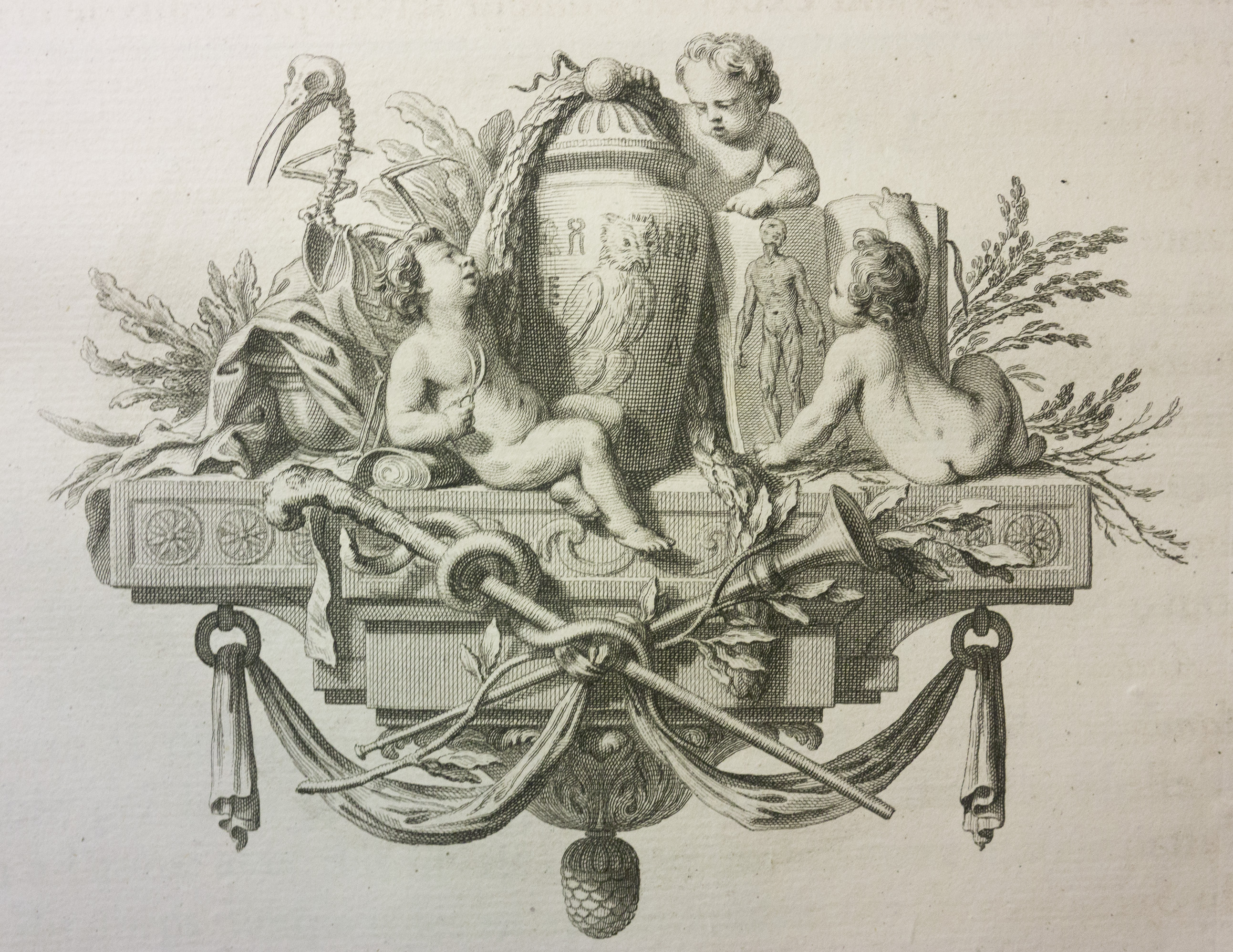
FrontispieceThe NYAM rare book collection holds a gorgeous copy of the first French edition of Alexander Monro’s (1697–1767) celebrated Traité d’ostéologie (or “Anatomy of Bones”). Monro was trained in London, Paris, and Leiden before going on to become the first professor of anatomy at the newly established University of Edinburgh. It was under his leadership, and that of his successors, that the school went on to become a renowned center of medical learning.

Monro originally published this book without images, thinking them unnecessary after William Cheselden’s lavishly heavily-illustrated Osteographia, or the anatomy of the bones of 1733 (more on that book at this recent post). The very fine copperplates you see here were added to the French edition by its translator, the anatomist Jean-Joseph Sue (1710–1792).

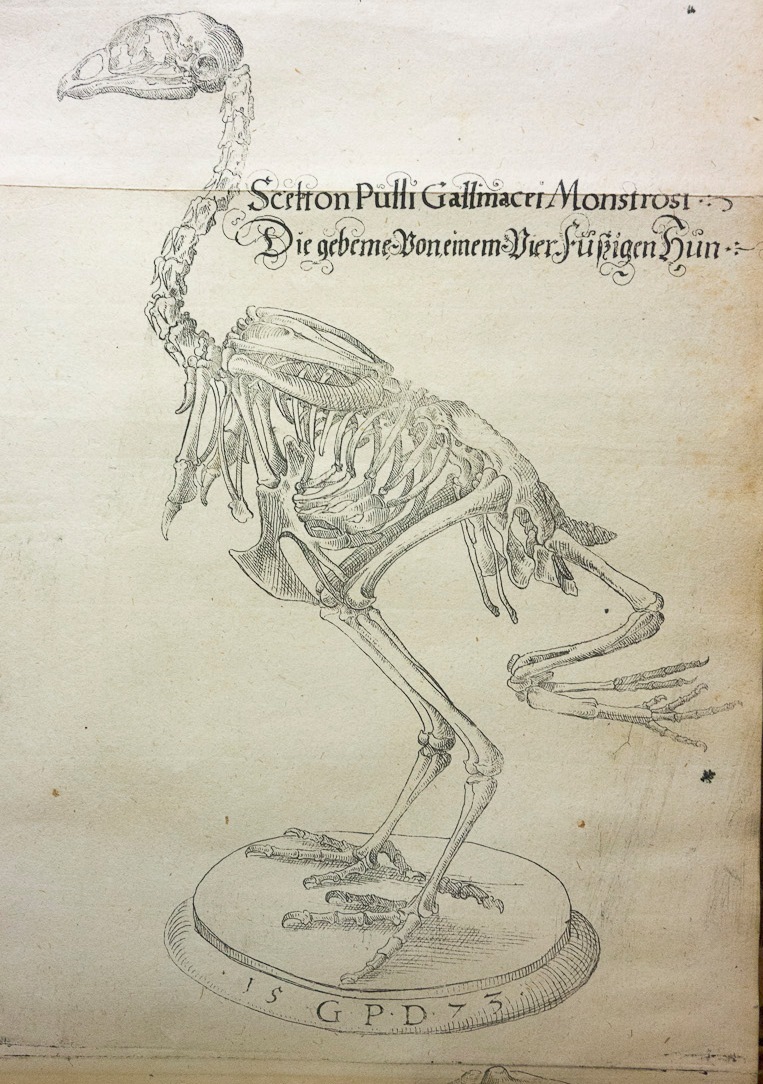
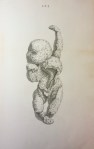
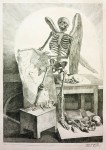
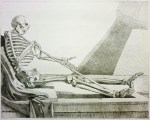
My favorite image in the book is a kind of memento mori–themed tableau morte of winsome, scythe-bearing fetal skeletons enigmatically arranged in a funereal landscape (images 1–3). I also love the frontispiece in which a group of plump putti proffer anatomical atlases and dissecting tools under the oversight of a skeletal bird (above).

This post was written by Joanna Ebenstein of the Morbid Anatomy blog, library and event series; click here to find out more. All images are my own, photographed at the New York Academy of Medicine.

A Renaissance Man at Work: Volcher Coiter’s “Externarum et internarum principalium humani corporis” of 1573: Guest post by Morbid Anatomy

Coiter2


Coiter10

One under-seen and fascinating book to be found in the NYAM rare book collection is Externarum et internarum principalium humani corporis partium tabulae published by Dutch Renaissance man Volcher Coiter (1534–1576) in 1573. Not only was Coiter renowned as an anatomist, surgeon, and physician accomplished in the fields of physiology, ornithology, and embryology; not only did he establish the study of comparative osteology and describe cerebrospinal meningitis before any of his peers; he was also an artist, and signed many of the finely drawn copper engravings in his books, including those you see here.


All images are my own, photographed at the New York Academy of Medicine, save the painted portrait of Coiter, which was sourced here. The caption, attributed to Dorothy M. Schullian, reads: “Coiter’s portrait (1575) in oils, attributed to Nicolas Neufchatel and representing him demonstrating the muscles of the arm, with the écorché he had constructed on his left and a shelf of medical classics behind him, is preserved in the Germanisches Nationalmuseum, at Nuremberg; there are later portraits at Weimar and Amsterdam.” (source for caption here)

Sources: Lessico Volcher CoiterWikipedia

This post was written by Joanna Ebenstein of the Morbid Anatomy blog, library and event series; click here to find out more.

Remmelin’s Dissectible Cosmic Anatomical Extravaganza: Guest post by Morbid Anatomy

Johan Remmelin (1583–1632) was town physician of Ulm and Plague physician of Augsberg. He was also the man behind both the concept and the original drawings (engraved by Lucas Kilian) for the ingenious moving-parts anatomical extravaganza Catoptrum microcosmicum, published in 1619, with numerous editions in many languages thereafter.  NYAM has both the 1619 and a 1639 edition in its rare book collection

title

This astounding book—in which flaps of paper can be drawn back to virtually dissect the human body—features a heady blend of the anatomical, the theological, and the metaphysical, beautifully expressing the worldview of Natural Philosophy, that precursor to science, which oversaw investigations into the human body in the early modern era. In this worldview, God and man, metaphor and the encountered world, were indivisible; the human being was the microcosm of all creation, so to understand the secrets of the human body would be to know the mind of God. Accordingly, as explained by Martin Kemp and Marina Wallace in their book Spectacular Bodies:

The purpose of anatomical images during the period from the Renaissance to the nineteenth century had as much to do with what we would call aesthetic and theological understanding as with the narrower intentions of medical illustration as now understood. . . .They were not simply instructional diagrams for the doctor technician, but statements about the nature of human beings as made by God in the context of the created world as a whole [as well as] the nature of life and death. . . .

It should not be surprising, then, that the dissectible humans herein are inextricably entwined with images of Jesus Christ (image 9,17); memento mori mottos (16) and imagery (images 12, 17); allusions to God and the angels (image 1); and even the head of the devil, serving as a kind of fig leaf covering the female sex organs in one instance (image 2). There are also numerous biblical references, including a serpent slithering through a human skull holding a branch from the tree of knowledge in its mouth (image 13), lest we forget that original sin introduced death and disease into our world in the first place; without it, we would still be luxuriating in Eden with no need for medicine, or, by extension, books such as this one. The book also contains the occasional inadvertent (?) eroticism, as the peeling back of obscuring layers brings you, in a sort of pre-modern striptease, to the unveiled sexual organs below (image 14 and 15).

If you page through all of the images below, you will get a sense of the carnivalesque exuberance and dynamism of this book; you can also virtually dissect them yourself by clicking here, or here, compliments of The Hardin Library of The University of Iowa, which was also a source for much of the factual content of this piece.

This post was written by Joanna Ebenstein of the Morbid Anatomy blog, library and event series; click here to find out more. All images are my own, photographed at the New York Academy of Medicine.

William Cowper’s Myotomia reformata: or an anatomical treatise on the muscles of the human body, Guest Post by Morbid Anatomy

Cowper01

William Cowper (c. 1666–1709) was a British surgeon and anatomist best known today for describing “Cowper’s Gland,” part of the genito-urinary system. He has also been described by at least one scholar as “the first of the surgeon-scientists of Great Britain… the first to bring the power of the experimental method to bear on practical surgical problems… [anticipating] the celebrated Hunterian school of surgery by more than half a century.” (In the last half of the 18th century, famous London surgeon John Hunter made his reputation in part by advocating for the scientific method in medicine.)

Cowper02

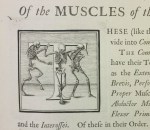
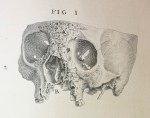
Cowper’s book Myotomia reformata: or an anatomical treatise on the muscles of the human body, first published in 1694 (NYAM’s copy is from 1724), is filled with grimly literal anatomical and dissection-themed initial capital letters, and charming, if somewhat rough, illustrations.

This post was written by Joanna Ebenstein of the Morbid Anatomy blog, library and event series; click here to find out more.

William Cheselden’s Memento Mori and Skeletons at Prayer: Guest Post by Morbid Anatomy

Cheselden 1

Cheselden 1

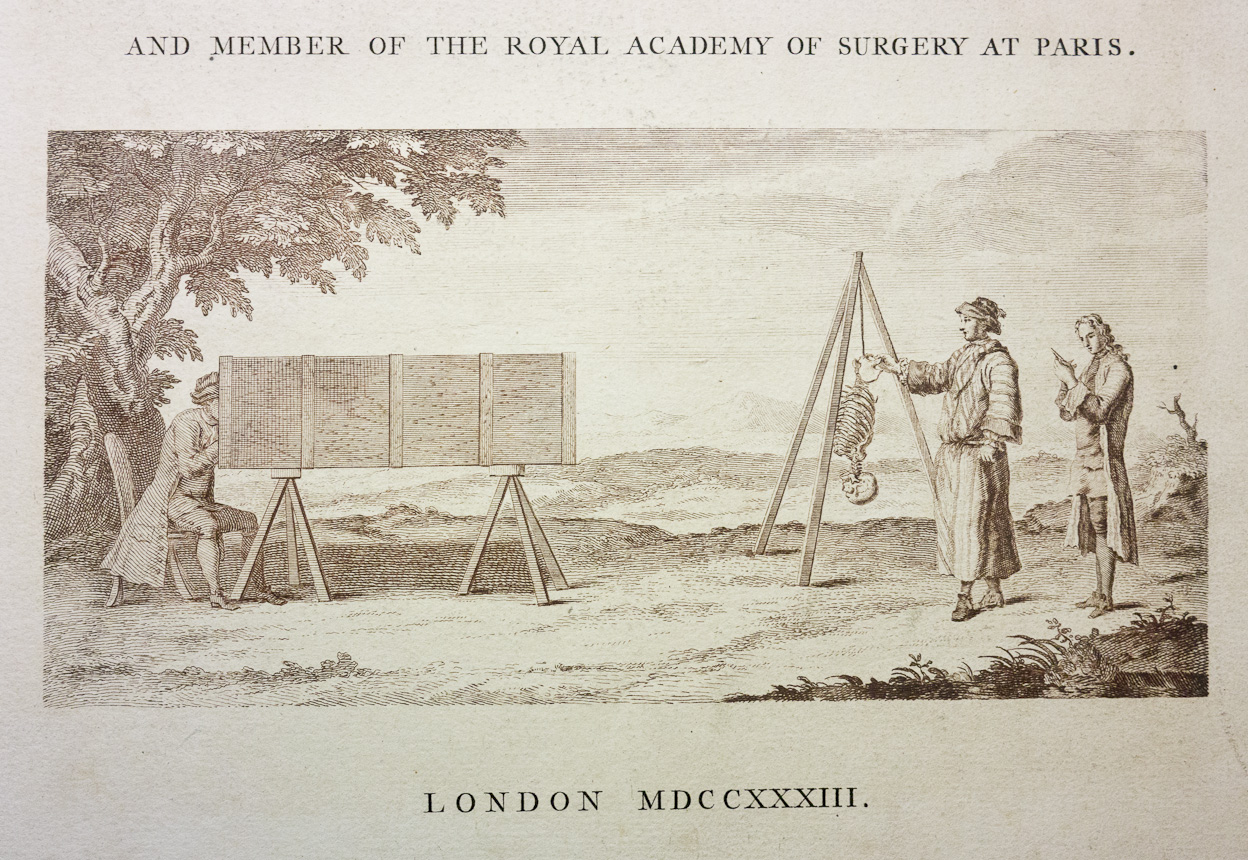
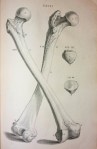
William Cheselden (1688–1752) is remembered today as one of the greatest English surgeons; he was surgeon to Queen Caroline, wife of King George II, to whom he dedicated the wonderful, epically scaled book Osteographia, or the anatomy of the bones  (1733), which is described by the NYAM Library as “one of the finest of English works containing anatomic illustrations.” The copperplate images were done by Cheselden and his engravers, Gerard van der Gucht and Mr. Shinevoet, with the use of the camera obscura—a pre-photographic drawing aid; this is delightfully alluded to in this wonderful image featured on the title page (images 1 & 2) .

Cheselden 2

Cheselden 2

The book is best known for its large scale and exquisite renderings of skeletons brandishing bones (image 3); leaning on skulls (image 4); with “the same proportions with the venus de Medicis” (image 5); “in the same proportions and attitude with the Belvidere Apollo” (image 6); or, most famously of all, “the side view of the skeleton of a very robust man” at prayer (image 7).

Less seen—yet equally delightful—are the wonderfully imaginative anatomically-themed initial capital letters (8-12); the playful chapter openers (13-19); the memento-mori themed end piece (30); and delicately exquisite animal skeletons (20-22) which fill the book. Despite—or perhaps because of—these luxurious touches, this large-scale atlas was a financial failure.

This post was written by Joanna Ebenstein of the Morbid Anatomy blog, library and event series; click here to find out more.

Jacques Gamelin’s Marauding Skeletons and Écorché Crucifixions: Guest Post by Morbid Anatomy

Gamelin 1

Gamelin 1

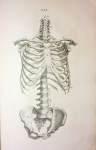
I was so excited to finally have the opportunity to pore over a book in the NYAM collection which I had long admired from afar: Jacques Gamelin‘s beautiful and lavish Nouveau recueil d’osteologie et de myologie (“New collection of osteology and mycology”) of 1779. This book, as explained to me by Arlene Shaner—acting curator and reference librarian for historical collections, at NYAM—was intended as a large scale, deluxe manual for artists interested in understanding human anatomy in order to create more convincing depictions of human figures.

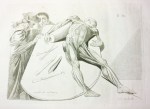
The meat of the book, as it were, is a collection of extremely virtuosic anatomical renderings (12-15) showing skinned—or écorché—human figures in a variety of poses. But what is much more interesting—at least to me—is the assortment of animated skeletons which fill the opening pages; these fanciful figures are engaging in such activities as waking up in a cemetery to the trumpet of the resurrection (text reading: surgite mortui venite ad judicium, or “Rise up, come to the judgment of the dead”; image 6); brandishing anatomical drawings in what looks to be a dissection room littered with bones (3); and raping and pillaging the parties of fashionably bewigged lords and ladies (9, 10). I am also very drawn images playing on biblical themes, such as a calm Saint Bartholomew being flayed alive (an old staple of anatomical illustration; image 11), and a skinned and anatomized Christ on the cross (12) which evokes this more literal rendition, cast from a convicted murderer just a few decades after this book was published.
Interestingly, Gamelin is best remembered today not for this book, but as a painter and engraver of battle scenes, genre scenes, and portraits. He dedicated this book to his mentor, a certain Baron de Puymaurin (image 1 and 2), who had recognized Gamelin’s artistic abilities and funded his training when his father refused to do so. It is thought that Gamelin funded the book himself after inheriting a great deal of money upon his father’s death, which perhaps accounts for its delightful eccentricity.

This post was written by Joanna Ebenstein of the Morbid Anatomy blog, library and event series; click here to find out more.

17th Century Anatomical Striptease: Guest Post by Morbid Anatomy

Tab VI

Another series of most wonderful and enigmatic anatomical illustrations in the New York Academy of Medicine historical library collections are to be found in De humani corporis fabrica libri decem, tabulis XCIIX aeri incisis … exornati … Opus posthumum and Tabulae anatomicae (Venice, 1627) by Adriaan van de Spiegel (1578–1625), Giulio Cesare Casserio (1533–1616), and Daniel Bucretius (d. 1631). In this complex effort, van de Spiegel produced the text; Casserio commissioned the plates (for his own unrealized work); and the whole was published through the editorial offices of Bucretius, after both van de Spiegel and Casserio had died.
Tab XVI

These illustrations are described beautifully by Michael Sappol in the exhibition text for his National Library of Medicine exhibition  “Dream Anatomy” where he placed them under the header “Show-off Cadavers” and described them thusly:

The emergence of anatomical illustration in the period 1500-1750 coincided with a larger phenomenon, a new definition of personhood that was performed at court, in salons, coffeehouses, country estates, theaters, marketplaces, and at court. Inevitably anatomists took up, commented on, and played with, the contemporary obsession with self-fashioning and individuality—it was an era of manners, wit, foppishness, and coquetry. In the works of Giulio Casserio, John Browne and Pietro da Cortona, the illustrated anatomy book is a stage featuring posing, prancing cadavers. Animated with an exuberant vitality, the corpses perform an anatomical show for the reader’s gaze.
The images in this post are from the Tabulae anatomicae and show the anatomized body engaging in a sort of exuberant anatomical striptease. All images are drawn from the National Library of Medicine’s brilliant online exhibition Dream Anatomy; click on the exhibition name to see more!

Tab XV

Michael Sappol will be both speaking and screening films from the National Library of Medicine as part of the October 5th NYAM Festival of Medical History & the Arts; more on that here. Hope very much to see you there!

This post was written by Joanna Ebenstein of the Morbid Anatomy blog, library and event series; click here to find out more.

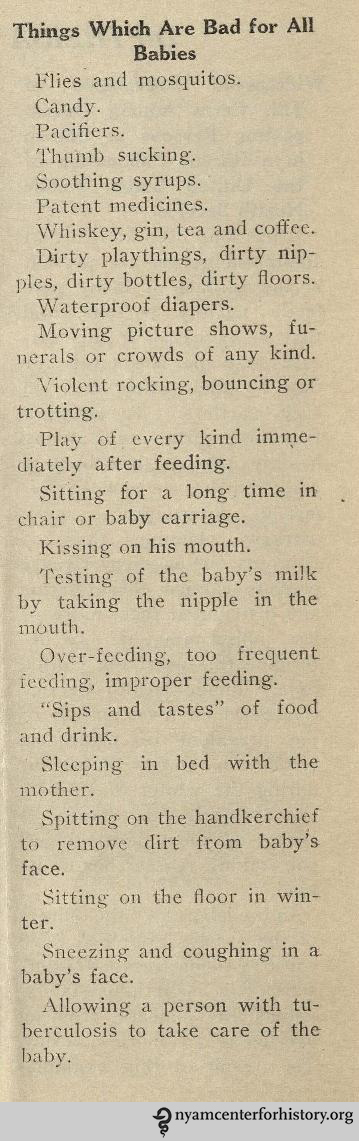
Item of the Month: “Better Babies” on Things Which Are Bad For All Babies

By Johanna Goldberg, Information Services Librarian

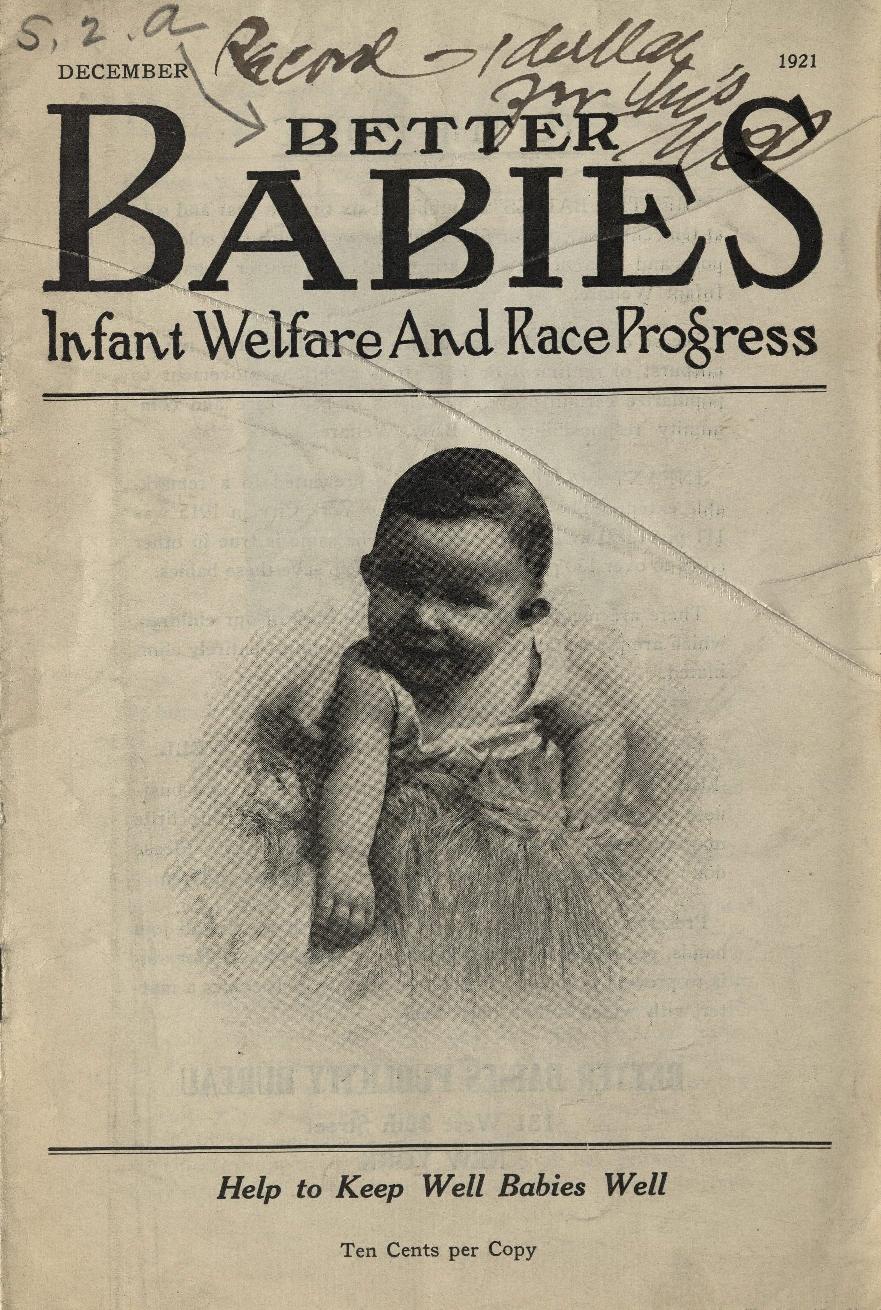
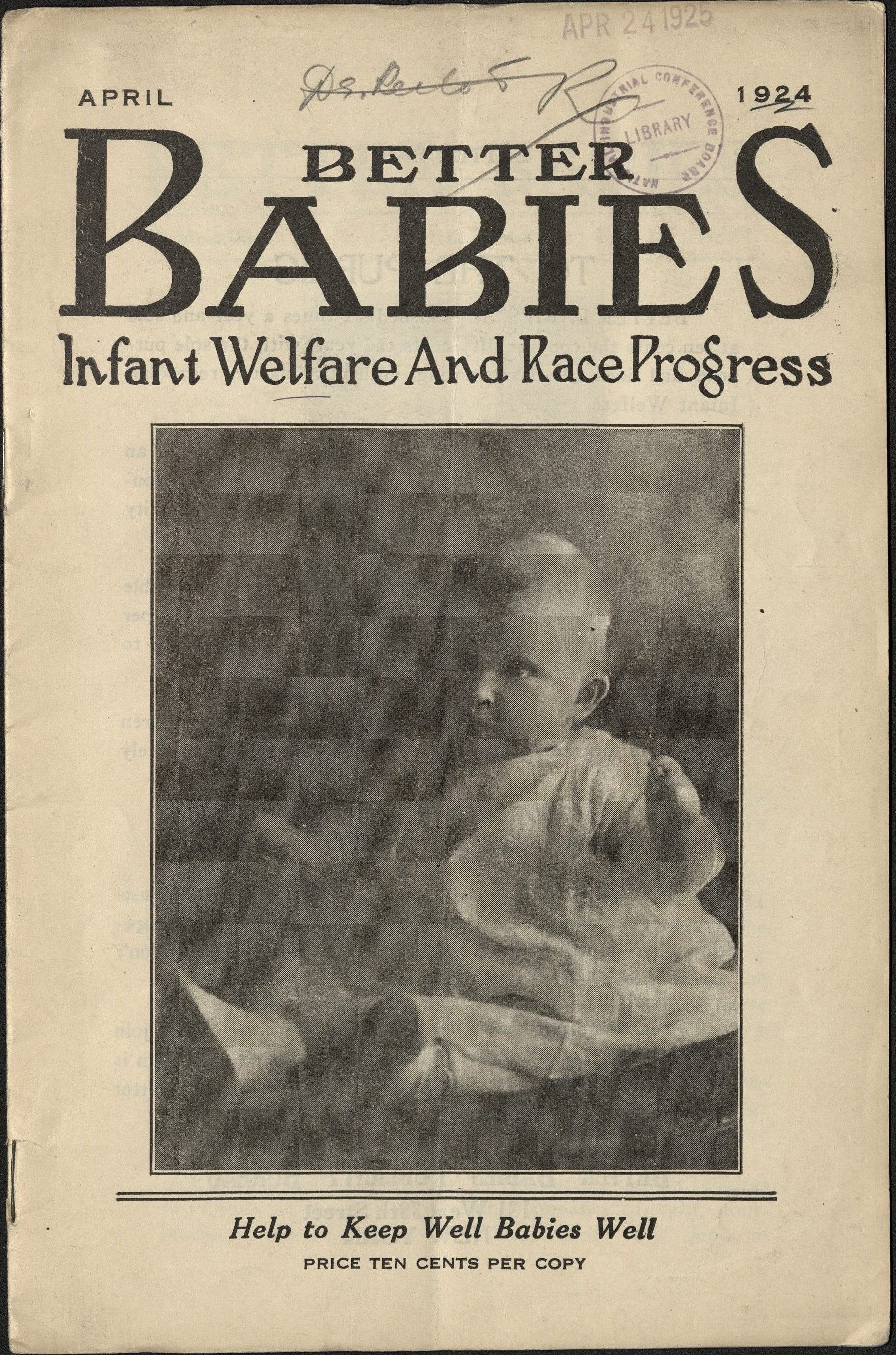
When in the stacks recently, I came across two slim issues of “Better Babies: Infant Welfare and Race Progress,” one published in December 1921 and the other in April 1924.

BetterBabies_Cover-1921

BetterBabies_Cover-1924

While the title suggests an interest in eugenics, the two issues in our collection focus solely on ways to keep babies healthy, including articles on clothes for children, playgrounds and public health, the benefits of breast feeding, and disease prevention.

This last topic inspired the following list, published in the 1924 issue. As it is (coincidentally) Baby Safety Month, it seems appropriate to share it.

Which piece of advice is your favorite?