Uncle Sam, M.D.

By Paul Theerman, Associate Director

Health Almanac, 1920 front cover.

Health Almanac, 1920 front cover.

How to get the word out? For the last two hundred years, health has been as much about education and prevention as intervention and response. And so an intrepid young doctor in the U.S. Public Health Service (USPHS) latched onto using the almanac as a public health vehicle. Health Almanac 1920 (Public Health Bulletin No. 98; Washington, GPO, 1920) was a 12-page almanac entwined in a 56-page public health pamphlet. Amid checking for the phases of the moon or the times of sunrise and sunset, one could find short pieces giving warning signs for cancer, means to prevent the spread of malaria, the necessity of registering births, and how to build a good latrine. These and many other topics were all presented by “Uncle Sam, M.D.”; the almanac was free for the asking.

Uncle Sam Image 4--July right page

Health Hints and Notable Events for July 1920. Click to enlarge.

In the distant past, almanacs became linked to health through “astro-medicine” or “iatromathematics,” that is, medical astrology. Each of the signs of the zodiac was held to influence a system of the body, from Ares controlling the head to Pisces the feet, and so for everything in between. Almanacs were calendrical and astronomical, and in addition to marking sunrise and sunset, the phases of the moon, and religious holidays, they charted the day-by-day progress of the moon through the zodiac, with its supposed medical consequences. To this technical data, the most famous American almanac, Benjamin Franklin’s Poor Richard’s Almanac, added moralistic lessons and practical advice, wittily presented. Health Almanac 1920 provided these same features within the context of progressive secular government. The publication started with inspirational statements from President Woodrow Wilson, the Secretary of the Treasury, and the Surgeon General —who together formed the chain of command for the Public Health Service! Instead of a calendar of religious seasons and saints’ days, the almanac noted national days and significant events in the history of medicine and in “The Great War,” just concluded. Everywhere were health aphorisms: “Good health costs little, poor health costs fortunes” (from the back cover), and “Large fillings from little cavities grow” (April 20). Some “health hints” were quite flatly presented: “Every home should have a sewer connection or a sanitary privy” (July 20), and “Food, fingers, and flies spread typhoid fever” (July 31). Some were just to the point: “Be thrifty” (November 15) and “Wear sensible shoes” (December 18). Throughout, the almanac highlighted the role of the USPHS in promoting health.
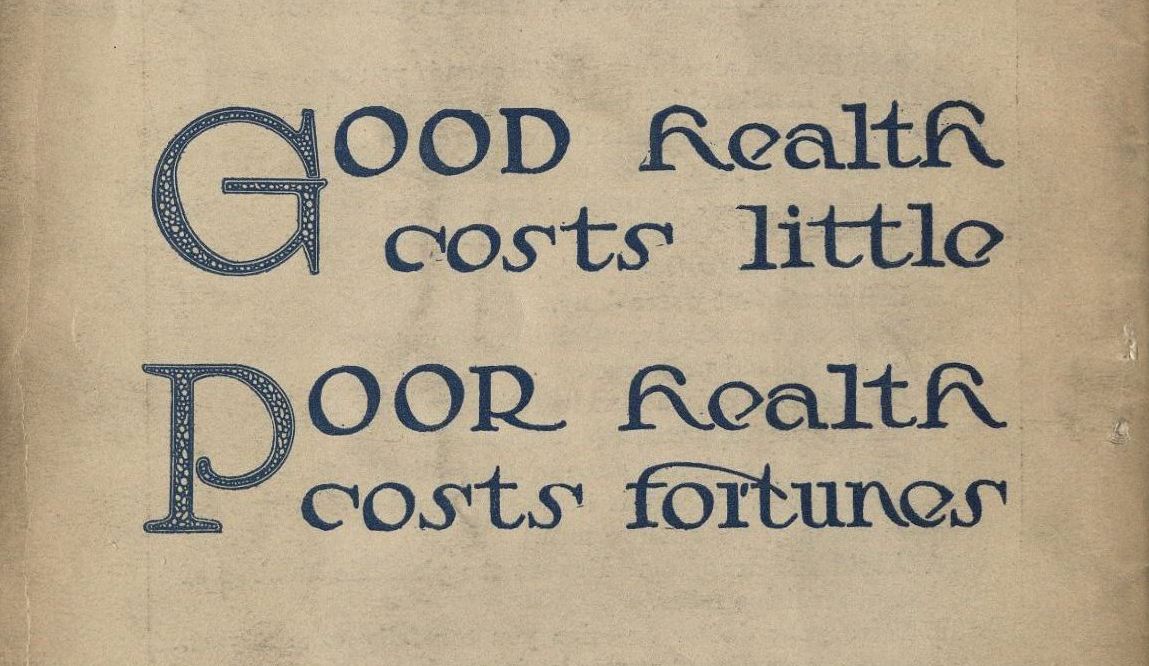
Uncle Sam Image 2--back cover

Health Almanac, 1920 back cover.

The Health Almanac was published in 1919 and 1920—we have the 1920 edition—as was a parallel publication called the Miners’ Safety and Health Almanac, put out by the Bureau of Mines. Both were the brainchild of Dr. Ralph Chester Williams (1888–1984), then at the outset of his successful career with the Public Health Service. Born in Alabama and a 1910 graduate of the University of Alabama Medical School, Williams entered the USPHS in 1916 and was posted to the Bureau of Mines during World War I. Pulled into the Office of the Surgeon General, he edited Public Health Reports, served as Chief Medical Officer to the Farm Security Administration, as Medical Director of the USPHS’s New York City office, and starting in 1943, as Assistant Surgeon General and head of its Bureau of Medical Services. In that capacity he oversaw a third of the operations of the USPHS, including immigration inspection and USPHS hospitals. In 1951 the Commissioned Officers Association of the USPHS published his standard history, The United States Public Health Service, 1798–1950. At almost 900 pages, it dwarfs the Health Almanac 1920, but both show their author’s dedication to getting the word out about health and, not incidentally, about the agency that helped make that happen.
Of Unicorns on Land and Sea

By Arlene Shaner, Acting Curator and Reference Librarian for Historical Collections

This spring the Cloisters, the branch of the Metropolitan Museum of Art that showcases the art and architecture of medieval Europe, is celebrating its 75th anniversary.  The most famous (and probably most beloved) items in the collection are the Unicorn Tapestries, the seven tapestries that tell the story of the hunt for this elusive animal.  A special exhibit about the unicorn is on display at the Cloisters through August 18th.

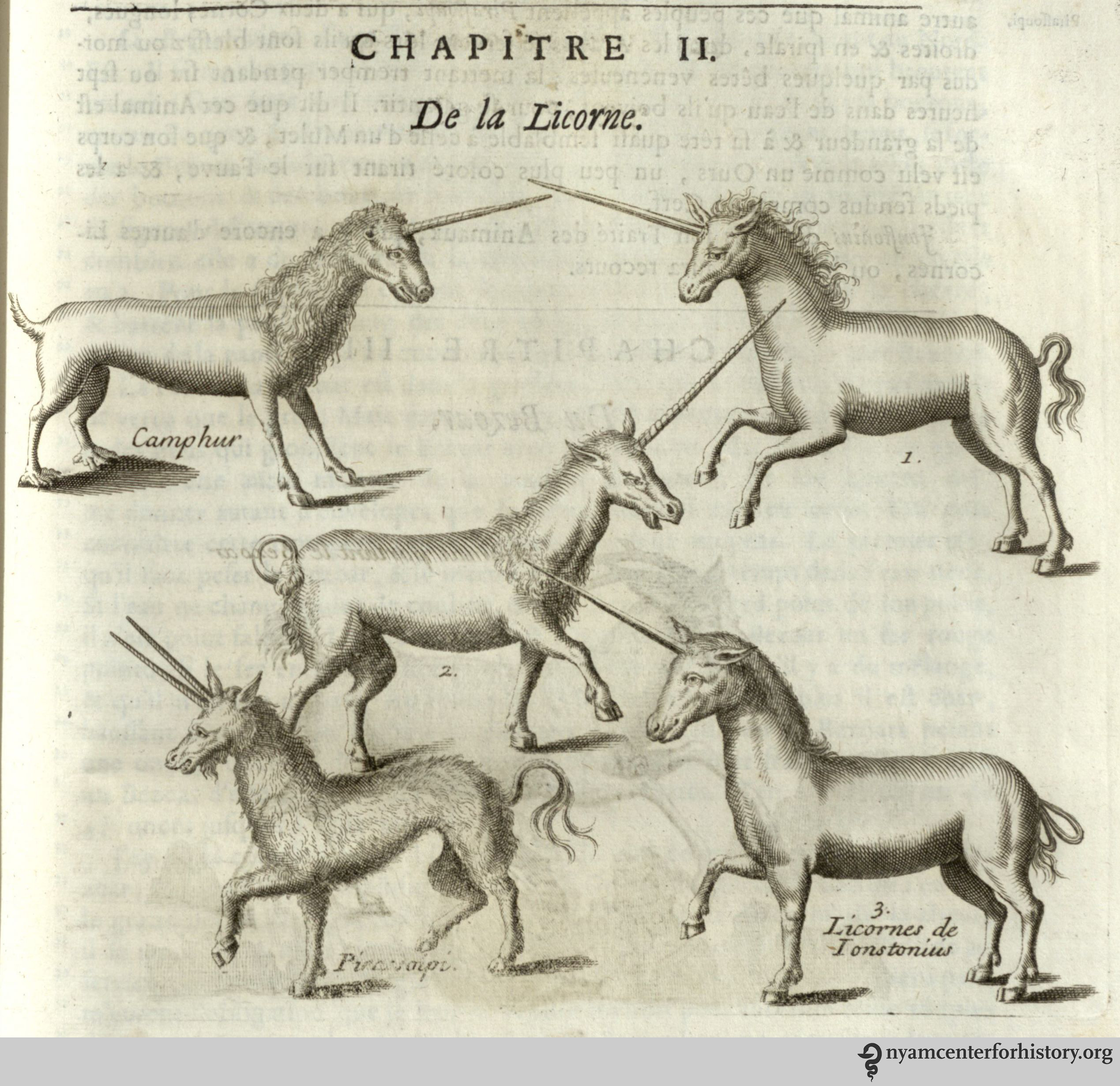
Unicorn horns and their purported medicinal uses are described in a variety of early books on drugs and natural history.  One of these, Pierre Pomet’s Histoire generale des drogues, traitant des plantes, des animaux, & des mineraux… (Paris, 1694) contains a detailed section on the unicorn, complete with an illustration of the five types of unicorns:

Pomet (1658-1699), a druggist to Louis XIV, also maintained an apothecary shop in Paris.  His Histoire was first translated into English in 1712, and appeared in a second edition in 1725.  The book contains detailed information about plant-based remedies, but also describes the compounding of various cures made from parts of exotic animals, metals, minerals, stones, and a variety of other substances.  In the case of the unicorn, Pomet admits almost immediately that what is sold by apothecaries as unicorn horn comes not from a unicorn at all, but from a fish, the narwhal, whose attributes he describes later in the animal section of the book. Of course, Pomet was wrong to describe the narwhal as a fish, as it is really a species of whale and whales are mammals.

The horns of unicorns and narwhals were believed to be effective as an antidote to all kinds of poisons and to cure various unspecified plagues and fevers.  Some people wore the horns as protective amulets, while others collected complete horns as curiosities for display.  While Pomet offers many details about both unicorns and narwhals, he hedges his bets regarding their efficacy, explaining that while some people believe in their worth, “I shall neither authorize nor contradict, having never had sufficient Experience of it.”

78 Years of Anonymity

By Johanna Goldberg, Information Services Librarian

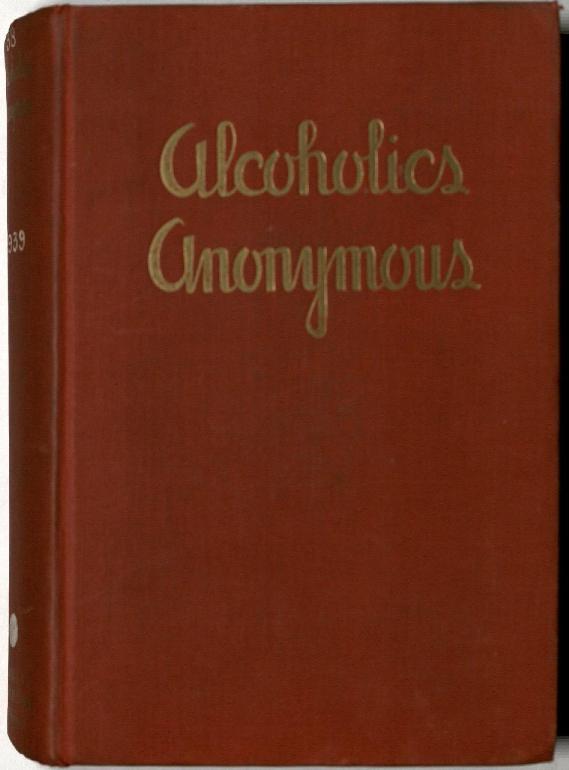
Alcoholics Anonymous (A.A.) celebrates June 10 as the anniversary of its founding. But why and how did the organization form?

As William L White explains in Slaying the Dragon: The History of Addiction Treatment and Recovery in America, A.A.’s founding occurred soon after the end of Prohibition, a time when there were a lack of places for alcoholics to turn to for help. Most institutions specializing in sobriety closed during Prohibition, and those still open were available only for the upper echelons of society. Overcrowded hospitals and sham home cures only worsened the problem. With the repeal of Prohibition and the start of the New Deal, the time was right for A.A.¹

Alcoholics Anonymous can trace its roots to the Oxford Group, a spiritual movement begun in the early 20th century looking to heal the world “through a movement of personal spiritual change.”¹ In 1934, Bill Wilson (known as Bill W.), a co-founder of Alcoholics Anonymous, heard about the Oxford Group from a member who had stopped drinking with the group’s support. After experiencing a spiritual awakening (which may have resulted from hallucinogenic medications) while at a New York hospital to treat his alcoholism, Bill W. started attending Oxford Group meetings.¹

AlcoholicsAnonymousIn 1935, Bill W. met co-founder Dr. Robert Smith (known as Dr. Bob), an alcoholic trying to remain sober with the help of the local Oxford Group in Akron. The date of Dr. Bob’s last drink—June 10, 1935—marks the founding of A.A, which formally separated from the Oxford Group in 1937 (New York) and 1939 (Akron).¹ In 1939, A.A. published Alcoholics Anonymous: The Story of How Many More Than One Hundred Men Have Recovered From Alcoholism. The book listed and explained A.A.’s 12 steps for the first time. As White notes, it also “broke the mold on earlier books by writing, not only about alcoholism, but to alcoholics.”¹ And by alcoholics, laying out its central tenets in a way that makes it clear that the authors had been through a great deal before regaining sobriety:

“If you are as seriously alcoholic as we were, we believe there is no middle-of-the-road solution. We were in a position where life was becoming impossible, and if we had passed into the region from which there is no return through human aid, we had but two alternatives: one was to go on to the bitter end, blotting out the consciousness of our intolerable situation as best we could; and the other, to accept spiritual help. This we did because we honestly wanted to, and were willing to make the effort.”²

Today, we know even more about recovery from alcoholism. Treatment options still include support groups like A.A., and now also incorporate medications and behavioral therapies, often used simultaneously. In addition, the National Institute on Alcohol Abuse and Alcoholism’s (NIAAA) National Epidemiological Study on Alcohol and Related Conditions found that some people with alcohol dependence may recover without treatment.³ And researchers have identified genes that can both increase and reduce a person’s likelihood of becoming dependent on alcohol.4

The landscape of alcohol recovery has greatly altered since June 10, 1935. And yet tenets first written down in 1939 retain significance for A.A.’s more than two million members.5

For more on alcohol dependence, visit the NIAAA’s site Rethinking Drinking.

1. White, W. (1998). Slaying the dragon: The history of addiction treatment and recovery in America. Bloomington Ill.: Chestnut Health Systems/Lighthouse Institute.

2. Alcoholics Anonymous: The story of how many more than one hundred men have recovered from alcoholism. (1939). New York: Works Pub. Co.

3. In this issue. (2006).Alcohol Research & Health, 29(2), 72–73. Retrieved May 30, 2013 from http://pubs.niaaa.nih.gov/publications/arh29-2/71-73.htm

4. NIH Fact Sheets – Alcohol Dependence (Alcoholism). (n.d.). Retrieved May 30, 2013 from http://report.nih.gov/NIHfactsheets/ViewFactSheet.aspx?csid=23

5. A.A. General Service Office. (n.d.). A.A. at a Glance. Retrieved May 30, 2013 from http://www.aa.org/pdf/products/f-1_AAataGlance.pdf

There is Death in the Pot

By Johanna Goldberg, Information Services Librarian

While in the stacks recently, we came across this intriguing cover.

DeathinthePot-cover


How can you not open the book? The title page did not disappoint.

DeathinthePot-titlepageFood adulteration was a dangerous problem in 19th-century London. In 1820, chemist Fredrick Accum wrote A Treatise on Adulterations of Food and Culinary Poisons, the first book of its kind to attempt to expose the dangers of the food, water, and beverage supply.¹

Among many other practices, Accum cautioned against alum in the bread supply, used to make bread whiter; fraudulent peppercorns, made of lintseed, clay, and a small bit of Cayenne; vinegar laced with sulphuric acid; red lead used to color cheese; and beer mixed with a poisonous narcotic plant, cocculus indicus.² Forty years after the book’s publication, Parliament passed the Food Adulteration Act.¹

The Royal Society of Chemistry’s Library and Information Centre offers an excellent online exhibit on the life and times of Accum (including a career-ending scandal involving mistreatment of library books). Learn more here.

Edit: A reader recognized the artwork as that of Berkeley King and kindly provided us with the following image of the cover of Accum’s Plans of the Gas Works in London, which King also designed.

AccumPlansoftheGasWorksinLondon


1. The fight against food adulteration. (n.d.). Retrieved May 16, 2013, from http://www.rsc.org/education/eic/issues/2005mar/thefightagainstfoodadulteration.asp

2. Accum, F. (1820). A treatise on adulterations of food, and culinary poisons exhibiting the fraudulent sophistications of bread, beer, wine, spirituous liquors, tea, coffee, cream, confectionery, vinegar, mustard, pepper, cheese, olive oil, pickles, and other articles employed in domestic economy, and methods of detecting them. London: Longman, Hurst, Rees, Orme, and Brown.

For your viewing pleasure

This Wednesday’s 2013 New York Academy of Medicine Gala featured the following video on the Center for the History of Medicine and Public Health. If you would like to learn more about our work or visit us in person, please email history@nyam.org and library@nyam.org.

Acne Can Be a Social Handicap

By Johanna Goldberg, Information Services Librarian

This is the second in an intermittent series of blogs featuring advertisements from medical journals. You can find the first here.

The ads below come from two dermatology journals—the first five from the Journal of Investigative Dermatology and the last from the International Journal of Dermatology—and span nearly two decades. They promise not only a better quality of life through medical intervention, but also show cultural standards of work, social interaction, and beauty.

1955: We love the cartoon depictions of each gendered occupation, barefoot sailor and all.

1955: We love the cartoon depictions of each gendered occupation, barefoot sailor and all.

1955: Only people with perfect skin drink martinis.

1955: Only people with perfect skin drink martinis.

1955: Why do these “adolescents” look 40+?

1955: Why do these “adolescents” look 40+?

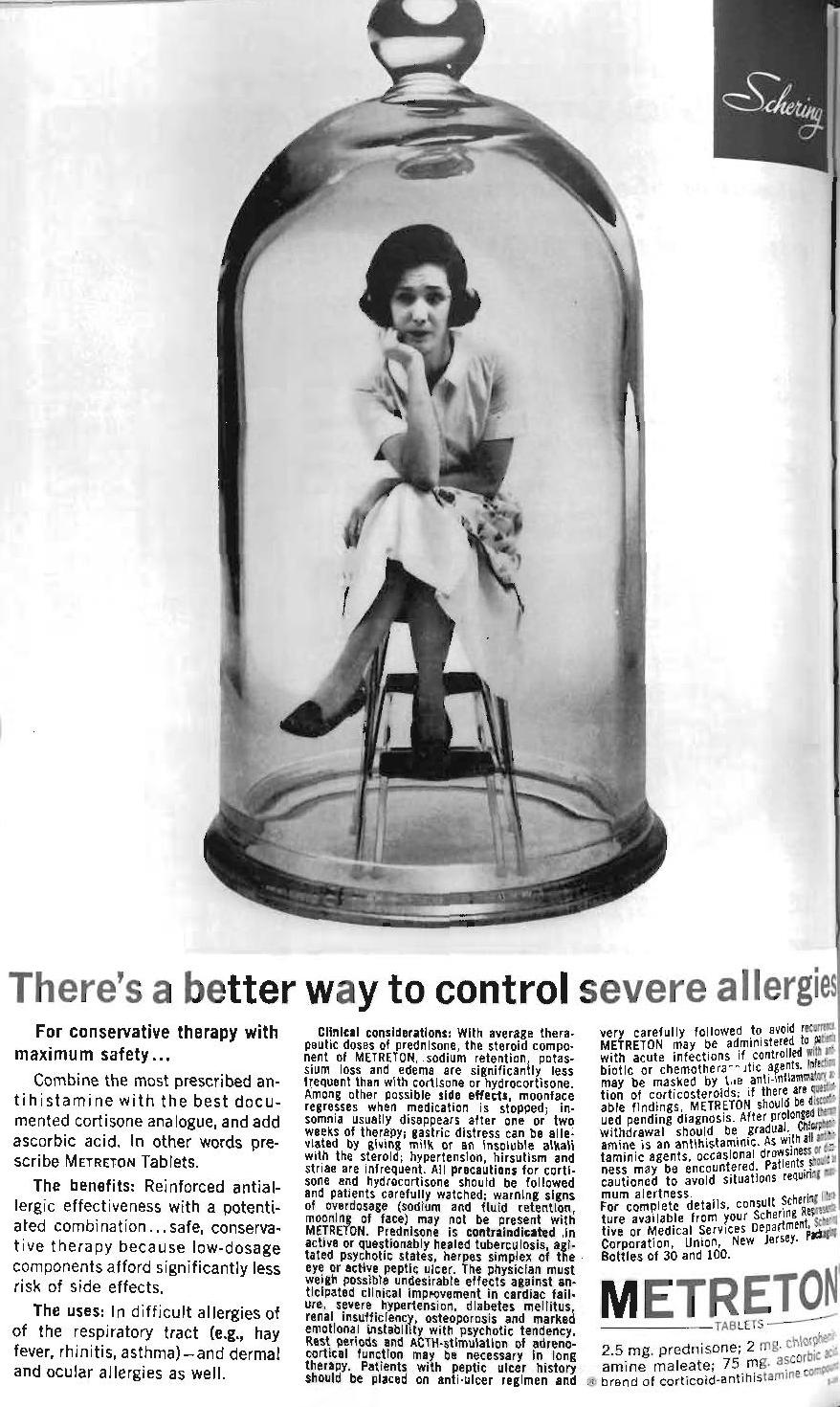
1963: Probably coincidentally, this ad appeared the same year The Bell Jar was published.

1963: Probably coincidentally, this ad appeared the same year The Bell Jar was published.

1963: Grenz rays are a mild form of radiation widely used from the 1940s–1970s to treat inflammatory skin diseases. While some practitioners still use Grenz rays, evidence of their efficacy remains limited.1,2

1963: Grenz rays are a mild form of radiation widely used from the 1940s–1970s to treat inflammatory skin diseases. While some practitioners still use Grenz rays, evidence of their efficacy remains limited.¹,²

1973: Nothing like nudity to convince doctors to recommend a medicated powder.

1973: Nothing like nudity to convince doctors to recommend a medicated powder.


1. Lindelöf, B., & Eklund, G. (1986). Incidence of malignant skin tumors in 14,140 patients after grenz-ray treatment for benign skin disorders. Archives of Dermatology, 122(12), 1391–1395.

2. National Institute for Health and Care Excellence (NICE). (2010, March 30). Grenz rays therapy for inflammatory skin conditions (interventional procedures consultation). Guidance/interventional procedures. Retrieved April 24, 2013 from http://www.nice.org.uk

An Elegy on the Death of a Mad Dog

By Rebecca Pou, Project Archivist

To celebrate National Poetry Month, we are sharing a poem from our collection each week during April.

Our last poem, An Elegy on the Death of a Mad Dog, is by Oliver Goldsmith (1730-1774). Our Rare Book Room contains an Oliver Goldsmith Collection, which includes 112 editions of his novel The Vicar of Wakefield, along with many of his other works. Most of the collection was donated by Mrs. Alberta Clay, the daughter of NYAM’s first director, Linsly R. Williams, M.D., in 1942.

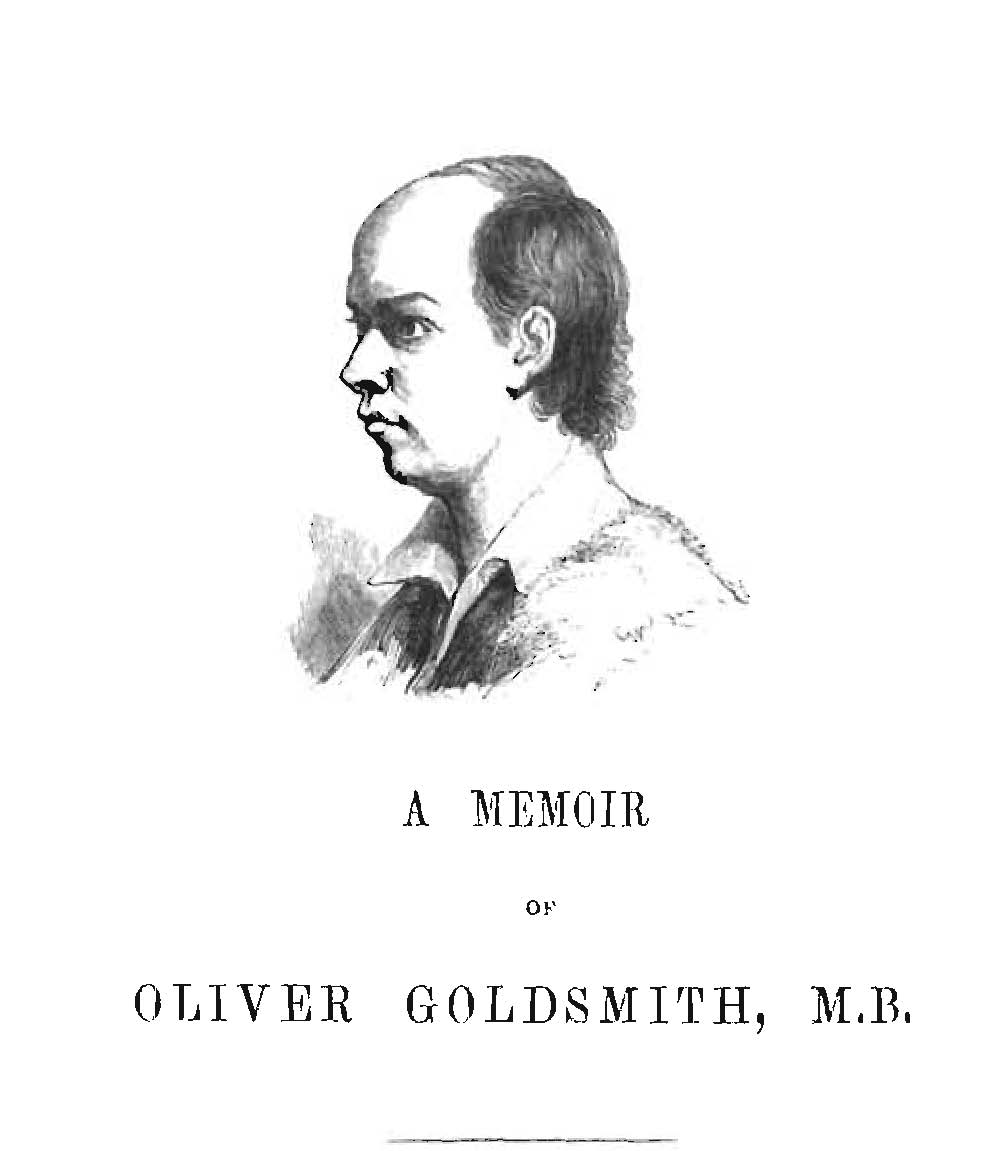
Goldsmith port_1863Oliver Goldsmith may seem to be a bit out of place in a medical collection, but NYAM has an interest in works of literature by and about physicians. Before establishing himself as an essayist, poet, and novelist, Goldsmith attempted a career in medicine. Goldsmith studied medicine in Edinburgh and Leyden, although it is not certain he ever received his medical degree. In London, he worked for a time as an apothecary’s assistant and a physician, but ultimately he devoted himself to writing. Still, despite his questionable credentials, Goldsmith was considered a doctor and often attributed as “Oliver Goldsmith, M.B.”

An Elegy on the Death of a Mad Dog is found in The Vicar of Wakefield, where the Vicar asks his son to recite it, and in collections of Goldsmith’s works and poetry. This version and the images are from The Poetical Works of Oliver Goldsmith, M.B. from 1863.

Goldsmith Mad dog 1863

An Elegy on the Death of a Mad Dog

Good people all, of every sort,
Give ear unto my song ;
And, if you find it wondrous short –
It cannot hold you long.

In Islington there was a man
Of whom the world might say,
That still a godly race he ran –
Whene’er he went to pray.

A kind and gentle heart he had,
To comfort friends and foes ;
The naked every day he clad –
When he put on his clothes.

And in that town a dog was found :
As many dogs there be ;
Both mongrel, puppy, whelp, and hound,
And curs of low degree.

This dog and man at first were friends ;
But, when a pique began,
The dog, to gain some private ends,
Went mad, and bit the man.

Around, from all the neighbouring streets,
The wondering neighbours ran ;
And swore the dog had lost his wits,
To bite so good a man.

The wound it seem’d both sore and sad
To every christian eye ;
And, while they swore the dog was mad,
They swore the man would die.

But soon a wonder came to light,
That show’d the rogues they lied :
The man recover’d of the bite ;
The dog it was that died.

Sources:

“Oliver Goldsmith.” Concise Dictionary of British Literary Biography. Vol. 2. Detroit: Gale Research, 1992. Biography In Context. Web. 24 Apr. 2013.

“Oliver Goldsmith.” Encyclopædia Britannica. Encyclopædia Britannica Online Academic Edition. Encyclopædia Britannica Inc., 2013. Web. 25 Apr. 2013.

Syphilis, or the French Disease

By Rebecca Pou, Project Archivist

To celebrate National Poetry Month, we are sharing a poem from our collection each week during April.

Portrait of Fracastorius from Homocentrica, Venice: 1538.

Portrait of Fracastorius from Homocentrica. Venice, 1538.*

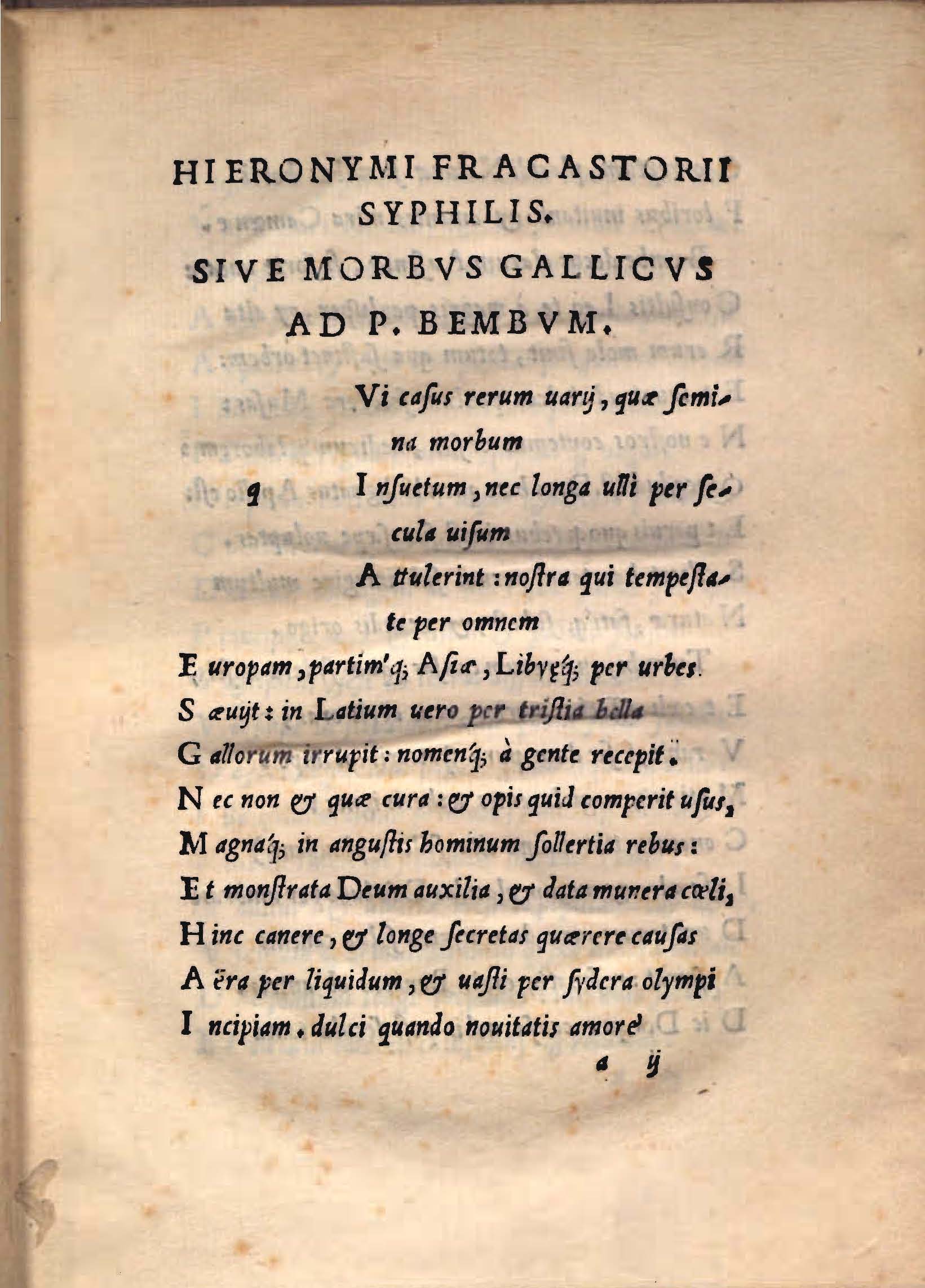
Syphilis seems like an unlikely topic for a poem, yet it is the subject of an important and popular work. Syphilis, or the French Disease, was first published in 1530. At that time, syphilis was new to Europe and spreading fast. To the Italians it was the “French disease,” to the French the “Italian disease,” with many other countries blaming one another for bringing the infection to their citizens. Written in Latin by the multi-faceted Italian physician and poet Fracastorius, the poem was translated into many languages, reflecting the great desire to understand this disease. Our collection holds multiple editions, including the original, pictured above, and several English versions (this post features two English translations – one is pictured below and another as the excerpts).

In the poem, which is broken into three parts, we learn of the disease and some popular treatments of the time, including mercury and the plant remedy guaiac. We also read the tale of a shepherd named Syphilus, supposedly the first person afflicted with the disease, which was his punishment for spurning the sun. Excerpts from each of the poem’s books, taken from William Van Wyck’s translation, are below.

Book 1

Within the purple womb of night, a slave,
The strangest plague returned to sear the world.
Infecting Europe’s breast, the scourge was hurled
From Lybian cities to the Black Sea’s wave.
When warring France would march on Italy,
It took her name. I consecrate my rhymes
To this unbidden guest of twenty climes,
Although unwelcomed, and eternally.
………………
O Muse, reveal to me what seed has grown
This evil that for long remained unknown!
Till Spanish sailors made west their goal,
And ploughed the seas to find another pole,
Adding to this world a new universe.
Did these men bring to us this latent curse?
In every place beneath a clamorous sky,
There burst spontaneously this frightful pest.
Few people has it failed to scarify,
Since commerce introduced it from the west.
Hiding its origin, this evil thing
Sprawls over Europe
………………

Albrecht Durer's woodcut of a syphilitic man.

Albrecht Durer’s woodcut of a syphilitic man, 1496.*

Book 2

Soon is repaired the ruin of the flesh,
If lard be well applied that’s good and fresh,
Or dyer’s colors of a soothing power.
If some poor soul, impatient for the hour
Of sweet release, should find too slow this cure,
And yearning for a quicker and more sure,
Then stronger remedies without delay
Shall kill this hydra another way.
………………
All men concede that mercury’s the best
Of agents that will cure a tainted breast.
To heat and cold sensitive’s mercury,
Absorbing the fires of the this vile leprosy
And all the body’s flames by its sheer weight…
………………

Book 3

An ancient king had we, Alcithous,
Who had a shepherd lad called Syphilus.
On our prolific meads, a thousand sheep,
A thousand kine this shepherd had to keep.
One day, old Sirius with his mighty flame,
During the summer solstice to us came,
Taking away the shade from all our trees,
The freshness from the meadow, coolth from breeze.
His beasts expiring, then did Syphilus
Turn to this horror of a brazen heaven,
Braving the sun’s so torrid terror even,
Gazing upon its face and speaking thus:
‘O Sun, how we endure, a slave to you!
You are a tyrant to us in this hour.
………………
The sun went pallid for his righteous wrath
And germinated poisons in our path.
And he who wrought this outrage was the first
To feel his body ache, when sore accursed.
And for his ulcers and their torturing,
No longer would a tossing, hard couch bring
Him sleep. With joints apart and flesh erased,
Thus was the shepherd flailed and thus debased.
And after him this malady we call
SYPHILIS, tearing at our city’s wall
To bring with it such ruin and such a wrack,
That e’en the king escaped not its attack.
………………

* From Van Wyck, William. The sinister shepherd: a translation of Girolamo Fracastoro’s Syphilidis; sive, De morbo gallico libri tres. Los Angeles, 1934.

The Craniad

By Johanna Goldberg, Information Services Librarian

To celebrate National Poetry Month, we are sharing a poem from our collection each week during April.

In 1817, the work of two fathers of phrenology, Franz Joseph Gall and Johann Gaspar Spurzheim, inspired poetry.

As explained by authors Francis Jeffrey and John Gordon in the preface of The Craniad: Or, Spurzheim Illustrated. A Poem in Two Parts:

“It is not our intention to conduct our readers through all the delightful mazes of the Craniologic paradise. We shall give them a bird’s-eye view of this garden of intellectual sweets; but should they feel disposed to examine every object minutely, they can leave the point of view which we have chosen for them, descend, and lose themselves, at leisure, in the charming confusion of the romantic labyrinth.”

Here is an excerpt from this “bird’s-eye view,” emphasizing the view of the poets (and their inspiration) that the shape of our heads and brains determine our futures—our criminality, careers, and guilt or innocence in a court of law.

Why do men fight,—and steal,—and cheat,—and
lie,—
String crime on crime, till strung on ropes they die?
“ Because within and on their skulls are found,
“ First known to Gall’s and Spurzheim’s tact pro-
found,
“ Organs, which mark the cause with obvious case,
“ Nature is sick, and crime is her disease.
. . .
To one thing more than others, not inclined—
Some think that education forms the mind.
Hence view we talents every day misplaced ;
Great public situations, too, disgraced !

Hnce [sic] have we preachers in our courts of law,
And lawyers in the pulpit—that’s a flaw.
We’ve some physicians who should nurses be,
And tend on those from whom they take a fee.
We’ve barbarous bungling surgeons, now and then,
Fit only to be barbers’ journeymen ;
Poor paltry puling poets,–who, Lord knows,
Should try to learn to write some decent prose.
Horse-jockies sometimes sit in Parliament !
On jockeying there, by dangerous habits bent,
Whilst many a genius lives by grinding knives,
And many a dunce without a genius thrives.
. . .
When Barristers learn Craniology,
Closer examinations we shall see ;
They then can make each witness shew his skull,
To see if ‘twill his evidence annul,
And if there’s evidence that this is so,
They’ll render it more evident, we know.
And poor unhappy criminals may then
Get leave to feel the skulls of jury-men ;
And when a man’s indicted for a rape,
His neck may then be saved by its own shape.
. . .
Behold a new employment for the blind,
With sense of tact so wondrously refined.
Let them be Craniologers, have schools,
In which succeeding blind may learn their rules ;
Let them have rank and titles with the great,
Be called, “ Prime Craniologers of state.
Such intellectual feelers, of the land,
Would form a useful, and important band ;
They could correct all errors in our courts,
And wavering doubts decide by their reports.”

Brain Awareness Week

By Lisa O’Sullivan, Director

Ambroise Paré, The brain and nerves of the head and neck, p134, Les Oeuvres

Ambroise ParéThe brain and nerves of the head and neck, p134, Les Oeuvres

This week is Brain Awareness Week, a global campaign to celebrate the brain and increase awareness of brain research. Treating the brain has a long history; trepanning, or trepanation, is one of the oldest known surgical procedures.

The brain featured in today’s post comes from Les Oeuvres d’Ambroise Paré, currently being treated in our conservation laboratory. The work was the culmination of the 16th century French barber-surgeon’s long and successful career, which saw him become royal surgeon for a number of French kings.

Les Oeuvres d’Ambroise Paré was first published in 1575, and was subsequently expanded in multiple new editions. It was groundbreaking on a number of levels, written in the vernacular French, rather than Latin, it included not only anatomical depictions and descriptions of procedures, but illustrations of the instruments used in surgery, many of which Paré had modified or developed himself.