Pox and Politics

By Rebecca Pou, Project Archvist

Arm with pustules

Edward Jenner. An Inquiry Into the Causes and Effects of the Variolæ Vaccinæ. London:1798.

Edward Jenner’s An Inquiry Into the Causes and Effects of the Variolæ Vaccinæ was published in 1798 and organizations encouraging inoculation were quick to form. In 1802, the New York Institution for the Inoculation of the Kine-Pock was established. The Institution issued documents on the advantages of inoculation with cowpox and created a clinic, “a main object whereof is to disseminate the blessings of this disease, free of cost, to the indigent members of the community.”
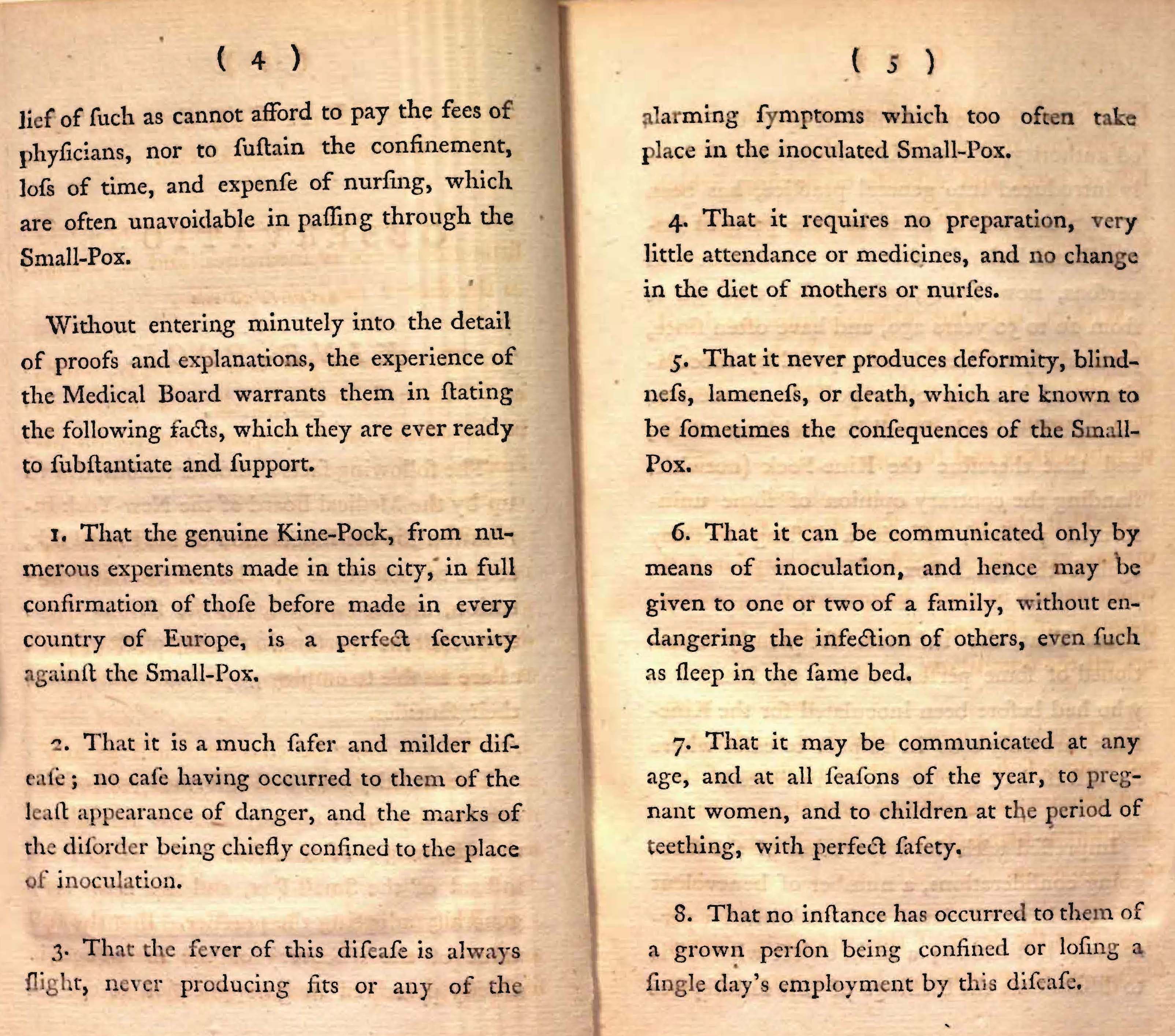
image of text

New York Institution for the Inoculation of the Kine Pock. Facts and Observations Relative to the Kine-pock. New York: 1802.

Despite massive efforts, smallpox persisted well into the 20th century. It took global vaccination to eliminate the disease in 1977. The story of vaccination programs is as much a political one as a medical, around balancing public health with individual choice. We are pleased to be welcoming Michael Willrich, PhD, to NYAM on Nov 29 to explore the tensions between compulsory vaccination and civil liberties brought into sharp focus in the smallpox epidemics of the late 19th and early 20th centuries. The lecture is free and open to the public. Register here.
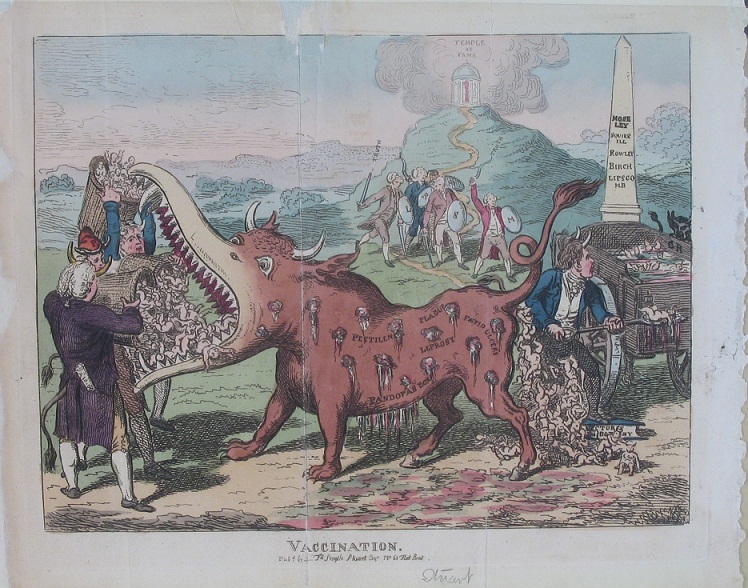
Mad Cows and Caricatures

By Lisa O’Sullivan, Director

Image of monster being fed infants and excreting them with horns.

Charles Williams caricature c.1802.

This early anti-vaccination caricature shows a monster being fed baskets of infants and excreting them with horns. In the background, four prominent anti-vaccine campaigners, Benjamin Moseley, Robert Squirrell, William Woodville and William Rowley, approach with “swords of truth”. This unusual colored version of the print was originally bound as a frontispiece to the 3rd edition of William Rowley’s 1805 Cow-pox inoculation no security against small-pox infection: with above 500 proofs of failure. One of Rowley’s “above 500 proofs of failure” was the case of a boy whose face, Rowley claimed, was assuming the character of a cow.

Vaccination Williams detail

Horned baby

Next week we look forward to welcoming Mark Largent to explore more recent controversies about childhood vaccination as part of our history of medicine series. Register for this free October 17 event here.

NYC History of Medicine Events in October — Hildebrandt, Tresch, Largent, and Warner

By Lisa O’Sullivan, Director

This month sees an exciting line up of history of medicine (and science) events in NYC. In fact, almost a festival. Hope to see you at some or all…

On October 10, NYAM’s Malloch lecture series begins with an exploration of the practice of anatomy under the Third Reich, with Dr Sabine Hildebrandt discussing the impact and legacy of the 1933-1945 period. More details here.

At the NYPL’s Cullman Center, John Tresch discusses his new book “The Romantic Machine” on October 11. Tresch explores the connections between Romanticism and industrialization in Paris after Napoleon, drawing on examples from art, literature, opera, scientific discoveries, and technological advancements. Find details here.

On October 17, Mark Largent is appearing at NYAM to discuss his new book “Vaccine: The Modern American Debate”. In it he explores the history of the vaccine-autism debate and argues that it obscures a constellation of concerns held by many parents.  More details here.

And on Oct 18 the A.C. Long Health Sciences Library at Columbia will host Prof. John Harley Warner, who will speak on “The Image of Modern Medicine: Professional Identity, Aesthetic Belonging and the American Doctor, 1880-1950.” Prof. Warner focuses on the visual choices that American physicians made in representing their profession, their work, and themselves during 1880’s through the 1940’s. Details here.

Click for larger size (possibly disturbing) images from Prof. Warner’s work with James Edmonson, Dissection.


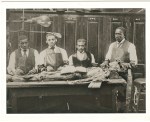
University of Pennsylvania School of Medicine, Philadelphia, 1895. European-American dissecting teams (left) and African-American teams (right) were racially segregated after the medical student body at the University of Pennsylvania was integrated. DHMC

More upcoming events can be found on our Calendar. Please feel free to get in touch at please email history@nyam.org if you have an event you would like to see featured.

Snakes in Medicine: Slippery Symbolism

By Lisa O’Sullivan, Director

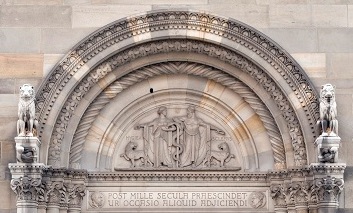
Image of Hygieia and Asclepius with staff and snake between them, accompanied by dogs, representing watchfulness.

Bas-relief of Hygeia and Asclepius overlooking our main entrance on 103rd St. Our 1926 building features numerous emblems and mythological figures associated with medicine. In this figure, father and daughter have the figure of the staff and snake between them, and are accompanied by dogs, representing watchfulness.

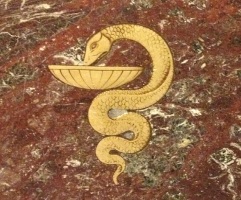
The snake in our blog header is a reference to Hygieia, the Greek goddess of health, cleanliness, and sanitation. Hygieia was often symbolized by a snake drinking from a bowl and was shown in sculptures and images with a serpent entwined around her. Her father was Asclepius, the god of medicine, generally depicted carrying a staff with a snake coiled around it. Snakes were introduced in Asclepian temples across the classical world, for use in healing rituals, and have remained associated with medicine in many ways since that time.

Brass snake inlaid on foyer floor

Our snake in-situ on our foyer floor, one of a series of inlaid figures with a connection to the practice of medicine over time.

As Walter J. Friedlander describes in his 1992 The Golden Wand of Medicine, the staff of Asclepius remained the primary symbol of medicine in the West until the 16th century, when examples of the caduceus began to be associated with medicine. The caduceus shows two snakes entwined around each other and a central staff, often with wings, and was associated with the god Hermes, especially as a symbol of commerce and trade. It was only in the late 19th century that the caduceus began to be widely accepted as a symbol of medicine. Friedlander suggests that this emerged in part from the use of the caduceus as a printer’s mark by medical publishers.

A wooden caduceus symbol shown in NYAM rare book reading room

A caduceus symbol in the NYAM rare book reading room

Most significant for the use of the caduceus as a medical symbol in the 20th century was the United States Army’s General Order Number 81, July 17, 1902. Included in its new regulations concerning army uniforms was the instruction that the new Medical Department insignia would be a gold or gilt caduceus. Subsequent arguments about the symbolism of the caduceus interpreted its elements in medical terms. For example, the rod represented power, the wings intelligence and activity, and the serpents wisdom and healing. Others argued that its use should be understood more in the traditional sense associated with Hermes, symbolizing a noncombatant messenger or envoy.

Despite initial objections to the appropriation of the symbol, the caduceus is now widely used as a symbol of medical practice, while Hygieia’s bowl continues to be particularly associated with the practice of pharmacy.