17th Century Anatomical Striptease: Guest Post by Morbid Anatomy

Tab VI

Another series of most wonderful and enigmatic anatomical illustrations in the New York Academy of Medicine historical library collections are to be found in De humani corporis fabrica libri decem, tabulis XCIIX aeri incisis … exornati … Opus posthumum and Tabulae anatomicae (Venice, 1627) by Adriaan van de Spiegel (1578–1625), Giulio Cesare Casserio (1533–1616), and Daniel Bucretius (d. 1631). In this complex effort, van de Spiegel produced the text; Casserio commissioned the plates (for his own unrealized work); and the whole was published through the editorial offices of Bucretius, after both van de Spiegel and Casserio had died.

Tab XVI

These illustrations are described beautifully by Michael Sappol in the exhibition text for his National Library of Medicine exhibition  “Dream Anatomy” where he placed them under the header “Show-off Cadavers” and described them thusly:

The emergence of anatomical illustration in the period 1500-1750 coincided with a larger phenomenon, a new definition of personhood that was performed at court, in salons, coffeehouses, country estates, theaters, marketplaces, and at court. Inevitably anatomists took up, commented on, and played with, the contemporary obsession with self-fashioning and individuality—it was an era of manners, wit, foppishness, and coquetry. In the works of Giulio Casserio, John Browne and Pietro da Cortona, the illustrated anatomy book is a stage featuring posing, prancing cadavers. Animated with an exuberant vitality, the corpses perform an anatomical show for the reader’s gaze.

The images in this post are from the Tabulae anatomicae and show the anatomized body engaging in a sort of exuberant anatomical striptease. All images are drawn from the National Library of Medicine’s brilliant online exhibition Dream Anatomy; click on the exhibition name to see more!

Tab XV

Michael Sappol will be both speaking and screening films from the National Library of Medicine as part of the October 5th NYAM Festival of Medical History & the Arts; more on that here. Hope very much to see you there!

This post was written by Joanna Ebenstein of the Morbid Anatomy blog, library and event series; click here to find out more.

Festival of Medical History & the Arts

We are excited to announce our first all-day extravaganza, co-curated by Lawrence Weschler, Morbid Anatomy, and the Center, and featuring esteemed speakers, artists workshops, behind-the-scenes tours, and more. Please check the Festival of Medical History & the Arts page and schedule for more information.

save the date Oct 5

Item of the month: Scrapbook of Doctor John T. Nagle, One Album, Three Perspectives

By Christina Amato, Book Conservator

Our item of the month is a scrapbook compiled by Dr. John Nagle from the years 1868-1900.  Dr. Nagle was an employee of the New York City Bureau of Vital Statistics, and the album mostly consists of newspaper clippings concerning births and deaths, diseases, methods of disposing of bodies, etc.  It is an interesting item on many different levels.  When an item comes into the conservation lab, the first thing we naturally see is damage.  The album’s spine had fallen off, many of the newspaper clippings inside were crumpled and broken, and the front cover had warped in a particularly exuberant fashion:

Foredge before treatment.

Foredge before treatment.

Most visitors to the lab who encounter the album, however, just see the charming artwork on the cover:

scrapbook after

A student of book history might be more inclined to see it as a typical example of a publisher’s cloth binding.  Starched bookcloth, which was invented in the 1820s, allowed for the mass production of embossed covers such as the one above. A heated brass die would be used to stamp the cover, and even as late as the 1870s, when Dr. Nagle started compiling his scrapbook, each detail of the die would have been hand carved.

A researcher might have a different take on this item altogether. Though mostly consisting of statistics, which are fascinating in their own right, there are several small clippings that provide intriguing clues into the nature of Dr. Nagle himself:

promenade

In addition to sunny afternoon promenades, Dr. Nagle was known to engage in daring, maritime rescues, and heated competition over the title of “handsomest man”:

swimming

handsomest man

Depending on who you ask, the most interesting thing about this album could be its physical structure, the details of the cover design, or the content.  Regardless of where your interest may lie, conservation treatment has rendered the book accessible to all.  If you are interested in seeing this item, contact us at (212) 822-7313 or history@nyam.org.

Scrapbook after conservation treatment.

Scrapbook after conservation treatment.

Mother Eve’s Pudding Redux

Image

By Erin Albritton, Head of the Gladys Brooks Book & Paper Conservation Laboratory

Last month, we kicked off National Poetry Month by sharing a rhyming recipe for Eve’s Pudding from our manuscript collection. Although charming, the recipe lacked the level of specificity to which most modern cooks have become accustomed. To solve this problem, cooking teacher and food historian Steve Schmidt (who will be delivering NYAM’s Friends of the Rare Book Room lecture on May 23rd) was kind enough to send along the following adaptation, together with a recipe for Cold Sweet Sauce that is scrumptious when drizzled over the top:

For the pudding:
3/4 cup (3 ounces) fine dry bread crumbs, plus a handful for coating the basin or bowl
1/3 cup plus 1 tablespoon (3 ounces) sugar
1 Tbsp all-purpose flour
1 tsp grated or ground nutmeg
1/2 tsp ground cinnamon
1/2 tsp salt
3 medium (about 1 1/4 pounds) firm, dry apples, such as Golden Delicious
2/3 cup (3 ounces) currants
3 large eggs, beaten until light and frothy
6 Tbsp (3 ounces) unsalted butter, melted and cooled
1 Tbsp strained fresh lemon juice

For the Cold Sweet Sauce:
1 stick of butter
2/3 cup confectioners’ sugar
1-2 Tbsp of brandy or lemon juice
A pinch of nutmeg

Very generously grease a 5- to 6-cup heatproof bowl or pudding basin with butter or solid vegetable shortening. Sprinkle the inside of the bowl with a handful of dry bread crumbs, tilt the bowl in all directions until coated and then tap the excess crumbs out.

Mix the 3/4 cup crumbs, sugar, flour, nutmeg, cinnamon, and salt in a bowl. Peel the apples and grate on the shredding plate of a box grater down to the cores. Stir the apples and currants into the crumb mixture, then the beaten eggs, then the melted butter and lemon juice. Pack the mixture into the prepared bowl, cover tightly with foil, set an upside-down plate on top of the foil, and steam the pudding for 3 hours in sufficient simmering water to reach halfway up the sides of the bow

While the pudding is steaming, make sauce by melting butter and whisking in sugar, brandy and nutmeg. Remove the pudding from the pot and let rest 15 minutes before unmolding. Drizzle (or drench!) with sauce and enjoy.

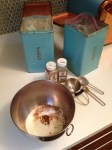
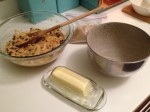
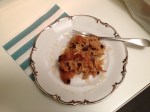
Below is a photo essay documenting one staff member’s kitchen adventure making this recipe (click to enlarge and open photo gallery). The next time you’ve got a couple of hours and find yourself craving a delicious dessert (with a bit of history), give Eve’s Pudding a try . . . you’ll be glad you did!

An Elegy on the Death of a Mad Dog

By Rebecca Pou, Project Archivist

To celebrate National Poetry Month, we are sharing a poem from our collection each week during April.

Our last poem, An Elegy on the Death of a Mad Dog, is by Oliver Goldsmith (1730-1774). Our Rare Book Room contains an Oliver Goldsmith Collection, which includes 112 editions of his novel The Vicar of Wakefield, along with many of his other works. Most of the collection was donated by Mrs. Alberta Clay, the daughter of NYAM’s first director, Linsly R. Williams, M.D., in 1942.

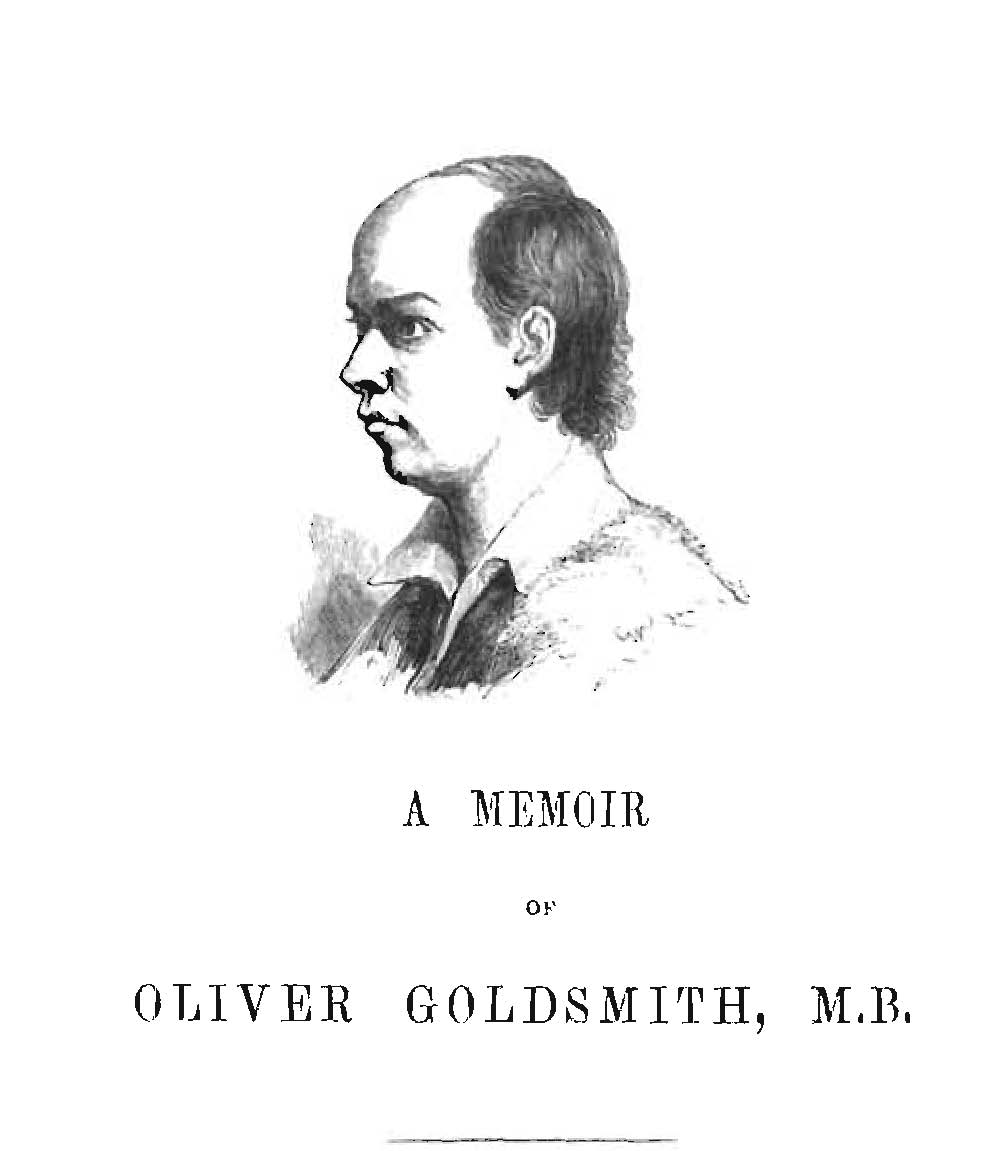
Goldsmith port_1863Oliver Goldsmith may seem to be a bit out of place in a medical collection, but NYAM has an interest in works of literature by and about physicians. Before establishing himself as an essayist, poet, and novelist, Goldsmith attempted a career in medicine. Goldsmith studied medicine in Edinburgh and Leyden, although it is not certain he ever received his medical degree. In London, he worked for a time as an apothecary’s assistant and a physician, but ultimately he devoted himself to writing. Still, despite his questionable credentials, Goldsmith was considered a doctor and often attributed as “Oliver Goldsmith, M.B.”

An Elegy on the Death of a Mad Dog is found in The Vicar of Wakefield, where the Vicar asks his son to recite it, and in collections of Goldsmith’s works and poetry. This version and the images are from The Poetical Works of Oliver Goldsmith, M.B. from 1863.

Goldsmith Mad dog 1863

An Elegy on the Death of a Mad Dog

Good people all, of every sort,
Give ear unto my song ;
And, if you find it wondrous short –
It cannot hold you long.

In Islington there was a man
Of whom the world might say,
That still a godly race he ran –
Whene’er he went to pray.

A kind and gentle heart he had,
To comfort friends and foes ;
The naked every day he clad –
When he put on his clothes.

And in that town a dog was found :
As many dogs there be ;
Both mongrel, puppy, whelp, and hound,
And curs of low degree.

This dog and man at first were friends ;
But, when a pique began,
The dog, to gain some private ends,
Went mad, and bit the man.

Around, from all the neighbouring streets,
The wondering neighbours ran ;
And swore the dog had lost his wits,
To bite so good a man.

The wound it seem’d both sore and sad
To every christian eye ;
And, while they swore the dog was mad,
They swore the man would die.

But soon a wonder came to light,
That show’d the rogues they lied :
The man recover’d of the bite ;
The dog it was that died.

Sources:

“Oliver Goldsmith.” Concise Dictionary of British Literary Biography. Vol. 2. Detroit: Gale Research, 1992. Biography In Context. Web. 24 Apr. 2013.

“Oliver Goldsmith.” Encyclopædia Britannica. Encyclopædia Britannica Online Academic Edition. Encyclopædia Britannica Inc., 2013. Web. 25 Apr. 2013.

History Night: Seeking Submissions

RBR deskThe New York Academy of Medicine (NYAM) Section on the History of Medicine and Public Health is pleased to announce its Third Annual History Night to be held on April 8, 2013, 6:00 pm – 8:00 pm. The event will take place at NYAM located at 1216 Fifth Avenue at the corner of 103rd Street.

We are inviting all those interested in presenting to submit papers on topics in the history of medicine and public health for consideration. Papers submitted previously at other educational events are eligible for submission. The time allotted for those papers chosen for presentation will be 15 minutes, with an additional 3-5 minutes for Q & A.

A panel of members of the NYAM Section on the History of Medicine and Public Health will select the papers to be presented.

The submission deadline is February 1, 2013. Papers may be submitted electronically to Donna Fingerhut at dfingerhut@nyam.org. Questions may be directed to Donna at 212-419-3645.

“Die Free”: Black Soldiers in the Civil War

By Lisa O’Sullivan, Director

Surgeon's Certificate for  Dick Parker Wills 1903

Surgeon’s Certificate for Dick Parker Wills 1903

More than 200,000 African men served in the Union Army’s United States Colored Troops during the Civil War. Among them were James Wills, Mack Wills, Dick (Wills) Parker, Andy Wills and Richard Wills, who fled the Tennessee plantation of Edmund Wills to join the 4th Heavy Field Artillery of Columbus, Kentucky.

In Die Free: A Heroic Family Tale acclaimed journalist Cheryl Wills explores the story of her great-great-great grandfather, Sandy Wills, and his companions. In unearthing her family history, she uncovers the discrepancies, disparities, and decisions “great and small, careless and deliberate” that impacted the treatment and care of black soldiers.

Black soldiers died from disease at a disproportionate rate to their white compatriots, and, as documented in Die Free, their higher burden of mortality continued after the end of the war. Evidence from medical records and surgeon’s certificates indicates that many black soldiers also struggled to have their conditions taken seriously and to be granted pensions.

We are delighted to be welcoming Cheryl Wills to the New York Academy of Medicine on December 10. She will appear in discussion with the renowned Lincoln scholar Harold Holzer, to explore the experiences of her family, and reflect on the ongoing legacy of the discrimination they suffered.

Discover more about Die Free here. In addition to their service as soldiers, African Americans also acted as nurses, surgeons and hospital workers during the Civil War. Some of these contributions are explored in Binding Wounds, Pushing Boundaries, an exhibition at the National Library of Medicine.