Cupid Out of Sorts—Is Advised to Take a Turkish Bath

By Anne Garner, Curator, Center for the History of Medicine and Public Health

Near Çemberlitas Square in Istanbul, a stone’s throw away from the Grand Bazaar, stands the ethereal Çemberlitas hammam, built in 1584. At first glance, one might think the frontispiece of David Urquhart’s Manual of the Turkish Bath depicts this famous Turkish bath, with its domed vaults and cut-away star windows in the ceiling.

The Hammam. In: Urquhart, Manual of the Turkish Bath, 1865.

It does not. Instead, the engraving depicts a proposed new construction in 19th-century London.

By the 1870s, these baths, modeled on Turkish hammams, were scattered across England and America, largely through the efforts of Scotsman David Urquhart.

In the mid-19th century, Urquhart, an antiquarian and diplomat who had travelled widely in Spain, Morocco, and Turkey, ignited a wave of enthusiasm for public baths in Britain. He wrote about the dry hot-air bath, or hammam, he visited in Turkey in his travelogue, The Pillars of Hercules.

Urquhart’s ideas gelled when he met Irish physician Richard Barter. In 1843, Barter opened the first public bath facility of its kind in the UK designed for medical benefits and fitted with Russian-style baths. In 1856, Barter invited Urquhart to visit, and the two devised a new “improved Turkish bath,” using dry heat to maximize the medical benefits.1

In 1861, Urquhart spoke to the Medical Society of London, arguing that the Turkish bath could alleviate a long list of illnesses. Urquhart believed that visiting the Turkish bath was beneficial to pregnant women and could aid digestion. He also championed its potency as a remedy for bronchitis, asthma, fever, diabetes, syphilis, baldness, and a handful of other maladies, including dementia and insanity.2

By the following decade, Urquhart’s bath at his Riverside home in England was well known, and served as an early model for other baths, including the first bath in London, on Bell Street in 1860. The celebrated Victorian dermatologist Erasmus Wilson describes his visit to Riverside in the 1850s:

We arrive at the door of the Frigidarium; we loosen the latchets of our shoes, and we leave them behind the lintel; the portal opens and we enter. The apartment is small, but it is sunny and bright; throughout the glass doors we see a balcony festooned with the tendrils of the rose…3

The Riverside bath was comprised of a hot room, built directly over the part of the floor with the hottest air underneath (240-250 F); followed by a second hot room, kept at 170F; and, down a set of marble steps, a third area with a divan, kept at 150F. Soft pillows were available for comfortable reclining in each space.

The Bath at Riverside. In Wilson, The Eastern or Turkish Bath, 1861.

The Bath at Riverside. In Wilson, The Eastern or Turkish Bath, 1861.

Wilson describes an adjacent washing area enclosed by a curtain:

We seat ourselves on the clean marble at the edge of the Lavaterina; our host plays the soft pad of gazul4 over the head, the back, the sides; we complete the operation on the limbs and feet ourselves; Basin after basin of warm water rinses the gazul and the loosened epidermis from the surface, and we rise…

After this scrub-down, Wilson visited the piscina, a square pool, for a cold water plunge. Wilson explains that typically this might be followed by a second washing, a warm Turkish towel, and a period of relaxation.

In 1862, Urquhart supervised the construction of another London bath at 76 Jermyn Street (the hammam depicted in the first image of this post). After several decades of popularity with Londoners it closed because of disuse. A bomb destroyed the facility in April 1941.

Section of the Hammam, Jermyn Street. In Urquhart, Manual of the Turkish Bath, 1865.

Plan of the Hammam, Jermyn Street. In Urquhart, Manual of the Turkish Bath, 1865.

Manual of the Turkish Bath presents many of Urquhart’s arguments for the health benefits of the Turkish bath in Socratic dialogue form. It is also notable for its case histories. A paper by Arthur Leared, “Treatment of Consumption by the Turkish Bath” notes the improved health of several patients he treated at 76 Jermyn Street. Leared reports that a 17-year-old wood engraver whose sister and mother died of phthisis and suffered from the same disease improved markedly with treatment:

April 16th—Twenty-first week of Bath treatment; has had about fifty baths in all. Is now in all respects going on well. Sleeps well, and has no night-sweats; appetite good; bowels regular; cough almost gone. Has worked ten hours a day for last two months, except on days when he takes a bath.

By the 1860s, Urquhart’s new Turkish bath had caught the notice of the Brooklyn physician Dr. Charles Shepard. Shepard’s 1873 pamphlet praised Urquhart’s revival of the bath, and promoted a new bath established by Shepard in Brooklyn Heights.

The pamphlet takes as its conceit the suggestion that even Cupid needs a pick-me-up sometimes:

Introduction to Shepard, The Turkish Bath, 1873.

The narrative unfolds with charming illustrations:

The pamphlet includes Shepard’s plan for his Brooklyn Heights bath. New Yorkers were encouraged to visit 9am to 9 pm, all days of the week except for Sundays. It remained open until 1913.
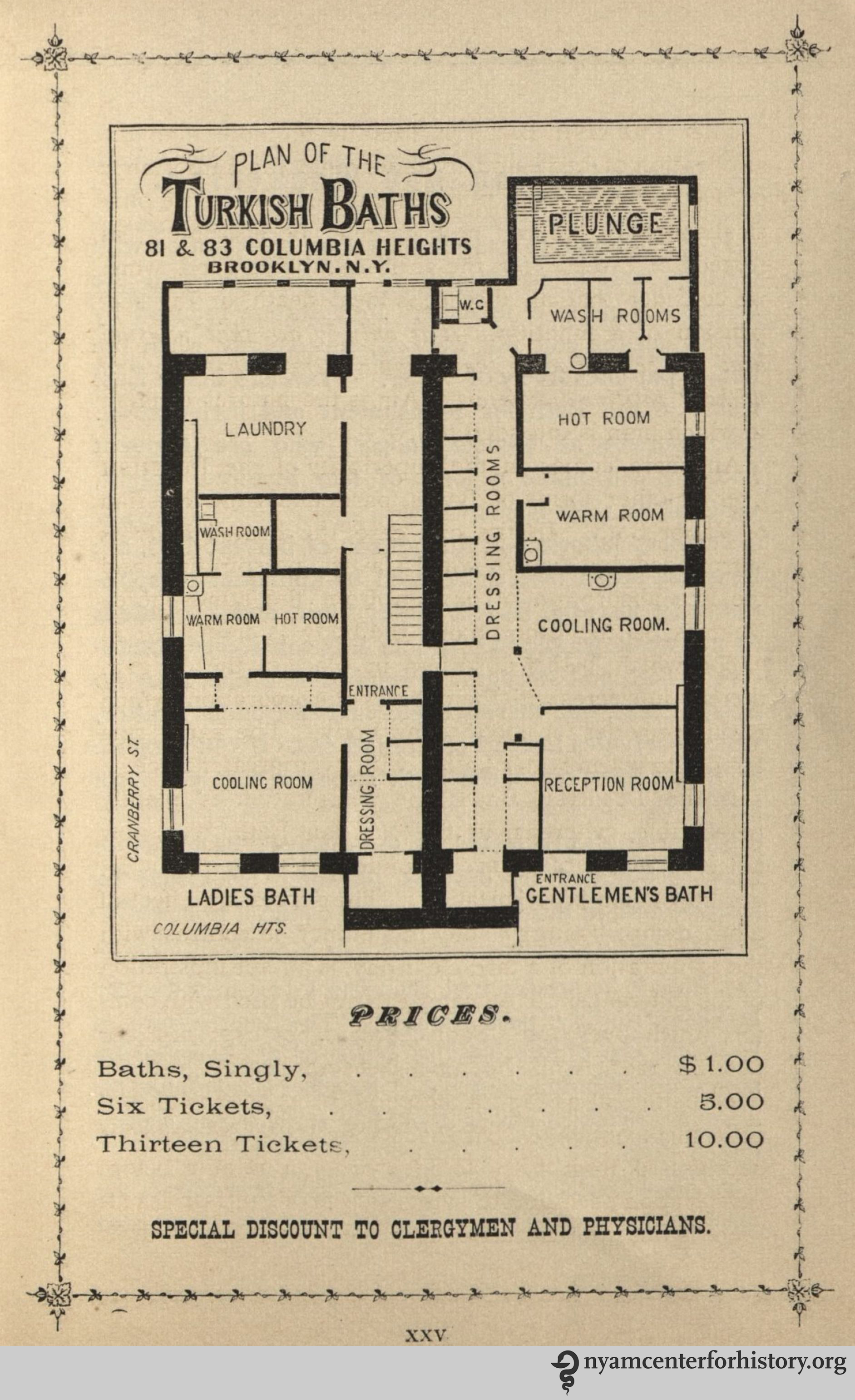
Plan and prices of the Turkish Baths in Brooklyn Heights. In Shepard, The Turkish Bath, 1873.

View of Brooklyn, showing the location of the Hammam. In Shepard, The Turkish Bath, 1873. Click to enlarge.
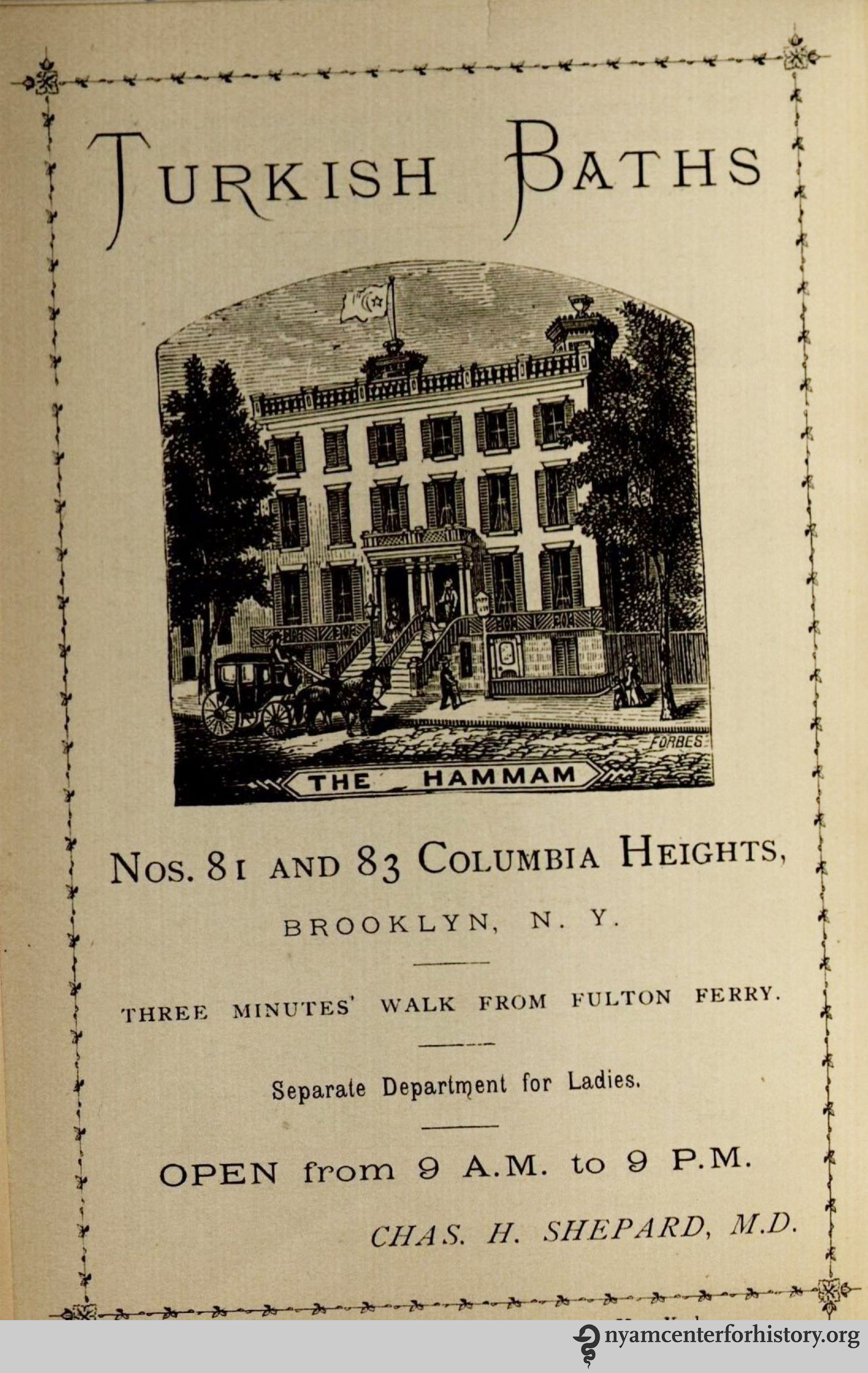
The Bath’s exterior. In Shepard, The Turkish Bath, 1873.

Whether in London or Brooklyn, these 19th and early 20th century baths provided centers of calm in a bustling city. As David Urquart said:

Well can I recall the Hammam doors which I have entered, scarcely able to drag one limb after the other, and from which I have sprung into my saddle again, elastic as a sinew and light as a feather.5

References

1. This was the Hydropathic Establishment of St. Anne’s in Cork. In many parts of Europe today, the “Turkish bath” is known as the “Irish-Roman bath.” See victorianturkishbath.org.

2. Urquhart, David. Manual of the Turkish Bath. John Fife (Ed.). London: John Churchill & Sons, 1865.

3. Wilson, Erasmus. The Eastern, or Turkish Bath: Its History, Revival in Britain, and Application to the Purposes of Health. London: John Churchill, 1861.

4. Soap.

5. Shepard, Charles H. The Turkish Bath. Brooklyn, NY: S.W. Green, 1873. P.30.
Beyond “The Yellow Wallpaper”: Silas Weir Mitchell, Doctor and Poet

By Johanna Goldberg, Information Services Librarian

To celebrate National Poetry Month, we are sharing poems from our collection throughout April.

Today, Silas Weir Mitchell (1829–1914) is best known as the purveyor of the Rest Cure, made infamous by Charlotte Perkins Gilman’s short story “The Yellow Wallpaper.” But while he was alive, he was renowned as a pioneering doctor of nervous diseases and a successful author.

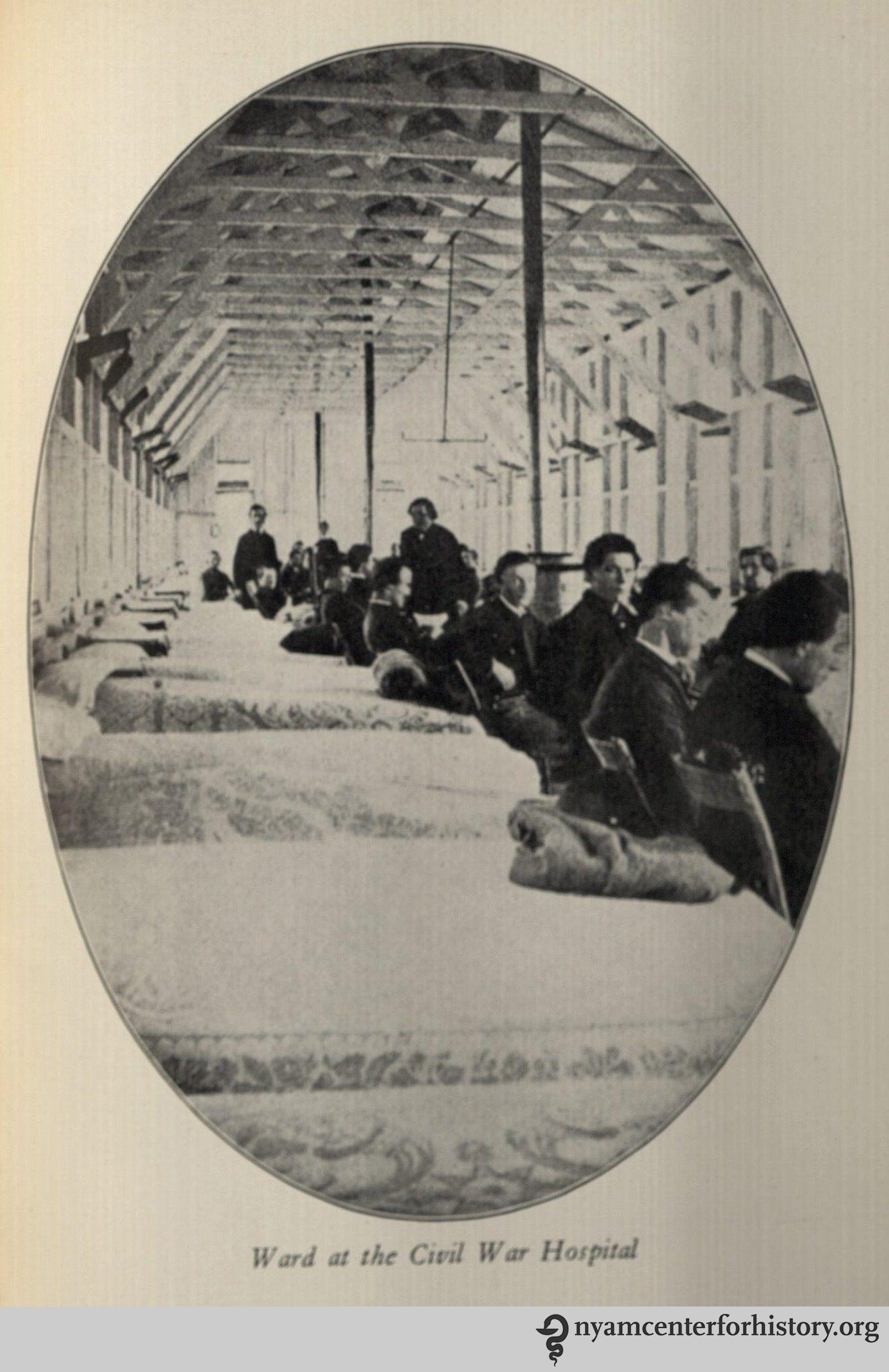
Mitchell began his medical career researching rattlesnake venom. With the outbreak of the Civil War, he shifted focus, beginning work as a contract surgeon at Philadelphia’s Turner’s Lane Hospital, specializing in nervous diseases.

"Ward at the Civil War Hospital." In Burr, Weir Mitchell: His Life and Letters, 1929.

“Ward at the Civil War Hospital.” In Burr, Weir Mitchell: His Life and Letters, 1929.

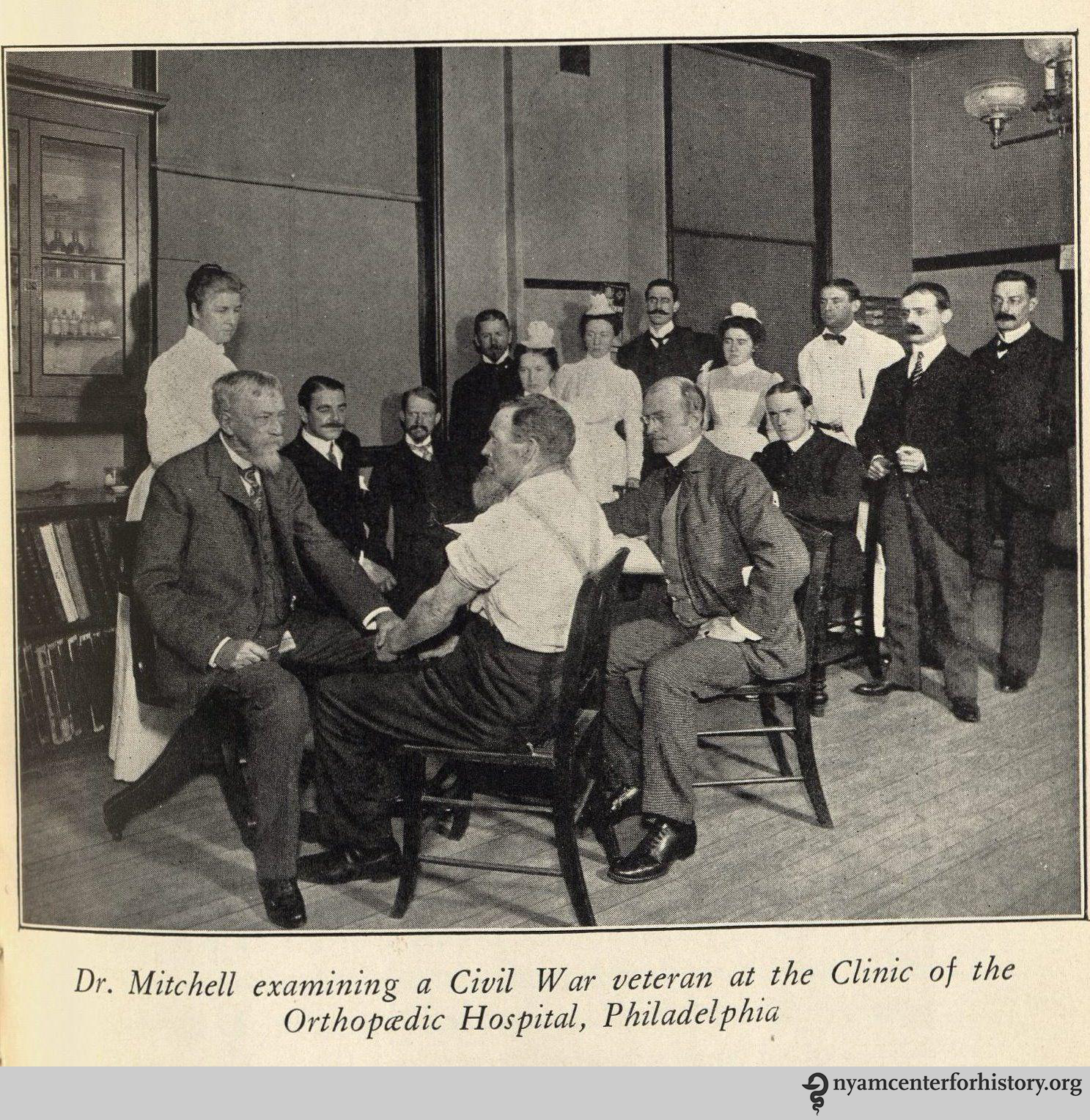
Here, he treated and studied patients with nervous system injuries and syndromes, including one he named causalgia (a form of neuropathic pain). These studies informed his numerous pamphlets and books and helped establish his reputation as a father of American neurology.1–3 After the war, Mitchell continued his research at the Philadelphia Orthopaedic Hospital and Infirmary for Nervous Diseases. He determined that eyestrain could cause headache, and also discovered the rare vascular pain disorder erythromelalgia, or Weir Mitchell’s disease.1

Dr. Mitchell examining a Civil War veteran at the Clinic of the Orhopaedic Hospital, Philadelphia. In Burr, Weir Mitchell: His Life and Letters, 1929.

“Dr. Mitchell examining a Civil War veteran at the Clinic of the Orthopaedic Hospital, Philadelphia.” In Burr, Weir Mitchell: His Life and Letters, 1929.

More controversially, Mitchell also developed the Rest Cure, a treatment for the now passé diagnoses of neurasthenia (physical and mental exhaustion) and hysteria. Women most often received the Rest Cure, which typically involved six to eight weeks of isolation, bed rest, a high calorie diet, massage, and electrotherapy.4 Though the Rest Cure seems problematic to modern eyes, it was an accepted and popular practice for decades, seen as a valuable alternative to drug treatment.3

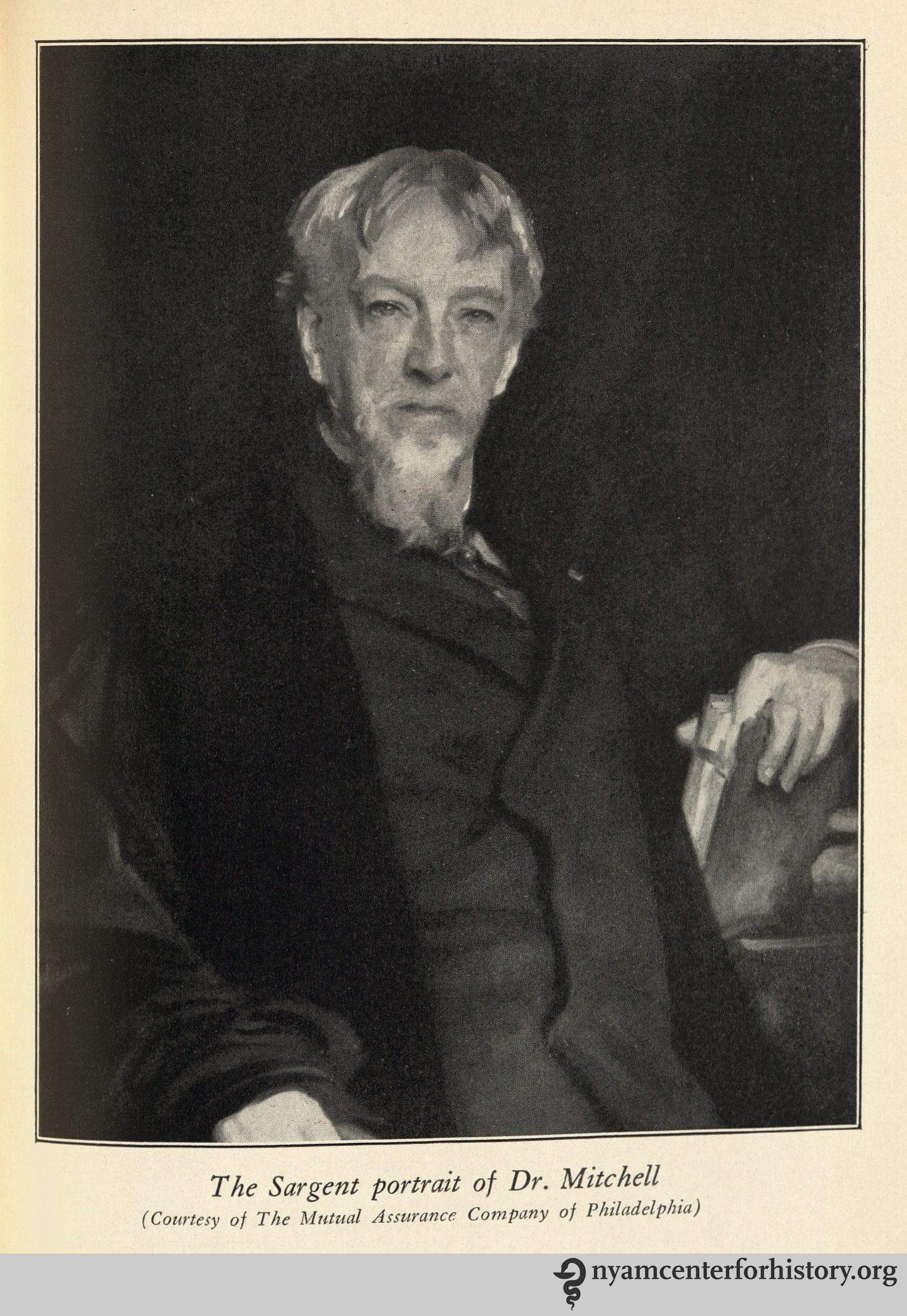
And what about men experiencing neurasthenia? For them, Mitchell developed the West Cure. Men—including Walt Whitman and Theodore Roosevelt—were sent West to “engage in vigorous physical activity … and to write about the experience.”5 The different treatments used for the same diagnosis—neurasthenia—speak volumes to how differently men and women can be viewed and medicalized.5

The Sargent portrait of Dr. Mitchell. In Burr, Weir Mitchell: His Life and Letters, 1929.

“The Sargent portrait of Dr. Mitchell.” In Burr, Weir Mitchell: His Life and Letters, 1929.

In addition to his medical research and private practice, Mitchell also enjoyed a career as an author. He published numerous short stories, 19 novels, a biography of George Washington, and 7 books of poetry.3 We have one of these poetry books, A Psalm of Deaths and Other Poems (available in full online), in our collection. We feature two poems from the volume here.

When Mitchell wrote “Of Those Remembered” in 1899, he was no stranger to loss: he had experienced the death of his father (1858), his first wife (1862), his mother (1872), and his sister (1874) in quick succession, along with the deaths of so many Civil War soldiers.2

Of Those Remembered

There is no moment when our dead lose power;
Unsignaled, unannounced they visit us.
Who calleth them I know not. Sorrowful,
They haunt reproachfully some venal hour
In days of joy, and when the world is near,
And for a moment scourge with memories
The money changers of the temple-soul.
In the dim space between two gulfs of sleep,
Or in the stillness of the lonely shore,
They rise for balm or torment, sweet or sad,
And most are mine where, in the kindly woods,
Beside the child like joy of summer streams,
The stately sweetness of the pine hath power
To call their kindred comforting anew.
Use well thy dead. They come to ask of thee
What thou hast done with all this buried love,
The seed of purer life? Or has it fallen unused
In stony ways and brought thy life no gain?
Wilt thou with gladness in another world
Say it has grown to forms of duty done
And ruled thee with a conscience not thine own?
Another world! How shall we find our dead?
What forceful law shall bring us face to face?
Another world! What yearnings there shall guide?
Will love souls twinned of love bring near again?
And that one common bond of duty held
This living and that dead, when life was theirs?
Or shall some stronger soul, in life revered,
Bring both to touch, with nature’s certainty,
As the pure crystal atoms of its kind
Draws into fellowship of loveliness?

The volume closes with a poem perfect for National Poetry Month: “Of a Poet” (1886).

Of a Poet
Written for a child

He sang of brooks, and trees, and flowers,
Of mountain tarns, of wood-wild bowers
The wisdom of the starry skies,
The mystery of childhood’s eyes,
The violet’s scent, the daisy’s dress
The timid breeze’s shy caress
Whilst England waged her fiery wars
He praised the silence of the stars,
And clear and sweet as upland rills
The gracious wisdom of her hills.
Save once when Clifford’s fate he sang,
And bugle-like his lyric rang,
He prized the ways of lowly men,
And trod, with them, the moor and fen.
Fair Nature to this lover dear
Bent low to whisper or to hear
The secrets of her sky and earth,
In gentle Words of golden Worth.

References

1. Silas Weir Mitchell, Papers, 1788; 1850-1928; 1949. Available at: http://www.collegeofphysicians.org/FIND_AID/hist/histswm1.htm. Accessed April 7, 2016.

2. Bailey P. Silas Weir Mitchell, 1829-1914. National Academy of Sciences; 1958. Available at: http://www.nasonline.org/publications/biographical-memoirs/memoir-pdfs/mitchell-silas.pdf. Accessed April 7, 2016.

3. Todman DH. History of Neuroscience: Silas Weir Mitchell (1829-1914). IBRO Hist Neurosci. 2008. Available at: http://ibro.info/wp-content/uploads/2012/12/Mitchell-Silas-Weir.pdf. Accessed April 7, 2016.

4. Science Museum, London. Rest cure. Brought to Life. Available at: http://www.sciencemuseum.org.uk/broughttolife/techniques/restcure. Accessed April 7, 2016.

5. Stiles A. Go rest, young man. Monit Psychol. 2012;43(1):32. Available at: http://www.apa.org/monitor/2012/01/go-rest.aspx. Accessed April 7, 2016.

ſociety for the Reſtoration of the ſ

As ſpecial collections librarians, we have an abiding intereſt in the hiſtory of printing, books, and manuſcripts. As ſuch, it pains us that ſ, the long s, has not only been ſwept into the waſtebin of hiſtory, but also has no ſuitable digital equivalent.

Logo for the Society for the Restoration of the Long STo this end, we have founded the ſociety for the Reſtoration of the ſ, a group dedicated to bringing back this neglected character. We invite you to join us by pledging the oath:

I, ________, ſolemnly ſwear to ſuſtain ſyſtematic uſe of the long ſ, in manuſcripts and print, on ſcreens and perſonal devices, for the ſake of myſelf and my ſociety.

The ſ has a ſtoried hiſtory. Before 1800, the lowercaſe letter s appeared in two forms, the one we uſe today and ſ, which typically looked like an f without the right half of its croſſbar. The italic form of ſ (ʃ) lacked the half-croſſbar.1 Our modern ſcreen equivalent also lacks this half-croſſbar, a development we deteſt and oppoſe!

Inaugural members of the ſociety for the Reſtoration of the ſ after pledging the oath of memberſhip.

Inaugural members of the ſociety for the Reſtoration of the ſ after pledging the oath of memberſhip.

The ſ goes back as far as Roman inſcriptions. By the 12th century, people uſed ſ at the beginning and middle of words, and s at the end of them. The ſ did not replace the capital letter s. Printers continued theſe conventions, as do we (with one exception: the capital S in our ſociety name).1

The ſ was on its way out beginning in 1782, when our ſociety’s menace, François-Ambroiſe Didot, cut a new “modern” typeface without the character. Other printers followed his lead.1 By the 19th century, the era of ſ in print (if not in handwriting) was over everywhere but Germany, where it remains today in the form of the Eſzett, or double s (ß).2,3

Join us! Petition Apple, Samſung, Microſoft, and other tech companies and printers to reinſtate the historic ſ! And ſhare your efforts on ſocial media.

Below we preſent a ſelection of collection items featuring ſ and ʃ, bolſtering our argument for the letter’s ſuſtained uſe. Click on an image to learn more.

References

1. Moſley J. The Long ſ. Print Hiʃt ʃoc Bull. 1991;31(Winter):32–33.

2. International Encyclopedia of Linguiʃtics, Volume 4. Oxford Univerſity Preſſ; 2003. Available at: https://books.google.com/books?id=sl_dDVctycgC&pgis=1. Acceſſed March 16, 2016.

3. Gilder Lehrman Inſtitute of American Hiſtory. Inſide the Vault: The “Long ſ.” 2016. Available at: http://www.gilderlehrman.org/community/blog/inside-vault-%E2%80%9Clong-s%E2%80%9D. Acceſſed March 16, 2016.

Announcing the March Madness Food Fight Club Winner

Drum roll please…

The winner of the 2016 March Madness Food Fight Club is…

Vegetable Curry!

Background image: Kirkland, The modern baker, confectioner, and caterer, c1907.

Background image: Kirkland, The modern baker, confectioner, and caterer, c1907.

Thanks to all who voted throughout the competition. If you decide to make this winning recipe, please tell us about it and share some photos.

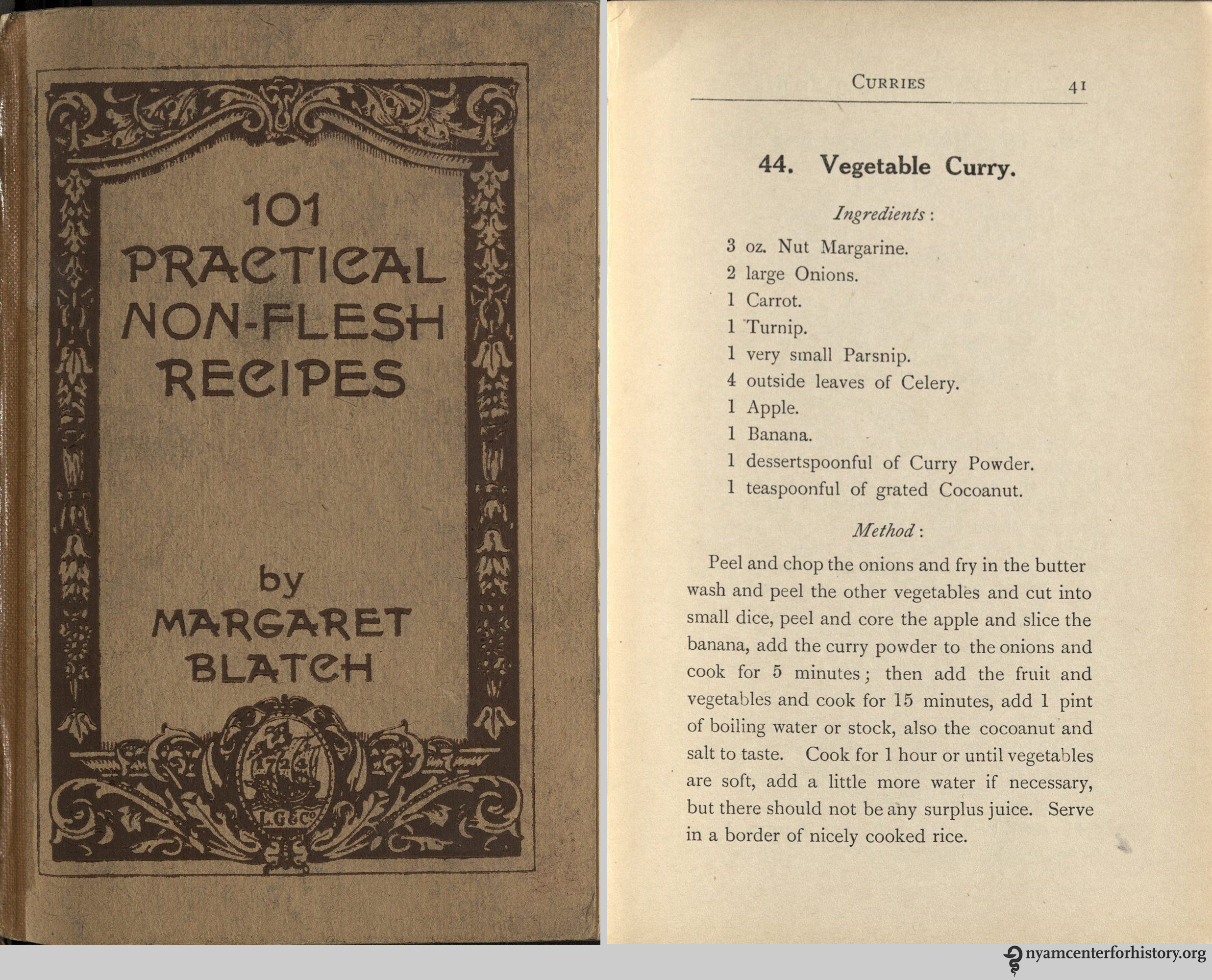
Vegetable Curry recipe in Blatch, 101 Practical Non-Flesh Recipes, 1917.

Vegetable Curry recipe in Blatch, 101 Practical Non-Flesh Recipes, 1917. Click to enlarge.

The four recipes in this competition—from a pamphlet, a manuscript receipt book, and two printed cookbooks—don’t begin to scratch the surface of what our cookery collection holds. We acquired our Margaret Barclay Wilson culinary collection in 1929, and it now contains about 10,000 items. The collection includes manuscripts, menus, and pamphlets that demonstrate the way cookery changed over time, and a large collection of printed books, beginning in the 16th century. These include works by Scappi, Platina, and Carême, as well as many other milestones in culinary printing.

Our cookbooks offer aspirational recipes, practical recipes, and everything in between.  Our collections hold a snapshot view of what daily cooking was like in a range of households across the world. These recipe books also reflect the changes that occur when people have access to new innovations—refrigeration, for example, or the gas range. We also have strong collections related to diet regimens and cooking for health, as well as cookbooks published during wartime when resources were scarce.

Interested in researching historic cookbooks? Our library is open to the public. To make an appointment, call 212-822-7315 or email library@nyam.org.

Mental Health in the Metropolis: The Midtown Manhattan Study

By Paul Theerman, Associate Director, Center for the History of Medicine and Public Health

How can we improve urban health? That is one of the missions of the New York Academy of Medicine, and a question public health professionals have been asking for decades. One of the landmark urban health studies, Mental Health in the Metropolis: The Midtown Manhattan Study, was published more than half a century ago.1 The study was intended to be a deep and exhaustive look into the mental health of residents in one of the most urban environments in the country, Midtown Manhattan. In many ways it was to be a model of the state of urban health throughout the country.2 And it was shaped by the medical experience of World War II.

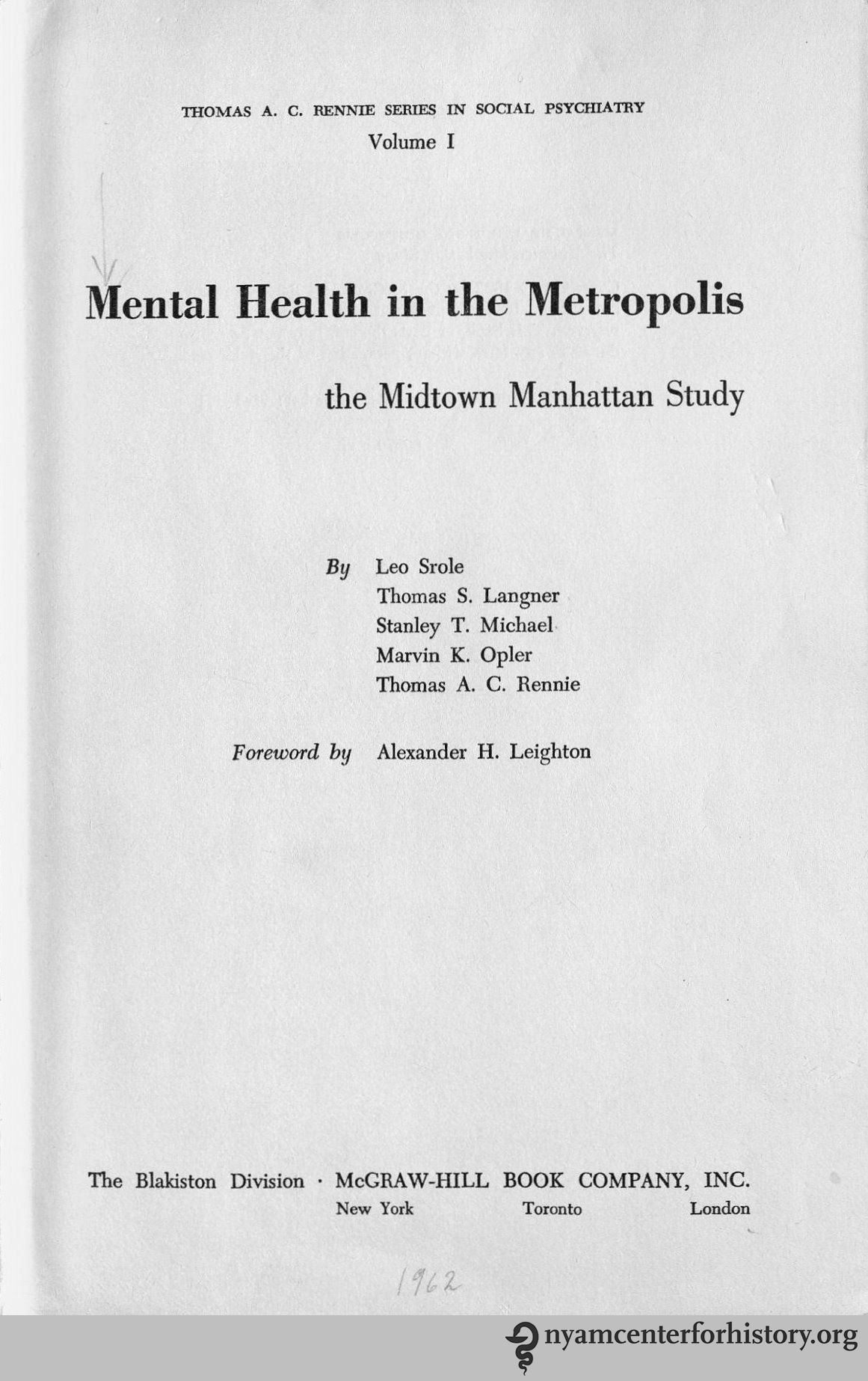
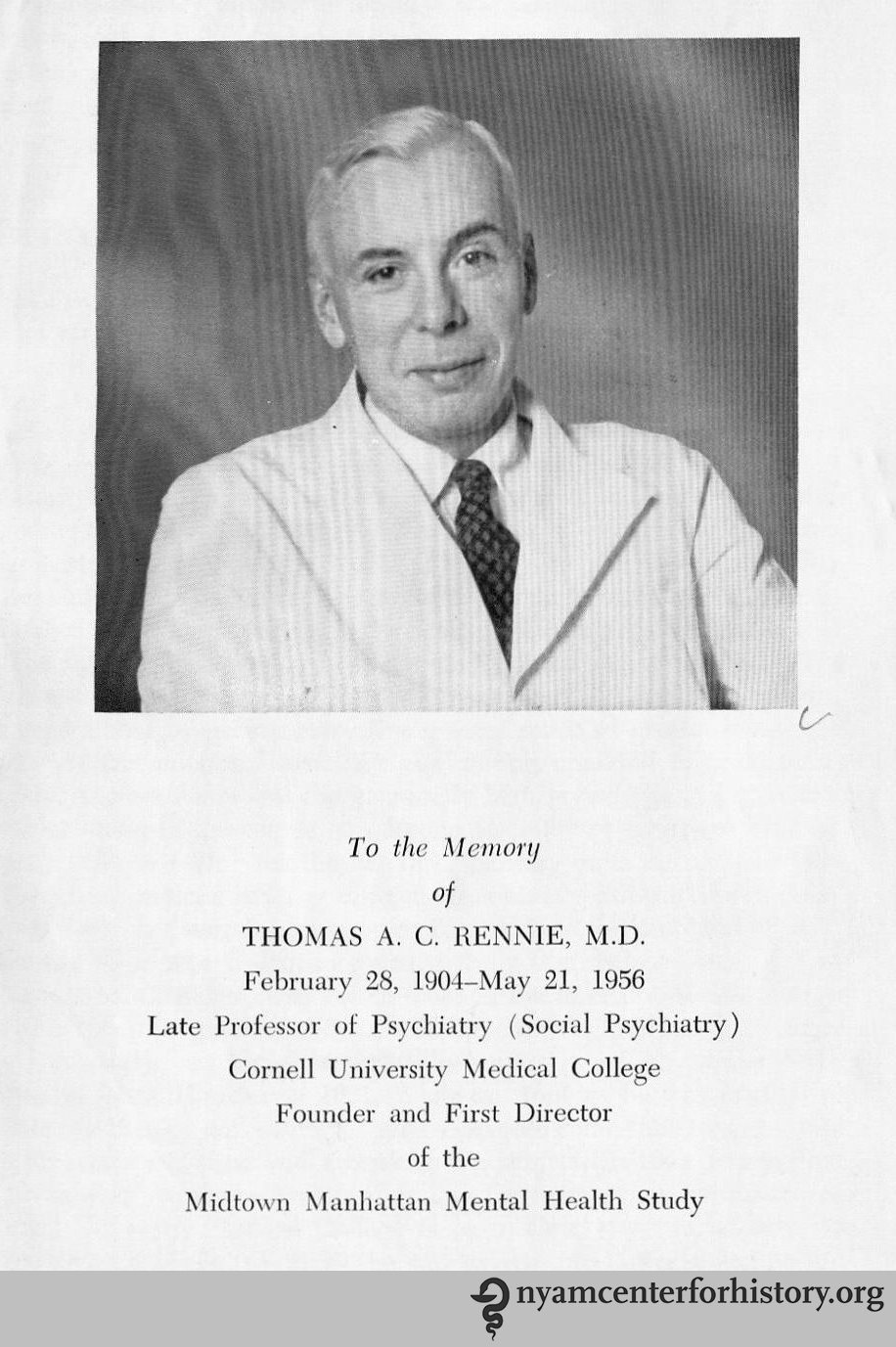
Title page of Mental Health in the Metropolis, 1962.

Title page of Mental Health in the Metropolis, 1962.

Many veterans developed mental illnesses over the course of the war. Dr. Thomas A. C. Rennie, associate professor of psychiatry at Cornell University Medical College, saw many cases directly. He organized rehabilitation services for veterans during the war, and in 1944 published When He Comes Back and If He Comes Back Nervous.3 This booklet was followed by Mental Health and Modern Society,4 a professional discussion of the effects of war on society. In his war and postwar experience, Rennie encountered many people suffering from mental difficulties, and concluded that the long and extended psychoanalytic approach would never treat them effectively, for lack of time and resources.

Dedication of Mental Health in the Metropolis to Thomas A. C. Rennie.

Dedication of Mental Health in the Metropolis to Thomas A. C. Rennie.

Instead, Rennie began to look at the relationship between mental health and the social community.5 In the process he created a new field—social psychiatry. In 1950, he was appointed the first professor of social psychiatry at Cornell, arguably holding the first position of this kind anywhere in the United States.6 He conceived the Midtown study this same year, and launched it in 1952. Upon Rennie’s sudden death from a cerebral hemorrhage in mid-1956, the program was continued by Dr. Alexander Leighton, a colleague, medical sociologist, and psychiatrist at Cornell. The study ended in 1960, with publication of its results in 1962.7 It was a large undertaking; overall, the project utilized the services of some 200 people.

What did the study look like? In the words of the lead author, sociologist Leo Srole of SUNY Medical Center Brooklyn (SUNY Downstate), “An investigation focused upon Midtown can, in a special sense, be likened to an intensive case study. Here a community, rather than an individual, is the case.”8 Mental health was investigated as an outcome of community function and dysfunction, as much as or even more so than of the individual. That community was studied along many lines: age, sex, marital status, socioeconomic status, “generation-in-the-U.S.,” and various frames of origination: rural or urban, nationality, and religious affiliation. Researchers also assessed access to and outcomes of mental health and psychiatric care by surveying community residents and treatment workers. Their work seemed to show that Midtown held large numbers of untreated ill individuals, most of whom still functioned at an acceptable level. But definitive results were difficult to come by, and more studies were called for.

Correspondence between sick-well ratios for 12 socioeconomic status strata, reported in 4 groups, with highest SES marked “1” and lowest “12”. The “sick-well” ratio is found by comparing the numbers of “impaired” persons in a particular grouping, with the number of “well” persons. Two other rankings lie between these designations: “mild symptom formation” and “moderate symptom formation.” Mental Health in the Metropolis, Figure 5, p. 231. Click to enlarge.

Correspondence between sick-well ratios for 12 socioeconomic status strata, reported in 4 groups, with highest SES marked “1” and lowest “12”. The “sick-well” ratio is found by comparing the numbers of “impaired” persons in a particular grouping, with the number of “well” persons. Two other rankings lie between these designations: “mild symptom formation” and “moderate symptom formation.” Mental Health in the Metropolis, Figure 5, p. 231. Click to enlarge.

Mental Health in the Metropolis was the report of a large and complex analysis, marrying the different disciplines of psychiatry and sociology to understand and address medical problems using social means. As such it was a child of the war—the war that created mass problems, and suggested ways towards solving them. And it was the harbinger of studies to come.

References

1. Authored by Leo Srole, Thomas S. Langner, Stanley T. Michael, Marvin K. Opler, and Thomas A. C. Rennie, volume 1 in the Thomas A. C. Rennie Series in Social Psychiatry (New York: Blakiston Division, McGraw-Hill, [1962]).

2. Mental Health in the Metropolis, p. 338. The precise boundaries of the study area were not disclosed for reasons of confidentiality; it was described as “more or less midway up the length of Manhattan Island,” bounded by the business district, two major thoroughfares, and a river, and “almost wholly residential in character,” with 175,000 inhabitants (p. 72, and fn 14). Using the name “Midtown” to describe this community was surely inspired by the famous “Middletown” studies of Muncie, Indiana, done by Robert Staughton Lynd and Helen Merrell Lynd, and published in 1929 and 1935.

3. With Luther E. Woodward: New York: The National Committee for Mental Hygiene, [c1944].

4. Also with Luther E. Woodward: New York: Commonwealth Fund, 1948.

5. He was not the first to explore this connection, of course, and he profited from his work with Adolf Meyer of The Johns Hopkins Medical School from 1931 to 1941, Oskar Diethelm, “Thomas A. C. Rennie, February 28, 1904 — May 21, 1956,” Cornell University Faculty Memorial Statement, https://ecommons.cornell.edu/handle/1813/17813, accessed March 18, 2016.

6. Mental Health in the Metropolis, pp. viii.

7. Mental Health in the Metropolis, pp. 336–37.

8. Mental Health in the Metropolis, p. 28.

Food Fight Club Final: Snail Water v. Vegetable Curry

It’s the Food Fight Club final! Snail Water won round 1 and Vegetable Curry won round 2. Now it’s time for these two tough competitors to duke it out once and for all.

Background image: Kirkland, The modern baker, confectioner, and caterer, c1907.

Background image: Kirkland, The modern baker, confectioner, and caterer, c1907.

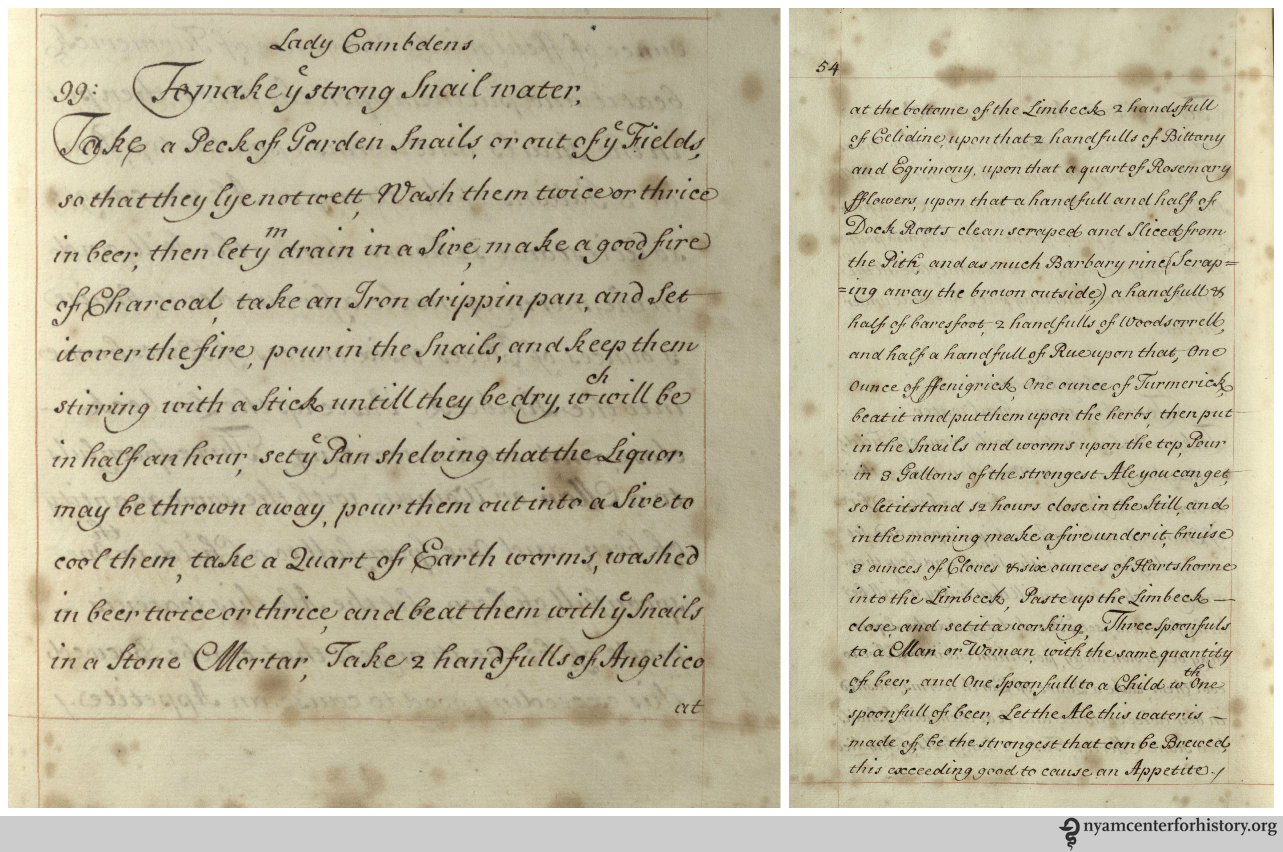
This final bout pits a recipe from a manuscript recipe collection against one found in a printed cookbook.

From A Collection of Choise Receipts. Click to enlarge.

From A Collection of Choise Receipts. Click to enlarge.

The recipe for Snail Water comes from A Collection of Choise Receipts, one of 36 manuscript receipt books in our collection. These collections of recipes, dating from the late 17th through the 19th century, tell stories about the ways food was prepared in a range of households. In many cases, they incorporate source material from contemporary cookbooks in print, showing us the kinds of recipes households valued and relied on. These manuscripts often include personal information about the families who kept them. One noteworthy case in our collections is a recipe for “How to make coffy of dry swet aple snits (slices),” found in a recipe book kept by a German-American family in Pennsylvania-Dutch country between 1835 and 1850. Manuscript cookbooks can also show us the kinds of cooking technologies used by families. Repeated references to coals and the Dutch oven indicate that Pennsylvania-Dutch cookbook’s author was cooking at the open hearth.
Vegetable Curry recipe in Blatch, 101 Practical Non-Flesh Recipes, 1917.

Vegetable Curry recipe in Blatch, 101 Practical Non-Flesh Recipes, 1917. Click to enlarge.

Publishers of printed cookbooks responded to demand from readers. These books—and the number of editions that were published—can tell us a great deal about cooking trends. Our 1917 copy of 101 Practical Non-Flesh Recipes, for example, is the book’s second edition, the first published just a year before. Cookbooks could be aspirational, practical, or a combination of both. A 19th-century cookbook published in Milwaukee in German in multiple editions tell us that there was a demand for cookbooks written in the mother tongue for newly-arrived German immigrants. The mixture of German and American recipes in these books indicate a need for familiar recipes from the Old World, as well as instruction on how to prepare foods that were more typical of the New. A number of printed cookbooks in our collection have emended recipes or manuscript recipes laid-in to their pages, offering clues to how readers modified published recipes for personal use.

Which recipe should be crowned the 2016 Food Fight Club Champion? Vote for your favorite—be it the most appealing, least appealing, or one that just tickles your fancy more—before 5 pm EST on Monday, March 28.

Food Fight Club Round 2: Vegetable Curry v. Ragout of Squirrel

It’s time for match two of our March Madness Food Fight Club.

First, the reveal of last week’s smackdown: Snail Water triumphed over Pear and Tomato Chutney. Whichever recipe wins this week has a tough competitor for next Wednesday’s final match.

March Madness Food Fight Club_Round1winner

Background image: Kirkland, The modern baker, confectioner, and caterer, c1907.

This week, we pit Vegetable Curry against Ragout of Squirrel.

Vegetable Curry recipe in Blatch, 101 Practical Non-Flesh Recipes, 1917.

Vegetable Curry recipe in Blatch, 101 Practical Non-Flesh Recipes, 1917. Click to enlarge.

The innocuous-sounding vegetable curry comes from Margaret Blatch’s 101 Practical Non-flesh Recipes, a nice little vegetarian cookbook from 1917. The title might sound a bit odd to modern readers and is an interesting choice, considering the term vegetarian was well-established by the 1840s.1 A 1908 physical education article sheds some light on the terminology of the time, saying the word vegetarian “usually suggests a person who abstains not on hygienic but on religious, ethical, or theological grounds,” preferring instead “flesh-abstainer.”2 It appears “non-flesh” was less provocative than “vegetarian.”

Ragout of Squirrel recipe in Recipes for the Jewett Chafing Dish, 1896. Click to enlarge.

Ragout of Squirrel recipe in Recipes for the Jewett Chafing Dish, 1896. Click to enlarge.

Our next contestant features two items not commonly seen on today’s dinner tables: Chafing dishes and squirrels. In the 1890s, chafing dishes experienced a surge in popularity in America, and Recipes for the Jewett Chafing Dish was just one of many cookbooks published featuring recipes specifically for the dish. The Waldorf-Astoria Hotel offered “chafing dish suppers” to top socialites, and stores sold table linens to match the cookware.3 Squirrel, too, was a common sight at the American dinner table due to its availability. One can track its rise and fall by looking at editions of The Joy of Cooking over time, where the numerous squirrel recipes of the 1930s gave way to recipes for chicken.4

Which recipe should face Snail Water in the final round? Vote for your favorite—be it the most appealing, least appealing, or one that just tickles your fancy more—before 5 pm EST on Monday, March 21.

References
1. Spencer C. The Heretic’s Feast: A History of Vegetarianism. UPNE; 1996. Available at: https://books.google.com/books?id=rIjZo-cvifAC&pgis=1. Accessed March 15, 2016.

2. Fisher I. The Influence of Flesh-eating on Endurance. Modern Medicine Publishing; 1908. Available at: https://books.google.com/books?hl=en&lr=&id=gW8yAQAAMAAJ&pgis=1. Accessed March 15, 2016.

3. Lovegren S, Smith AF. Chafing Dish. Oxford Companion to Am Food Drink. 2007:103. Available at: https://books.google.com/books?id=AoWlCmNDA3QC&pgis=1. Accessed March 10, 2016.

4. Smith H. Al rodente: Could squirrel meat come back into vogue? Grist. 2012. Available at: http://grist.org/animals/al-rodente-could-squirrel-meat-come-back-into-vogue/. Accessed March 10, 2016.

Surviving the Great Blizzard of 1888

By Johanna Goldberg, Information Services Librarian

After the snowstorm on January 22–23, 2016 dropped 26.8 inches of snow on New York City, lists circulated of the worst snowstorms in the city’s history dating back to 1869. Of the top ten storms, only one occurred in the 19th century: the blizzard of 1888, which resulted in 21 inches of snow falling on the city from March 12–14 of that year.

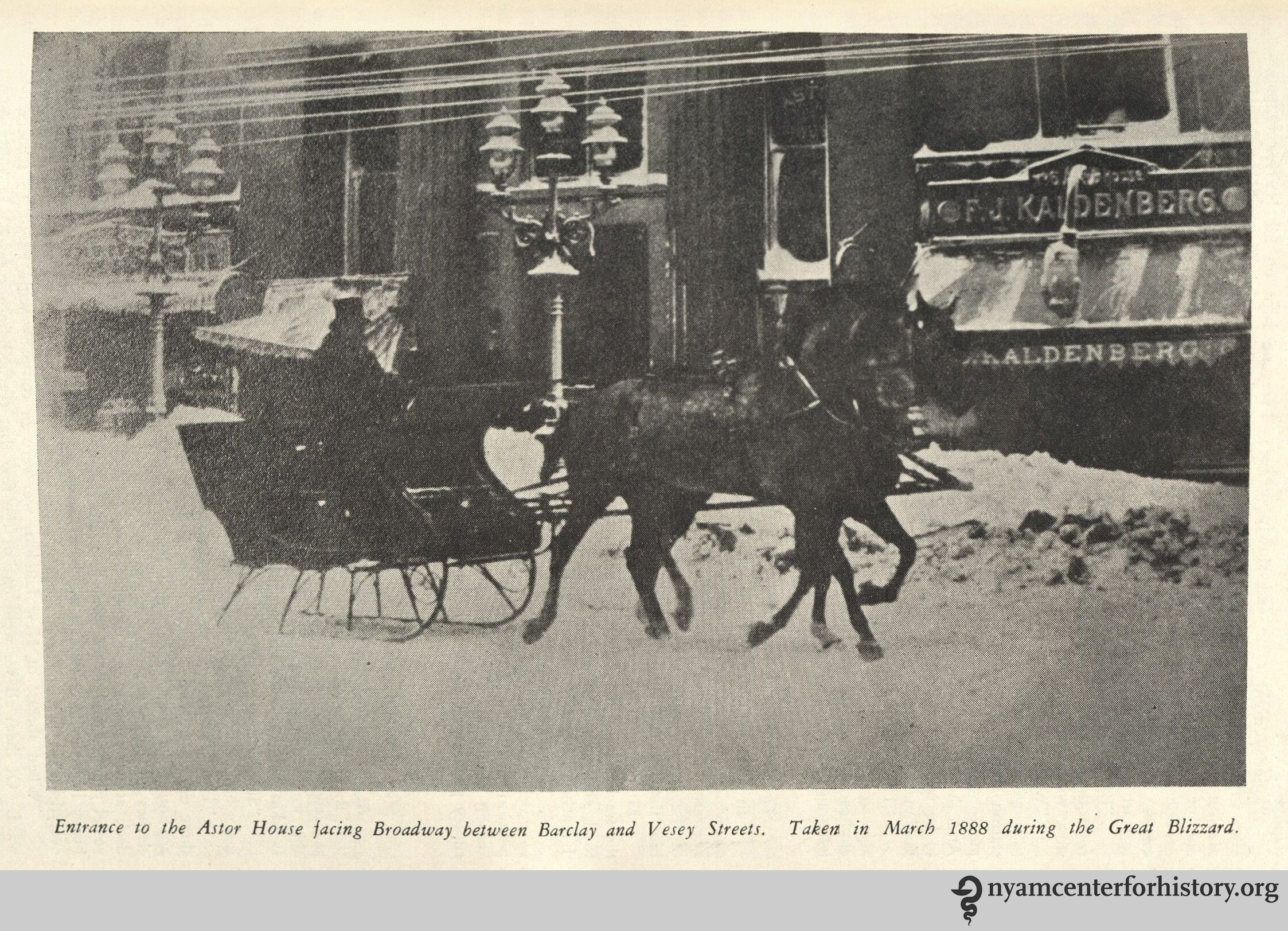
"Entrance to the Astor House facing Broadway between Barclay and Vesey Streets. Taken in March 1888 during the Great Blizzard." From Strong, The Great Blizzard of 1888.

“Entrance to the Astor House facing Broadway between Barclay and Vesey Streets. Taken in March 1888 during the Great Blizzard.” From Strong, The Great Blizzard of 1888.

The blizzard arrived unexpectedly. The forecast for Sunday, March 11 called for slight wind and evening rain. But late that night, a storm from the south altered its course at the same time that the wind changed direction. Rain turned to sleet, hail, and finally snow. New Yorkers woke up on Monday to 10 inches of snow and bitter cold.

“Looking north on Madison Avenue during the March 1888 Blizzard.” From Strong, The Great Blizzard of 1888.

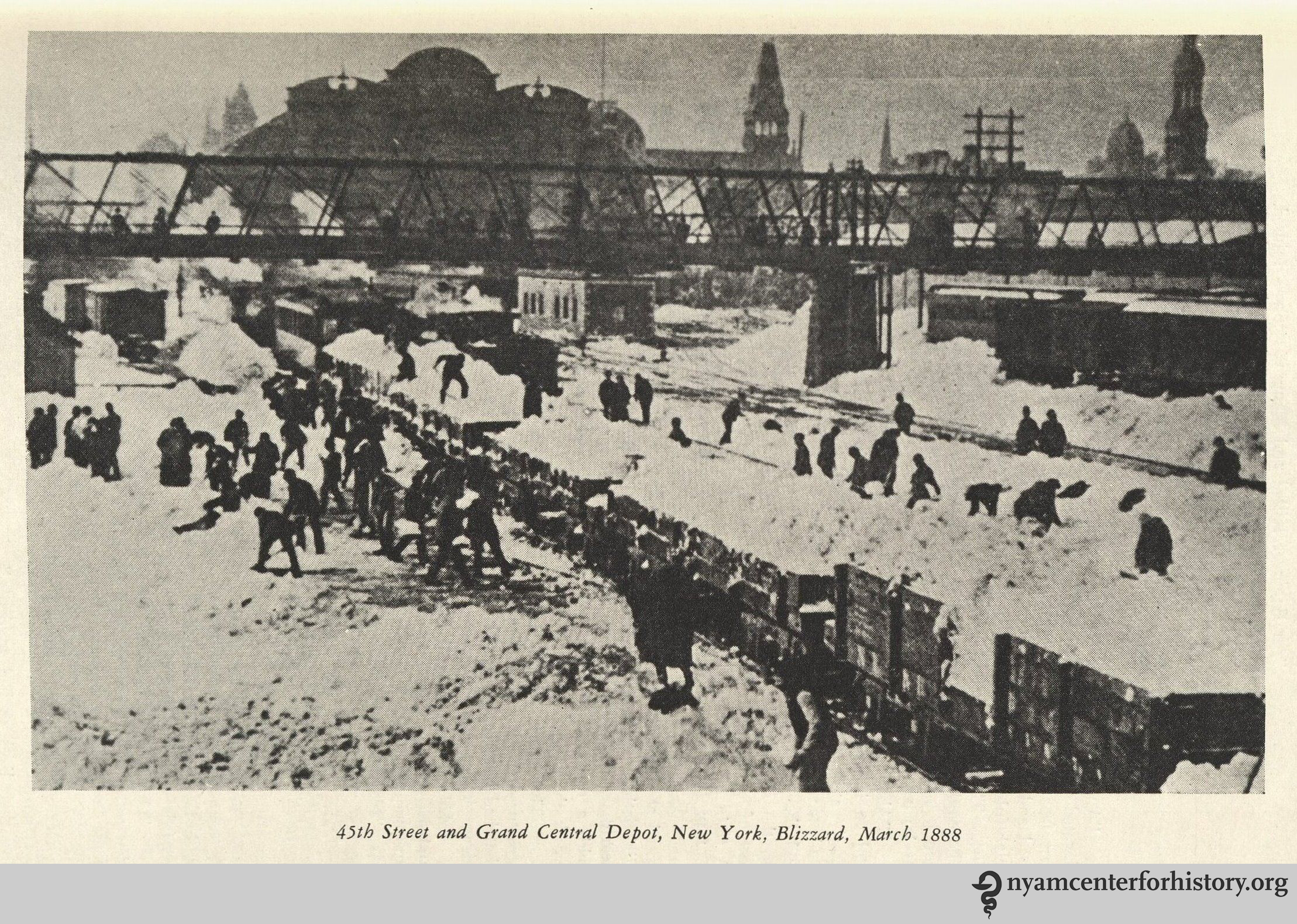
Not realizing that the worst was yet to come—11 more inches of wind-swept snow fell before the storm ended—many ended up stranded on their way to work or school. Eighty mile an hour wind gusts blew snow into drifts as high as second story windows and, along with the snow and ice, stopped elevated trains and toppled phone, electric, and telegraph poles. After the suspension of ferry service, people attempted to cross the frozen East River on foot (many were rescued by tugboats). More than 200 New Yorkers died as a result of the storm.1,2

"45th Street and Grand Central Depot, New York, Blizzard, March 1888." From Strong, The Great Blizzard of 1888.

“45th Street and Grand Central Depot, New York, Blizzard, March 1888.” From Strong, The Great Blizzard of 1888.

"149 Broadway, now the site of the Singer Building, March 1888." From Strong, The Great Blizzard of 1888.

“149 Broadway, now the site of the Singer Building, March 1888.” From Strong, The Great Blizzard of 1888.

In 1938, fifty years after the blizzard, Samuel Meredith Strong, M.D., “Former President of ‘The Blizzard Men of 1888,’” published The Great Blizzard of 1888, a collection of oral histories and printed articles from those who survived the storm. Below are some selections from the book:2

Excerpt from an article by Julian Ralph in the New York Sun, September 2, 1933:

“Few of the women who worked for a living could get to their work places. Never, perhaps, in the history of petticoats was the imbecility of their design better illustrated. ‘To get here I had to take my skirts up and clamber through the snowdrifts,’ said a washerwoman when she came to the house of the reporter who writes this. She was the only messenger from the world at large that reached that house up to half-past 10 o’clock. ‘With my dress down I could not move half a block.’ It was so with many thousands of women; the thousand few who did not turn back when they had started out.”2

11th Street, New York, looking west." From Strong, The Great Blizzard of 1888.

11th Street, New York, looking west.” From Strong, The Great Blizzard of 1888.

From Wm. Chamberlain, Maspeth, New York:

“Mount Olivet Cemetery at Maspeth, New York, had two orders for burials to take place that day, and the Superintendent had men with a small plow drawn by horses work to keep the roads in the cemetery open. Along about ten o’clock he got me on the job shoveling, and after dinner sent me for men in the neighborhood. I think I got two or three and with others and the plows we worked until about 4:30 in the afternoon, but it was no use as the wind blew the snow back faster than we could handle it. We quit, licked to a frazzle, cold and tired and hungry. The funerals, according to the records in the cemetery, did not take place until two or three days later.”

"Copy of photograph taken in Flushing, Long Island, by Mr. William James in March 1888. Mr. Frederick Morris at the left, Dan Beard standing in the center." From Strong, The Great Blizzard of 1888.

“Copy of photograph taken in Flushing, Long Island, by Mr. William James in March 1888. Mr. Frederick Morris at the left, Dan Beard standing in the center.” From Strong, The Great Blizzard of 1888.

Dr. Charles Gilmore Kerley, published in Medical Clinic of North America, November 1935:

“I was a resident physician at the New York Infant Asylum in Westchester County, N.Y. At this institution there were a few over 400 children and about 200 mothers. The age of the child population ranged from infants of a few weeks to children five or six years of age. Among those under one year were perhaps 100 who were partly or entirely dependent on cow’s milk feeding. Eight cans of loose milk a day were supplied by a dairy eight miles distant, the milk being delivered in a horse-drawn truck—then came the big blizzard completely blocking traffic of every nature—in our case for seven days. I well remember the consternation and alarm at the thought of being cut off from all food supplies with over 600 people to be cared for. A few days before the historic storm, through error a large consignment of Borden’s condensed milk arrived at the institution. Twelve dozen cans had been ordered and 12 gross (1728) cans were received. Our greatest anxiety naturally centered on the bottle fed; the condensed product was at once brought in to use and a blizzard feeding plan was inaugurated through dilution with barley water. Greatly to our surprise the marasmic and difficult feeders, struggling along on diluted sterilized milk, took on new life, began to smile and gain in weight.”

Baxter Street, New York, Blizzard, March 1888." From Strong, The Great Blizzard of 1888.

Baxter Street, New York, Blizzard, March 1888.” From Strong, The Great Blizzard of 1888.

John Potter of Lowville, New York:

At that time I had a room on West 24th Street. I was employed as bookkeeper by a firm on Beach Street and started for work at 8:00 o’clock on that morning, taking the 6th Avenue elevated railroad from West 23rd Street. The train proceeded slowly until we reached the curve at Bleeker and 8th Streets when we came to a standstill and remained there until 3:00 o’clock in the afternoon without any heat in the car. About that time a man appeared on the street from a corner saloon with a long ladder which he placed against the elevated railing. The railing being coated with ice it was a difficult matter to climb over and reach the ladder. I recall carrying a young woman and, missing my footing partly down, we both landed in a snow bank. The man charged us fifty cents for the privilege of using his ladder.”

Hotel Martin 17-19 University Place, corner of 9th Street during the March 1888 Blizzard. Abandoned horse-car." From Strong, The Great Blizzard of 1888.

Hotel Martin 17-19 University Place, corner of 9th Street during the March 1888 Blizzard. Abandoned horse-car.” From Strong, The Great Blizzard of 1888.

Caroline Kleindienst, from Cranbury, New Jersey:

“Through the long lone hours of that night we were blessed with our eleven pound boy, without nurse or doctor.… Next morning we found we were completely snowed in. My husband started to shovel his way out, through snow as deep as he was tall….It was three weeks before the roads were cleared and the Doctor then made his first visit to our home and congratulated me on the fine new baby who came into this world unaided and alone in the Big Blizzard of 1888 and twenty-six years and six months later left this world in the Wright chemical explosion [an accident at a factory in Elizabeth, NJ that killed three workers3].”

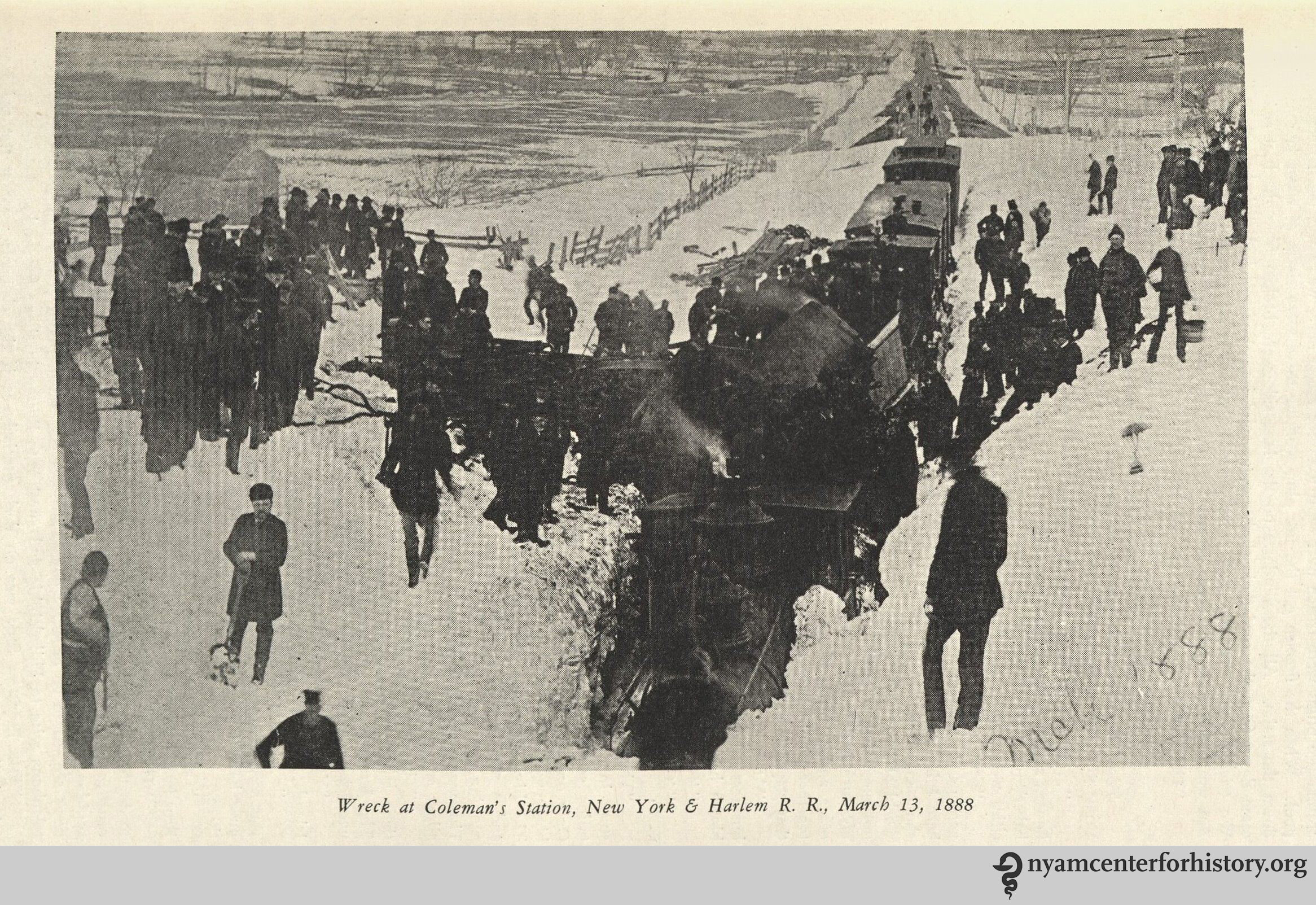
"Wreck at Coleman's Station, New York & Harlem R. R., March 13, 1888." From Strong, The Great Blizzard of 1888.

“Wreck at Coleman’s Station, New York & Harlem R. R., March 13, 1888.” From Strong, The Great Blizzard of 1888.

The blizzard contributed to slow but successful city efforts to move power lines underground and replace elevated trains with the underground subway. It also spurred a more organized response to future weather events from the Department of Street Cleaning, now called the Department of Sanitation.1

Park Place, Brooklyn, N. Y., March 14, 1888." From Strong, The Great Blizzard of 1888.

Park Place, Brooklyn, N. Y., March 14, 1888.” From Strong, The Great Blizzard of 1888.

The next time a blizzard comes to New York, be grateful for modern weather forecasting technology and heated subway cars. And don’t try to cross the East River by foot!

References

1. Virtual New York. Blizzard of 1888. Available at: http://www.virtualny.cuny.edu/blizzard/bliz_hp.html.

2. Strong SM, Overton M. The great blizzard of 1888. [New York]; 1938.

3. GUNCOTTON KILLS THREE. Explosion Wrecks Factory and Shakes a New Jersey County. New York Times. http://query.nytimes.com/gst/abstract.html?res=9D00EEDB1438EF32A2575AC1A96F9C946596D6CF. Published September 19, 1914. Accessed March 4, 2016.

Food Fight Club Round 1: Snail Water v. Pear and Tomato Chutney

Today we begin our March Madness competition, Food Fight Club.

This week and next, two recipes will go head to head, vying for your votes. The following week, the winners of the first two rounds will duke it out for the honor of being named the champion of our first Food Fight Club.

Background image: Kirkland, The modern baker, confectioner, and caterer, c1907.

The smackdown begins with Snail Water versus Pear and Tomato Chutney.

This lovely snail water recipe comes from A Collection of Choise Receipts, a late 17th-century English manuscript written in exquisite penmanship, perhaps written by a professional scribe. Snail water was thought to treat ailments including “sharpness in [the] blood” and appetite loss. Learn more about snail water in our blog archives.

From A Collection of Choise Receipts. Click to enlarge.

From A Collection of Choise Receipts. Click to enlarge.

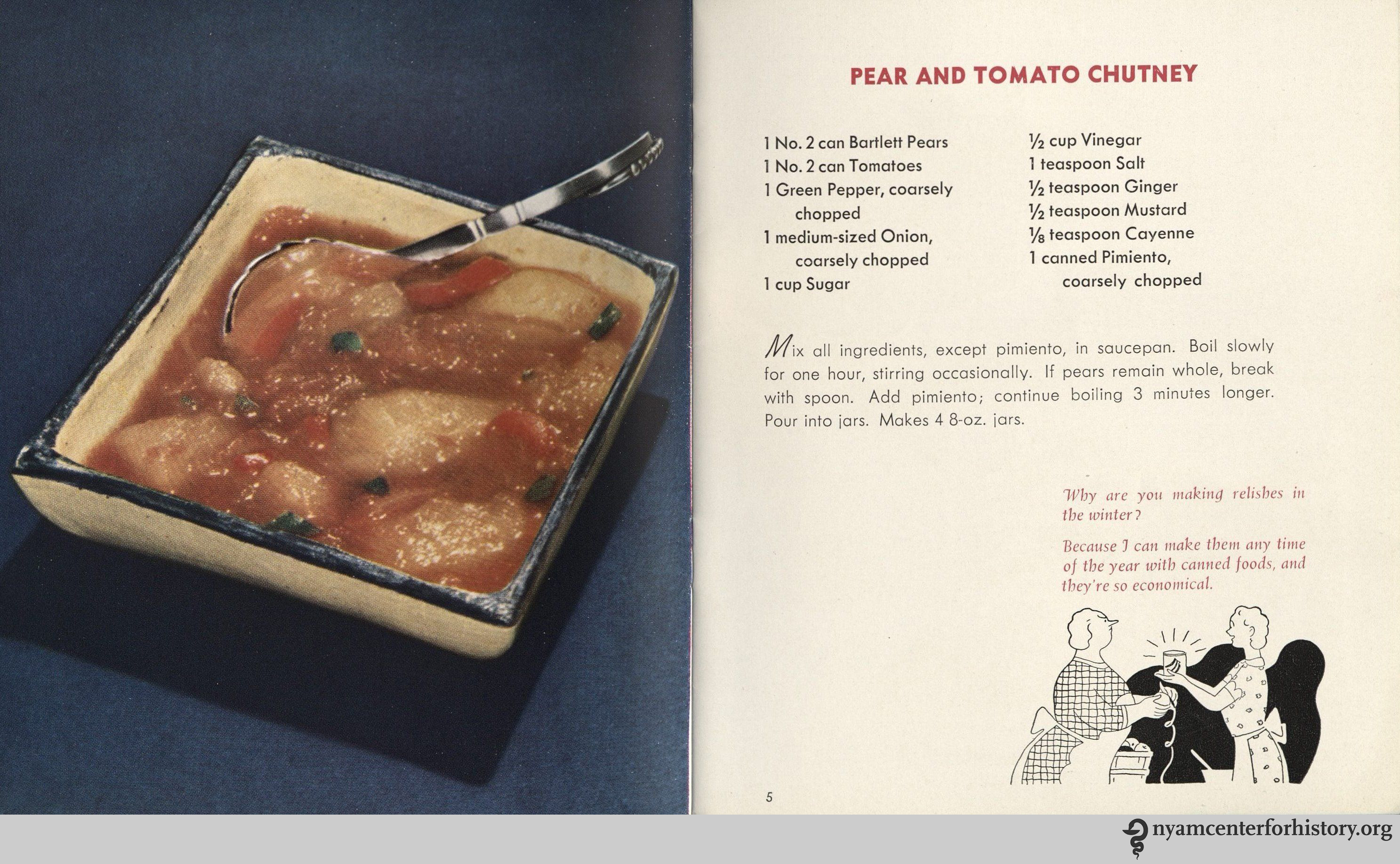
It takes a bold competitor to go up against this beauty. But we have one: Pear and Tomato Chutney from the American Can Company’s undated Relishes from Canned Food pamphlet. As early as the 1850s, commercially canned goods—especially sardines, tomatoes, condensed milk, and fruits and vegetables—found an eager consumer audience in the Western United States. Their popularity only increased over time; by the 1930s, foods from supermarkets were increasingly prepackaged (learn more in our 2015 April Fool’s blog—the food history facts are true!).

Pear and Tomato Chutney from American Can Company, Relishes from Canned Foods, no date. Click to enlarge.

Pear and Tomato Chutney from American Can Company, Relishes from Canned Foods, no date. Click to enlarge.

Which recipe should move on to the next round? Vote for your favoritebe it the most appealing, least appealing, or one that just tickles your fancy morebefore 5 pm EST on Monday, March 14.

“Solving Woman’s Oldest Hygienic Problem in a New Way”: A History of Period Products

By Johanna Goldberg, Information Services Librarian

This is part of an intermittent series of blogs featuring advertisements from medical journals. You can find the entire series here.

For the past few weeks, subway-riding New Yorkers have been surrounded by advertisements for absorbent underwear, the latest in a long history of products designed for use during menstruation.

But what did people use before the era of special undies, tampons, pads, and cups? Very little is known about pre-20th century methods, but historians believe (and oral history interviews confirm) that many relied on homemade cloth or paper pads or diapers pinned to belts and strings. Some women reused these items, while others disposed of them after one use.1,2 Other women—even going back to ancient Rome—fashioned their own tampons from absorbent wool, fibers, paper, sponges, and other materials.3

Things began to change in the mid-1800s. Between 1854 and 1921 (the year the Kotex was first marketed), the U.S. Patent Office granted 185 patents for menstrual (or catamenial) devices.1 In her 1994 doctoral dissertation, Laura Klosterman Kidd breaks these patents into six interconnected categories:

(1) Belts or supporters, from which were suspended (2) a catamenial sack, pouch, shield, menstrual receiver, or napkin-holder, into which was placed (3) an absorbent, consisting of cloths, pads, napkins, sponges, or raw waste fibers. Ancillary categories of menstrual patents were (4) attaching devices used to secure or connect the catamenial sack to the supporter, (5) catamenial garments or appliances that aided in protecting the wearer’s clothing, and (6) vaginally inserted menstrual retentive cups.1

One of these patented products is advertised in the 1884 American Druggist. Despite claims that it is “the grandest invention for the convenience and cleanliness of ladies,” it certainly gives the modern audience pause. A soft rubber cup gets inserted into the vagina, and fluid flows into a “receptacle” attached to a belt. “At night, before retiring, the fluid can and should be removed [from the receptacle], simply by removing a cap, without removing the instrument.”

"Farr's Patent Ladies' Menstrual Receptacle," advertised in American Druggist, January 1884.

“Farr’s Patent Ladies’ Menstrual Receptacle,” advertised in American Druggist, January 1884. Click to enlarge.

There’s a reason these never caught on. But they aren’t such a far cry from today’s (much less cumbersome) menstrual cups.

The real shift in feminine hygiene products came in the 1920s and 1930s. During World War I, nurses at the front lines used absorbent Cellucotton, a Kimberly-Clark product made from wood pulp, both to bandage soldiers (as intended) and to absorb menstrual blood. After the war, Kimberly-Clark developed Cellucotton into Kotex, introducing the product in 1920.4 These napkins were held in place using belts; adhesive napkins only became available in the late 20th century.2

This was not the first commercial sanitary napkin; earlier brands appeared for sale through mail-order catalogs. But it was the first to get a hard-won advertising campaign, which began in 1921. As Lara Freidenfelds relates in her book The Modern Period, advertisements for Kotex appeared in Ladies Home Journal once its editor’s secretary “declared the ads to be in good taste and of great benefit to women.” After Ladies Home Journal agreed to run the ads, other magazines, including the American Medical Association’s Hygeia, followed.2

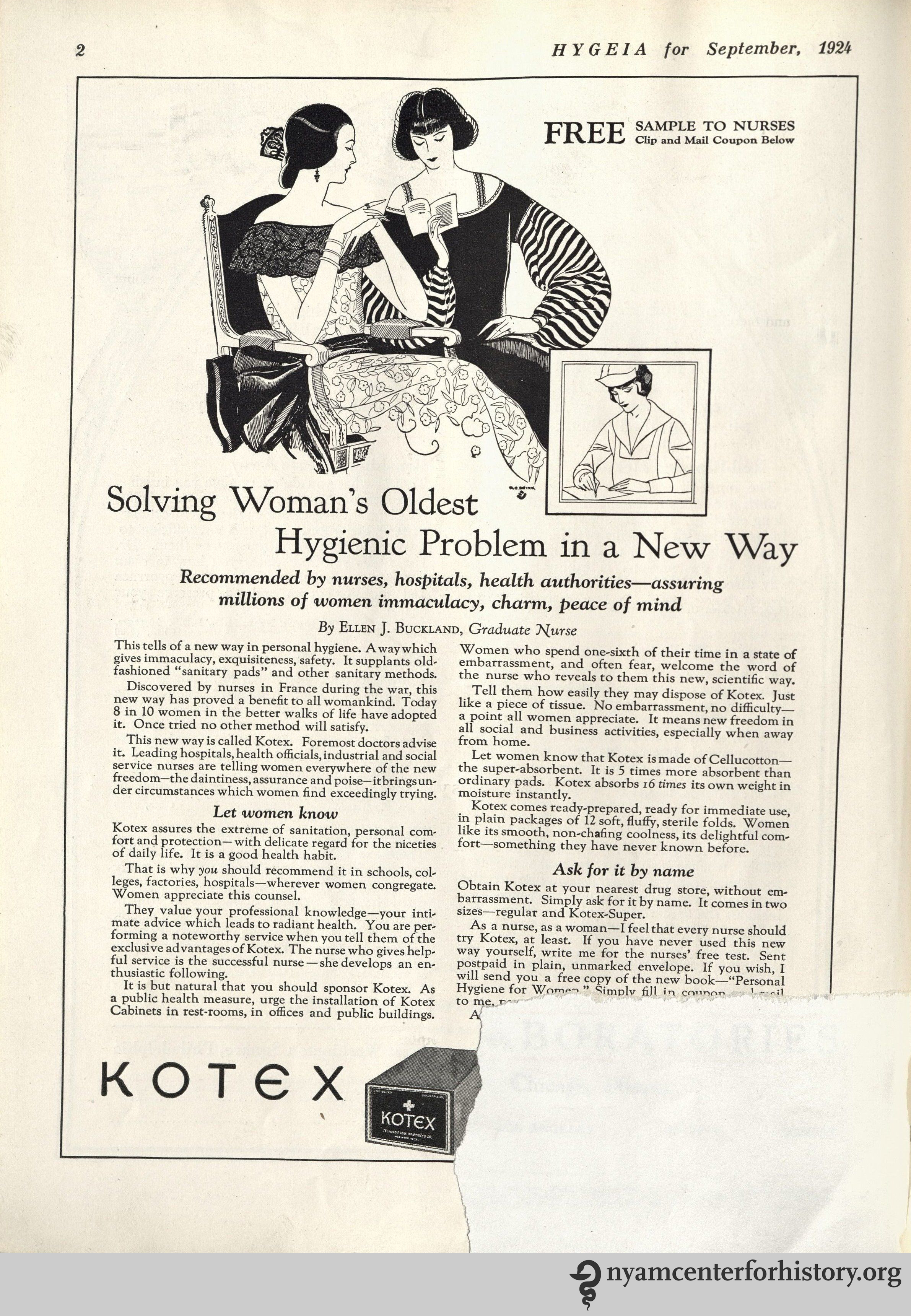
Below are two early advertisements for Kotex, which appeared in Hygeia in 1924 and are both geared to nurses. We love that the coupon from the September 1924 ad has been clipped and, presumably, mailed in for a free sample.

Kotex ad in Hygeia Magazine, September 1924.

Kotex ad in Hygeia Magazine, September 1924. Click to enlarge.

Kotex ad in Hygeia Magazine, November 1924. Click to enlarge.

Kotex ad in Hygeia Magazine, November 1924. Click to enlarge.

While Hygeia does not appear to have run ads for Kotex prior to 1924, it did advertise an absorbent cotton on the back cover of its volumes in 1923. Bauer & Black Absorbent Cotton touted its many uses in these advertisements, noting that “Women use it to meet personal emergencies.” Even after the advent of commercially available sanitary napkins, some women preferred a more do-it-yourself approach.

Bauer & Black Absorbent Cotton ad in Hygeia Magazine, August 1923. Click to enlarge.

Bauer & Black Absorbent Cotton ad in Hygeia Magazine, August 1923. Click to enlarge.

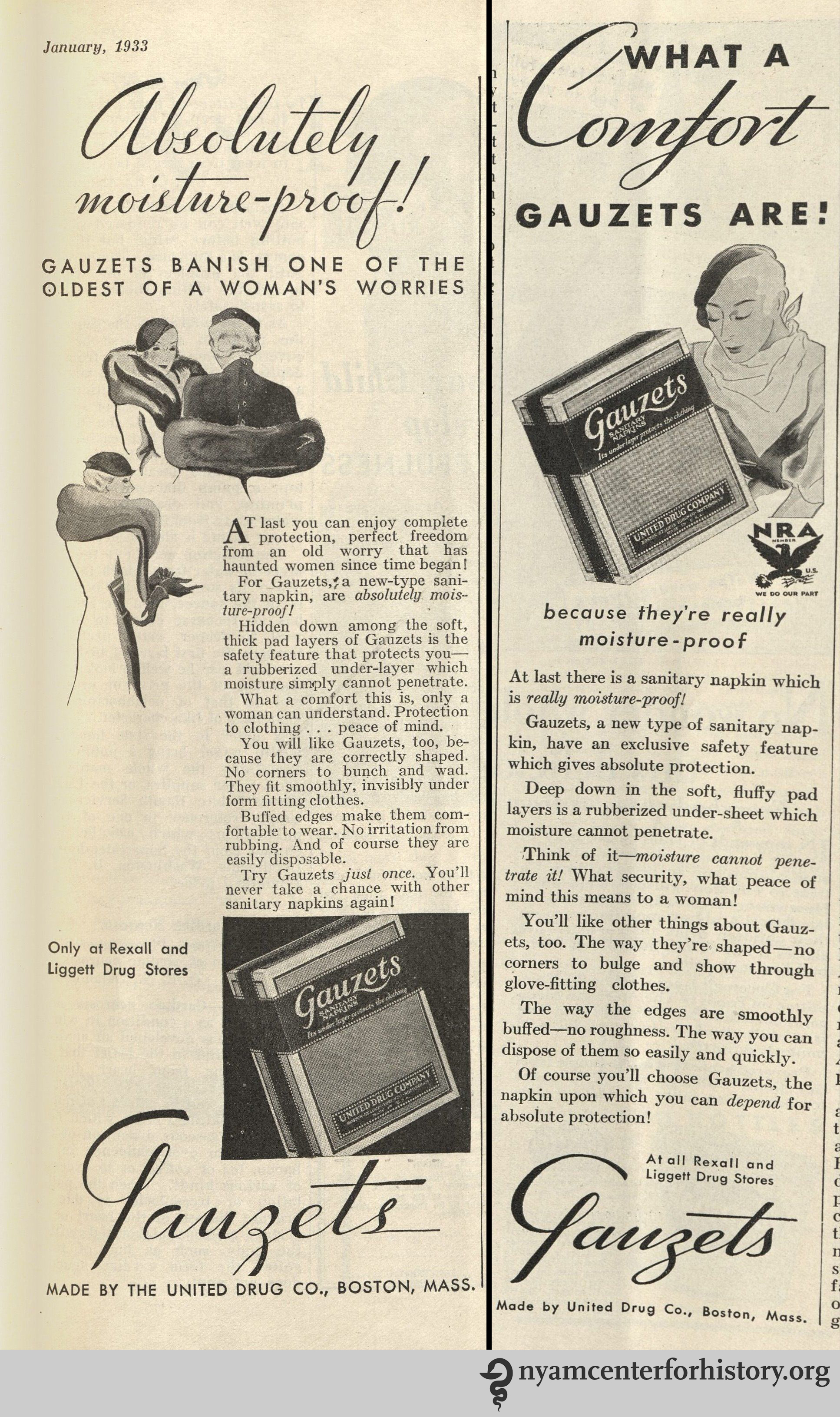
Kotex wasn’t alone in the marketplace for long: Gauzets and other, often cheaper, brands came along soon after, and also advertised heavily.

Gauzets ads from Hygeia Magazine, published in January and November 1933. Click to enlarge.

Gauzets ads from Hygeia Magazine, published in January and November 1933. Click to enlarge.

The first widespread commercial tampon arrived in the 1930s: Physician Earle Cleveland Haas received a patent for his applicator tampon in 1933, which he named Tampax. He distributed his product beginning in 1936.2,3 Prior to Tampax, tampons had widespread use as medical devices dating as far back as the 18th century.2,3 Soon after the development of Tampax, other commercial tampon brands, like Wix and B-ettes, became available and also advertised widely.

These early ads show the hurdles Tampax had to overcome to win wide acceptance from consumers and doctors. In fact, Tampax spent $100,000 on advertising in its first nine months alone; by 1941, the company was “one of the one hundred largest advertisers in the United States.”2 The ads worked: a 1944 survey showed that one quarter of women in the United States used tampons, even as doctors debated their safety.2,3 These ads, spanning the first 10 years of commercial tampon availability, emphasize the safety, comfort, convenience, and invisibility of the products.

Click on an image to view the gallery:

Despite the worries of physicians, early tampons were safe. In fact, our main concern with tampon use today, Toxic Shock Syndrome (TSS), was only linked to tampon use about 40 years after their debut. In 1978, Procter & Gamble released Rely, a super-absorbent tampon made from synthetic fibers. This new kind of tampon led to 55 cases of TSS from October 1979 through May 1980. But non-synthetic, less absorbent tampons pose little threat, and the bacteria that causes TSS is present and active in only a small percentage of people.3,5

Other options entered the marketplace in the 1930s: several menstrual cups received patents, including the first commercially available cup in the United States, patented by actress Leona Chalmers as a “catamenial appliance” in 1937.6 This cup’s design looks much the same as those on the market today.

Image from Leona Chalmers' 1937 patent for a "catamenial appliance." Source: https://www.google.com/patents/US2089113

Image from Leona Chalmers’ 1937 patent for a “catamenial appliance.” Source: https://www.google.com/patents/US2089113

In less than 100 years, menstrual supplies have moved from mostly homemade affairs to mass-market items available in stores, from products hidden away at the back of mail-order catalogs to some of the most commonly advertised goods in the United States. The advances of the 1920s and 1930s still impact our lives, as sanitary napkins, tampons, and cups remain go-to products, improved upon over time but not abandoned.

References

1.Kidd LK. Menstrual technology in the United States, 1854 to 1921. Ames, Iowa: Iowa State University Department of Textiles and Clothing; 1994.

2. Freidenfelds L. The modern period: Menstruation in twentieth-century America. Baltimore: Johns Hopkins University Press; 2009.

3. Fetters A. The tampon: A history. The Atlantic. June 1, 2015. Available at: http://www.theatlantic.com/health/archive/2015/06/history-of-the-tampon/394334/. Accessed March 1, 2016.

4. World War I centenary: Sanitary products. Available at: http://online.wsj.com/ww1/sanitary-products. Accessed March 1, 2016.

5. Vostral SL. Rely and Toxic Shock Syndrome: a technological health crisis. Yale J Biol Med. 2011;84(4):447–59. Available at: http://www.pubmedcentral.nih.gov/articlerender.fcgi?artid=3238331&tool=pmcentrez&rendertype=abstract. Accessed March 1, 2016.

6. North BB, Oldham MJ. Preclinical, clinical, and over-the-counter postmarketing experience with a new vaginal cup: menstrual collection. J Womens Health (Larchmt). 2011;20(2):303–11. doi:10.1089/jwh.2009.1929.