The Drs. Barry and Bobbi Coller Rare Book Reading Room – the panoramic view

The Drs. Barry and Bobbi Coller Rare Book Reading Room captured by Ardon Bar-Hama.

The Drs. Barry and Bobbi Coller Rare Book Reading Room captured by Ardon Bar-Hama. Click for the full panoramic experience.

The Drs. Barry and Bobbi Coller Rare Book Reading Room has reopened. Renovations improved environmental conditions for the collections, including a new HVAC system, restored the historic windows, and a return to the cork floor’s former glory. We are once again welcoming readers and visitors to the room and were delighted to have the chance to host the wonderful Ardon Bar-Hama, who kindly captured the space in its full panoramic glory. Click through on the image to see the interactive (and highly zoom-able) panoramic view.

On Santiago Ramón y Cajal’s 162nd Birthday

Benjamin Ehrlich, today’s guest blogger, studies the life and work of Santiago Ramón y Cajal. His translations from Charlas de café have appeared in New England Review.

The study of the brain is receiving more attention than ever from the general public, and yet “the father of modern neuroscience” remains largely under-recognized. We owe our basic knowledge of what many consider the most complex object in the known universe to a man named Santiago Ramón y Cajal (1852-1934), born on this date in 1852.

Ramón y Cajal spent his life investigating nearly every part of the nervous system in numerous species, using old-fashioned microscopes and a series of chemical staining techniques. Contrary to the paradigmatic belief at the time, the Spanish histologist found that the nervous system (including the brain) is composed of distinctly individual cells (later termed neurons) that must communicate across nearly imperceptible gaps (later termed synapses). This became the basis for the neuron theory, disproving the reticular theory, which claimed the existence inside the brain of a continuous network formed by the fibers fused together.

"A neuron with a short axon in the cerebral cortex. Golgi Method." Figure 10 from Ramon y Cajal's Histologie du système nerveux de l'homme & des vertébrés. Copyright is owned by the family of Santiago Ramón y Cajal.

“A neuron with a short axon in the cerebral cortex. Golgi Method.” Figure 10 from Ramon y Cajal’s Histologie du système nerveux de l’homme & des vertébrés (1909–1911). Copyright is owned by the family of Santiago Ramón y Cajal.

In 1888, his “pinnacle year,” the first evidence of the existence of cells in the nervous system came from the cerebellum of a baby chicken (raised in the garden behind the laboratory in his home), in which he observed some infinitely small bodies that did not physically touch each other. Ramón y Cajal started his own scientific journal, the Revista trimestral de histología normal y patológica, in which he published his new papers. The first issue was released on his birthday.

Santiago Ramón y Cajal was born in Petilla de Aragón, a poor rural village in the mountains of northern Spain, with dirt roads and fewer than a hundred stone houses.1 His autobiography (Recollections of My Life, 1917) is in the collection of the New York Academy of Medicine Library, along with editions of his scientific masterpiece (Histology of the Nervous System of Man and Vertebrates, 1904), his final testament to the neuron theory (Neuron Theory or Reticular Theory?, 1933, translated in 1954) and his guidebook for biological researchers (Advice for a Young Investigator, 1987). Spanish titles include a collection of aphorisms and meditations (Charlas de café, or Café Chats, 1921) and a detailed account of old age (El mundo visto a los ochenta años, or The World as Seen By an Eighty-Year-Old, 1932). Ramón y Cajal describes the brain as a living scene, as he watched neurons develop throughout their dramatic course. Let us celebrate his life and work, which humanize the study of the brain.

Reference
1. Calvo Roy, Antonio. Cajal: Triunfar a toda costa. Madrid: Alianza Editorial, 1999.

Celebrate Preservation Week, April 26–May 3, 2014

PreservationWeekIn 2010, the American Library Association (ALA) created Preservation Week to bring attention to the millions of items in collecting institutions that require care. Sponsored by the ALA’s Association of Library Collections and Services and partner organizations, it was designed to inspire the preservation of personal, family, and community collections of all kinds, as well as library, museum, and archive collections. The goal is also to raise awareness of the role libraries and other cultural institutions can play in providing ongoing preservation information.

What will you do to celebrate Preservation Week? Here are a few ideas.

1. Write a disaster plan for your institution, if it doesn’t have one already. If it doesn’t, you are not alone. According to a 2004 study, 78% of public libraries and 73% of academic libraries do not have an emergency plan or staff to carry it out. (Read more about it here.)

Get ahead of the game—here are some places to start:

2. Learn more about caring for your private collection materials.

Facsimile denture in custom-made clamshell box

Custom-made box for a facsimile of George’s Washington’s lower denture.

3. Make sure your collection materials are correctly housed. 

  • There are several posts about creating enclosures in our blog that you can peruse:

o Creating a box for a facsimile of George Washington’s lower denture.

o On re-housing our diploma collection.

o And be sure to check out our Item of the Month blog for May 2014, which features an introduction to enclosure basics.

  • A variety of custom enclosures are available from the following vendors:

o Archival Products (of particular note is the Academy folder, named after the New York Academy of Medicine)

o Talas

o Hollinger Metal Edge

4. Find a conservator. Of course, we don’t recommend undertaking conservation treatments unless you are a trained conservator. AIC (The American Institute for Conservation for Historic and Artistic Works) provides a searchable listing of conservation professionals working in specialties ranging from books and paper to objects and textiles. You can search by specialty or by zip code.

5. Attend a Preservation Week event. Click here for an event map and list of speakers.

Preservation week happens only once a year, but collections need constant care. We hope the above can help you get started, or serve as a reminder of the importance of preservation.

Read more about Preservation Week.

Marijuana Regulation: The LaGuardia Report at 70 (Item of the Month)

By Paul Theerman, Associate Director, Center for the History of Medicine and Public Health

Medical and recreational marijuana regulation is undergoing a sea change right now, the reworking of a drug regulation regime that goes back at least 75 years. Debates about the drug are not new, however; the New York Academy of Medicine found itself in the middle of the political discussion back in the 1930s and 40s and is now taking a look at this history.

For a hundred years, from the published attestation of the medical use of Cannabis by William Brooke O’Shaughnessy in 1839, medical marijuana use increased and came more and more under medical regulation.  Discussions around regulation usually sounded two concerns: first, that the material be unadulterated and eventually physician-prescribed, and second, that potential benefits could be seen to outweigh harms. For from the beginning, many demonized marijuana use; early on, some went so far as to lump it in with opiates and their abuse.

By 1930, the United States established the Federal Bureau of Narcotics, with increased central control as the goal and Harry J. Anslinger as the willing head. In 1937, over the objections of the American Medical Association, he had pushed through the Marihuana Tax Act. An indirect means of control—as the state governments had most authority to control medicine and drugs directly—it was in fact very effective in criminalizing marijuana. Imposing annual licensing fees on producers and prescribers, it also called for a transfer fee of $1.00 per ounce to registered users, such as physicians, but $100.00 per ounce to unregistered ones—the vast majority. This tax structure was laid down in an era when average American incomes were about $2,000 a year. And indeed, $2,000 was the amount of the fine that could be imposed, along with up to five years in jail, with seizure of the drug as well. The first dealer convicted under the act received a sentence of four years in Leavenworth Penitentiary!

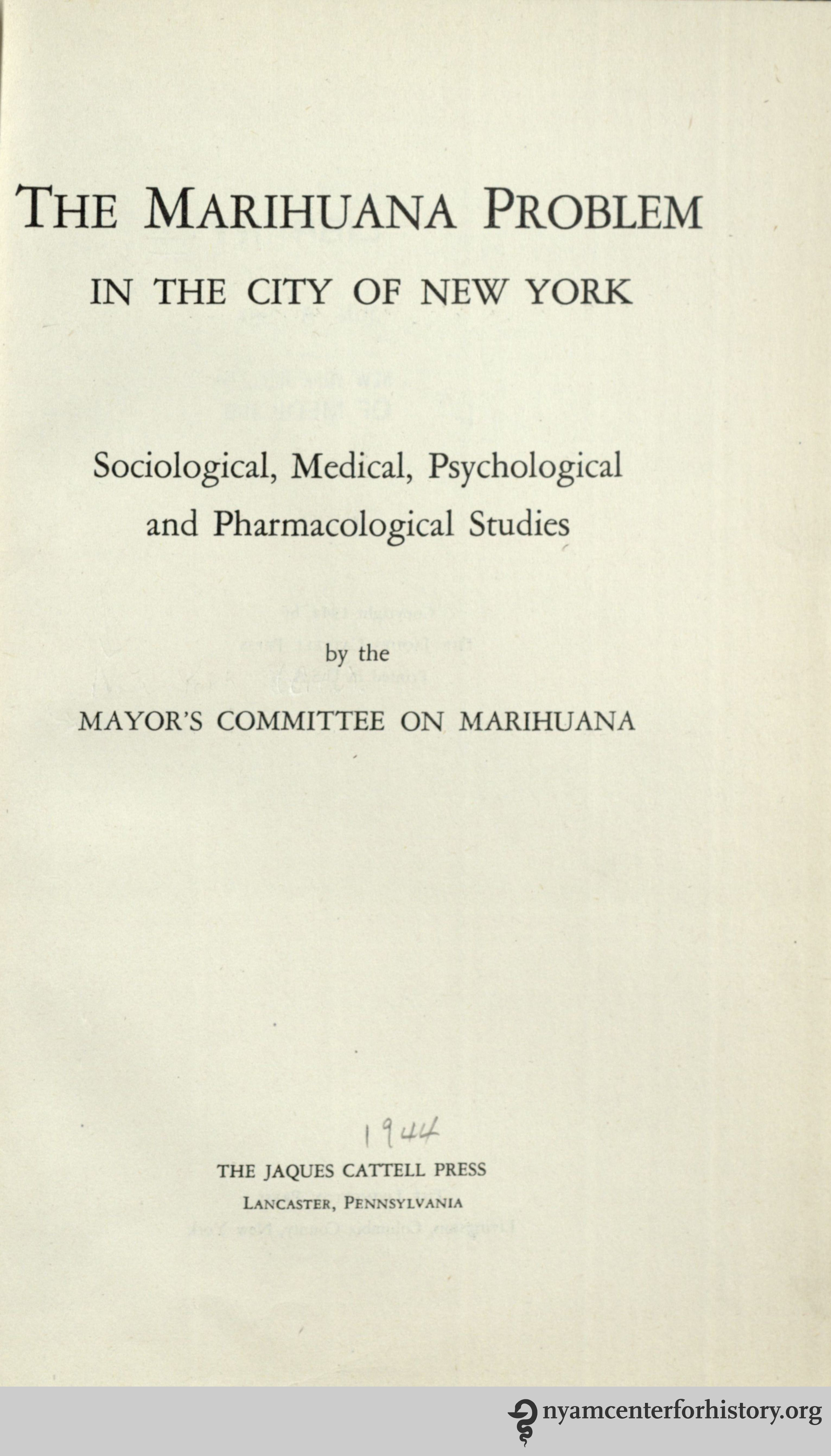
The title page of The Marihuana Problem in the City of New York.

The title page of The Marihuana Problem in the City of New York.

New York Mayor Fiorello LaGuardia was skeptical of the reasons behind this stringent control. In 1938, he commissioned a report from the New York Academy of Medicine on marijuana use. With the study supported by the Commonwealth Fund, the Friedsam Foundation, and the New York Foundation, an expert panel of researchers considered “The Marihuana Problem in the City of New York” (as their report was ultimately titled) from the viewpoint of sociology, psychology, medicine, and pharmacology. Their work continued for six years.

The report ran 220 pages, and La Guardia’s own foreword summarized the results:

I am glad that the sociological, psychological, and medical ills commonly attributed to marihuana have been found to be exaggerated insofar as the City of New York is concerned. I hasten to point out, however, that the findings are to be interpreted only as a reassuring report of progress and not as encouragement to indulgence[!]

Anslinger was furious and denounced the report, and, as painstaking and factual as it was, it had little effect on marijuana decriminalization. Eventually, the Supreme Court found the Marihuana Tax Act of 1937 unconstitutional on grounds of self-incrimination, in a suit raised by Timothy Leary in 1969. The next year, Congress passed the Controlled Substances Act, which placed marijuana in Schedule I, the most highly controlled category, used for drugs that have no currently accepted medical use and are considered liable for abuse even under medical supervision. It remains there today.

On May 1 and 2, the New York Academy of Medicine, partnering with the Drug Policy Alliance, is mounting a day-and-a-half-long conference, “Marijuana & Drug Policy Reform in New York—the LaGuardia Report at 70.” Historians and drug policy experts will gather to consider the report and its effects, look at the “drug wars” over the last century, and survey the policy landscape of the near future. Please join us; the conference is free. View the full schedule and participant information. Register here.

Lessons from the Good Doctor

To celebrate National Poetry Month, we are sharing poems from our collection throughout April.

By Rebecca Pou, Archivist

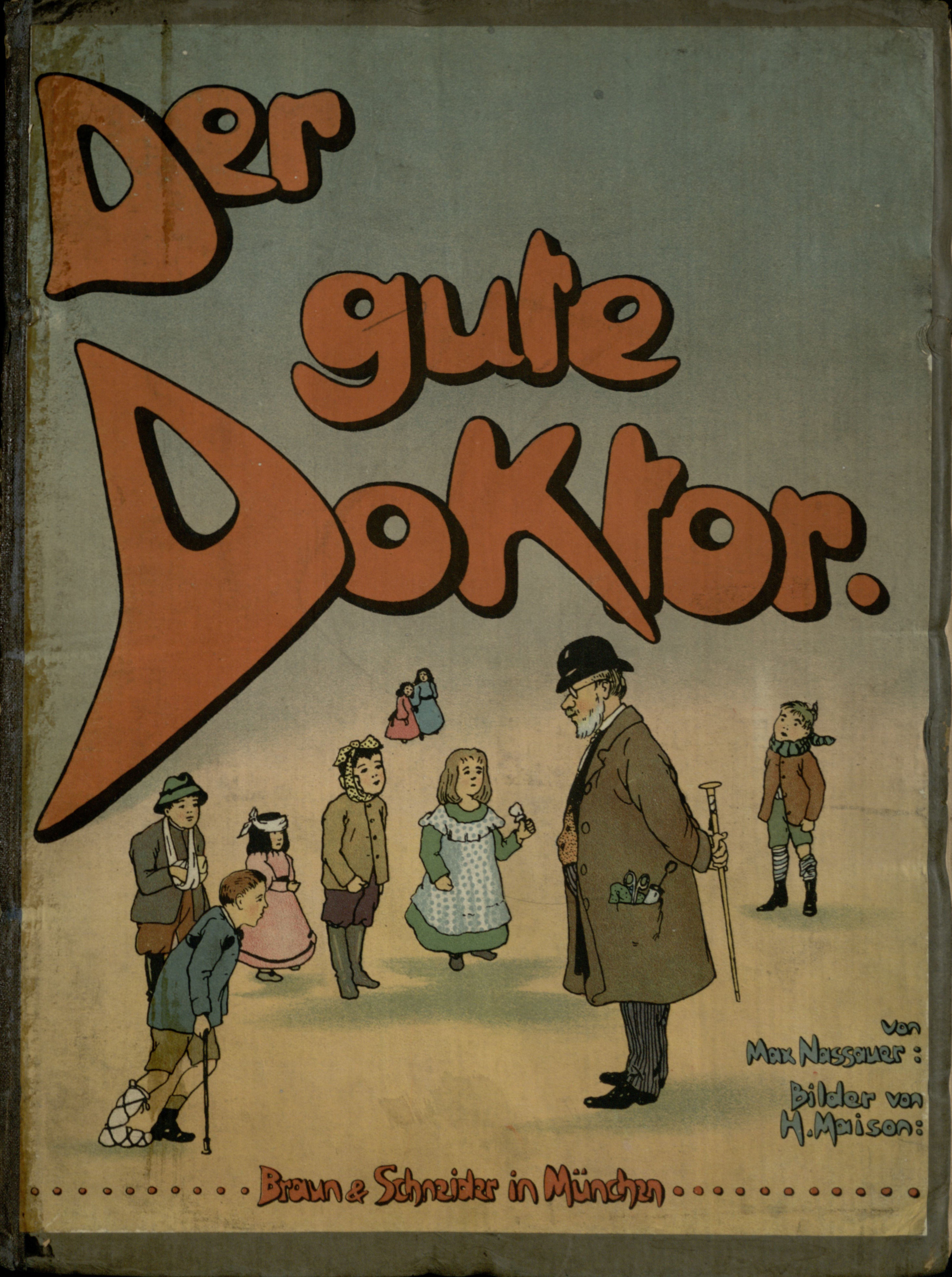
Cover of Der Gute Doktor. Click to enlarge.

Cover of Der gute Doktor. Click to enlarge.

This week, we’re celebrating national poetry month with some medical children’s verse. Der Gute Doktor:ein Nützlich Bilderbuch für Kinder und Eltern (The Good Doctor: a Useful Picture Book for Children and Parents) is a colorful children’s book written by Max Nassauer, a German gynecologist and writer.1  The first edition was published in 1905; our copy is the 9th edition, probably printed in 1926.

The book contains fourteen cautionary tales with medical morals. While the stories, and especially the illustrations, are amusing, they certainly aren’t lighthearted. The consequences of poor health habits are unpleasant. One boy falls ill after walking through the rain and snow. Another gives himself a painful stomachache because he is too embarrassed to use the bathroom at school. Sometimes the repercussions for ignoring the doctor’s orders are far more tragic. In one tale, a stubborn young man refuses the doctor’s medicine and dies the next day.

I found little information on the history of medically-themed children’s tales, but Der Gute Doktor falls into the larger tradition of didacticism in children’s literature. Grimm’s Fairy Tales, translated from oral stories between 1812 and 1857, include cautionary tales, such as Little Red Riding Hood.2 Der Gute Doktor especially brings to mind another children’s book written by a German doctor, Struwwelpeter by Dr. Heinrich Hoffman, published 60 years earlier.2 Struwwelpeter includes similar tales of unruly children suffering for their bad behavior. The tale of Augustus, a boy who refuses to eat his soup and starves to death, would easily fit among the tales of Der Gute Doktor.3 Struwwelpeter was hugely popular and is one of the most well-known German children’s books.2 Undoubtedly, Nassauer was familiar with and influenced by this iconic book.

Here are a few more lessons from the good doctor (translating credit and my thanks go to Mascha Artz):

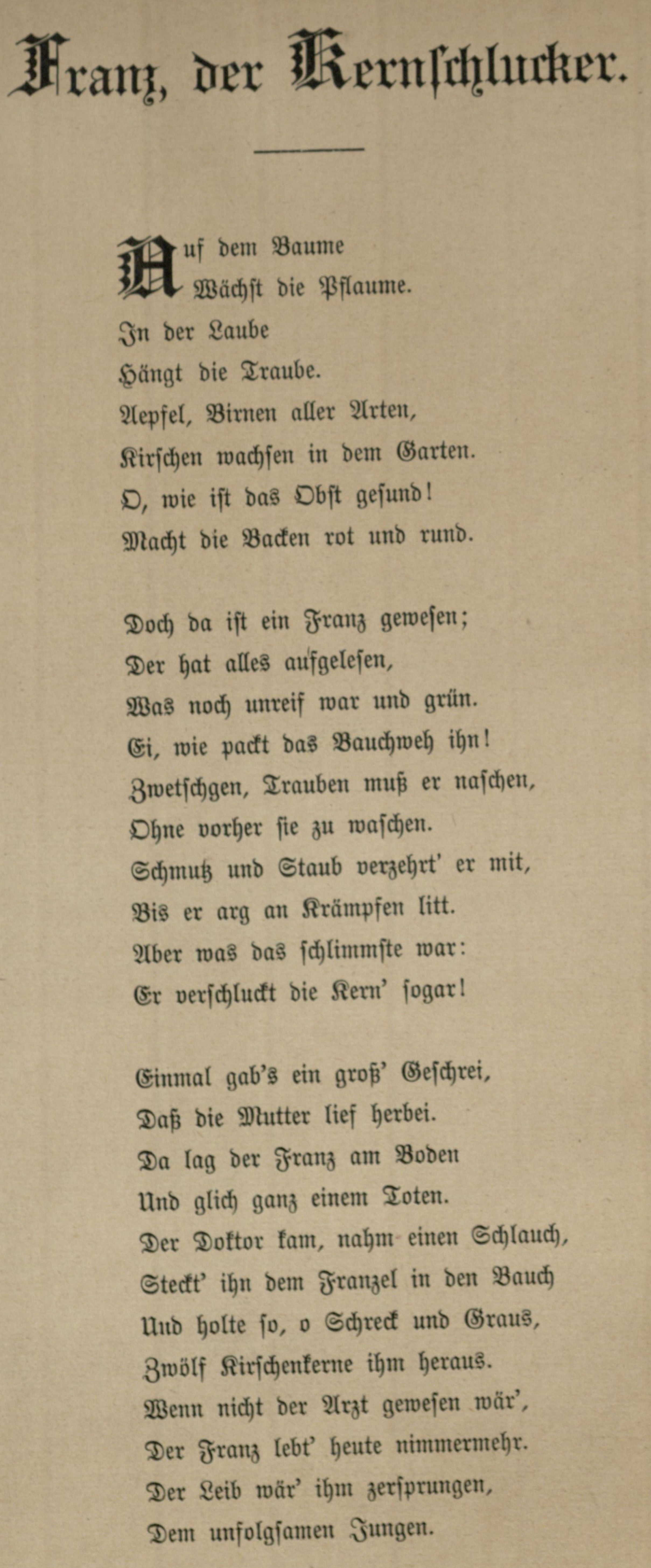
Franz, the pip swallower

The original German text. Click to enlarge.

The original German text. Click to enlarge.

On the tree
Grows the plum.
In the arcade
hangs the grape,
Apples, pears of all kinds,
cherries grow in the garden.
Oh, how fruit is healthy!
Makes the cheeks red and round.

But there has been Franz,
Who has picked up all,
That was unripe and green.
Well, how bellyache catches him!
Plums, grapes he must snack on,
Without rinsing them.
Dirt and dust he partakes,
Until of cramps he suffered.
But what was the worst:
He cursed the pips in fact!

One time there was a big bawling,
That the mother comes running.
There laid Franz on the ground
And was like dead.

The doctor came, took a tube,
Sticks it into Franz’s tummy
And takes like this, horror of horrors,
Twelve cherry pips out.
If the doctor was not there,
Franz would be living nevermore.
The belly would have burst,
his disobedient tongue

Franz, the Pip Swallower. Click to enlarge.

Franz, the Pip Swallower. Click to enlarge.

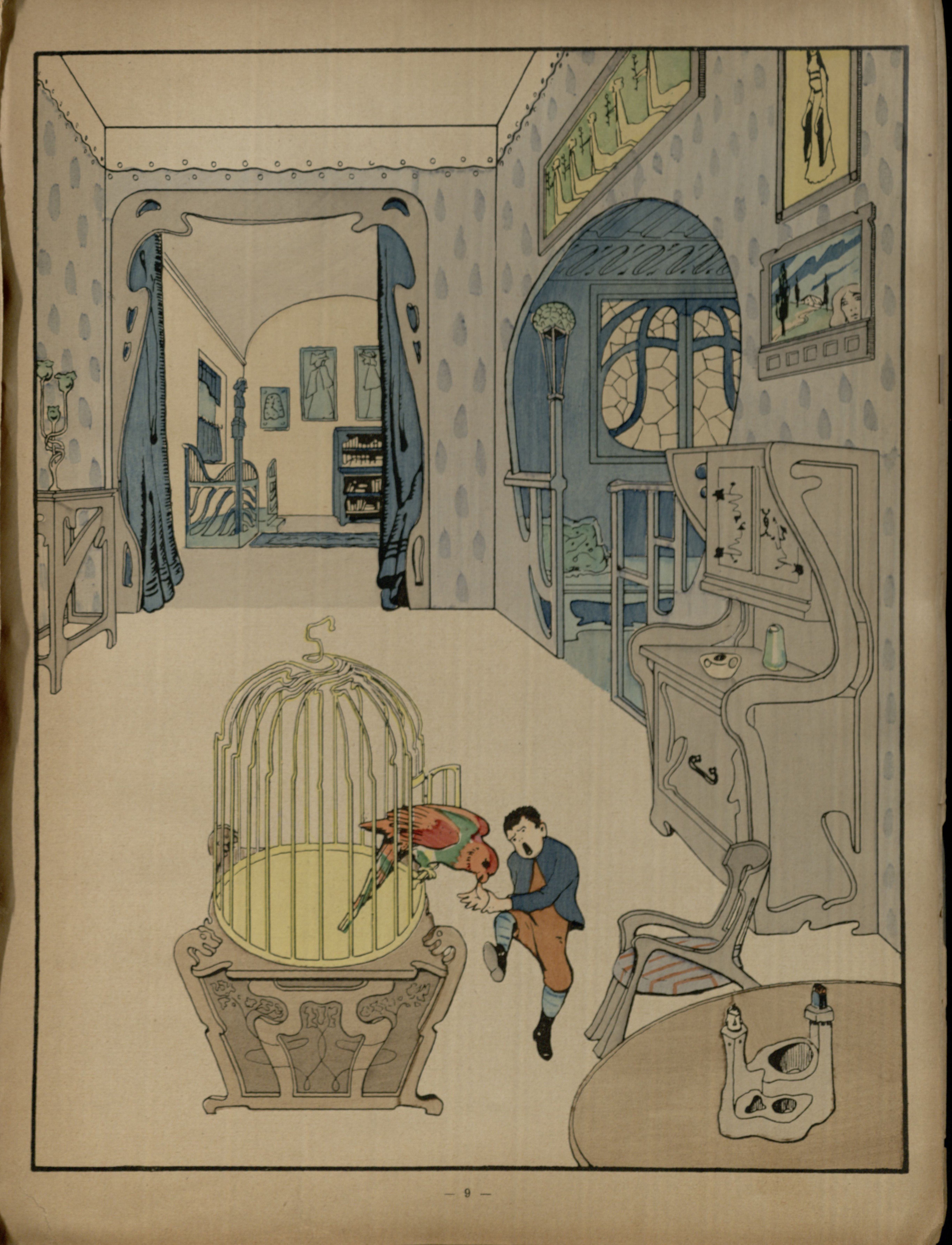
Hans, who teased the animals

The original text. Click to enlarge.

The original text. Click to enlarge.

At uncle’s place there is a parrot;
who sings and talks and screeches.
It eats the fruit along with the pip.
Hans liked to watch this.
The uncle said: “Dear Hans,
Don’t touch the parrot by its tail!
Don’t go to close to the cage,
because the parrot can bite you!”
But Hans laughs and says:
“This cannot be that dangerous.”
His hand he put into the cage
and teased the parrot,
tried to grab it by the tail…
The parrot wants to hack him,
catches the finger… what crying!…
Hans’ finger is in pieces!
Blood runs down from his hand.
Hans’ limbs are shaking. –
The doctor put around his hand
Quickly a wound dressing
And gives Hans a severe look,
Nods his head and says:
“One mustn’t tease the animals!
In their fear they easily get frightened
And bite, with shock…
And crack, then the finger is gone.”

Hans, who teased the animals. Click to enlarge.

Hans, who teased the animals. Click to enlarge.

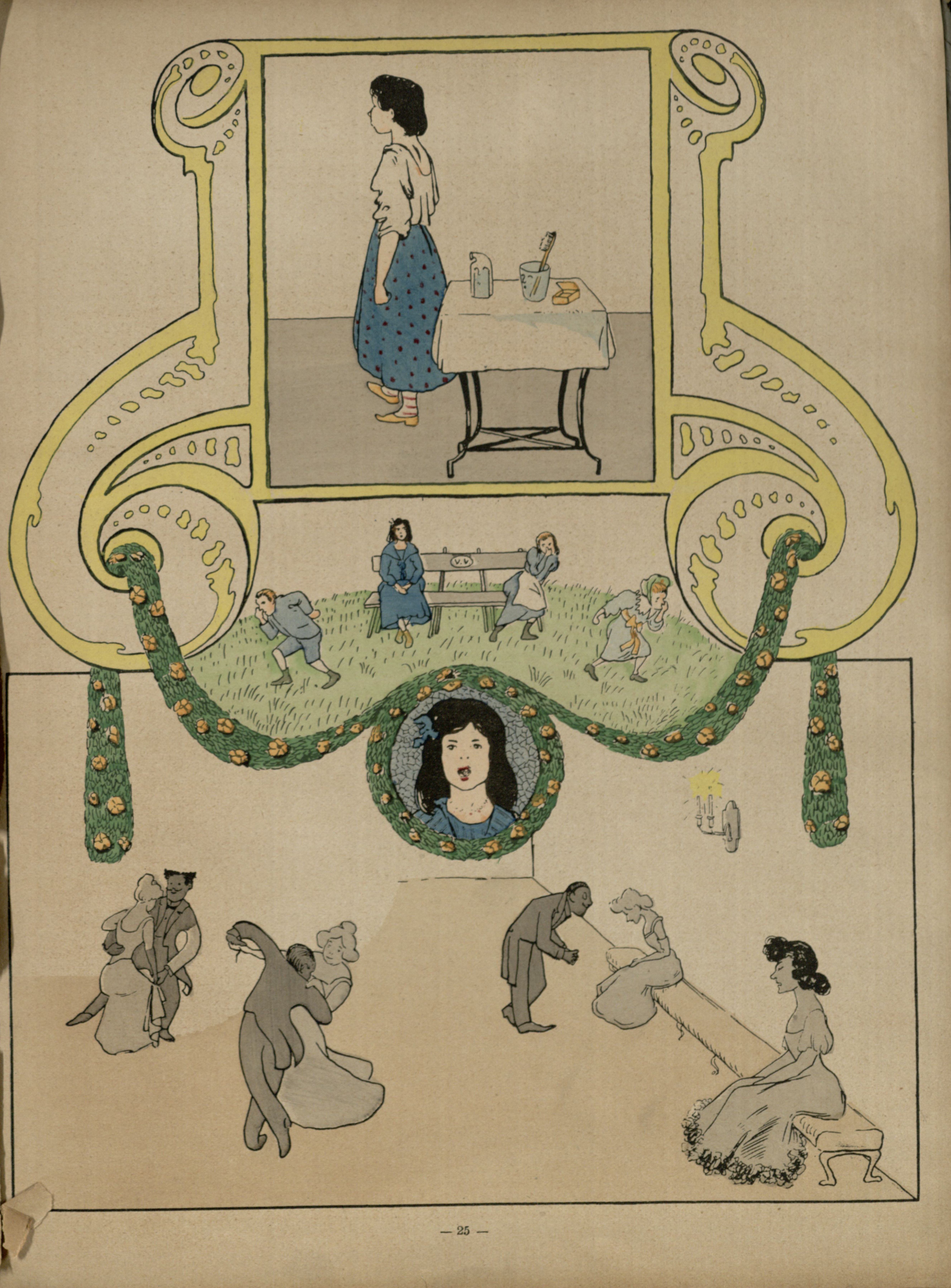
Anna who wouldn’t brush her teeth

The original text. Click to enlarge.

The original text. Click to enlarge.

Anna was perfectly healthy.
But she did not like rinsing her mouth
and she did not want to brush her teeth,
especially not using a tooth brush.
And soon she was not healthy any longer.
She smelled awful from her mouth.
The teeth rot and fell out…
How horrible Anna looked!
And all girls moved away from her
And sat down at the other corner.

And when she was older at a ball
all of her girl friends were dancing.
And nobody looked at Anna,
She did not have a single tooth left!
So she cried all day,
because nobody wanted to dance with her,
And sobs, although it doesn’t help now:
“Had I only brushed my teeth!”

Anna who wouldn’t brush her teeth. Click to enlarge.

Anna who wouldn’t brush her teeth. Click to enlarge.

 References

1. Gerabek, Werner E. (1997). Nassauer, Max.  New German Biography. Retrieved April 5, 2014 from http://www.deutsche-biographie.de/pnd116884150.html.

2. Chalou, Barbara Smith. (2006). Struwwelpeter: Humor or Horror? Lanham: Lexington Books. Retrieved April 5, 2014 from http://books.google.com/books?id=2UE2AAAAQBAJ&source=gbs_navlinks_s.

3. Hoffman, Heinrich. (n.d.)  Struwwelpeter: Merry Tales and Funny Pictures. New York: Frederick Warne & Co. Retrieved April 5, 2014 from http://www.gutenberg.org/ebooks/12116.

Limerick Anatomy

To celebrate National Poetry Month, we are sharing poems from our collection throughout April.

By Andrew Gordon, Systems Librarian

The cover of The Limeratomy.

The cover.

Anthony Euwer, an American poet and painter, published The Limeratomy in 1917. Subtitled A Compendium of universal knowledge for the more perfect understanding of the human machine, The Limeratomy features poems “done in the Limerick Toungue” and is illustrated by Euwer himself. Its contents comprise the more conventional components of human anatomy (the eyes, the nose, the brain, the ears) alongside more intangible or abstract qualities (the soul, the conscience) and some that are more poetic than scientific (the cockles, the funny bone).

On giving anatomy the limerick treatment, Euwer writes in the preface:

In this clinic-limerique the author has endeavored to put within the common grasp, certain livid and burning truths that have been dragged from heaped-up piles of scientific expression and kultur. It is hoped that the appearance of this little volume may prove a happy psychology at this time—an age of self-examination—an epoch when the human machine is coming into its own.

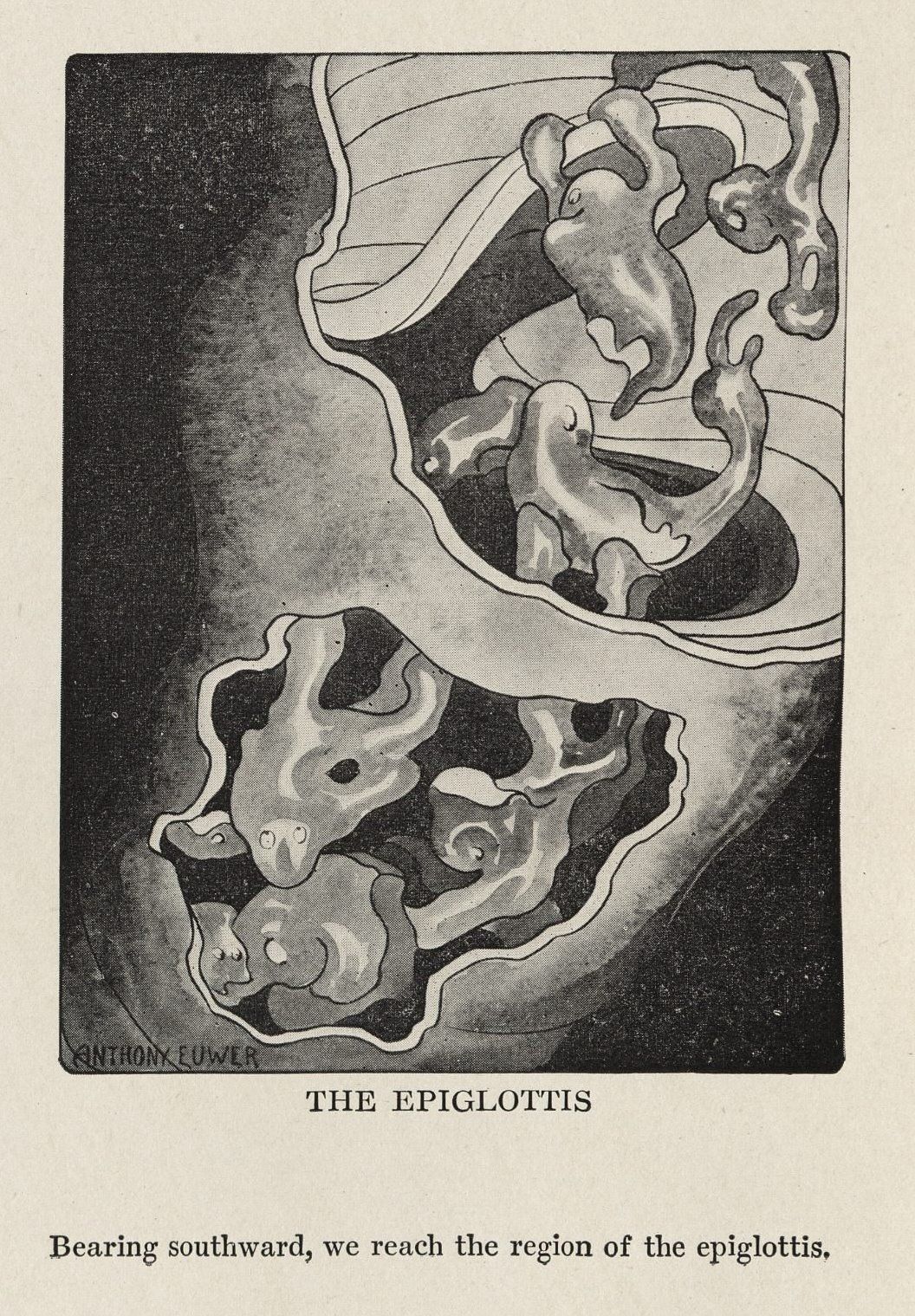
Throughout this book are not only descriptions of the anatomy, but also humorous suggestions at living healthfully. In “The Epiglottis” he writes:

Have a heart for you poor epiglottis,
Don’t crowd down your victuals, for what is
More sad than the sight
Of a wind-pipe plugged tight
When the food fails to see where the slot is.

Euwer's epiglottis illustration. Click to enlarge.

Euwer’s epiglottis illustration. Click to enlarge.

While full of humor, the pithy nature of the limerick also lends itself to concise understanding of otherwise baffling parts of the human body. In “The Medula Oblongata,” Euwer writes:

Though it sounds like a sort of sonata,
‘Tain’t confirmed by our medical data,
I’m referring of course
To that centre of force—
The medula-ah-ah-oblongata

The illustration accompanying . Click to enlarge.

The illustration accompanying “The Medula Oblongata.” Click to enlarge.

Not limited to those parts of the anatomy that exist, Euwer writes of “The Cockles”:

Now the function of cockles, we’re told
Is just to get warmed, hence I hold—
And I’m quite sure that you
Will agree with me too—
That the cockles are usu’lly cold.

The cockles. Click to enlarge.

The cockles. Click to enlarge.

There are 70 limericks in this volume. You can find them all digitized at the Internet Archive.

A Hospital Stay in 28 Poems

To celebrate National Poetry Month, we are sharing poems from our collection throughout April.

By Johanna Goldberg, Information Services Librarian

On our shelves of poetry sits In Hospital, a small, inconspicuous tome by British poet, critic, and editor William Ernest Henley (1849-1903), printed in 1908.

Henley was no stranger to hospital visits. As a child, doctors amputated one of his legs below the knee due to tuberculosis of the bone. Later in life, doctors recommended amputation of the other leg; Joseph Lister treated Henley at the Edinburgh Royal Infirmary and managed to save the leg.1
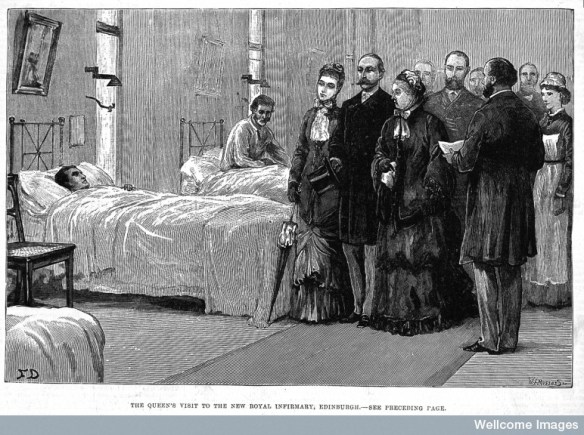
Queen Victoria visiting the Royal Infirmary Edinburgh (1881). This Infirmary building opened shortly after Henley's stay at the hospital. Courtesy of the Wellcome Library, London.

Queen Victoria visiting the Royal Infirmary Edinburgh (1881). This Infirmary building opened shortly after Henley’s stay at the hospital. Courtesy of the Wellcome Library, London.

Henley’s time at the Infirmary inspired In Hospital,1 a collection of 28 poems written between 1873 and 1875. Samuel Treat Armstrong, a physician and army surgeon who had chaired NYAM’s Section on Public Health and Hygiene, donated the book to our collection.2,3 In the volume’s endpapers, Armstrong pasted a New York Times article from September 1, 1912: “Ernest Henley: A Study of the Great Swashbuckler Poet.” The article notes:

To [Henley], life was the supremely important fact; art one of its manifestations. He never separated the work from the man behind it. He did not believe mere skill in the pretty arrangement of words sufficient excuse for writing . . . A man must have a sense of language (which makes literature an art) but he must also have something worth saying, and, having said it adequately, need not trouble about trimmings.

Here are some poems worth saying:

After
Like as a flamelet blanketed in smoke,
So through the anaesthetic shows my life;
So flashes and so fades my thought, at strife
With the strong stupor that I heave and choke
And sicken at, it is so foully sweet.
Faces look strange from space—and disappear.
Far voices, sudden loud, offend my ear—
And hush as sudden. Then my senses fleet:
All were a blank, save for this dull, new pain
That grinds my leg and foot; and brokenly
Time and the place glimpse on to me again;
And, unsurprised, out of uncertainty,
I wake—relapsing—somewhat faint and fain,
To an immense, complacent dreamery.

Casualty
As with varnish red and glistening
Dripped his hair; his feet looked rigid;
Raised, he settled stiffly sideways:
You could see his hurts were spinal.

He had fallen from an engine,
And been dragged along the metals.
It was hopeless, and they knew it;
So they covered him, and left him.

As he lay, by fits half sentient,
Inarticulately moaning,
With his stockinged soles protruded
Stark and awkward from the blankets,

To his bed there came a woman,
Stood and looked and sighed a little,
And departed without speaking,
As himself a few hours after.

I was told it was his sweetheart.
They were on the eve of marriage.
She was quiet as a statue,
But her lip was grey and writhen.

Suicide
Staring corpselike at the ceiling,
See his harsh, unrazored features,
Ghastly brown against the pillow,
And his throat—so strangely bandaged!

Lack of work and lack of victuals,
A debauch of smuggled whisky,
And his children in the workhouse
Made the world so black a riddle

That he plunged for a solution;
And, although his knife was edgeless,
He was sinking fast towards one,
When they came, and found, and saved him.

Stupid now with shame and sorrow,
In the night I hear him sobbing.
But sometimes he talks a little.
He has told me all his troubles.

In his broad face, tanned and bloodless,
White and wild his eyeballs glisten;
And his smile, occult and tragic,
Yet so slavish, makes you shudder!

References

1. William Ernest Henley (1849-1903). (n.d.). Retrieved March 26, 2014, from http://www.sciencemuseum.org.uk/broughttolife/people/williamernesthenley.aspx

2. Transactions of the New York Academy of Medicine. (1894). New York: Press of Stettiner, Lambert, and Co.

3. Herringshaw, T. W. (1914). Herringshaw’s American Blue-book of Biography. Chicago: American Publishers’ Association.

Program Announcement: The Beginning of the Ends

CenterforBookendScholarship_logoThe Center for the History of Medicine and Public Health is excited to announce the founding of its newest program, the Center for Bookend Scholarship. Through the Center for Bookend Scholarship, we aim to foster knowledge and appreciation of the most underappreciated object in the history of the book. We will encourage scholarly and public interest in the bookend through exhibitions, public programs, and research opportunities.
Book storage methods as shown in Fasciculus Medicinae, published in 1495.

Book storage methods as shown in our 1509 edition of Fasciculus Medicinae. Click to enlarge.

Early libraries did not need bookends. People arranged books horizontally into the 16th century (and perhaps longer). Only once enough books existed to fill up a bookshelf—which only started to resemble the furniture of today in the 16th century—without falling over did libraries begin to store books vertically.1

It took even longer for people to shelve books spine-out. Many Medieval and Renaissance libraries chained books to lecterns and shelves; in order to attach the chain without causing damage, these libraries stored books fore-edge out. In the 16th century, books began to include authors and titles on their spines, though not universally, a sign that shelving practices included spine-out configurations. By the next century, nearly all books had bibliographic information on their spines.1

Bookends are a relatively new technology. The familiar L-shaped metal kind were first patented in the 1870s.1 It took some decades before the term became common parlance: the Oxford English Dictionary records 1907 as the first year the term “book end” appeared in print.2

The New York Academy of Medicine Library has long held an interest in the bookend. Since our founding in 1847, we have intentionally amassed thousands of bookends. Strengths of the collection include American and functional bookends, but we are beginning to add to our European and decorative holdings. Through the Center for Bookend Scholarship, we will now dedicate more time and attention to these objects as we move forward in building the world’s preeminent collection.

Below is a selection of bookends from our collection.

This slideshow requires JavaScript.


References

1. Petroski, H. (2000). The book on the bookshelf. New York: Vintage Books.

2. book, n. (2014). OED Online. Oxford University Press. Retrieved from http://www.oed.com/view/Entry/21412

The Healthful Art of Dancing

By Johanna Goldberg, Information Services Librarian

This is one of several posts leading up to our day-long Performing Medicine Festival on April 5, 2014, which will explore the interrelationships of medicine, health, and the performing arts. Register for the festival here.

Dr. Luther Halsey Gulick (1865–1918), best known today as a father of basketball, was an ardent physical education educator and promoter. In 1903, he became the New York City public schools’ first director of physical education, a position he held for 10 years. He may have been one of the busiest men in the city; while holding the position, he co-founded the Campfire Girls with his wife, founded several physical education associations, wrote five books, and served as president of the Playground and Recreation Society of America.1

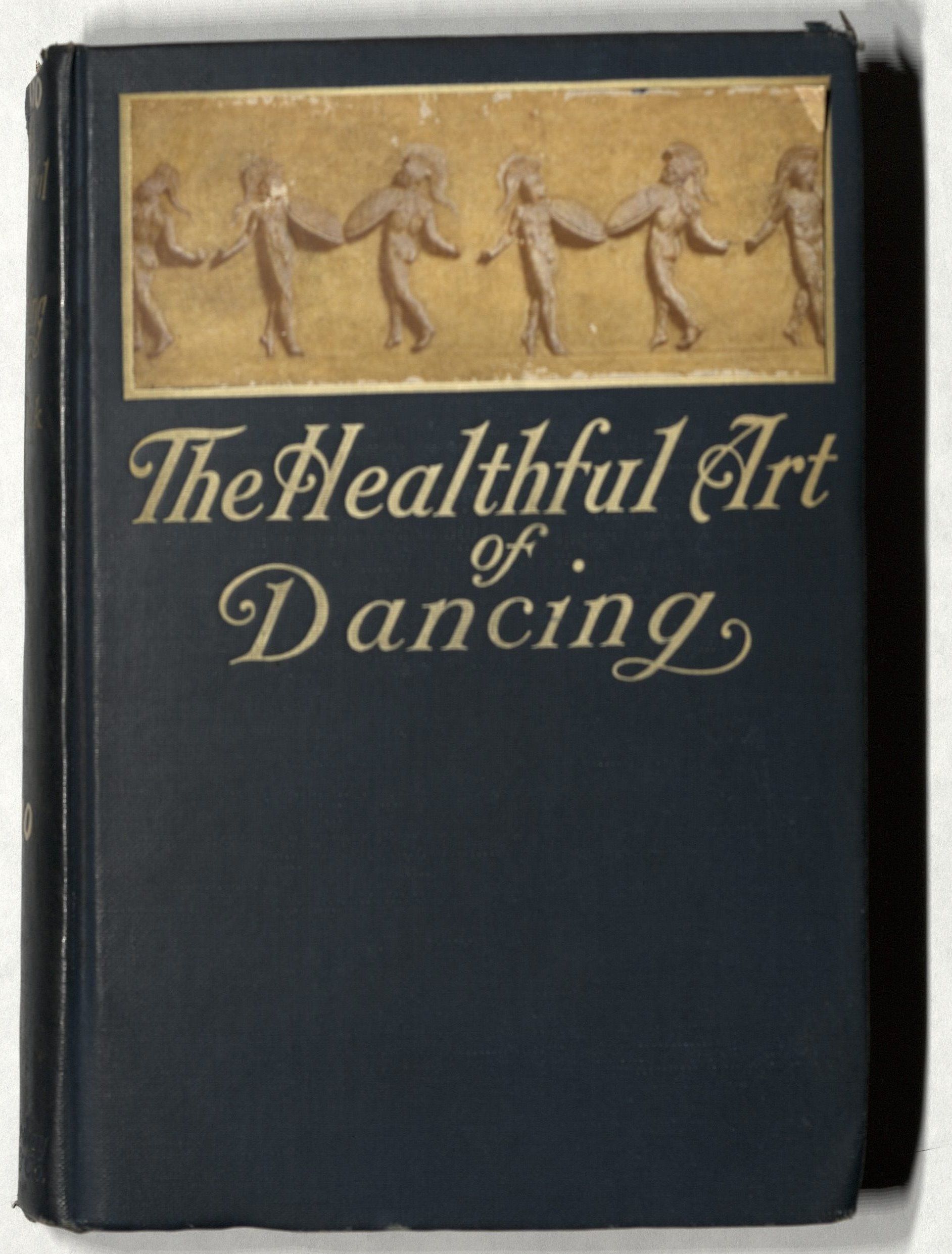
The Healthful Art of Dancing

The Healthful Art of Dancing

In his 1910 book, The Healthful Art of Dancing, Gulick devoted a chapter to dance in education. Average New York City children, wrote Gulick, spent “Five hours a day in the schoolroom, and then the crowded, ill-ventilated tenement or apartment house, with perhaps a game of tag or hop-scotch or jump-rope in the midst of the hubbub and dirt of the street.”2 In 1905, a partnership with the Girls’ Branch of the Public Schools Athletic League allowed schoolgirls the same opportunity as boys: “Interesting and helpful recreation that would have a real part in their lives outside of school hours.”2

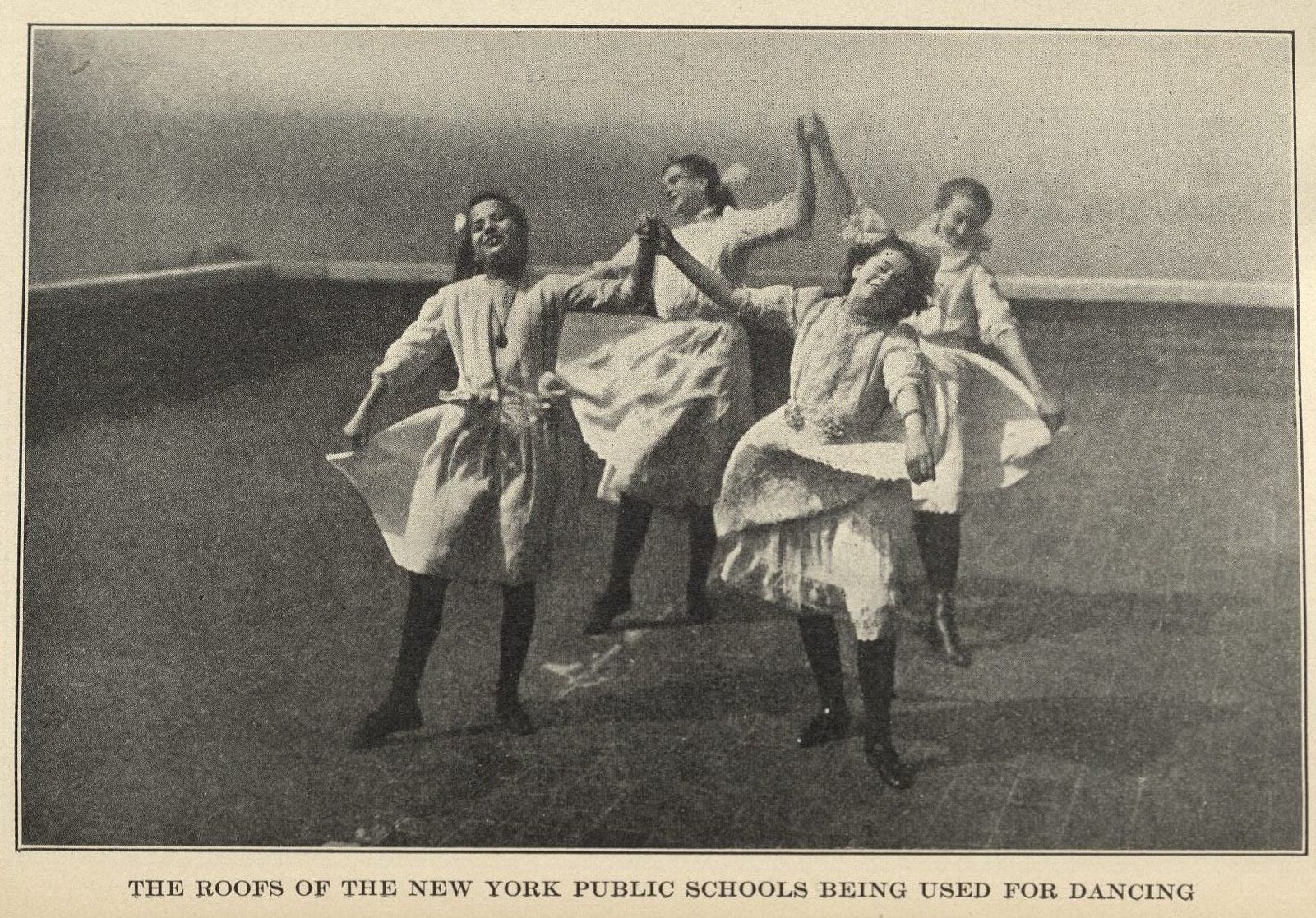
So began after-school folk dance classes for girls on city school rooftops, in gymnasiums, and in school basements. After one year of the program, 2,000–3,000 students were participating.2 Gulick paints an evocative picture:

These classes come after school. The roof playground, high above the chimneys and dangling clotheslines of the neighborhood, is a favorite place for them, unless the weather forbids. There is a piano up there that can be rolled out, and clean open air and sunshine—good things in New York—are all about.2

"The roofs of the New York Public Schools being used for dance," a photograph from The Healthful Art of Dancing. Click to enlarge.

“The roofs of the New York Public Schools being used for dance,” a photograph from The Healthful Art of Dancing. Click to enlarge.

He goes on to describe the students’ enthusiasm:

One has to see [the dances] to get an idea of the kind of spell they possess for the children—how every muscle of their bodies responds accurately and eagerly to the exhilarating, well-cadenced rhythm of the music; how the dancers move back and forth, gliding, hopping, or tripping, crossing and recrossing, now fast, now slow, according to some intricate scheme at which an outsider can only stare in wonder.2

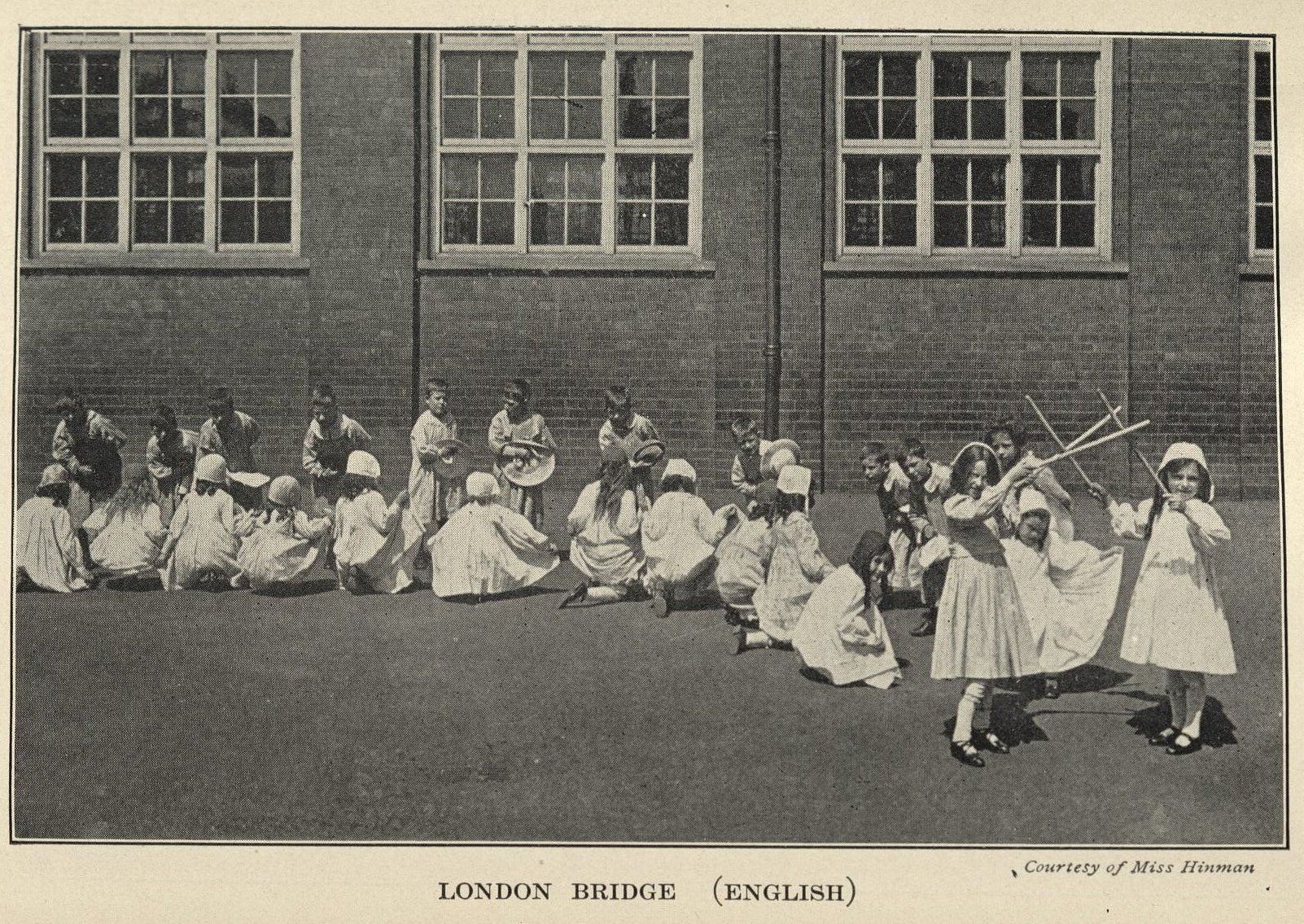
"London Bridge," a photograph in The Healthful Art of Dancing. Click to enlarge.

“London Bridge,” a photograph in The Healthful Art of Dancing. Click to enlarge.

And this joy did not end at school:

The noisy, crowded street and the dingy tenement will be happier places because of the healthy, full-blooded rhythm that still pulsates through their bodies—and their souls, too; for it means that they have a new feeling about life; it is ‘the little white bird’ that is going to keep on singing in their hearts.2

On the Lower East Side? Visit the Luther Gulick playground and dance in his honor.

References

1. Winter, T. (2004). Luther Halsey Gulick: Recreation, physical education and the YMCA. infed.org. Retrieved February 25, 2014 from http://infed.org/mobi/luther-halsey-gulick-recreation-physical-education-and-the-ymca/

2. Gulick, L. H. (1910). The Healthful Art of Dancing. New York: Doubleday, Page & Company. Available at http://books.google.com/books/about/The_healthful_art_of_dancing.html?id=6o0ZAAAAYAAJ

Music as a Means of Discipline

By Johanna Goldberg, Information Services Librarian

This is one of several posts leading up to our day-long Performing Medicine Festival on April 5, 2014, which will explore the interrelationships of medicine, health, and the performing arts. Register for the festival here.

From van de Wall, W. (1924). The utilization of music in prisons and mental hospitals, its application in the treatment and care of the morally and mentally afflicted. New York: Published for the Committee for the Study of Music in Institutions by the National Bureau for the Advancement of Music.

Willem van de Wall.2

In the 1920s, Willem van de Wall, a Dutch-born professional harpist and choral director, began promoting the therapeutic use of music in prisons, hospitals, and other institutions.1

In the pamphlet “Music as a Means of Discipline,” van de Wall discussed his successes in prisons, along with this caution:

Never forget that the use of music as an energy awakener call of earnest deliberation, besides psychological and musical insight. If applied indiscriminately it might cause the boiling over of seething temperaments and create havoc through conjuring individual and social crises. If utilized sagaciously, however, it will soothe and transform the lower emotional trends into currents of loftier endeavor and expression.3

Van de Wall carefully chose well-known folk and traditional tunes (including “The Star-Spangled Banner,” “Stars of the Summer Night,” “A Perfect Day,” and “The Missouri Waltz”), sang them with groups of prisoners, and discussed the texts “for teachings about socially ethical principles.” And he clearly laid out the limitations of his work: “Can music do it all? No. Can it do a part? Yes. What part? That of inspiring, starting and supporting.”3

As described by van de Wall, the results were often astonishing. In terms of individual inmates, “Many a detained soul confessed to me that our weekly choral group was the first constructive affair in which he had participated since school days.”3 And at the institutional level:

I go to a penal institution where it would be absolute folly to bring the entire population together for any other group expression than community singing. One song of thirty-two bars of music lasting one minute and a half accomplishes more than all the keepers and matrons and disciplinarians and all the other ‘arians’ together.3

phonographdemo

“Group from the extra-recalcitrant, psychopaths, and borderline criminal insane listening to a phonograph demonstration to correct singing methods.”2 Click to enlarge.

Later in his career, van de Wall shifted his focus to music therapy with a broader audience, including those without special behavioral or physical needs.1 As he wrote:

“Music is a great unseen friend accompanying us from our cradle to our grave, always expressing for us, caressing us with, our dearest emotions of life.”3

References

1. Clair, A. A., & Heller, G. N. (1989). Willem van de Wall: Organizer and innovator in music education and music therapy. Journal of Research in Music Education, 37(3), 165–178. doi:10.2307/3344667

2. Van de Wall, W. (1924). The utilization of music in prisons and mental hospitals, its application in the treatment and care of the morally and mentally afflicted. New York: Published for the Committee for the Study of Music in Institutions by the National Bureau for the Advancement of Music.

3. Van de Wall, W. (192?). Music as a means of discipline. Reprinted from the Proceedings of the 53rd Annual Congress of the American Prison Association.