Hoping for the Best, but Preparing for the Worst: A Disaster Preparedness Workshop

By Emily Moyer, Collections Care Assistant, The Gladys Brooks Book & Paper Conservation Laboratory

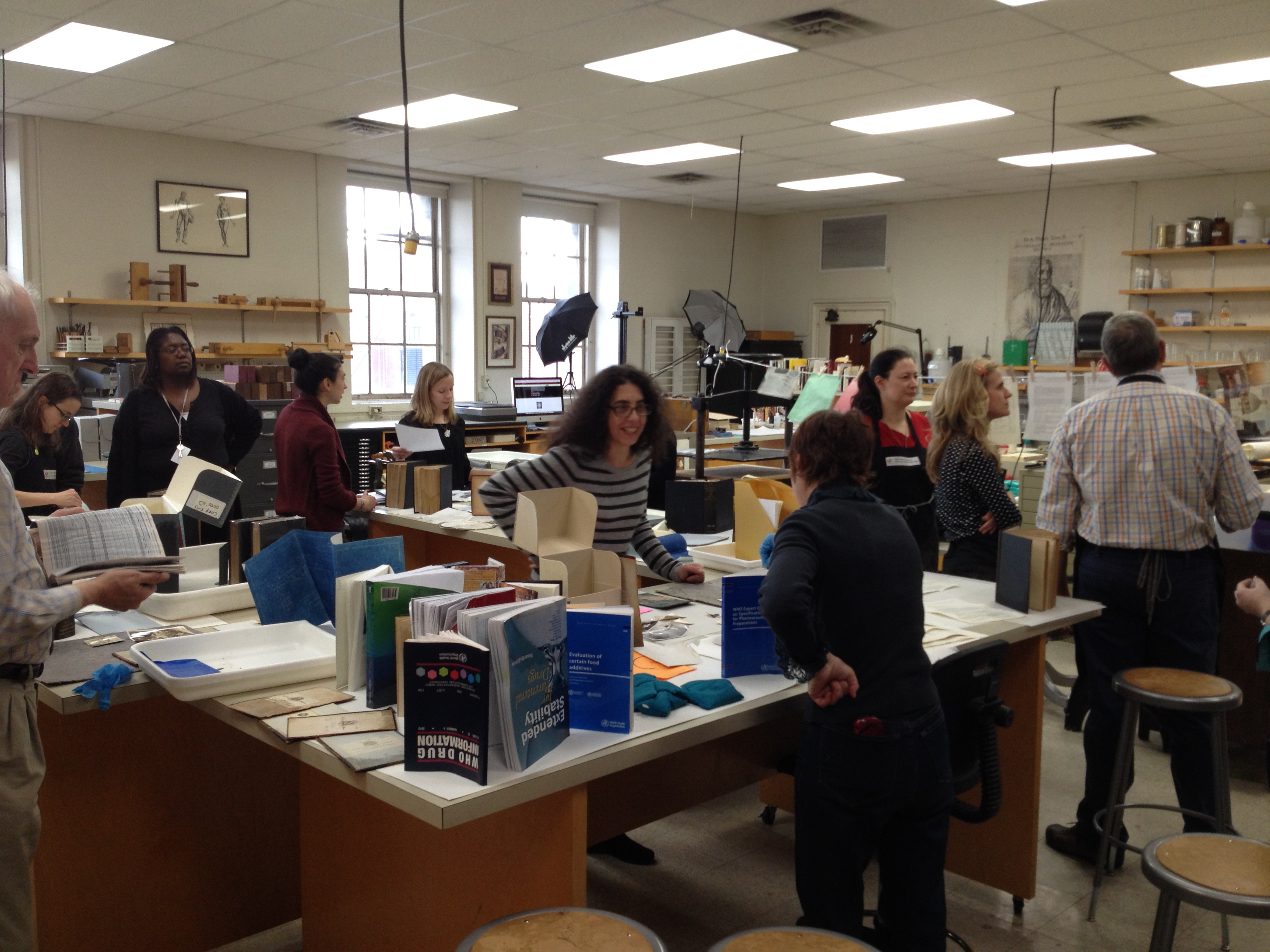
Puzzling over what to do with materials.  Alan Galicki supervises, far right.

Puzzling over what to do with materials. Alan Balicki supervises, far right.

On December 11, Alan Balicki, chief conservator at the New York Historical Society, came to NYAM’s Gladys Brooks Book & Paper Conservation Laboratory to lead an afternoon workshop about the importance of disaster planning, response, and recovery. The Conservation Lab recently rolled out a comprehensive Collections Disaster Plan detailing the proper protocols for dealing with disasters and Alan’s workshop was a great way to cap off this project.

Facilities staff experiment with draping techniques to protect against a leak.

Facilities staff experiment with draping techniques to protect against a leak.

The most common risk that libraries face is flooding due to pipe leaks or severe weather conditions. All the staff from Center for the History of Medicine and Public Health as well as several members from the Facilities Department had the opportunity to see what happens when materials get wet (all items used were set to be discarded). Center staff members were also able to engage in hands-on experimentation on how to dry different items based on their materiality and to ask questions in a non-disaster setting. Staff were encouraged to return to the lab the next day to see how the items had dried and engage in conversation about best practices.

Wet items everywhere!

Wet items everywhere!

VHS, film, and photographs.

VHS, film, and photographs.

We experimented with a variety of materials, including coated paper, leather covers, colored paper, shrink wrapped materials, photographs, audio-visual materials, and blueprints. Staff practiced interleaving soaked books, draping with plastic, and basic techniques for dealing with wet and fragile materials. Workshop participants dried materials using best practices (fanning and interleaving) as well as unorthodox methods (keeping the materials wet and closed) in order to compare the results. It was very instructive to witness how thoroughly books soaked up surrounding water, and how quickly coated paper began to “block,” or stick together, when wet. It was not surprising that some colored papers and Post-it notes bleed when wet, but seeing how quickly and dramatically they reacted to water was a good cautionary lesson. Conversely, it was encouraging to see how effectively shrink wrapping protected items from water.

Paper, cloth, and leather materials.

Paper, cloth, and leather materials.

Alan gave a thoughtful presentation on real-world dangers faced by libraries, and impressed the group with his capable and pragmatic approach to disaster planning. Thanks to everybody for a great learning experience, and especially to Alan for his time and expertise.

The Bookplates of Medical Men (Item of the Month)

By Erin Albritton, Head of Conservation, Gladys Brooks Book & Paper Conservation Laboratory

Book owners have forever endeavored to find ways to identify volumes as their own. With the invention of the printing press, however, books became more plentiful and an owner’s need to identify his or her own copy even more pressing. The earliest examples of printed bookplates (also known as ex-libris) come from Germany and date to the 15th century, just as printing began to take off in Europe. Over the following centuries, the use of bookplates became widespread throughout Europe and eventually followed colonists to America.1

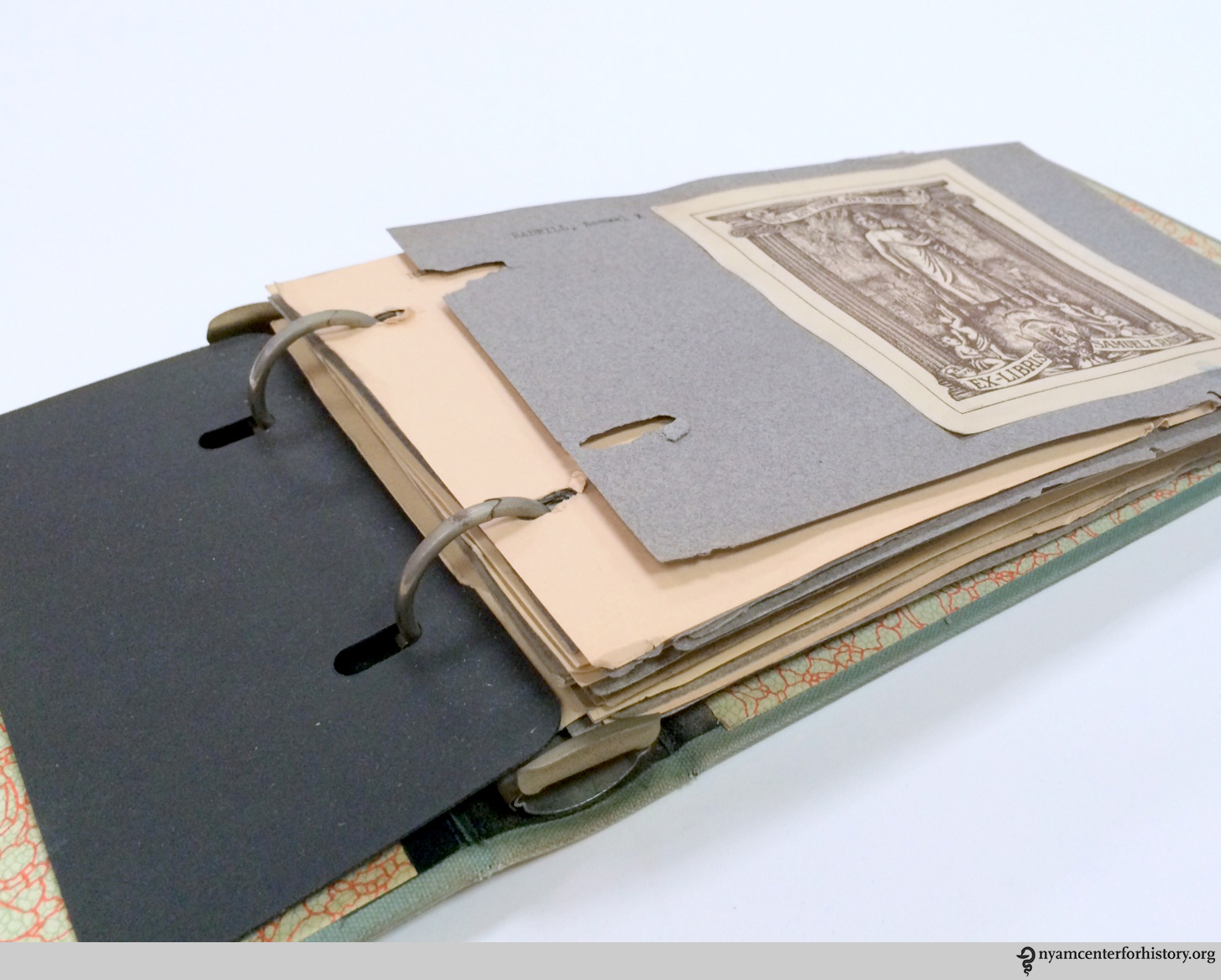
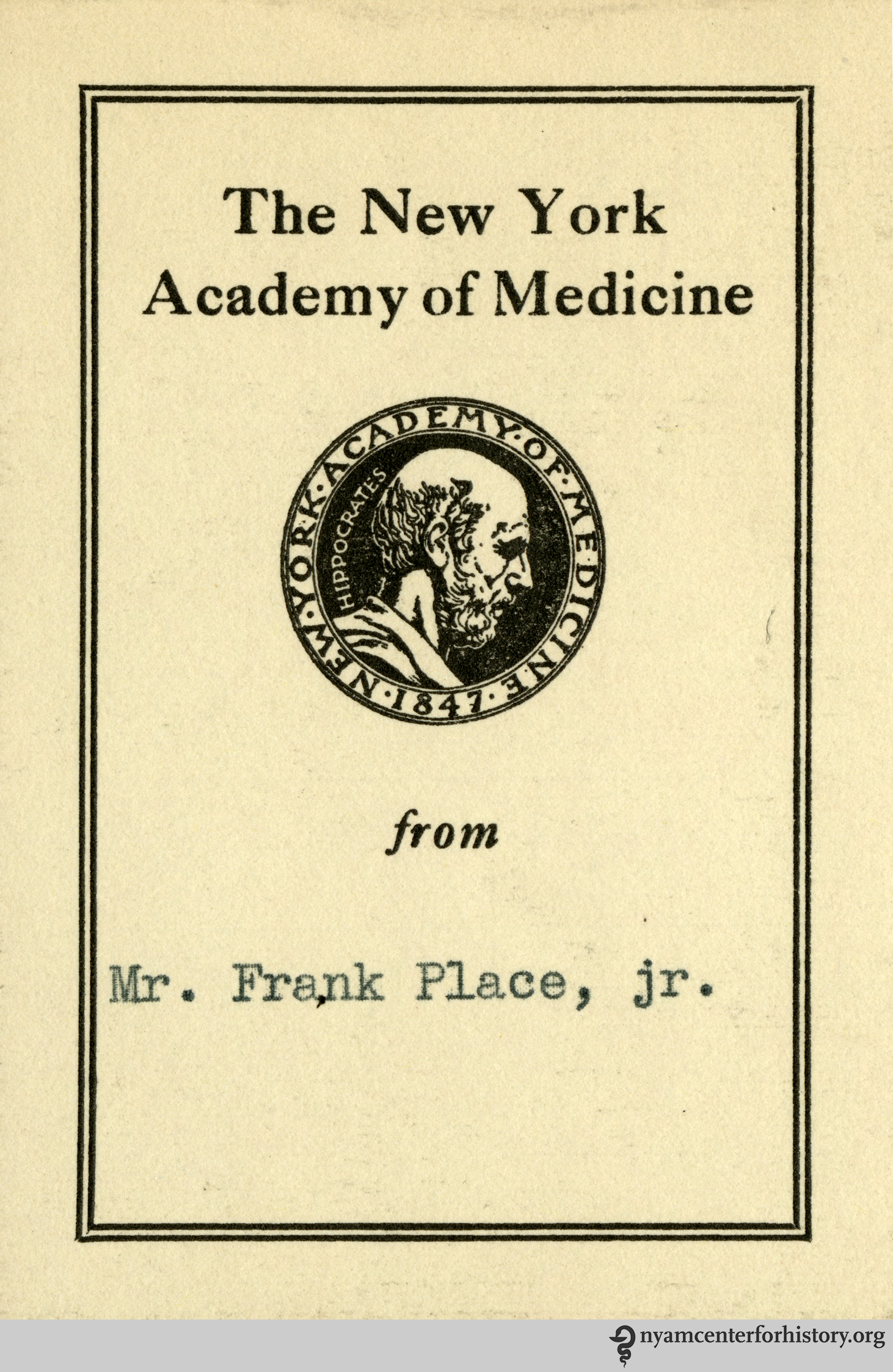
In the summer of 2014, conservators in the Gladys Brooks Book & Paper Conservation Laboratory began treating three scrapbooks containing 184 bookplates.2 Frank Place, Jr., NYAM’s reference librarian from 1905 to 1945, collected them and donated the books to the library sometime in the mid-20th century. In compiling his collection, Mr. Place mounted the bookplates onto recycled paper pamphlet covers (measuring approximately 5.25” x 8”) and stored them alphabetically in two-ring binders,3 which were actively damaging the plates’ fragile paper supports and making it difficult to use the collection.

Binder showing ring mechanism and resulting damage to paper supports.
Binder showing ring mechanism and resulting damage to paper supports.

Example of pamphlet cover Mr. Place reused as a support for his bookplates.

Example of pamphlet cover Mr. Place reused as a support for his bookplates.

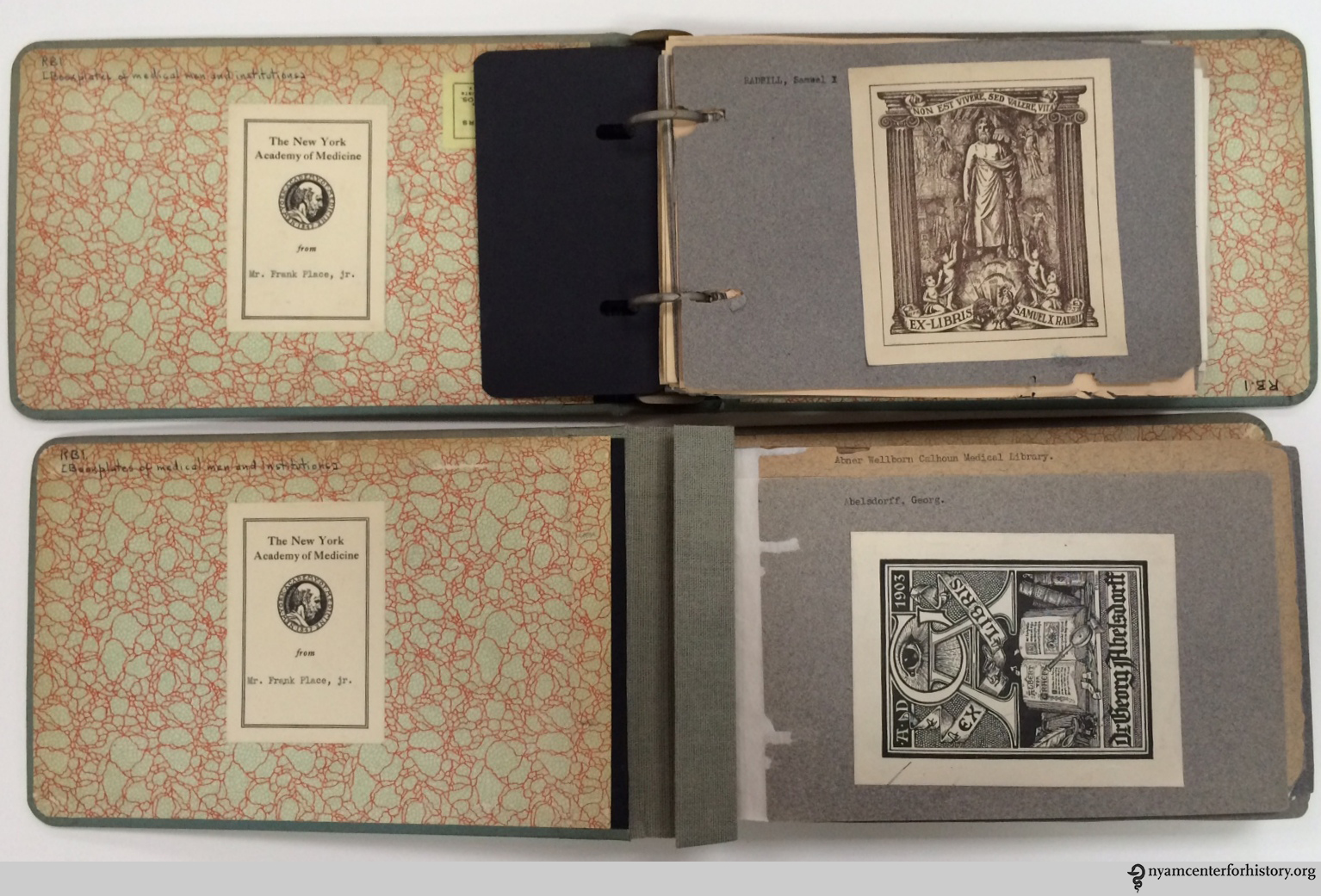
To remedy these issues and minimize the risk of future damage, conservators modified the binders while retaining as much of the original binding structure as possible, replacing the ring mechanisms with fixed posts and hinging the paper supports onto stubs.

Top: Volume 3, before treatment, in its original ring binder. Bottom: Volume 1, after treatment, in a modified post binding with hinged plates.

Top: Volume 3, before treatment, in its original ring binder. Bottom: Volume 1, after treatment, in a modified post binding with hinged plates.

Before and after binder modification.

Before and after binder modification.

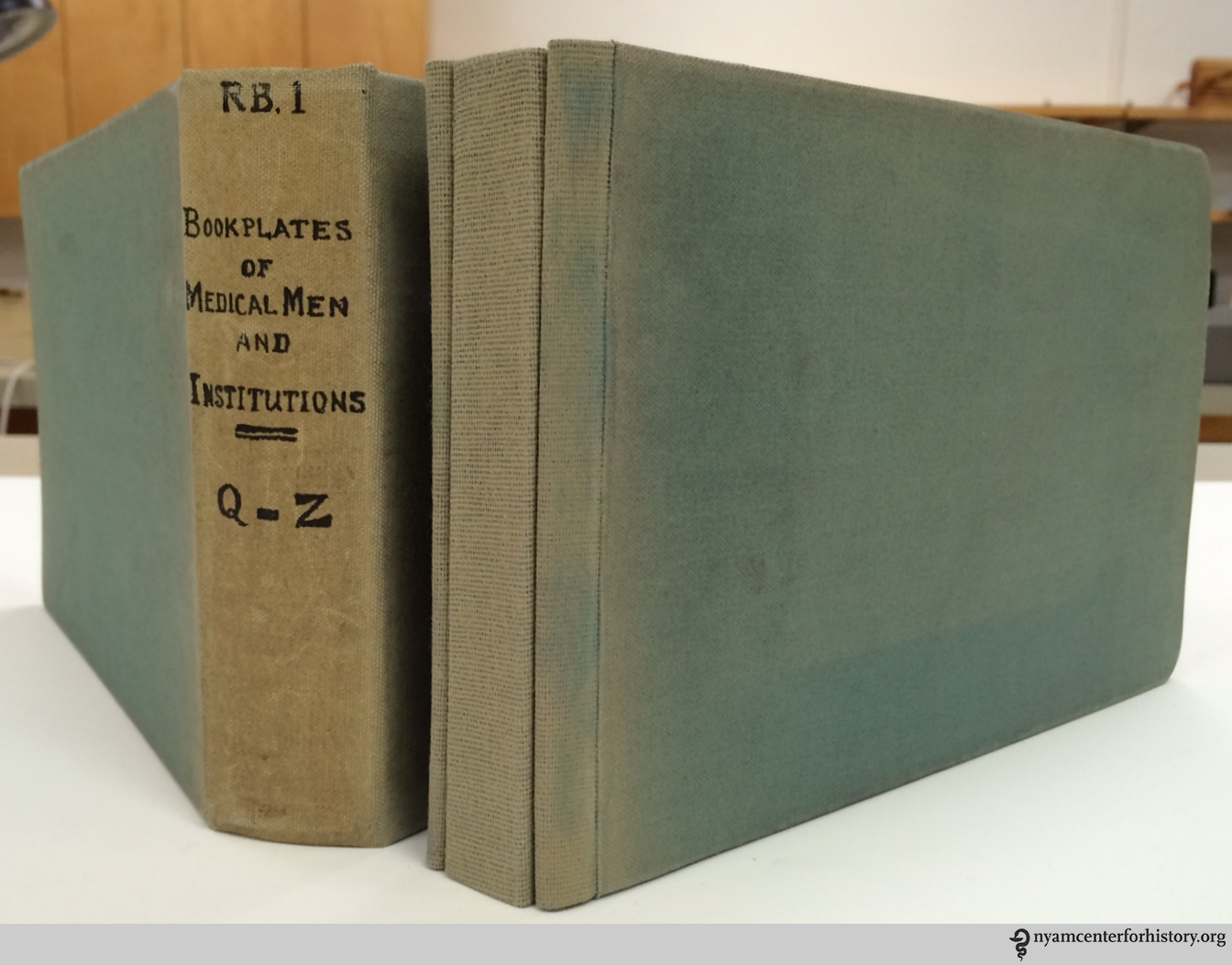
Because the original binder spine pieces were too big for the modified structures, conservators encapsulated the pieces in Mylar and affixed them to protective four-flap enclosures.

Mylar-spine wrappers with encapsulated original spine pieces.

Mylar-spine wrappers with encapsulated original spine pieces.

Mr. Place’s charming collection in NYAM’s library offers a window into what some scholars have referred to as the “golden age of bookplate enthusiasm,”4 which spanned from the end of the 19th century through the first decades of the 20th century. During this time, societies for the collection and exchange of ex-libris sprang up across Europe and the United States. Collectors prized plates for their aesthetic value as miniature pieces of art and often acquired them, not for use in identifying their books, but for the sole purpose of organizing, exhibiting, and exchanging them with others. Many collectors limited their acquisitions to bookplates representing a particular theme and, here, it is no surprise that Mr. Place specialized in the plates of medical practitioners and institutions. Correspondence (included in the scrapbooks) between Mr. Place and other collectors (specifically H. M. Barlow, secretary at the Royal College of Physicians, and Dr. Henry de Forest, a prominent New York physician5) indicates that he was not only interested in growing NYAM’s collection but, in the spirit of the times, was also an active contributor to the collections of others.

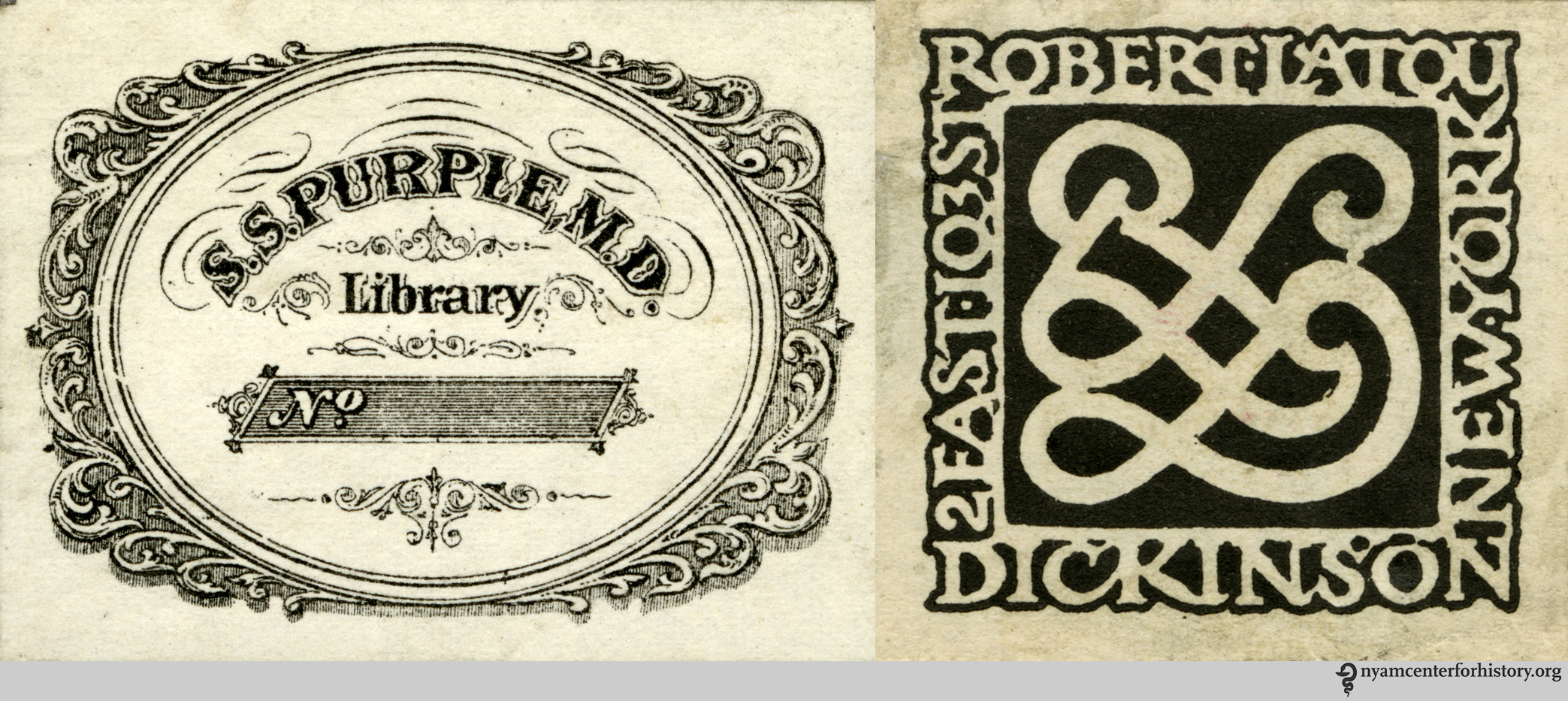
While small by comparison to other collections, Mr. Place’s scrapbooks offer some wonderful examples of the broad ranging sizes and styles of bookplates—from modest ornamental name labels:

Ornamental name labels of (left) Samuel Smith Purple, MD and (right) Robert Latou Dickinson, MD.

Ornamental name labels of (left) Samuel Smith Purple, MD and (right) Robert Latou Dickinson, MD.

to elaborately illustrated panels, depicting anything from coats of arms to the owner’s occupation and hobbies. Not surprisingly, in the case of medical bookplates, images such as Hippocrates, microscopes, and the caduceus, along with skeletons, skulls, and beakers tend to figure prominently.

This slideshow requires JavaScript.

NewYorkAcademyOfMedicine_watermarkIt is a pity we do not know whether, in addition to collecting, Mr. Place ever commissioned his own miniature work of art to grace the inside covers of his personal volumes. Thanks to a bookplate, however, we are forever reminded of his contribution of this delightful little collection to NYAM’s library.

Treatment of the third and final scrapbook is in process and the entire collection will be available for use in early 2015. In the meantime, a list of all 184 bookplates can be obtained by contacting history@nyam.org or calling 212-822-7313.


Notes

1. The oldest known American bookplate dates to 1679 and takes the form of a simple label indicating the owner’s name. Curtin, R. G. (1910). “The Book-Plates of Physicians, with Remarks on the Physician’s Leisure-Hour ‘Hobbies’.” Philadelphia: J.B. Lippincott Co. (Reprinted from International Clinics, Vol. II, 20th Series), p. 239.

2. Thanks to Saira Haqqi, 2014 Gladys Brooks Book Conservation Intern, for her work conserving volume 2 of this collection.

3. In an address to the Historical Section of the Philadelphia College of Physicians on November 22, 1907, physician and bookplate collector Roland G. Curtin advises collectors to hinge their plates onto paper cards (measuring 7.5” x 9.5”) and to keep the cards loose, thus enabling the inspection of the backside of plates as well as the display of single plates without endangering the entire collection. Ibid. 253. It seems likely that Mr. Place read Dr. Curtin’s address (a reprint, cited above, was accessioned into NYAM’s collection in 1910) and was endeavoring to follow this advice when arranging his own collection.

4. Pincott, A. “American Bookplates.” Rev. of American Bookplates by W.E. Butler. Print Quarterly, Vol. 18, No. 3 (Sept. 2001), p. 351. http://www.jstor.org/stable/41826267.

5. See blog post by Arlene Shaner, Reference Librarian for NYAM’s Historical Collections, discussing a bookplate and correspondence from Dr. Henry de Forest: https://nyamcenterforhistory.org/2013/03/06/biblioclasts-bibliosnitches-beware/.

Dusting off a Treasure: Cleaning and Rehousing the Ladd Collection

By Emily Moyer, Collections Care Assistant

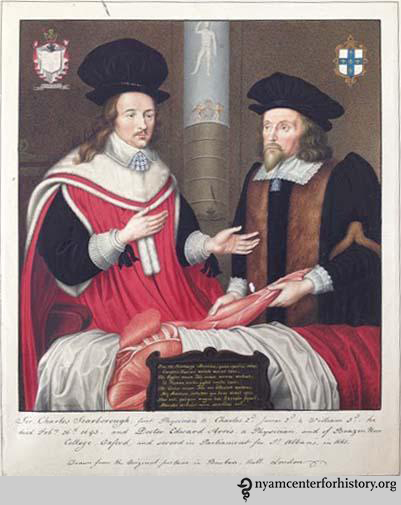
English Physicians Charles Scarborough and Edward Arris performing an anatomical dissection in 1651. After an original watercolor by G.P. Harding. Click to enlarge.

English Physicians Charles Scarborough and Edward Arris performing an anatomical dissection in 1651. After an original watercolor by G.P. Harding. Click to enlarge.

Accepted as a gift by The New York Academy of Medicine in 1975, the Ladd Collection comprises 671 prints dating from the early 17th century to the first half of the 19th century. The prints, which demonstrate a variety of printing processes including etching, engraving, mezzotint, stippling, lithography, and hand coloring, primarily depict people who have made historically significant contributions to the fields of science and medicine, as well as some medical institutions, procedures, and other health-related topics. William S. Ladd, a former dean of Cornell University Medical College, accumulated the collection during the first half of the 20th century, purchasing many of the prints as deaccessioned duplicates from the Ashmolean Museum at Oxford University.

Georg Faber von Rottenman. Engraving by Bernard Strauss. Von Rottenman was a maker of pills in Ratisbon ca. 1648. Click to enlarge.

Georg Faber von Rottenman. Engraving by Bernard Strauss. Von Rottenman was a maker of pills in Ratisbon ca. 1648. Click to enlarge.

Erich Meyerhoff, librarian of Cornell’s Medical Library from 1970 to 1986, recognized the research value of the collection and suggested it be given to the NYAM Library because, as he stated in his correspondence to NYAM librarian Alfred Brandon in 1975, “[NYAM] has the most important collection in the history of medicine in our region, which includes an extensive collection of portraits listed in its ‘Portrait Catalog.’”

The Ladd Collection was previously housed in a basement storage room in 27 flat-file drawers, which were overstuffed, dirty, and causing damage to the portrait mats. Our goals for the project—which began in January 2014 and finished in August 2014—were to clean the portraits, rehouse them to prevent further deterioration, and increase access to the collection by creating a digital inventory and location guide.

Click an image to view the gallery:

To begin, all of the portraits were dry cleaned using a smoke sponge.

SmokeSponge_watermark

Cleaning with a smoke sponge.

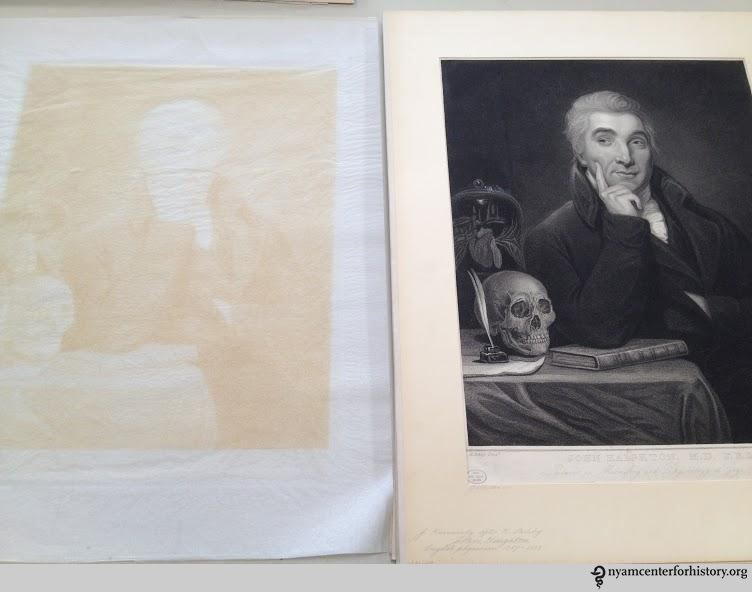
Many of the portraits also needed new mats (because the originals were either damaged or unacceptably acidic), as well as new interleaving tissue to replace tissue that had become stained and torn.

Portrait in need of a new mat and interleaving tissue.

Portrait in need of a new mat and interleaving tissue.

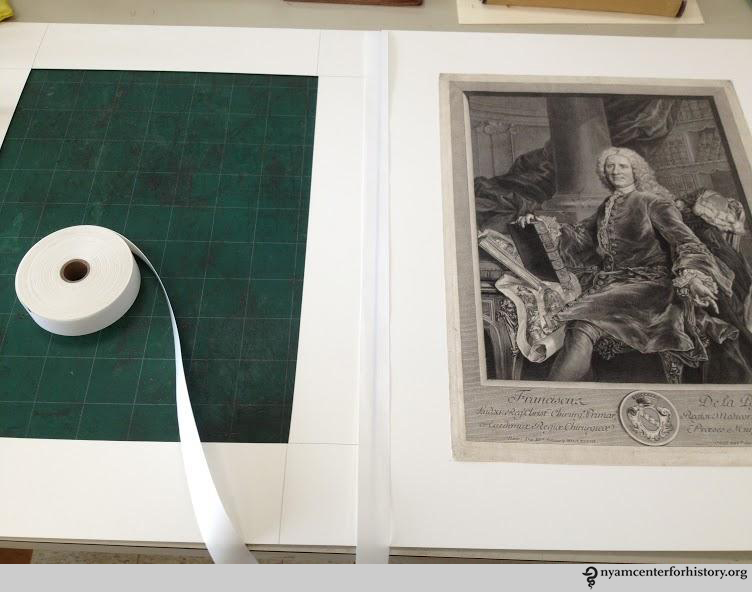
We created new window mats for the portraits and hinged them to archival mat board supports using Japanese tissue and wheat starch paste. Because the prints themselves are in good condition, very few needed extensive repairs.

Cutting new mats.

Cutting new mats.

New window mat hinged to archival mat board supports.

New window mat hinged to archival mat board supports.

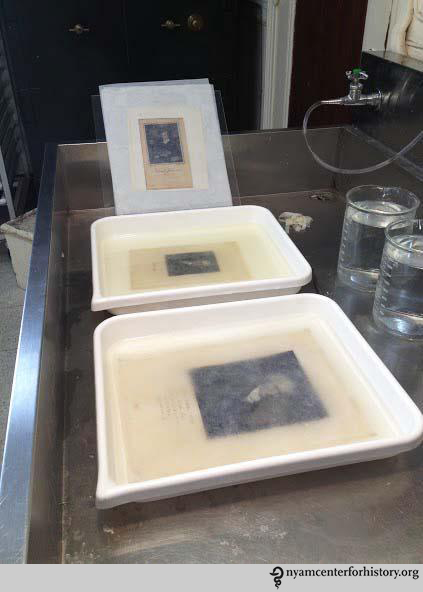
That said, about 10 of the portraits needed washing in order to remove thickly applied, brittle adhesive residue that was causing damage to the edges of the prints. First, we tested the inks for solubility to determine whether an aqueous treatment was appropriate. Once we determined that the inks were stable, we washed the prints in a slightly alkaline bath.

Prints in a slightly alkaline bath.

Prints in a slightly alkaline bath.

Rather than returning the collection to flat-file drawers, the conservation team made the decision to rehouse the matted prints (alphabetically and according to size) in acid and lignin-free, custom-ordered drop-front boxes from Talas that will be stored in climate-controlled conditions in NYAM’s recently renovated rare book storage stacks.

Prints rehoused in drop-front boxes.

Prints rehoused in drop-front boxes.

Although the collection had been described and cataloged at the time of its acquisition in 1975, it had no online presence and was virtually undiscoverable to the average user. Thus, over the course of the project, staff completed a digital inventory and location guide with the aim of increasing accessibility. This will be made available online soon.

The end result.

The end result.

These prints have importance not only because of their subject matter but also because of their aesthetic and art historical value. As a result of this project, scholars of the history of medicine, art, and printing can now use these prints as primary resources in their studies.

To view the collection or to access the collection guide, contact history@nyam.org or call 212-822-7313.

Preservation Enclosures 101 (Items of the Month)

By Christina Amato, Book Conservator, Gladys Brooks Book & Paper Conservation Laboratory

How simple is a box?

It is often overlooked, but creating appropriate enclosures, or housing, for collection materials is an important part of the work of a library conservation lab. A well made box can have a huge impact on the longevity of a book. Conservators have to weigh many factors when deciding what kind of enclosure is appropriate to use. When is a clamshell box the best choice, and when would a phase box be better? Scroll down to see some examples of typical enclosures made at the Gladys Brooks Book and Paper Conservation Laboratory.

First, the clamshell box. This type of enclosure is one of the most traditional you will find in a library. Each one is custom made for each book. They provide an enormous amount of protection to the book, and can be very attractive. However, they are quite time consuming to make, and add to the width of the book. For one or two books, this may not be significant, but for a large collection, and if you have limited shelf space, it can become an issue.

Enclosures1-2_merged_watermark

Three books in clamshell boxes, left. An open box, right.

Consider the pamphlets below, which are housed in brittle and crumbling old folders. They no longer provide adequate protection to the material inside, and in some cases are actively causing damage. Clearly, new enclosures are needed. However, there are thousands of these pamphlets in the collection, and it would be impractical to create clamshell boxes for each one.

Enclosures3-4_merged_watermark

Pamphlets in need of new housing.

Enter the phase box, or wrapper. These are constructed out of a thin cardstock and take up much less room on a shelf than a clamshell box. They also take a fraction of the time to complete, though each is also custom made for the material within.

Enclosures5-6_merged_watermark

Phase boxes.

Phase boxes are a good solution for this kind of collection. However . . . are there any downsides to having rows and rows of items that look like this?

Rows of phase boxes.

Rows of phase boxes.

What if your collection looks like this?

A shelf with visible spines.

A shelf of books with visible spines.

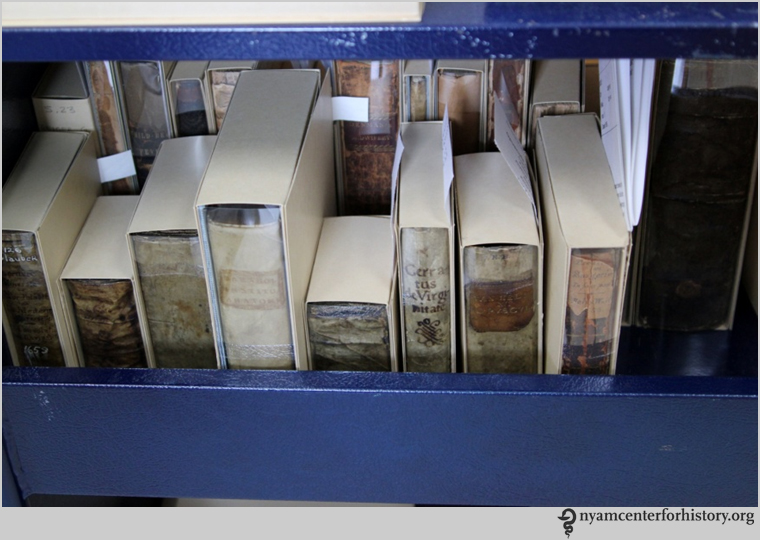
Conservators at the Folger Shakespeare Library in Washington, DC, developed a “visible spine phase box” similar to a traditional phase box, but which incorporates a clear piece of Mylar. This way, you can see what is inside the enclosure. Not only can this be more appealing visually than a row of undifferentiated cardstock, but it can be useful in monitoring the condition of a book. And, of course, it is immediately obvious if the box’s tenant has gone missing!

Books in visible spine phase boxes.

Books in visible spine phase boxes.

Occasionally, an item will enter the lab that doesn’t fit into any of the usual categories. Below is a Sinhalese “Ola,” or a palm-leaf manuscript, written in 1720. The mailer bag it arrived in doesn’t quite meet the standards for an adequate enclosure.

An ola in a mailer bag.

An Ola in a mailer bag.

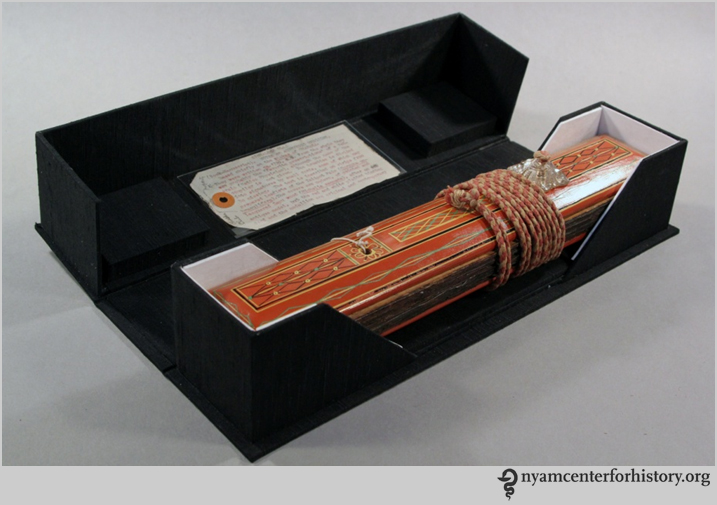
Our solution was to make a modified clamshell box; the sides are cut away so that it is easy to reach in and safely remove the item; the cover is built up to provide room for the protruding button and string on the cover; and the sides are covered with a smooth Tyvek to protect the fragile palm leaf edges.

An Ola in a modified clamshell box.

An Ola in a modified clamshell box.

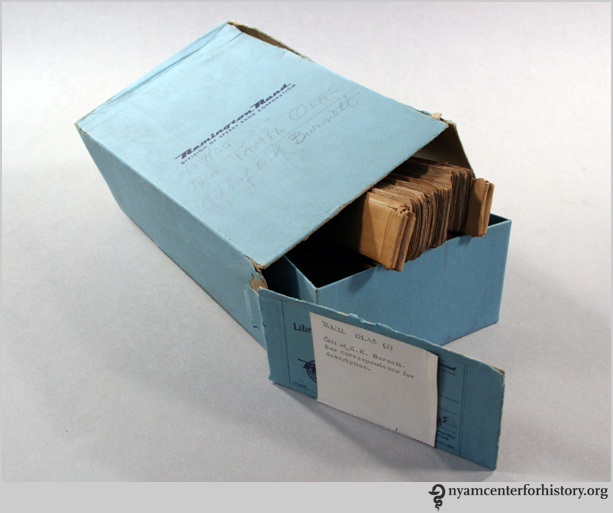
If you have an entire box full of Olas that require re-housing, however, like the unfortunate ones below, that may prove to be too time consuming.

Many unfortunate Olas in need of rehousing.

Many unfortunate Olas in need of rehousing.

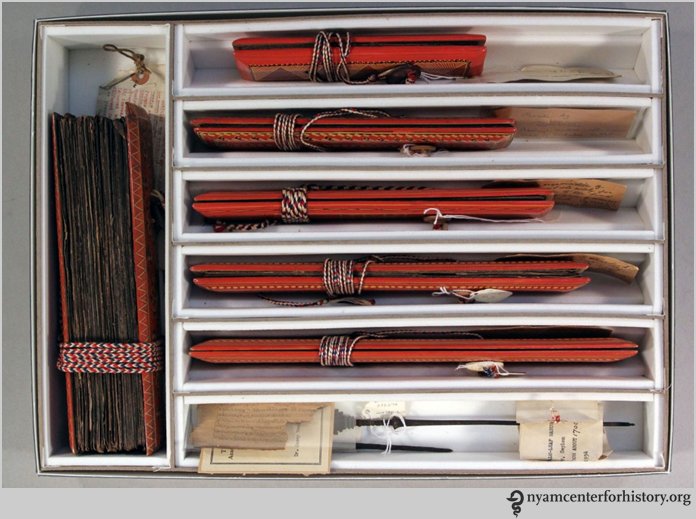
The solution here was to modify a commercially made enclosure with separate compartments made out of Valera foam. Each piece is protected, and using a pre-made, standard sized box saved time.

Olas in a modified commercially made enclosure.

Olas in a modified commercially made enclosure.

These are just a few of the typical sorts of enclosures you will encounter in a library. Labs will often make their own modifications and improvements. Whether it be simple or very complex, the box plays a crucial role in preserving fragile materials.

The Drs. Barry and Bobbi Coller Rare Book Reading Room – the panoramic view

The Drs. Barry and Bobbi Coller Rare Book Reading Room captured by Ardon Bar-Hama.

The Drs. Barry and Bobbi Coller Rare Book Reading Room captured by Ardon Bar-Hama. Click for the full panoramic experience.

The Drs. Barry and Bobbi Coller Rare Book Reading Room has reopened. Renovations improved environmental conditions for the collections, including a new HVAC system, restored the historic windows, and a return to the cork floor’s former glory. We are once again welcoming readers and visitors to the room and were delighted to have the chance to host the wonderful Ardon Bar-Hama, who kindly captured the space in its full panoramic glory. Click through on the image to see the interactive (and highly zoom-able) panoramic view.

Celebrate Preservation Week, April 26–May 3, 2014

PreservationWeekIn 2010, the American Library Association (ALA) created Preservation Week to bring attention to the millions of items in collecting institutions that require care. Sponsored by the ALA’s Association of Library Collections and Services and partner organizations, it was designed to inspire the preservation of personal, family, and community collections of all kinds, as well as library, museum, and archive collections. The goal is also to raise awareness of the role libraries and other cultural institutions can play in providing ongoing preservation information.

What will you do to celebrate Preservation Week? Here are a few ideas.

1. Write a disaster plan for your institution, if it doesn’t have one already. If it doesn’t, you are not alone. According to a 2004 study, 78% of public libraries and 73% of academic libraries do not have an emergency plan or staff to carry it out. (Read more about it here.)

Get ahead of the game—here are some places to start:

2. Learn more about caring for your private collection materials.

Facsimile denture in custom-made clamshell box

Custom-made box for a facsimile of George’s Washington’s lower denture.

3. Make sure your collection materials are correctly housed. 

  • There are several posts about creating enclosures in our blog that you can peruse:

o Creating a box for a facsimile of George Washington’s lower denture.

o On re-housing our diploma collection.

o And be sure to check out our Item of the Month blog for May 2014, which features an introduction to enclosure basics.

  • A variety of custom enclosures are available from the following vendors:

o Archival Products (of particular note is the Academy folder, named after the New York Academy of Medicine)

o Talas

o Hollinger Metal Edge

4. Find a conservator. Of course, we don’t recommend undertaking conservation treatments unless you are a trained conservator. AIC (The American Institute for Conservation for Historic and Artistic Works) provides a searchable listing of conservation professionals working in specialties ranging from books and paper to objects and textiles. You can search by specialty or by zip code.

5. Attend a Preservation Week event. Click here for an event map and list of speakers.

Preservation week happens only once a year, but collections need constant care. We hope the above can help you get started, or serve as a reminder of the importance of preservation.

Read more about Preservation Week.

Rehousing the Diploma Collection

Today’s post was written by the 2013 Gladys Brooks Conservation Intern, Caroline Evans.

The diploma collection at The New York Academy of Medicine contains over eight hundred certificates, diplomas, seals and proclamations granted by universities, professional societies and institutions across a wide geographical span. The items in the collection range from the mid-eighteenth century up to the late twentieth century. The diplomas were the subjects of a major collections care project carried out in the Gladys Brooks Book and Paper Conservation Lab by Caroline Evans (summer intern), with the assistance of Emily Moyer (Collections Care Assistant) and Allie Rosenthal (volunteer).

Piles of diplomas to be sorted, cleaned, and housed.

Piles of diplomas to be sorted, cleaned, and housed.

While most of the earlier diplomas are printed or written on parchment and display elaborate calligraphy, many of the later items in the collection are printed on paper. The diplomas can provide a glimpse into the changing methods of printing during this period, as well as into the preservation needs of flat paper—in some cases, for instance, some of the ink in the signatures had begun to flake, and seals on parchment were cracked. In addition to dry cleaning the diplomas and making the appropriate efforts to stabilize each of these items, we constructed folders and housing for each diploma or seal before sorting them by size, date, and granting institution.

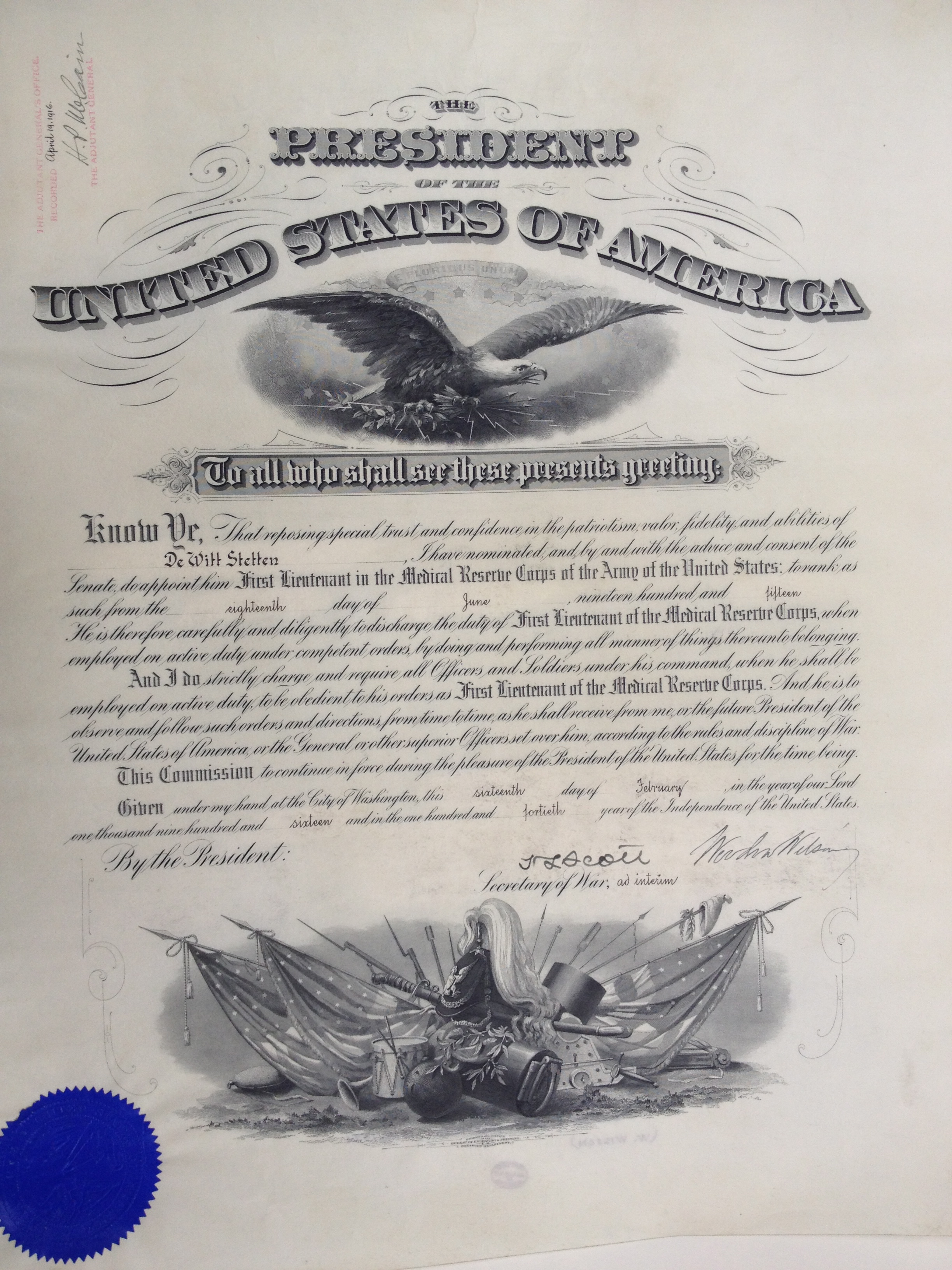
Over the course of this undertaking, some gems emerged—documents significant to the history of the Academy and to the history of medicine. Among these are certificates nominating and appointing military ranks to fellows of the Academy and other doctors serving in wartime. In addition to signatures from the “Secretary of War”, many of these documents boast signatures from various Presidents of the United States. Indeed, while sorting through the collection, we encountered wartime documents—appointments or commendations thanking military doctors for their service—with signatures from Presidents Abraham Lincoln, Andrew Jackson, Andrew Johnson, Herbert Hoover, William Howard Taft, Woodrow Wilson, and Warren G. Harding, to name a few.

Certificate signed by Woodrow Wilson.

Certificate signed by Woodrow Wilson.

Certificate signed by Andrew Johnson.

Certificate signed by Andrew Johnson.

Certificate signed by Abraham Lincoln.

Certificate signed by Abraham Lincoln.

Occasionally found tacked onto the back of certificates and acknowledgments of service were documents indicating the intersection of military service and medical research—for example, a letter from Walter Reed Hospital to a soldier encouraging him to participate in a study on the effect of injections of yellow fever. There are also a significant number of female medical professionals whose successes and contributions to the field of medicine and women’s health are commemorated in the collection. Some of these awards and diplomas are dated as early as the nineteenth century.

Photographs of Howard and Edith Lilienthal attached to a certificate

Photographs of Howard and Edith Lilienthal attached to a passport.

The diploma collection contains items printed in French, Portuguese, Hungarian, Latin, Hebrew and Arabic that display a variety of design styles.  One particularly beautiful certificate from 1945 was granted by the Société Impériale de Médecine de Constantinople, written in Arabic on thin paper with gold leaf.

Certificate in Arabic with gold ornament

Certificate in Arabic with gold ornament

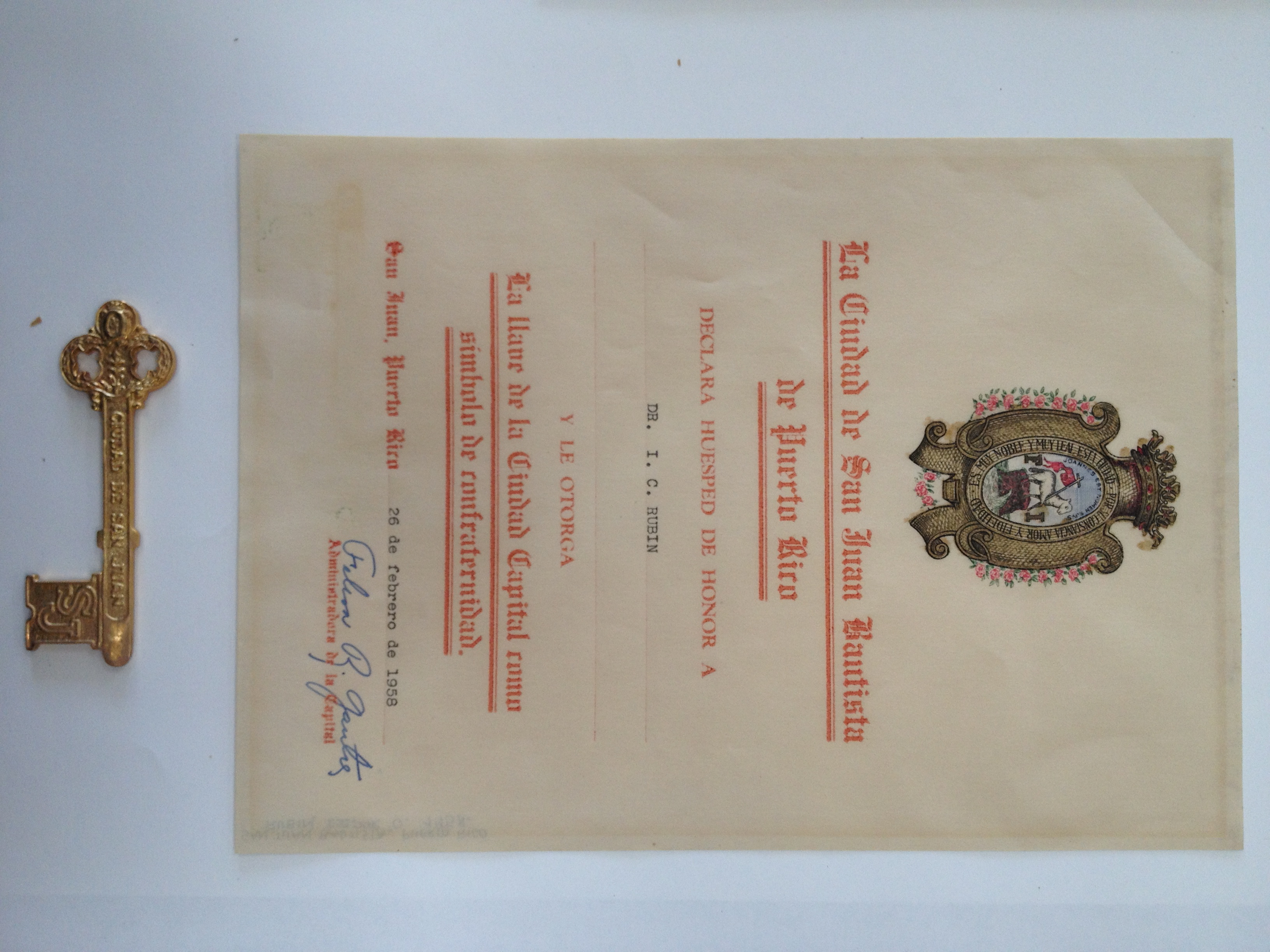
Key to the City of San Juan Batista, granted to Isidor Rubin.

Key to the City of San Juan Batista, granted to Isidor Rubin.

Some more recent certificates are printed in color, with hand-colored borders and modern, stylized type. The diplomas on paper were a special challenge to clean and house, as many of the papers had become brittle or were adhered to acidic backings. This allowed the aspiring conservators interning and volunteering in the lab ample practice with paper repair. Diplomas printed on vellum provided their own challenges, however, as humidity fluctuations over time caused some of the works to curl and stretch, obscuring and fading labels and printed text.

Repairing paper certificates in the conservation lab.

Repairing paper certificates in the conservation lab.

These challenges, in addition to the diverse languages present in the collection, necessitated some additional investigation for the creation of new labels for each item. In the end, though, the lab was able to create a location guide with the identifying information for each sorted, cleaned, and re-housed object, so that the diploma collection will be accessible well into the future.

A certificate and seal, re-housed.

A certificate and seal, re-housed.

Holiday News from the Center

NYAM Library, Rare Book Room photos by Amy Hart © 2012As the year comes to an end, there is a lot going at the Center for the History of Medicine and Public Health.

♦ We are planning our 2014 Festivals (there will be two! Save the date for the first on April 5. Keep an eye out for details coming early next year).

♦ On December 4, we will welcome a number of influential librarians to an informal roundtable to discuss the impact of open access publishing for libraries, researchers, and users. Simon Chaplin, Head of the London Wellcome library, will take part in this discussion, and in the evening present a lecture on the (often eccentric) history of medical tourism. Both events are free but require pre-registration (follow the links to register).

♦ For those in the scholarly world, details of our two research fellowships have just gone live:

  • The Paul Klemperer Fellowship supports research using our collections for the history of medicine. Find out more here.
  • The Audrey and William H. Helfand Fellowship supports work in the history of medicine and public health, with a particular focus on the use of visual materials. More details here.

Applications close March 4, 2014 for the 20142015 academic year. We encourage applicants to get in touch with our Reference Librarian for Historical Collections when shaping their applications.

♦ We are accepting applications for the 2014 Gladys Brooks Book and Paper Conservation Internship now through December 15, 2013. For more information about eligibility, click here.

♦ The Center is growing! We are looking for a curator to join the team to help us develop our scholarly and public presence through exhibitions, programming, and collection development. For more details see the job description here.

♦ The library closes early today, November 27, and will be closed on Thursday and Friday, November 28 and 29. We will also be closed on December 24 and 25.

Item of the month: Scrapbook of Doctor John T. Nagle, One Album, Three Perspectives

By Christina Amato, Book Conservator

Our item of the month is a scrapbook compiled by Dr. John Nagle from the years 1868-1900.  Dr. Nagle was an employee of the New York City Bureau of Vital Statistics, and the album mostly consists of newspaper clippings concerning births and deaths, diseases, methods of disposing of bodies, etc.  It is an interesting item on many different levels.  When an item comes into the conservation lab, the first thing we naturally see is damage.  The album’s spine had fallen off, many of the newspaper clippings inside were crumpled and broken, and the front cover had warped in a particularly exuberant fashion:

Foredge before treatment.

Foredge before treatment.

Most visitors to the lab who encounter the album, however, just see the charming artwork on the cover:

scrapbook after

A student of book history might be more inclined to see it as a typical example of a publisher’s cloth binding.  Starched bookcloth, which was invented in the 1820s, allowed for the mass production of embossed covers such as the one above. A heated brass die would be used to stamp the cover, and even as late as the 1870s, when Dr. Nagle started compiling his scrapbook, each detail of the die would have been hand carved.

A researcher might have a different take on this item altogether. Though mostly consisting of statistics, which are fascinating in their own right, there are several small clippings that provide intriguing clues into the nature of Dr. Nagle himself:

promenade

In addition to sunny afternoon promenades, Dr. Nagle was known to engage in daring, maritime rescues, and heated competition over the title of “handsomest man”:

swimming

handsomest man

Depending on who you ask, the most interesting thing about this album could be its physical structure, the details of the cover design, or the content.  Regardless of where your interest may lie, conservation treatment has rendered the book accessible to all.  If you are interested in seeing this item, contact us at (212) 822-7313 or history@nyam.org.

Scrapbook after conservation treatment.

Scrapbook after conservation treatment.

For your viewing pleasure

This Wednesday’s 2013 New York Academy of Medicine Gala featured the following video on the Center for the History of Medicine and Public Health. If you would like to learn more about our work or visit us in person, please email history@nyam.org and library@nyam.org.