Every year, our public programs explore a different aspect of our collections, culminating with an all-day Festival. This year’s Festival on October 17 is the highlight of our 2015 Eating Through Time: Food, Health and History celebration of food, cookery, and health.
Join us as we welcome chefs, community activists, historians, and food enthusiasts to discuss the past, present, and future of food in society, culture, and policy. The festival will feature talks, panels, demonstrations, tastings, performances, book signings, food trucks, a pop-up bookstore and marketplace, historic cookbooks on display in The Drs. Barry and Bobbi Coller Rare Book Reading Room, and more. Food and science writer Evelyn Kim is guest curator for the event.
Panels on food and its relationship to aging, the law, technology, the future, and community health
Workshops on topics from insect eating to aphrodisiacs
Online registration is available here with discounts for Academy Fellows and Members, Friends of the Rare Book Room, students, and hospital house staff.
On June 7, our Friends of the Rare Book Room and ARCHIVE Global: Architecture for Health enjoyed a private visit to the hospital zone on Ellis Island. The private support group Save Ellis Island offers hardhat tours of the hospital complex, which is adjacent to the main reception center operated by the National Park Service. More than 30 people took the ferry from Battery Park across New York Harbor to Ellis Island to learn more about the site and its importance to the history of public health in New York City. Some stayed on for lunch afterward at historic Fraunces Tavern.
Our Save Ellis Island tour guide gives safety instructions before the group enters the hospital zone.
On the south side of the island, and out of use since 1954, the hospital complex housed would-be immigrants who were not permitted to immediately enter the country. All steerage passengers were inspected—usually for only a few seconds, given their great numbers—and some 1 to 2% were detained for health reasons. Completed in 1909, the 750-bed hospital included wards for infectious diseases, kitchens, massive laundry facilities, an autopsy room, and recreation spaces for patients and staff alike.
The autopsy room.
Even in its semi-derelict condition, the complex is one of the few remaining “pavilion” style hospitals in the country. Pavilion hospitals were first built in France in the 18th century, and were enthusiastically endorsed by reformers such as Florence Nightingale in the 19th century. The design emphasized the need for ventilation, with wards built to promote sanitary conditions, provide light, and maximize the circulation of air. Pavilion hospital design fell out of use in the 20th century.
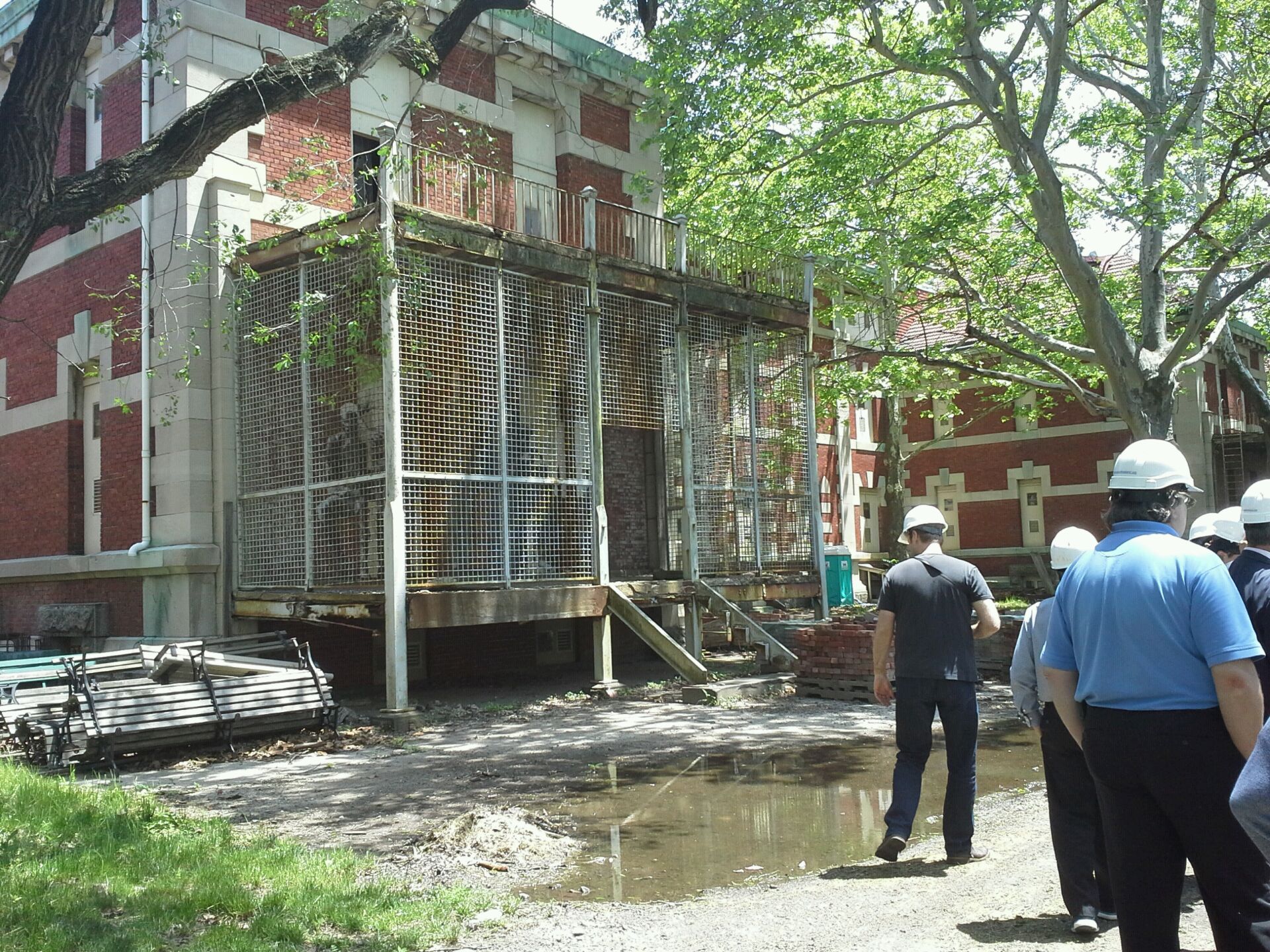
Caged verandas allowed patients access to fresh air while controlling their movement around the complex.
The Ellis Island site, already abandoned and crumbling, was further damaged during hurricane Sandy, and Save Ellis Island is working to stabilize the buildings, while preserving the sometimes eerie atmosphere of the site, now partially overgrown with vegetation. For more information about the complex, and the Save Ellis Island project to bring it back into public view, see: http://www.saveellisisland.org/history/hospital-complex
Wall with a tide mark showing the level of water during Hurricane Sandy.
We are increasingly offering our Friends group exclusive events such as this visit. If you are interested in becoming a Friend, find out more here. Friends who missed out on this sold-out event should e-mail culturalevents@nyam.org to express their interest in another tour at a later date.
New York City garbage truck, circa 1929. Photo from The New York Academy of Medicine Committee on Public Health Archive.
The Academy has a long history tackling questions related to New York City’s sanitation infrastructure. Waste management and disposal was an ongoing concern as the city grew. Despite the creation of the Department of Street Cleaning in 1881, street cleaning and garbage removal contracts, like many other services enmeshed in the politics of city, included the trading of political favors, jobs for constituents, and the creation of slush funds. The threat or occurrence of epidemic disease triggered attempts to improve the situation, but at the turn of the 20th century, sanitation and waste disposal efforts remained haphazard and slow to change.
Many sanitation advocates of the late 19th century blamed disease on filth and refuse and the foul-smelling miasmas they produced. The emergence of new bacterial theories and techniques linked disease to the presence of specific pathogens. Whichever approach to disease was taken, the reality was clear: keeping the city clean from refuse was critical to minimizing the spread of infectious diseases such as cholera, making dealing with garbage a critical issue for the health of the city.
An open letter to mothers from the Committee of Twenty. Click to enlarge.
The Academy’s Committee for Public Health proposed new street cleaning methods periodically in the early 1900s. At this time, most of New York City’s garbage was carried out to sea in barges and dumped into the ocean. Collaborating with municipal officials and around a dozen civic organizations, the Academy appointed a Committee of Twenty on Street and Outdoor Cleanliness (a subcommittee of its Committee on Public Health). Its goal was public education, and included signage urging people to clean the sidewalks and curb their dogs, and a competition to design a more effective trash basket. The Committee reported on topics as varied as the effective design of dump trucks; conditions at the city’s open air markets and suggestions for their improvement; education campaigns instructing “every mother in this neighborhood” to teach their children to “refrain from this obnoxious practice” of throwing litter in street; and air pollution from fires on Rikers Island.1
Pamphlets reflecting the work of George Soper and the Committee of Twenty.
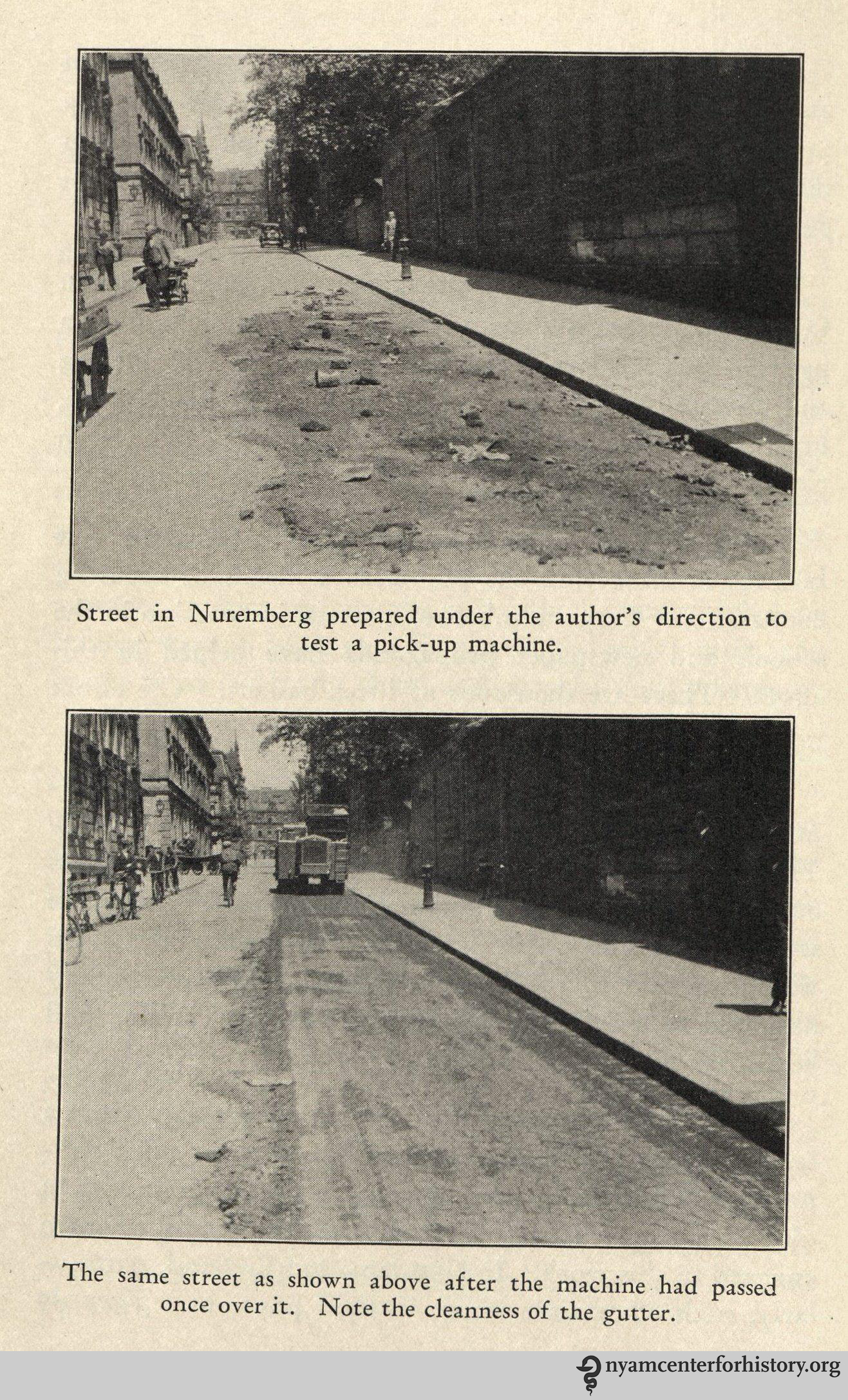
In the 1930s, George Soper, the sanitation engineer best known for identifying Mary Mallon (“Typhoid Mary”) as a carrier of typhoid,2 was sent by the Committee of Twenty to take a trash tour of Europe. He attended the 1931 International Conference on Public Cleansing in London; measured the plowing capacity of German snow trucks; visited 14 incineration plants; and documented varied street sweeping methods during his extensive travels. The evidence he brought back all pointed in the same direction: whatever its successes, New York City was behind the times when it came to dealing with trash. The Academy used Soper’s reports to urge significant changes in the infrastructure of New York City’s garbage collection and disposal.
By 1933, politics struck again. The Committee chairman’s report stated that “the activities of the Committee of Twenty were considerably curtailed by the unexpected changes in City administration.”3 The Committee bemoaned the fact that despite better cooperation between the Police and Sanitation Departments, new ordinances and regulations were not systematically followed, and the “streets of New York City remain an untidy, if not disgraceful, condition.”4 Despite their concerns, the Committee concluded that the combination of political change and worsening economic conditions meant their attention would be better directed towards other efforts at a national level.
On a more positive note, the 1930s saw considerable resources expended, partly through New Deal projects, building new sanitation infrastructure, particularly sewage treatment.5 A 1934 law curtailed the dumping of municipal waste at sea, beginning a new era of sanitary landfills.6 Throughout the decade the Department of Sanitation (renamed from the Department of Street Cleaning in 1929) introduced new mass-produced garbage truck able to better compact and transport garbage. The winning entrant of the Committee’s competition for a more effective trash basket however, has sadly been lost to time.
New York City garbage truck, circa 1930. Photo from the New York Academy of Medicine Committee on Public Health Archive.
The “Garbage and the City” series is presented in collaboration with the Museum of the City of New York and ARCHIVE GLOBAL and is supported by a grant from the New York Council for the Humanities. Any views, findings, conclusions or recommendations expressed in this program do not necessarily represent those of the National Endowment for the Humanities.
References
1. Committee of Twenty on Street and Outdoor Cleanliness, Committee on Public Health Archive, New York Academy of Medicine.
3. Presumably a reference to Mayor John O’Brien, who served a one year term in 1933 before being defeated by Fiorello LaGuardia. O’Brien is now regarded as the last of the “Tammany Hall” mayors, criticized for his lackluster response to the impact of the Depression on the New York population. See: “Mayor John O’Brien: His Heart Is As Black As Yours!” Bowery Boys blog, February 25, 2010.
4. Report of the Chairman at the meeting of March 23, 1933, Committee of 20 on Street and Outdoor Cleanliness, New York Academy of Medicine Archives.
Cover image from an undated menu of a hotel cafe outside Lisbon. Click to view brochure.
We are thrilled to share our brochure of 2015 programming with you.
A few of these events are right around the corner. We will present two panels on Sunday at the Food Book Fair: Food and Empire and Cookbooks and History. For more information and for tickets, visit foodbookfair.com.
Today’s guest blogger is Dr. Rachel Laudan. Originally trained as a historian of science, Dr. Laudan has taken her historical research into food history. This blog post is inspired by Dr. Laudan’s most recent work, Cuisine and Empire:Cooking in World History (University of California Press, 2013), focusing on the movers of gastronomic change from pre-history to the present.
Dr. Laudan will discuss her work on April 12 at the Food Book Fair at Brooklyn’s Wythe Hotel. The Fair will include two panels presented by the New York Academy of Medicine, Food and Empire and Cookbooks and History. For more information and for tickets, visit foodbookfair.com.
“Where’s the beef?” asked actress Clara Peller of a rival burger in a 1984 Wendy’s advertisement. Within a matter of weeks, her words had become an American catchphrase.
Curious, though, when you think about it, that Americans were so enamored of beef. Through most of history, beef was low on the hierarchy of meats. Chinese preferred pork or fish; people in the Middle East and the Mediterranean relished lamb and goat; and Indians created cuisines in which meat played a secondary role if not avoided altogether. Most people stayed away from the tough stringy meat from old work animals or worn out dairy cattle.
Northwestern Europe and its former colonies are the exceptions. For Americans, for example, not only is beef delicious, but they and others see it as a symbol of American power, particularly when combined with white bread to make a hamburger. On January 31, 1990, 5,000 people waited in the chilly Moscow dawn for the first McDonald’s in the USSR to open its doors; by nightfall, 30,000 had been served. Many commented that the opening of McDonald’s foreshadowed the fall of the USSR.
Because McDonald’s was so symptomatic of American strength, no one took it lightly, whether they liked it or not. The Economist used the price of a Big Mac to value the world’s currencies; the sociologist George Ritzer coined the term McDonaldization to mean efficiency, predictability, and mechanization. In the 1980s, the Slow Food movement took its name as it opposed the opening of a McDonald’s in Rome. In 1999, the French farmer José Bové dismantled a McDonald’s under construction in France, rallying supporters with the call McMerde (McShit).
Beef recipes from pages 38-39 of Ann Peckham’s The Complete English Cook, fourth edition, Leeds, 179?. Click to enlarge.
Beef as the symbol of American power was a natural successor to beef as the symbol of British power. Beef, the flesh of the most powerful domesticated animal, its bright red color suggesting strength and masculinity, had been hallowed by the English since at least the 17th century. In song, in quips such as the “roast beef of Old England,” in clubs centered around eating steaks, and in ox roasts distributed to the poor on political occasions, beef became synonymous with Englishness. When Justus Liebig, the leading chemist of the first half of the 19th century, declared that proteins were the crucial nutrients, essential to the building and maintenance of the body, English faith in beef was confirmed.
In fact, steaks and roasts were beyond the means of most English in the 19th century. Sticky brown essence of beef provided, as hamburger offered later, an affordable alternative. Meat extract, according to Liebig, was as nutritious as beef itself. He offered to provide it neatly bottled from his factory in distant Uruguay, which extracted beef essence from cattle carcasses hitherto valuable only for their fat and hides.
Calendar blotter for December 1928 and January 1929 issued by Fairchild Brothers and Foster and their UK agents, Burroughs, Wellcome and Co. advertising ‘Panopepton’ beef extract, “the pure nutritious substance of beef and wheat in perfect solution”. This would have been one of a series of blotters sent out to members of the medical profession every 2 months. Courtesy of Wellcome Library, London.
Beef essence was one of the fastest growing areas of the food-processing industry in the 19th century, with entrepreneurs from the American meat packer Armour to the chef Escoffier investing their reputation and money in extracts.
“I hear they want more Bovril. My place is at the front.” 1915 advertisement. Library of Congress, Prints & Photographs Division, WWI Posters.
One of the most successful companies was Bovril. Its name combined modern theories of race embodied in the bestselling novel The Coming of the Master Race (1871) by the politician Edward Bulwer Lytton, and classical antecedents of empire. The first provided “Vril,” the name for all-penetrating energy harnessed by a subterranean race of super men, and the second “bovis,” Latin for “of the ox.” According to a series of stunning advertisements, this small jar of brown syrupy stuff strengthened men at the front, built up children bursting with health, and averted influenza, no small matter when the 1918 pandemic killed three to five percent of the world’s population.
Meat extract, like hamburgers later, depended on an infrastructure that stretched from the advertising and retailing industries, through the steamships and trains that shipped carcasses to factories and gleaming bottles of extract around the world, to vast areas of land. In 1932, Bovril ran cattle on 1.3 million acres in Argentina and 9 million acres in Canada, over ten times the acreage of the King Ranch in Texas, which claimed to be the biggest in the United States.
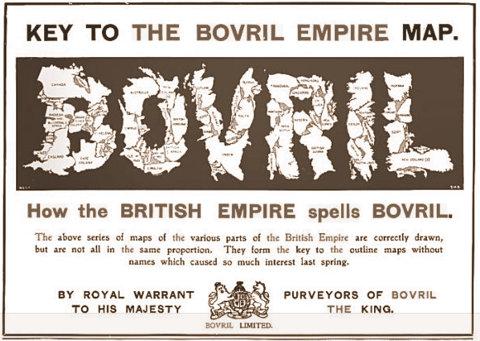
Inevitably, the power of beef came to be seen as underpinning the expanding British Empire. To mark the coronation of Edward VII, the major British weekly TheIllustrated London News ran an advertisement on February 2, 1902. Titled “How the British Empire Spells Bovril,” it illustrated “the close association of this Imperial British Nourishment with the whole of King Edward’s Dominions at Home and Beyond the Seas” by fitting the national outlines (reduced or expanded as necessary) into the letters of the word Bovril.
Bovril advertisement in The Illustrated London News, February 2, 1902. Courtesy of Rachel Laudan.
Today, although English soccer fans still take hot Bovril broth to games, the idea that it is nourishment for Empire builders is long gone. And even McDonald’s is not the power it was a decade ago. Consumers go instead to Chipotle, Panera, and Starbucks, which offer the promise of healthier, tastier, less mass-market foods. Is this the end of empire? Or a change of direction?
The New York Academy of Medicine’s Section on the History of Medicine and Public Health invites you to join us for “History of Medicine Night: 19th and 20th Century Stories” on May 6, 2015 from 6:00pm–7:30 pm at the Academy, 1216 Fifth Avenue at the corner of 103rd Street. Admission is free but advanced registration is required. Register online. Presenters will address historical topics relating to medicine with a focus on the 19th and 20th centuries. The evening’s presenters will be:
Constance E. Putnam, PhD
Independent Scholar (Medical Historian)
“Semmelweis Revisited”
Devon Santoro
Health Advocacy Program, M.A. expected 2016
Sarah Lawrence College
“Puffing and Passing Legislation: The History of Marijuana and Its Place in Society”
Jane Himmel
Health Advocacy Program, M.A. expected May 2016
Sarah Lawrence College
“Medical School Discrimination: Advocacy In A Postwar World”
Georgia Gaveras, DO
Director of Training and Education in Child and Adolescent Psychiatry
Director of the Child and Adolescent Psychiatry Consultation Liaison Service
Department of Psychiatry
Mount Sinai Health System
“Art of Medicine – Medicine in Art”
Natalie Taylor
Health Advocacy Program, M.A. expected May 2016
Sarah Lawrence College
“The Unequal Burden of Censorship: Classism in the Wake of the Comstock Law”
Karen G. Langer, PhD
Clinical Associate Professor of Rehabilitation Medicine
NYU Langone Medical Center
“Fixation Found: On the Process of Anchoring Impressions into Memory”
We are thrilled to introduce a new pilot program, the Reciprocal Library Snack Cooperative, or Interlibrary Snacking, to go along with this theme. Our library boasts more than 10,000 volumes relating to food and cookery. For this new program, library staff will prepare recipes from the collection and send them to requesting libraries, who will in turn offer prepared recipes from their collections. All service providers will undergo thorough food safety training. In addition to white cotton gloves, cookbook users will receive hairnets.
Library snacks will focus on locally sourced, sustainable items. We are building a bespoke refrigeration unit based on the 1890 volume Mechanical Refrigeration and are taking into consideration cold storage advice from Into the Freezer—And Out (1946).
We are building a refrigeration unit, scheduled for completion in September 2016, based on this illustration from Mechanical Refrigeration.
The plan for our cold storage organization closely adheres to that shown in Into the Freezer—And Out.
Men Like Meat, an undated pamphlet from the American Can Company. Disclaimer on back cover: “We manufacture cans – we do no canning.”
Before we tackle perishables, however, our focus will be on more shelf-stable foodstuff. Our collection includes a selection of items on canning, preserves, canned meats, food drying and dehydration, and other expiration-extending technologies.
The practice of developing new technologies to enable the safe transportation of food from one place to the next is an old story. As early as the 1850s, commercially canned goods—especially sardines, tomatoes, condensed milk, and fruits and vegetables—found an eager consumer audience in the Western United States. Cowboys bought oysters from Baltimore and canned tomatoes in bulk. In the early 20th century, canning facilitated the introduction of regional fruits like the California fig and the pineapple nationwide. Coast to coast, commercial canning introduced Americans to new foods, but often at the expense of freshness and taste.1
After the 1930s, supermarket foods were increasingly packaged: boxed, frozen, canned, dried, bottled, or combined in ready-to-eat forms. Advertisers marketed these in bright colors with catchy names that increased sales and added preservatives to ensure a longer-shelf life. Convenience usually trumped taste, and boredom at the family dinner table led many families increasingly to dine out.1
Our aim will be to use technologies like canning to enhance flavor. Along with the Reciprocal Library Snack Cooperative’s mission to include local, sustainable foods, we will also embrace more traditional methods of preservation. Goodbye chemical preservatives, hello pickling! Here is an example of a recipe currently in the works.
In addition, our program will have a secondary focus on recipes featuring new cooking technologies at the time of their publication. We have already had the soft-launch of the program: Our first item sent was inspired by this recipe from 1911.
The first recipe successfully made and sent as part of the Reciprocal Library Snack Cooperative.2
Want to know more about food history? Attend our Eating Through Time programming.
Reference
1. Hooker RJ. Food and drink in America: A history. Indianapolis: Bobbs-Merrill; 1981.
2. Special thanks to Juan at Sterling Affair for preparing historically accurate toast.
Evelyn J. Kim, today’s guest blogger, is an author and writer working on issues of food and food justice through the lens of science. Trained as a historian of science, her work has been in the The New York Times, Scientific American, and The Atlantic. She is our guest curator for this year’s programming, Eating Through Time.
Les Aphorismes de Brillat-Savarin. From the Margaret Barclay Wilson Collection.
“Dis-moi ce que tu manges, je te dirai ce que tu es” (Tell me what you eat, and I will tell you what you are)
– Jean Anthelme Brillat-Savarin (1755-1826), Physiologie du Goût ou: Méditations de Gastronomie Transcendante
“Let food be your medicine and medicine be your food” – Attributed to Hippocrates
What do you do every day, beyond sleeping, breathing and thinking? You eat! This year, The New York Academy of Medicine is proud to announce its programming theme for 2015: Eating Through Time.
Top Chef. The Salt. Lucky Peach. Grub Street. Modernist Cuisine. And thousands upon thousands of food blogs. Unless you’ve been living underneath a rock, food seems to be all around us. On television, on the web, in art, in books, in science…Food seems to be having its own “moment” as form of cultural currency. But lest anyone think that this is a new phenomenon, food has always been with us, from pre-history to the present, a basis of our bodily, social, economic, and historical selves.
To that end, we are sponsoring a whole year of activities around food, including guest lectures at the Academy and panel discussions at this year’s Food Book Fair, culminating in a full-day festival at the Academy on October 17, 2015. Based on the Academy’s collection of more than 10,000 volumes on food and health, the festival will include speakers, demonstrations, and performances centered on the topic of food. Featured speakers include our keynote speaker, famed chef Jacques Pépin, food historian Dr. Ken Albala, and Nordic Food Lab’s Joshua Evans, as well as the Culinary Institute of America and Harvard School of Public Health’s Healthy Kitchens, Healthy Lives program.
This year’s programming will encompass not only contemporary debates surrounding food, medicine, and culture, but also the historical linkages that undergird much of those discussions. We will ask chefs, historians, writers, and public health experts their perspectives on not only food’s past influence but also what’s in store in the future for us as eaters and as a society.
To kick off this year’s programming, our inaugural lecture on March 17 will feature historian of science Dr. Steven Shapin from Harvard University. Dr. Shapin has written on several topics, from Dr. Robert Boyle to the role of business in scientific research, and his current interests lie in the history of dietetics. His lecture, entitled “Beef-Eaters: A Cultural History of Food and Identity” exemplifies the complicated nexus between our dietary habits and our social identities—and is a perfect start to this year’s theme.
We’re excited about this year’s programming and we hope to see you at any or all our events. Visit www.nyam.org/events for event details and registration, and follow this blog for more delicious tidbits on our year in food.
We are excited to announce the re-launch of our Friends of the Rare Book Room program, with new Friends levels and benefits bringing you access to more events and opportunities for engagement with our world-renowned collections. Our rare book room is home to some of our rarest and most significant holdings, forming the heart of our collections. You can make an appointment to visit the rare book room by e-mailing history@nyam.org or calling 212-822-7313.
By becoming a Friend of the Rare Book Room you’ll support our mission of preserving and promoting the heritage of medicine and health though our public programs and outreach activities; the acquisition, conservation, and cataloging of remarkable historical materials; and digitization of our key treasures. And you’ll join an engaged group of supporters, passionate about preserving our collections.
We’ll be announcing exciting new additions to our programming throughout the year, including special Friends events. In the meantime, please save the date for the March 31 and April 14:
On March 31 we will welcome Dr. Vivian Nutton, Professor Emeritus of the History of Medicine at University College, London, who will speak on “Vesalius Correcting Vesalius.”
Friends’ contributions make a huge difference to us, allowing us to better care for our collections and make them as widely accessible as possible to everyone who wishes to use them. Please consider supporting our efforts!
The New York Academy of Medicine’s Section on History of Medicine will hold the “Fifth Annual History of Medicine Night: Insights from the Early Modern Period” on March 11 from 6:00 pm–7:30 pm at NYAM, 1216 Fifth Avenue at the corner of 103rd Street. Register to attend here. Presenters will address historical topics relating to medicine with a focus on the Early Modern period. This year’s presenters are:
Barbara Chubak, MD
Urology Resident (PGY-5), Montefiore Medical Center “Imagining Sex Change in Early Modern Europe”
Jeffrey M. Levine, MD
Assistant Clinical Professor of Medicine and Palliative Care
Icahn School of Medicine at Mount Sinai “A Fresh Look at the Historiated Initials in the De Humani Corporis Fabrica”
John E. Jacoby, MD, MPH
Assistant Clinical Professor of Medicine and Pediatrics
Icahn School of Medicine at Mount Sinai “On the Life of Dr. Robert Levett: The Philosophy of Primary Care”
Nina Samuel, PhD
Center for Literary and Cultural Research
University of Berlin “The Art of Hand Surgery”
Michelle Laughran, PhD
Associate Professor of History
Saint Joseph’s College of Maine “The Medical Renaissance among Three Plagues: Epidemic Disease, Heresy and Calumny in Sixteenth-Century Venice”
Sharon Packer, MD
Assistant Clinical Professor of Psychiatry and Behavioral Sciences
Icahn School of Medicine at Mount Sinai “Epidemic Ergotism, Medieval Mysticism & Future Trends in Palliative Care”
Part two of this lecture series, “History of Medicine Night: 19th– and 20th-Century Stories,” will take place on May 6, 2015.

 Every year, our public programs explore a different aspect of our collections, culminating with an all-day Festival. This year’s Festival on October 17 is the highlight of our 2015 Eating Through Time: Food, Health and History celebration of food, cookery, and health.










 Books, Health and History
