Music as a Means of Discipline

By Johanna Goldberg, Information Services Librarian

This is one of several posts leading up to our day-long Performing Medicine Festival on April 5, 2014, which will explore the interrelationships of medicine, health, and the performing arts. Register for the festival here.

From van de Wall, W. (1924). The utilization of music in prisons and mental hospitals, its application in the treatment and care of the morally and mentally afflicted. New York: Published for the Committee for the Study of Music in Institutions by the National Bureau for the Advancement of Music.

Willem van de Wall.2

In the 1920s, Willem van de Wall, a Dutch-born professional harpist and choral director, began promoting the therapeutic use of music in prisons, hospitals, and other institutions.1

In the pamphlet “Music as a Means of Discipline,” van de Wall discussed his successes in prisons, along with this caution:

Never forget that the use of music as an energy awakener call of earnest deliberation, besides psychological and musical insight. If applied indiscriminately it might cause the boiling over of seething temperaments and create havoc through conjuring individual and social crises. If utilized sagaciously, however, it will soothe and transform the lower emotional trends into currents of loftier endeavor and expression.3

Van de Wall carefully chose well-known folk and traditional tunes (including “The Star-Spangled Banner,” “Stars of the Summer Night,” “A Perfect Day,” and “The Missouri Waltz”), sang them with groups of prisoners, and discussed the texts “for teachings about socially ethical principles.” And he clearly laid out the limitations of his work: “Can music do it all? No. Can it do a part? Yes. What part? That of inspiring, starting and supporting.”3

As described by van de Wall, the results were often astonishing. In terms of individual inmates, “Many a detained soul confessed to me that our weekly choral group was the first constructive affair in which he had participated since school days.”3 And at the institutional level:

I go to a penal institution where it would be absolute folly to bring the entire population together for any other group expression than community singing. One song of thirty-two bars of music lasting one minute and a half accomplishes more than all the keepers and matrons and disciplinarians and all the other ‘arians’ together.3

phonographdemo

“Group from the extra-recalcitrant, psychopaths, and borderline criminal insane listening to a phonograph demonstration to correct singing methods.”2 Click to enlarge.

Later in his career, van de Wall shifted his focus to music therapy with a broader audience, including those without special behavioral or physical needs.1 As he wrote:

“Music is a great unseen friend accompanying us from our cradle to our grave, always expressing for us, caressing us with, our dearest emotions of life.”3

References

1. Clair, A. A., & Heller, G. N. (1989). Willem van de Wall: Organizer and innovator in music education and music therapy. Journal of Research in Music Education, 37(3), 165–178. doi:10.2307/3344667

2. Van de Wall, W. (1924). The utilization of music in prisons and mental hospitals, its application in the treatment and care of the morally and mentally afflicted. New York: Published for the Committee for the Study of Music in Institutions by the National Bureau for the Advancement of Music.

3. Van de Wall, W. (192?). Music as a means of discipline. Reprinted from the Proceedings of the 53rd Annual Congress of the American Prison Association.

Author’s Night – The AIDS Generation: Stories of Survival and Resilience

Perry N. HalkitisPlease join us on Wednesday, March 19 at 6 pm to hear NYAM Fellow Perry N. Halkitis, PhD, MS, MPH, discuss his latest book, The AIDS Generation: Stories of Survival and Resilience. The book has just been named a finalist for a 2014 Lamda Literary Award in the biography/memoir category. To RSVP, e-mail Donna Fingerhut.

Dr. Halkitis had several motivations for writing this book, as he explains:

First, I wanted to create a historical document of the unique experiences that these men—the men of the AIDS Generation—lived through—people who lived through the darkest moments of the epidemic in the first two decades of AIDS. Second, I wanted to demonstrate the resilience of my generation of gay men and move away from research that is based on deficit models that are too often evident in the literature.  In fact, somehow the men of the AIDS Generation survived and thrived. It would be simple to say it was pure luck that they remained healthy long enough for the development of antiviral therapies. But I believe what I learned from these stories is that there is something greater at work here. These men were able to attend and care for the whole selves—social, biological, and emotional selves—which empowered them to get through to 1996, the turning point of the epidemic, and which is demonstrative of resilience and not deficit. Third, the way that the men of the AIDS Generation managed the disease helps to inform how we can work with all people who are living with HIV and other people living with challenging chronic diseases.

Dr. Halkitis is professor of applied psychology and public health and population health (Steinhardt School and Langone School of Medicine), director of the Center for Health, Identity, Behavior & Prevention Studies, and associate dean for academic affairs (Global Institute of Public Health) at New York University. He is also an affiliate of NYU’s Center for AIDS Research and Center for Drug Use and HIV Research. Dr. Halkitis has conducted HIV behavior research for the last 20 years, examining HIV in relation to other health problems.

Item of the Month: Jacques Gamelin’s Nouveau recueil d’osteologie et de myologie

By Lisa O’Sullivan, Director, Center for the History of Medicine and Public Health

This is one of several posts leading up to our day-long Performing Medicine Festival on April 5, 2014, which will explore the interrelationships of medicine, health, and the performing arts. Register for the festival here.

Skeleton Musicians from Jacques Gamelin

O Quanto ci deve dare pensiere (O, how it should give us thought). Table 5. Click to enlarge.

The musical skeletons featured in our Performing Medicine design look cheerful enough. However, the text beneath the flautist’s feet, “O Quanto ci deve dare pensiere,” or “O, how it should give us thought,” makes it clear that they are a memento mori, reminding viewers of the inevitability of death. The skeletons come from Jacques Gamelin‘s Nouveau recueil d’osteologie et de myologie (A New Collection of Bones and Muscles, Drawn from Life).

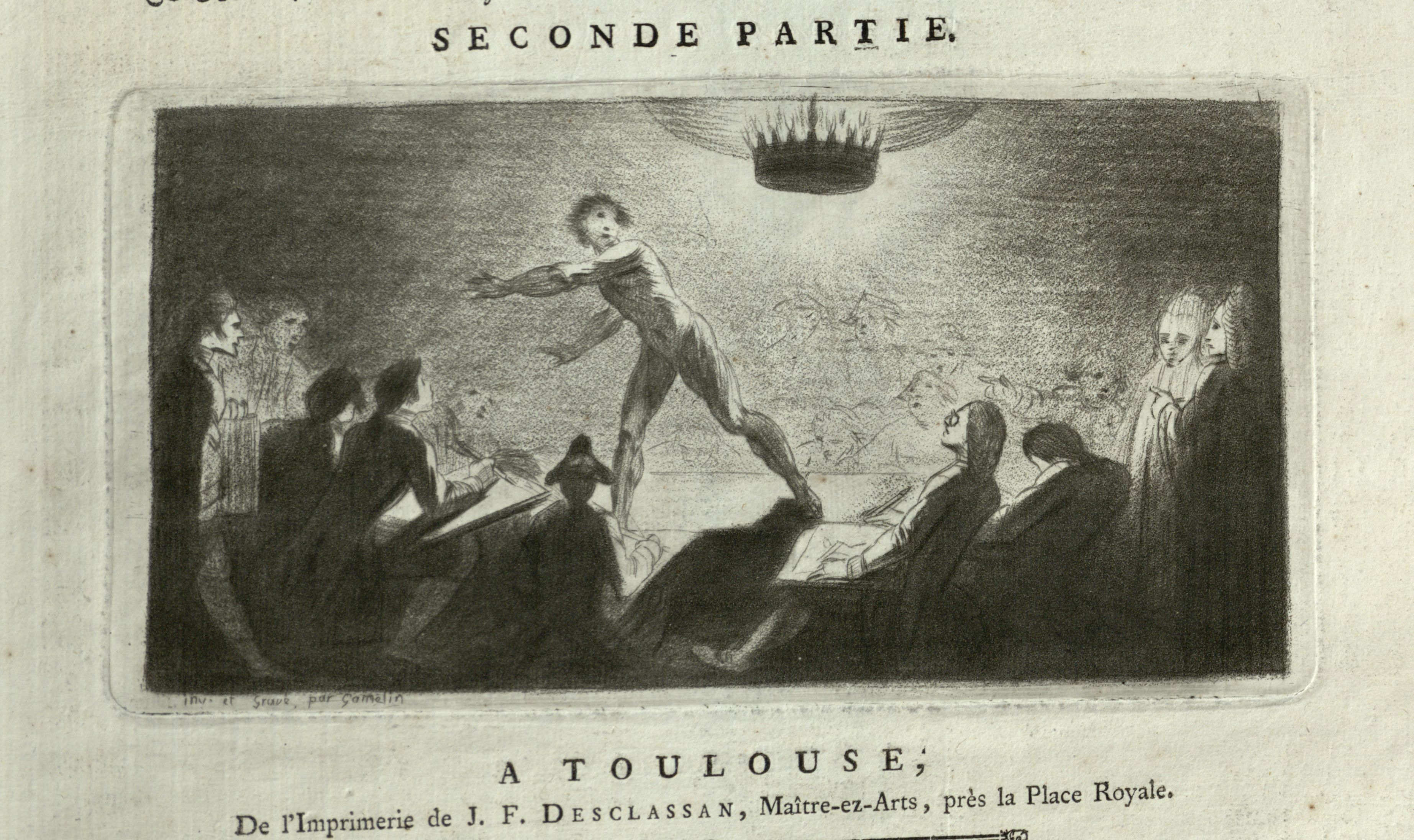
Artists studying anatomy, title page, v.2.

Artists studying anatomy, title page, v.2. Click to enlarge.

The Nouveau recueil d’osteologie et de myologie is an opulent and eccentric work, published in Toulouse in 1779 and paid for with financing from Gamelin’s patron, Baron de Puymaurin, and an inheritance from Gamelin’s father. The volume’s 41 full-page engraved plates and ten etchings are by turns witty and fantastical while maintaining a high level of accuracy and anatomical detail. Jacques Gamelin trained as a painter and engraver and designed the work to be of use to artists as well as anatomy students. The first section of the book is dedicated to bones, the second to muscles, and throughout the book allegorical scenes and tableaux highlight warfare, battles, and death.

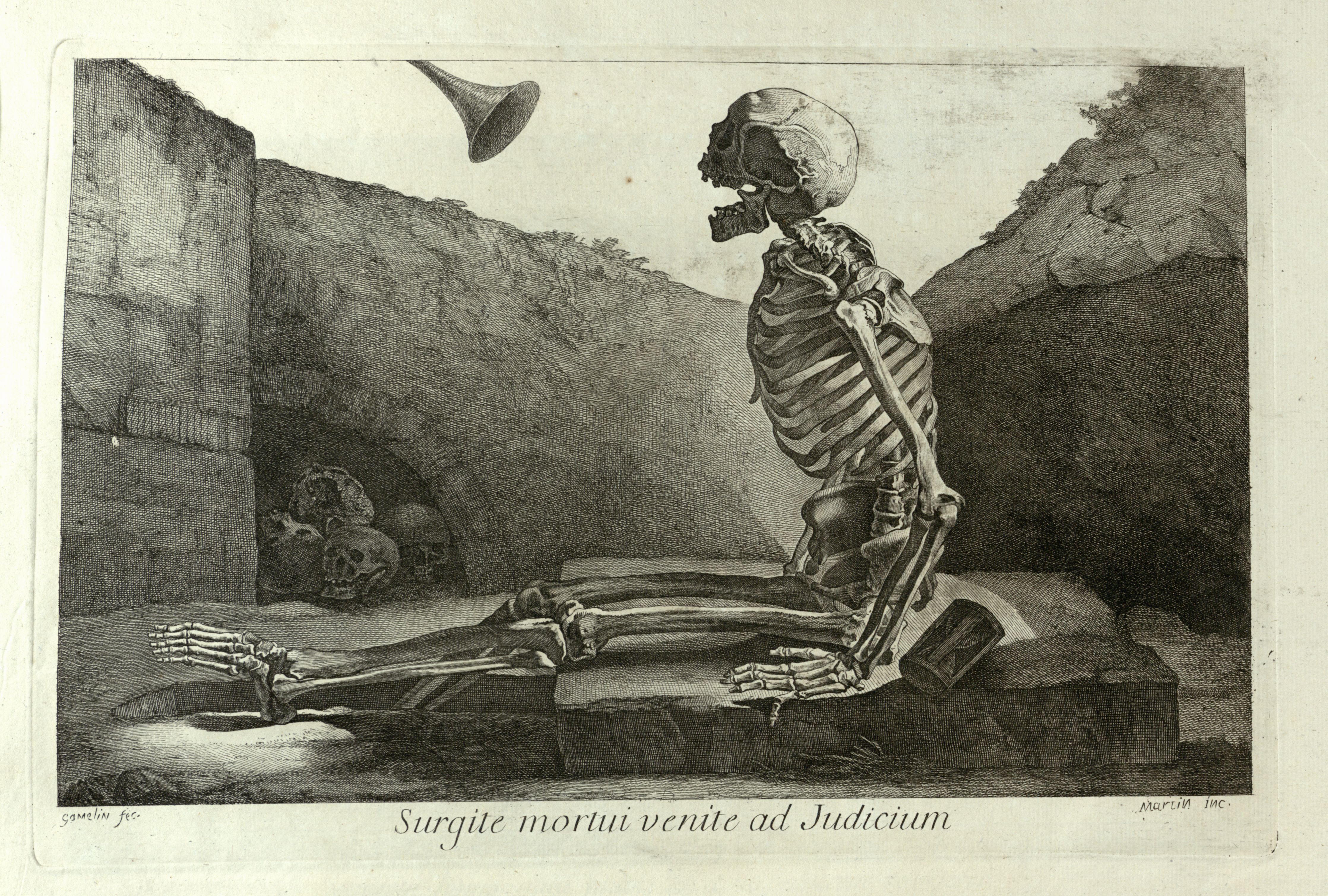
Local authorities in Toulouse gave Gamelin access to the corpses of executed criminals, and he produced sketches based on his dissections. He then worked with two engravers, Jacques Lavalée and an artist known only as Martin, to produce prints from these drawings (“Lavalée Inc. 1778” and “Gamelin fec.” (Gamelin fec[it] – or Gamelin made it) are both found on the musical skeleton image). Production of the 200 copies of the volume, which took two years, bankrupted Gamelin, and many copies were subsequently pulped.

Skeleton figure responding to Trumpet call on day of resurrection

Surgite mortui, et venite ad judicium (Arise, ye dead, and come to the judgment). Table 6. Click to enlarge.

Find more information at Gamelin’s Marauding Skeletons and Écorché Crucifixions and Princeton’s Graphic Arts blog. More images from the book can be found on the National Library for Medicine’s Historical Anatomies on the Web.

Announcing Our Performing Medicine Festival

Header for Performing Medicine FestivalJoin us on April 5, 2014 to explore the interrelationships of medicine, health, and the performing arts with a day-long festival of actors, dancers, doctors, and musicians. Register here.

Performers will include Dr. Richard Kogan on the mental life of famous composers; Brian Lobel and his comedic adventures as a cancer patient; David Leventhal and Pamela Quinn on dance and Parkinson’s disease with DANCE FOR PD® from Mark Morris Dance Group/Brooklyn Parkinson Group; the medical musicians of Mount Sinai on the art of listening; with discussions, musical interludes from Weill Cornell’s Music and Medicine Initiative, and more.

Throughout the day there will be guided behind-the-scenes tours of our Coller Rare Book Reading Room and and Gladys Brooks Book & Paper Conservation Laboratory. Spaces are limited to 20 people per tour; make sure to get your tickets early!

This will be the first of two festivals in 2014 exploring the connections between medicine, health, and the performing and visual arts. In the fall our main festival, Vesalius 500: Art and the Body, will celebrate the 500th anniversary of the birth of Andreas Vesalius and the impact of his De Humani Corporis Fabrica or The Fabric of the Human Body. Like our 2013 Festival, the day will feature multiple strands of programs, performances, workshops and interactive events.

History Night Presentations Announced

The New York Academy of Medicine’s Section on History of Medicine will hold the “Fourth Annual History of Medicine Night – Part One: Spotlight on New York” on February 6 from 6:00 pm–7:30 pm at NYAM, 1216 Fifth Avenue at the corner of 103rd Street. Register to attend here. A second evening of presentations is being planned for spring.

RBR deskThe night will feature the following presentations, as described by the speakers:

“Psychiatric Criminology in the Eugenic Era: The New York Police Psychopathic Laboratory, 1915-1929”
Sara Bergstresser, M.P.H., Ph.D., Columbia University, Bioethics

“First, I explore the historical background of North American and European psychiatry, criminology, and eugenics in the nineteenth century, including threads of early convergence. Next, I examine the development of eugenic psychiatry and its intersections with eugenic criminology, with a particular emphasis on New York State in the early twentieth century. I then present a case study from that time period, which is based primarily on materials from the archives of the New York Police Psychopathic Laboratory. I go on to argue that in this case the workings of psychiatric criminology were more eclectic and uncertain than they may otherwise appear based on broad descriptions of the eugenic era.”

“Not for Self but Others: The Presbyterian Hospital Goes to War”
Pascal J. de Caprariis, M.D., Lutheran Medical Center

“On March 11, 1940 the U.S. Surgeon General reached out to Presbyterian Hospital’s medical board president to develop a military hospital to support US troops in an eventual war. Structured to receive patients from combat areas and follow American troops throughout war, it was to provide complex medical and surgical care over the course of three years and two months abroad.”

“The Cancer Education Campaigns in Progressive Era New York City: The Role of Women”
Elaine Schattner, M.A., M.D., F.A.C.P., Weill Cornell Medical College

“At the start of the 20th century, myths about cancer’s causes and treatments were widespread. Fear of the disease—and of inept surgeons—was rampant. Many afflicted fell prey to hoaxers selling bogus salves, patent medicines and painless “cures.” In April 1913, a prominent New York City surgeon and gynecologist, Dr. Clement Cleveland, invited a group of well-to-do ladies, bankers and physicians to his home. They heard from statisticians and public health specialists, and considered what might be done to reduce cancer’s mounting toll. The group met formally again in June 1913 at the Harvard Club in New York City. They formed the American Society for the Control of Cancer (ASCC), which three decades later became the American Cancer Society.”

“A Diagnosis of Philanthropy: Carnegie and Rockefeller and the Medical Profession”
Catherine (Katia) Sokoloff, Sarah Lawrence College

“Through exploring the evolving interests of Andrew Carnegie and John D. Rockefeller during the Progressive Era, this paper unearths how these philanthropists and their advisers facilitated and funded the writing of the infamous Flexner Report in 1910. The report, also called Bulletin Number Four, exposed the inadequacies of medical schools and catalyzed dramatic education reforms.”

“Organizing Orthopaedic Societies in New York City in the 1880s: The New York Orthopaedic Society, the New York Academy of Medicine Section of Orthopaedic Surgery and the American Orthopaedic Association”
Jonathan B. Ticker, M.D., College of Physicians and Surgeons, Columbia University

“After the seventh general meeting of the New York Orthopaedic Society (NYOS) on January 4, 1886, steps were taken to merge NYOS into a section of the New York Academy of Medicine (NYAM). Thus, on January 29, 1886, NYOS adjourned and the NYAM Section of Orthopaedic Surgery began. On January 29th, 1887, the chairman of the Section and 15 others “[met] and [discussed] the organization of a national orthopaedic society.” This led to the founding of the American Orthopaedic Association (AOA).”

History Night: Call for Papers

RBR desk

The New York Academy of Medicine’s Section on History of Medicine is pleased to announce its Annual History of Medicine night to be held on February 6, 2014 from 6:00 pm–7:30 pm. The event will take place at the Academy, located at 1216 Fifth Avenue at the corner of 103rd Street.

We are inviting all those interested in presenting to submit a narrative on a historical subject relating to medicine for consideration.

Note the following submission requirements:

  • Applications must include an abstract, with a  500-word maximum, and this form
  • Abstracts must be submitted no later than January 15, 2014

The time allotted for presentation is 12 minutes with an additional 3 minutes for questions/discussion. Papers selected for presentation will be determined by a panel of History of Medicine Section members.

Abstracts should be submitted electronically to Donna Fingerhut at dfingerhut@nyam.org.  Questions may be directed to Donna via email or phone (212-419-3645).

Holiday News from the Center

NYAM Library, Rare Book Room photos by Amy Hart © 2012As the year comes to an end, there is a lot going at the Center for the History of Medicine and Public Health.

♦ We are planning our 2014 Festivals (there will be two! Save the date for the first on April 5. Keep an eye out for details coming early next year).

♦ On December 4, we will welcome a number of influential librarians to an informal roundtable to discuss the impact of open access publishing for libraries, researchers, and users. Simon Chaplin, Head of the London Wellcome library, will take part in this discussion, and in the evening present a lecture on the (often eccentric) history of medical tourism. Both events are free but require pre-registration (follow the links to register).

♦ For those in the scholarly world, details of our two research fellowships have just gone live:

  • The Paul Klemperer Fellowship supports research using our collections for the history of medicine. Find out more here.
  • The Audrey and William H. Helfand Fellowship supports work in the history of medicine and public health, with a particular focus on the use of visual materials. More details here.

Applications close March 4, 2014 for the 20142015 academic year. We encourage applicants to get in touch with our Reference Librarian for Historical Collections when shaping their applications.

♦ We are accepting applications for the 2014 Gladys Brooks Book and Paper Conservation Internship now through December 15, 2013. For more information about eligibility, click here.

♦ The Center is growing! We are looking for a curator to join the team to help us develop our scholarly and public presence through exhibitions, programming, and collection development. For more details see the job description here.

♦ The library closes early today, November 27, and will be closed on Thursday and Friday, November 28 and 29. We will also be closed on December 24 and 25.

Congratulations, Captioners!

At our Festival of Medical History and the Arts on October 5, we asked attendees to submit captions for three images from items in our collection. Today, we’re happy to announce the winners of the competition, who will receive high-quality prints of the captioned image. We’ve included original captions with the images, where available, to help show how they appear in context (although the Festival attendees did not get to see them).

The first image comes from William Cheselden’s Osteographia, or The Anatomy of the Bones, published in London in 1733. Linda Kleinman wrote the winning caption.

“I’ve had enough of your lip!”

I’ve had enough of your lip!

The second image appears in Konrad Gesner’s Historiae Animalium Liber IIII, published in Zurich in 1558. Samuel Luterbacher wrote the winning caption.

“I knew I should have never trusted Dr. Moreau.”

I knew I should have never trusted Dr. Moreau.

The final image, produced by Egbert van Heemskerck II circa 1730, appears in the George Osborne Mitchell Medical Scrapbook. This picture inspired the strongest pool of captions. But Iana Dikidjieva’s caption stood out from the pack.

“It appears to have been curiosity.”

“It appears to have been curiosity.”

Congratulations to the winners!

“A Passionate Statistician”: Florence Nightingale and the Numbers Game

In conjunction with its exhibit, “Extraordinary Women in Science & Medicine: Four Centuries of Achievement,” the Grolier Club is holding a symposium on October 26, 2013, to which all are welcome. The exhibition and symposium explore the contributions of 32 women, one being Florence Nightingale, to science and medicine. The exhibition features NYAM’s copy of one of Nightingale’s statistical charts. In today’s blog post, Natasha McEnroe, director of London’s Florence Nightingale Museum, explains their significance.

Florence Nightingale. Reproduced by courtesy of the Florence Nightingale Museum.

Florence Nightingale. Reproduced by courtesy of the Florence Nightingale Museum.

The Victorians loved nothing better than to measure and classify, trying to discover natural laws through the data they recorded, and Florence Nightingale (1820-1910) was no exception in sharing this general enthusiasm. Having gained celebrity status from her nursing work at the infamous Barracks Hospital at Scutari, the British base hospital in the Crimean War (1853-1856), Nightingale returned to England with her health permanently broken down. Determined that the appalling treatment of the soldiers during the war should not be repeated, she spent the rest of her life conducting a political campaign for health reform from her bedroom. One of the ways her campaigning was groundbreaking was in the use of statistics.

Reproduced by courtesy of the Florence Nightingale Museum.

St Thomas’ Hospital, London, home of the Nightingale Training School for nurses. Reproduced courtesy of the Florence Nightingale Museum.

Nightingale’s love of mathematics was apparent from an early age and was an interest  encouraged by her father, who took the responsibility of educating his daughters into his own hands. Her parents’ social circle brought the young Nightingale into contact with many of the most brilliant minds of the age, including Charles Babbage, whose own passion for numbers (and not a little pedantry) is shown in a letter to Alfred Tennyson in response to the poem The Vision of Sin:

‘In your otherwise beautiful poem, one verse reads,
Every moment dies a man,
Every moment one is born.

…If this were true, the population of the world would be at a standstill. In truth, the rate of birth is slightly in excess of that of death. I would suggest that the next version of your poem should read:
Every moment dies a man,
Every moment 1 1/16 is born.
Strictly speaking, the actual figure is so long I cannot get it into a line, but I believe the figure 1 1/16 will be sufficiently accurate for poetry.’

Just weeks after her return from the Crimean War in 1856, Nightingale secured a Royal Commission from Queen Victoria investigating the health of the British Army. Nightingale herself was involved in every step of the Commission’s investigations, working with the statistician William Farr to illustrate graphically that more British troops died of disease during the war than in battle. Farr encouraged Nightingale to compare statistics on mortality rates of civilians with that of soldiers, showing that whether at war or at home, soldiers demonstrated a higher mortality rate.  He wrote to Nightingale, “This I know…Numbers teach us whether the world is ill or well governed.”  Nightingale pioneered what is now called evidence-based healthcare and in 1858 she was the first woman elected to the Royal Statistical Society.

Chart from Florence Nightingale’s A contribution to the sanitary history of the British army during the late war with Russia (London, 1859)

Chart from NYAM’s copy of Florence Nightingale’s A contribution to the sanitary history of the British army during the late war with Russia (London, 1859).

A devout woman, Nightingale saw statistics as having a spiritual aspect as well as being the most important science, and believed statistics helped us to understand God’s word. Influenced by the ethos of Victorian vital statistics, her greatest legacy can be seen in improved public health, reformed nursing education, and in her innovative polar area graphs and other work in statistics. In Nightingale, this most eminent of Victorians, we can see the combination of the two great passions of her age—a compulsion to classify and a desire to improve by reform. What made Nightingale remarkable were the personal qualities of fierce intelligence and energy that enabled her to pursue these passions with the immense determination for which she was famed.

Shadow Journals: The Story of Medical Advertising (Part 3 of 3)

Today we have the third and final part of a guest post written by David Herzberg, Ph.D., who will present “The Other Drug War: Prescription Drug Abuse and Race in 20th-Century America” on Tuesday, October 22. Read part one here and part two here.

We don’t have a definitive history of medical advertising (dissertators, take note!). In fact, the world of medicine barely appears in the standard histories of advertising beyond 19th-century patent medicines. We know all about the key campaigns that transformed the wider advertising industry: Uneeda Biscuit and Oleo margarine in the Progressive Era, Wonder Bread and Dwight Eisenhower in the 1950s, the Volkswagon Beetle in the 1960s, and so forth. The annals of medical advertising begin promisingly with a chapter on patent medicines but then basically peter out.

"The obvious anxieties that preoccupy many middle-aged minds often obscure a coexisting depression." From JAMA, volume 209, number 1 (September 22, 1969). Click to enlarge

“The obvious anxieties that preoccupy many middle-aged minds often obscure a coexisting depression.” From JAMA, volume 209, number 1 (September 22, 1969). Click to enlarge.

Obviously any such history would need to be based, in part, on the records of a medical advertising company or the in-house marketing arm of a pharmaceutical company. But they also require access to the advertisements themselves, in the context in which they appeared—i.e., among other places, in medical journals.

It’s not just historians of medical marketing who need the advertisements. Anyone interested in the history of medicine, or of medicine’s relationship to society at large, should care about them. The ads and the articles talked to each other, either through their joint acceptance of larger cultural beliefs or through vigorous debate when professional and profit-seeking agendas clashed. Advertisements also provide a bridge to connect such medical histories to broader developments, via the same links that contemporaries deplored. “They sell medicine like soap!” raged witnesses before Congress in the 1950s, believing that this was argument enough to win the day. This same observation, less polemically framed, might tell us as much about soap and the consumer culture as it does about medicine.

"In many cases the result of 'empty-nest snydrome.' From JAMA, volume 232, number 2 (April 14, 1975). Click to enlarge.

“In many cases the result of ’empty-nest syndrome.'” From JAMA, volume 232, number 2 (April 14, 1975). Click to enlarge.

This is why it was a historic mistake to cut out the ads. And it’s a mistake that we may still be making: today’s online databases offer a la carte articles without the surrounding advertisements, nearby articles, particular layouts, cartoons, etc. (Medical journals used to have cartoon pages; editorial policy apparently insisted that these mostly be nasty pokes at women patients. These pages, too, were often sliced out by well-meaning librarians.)

As I noted before, the New York Academy of Medicine was the only library I have found that did not cut out the advertisements. And even there policy changed for a while in the 1970s. I still don’t know why they had the prescience to spare the advertisements, but we are lucky that they did. It makes for a precious collection that is unlikely to be made obsolete in the digital era.