From Central Park to the Front Lines: Frederick Law Olmsted and the Sanitary Commission

By Paul Theerman, Associate Director, Center for the History of Medicine and Public Health

We are fortunate at the Academy to look out over Central Park—one of the jewels of the city of New York. The park got its start in the 1850s, and took shape due to the visionary efforts of two men, landscape architects Calvert Vaux and Frederick Law Olmsted (1822–1903). In the 1860s Olmsted—whose birthday we celebrate today—was instrumental in one of the great medical and public health efforts of the 19th century: the organization of relief to Union soldiers in the Civil War. As executive secretary of the U.S. Sanitary Commission, he coordinated voluntary efforts to support the Army’s medical department in the war effort.1

Olmsted was a restless person, continually trying on new roles. He first made his mark in journalism, publishing his observations of life in the South after three tours through the region in 1850s.2 He offered a scathing depiction of slavery, the resistance of southern society to change, and the degrading effects of the institution on society as a whole. Olmsted became an abolitionist when that was still a minority position, and a reformer throughout his life.

At the outbreak of the Civil War, Olmsted’s superintendence of the Central Park project was limited due to disputes with the city, and he contacted Henry W. Bellows, a New York Unitarian minister, for help in securing a position. Bellows drafted him to head up, as executive secretary, a newly chartered private institution, the U.S. Sanitary Commission, of which Bellows was a founding Commissioner. Broadly modeled on the British example in the Crimean War, the Sanitary Commission addressed two persistent needs in the delivery of medical services in wartime. The first was that the standing army of the United States was relatively minuscule, and its medical department equally so. At the outbreak of the war, the army had some 16,000 men at arms, a portion of whom defected to the Southern cause. Through volunteers and conscription, the number of men serving eventually reached 2.5 million over the four years of the war, with perhaps half a million in uniform at the height of the conflict. As the volunteer army geared up so did the medical corps, but by any measure the medical service of the army was largely inadequate for the task.

And the medicine of the army seemed inadequate as well. The Sanitary Commission as he organized it had a paid professional staff and a corps of medical inspectors to review military camp conditions and advise military physicians. The inspectors also relayed requests for supplies back to the Commission’s offices in Washington, where central office staff would work to fill requests from donations.

Olmsted also lobbied to induce Congress and Cabinet officials for assistance through reformed laws and sympathetic appointments. He put his work into the overall context of reform for the good of the nation: “service on the Commission was part of his patriotic duty. It would strengthen the fighting power of the nation by assuring the health of the soldiers and by making the best use of goods and money contributed by the public.”3
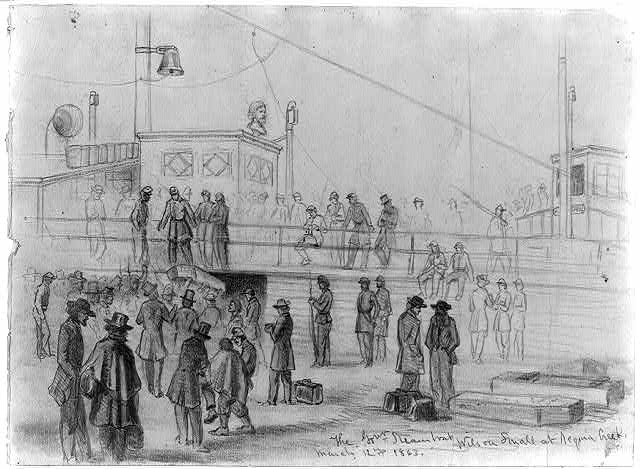
“The Sanitary Commission used the side-wheel steamboat Wilson Small as its headquarters for much of the Peninsula campaign.” Olmsted Papers, 4:331, n1. This drawing, from the collections of the Library of Congress, portrays the ship at harbor in Aquia Creek, Virginia, March 12, 1863.

“The Sanitary Commission used the side-wheel steamboat Wilson Small as its headquarters for much of the Peninsula campaign.” Olmsted Papers, 4:331, n1. This drawing, from the collections of the Library of Congress, portrays the ship at harbor in Aquia Creek, Virginia, March 12, 1863.

Though Olmsted thought his service—and the war for that matter—would last a matter of weeks, it did not. Several times he was called to the field. During the series of battles that constituted the Peninsula Campaign—Union General George B. McClellan facing Confederate General Joseph E. Johnston in the spring and summer of 1862—Olmsted found himself organizing the evacuation of wounded Union troops to ships, amid a chaos of competing orders and information. During this period, he wrote a series of letters back to the Commission, and over the next year he took his letters and those of another unnamed Commission member and edited them into Hospital Transports: A Memoir of the Embarkation of the Sick and Wounded from the Peninsula of Virginia in the Summer of 1862. Designed to lay out the work of the Commission and solicit donations, the book also provided a gripping account of life just behind the front lines. The Academy’s copy was donated from the English branch of the U.S. Sanitary Commission—set up in London to coordinate donations from Americans abroad and sympathetic Britons—and is inscribed by Edmund Crisp Fisher, the Secretary of the branch.4

Title page of Olmsted's Hospital Transports. Our copy is inscribed by Edmund Crisp Fisher, the Secretary of the English branch of the U.S. Sanitary Commission, whose cancelled stamp is also on the page.

Title page of Olmsted’s Hospital Transports, 1863. Our copy is inscribed by Edmund Crisp Fisher, secretary of the English branch of the U.S. Sanitary Commission, whose cancelled stamp is also on the page.

Olmsted’s work with the Commission ended in the fall of 1863. He was not able to maneuver among the competing factions, especially between eastern and western branches of the Commission, nor readily subject himself to the control of the Commission’s executive committee. He went to California to manage a ranch caught up in the confusion of competing gold rush claims; when he returned to the East two years later, he devoted himself to landscape architecture. But as he left, he knew that he had tried, and at times succeeded, in providing a trained professional cadre of medical doctors and reformers to coordinate care to wounded soldiers and to better their conditions under arms. His work prefigured broader efforts leading into World War I—in such organizations as the Red Cross—in the scope of their ambition and in the vision of their success.5

References

1. I acknowledge the excellent introduction to The Papers of Frederick Law Olmsted, Volume 4: Defending the Union: The Civil War and the U.S. Sanitary Commission, 1861–1863, ed. Jane Turner Censer, with Charles Capon McLaughlin, editor in chief, and Charles E. Beveridge, series editor (The John Hopkins University Press, 1986), pp. 1–69, which is a major source for this account.

2. Olmsted published his accounts as A Journey in the Seaboard Slave States, with Remarks on Their Economy (1856), A Journey Through Texas (1857) and A Journey in the Back Country (1860) and then reissued them as a two-volume work titled The Cotton Kingdom: A Traveller’s Observations on Cotton and Slavery in the American Slaves States (1861).

3. Olmsted Papers, 4:7.

4. A copy is available online, and the book has been recently edited by Laura L. Behling and re-released.

5. There are many excellent books on Frederick Law Olmsted: for further reading, consider Witold Rybczynski, A Clearing in the Distance: Frederick Law Olmsted and America in the 19th Century (1999), and Justin Martin, Genius of Place: The Life of Frederick Law Olmsted (2012).
Medical Rhymes

By Danielle Aloia, Special Projects Librarian

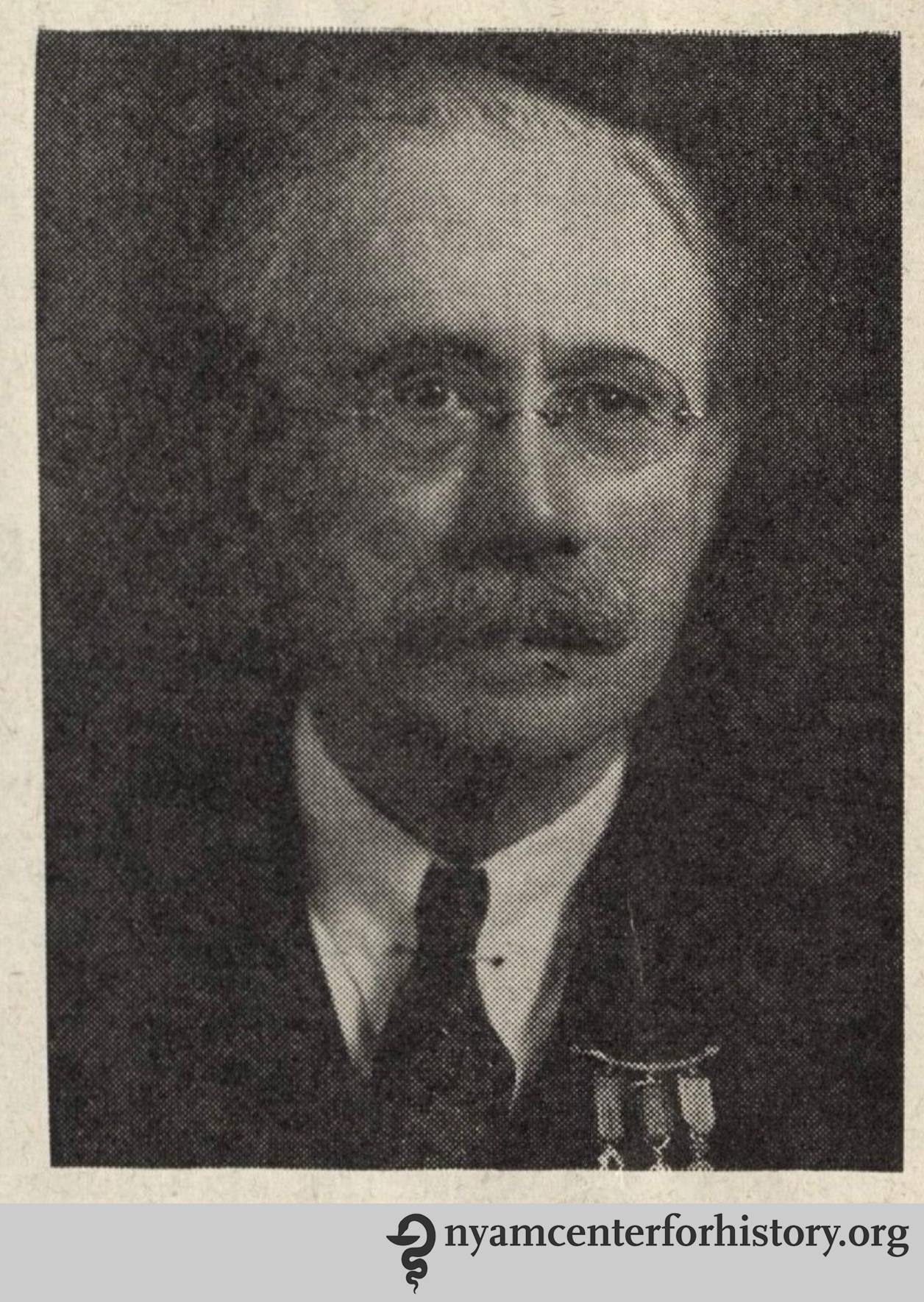
Cree, WJ. In memoriam: Hugo Erichsen M.D. Detroit Medical News. 1944;36(12):9.

Cree, WJ. In memoriam: Hugo Erichsen M.D. Detroit Medical News. 1944;36(12):9.

In 1884, Dr. Hugo Erichsen (1860-1944) published Medical Rhymes, a collection of rhymes and illustrations from a variety of sources. The subtitle speaks volumes of the books contents: “A collection of rhymes of ye Ancient Time, and Rhymes of the Modern Day ; Rhymes  Grave and Rhymes Mirthful ; Rhymes Anatomical, Therapeutical and Surgical, all sorts of Rhymes to Interest, Amuse and Edify all Sorts of Followers of Esculapius.”

Erichsen wrote in his preface that “The purpose of my book is to amuse the busy doctor in leisure hours. Some of the serious poems will no doubt furnish food for reflection.”1 Erichsen, was a busy doctor himself, working as a Detroit physician, a prolific writer, and proponent of cremation.2

In the introduction of Medical Rhymes, Willis P. King, M.D., writes, “There are a thousand and one things in the life of every doctor which are calculated to cause him to ’break out’ with violent attacks of rhyming.”3 Poetry was one area of life where normally stoic doctors could break free of societal expectations.

Erichsen divided his book into seven chapters: Anatomical Lore, For Ye Student Men, The Doctor Himself, Medicine, Surgery, Obstetrics, and Miscellaneous Poems. All poems are given attribution, where available, and some include illustrations.

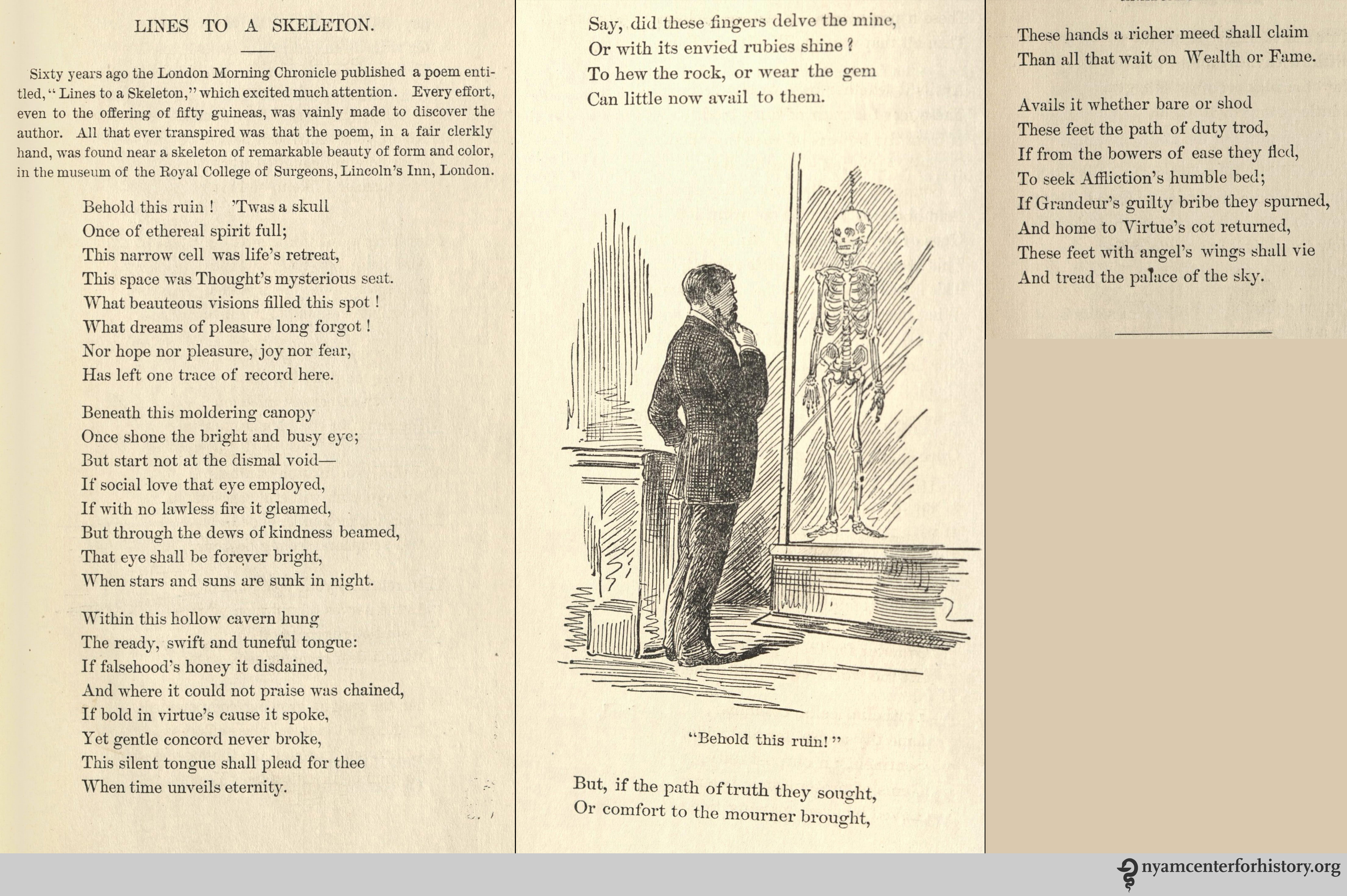
This selected poem includes a little anecdote as to its origins:

"Lines to a Skeleteon." In Erichsen, Medical Rhymes, 1884. Click to enlarge.

“Lines to a Skeleteon.” In Erichsen, Medical Rhymes, 1884. Click to enlarge.

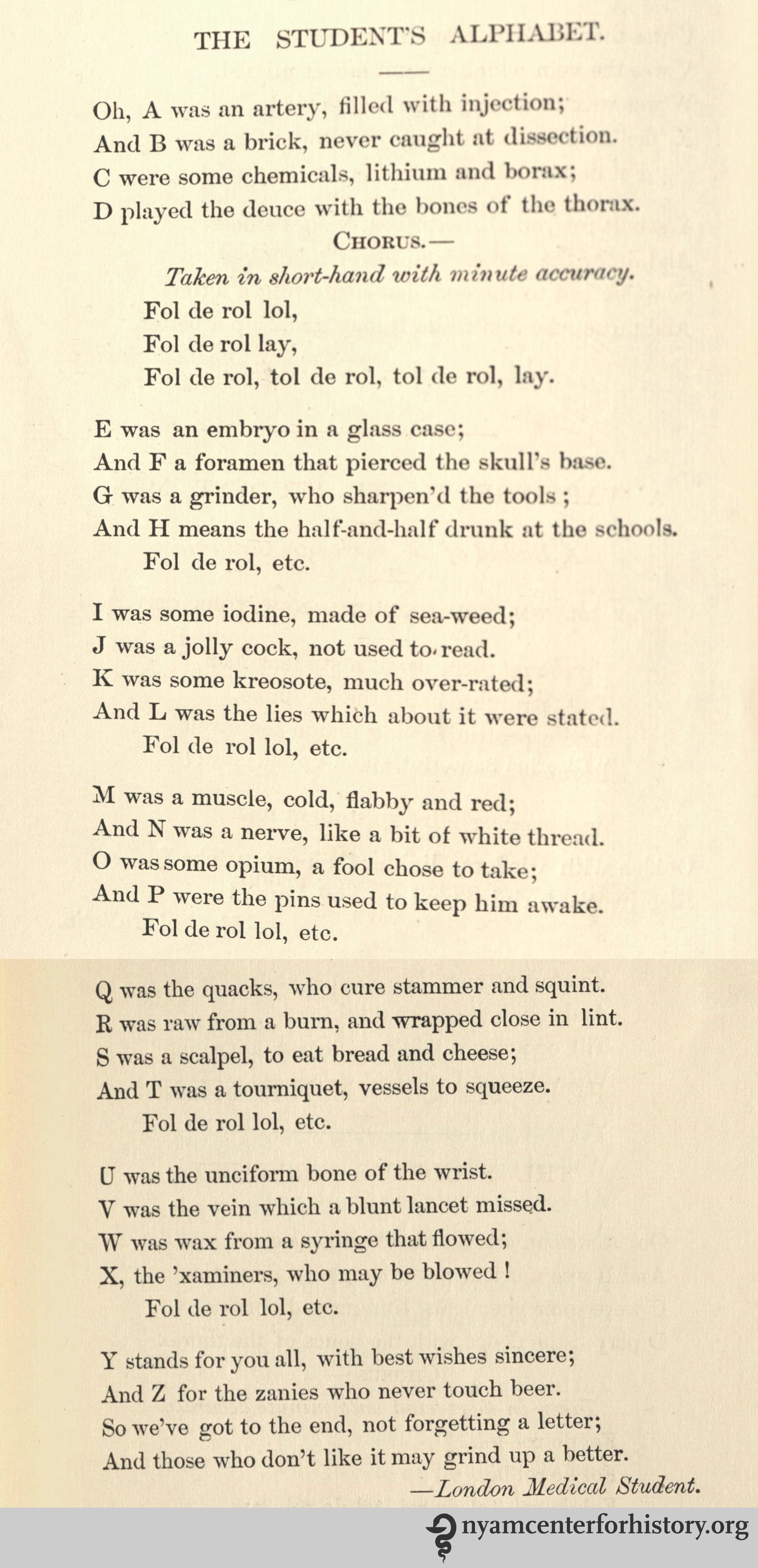
This next poem is attributed to a London medical student and is quite telling of the time, where K is for kreosote and O is for opium. This one even has a little repeating chorus!

"The Student's Alphabet." In Erichsen, Medical Rhymes, 1884. Click to enlarge.

“The Student’s Alphabet.” In Erichsen, Medical Rhymes, 1884. Click to enlarge.

Let’s not forget the book’s compiler. Erichsen included a poem of his own, “The Physician,” in which he pays tribute to all the good a doctor does to “save another life.”

"The Physician." In Erichsen, Medical Rhymes, 1884. Click to enlarge.

“The Physician.” In Erichsen, Medical Rhymes, 1884. Click to enlarge.

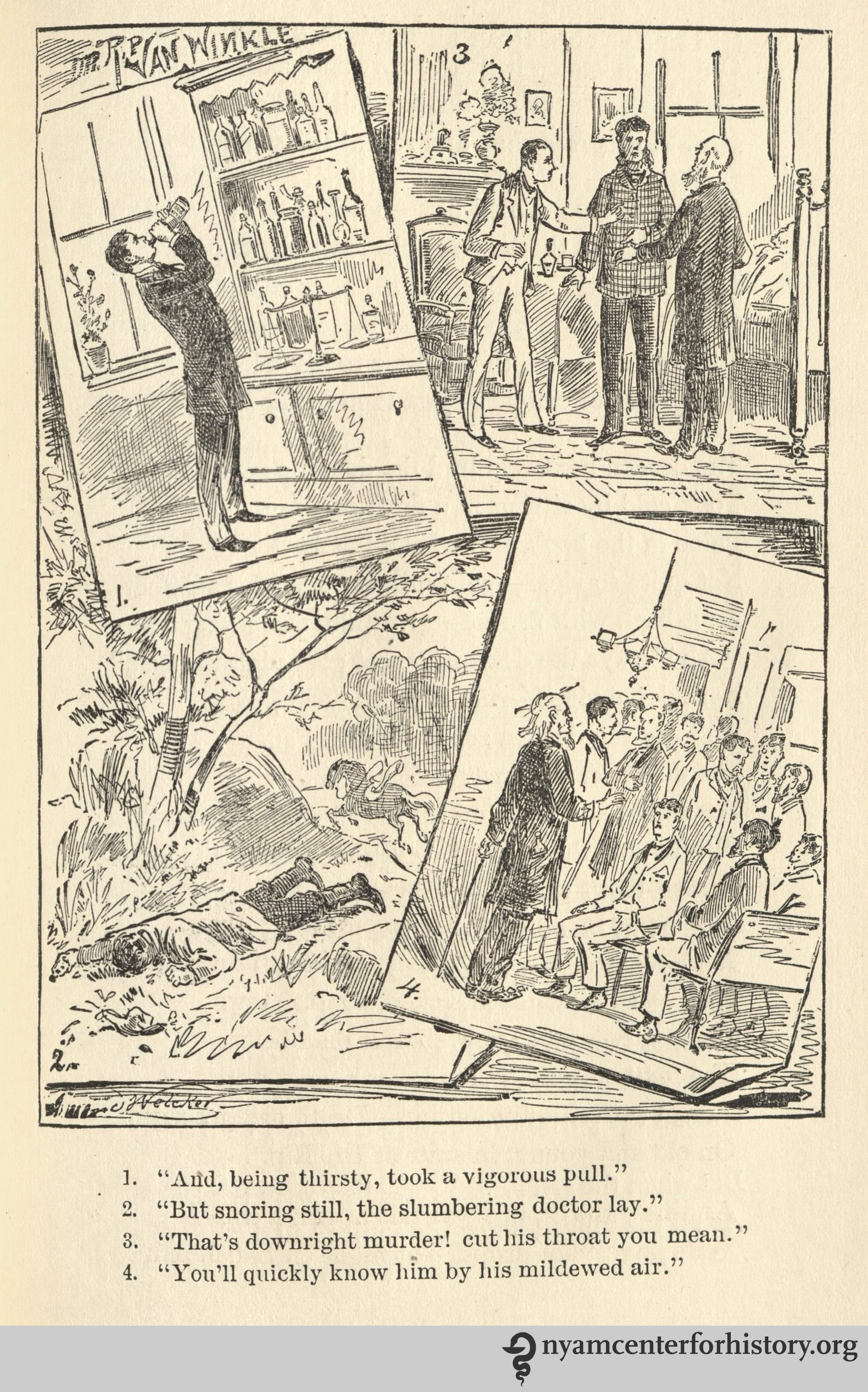
The image below accompanies a 12-page poem by Oliver Wendell Holmes, M.D. The poem, “Rip Van Winkle, M.D.,” recounts the story of young Rip as a doctor who took a “vigorous pull” of “Elixir Pro,” then fell off his horse fast asleep. For 30 years he lay, until the sounds of Civil War battle woke him. But his doctoring was no use, as his methods were 30 years out of date. When he consulted with the modern day doctors, they cried murder and suggested he go back to sleep. Today, he can be found by his mildew-y air.

Rip van Winkle, M.D. illustration. In Erichsen, Medical Rhymes, 1884. Click to enlarge.

Rip van Winkle, M.D. illustration. In Erichsen, Medical Rhymes, 1884. Click to enlarge.

Want more Medical Rhymes? You’re in luck: The book is available in full online.

References

1. Erichsen, H. Medical Rhymes. St. Louis, MO: J.H. Chambers. 1884.

2. Cree, WJ. In memoriam: Hugo Erichsen M.D. Detroit Medical News. 1944;36(12):9.

3. Ibid.

Cupid Out of Sorts—Is Advised to Take a Turkish Bath

By Anne Garner, Curator, Center for the History of Medicine and Public Health

Near Çemberlitas Square in Istanbul, a stone’s throw away from the Grand Bazaar, stands the ethereal Çemberlitas hammam, built in 1584. At first glance, one might think the frontispiece of David Urquhart’s Manual of the Turkish Bath depicts this famous Turkish bath, with its domed vaults and cut-away star windows in the ceiling.

The Hammam. In: Urquhart, Manual of the Turkish Bath, 1865.

It does not. Instead, the engraving depicts a proposed new construction in 19th-century London.

By the 1870s, these baths, modeled on Turkish hammams, were scattered across England and America, largely through the efforts of Scotsman David Urquhart.

In the mid-19th century, Urquhart, an antiquarian and diplomat who had travelled widely in Spain, Morocco, and Turkey, ignited a wave of enthusiasm for public baths in Britain. He wrote about the dry hot-air bath, or hammam, he visited in Turkey in his travelogue, The Pillars of Hercules.

Urquhart’s ideas gelled when he met Irish physician Richard Barter. In 1843, Barter opened the first public bath facility of its kind in the UK designed for medical benefits and fitted with Russian-style baths. In 1856, Barter invited Urquhart to visit, and the two devised a new “improved Turkish bath,” using dry heat to maximize the medical benefits.1

In 1861, Urquhart spoke to the Medical Society of London, arguing that the Turkish bath could alleviate a long list of illnesses. Urquhart believed that visiting the Turkish bath was beneficial to pregnant women and could aid digestion. He also championed its potency as a remedy for bronchitis, asthma, fever, diabetes, syphilis, baldness, and a handful of other maladies, including dementia and insanity.2

By the following decade, Urquhart’s bath at his Riverside home in England was well known, and served as an early model for other baths, including the first bath in London, on Bell Street in 1860. The celebrated Victorian dermatologist Erasmus Wilson describes his visit to Riverside in the 1850s:

We arrive at the door of the Frigidarium; we loosen the latchets of our shoes, and we leave them behind the lintel; the portal opens and we enter. The apartment is small, but it is sunny and bright; throughout the glass doors we see a balcony festooned with the tendrils of the rose…3

The Riverside bath was comprised of a hot room, built directly over the part of the floor with the hottest air underneath (240-250 F); followed by a second hot room, kept at 170F; and, down a set of marble steps, a third area with a divan, kept at 150F. Soft pillows were available for comfortable reclining in each space.

The Bath at Riverside. In Wilson, The Eastern or Turkish Bath, 1861.

The Bath at Riverside. In Wilson, The Eastern or Turkish Bath, 1861.

Wilson describes an adjacent washing area enclosed by a curtain:

We seat ourselves on the clean marble at the edge of the Lavaterina; our host plays the soft pad of gazul4 over the head, the back, the sides; we complete the operation on the limbs and feet ourselves; Basin after basin of warm water rinses the gazul and the loosened epidermis from the surface, and we rise…

After this scrub-down, Wilson visited the piscina, a square pool, for a cold water plunge. Wilson explains that typically this might be followed by a second washing, a warm Turkish towel, and a period of relaxation.

In 1862, Urquhart supervised the construction of another London bath at 76 Jermyn Street (the hammam depicted in the first image of this post). After several decades of popularity with Londoners it closed because of disuse. A bomb destroyed the facility in April 1941.
Section of the Hammam, Jermyn Street. In Urquhart, Manual of the Turkish Bath, 1865.

Plan of the Hammam, Jermyn Street. In Urquhart, Manual of the Turkish Bath, 1865.

Manual of the Turkish Bath presents many of Urquhart’s arguments for the health benefits of the Turkish bath in Socratic dialogue form. It is also notable for its case histories. A paper by Arthur Leared, “Treatment of Consumption by the Turkish Bath” notes the improved health of several patients he treated at 76 Jermyn Street. Leared reports that a 17-year-old wood engraver whose sister and mother died of phthisis and suffered from the same disease improved markedly with treatment:

April 16th—Twenty-first week of Bath treatment; has had about fifty baths in all. Is now in all respects going on well. Sleeps well, and has no night-sweats; appetite good; bowels regular; cough almost gone. Has worked ten hours a day for last two months, except on days when he takes a bath.

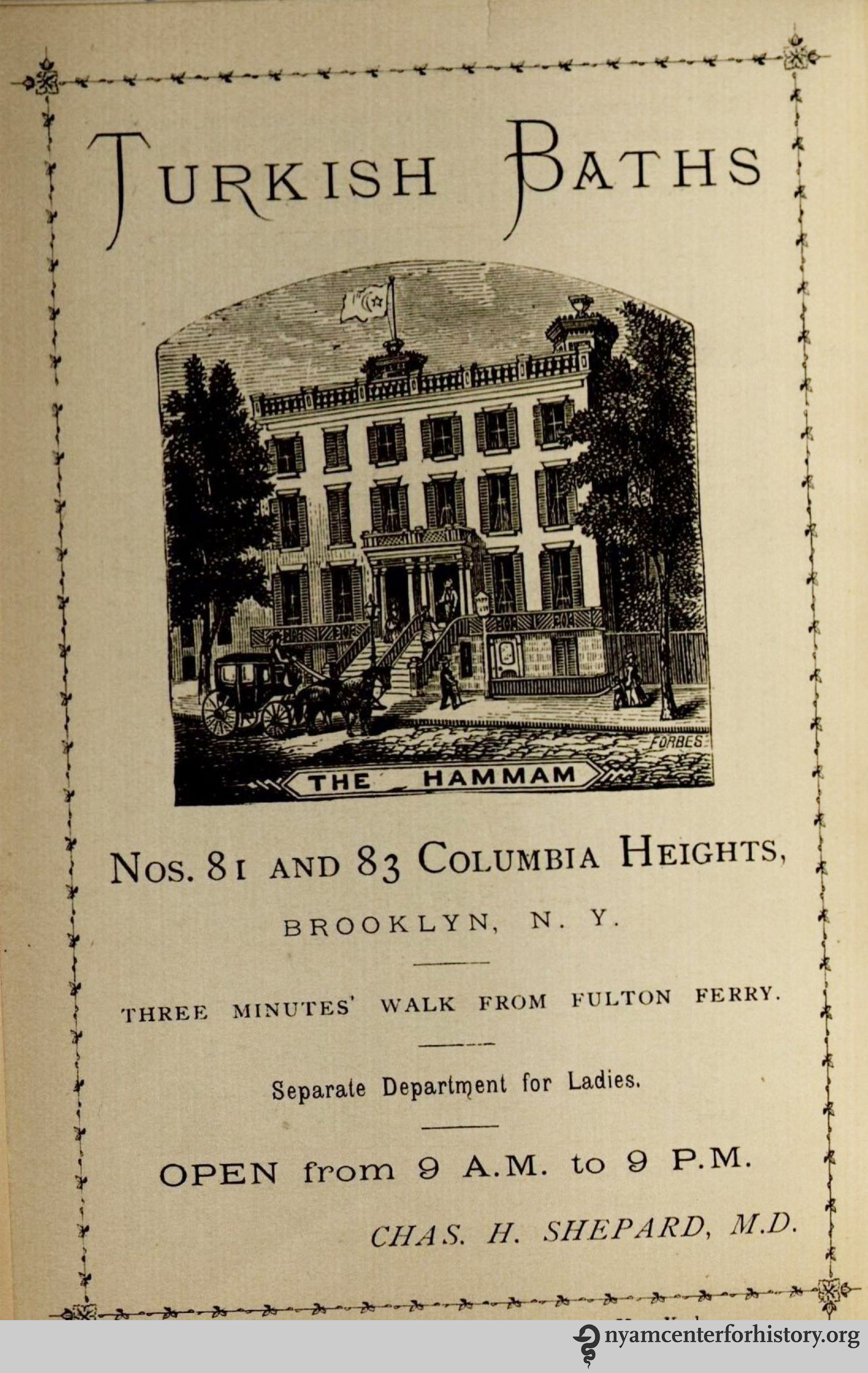
By the 1860s, Urquhart’s new Turkish bath had caught the notice of the Brooklyn physician Dr. Charles Shepard. Shepard’s 1873 pamphlet praised Urquhart’s revival of the bath, and promoted a new bath established by Shepard in Brooklyn Heights.

The pamphlet takes as its conceit the suggestion that even Cupid needs a pick-me-up sometimes:

Introduction to Shepard, The Turkish Bath, 1873.

The narrative unfolds with charming illustrations:

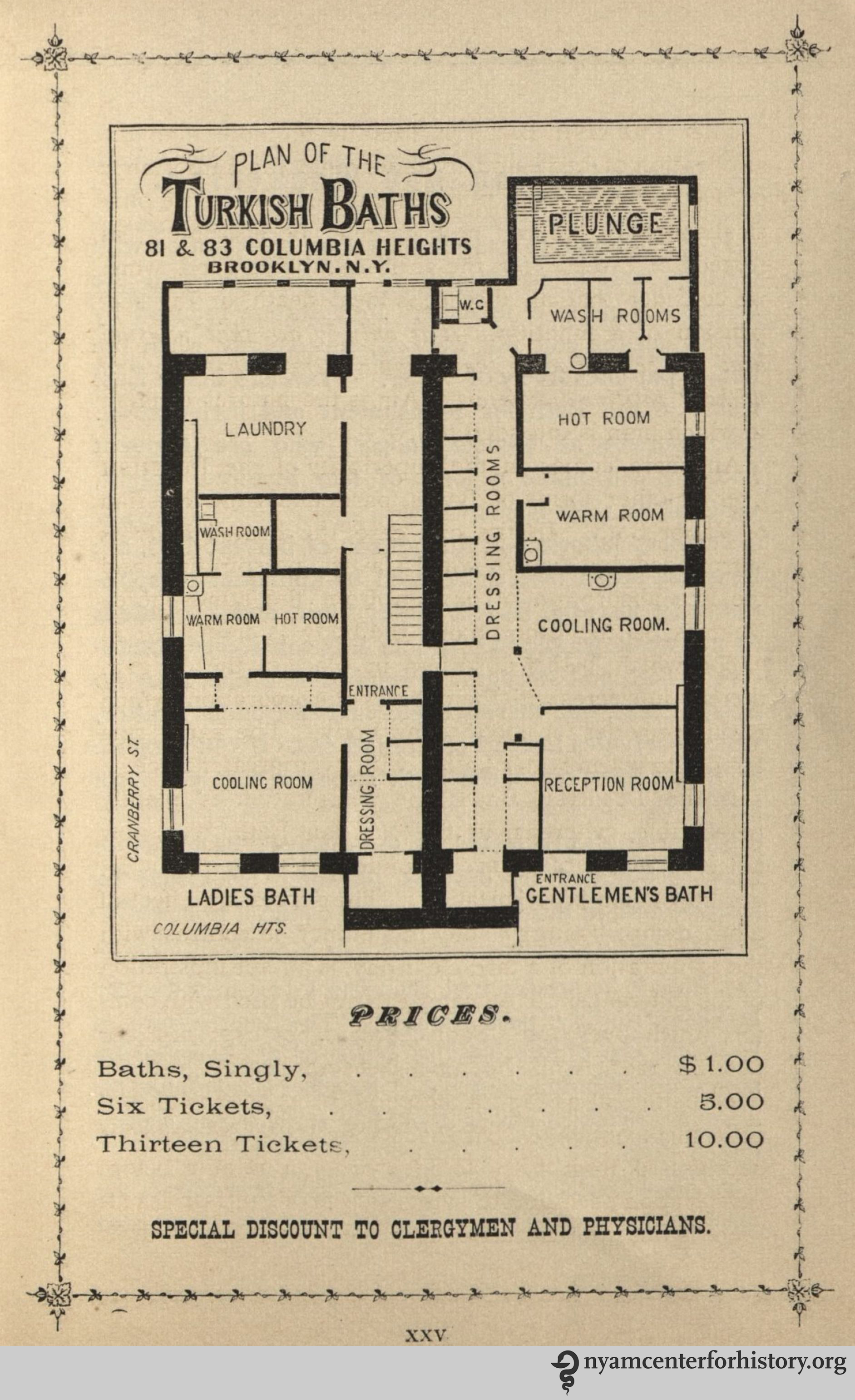
The pamphlet includes Shepard’s plan for his Brooklyn Heights bath. New Yorkers were encouraged to visit 9am to 9 pm, all days of the week except for Sundays. It remained open until 1913.

Plan and prices of the Turkish Baths in Brooklyn Heights. In Shepard, The Turkish Bath, 1873.

View of Brooklyn, showing the location of the Hammam. In Shepard, The Turkish Bath, 1873. Click to enlarge.

The Bath’s exterior. In Shepard, The Turkish Bath, 1873.

Whether in London or Brooklyn, these 19th and early 20th century baths provided centers of calm in a bustling city. As David Urquart said:

Well can I recall the Hammam doors which I have entered, scarcely able to drag one limb after the other, and from which I have sprung into my saddle again, elastic as a sinew and light as a feather.5

References

1. This was the Hydropathic Establishment of St. Anne’s in Cork. In many parts of Europe today, the “Turkish bath” is known as the “Irish-Roman bath.” See victorianturkishbath.org.

2. Urquhart, David. Manual of the Turkish Bath. John Fife (Ed.). London: John Churchill & Sons, 1865.

3. Wilson, Erasmus. The Eastern, or Turkish Bath: Its History, Revival in Britain, and Application to the Purposes of Health. London: John Churchill, 1861.

4. Soap.

5. Shepard, Charles H. The Turkish Bath. Brooklyn, NY: S.W. Green, 1873. P.30.

Beyond “The Yellow Wallpaper”: Silas Weir Mitchell, Doctor and Poet

By Johanna Goldberg, Information Services Librarian

To celebrate National Poetry Month, we are sharing poems from our collection throughout April.

Today, Silas Weir Mitchell (1829–1914) is best known as the purveyor of the Rest Cure, made infamous by Charlotte Perkins Gilman’s short story “The Yellow Wallpaper.” But while he was alive, he was renowned as a pioneering doctor of nervous diseases and a successful author.

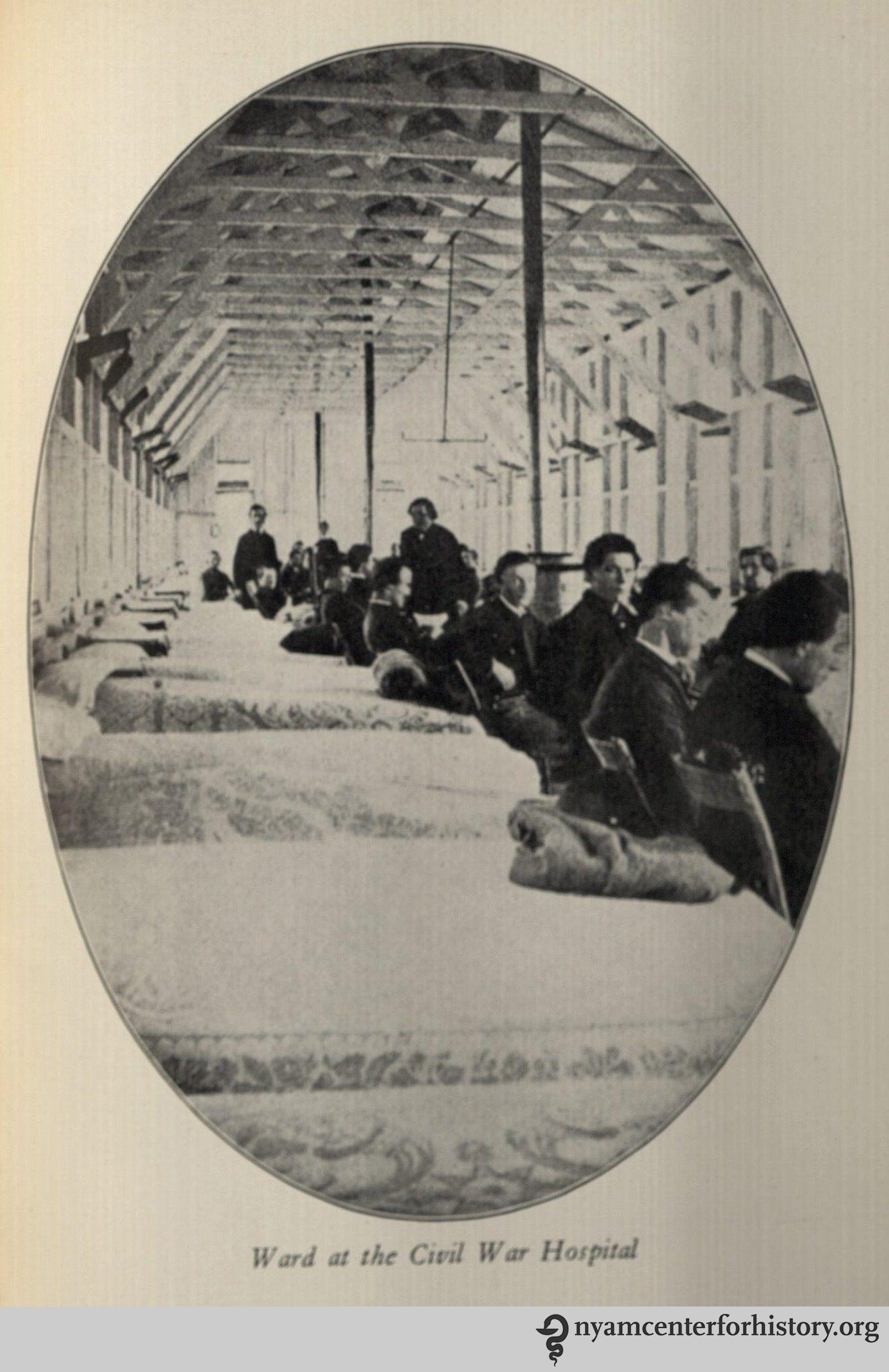
Mitchell began his medical career researching rattlesnake venom. With the outbreak of the Civil War, he shifted focus, beginning work as a contract surgeon at Philadelphia’s Turner’s Lane Hospital, specializing in nervous diseases.

"Ward at the Civil War Hospital." In Burr, Weir Mitchell: His Life and Letters, 1929.

“Ward at the Civil War Hospital.” In Burr, Weir Mitchell: His Life and Letters, 1929.

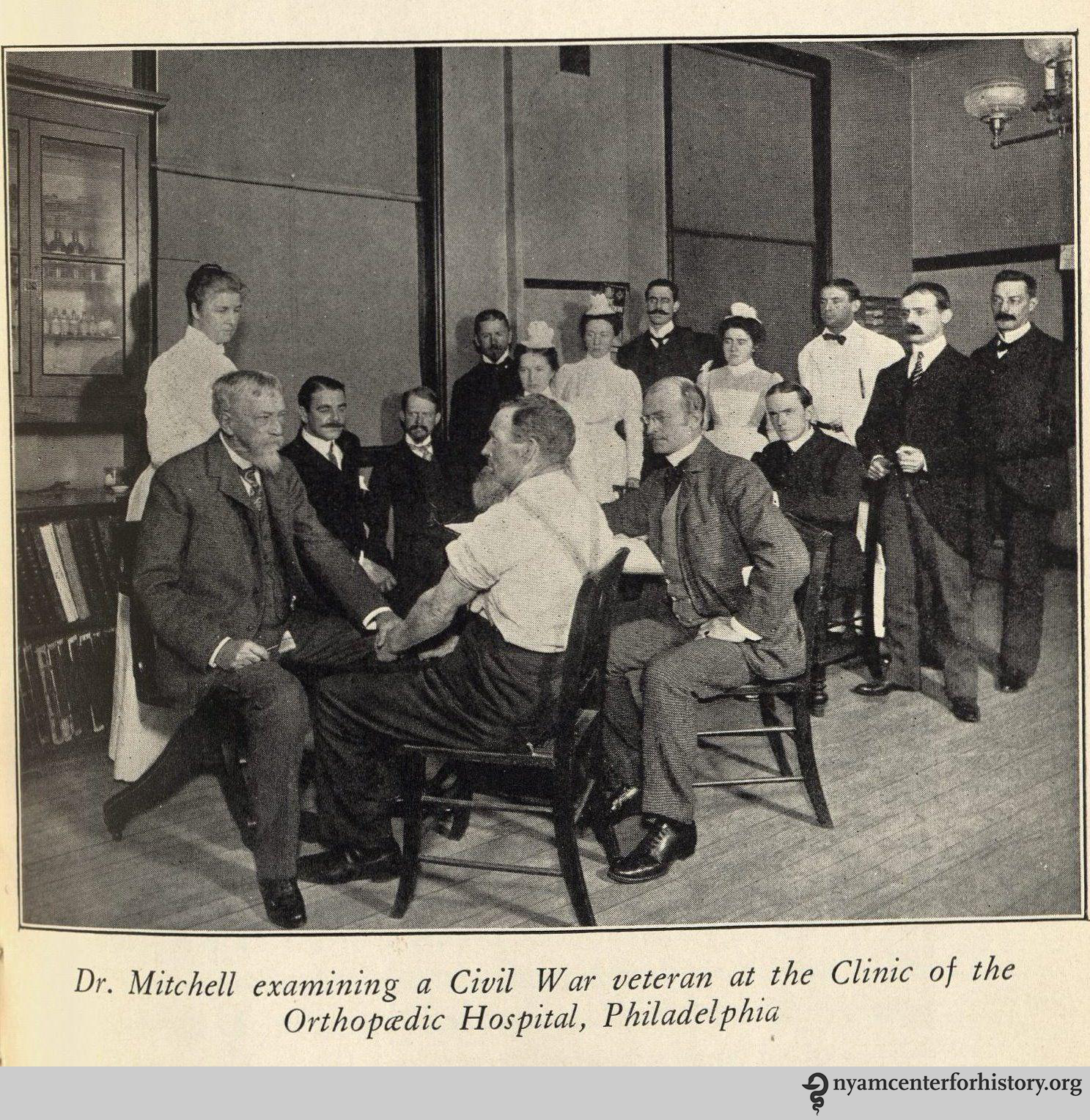
Here, he treated and studied patients with nervous system injuries and syndromes, including one he named causalgia (a form of neuropathic pain). These studies informed his numerous pamphlets and books and helped establish his reputation as a father of American neurology.1–3 After the war, Mitchell continued his research at the Philadelphia Orthopaedic Hospital and Infirmary for Nervous Diseases. He determined that eyestrain could cause headache, and also discovered the rare vascular pain disorder erythromelalgia, or Weir Mitchell’s disease.1

Dr. Mitchell examining a Civil War veteran at the Clinic of the Orhopaedic Hospital, Philadelphia. In Burr, Weir Mitchell: His Life and Letters, 1929.

“Dr. Mitchell examining a Civil War veteran at the Clinic of the Orthopaedic Hospital, Philadelphia.” In Burr, Weir Mitchell: His Life and Letters, 1929.

More controversially, Mitchell also developed the Rest Cure, a treatment for the now passé diagnoses of neurasthenia (physical and mental exhaustion) and hysteria. Women most often received the Rest Cure, which typically involved six to eight weeks of isolation, bed rest, a high calorie diet, massage, and electrotherapy.4 Though the Rest Cure seems problematic to modern eyes, it was an accepted and popular practice for decades, seen as a valuable alternative to drug treatment.3

And what about men experiencing neurasthenia? For them, Mitchell developed the West Cure. Men—including Walt Whitman and Theodore Roosevelt—were sent West to “engage in vigorous physical activity … and to write about the experience.”5 The different treatments used for the same diagnosis—neurasthenia—speak volumes to how differently men and women can be viewed and medicalized.5

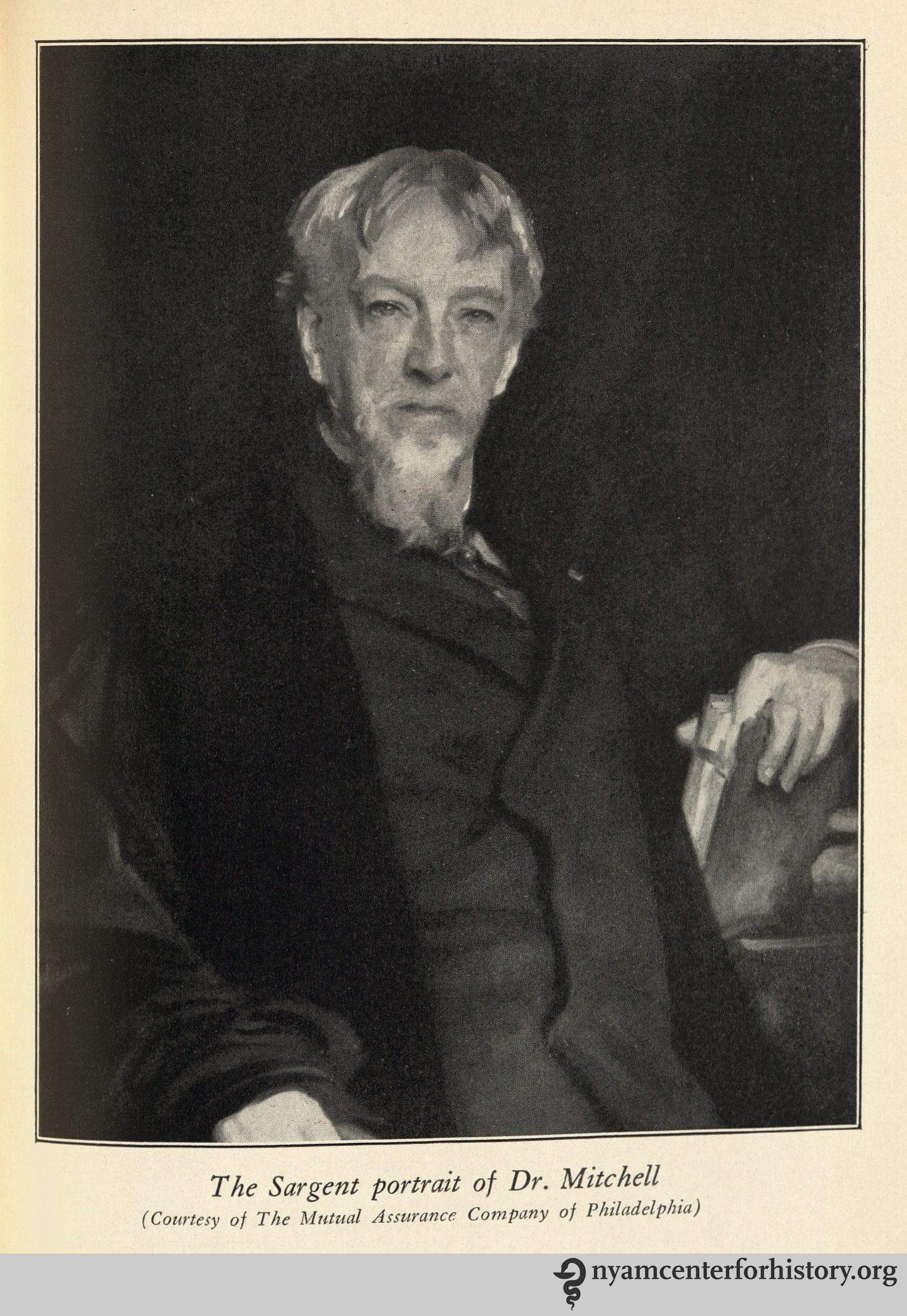
The Sargent portrait of Dr. Mitchell. In Burr, Weir Mitchell: His Life and Letters, 1929.

“The Sargent portrait of Dr. Mitchell.” In Burr, Weir Mitchell: His Life and Letters, 1929.

In addition to his medical research and private practice, Mitchell also enjoyed a career as an author. He published numerous short stories, 19 novels, a biography of George Washington, and 7 books of poetry.3 We have one of these poetry books, A Psalm of Deaths and Other Poems (available in full online), in our collection. We feature two poems from the volume here.

When Mitchell wrote “Of Those Remembered” in 1899, he was no stranger to loss: he had experienced the death of his father (1858), his first wife (1862), his mother (1872), and his sister (1874) in quick succession, along with the deaths of so many Civil War soldiers.2

Of Those Remembered

There is no moment when our dead lose power;
Unsignaled, unannounced they visit us.
Who calleth them I know not. Sorrowful,
They haunt reproachfully some venal hour
In days of joy, and when the world is near,
And for a moment scourge with memories
The money changers of the temple-soul.
In the dim space between two gulfs of sleep,
Or in the stillness of the lonely shore,
They rise for balm or torment, sweet or sad,
And most are mine where, in the kindly woods,
Beside the child like joy of summer streams,
The stately sweetness of the pine hath power
To call their kindred comforting anew.
Use well thy dead. They come to ask of thee
What thou hast done with all this buried love,
The seed of purer life? Or has it fallen unused
In stony ways and brought thy life no gain?
Wilt thou with gladness in another world
Say it has grown to forms of duty done
And ruled thee with a conscience not thine own?
Another world! How shall we find our dead?
What forceful law shall bring us face to face?
Another world! What yearnings there shall guide?
Will love souls twinned of love bring near again?
And that one common bond of duty held
This living and that dead, when life was theirs?
Or shall some stronger soul, in life revered,
Bring both to touch, with nature’s certainty,
As the pure crystal atoms of its kind
Draws into fellowship of loveliness?

The volume closes with a poem perfect for National Poetry Month: “Of a Poet” (1886).

Of a Poet
Written for a child

He sang of brooks, and trees, and flowers,
Of mountain tarns, of wood-wild bowers
The wisdom of the starry skies,
The mystery of childhood’s eyes,
The violet’s scent, the daisy’s dress
The timid breeze’s shy caress
Whilst England waged her fiery wars
He praised the silence of the stars,
And clear and sweet as upland rills
The gracious wisdom of her hills.
Save once when Clifford’s fate he sang,
And bugle-like his lyric rang,
He prized the ways of lowly men,
And trod, with them, the moor and fen.
Fair Nature to this lover dear
Bent low to whisper or to hear
The secrets of her sky and earth,
In gentle Words of golden Worth.

References

1. Silas Weir Mitchell, Papers, 1788; 1850-1928; 1949. Available at: http://www.collegeofphysicians.org/FIND_AID/hist/histswm1.htm. Accessed April 7, 2016.

2. Bailey P. Silas Weir Mitchell, 1829-1914. National Academy of Sciences; 1958. Available at: http://www.nasonline.org/publications/biographical-memoirs/memoir-pdfs/mitchell-silas.pdf. Accessed April 7, 2016.

3. Todman DH. History of Neuroscience: Silas Weir Mitchell (1829-1914). IBRO Hist Neurosci. 2008. Available at: http://ibro.info/wp-content/uploads/2012/12/Mitchell-Silas-Weir.pdf. Accessed April 7, 2016.

4. Science Museum, London. Rest cure. Brought to Life. Available at: http://www.sciencemuseum.org.uk/broughttolife/techniques/restcure. Accessed April 7, 2016.

5. Stiles A. Go rest, young man. Monit Psychol. 2012;43(1):32. Available at: http://www.apa.org/monitor/2012/01/go-rest.aspx. Accessed April 7, 2016.

Stories and Heritage of Nursing in New York City

The Fellows Nursing Section at The New York Academy of Medicine and the Academy Library invite you to join us next Thursday, April 14, at 6:00 PM for an evening exploring the stories and heritage of nursing in New York City. Admission is free but advanced registration is required. Register online.

The evening’s presenters include:

Dr. Joanne Singleton, Professor at Pace University and author of White Beret: The Story of an Urban Nurse, her fictional account of life in a pediatric unit in a New York City hospital.

Lisa Mix, Head, Medical Center Archives, New York-Presbyterian Hospital Weill-Cornell Medical College.

Barbara Niss, Director, Archives & Records Management at Mount Sinai Medical Center.

Arlene Shaner, Historical Collections Librarian, New York Academy of Medicine Library who will provide insights into the nursing heritage held in libraries and archives across the city.

Two tours of the Drs. Barry and Bobbi Coller Rare Book Reading Room will be held following the evenings speakers. Tours are limited to 15 people each; email culturalevents@nyam.org to register. Other nursing-related materials will be on display in the main meeting room.

Mental Health in the Metropolis: The Midtown Manhattan Study

By Paul Theerman, Associate Director, Center for the History of Medicine and Public Health

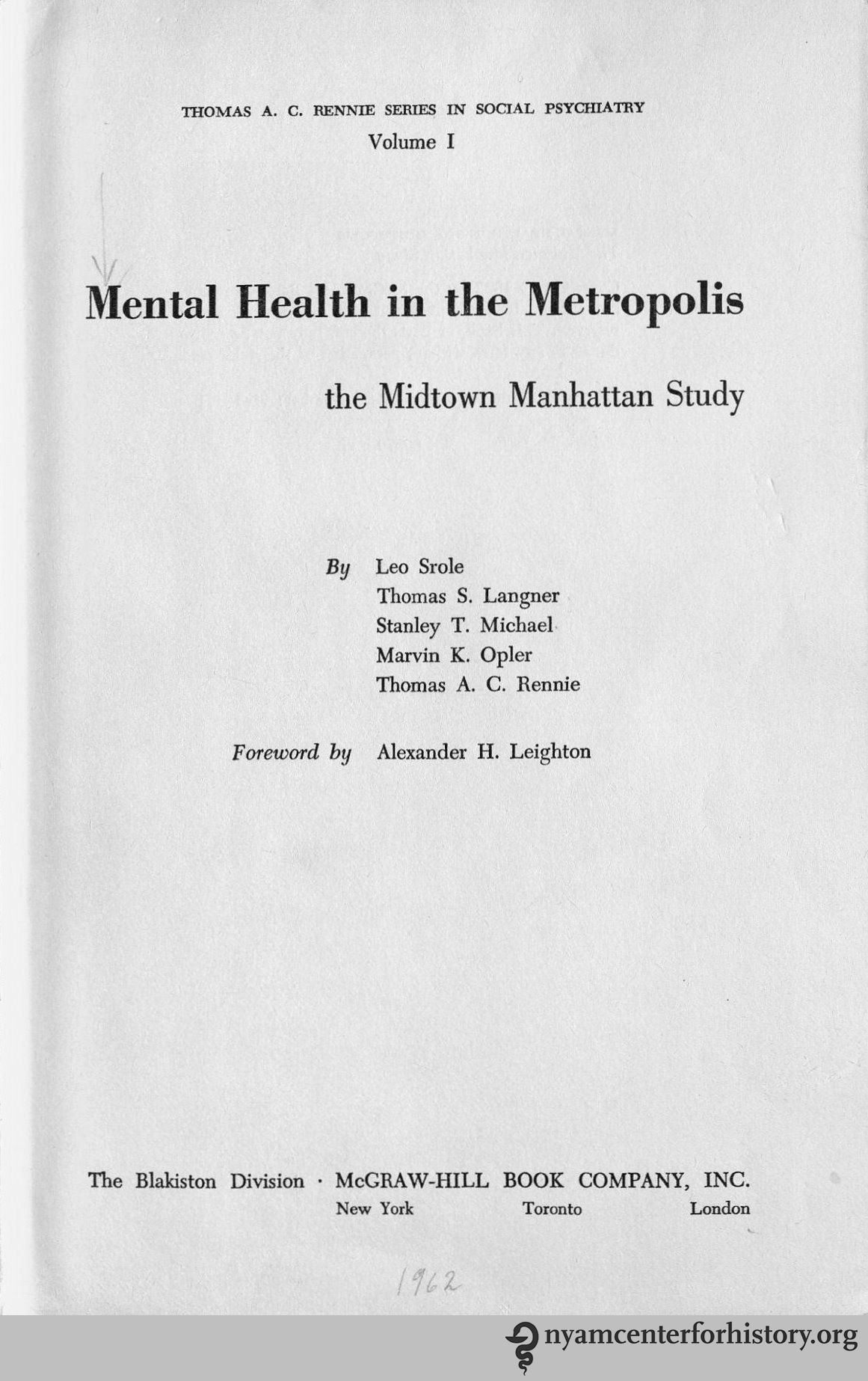
How can we improve urban health? That is one of the missions of the New York Academy of Medicine, and a question public health professionals have been asking for decades. One of the landmark urban health studies, Mental Health in the Metropolis: The Midtown Manhattan Study, was published more than half a century ago.1 The study was intended to be a deep and exhaustive look into the mental health of residents in one of the most urban environments in the country, Midtown Manhattan. In many ways it was to be a model of the state of urban health throughout the country.2 And it was shaped by the medical experience of World War II.

Title page of Mental Health in the Metropolis, 1962.

Title page of Mental Health in the Metropolis, 1962.

Many veterans developed mental illnesses over the course of the war. Dr. Thomas A. C. Rennie, associate professor of psychiatry at Cornell University Medical College, saw many cases directly. He organized rehabilitation services for veterans during the war, and in 1944 published When He Comes Back and If He Comes Back Nervous.3 This booklet was followed by Mental Health and Modern Society,4 a professional discussion of the effects of war on society. In his war and postwar experience, Rennie encountered many people suffering from mental difficulties, and concluded that the long and extended psychoanalytic approach would never treat them effectively, for lack of time and resources.

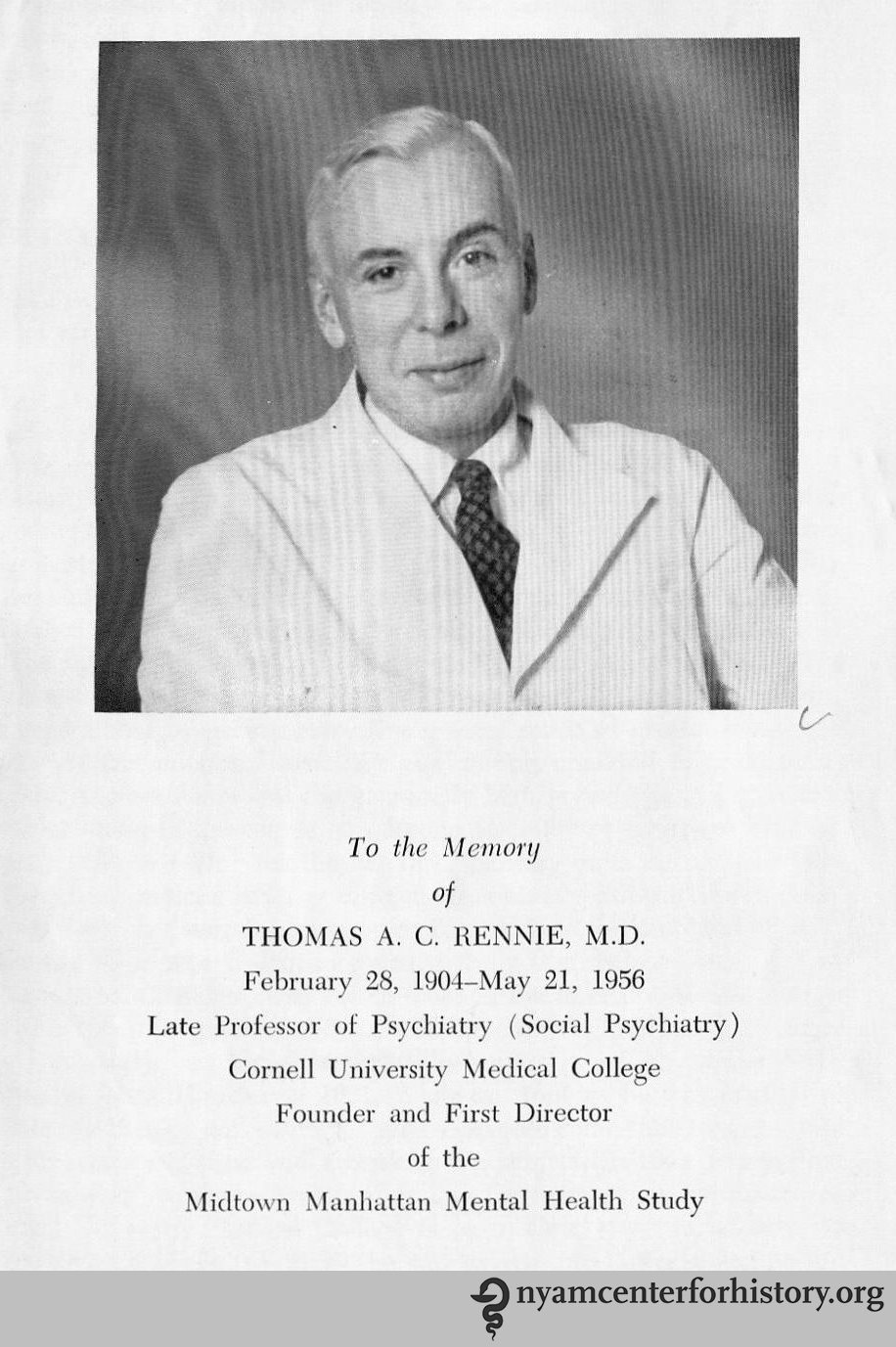
Dedication of Mental Health in the Metropolis to Thomas A. C. Rennie.

Dedication of Mental Health in the Metropolis to Thomas A. C. Rennie.

Instead, Rennie began to look at the relationship between mental health and the social community.5 In the process he created a new field—social psychiatry. In 1950, he was appointed the first professor of social psychiatry at Cornell, arguably holding the first position of this kind anywhere in the United States.6 He conceived the Midtown study this same year, and launched it in 1952. Upon Rennie’s sudden death from a cerebral hemorrhage in mid-1956, the program was continued by Dr. Alexander Leighton, a colleague, medical sociologist, and psychiatrist at Cornell. The study ended in 1960, with publication of its results in 1962.7 It was a large undertaking; overall, the project utilized the services of some 200 people.

What did the study look like? In the words of the lead author, sociologist Leo Srole of SUNY Medical Center Brooklyn (SUNY Downstate), “An investigation focused upon Midtown can, in a special sense, be likened to an intensive case study. Here a community, rather than an individual, is the case.”8 Mental health was investigated as an outcome of community function and dysfunction, as much as or even more so than of the individual. That community was studied along many lines: age, sex, marital status, socioeconomic status, “generation-in-the-U.S.,” and various frames of origination: rural or urban, nationality, and religious affiliation. Researchers also assessed access to and outcomes of mental health and psychiatric care by surveying community residents and treatment workers. Their work seemed to show that Midtown held large numbers of untreated ill individuals, most of whom still functioned at an acceptable level. But definitive results were difficult to come by, and more studies were called for.

Correspondence between sick-well ratios for 12 socioeconomic status strata, reported in 4 groups, with highest SES marked “1” and lowest “12”. The “sick-well” ratio is found by comparing the numbers of “impaired” persons in a particular grouping, with the number of “well” persons. Two other rankings lie between these designations: “mild symptom formation” and “moderate symptom formation.” Mental Health in the Metropolis, Figure 5, p. 231. Click to enlarge.

Correspondence between sick-well ratios for 12 socioeconomic status strata, reported in 4 groups, with highest SES marked “1” and lowest “12”. The “sick-well” ratio is found by comparing the numbers of “impaired” persons in a particular grouping, with the number of “well” persons. Two other rankings lie between these designations: “mild symptom formation” and “moderate symptom formation.” Mental Health in the Metropolis, Figure 5, p. 231. Click to enlarge.

Mental Health in the Metropolis was the report of a large and complex analysis, marrying the different disciplines of psychiatry and sociology to understand and address medical problems using social means. As such it was a child of the war—the war that created mass problems, and suggested ways towards solving them. And it was the harbinger of studies to come.

References

1. Authored by Leo Srole, Thomas S. Langner, Stanley T. Michael, Marvin K. Opler, and Thomas A. C. Rennie, volume 1 in the Thomas A. C. Rennie Series in Social Psychiatry (New York: Blakiston Division, McGraw-Hill, [1962]).

2. Mental Health in the Metropolis, p. 338. The precise boundaries of the study area were not disclosed for reasons of confidentiality; it was described as “more or less midway up the length of Manhattan Island,” bounded by the business district, two major thoroughfares, and a river, and “almost wholly residential in character,” with 175,000 inhabitants (p. 72, and fn 14). Using the name “Midtown” to describe this community was surely inspired by the famous “Middletown” studies of Muncie, Indiana, done by Robert Staughton Lynd and Helen Merrell Lynd, and published in 1929 and 1935.

3. With Luther E. Woodward: New York: The National Committee for Mental Hygiene, [c1944].

4. Also with Luther E. Woodward: New York: Commonwealth Fund, 1948.

5. He was not the first to explore this connection, of course, and he profited from his work with Adolf Meyer of The Johns Hopkins Medical School from 1931 to 1941, Oskar Diethelm, “Thomas A. C. Rennie, February 28, 1904 — May 21, 1956,” Cornell University Faculty Memorial Statement, https://ecommons.cornell.edu/handle/1813/17813, accessed March 18, 2016.

6. Mental Health in the Metropolis, pp. viii.

7. Mental Health in the Metropolis, pp. 336–37.

8. Mental Health in the Metropolis, p. 28.

Surviving the Great Blizzard of 1888

By Johanna Goldberg, Information Services Librarian

After the snowstorm on January 22–23, 2016 dropped 26.8 inches of snow on New York City, lists circulated of the worst snowstorms in the city’s history dating back to 1869. Of the top ten storms, only one occurred in the 19th century: the blizzard of 1888, which resulted in 21 inches of snow falling on the city from March 12–14 of that year.

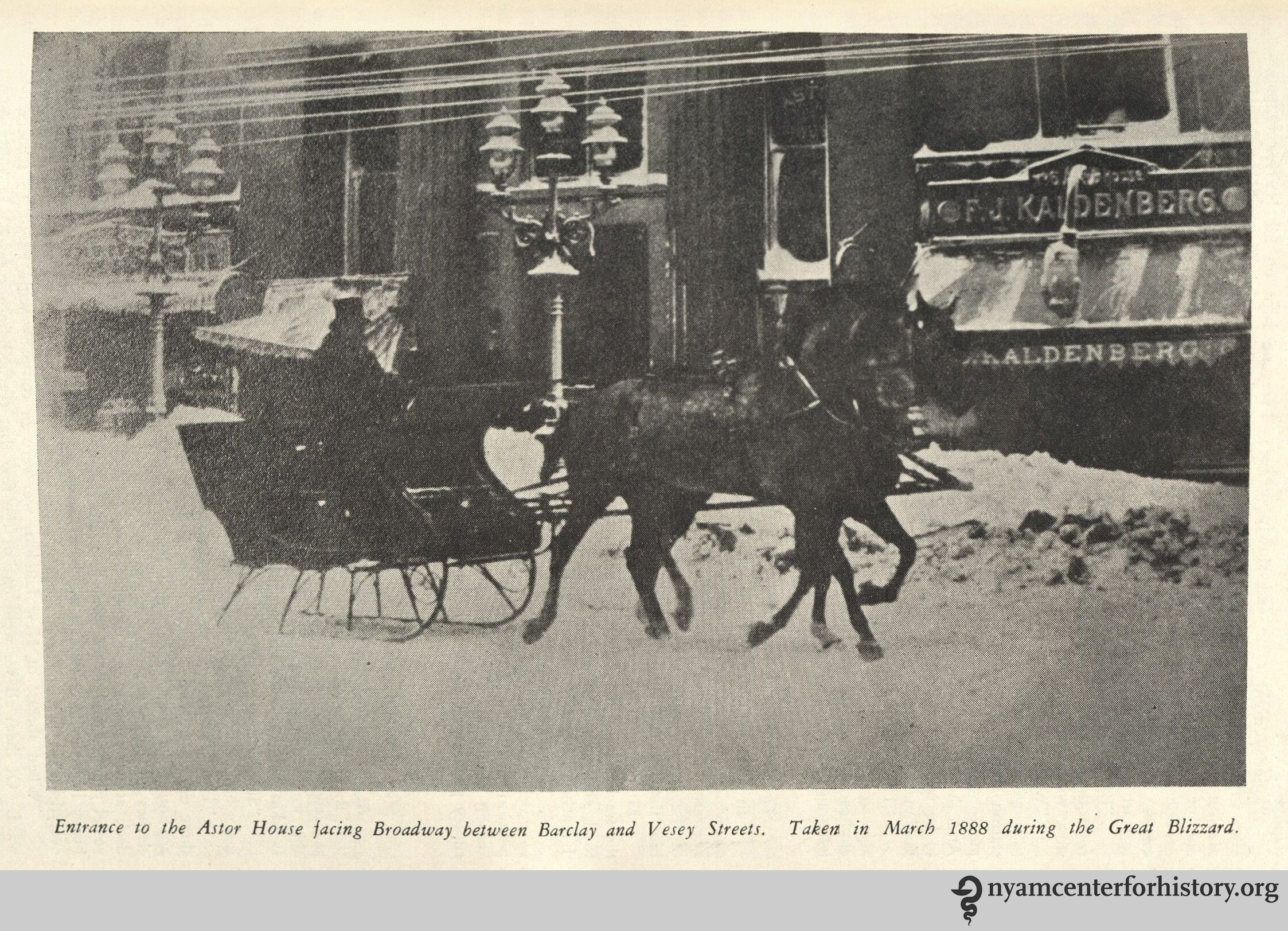
"Entrance to the Astor House facing Broadway between Barclay and Vesey Streets. Taken in March 1888 during the Great Blizzard." From Strong, The Great Blizzard of 1888.

“Entrance to the Astor House facing Broadway between Barclay and Vesey Streets. Taken in March 1888 during the Great Blizzard.” From Strong, The Great Blizzard of 1888.

The blizzard arrived unexpectedly. The forecast for Sunday, March 11 called for slight wind and evening rain. But late that night, a storm from the south altered its course at the same time that the wind changed direction. Rain turned to sleet, hail, and finally snow. New Yorkers woke up on Monday to 10 inches of snow and bitter cold.

“Looking north on Madison Avenue during the March 1888 Blizzard.” From Strong, The Great Blizzard of 1888.

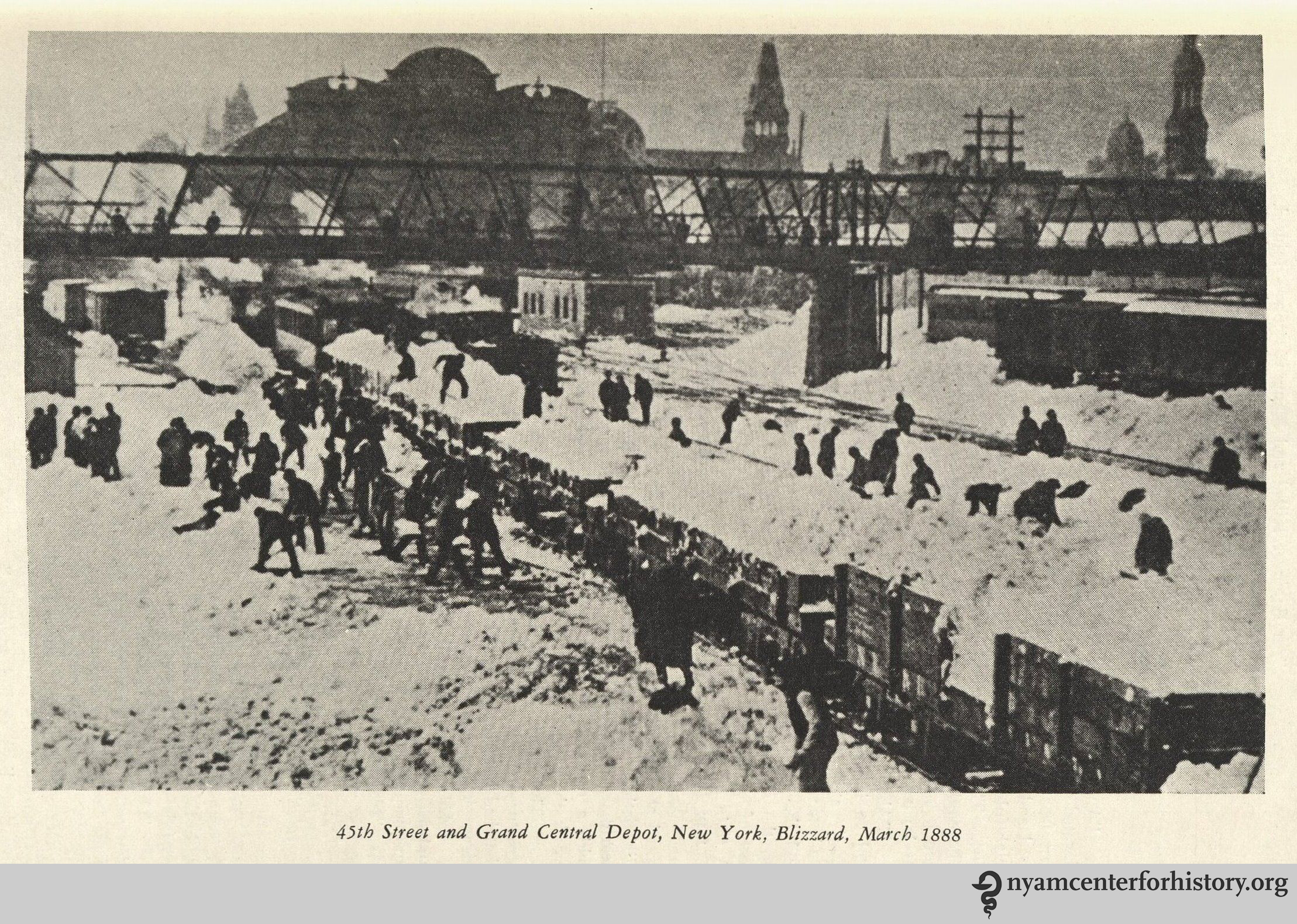
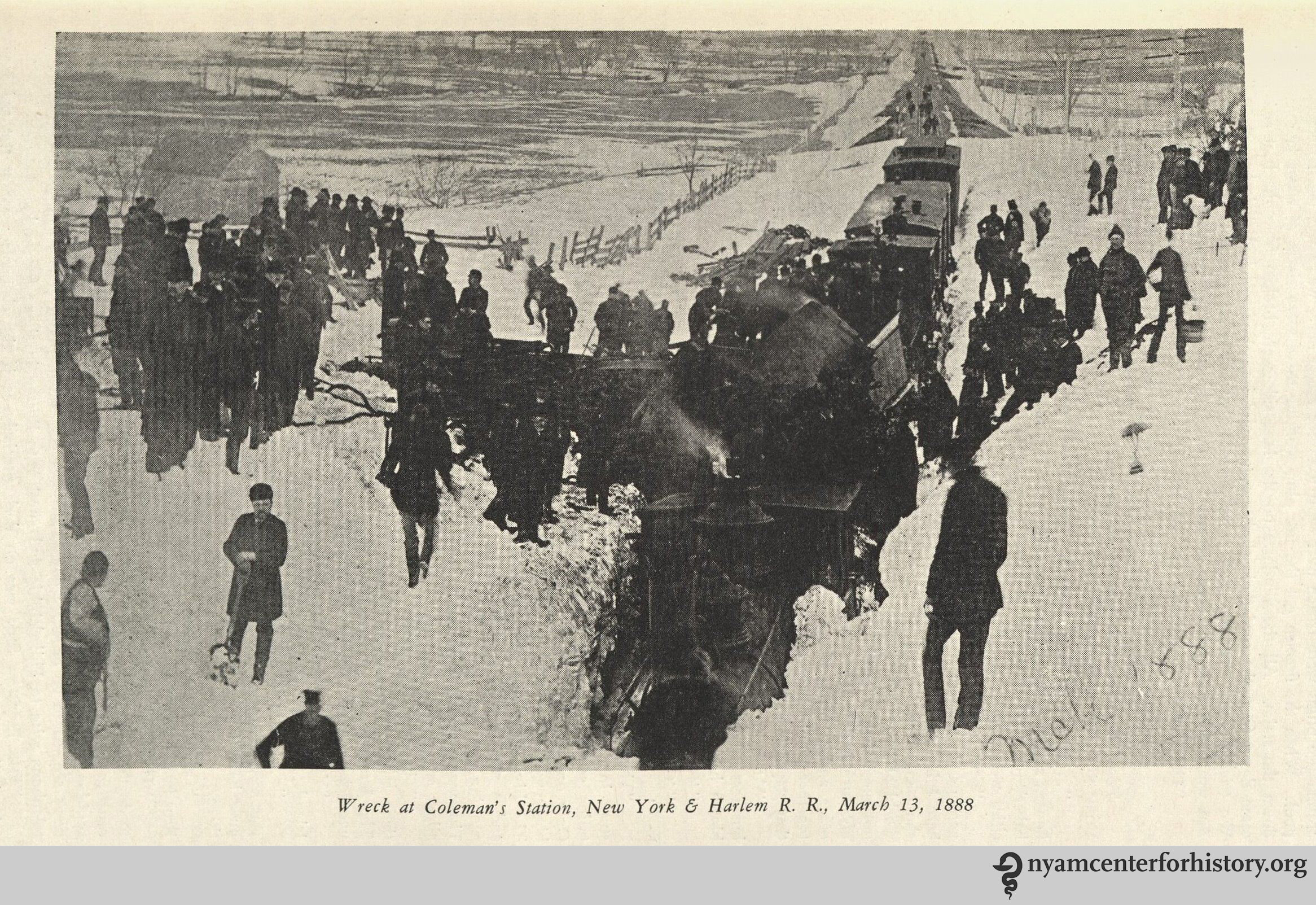
Not realizing that the worst was yet to come—11 more inches of wind-swept snow fell before the storm ended—many ended up stranded on their way to work or school. Eighty mile an hour wind gusts blew snow into drifts as high as second story windows and, along with the snow and ice, stopped elevated trains and toppled phone, electric, and telegraph poles. After the suspension of ferry service, people attempted to cross the frozen East River on foot (many were rescued by tugboats). More than 200 New Yorkers died as a result of the storm.1,2

"45th Street and Grand Central Depot, New York, Blizzard, March 1888." From Strong, The Great Blizzard of 1888.

“45th Street and Grand Central Depot, New York, Blizzard, March 1888.” From Strong, The Great Blizzard of 1888.

"149 Broadway, now the site of the Singer Building, March 1888." From Strong, The Great Blizzard of 1888.

“149 Broadway, now the site of the Singer Building, March 1888.” From Strong, The Great Blizzard of 1888.

In 1938, fifty years after the blizzard, Samuel Meredith Strong, M.D., “Former President of ‘The Blizzard Men of 1888,’” published The Great Blizzard of 1888, a collection of oral histories and printed articles from those who survived the storm. Below are some selections from the book:2

Excerpt from an article by Julian Ralph in the New York Sun, September 2, 1933:

“Few of the women who worked for a living could get to their work places. Never, perhaps, in the history of petticoats was the imbecility of their design better illustrated. ‘To get here I had to take my skirts up and clamber through the snowdrifts,’ said a washerwoman when she came to the house of the reporter who writes this. She was the only messenger from the world at large that reached that house up to half-past 10 o’clock. ‘With my dress down I could not move half a block.’ It was so with many thousands of women; the thousand few who did not turn back when they had started out.”2

11th Street, New York, looking west." From Strong, The Great Blizzard of 1888.

11th Street, New York, looking west.” From Strong, The Great Blizzard of 1888.

From Wm. Chamberlain, Maspeth, New York:

“Mount Olivet Cemetery at Maspeth, New York, had two orders for burials to take place that day, and the Superintendent had men with a small plow drawn by horses work to keep the roads in the cemetery open. Along about ten o’clock he got me on the job shoveling, and after dinner sent me for men in the neighborhood. I think I got two or three and with others and the plows we worked until about 4:30 in the afternoon, but it was no use as the wind blew the snow back faster than we could handle it. We quit, licked to a frazzle, cold and tired and hungry. The funerals, according to the records in the cemetery, did not take place until two or three days later.”

"Copy of photograph taken in Flushing, Long Island, by Mr. William James in March 1888. Mr. Frederick Morris at the left, Dan Beard standing in the center." From Strong, The Great Blizzard of 1888.

“Copy of photograph taken in Flushing, Long Island, by Mr. William James in March 1888. Mr. Frederick Morris at the left, Dan Beard standing in the center.” From Strong, The Great Blizzard of 1888.

Dr. Charles Gilmore Kerley, published in Medical Clinic of North America, November 1935:

“I was a resident physician at the New York Infant Asylum in Westchester County, N.Y. At this institution there were a few over 400 children and about 200 mothers. The age of the child population ranged from infants of a few weeks to children five or six years of age. Among those under one year were perhaps 100 who were partly or entirely dependent on cow’s milk feeding. Eight cans of loose milk a day were supplied by a dairy eight miles distant, the milk being delivered in a horse-drawn truck—then came the big blizzard completely blocking traffic of every nature—in our case for seven days. I well remember the consternation and alarm at the thought of being cut off from all food supplies with over 600 people to be cared for. A few days before the historic storm, through error a large consignment of Borden’s condensed milk arrived at the institution. Twelve dozen cans had been ordered and 12 gross (1728) cans were received. Our greatest anxiety naturally centered on the bottle fed; the condensed product was at once brought in to use and a blizzard feeding plan was inaugurated through dilution with barley water. Greatly to our surprise the marasmic and difficult feeders, struggling along on diluted sterilized milk, took on new life, began to smile and gain in weight.”

Baxter Street, New York, Blizzard, March 1888." From Strong, The Great Blizzard of 1888.

Baxter Street, New York, Blizzard, March 1888.” From Strong, The Great Blizzard of 1888.

John Potter of Lowville, New York:

At that time I had a room on West 24th Street. I was employed as bookkeeper by a firm on Beach Street and started for work at 8:00 o’clock on that morning, taking the 6th Avenue elevated railroad from West 23rd Street. The train proceeded slowly until we reached the curve at Bleeker and 8th Streets when we came to a standstill and remained there until 3:00 o’clock in the afternoon without any heat in the car. About that time a man appeared on the street from a corner saloon with a long ladder which he placed against the elevated railing. The railing being coated with ice it was a difficult matter to climb over and reach the ladder. I recall carrying a young woman and, missing my footing partly down, we both landed in a snow bank. The man charged us fifty cents for the privilege of using his ladder.”

Hotel Martin 17-19 University Place, corner of 9th Street during the March 1888 Blizzard. Abandoned horse-car." From Strong, The Great Blizzard of 1888.

Hotel Martin 17-19 University Place, corner of 9th Street during the March 1888 Blizzard. Abandoned horse-car.” From Strong, The Great Blizzard of 1888.

Caroline Kleindienst, from Cranbury, New Jersey:

“Through the long lone hours of that night we were blessed with our eleven pound boy, without nurse or doctor.… Next morning we found we were completely snowed in. My husband started to shovel his way out, through snow as deep as he was tall….It was three weeks before the roads were cleared and the Doctor then made his first visit to our home and congratulated me on the fine new baby who came into this world unaided and alone in the Big Blizzard of 1888 and twenty-six years and six months later left this world in the Wright chemical explosion [an accident at a factory in Elizabeth, NJ that killed three workers3].”

"Wreck at Coleman's Station, New York & Harlem R. R., March 13, 1888." From Strong, The Great Blizzard of 1888.

“Wreck at Coleman’s Station, New York & Harlem R. R., March 13, 1888.” From Strong, The Great Blizzard of 1888.

The blizzard contributed to slow but successful city efforts to move power lines underground and replace elevated trains with the underground subway. It also spurred a more organized response to future weather events from the Department of Street Cleaning, now called the Department of Sanitation.1

Park Place, Brooklyn, N. Y., March 14, 1888." From Strong, The Great Blizzard of 1888.

Park Place, Brooklyn, N. Y., March 14, 1888.” From Strong, The Great Blizzard of 1888.

The next time a blizzard comes to New York, be grateful for modern weather forecasting technology and heated subway cars. And don’t try to cross the East River by foot!

References

1. Virtual New York. Blizzard of 1888. Available at: http://www.virtualny.cuny.edu/blizzard/bliz_hp.html.

2. Strong SM, Overton M. The great blizzard of 1888. [New York]; 1938.

3. GUNCOTTON KILLS THREE. Explosion Wrecks Factory and Shakes a New Jersey County. New York Times. http://query.nytimes.com/gst/abstract.html?res=9D00EEDB1438EF32A2575AC1A96F9C946596D6CF. Published September 19, 1914. Accessed March 4, 2016.

“Solving Woman’s Oldest Hygienic Problem in a New Way”: A History of Period Products

By Johanna Goldberg, Information Services Librarian

This is part of an intermittent series of blogs featuring advertisements from medical journals. You can find the entire series here.

For the past few weeks, subway-riding New Yorkers have been surrounded by advertisements for absorbent underwear, the latest in a long history of products designed for use during menstruation.

But what did people use before the era of special undies, tampons, pads, and cups? Very little is known about pre-20th century methods, but historians believe (and oral history interviews confirm) that many relied on homemade cloth or paper pads or diapers pinned to belts and strings. Some women reused these items, while others disposed of them after one use.1,2 Other women—even going back to ancient Rome—fashioned their own tampons from absorbent wool, fibers, paper, sponges, and other materials.3

Things began to change in the mid-1800s. Between 1854 and 1921 (the year the Kotex was first marketed), the U.S. Patent Office granted 185 patents for menstrual (or catamenial) devices.1 In her 1994 doctoral dissertation, Laura Klosterman Kidd breaks these patents into six interconnected categories:

(1) Belts or supporters, from which were suspended (2) a catamenial sack, pouch, shield, menstrual receiver, or napkin-holder, into which was placed (3) an absorbent, consisting of cloths, pads, napkins, sponges, or raw waste fibers. Ancillary categories of menstrual patents were (4) attaching devices used to secure or connect the catamenial sack to the supporter, (5) catamenial garments or appliances that aided in protecting the wearer’s clothing, and (6) vaginally inserted menstrual retentive cups.1

One of these patented products is advertised in the 1884 American Druggist. Despite claims that it is “the grandest invention for the convenience and cleanliness of ladies,” it certainly gives the modern audience pause. A soft rubber cup gets inserted into the vagina, and fluid flows into a “receptacle” attached to a belt. “At night, before retiring, the fluid can and should be removed [from the receptacle], simply by removing a cap, without removing the instrument.”

"Farr's Patent Ladies' Menstrual Receptacle," advertised in American Druggist, January 1884.

“Farr’s Patent Ladies’ Menstrual Receptacle,” advertised in American Druggist, January 1884. Click to enlarge.

There’s a reason these never caught on. But they aren’t such a far cry from today’s (much less cumbersome) menstrual cups.

The real shift in feminine hygiene products came in the 1920s and 1930s. During World War I, nurses at the front lines used absorbent Cellucotton, a Kimberly-Clark product made from wood pulp, both to bandage soldiers (as intended) and to absorb menstrual blood. After the war, Kimberly-Clark developed Cellucotton into Kotex, introducing the product in 1920.4 These napkins were held in place using belts; adhesive napkins only became available in the late 20th century.2

This was not the first commercial sanitary napkin; earlier brands appeared for sale through mail-order catalogs. But it was the first to get a hard-won advertising campaign, which began in 1921. As Lara Freidenfelds relates in her book The Modern Period, advertisements for Kotex appeared in Ladies Home Journal once its editor’s secretary “declared the ads to be in good taste and of great benefit to women.” After Ladies Home Journal agreed to run the ads, other magazines, including the American Medical Association’s Hygeia, followed.2

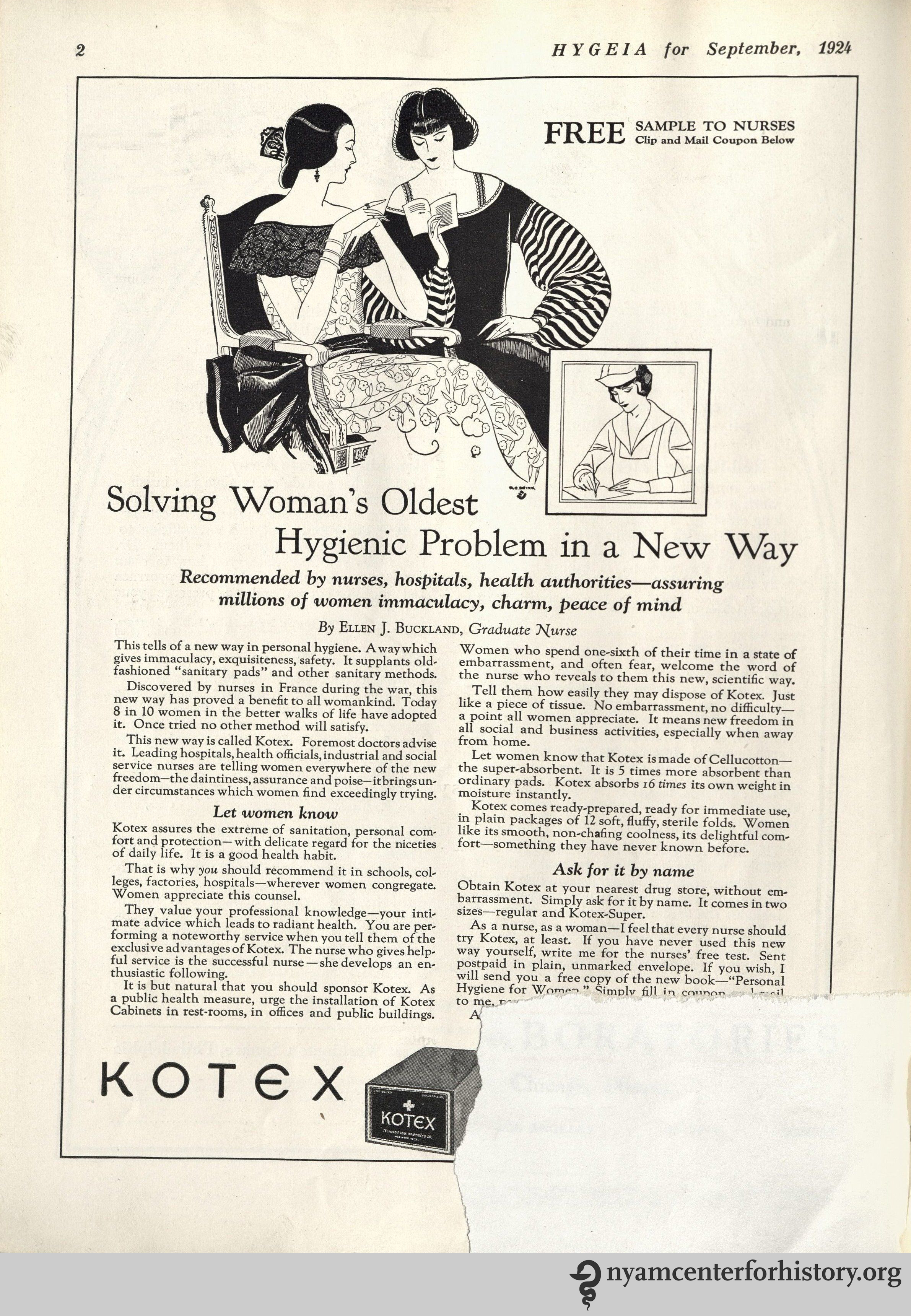
Below are two early advertisements for Kotex, which appeared in Hygeia in 1924 and are both geared to nurses. We love that the coupon from the September 1924 ad has been clipped and, presumably, mailed in for a free sample.

Kotex ad in Hygeia Magazine, September 1924.

Kotex ad in Hygeia Magazine, September 1924. Click to enlarge.

Kotex ad in Hygeia Magazine, November 1924. Click to enlarge.

Kotex ad in Hygeia Magazine, November 1924. Click to enlarge.

While Hygeia does not appear to have run ads for Kotex prior to 1924, it did advertise an absorbent cotton on the back cover of its volumes in 1923. Bauer & Black Absorbent Cotton touted its many uses in these advertisements, noting that “Women use it to meet personal emergencies.” Even after the advent of commercially available sanitary napkins, some women preferred a more do-it-yourself approach.

Bauer & Black Absorbent Cotton ad in Hygeia Magazine, August 1923. Click to enlarge.

Bauer & Black Absorbent Cotton ad in Hygeia Magazine, August 1923. Click to enlarge.

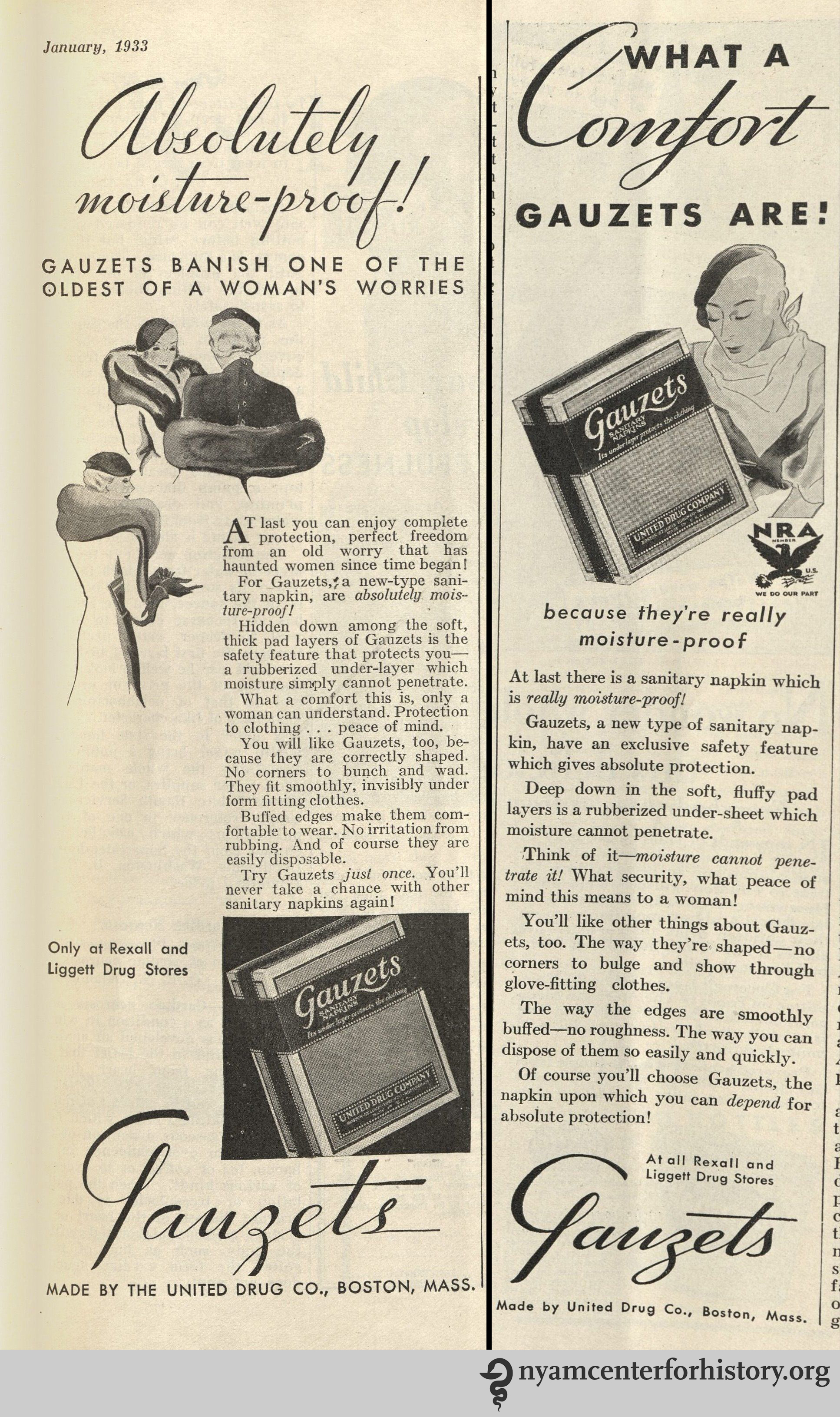
Kotex wasn’t alone in the marketplace for long: Gauzets and other, often cheaper, brands came along soon after, and also advertised heavily.

Gauzets ads from Hygeia Magazine, published in January and November 1933. Click to enlarge.

Gauzets ads from Hygeia Magazine, published in January and November 1933. Click to enlarge.

The first widespread commercial tampon arrived in the 1930s: Physician Earle Cleveland Haas received a patent for his applicator tampon in 1933, which he named Tampax. He distributed his product beginning in 1936.2,3 Prior to Tampax, tampons had widespread use as medical devices dating as far back as the 18th century.2,3 Soon after the development of Tampax, other commercial tampon brands, like Wix and B-ettes, became available and also advertised widely.

These early ads show the hurdles Tampax had to overcome to win wide acceptance from consumers and doctors. In fact, Tampax spent $100,000 on advertising in its first nine months alone; by 1941, the company was “one of the one hundred largest advertisers in the United States.”2 The ads worked: a 1944 survey showed that one quarter of women in the United States used tampons, even as doctors debated their safety.2,3 These ads, spanning the first 10 years of commercial tampon availability, emphasize the safety, comfort, convenience, and invisibility of the products.

Click on an image to view the gallery:

Despite the worries of physicians, early tampons were safe. In fact, our main concern with tampon use today, Toxic Shock Syndrome (TSS), was only linked to tampon use about 40 years after their debut. In 1978, Procter & Gamble released Rely, a super-absorbent tampon made from synthetic fibers. This new kind of tampon led to 55 cases of TSS from October 1979 through May 1980. But non-synthetic, less absorbent tampons pose little threat, and the bacteria that causes TSS is present and active in only a small percentage of people.3,5

Other options entered the marketplace in the 1930s: several menstrual cups received patents, including the first commercially available cup in the United States, patented by actress Leona Chalmers as a “catamenial appliance” in 1937.6 This cup’s design looks much the same as those on the market today.

Image from Leona Chalmers' 1937 patent for a "catamenial appliance." Source: https://www.google.com/patents/US2089113

Image from Leona Chalmers’ 1937 patent for a “catamenial appliance.” Source: https://www.google.com/patents/US2089113

In less than 100 years, menstrual supplies have moved from mostly homemade affairs to mass-market items available in stores, from products hidden away at the back of mail-order catalogs to some of the most commonly advertised goods in the United States. The advances of the 1920s and 1930s still impact our lives, as sanitary napkins, tampons, and cups remain go-to products, improved upon over time but not abandoned.

References

1.Kidd LK. Menstrual technology in the United States, 1854 to 1921. Ames, Iowa: Iowa State University Department of Textiles and Clothing; 1994.

2. Freidenfelds L. The modern period: Menstruation in twentieth-century America. Baltimore: Johns Hopkins University Press; 2009.

3. Fetters A. The tampon: A history. The Atlantic. June 1, 2015. Available at: http://www.theatlantic.com/health/archive/2015/06/history-of-the-tampon/394334/. Accessed March 1, 2016.

4. World War I centenary: Sanitary products. Available at: http://online.wsj.com/ww1/sanitary-products. Accessed March 1, 2016.

5. Vostral SL. Rely and Toxic Shock Syndrome: a technological health crisis. Yale J Biol Med. 2011;84(4):447–59. Available at: http://www.pubmedcentral.nih.gov/articlerender.fcgi?artid=3238331&tool=pmcentrez&rendertype=abstract. Accessed March 1, 2016.

6. North BB, Oldham MJ. Preclinical, clinical, and over-the-counter postmarketing experience with a new vaginal cup: menstrual collection. J Womens Health (Larchmt). 2011;20(2):303–11. doi:10.1089/jwh.2009.1929.

Presentations for History of Medicine Night: Intersections of Medicine, Health, and Ethnicity

The New York Academy of Medicine’s Section on the History of Medicine and Public Health invites you to join us for “Intersections of Medicine, Health, and Ethnicity” on March 9, 2016 from 6:00pm–7:30 pm at the Academy, 1216 Fifth Avenue at the corner of 103rd Street. Admission is free but advanced registration is required. Register online.

The evening’s presenters will be:

A wooden caduceus symbol shown in NYAM rare book reading room

A caduceus symbol donated to our rare book reading room

HARRIET A. WASHINGTON
Independent scholar
“The 1788 New York Doctors’ Riot: A Signal Event in the Dissection of Anatomical Ethics”

KATE BAILEY
Graduate Student, M.A. Health Advocacy Program, Expected May 2017
Sarah Lawrence College
“From Motherhood to Sisterhood: How Underground Abortion Referral Networks Worked Towards Advocacy and Solidarity”

KIRK JOHNSON
Doctoral candidate in the Medical Humanities program at Drew University
“Heart Illness: Developments of Racial Discourse”

MARLENE A. GEORGE
Graduate Student, Health Advocacy Program, Sarah Lawrence College
“Social Service Sterilization – Eugenics Of The 1950’s-1970’s”

BOB VIETROGOSKI
Head of Special Collections
George F. Smith Library of the Health Sciences
Rutgers Biomedical and Health Sciences
“‘Agitation of the Question’: James McCune Smith’s Nomination for Fellowship to the New York Academy of Medicine, 1847”

A second evening of presentations, History of Medicine Night Part II, will take place on Wednesday, May 4, and we hope that you will be able to join us for that one as well.

The Berg Brothers: Bibliophile Surgeons

By Anne Garner, Curator, Center for the History of Medicine and Public Health

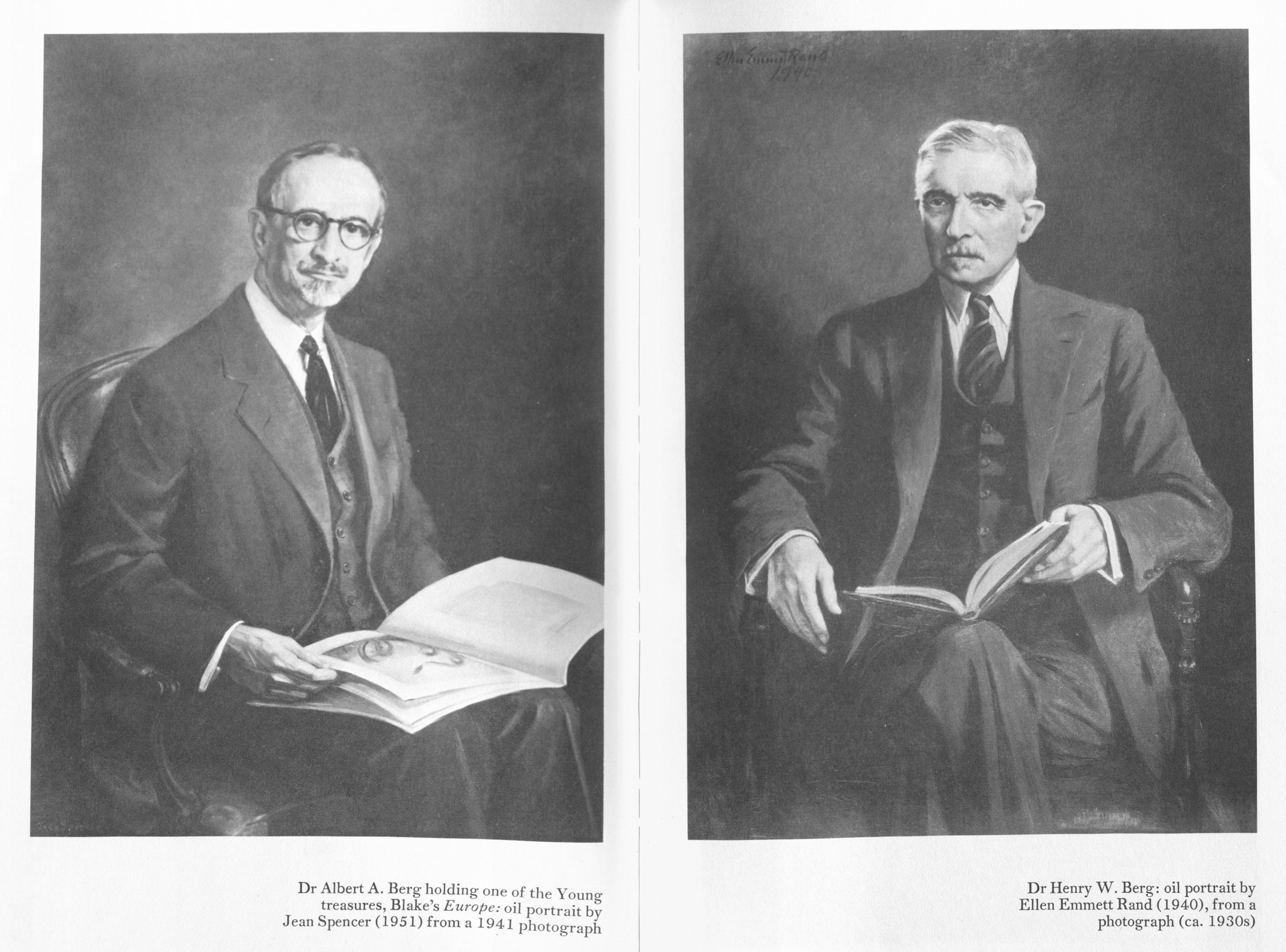
New York physicians Henry W. and Albert A. Berg are well-known to students of literature. In 1940, Albert A. Berg founded the New York Public Library’s spectacular Berg Collection, endowed in his older brother Henry’s memory. It is a magical place, nestled on the third floor of NYPL’s Steven A. Schwarzman building, with endlessly deep collections in its vaults (I should know, I was lucky enough to work there). Highlights include a typescript draft of T.S. Eliot’s The Wasteland, annotated by Ezra Pound; the manuscript notebooks containing five of Virginia Woolf’s seven novels; and a map drawn by Jack Kerouac of territory covered on the cross-country trip that inspired On The Road.

Left: Dr. Albert A. Berg, holding Blake's Europe, in an oil portrait by Jean Spencer hanging in The New York Public Library's Berg Collection. Right: Dr. Henry W. Berg in an oil portrait by Ellen Emmett Rand, also in the New York Public Library's Berg Collection. In Szladits, Brothers: The Origins of the Henry W. and Albert A. Berg Collection,1985.

Left: Dr. Albert A. Berg, holding Blake’s Europe, in an oil portrait by Jean Spencer hanging in The New York Public Library’s Berg Collection.
Right: Dr. Henry W. Berg in an oil portrait by Ellen Emmett Rand, also in the New York Public Library’s Berg Collection.
In Szladits, Brothers: The Origins of the Henry W. and Albert A. Berg Collection,1985. Click to enlarge.

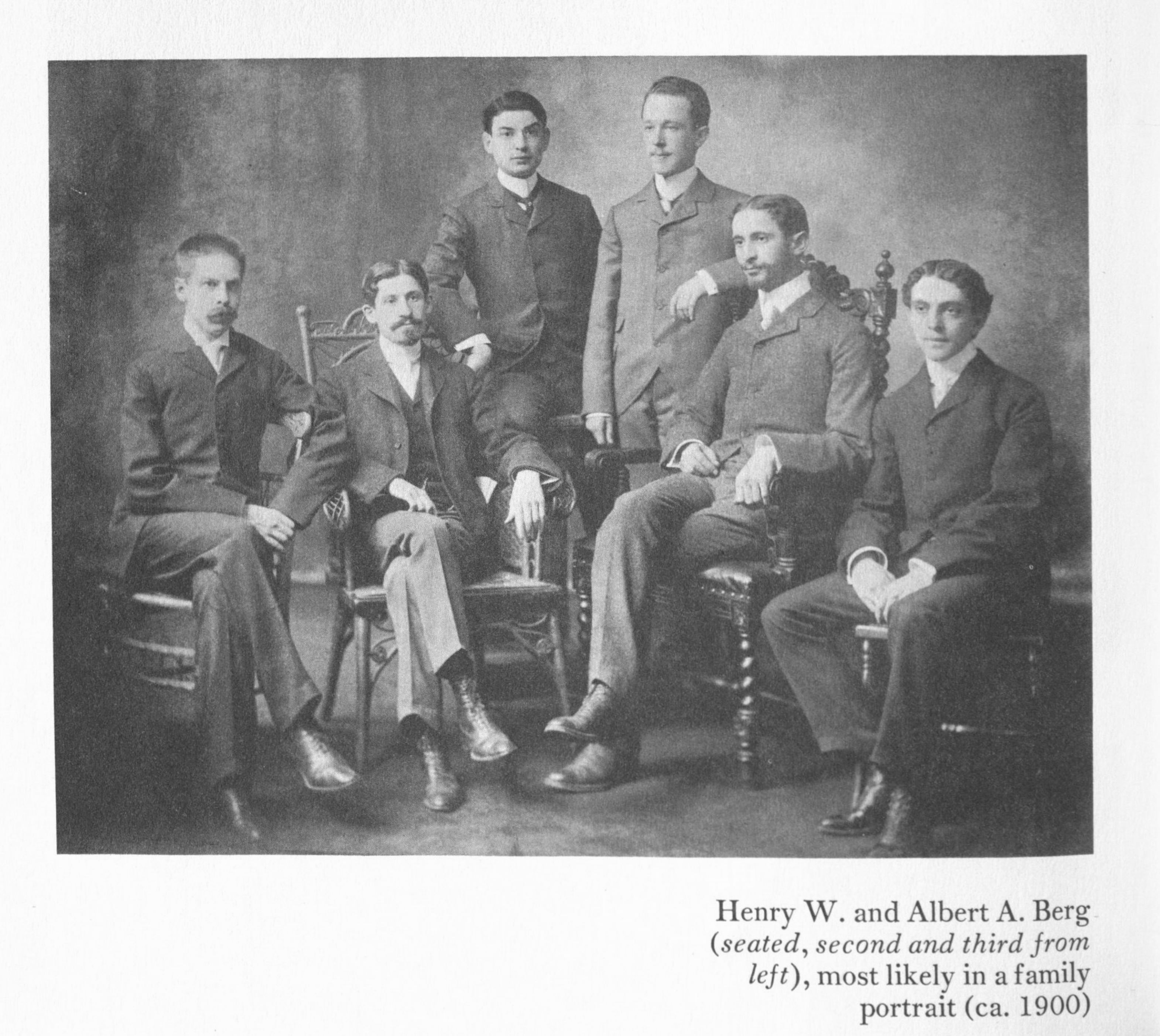
Fourteen years separated the eldest and youngest Berg siblings, but they had much in common, including interests in book collecting and literature, along with an aptitude for real estate investment (a pastime that funded their library interests). The two doctors lived together until Henry’s death in 1939 in a townhouse on East 73rd Street. The story of Henry and Albert Berg’s establishment of one of the world’s great literary collections is told in Lola Szladits’ excellent book, The Brothers.

The medical legacy of the brothers, both prominent New York doctors, is less widely known. Henry and Albert’s father, Moritz Berg, immigrated to America from Hungary in 1862 with designs to work as a doctor. He found work instead as a tailor to support his family of eight children. Moritz died of cancer when Albert was young, and Henry, already interested in medicine himself, determined that Albert should follow the same career path.1

Henry W. and Albert A. Berg (seated, second and third from left), most likely in a family portrait (circa 1900). In Szladits, Brothers: The Origins of the Henry W. and Albert A. Berg Collection,1985.

Henry W. and Albert A. Berg (seated, second and third from left), most likely in a family portrait (circa 1900). In Szladits, Brothers: The Origins of the Henry W. and Albert A. Berg Collection,1985.

Henry earned his medical degree from Columbia University’s College of Physicians and Surgeons in 1878, specialized in infectious disease, and headed Mount Sinai’s isolation service. He taught both neurology and pediatrics at the College of Physicians and Surgeons.2 Henry was attending physician at Willard Parker Hospital on East 16th Street for 40 years, until his death in 1939.3 His active role on Willard Parker’s board is documented in the Academy’s collection of Willard Parker minute books.

It was Henry who mentored Albert, put him through medical school, and showed him he could be a great doctor. All early indications were to the contrary: Albert repeatedly ditched class to play pool. Their mother was skeptical that Henry could ever make a doctor out of him.4 But by graduation (also from College of Physicians and Surgeons), Albert was a decorated prizewinner.5 And as a surgeon, he proved a brilliant and visionary pioneer, a key player in the development of abdominal surgery in the United States.

Albert A. Berg as a young doctor (seated, second from left). In Szladits, Brothers: The Origins of the Henry W. and Albert A. Berg Collection,1985, page 37.

Albert A. Berg as a young doctor (seated, second from left). In Szladits, Brothers: The Origins of the Henry W. and Albert A. Berg Collection,1985, page 37.

Albert’s exceptional skill as a surgeon is attested in a tribute article by Dr. Leon Ginzberg in a festschrift volume of the Journal of the Mount Sinai Hospital devoted to Albert’s career:

[Dr. Berg’s] tremendous capacity for work, his boldness and resolution, his extraordinary operative skill and his refusal to remain on the accepted path, had brought his service to an enviable position in the field of abdominal surgery. The most significant studies from his clinic were in the fields of gastroduodenal and jejunal ulcers. Other important contributions were made to the subjects of colonic, and more particularly rectal and recto-sigmoidal carcinoma….to chronicle adequately all of Dr. Berg’s ‘labors in the vineyard’ would be to write an important chapter in the history of the development of abdominal surgery in the United States.6

Title page of Alfred A. Berg’s Surgical Diagnosis, 1905, given by the author to the New York Academy of Medicine Library.

Albert’s skill and personal style made him one of New York’s most recognizable doctors by the 1920s. In physical appearance he was “six feet tall, slender, and forbidding.”7 Katie Loucheim’s remembrance in the New Yorker compares his appearance to an “esteemed rabbi…with a Vandyke beard…his manner in speaking and his voice were reassuring.”8 He wore a red carnation in his lapel, even during surgery, until the death of his brother in 1939.9

Albert—or A.A. as his medical friends called him—observed an almost fanatical devotion to the operating room. Loucheim reports that Albert regularly scheduled surgery for a few minutes before midnight on New Year’s Eve, believing that if he began the new year in surgery he could secure for himself a happy year. Berg’s dexterity as a surgeon ensured that he could easily converse about rare books while operating on patients, including his friend, the great book collector Carl Pforzheimer. Seven days a week, the Fifth Avenue bus—“Berg’s green taxi” to his colleagues, dropped him halfway down the block in front of the canopy of Mount Sinai. Other passengers complained because it wasn’t an actual bus stop (in turn, the conductors and bus drivers relied on Berg for any surgical needs).10

Mount Sinai Hospital, circa 1913. From The Dr. Robert Matz Collection of Medical Postcards.

Mount Sinai Hospital, circa 1913. From The Dr. Robert Matz Collection of Medical Postcards.

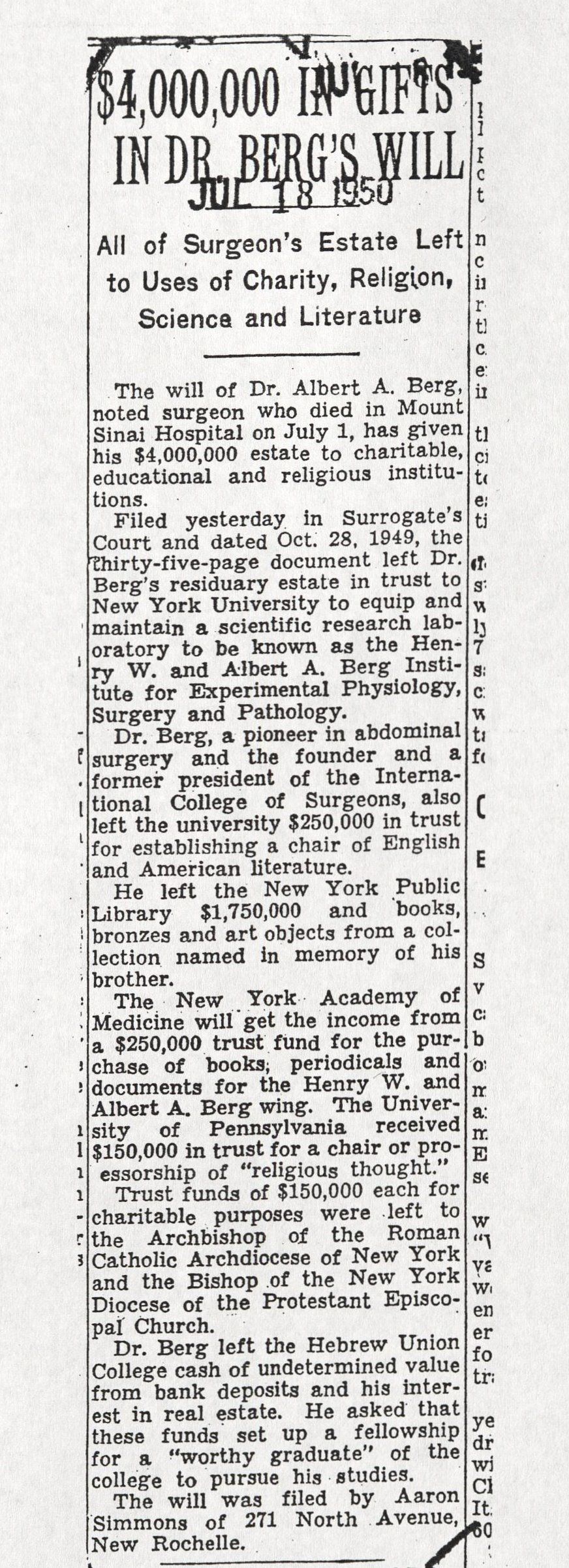
A stone’s throw away from A.A. Berg’s beloved Guggenheim pavilion at Mount Sinai Hospital, the Berg name lives on. On the third floor of the New York Academy of Medicine in the former periodicals room is a bronze plaque commemorating the gifts of Drs. Henry W. and Albert A. Berg to the Academy. A bequest from Albert endowed the third floor room that bears their name and still supports the acquisition of library periodicals today. Both brothers were Academy Fellows (Henry beginning in 1890, Albert in 1900).

Albert seems to have recognized how vital a good set of tools were to students of surgery. A copy of his last will and testament in the Academy’s archives entrusts his surgical instruments, instrument bags, and laboratory equipment, including two microscopes and examination tables and one portable operating table, to “one or more deserving young surgeons” to be selected at the Academy’s discretion.11 The items are no longer at the Academy; perhaps they were also used by a student whose path to medicine was at first uncertain, but later found his or her way.

New York Times article from July 18, 1950 announcing Albert A. Berg's bequests, including to the New York Public Library and the New York Academy of Medicine.

New York Times article from July 18, 1950 announcing Albert A. Berg’s bequests, including to the New York Public Library and the New York Academy of Medicine. Click to enlarge.

References

1. Szladits, Lola. Brothers : The Origins of the Henry W. and Albert A. Berg Collection. New York: New York Public Library, 1985. pp. 9-10.

2. Szladits, pp. 10-11.

3. Medical Society of the State of New York. Medical Directory of New York, New Jersey and Connecticut. New York: 1899-1939.

4. Louchheim, Katie. “Sweeping Formalities and Offstage Flourishes.” The New Yorker 3 Nov. 1975: 40-48. Print.

5. Szladits, pp. 11.

6. Ginzburg, Leon. “Some of the Principles and Methods contributed by the service of Dr. A.A. Berg.” Journal of the Mount Sinai Hospital Volume 17.6 (1951): 356-368. The Journal of the Mount Sinai Hospital has been digitized and is available online.

7. Szladits, 39.

8. Loucheim, 41.

9. New Yorker and Szladits.

10. Szladits, 42.

11. The New York Academy of Medicine Archives. Library Correspondence, 1927-1974.