The Good Man of Religion (Part 2 of 3)

This is part two of a guest post written by Anna Weerasinghe, a graduate of Harvard Divinity School studying the history and theology of Hansen’s disease. Read part one and part three.

Our last post saw Protestants Robert Louis Stevenson and the Rev. Dr. Hyde in a pitched, public battle for religious missionary Father Damien’s reputation. But what did fellow Catholics think of Damien?

Bishop Hermann Koeckmann and Father Leonor Fouesnel. In Daws, Holy man: Father Damien of Molokai, 1973.

Bishop Hermann Koeckmann and Father Leonor Fouesnel. In Daws, Holy man: Father Damien of Molokai, 1973.

“Good man of religion, good priest,” wrote Father Fouesnel, the vice-provincial of the mission at Honolulu, “but…sometimes indiscreet zeal leads him to say, to write, and even to do things which ecclesiastical authority can only criticize.”1 Damien was constantly at loggerheads with his superiors Fouesnel and Hermann Koeckemann, bishop of the Congregation of the Sacred Hearts on Hawaii, throughout his time at the Molokai leper settlement, and this is was nothing new.

Damien, born Jozef de Veuster on January 3, 1840 to a farming family in Tremelo, Belgium, was driven, strong, and competitive from a young age. He followed his elder brother Auguste into the Congregation of the Sacred Hearts of Jesus and Mary in 1860 and quickly strove to surpass him. When Auguste fell ill and was unable to make the trip to Hawaii to begin his mission, Damien literally jumped at the chance to take his place. He even went over the head of his direct superior by writing a letter to the father-general of the Congregation, much to his superior’s annoyance. By October 1863, he was onboard a ship destined for Hawaii. He was only 23 years old and had yet to be ordained.2

Damien at twenty-three, just before he left Europe. In Daws, Holy man: Father Damien of Molokai, 1973.

Damien at twenty-three, just before he left Europe. In Daws, Holy man: Father Damien of Molokai, 1973.

This first step towards Molokai set the tone for Damien’s often-fraught relationship with his superiors throughout his life. Damien was impolitic, demanding, and at times even imperious. He did not request supplies or aid, he demanded them; when he got the desired materials or money, he used them as he saw fit without waiting for approval. His intentions were generally good: for example, Damien once took lumber intended for the chapel in Pelekunu, a town on the other side of Molokai, to perform much-needed repairs on the chapel at the leper settlement instead.

But the biggest bone of contention was Damien’s extraordinary international media presence, particularly towards the close of the 1880s when Damien’s terminal Hansen’s disease diagnosis had been confirmed and publicized. This massive surge in popularity was accompanied by an equally vast outpouring in donations, directed not towards the Congregation’s mission, but to Damien himself.

“I see with displeasure,” wrote Bishop Koeckemann in early 1887, “that the newspapers which admire you exaggerate and put things in a false light, without taking account of what the government and others do—the mission also has its share.” Koeckemann and Fouesnel were convinced that Damien was fanning the flames of publicity, writing “to the four winds” about the miserable state of the leper settlement and insinuating that the mission and the government were shirking their duties.3

Damien was taken aback by his superior’s disapproval as much as by the media attention. He believed his actions to be encouraging charity, not publicity—and in fact, only a few letters by Damien were published during his life. His circumstances, rather than his words, were what aroused public interest. The press presented Damien as a hero of self-sacrifice: losing first his freedom of movement, then his health, and finally his life.

Still, after Damien’s death, neither Koeckemann nor Fouesnel were interested in pursuing a sainthood for Damien. All agreed that, after the press had labeled Damien a “hero” and “martyr of charity,” everything had been said. “The rest,” Koeckemann concluded, delicately leaving out all mention of Damien’s personal faults, “only complicates matters.” As Koeckemann’s successor, Bishop Gulston Ropert observed, “Even the beginnings of the process of beatification would have to wait until everyone who knew Damien well was dead.”4

Indeed, the process of Damien’s canonization did not begin until 1977, when Pope Paul VI declared him to be venerable (the first step towards full sainthood). It would take another three decades and two posthumous miracles for Damien to be officially recognized as the patron saint of Hansen’s disease patients.5

The feast day chosen for the new Saint Damien was not the day of his death, as is typical for Catholic saints. Instead, Damien is venerated on May 10, the anniversary of his arrival on the island of Molokai—a moment that many regarded as a death sentence far worse than physical death.6 In the final post, we will look at Hansen’s disease on Hawaii, as well as the progression of Damien’s own illness and death.

Read part three.

References

1. Gavan Daws, Holy Man: Father Damien of Molokai (New York: Harper & Row, 1973), 136.

2. Philibert Tauvel, Rtather Damien: Apostle of the Lepers of Molokai, Priest of the Cognregation of the Sacred Hearts (London: Art and Book Co., 1904), 29-31.

3. Daws, 191.

4. Daws, 245-246. Beatification is the second of three formal steps in the process leading towards sainthood.

5. Rachel Donadio, “Benedict Canonizes 5 New Saints,” The New York Times, October 11, 2009. For more about the second miracle, which was documented in the Hawaii Medical Journal, see “Vatican Affirms Miraculous Healing Attributed to Blessed Father Damien.” Catholic News Agency. May 1, 2008.

6.In fact, at the time when Damien left for Molokai, the government of Hawaii was deliberating a law that would declare confirmed Hansen’s disease victim legally dead. Daws, 73.
The Strange Case of Father Damien (Part 1 of 3)

Today we have part one of a guest post written by Anna Weerasinghe, a graduate of Harvard Divinity School studying the history and theology of Hansen’s disease. Read part two and part three.

“The simple truth is, [Father Damien] was a coarse, dirty man, headstrong, and bigoted. He was not sent to Molokai, but went there without orders; did not stay at the leper settlement (before he became one himself), but circulated freely over the whole island. He had no hand in the reforms and improvement inaugurated, which were the work of our Board of Health…and the leprosy of which he died should be attributed to his vices and carelessness.”1   

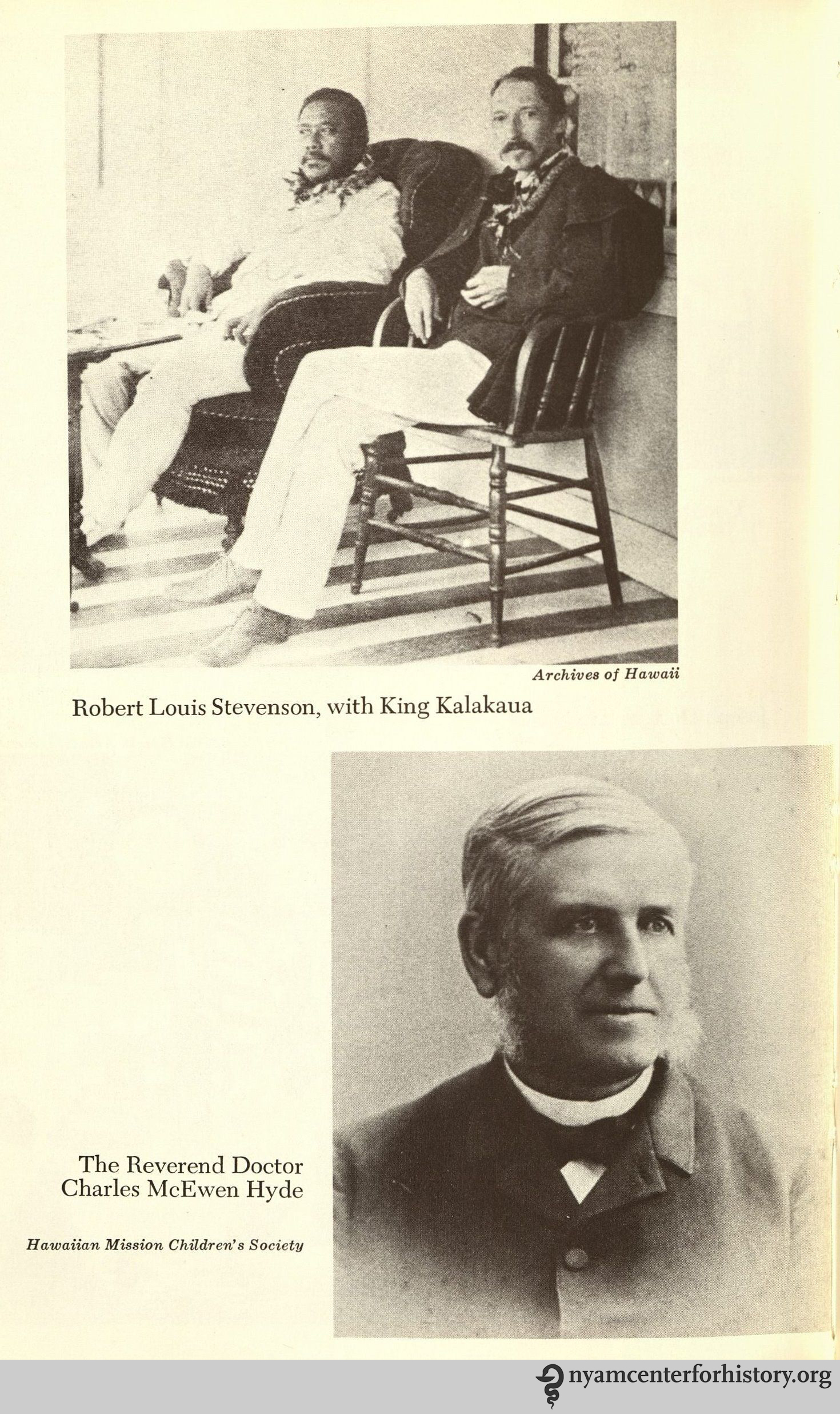
Robert Louis Stevenson and the Reverend Doctor Charles McEwen Hyde. In In Daws, Holy man: Father Damien of Molokai, 1973.

Robert Louis Stevenson and the Reverend Doctor Charles McEwen Hyde. In In Daws, Holy man: Father Damien of Molokai, 1973.

So wrote the Reverend Doctor Charles Hyde on August 2, 1889, just months after Father Damien’s death. In just a few weeks on May 11, “Father Damien Way” (33rd Street between First and Second Avenues) will join the ranks of the numerous public memorials named in Saint Damien’s honor.2 Based on Hyde’s colorful description, Damien hardly sounds like the kind of man to be sainted for his charitable work in Hawaii among sufferers of Hansen’s disease (better known as leprosy). Nor does Damien seem like the kind of celebrity whose death would ignite a firestorm of controversy, culminating in a pitched battle of wits between the Reverend Doctor Hyde and world-renowned author Robert Louis Stevenson that would help catapult its subject to enduring international fame.

So just who was Father Damien? A saint or a sinner? A hero or a victim? In this series of blog posts, we will get to know the many sides of Father Damien—the man, the saint, the Hansen’s disease victim—and the divisive forces that shaped his life and legacy.

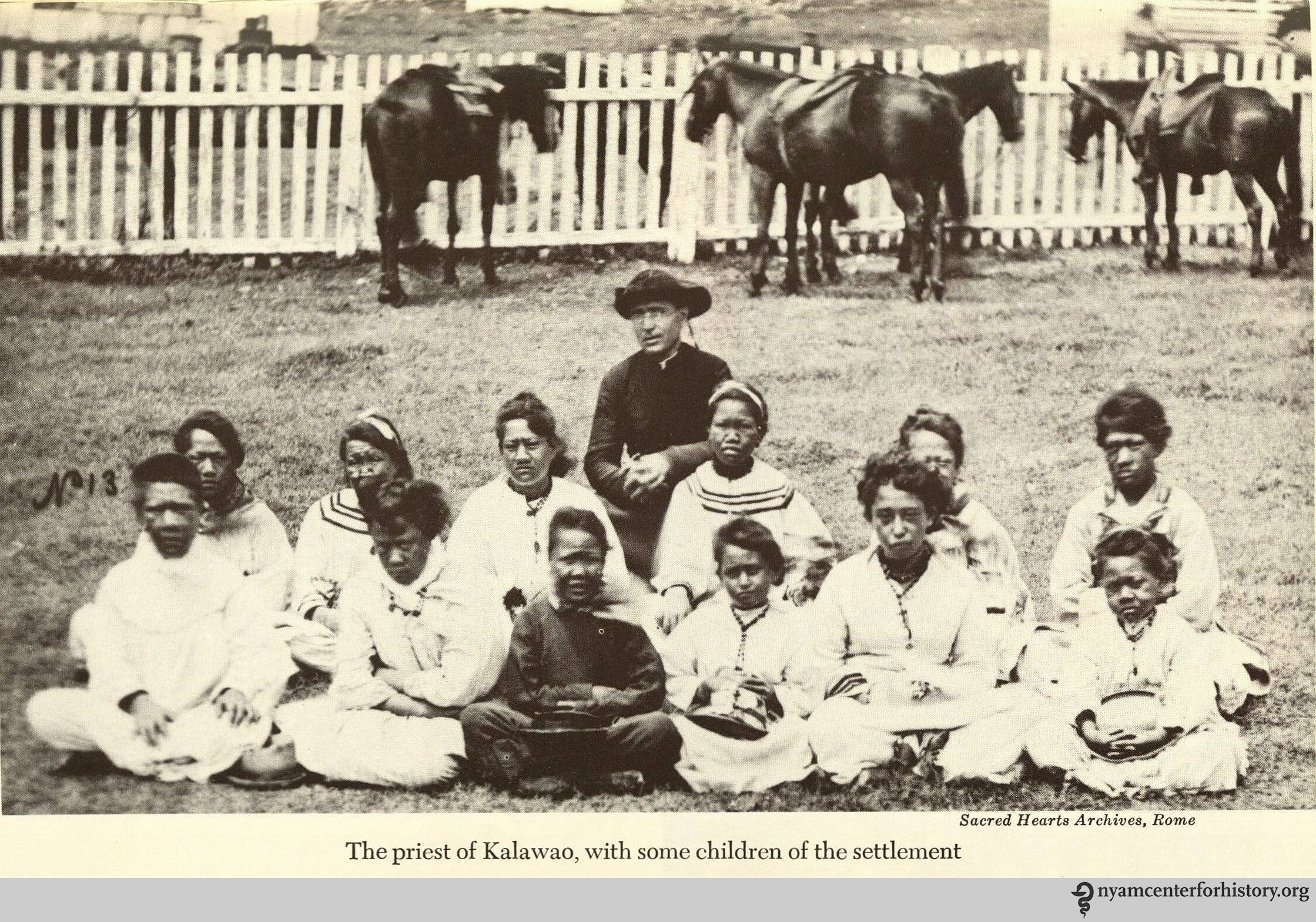
When Father Damien first arrived at the Kalawao leper settlement on the isolated Hawaiian island of Molokai in 1873, he caught the attention of the press almost immediately. As the first western religious missionary, Catholic or Protestant, to live within the leper settlement despite being free of the disease himself, Damien was something of a sensation. He was praised for his Catholic sense of self-sacrifice and even dubbed a “martyr,” particularly towards the end of his life when it became clear that he had contracted a severe and ultimately fatal form of Hansen’s disease.3

“The priest of Kalawao, with some children of the settlement.” In Daws, Holy man: Father Damien of Molokai, 1973.

So while the Reverend Doctor Hyde only met Damien once during a brief visit to Kalawao in 1885, he had already heard far too much about the priest’s saintliness for his taste. Philanthropic efforts to segregate and support those afflicted with Hansen’s disease in Hawaii were largely funded by wealthy Protestant businessmen and politicians from the United States with a view to future American annexation of the islands. Hyde, an able administrator of these charitable funds, felt that Damien was taking advantage of Protestant charity. “Others have done much for the lepers, our own ministers, the government physicians, and so forth,” Hyde complained. “But never with the Catholic idea of meriting eternal life.”4

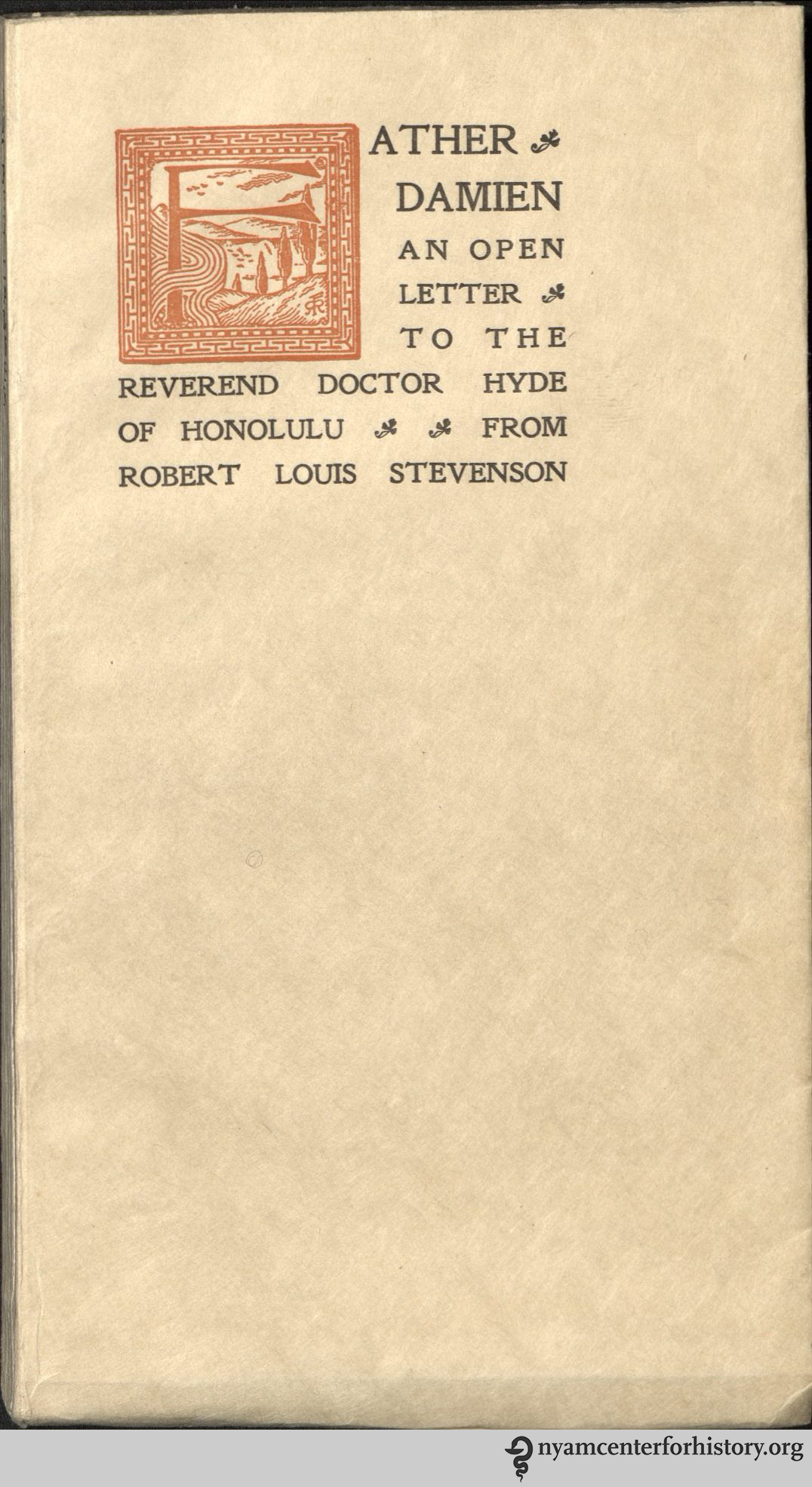
Halfway across the world in Sydney, Robert Louis Stevenson read Hyde’s criticism of Damien with mounting rage. Fresh from the success of his best-selling novel Dr. Jekyll and Mr. Hyde, Stevenson wasted no time in raising his pen against the Reverend Doctor: “With you,” he wrote with a certain viciousness, “I rejoice to feel the button off the foil and to plunge home.”5 In February of 1890, he printed his own “Open Letter to the Reverend Doctor Hyde of Honolulu,” a thirty-page rebuttal ripping apart Hyde’s short complaint.

Unlike Hyde, Stevenson had never met Damien personally. But he was a fellow invalid, terminally ill with tuberculosis, and felt a close affinity for the priest and his country despite their religious differences. Stevenson had travelled to Hawaii for his health in the summer of 1889 and visited the island of Molokai just after Damien’s death. Interviewing both Damien’s compatriots and Protestant critics, he found they “build up the image of a man, with all his weaknesses, essentially heroic, and alive with rugged honesty, generosity, and mirth.”6 Was he coarse? Dirty? Headstrong? Even bigoted? Stevenson admitted he probably was, but asserted that these faults didn’t diminish his bravery or achievements. To Stevenson, Damien’s failings simply made him a human, rather than superhuman, hero.

The response was immediate. Hawaiian newspapers were flooded with responses to Stevenson’s letter ranging from gleeful to indignant. Headlines bloomed across the United States, from San Francisco to Omaha to New York. “Damien Defended!” declared the Omaha Daily Bee. “A Reverend Gossip Rebuked,” taunted The New York Times.7 Hyde didn’t stand much of a chance in this battle of the printed word. Stevenson’s impassioned defense of Damien triggered an outpouring of charity from around the world dedicated to the deceased Damien’s cause. Hyde never backed down from his position, but he retreated from public view. “I leave it to any candid mind to judge which side lies the calumny and slander,” the beleaguered Hyde concluded. “There let it lie.”8

Damien’s greatest public critic and most famous defender have had their say, but the man himself remains a mystery Next time, we’ll hear more from those who knew the best and worst of Damien personally—his religious superiors.

Read part two and part three.

References

1. As quoted in Robert Louis Stevenson, Father Damien: an open letter to the Reverend Doctor Hyde of Honolulu from Robert Louis Stevenson (London: Chatto and Windus, 1890), 6-7.

2. Flanders House. http://www.flandershouse.org/fatherdamien

3. For examples see, “Father Damien’s Mission,” The Pacific Commercial Advertiser, November 5, 1885; “The Late Father Damien,” The Honolulu Daily Bulletin, April 29, 1889; “The Leper Martyr,” New-York Tribune, May 12, 1889.

4. Gavan Daws, Holy Man: Father Damien of Molokai (New York: Harper & Row, 1973), 12-13. Stevenson, Father Damien, 7.

5. Stevenson, Father Damien, 8.

6. Stevenson, Father Damien, 20.

7. For examples see “Letter to the Editor: Robert Louis Stevenson’s Letter,” The Hawaiian Gazette, May 27, 1890; “Letter to the Editor: Stevenson’s Letter,” The Pacific Commercial Advertiser, May 21, 1890; Mary Lambert, “Stevenson and Father Damien,” San Francisco Morning Call., June 8, 1990; “Damien Defended!,” Omaha Daily Bee, May 24, 1890; “A Reverend Gossip Rebuked,” The New York Times, January 21, 1890.

8. As quoted in Daws, Holy Man, 247.

Why the Beef? Empire and Cuisine

Today’s guest blogger is Dr. Rachel Laudan. Originally trained as a historian of science, Dr. Laudan has taken her historical research into food history. This blog post is inspired by Dr. Laudan’s most recent work, Cuisine and Empire: Cooking in World History (University of California Press, 2013), focusing on the movers of gastronomic change from pre-history to the present.

Dr. Laudan will discuss her work on April 12 at the Food Book Fair at Brooklyn’s Wythe Hotel. The Fair will include two panels presented by the New York Academy of Medicine, Food and Empire and Cookbooks and History. For more information and for tickets, visit foodbookfair.com.

“Where’s the beef?” asked actress Clara Peller of a rival burger in a 1984 Wendy’s advertisement. Within a matter of weeks, her words had become an American catchphrase.


Curious, though, when you think about it, that Americans were so enamored of beef. Through most of history, beef was low on the hierarchy of meats. Chinese preferred pork or fish; people in the Middle East and the Mediterranean relished lamb and goat; and Indians created cuisines in which meat played a secondary role if not avoided altogether. Most people stayed away from the tough stringy meat from old work animals or worn out dairy cattle.

Northwestern Europe and its former colonies are the exceptions. For Americans, for example, not only is beef delicious, but they and others see it as a symbol of American power, particularly when combined with white bread to make a hamburger. On January 31, 1990, 5,000 people waited in the chilly Moscow dawn for the first McDonald’s in the USSR to open its doors; by nightfall, 30,000 had been served. Many commented that the opening of McDonald’s foreshadowed the fall of the USSR.

Because McDonald’s was so symptomatic of American strength, no one took it lightly, whether they liked it or not. The Economist used the price of a Big Mac to value the world’s currencies; the sociologist George Ritzer coined the term McDonaldization to mean efficiency, predictability, and mechanization. In the 1980s, the Slow Food movement took its name as it opposed the opening of a McDonald’s in Rome. In 1999, the French farmer José Bové dismantled a McDonald’s under construction in France, rallying supporters with the call McMerde (McShit).

Beef recipes from pages 38-39 of Ann Peckham's The Complete English Cook, Leeds, 179?. Click to enlarge.

Beef recipes from pages 38-39 of Ann Peckham’s The Complete English Cook, fourth edition, Leeds, 179?. Click to enlarge.

Beef as the symbol of American power was a natural successor to beef as the symbol of British power. Beef, the flesh of the most powerful domesticated animal, its bright red color suggesting strength and masculinity, had been hallowed by the English since at least the 17th century. In song, in quips such as the “roast beef of Old England,” in clubs centered around eating steaks, and in ox roasts distributed to the poor on political occasions, beef became synonymous with Englishness. When Justus Liebig, the leading chemist of the first half of the 19th century, declared that proteins were the crucial nutrients, essential to the building and maintenance of the body, English faith in beef was confirmed.

In fact, steaks and roasts were beyond the means of most English in the 19th century. Sticky brown essence of beef provided, as hamburger offered later, an affordable alternative. Meat extract, according to Liebig, was as nutritious as beef itself. He offered to provide it neatly bottled from his factory in distant Uruguay, which extracted beef essence from cattle carcasses hitherto valuable only for their fat and hides.

Calendar blotter for December 1928 and January 1929 issued by Fairchild Brothers and Foster and their UK agents, Burroughs, Wellcome and Co. advertising 'Panopepton' beef extract, "the pure nutritious substance of beef and wheat in perfect solution". This would have been one of a series of blotters sent out to members of the medical profession every 2 months. Courtesy of Wellcome Library, London.

Calendar blotter for December 1928 and January 1929 issued by Fairchild Brothers and Foster and their UK agents, Burroughs, Wellcome and Co. advertising ‘Panopepton’ beef extract, “the pure nutritious substance of beef and wheat in perfect solution”. This would have been one of a series of blotters sent out to members of the medical profession every 2 months. Courtesy of Wellcome Library, London.

Beef essence was one of the fastest growing areas of the food-processing industry in the 19th century, with entrepreneurs from the American meat packer Armour to the chef Escoffier investing their reputation and money in extracts.

"I hear they want more Bovril. My place is at the front." 1915 advertisement. Library of Congress, Prints & Photographs Division, WWI Posters.

“I hear they want more Bovril. My place is at the front.” 1915 advertisement. Library of Congress, Prints & Photographs Division, WWI Posters.

One of the most successful companies was Bovril. Its name combined modern theories of race embodied in the bestselling novel The Coming of the Master Race (1871) by the politician Edward Bulwer Lytton, and classical antecedents of empire. The first provided “Vril,” the name for all-penetrating energy harnessed by a subterranean race of super men, and the second “bovis,” Latin for “of the ox.” According to a series of stunning advertisements, this small jar of brown syrupy stuff strengthened men at the front, built up children bursting with health, and averted influenza, no small matter when the 1918 pandemic killed three to five percent of the world’s population.

Meat extract, like hamburgers later, depended on an infrastructure that stretched from the advertising and retailing industries, through the steamships and trains that shipped carcasses to factories and gleaming bottles of extract around the world, to vast areas of land. In 1932, Bovril ran cattle on 1.3 million acres in Argentina and 9 million acres in Canada, over ten times the acreage of the King Ranch in Texas, which claimed to be the biggest in the United States.

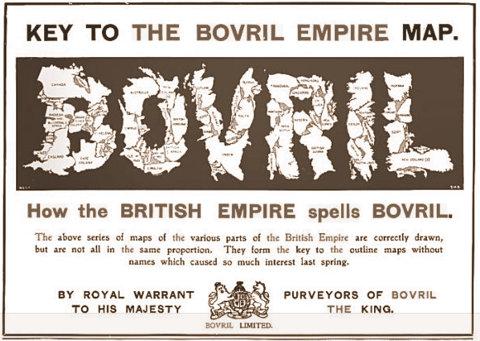
Inevitably, the power of beef came to be seen as underpinning the expanding British Empire. To mark the coronation of Edward VII, the major British weekly The Illustrated London News ran an advertisement on February 2, 1902. Titled “How the British Empire Spells Bovril,” it illustrated “the close association of this Imperial British Nourishment with the whole of King Edward’s Dominions at Home and Beyond the Seas” by fitting the national outlines (reduced or expanded as necessary) into the letters of the word Bovril.

Bovril advertisement in The Illustrated London News, February 2, 1902. Courtesy of Rachel Laudan.

Bovril advertisement in The Illustrated London News, February 2, 1902. Courtesy of Rachel Laudan.

Today, although English soccer fans still take hot Bovril broth to games, the idea that it is nourishment for Empire builders is long gone. And even McDonald’s is not the power it was a decade ago. Consumers go instead to Chipotle, Panera, and Starbucks, which offer the promise of healthier, tastier, less mass-market foods. Is this the end of empire? Or a change of direction?

Got Food?

Evelyn J. Kim, today’s guest blogger, is an author and writer working on issues of food and food justice through the lens of science. Trained as a historian of science, her work has been in the The New York TimesScientific American, and The Atlantic. She is our guest curator for this year’s programming, Eating Through Time.

Les Aphorismes de Brillat-Savarin. From the Margaret Barclay Wilson Collection.

Les Aphorismes de Brillat-Savarin. From the Margaret Barclay Wilson Collection.

“Dis-moi ce que tu manges, je te dirai ce que tu es” (Tell me what you eat, and I will tell you what you are)

– Jean Anthelme Brillat-Savarin (1755-1826), Physiologie du Goût ou: Méditations de Gastronomie Transcendante

“Let food be your medicine and medicine be your food” – Attributed to Hippocrates

What do you do every day, beyond sleeping, breathing and thinking? You eat! This year, The New York Academy of Medicine is proud to announce its programming theme for 2015: Eating Through Time.

CHM-ETT-Logo1_VertTop Chef. The Salt. Lucky Peach. Grub Street. Modernist Cuisine. And thousands upon thousands of food blogs. Unless you’ve been living underneath a rock, food seems to be all around us. On television, on the web, in art, in books, in science…Food seems to be having its own “moment” as form of cultural currency. But lest anyone think that this is a new phenomenon, food has always been with us, from pre-history to the present, a basis of our bodily, social, economic, and historical selves.

To that end, we are sponsoring a whole year of activities around food, including guest lectures at the Academy and panel discussions at this year’s Food Book Fair, culminating in a full-day festival at the Academy on October 17, 2015. Based on the Academy’s collection of more than 10,000 volumes on food and health, the festival will include speakers, demonstrations, and performances centered on the topic of food. Featured speakers include our keynote speaker, famed chef Jacques Pépin, food historian Dr. Ken Albala, and Nordic Food Lab’s Joshua Evans, as well as the Culinary Institute of America and Harvard School of Public Health’s Healthy Kitchens, Healthy Lives program.

This year’s programming will encompass not only contemporary debates surrounding food, medicine, and culture, but also the historical linkages that undergird much of those discussions. We will ask chefs, historians, writers, and public health experts their perspectives on not only food’s past influence but also what’s in store in the future for us as eaters and as a society.

Marx Rumpolt, Ein new Kochbuch, 1581.

Marx Rumpolt, Ein new Kochbuch, 1581.

To kick off this year’s programming, our inaugural lecture on March 17 will feature historian of science Dr. Steven Shapin from Harvard University. Dr. Shapin has written on several topics, from Dr. Robert Boyle to the role of business in scientific research, and his current interests lie in the history of dietetics. His lecture, entitled “Beef-Eaters: A Cultural History of Food and Identity” exemplifies the complicated nexus between our dietary habits and our social identitiesand is a perfect start to this year’s theme.

We’re excited about this year’s programming and we hope to see you at any or all our events. Visit www.nyam.org/events for event details and registration, and follow this blog for more delicious tidbits on our year in food.

Adenoids and American School Hygiene in the Early 20th Century

Kate Mazza, today’s guest blogger, received her doctorate in US history from the Graduate Center, CUNY. Her dissertation, “The Biological Engineers: Health Creation and Promotion in the United States, 1880-1920” examines the ideas and progress of the interrelated health reforms of physical education and school hygiene. She has published an article, “Distracted At School: Aprosexia, ADHD and Adenoids in American Culture” in the Journal of American Culture.

NYTimesHeadlines_AdenoidsAs the school year came to a close in June 1906, a panic swept through New York’s Lower East Side. According to newspaper reports, hundreds of parents, mostly Eastern European immigrants, ran to about a dozen local schools believing that their children were going to be harmed or murdered by doctors. Some people broke windows, some hit school workers, many yelled and cried and all demanded to see their children. At each school, children were eventually dismissed early, and, to the great relief of the frightened parents, were unharmed. A similar course of events took place in Brownsville, Brooklyn the next day.1 These events came to be known as the “adenoid riots” because they occurred a week after students had undergone surgeries, apparently without incident, to remove enlarged adenoids at Public School 110 in the Lower East Side.

What caused the riots? Most accounts of the time blamed the immigrant population, stating that they were subject to panics, suspicious and ignorant of modern medical practice, and incensed and saddened by recent news of the Bialystok pogroms. Reporters also commented that local doctors intentionally spread rumors that children were being harmed because they saw free school and city services as a threat to their business.

Modern scholars, sympathetic to the immigrant’s perspective, have analyzed the events as a reaction against coercive means of assimilation.2 Yet while “Americanization” certainly played a role in this health initiative, school medical inspection affected children of all classes and ethnic groups in the United States and abroad. The confusion, fear, and misunderstanding of the adenoid riots was caused, in part, by erroneous beliefs about the implications of enlarged adenoids (masses in the back of the nasal cavity that can help fight infection), the methods used in NYC, and the zealousness of the hygienists to find and root out adenoids.

In Gulick and Ayres, Medical inspection of schools, 1917 (2nd ed.), page 4.

“Mouth breathing means adenoids; adenoids mean deadened intellects.” In Gulick and Ayres, Medical inspection of schools, 1917 (2nd ed.), p. 4.

In 1887, Amsterdam physician A.A. Guye connected enlarged adenoids to aprosexia, or the inability to pay attention, along with poor memory and headaches.3 This idea laid the foundation for associating adenoids with academic failure, disobedience, and truancy. Over the years, physicians also linked enlarged adenoids to deafness, poor voices, trouble sleeping, colds, weight loss, restlessness, chest and mouth deformity, mouth breathing, ear disease, and even tuberculosis.4

By the early 1900s, many involved in the growing school hygiene movement in the United States were convinced that enlarged adenoids were a common impediment to learning. In 1905 New York City became one of the first cities to inspect students for enlarged adenoids along with ear, nose, and throat problems. This more thorough physical examination was added to examinations for contagious diseases that had taken place since the 1890s in a number of cities.

"Mouth breathers before adenoid party." In Allen, Civics and Health, 1909, p. 55.

“Mouth breathers before ‘adenoid party.'” In Allen, Civics and health, 1909, p. 55.

Chief Medical Inspector of the New York City Department of Health, Dr. John C. Cronin, spearheaded the expanded medical inspection. He claimed that at PS 110, 137 children out of 150 in a specialized class of so-called “backward,” “incorrigible,” and “truant” children had enlarged adenoids.5 As the end of the school year approached, 56 children had had them removed, with 81 remaining. Cronin arranged to have the students convalesce in the countryside with the Society of Improving the Condition of the Poor at the end of the school year. Yet Cronin also wrote later that “it was then thought justifiable to get information as to what scholastic results would be obtained if these children were operated on collectively.”6 Seemingly frustrated, he brought in three doctors from Mount Sinai hospital to perform the operations at the school, after obtaining permission slips from parents. Cronin stated that doctors performed operations on 81 children in 84 minutes.7 While it was typical to do these surgeries quickly and without anesthesia or after care, these operations were done at an exceedingly rapid pace. From various accounts, children left the schools bleeding profusely. The riots occurred a week later.

"Mouth breathers immediately after 'adenoid party.'" In Allen, Civics and Health, 1909, p. 46.

“Mouth breathers immediately after ‘adenoid party.'” In Allen, Civics and health, 1909, p. 46.

Despite the rioting, Cronin publicized the efforts at PS 110 as an outright success. He held that all but four of the students had significant mental and physical improvement. He wrote: “From dullards, many of them have become the brightest among their fellows, after the operation.”8 A New Jersey doctor commented that removal of adenoids “has been followed by such wonderful improvement of the body and mind as to make recital sound like romance. The story of public school No. 110 in New York City, is almost beyond belief except to those who are familiar to it.”9 Medical and educational journals were filled with accounts of transformation through adenoid surgeries, many referencing PS 110.

As they preached their belief in transformation through surgery, these doctors and hygienists continually bolstered the idea that presence of enlarged adenoids caused poor scholarship and deviance. This association is clear when looking at hygiene statistics. When medical inspections took place in Northeastern urban centers, adenoids were found in roughly 30% of students. However, when the students were in a reformatory or a specialized class, like the students at PS 110, numbers climbed to 90%.

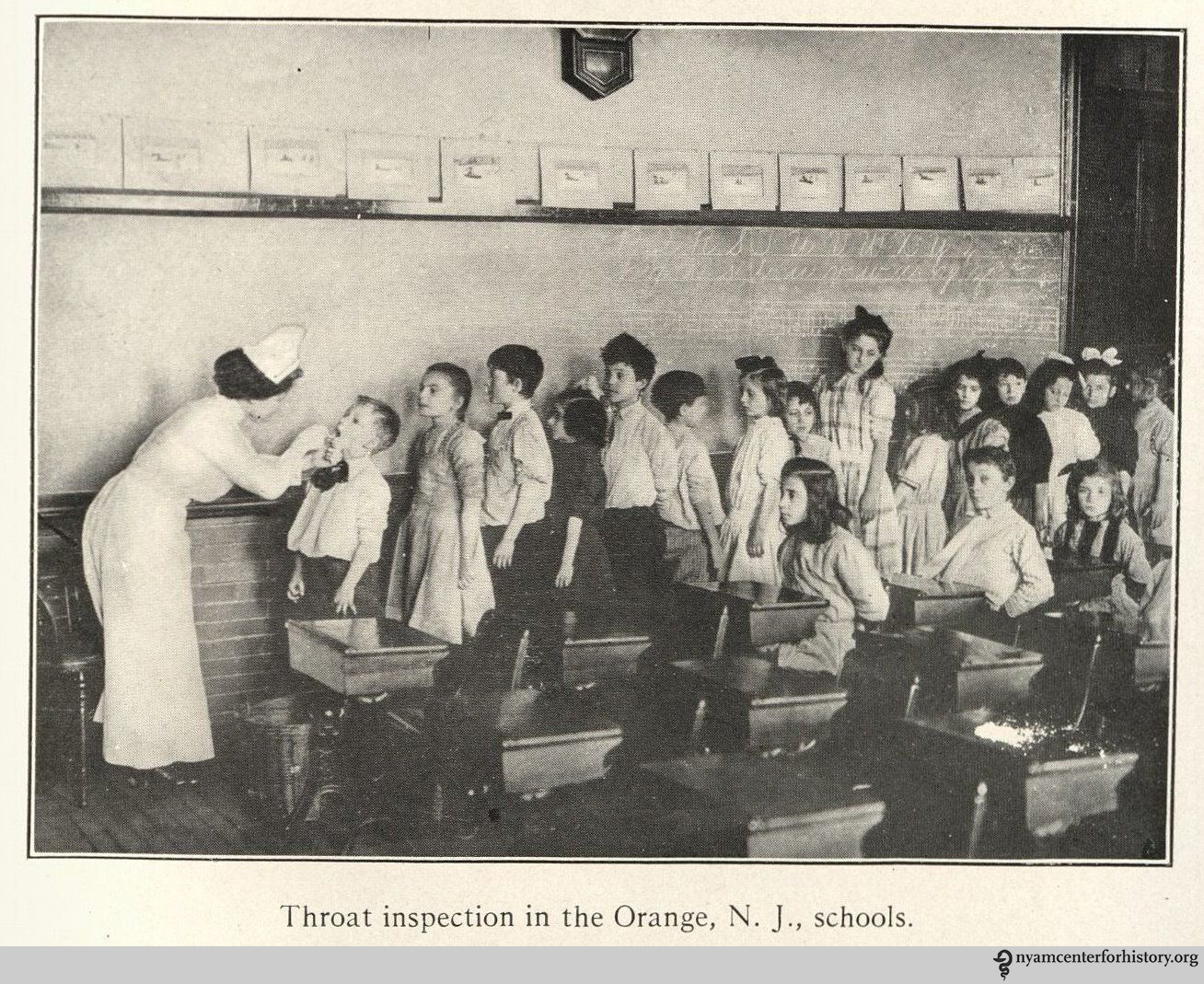
"Throat inspection in the Orange, N. J. schools." In Gulick and Ayres, Medical inspection of schools, 1917 (2nd ed.), p. 148.

“Throat inspection in the Orange, N. J. schools.” In Gulick and Ayres, Medical inspection of schools, 1917 (2nd ed.), p. 148.

Even while the “adenoid craze” was in full swing, many parents did not abide by the prescriptions of medical inspectors to have their children undergo various treatments and adenoidectomy. When “defects” were found in school medical examinations, the rate of compliance was usually less than a third, as inspectors in various cities including Cleveland, Chicago, and Bridgeport, Connecticut remarked in the 1900s and 1910s.10

During the 1910s, the faith that experts had in the radical transformation of students through adenoidectomy began to wane. Walter Cornell, a leading advocate of the surgeries, found that his study group did not succeed academically after the surgeries as was expected, and wrote in 1912 that this case “certainly explodes the theory that the removal of adenoids is the panacea for all juvenile delinquencies.”11 Others began to see similar results.

"Typical adenoid faces showing mouth breathing, flattened noses, and protruding eyes." In Gulick and Ayres, Medical inspection of schools, 1917 (2nd ed.), p. 170.

“Typical adenoid faces showing mouth breathing, flattened noses, and protruding eyes.” In Gulick and Ayres, Medical inspection of schools, 1917 (2nd ed.), p. 170.

Medical inspection, particularly in New York City, came under fire, as many complained that examinations were too superficial and inaccurate and that enlarged adenoids were overdiagnosed. In one investigation, for example, the same group of children was examined by two different inspectors. The first inspector found that 70 students needed adenoidectomy, the second found that 96 did, with only 49 students in common.12

For school and city authorities, adenoid surgeries were an appealing, cheap, convenient way to reform education by changing the child, rather than overhauling the educational system. It is not surprising that they were overdiagnosed or misdiagnosed. While the adenoid riots took place at the beginning of the “adenoid craze,” they illustrate a general suspicion of these new hygiene practices and of the school’s new role in public health.

References

1. “East Side Parents Storm the Schools,” New York Times, 28 June 1906, pg. 4; “Throat-Cutting Rumors Revive School Rioting,” New York Times, 29 June 1906, pg.9.

2. For an interesting view of the adenoid riots, see Alan Kraut, Silent Travelers: Germs, Genes and the Immigrant Menace (Baltimore: Johns Hopkins University Press, 1994).

3. A.A. Guye, “On Aprosexia, Being the Inability to Fix the Attention and other Allied Alterations of the Cerebral Functions caused by Nasal Disorders,” Journal of Laryngology and Rhinology 3 no.11 (December, 1889):499-506.

4. For example, see Macleod Yearsley, Adenoids (London: The Medical Times, 1901); 39-74; W.E. Casselberry, “Facial and Thoraic Deformities Incident to Obstruction by Adenoid Hypertrophy in the Naso-Pharynx,” Journal of the American Medical Association 15 no. 12(September 20, 1890): 417-420; W.L. Grant, “Some Common Conditions of the Nose and Naso-Pharynx Demanding Operative Interference,” Philadelphia Medical Journal 2 no.16(October 15, 1898):798-799; Allen T. Haight, “Naso-Pharyngeal Adenoids as a Causative Factor in Ear Diseases,” Journal of the American Medical Association 33 no. 26 (December 23, 1899): 1577-1578.

5. John J. Cronin, “The Physical Defects of School Children,” The Journal of the New York Institute of Stomatology 2 no. 4(December, 1907):280.

6. Ibid., 280.

7. “Medical Attention in Public Schools,” American Gymnasia and Athletic Record 3 no. 6(February, 1907):125.

8. John J. Cronin, “The Doctor in the Public School” The American Monthly Review of Reviews 35 no. 4 (April, 1907): 438.

9. F.C. Jackson, “The Medical Supervision of Schools” The New Jersey Review of Charities and Corrections 7 no. 3 (March, 1908): 84.

10. Luther Gulick and Leonard Ayres, Medical Inspection of Schools (New York: Russell Sage, 1909, ed.), 102; Florence A. Sherman, “Medical Inspection in Bridgeport (Conn.) Public Schools,” Fourth International Congress on School Hygiene 4(August, 1913):394; Mrs. Edward W. Hooke, “To Save All Babies,” The American Club Woman 10 no. 6(December, 1915):117.

11. Walter Cornell, Health and Medical Inspection of School Children (Philadelphia: F.A. Davis Company, 1912), 278.

12. A Bureau of Child Hygiene: Co-operative Studies and Experiments by the Department of Health of the City of New York and the Bureau of Municipal Research (Bureau of Municipal Research, 261 Broadway: September, 1908): 13.

Proposed 1920s Orphanage Study Just One Example in History of Scientific Racism

By Michael Yudell, interim chair and associate professor at the School of Public Health at Drexel University. Originally published in The Conversation.

In the late 1920s, scientists hatched an outrageous plan to settle a question at the heart of American racial thought: were differences between racial groups driven by environment or by heredity? In other words, was the racist social order of the time – white over black — an inevitable and genetically driven outcome? Or did the environment in which all Americans lived create the deep disparities and discord between races that defined the social, economic and political reality of the United States?

A committee on “Racial Problems,” jointly sponsored by the venerable National Research Council and the Social Science Research Council, discussed an experiment: create racial orphanages, separate institutions where children of different races would be received as close to birth as possible. The idea was to compare white and black children under similar conditions. Scientists could closely monitor the institutionalized children as they developed to figure out whether differences were due to innate characteristics or environmental influence. Nursery schools and foster homes were proposed as places of comparative study too, but most of committee’s discussions focused on the idea of racial orphanages.

Morton and contemporaries believed differences in skull size among races explained variance in intelligence. Here scientists fill skulls with water to measure capacity. Morton filled them with lead shot.
Washington Matthews

Science has made claims about race in America since the late 18th century, when Thomas Jefferson hypothesized that the differences between races are “fixed in nature.” In the 19th century, anthropologists such as Samuel Morton argued for a racial hierarchy of intelligence and believed human races evolved from separate origins. Eugenicists tried to quantify the hereditary nature of race difference in the early 20th century, using their science to develop social policy, including forced sterilization and anti-immigration laws. Racism has indeed left its stain on scientific thought.

The committee on “Racial Problems” was no different. Its 1930 report alleged the racial orphanage experiment could “throw light” on how heredity and environment influenced health, vigor, intelligence and sociability. To do this, scientists would try to improve the condition of the black children in the study by altering environmental factors, including shielding the children from racism, offering improved nutrition, and providing better educational opportunities than they might otherwise have had.

The idea for the experiment came from Dr Joseph Peterson, a psychologist at George Peabody College for Teachers in Nashville (now part of Vanderbilt University). Peterson wrote extensively on racial differences in intelligence. He proposed that the experimenters have “complete control” over children enrolled in the study from birth through schooling years.

The study would have experimented on children similar to those who lived at the segregated Colored Orphan Asylum in New York.
Harlem Dowling-West Side Center for Children and Family Services

At a 1930 meeting to discuss the proposal’s feasibility, concerns were raised on a number of issues. Could the differences in care between the black and white children be controlled for? Could the children be shielded from the racist world around them? And how would children be recruited into such a study?

Recruitment proved to be a sticking point. In a chilling exchange, psychologist Knight Dunlap from Johns Hopkins and Clark Wissler, an anthropologist at the American Museum of Natural History, discussed “the difficulty of obtaining children.” Dunlap worried about the “difficulty in getting a perfect sampling of children away from their parents.” Wissler’s response: “Suppose you took infants completely at random. If we are interested in the question of how much the actual life creates bias, shouldn’t you have random selection?” The committee went on to debate whether it would be more “desirable in this study to take orphans, in order to be free from the home environment” or whether “taking negro children away from negro families” would be better for the proposed experiment.

What Dunlap and Wissler meant when they talked about “taking” children from black families isn’t clear. Whether they wanted to forcibly remove black children from their homes or had in mind some form of consent or some incentive, is unknown. It’s ironic that the closest the committee came to any level of concern for the children was wondering what would happen to black children raised in an environment shielded from racism once they became adults, left the orphanage, and experienced the full force of American racism.

By today’s standards, such an experiment seems preposterous and disgraceful. Preposterous because of the implicit and explicit racism that shaped and limited such a study. Disgraceful both because of the inferiority committee members ascribed to an entire race – even while debating an experiment to see if that alleged inferiority was or was not innate – and because there was no consideration of the ethical implications of placing children in an orphanage under experimental conditions.

The only good news in this history is that the study never went forward. By 1931, the idea for racial orphanages died.

Blood being drawn from one of the Tuskegee study subjects.
Centers for Disease Control and Prevention

Yet, at that same time, preparations were beginning for another awful and unethical racial experiment. Beginning in 1932, the notorious “Tuskegee Study of Untreated Syphilis in the Negro Male” was in the earliest stages of its forty year study. Like the proposed racial orphanages experiment, it was a federally sponsored project and assumed that traits believed to be unique to African-Americans and whites were worthy of both study and expense.

These studies of race — proposed and actual — assumed difference and inferiority. Such presumptions fueled unethical behavior, from the denial of effective medical care for the men in the Tuskegee Study to the proposal to take children from their families to place in an orphanage. It is somewhat heartening that neither study would win approval today thanks to ethical safeguards put in place in part because of the fallout from the Tuskegee Study.

Though the deeply rooted racism of the proposed racial orphanages experiment is today largely absent from science, science still struggles with the meaning of race. Today mainstream scientists utilize race in studies of human evolutionary history, to study the distribution of health-related traits within and between groups, and to use an individual’s ancestry to help determine the best medical treatments.

But this too is not without controversy. Many scientists argue that race is an imprecise marker of human genetic diversity and a poor proxy for predicting disease risk or drug response. As experiments like the racial orphanage and Tuskegee studies remind us, the scientific and social meanings of race are inseparable. The use of race in scientific study is problematic at best and dangerous at worst.

The Conversation

This article was originally published on The Conversation.
Read the original article.

Censoring Leonhart Fuchs: Examples from the New York Academy of Medicine

Hannah Marcus, today’s guest blogger, is a PhD candidate at Stanford University studying the history of censorship in Early Modern Europe.

In 1559, 32 years after Martin Luther started the Reformation by posting his Ninety Five Theses on the door of the Castle Church in Wittenberg, Pope Paul IV published the papacy’s first Index of Prohibited Books. The list banned more than 500 authors and proclaimed that Catholic readers could no longer own or read books written by heretics. Leonhart Fuchs (1501-1566) was one of many Protestant authors whose works were banned by the Index of Prohibited Books. And yet, Fuchs was no theologian and his published works were not about religion. Leonhart Fuchs was one of the great botanists and doctors of the 16th century.

Within months of the first prohibition, Catholic readers and ecclesiastical officials alike realized that Fuchs’s books were important resources for physicians, despite their author’s religion. Thus began a process of compromise that lasted for more than a century in Italy: with permission from Church authorities, Catholic readers were allowed to keep their copies of Fuchs’s books if they removed his name from text.

The New York Academy of Medicine Library owns a number of copies of these censored works, and these copies reveal a great deal about how Italians lived with and circumvented the culture of censorship. The order to remove Fuchs’s name could take a variety of forms, and NYAM has a remarkable assortment of examples.

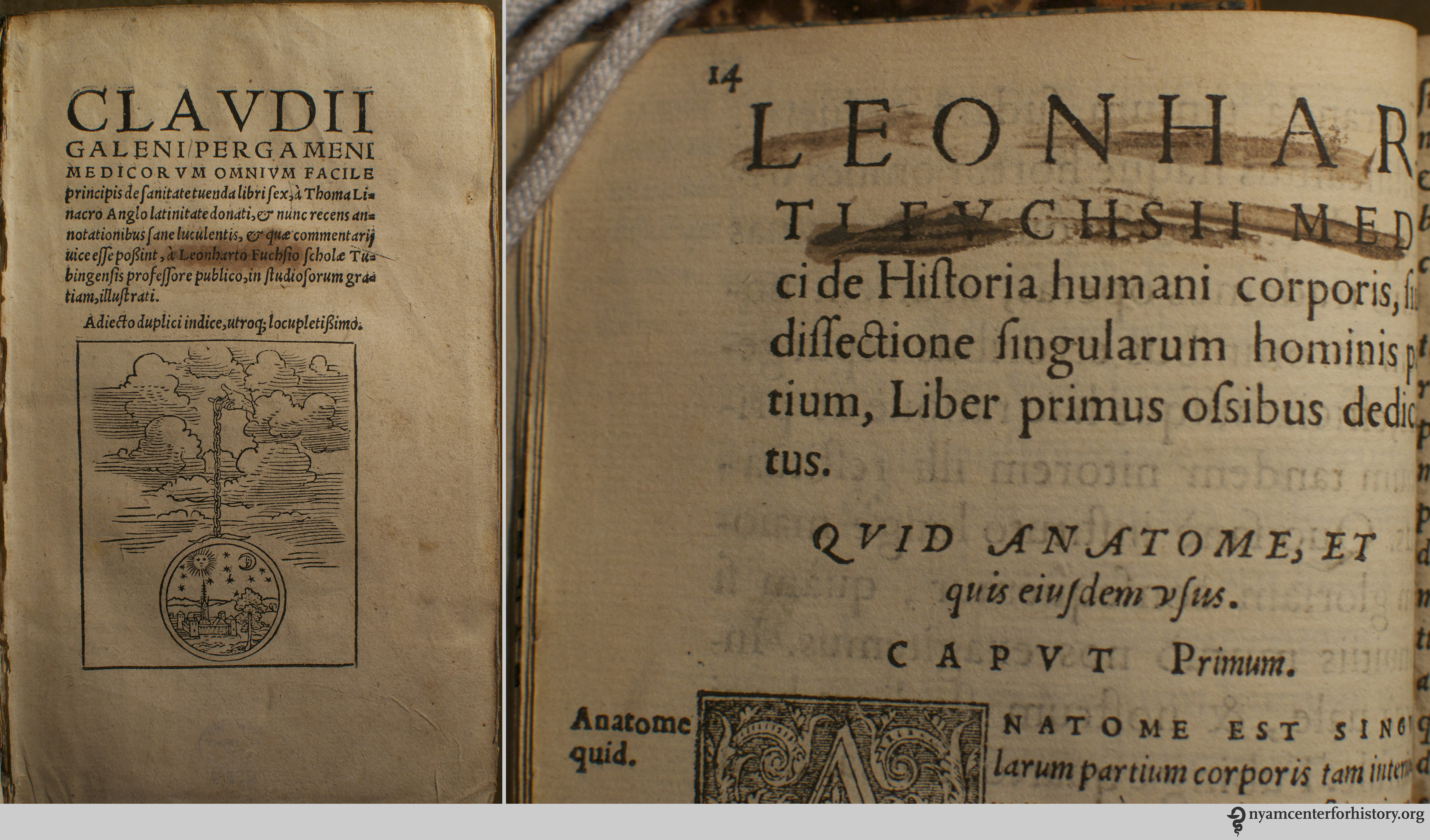
The most common way to censor a name or passage from a book was simply to cross it out with ink. In these two examples we can see copies of books from which Fuchs’s name has been blacked out with a pen and ink and then clearly washed off at a later date (on the left) and blacked out with ink using a paintbrush (right). The sloppiness of the paintbrush and speed with which the name has been canceled indicates that the expurgation, that is the removal of the name, was probably done by an inquisitor or Catholic official who was censoring many books in rapid succession.

Left, Fuch's Claudii Galeni Pergameni, 1549?. Right, NEED ID.

Left, De sanitate tuenda libri sex, 1541. Right, De humani corporis fabrica, 1551. Click to enlarge.

In contrast to the inquisitor who sloppily painted over Fuchs’s name, this book owner took pains to transform the letters of LEONHART FUCHS into a jumble of nonsense characters. This is an incredibly unusual practice, but another example of the technique can be found in a copy of Conrad Gesner’s book On Animals kept at the Stanford University Special Collections. It is likely that both books were owned and censored by the same person.

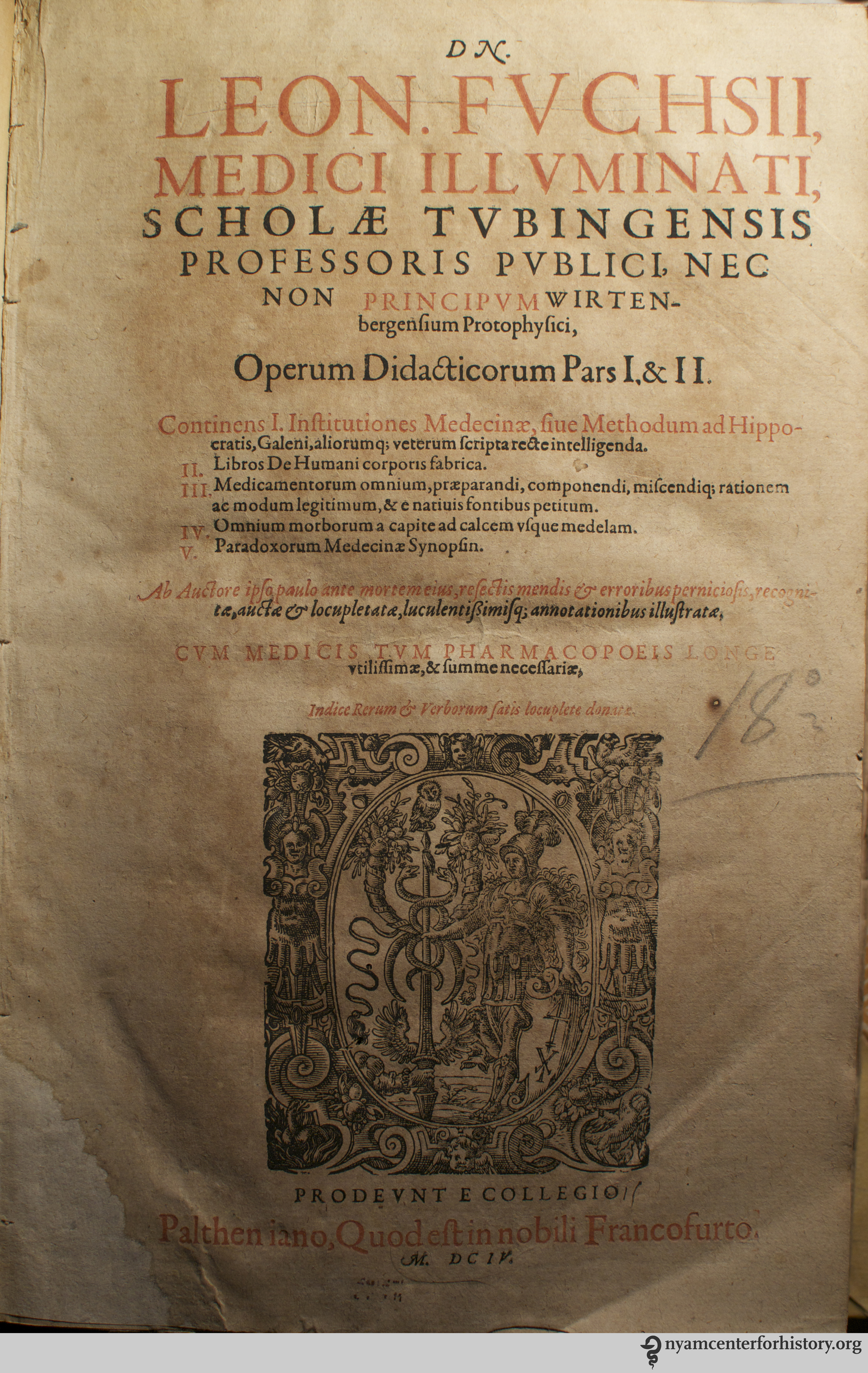
Looking at this copy of Fuchs’s works from 1604, we get the sense that the reader was more interested in complying with the letter of the law than its spirit. The thin line through the author’s name does little to mask the huge characters on the title page.

Fuchs, Operum didacticorum, 1604.

Fuchs, Operum didacticorum, 1604. Click to enlarge.

Gluing a piece of blank paper over prohibited text was another way to expurgate a book. As a technique it also left an obvious space where the prohibited words or names had been. In many examples, like that of Fuchs’s portrait from his 1542 History of Plants, a later owner has used this blank space to write in the author’s name where it was originally printed.

Fuchs, De historia stirpium commentarii insignes, 1542. Click to enlarge.

Fuchs, De historia stirpium commentarii insignes, 1542. Click to enlarge.

Censorship laws forced readers in Catholic Europe to alter their books in ways that have left lasting traces more than 400 years later. We can also see that as rigidly as these rules were laid down, their execution betrays a variety of impulses on the part of readers and censors. Expurgation was meant to correct a book and remove what was harmful, not to destroy the whole object. In a way then, expurgation made it possible for these books to avoid the inquisitors’ bonfires and find their way eventually to the corner of East 103rd Street and Fifth Avenue, bearing on their pages the scars of their histories in Counter-Reformation Europe.

Table Reading

Our October 2014 “Art, Anatomy, and the Body: Vesalius 500″ festival guest curator, artist and anatomist Riva Lehrer, describer her first experience with cadavers and how that shaped her thinking about bodies, anatomy, and art.

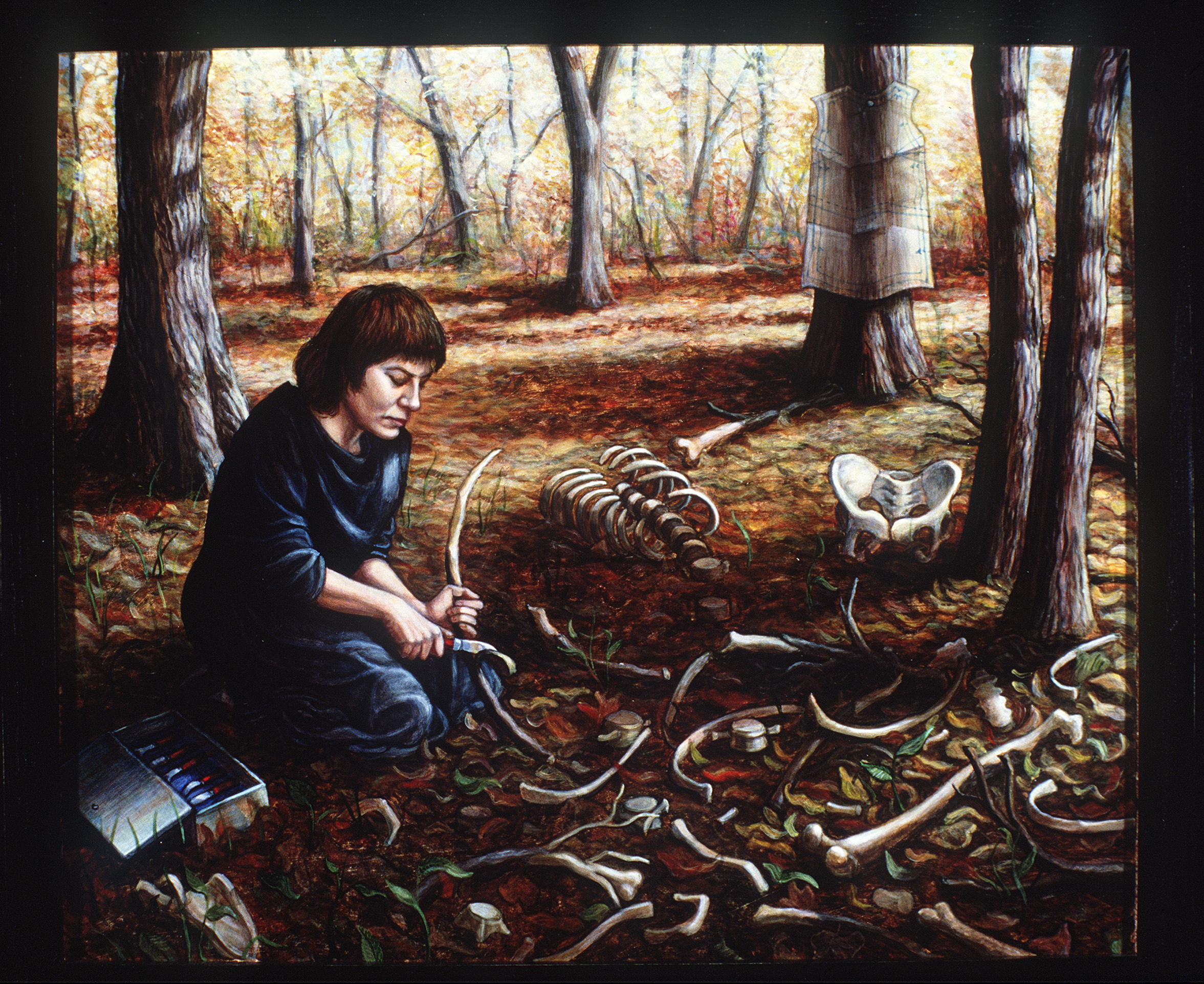
"In the Yellow Woods," by Riva Lehrer. Click to enlarge.

“In the Yellow Woods,” by Riva Lehrer. Click to enlarge.

The first time I ever saw a cadaver was a day in early September of 2006. The light was perfect—a glowing blue and gold herald of the coming Jewish New Year. I walked into lab behind Dr. Norm Lieska, head of Gross Anatomy at University of Illinois at Chicago, and a group of M1 students, all gangly in their brand-new starched white coats and spotless scrubs. The laboratory was a sort of extended corridor, comprised of a series of interlocking rooms, lit by high, industrial windows like those in an old factory. Burnished shafts of sunlight slanted across the rows of steel tables, skimming across the unzipped body bags. Each contained a cadaver that had been preserved and prepped for student exploration. For the main, though, they were pristine; head and hands demurely wrapped, all original parts on board.

I’d been warned that I might be nauseated or disgusted by the bodies. I braced myself to be sickened by the miasma of chemicals in the air. I did not expect to be overwhelmed by the sheer generosity represented in that room. Twenty-five people had decided that we needed to understand the human body in the most direct and unmediated way. They’d signed donation papers that gave us the right to read the history of their own flesh. I felt the impact of that gift even from my first steps into lab.

The dark vinyl of the body bags appeared as if gilded. This was the last moment they would all appear the same. We would pull down the zippers, and reveal the wild variations within. I am not in any way a religious person, but I thought: if I felt this kind of awe in synagogue, I’d be a very different kind of Jew. I was at the lab as part of my position as visiting artist in Medical Humanities at the Medical School of the University of Illinois at Chicago. Each cadaver in Gross Lab was assigned to a team of about 10 students; at the start of the semester I’d been assigned to one such team. These students worked on the same person for the entire year. Scalpels peeled away each archeological layer, skin down to the deepest core. It was a bizarre form of intimate knowledge—both closer and more abstract than their inhabitants had had in life. I began to focus on comparing the bodies from table to table, and to show the members of my team that each cadaver had its idiosyncrasies. None of them were ringers for the photographs in their Color Atlas of Human Anatomy.

"Theresia Degener," by Riva Lehrer. International Human Rights lawyer Theresia Degener is one of the drafters of the United Nations Convention on the Rights of Persons with Disabilities. As a member of the German generation of children whose mothers were given thalidomide, Degener  accomplishes all she wants to do through a range of inventive strategies.  Click to enlarge.

“Theresia Degener,” by Riva Lehrer. International Human Rights lawyer Theresia Degener is one of the drafters of the United Nations Convention on the Rights of Persons with Disabilities. As a member of the German generation of children whose mothers were given thalidomide, Degener accomplishes all she wants to do through a range of inventive strategies. Click to enlarge.

In all the time I was there, though, I never saw a body anything like mine. I was much too intimidated to ask why. Perhaps a body that was too different from those dissection pictures could not function as a primer? (Oddly enough, when I visited a different cadaver lab last year, a bare scoliotic spine was on a table in the back of the room, picked clean of the body in which it had dwelt).

I was the visiting artist in Medical Humanities at the Medical School of the University of Illinois at Chicago for four years, during which I taught figure drawing and portraiture for med students. I’ve gone on to teach those classes at Northwestern University School of Medicine, and as the professor of anatomy at the School of the Art Institute of Chicago (I’m on leave now to pursue other projects). Each year of teaching and study has only increased my sense of wonder at what a living body can do. All bodies (human and animal) are so densely woven with function, yet can accommodate such dysfunction.

I’ve asked my students at both medical schools whether I’m the only disabled person they interact with outside of clinical rotations. The answer is yes. I wonder if my professional presence changes what they think when they begin clinicals, though I also wonder if they begin silent diagnoses when I walk into the classroom. My SAIC students do often seem startled on their first day. (Though maybe that’s just an effect of the tables full of bones. Hard to tell with the young and ironic.) They may not have medical knowledge, but they are trained observers, and mine is the body at the center of the room, at least until our model climbs onto the platform in his/her birthday suit.

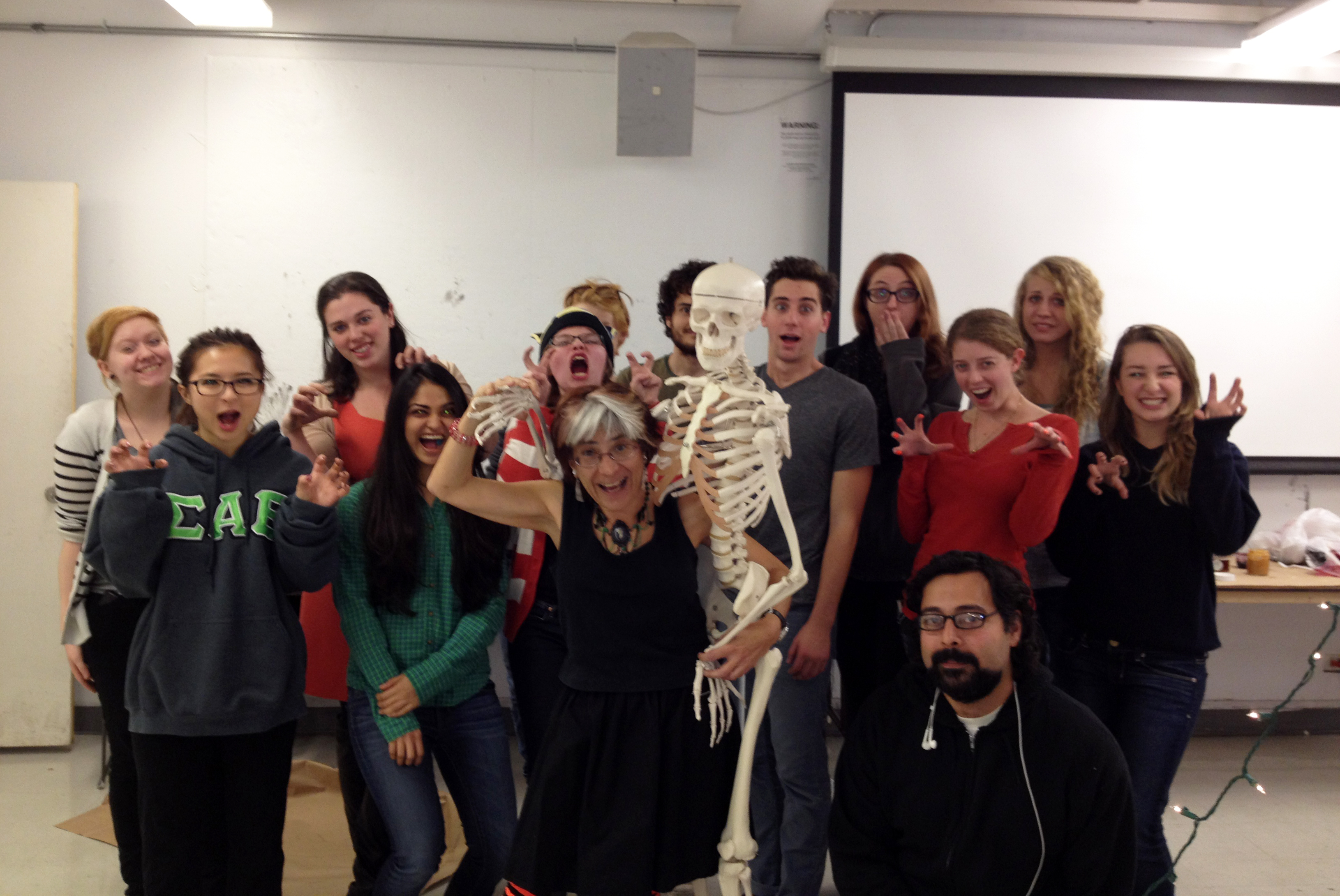
Riva Lehrer with students at SAIC in 2012.

Riva Lehrer with students at the School of the Art Institute of Chicago in 2012.

For years, I was the elephant in the room. Eventually, I stopped pretending I wasn’t there and began to use myself as an exemplar. This doesn’t come easy—sometimes, my attempts at coping through humor sound like outtakes from Young Frankenstein—but it does produce a willingness on the part of students to ask uncomfortable questions. As the cadavers prove year after year, normal is a matter of degree. Our bodies let us live so many ways. Healing is creativity made manifest.

I’m writing this just before another New Year. I hope that 2015 brings you joy of your own mysteries, and that you will follow those secret trails through your own glowing, shadowed, and gilded rooms.

Innovation in Digital Publishing: A Summary

By Cecy Marden, Wellcome Trust Open Access Project Manager

On January 5, the last day of the 2015 American Historical Association Conference, a panel of people from “other disciplines,” chaired by digital historian Stephen Robertson,  spent two hours discussing innovation in digital publishing in the humanities. The audience did an astonishing job of summarizing the discussion on Twitter which @EstherRawson kindly Storified.

Matthew K. Gold (New York City College of Technology and City University of New York, Graduate Center) kicked off proceedings talking about creating well-designed open-source platforms that trace scholarly creation in all its versions and forms. Kathleen Fitzpatrick (Modern Language Association) extended this thread to highlight the social challenges faced by scholarly societies in creating communication platforms for their members. Martin Eve (Open Library of Humanities), Cecy Marden (Wellcome Trust) and Lisa Norberg ( K|N Consultants) discussed approaches to making open-access publication financially sustainable, considering the roles played by publishers, funders, librarians, and institutions in innovative digital publishing in the humanities.

The intentionally short presentations left us with an hour and a half for discussion, which the audience had no problem filling with questions. We ranged over how to overcome the social challenges identified by Kathleen and how to preserve the increasing variety of “stuff” that constitutes scholarly communication. We looked at whether researchers are being rewarded for the innovative work they do, and the fact they are not being rewarded for ongoing projects. We ran out of time before we ran out of questions, so if the Storify, or the blog posts by the panelists, leave you with a burning question please ask it in a comment.

Reflections on “Art, Anatomy and the Body: Vesalius 500”

Our “Art, Anatomy, and the Body: Vesalius 500″ festival guest curator, artist and anatomist Riva Lehrer, reflects on the event.

Riva Lehrer, left, with Lisa O'Sullivan, director of the Center for the History of Medicine and Public Health. Photo by Charles Manley.

Riva Lehrer, left, with Lisa O’Sullivan, director of the Center for the History of Medicine and Public Health. Photo by Charles Manley.

My approach as co-curator of “Art, Anatomy and the Body: Vesalius 500” was to ask how we use anatomy today to understand what it means to be human. Throughout history, we’ve used metaphor to organize our concepts of the body. We’ve imagined it as a vessel full of roiling humors, as an elaborate clock, as a regulated factory, as a robot and a computer, to name just a few. Even anatomical study is affected by metaphor and symbolism, and often guides what we see.

As science creates new perspectives on human (and non-human) anatomy, society responds by re-imagining new possibilities. When we internalize these visions we live differently in our bodies. “Art, Anatomy and the Body: Vesalius 500” brought together artists, writers, and scholars to discuss about how we see ourselves now and how we construct ourselves as public bodies.

As emcee, I had the pleasure of introducing Ann Fox, Sandie Yi, Dan Garrison, Sander Gilman, Nuha Nazy, Dima Elissa, Bill Hayes, Steven Assael and Alice Dreger, who were among the more than 25 festival participants.

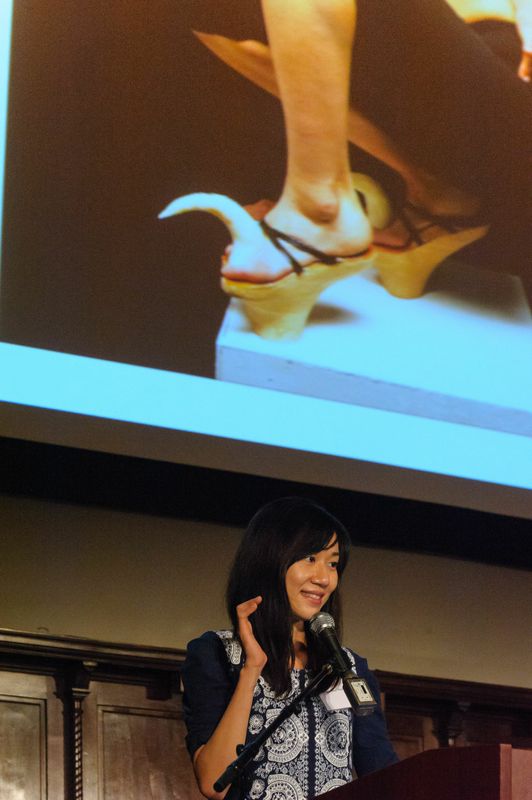
Chun-Shan “Sandie” Yi. Photo by Charles Manley

Chun-Shan “Sandie” Yi. Photo by Charles Manley

Curator Ann Fox and artist Chun-Shan “Sandie” Yi started the day with an overview of contemporary artists who explore identity through medical and anatomical imagery, including artists who tackle our continuing discomfort with HIV/AIDS, a disease that from the very first raised issues of identity and ostracism. Sander Gilman furthered our thoughts about unacceptable bodies by discussing how teaching posture in schools has been used to control and regulate bodies, and make them socially predictable.

Dan Garrison brought us back to the core of the festival via the origin of Vesalius’ Fabrica. He posited some very intriguing ideas around who Vesalius may have been; he may have had a variant body (possibly dwarfism), and this may have contributed to how he created his great work.

Dan Garrison. Photo by Charles Manley.

Dan Garrison. Photo by Charles Manley.

Identity is always a struggle between the specifics of individuality and alliance with group affiliation. This echoes the direction of modern medicine; treatments are becoming increasingly targeted to individual bodies, whether through genetics, prosthetics, or adapted drug regimens. We glimpsed this future during the ProofX presentation, with Nuha Nazy and Dima Elissa. ProofX uses 3D printing to produce extremely precise implants, surgical models, and adaptive devices for a wide range of conditions. It’s anatomical interface at an unprecedented level.

ProofX's 3D-printing demonstration.

ProofX’s 3D-printing demonstration. Photo by Charles Manley.

Bill Hayes engages medical history in order to understand his own biography. His research blends with memoir and hands-on experience, as witnessed by The Anatomist, the remarkable story of Henry Gray, author of Gray’s Anatomy. Hayes steps across the boundary between modern identity and historical precedent, here discussing the history of exercise, in order to show us how we arrived at our present state.

Anatomy and poetics also wove together in the work of Steven Assael. His paintings and drawings are highly (and gracefully) accurate, yet manage to be astute and nuanced examinations of his subjects’ personalities. He transfixed the audience by the lushness of his technique and the drama of his compositions.

Alice Dreger. Photo by Charles Manley.

Alice Dreger. Photo by Charles Manley.

Our excellent final event was a talk by bioethicist Alice Dreger. She traced the origins of contemporary medical photography as well as taking a fresh look at traditional anatomical illustration. Dreger has thought deeply about how we signal our identity through bodily choice. She raised questions about what caused doctors to lose touch with the vulnerability of people in medical settings, and to describe variant bodies in dehumanizing ways. She also pointed out that doctors often can’t admit the taboo pleasure of viewing physical anomalies, and how that covert pleasure affects their relationships with patients.

The human body has its secret, unspoken existence and its public presentation, meant to be decoded by other human beings. Anatomy would seem to be an objective bridge between the two, yet can be just as complicated and interpretive as any form of art. Our festival let us perceive the dialogue between poetics and science, and between inner and outer realities of the body.

For more images of the festival, visit our Facebook page.
Read a summary of the festival by presenter Kriota Willberg: Part 1 and Part 2
Click here for a blog from Hyperallergic.
Read “Seeing is Believing: New York Academy of Medicine’s Vesalius 500th Year Celebrations,” an article by presenter Brandy Schillace, PhD.