Angelique Marguerite Le Boursier du Coudray’s Abrégé de l’art des accouchements

During the fall 2013 semester, Hunter College students in Professor Daniel Margocsy’s undergraduate seminar, Health and Society in Early Modern Europe, 15001800, visited NYAM several times to talk about rare anatomical books. Each student then studied one text in depth, learned about its bibliographical and historiographical context, and wrote a blog post about that item. We are pleased to feature two of the blog posts from the class, one last week and one today, both on books from our collections relating to midwifery.

By Rebecca Halff

The title page of Abrégé de l’art de l’accouchmens.

The title page of Abrégé de l’art des accouchements. Click to enlarge.

Simply put, the magnitude of Angelique Marguerite Le Boursier du Coudray’s 1769 Abrégé de l’art des accouchements does not slap the reader in the face. The Abrégé is a small, light, unobtrusive volume. It easily fits in one’s hands and could be squeezed into a woman’s large apron pocket. Although it contains color images—a marker of luxury in eighteenth-century France—they are few, and are used only when illustrations are absolutely necessary. If we were to liken the midwifery textbook to a woman, we would say that despite her superior intelligence and great beauty, the Abrégé is modest and self-effacing, preferring to stand discretely in a corner at parties rather than flaunt herself ostentatiously.

This trait may be the reason the academic world neglected the Abrégé for so long despite its important contributions—and the important contributions of its author—to the field of midwifery. Only in 1998 was the first scholarly biography of du Coudray written.1 It is surprising that her unique story did not attract the interest of feminist historians before then. Not only was du Coudray a high-achieving woman of the eighteenth-century, but she gained fame when men were taking over the field of midwifery. This makes her quite an anomaly: she was a powerful woman in a field in which women were steadily losing power.2

du Coudray, from the frontispiece of  Abrégé de l’art de l’accouchmens.

Du Coudray, from the frontispiece of Abrégé de l’art des accouchements. Click to enlarge.

We know nothing about du Coudray’s first twenty years of life. She likely came from a middle-class background, but her only English-language biographer explains that “because we know nothing of her biological birth, her professional birth must serve as our beginning.”3We do know that at twenty-five years old, du Coudray had graduated from the College of Surgery in Paris and completed the three years of apprenticeship required to become an accredited midwife. Within the next few years, the school of surgery on the rue des Cordeliers, which had always welcomed midwives to its surgery lectures, decided to bar its doors to them. This was only one of many new developments that sought to exclude, reject, and ultimately eliminate female midwives. Du Coudray reacted by signing a petition pressing the Faculty of Medicine of the University of Paris to provide instruction to midwives and midwifery students.4

Surprisingly, University of Paris doctors conceded rapidly to the request. Their reasons for doing so have much to do with their age-old conflict with surgeons, a group of medical practitioners usually clustered into the same humiliating category as barbers. In 1743, however, the King had elevated the status of surgeons. Given their new prestige, surgeons sought to expand their territory to the field of midwifery, squeezing out female midwives by denying them instruction, as they had done at the school on the rue des Cordeliers. But Parisian midwives had challenged surgeons with their petition, arguing that their refusal to educate midwives amounted to neglect of their professional duties. Surgeons were accused of selfishly causing a dangerous reality: midwives were not being thoroughly trained, midwifery students were not becoming officially accredited, and as a result there was a shortage of midwives in the city. Doctors stepped in both to remedy the dilemma and to make their adversaries (surgeons) look worse than they already did.5

Plate III: A fetus in its natural position.

Plate III: A fetus in its natural position. Click to enlarge.

Through her involvement in this political matter, du Coudray gained a measure of renown in Paris. This was compounded by the very small number of midwives who were allowed to practice in the city—the world of Parisian midwifery was insular and intimate. Through what we today refer to as networking, Du Coudray made acquaintance and friends and formed alliances with important and well-connected medical professionals.

In 1759, King Louis XV charged du Coudray with the responsibility of educating rural midwives. In the wake of the Seven Years War, concerns had arisen over a high death toll and a simultaneous decrease in the French birth rate. Healthy pregnancies, safe deliveries, and the survival of infants suddenly became nationalist causes: France needed all the subjects it could get. The practice of midwifery became a means to support the state, and du Coudray soon became a national sensation and international symbol of French medical advancement.5

Plate XXIII deals with the difficulty of delivering twins presenting together and feet first. Click to enlarge.

At the King’s request, du Coudray began touring the French countryside to deliver medical lectures to rural midwives whose perceived incompetence was causing the deaths of French women (baby-makers) and infants (future soldiers and baby-makers). The Abrégé compiles these lectures in the order in which du Coudray delivered them. Du Coudray begins by discussing the female reproductive organs and the process of reproduction. She follows this with the issue of proper prenatal care. Finally, she instructs readers on deliveries, including how to handle common obstetric problems, for example a baby coming out feet-first, knee-first, stomach-first, or arm-first, the delivery of twins, and the delivery of a stillborn. Du Coudray concludes the Abrégé with a list of what she terms “observations”—singular cases that she believes should be noted despite their rare occurrence. These “observations” include the tale of a woman who remained pregnant for twenty-two months, and the case of a woman who began excreting the bones of a fetus as a result of an intestinal pregnancy.

Du Coudray’s lecture series and the resulting Abrégé  were incredible feats for an eighteenth-century woman. But the King’s midwife’s most celebrated achievement was not the publication of her book, but rather the invention of her “machine,” to which she refers several times in the Abrégé. This “machine” was the first of its kind: a teaching model of the female reproductive system. It came with a leather and cloth fetus which could be placed in any number of different positions to simulate the complications of a real delivery.
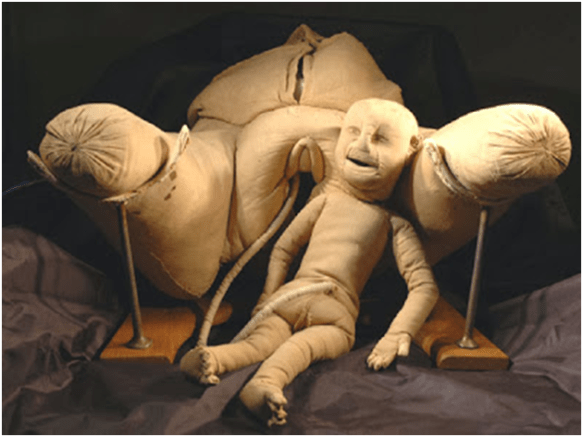
Picture of Madame du Coudray’s “Machine,” from the website of Les Musees en Haute-Normandie.

Picture of Madame du Coudray’s “Machine,” from Les Musees en Haute-Normandie.

Du Coudray was a medical innovator—a forward-thinking, idealistic pioneer. She realized the need for outreach to and instruction of rural midwives, toured France’s smallest villages to deliver these lectures herself, converted her lectures into a book format, and invented an anatomically accurate “machine” to ensure the proper training of midwives before they provided medical care.

But du Coudray did not stop her discussion at prenatal care and delivery. She also denounced traditional midwifery practices that caused unnecessary deaths, offering new ideas that would result in healthier mothers and babies. For example, du Coudray criticized the common practice of removing near-dead infants from their mothers immediately, done in order to avoid distressing the already exhausted and weakened new mother. These babies—immediately seized up as lost causes—were placed as far away from their mothers as possible, often on the floor. Midwives would then take care of their adult patient, leaving the baby to slowly perish. As du Coudray tells it, midwives could prevent many of these deaths if they did not give up on feeble infants so quickly and casually. Once, she recounts, she noticed that a baby’s toe had been bitten off by the household dog without anybody even noticing. Du Coudray accuses midwives of causing needless and preventable deaths through their foolish and antiquated practices. She instructs them to immediately attempt to revive faltering babies rather than leave them to their death.
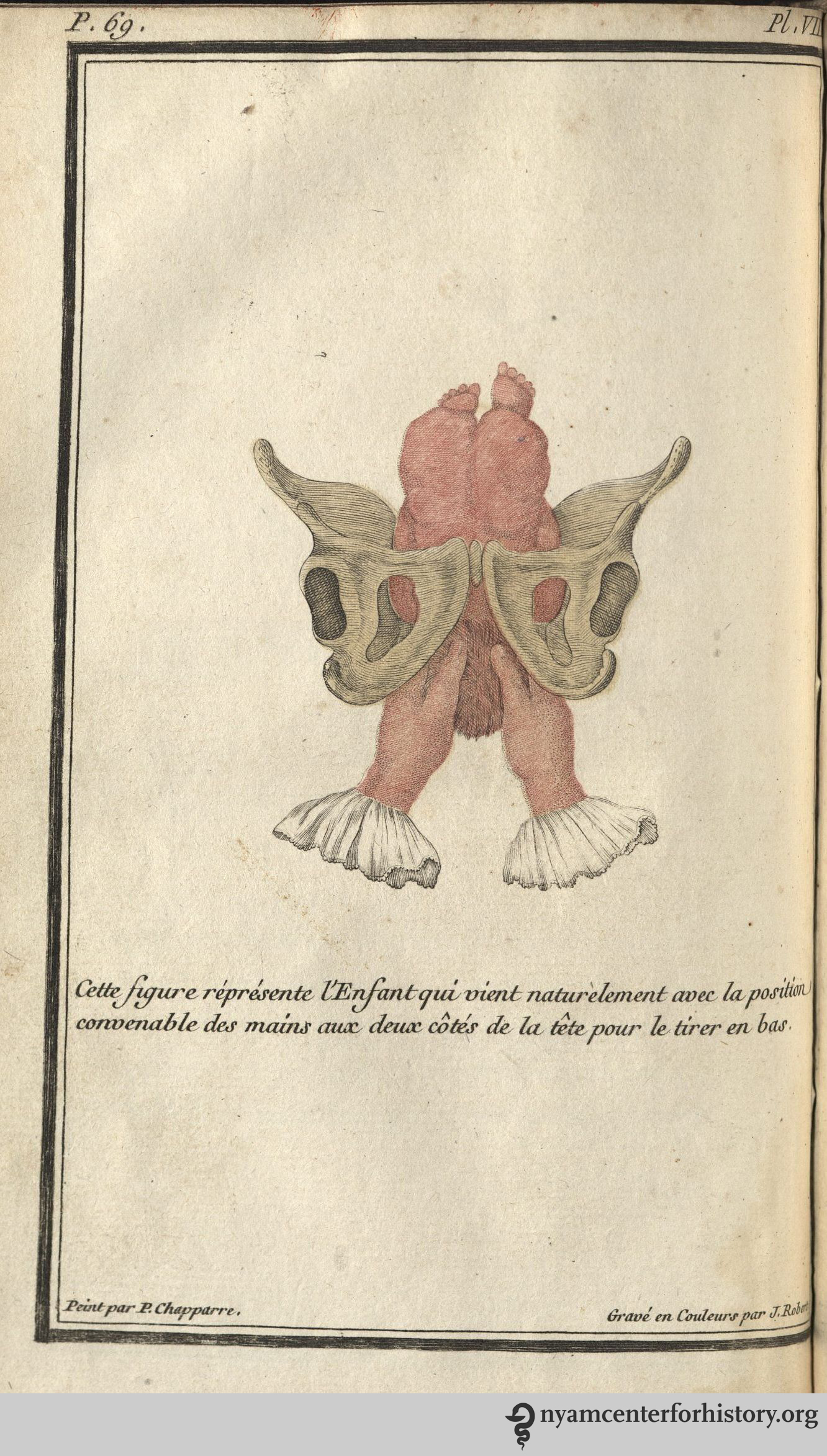
Plate VIII: The proper hand position to help the baby’s head emerge in a normal delivery. Click to enlarge.

Du Coudray was serious about her life’s work. She was simultaneously a medical innovator, concerned with advancing medical knowledge and developing new techniques, and a spokesperson for rural women who did not have access to competent midwives. But du Coudray does not present herself as either a medical innovator or a champion for ethical medicine in the Abrégé. Instead of proclaiming her passion for medicine, du Coudray downplays her agency, explaining again and again that she had no choice but to become involved in this work. Sometimes, she uses Christian rhetoric: how can we not, as good Christians, respond to the call of our brothers and sisters who need our help? Sometimes, she justifies her work by reframing it as nationalist—isn’t it a crime against France to deprive the nation of a subject? And sometimes, she cites the ineptitude of some midwives as the catalyst for her career: because of her intelligence, her natural duty is to find a way to transmit knowledge to someone with less knowledge. She even explains her greatest innovation in these terms, stating that she “perfected a machine which pity made [her] imagine.”

Like the Abrégé, du Coudray herself is self-effacing. A serious midwife who dedicated herself to her work, she cites religion, responsibility to the state, and pity for inspiring her career. Undoubtedly, she relied on this technique to get away with being a serious physician in a time when women were being pushed out of the medical sphere. She softened her persona and message to make it acceptable to male ears. But this technique did not die out with du Coudray. Women throughout history have used excuses to justify their pursuit of higher education and higher status, and will continue to do so until it is no longer necessary. Du Coudray provided the medical world with important resources, her book and her “machine.” She also left women with an example of how to achieve despite societal expectations, as she successfully gained a career she was passionate about, the mastery of her art, the esteem of her colleagues, students, and superiors, and a degree of fame and celebrity.

References

1. Nina Rattner Gelbart, The King’s Midwife: A History and Mystery of Madame du Coudray (Berkley and Los Angeles: University of California Press, 1998), 8.

2. Lisa Forman Cody, “Sex, Civility, and the Self: Du Coudray, d’Eon, and Eighteenth-Century Conceptions of Gendered, National, and Psychological Identity,” French Historical Studies 24 no. 3 (2001): 379-407.

3. Nina Rattner Gelbart, The King’s Midwife, 25.

4. Ibid., 26-42.

5. Ibid., 42-46.

6. “News,” Middlesex Journal or Universal Evening Post (London, England), Sep. 12, 1772.

The Art of Midwifery Improv’d

During the fall 2013 semester, Hunter College students in Professor Daniel Margocsy’s undergraduate seminar, Health and Society in Early Modern Europe, 15001800, visited NYAM several times to talk about rare anatomical books. Each student then studied one text in depth, learned about its bibliographical and historiographical context, and wrote a blog post about that item. We are pleased to feature two of the blog posts from the class, one this week and one next, both on books from our collections relating to midwifery.

By Sarah Hatoum

The Discovery

Title page to The Art of Midwifery, Improv'd.

Title page to The Art of Midwifery, Improv’d. Click to enlarge.

In the eighteenth century, the field of obstetrics enjoyed an influx of novel scientific observations about birth and innovations aiding the process of birth. Dutch physician Hendrik van Deventer, author of The Art of Midwifery Improv’dwas the first to give a thorough description of the pelvis and was the first to suggest that the shape and size of the pelvic bone could cause difficulty in birth (e.g. if the pelvis were too narrow, usually due to rickets—the softening and deformation of bones caused by malnutrition—a child could not be born).1 Van Deventer asserted that determining the shape and size of a pregnant woman’s pelvis and being familiar with the relationship of the fetus and pelvic bones were essential for a midwife to carry out a safe delivery. 2

In the preface of Van Deventer’s instructive, detailed, and “beautifully calf-bound octavo volume” The Art of Midwifery Improv’d,3 translated from Dutch and Latin into English in 1716, an “Eminent Physician” briefly praises the works of contemporary French physicians such as the skilled man-midwife Francois Mariceau but ultimately remarks that Van Deventer’s The Art of Midwifery Improv’d is “more perfect, more easy, better founded, and extend[s] to more Cases” than other physicians’ works.4

While this was a lofty claim, it was true that prior to Van Deventer there had been little attention paid to the structure of the pelvis. Dr. H. L. Houtzager suggests two reasons for this lack of attention prior to the eighteenth century. Since there was an accepted belief that fetuses were born “by their own strenuous efforts,” there was no reason to blame the bony structure of the pelvis for the death of a fetus. The second reason was that people did not often challenge the Hippocratic paradigm (named after the ancient Greek father of medicine, Hippocrates) that suggested that pelvic bones completely separated during birth. Van Deventer determined that the pelvis was essentially “rigid and had only one mobile part—the coccyx.” Again, following the Hippocratic idea, there would also be no cause to suggest that the pelvis could cause a malformed or fatal birth.5

The Journey

Van Deventer was born in the Netherlands in 1651, during a Dutch golden age. In his early adulthood, Van Deventer moved to Germany and joined an orthodox Protestant sect, the Labadists. Van Deventer was in good company, for two notable women, religious writer Anna Maria van Schurman and the natural-philosophical artist Maria Sibylla Merian, had also belonged to the sect.7 Van Deventer became a mentee to the parish’s medical assistant and eventually became the community’s private physician, surgeon, and man-midwife (he later wrote, five years before his death in 1724, “I have already been delivering babies for roughly forty years…”).8 Van Deventer’s time as the head physician of the Labadist community allowed him to gain hands-on experience in certain fields of medicine, most particularly, orthopedics. The Labadists maintained an ascetic diet often resulting in a vitamin D deficiency that led to bone deformation. Van Deventer thus became proficient in the field of orthopedics, invented instruments to correct bone deformities in adults as well as infants,9 and even treated the King of Denmark, Christian V, for rickets.10

In 1694, the central college of doctors in The Hague denied Van Deventer membership because he did not have the proper background (i.e. he had not studied classical Latin). As a result, he moved to Voorburg (where philosopher Baruch Spinoza lived in the 1660s and worked on his magnum opus Ethics), which was not under the Hague’s jurisdiction, allowing Van Deventer free reign; it is here that he began to educate midwives. Several years later, as a middle-aged man, Van Deventer was finally allowed to officially practice as a physician in The Hague.11

Words of Wisdom

Van Deventer applied his orthopedic knowledge to obstetrics and was the first to focus on physical structure of the pelvis and its importance in The Art of Midwifery Improv’d. The question of why Van Deventer decided to write this book as well as why he became interested in obstetrics could be because of his religious fervor. In The Art of Midwifery Improv’d, there is an emphasis on a safe, natural (i.e. without the use of forceps) deliveries because of his belief that a child is made in the image and likeness of God. Furthermore, the work concludes with an Amen. His handbook acts as a prayer for the preservation of the lives of God’s creations. Perhaps Van Deventer’s challenge of the widely accepted Hippocratic paradigm was a testament to Van Deventer’s religious conviction, and he saw himself as a martyr in the name of perfecting the art of the birth of a child made in God’s image.

Plate 4, with figures showing shows the relation of a certain position of the fetus to the pelvis. Click to enlarge.

Plate 4, with figures showing shows the relation of a certain position of the fetus to the pelvis. Click to enlarge.

Van Deventer held midwives in high esteem and was unlike some of his contemporaries who preferred “man-midwives” to female midwives. Man-midwives, from the seventeenth century onward, were fighting to gain supremacy over female midwives and believed that female midwives were “ignorant meddlers whose arrogance prevented them from calling for male assistance” and that they “lacked a theoretical comprehension of childbirth.” 12 Van Deventer was probably a supporter of female midwives because his wife was a midwife, practiced with him and may have contributed to innovative medical discoveries.13

Figure 5, Number 1 shows a placenta for a single infant. Number 2 shows a placenta for twins.

Figure 5, number 1 (bottom) shows a placenta for a single infant. Number 2 (top) shows a placenta for twins. Click to enlarge.

Many man-midwives such as Mauriceu were “confined within the horizon of traditional obstetric surgery” which Wilson ascribes to a focus on handling a dead child rather than a live one.14 Van Deventer instead focused on providing a safe delivery. He gave detailed advice that would allow midwives to perform a safe and efficient birth. First and foremost, he wrote, midwives should have knowledge of female anatomy. Thenceforth, Van Deventer wrote, midwives should know:

  • How to handle patient and child
  • How to deal with afterbirth (the placenta discharged after birth)
  • How to respond to infants positioned awkwardly in the womb during birth
  • General birth preparation
  • How to offer emotional support post-birth to mother and child15

Unlike many of his predecessors, Van Deventer’s work featured accurate illustrations of the pelvis, seen in Figure 1 below:

Figure 1: The pelvis.

Figure 1: The pelvis. Click to enlarge.

The Art of Midwifery Improv’d brought forth important ideas that had not been studied prior to its publication— particularly the importance of the pelvic bone in birth. Hendrik van Deventer laid the groundwork for a focus on orthopedics within the field of obstetrics. Safer deliveries of children and a better understanding of the process of birth came through his advice to midwives.

References

1. John Byers, “The Evolution of Obstetric Medicine,” The British Medical Journal 1, no. 2685, 15 June 1912, 1347.

2. H. L. Houtzager,“The Commemoration of the Birthday of H. Van Deventer,” Vesalius 7, 2001, 17.

3. Byers, 1347.

4. Hendrik van Deventer, The Art of Midwifery Improv’d, (London, 1716): 4.

5. Adrian Wilson, The Making of Man-midwifery: Childbirth in England, 1660-1770, (Cambridge, Massachusetts: Harvard University Press, 1995), 56 and Houtzager, 16-17.

6. L. J. Benedek-Jaszmann, “The Silversmith Who Became the Co-Founder of Modern Obstetrics,” 1980, 243.

7. Wilson, 80.

8. Qtd. in Peter M. Dunn, “Hendrik van Deventer (1651-1724) and the Pelvic Birth Canal,” Perinatal Lessons from the Past, 1998.

9. Byers, 1347.

10. Jaszmann, 243.

11. R. M. F. van der Weiden and W. J. Hoogsteder, “A New Light upon Hendrik van Deventer (1651-1724): Identification and Recovery of a Portrait,” Journal of the Royal Society of Medicine 90, October 1997.

12. Lianne McTavish. Childbirth and the Display of Authority in Early Modern France, (International Ltd., 2005).

13. Wilson, 80.

14. Wilson, 56.

15. Van Deventer, 14.

On Santiago Ramón y Cajal’s 162nd Birthday

Benjamin Ehrlich, today’s guest blogger, studies the life and work of Santiago Ramón y Cajal. His translations from Charlas de café have appeared in New England Review.

The study of the brain is receiving more attention than ever from the general public, and yet “the father of modern neuroscience” remains largely under-recognized. We owe our basic knowledge of what many consider the most complex object in the known universe to a man named Santiago Ramón y Cajal (1852-1934), born on this date in 1852.

Ramón y Cajal spent his life investigating nearly every part of the nervous system in numerous species, using old-fashioned microscopes and a series of chemical staining techniques. Contrary to the paradigmatic belief at the time, the Spanish histologist found that the nervous system (including the brain) is composed of distinctly individual cells (later termed neurons) that must communicate across nearly imperceptible gaps (later termed synapses). This became the basis for the neuron theory, disproving the reticular theory, which claimed the existence inside the brain of a continuous network formed by the fibers fused together.

"A neuron with a short axon in the cerebral cortex. Golgi Method." Figure 10 from Ramon y Cajal's Histologie du système nerveux de l'homme & des vertébrés. Copyright is owned by the family of Santiago Ramón y Cajal.

“A neuron with a short axon in the cerebral cortex. Golgi Method.” Figure 10 from Ramon y Cajal’s Histologie du système nerveux de l’homme & des vertébrés (1909–1911). Copyright is owned by the family of Santiago Ramón y Cajal.

In 1888, his “pinnacle year,” the first evidence of the existence of cells in the nervous system came from the cerebellum of a baby chicken (raised in the garden behind the laboratory in his home), in which he observed some infinitely small bodies that did not physically touch each other. Ramón y Cajal started his own scientific journal, the Revista trimestral de histología normal y patológica, in which he published his new papers. The first issue was released on his birthday.

Santiago Ramón y Cajal was born in Petilla de Aragón, a poor rural village in the mountains of northern Spain, with dirt roads and fewer than a hundred stone houses.1 His autobiography (Recollections of My Life, 1917) is in the collection of the New York Academy of Medicine Library, along with editions of his scientific masterpiece (Histology of the Nervous System of Man and Vertebrates, 1904), his final testament to the neuron theory (Neuron Theory or Reticular Theory?, 1933, translated in 1954) and his guidebook for biological researchers (Advice for a Young Investigator, 1987). Spanish titles include a collection of aphorisms and meditations (Charlas de café, or Café Chats, 1921) and a detailed account of old age (El mundo visto a los ochenta años, or The World as Seen By an Eighty-Year-Old, 1932). Ramón y Cajal describes the brain as a living scene, as he watched neurons develop throughout their dramatic course. Let us celebrate his life and work, which humanize the study of the brain.

Reference
1. Calvo Roy, Antonio. Cajal: Triunfar a toda costa. Madrid: Alianza Editorial, 1999.

The Origins of “Sweat”

Guest blogger Bill Hayes, author of The Anatomist and the forthcoming Sweat: A History of Exercise, will present our 2014 Friends of the Rare Book Room Lecture, “Writing the Body,” on April 23 at 6pm. Register here.

Most of my writing has dealt in one way or the other with medical history and the human body. I don’t exactly know why or how to explain this. I don’t come from a family of doctors or scientists, for instance. But from an early age, I had a keen interest in the body. This has not changed. Sometimes I think I’m still in that stage you see babies in where they are endlessly fascinated with their own limbs. I am over 50 now, so I don’t see myself growing out of it. I look at the human body as an amazing machine and try to figure out how things work.

From the book Medico-Mechanical Gymnastics by Gustaf Zander, 1892

From the book Medico-Mechanical Gymnastics by Gustaf Zander, 1892

If I had excelled in the sciences in school, I might have gone on to become a doctor. But frankly, I didn’t even do well—I barely passed high school biology—whereas writing came easily. I followed that path instead. My interest in the body has led me to write about the science of sleep (my first book, Sleep Demons); the history of human blood (Five Quarts); and, in my last book, The Anatomist, the story behind the classic 19th-century anatomy text Gray’s Anatomy. For this, I spent a year studying anatomy alongside first-year medical students. I went from never having seen a cadaver to doing full cadaver dissection, trying to get a feel for what the original Henry Gray had done.

After finishing the book, I had time on my hands and spent hours working out at a gym. I began running again; I went to yoga classes; I swam. I got into the best shape I’d ever been in. Exercise and I had had a long history by this point, yet the notion that exercise itself might have a history—that there could be such a thing—never occurred to me until one afternoon at the gym.

I don’t recall the exact date but do know it was a cardio day, a cardiovascular workout, about six years ago. At the gym, I tend to go old school; the original StairMaster has long been my cardio machine of choice, both because it makes you sweat like nothing else and it gives you a certain psychological lift. Standing atop a StairMaster, one is a good four feet taller, allowing the illusion that you are Lord and Master of the Gym—like Sigourney Weaver when she mans the robotic killing machine in the second Aliens. You feel like you could conquer anything.

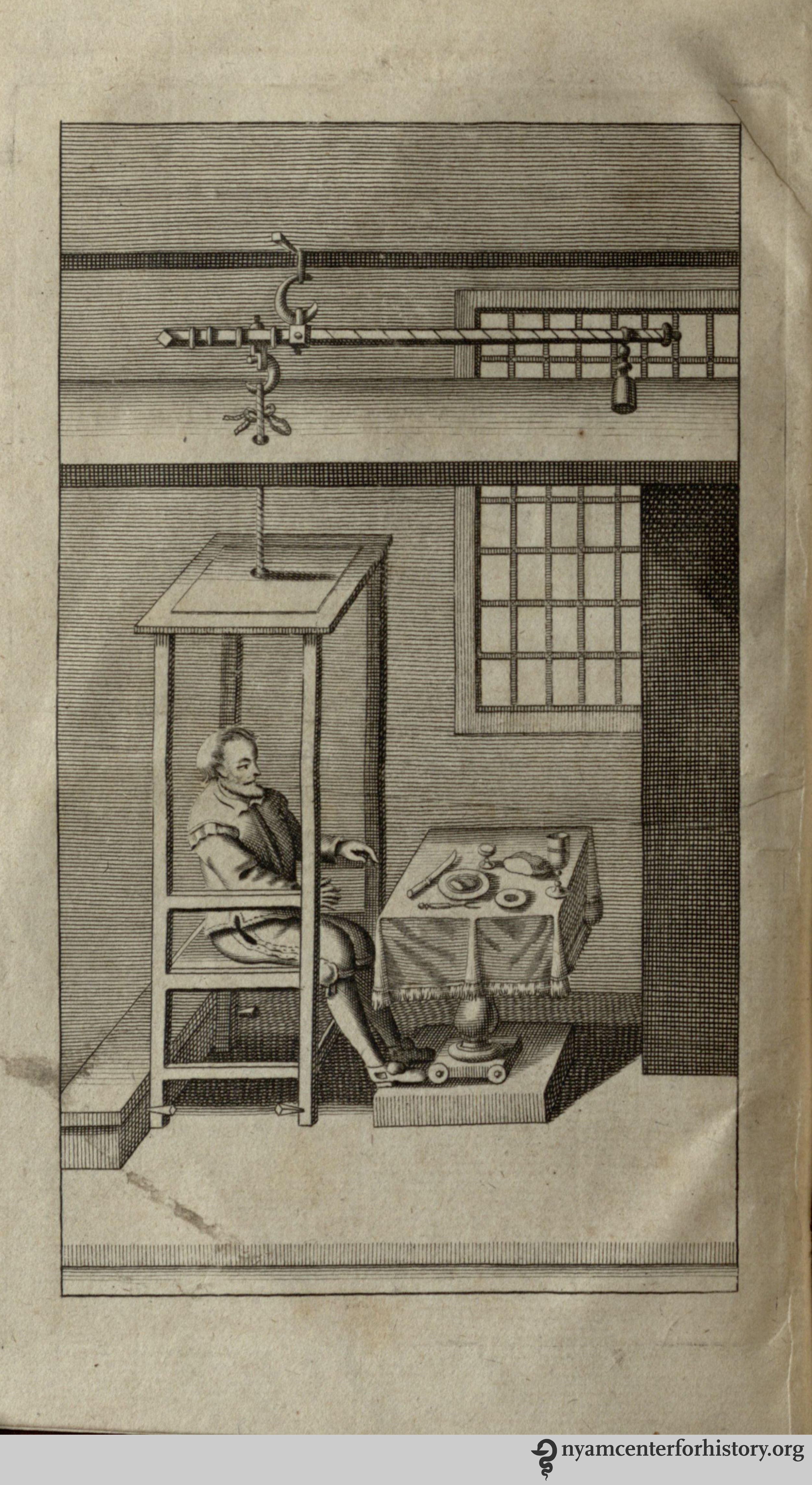
Santorius weighing himself for a metabolism experiment after eating a meal. From Medicina statica: being the aphorisms of Sanctorius, 1720. Click to enlarge.

I climbed up and punched in my usual program—Fat Burner, Level 15, 25 minutes. I arranged my towel and bottle of water, and thumbed in my iPod earphones. My finger found the machine’s START button, that small green circle, so powerfully endowed; each time you press it is a chance to wipe the slate clean and absolve yourself of somatic sins. Yet for some reason, I hesitated a moment on this particular day. I took in the scene before me—men and women of all ages and races, lifting weights, back-bending over giant rubber balls, fitting themselves into torturous-looking apparatuses, pulling themselves up on chin-up bars, dutifully doing sit-ups—and a thought popped into in my head: How did we all end up here? If one were to trace a line backward in time, where would one land?

I stood there and thought about this for a long while then pressed clear, took up my towel and water and climbed back down. What I did next was pure reflex: I went to the library. Little did I know at the time: the journey to write my next book, a history of exercise titled Sweat, had started.


BALL & Other Funny Stories About Cancer

This guest blog is an excerpt from the ending of BALL & Other Funny Stories About Cancer, a 70-minute stage performance by Brian Lobel about illness and the changing body over time originally produced in 2003.

This is one of several posts leading up to our day-long Performing Medicine Festival on April 5, 2014, which will explore the interrelationships of medicine, health, and the performing arts. Brian Lobel will perform this and four other monologues at the event. Register for the festival here.

By Brian Lobel

Brian Lobel

Brian Lobel

But what do I win? Lance Armstrong got the Tour De France, speaking gigs, and a ghost writer named Sally Jenkins (who I’m pretty sure never had testicular cancer), everyone else gets all this wisdom and depth that only derive from cancer, and what do I get? If I wasn’t going to become a better person because of all of those procedures then I sure as hell better win some kind of competition.


Competition. I need to be a hero. A role model. A SURVIVOR! I was actually considering sports, which I hadn’t done since my leg surgery in fourth grade. And, P.S., I still hate sports. I still hate to compete. Maybe ballroom dancing. Yeah, ballroom dance is going to become an Olympic sport. I dance. I have nice posture. Ooh, cancer survivor turned Olympic gold medalist —that would definitely make the ticker on CNN. Cancer survivor turned Olympic gold medalist—hah, not even Lance Armstrong has an Olympic gold medal! You can’t just survive cancer anymore. I know that I will never be the best role model or ideal survivor—but I will die trying.

July 1, 2002. Indiana University-Purdue University Indianapolis Hospital Stem Cell Transplant Reunion Picnic. For all of my doctors and nurses a chance to reflect, to reunite with their former patients, and to share in the blessings of life, family, and community. I was three days finished with my stem-cell transplantation process and ready to kick some ass. The day was bright and sunny—as saccharine-sweet and sentimental as the day any cancer-survivor picnic should be. We all gathered in the park—about five miles from the Indianapolis Speedway—and we celebrated. We celebrated living.

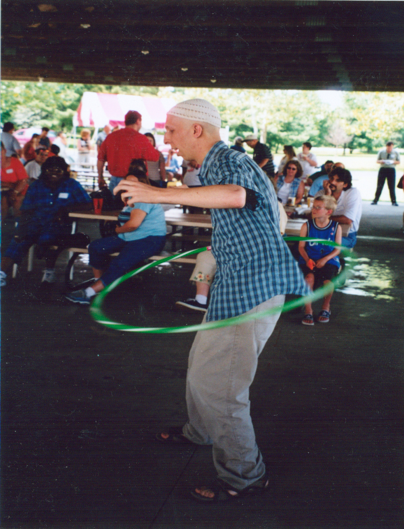
The Indiana University-Purdue University Indianapolis Hospital Stem Cell Transplant Reunion Picnic Hula Hoop Contest. For the kids. Eight un-ironic, cute little daughters of stem-cell transplant patients (who I’m sure were once upon a time frozen at International Cryogenics Incorporated) versus Brian Lobel, the world’s most competitive cancer survivor. A race to the finish, a fight to the death. Winner take all: a Coleman folding lawn chair. They were nothing. The world needed to see who the real cancer survivor turned hula hoop champion was…and so, I hula-d.

If it was a title that Lance Armstrong would never hold, I would hold it, and so I focused, intensely, passionately.

My hips began to twirl on their own and my mind began to flash back over the last eight months…boring, endless, depressing, near defeating…The support, the love, the compassion… The hundreds of people who didn’t make mention in this cancer story because they were beautiful, and perfect, and caring, and kind.

Most of the crap I hate about cancer is story after story after story about people supporting and loving each other with cancer. But I think that’s because, to me, it all seems so obvious. But I do feel indebted to those people. Even those people who said obscene things to me like “But thank God you have a good cancer” or “Your spirit will get you through it,” had enough love in their hearts to attempt to connect with me because they cared. Regardless of the messed up way they demonstrated their compassion. They supported me enough so that I could survive cancer and write a story about balls, tubes, and masturbation. I’m sure they’re proud. I thought of my parents, my family, my doctors, and my cohort in struggle. If there were words to describe them or the love I feel towards them, I would share those words with you. Everyone should experience even a little bit of that love in their life…

FOCUS BRIAN. DAMMIT. Don’t give in to that mushy, sentimental bull. You’ve got a match to win. The DJ spoke over the microphone. “OK girls, um, and boy. You’re doing great out there. Now it’s time to take a big step to your right.” DON’T FALL BRIAN. STAY UP, STAY FOCUSED. Four girls lost their hula hoops when they stepped to the right, but mine stayed snugly around my hips…and again my mind began to wander…

Eight months. Gone. Like that. One day, I was studying and living and dancing and hugging and experiencing, and then cancer. The path back to normalcy would be a long and tedious one. I could see years into the future and see how my scars still haunt me, how the smell of saline still reminds me of the hospital, and how people consistently wonder at my healthy appearance and comment, “You look so good, Brian,” thereby never allowing me to forget how sick I really was, and how much everyone around me worried.

“Are you training for the Tour de France?” “How’s the cycling going?” “Hey Brian, where’s your bike?!” Actual jokes, challenges…Well, what was I going to accomplish with my new lease on life? I felt the need to compete, to succeed, and to become this ideal cancer survivor that gets so so so much wisdom. Take my wisdom! Just give me eight months back! I want to be able to walk down the street without thinking Oh, don’t die now, Brian, that would be really uninspiring to everyone, and I want to be able to look at a pimple on my body and not think it’s a melanoma. I did not realize this was a life sentence.

BRIAN. BRIAN. WHAT ARE YOU DOING? FOCUS!!!

Another girl down, and then there were three. I looked into their devil eyes, and saw straight into their struggle-free life. Ooh, how nice. How cute. As I instilled the fear of God into their eyes, their hula hoops soon followed suit and fell with perfect synchronicity. And then there was one. “OK you two…now let’s see you clap those hands.”

WIN. CLAP. CLAP. WIN. CLAP.

Brian Lobel at the hula hoop contest.

Brian Lobel competing in the Indiana University-Purdue University Indianapolis Hospital Stem Cell Transplant Reunion Picnic Hula Hoop Contest.

WIN BRIAN. CLAP. WIN. CLAP. WIN. And then it happened. I let go. Not of my hula hoop, which was still twirling with ease around my body, but of my drive to be something I wasn’t. I wasn’t someone who would let my life be defined by my illness. If cancer didn’t define who I was, then the pressure of Lance Armstrong-like success or masculinity would never even apply. I would never be Lance Armstrong. I would never be an athlete or a competitor, or an inspirational speaker. I would just be me. And that was, surprisingly, OK. It’s weird, as soon as I let go, my life became simpler, less complicated somehow. I was going to live for me, for Brian Lobel as I really was—quirky, awkward, unathletic, unmasculine, sexy-as-hell One-Ball Lobel—and I was happy.

And it fell. My hula hoop fell. What? That wasn’t supposed to happen. I was supposed to be victorious. I was supposed to learn to love myself and to learn that winning doesn’t matter, and then I was supposed to win anyway. That’s how it ends, right? I don’t win and I don’t die? What? I competed, I tried, and I failed. And I guess that’s me.

I sulked back, completely unsettled, to the picnic table. Where would I go from here? Where does anyone go from here? The DJ came over to whisper something in my ear. The little girl who won the hula hoop contest didn’t clap her hands, and was disqualified. I won. (The news sets in slowly.) The eight-year-old girl who won the hula hoop contest forgot to clap her hands. I won. That cheating, lying, eight-year-old who stole the hula hoop championship from me forgot to clap her hands. And so, the 2002 Indiana University-Purdue University Indianapolis Hospital Stem Cell Transplant Reunion Picnic Hula Hoop Championship was won by Brian Lobel, by default. And that’s good enough for me. I don’t know what’s better, beating cancer or beating an eight-year-old girl in a hula hoop contest.


Music and Medicine: Thoughts on a G-String

This is one of several posts leading up to our day-long Performing Medicine Festival on April 5, 2014, which will explore the interrelationships of medicine, health, and the performing arts. Register for the festival here.

Guest blogger Dr. Danielle Ofri, editor-in-chief of the Bellevue Literary Review, will moderate the closing panel discussion at the event. This essay was originally published in The Lancet and is reposted with permission.

By Danielle Ofri

Danielle Ofri. Credit: Joon Park

Danielle Ofri. Credit: Joon Park

The moment has finally arrived. After three years of sweating through etudes, scales, and Suzuki practice books, my teacher utters the words that every cello student yearns to hear: “It’s time to start the first Bach suite.”

It started on a lark, really, when I asked my daughter’s first violin teacher how to coax a child to practice. She casually commented that the best thing is to see a parent practice. I hailed the nearest taxi and promptly purchased a cello. I started lessons, applying the same brute-force approach I’d acquired in medical school—playing the assigned notes over and over again until they were seared in my memory like the Krebs’ cycle and the 12 cranial nerves.

I added cello to the chores of my life—caring for patients, teaching, writing, and editing. But over the three years, an unexpected transformation occurred. Far from being a chore or a parental device to influence my daughter’s propensity to practice, cello turned out to be something that I genuinely wanted to do each night, almost to the exclusion of all else. Newspaper reading shrunk to cursory glances. Phone calls were avoided. Medical journals slipped to the subterranean level of the reading pile. Journal subscriptions lapsed.

I still love my “day job,” taking pleasure in teaching students and connecting with patients, but I have to be honest that, at this point in my career, the sense of growth has remained at a relatively steady state. With music, however, the intellectual challenges develop in ways that are new and surprising to me. The trajectory of learning, of frustration, and of accomplishment for the beginning musician has more in common with the intellectual vibrancy of life as a beginning medical student. I find that I am more driven to enhance my musical skills than I am my medical skills, although I certainly don’t wish the latter to falter.

As I continued to pursue the cello in the evenings, hospital-corridor conversations during the day revealed musicians hidden in all sorts of unlikely clinical corners: the pathologist who played violin, the ER doctor who was an accomplished cellist, the clinic director who played saxophone, the student who’d flipped a coin between Juilliard and medical school, the anesthesiologist who studied flute at the Eastman School of Music before “retiring” to a more practical career, the pulmonary fellow whose legendary beer-chugging habits masked a prodigious violin repertoire. Was this just a matter of uncovering a common hobby by making the effort to look, or might there be some intrinsic connection between?

I knew there was a doctors’ orchestra here in New York City, and as I started poking around I learned that there were others in Boston, Houston, Los Angeles, and Philadelphia. There was also one in Europe, one in Jerusalem, one in Australia; even a World Doctors’ Orchestra.

Was this merely because most doctors grew up in middle-class homes conducive to music lessons? I searched other professions, and uncovered one lawyers’ orchestra in Atlanta. But I couldn’t find a single accountants’ orchestra, or architects’ orchestra, or engineers’ orchestra. There wasn’t any orchestra made up of Wall Street executives, computer programmers, government officials, or direct marketers.

There have been writings about the relation between medicine and the listening aspects of music, but nothing on the playing of music. Why do so many doctors pursue music? Why does the orchestra of doctors in Boston (the Longwood Symphony) receive audition inquiries on a daily basis?

Mark Jude Tramo, a neurologist, songwriter/musician, and director of The Institute for Music and Brain Science at Harvard and Massachusetts General Hospital, feels that “there is overlap between the emotional and social aspects of relating to sick patients and communicating emotion to others through music. Some would speculate that there is [also] an overlap between aptitude for science, which most premeds major in, and for music.”

Lisa Wong—violinist, pediatrician, and president of the Longwood Symphony Orchestra—speaks for the many who came to medicine after years dedicated to serious musicanship. “The music we create builds in us an emotional strength, sense of identity, and sense of order. Then it is given away—we play for others, we play in ensembles. We come to medicine and it is the same thing. The giving, the service—in music and medicine—is a natural connection.”

Michael Lasserson, a British double-bass player, retired family physician, and founder of the European Doctors’ Orchestra, speaks from the perspective of the dedicated amateur. Although he was raised in a family of professional musicians, it was clear rather early on that he was headed for medicine rather than the stage. But, “music never lets you go,” he says. And it is more than just a hobby to make one a happier doctor. “It is a means whereby one is lifted away from the essential loneliness of clinical decision-making and action, into a world of a common enthusiasm and endeavor as the group searches for the beauty of sound [and] the composer’s intent, and those few hours have what can only be described as a healing function.”

There is also the risk-taking that offers parallels between medicine and music. It takes a certain amount of fortitude to slice open a patient’s abdomen with a scalpel. No less is required to take on Mahler’s seventh or the late Beethoven string quartets. “We hurl ourselves with suicidal courage against the commanding heights of the repertoire,” Lasserson says, hoping just to “touch the hem of that greatness”, though he acknowledges that sometimes, for the amateur, “miming skills will come to the fore.”

I debate this every night as I approach that single precious hour of energy after all the childcare has been completed and before exhaustion forces me to bed. Do I read that groundbreaking clinical trial that will surely impact my practice? Do I work on that unfinished book chapter? Do I read the newspaper and catch up on world events? Do I organize the entropy of my desk? Do I exercise for 30 minutes as I routinely exhort my patients to do?

Unfailingly, the answer is “none of above.” No matter how tired I am, no matter how much neuronal lint has accumulated throughout the day, I tighten the hairs on my bow and dig the end-pin of the cello into my rutted carpet. As I start to work on my assigned music for the week, I find myself focusing ever more narrowly on a single page, a single line, a single measure—even a single note.

Temperamentally, this is the exact opposite of life in the hospital, in which I feel pelted by ringing phones, needy patients, impossible schedules, irritating bureaucracies, and a cacophony of meaningless minutiae. It is a glorious relief, instead, to struggle for—and occasionally achieve—precisely the right note. But then, there is a step even beyond that. The note doesn’t have to merely be right—it also has to be beautiful.

Beauty is not something that gets much shrift in medicine. Other than the experimental design of a classic study that might be referred to as “elegant,” there isn’t much in medicine that falls into the category of beauty. Beauty is inherently unpragmatic—it doesn’t enhance efficiency, increase productivity, earn a grant, or cure a patient. Maybe it is this lack of beauty that drives doctor–musicians to struggle to draw some into their lives via music.

But perhaps there is indeed something in medicine that is related to beauty. After all, medicine is about life—the wriggling, sensual, bodily aspects of being alive. This is not something that can be said about engineering, law, or accounting. Although being alive—and being sick—can frequently be unpleasant, it never ceases to be miraculous. That miraculousness—and the privilege of doctors to be part of it—is a beauty in itself.

Willa Cather once said, “Novelists, opera singers, even doctors, have in common the unique and marvelous experience of entering into the very skin of another human being.” The beauty of entering the very skin of another human being is how many musicians describe the emotional experience of playing music. And for many, it is the striving to achieve that—almost more than the attainment—that offers the most pleasure. As we physicians strive to achieve the best for our patients in the messy, corporeal world of clinical medicine, we work to enter that very skin of another human being, and perhaps—with luck—we can touch the hem of that greatness.

Touching the hem is about all I can aspire to, but that’s enough. I’m willing to grovel for that. The sheet music of the first Bach suite appears straightforward—two pages of evenly spaced notes in the key of G. No intricate timing, no double-sharps, no key shifts, no clef shifts, no fancy ornamentation. But as anyone who as ever tussled with Bach knows, that simplicity is ruthlessly deceptive. “One measure at a time,” my teacher has instructed me. “It needs to be completely memorized. Expect to put in about a year on this.” This is said without irony.

Week after week, month after month, I tiptoe gingerly through the music. The melodic phrases are simultaneously simple and horrifically complex. But when I’ve survived a measure and can play several notes in sequence, the beauty is astounding—the type of beauty that really does take the breath away. I haven’t made it to the hem yet, and may never. But that’s okay. It’s all in the reaching.

New Year’s Luck—and How to Keep Safe, 1950s Style

Bert Hansen, professor of history at Baruch College and author of Picturing Medical Progress from Pasteur to Polio: A History of Mass Media Images and Popular Attitudes in America, wrote today’s guest post. Dr. Hansen will give a Friends of the Rare Book Room talk, “Louis Pasteur: Exploring His Life in Art,on January 14. Join the Friends and register for the talk by clicking here.

At the start of every New Year, people’s attention turns to health and safety (a popular New Year’s resolution is to lose weight). And as we again confront the passage of time, thinking about what’s permanent and what is not, ephemera come to mind. Printed materials of temporary use, when they have luckily been saved and not casually discarded, are especially important for historians as sources to understand ordinary people’s life in the past.

In that spirit, it is a pleasure to share with blog followers a sampling of Lucky Safety Cards from the 1950s, recently donated to NYAM’s Rare Books and Special Collections.

Card 45, featuring Popeye.

Card 45, featuring Popeye. Click to enlarge.

Distributed free in newspapers around 1953, these 2-by-4-inch cards featured characters from popular comic strips and offered ways to be smart and prevent accidents.1 Although children appear in the frame with such cartoon characters at Popeye, Dagwood Bumstead, and the Katzenjammer Kids, it seems likely the messages were aimed at adults as well since people of all ages read newspaper comic strips assiduously.

With vivid two-color printing and graphic styles characteristic of the time, these little collectibles vividly illustrate the history of a popular public health campaign in the decade after World War II. It may not be a coincidence that during the war, cartoon and comic strip figures had been used on health and safety posters and in military instruction and recruitment.2

Modern readers may be struck by the formality of language and styles of dress, quite different than the comics’ drawing styles and casual language used from the 1960s onward. And if the points appear less flashy than modern public service announcements, we would still do well to heed most of their concerns. Each card supplements the illustration with two short texts: a very brief general rule at the bottom (suitable for memorization, perhaps) and a more concrete explanation within the frame. The rules were often puns or contained a rhyme.

“Caution, care, and common sense / eliminate home accidents.”
“Use your ears, eyes, and knows.”
“The right-of-way isn’t worth dying for.”
“Don’t learn the traffic laws by accident.”
“A slip for a trip / may break a hip.”

Each card carried a safety slogan number from 1 to 48 identifying its message (and perhaps encouraging people to collect a complete set), along with a unique serial number. The serial numbers were part of a lottery offering cash prizes. Readers were advised to check for the winning numbers in the newspaper.

It is not clear how many newspapers distributed Lucky Safety Cards. All the examples in NYAM’s collection come from three newspapers: the Albany Times-Union, the Baltimore News-Post and American, and the New York Journal-American.

The Academy holds 31 of the 48 published cards. Missing numbers are 5, 12, 13, 16, 17, 19, 21, 24, 26, 28, 29, 31, 33, 34, 37, 39, and 40. If you have one of the missing cards and want to help fill the seventeen gaps in the set, donations will be warmly received and greatly appreciated.

Although in the truest sense of the word, these cards were ephemeral, historians and artists now—and long into the future—will have permanent access to them thanks to modern conservation and preservation practices in the Academy Library’s Rare Books and Special Collections.

April 2014 update:

Thanks to a “New Yorker who enjoys flea markets,” our set of Lucky Safety Cards is one card closer to completion. Here’s card No. 24 from the set.

Lucky Safety Card 24. Click to enlarge.

Lucky Safety Card 24. Click to enlarge.

April 2017 update:

Our collection now includes cards 13, 17, 29, and 39, thanks to Diane DeBlois and Robert Harris. Just 12 more cards to go!

References

1. For a handy orientation to the wide range of advice and information in comics formats, see Sol Davidson, “Educational Comics: A Family Tree,” in the open-access journal ImageTexT 4:2, Supplement (2008) at http://www.english.ufl.edu/imagetext/archives/v4_2/davidson/.

2. Michael Rhode, “She may look clean, but. . . .  Cartoons Played an Important Role in the Military’s Health-Education Efforts during World War II,” Hogan’s Alley, 8 (Fall 2000).

Two entries in Hidden Treasure: The National Library of Medicine ed. by Michael Sappol, Bethesda, MD: National Library of Medicine / New York: Blast Books, 2012:  “Malaria Pinup Calendars (1945): Frank Mack, for the U.S. Army,” on pp. 172-173, by Sport Murphy, and “Commandments for Health (1945): Hugh Harman Productions, for the U.S. Navy,” on pp. 174-175, by Michael Rhode.

Many fascinating examples are listed in a ten-page finding aid for materials in the Otis Archives Collections, “Cartoons and Comics in the National Museum of Health and Medicine” by Michael Rhode, which may be accessed in PDF format at http://www.medicalmuseum.mil/index.cfm?p=collections.archives.collections.index.

Three Days in Baden-Baden: On the Enchantments of Soviet Biography

Johanna Conterio, a Ph.D. candidate in the History Department at Harvard University specializing in modern Russia, wrote today’s guest post.

It is notoriously difficult to find biographical information about people who lived in the Soviet Union. Personal papers, the kind that historians of the United States rely on, are rarely found in state archives in Russia. Russian intellectuals historically tried to keep their materials out of state archives, associating these with policing rather than with preservation—reasonable enough, as archives were mainly acquired during police raids! But that does not mean that biographical information is impossible to find. When getting into a story in the Soviet past, certain names keep coming up, and information comes from unexpected places. A person may have written an article. If their position is given in the byline, one can figure out where they worked and perhaps find the archive of that organization, or a published history. One checks the stacks for books and brochures they have written. Perhaps they gave a talk at an international conference and left a trace in conference volumes. The more one learns, the more curious one becomes about the course of a life in the past, at first seen only in fragments.

Nikolai Ivanovich Teziakov

Nikolai Ivanovich Teziakov

I first encountered Nikolai Teziakov in a source from the Central Scientific Medical Library in Moscow. In 1923, he published a small book, Health Resorts in the Russian Socialist Soviet Republic. When the librarian delivered the book, I was surprised to find that it was in German and had been published in Berlin (in the card catalogue, the title was given in Russian).1 I had it photocopied and didn’t think about it again for some time. But as I continued my research, I started to see the name Nikolai Teziakov again and again. He was the second director of the Main Health Resort Administration, the state organ that organized Soviet health resorts, and part of the People’s Commissariat for Public Health. He worked during the Russian Civil War (1918-1922) in rural Saratov, 500 miles southeast of Moscow, heading the regional health department fighting infectious diseases and setting up sanatoria for tuberculosis patients. But some very basic questions about who he was remained unanswered. Was he a member of a political party? How did he progress from rural physician in Saratov to top official in Moscow? What was his family background? Where did he study medicine? Did he ever travel abroad? And what did he look like?

Some basic information comes from The Great Soviet Encyclopedia, and I’ve filled in some more details. Nikolai Ivanovich Teziakov was born in 1859 into a peasant family in a village outside of Sverdlovsk, in the Ural Mountains. He finished secondary school in 1879, and studied medicine in Kazan, finishing in 1884. Teziakov was enormously active in public health in Russia before the October Revolution of 1917. Following the cholera epidemic of 1892-1893, he became a sanitary physician and began to collect statistics and conduct epidemiological research. He worked to lower the rates of infant mortality through the organization of free day care for agricultural families, and to fight infectious diseases through disinfection and immunization. He was also active in training medical workers in the new field of hygiene. He attended the famous International Hygiene Exhibition in Dresden in 1911. While working in Kherson province, he wrote about the increasing rates of landlessness among the peasantry. His statistics were used by Lenin in his work On the Development of Capitalism in Russia. During the years of the Civil War, he wrote the slogan “Health Resorts for the Workers!” He was convinced that health resorts were important for the improvement of the health of the workers, an opinion shared by Lenin and Commissar [Minister] of Public Health, Nikolai Aleksandrovich Semashko, powerful patrons of Soviet health resorts, who oversaw the development of the first health resorts for workers in Europe. He died in 1925 at age 65.

But it is Teziakov’s German connections that emerged as an intriguing story, told through the official journal published by the Main Health Resort Administration, Health Resort Affairs [Kurortnoe delo], in the New York Academy of Medicine’s rich collection of Soviet medical journals.  Teziakov’s Berlin publication was meant to be a conference paper, originally to be presented at the 38th German Balneological Congress in 1923 in Aachen.2 He travelled to Germany in 1923 for the conference, but due to the French occupation of Aachen (these were eventful years in Europe!), the conference was abruptly cancelled. Nonetheless both the director and the secretary of the German Balneological Society gamely hosted him and his small Soviet entourage for ten days in Berlin. Add two new names to the historical index: Eduard Dietrich and Max Hirsch.

Teziakov was eager to see the health resorts of Germany. Together with the Soviet physician [S. V.] Korshun and a German secretary, Binger, and carrying with them a letter of introduction from Dietrich, from April 12 to 30 Teziakov visited the German health resorts Baden-Baden, Wildbad, Bad Homburg, Bad Kissingen, Wiesbaden, Bad Nauheim, and Bad Eichhausen.3 Upon his return to Moscow, Teziakov published two detailed accounts of his travels in Health Resort Affairs. Although he was impressed by the beautiful parks and gardens, clean streets, and brilliant architecture of the German baths, Teziakov was disappointed to find that these were only accessible to what he called the “grand bourgeoisie,” and deplored what he called the “commercial” organization of health resort care. Exceptions to this rule were a few charitable organizations that he visited during his three days in Baden-Baden, but Teziakov called these “pathetic.” He contrasted German with Russian medicine: “Medical help at the health resorts is in the hands of private physicians, united into unions. The organization of state or public, municipal health care such as we, Russian physicians, understand it, does not exist.”4 Teziakov’s reports were republished in a brochure for a mass audience, and reviewed by Commissar Semashko on page one of the newspaper Izvestiia. Reprising a common theme among the new Soviet leaders, Semashko wrote that the country needed to combine “German” technology and “iron discipline” with the Soviet approach to social questions. “What a fantastic order we might then establish in health resort construction,” he wrote.5

The German balneologists were also interested in developments in the Soviet Union. The director of the German Balneological Society, Eduard Dietrich, was invited to the Soviet Union in 1924, as a delegate to the Fourth All-Russian Balneological Congress in Moscow (although it remains unclear whether he attended).6 The Society’s secretary, Max Hirsch, developed an ongoing fascination with Soviet balneology and health resorts. He wrote a number of articles about Soviet balneology in the German press in the 1920s, particularly in the Journal for Scientific Balneology [Zeitschrift für wissenschaftliche Bäderkunde]7 and provided reports on various balneological conferences and proceedings to Health Resort Affairs. Hirsch’s relationship with the Soviet Union had begun, and was continued by further meetings with Teziakov in 1923 and 1924, when Teziakov returned to Germany to attend the balneological congress. Of Jewish heritage, Max Hirsch emigrated to the Soviet Union in 1933, fleeing his native Germany via Czechoslovakia. My next task is to find out what happened to him when he arrived in the USSR. Through detective work in the journals, I’ve learned not only more about Teziakov’s career, but discovered the surprising interplay of German and Soviet public health in the 1920s and 1930s, mirroring political developments of those decades.


1. N.J. Tesjakow, Das Kurortwesen in der Russischen Sozialistischen Räterepublik (Berlin: Verlagsbuchhandlung von Richard Schoetz, 1923)

2. Balneology is the science of baths or bathing, especially the study of the therapeutic use of thermal baths.

3. N.I. Teziakov, “Po germanskim kurortam (12-30 apr. 1923 g.)” Kurortnoe delo 1 (No. 6, 1923): 19.

4. N.I. Teziakov, “Po germanskim kurortam (12-30 apr. 1923 g.)” Kurortnoe delo 1 (No. 6, 1923): 30.

5. Izvestiia, August 3, 1923.

6. Christine Böttcher, Das Bild der Sowjetischen Medizin in der ärztlichen Publizistik und Wissenschaftspolitik der Weimarer Republik (Pfaffenweiler: Centaurus-Verlagsgesellschaft, 1998), 52-53.

7. This journal is also held in the collections of the New York Academy of Medicine Library.

A Ceroplast at NYAM

In today’s guest post, the artist Sigrid Sarda tells us how historical collections inform her work. Visitors to our Festival of Medical History & the Arts may have seen her moulages in person, and be sure to visit her blog for information on exhibitions and more of her fabulous work.

Earlier this year, I began researching the collections at the Center for the History of Medicine and Public Health. I am an artist/ceroplast, which means wax modeler. The resources I discovered at the Center have been of great inspiration to my work.

Sigrid Sarda, "MRSA," 2013. Wax, Human Hair, Life-size.

Sigrid Sarda, “MRSA,” 2013. Wax, Human Hair, Life-size.

First, let me tell you about myself. For over 30 years I was a painter. Due to the death of my father and the psychological aftermath I experienced, I ceased painting. In its place, the obsession of the wax figure came into being. Since I was completely self-taught and only worked in this medium for a few years, it was necessary to learn more about its technique and history. Having always had a fascination with religious icons, the body (particularly skin), diseases, and later on death, as well as incorporating human remains such as teeth, bone, and hair in my work, I realized I needed a better understanding of the aesthetics and techniques of wax used in creating these life-size figures and medical moulages.

While exhibiting a waxwork in New York City, I met up with Lisa O’Sullivan, director of the Center for the History of Medicine and Public Health at NYAM, and Arlene Shaner, reference librarian and acting curator for historical collections. After discussing the exhibited piece and my ambitions working in wax Dr. O’Sullivan invited me to explore NYAM’s collections. This was an opportunity not to be missed!

Upon arriving at NYAM, I was directed to the 3rd floor of the massive Romanesque building where Arlene welcomed me. Delightful, funny, and knowledgeable, she made me immediately comfortable in the surroundings of the library and excited to view the books housed in the collection. She checked out my waxwork, we geeked out on ceroplasts, and spoke about other artists whose work dealt with death such as Joyce Cutler-Shaw.

On my second visit, filled with anticipation, I found myself greeted by marvelous books and an actual anatomical wax moulage of a diseased infant. After the initial perusal of my work, Arlene knew what was needed for my research: anatomical images and techniques, and had the books waiting for me in the formidable reading room. As a bonus she brought out the works of M. Gautier D’Agoty, the 18th-century French artist and anatomical illustrator. I pored over both heavily illustrated and non-illustrated books for hours, amassing information for future waxworks. There is truly nothing like the feel of a beautiful book in your hands. The library has become quite the addiction, what with the wonderful staff and superb collection!

Below are images from D’Agoty and various books consulted at NYAM, and above is one of my wax moulages.

“A Passionate Statistician”: Florence Nightingale and the Numbers Game

In conjunction with its exhibit, “Extraordinary Women in Science & Medicine: Four Centuries of Achievement,” the Grolier Club is holding a symposium on October 26, 2013, to which all are welcome. The exhibition and symposium explore the contributions of 32 women, one being Florence Nightingale, to science and medicine. The exhibition features NYAM’s copy of one of Nightingale’s statistical charts. In today’s blog post, Natasha McEnroe, director of London’s Florence Nightingale Museum, explains their significance.

Florence Nightingale. Reproduced by courtesy of the Florence Nightingale Museum.

Florence Nightingale. Reproduced by courtesy of the Florence Nightingale Museum.

The Victorians loved nothing better than to measure and classify, trying to discover natural laws through the data they recorded, and Florence Nightingale (1820-1910) was no exception in sharing this general enthusiasm. Having gained celebrity status from her nursing work at the infamous Barracks Hospital at Scutari, the British base hospital in the Crimean War (1853-1856), Nightingale returned to England with her health permanently broken down. Determined that the appalling treatment of the soldiers during the war should not be repeated, she spent the rest of her life conducting a political campaign for health reform from her bedroom. One of the ways her campaigning was groundbreaking was in the use of statistics.

Reproduced by courtesy of the Florence Nightingale Museum.

St Thomas’ Hospital, London, home of the Nightingale Training School for nurses. Reproduced courtesy of the Florence Nightingale Museum.

Nightingale’s love of mathematics was apparent from an early age and was an interest  encouraged by her father, who took the responsibility of educating his daughters into his own hands. Her parents’ social circle brought the young Nightingale into contact with many of the most brilliant minds of the age, including Charles Babbage, whose own passion for numbers (and not a little pedantry) is shown in a letter to Alfred Tennyson in response to the poem The Vision of Sin:

‘In your otherwise beautiful poem, one verse reads,
Every moment dies a man,
Every moment one is born.

…If this were true, the population of the world would be at a standstill. In truth, the rate of birth is slightly in excess of that of death. I would suggest that the next version of your poem should read:
Every moment dies a man,
Every moment 1 1/16 is born.
Strictly speaking, the actual figure is so long I cannot get it into a line, but I believe the figure 1 1/16 will be sufficiently accurate for poetry.’

Just weeks after her return from the Crimean War in 1856, Nightingale secured a Royal Commission from Queen Victoria investigating the health of the British Army. Nightingale herself was involved in every step of the Commission’s investigations, working with the statistician William Farr to illustrate graphically that more British troops died of disease during the war than in battle. Farr encouraged Nightingale to compare statistics on mortality rates of civilians with that of soldiers, showing that whether at war or at home, soldiers demonstrated a higher mortality rate.  He wrote to Nightingale, “This I know…Numbers teach us whether the world is ill or well governed.”  Nightingale pioneered what is now called evidence-based healthcare and in 1858 she was the first woman elected to the Royal Statistical Society.

Chart from Florence Nightingale’s A contribution to the sanitary history of the British army during the late war with Russia (London, 1859)

Chart from NYAM’s copy of Florence Nightingale’s A contribution to the sanitary history of the British army during the late war with Russia (London, 1859).

A devout woman, Nightingale saw statistics as having a spiritual aspect as well as being the most important science, and believed statistics helped us to understand God’s word. Influenced by the ethos of Victorian vital statistics, her greatest legacy can be seen in improved public health, reformed nursing education, and in her innovative polar area graphs and other work in statistics. In Nightingale, this most eminent of Victorians, we can see the combination of the two great passions of her age—a compulsion to classify and a desire to improve by reform. What made Nightingale remarkable were the personal qualities of fierce intelligence and energy that enabled her to pursue these passions with the immense determination for which she was famed.