Mental Health in the Metropolis: The Midtown Manhattan Study

By Paul Theerman, Associate Director, Center for the History of Medicine and Public Health

How can we improve urban health? That is one of the missions of the New York Academy of Medicine, and a question public health professionals have been asking for decades. One of the landmark urban health studies, Mental Health in the Metropolis: The Midtown Manhattan Study, was published more than half a century ago.1 The study was intended to be a deep and exhaustive look into the mental health of residents in one of the most urban environments in the country, Midtown Manhattan. In many ways it was to be a model of the state of urban health throughout the country.2 And it was shaped by the medical experience of World War II.
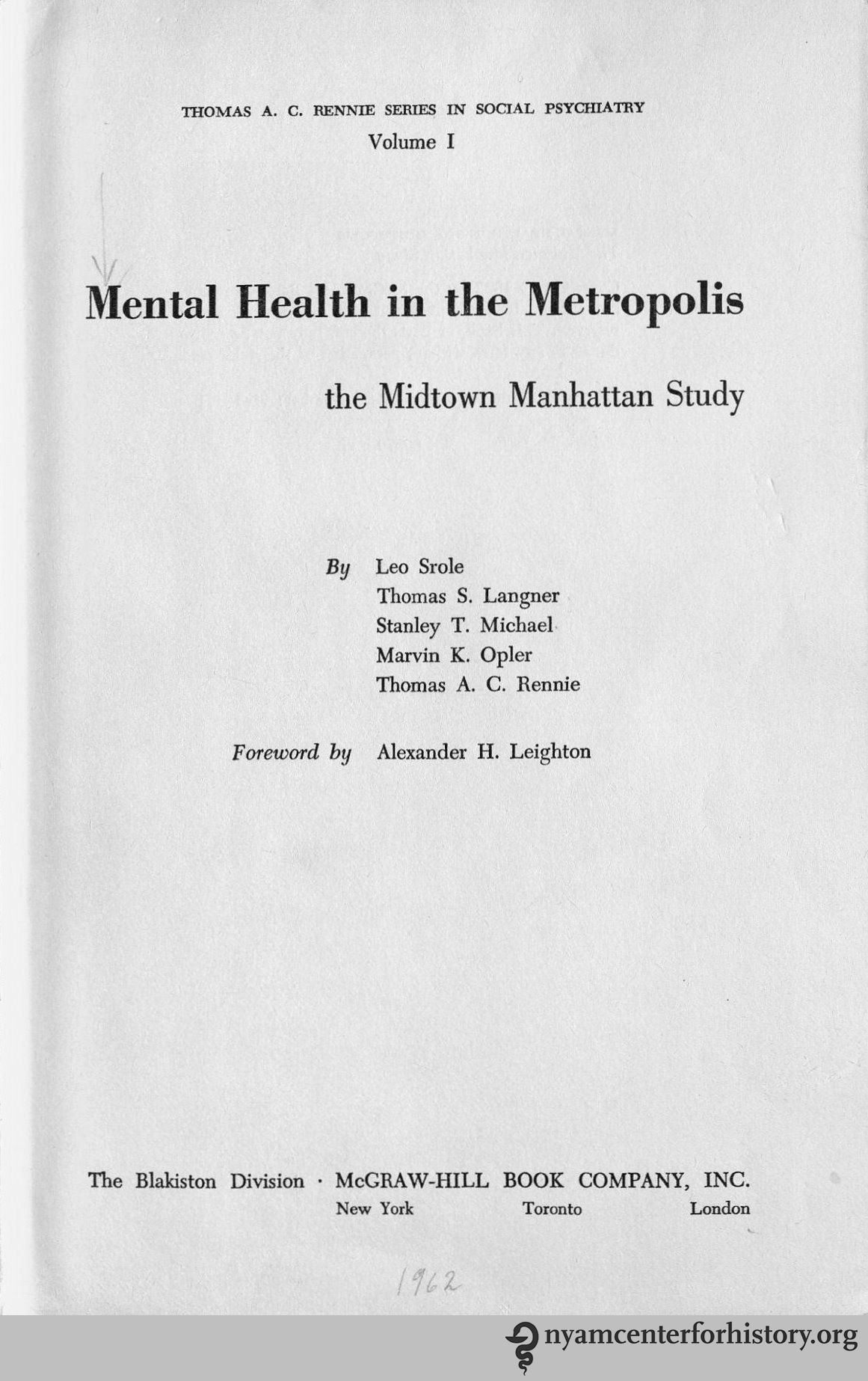
Title page of Mental Health in the Metropolis, 1962.

Title page of Mental Health in the Metropolis, 1962.

Many veterans developed mental illnesses over the course of the war. Dr. Thomas A. C. Rennie, associate professor of psychiatry at Cornell University Medical College, saw many cases directly. He organized rehabilitation services for veterans during the war, and in 1944 published When He Comes Back and If He Comes Back Nervous.3 This booklet was followed by Mental Health and Modern Society,4 a professional discussion of the effects of war on society. In his war and postwar experience, Rennie encountered many people suffering from mental difficulties, and concluded that the long and extended psychoanalytic approach would never treat them effectively, for lack of time and resources.
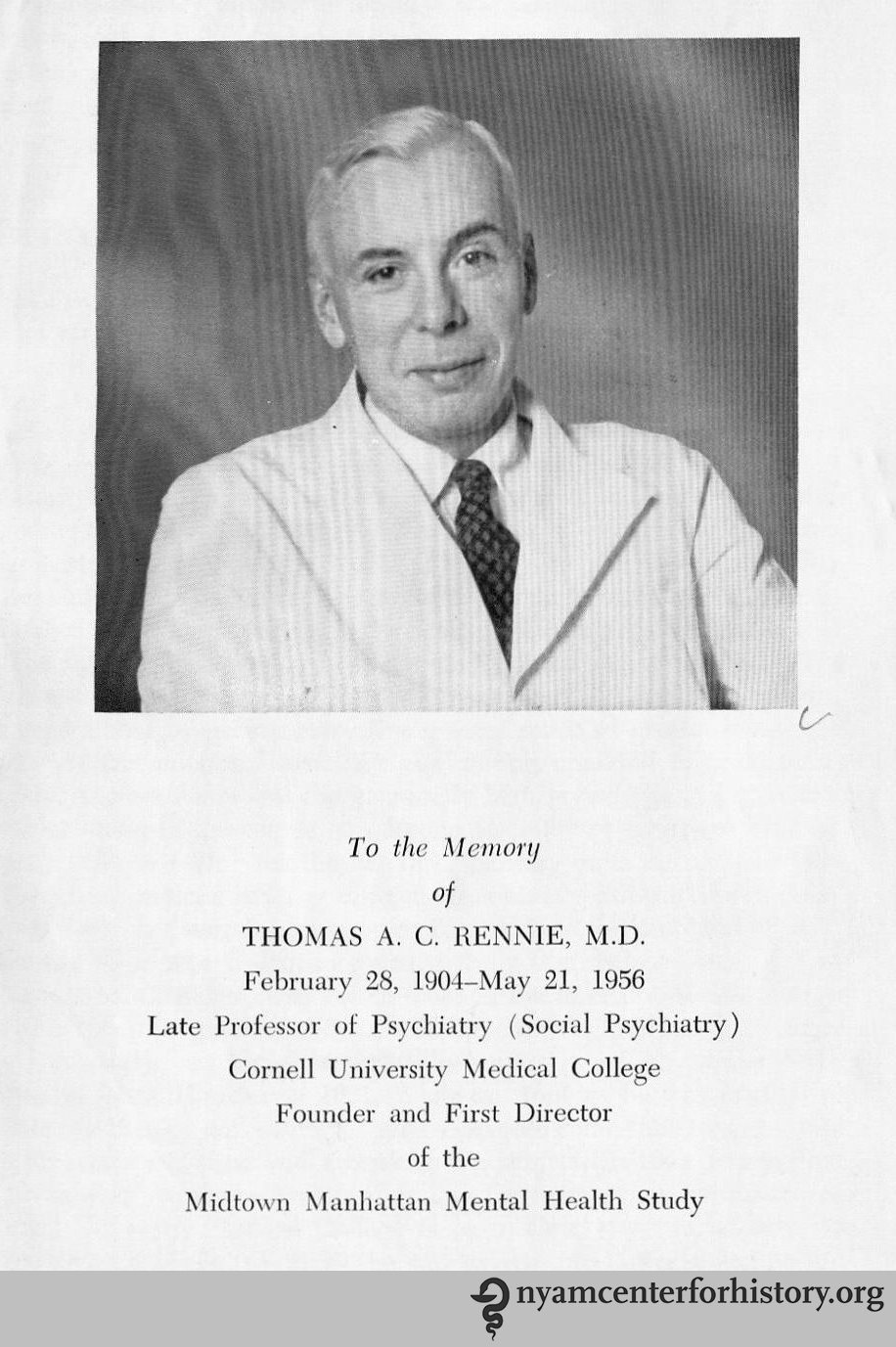
Dedication of Mental Health in the Metropolis to Thomas A. C. Rennie.

Dedication of Mental Health in the Metropolis to Thomas A. C. Rennie.

Instead, Rennie began to look at the relationship between mental health and the social community.5 In the process he created a new field—social psychiatry. In 1950, he was appointed the first professor of social psychiatry at Cornell, arguably holding the first position of this kind anywhere in the United States.6 He conceived the Midtown study this same year, and launched it in 1952. Upon Rennie’s sudden death from a cerebral hemorrhage in mid-1956, the program was continued by Dr. Alexander Leighton, a colleague, medical sociologist, and psychiatrist at Cornell. The study ended in 1960, with publication of its results in 1962.7 It was a large undertaking; overall, the project utilized the services of some 200 people.

What did the study look like? In the words of the lead author, sociologist Leo Srole of SUNY Medical Center Brooklyn (SUNY Downstate), “An investigation focused upon Midtown can, in a special sense, be likened to an intensive case study. Here a community, rather than an individual, is the case.”8 Mental health was investigated as an outcome of community function and dysfunction, as much as or even more so than of the individual. That community was studied along many lines: age, sex, marital status, socioeconomic status, “generation-in-the-U.S.,” and various frames of origination: rural or urban, nationality, and religious affiliation. Researchers also assessed access to and outcomes of mental health and psychiatric care by surveying community residents and treatment workers. Their work seemed to show that Midtown held large numbers of untreated ill individuals, most of whom still functioned at an acceptable level. But definitive results were difficult to come by, and more studies were called for.

Correspondence between sick-well ratios for 12 socioeconomic status strata, reported in 4 groups, with highest SES marked “1” and lowest “12”. The “sick-well” ratio is found by comparing the numbers of “impaired” persons in a particular grouping, with the number of “well” persons. Two other rankings lie between these designations: “mild symptom formation” and “moderate symptom formation.” Mental Health in the Metropolis, Figure 5, p. 231. Click to enlarge.

Correspondence between sick-well ratios for 12 socioeconomic status strata, reported in 4 groups, with highest SES marked “1” and lowest “12”. The “sick-well” ratio is found by comparing the numbers of “impaired” persons in a particular grouping, with the number of “well” persons. Two other rankings lie between these designations: “mild symptom formation” and “moderate symptom formation.” Mental Health in the Metropolis, Figure 5, p. 231. Click to enlarge.

Mental Health in the Metropolis was the report of a large and complex analysis, marrying the different disciplines of psychiatry and sociology to understand and address medical problems using social means. As such it was a child of the war—the war that created mass problems, and suggested ways towards solving them. And it was the harbinger of studies to come.

References

1. Authored by Leo Srole, Thomas S. Langner, Stanley T. Michael, Marvin K. Opler, and Thomas A. C. Rennie, volume 1 in the Thomas A. C. Rennie Series in Social Psychiatry (New York: Blakiston Division, McGraw-Hill, [1962]).

2. Mental Health in the Metropolis, p. 338. The precise boundaries of the study area were not disclosed for reasons of confidentiality; it was described as “more or less midway up the length of Manhattan Island,” bounded by the business district, two major thoroughfares, and a river, and “almost wholly residential in character,” with 175,000 inhabitants (p. 72, and fn 14). Using the name “Midtown” to describe this community was surely inspired by the famous “Middletown” studies of Muncie, Indiana, done by Robert Staughton Lynd and Helen Merrell Lynd, and published in 1929 and 1935.

3. With Luther E. Woodward: New York: The National Committee for Mental Hygiene, [c1944].

4. Also with Luther E. Woodward: New York: Commonwealth Fund, 1948.

5. He was not the first to explore this connection, of course, and he profited from his work with Adolf Meyer of The Johns Hopkins Medical School from 1931 to 1941, Oskar Diethelm, “Thomas A. C. Rennie, February 28, 1904 — May 21, 1956,” Cornell University Faculty Memorial Statement, https://ecommons.cornell.edu/handle/1813/17813, accessed March 18, 2016.

6. Mental Health in the Metropolis, pp. viii.

7. Mental Health in the Metropolis, pp. 336–37.

8. Mental Health in the Metropolis, p. 28.

Food Fight Club Final: Snail Water v. Vegetable Curry

It’s the Food Fight Club final! Snail Water won round 1 and Vegetable Curry won round 2. Now it’s time for these two tough competitors to duke it out once and for all.

Background image: Kirkland, The modern baker, confectioner, and caterer, c1907.

Background image: Kirkland, The modern baker, confectioner, and caterer, c1907.

This final bout pits a recipe from a manuscript recipe collection against one found in a printed cookbook.

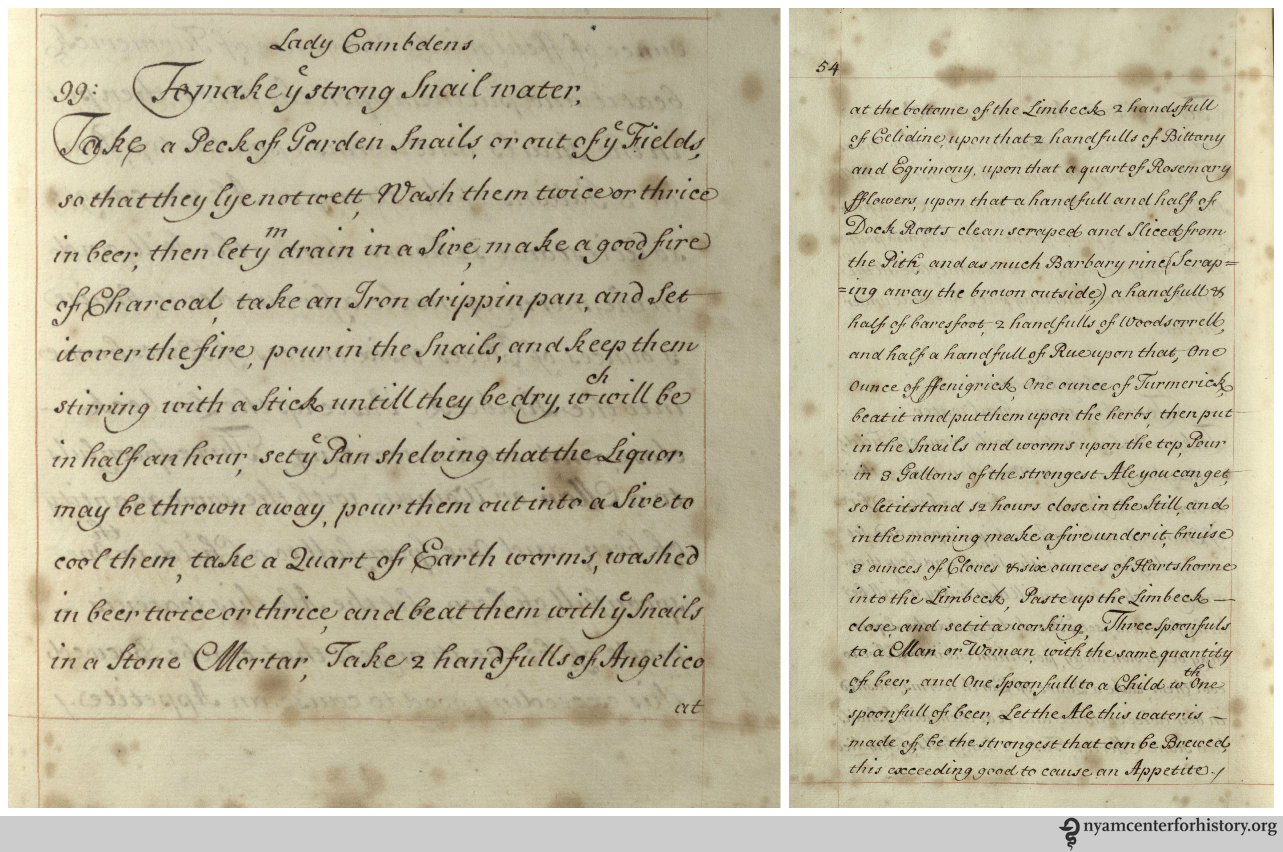
From A Collection of Choise Receipts. Click to enlarge.

From A Collection of Choise Receipts. Click to enlarge.

The recipe for Snail Water comes from A Collection of Choise Receipts, one of 36 manuscript receipt books in our collection. These collections of recipes, dating from the late 17th through the 19th century, tell stories about the ways food was prepared in a range of households. In many cases, they incorporate source material from contemporary cookbooks in print, showing us the kinds of recipes households valued and relied on. These manuscripts often include personal information about the families who kept them. One noteworthy case in our collections is a recipe for “How to make coffy of dry swet aple snits (slices),” found in a recipe book kept by a German-American family in Pennsylvania-Dutch country between 1835 and 1850. Manuscript cookbooks can also show us the kinds of cooking technologies used by families. Repeated references to coals and the Dutch oven indicate that Pennsylvania-Dutch cookbook’s author was cooking at the open hearth.

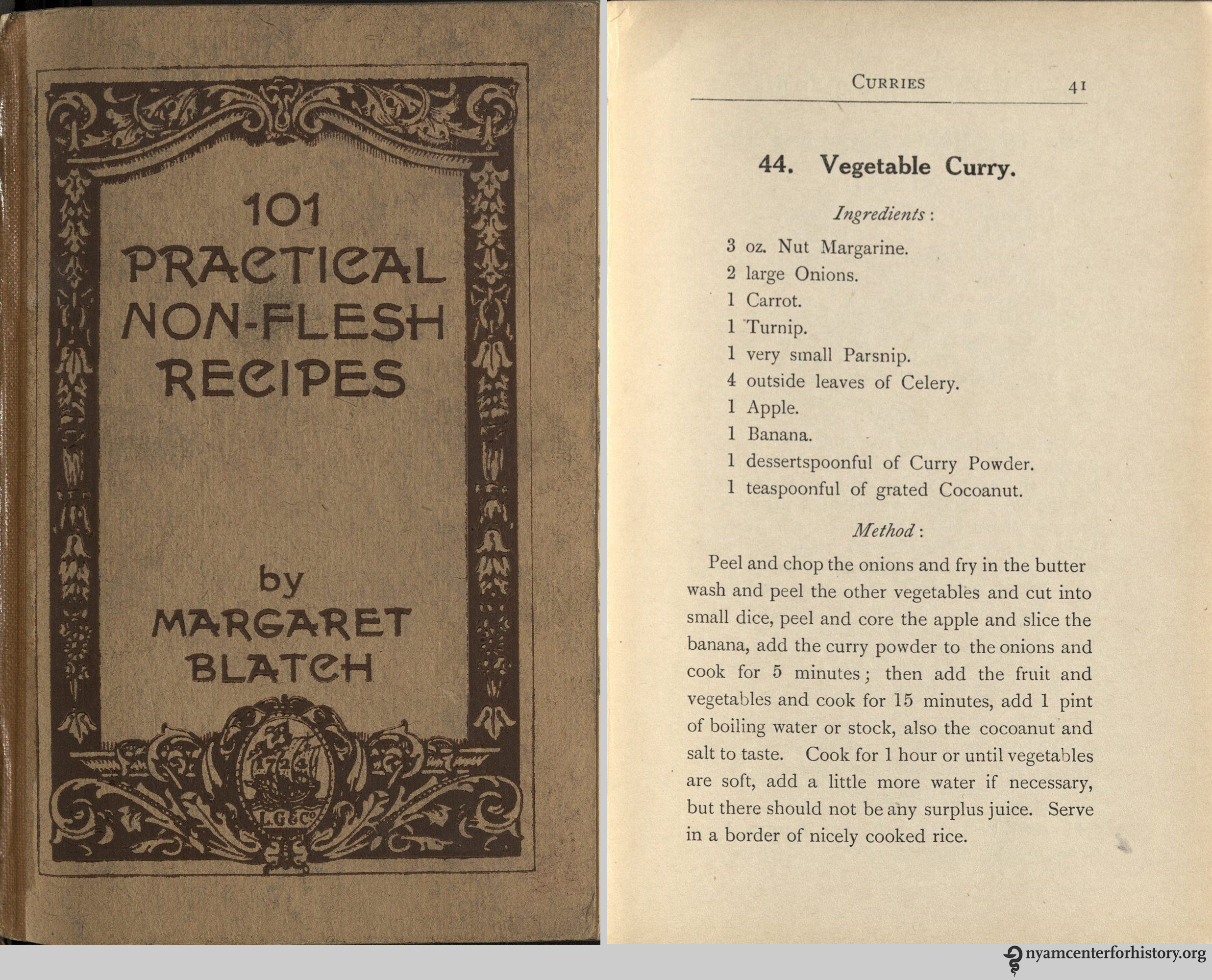
Vegetable Curry recipe in Blatch, 101 Practical Non-Flesh Recipes, 1917.

Vegetable Curry recipe in Blatch, 101 Practical Non-Flesh Recipes, 1917. Click to enlarge.

Publishers of printed cookbooks responded to demand from readers. These books—and the number of editions that were published—can tell us a great deal about cooking trends. Our 1917 copy of 101 Practical Non-Flesh Recipes, for example, is the book’s second edition, the first published just a year before. Cookbooks could be aspirational, practical, or a combination of both. A 19th-century cookbook published in Milwaukee in German in multiple editions tell us that there was a demand for cookbooks written in the mother tongue for newly-arrived German immigrants. The mixture of German and American recipes in these books indicate a need for familiar recipes from the Old World, as well as instruction on how to prepare foods that were more typical of the New. A number of printed cookbooks in our collection have emended recipes or manuscript recipes laid-in to their pages, offering clues to how readers modified published recipes for personal use.

Which recipe should be crowned the 2016 Food Fight Club Champion? Vote for your favorite—be it the most appealing, least appealing, or one that just tickles your fancy more—before 5 pm EST on Monday, March 28.

Food Fight Club Round 2: Vegetable Curry v. Ragout of Squirrel

It’s time for match two of our March Madness Food Fight Club.

First, the reveal of last week’s smackdown: Snail Water triumphed over Pear and Tomato Chutney. Whichever recipe wins this week has a tough competitor for next Wednesday’s final match.

March Madness Food Fight Club_Round1winner

Background image: Kirkland, The modern baker, confectioner, and caterer, c1907.

This week, we pit Vegetable Curry against Ragout of Squirrel.

Vegetable Curry recipe in Blatch, 101 Practical Non-Flesh Recipes, 1917.

Vegetable Curry recipe in Blatch, 101 Practical Non-Flesh Recipes, 1917. Click to enlarge.

The innocuous-sounding vegetable curry comes from Margaret Blatch’s 101 Practical Non-flesh Recipes, a nice little vegetarian cookbook from 1917. The title might sound a bit odd to modern readers and is an interesting choice, considering the term vegetarian was well-established by the 1840s.1 A 1908 physical education article sheds some light on the terminology of the time, saying the word vegetarian “usually suggests a person who abstains not on hygienic but on religious, ethical, or theological grounds,” preferring instead “flesh-abstainer.”2 It appears “non-flesh” was less provocative than “vegetarian.”

Ragout of Squirrel recipe in Recipes for the Jewett Chafing Dish, 1896. Click to enlarge.

Ragout of Squirrel recipe in Recipes for the Jewett Chafing Dish, 1896. Click to enlarge.

Our next contestant features two items not commonly seen on today’s dinner tables: Chafing dishes and squirrels. In the 1890s, chafing dishes experienced a surge in popularity in America, and Recipes for the Jewett Chafing Dish was just one of many cookbooks published featuring recipes specifically for the dish. The Waldorf-Astoria Hotel offered “chafing dish suppers” to top socialites, and stores sold table linens to match the cookware.3 Squirrel, too, was a common sight at the American dinner table due to its availability. One can track its rise and fall by looking at editions of The Joy of Cooking over time, where the numerous squirrel recipes of the 1930s gave way to recipes for chicken.4

Which recipe should face Snail Water in the final round? Vote for your favorite—be it the most appealing, least appealing, or one that just tickles your fancy more—before 5 pm EST on Monday, March 21.

References
1. Spencer C. The Heretic’s Feast: A History of Vegetarianism. UPNE; 1996. Available at: https://books.google.com/books?id=rIjZo-cvifAC&pgis=1. Accessed March 15, 2016.

2. Fisher I. The Influence of Flesh-eating on Endurance. Modern Medicine Publishing; 1908. Available at: https://books.google.com/books?hl=en&lr=&id=gW8yAQAAMAAJ&pgis=1. Accessed March 15, 2016.
3. Lovegren S, Smith AF. Chafing Dish. Oxford Companion to Am Food Drink. 2007:103. Available at: https://books.google.com/books?id=AoWlCmNDA3QC&pgis=1. Accessed March 10, 2016.

4. Smith H. Al rodente: Could squirrel meat come back into vogue? Grist. 2012. Available at: http://grist.org/animals/al-rodente-could-squirrel-meat-come-back-into-vogue/. Accessed March 10, 2016.

Surviving the Great Blizzard of 1888

By Johanna Goldberg, Information Services Librarian

After the snowstorm on January 22–23, 2016 dropped 26.8 inches of snow on New York City, lists circulated of the worst snowstorms in the city’s history dating back to 1869. Of the top ten storms, only one occurred in the 19th century: the blizzard of 1888, which resulted in 21 inches of snow falling on the city from March 12–14 of that year.

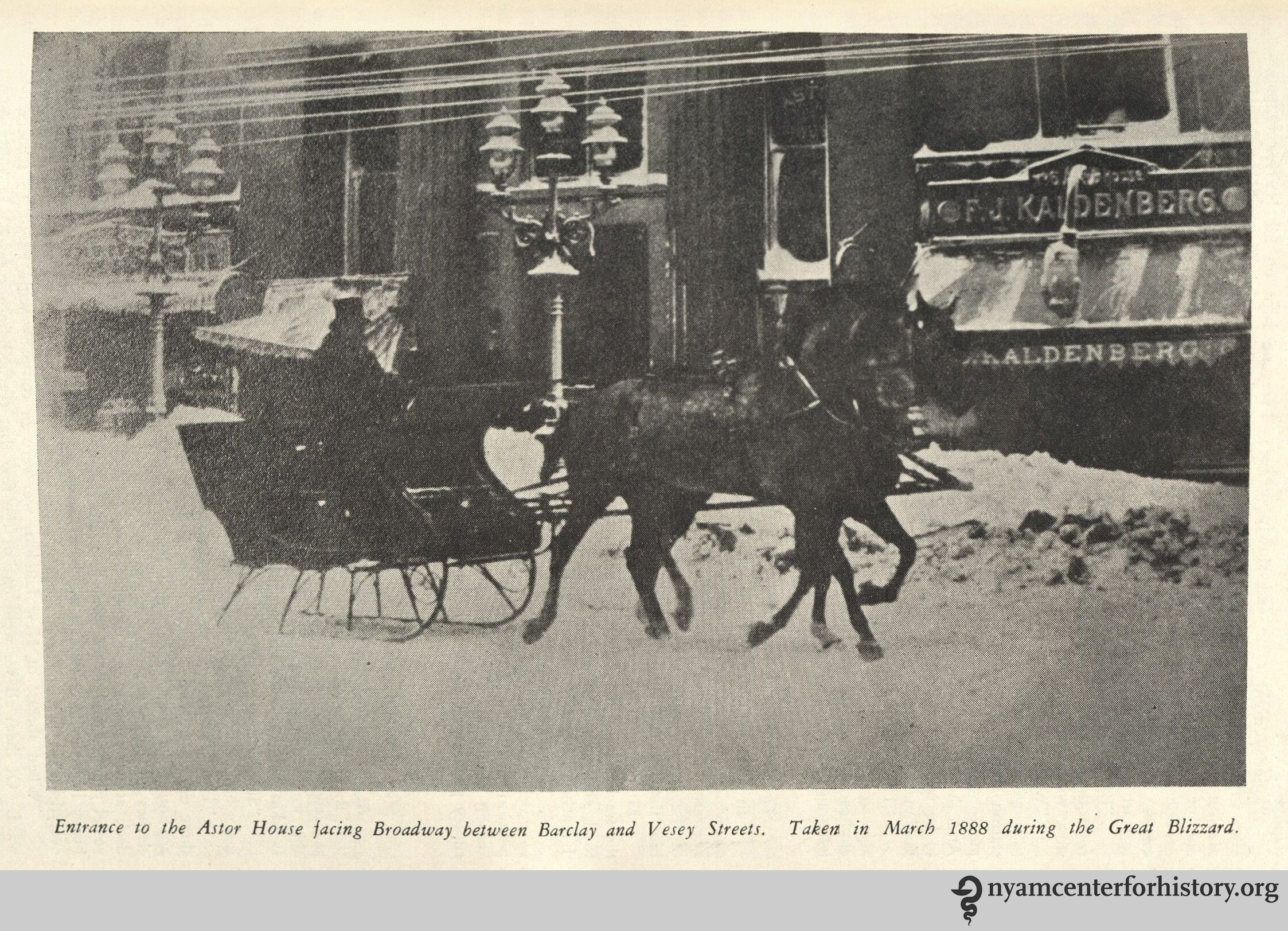
"Entrance to the Astor House facing Broadway between Barclay and Vesey Streets. Taken in March 1888 during the Great Blizzard." From Strong, The Great Blizzard of 1888.

“Entrance to the Astor House facing Broadway between Barclay and Vesey Streets. Taken in March 1888 during the Great Blizzard.” From Strong, The Great Blizzard of 1888.

The blizzard arrived unexpectedly. The forecast for Sunday, March 11 called for slight wind and evening rain. But late that night, a storm from the south altered its course at the same time that the wind changed direction. Rain turned to sleet, hail, and finally snow. New Yorkers woke up on Monday to 10 inches of snow and bitter cold.

“Looking north on Madison Avenue during the March 1888 Blizzard.” From Strong, The Great Blizzard of 1888.

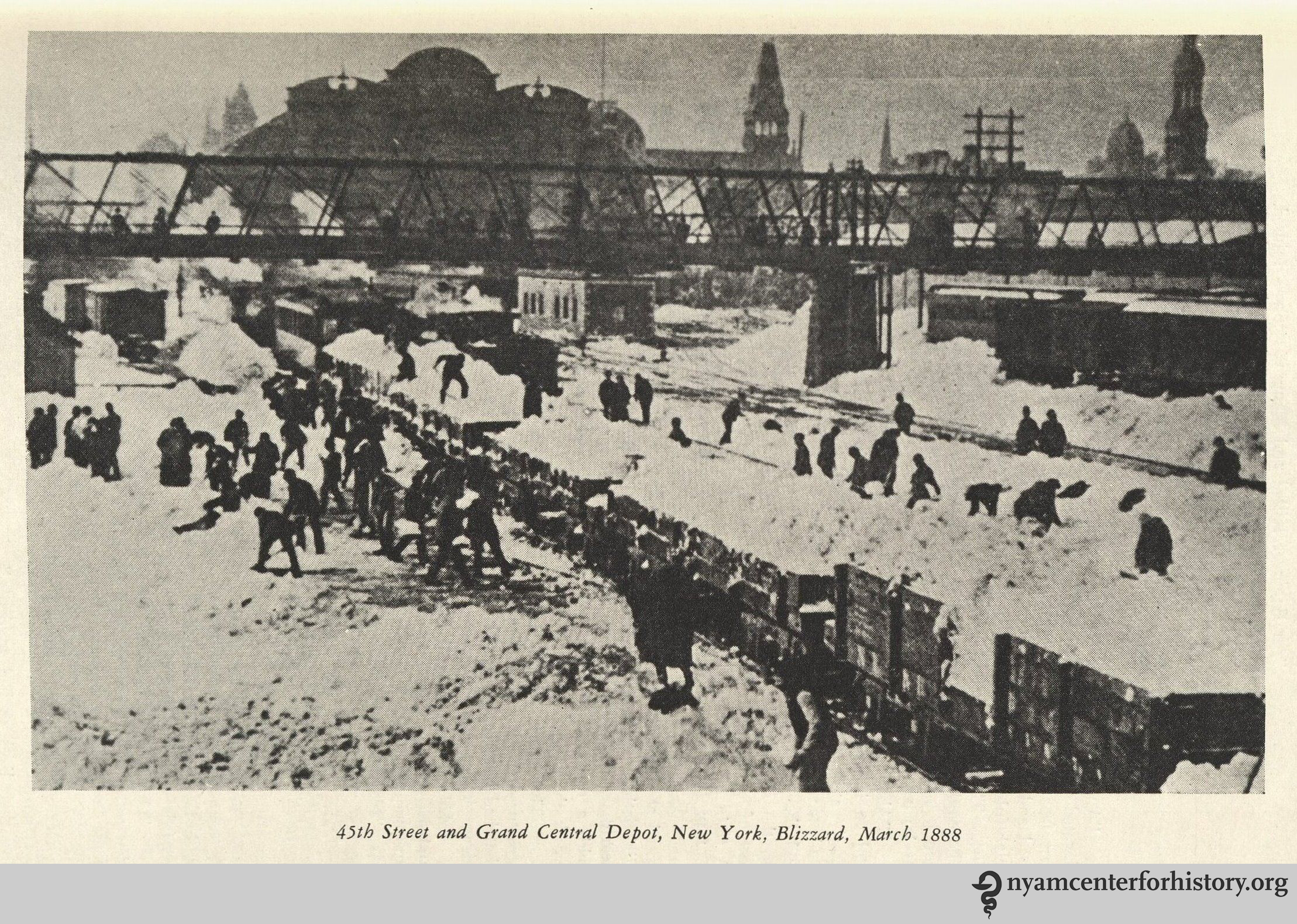
Not realizing that the worst was yet to come—11 more inches of wind-swept snow fell before the storm ended—many ended up stranded on their way to work or school. Eighty mile an hour wind gusts blew snow into drifts as high as second story windows and, along with the snow and ice, stopped elevated trains and toppled phone, electric, and telegraph poles. After the suspension of ferry service, people attempted to cross the frozen East River on foot (many were rescued by tugboats). More than 200 New Yorkers died as a result of the storm.1,2

"45th Street and Grand Central Depot, New York, Blizzard, March 1888." From Strong, The Great Blizzard of 1888.

“45th Street and Grand Central Depot, New York, Blizzard, March 1888.” From Strong, The Great Blizzard of 1888.

"149 Broadway, now the site of the Singer Building, March 1888." From Strong, The Great Blizzard of 1888.

“149 Broadway, now the site of the Singer Building, March 1888.” From Strong, The Great Blizzard of 1888.

In 1938, fifty years after the blizzard, Samuel Meredith Strong, M.D., “Former President of ‘The Blizzard Men of 1888,’” published The Great Blizzard of 1888, a collection of oral histories and printed articles from those who survived the storm. Below are some selections from the book:2

Excerpt from an article by Julian Ralph in the New York Sun, September 2, 1933:

“Few of the women who worked for a living could get to their work places. Never, perhaps, in the history of petticoats was the imbecility of their design better illustrated. ‘To get here I had to take my skirts up and clamber through the snowdrifts,’ said a washerwoman when she came to the house of the reporter who writes this. She was the only messenger from the world at large that reached that house up to half-past 10 o’clock. ‘With my dress down I could not move half a block.’ It was so with many thousands of women; the thousand few who did not turn back when they had started out.”2

11th Street, New York, looking west." From Strong, The Great Blizzard of 1888.

11th Street, New York, looking west.” From Strong, The Great Blizzard of 1888.

From Wm. Chamberlain, Maspeth, New York:

“Mount Olivet Cemetery at Maspeth, New York, had two orders for burials to take place that day, and the Superintendent had men with a small plow drawn by horses work to keep the roads in the cemetery open. Along about ten o’clock he got me on the job shoveling, and after dinner sent me for men in the neighborhood. I think I got two or three and with others and the plows we worked until about 4:30 in the afternoon, but it was no use as the wind blew the snow back faster than we could handle it. We quit, licked to a frazzle, cold and tired and hungry. The funerals, according to the records in the cemetery, did not take place until two or three days later.”

"Copy of photograph taken in Flushing, Long Island, by Mr. William James in March 1888. Mr. Frederick Morris at the left, Dan Beard standing in the center." From Strong, The Great Blizzard of 1888.

“Copy of photograph taken in Flushing, Long Island, by Mr. William James in March 1888. Mr. Frederick Morris at the left, Dan Beard standing in the center.” From Strong, The Great Blizzard of 1888.

Dr. Charles Gilmore Kerley, published in Medical Clinic of North America, November 1935:

“I was a resident physician at the New York Infant Asylum in Westchester County, N.Y. At this institution there were a few over 400 children and about 200 mothers. The age of the child population ranged from infants of a few weeks to children five or six years of age. Among those under one year were perhaps 100 who were partly or entirely dependent on cow’s milk feeding. Eight cans of loose milk a day were supplied by a dairy eight miles distant, the milk being delivered in a horse-drawn truck—then came the big blizzard completely blocking traffic of every nature—in our case for seven days. I well remember the consternation and alarm at the thought of being cut off from all food supplies with over 600 people to be cared for. A few days before the historic storm, through error a large consignment of Borden’s condensed milk arrived at the institution. Twelve dozen cans had been ordered and 12 gross (1728) cans were received. Our greatest anxiety naturally centered on the bottle fed; the condensed product was at once brought in to use and a blizzard feeding plan was inaugurated through dilution with barley water. Greatly to our surprise the marasmic and difficult feeders, struggling along on diluted sterilized milk, took on new life, began to smile and gain in weight.”

Baxter Street, New York, Blizzard, March 1888." From Strong, The Great Blizzard of 1888.

Baxter Street, New York, Blizzard, March 1888.” From Strong, The Great Blizzard of 1888.

John Potter of Lowville, New York:

At that time I had a room on West 24th Street. I was employed as bookkeeper by a firm on Beach Street and started for work at 8:00 o’clock on that morning, taking the 6th Avenue elevated railroad from West 23rd Street. The train proceeded slowly until we reached the curve at Bleeker and 8th Streets when we came to a standstill and remained there until 3:00 o’clock in the afternoon without any heat in the car. About that time a man appeared on the street from a corner saloon with a long ladder which he placed against the elevated railing. The railing being coated with ice it was a difficult matter to climb over and reach the ladder. I recall carrying a young woman and, missing my footing partly down, we both landed in a snow bank. The man charged us fifty cents for the privilege of using his ladder.”

Hotel Martin 17-19 University Place, corner of 9th Street during the March 1888 Blizzard. Abandoned horse-car." From Strong, The Great Blizzard of 1888.

Hotel Martin 17-19 University Place, corner of 9th Street during the March 1888 Blizzard. Abandoned horse-car.” From Strong, The Great Blizzard of 1888.

Caroline Kleindienst, from Cranbury, New Jersey:

“Through the long lone hours of that night we were blessed with our eleven pound boy, without nurse or doctor.… Next morning we found we were completely snowed in. My husband started to shovel his way out, through snow as deep as he was tall….It was three weeks before the roads were cleared and the Doctor then made his first visit to our home and congratulated me on the fine new baby who came into this world unaided and alone in the Big Blizzard of 1888 and twenty-six years and six months later left this world in the Wright chemical explosion [an accident at a factory in Elizabeth, NJ that killed three workers3].”

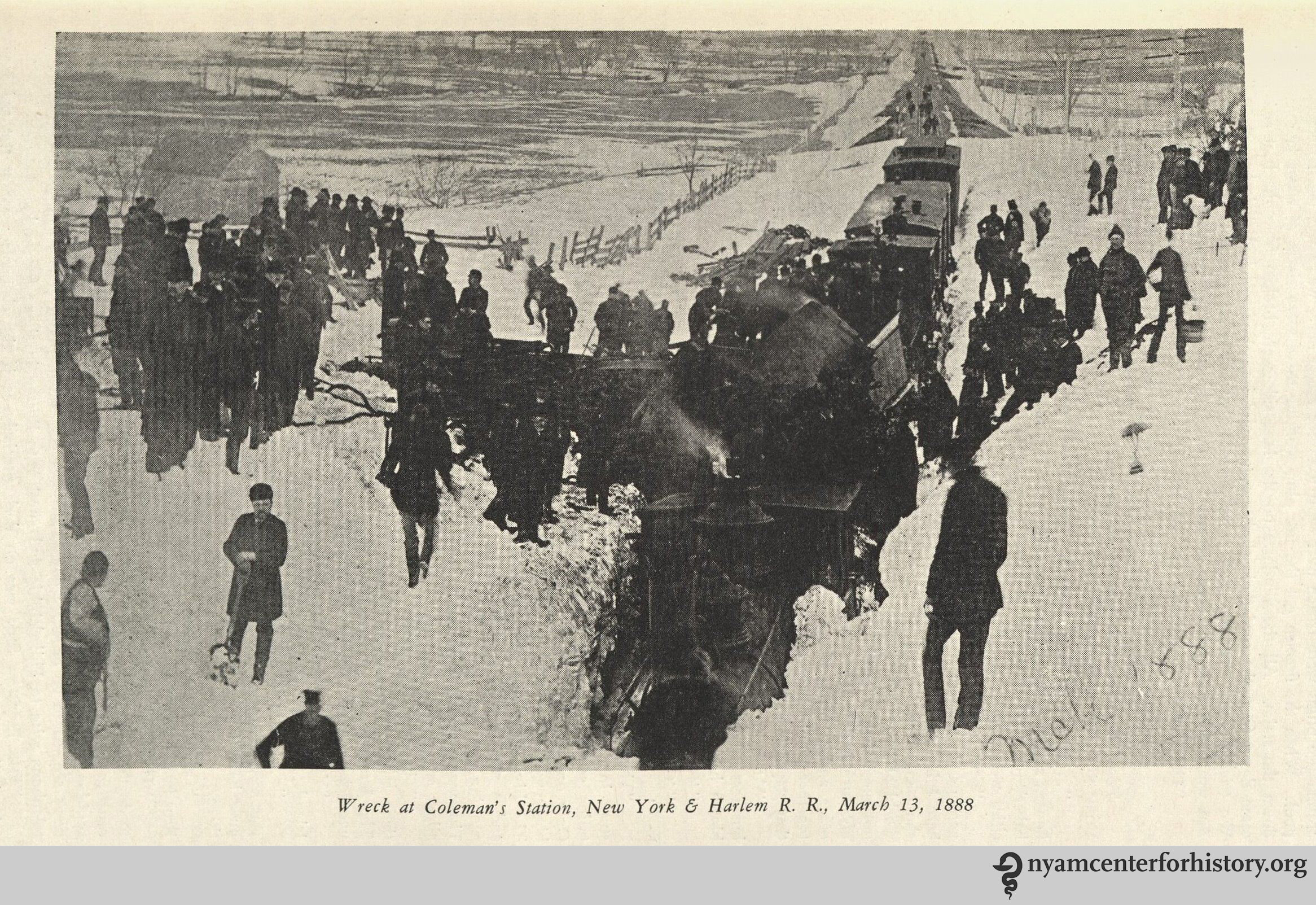
"Wreck at Coleman's Station, New York & Harlem R. R., March 13, 1888." From Strong, The Great Blizzard of 1888.

“Wreck at Coleman’s Station, New York & Harlem R. R., March 13, 1888.” From Strong, The Great Blizzard of 1888.

The blizzard contributed to slow but successful city efforts to move power lines underground and replace elevated trains with the underground subway. It also spurred a more organized response to future weather events from the Department of Street Cleaning, now called the Department of Sanitation.1

Park Place, Brooklyn, N. Y., March 14, 1888." From Strong, The Great Blizzard of 1888.

Park Place, Brooklyn, N. Y., March 14, 1888.” From Strong, The Great Blizzard of 1888.

The next time a blizzard comes to New York, be grateful for modern weather forecasting technology and heated subway cars. And don’t try to cross the East River by foot!

References

1. Virtual New York. Blizzard of 1888. Available at: http://www.virtualny.cuny.edu/blizzard/bliz_hp.html.

2. Strong SM, Overton M. The great blizzard of 1888. [New York]; 1938.

3. GUNCOTTON KILLS THREE. Explosion Wrecks Factory and Shakes a New Jersey County. New York Times. http://query.nytimes.com/gst/abstract.html?res=9D00EEDB1438EF32A2575AC1A96F9C946596D6CF. Published September 19, 1914. Accessed March 4, 2016.

Food Fight Club Round 1: Snail Water v. Pear and Tomato Chutney

Today we begin our March Madness competition, Food Fight Club.

This week and next, two recipes will go head to head, vying for your votes. The following week, the winners of the first two rounds will duke it out for the honor of being named the champion of our first Food Fight Club.

Background image: Kirkland, The modern baker, confectioner, and caterer, c1907.

The smackdown begins with Snail Water versus Pear and Tomato Chutney.

This lovely snail water recipe comes from A Collection of Choise Receipts, a late 17th-century English manuscript written in exquisite penmanship, perhaps written by a professional scribe. Snail water was thought to treat ailments including “sharpness in [the] blood” and appetite loss. Learn more about snail water in our blog archives.

From A Collection of Choise Receipts. Click to enlarge.

From A Collection of Choise Receipts. Click to enlarge.

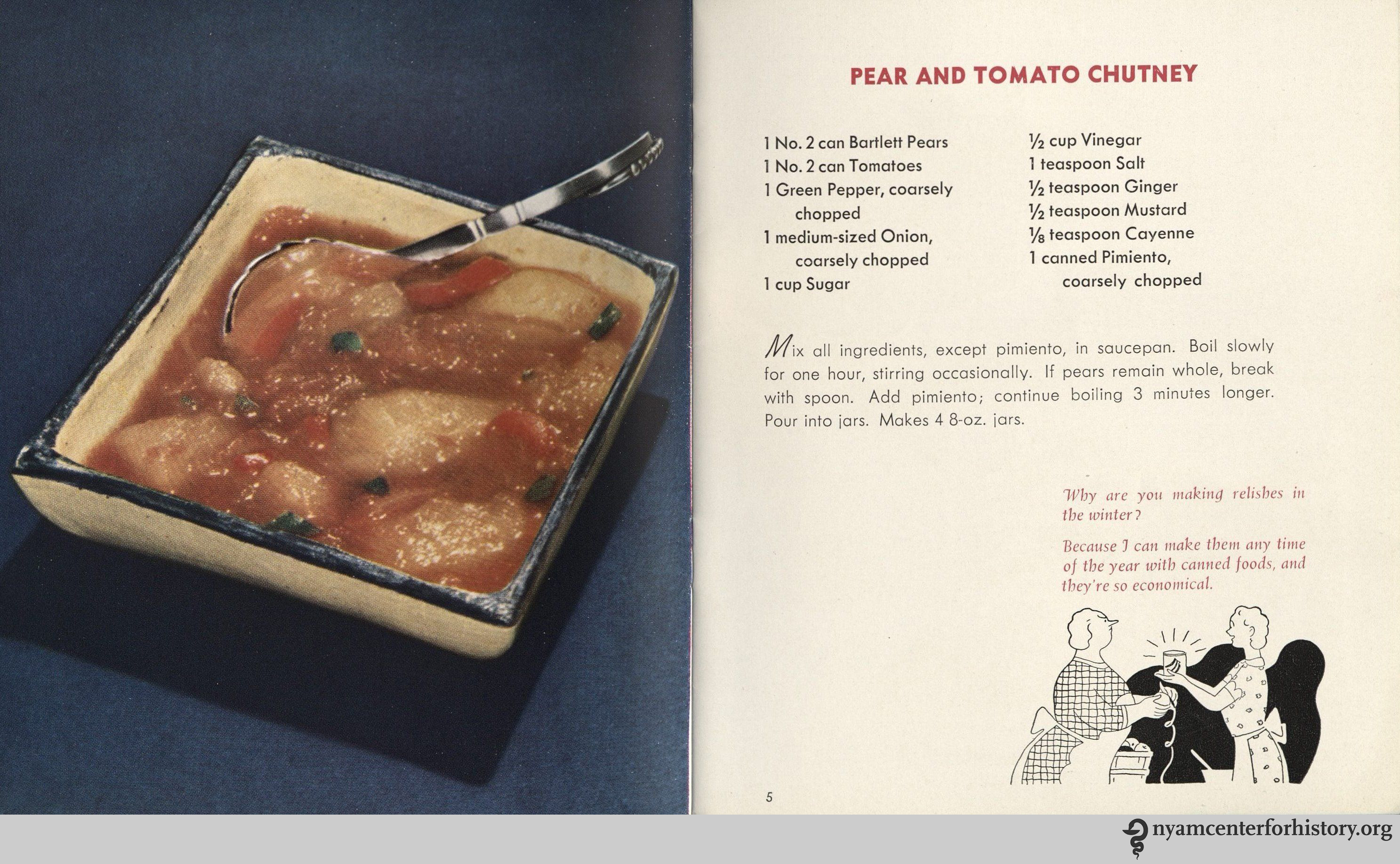
It takes a bold competitor to go up against this beauty. But we have one: Pear and Tomato Chutney from the American Can Company’s undated Relishes from Canned Food pamphlet. As early as the 1850s, commercially canned goods—especially sardines, tomatoes, condensed milk, and fruits and vegetables—found an eager consumer audience in the Western United States. Their popularity only increased over time; by the 1930s, foods from supermarkets were increasingly prepackaged (learn more in our 2015 April Fool’s blog—the food history facts are true!).

Pear and Tomato Chutney from American Can Company, Relishes from Canned Foods, no date. Click to enlarge.

Pear and Tomato Chutney from American Can Company, Relishes from Canned Foods, no date. Click to enlarge.

Which recipe should move on to the next round? Vote for your favoritebe it the most appealing, least appealing, or one that just tickles your fancy morebefore 5 pm EST on Monday, March 14.

“Solving Woman’s Oldest Hygienic Problem in a New Way”: A History of Period Products

By Johanna Goldberg, Information Services Librarian

This is part of an intermittent series of blogs featuring advertisements from medical journals. You can find the entire series here.

For the past few weeks, subway-riding New Yorkers have been surrounded by advertisements for absorbent underwear, the latest in a long history of products designed for use during menstruation.

But what did people use before the era of special undies, tampons, pads, and cups? Very little is known about pre-20th century methods, but historians believe (and oral history interviews confirm) that many relied on homemade cloth or paper pads or diapers pinned to belts and strings. Some women reused these items, while others disposed of them after one use.1,2 Other women—even going back to ancient Rome—fashioned their own tampons from absorbent wool, fibers, paper, sponges, and other materials.3

Things began to change in the mid-1800s. Between 1854 and 1921 (the year the Kotex was first marketed), the U.S. Patent Office granted 185 patents for menstrual (or catamenial) devices.1 In her 1994 doctoral dissertation, Laura Klosterman Kidd breaks these patents into six interconnected categories:

(1) Belts or supporters, from which were suspended (2) a catamenial sack, pouch, shield, menstrual receiver, or napkin-holder, into which was placed (3) an absorbent, consisting of cloths, pads, napkins, sponges, or raw waste fibers. Ancillary categories of menstrual patents were (4) attaching devices used to secure or connect the catamenial sack to the supporter, (5) catamenial garments or appliances that aided in protecting the wearer’s clothing, and (6) vaginally inserted menstrual retentive cups.1

One of these patented products is advertised in the 1884 American Druggist. Despite claims that it is “the grandest invention for the convenience and cleanliness of ladies,” it certainly gives the modern audience pause. A soft rubber cup gets inserted into the vagina, and fluid flows into a “receptacle” attached to a belt. “At night, before retiring, the fluid can and should be removed [from the receptacle], simply by removing a cap, without removing the instrument.”

"Farr's Patent Ladies' Menstrual Receptacle," advertised in American Druggist, January 1884.

“Farr’s Patent Ladies’ Menstrual Receptacle,” advertised in American Druggist, January 1884. Click to enlarge.

There’s a reason these never caught on. But they aren’t such a far cry from today’s (much less cumbersome) menstrual cups.

The real shift in feminine hygiene products came in the 1920s and 1930s. During World War I, nurses at the front lines used absorbent Cellucotton, a Kimberly-Clark product made from wood pulp, both to bandage soldiers (as intended) and to absorb menstrual blood. After the war, Kimberly-Clark developed Cellucotton into Kotex, introducing the product in 1920.4 These napkins were held in place using belts; adhesive napkins only became available in the late 20th century.2

This was not the first commercial sanitary napkin; earlier brands appeared for sale through mail-order catalogs. But it was the first to get a hard-won advertising campaign, which began in 1921. As Lara Freidenfelds relates in her book The Modern Period, advertisements for Kotex appeared in Ladies Home Journal once its editor’s secretary “declared the ads to be in good taste and of great benefit to women.” After Ladies Home Journal agreed to run the ads, other magazines, including the American Medical Association’s Hygeia, followed.2

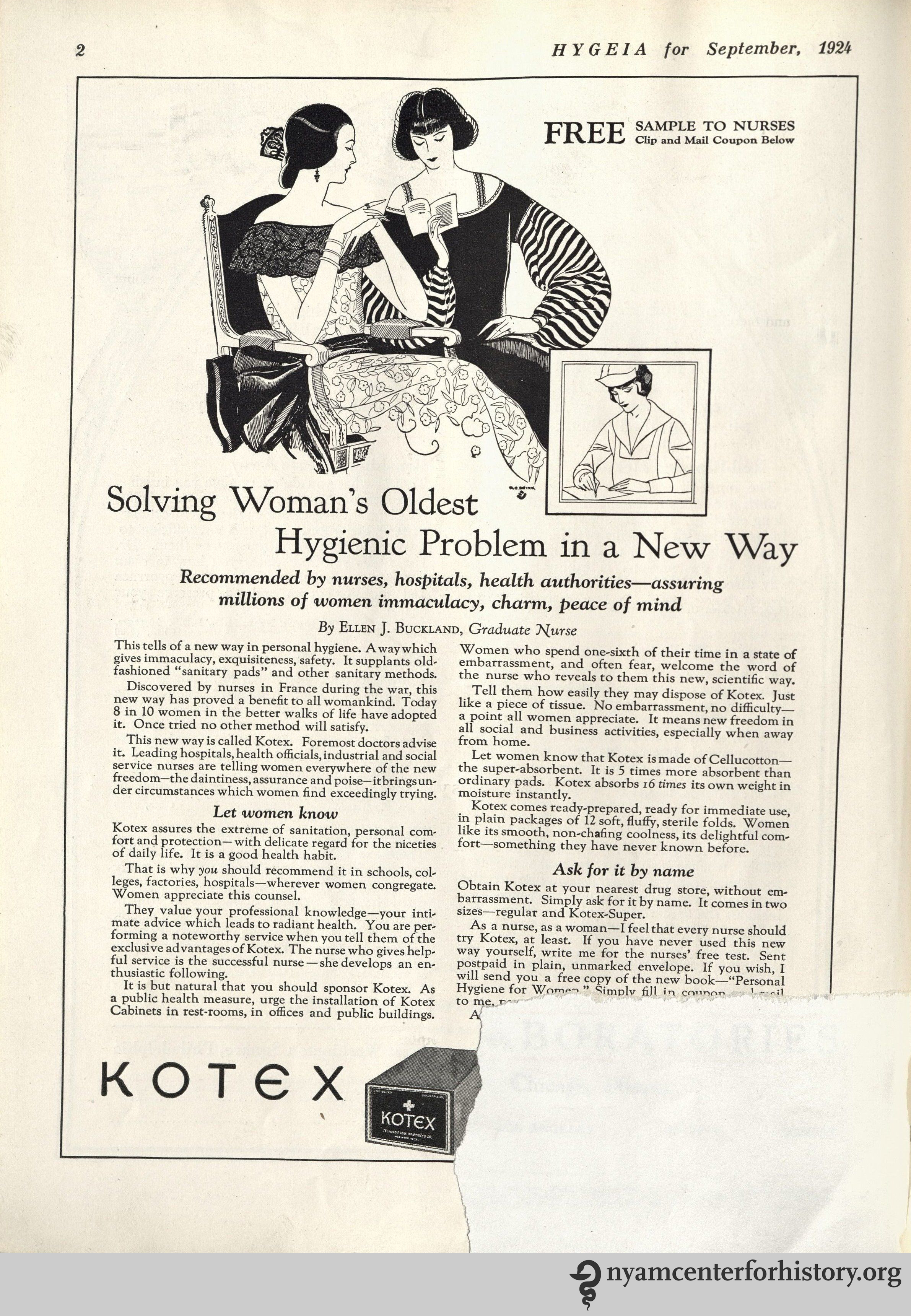
Below are two early advertisements for Kotex, which appeared in Hygeia in 1924 and are both geared to nurses. We love that the coupon from the September 1924 ad has been clipped and, presumably, mailed in for a free sample.

Kotex ad in Hygeia Magazine, September 1924.

Kotex ad in Hygeia Magazine, September 1924. Click to enlarge.

Kotex ad in Hygeia Magazine, November 1924. Click to enlarge.

Kotex ad in Hygeia Magazine, November 1924. Click to enlarge.

While Hygeia does not appear to have run ads for Kotex prior to 1924, it did advertise an absorbent cotton on the back cover of its volumes in 1923. Bauer & Black Absorbent Cotton touted its many uses in these advertisements, noting that “Women use it to meet personal emergencies.” Even after the advent of commercially available sanitary napkins, some women preferred a more do-it-yourself approach.

Bauer & Black Absorbent Cotton ad in Hygeia Magazine, August 1923. Click to enlarge.

Bauer & Black Absorbent Cotton ad in Hygeia Magazine, August 1923. Click to enlarge.

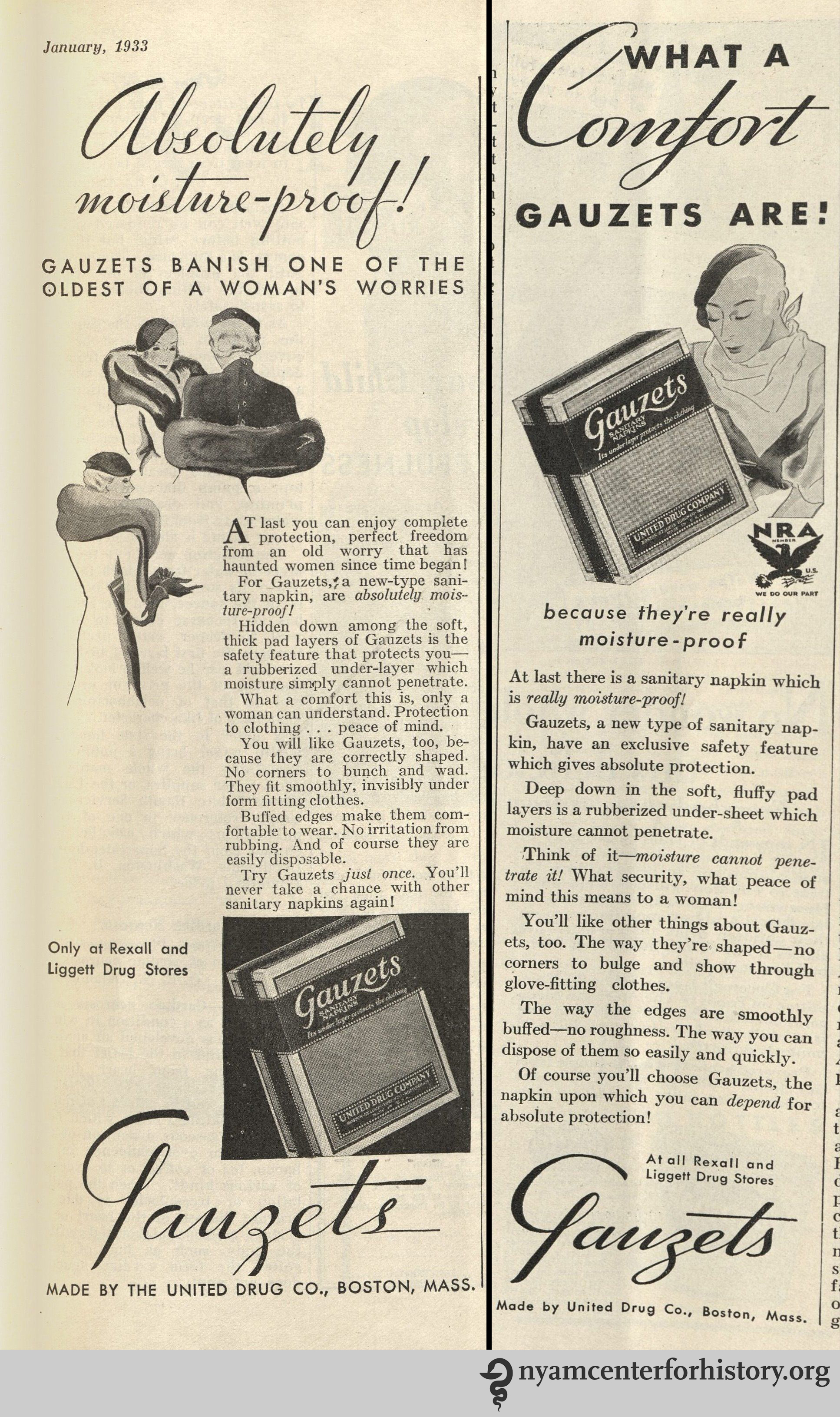
Kotex wasn’t alone in the marketplace for long: Gauzets and other, often cheaper, brands came along soon after, and also advertised heavily.

Gauzets ads from Hygeia Magazine, published in January and November 1933. Click to enlarge.

Gauzets ads from Hygeia Magazine, published in January and November 1933. Click to enlarge.

The first widespread commercial tampon arrived in the 1930s: Physician Earle Cleveland Haas received a patent for his applicator tampon in 1933, which he named Tampax. He distributed his product beginning in 1936.2,3 Prior to Tampax, tampons had widespread use as medical devices dating as far back as the 18th century.2,3 Soon after the development of Tampax, other commercial tampon brands, like Wix and B-ettes, became available and also advertised widely.

These early ads show the hurdles Tampax had to overcome to win wide acceptance from consumers and doctors. In fact, Tampax spent $100,000 on advertising in its first nine months alone; by 1941, the company was “one of the one hundred largest advertisers in the United States.”2 The ads worked: a 1944 survey showed that one quarter of women in the United States used tampons, even as doctors debated their safety.2,3 These ads, spanning the first 10 years of commercial tampon availability, emphasize the safety, comfort, convenience, and invisibility of the products.

Click on an image to view the gallery:

Despite the worries of physicians, early tampons were safe. In fact, our main concern with tampon use today, Toxic Shock Syndrome (TSS), was only linked to tampon use about 40 years after their debut. In 1978, Procter & Gamble released Rely, a super-absorbent tampon made from synthetic fibers. This new kind of tampon led to 55 cases of TSS from October 1979 through May 1980. But non-synthetic, less absorbent tampons pose little threat, and the bacteria that causes TSS is present and active in only a small percentage of people.3,5

Other options entered the marketplace in the 1930s: several menstrual cups received patents, including the first commercially available cup in the United States, patented by actress Leona Chalmers as a “catamenial appliance” in 1937.6 This cup’s design looks much the same as those on the market today.

Image from Leona Chalmers' 1937 patent for a "catamenial appliance." Source: https://www.google.com/patents/US2089113

Image from Leona Chalmers’ 1937 patent for a “catamenial appliance.” Source: https://www.google.com/patents/US2089113

In less than 100 years, menstrual supplies have moved from mostly homemade affairs to mass-market items available in stores, from products hidden away at the back of mail-order catalogs to some of the most commonly advertised goods in the United States. The advances of the 1920s and 1930s still impact our lives, as sanitary napkins, tampons, and cups remain go-to products, improved upon over time but not abandoned.

References

1.Kidd LK. Menstrual technology in the United States, 1854 to 1921. Ames, Iowa: Iowa State University Department of Textiles and Clothing; 1994.

2. Freidenfelds L. The modern period: Menstruation in twentieth-century America. Baltimore: Johns Hopkins University Press; 2009.

3. Fetters A. The tampon: A history. The Atlantic. June 1, 2015. Available at: http://www.theatlantic.com/health/archive/2015/06/history-of-the-tampon/394334/. Accessed March 1, 2016.

4. World War I centenary: Sanitary products. Available at: http://online.wsj.com/ww1/sanitary-products. Accessed March 1, 2016.

5. Vostral SL. Rely and Toxic Shock Syndrome: a technological health crisis. Yale J Biol Med. 2011;84(4):447–59. Available at: http://www.pubmedcentral.nih.gov/articlerender.fcgi?artid=3238331&tool=pmcentrez&rendertype=abstract. Accessed March 1, 2016.

6. North BB, Oldham MJ. Preclinical, clinical, and over-the-counter postmarketing experience with a new vaginal cup: menstrual collection. J Womens Health (Larchmt). 2011;20(2):303–11. doi:10.1089/jwh.2009.1929.

Presentations for History of Medicine Night: Intersections of Medicine, Health, and Ethnicity

The New York Academy of Medicine’s Section on the History of Medicine and Public Health invites you to join us for “Intersections of Medicine, Health, and Ethnicity” on March 9, 2016 from 6:00pm–7:30 pm at the Academy, 1216 Fifth Avenue at the corner of 103rd Street. Admission is free but advanced registration is required. Register online.

The evening’s presenters will be:

A wooden caduceus symbol shown in NYAM rare book reading room

A caduceus symbol donated to our rare book reading room

HARRIET A. WASHINGTON
Independent scholar
“The 1788 New York Doctors’ Riot: A Signal Event in the Dissection of Anatomical Ethics”

KATE BAILEY
Graduate Student, M.A. Health Advocacy Program, Expected May 2017
Sarah Lawrence College
“From Motherhood to Sisterhood: How Underground Abortion Referral Networks Worked Towards Advocacy and Solidarity”

KIRK JOHNSON
Doctoral candidate in the Medical Humanities program at Drew University
“Heart Illness: Developments of Racial Discourse”

MARLENE A. GEORGE
Graduate Student, Health Advocacy Program, Sarah Lawrence College
“Social Service Sterilization – Eugenics Of The 1950’s-1970’s”

BOB VIETROGOSKI
Head of Special Collections
George F. Smith Library of the Health Sciences
Rutgers Biomedical and Health Sciences
“‘Agitation of the Question’: James McCune Smith’s Nomination for Fellowship to the New York Academy of Medicine, 1847”

A second evening of presentations, History of Medicine Night Part II, will take place on Wednesday, May 4, and we hope that you will be able to join us for that one as well.

The Berg Brothers: Bibliophile Surgeons

By Anne Garner, Curator, Center for the History of Medicine and Public Health

New York physicians Henry W. and Albert A. Berg are well-known to students of literature. In 1940, Albert A. Berg founded the New York Public Library’s spectacular Berg Collection, endowed in his older brother Henry’s memory. It is a magical place, nestled on the third floor of NYPL’s Steven A. Schwarzman building, with endlessly deep collections in its vaults (I should know, I was lucky enough to work there). Highlights include a typescript draft of T.S. Eliot’s The Wasteland, annotated by Ezra Pound; the manuscript notebooks containing five of Virginia Woolf’s seven novels; and a map drawn by Jack Kerouac of territory covered on the cross-country trip that inspired On The Road.

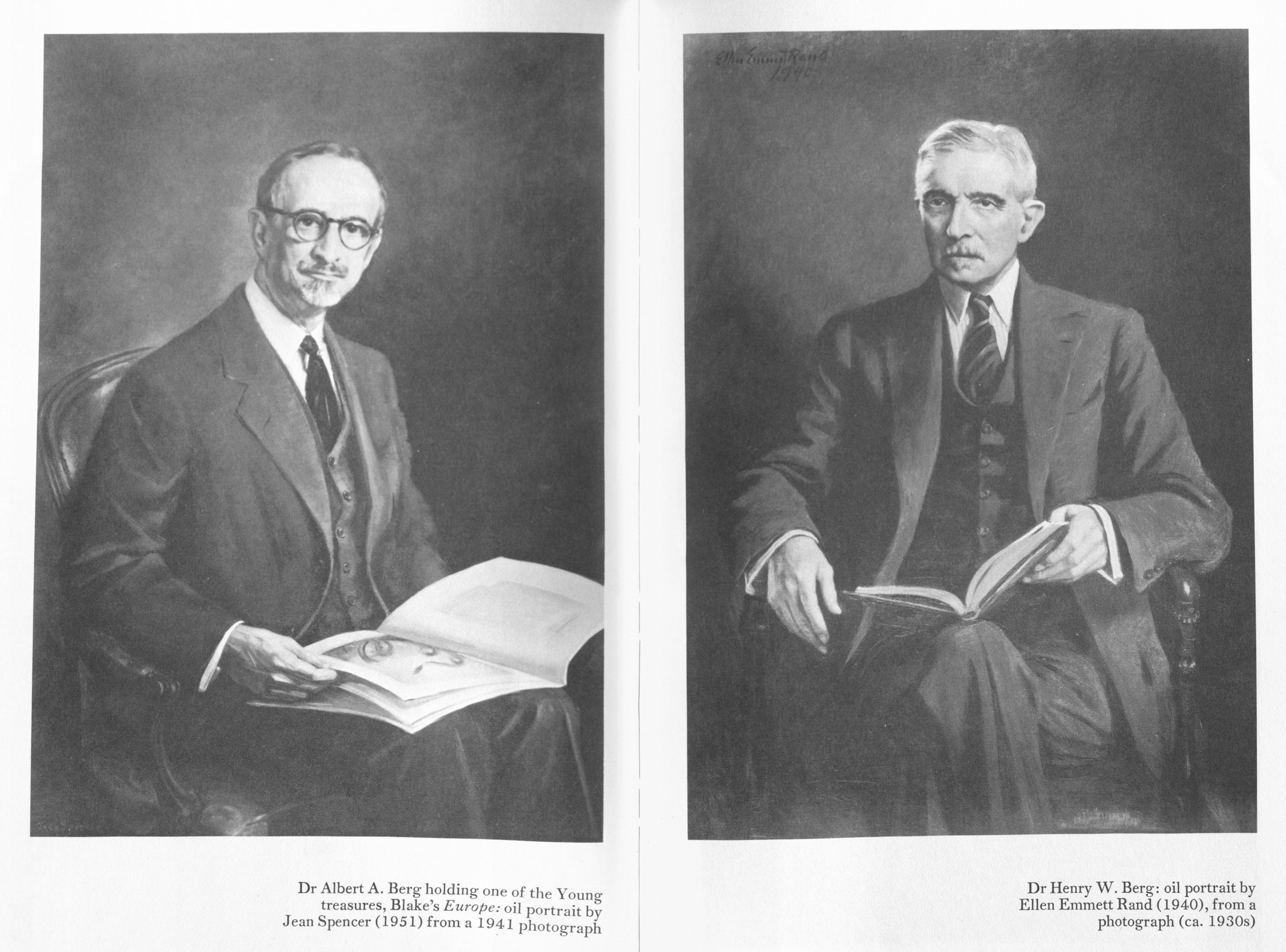
Left: Dr. Albert A. Berg, holding Blake's Europe, in an oil portrait by Jean Spencer hanging in The New York Public Library's Berg Collection. Right: Dr. Henry W. Berg in an oil portrait by Ellen Emmett Rand, also in the New York Public Library's Berg Collection. In Szladits, Brothers: The Origins of the Henry W. and Albert A. Berg Collection,1985.

Left: Dr. Albert A. Berg, holding Blake’s Europe, in an oil portrait by Jean Spencer hanging in The New York Public Library’s Berg Collection.
Right: Dr. Henry W. Berg in an oil portrait by Ellen Emmett Rand, also in the New York Public Library’s Berg Collection.
In Szladits, Brothers: The Origins of the Henry W. and Albert A. Berg Collection,1985. Click to enlarge.

Fourteen years separated the eldest and youngest Berg siblings, but they had much in common, including interests in book collecting and literature, along with an aptitude for real estate investment (a pastime that funded their library interests). The two doctors lived together until Henry’s death in 1939 in a townhouse on East 73rd Street. The story of Henry and Albert Berg’s establishment of one of the world’s great literary collections is told in Lola Szladits’ excellent book, The Brothers.

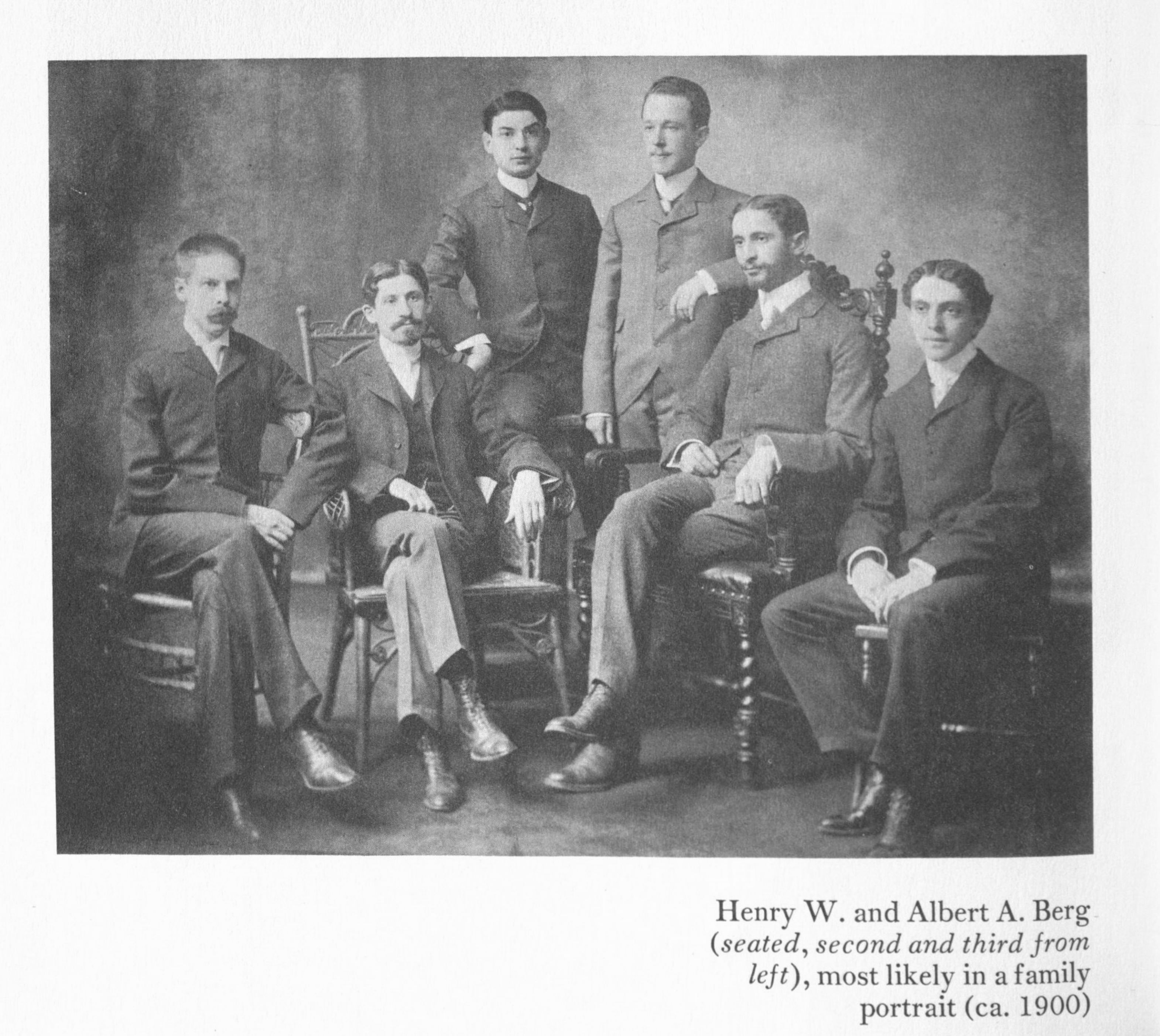
The medical legacy of the brothers, both prominent New York doctors, is less widely known. Henry and Albert’s father, Moritz Berg, immigrated to America from Hungary in 1862 with designs to work as a doctor. He found work instead as a tailor to support his family of eight children. Moritz died of cancer when Albert was young, and Henry, already interested in medicine himself, determined that Albert should follow the same career path.1

Henry W. and Albert A. Berg (seated, second and third from left), most likely in a family portrait (circa 1900). In Szladits, Brothers: The Origins of the Henry W. and Albert A. Berg Collection,1985.

Henry W. and Albert A. Berg (seated, second and third from left), most likely in a family portrait (circa 1900). In Szladits, Brothers: The Origins of the Henry W. and Albert A. Berg Collection,1985.

Henry earned his medical degree from Columbia University’s College of Physicians and Surgeons in 1878, specialized in infectious disease, and headed Mount Sinai’s isolation service. He taught both neurology and pediatrics at the College of Physicians and Surgeons.2 Henry was attending physician at Willard Parker Hospital on East 16th Street for 40 years, until his death in 1939.3 His active role on Willard Parker’s board is documented in the Academy’s collection of Willard Parker minute books.

It was Henry who mentored Albert, put him through medical school, and showed him he could be a great doctor. All early indications were to the contrary: Albert repeatedly ditched class to play pool. Their mother was skeptical that Henry could ever make a doctor out of him.4 But by graduation (also from College of Physicians and Surgeons), Albert was a decorated prizewinner.5 And as a surgeon, he proved a brilliant and visionary pioneer, a key player in the development of abdominal surgery in the United States.

Albert A. Berg as a young doctor (seated, second from left). In Szladits, Brothers: The Origins of the Henry W. and Albert A. Berg Collection,1985, page 37.

Albert A. Berg as a young doctor (seated, second from left). In Szladits, Brothers: The Origins of the Henry W. and Albert A. Berg Collection,1985, page 37.

Albert’s exceptional skill as a surgeon is attested in a tribute article by Dr. Leon Ginzberg in a festschrift volume of the Journal of the Mount Sinai Hospital devoted to Albert’s career:

[Dr. Berg’s] tremendous capacity for work, his boldness and resolution, his extraordinary operative skill and his refusal to remain on the accepted path, had brought his service to an enviable position in the field of abdominal surgery. The most significant studies from his clinic were in the fields of gastroduodenal and jejunal ulcers. Other important contributions were made to the subjects of colonic, and more particularly rectal and recto-sigmoidal carcinoma….to chronicle adequately all of Dr. Berg’s ‘labors in the vineyard’ would be to write an important chapter in the history of the development of abdominal surgery in the United States.6

Title page of Alfred A. Berg’s Surgical Diagnosis, 1905, given by the author to the New York Academy of Medicine Library.

Albert’s skill and personal style made him one of New York’s most recognizable doctors by the 1920s. In physical appearance he was “six feet tall, slender, and forbidding.”7 Katie Loucheim’s remembrance in the New Yorker compares his appearance to an “esteemed rabbi…with a Vandyke beard…his manner in speaking and his voice were reassuring.”8 He wore a red carnation in his lapel, even during surgery, until the death of his brother in 1939.9

Albert—or A.A. as his medical friends called him—observed an almost fanatical devotion to the operating room. Loucheim reports that Albert regularly scheduled surgery for a few minutes before midnight on New Year’s Eve, believing that if he began the new year in surgery he could secure for himself a happy year. Berg’s dexterity as a surgeon ensured that he could easily converse about rare books while operating on patients, including his friend, the great book collector Carl Pforzheimer. Seven days a week, the Fifth Avenue bus—“Berg’s green taxi” to his colleagues, dropped him halfway down the block in front of the canopy of Mount Sinai. Other passengers complained because it wasn’t an actual bus stop (in turn, the conductors and bus drivers relied on Berg for any surgical needs).10

Mount Sinai Hospital, circa 1913. From The Dr. Robert Matz Collection of Medical Postcards.

Mount Sinai Hospital, circa 1913. From The Dr. Robert Matz Collection of Medical Postcards.

A stone’s throw away from A.A. Berg’s beloved Guggenheim pavilion at Mount Sinai Hospital, the Berg name lives on. On the third floor of the New York Academy of Medicine in the former periodicals room is a bronze plaque commemorating the gifts of Drs. Henry W. and Albert A. Berg to the Academy. A bequest from Albert endowed the third floor room that bears their name and still supports the acquisition of library periodicals today. Both brothers were Academy Fellows (Henry beginning in 1890, Albert in 1900).

Albert seems to have recognized how vital a good set of tools were to students of surgery. A copy of his last will and testament in the Academy’s archives entrusts his surgical instruments, instrument bags, and laboratory equipment, including two microscopes and examination tables and one portable operating table, to “one or more deserving young surgeons” to be selected at the Academy’s discretion.11 The items are no longer at the Academy; perhaps they were also used by a student whose path to medicine was at first uncertain, but later found his or her way.

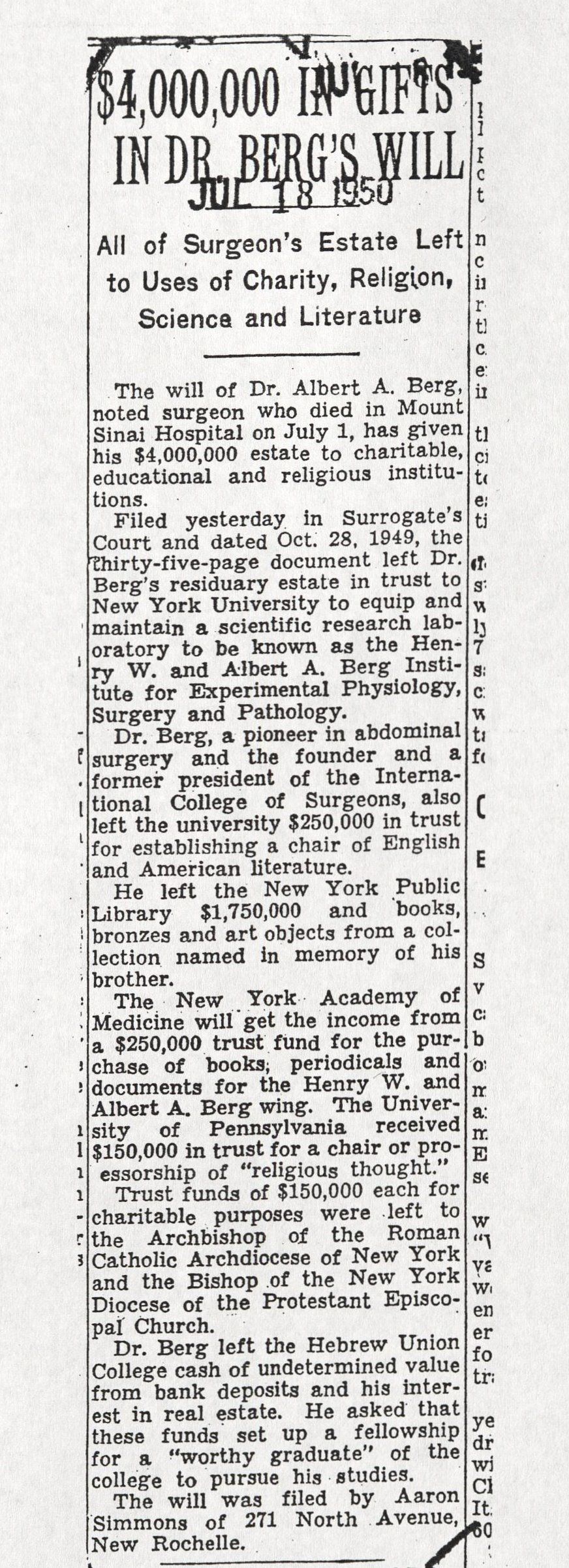
New York Times article from July 18, 1950 announcing Albert A. Berg's bequests, including to the New York Public Library and the New York Academy of Medicine.

New York Times article from July 18, 1950 announcing Albert A. Berg’s bequests, including to the New York Public Library and the New York Academy of Medicine. Click to enlarge.

References

1. Szladits, Lola. Brothers : The Origins of the Henry W. and Albert A. Berg Collection. New York: New York Public Library, 1985. pp. 9-10.

2. Szladits, pp. 10-11.

3. Medical Society of the State of New York. Medical Directory of New York, New Jersey and Connecticut. New York: 1899-1939.

4. Louchheim, Katie. “Sweeping Formalities and Offstage Flourishes.” The New Yorker 3 Nov. 1975: 40-48. Print.

5. Szladits, pp. 11.

6. Ginzburg, Leon. “Some of the Principles and Methods contributed by the service of Dr. A.A. Berg.” Journal of the Mount Sinai Hospital Volume 17.6 (1951): 356-368. The Journal of the Mount Sinai Hospital has been digitized and is available online.

7. Szladits, 39.

8. Loucheim, 41.

9. New Yorker and Szladits.

10. Szladits, 42.

11. The New York Academy of Medicine Archives. Library Correspondence, 1927-1974.

Fair Use at the New York Academy of Medicine Library

By Emily Miranker, Project Coordinator

As we go about our work at the library—sharing coloring pages featuring images from our collection, digitizing decades-old journal volumes, pointing people towards resources on the HathiTrust and Medical Heritage Library, among other endeavors—we keep something known as fair use in the back of our minds. It’s a legal doctrine that helps determine when it’s OK to use copyrighted material without explicit permission. This week, Fair Use/Fair Dealing Week, the doctrine moves front and center for an annual shout-out by libraries, universities, arts organizations, media groups, and other institutions. It’s a form of consciousness-raising and an opportunity to share examples of fair use in action.

Fair use isn’t particularly new—the codification of it in U.S. law is part of the 40-year old Copyright Act of 1976, with the concept of fair use going back even farther. Fair Use/Fair Dealing Week, by contrast, is just three years young. It was started by Harvard’s copyright advisor Kyle K. Courtney as a way of spotlighting and sharing the Association of Research Libraries’ Code of Best Practices in Fair Use for Academic and Research Libraries.1

Not a scholar or a librarian? Wondering if you really need to know how fair use works? Yes, you do. As a reader of this blog you’re a cultural consumer, but probably a cultural producer as well. We all routinely download, share, and often repurpose photos and videos, songs and TV clips, text, artwork, and sound bites. We create—and recreate—all the time. And we would like our creations to “reference the world around us without getting [us] into trouble” with copyright infringement. 2

This photo was shared under a Creative Commons Attribution License and was taken from the Flickr photostream of Timothy Vollmer.

This photo was shared under a Creative Commons Attribution License and was taken from the Flickr photostream of Timothy Vollmer.

Copyright law works for two constituencies, broadly speaking. It defends the interests of copyright holders, protecting the success of creators. It also protects use by cultural consumers of copyrighted materials for select purposes. Deciding when copyrighted materials can be used without permission is the subject of fair use, formally known as Section 107 of the Copyright Act of 1976. Section 107 sets out four factors for determining whether a use is fair: the purpose and character of the use; the nature of the copyrighted work; the portion of the copyrighted work used, and the effect of the use on the copyrighted work.

This very blog you’re reading is a frequent arena where we at the library have applied these fair-use tests as we share, curate, interpret, and provide access to the materials in our collections. Often our blog posts feature both images and selected quotes from copyrighted materials in our collections. Here’s a look at the doctrine’s four tests in relation to our intermittent blog series on advertisements in medical journals:

  • Purpose: The Academy Library has strong holdings in 20th-century journals, and highlighting them in online blog entries makes them more accessible to researchers and indeed anyone with an interest in medical history or Americana. Moreover, the Academy did not follow a common library practice of removing advertisements from journals. So we have a wealth of now nearly unique content we’re sharing, free, to eager historians and the public at large. Section 107 strongly favors this sort of education, transformative, and non-commercial use.
  • Nature: Typically this factor favors fair use if the underlying work is factual in nature as opposed to involving more creative expression, such as fiction or music. While advertisements take creativity to make, their relevance in our collection and to our users lies in the cultural and historical context they provide, a public benefit that goes to the heart of this factor.
  • Effect: This factor asks us to consider whether including images and quotes in posts harms the rights of the authors. Since we focus on the cultural and historical significance of these journal ads, our posts do not diminish or undermine their market.
  • Portion: The less you use, the more likely a use will be considered fair. With the short format of a blog post, images and quotes shared are always minimal in contrast to how many ads appear in a single journal.
Parke Davis ad in Hygeia Magazine, August 1945. Click to enlarge.

Parke Davis ad in Hygeia Magazine, August 1945. Click to enlarge.

What makes fair-use worthy of a week-long celebration is that “copyright law does not specify exactly how to apply fair use.3 Case law helps shape what is considered fair use, and industry standards guide everyday decision making. Best practices—not only the Association of Research Libraries’ code but also an increasing number of industry-specific standards for fields like journalism, documentary filmmakers, OpenCourseWare, poetry, and visual art—provide guidelines on fair use factors, facts, and community norms. To join the conversation on how to apply fair use, click on over to the feed of stories on Fair Use/Fair Dealing Week’s Tumblr.

References

1. Courtney, Kyle. “About Fair Use Week,” Copyright at Harvard (blog), Office for Scholarly Communication, Harvard University, 2014, https://blogs.harvard.edu/copyrightosc/about-fair-use-week/.

2. Patricia Aufderheide, Peter Jaszi, Reclaiming Fair Use: How to Put Balance Back in Copyright (Chicago, University of Chicago Press, 2011), ix.

3. “Code of Best Practices in Fair Use for Academic and Research Libraries.” Association of Research Libraries. Accessed January 20, 2016. http://www.arl.org/storage/documents/publications/code-of-best-practices-fair-use.pdf.

Special thanks to Professor Betsy Rosenblatt J.D., Director of the Center for Intellectual Property Law, Whittier Law School.

De Revolutionibus

By Danielle Aloia, Special Projects Librarian

Today marks the 543rd birthday of Nicolaus Copernicus, who was born February 19, 1473 at 4:48pm.1 What better way to celebrate his birth than to look at his seminal work: De revolutionibus orbium coelestium (On the Revolutions of the Heavenly Spheres). The library owns a 1566 second edition.

The work was originally published in 1543, a few months before Copernicus’ death and the same year that Vesalius published his Fabrica. That year is considered by many scholars to be “the veritable annus mirabilis of the sixteenth century.”2 This miraculous or amazing year was a culmination of late Renaissance humanistic thinking. Indeed, Copernicus was a true renaissance man; he was a scholar, physician, clergyman, and astronomer.

Cover photo: Copernicus N, Dobrzycki J. On the Revolutions. Baltimore: Johns Hopkins University Press; 1978.

Cover photo: Copernicus N, Dobrzycki J. On the Revolutions. Baltimore: Johns Hopkins University Press; 1978.

Yet Copernicus was reluctant to publish De revolutionibus; his pupil, Georg Joachim Rheticus, had to convince him to do so. Copernicus feared the controversy that would come if he published that the Sun was the center of the solar system. At the time, the Church was burning people at the stake for their views on Aristotle.3 De revolutionibus expounded upon Ptolemy’s idea of planetary motion from his treatise Almagest. As one biographer questioned: “Did Copernicus fail to see that he was pushing the dear Lord out into the infinite void?”4

Copernicus, a bishop himself, did have the support of two other bishops, Nicholas Schönberg and Tiedemann Giese, both of whom encouraged him to publish his work. Schönberg wrote an encouraging letter stating: “I had learned that you had not merely mastered the discoveries of the ancient astronomers uncommonly well but had also formulated a new cosmology … I entreat you … to communicate this discovery of yours to scholars…”5

According to historian Guy Freeland, “Copernicus was cautious about printing his treatise on the motion of the earth because the act of printing was politically and epistemologically loaded; and while he seemed to understand enough about politics of knowledge at the time to attempt to control the reception of his work, he failed to grasp the ways in which that politics was being affected by printing.”

Title page of our 1566 edition of De Revolutionibus.

Title page of our 1566 edition of De Revolutionibus.

The publication of the Revolutions caused Copernicus great anxiety. He feared that “the devoted research of great men, should not be exposed to contempt of those who either find it irksome to waste effort on anything learned, unless it is profitable, or if they are stirred by exhortations and examples of others to a high-minded enthusiasm for philosophy, are nevertheless so dull-witted that among philosophers they are like drones among bees.”6

Copernicus passed away at the time of publication, “and so he was spared the shame of the failure of his Revolutions.”7

There was no immediate backlash or threats. Really, there was no major upheaval until later scholars began unfolding its contents. First in the 1580s by Giordano Bruno, forty years after its publication. Bruno would later be burned at the stake for his heretic ideas. Then Tycho de Brahe, Johannes Kepler, Galileo Galilei, and Isaac Newton all followed suit.8 What made the work so revolutionary was the widespread interest and attention from outside the sciences and “certain embellishments contributed by other men.”9

De revolutionibus is divided into six books. Here are images taken from each section of our 1566 edition, alongside translations and explanations from Copernicus N, Dobrzycki J. On the Revolutions. Baltimore: Johns Hopkins University Press; 1978.

Click on an image to enlarge and view the gallery:

References

1. Kesten H. Copernicus and His World. New York: Roy Publishers; 1945.

2. Freeland, G. 1543 and All That. Dordrecht ; Kluwer Academic Publishers; c2000.

3. Kesten H. Copernicus and His World. New York: Roy Publishers; 1945.

4. Ibid.

5. Copernicus N, Dobrzycki J. On the Revolutions. Baltimore: Johns Hopkins University Press; 1978.

6. Freeland, G. 1543 and All That. Dordrecht ; Kluwer Academic Publishers; c2000.

7. Kesten H. Copernicus and His World. New York: Roy Publishers; 1945.

8. Armitage, A. Copernicus: The Founder of Modern Astronomy. London: George Allen & Unwin, LTD; 1938.

9. Drake, S. Copernicus philosophy and science: Bruno – Kepler – Galileo. Norwalk, CT: Burndy Library; 1973.