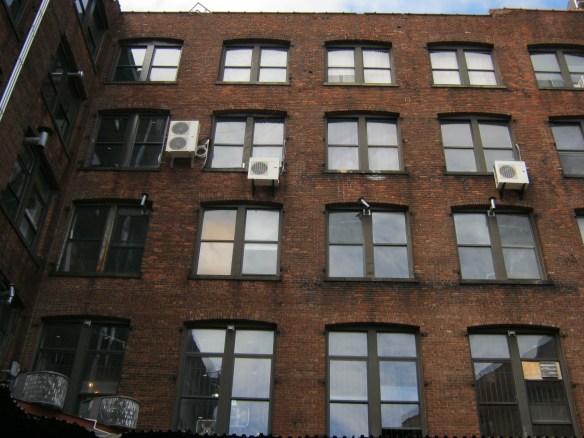
Today is #GivingTuesday

After Black Friday and Cyber Monday, two whirlwind days for getting deals, #GivingTuesday is a day for giving back.  Through this campaign, millions of people have come together to support and champion the organizations and causes they value. On this day, please consider donating to the New York Academy of Medicine Library.

Open to the public since 1878, the library is home to a collection that spans 12 centuries of learning.  It is a place where world-renowned historians and students alike come to learn, to be inspired, and to form the foundation of knowledge that opens the door to a future discovery.  With your generous contribution, we can foster this discovery for years to come.

donate

As we look to the future, please enjoy this look back at the past year through the eyes of our library staff.

“From Dr. Dorothy Boulding Ferebee, the African American physician leading the Mississippi Health Project during the Great Depression; Mexican physicians marching on the street for reform in the 1960s; to the doctors and nurses at the Lincoln Hospital creating a model for medical activism in the 1970s; this year’s “Changemakers” series was an important reminder that creating social and political change requires energy, engagement, and commitment, at any time in history.”  –Lisa O’Sullivan, Director

archivespanel“On October 26th, the Academy Library convened  ‘Archives, Advocacy and Change:  Tales from Four New York City Collections.’  I moderated a lively conversation with all-star panelists Jenna Freedman (Barnard College), Steven Fullwood (In the Life Archive), Timothy Johnson (Tamiment Library, New York University) and Rich Wandel (The Lesbian, Gay, Bisexual & Transgender Community Center).  The discussion hit on a lot of fascinating issues, including how archivists shape the historical record with the selection and acquisition choices they make, issues of privilege, and access for communities.”  –Anne Garner, Curator

edwardjenner“I was excited to learn in 2016 that the Library holds autograph letters from Edward Jenner in which he discusses the smallpox vaccine that he helped pioneer. These fascinating letters are available to the public for consultation. They demonstrate how strongly Jenner believed that inoculation with cowpox would protect people from the scourge of smallpox.”  –Rebecca Filner, Head of Cataloging

“As a new staff member, I really enjoyed the Rare Book Room tour that Arlene Shaner gave me during my first few weeks at the Academy. I got to see some absolutely incredible items and learned so much about the building’s history. As a little aside, these tours are free and open to the public! They happen from 12-1 on the first Monday of each month.”  –Audrey Lorberfeld, Digital Technical Assistant

pendleton_bugsandnuts_1924_cover_watermark“Most of my works has a lot to do with satisfaction—satisfactions from cleaning dusted books, from placing crumbled health pamphlets into clean, acid-free envelopes, from making fitted enclosures for damaged books, from putting torn pieces together, and so much more. But all of these satisfactions is ultimately coming from that I’m contributing in preservation of the library materials to be more accessible and usable for the future! One of the most memorable item I worked through in Health Pamphlet Rehousing Project this year is this “Bugs and Nuts” pamphlet by Andrew Lenis Pendleton, with so many absurd and eerie illustrations.”  –Yungjin Shin, Collections Care Assistant


color-our-collections“A recent highlight for me would be our first #ColorOurCollections week, held February 1-5, 2016. Over 200 libraries, archives, and cultural institutions around the world participated by creating collections-based coloring sheets and sharing them freely online. It was exciting to connect with other institutions and new followers, and it was especially rewarding to share our collection and see people engage with it in new and creative ways. I can’t wait for the next #ColorOurCollections, coming up on February 6-10, 2017!”  –Rebecca Pou, Archivist


shop1

“One thing I particularly enjoyed this year was developing an online store featuring images from our collections on a variety of products. It allowed me to delve into and share the collections in a new and often very quirky ways. A 1910 health pamphlet on a beer koozie, a 17th century microscopic slice of rock as your party clutch, a poster of vintage stethoscopes to adorn your walls, a refrigerator magnet with a an octopus, or beautifully calligraphic roman numerals from a 9th century Roman cookbook decorating a bookmark – these truly breathe new life into elements of the collection.”  –Emily Miranker, Team Administrator/Project Coordinator

“In sitting down to go through the William J. Morton Papers in connection with my residency as The Helfand Fellow, I was just stunned to find a 7-in thick stack of newspaper cuttings curated by Morton himself and preserved in their original order. The subject of my research is the history of the X-ray, and the difficulty is dealing with the voluminous print matter that appeared almost instantly. Yet Morton essentially curated some of that for me, by clipping articles that reflected his view of what was relevant to the New York metropolitan area and the networks of physicians and scientists in which he traveled. The collection is a gift for the historian, not just for its content, but because of its window into what one prominent NYC physician deemed worth noting about X-ray fever.”  –Daniel Goldberg, Audrey and William H. Helfand Fellow
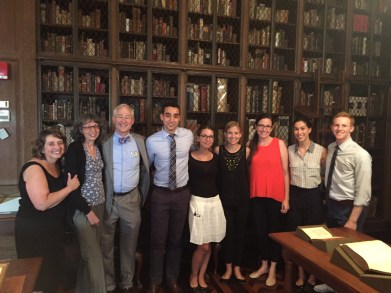
columbia-dermatology“Dr. Paul Schneiderman brought his Columbia dermatology residents to visit the rare book room on August 26th so that we could explore the history of dermatology. Looking at highlights from the dermatology collection from the 16th through the 20th centuries gave the residents a chance to think about the many ways in which their specialty has changed over time, especially since dermatology relies so heavily on visual representation. We looked at hand colored engravings, chromolithographs, photographs and stereoscopic images and the residents and their mentor engaged in lively debates about whether the descriptions and images matched with current information about some of the diseases that were shown. Not only did the residents have the opportunity to see these wonderful materials, but I had the pleasure of learning more about how to interpret the images from them.”  –Arlene Shaner, Historical Collections Librarian

Discover Grey Literature: Hidden Health and Science Resources

By Danielle Aloia, Special Projects Librarian

This fall, the Academy will host the 18th International Conference on Grey Literature to reveal one of the most valuable hidden resources for students, health professionals, and researchers. This post was originally posted on The New York Academy of Medicine‘s blog, Urban Health Matters.

Where can anyone get access to more than 20,000 expert health and science resources for free? The Grey Literature Report—GreyLit for short. A treasured resource among librarians since 1999, the GreyLit Report also offers students, health sciences researchers and professionals a one-stop-shop for incredibly difficult to find information. Once a quarterly publication, the GreyLit Report became so popular by 2006 that the Academy doubled the number of issues published each year.

greylitscreenshotWhy Grey?

The very title of the report is a clue to why it’s such a valuable tool. The carefully curated resources it provides often exist in a “grey” area between widely distributed peer-reviewed journals and the proprietary research that does not make it into the public sphere.

Grey literature is notoriously hard to find, often buried on the websites of any number of organizations or in the stacks of medical and science libraries. By publishing a categorized, bi-monthly compendium of the top resources in the field, the GreyLit Report does the detective work for thousands of overwhelmed students, scientists and academics that often leads them to the critical information they need to complete their work.

One popular document included in the report, for example, was A closer look at the implementation of taxation on sugar-sweetened beverages: a civil society perspective, published by the government of Barbados. Normally, this study would not land on the desks of American researchers, even those studying nutrition policy. It was nearly impossible to find on Google, prior to its mention in the August 2016 GreyLit newsletter, yet it offers a valuable analysis of the policy implications of attempting to regulate the consumption of unhealthy foods.

I discovered GreyLit long before I came to the Academy to become the editor of the report. In my previous life at AARP, as editor of the AgeLine Database, the premier literature database on aging research, the GreyLit Report became one of my most valuable sources of publications on aging.

I could just glance at the report and find new resources. It also became a way for AARP’s research to be disseminated to a broader audience, as it sometimes included research from other divisions.

Now, 17 years after it was created, the Academy’s GreyLit Report is still the only publication of its type in the United States. This year, as members of GreyNet International, an organization dedicated to increasing public awareness of grey literature, the Academy will be hosting the 18th International Conference on Grey Literature on Nov 28th and 29th, 2016. This year’s topic is Leveraging Diversity because grey literature can play a pivotal role in the search for solutions to urban health challenges here in New York and around the world.

That’s also why we have named the week of Nov 28 as the 1st International Grey Literature Week. We will be holding workshops and events along with the conference in celebration of grey literature. If you are interested in finding the best, hidden resources in your field, join us this November and discover GreyLit!

Cool Products for Curious Minds

Emily Miranker, Project Coordinator

Here at the Library our highest priority and our favorite thing to do are one and the same: share the collection. We’re constantly thinking up new ways to do this and we’re thrilled to announce the latest: we’ve launched an online shop with over 3,000 products featuring images from our collections. If you’ve ever been entranced by a gorgeous picture featured on the blog, something we’ve posted on our Instagram feed, or an item seen during an in-person visit to the library, our store is for you! Or if you need a truly unique treat for someone in your life who’s just impossible to find the perfect gift for; we’ve got you covered.

The items you’ll find in our shop range from accessories to home goods to fine art. The products mirror the diversity of our collections from medicine, food, and cookery, to New York City history, botany, and much more. And, best of all, the proceeds from shop sales support preservation of the collections, outreach and programming.

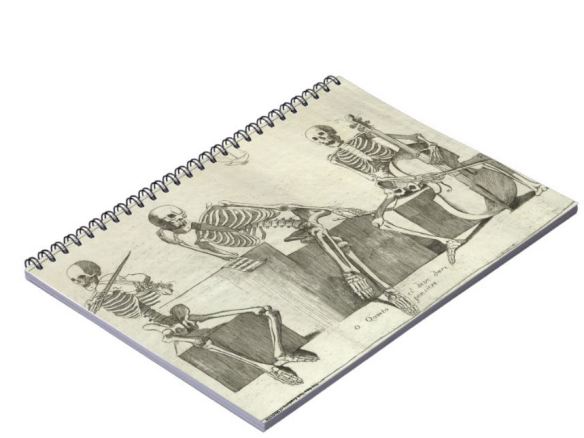
This group of musicians come from an 18th century work by Jacques Gamelin –possibly my favorite memento mori in the collection.

skeletal-musicians-notebook

Spiral notebook, featuring the musicians of Jacques Gamelin’s Noveau recueil d’ostéologie, 1779.

As you browse the items, you’ll find bibliographic and historical information about the featured image in the product description. And if you’re not interested in a notebook per se, there’ll be a link to see the image on other products.

see-more-and-its-options

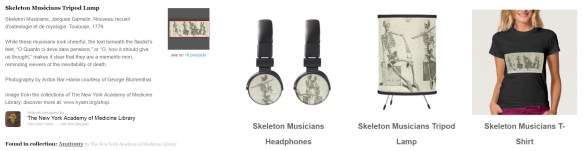
In the Academy’s online shop, you can find other product options using a particular image from the collections.  Here, headphones, a lamp and a t-shirt, to name just a few.

The subjects of our images were frequently the inspiration for the products on which they feature. Even the most familiar picture gets some new life breathed into it as they take on new forms.

Below, we draw from a confectioner’s 1907 cookery manual, a tempting selection of pretzels and breads from Prague, and a detail of condiment bottles from Lyman Phillips’ helpful book for the solo gentleman A Bachelor’s Cupboard, and the best Benjamin Franklin look-a-like I’ve ever seen on a 1911 pamphlet from our Margaret Barclay Wilson cookery collection.

dessert-fancies-paper-plates

Paper plates from the Academy shop, with image, “Types of Dessert Fancies” from John Kirkland’s The modern baker, confectioner, and caterer…, 1907.

pretzels-apron

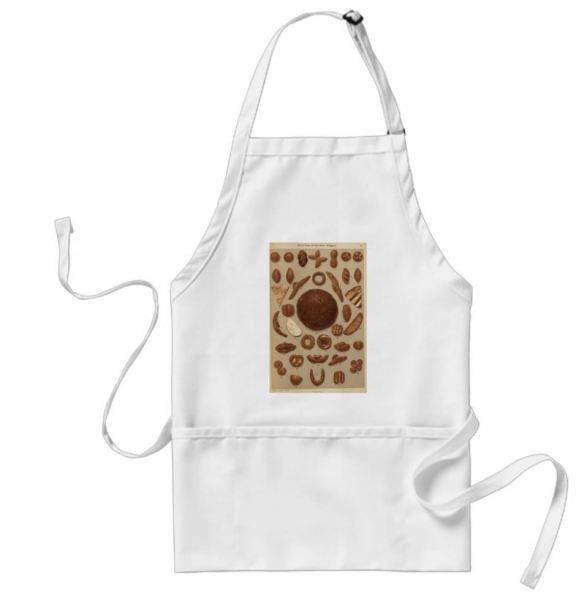
Apron from the Academy shop, using an image from Emil Braun’s 1903 Baker’s Book.

We’re also loving kitchen accessories from our Botanicals collection:

clove-serving-tray

Clove serving tray from the Academy shop, featuring an image from Robert Bentley’s Medicinal Plants, 1880. 

In case you’re starting to think about holiday cards or stocking stuffers for later this season, consider any of these:

Enjoy seeing our collection from these new angles. Don’t forget that we are open to readers by appointment four days a week, and for those just wanting to visit, we have lunchtime tours on the first Monday of the month .

We will be constantly adding new products to the store, if you’d like to see your favorite image on a product, feel free to get in touch and we will see what we can do!

Explore the Academy Library Timeline

By Robin Naughton, Head of Digital 

The New York Academy of Medicine Library began in 1847 with the intention of serving the Academy fellows, but in 1878, after the collection had expanded to include over 6,000 volumes, Academy President Samuel Purple and the Council voted to open the Library to the public.  It continues to serve both the Academy fellows and the general public, providing an unprecedented level of access to a private medical collection.  Today, the Academy Library is one of the most significant historical libraries in the history of medicine and public health in the world.

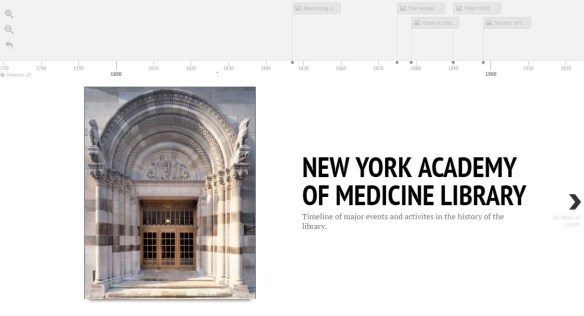
The Academy Library’s history spans almost 170 years and a glimpse into this history is documented in this interactive timeline. While the timeline does not represent everything that has occurred in the Library, notable milestones can be seen here. The story starts with the founding of the Library on January 13,1847, with a gift from Isaac Wood of Martyn Payne’s Medical and Physiological Commentaries and continues forward to the recent renovation and naming of the Drs. Barry and Bobbi Coller Rare Book Reading Room.


academy-timeline-figure-1

Figure 1:  The New York Academy of Medicine Library Timeline (Created using Northwestern University’s Knight Lab Timeline JS).


Timeline Highlights


2academy-timeline-figure_watermark

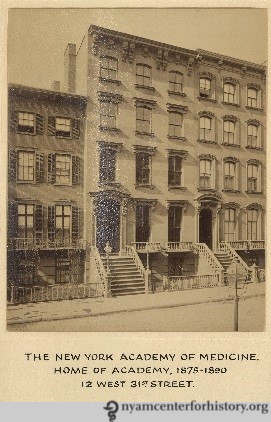
New York Academy of Medicine, Archives.


Academy’s First Permanent Home: In 1875, the Academy purchased and moved into its first permanent home at 12 west 31st Street. This image of the Academy’s first building will take you back to a different time.


3academy-timeline-figure_watermark

New York Academy of Medicine, Archives.


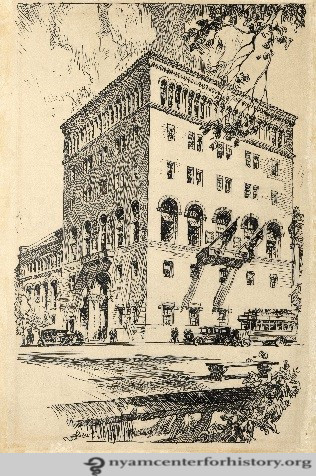
Academy’s Current Home: In 1926, the Academy moved to its current location on 103rd Street and 5th Avenue. The architectural firm York & Sawyer designed the building.  A 1932 expansion added three new floors on the northeast side of the original structure above the existing floors.  Today, you can visit the Academy at this location and explore the historic building.


apicius-image_watermark

Apicius’ de re culinaria, 830 A.D. 


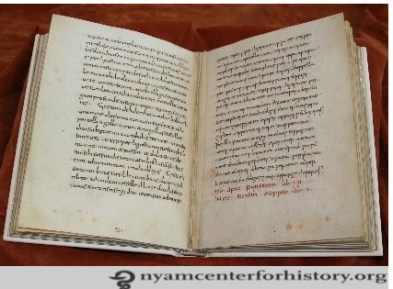
Cookery Collection: In 1929, Margaret Barclay Wilson gave the Academy her collection of books on food and cookery, which includes a 9th-century manuscript (De re culinaria) attributed to Apicius, and sometimes referred to as the oldest cookbook in the West.


5academy-timeline-figure_watermark

George Washington’s lower denture, 1789.


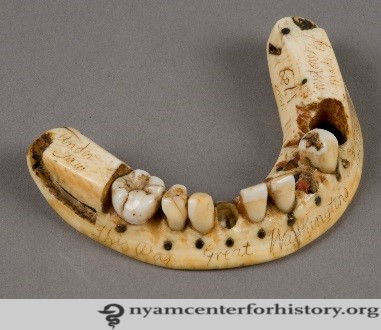
George Washington’s Teeth:  Yes, that’s right!  In the spring of 1937, the descendants of John Greenwood gave the Academy the lower denture created by New York dentist John Greenwood for Washington in 1789. The denture is just one of the artifacts that the Library owns.


6academy-timeline-figure_watermark

Librarians Gertrude L. Annan and Janet Doe, both in The Bulletin of the New York Academy of Medicine., vol. 50, no. 10, 1974.


Honored Librarians: In 1974, the Academy honored Gertrude L. Annan and Janet Doe, long-time librarians for their contributions to the Library.


There are many more highlights in the timeline so click through and enjoy.

The Tech


The Academy Library timeline was created using Northwestern University’s Knight Lab open-source timeline tool called TimelineJS. The tool was released under the Mozilla Public License (MPL), making it possible for anyone to create timelines to embed and share publicly.

TimelineJS is an easy tool to create a timeline with just a few steps. Here are some things to keep in mind when creating a timeline:

Content: Have content ready prior to creating

It’s important to have content ready prior to creating the timeline.  For the Academy Library timeline, there was already a text version of the timeline that could be used to create the interactive timeline. Together Arlene Shaner, Historical Collections Librarian and I edited, updated and added images to the timeline. Starting with some content allowed us to devote time to enhancing the timeline by finding and adding associated images.
Media:  Make media publicly available

It is important that the media resources used in the timeline are publicly available.  TimelineJS uses URLs to access and display the media files (images, videos, maps, Wikipedia entries, Twitter, etc.). Thus, items behind firewalls or logins will not be accessible to the public. Make sure to upload images to a publicly available server and use that URL for the timeline.

Google Sheets: Add all content and links into spreadsheet and publish

Google Sheets is the data source for the timeline and this means that all data for the timeline is managed in Google Sheets. Once the Google Sheets file is published, the URL is used by TimelineJS to create the timeline, link to the timeline and embed code for websites.

If you’re familiar with Google Sheets or have used any spreadsheet program, then you know the process of adding content to the spreadsheet. If you haven’t used any spreadsheet program before, think of Google Sheets as a table with multiple columns and rows where you’ll input data for the timeline.

academy-timeline-figure-2

Figure 2:  TimelineJS Google Sheets Template

To get started, the TimelineJS template and directions provide a good guide to the parameters of the timeline with each row representing a screen and each column a component of that screen. For example, the date structures are very flexible and the timeline can include a full date and time or just a year. Also, in the background column, adding a hex number for color can change the background color or including a link to image will show a background image.


Dr. Dorothy Boulding Ferebee: Civil Rights Pioneer

Today’s guest post is written by the Honorable Diane Kiesel, an acting justice of the New York State Supreme Court. She is the author of She Can Bring us Home (2015), a biography of Dr. Dorothy Boulding Ferebee. On Wednesday, September 21st at 6pm, Kiesel will give a lecture, “Dr. Dorothy Boulding Ferebee:  Civil Rights Pioneer.” There is no charge, but please register in advance here.   

Today, when social security and Medicare address the needs of the elderly, health care programs are in place to take care of the sick and a myriad of government agencies exist to help the poor, it is hard to imagine a time when the hungry, the elderly, the sick and the poverty stricken – particularly if they were people of color – were largely forgotten.

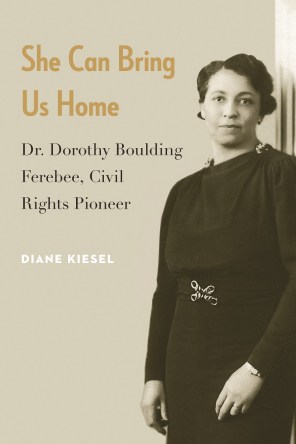
Diane Kiesel's She Can Bring Us Home, a biography of Dorothy Boulding Ferebee.

Diane Kiesel’s She Can Bring Us Home, a biography of Dorothy Boulding Ferebee.

Dr. Dorothy Boulding Ferebee (1898-1980), was a well-known African American physician in her day who focused on the health needs of the destitute early in the 20th century, providing a private safety net where none was yet put in place by the government. For seven summers during the Great Depression, Dr. Ferebee, who came from privilege and whose Washington, D.C. medical practice catered to the upper class of her race, led what came to be known as the Mississippi Health Project.  She and a team of all-volunteer doctors, nurses, schoolteachers and social workers traveled to the Mississippi Delta to bring health care to tenant farmers and sharecroppers. The women who made up the health project were graduates of some of the nation’s finest historic black colleges and members of the elite Alpha Kappa Alpha sorority. They left their comfortable homes to drive thousands of miles of unpaved roads through the Deep South to swelter in the cotton fields for their cause.

dorothy-and-car

Photo of Dorothy Boulding Ferebee, ca. 1958. Courtesy of Moorland-Spingarn Research Center, Howard University, Washington D.C.

It was a daunting task. Their sharecropper patients earned about $50 a year; they worked the most fertile ground on earth but their diets contained almost no fruits or vegetables because the landowners refused to let them use valuable cotton acreage for gardens. They suffered from diseases that had not, and should not, have been seen in the United States since the 19th century – even though it was 1935. Pellagra and rickets were common, as were outbreaks of smallpox. Tuberculosis deaths were rampant. Thirty percent of the black men in the region suffered from untreated syphilis. Dr. Ferebee’s health team not only had to face disease, but ignorance. Some mothers had no idea how old their own children were. They thought if they put tea bags on their children’s eyes, they would cure their colds and feared cutting their hair lest their children be unable to speak.  Some of them had never seen a physician and others had never used a toothbrush.

In the Jim Crow South, Dr. Ferebee’s motives were suspect – some plantation owners feared she was a Communist union organizer or civil rights agitator. But she persevered, and before World War II gasoline and rubber rationing helped put an end to the project, she and her team provided inoculations, medical and dental care as well as nutrition and hygiene lessons to 15,000 of the poorest of the poor. To this day the United States Public Health Service calls it the best volunteer health effort in history.

Ferebee Scrapbook, Box 183-30.

Dorothy and her medical team stuck in the mud in Mississippi. Photo Courtesy of Moorland-Spingarn Research Center, Howard University, Washington D.C.  From the Ferebee Scrapbook, Box 183-30.

The Mississippi Health Project propelled Dorothy Ferebee into the national spotlight. She became president of Alpha Kappa Alpha and followed the iconic Mary McLeod Bethune as the leader of the National Council of Negro Women. In that role she met with presidents and testified before Congress on major civil rights issues. She became a consultant to the State Department where she traveled to Third World countries to bring best health care practices to emerging nations.

Fifty years after the Mississippi Health Project ended one of the participants described it as the inspiration for the next generation of civil rights activists who participated in Freedom Summer and the voting rights struggles of the early 1960s.

Join us to learn more about Dr. Ferebee, this Wednesday night, at The New York Academy of Medicine (103rd St. and Fifth Avenue) for a lecture and book signing (books will be available for purchase on site). Register here; we look forward to seeing you!

Is Air-Conditioning Heating Up Our Environment?

Stan Cox image

The former Sackett & Wilhelm printers’ building in Brooklyn, the place where Willis Carrier first put air-conditioning into practice in 1902. Image Credit: Stan Cox.

This summer, we’re teaming up with our friends at The Museum of the City of New York to offer “Fast, Cool & Convenient: Meeting New Yorkers’ High Demands,” our free three-part talk series supported by a grant from The New York Council for the Humanities.

Tomorrow night (Thursday the 11th) the Academy will host the second of these three events, entitled COOL: Uncomfortable Truths About Our Air-Conditioned City.  The speaker will be Stan Cox, Ph.D., research coordinator and climate change expert at The Land Institute in Salina, Kansas.  The event will begin at 6:30pm; please register in advance here.

This week, Dr. Cox has guest-authored “Is Air-Conditioning Heating Up Our Environment?” for the Academy’s Urban Health Matters blog.  You’ll find a link to the post here.  Enjoy, and we hope to see you tomorrow evening!

Apply for our 2017 Research Fellowships

Does a one-month residence in The Drs. Barry and Bobbi Coller Rare Book Reading Room, immersed in resources on the history of medicine and public health, sound like a dream come true?

Rare book room

The Drs. Barry and Bobbi Coller Rare Book Reading Room

The Academy Library offers two annual research fellowships, the Paul Klemperer Fellowship in the History of Medicine and the Audrey and William H. Helfand Fellowship in the History of Medicine and Public Health, to support the advancement of scholarly research in the history of medicine and public health. Fellowship recipients spend a month in residence conducting research using the library’s collections.

Applications for our fellowships are being accepted now through late August for fellowships that may be used at any time during 2017.

Preference in the application process is given to early career scholars, although the fellowships are open to anyone who wishes to apply, regardless of academic status, discipline, or citizenship. While both fellowships are for researchers engaged in history of medicine projects, the Helfand Fellowship emphasizes the role of visual materials in understanding that history.

Applications are due by the end of the day on Friday, August 26, 2016. Letters of recommendation are due by the end of the day on Monday, August 29, 2016. Applicants will be notified of whether or not they have received a fellowship by Monday, October 3, 2016.

Prospective applicants are encouraged to contact Arlene Shaner, Historical Collections Librarian, at 212-822-7313 or history@nyam.org with questions or for assistance identifying useful materials in the library collections.

Digitizing Medical Journals of State Societies

By Robin Naughton, Ph.D., Head of Digital

State medical journals digitized for the MHL collective project.

State medical journals digitized for the MHL consortium.

The New York Academy of Medicine Library is digitizing state society medical journals as part of a mass digitization project with the Medical Heritage Library (MHL), a digital curation consortium. The Academy Library is one of five collaborators on the project, along with the College of Physicians of Philadelphia; the Countway Library of Medicine at Harvard University; the Health Sciences and Human Services Library, University of Maryland; the Founding Campus; and the University of California at San Francisco.

Together, the MHL team is actively working to digitize 48 state society journals, more than 3,800 volumes that span much of the 20th century. Digitizing the state medical journals will provide open access to quality historical resources in medicine for researchers and the general public, letting them explore connections between medicine and society.

State medical journals digitized for the MHL collective project.

State medical journals digitized for the MHL collective project.

Evenly splitting the volumes among the MHL team makes the process of mass digitization more manageable and very collaborative. The Academy Library has already digitized almost 50% of the state medical journals assigned to it since Fall 2015. The journals are scanned by the Internet Archive (IA) and are publicly available as part of the Library’s and MHL’s collections on the IA site. Our digitized assets are open for anyone to access and use. Thus far, we have digitized journals representing 24 states and almost 238, 000 images.

The volumes are digitized in their entirety, showing the journals’ articles and  advertising. For example, in Alaska Medicine (vol. 29, 1987), as you read the article “Alaska State Hepatitis B Program – Past, Present and Future” by Elizabeth A. Tower, you can’t help but notice the advertisement for medical transcription. It is hard to resist the “Hello …. Museum of Primitive Civilizations and Hieroglyphs?”

Scan from Alaska Medicine, vol. 29, 1987.

Scan from Alaska Medicine, vol. 29, 1987.

State medical journals are valuable resources that should lead to many new and novel projects for researchers in the history of medicine. Look for more on the project as it progresses.

Explore our collection.

Stories and Heritage of Nursing in New York City

The Fellows Nursing Section at The New York Academy of Medicine and the Academy Library invite you to join us next Thursday, April 14, at 6:00 PM for an evening exploring the stories and heritage of nursing in New York City. Admission is free but advanced registration is required. Register online.

The evening’s presenters include:

Dr. Joanne Singleton, Professor at Pace University and author of White Beret: The Story of an Urban Nurse, her fictional account of life in a pediatric unit in a New York City hospital.

Lisa Mix, Head, Medical Center Archives, New York-Presbyterian Hospital Weill-Cornell Medical College.

Barbara Niss, Director, Archives & Records Management at Mount Sinai Medical Center.

Arlene Shaner, Historical Collections Librarian, New York Academy of Medicine Library who will provide insights into the nursing heritage held in libraries and archives across the city.

Two tours of the Drs. Barry and Bobbi Coller Rare Book Reading Room will be held following the evenings speakers. Tours are limited to 15 people each; email culturalevents@nyam.org to register. Other nursing-related materials will be on display in the main meeting room.

Presentations for History of Medicine Night: Intersections of Medicine, Health, and Ethnicity

The New York Academy of Medicine’s Section on the History of Medicine and Public Health invites you to join us for “Intersections of Medicine, Health, and Ethnicity” on March 9, 2016 from 6:00pm–7:30 pm at the Academy, 1216 Fifth Avenue at the corner of 103rd Street. Admission is free but advanced registration is required. Register online.

The evening’s presenters will be:

A wooden caduceus symbol shown in NYAM rare book reading room

A caduceus symbol donated to our rare book reading room

HARRIET A. WASHINGTON
Independent scholar
“The 1788 New York Doctors’ Riot: A Signal Event in the Dissection of Anatomical Ethics”

KATE BAILEY
Graduate Student, M.A. Health Advocacy Program, Expected May 2017
Sarah Lawrence College
“From Motherhood to Sisterhood: How Underground Abortion Referral Networks Worked Towards Advocacy and Solidarity”

KIRK JOHNSON
Doctoral candidate in the Medical Humanities program at Drew University
“Heart Illness: Developments of Racial Discourse”

MARLENE A. GEORGE
Graduate Student, Health Advocacy Program, Sarah Lawrence College
“Social Service Sterilization – Eugenics Of The 1950’s-1970’s”

BOB VIETROGOSKI
Head of Special Collections
George F. Smith Library of the Health Sciences
Rutgers Biomedical and Health Sciences
“‘Agitation of the Question’: James McCune Smith’s Nomination for Fellowship to the New York Academy of Medicine, 1847”

A second evening of presentations, History of Medicine Night Part II, will take place on Wednesday, May 4, and we hope that you will be able to join us for that one as well.