Aldrovandi’s Quadrupeds, and #ColorOurCollections: Day 4

fb-cover_828x315_nyam9-aldrovandi_quadrupedum_1621_931_watermark

It’s the fourth day of #ColorOurCollections, a week-long special collections coloring fest we’ve organized on social media. Check out all the coloring books at colorourcollections.org.

A set of charming four-footed beasts from the quadrupeds volume of Ulisse Aldrovandi’s (1522-1605) multi-volume  natural history encyclopedia is our choice for today’s coloring sheets.

Aldrovandi grew up in Bologna as the privileged son of a noble family.  His father, Teseo Aldrovandi, served as secretary for the Senate of Bologna and his mother was a first cousin of Pope Gregory XIII.  From an early age, Aldrovandi displayed a restless intelligence, studying mathematics, law and philosophy before finally earning a degree in medicine and philosophy from the University of Padua in 1553.

By the time he earned his degree, Aldrovandi had already developed a passionate interest in natural history.  A popular teacher, he taught philosophy and other subjects at the University of Bologna before he was appointed the first professor of natural sciences in 1561.  Aldrovandi’s interest was sparked by personal encounters with other major figures in the world of 16th century natural history, including the ichthyologist Guillaume Rondelet and the botanist Luca Ghini. While Ghini failed in his attempts to garner support for the establishment of a botanical garden in Bologna, Aldrovandi was successful, founding the garden with the support of the Senate in 1568 and serving as its director for almost 40 years.  He also travelled widely, often with students, to collect plants  and natural history specimens.

Over the course of his lifetime, Aldrovandi assembled a natural history museum of 18,000 specimens, as well as an extensive herbarium.  Only four of the thirteen volumes of his magisterial Storia Naturale were published during his lifetime; the others appeared posthumously over a period of decades.  He left the museum collections, his library, his unpublished manuscripts, drawings, water colors and the wood blocks that were meant to be used to illustrate the encyclopedia volumes to the city of Bologna when he died.  A portion of the specimen collections can be visited today in the Istituto delle scienze at the Palazzo Poggi, while the manuscripts, watercolors, and wood blocks are available for study in the library at the University of Bologna.

If you like Aldrovandi’s majestic beasts, you’ll love the following coloring pages from our participating institutions.

We’re mesmerized by Dittrick Medical History Center‘s beautiful Anatomy of an Horse (1683) by Andrew Snape.

dittrick-coloring-book-2017-3

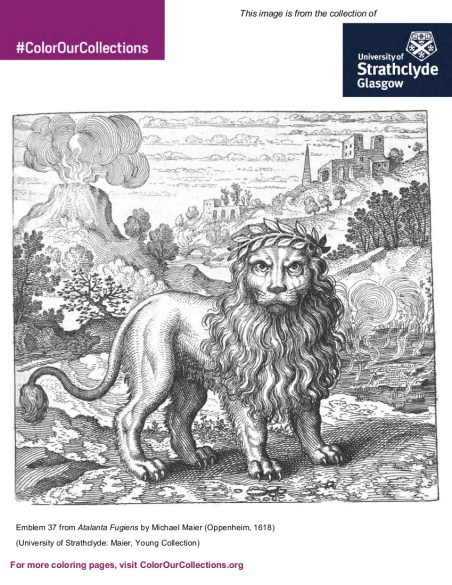
Enjoy coloring the many details of University of Strathclyde Glasgow‘s regal lion from Michael Maire’s Atalanta Fugiens (1618).
strathclyde_colouring-book-2017

Finally, here is the legendary manticore for your coloring delight. The Donald F. and Mildred Topp Othmer Library of Chemical History adds a bit of whimsy with Historie of foure-footed beastes(1658) by Edward Topsell.

othmerlibrarycoc2017coloringbook

Check back in tomorrow for the last day of #ColorOurCollections!


Hebra’s Atlas of Skin Diseases, and #ColorOurCollections: Day 3

fb-cover_828x315_nyamhebra

It’s the third day of #ColorOurCollections, a week-long special collections coloring fest organized on social media. Every day on our blog, we will feature #ColorOurCollections coloring sheets from our library, along with content from participants worldwide.

Today’s Academy coloring sheets come from the works of Ferdinand von Hebra  (1816- 1880), a significant figure in the influential Vienna school of dermatology. Dermatology emerged as a clinical specialty in the early to mid-19th century, and in 1849, Hebra was appointed the first German language professor in the subject, at Vienna General Hospital.[i]

Hebra’s Atlas of Skin Diseases (1856 – 76) was a monumental work printed in 10 installments, with mostly life-sized illustrations, using the new technique of chromolithography, which allowed the artist to draw directly onto the lithographic stone and print in color. The illustrations were created by two Viennese painter physicians, Anton Elfinger and Carl Heitzmann. Each issue of the Atlas was dedicated to a group of disorders which affected the skin.

The “tattooed man” is an unusual addition to the Atlas, being presented as of cultural rather than the clinical interest. Unusually, the tattooed man is also identified by name, as Georg Constantin, a circus performer from Albania. Constantin was a well-known circus performer, who traveled extensively in Europe and North America. He spent time with Barnum’s Circus as “Prince Constantine,” where he also sold pamphlets describing his tattoos (which are variously described as Chinese and Burmese in origin).[ii] Constantin’s body was covered with 388 tattoos of animals and symbols in red and blue. As was Hebra’s habit, Constantin was depicted twice in the Atlas, once in full color and once as the outline drawing presented here.[iii]

Itching to color the tattooed man? Some of these intricate patterns from participating institutions may also be your groove.

From University of North Carolina at Chapel Hill’s Health Science Library: Adam Lonicer, Naturalis historiae opus novum (1551).
unchsl_coloringbook

From Amguedddfa Cymru – National Museum Wales: Benjamin Wilkes, Twelve new designs of English Butterflies (1742).

nmw-colour-our-collections

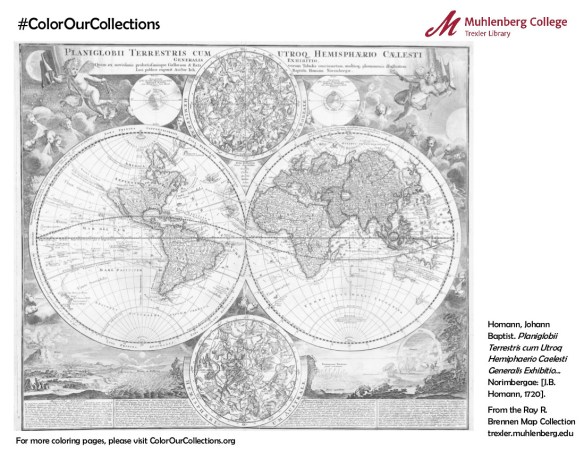
We’re also loving Muhlenberg College Trexler Library‘s maps coloring book.  Check out this detailed world map of Johann Baptist Hormann’s Planiglobii terrestris cum utroq hemisphærio cælesti generalis repræsentatio (1720).muhlenbergcollege_colorourcollections_maps

References:

[i] Holubar, K. (1981), Ferdinand von Hebra 1816–1880: On the Occasion of the Centenary of His Death. International Journal of Dermatology, 20: 291–295. doi:10.1111/j.1365-4362.1981.tb04341.x

[ii] Margo DeMello, Bodies of Inscription: A Cultural History of the Modern Tattoo Community (Duke University press, 2000), p56. DeMello states that Constantin sold pamphlets describing the “Chinese cannibal natives” who had forced his tattooing on him. In Hebra’s Atlas the tattoos are identified as being Burmese. There is also a suggestion that Constantin had himself tattooed with an eye to displaying himself as a circus attraction.

[iii] Mechthild Fend, “Skin portraiture ‘painted from nature’: Ferdinand Hebra’s Atlas of Skin Diseases (1856-76)”, in Hidden Treasure, Michael Sappol (ed), New York: Blast Books, 2012, pp. 122-26.

Elizabeth Blackwell’s A Curious Herbal, and #ColorOurCollections: Day 2

fb-cover_828x315_nyam

Elizabeth Blackwell’s A Curious Herbal has quite a curious publication story.  We’ve transformed six images from this stunning eighteenth-century botanical first published in 1737 in London into coloring sheets.

blackwell_melon_colored

Blackwell’s melon, colored by library staff member, Emily Miranker.

Aberdeen-born Elizabeth Blackwell (1700-1758), the daughter of a successful merchant, married her cousin Alexander Blackwell at age 28.  Though trained in reading Greek and Latin, Alexander practiced as a physician in Aberdeen, without appropriate permissions. The couple relocated to London when his right to practice medicine in Aberdeen was challenged.  In London, Blackwell opened a printing shop—again without the proper credentials, and again with less than stellar results.  When he couldn’t pay his business debts, he was installed at the city’s Highgate Prison.

Elizabeth, by then a mother, needed to find a way to support her family.  The printer’s shop she operated with her husband had made her a savvy observer of the book marketplace.  She realized that a new high quality herbal including New World species didn’t yet exist.  She took a room next to the Chelsea Physic Gardens, which exhibited some of the new American plants.  Later, she ferried the finished drawings to the prison at Highgate, where her husband supplied the Latin and Greek names of the plants and their uses. Some American plants, like sassafras, native to Virginia, were given only the English and Latin names.

Alexander also offered counsel on the plants’ medicinal uses.  The text accompanying sweet gum, here, “sweet cistus of candy” attests that it “Stays Vomiting” and that “the Fume of it Comforts the Brain” (we’re hoping that these same effects can be said about the practice of coloring these images).

blackwell_watermarkblackwell3Elizabeth was not only responsible for the drawings themselves, but did the engravings of the drawings on copper plates for printing.  In many copies, she hand-colored every single plate.  The images were first published at a rate of four a week, beginning in 1737, but through her own connections and market-savvy, she soon secured a book deal.  With the profits, Elizabeth was able to secure Alexander’s release from Highgate Prison, though their reunion was temporary (later he was put to death in Sweden for treason, though that is another story).

This week, we’re grateful that our own copy of Blackwell’s Curious Herbal is gloriously pristine so that we could transform them into a bouquet of coloring sheets.

In need of color specifics?  Blackwell’s text gives vivid, precise descriptions of the hues of her selected plants.  Great Bindweed (v.1, plate 38), which blooms in the late summer, has leaves that are “a willow green” with “Flowers white,” while her Female Piony possesses “leaves a grass green and flowers a fire crimson.”

femalepiony_text_watermarkblackwell5

We leave it to you imaginative colorists to fill in these pages in any range of glorious hues you like!

While we’re on a plant theme, let’s take a look at some beautiful coloring pages from participating institutions.

nybg-coloring-book

New York Botanical Garden includes this lovely sunflower in their coloring book. Source: Basillius Besler, Hortus Eystettensis (1613).

williamscollege_dehistoriastirpiumleonhartfuchs1542

Williams College Libraries includes this ready-to-color image from Leonhart Fuchs’ De historia stirpium (1542).

Don’t forget to check out more coloring books at colorourcollections.org!

#ColorOurCollections 2017: Day 1

fb-cover_828x315_nyam

The second annual #ColorOurCollections week has officially begun! From February 6th through 10th, libraries, archives, and other cultural institutions are showcasing their collections in the form of free coloring sheets. Follow the hashtag on Twitter, Instagram, Facebook, and other social media platforms to be introduced to new library collections, find out more about your favorites, and have some fun. Throughout the week, we will be featuring new coloring books from other institutions on the blog, and be sure to visit the #ColorOurCollections website for the list of participants and a collection of coloring books created for the campaign.

We also plan to showcase the work of the talented colorists out there! Share your filled-in sheets on social media with the hashtag #ColorOurCollections for a chance to get featured on our blog.

Our coloring book this year features hooved creatures from Ulisse Aldrovani’s Qvadrvpedvm omniv bisvlcorv historia, 1621; beautiful botanicals from Elizabeth Blackwell’s A curious herbal, 1739; and a dashing tattooed fellow from Ferdinand Hebra’s Atlas der Hautkrankheiten, 1856-1876. Download our full coloring book and check back throughout the week for background on our sources.

newyorkacademymedicine_coloringbook_2017-1

The coloring content shared by collections so far tell us we are in for an incredible week! We’re particularly taken with Europeana’s Art Nouveau coloring book. The style lends itself beautifully to coloring sheets and we cannot wait to get started on the nasturtium design.

europeana-art-nouveau-colouring-book-3

The Biodiversity Heritage Library’s new coloring book features the work of great naturalists such Pierre Belon, Mark Catesby, and John Gould.

2017bhlcoloringbookpt3-2

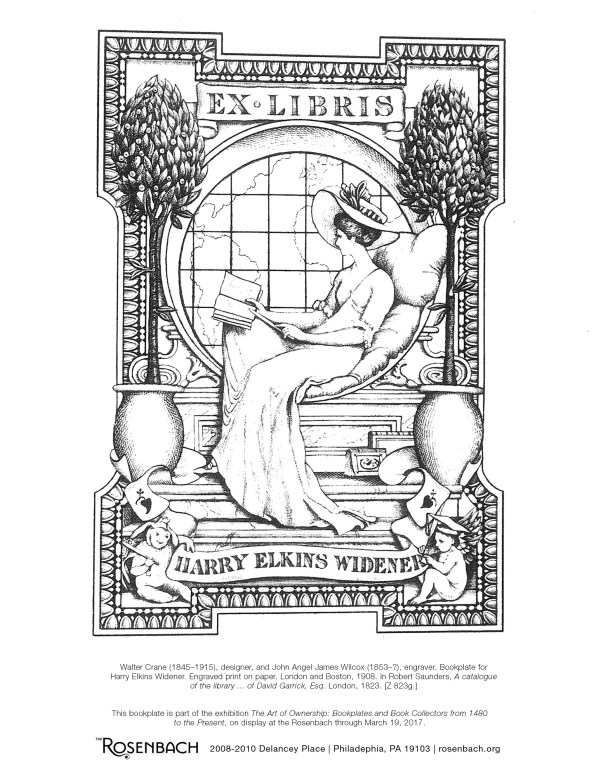
We’re excited to see some new participants this year! The Rosenbach created several coloring sheets based on bookplates from their exhibition The Art of Ownership.

rosenbach-bookplate2

Keep following #ColorOurCollections on your favorite social media outlets. Happy coloring!

#ColorOurCollections: February 6-10, 2017

Get your crayons and colored pencils ready, we’re gearing up to #ColorOurCollections again! This year’s library social media coloring extravaganza will happen February 6th-10th. During that week, libraries, archives, special collections, and other cultural institutions around the world will share coloring sheets based on materials in their collections.  You will find these posts on social media with the hashtag #ColorOurCollections, as well as on our new website, colorourcollections.org.

Last year, more than 210 libraries and cultural institutions participated, representing 7 countries (United States, Canada, United Kingdom, France, Spain, Australia, and New Zealand). Institutions, let’s make it even bigger this year. If you work in a library or special collection, join us in this fun initiative! Find out how to participate here.

If you can’t wait and want to sharpen those coloring skills, try your hand at one of our new coloring sheets. This illustration of 26 notable women comes from the pamphlet Famous women of the world published by the Pepsin Syrup Company, circa 1920.

capturecoc


Winter/Spring 2017 Catalog: Events with a Unique Perspective

library-programming-winter-spring-2017-thumbWelcome to The New York Academy of Medicine Library’s Winter/Spring 2017 cultural programming.  Today we launch a new season of events with a unique perspective on the history and culture of medicine and health, and what they mean for the future.

The upcoming season includes talks by prominent authors, historians and artists. Highlights include science writer Harriet Washington on the role of microbes in mental health (March 15), historian Lisa Rosner on the controversial history of vaccine advocacy starting in the 1700s (April 6), food journalist Sarah Lohman on garlic’s journey from a tuberculosis remedy to a food seasoning (June 5), and science writer Mary Roach on her new book GRUNT: The Curious Science of Humans at War (June 12).

Legacies of War: Medical Innovations and Impacts,” our special 2017 event series commemorating the 100th anniversary of the American entry into WWI, will explore how the experience of war has prompted medical innovation, including surgical techniques, prosthetics, ambulances, and trauma care. Speakers will also address the impact of conflict on the minds and bodies of soldiers and civilian populations, past and present. This series commences On February 21, with Prof. Margaret Humphreys (Duke University) speaking on “The Marrow of Tragedy: Disease and Diversity in Civil War Medicine.”

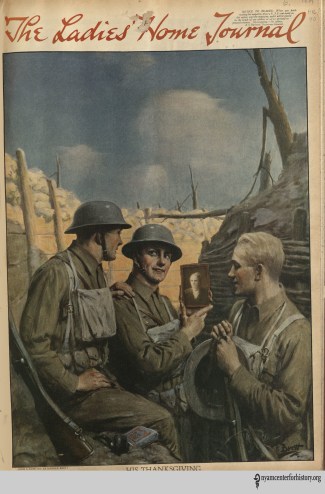
ladieshomejournal_nov-1918_cover_watermark

To ensure the sustainability of our programs, we have added a nominal fee for our events. A number of events throughout the year remain free due to the generosity of our sponsors. Discounts continue to be available to our valued Friends of the Rare Book Room and Academy Fellows and Members, and we welcome students to attend for free.

Download the Winter/Spring 2017 programming catalog for more details. To register, click the names of events in the catalog, or visit www.NYAM.org/events.

We look forward to seeing you throughout the year.

Image sources:

Welcome to Year of the Rooster: 新年快乐

By Emily Miranker, Project Coordinator

Growing up in the very multicultural city of San Francisco, Chinese New Year has always been one of my favorite holidays. It’s bright and noisy, with dancing, fantastic animals, cymbals, and vibrant costumes.

rooster-usp-stamp

The vivacity and strength that the rooster symbolizes, prevalent in many traditions beyond Chinese astrology and the Greco-Roman West, is evident in the cheerful design by the late Clarence Lee. Lee designed an entire series of twelve stamps for the Chinese zodiac cycle, starting with the Year of the Rooster in 1992.[i]

The Year of the Rooster starts on the 28th thanks to a (legendary) challenge set by an emperor of China (for a fuller and charming retelling of the story, click here). Briefly, the emperor told all the animals to race across a river. The first twelve to reach the far bank would have a year named after them – these twelve years make up the zodiac. Famously, the trickster rat caught a ride on the powerful ox, and leapt off his head at the last minute onto the far bank thus coming in first. This year’s star, the rooster, found a raft and came across the river on it along with a goat, who cleared weeds from their path, and monkey, who paddled the raft. The rooster was awarded the eighth year in the zodiac in honor of his resourcefulness and teamwork.

In addition to the above qualities, the Chinese believe roosters symbolize moral fortitude and protection. Their role as protectors may originate from the habit of watching for the day to return; heralded by their crowing at dawn. Scientists have actually discovered that, in fact, it’s not the first light of morning that triggers roosters crowing (they can crow at any time of the day; how much and when depends on breed and personality).  Rather, it’s a roosters internal body clock.[ii] This watchful quality spoke not only to the Chinese, but to the ancient Greeks for whom the rooster was a symbol of the god of healing, Aesclepius.

nyam_building_187a

The god of medicine and physician, Aesclepius is depicted along with his daughter, Hygeia, goddess of health, over the entrance to the New York Academy of Medicine.

Aesclepius sometimes took the form of a rooster when appearing to supplicants, and the bird was also sacrificed in his honor. As it’s a symbol of restoring health, watching to keep illness and evil at bay, the rooster is one of many health and medicine icons that decorate the interior of the Academy building.

lobby-ceiling-rooster

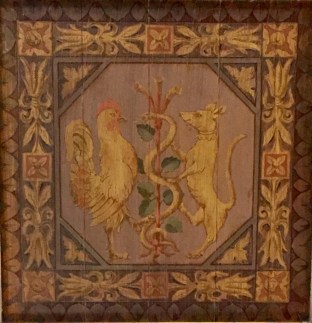
In this painted ceiling ornamentation from our lobby, a rooster dances with a dog, also sacred to Aesclepius. Like the rooster, the dog stands for watchfulness, driving away death.

Other roosters you’ll find in our library include this rooster, with his hen and chicks, from the 1536 Hortus Sanitatis, a natural history from Germany.

Jumping fifty years ahead, still from Germany, we have one rooster with fantastic plumage and an eerily long tongue for a bird, and his more sedate and regale fellow. They feature in a cook book by Marx Rumpolt, head cook to the Elector of Mainz, which includes nearly 2,000 recipes and instructions on how to make wine.

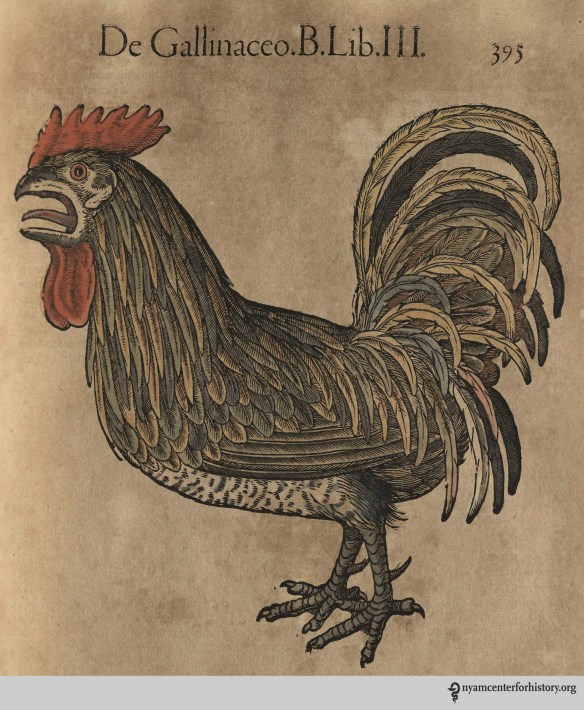
The above rooster (mid-squawk?) is from the third of a five volume set, the Historia Animalium, the most famous work of Conrad Gessner. Gessner was a 16th-century Swiss physician and naturalist. The woodcuts in our 1555 edition of the third volume were hand-colored and have many of the birds’ French names added by a reader of the past. Gessner did draw, but most of the woodcuts in his volumes were the work of others. Their identities are largely unknown, except for Lucas Schan, an expert fowler, who drew images of birds.[iii]

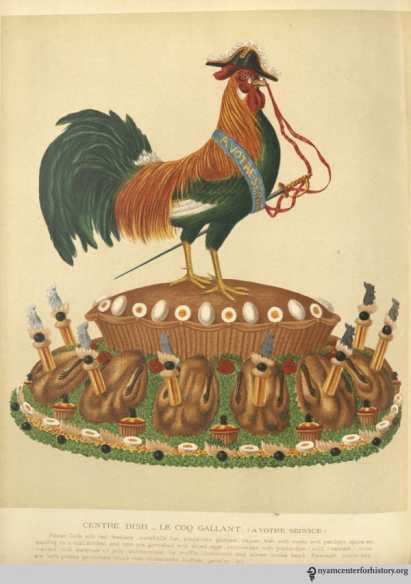
For the grande finale, my favorite rooster is this glorious French fellow, the Coq Gallante, who is just a decoration made of plaster and not an actual fowl, atop a sumptuous Victorian savory pie featured in The Encyclopedia of Practical Cookery by Theodore Garrett (1898). The meat pie is surrounded by real, edible game birds, mini pies, and cooked eggs on a bed of parsley. ­Monsieur Gallante’s sash says, “A Votre Sante;” French for, “To your good health!” I can think of no better wish for the New Year.

References:
[i] Gregg K. Kakesako. “Clarence Lee, designer of New Years stamps, diesHonolulu Star Advertiser, January 30, 2015. Accessed 1/4/17.

[ii] Lee, Jane J. “How a Rooster Knows to Crow at Dawn,” National Geographic. March 19, 2013.

[iii] S. Kusukawa. “The Sources for Gessner’s pictures for the Historia animaliumAnnals of Science, Vol. 67, No. 3, July 2010. 322-323.

The Homegrown Table: American Cookbook Highlights in the Academy Library

By Anne Garner, Curator, Rare Books and Manuscripts

Last week I had the pleasure of hosting renowned chef James Kent in the Rare Book Room.  Chef Kent is interested in the history of American cooking, and as I was selecting highlights for his visit, I was reminded–again!—of the depth and variety our American food holdings.  Here are a few of our favorite early American cookbooks from our stacks (a later post will look at late 19th and early 20th-century highlights.)

American Cookery

simmons_americancookery_1804_watermark

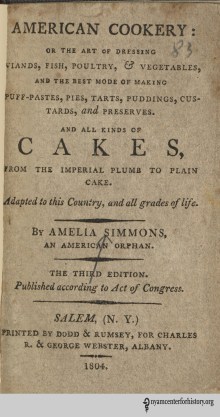
Title page of American Cookery by Amelia Simmons.

The Academy library has one of only four copies in the United States of the slim third edition of Amelia Simmons’ American Cookery, long considered the first homegrown American cookbook. The book’s intriguing title page, modified only slightly from the 1796 first edition, credits the book’s authorship to one “Amelia Simmons, an American orphan.”  The author’s nod to her Americanness is one of the earliest to occur in print—and possibly the earliest in culinary sources.

American Cookery likely drew from manuscript cookbooks with recipes known for some time, and now appearing in print. The recipes in these pages were known throughout the colonies and appealed to Americans living both north and south; they made use of thriving American crops, including corn, peas and beans. Recipes for pumpkin pie, American citron, and an adventurous chowder, composed of fried pork, fish and crackers, were recorded here in print for the first time.


The Virginia Housewife

Another early and influential American cookbook was authored by Mary Randolph, a Virginia housewife turned entrepreneur whose culinary creations drew generously on local crops. Before the publication of Randolph’s The Virginia Housewife in 1824, many home cooks in Virginia relied on English cookbooks, but found these sources lacking in recipes drawing on local plant sources.  Randolph earned her culinary chops—and her nickname, “the Queen” —while supervising the cooking in the kitchen of her boarding house in Richmond.  When she retired, she collected her recipes and published them. Randolph had a soft spot for bread; recipes for cakes and biscuits occupy a lengthy section of the book, and include instructions for making batter cakes (using hominy and cornmeal), “Apoquiniminc Cakes” (beaten biscuits), and corn bread.  Other favorites include classic southern dishes like sweet potatoes, peach pie, boiled turnip tops, ham, and apple fritters.

randolph_virginiahousewife_1824_watermark

Pages from The Virginia Housewife by Mary Randolph.

Praktisches Kochbuch

A number of cookbooks published during the 19th-century in America targeted immigrant audiences, hoping to minimize their anxiety about maintaining their own food traditions while embracing their new country’s agricultural resources and culinary influences. A favorite of these is Henrietta Davidis’ Praktisches Kochbuch. First published in 1844, Praktisches Kochbuch, or Practical Cookbook, was easily the most popular cookbook of the nineteenth century in Germany.  It was republished in innumerable editions well into the twentieth century, including a number of American editions, which were brought out by a Milwaukee publishing house seeking to tap the large German-American community in Wisconsin. In our 1897 edition, Davidis clarifies her intention to write a cookbook that combines German and American elements in her preface:

Ein deutsches Kochbuch in Amerika soll nicht dutsch oder amerikanisch, sondern deutsch-amerikanisch sein.  [A German cookbook in America should not be German or American, but German-American.]

For easy reading, the introduction and recipes were published in German, with English translations next to the name of the dish. Indexes in both German and English made it easy for new students of English to use the book.

Left, title page of Henrietta Davidis’ Praktisches Kochbuch. Right, Portrait of Henrietta Davidis.

Hoffman Family Cookbook

A number of manuscript cookbooks in our collection add dimension to the many American stories of cooking in the immigrant kitchen. A handwritten collection of recipes kept by the Hoffman family, papermakers by trade who opened their first mill in 1766 in what is now Hoffmanville, Maryland, dates between 1835-1850.

The manuscript contains a fascinating mix of ethnically German recipes, many suggestive of the regional culinary style now called “Pennsylvania Dutch,” and then-standard American recipes, some of which show the writer, apparently a German immigrant, struggling to master an unfamiliar cuisine.  Recipes for “sowar crout” and “soft rivals” (small dumplings) in milk soup suggest that the Hoffman household continued to eat German dishes, while recipes for pound cake, pumpkin pie and ketchup attest to a desire to incorporate the influences of their new country at the table.

hoffman_manuscriptcookbook_c1835-70_pumpkinpie_watermark

Pumpkin pie recipe from the Hoffman family cookbooks.

matt-jozwiak_chef

Matt Jozwiak, our indispensable Chef Curator

In 2017, we are working with our volunteer Chef Curator, Matt Jozwiak, on a variety of projects to increase awareness and use of our culinary collections. Matt is exploring historical recipes, helping us develop food-related events, and coordinating outreach to the culinary community to help them access the resources we hold. Two of his adapted recipes featured at the Academy’s 2016 Gala.

Matt also works with the Academy’s food policy group, which focuses on better food procurement for East Harlem community based organizations.  He is also currently developing his own nonprofit, which is focused on the better use of food waste.

We’re looking forward to serving up a number of collaborations with Matt this year, continuing a long tradition of great American food.

Cakes and Ale at Woodbine: From Twelfth Night to New Year’s Day

By Paul Theerman, Associate Director

Part of the Margaret Barclay Wilson collection of cookbooks and cookery, Cakes and Ale at Woodbine: From Twelfth Night to New Year’s Day is a pseudonymously published light novel of mid-century Fordham, New York. Ostensibly the work of “Barry Gray,” the book was written by Robert Barry Coffin (1826–1886), one of the “Bohemians” of antebellum New York.[i]  He was a critic for, and eventually editor of, the Home Journal, later renamed Town and Country, which continues in publication to this day.  This book was first published in 1868; the Library’s edition is from 1883.

The “cakes and ale” of the title is not culinary, but purely literary. On the title page is this quote from Shakespeare’s Twelfth Night: “Dost thou think, because thou art virtuous, there shall be no more cakes and ale?” (Act 2, Scene 3).

sir-toby-belch

Sir Toby Belch uttered the line “Dost thou think, because thou art virtuous, there shall be no more cakes and ale?” the epigram for the novel. This is an image of Lionel Brough in a 1901 production.

“Cakes and ale” are not only mentioned in Twelfth Night, they are parts of Twelfth-Night celebrations: the merriment on the day of (or day before, depending on how one count) the feast of the Epiphany on January 6, the twelfth day after Christmas. Coffin is therefore having fun with the title, “From Twelfth Night to New Year’s Day,” as it means from January 6 all around to January 1: a romp through the year, touching on all the major holidays in turn. Each day is an occasion for indulging in cakes and ale, “the good things of this life” (p. 13): Epiphany, the first day of spring, a birthday, Easter, the fourth of July, “summer,” Christmas and a Christmas wedding, and then New Year’s.

Set at the author’s purported cottage, Woodbine, in Fordham, New York, domestic scenes alternate with long fanciful stories, much of which contrast city and country life, to the decided benefit of the latter! Toward the end of the book, the narrator has an imagined (perhaps alcohol-induced) encounter with Santa Claus, who says he prefers the large expansive chimneys of the country to the narrow ones of the city, and thought that the new city fashion of Christmas trees might put him out of a job:

“When the city folks first began to talk about Christmas trees, and introduced them into their nurseries, it nearly broke my heart; for I feared that my occupation . . . was gone” [p. 225.]

The virtues of the country always win out, in grand matters of love, and more prosaic ones of cakes and ale.

May you have a great holiday season, and may you get all the cakes and ale you want!


Another literary retreat, left, the Edgar Allan Poe house in Fordham, New York, where the author lived from 1846 to 1849, some 20 years before the recounted events in Cakes and Ale, also set in Fordham, a village only recently connected to the city by rail.  Right, a view of the Poe cottage in its rural setting.

References

[i] “Gray, Barry (1826–1886) [Robert Barry Coffin],” in “The Vault at Pfaff’s: An Archive of Art and Literature by the Bohemians of Antebellum New York,” https://pfaffs.web.lehigh.edu/node/54192, accessed December 22, 2016.

Image Sources

A Show of Hands

By Emily Miranker, Project Coordinator

Welcome to my celebration of one of our collections’ unsung heroes – not a specific book, or author, but a punctuation mark that decorates many of them: the manicule.

berengario_anatomiacarpi_1535_manicule-marginaliap12_watermark

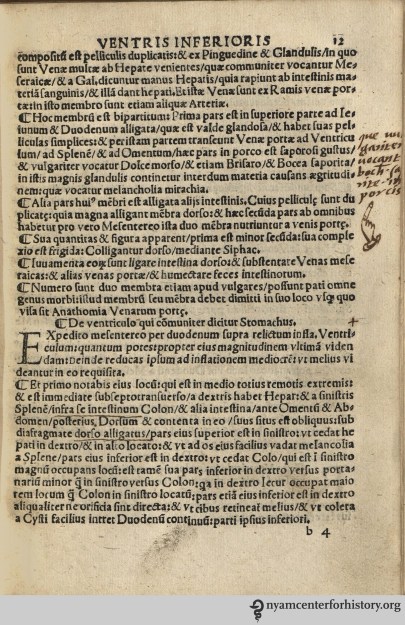
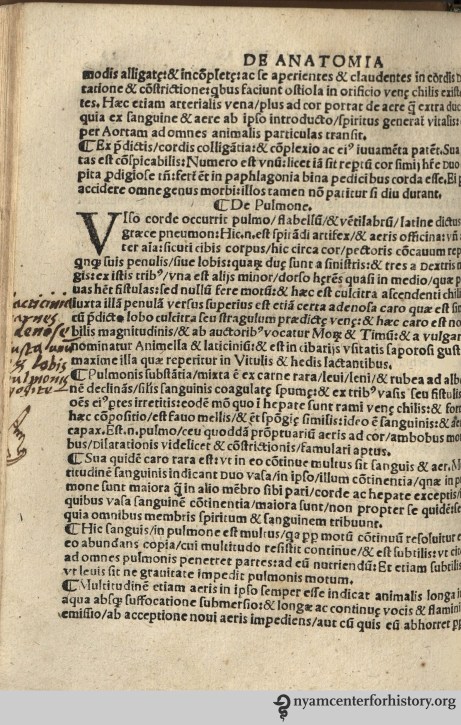
As you can see from the example above, the manicule is a disembodied, pointing hand. In case this, as in many, the manicule also has a little cuff, and a fingernail on the pointing finger that is visible, too. This manicule comes from our Anatomia Carpi by Jacopo Berengario da Carpi, a 16th century Italian physician.

The manicule gets its name from the Latin maniculum for “little hand.” This connection with the actual human body is apparent in some of the other names of the symbol: fist, printer’s first, bishop’s fist, pointer, pointing hand, even mutton-fist.[1] Its usage starts around the 12th century, though there is a record of it appearing in the Domesday Book of 1086 in John Johnson’s Typographia.[2]

Professor William Sherman of York University draws a connection between the classical gesture of “three fingers doubled under the thumb [and index the] finger extended”[3] from formal Roman oration to the strong connection between hands and texts when zeroing in on the manicule in his research on marginalia. Sherman observes the bond between hands and reading is so innate it often goes unnoticed:

“Unless we’re wrestling with an unusually large volume or feeling our way through an unusually delicate book; unless we’re running our fingertips over a text in Braille or our pointers through a Torah scroll; and unless we’re the kind of reader who follows along with our index finger or gives them a good lick before turning the page, it’s probably safe to say that we’re not even conscious of our hands as we make our way through a text.”

It’s certainly compelling to think of the manicule mark as the descendent of an oratory pose and natural human gesticulation.

Manicules are windows into people’s relationships with their books and texts.  Time was taken to read the passage, react to it and record or reference it by hand on the page, which makes sense given the tremendous amount of work, time and expense it once took to get a book into your hands. Keith Houston, author of Shady Characters, observed readers’ investment and attachment to their books was quite unlike the modern day consumer. “It was second nature for a book’s owner to brand it, to annotate and embellish it as they read; to underline pithy phrases and fill the margins with notes.”[4] Indeed, the manicule isn’t really a punctuation mark, something put in by the author for grammatical structural or clarity. Rather, it’s a reader’s mark indicating something to that person – something that could be wholly mysterious, banal, or unimportant to me or you.

doctors-dispensary_page1_watermarked

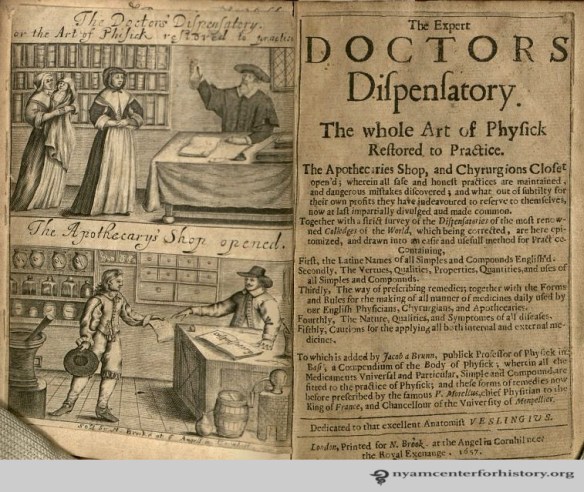
One past owner of our 1657 copy of The Doctor’s Dispensary found many points of interest in the book. Its pages are littered with marginal notes, underlining and manicules. This reader’s manicules are fairly simple, though they do include a cuff –or possibly a sleeve or an arm- while some examples can have long sleeves that drip down to mark the end of the passage of notable text, complete with shading on the clothing or secondary digits pointing things out as well.

As intellectual and cultural knowledge fairly exploded during the Renaissance, ink flowed from readers marking up their books. Then came the world-altering printing press from Johannes Gutenberg in 1440 in Mainz, Germany. Readers continued to annotate their printed books just as they had their handwritten ones; and printed manicules joined the handwritten ones on the page.[5] Printers inserted in-line manicules that indicated authorial notations that were not the readers’ own commentary, subtly (or not) guiding a reader to the ‘correct’ interpretation of the work. Printed manicules became more prominent as authors and publishers took advantage of a means to protect the integrity of their work. The manicule drawn in by hand more or less died out by the 19th century.

berengario_anatomiacarpi_1535_manicule-marginalia1_watermark

The mark lived on in its printed form and got almost annoyingly ubiquitous by the end of the 19th century. Manicules were a bread and butter symbol for advertising typography where they literally pointed the way to headlines, punchlines, venues and notable names.[6] They were even on gravestones, pointing the way to heaven.[7]

manicule-on-a-va-gravestone

This gravestone photo from a Virginia cemetery was snapped by literature professor and medievalist Jonathan Hsy of George Washington University.

The public visually overdosed on the manicule as this point and it fell from such frequent (over)use. The manicule is definitely still around though; on returned envelopes from the US postal service, in design products seeking to impart a vintage flare and in directional signage. And of course in the newest frontier of information and communication; the digital screen where the computer’s cursor was, and sometimes still is, a hand pointing the way.

cursor-hand_freeclipart

References

[1] Sherman, William H. Towards a History of the Manicule, 2005. Accessed November 22, 2016.

[2] McPharlin, Paul. Roman numerals, typographic leaves and pointing hands: some notes on their origin, history and contemporary use. New York: Typophiles, 1942. 47.

[3] Sherman, William H. Towards a History of the Manicule, 2005. Accessed November 22, 2016.

[4] Houston, Keith. Shady Characters: The Secret Life of Punctuation, Symbols & Other Typographic Marks. New York: W.W. Norton & Company, 2013. 170.

[5] Houston, Shady Characters. 178.

[6] Palmer & Rey. Palmer & Rey’s Type Specimen Book. San Francisco: Palmer & Rey, 1887.

[7] McPharlin, Roman numerals, 1942. 65.