Many Anatomy Lessons at the New York Academy of Medicine

Kriota Willberg, the author of today’s guest post, explores the intersection of body sciences with creative practice through drawing, writing, performance, and needlework. She is offering the workshop “Visualizing and Drawing Anatomy” beginning June 6 at the Academy. Register online.

Cheselden's Osteographia, 1733, opened to the title page and frontispiece.

Cheselden’s Osteographia, 1733, opened to the title page and frontispiece.

Different Disciplines, Same Body

I teach musculoskeletal anatomy to artists, dancers, and massage therapists. In my classes the students study the same raw material, and the set of skills each group acquires can be roughly organized around three distinct areas: representation of the body, kinesiology (the study of movement), and palpation (feeling the body).

As an anatomy teacher I am constantly on the prowl for images of the body that visually reinforce the information my students are learning. The Internet has become my most utilized source for visual teaching tools. It is full of anatomy virtual galleries, e-books, and apps. 3D media make it ever easier to understand muscle layering, attachment sites, fiber direction, and more.

In spite of the overwhelming volume of quality online cutting-edge anatomical imagery, I find myself drawn to historical 2D printed representations of the body and its components, once the cutting-edge educational technology of their respective centuries. Their precision, character, size, and even smell enhance my engagement with anatomical study. Many of these images emphasize the same principles as the apps replacing them centuries later.

The Essential Structure Of The Body

Different artists prefer different methods of rendering bodies in sketches. One method is to organize the body by its masses, outlining its surface to depict its bulk. Another method is to draw a stick figure, organizing body volume around inner scaffolding.
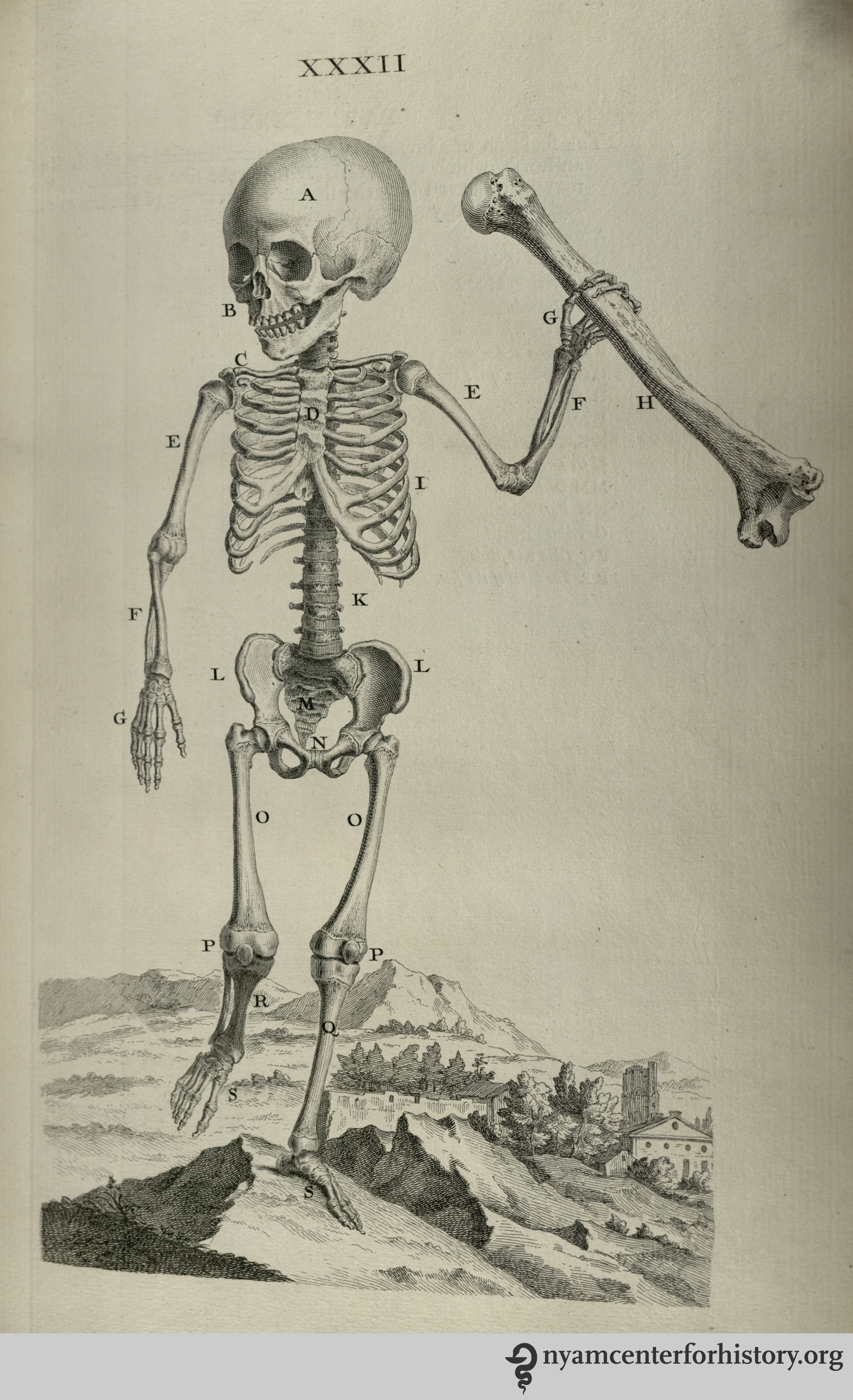
Plate XXXIII in Cheselden, Osteographia, 1733.

Plate XXXIII in Cheselden, Osteographia, 1733.

And what is a skeleton but an elaborate stick figure? William Cheselden’s Osteographia (1733) presents elegant representations of human and animal skeletons in action. These images remind us that bones are rigid and their joints are shaped to perform very specific actions. The cumulative position of the bones and joints gives the figure motion. In Cheselden’s world of skeletons, dogs and cats fight, a bird eats a fish, a man kneels in prayer, and a child holds up an adult’s humerus (upper arm bone) to give us a sense of scale while creating a rather creepy theatrical moment.

Muscle Layering

3D apps and other imaging programs facilitate the exploration of the body’s depth. One of the challenges of artists and massage therapists studying anatomy is transitioning information from the 2D image of the page into the 3D body of a sculpture or patient.

Planche 11 in Salvage, Anatomie du gladiateur combattant, 1812.

Planche 11 in Salvage, Anatomie du gladiateur combattant, 1812.

Salvage’s Anatomie du gladiateur combattant: applicable aux beaux artes… (1812) is a 2D examination of the 3D Borghese Gladiator. Salvage, an artist and military doctor, dissected cadavers and positioned them to mimic the action depicted in the statue. His highly detailed images depict muscle layering of a body in motion. The viewer can examine many layers of the anatomized body in action from multiple directions, rendered in exquisite detail. Salvage retains the outline of the body in its pose to keep the viewer oriented as he works from superficial to deeper structures.

Tab. VIII in Albinus, Tabulae sceleti et musculorum corporis humani, 1749.

Tabula VIII in Albinus, Tabulae sceleti et musculorum corporis humani, 1749 edition.

Bernhard Siegried Albinus worked with artist Jan Wandelaar to publish Tabulae sceleti et musculorum corporis humani (1749). Over their 20-year collaboration, they devised new methods for rendering the dissected body more accurately.  The finely detailed illustrations and large size of the book invite the reader to scrutinize the dissected layers of the body in all their detail. Although there is no superficial body outline, the cadaver’s consistent position helps to keep the reader oriented. On the other hand, cherubs and a rhinoceros in the backgrounds are incredibly distracting!

Fiber Direction

Familiarity with a muscle’s fiber direction can make it easier to palpate and can indicate the muscle’s line of pull (direction of action).

Figure in Berengario, Anatomia Carpi Isagoge breves, 1535.

Figure in Berengario, Anatomia Carpi Isagoge breves, 1535.

The images of Jacopo Berengario da Carpi’s Anatomia Carpi Isagoge breves, perlucide ac uberime, in anatomiam humani corporis… (1535) powerfully emphasize the fiber direction of the muscles of the waist. This picture in particular radiates the significance of our “core muscles.” Here, the external oblique muscles have been peeled away to show the lines of the internal obliques running from low lateral to high medial attachments. The continuance of this line is indicated in the central area of the abdomen. It perfectly illustrates the muscle’s direction of pull on its flattened tendon inserting at the midline of the trunk.

The Internal Body Interacting with the External World

One of the most important lessons of anatomy is that it is always with us. Gluteus maximus and quadriceps muscles climb the stairs when the elevator is broken. Trapezius burns with the effort of carrying a heavy shoulder bag. Heck, that drumstick you had for lunch was a chicken’s gastrocnemius (calf) muscle.

Tab. XII in Speigel, De humani corporis fabrica libri decem, 1627.

Tab. XII in Speigel, De humani corporis fabrica libri decem, 1627.

Anatomists from Albinus to Vesalius depict the anatomized body in a non-clinical environment. One of my favorites is Adriaan van de Spiegel and Giulio Casseri’s De humani corporis fabrica libri decem (1627). In this book, dissected cadavers are depicted out of doors and clearly having a good time. They demurely hold their skin or superficial musculature aside to reveal deeper structures. Some of them are downright flirtatious, reminding us that these anatomized bodies are and were people.
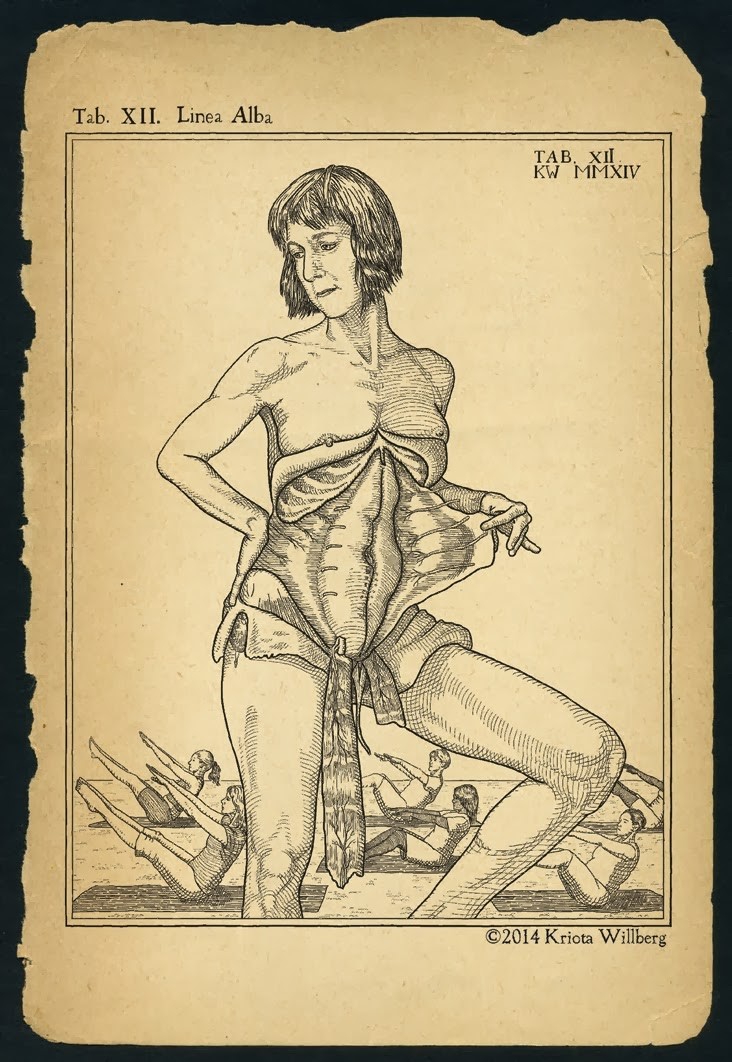
Kriota Willberg's self portrait. Courtesy of the artist.

Kriota Willberg’s self portrait. Courtesy of the artist.

I am so enamored of van de Spiegel and Casseri that I recreated page 24 of their book as a self-portrait. After my abdominal surgery, the image of this cadaver revealing his trunk musculature resonated with me. In my portrait I assume the same pose, but if you look closely you will see stitch marks tracing up my midline. I situate myself in a “field” of women performing a Pilates exercise that challenges abdominal musculature. And of course, I drew it in Photoshop.
Edward Jenner and the Development of the Smallpox Vaccine

By Rebecca Filner, Head of Cataloging

Smallpox was one of the leading causes of death in 18th-century Europe, killing about 400,000 people annually and leaving many more disfigured or blind. Epidemics in major cities routinely killed 20% or more of those infected, and this case-fatality rate rose to 80% for infants.

Variolation, a process through which people were deliberately infected with mild strains of smallpox in an effort to shield them from catching a more virulent form of the disease, was first used in England by Lady Mary Wortley Montagu in 1721 and became increasingly common later in the 18th century. However, 0.5 to 3% of variolated patients still died of smallpox, and there was always the risk that a variolated person would infect others with the disease.1

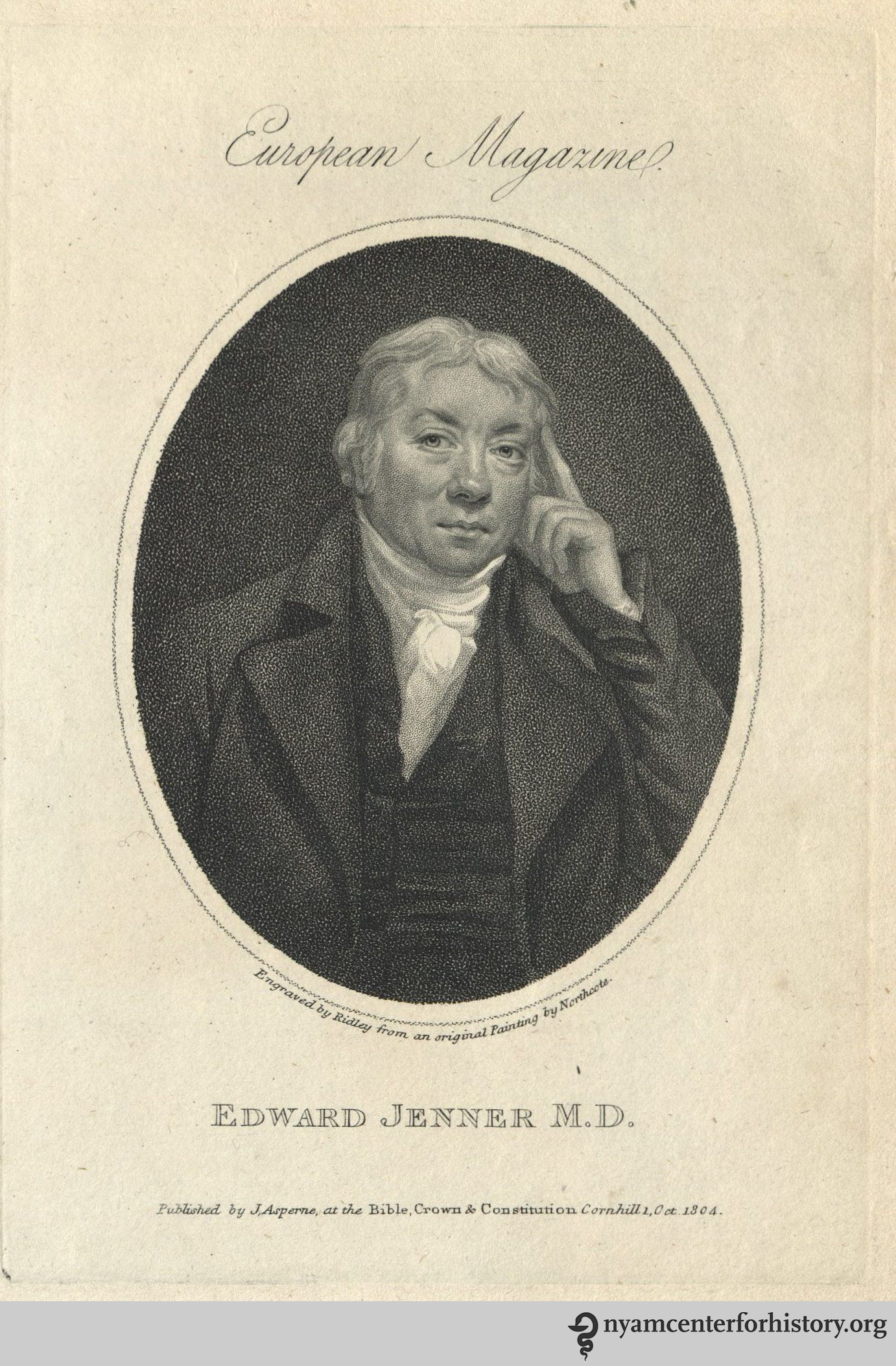
Engraving of Edward Jenner by William Ridley from an original painting by James Northcote.

Engraving of Edward Jenner by William Ridley from an original painting by James Northcote.

Enter Edward Jenner, an English doctor working in Gloucestershire in the late 18th century. Jenner was interested in testing the commonly held rural belief that dairy maids exposed to cowpox were no longer susceptible to the disease.2 He first heard this theory in 1770,3 and he began compiling case studies to test it in the 1780s and 1790s. On May 14, 1796, Jenner performed the first documented cowpox inoculation, taking a sample from a cowpox pock on the hand of a dairy maid named Sarah Nelmes and deliberately inserting the cowpox material into the arm of James Phipps, an eight-year-old boy. Phipps developed a cowpox lesion that healed within two weeks. When Jenner later exposed Phipps to smallpox through variolation, the boy was immune to the disease. Jenner was so confident that cowpox infection was a safe and effective method to prevent smallpox that he inoculated his infant son.

Jenner wrote a paper about his findings and submitted it to the Royal Society in 1797. The paper was not accepted for publication, however, because the reviewers found it had insufficient data. Undeterred, Jenner conducted additional trials and in 1798 published An Inquiry into the Causes and Effects of the Variolae Vaccinae, a Disease Discovered in Some of the Western Counties of England, Particularly Gloucestershire, and Known by the Name of the Cow Pox. He wrote three additional books on the same subject by 1801. Shown below is the title page from the first edition of the Inquiry, Jenner’s description of Sarah Nelmes’ case, and a detail from one of the color plates showing the cowpox on Nelmes’ hand.

The title page of the first edition of Jenner’s Inquiry, 1798.

The title page of the first edition of Jenner’s Inquiry, 1798.

Jenner’s description of Sarah Nelmes’ cowpox infection in Inquiry, 1798.

Jenner’s description of Sarah Nelmes’ cowpox infection in Inquiry, 1798.

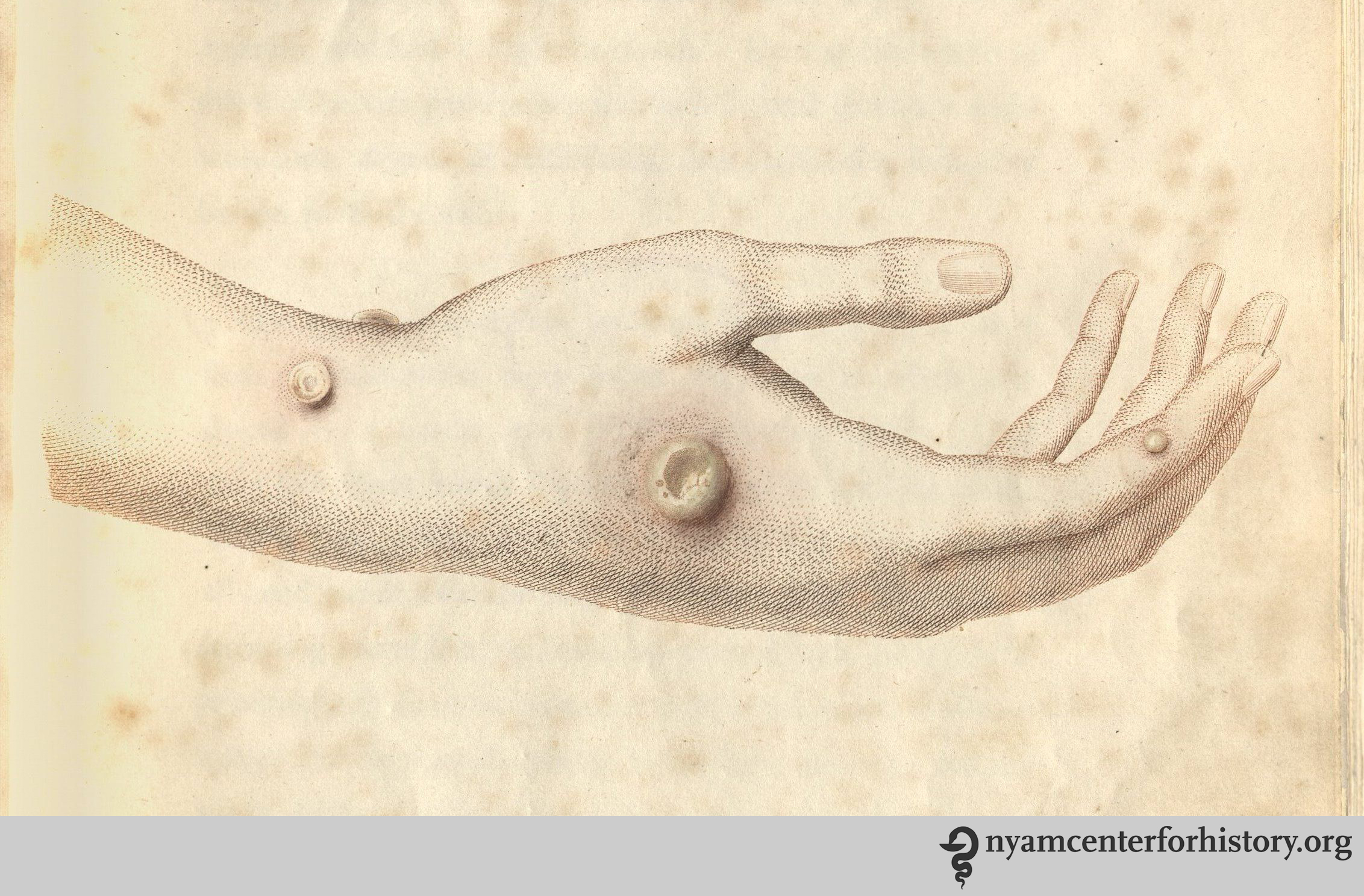
Color engraving of Sarah Nelmes’ cowpox pocks from the first edition of Jenner’s Inquiry.

Color engraving of Sarah Nelmes’ cowpox pocks from the first edition of Jenner’s Inquiry.

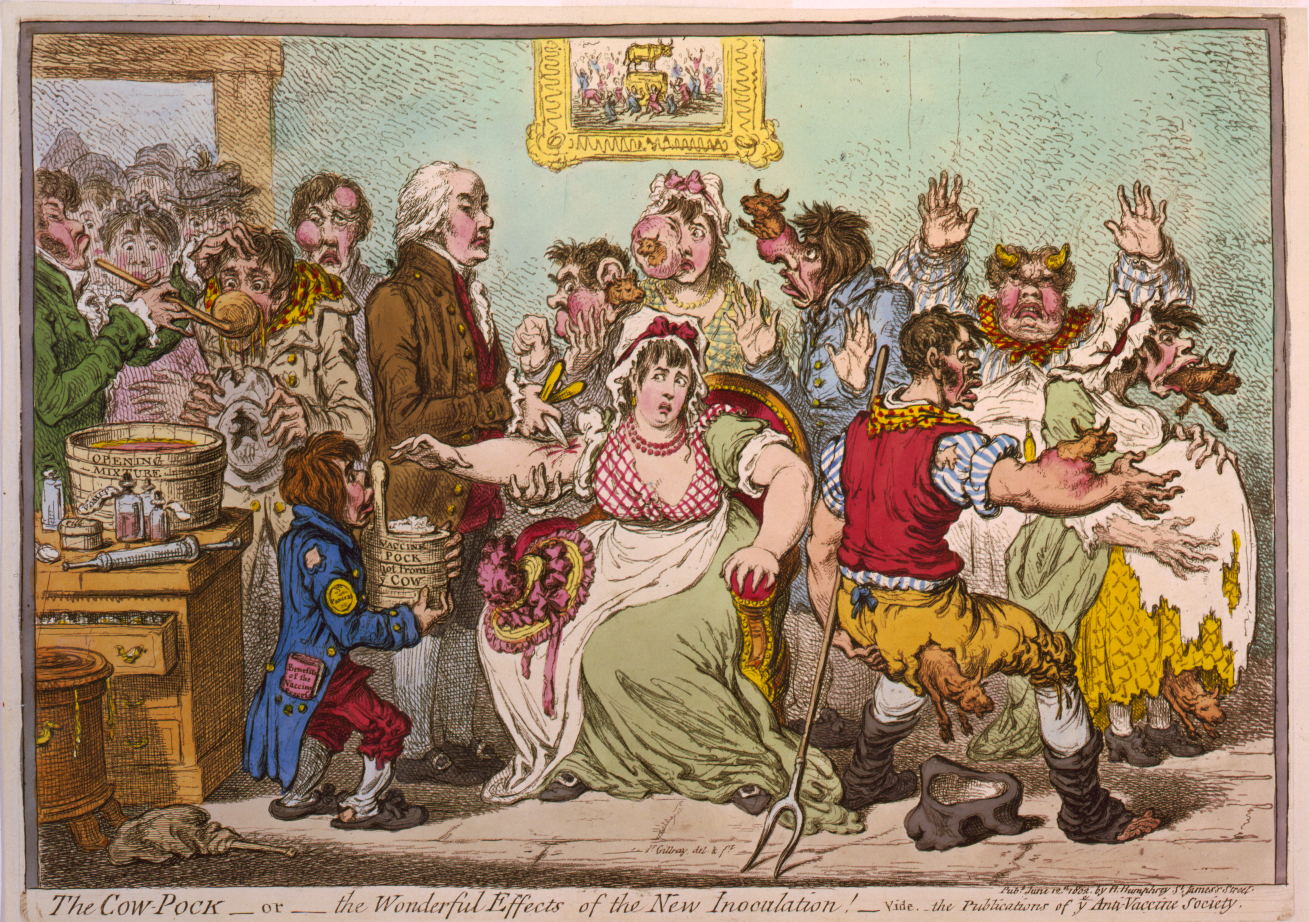
Early reactions to the Inquiry from the medical community and the general public were mixed. A cartoon by the famous caricaturist James Gillray, shown below, plays on the fear that using animal matter on people would cause the patients to assume animal characteristics. Members of the medical community, especially those with investments in the practice of variolation, tried to discredit Jenner’s discovery or stake their own claim to it. Jenner had especially acrimonious feuds with two London physicians, Dr. George Pearson and Dr. William Woodville. Pearson even gave evidence against Jenner’s 1802 petition to the House of Commons for recognition of his work on vaccination.

James Gillray’s “The Cow Pock – or – the Wonderful Effects of the New Inoculation,” published June 12, 1802, by H. Humphrey, St. James’s Street. Image courtesy of the Library of Congress.

James Gillray’s “The Cow Pock – or – the Wonderful Effects of the New Inoculation,” published June 12, 1802, by H. Humphrey, St. James’s Street. Image courtesy of the Library of Congress.

The New York Academy of Medicine holds a number of Edward Jenner’s autograph letters. In them, he rails against the misguided opposition to his discovery. On June 30, 1806, he writes to the Rev. Mr. Joyce:

“How wonderful that this horrid pestilence should at this time even have an existence in our island . . . A Physician from Copenhagen call’d on me today, and express’d his astonishment at an opposition to vaccine Inoculation, as by that means only the smallpox was completely extinguish’d in that City.”

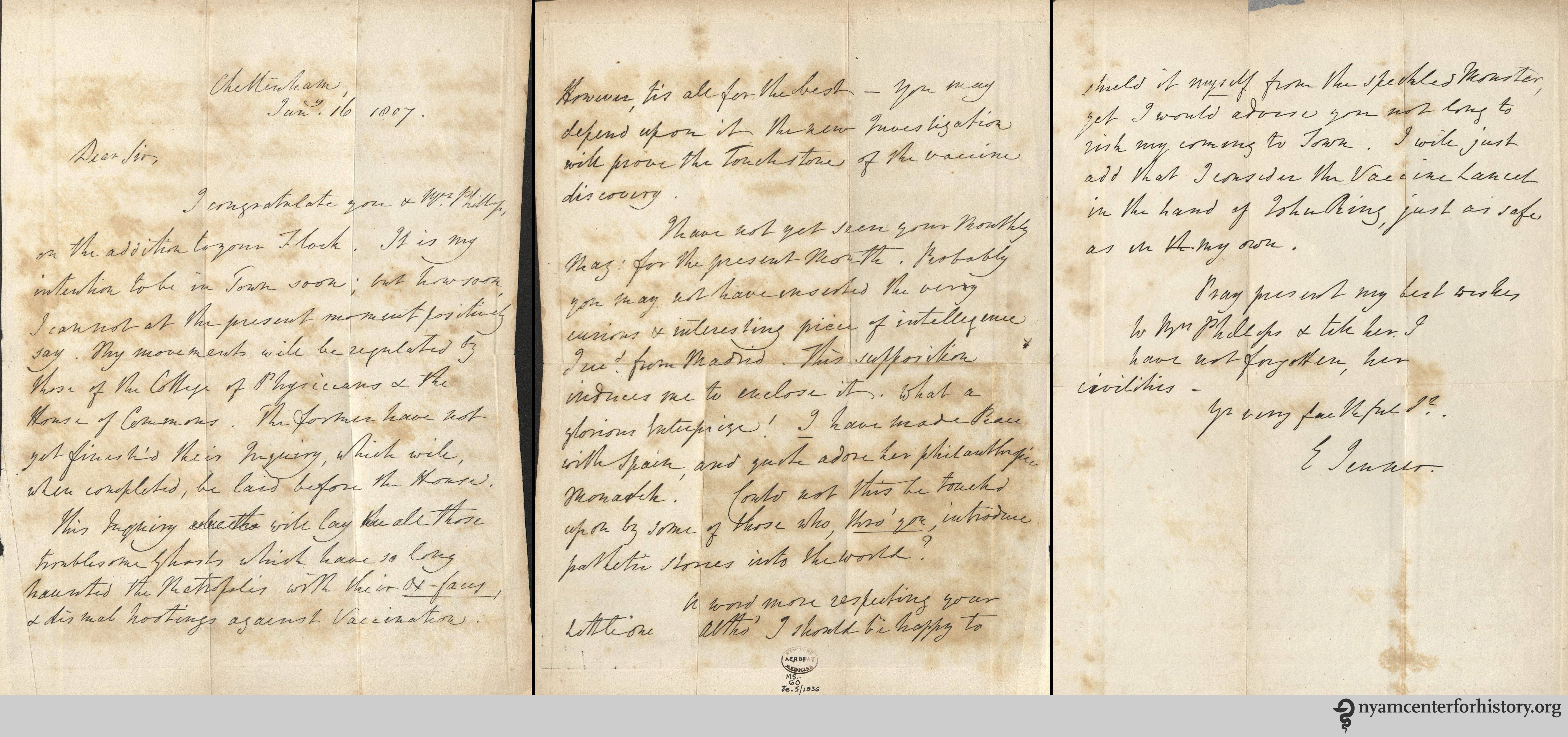
Writing to a Mr. Phillips on Jan. 16, 1807, Jenner notes that the College of Physicians:

“[Has] not yet finished this Inquiry, which will, when completed, be laid before the House [of Commons]. This Inquiry will lay all those troublesome ghosts which have so long haunted the Metropolis with their ox-faces, & dismal hootings against Vaccination. However, tis all for the best – you may depend upon it the new Investigation will prove the touchstone of the vaccine discovery.”

Jenner also offers advice about his smallpox vaccine:

“A word more respecting your little one. Altho’ I should be happy to shield it myself from the speckled Monster, yet I would advise you not long to risk my coming to Town. I will just add that I consider the Vaccine Lancet in the hand of [Dr.] John Ring, just as safe as in my own.”4

In an autograph letter signed to Mr. Phillips, dated Jan. 16, 1807, Edmund Jenner discusses the ongoing vaccination controversy and offers advice for vaccinating Phillips’ new baby.

In an autograph letter signed to Mr. Phillips, dated Jan. 16, 1807, Edmund Jenner discusses the ongoing vaccination controversy and offers advice for vaccinating Phillips’ new baby. Click to enlarge.

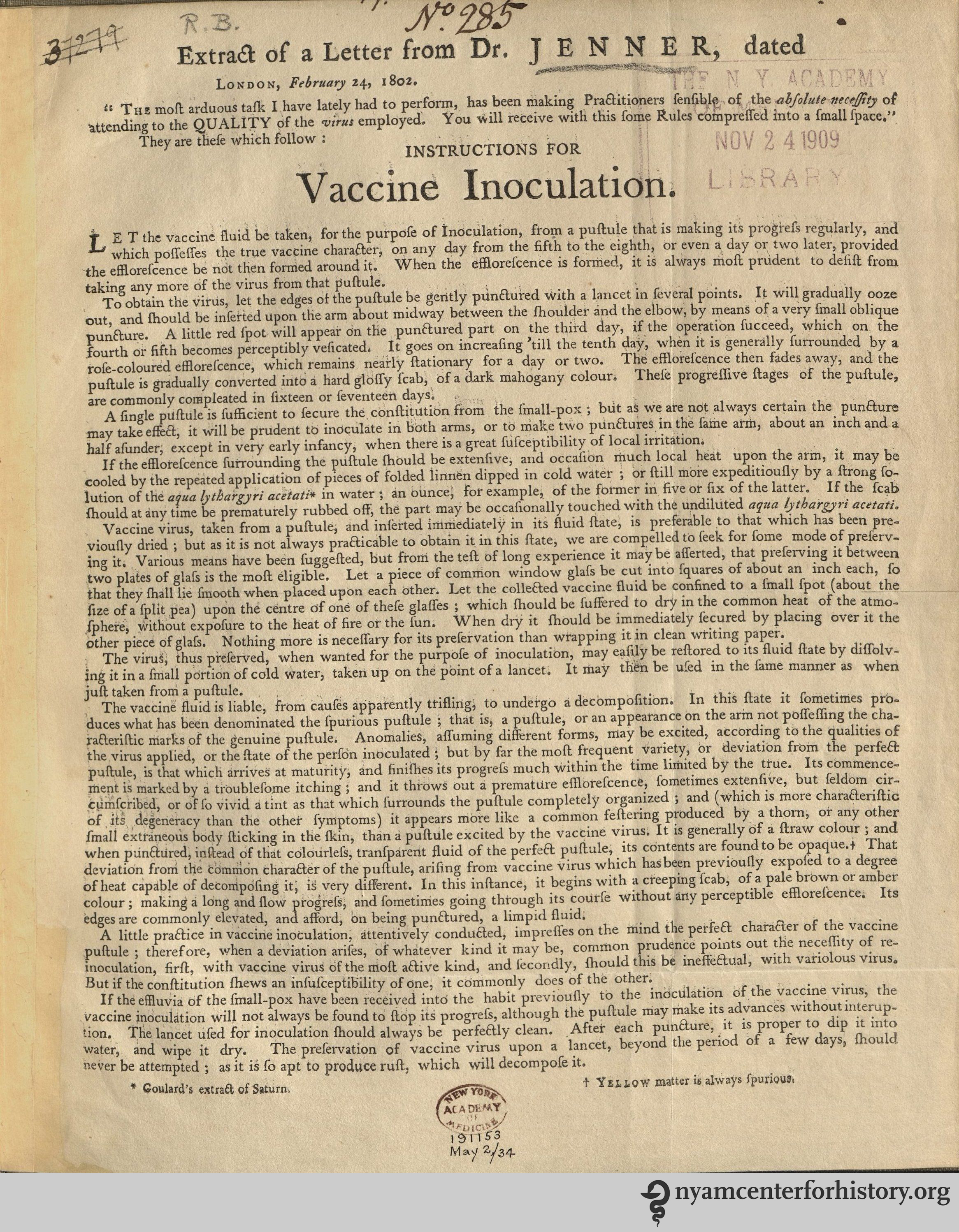
Despite some people’s doubts about the safety and efficacy of Jenner’s smallpox vaccine, there was great demand for cowpox samples to conduct vaccinations in England and abroad. Jenner and other practitioners in England sent dried cowpox specimens sandwiched between glass to Europe and the United States. The hand-colored drawing below presumably accompanied cowpox samples sent from England to America; the drawing shows the difference between cowpox pustules (on the left) and smallpox pustules (on the right) at 6, 8, 10, 12, 14, and 18-20 days after infection. Also shown below is an example of printed “Instructions for Vaccine Inoculation” from an “Extract of a Letter from Dr. Jenner, dated London, February 24, 1802.”

The New York Academy of Medicine holds this hand-colored drawing that shows the difference between cowpox and smallpox pustules at various stages of infection.

The New York Academy of Medicine holds this hand-colored drawing that shows the difference between cowpox and smallpox pustules at various stages of infection.

This broadside shows what kind of instructions were available for people interested in administering the smallpox vaccine.

This broadside shows what kind of instructions were available for people interested in administering the smallpox vaccine.

The smallpox vaccine became more common during the 19th century, but smallpox epidemics continued to occur, at least partly because people did not yet fully appreciate the need for re-vaccination. In the 20th century, smallpox continued to plague third-world countries. Finally, a global eradication campaign organized by the World Health Organization (WHO) in 1967 succeeded in eliminating smallpox. The last naturally occurring case was in Somalia in 1977.5 Thanks to Edmund Jenner’s research and his efforts to promote smallpox vaccination, one of the world’s most feared diseases is now a historical curiosity instead of an ongoing deadly threat.

References

1. These statistics are from Abbas M. Behbehani’s “The Smallpox Story: Life and Death of an Old Disease” in Microbiology and Molecular Biology Reviews, v. 47, no. 4 (Dec. 1983), p. 455-509. Available online at http://mmbr.asm.org/content/47/4/455.long See also Stefan Riedel’s “Edward Jenner and the history of smallpox and vaccination” in Baylor University Medical Center Proceedings, v. 18, no. 1 (Jan. 2005), p. 21-25. Available online at https://www.ncbi.nlm.nih.gov/pmc/articles/PMC1200696/
2. The Jenner Museum gives a good summary of Jenner’s interest in cowpox as a way to prevent smallpox infection. See http://www.jennermuseum.com/vaccination.html

3. Behbehani, p. 468.

4. The quotations in this paragraph are from MS 1155 (Edmund Jenner, autograph letter signed: London, to the Revd. Mr. Joyce, 1806 June 30; first quote) and MS 59 (Edmund Jenner, autograph letter signed: Cheltenham, to [Mr. Phillips], 1807 Jan. 16; second two quotes.)

5. See the World Health Organization’s page on smallpox, available online at http://www.who.int/csr/disease/smallpox/en/

Sitadevi’s Sutra

By Emily Miranker, Team Administrator/Project Coordinator

In 1934, Sitadevi Yogendra (1912–2008) published Yoga: Physical Education for Women, the first book on yoga for women by a woman.1 Married at age 15 to Shri Yogendraji, founder of The Yoga Institute in Mumbai, they became what Sitadevi described as “the first yogi couple.”2 Her book enjoyed three editions in less than 10 years and has been translated into several languages. It leads the reader through a course of exercises and postures specially geared towards women, recognizing that the prevailing techniques of the teachers of her day were “based upon the physiopsychic needs of Man.”3

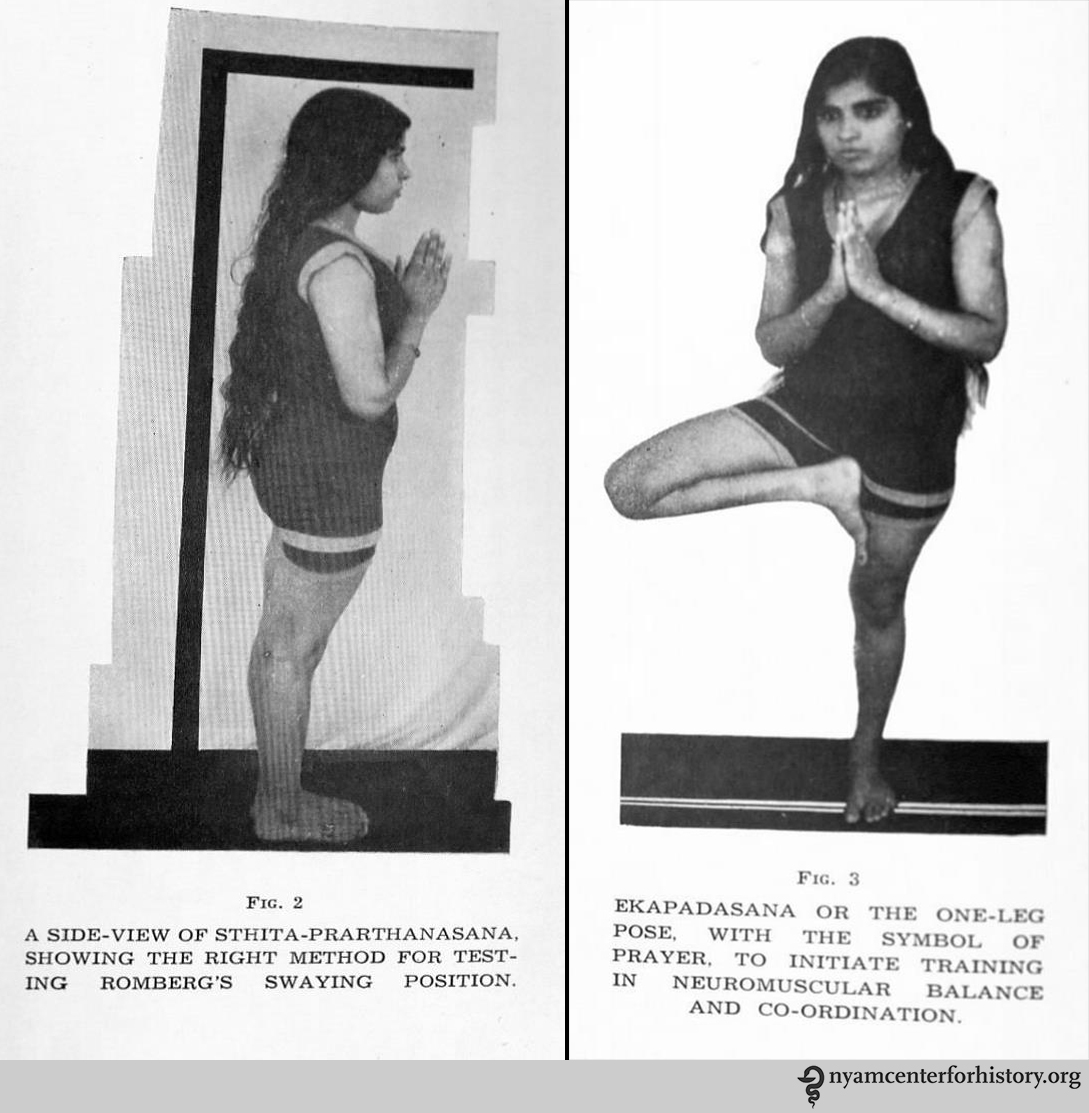
First up in the routine are the corrective prayer poses. These instill proper posture in the body, something difficult to maintain under the “imposition of unnatural living under modern conditions”4— and this was before we slouched at computers all day and cramped our fingers with constant texting.

Figures 2 and 3 in, Yogendra, Yoga: Physical Education for Women,” 1947.

Figures 2 and 3 in Yogendra, Yoga: Physical Education for Women, 1947.

With your posture thus improved, the next poses maintain or even increase your height. The common triangle pose (trikonasana) is among those recommended. It’s a spine-stretching equilateral triangle shape in contrast to the flashier right-triangle that frequently adorns today’s Western fitness magazine covers.

Figure 7 in in Yogendra, Yoga: Physical Education for Women, 1947.

Figure 7 in in Yogendra, Yoga: Physical Education for Women, 1947.

Right triangle pose. Yoga.com. https://yoga.com/pose/right-triangle-pose Accessed April 28, 2016.

Right triangle pose. Yoga.com. Accessed April 28, 2016.

Sitadevi details exercises for the trunk to develop core strength and tone, and poses to keep the sex organs healthy. She considered it the “duty of every woman to safeguard her health”5 as the bearers of children. She concludes with poses for the spine, which she found good for the nervous system and mental equity (samatvam).

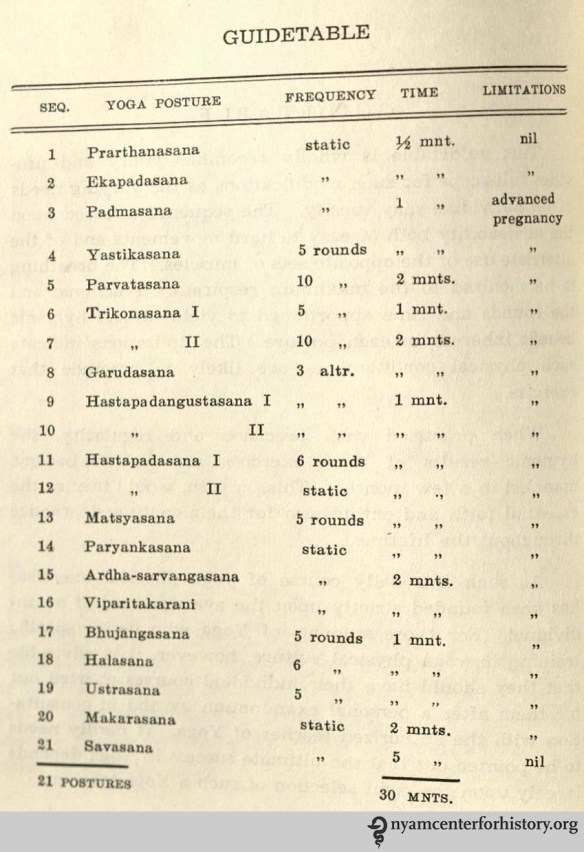
She provides a table of the entire sequence, which should take just 30 minute to run through. “When practiced with precision and regularity, the hygienic results of these exercises are sure to become manifest in a few months. This, in turn, would inspire the essential faith and enthusiasm for their continued practice throughout the lifetime.”6

Guidetable for a yoga sequence in Yogendra, Yoga: Physical Education for Women, 1947.

Guidetable for a yoga sequence in Yogendra, Yoga: Physical Education for Women, 1947.

Sitadevi’s book, along with other publications of The Yoga Institute, were microfilmed and included in the Crypt of Civilization,7 which isn’t a videogame but rather a time capsule housed at Oglethorpe University in Atlanta, GA. Consider coming by our library to read up on Sitadevi and master her healthful poses to cultivate longevity so you’ll be around for the Crypt’s opening … in May of 8113.

References

1. “Mother Sita Devi Yogendra: A Brief Profile.” The Yoga Institute (May 29, 2013). Accessed May 3, 2016.

2. Mohanty, Sweta. “Fit to Lead.” DNA India (May 2007).Accessed April 28, 2016. http://www.dnaindia.com/lifestyle/grandeur-fit-to-lead-1099213

3. Yogendra, Sitadevi. Yoga: Physical Education for Women. Bombay: The Yoga Institute, 1947: 11.

4. Yogendra, Sitadevi. Yoga: Physical Education for Women. Bombay: The Yoga Institute, 1947: 27.

5. Yogendra, Sitadevi. Yoga: Physical Education for Women. Bombay: The Yoga Institute, 1947: 29.

6. Yogendra, Sitadevi. Yoga: Physical Education for Women. Bombay: The Yoga Institute, 1947: 127.

7. “Crypt of Civilization,” Oglethorpe University. Accessed April 28, 2016.  http://crypt.oglethorpe.edu/

Young Man Freud

By Paul Theerman, Associate Director, Center for the History of Medicine and Public Health

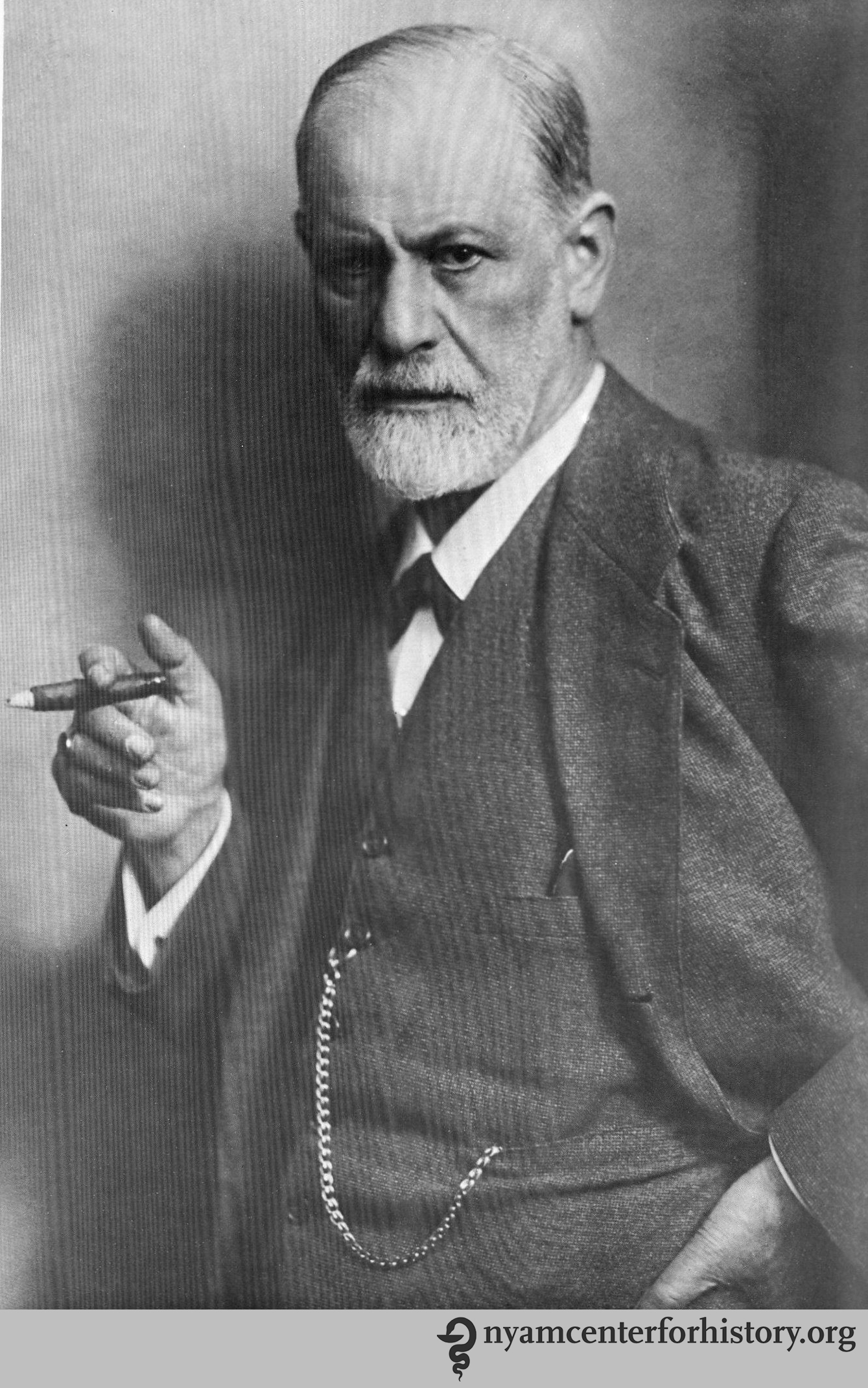
The best-known photograph of Sigmund Freud (1856–1939) is forbidding: cigar in hand, he appears grim-faced and imperious. The image bespeaks his complete confidence in the truth of his psychoanalytic theories, indeed in the whole venture of psychoanalysis, a field he created and, at least in the American sphere, a field that held sway in psychiatric treatment through the first half of the 20th century.

Freud circa 1921. In Ernst L. Freud, Lucie Freud, and Ilse Grubrich-Simitis, eds., Sigmund Freud : his life in pictures and words, 1978, reprint 1998.

Freud circa 1921. In Ernst L. Freud, Lucie Freud, and Ilse Grubrich-Simitis, eds., Sigmund Freud: His life in pictures and words, 1978, reprint 1998.

But that success was in the last half of his life. In honor of Freud’s 160th birthday, May 6, we wanted to present pictures of young Freud before his breakthrough works of the late 1890s, pictures of a man on the make in the intellectual culture of Vienna.

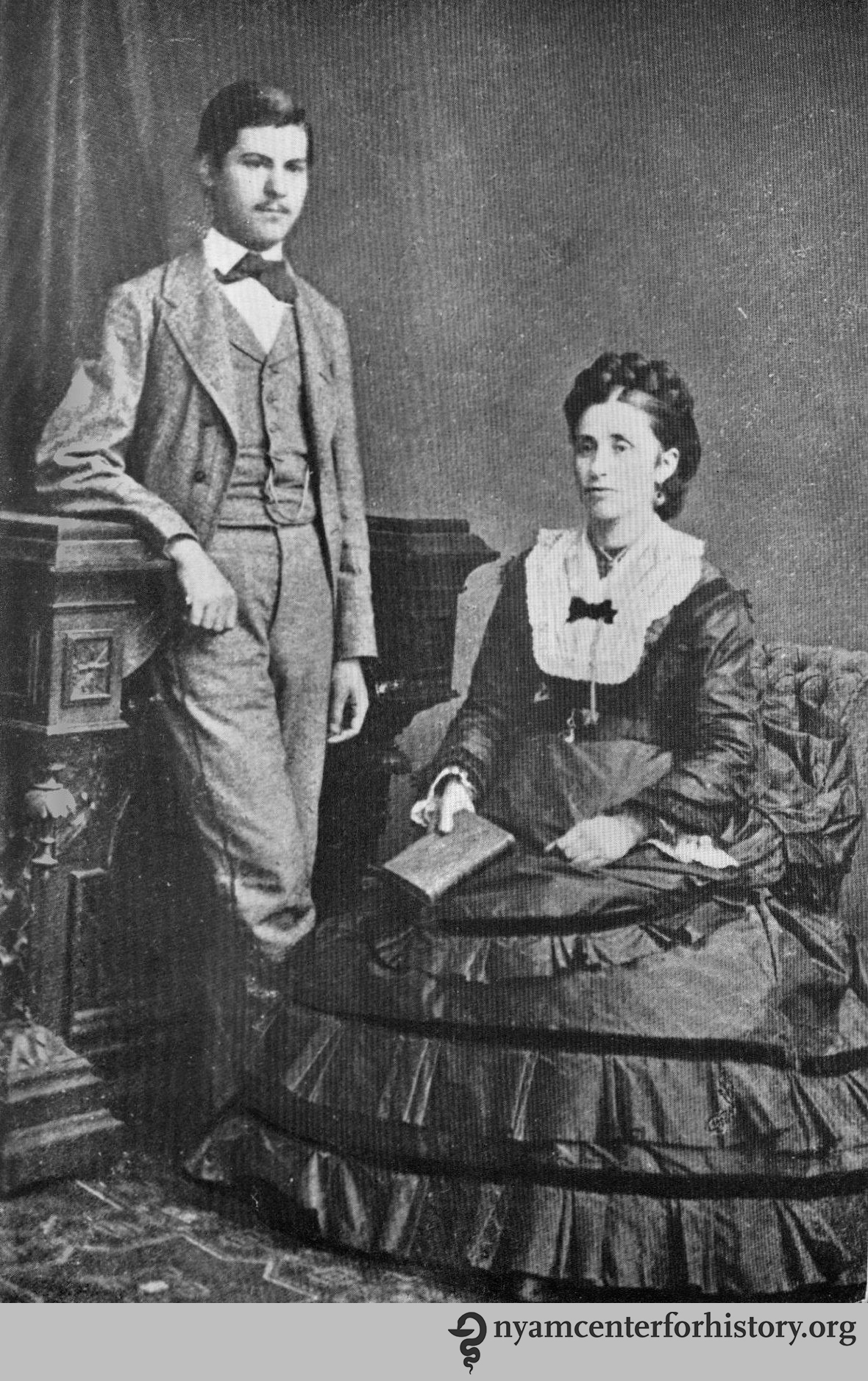
First, pictures of Freud with father Jakob and mother Amelie, when he was age 8 and 16, respectively, in Vienna. Born in Freiberg, Moravia, within the Austro-Hungarian Empire, Freud moved with his family to Vienna within a year. That city would remain his home until he moved to London in 1938, after Austria’s annexation by Nazi Germany.

Freud with his father Jakob in 1864. In The Freud centenary exhibit of the American Psychoanalytic Association, 1956.

Freud with his father Jakob in 1864. In The Freud centenary exhibit of the American Psychoanalytic Association, 1956.

Freud with his mother Amalie, circa 1872. In The Freud centenary exhibit of the American Psychoanalytic Association, 1956.

Freud with his mother Amalie, circa 1872. In The Freud centenary exhibit of the American Psychoanalytic Association, 1956.

After excelling in high school, the Leopoldstädter Kommunal-Realgymnasium, Freud entered the University of Vienna at 17 and graduated with his medical degree eight years later, in 1881. Interested in neurology, he hoped for a career in academic medicine.

Here, Freud in a wedding photograph with Martha Bernays in 1886, age 27. At this point, he had been out of medical school for five years, had begun his career at Vienna General Hospital (Allgemeines Krankenhaus der Stadt Wien), and had spent five months in Paris studying with the great French neurologist Jean-Martin Charcot, whose work on hypnosis would prove revelatory.

And finally, a portrait of Freud in 1891, five years after starting his private practice, where using hypnosis and free association he began to develop the new discipline of psychoanalysis. His works, Studies in Hysteria (1895) and The Interpretation of Dreams (1900), made his reputation. The second half of his life was spent elaborating and defending his ideas within the medical profession and in broader intellectual life.

Child Health Around the Maypole

By Johanna Goldberg, Information Services Librarian

From 1924 through 1960, May 1 marked the celebration of Child Health Day, as described in the pamphlet The Goal of May Day: A Year-Round Program:

May Day as Child Health Day holds within it the power of a great vision. Its goal is to focus the interest of the nation upon perfected childhood—with the hope of a start in life free, sound and richly potential for every child….

This day has been given to the country to become, like the Maypole, a central rallying point for all the diverse activities concerned with the welfare of children….1

"The summer round-up, with the State Congress of Parents and Teachers and the State Bureau of Maternity and Infancy cooperating in Oklahoma City, Oklahoma. In The Goal of May Day, 1928.

“The summer round-up, with the State Congress of Parents and Teachers and the State Bureau of Maternity and Infancy cooperating in Oklahoma City, Oklahoma. In The Goal of May Day, 1928.

The American Child Health Association (ACHA)—an organization founded by Herbert Hoover in 1923 with the merging of the American Child Hygiene Association and the Child Health Organization—began Child Health Day in 1924. The ACHA was inspired by the success of National Baby Week, an observance that spread awareness of infant care to millions by 1919 (clearly, awareness days and weeks are not a new phenomenon).1,2 The ACHA was also motivated by Congressional inaction (also not a new phenomenon); President Wilson had called for a child health program in 1919, to no avail.

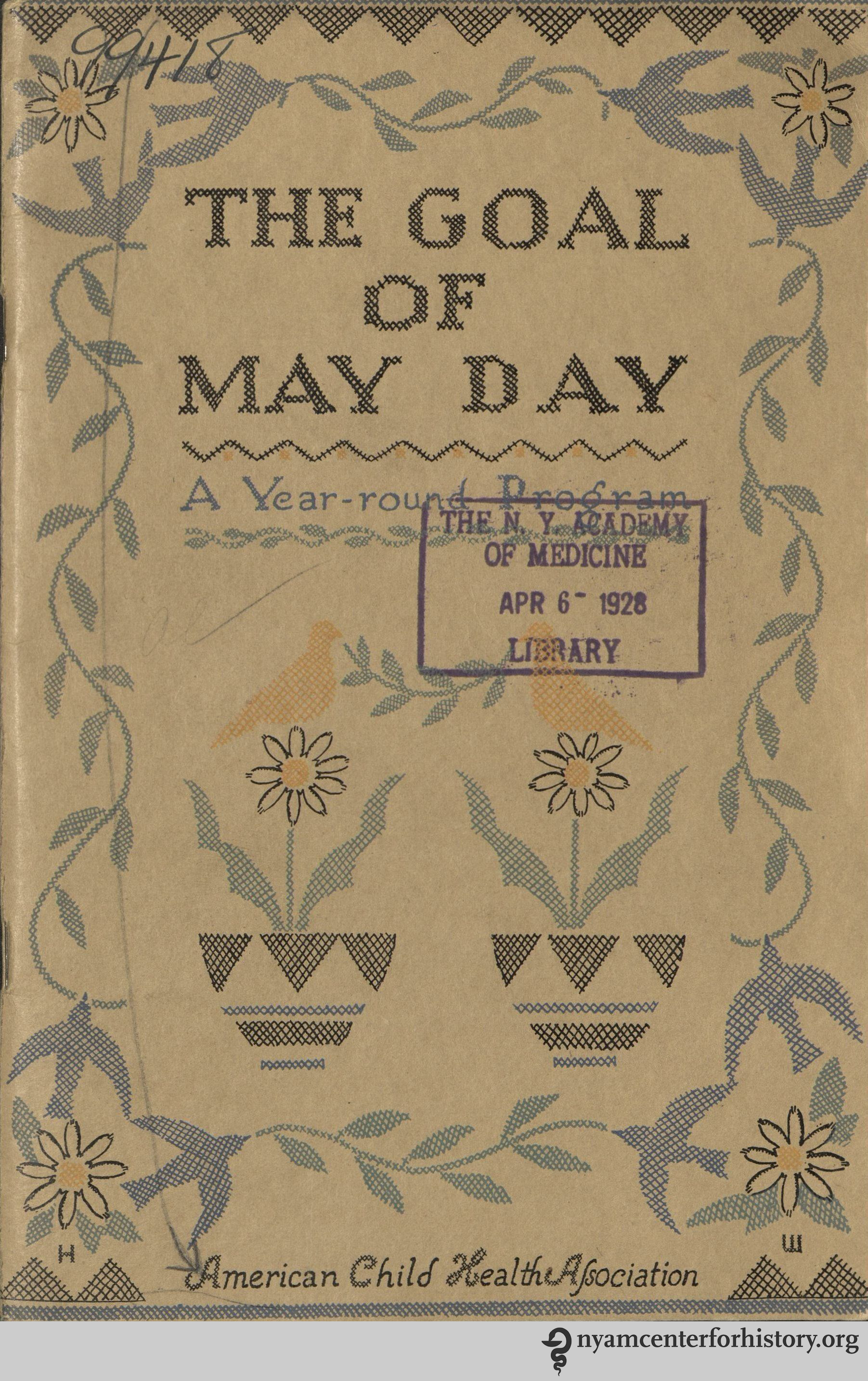
Cover of The Goal of May Day, 1928.

Cover of The Goal of May Day, 1928.

Aida de Acosta Breckinridge, wife of President Wilson’s Assistant Secretary of War Henry Breckinridge (and intriguingly, the first woman to pilot an aircraft solo), thought up May Day as Child Health Day and ran with the idea. Through her efforts, three million department stores nationwide handed out booklets on child health. Magazines like Women’s World and Literary Digest promoted the day.2 In 1928, President Calvin Coolidge officially declared Child Health Day a national celebration. It remains one today, though in 1960, Child Health Day moved to the first Monday in October.3

By 1928, when the ACHA released The Goal of May Day, the organization viewed May Day-Child Health Day as a time to celebrate the past year’s child welfare successes and plan for the year ahead. As the pamphlet emphasizes, May Day-Child Health Day activities occurred thanks to the efforts of community groups and local governments rather than through centralized ACHA planning, “each [group] coloring [May Day] with its own interpretation and using it according to its needs.”1 The Goal of May Day provides these organizations tips and lists of further resources to plan events and to improve child health year-round.

"A child health clinic in a church." In The Goal of May Day, 1928.

“A child health clinic in a church.” In The Goal of May Day, 1928.

The challenge was significant: the pamphlet states that 18,000 mothers died in childbirth in the United States each year. In 1924, cites the pamphlet, “the stillbirth rate was 3.9 per 100 live births.” While infant deaths from diarrhea and enteritis were down by 1928, those from congenital malformation, birth injuries, and premature birth had risen. And between infancy and school age, fifty percent of deaths came from diphtheria, recently preventable by vaccine.1

Making them safe from the great menace - diphtheria. In The Goal of May Day, 1928.

“Making them safe from the great menace – diphtheria.” In The Goal of May Day, 1928.

On a larger scale, the pamphlet offers a community health inventory to spur local government to improve child health, with questions ranging from “Have you a safe water supply?” to “Is there a tuberculosis clinic?” to “Is there an organized course of study for the education of the school child in health?”

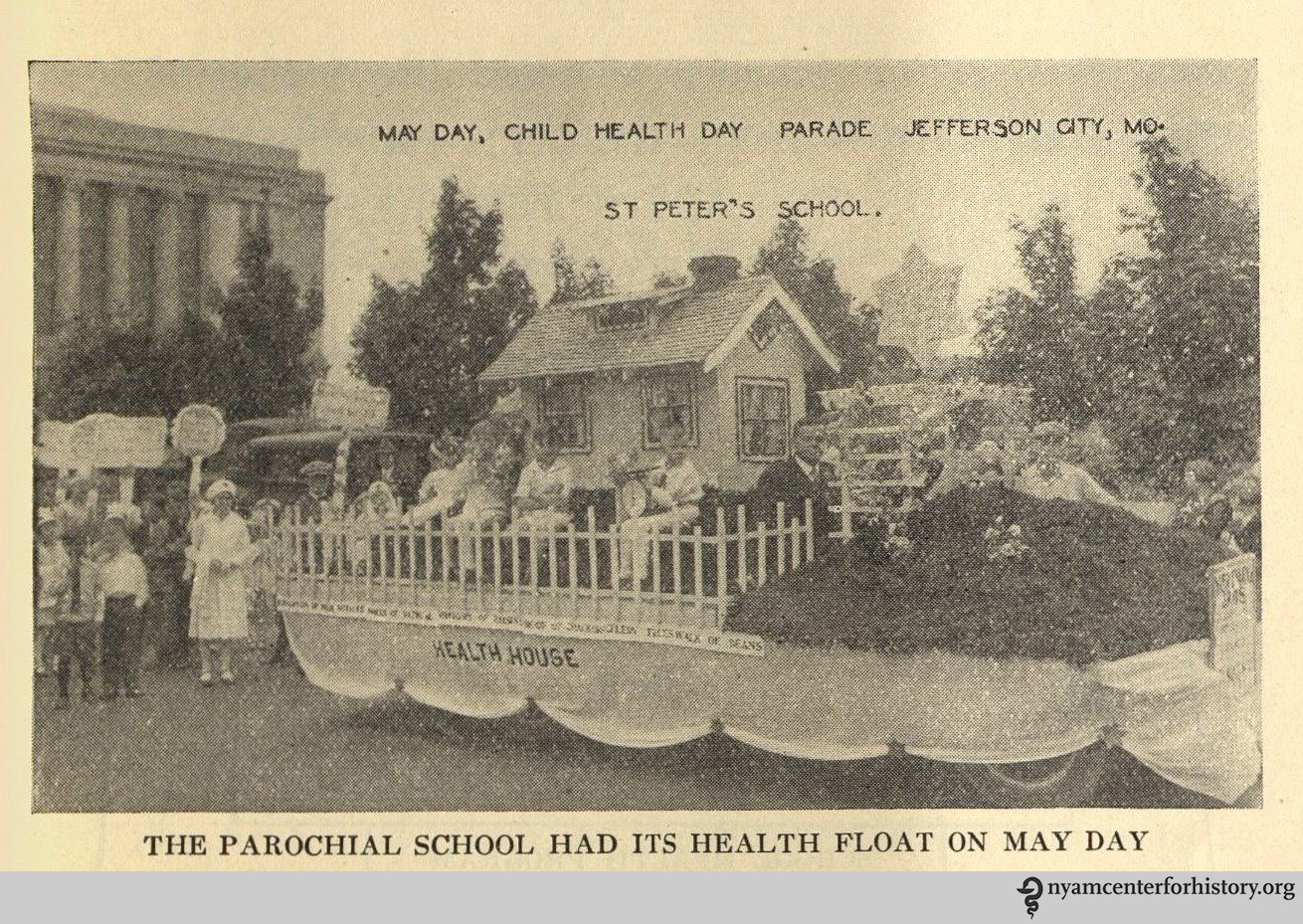
"The parochial school had its health float on May Day." In The Goal of May Day, 1928.

“The parochial school had its health float on May Day.” In The Goal of May Day, 1928.

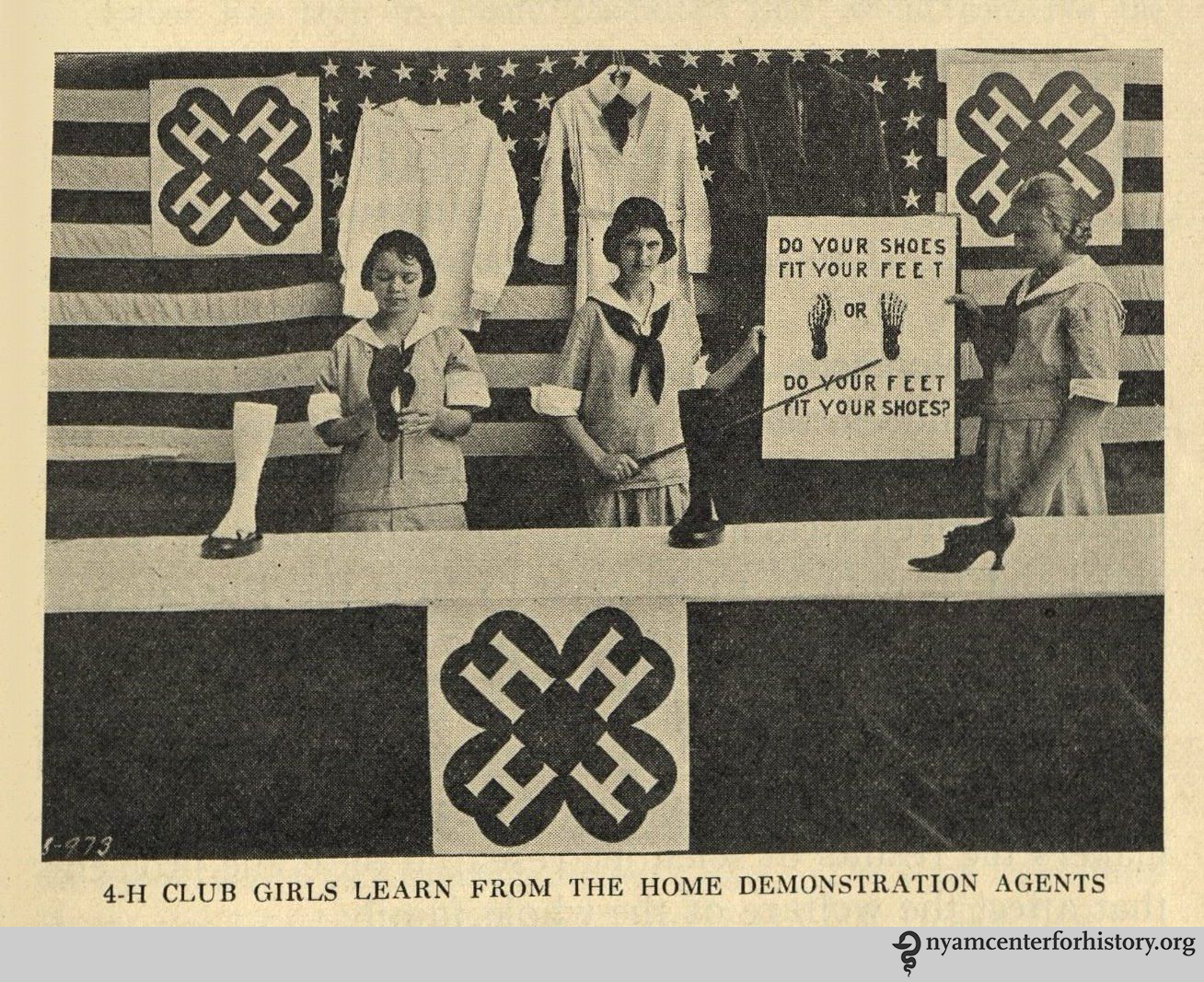
For community groups, the pamphlet recommends consulting with national organizations—the Girl Reserves, Boy Scouts, Jewish Welfare Board, National Catholic Welfare Conference, Child Study Association, and more—to plan programs and events like home demonstrations, distribution of health-related literature, community clean ups, health dramatizations, athletics, and exhibits.1

"4-H girls club learn from the home demonstration agents." In The Goal of May Day, 1928.

“4-H girls club learn from the home demonstration agents.” In The Goal of May Day, 1928.

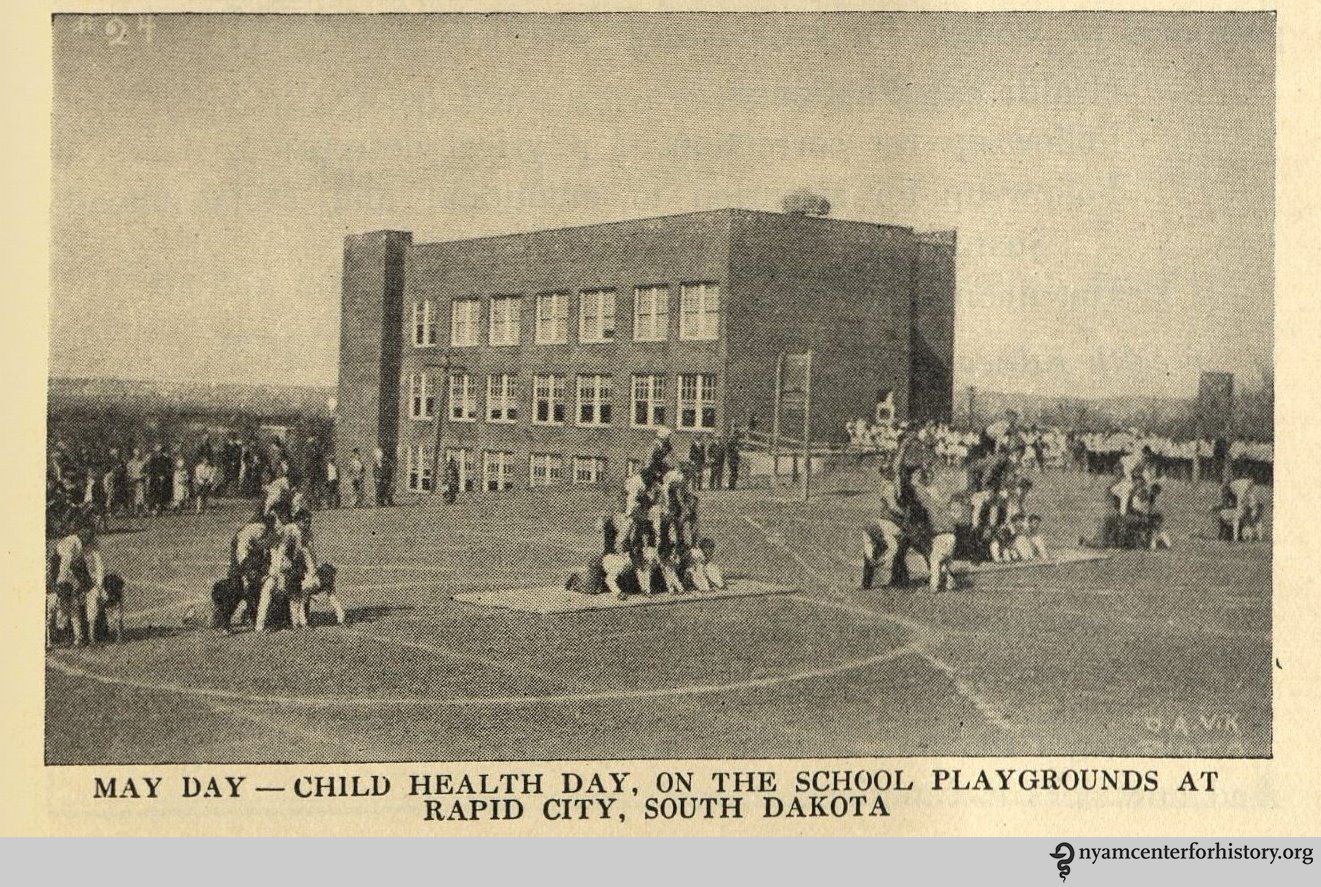
May Day - Child Health Day, on the school playgrounds at Rapid City, South Dakota. In The Goal of May Day, 1928.

May Day – Child Health Day, on the school playgrounds at Rapid City, South Dakota. In The Goal of May Day, 1928.

The American Child Health Association closed in 1935. During its 12 years of existence, it raised about $5 million for child-focused community services.2 And the observance of Child Health Day continues some 92 years after it began, though no longer around a Maypole.

References
1. The Goal of May Day: A Year-round Community Child Health Program. New York: American Child Health Association; 1928.

2. Lee RA. From Snake Oil to Medicine: Pioneering Public Health. Westport, Conn.: Greenwood Publishing Group; 2007.

3. Health Resources and Services Administration. Child Health Day History. Available at: http://mchb.hrsa.gov/childhealthday/history.html. Accessed April 27, 2016.

“How Many Stamens Has Your Flower?” The Botanical Education of Emily Dickinson

By Anne Garner, Curator of Rare Books and Manuscripts

So unsuspected violets
Within the fields lie low,
Too late for striving fingers
That passed, an hour ago.

Emily Dickinson (1858)1

Daguerreotype of Emily Dickinson, from the collection of Amherst College.

Daguerreotype of Emily Dickinson, from the collection of Amherst College.

Emily Dickinson fell early and fast for flowers. Her poetry is full of the blooms and buds that signal the awakening of spring. There’s her crocus, “Spring’s first conviction” (Letter 891) “stir[ring] its lids,” (J10) her May-Flower, “pink small and punctual,” (J 3) and her “chubby” daffodil with its “yellow bonnet” (J 10 and J4), among an army of many other blossoms that decorate her pages.

As her biographer Alfred Habegger has noted, the poet spent hours as a girl in the 1840s roaming the woods and fields near her Amherst, Massachusetts home, looking for flowers. In many cases, these were sent to friends, but the poet also kept some for herself. Her first assembled collection was not, as one might expect, a collection of writing, but a collection of plant specimens.2

Dickinson likely began her herbarium when she was 14, in 1845.3 It has been fully digitized by Harvard’s Houghton Library (all 66 pages can be viewed here). Several of the texts that influenced Dickinson’s flower collection are available in our library.

A page of Dickinson's herbarium, courtesy of Harvard University's Houghton Library.

A page of Dickinson’s herbarium, courtesy of Harvard University’s Houghton Library, including specimens of Liriodendron tulipfera and of the rare Chenopodium capitatum (strawberry blite).

In 1845, Dickinson was enrolled in both botany and Latin at Amherst Academy. Coursework in both subjects was instrumental in her identification and labeling of plants.

In use at Amherst during Dickinson’s time was Almira Lincoln Phelps’ textbook, Familiar Lectures on Botany, first published in 1829.4 Phelps, a pioneer educator and only the second woman elected a member of the American Association for the Advancement of Science, was the sister of the American education reformer Emma Willard.5 Phelps probably taught at Amherst Academy for at least one term, using the Familiar Lectures. Her textbook was certainly known and used by Dickinson.6

Our copy of Phelps’ Lectures on Botany contains a sweet floral treasure pressed within, with the ghost of its outline visible on its pages. If you can identify the flower, please let us know.

Our copy of Phelps’ Familiar Lectures on Botany (1838) contains a sweet floral treasure pressed within, with the ghost of its outline visible on its pages. If you can identify the flower, please let us know. Click to enlarge. [N.B.: Thanks to Julie Shapiro, Curatorial Associate and Herbarium Plant Specimen Technician at Harvard University Herbaria for her canny ID of the pressed flower in our 1838 copy of Phelps’ Familiar Lectures on Botany as a geranium.]

In the prefatory note to Familiar Lectures, Phelps describes how as a teacher of botany she struggled to find suitable textbooks, and composed the lessons within to fill this gap.7 Benjamin Smith Barton’s The Elements of Botany, while beautifully illustrated, was very out of date by the late 1820s, and written in an archaic language unsuitable for young students.8

Plate VI from Phelps, Familiar Lectures on Botany, 1838. Click to enlarge.

Plate VI from Phelps, Familiar Lectures on Botany, 1838. Click to enlarge.

Familiar Lectures, sometimes called Mrs. Lincoln’s Botany, became the standard textbook for young students, and went through at least 39 editions. The volume contains a prefatory note directed at teachers that tells us about Phelps’ pedagogical style, and what Dickinson may have experienced in her classroom:

Each member is presented with a flower for analysis….The names of the different parts of the flower are then explained; each pupil being directed to dissect and examine her flower as we proceed. ..After noticing the parts…the pupils are prepared to understand the principles on which the artificial classes are founded, and to trace the plant to its proper class, order, & c. At each step, they are required to examine their floors, and to answer simultaneously the questions proposed; as, how many stamens has your flower?9

Phelps taught her students the Linnaean system of identifying specimens: the number of stamens in a flower would determine its class, and the number of pistils, its order. Successive editions of Phelps’ text acknowledged the new “natural” system of classification, a system that moved away from stamen and pistil counting, but discarded the new method as too complex for students.10

“Of leaves.” In Phelps’ Familiar Lectures on Botany, 1838. Click to enlarge.

Dickinson’s biographer Alfred Habegger emphasizes Phelps’ belief that botany was a subject well-suited to females, and that Dickinson herself characterized plants most frequently as female, and, by extension, as central to the role of playing female:

That the poet thought of flowers as female suggests her love of plants owed more to culture than science….Pressed between the pages of a letter, they became a medium of exchange between her and her friends, those of her own sex especially. Cultivated indoors, especially after a conservatory was added to the Dickinson Homestead, they became a consuming avocation.11

Emily Dickinson seems to have consulted another book for the organization of her specimens. That book was Amos Eaton’s Manual of Botany, for the Northern and Middle States of America.

Title page of Eaton, Manual of Botany, 1822.

Title page of Eaton, Manual of Botany, 1822.

Eaton, a botanist and geologist, had mentored Phelps during her time at Emma Willard’s Female Seminary in Troy. It was Eaton who had first encouraged the publication of Familiar Lectures.12 Dickinson likely used Eaton’s manual to identify the specimens she gathered on walks in the woods. She labelled her specimens in accordance with Eaton’s Linnaean numbering system, in which the class and order correspond to number of stamens and pistils, probably unaware that by this time, the method had been largely discounted.13

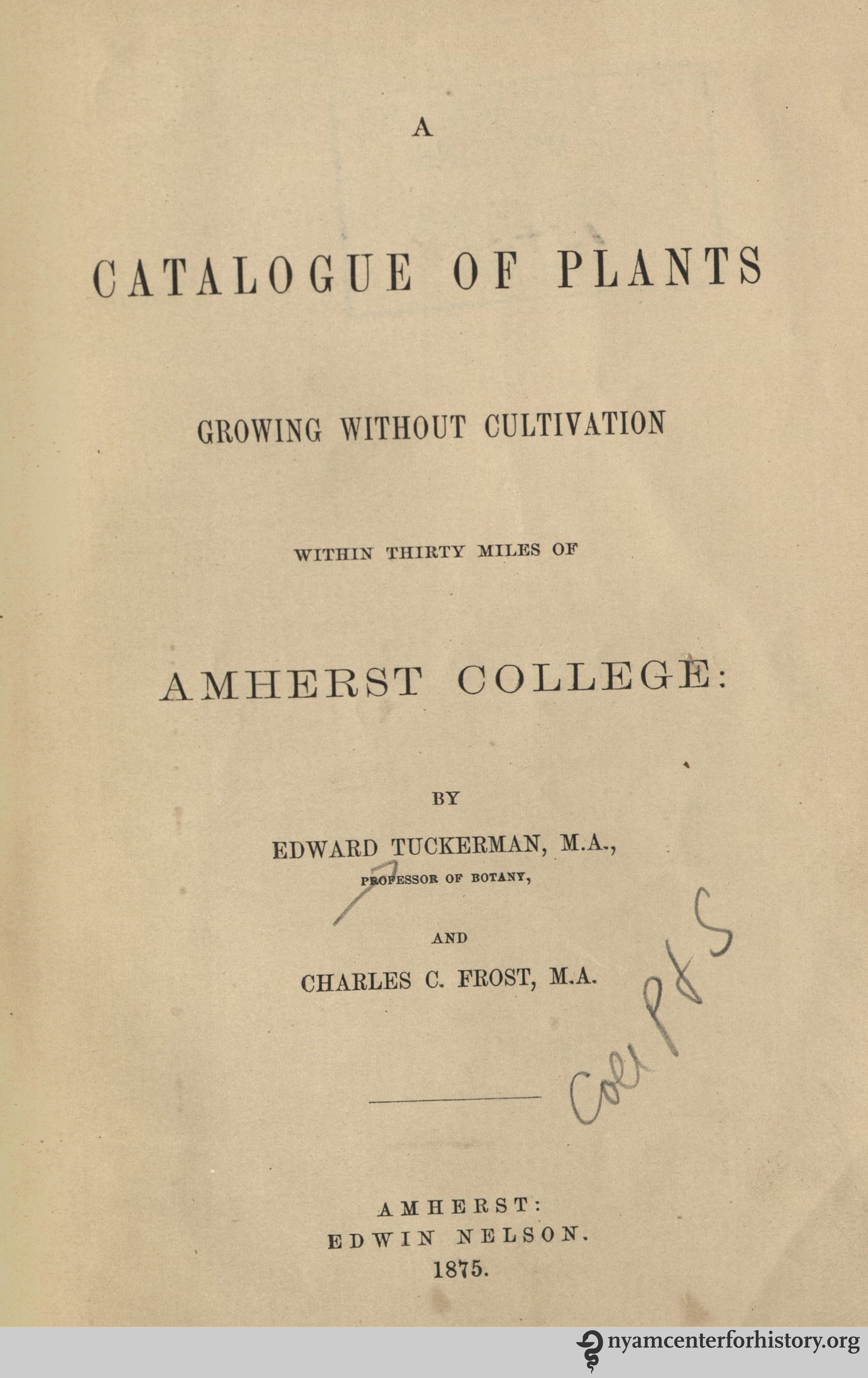
Dickinson also consulted Edward Hitchcock’s Catalogue of Plants growing without cultivation within thirty miles of Amherst College in the creation of her herbarium. The text Dickinson used was published in 1829, but our copy, revised by Edward Tuckerman, dates to 1875. Hitchcock was president at nearby Amherst College, and the area’s most eminent naturalist. He’s especially remembered for his geological contributions (Hitchcock led the first geological survey in Massachusetts after studying dinosaur footprints). “Hitchcock’s guide includes many rare plants native to Massachusetts also collected by Dickinson, including the very rare strawberry blite, cancer root (found near Mt. Holyoke), and verbena (found in South Hadley).14

Title page of Tuckerman and Frost's A Catalogue of Plants, 1875.

Title page of Tuckerman and Frost’s A Catalogue of Plants, 1875.

Dickinson refers to Hitchcock in an 1877 letter to T.W. Higginson:

When Flowers annually died and I was a child, I used to read Dr Hitchcock’s Book on the Flowers of North America. This comforted their Absence–assuring me they lived.” (Letter 488)15

Dickinson seems to have confused the authorship of the book she mentions above; here, too, she’s likely referring to Eaton’s Manual of Botany for North America.

Phelps, Eaton, and Hitchcock’s texts all influenced Dickinson’s impressions of the natural world in girlhood. As a mature poet, as her physical reach and exploration of the natural world became more and more limited, the plants familiar to her from girlhood stuck, fixing their roots all the more deeply in her mind.

Perhaps you’d like to buy a flower?
But I could never sell.
If you would like to borrow
Until the daffodil

Unties her yellow bonnet
Beneath the village door,
Until the bees, from clover rows
Their hock and sherry draw,

Why, I will lend until just then,
But not an hour more!16

References

1. Johnson, Thomas ed., The Complete Poems of Emily Dickinson. Boston: Little, Brown, 1960. 7; Johnson, Thomas and Theodora Van Wagenen Ward, eds., The Letters of Emily Dickinson. Cambridge: Harvard, 1958.

2. Habegger, Alfred. My Wars are Laid Away In Books The Life of Emily Dickinson. New York: Random House, 2001.

3. Habegger, 154.

4. Habegger, 155.

5. Rudolph, Emanuel. “Almira Hart Lincoln Phelps (1793-1884) and the Spread of Botany in Nineteenth Century America.” American Journal of Botany, Vol. 71, No. 8 (Sep. 1984), pp. 1161-1167.

6. Habegger, 155.

7. Phelps, Almira Hart Lincoln. Familiar Lectures of Botany. New York: Huntington, 1839. Pp.8-9.

8. Rudolph, 1162.

9. Phelps, 8-9.

10. Rudolph, 1163-1164.

11. Habegger, 156.

12. Rudolph, 1163.

13. Habegger, 158.

14. Habegger, 158-159.

15. Johnson, Thomas and Theodora Van Wagenen Ward, eds., The Letters of Emily Dickinson. Cambridge: Harvard, 1958.

16. Johnson, Thomas ed., The Complete Poems of Emily Dickinson. Boston: Little, Brown, 1960. 4.

From Central Park to the Front Lines: Frederick Law Olmsted and the Sanitary Commission

By Paul Theerman, Associate Director, Center for the History of Medicine and Public Health

We are fortunate at the Academy to look out over Central Park—one of the jewels of the city of New York. The park got its start in the 1850s, and took shape due to the visionary efforts of two men, landscape architects Calvert Vaux and Frederick Law Olmsted (1822–1903). In the 1860s Olmsted—whose birthday we celebrate today—was instrumental in one of the great medical and public health efforts of the 19th century: the organization of relief to Union soldiers in the Civil War. As executive secretary of the U.S. Sanitary Commission, he coordinated voluntary efforts to support the Army’s medical department in the war effort.1

Olmsted was a restless person, continually trying on new roles. He first made his mark in journalism, publishing his observations of life in the South after three tours through the region in 1850s.2 He offered a scathing depiction of slavery, the resistance of southern society to change, and the degrading effects of the institution on society as a whole. Olmsted became an abolitionist when that was still a minority position, and a reformer throughout his life.

At the outbreak of the Civil War, Olmsted’s superintendence of the Central Park project was limited due to disputes with the city, and he contacted Henry W. Bellows, a New York Unitarian minister, for help in securing a position. Bellows drafted him to head up, as executive secretary, a newly chartered private institution, the U.S. Sanitary Commission, of which Bellows was a founding Commissioner. Broadly modeled on the British example in the Crimean War, the Sanitary Commission addressed two persistent needs in the delivery of medical services in wartime. The first was that the standing army of the United States was relatively minuscule, and its medical department equally so. At the outbreak of the war, the army had some 16,000 men at arms, a portion of whom defected to the Southern cause. Through volunteers and conscription, the number of men serving eventually reached 2.5 million over the four years of the war, with perhaps half a million in uniform at the height of the conflict. As the volunteer army geared up so did the medical corps, but by any measure the medical service of the army was largely inadequate for the task.

And the medicine of the army seemed inadequate as well. The Sanitary Commission as he organized it had a paid professional staff and a corps of medical inspectors to review military camp conditions and advise military physicians. The inspectors also relayed requests for supplies back to the Commission’s offices in Washington, where central office staff would work to fill requests from donations.

Olmsted also lobbied to induce Congress and Cabinet officials for assistance through reformed laws and sympathetic appointments. He put his work into the overall context of reform for the good of the nation: “service on the Commission was part of his patriotic duty. It would strengthen the fighting power of the nation by assuring the health of the soldiers and by making the best use of goods and money contributed by the public.”3

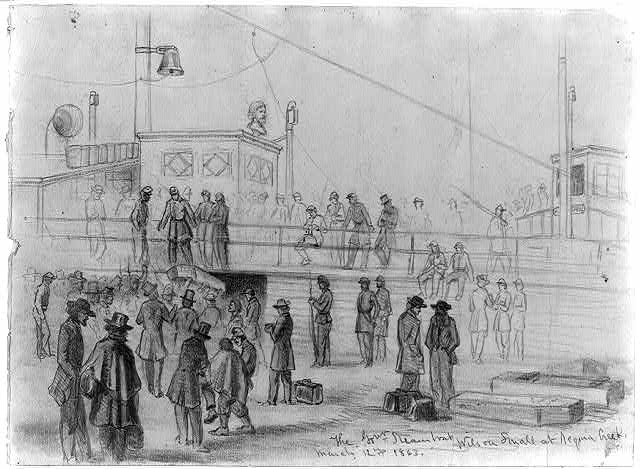
“The Sanitary Commission used the side-wheel steamboat Wilson Small as its headquarters for much of the Peninsula campaign.” Olmsted Papers, 4:331, n1. This drawing, from the collections of the Library of Congress, portrays the ship at harbor in Aquia Creek, Virginia, March 12, 1863.

“The Sanitary Commission used the side-wheel steamboat Wilson Small as its headquarters for much of the Peninsula campaign.” Olmsted Papers, 4:331, n1. This drawing, from the collections of the Library of Congress, portrays the ship at harbor in Aquia Creek, Virginia, March 12, 1863.

Though Olmsted thought his service—and the war for that matter—would last a matter of weeks, it did not. Several times he was called to the field. During the series of battles that constituted the Peninsula Campaign—Union General George B. McClellan facing Confederate General Joseph E. Johnston in the spring and summer of 1862—Olmsted found himself organizing the evacuation of wounded Union troops to ships, amid a chaos of competing orders and information. During this period, he wrote a series of letters back to the Commission, and over the next year he took his letters and those of another unnamed Commission member and edited them into Hospital Transports: A Memoir of the Embarkation of the Sick and Wounded from the Peninsula of Virginia in the Summer of 1862. Designed to lay out the work of the Commission and solicit donations, the book also provided a gripping account of life just behind the front lines. The Academy’s copy was donated from the English branch of the U.S. Sanitary Commission—set up in London to coordinate donations from Americans abroad and sympathetic Britons—and is inscribed by Edmund Crisp Fisher, the Secretary of the branch.4

Title page of Olmsted's Hospital Transports. Our copy is inscribed by Edmund Crisp Fisher, the Secretary of the English branch of the U.S. Sanitary Commission, whose cancelled stamp is also on the page.

Title page of Olmsted’s Hospital Transports, 1863. Our copy is inscribed by Edmund Crisp Fisher, secretary of the English branch of the U.S. Sanitary Commission, whose cancelled stamp is also on the page.

Olmsted’s work with the Commission ended in the fall of 1863. He was not able to maneuver among the competing factions, especially between eastern and western branches of the Commission, nor readily subject himself to the control of the Commission’s executive committee. He went to California to manage a ranch caught up in the confusion of competing gold rush claims; when he returned to the East two years later, he devoted himself to landscape architecture. But as he left, he knew that he had tried, and at times succeeded, in providing a trained professional cadre of medical doctors and reformers to coordinate care to wounded soldiers and to better their conditions under arms. His work prefigured broader efforts leading into World War I—in such organizations as the Red Cross—in the scope of their ambition and in the vision of their success.5

References

1. I acknowledge the excellent introduction to The Papers of Frederick Law Olmsted, Volume 4: Defending the Union: The Civil War and the U.S. Sanitary Commission, 1861–1863, ed. Jane Turner Censer, with Charles Capon McLaughlin, editor in chief, and Charles E. Beveridge, series editor (The John Hopkins University Press, 1986), pp. 1–69, which is a major source for this account.

2. Olmsted published his accounts as A Journey in the Seaboard Slave States, with Remarks on Their Economy (1856), A Journey Through Texas (1857) and A Journey in the Back Country (1860) and then reissued them as a two-volume work titled The Cotton Kingdom: A Traveller’s Observations on Cotton and Slavery in the American Slaves States (1861).

3. Olmsted Papers, 4:7.

4. A copy is available online, and the book has been recently edited by Laura L. Behling and re-released.

5. There are many excellent books on Frederick Law Olmsted: for further reading, consider Witold Rybczynski, A Clearing in the Distance: Frederick Law Olmsted and America in the 19th Century (1999), and Justin Martin, Genius of Place: The Life of Frederick Law Olmsted (2012).

Medical Rhymes

By Danielle Aloia, Special Projects Librarian

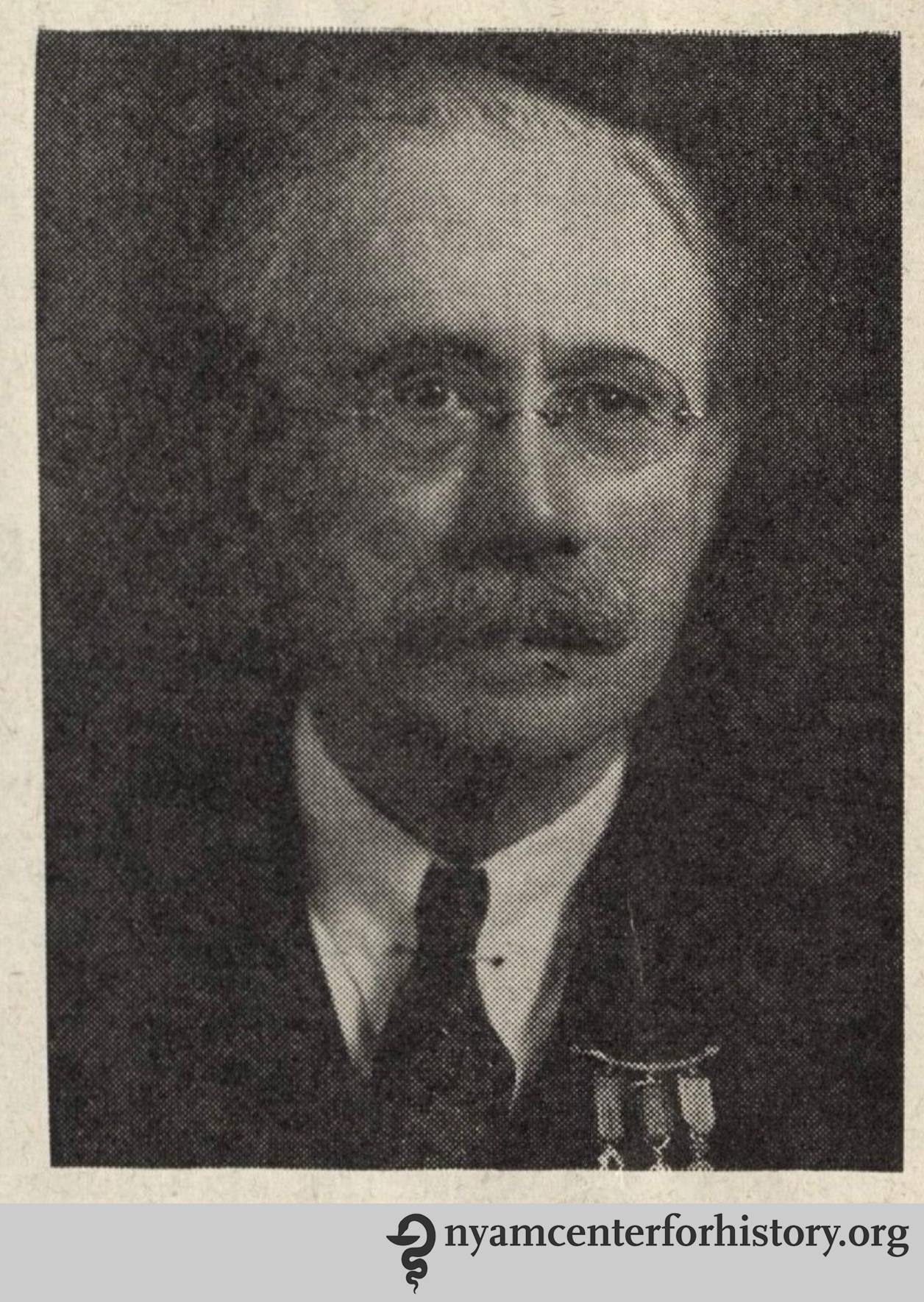
Cree, WJ. In memoriam: Hugo Erichsen M.D. Detroit Medical News. 1944;36(12):9.

Cree, WJ. In memoriam: Hugo Erichsen M.D. Detroit Medical News. 1944;36(12):9.

In 1884, Dr. Hugo Erichsen (1860-1944) published Medical Rhymes, a collection of rhymes and illustrations from a variety of sources. The subtitle speaks volumes of the books contents: “A collection of rhymes of ye Ancient Time, and Rhymes of the Modern Day ; Rhymes  Grave and Rhymes Mirthful ; Rhymes Anatomical, Therapeutical and Surgical, all sorts of Rhymes to Interest, Amuse and Edify all Sorts of Followers of Esculapius.”

Erichsen wrote in his preface that “The purpose of my book is to amuse the busy doctor in leisure hours. Some of the serious poems will no doubt furnish food for reflection.”1 Erichsen, was a busy doctor himself, working as a Detroit physician, a prolific writer, and proponent of cremation.2

In the introduction of Medical Rhymes, Willis P. King, M.D., writes, “There are a thousand and one things in the life of every doctor which are calculated to cause him to ’break out’ with violent attacks of rhyming.”3 Poetry was one area of life where normally stoic doctors could break free of societal expectations.

Erichsen divided his book into seven chapters: Anatomical Lore, For Ye Student Men, The Doctor Himself, Medicine, Surgery, Obstetrics, and Miscellaneous Poems. All poems are given attribution, where available, and some include illustrations.

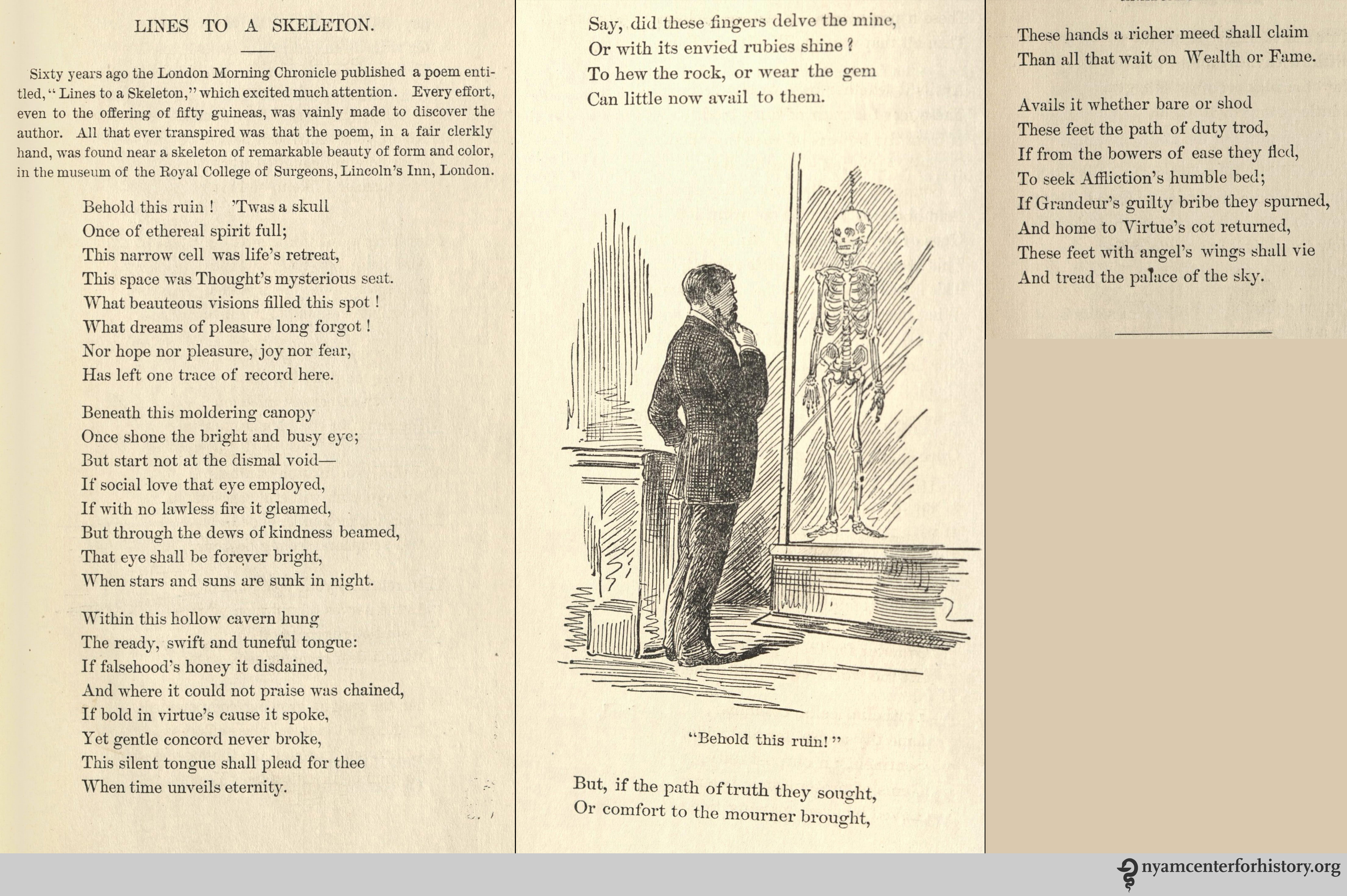
This selected poem includes a little anecdote as to its origins:

"Lines to a Skeleteon." In Erichsen, Medical Rhymes, 1884. Click to enlarge.

“Lines to a Skeleteon.” In Erichsen, Medical Rhymes, 1884. Click to enlarge.

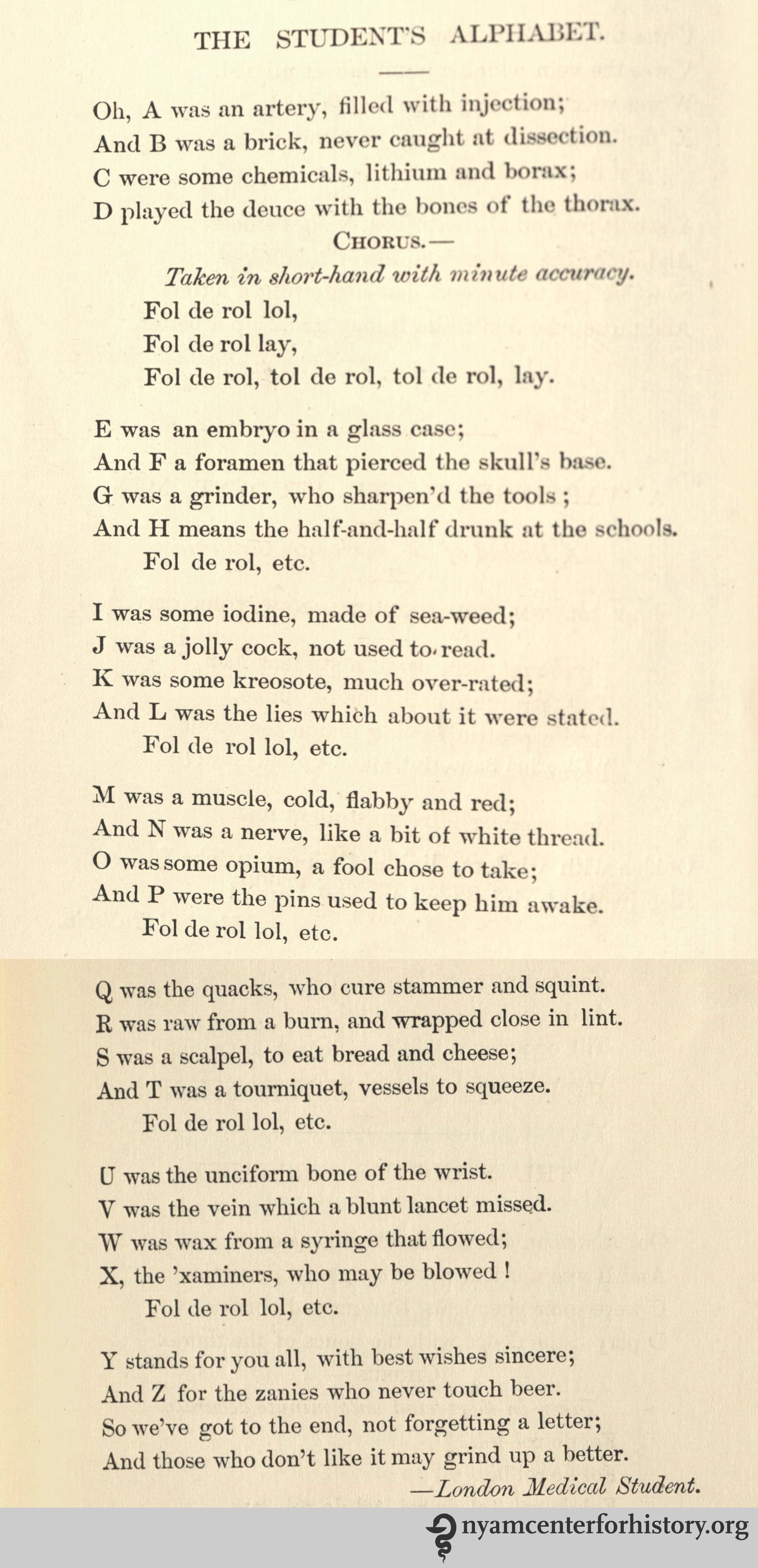
This next poem is attributed to a London medical student and is quite telling of the time, where K is for kreosote and O is for opium. This one even has a little repeating chorus!

"The Student's Alphabet." In Erichsen, Medical Rhymes, 1884. Click to enlarge.

“The Student’s Alphabet.” In Erichsen, Medical Rhymes, 1884. Click to enlarge.

Let’s not forget the book’s compiler. Erichsen included a poem of his own, “The Physician,” in which he pays tribute to all the good a doctor does to “save another life.”

"The Physician." In Erichsen, Medical Rhymes, 1884. Click to enlarge.

“The Physician.” In Erichsen, Medical Rhymes, 1884. Click to enlarge.

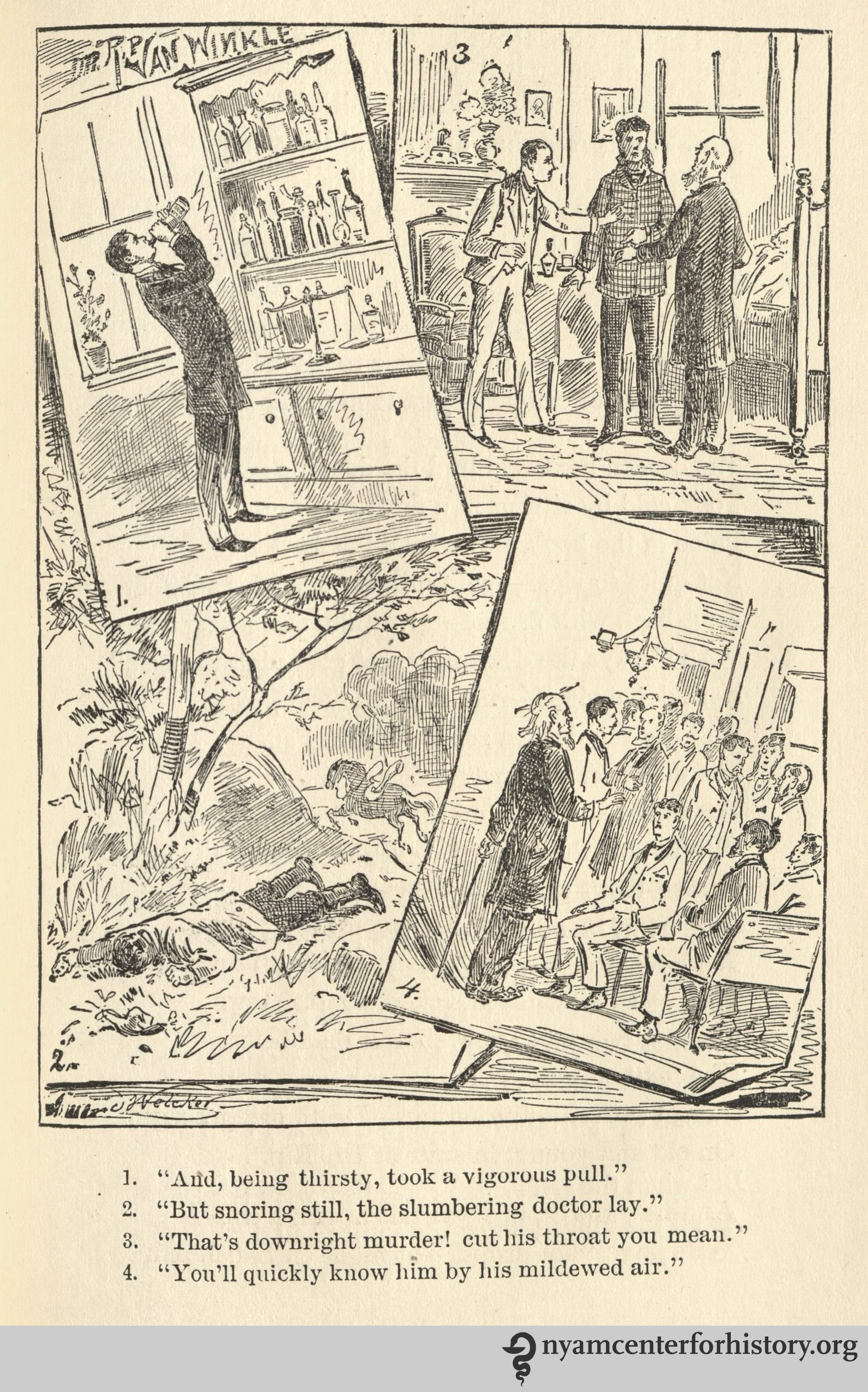
The image below accompanies a 12-page poem by Oliver Wendell Holmes, M.D. The poem, “Rip Van Winkle, M.D.,” recounts the story of young Rip as a doctor who took a “vigorous pull” of “Elixir Pro,” then fell off his horse fast asleep. For 30 years he lay, until the sounds of Civil War battle woke him. But his doctoring was no use, as his methods were 30 years out of date. When he consulted with the modern day doctors, they cried murder and suggested he go back to sleep. Today, he can be found by his mildew-y air.

Rip van Winkle, M.D. illustration. In Erichsen, Medical Rhymes, 1884. Click to enlarge.

Rip van Winkle, M.D. illustration. In Erichsen, Medical Rhymes, 1884. Click to enlarge.

Want more Medical Rhymes? You’re in luck: The book is available in full online.

References

1. Erichsen, H. Medical Rhymes. St. Louis, MO: J.H. Chambers. 1884.

2. Cree, WJ. In memoriam: Hugo Erichsen M.D. Detroit Medical News. 1944;36(12):9.

3. Ibid.

Presenting Grey Literature at the 13th International Conference on Urban Health

By Danielle Aloia, Special Projects Librarian, and Robin Naughton, Digital Systems Manager

Danielle Aloia, Special Projects Librarian, and Robin Naughton, Digital Systems Manager, presented Hidden Urban Health: Exploring the Possibilities of Grey Literature on the Academy’s Grey Literature Report (GreyLit Report) in two sessions at the recent International Conference on Urban Health in San Francisco, April 1-4, 2016. The conference focused on Place and Health and included a joint program with the American Association of Geographers. Combining data from geography with health data is one way to develop better models for urban and population health, and those involved in fields as diverse as urban planning, transportation, housing, and education all need to be at the table.

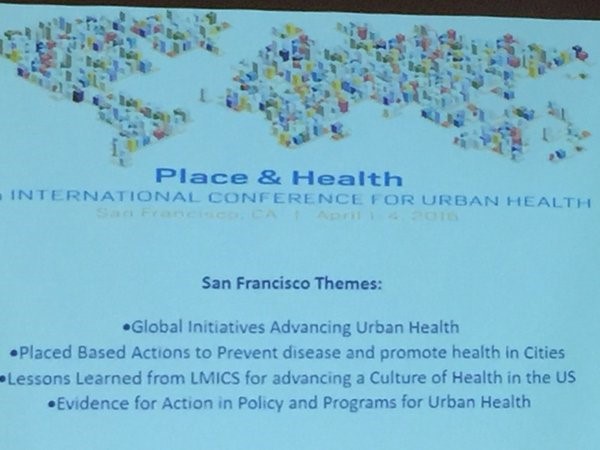
Themes of the ICUH 2016 opening ceremony. Photo by Danielle Aloia.

Themes of the ICUH 2016 opening ceremony. Photo by Danielle Aloia.

During the conference, two themes particularly relevant to the GreyLit Report emerged: the need for a better definition of urban health and the importance of interdisciplinary research. These are important concepts for the GreyLit Report when collecting and providing access to urban health resources, helping us to identify and understand topics that cross disciplines.

We had an opportunity to appeal to the cross-disciplinary audience of researchers during two conference sessions, providing a brief explanation of what grey literature is and ways to search for it beyond traditional databases. In brief, grey literature is produced by think tanks, university centers, government agencies, and other organizations. It can be published as reports, fact sheets, data sets, white papers, and more. It provides current research on trending topics and is used to communicate findings to stakeholders and policy-makers.

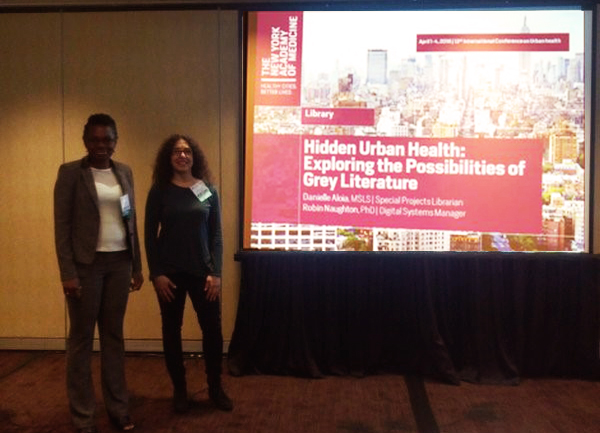
Robin Naughton and Danielle Aloia before the Hidden Urban Health: Exploring the Possibilities of Grey Literature session. Photo courtesy of ICUH.

Robin Naughton and Danielle Aloia before a Hidden Urban Health: Exploring the Possibilities of Grey Literature session. Photo courtesy of ICUH.

Some forms of grey literature can be found in traditional databases, such as PubMed or Web of Science, but the majority is not indexed or organized in systematic ways. To help solve this problem, the Academy Library developed the GreyLit Report in 1999 to collect these reports and make them accessible. During the presentations, we emphasized the importance the GreyLit Report places on interdisciplinary research. We collect reports related to public health in all sectors, to truly make a one-stop-shop for urban health.

During the presentation, participants learned about Google Custom Search (using Google to search specific websites and document types), Twitter, and the GreyLit Report as three resources relevant to finding grey literature. Still, depending on the resource used for search, altering keywords may be necessary to get relevant results. What terms one discipline uses may be defined differently in another. For example, the word mobility can have multiple meanings. In urban health, it usually means how people get from place to place, but when searching Google or Twitter one can get results for mobile technologies and physical disabilities. We clarified that the terms used in searching are very important to the relevance of the results. Often, searches in Google and Twitter need to be weeded through to find relevant results. We also presented some criteria for evaluating such results: authority, credibility, affiliation, purpose, and conflict of interest.

Danielle Aloia presenting at ICUH. Photo by Robin Naughton.

Danielle Aloia presenting at ICUH. Photo by Robin Naughton.

The GreyLit Report is much easier to search than Google or Twitter. Because we collect, archive, and index reports from all sectors, its focus limits irrelevant results. Users do not have to wade through millions of results, but have a credible, authoritative selection from which to choose.

At the end of each session, we opened up a conversation with participants to see what their concerns were in regard to grey literature and how the GreyLit Report may help them in their research. This produced an intimate, lively discussion. Participant concerns about grey literature included how to promote their own grey literature and ideas to enhance the Report. One idea is to add canned (one-click) searches on specific urban health topics.  Another idea is to add the United Nations’ 17 Sustainable Development Goals with links to reports in those areas so that users can easily find grey literature for specific sustainable development goals in urban health. We will work on enhancing the GreyLit Report website, and more importantly, we will think about ways to help promote this growing body of research for users.

A Thousand Ways to Please

By Johanna Goldberg, Information Services Librarian

To celebrate National Poetry Month, we are sharing poems from our collection throughout April.

Two of my favorite books in the library’s collection have, by all accounts, not aged well.

Novelized household and cooking guides, A Thousand Ways to Please a Husband (1917) and its sequel, A Thousand Ways to Please a Family (1922), present the life of Bettina, her husband Bob, their oft-visiting friends and family, and in the sequel, their son Robin and daughter Sue. Bettina constantly doles out advice to her friends (who, as this is fiction, are always happy to receive it), including this look back on how to select a refrigerator in the 1910s:

Bettina's refrigerator-buying tips. Pages 84-85 of Weaver, A Thousand Ways to Please a Husband, 1917.

Bettina’s refrigerator-buying tips. Pages 84-85 of Weaver, A Thousand Ways to Please a Husband, 1917. Click to enlarge.

That Bettina sure knows everything.

Both books span the course of a year, and each month begins with a poem. Here are the poems for April from both volumes:

April poem from Weaver, A Thousand Ways to Please a Husband, 1917.

April poem from Weaver, A Thousand Ways to Please a Husband, 1917.

April poem from Weaver, A Thousand Ways to Please a Family, 1922.

April poem from Weaver, A Thousand Ways to Please a Family, 1922.

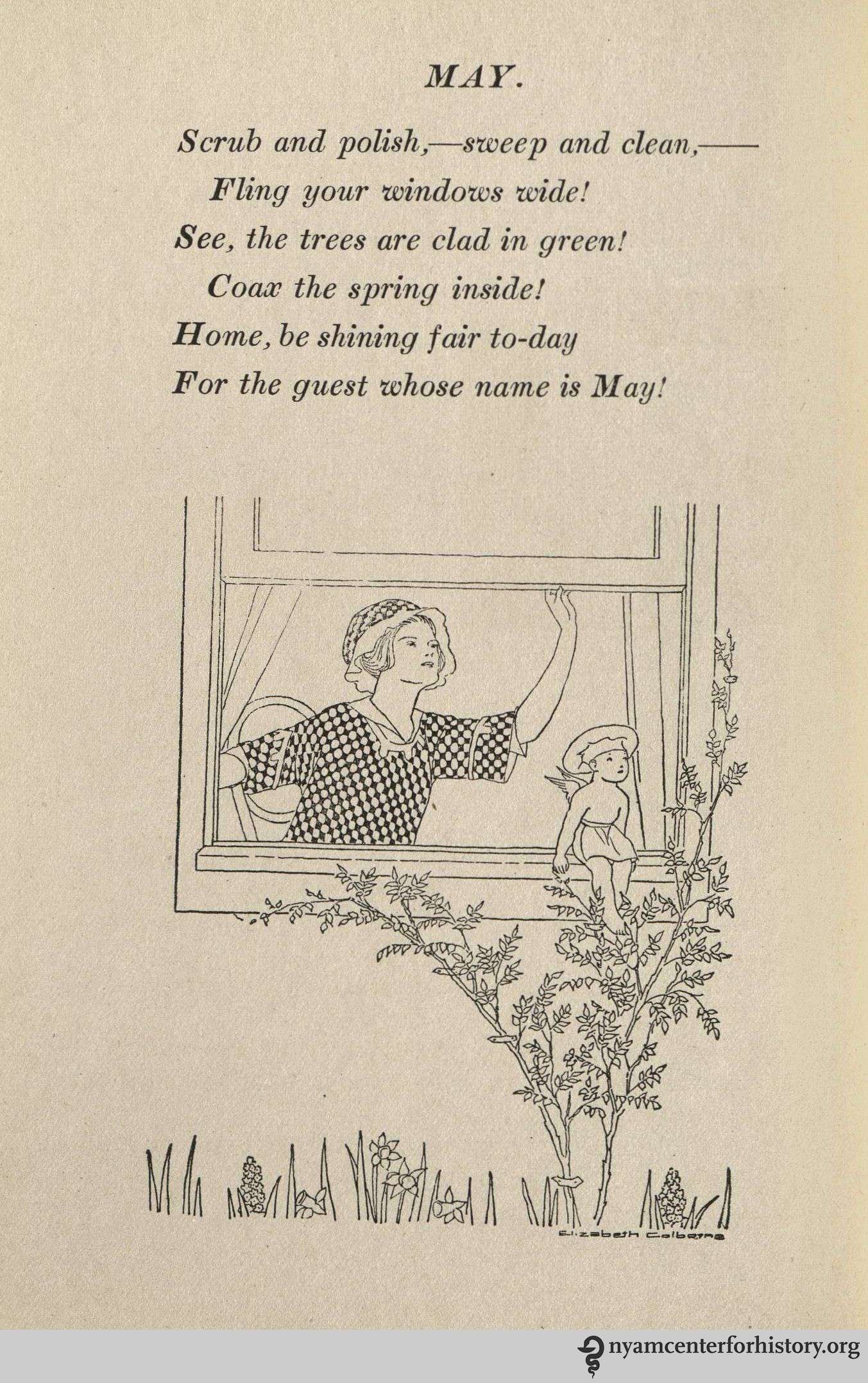
And from May:

May poem from Weaver, A Thousand Ways to Please a Husband, 1917.

May poem from Weaver, A Thousand Ways to Please a Husband, 1917.

May poem from Weaver, A Thousand Ways to Please a Family, 1922.

May poem from Weaver, A Thousand Ways to Please a Family, 1922.

Though the gender politics are dated, the household advice based on nearly 100-year-old technologies and trends, and the food not always tempting to the modern palate, these books (both available in full online) remain fascinating looks into an idealized home life in the 1910s and early 1920s.