Merman or Mandrake? Costume Ideas From Our Collection

By Johanna Goldberg, Information Services Librarian

With Halloween just around the corner, our library is here to help with your costume planning. We’ve leafed through our collections for ideas, inspired by items from the late-15th century through the mid-20th century. If one of our images inspires your costume, please send us a picture!

Click on an image to enlarge and view the gallery:*

*Thanks to Anne Garner, Curator; Arlene Shaner, Historical Collections Librarian; Rebecca Pou, Archivist; and Emily Moyer, Collections Care Assistant, for their input and ideas.

Cook like a Roman: The New York Academy of Medicine’s Apicius Manuscript

By Anne Garner, Curator, Center for the History of Medicine and Public Health

This is one of several posts leading up to our day-long Eating Through Time Festival on October 17, 2015, a celebration of food, cookery, and health. View the full program and register for the Festival.

Ancient sources document the culinary excellence of one Marcus Gavius Apicius, a Roman gourmet who flourished during Tiberius’ reign (1st century CE). It isn’t clear from textual evidence that this Apicius ever wrote a book of cookery.1 And yet, the gem of our Library’s cookery collection—a 9th-century manuscript collection of Greek and Roman recipes—bears his name.

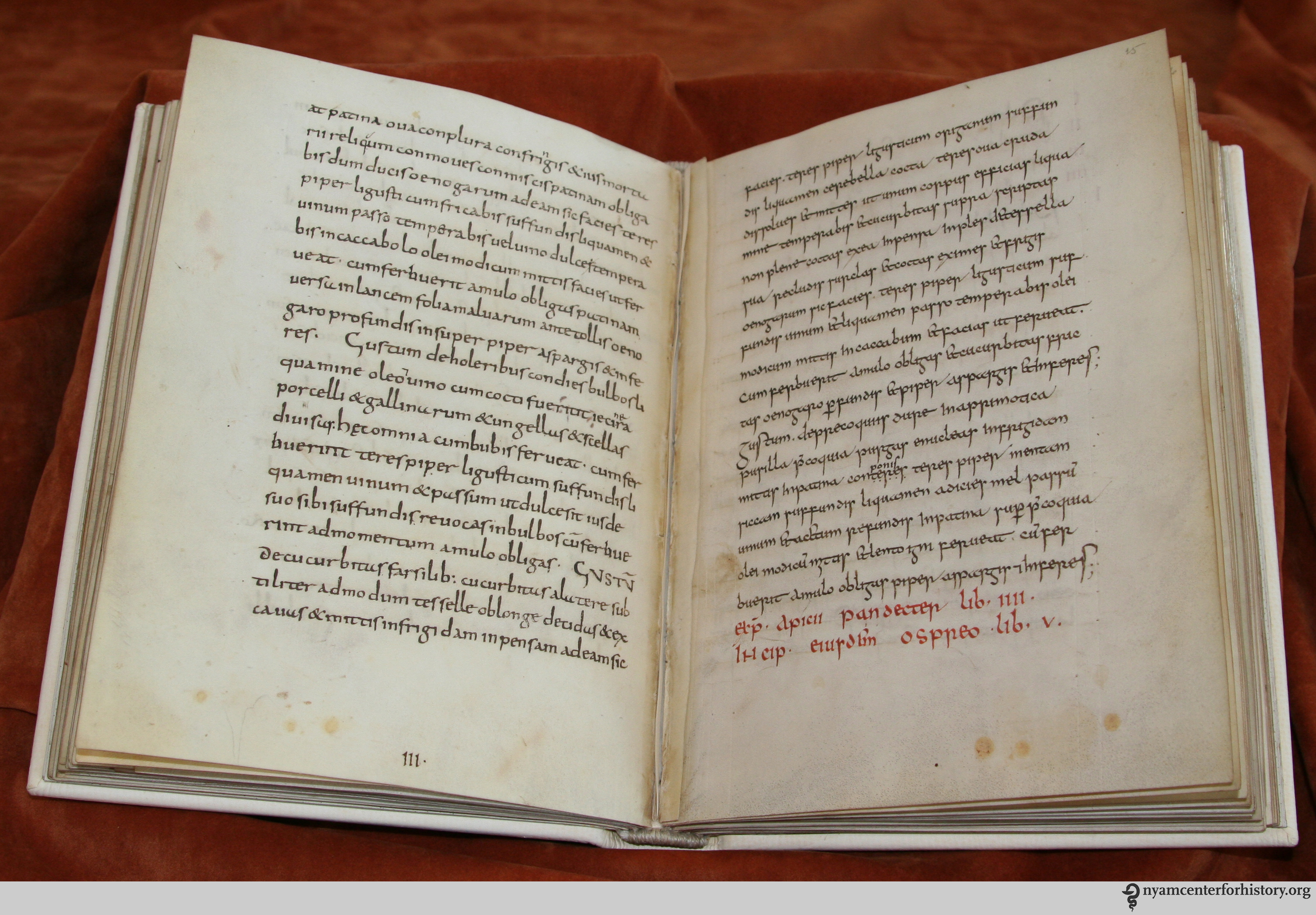
9th-century manuscript De re culininaria (sometimes De re coquinaria), attributed to Apicius.

9th-century manuscript De re culininaria (sometimes De re coquinaria), attributed to Apicius. Click to enlarge.

Our manuscript, transmitting a 4th– or 5th-century compendium of culinary and medical recipes compiled from a number of 2nd-century Roman sources, packs a powerful wow factor. It contains 500 Greek and Roman recipes from the Mediterranean basin. A handful may date as early as the 4th century BCE. As such, our manuscript is sometimes referred to as the oldest extant cookbook in the West.

This collection of recipes was likely compiled from multiple sources. The 2nd-century satirical writer Juvenal indicated that the name “Apicius” was frequently used to describe a foodie, not a specific person. Other sources suggest that the name conjured luxury and excessive eating.2

These recipes appear to be written by and for cooks. While some recipes called for cuts of meat that might have been beyond the means of the average Roman citizen, many others, including a number of meat, vegetable, and legume dishes, were well within the reach of Rome’s tradespeople, builders, artists, and modest farmers. Some of the recipes may have reflected popular dishes served in local popinae (street bars).

A closer look at book one reveals a wide range of useful directives applicable for the Mediterranean home cook. Called Epimeles (careful, or attentive), book one includes recipes for a spiced wine surprise, honeyed wine, and Roman absinthe. Here too are tips for preserving pork and beef rind, fried fish, blackberries, and truffles.

The dishes reflect the polyglot culture of the Mediterranean basin. The dominance of Greek culinary tradition in the early empire makes it likely that the Apicius began as a Greek collection of recipes, though mainly written in Latin, and adapted for a Roman palate.3 The cookbook incorporates a number of Greek terms, like melizomum (honey sauce) and hypotrimma (here a mixture of cheese and herbs), despite the existence of Latin glosses. Other words are hybrids of Greek and Latin, like tractogalatae, combining the Latin tractum (thin sheet of pastry) and gala, Greek for milk.

The Apicius manuscript is the gem of the Academy’s Margaret Barclay Wilson Collection of Cookery, acquired in 1929. Conservators restored and rebound it in 2006.

Our manuscript was penned in several hands in a mix of Anglo-Saxon and Carolingian scripts at the monastery at Fulda (Germany) around 830 CE. It is one of two manuscripts (the other at the Vatican) presumed to have been copied from a now lost common source.4

The gilt and illuminated Vatican manuscript of De re culininaria, as replicated in a 2013 facsimile.

The gilt and illuminated Vatican manuscript of De re culininaria, as replicated in a 2013 facsimile. Click to enlarge.

Images from both 9th-century iterations illustrate the different approaches to the text. The image above shows the gilt and illuminated Vatican manuscript, as replicated in a 2013 facsimile. Below is the Academy’s text. The number of cross-outs and the plain, unadorned style of the manuscript suggest it may have been a teaching tool for scribes.

The Academy’s unadorned 9th-century manuscript of De re culininaria. Click to enlarge.

The Academy’s unadorned 9th-century manuscript of De re culininaria. Click to enlarge.

Apicius has been a bestseller since the beginning of the print era, published in multiple editions since the 15th century. The Academy library holds many print editions, including two of the earliest.

This title page is from the earliest dated edition of the text, published in Milan in 1498. Pictured below is the device of the printer, La Signerre, who later set up shop in Rouen. Our copy is annotated by an early reader who adds the titles of the text’s ten books, grouped by type of dish.

Title page from the earliest dated edition of the De re culininaria, published in Milan in 1498.

Title page from the earliest dated edition of the De re culininaria, published in Milan in 1498. Click to enlarge.

The second earliest dated edition, printed in Venice, offers one of the earliest examples of a title page in printing history. It too is heavily annotated by an early food-lover, fluent in Greek and Latin.

Marginalia in our 1503 printed Apicius offers Greek glosses on Latin terms.

Marginalia in our 1503 printed Apicius offers Greek glosses on Latin terms.

Enthusiasts will find many other print descendants of this extraordinary manuscript in the Academy’s library.

The Apicius manuscript and a number of print editions of the text will be on display in the Academy Library’s Drs. Barry and Bobbi Coller Rare Book Reading Room during our October 17th festival, Eating through Time. A complete schedule of events can be found here.

References

1. Mayo, H. (2008). “New York Academy of Medicine MS1 and the textual tradition of Apicius”. In Coulson, F. T., & Grotans, A., eds., Classica et Beneventana: Essays Presented to Virginia Brown on the Occasion of her 65th Birthday. Turnhout: Brepols. pp. 111–135.

2. Christopher Grocock and Sally Grainger, eds. Apicius. A Critical Edition with an Introduction and an English Translation of the Latin Recipe Text Apicius. Devon: Prospect, 2006. p. 35.

3. Grockock and Grainger, p. 17-20.

4. Mayo, p. 112.

The Diaspora of Spam

This post, by Evelyn Kim, guest curator for our day-long Eating Through Time Festival, is one of several posts leading up to the October 17, 2015 celebration of food, cookery, and health. View the full program and register for the Festival.

For millions of Asians and Pacific Islanders, Spam makes the world go ‘round. Seemingly inconsistent with local food cultures, Spam has seeped itself into regional cuisines, including Hawaii’s Spam musubi, South Korea’s Spam jjigae, and Hong Kong’s Spam ramen. In China, Spam is considered a gourmet treat, with Spam gift boxes appearing for Chinese New Year.

How did this piece of tinned meat earn so many frequent flyer miles? The answer lies in the history of Spam. Hormel, the meat processor and eventual food giant, originally developed Spam as a means to commercialize pork shoulder, an unwanted cut at the time, in 1937.1 Originally marketed as a home alternative to butcher-sliced luncheon meat, Spam’s worldwide debut came with the United States’ entry into World War II. While spurned by American housewives, Spam was perfect for US military rations: it was shelf-stable, compact, and a cheap source of protein. And it wasn’t just for the US military. Thanks to the Lend-Lease Act of 1941, Spam was the star food aid product for Allied countries and troops, finding its way across the United Kingdom, France, and even Russia. By the end of the war, the US government had bought nearly 150 million pounds of Spam.2

Advertisement for Spam from Time Magazine, June 20, 1938. Source: Duke University Libraries.

Advertisement for Spam from Time Magazine, June 20, 1938. Source: Duke University Libraries.

The same story repeated itself in Asia, but with a twist. US troops also brought Spam with them there. But unlike European countries, where Spam’s utility and popularity waned after the war, the product remained popular in Asia and the Pacific Islands. In many places, including Hong Kong and Japan, Spam was the only meat available immediately after WWII. In the case of Korea, the Korean War insured a steady supply of Spam to the peninsula, even becoming local currency for troops and the civilian population for everything from dental care to building supplies to tactical information.3

But the question remains as to why Spam stayed so popular in Asia as opposed to Europe. Europe did not embrace Spam after the war for a number of reasons. While post-war Europe had the same problems with hunger as post-War Asia, Europe reverted to pre-war agricultural production relatively quickly. The other possibility is that the association of Spam with wartime poverty and starvation led to a backlash against the product. This was certainly the case in America. For the troops coming home, the mere mention of Spam sent them into paroxysms of disgust.

While many of the circumstances in Asia were fairly similar in the post-war era, geography and politics may explain Spam’s continued proliferation in the region. With the exception of China, all areas in which Spam was introduced during WWII have limited land for agricultural use, making meat a scarce commodity, even in the best of times.4 Compared to the price of locally produced fresh meat, Spam was relatively cheap, even after the war. For Hawaii, political conditions allowed Spam to dominate the market. Hawaii had a large population of Japanese residents during WWII. Instead of interning them like on the US mainland, the US government resorted to restricting Japanese-American dominated industries, such as fishing. Without a steady supply of locally available protein, Spam easily dominated the Hawaiian market.5

One other major factor explains Spam’s ubiquity across Asia: marketing. Hormel, like many other industries post-war, had to re-market itself. Hormel attempted to re-brand Spam as the food for the modern 1950s housewife. Unfortunately for Hormel, this effort didn’t revive Spam’s sales in North America. However, Hormel’s re-branding efforts were quite successful in Asia. Across the continent, Spam can be found in gift packs for any occasion. Furthermore, Hormel not only has added different varieties to please local markets, but in some places, like China, it has reformulated the recipe.

Spam is now available in 44 countries across the world. Hormel, in some ways, became the case study for food multi-nationals in how to introduce new food product to a global audience. Spam may have lost its battle with the American housewife, but it certainly has won the war across the globe.

References

1. Oxford Companion to American Food and Drink. Ed. Andrew Smith. (New York: Oxford UP), 2007.p. 559.

2. Yoon H. Spam: More than Junk Mail or Junk Meat. NPR. http://www.npr.org/templates/story/story.php?storyId=11714236. Published July 4, 2007. Accessed October 8, 2015. See also endnote 1.

3. Williamson L. Why is Spam a luxury food in South Korea? BBC News. http://www.bbc.com/news/world-asia-24140705. Published September 19, 2013. Accessed September 17, 2015.

4. As a side note, the popularity of pork across all Asian nations is also due to a combination of poverty and land scarcity. Pigs have a low feed conversion ratio and have a higher meat yield compared to other livestock. Sigrid Schmalzer, in her fantastic article, Breeding a Better China: Pigs, Practices, and Place in a Chinese County, 1929-1937 (Geographical Review, Vol. 92, No. 1. Jan, 2002. Pp 1-22.) discusses the importance of pigs to the Chinese diet.

5. In her book, The Food of Paradise: Hawaii’s Culinary Heritage (University of Hawai’i Press, 1996), Rachel Laudan has a full discussion of Spam’s role in Hawaii.

Extra, Extra, Get Your New Banana!

By Anne Garner, Curator, Center for the History of Medicine and Public Health

This is one of several posts leading up to our day-long Eating Through Time Festival on October 17, 2015, a celebration of food, cookery, and health. View the full program and register for the Festival.

Among the many attractions at the Philadelphia Centennial Exposition of 1876 were the bananas. Wrapped in foil and sold for a dime each, they were a novelty for many Americans who had never seen them before.1

In the decades that followed the Exposition, the United Fruit Company (now Chiquita) was responsible for introducing many more Americans to the fruit, promoting the banana in their literature, and distributing them throughout the country.

The story of the UFC begins in 1871, when cattle rancher Minor C. Keith first planted bananas alongside the tracks of the national railroad in Costa Rica. By the 1880s, Keith was the dominant banana trader in Central America. In the same decade, Lorenzo Dow Baker founded Boston Fruit, the first to import bananas in the U.S. Keith’s enterprise merged with Boston Fruit in 1899 to create the United Fruit Company.

During the next decade, United Fruit Company’s Great White Fleet, painted white to reflect the intense sun, carried bananas from Central America to the U.S. An increasing number of refrigerated train cars pushed bananas further inland, to places they had never gone before.

Beginning in the early 20th century, the United Fruit Company promoted the banana in a series of pamphlets and ads, taking it from a little-known novelty to a household staple. At the heart of their campaign was an endorsement of the fruit’s healthy properties. During the 1920s, the United Fruit Company hired doctors to extol the nutritional virtues of the fruit. In 1939, they offered free textbooks—decidedly pro-banana—to schoolchildren.2

The Academy Library has a number of historical pamphlets produced by the United Fruit Company and its distribution arm, The Fruit Dispatch Company. Here, we offer a selection of images from our collection.
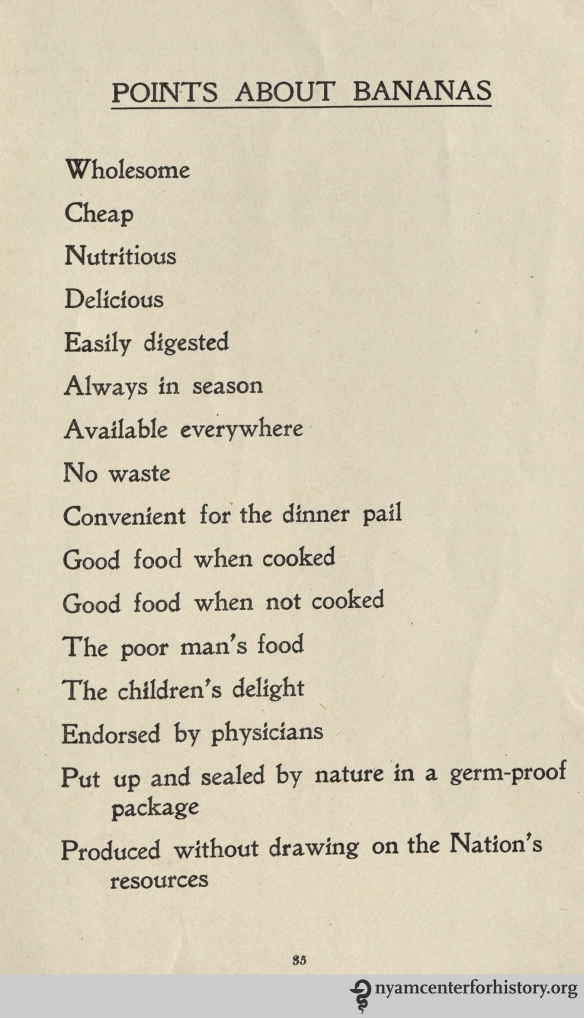
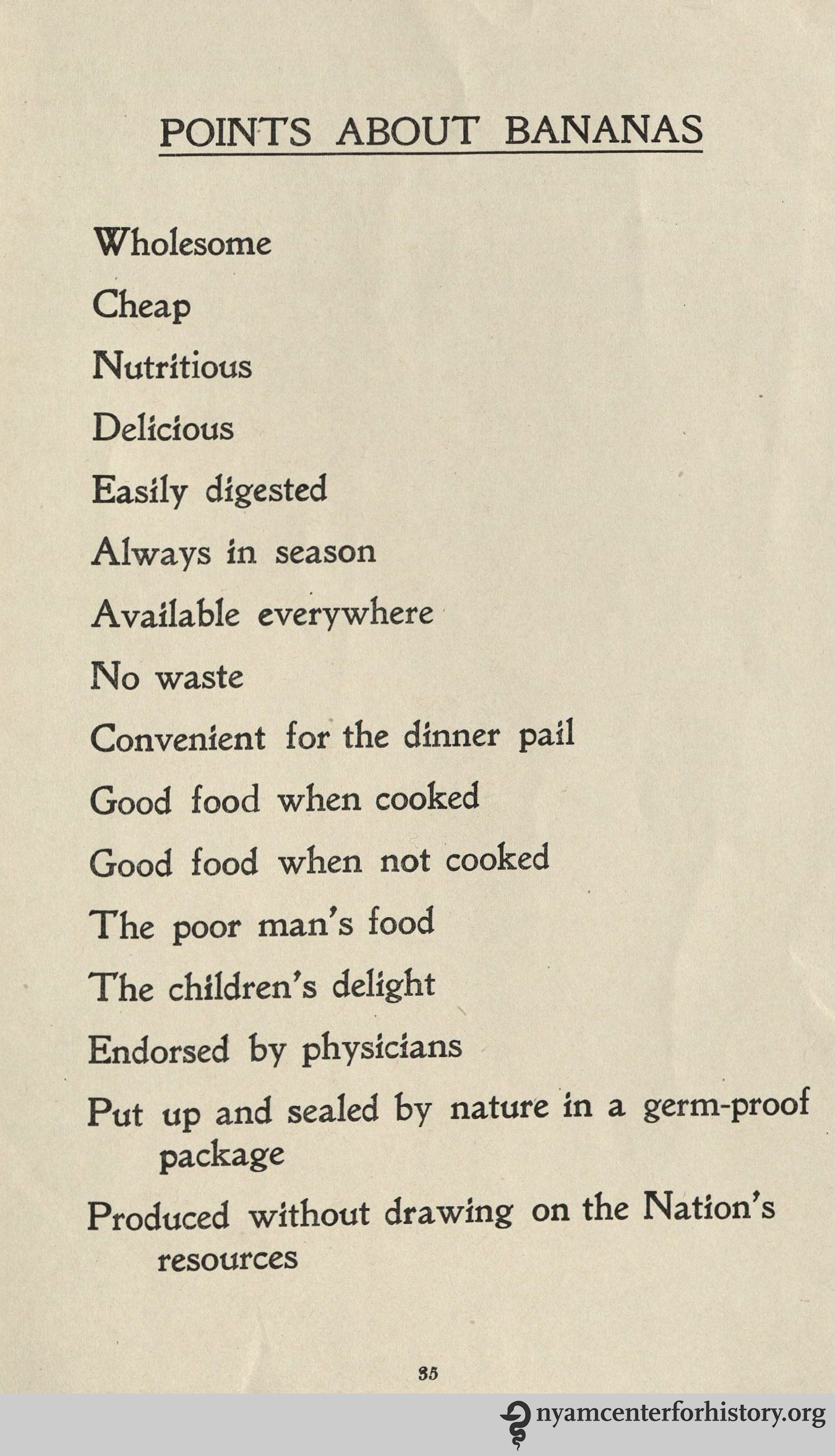
“The Food Value of the Banana,” 1917, page 35.

“The Food Value of the Banana,” 1917, page 35.

In 1917 the United Fruit Company published “The Food Value of the Banana,” a collection of 15 opinion pieces touting the virtues of the banana as a nutritious snack. “Points about Bananas” concluded the volume.

The United Fruit Company’s test kitchens reported in 1924 that bananas with corn flakes and milk made the best breakfast for families.3 The company’s subsequent publications emphasized that bananas were powerfully healthy, especially for the very young.

“The Food Value of the Banana,” 1928.

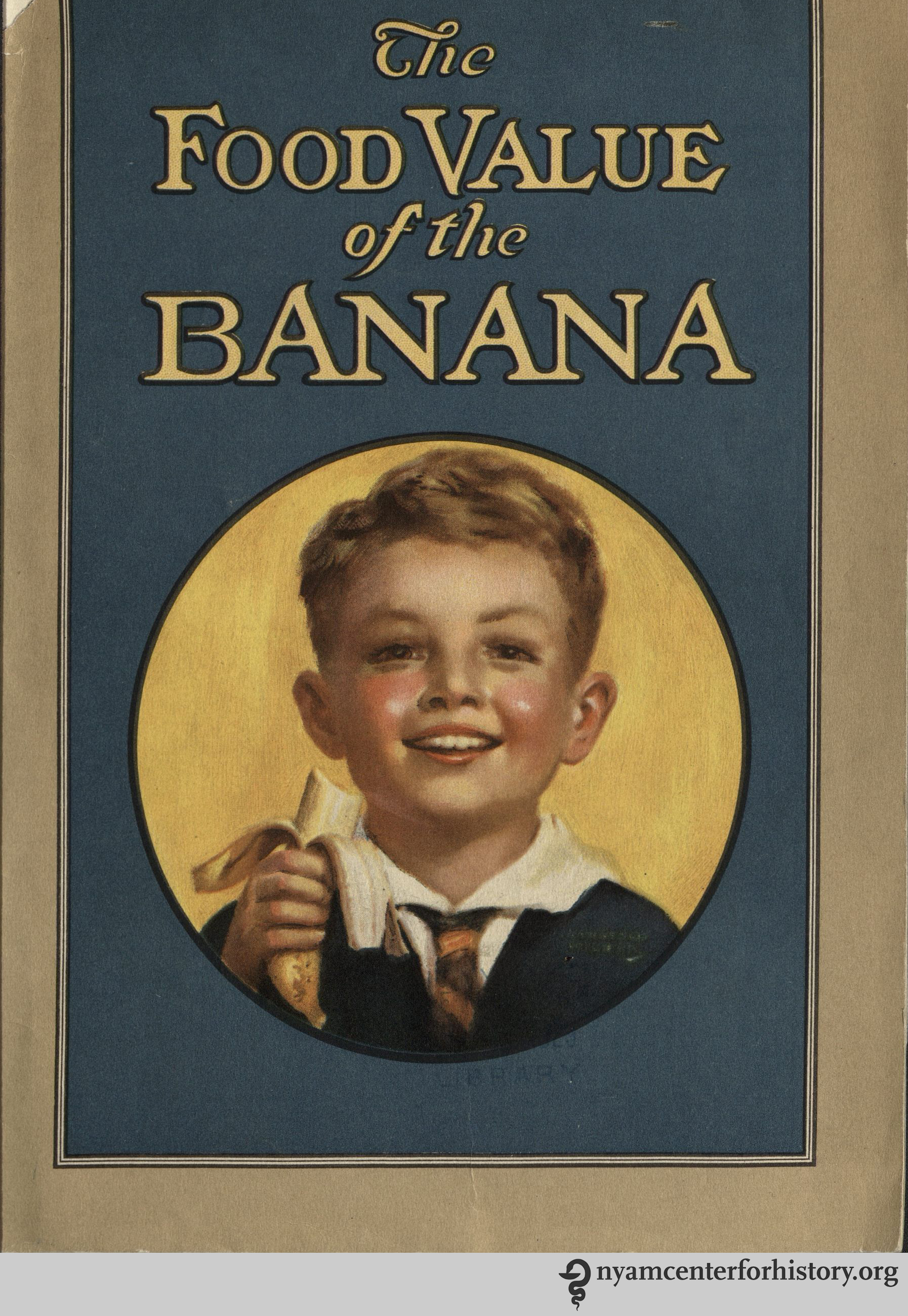
Cover of “The Food Value of the Banana,” 1928.

The cover of the fourth edition of “The Food Value of the Banana,” published in 1928, features a rosy-cheeked and radiant little boy, banana in hand.

 “The Food Value of the Banana,” 1928, back cover.

“The Food Value of the Banana,” 1928, back cover.

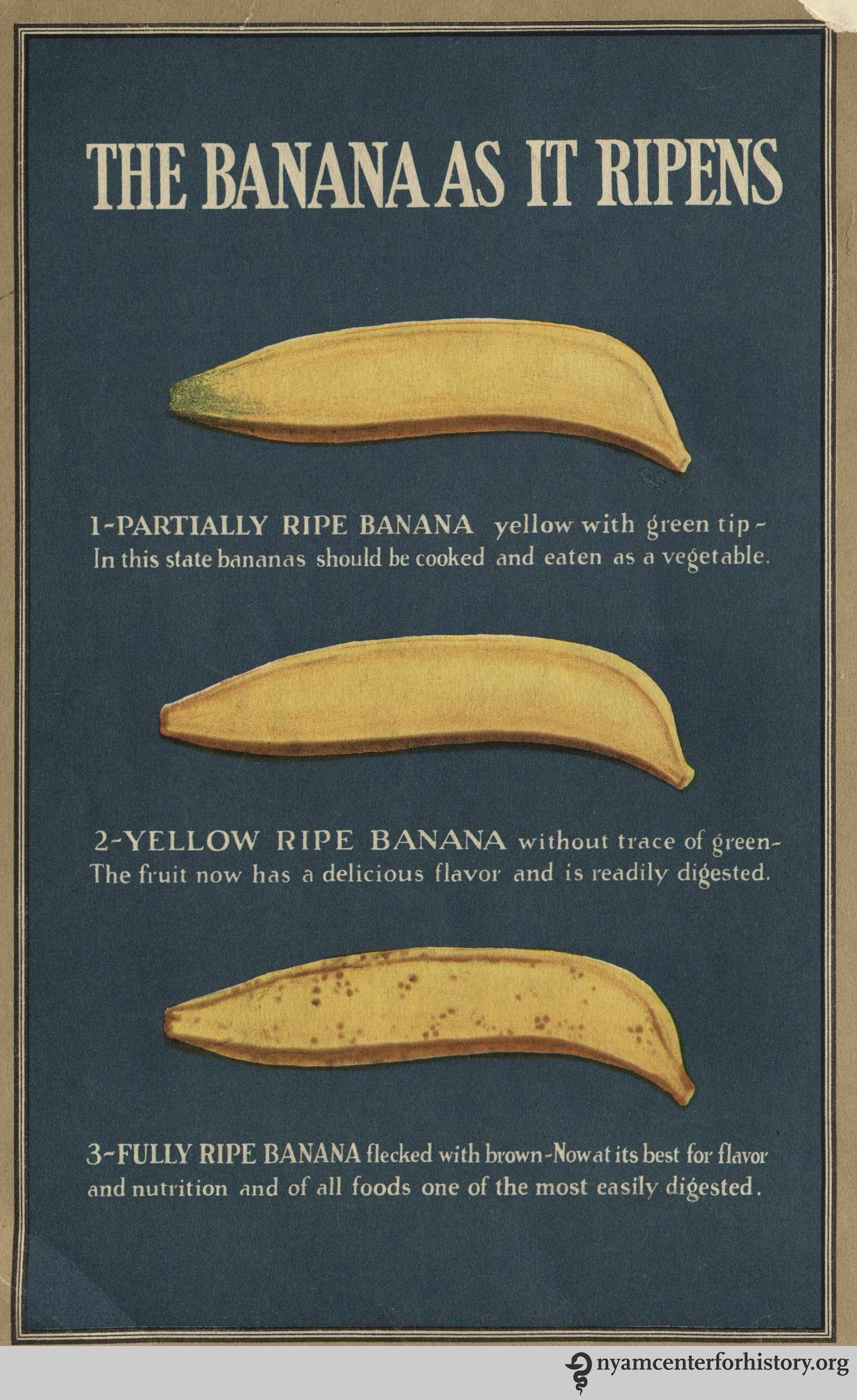
The back cover of the same 1928 pamphlet explains the ideal time to consume a banana, and how it can be eaten in each phase of ripeness. Most bananas cycle from green to yellow to yellow with brown spots in seven days.4
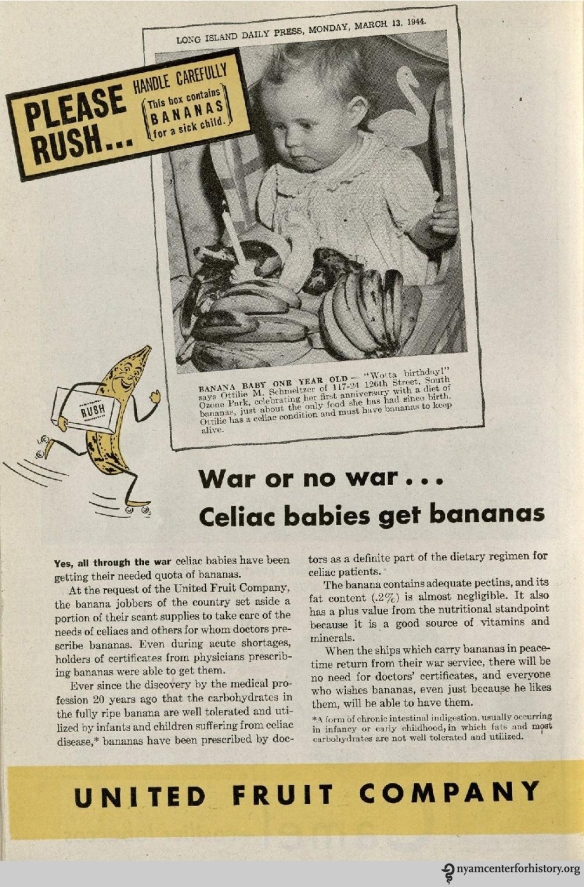
Ad in Woman's Medical Journal, vol. 52 no. 6, June 1945.

Ad in Woman’s Medical Journal, vol. 52 no. 6, June 1945.

In the 1920s, UFC hired doctors to publicly recommend that babies should consume mashed bananas. Researcher Sidney Haas found that children diagnosed with celiac disease who had been given a diet of milk and bananas dramatically improved (of course bananas are gluten free, which may have had something to do with it).5 Here, an ad from the Women’s Medical Journal from 1945 (v.52, no.6).
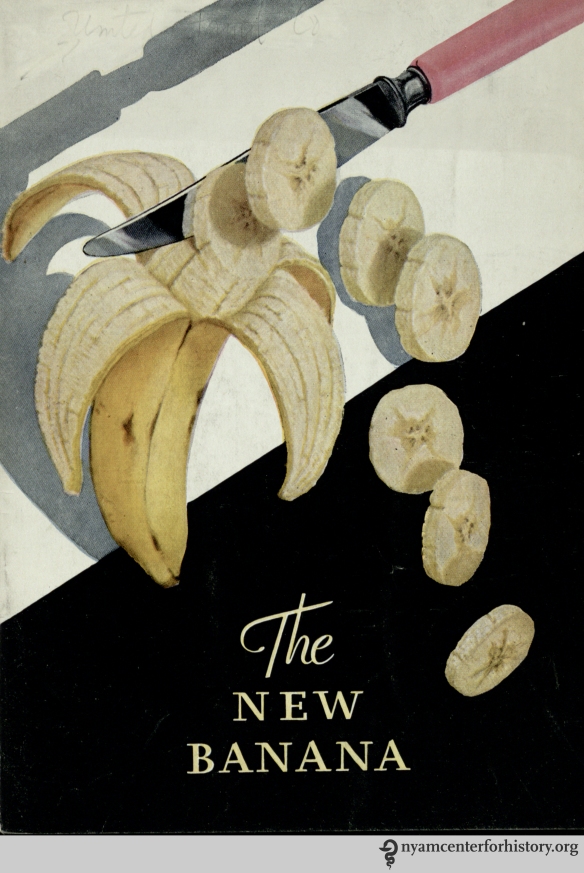
“The New Banana,” 1931.

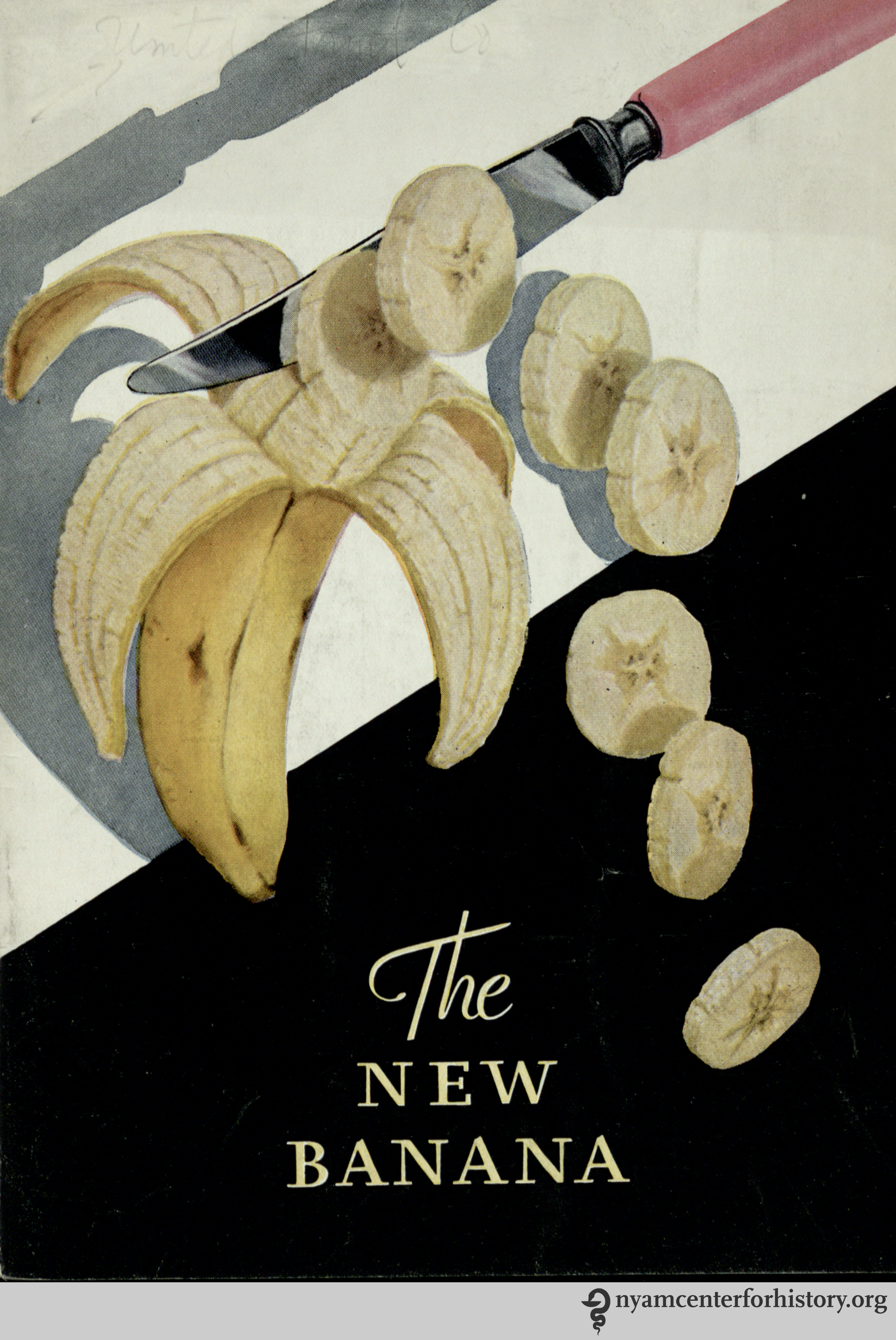
Cover of “The New Banana,” 1931.

From “The New Banana,” 1931.

From “The New Banana,” 1931. Click to enlarge.

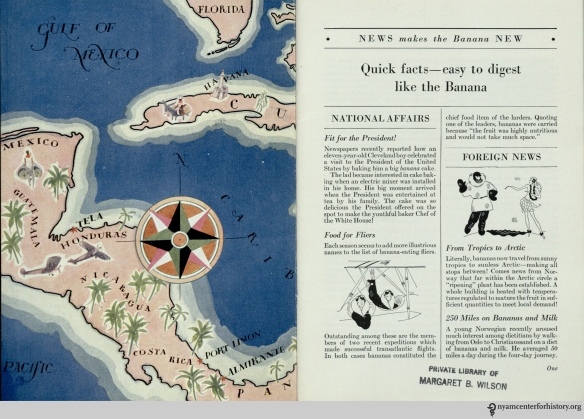
The Fruit Dispatch Company’s 1931 newspaper-format pamphlet, “The New Banana,” tells stories in which the banana’s hero status is high. In one, a Norwegian hikes from Oslo to Christianssand. Nourished by the banana, “his strength increased from day-to-day!” In another, the banana sustains two transatlantic pilots (and fits compactly into the cockpit).

From “The New Banana,” 1931.

“The New Banana,” 1931, back cover.

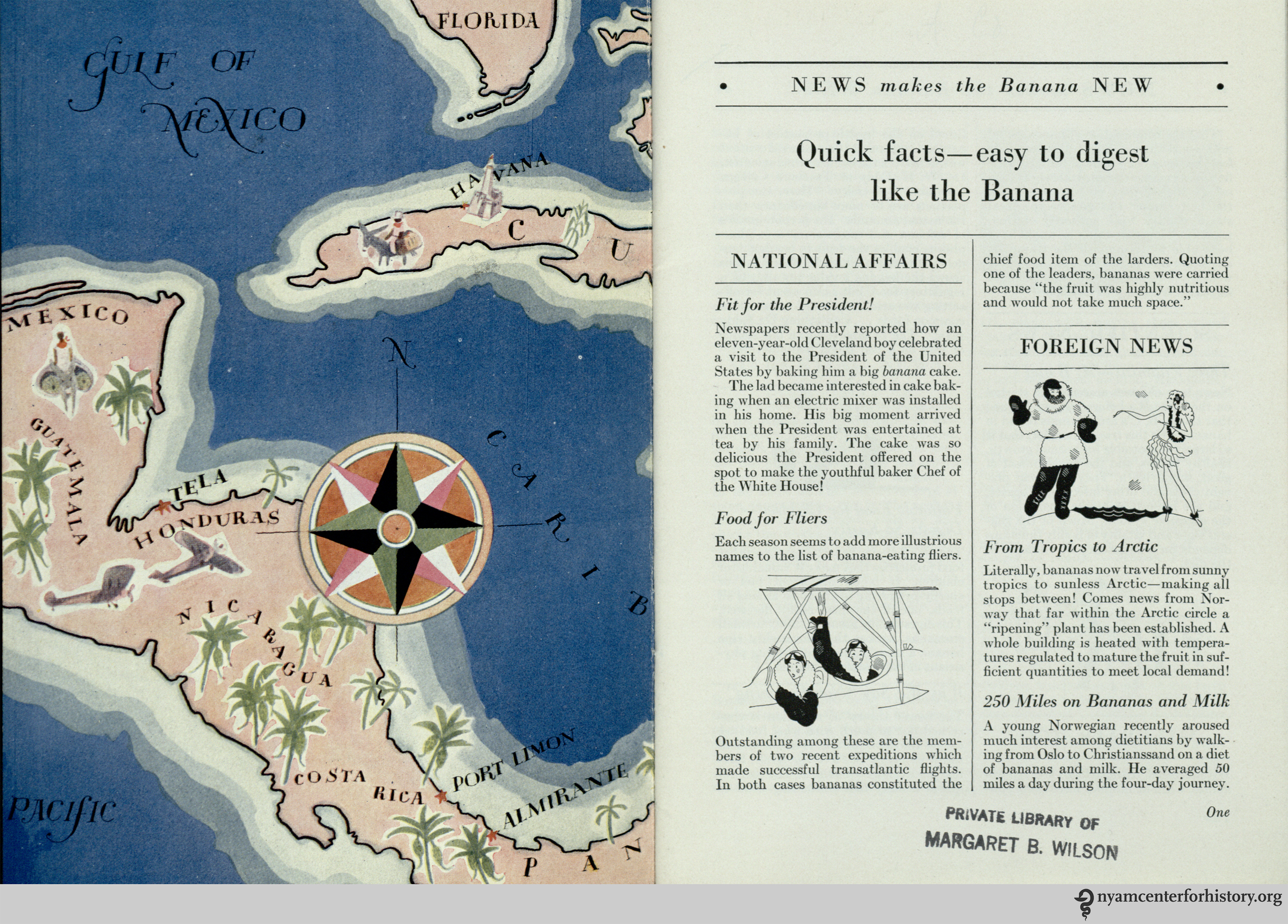
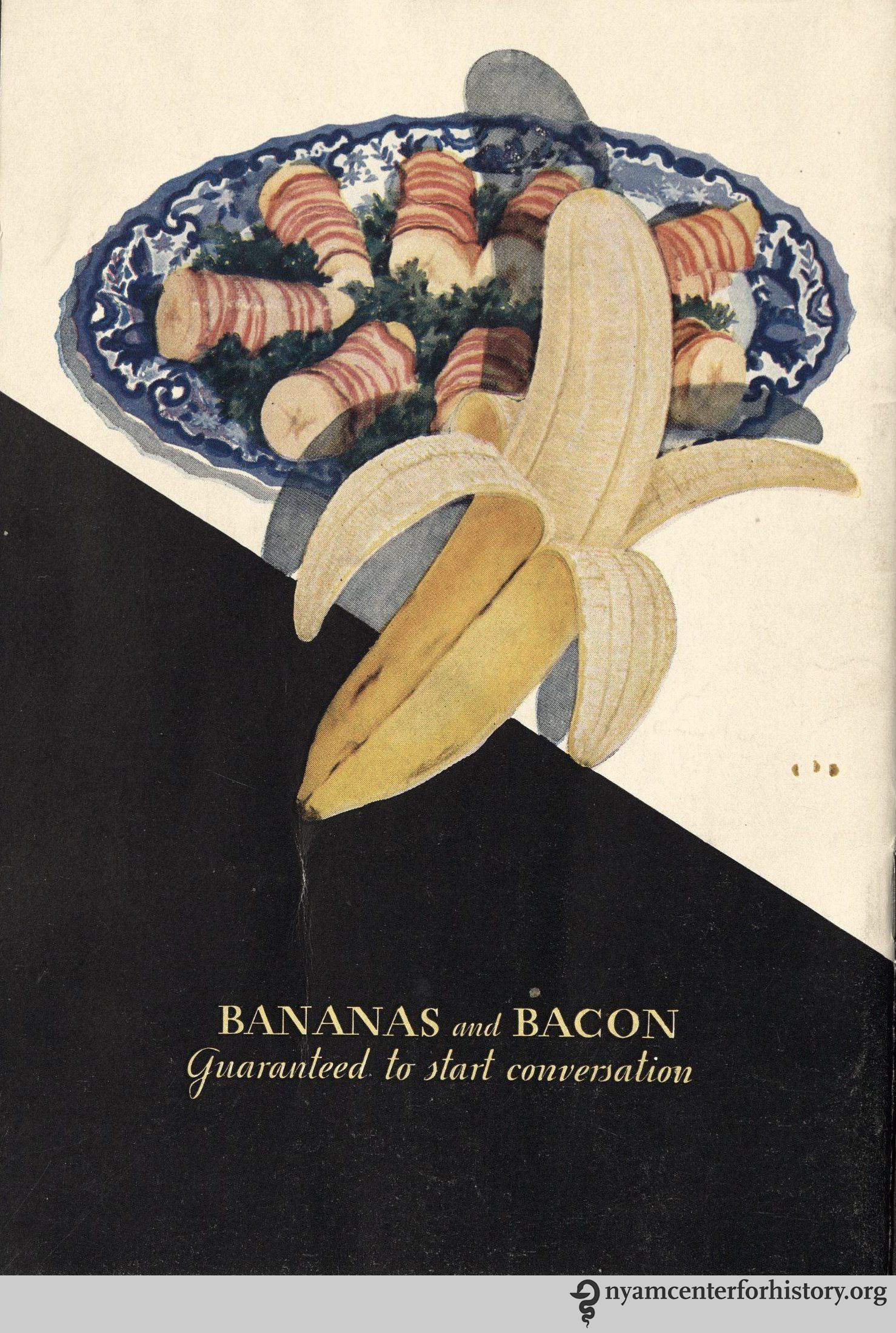
The Scientific News section of “The New Banana” reminds parents of the considerable nutrients in the banana: vitamins A, B, and C, calcium, magnesium, and iron. It’s also “non-fattening” though not especially so when paired with bacon, as on the back cover.
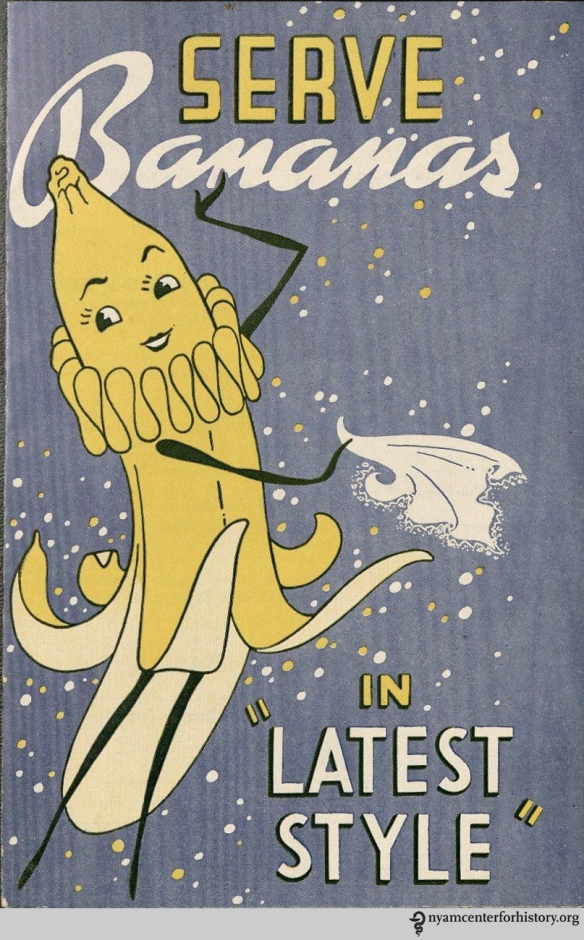
Cover of “Serve Bananas in ‘Latest Style,’” 1940.

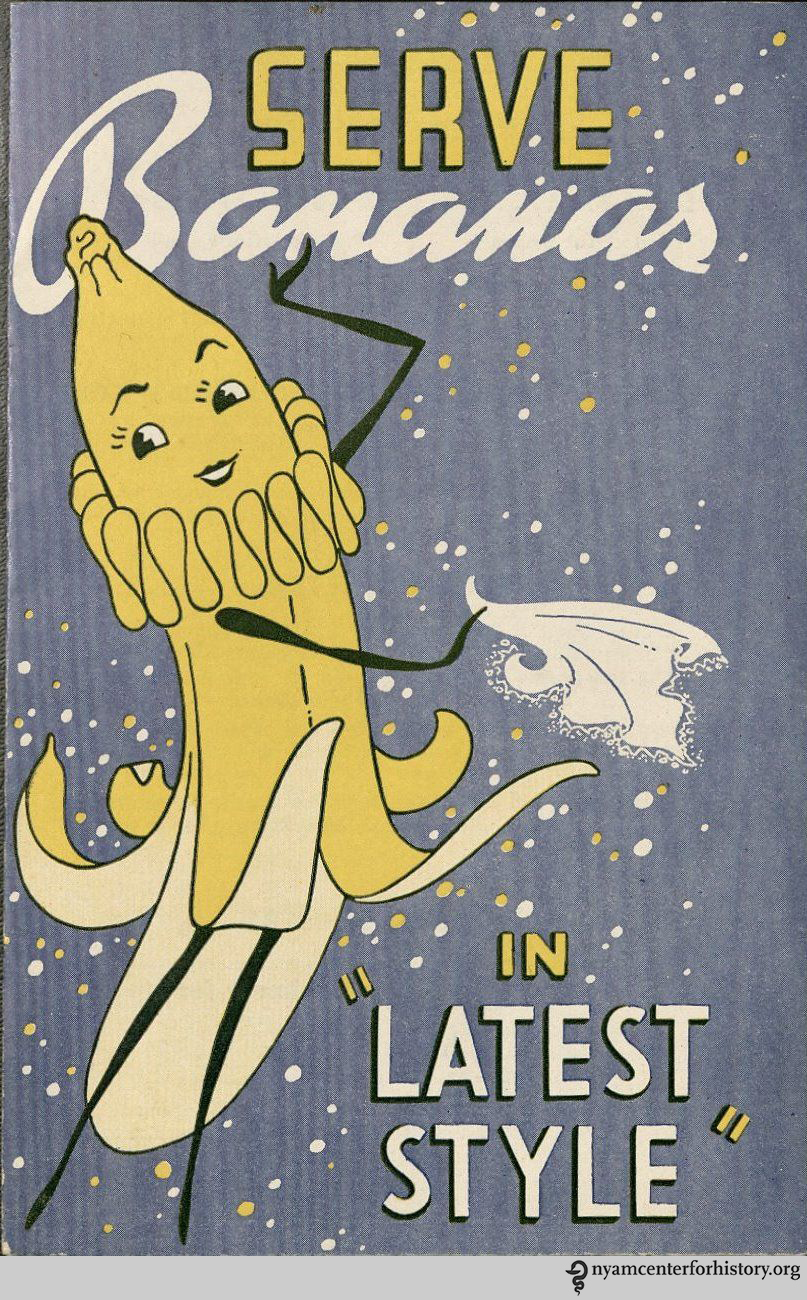
Cover of “Serve Bananas in ‘Latest Style,’” 1940.

The Fruit Dispatch Company published “Serve Bananas in ‘Latest Style’” in 1940 to introduce new banana recipes to American households. Recipes included “ham banana rolls with cheese sauce” and “banana fritters” as well as a “banana sweet potato casserole.” We’re charmed by the lady banana with the Elizabethan collar waving her napkin. She predates the United Fruit Company’s Chiquita Banana by four years.
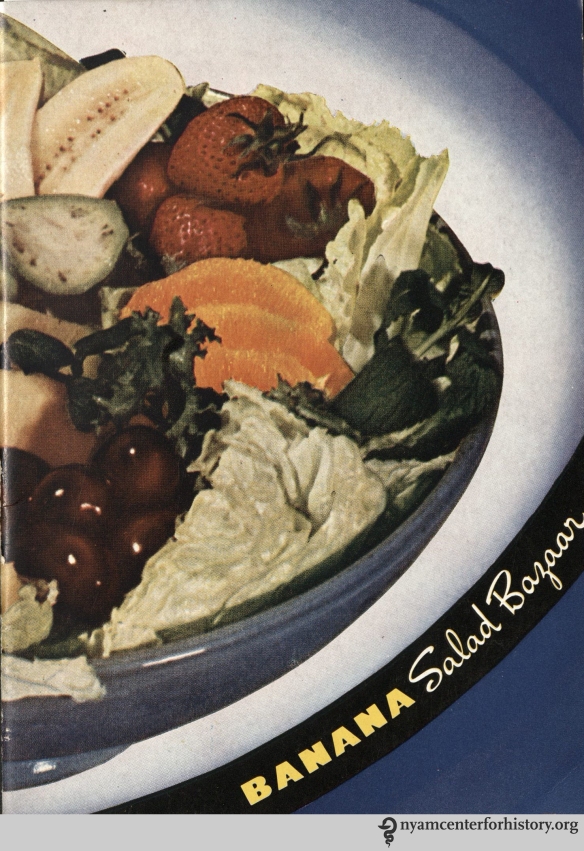
Cover of

Cover of “Banana Salad Bazaar,”1940

“Banana Salad Bazaar,”1940, pages 2 and 3. Click to enlarge.

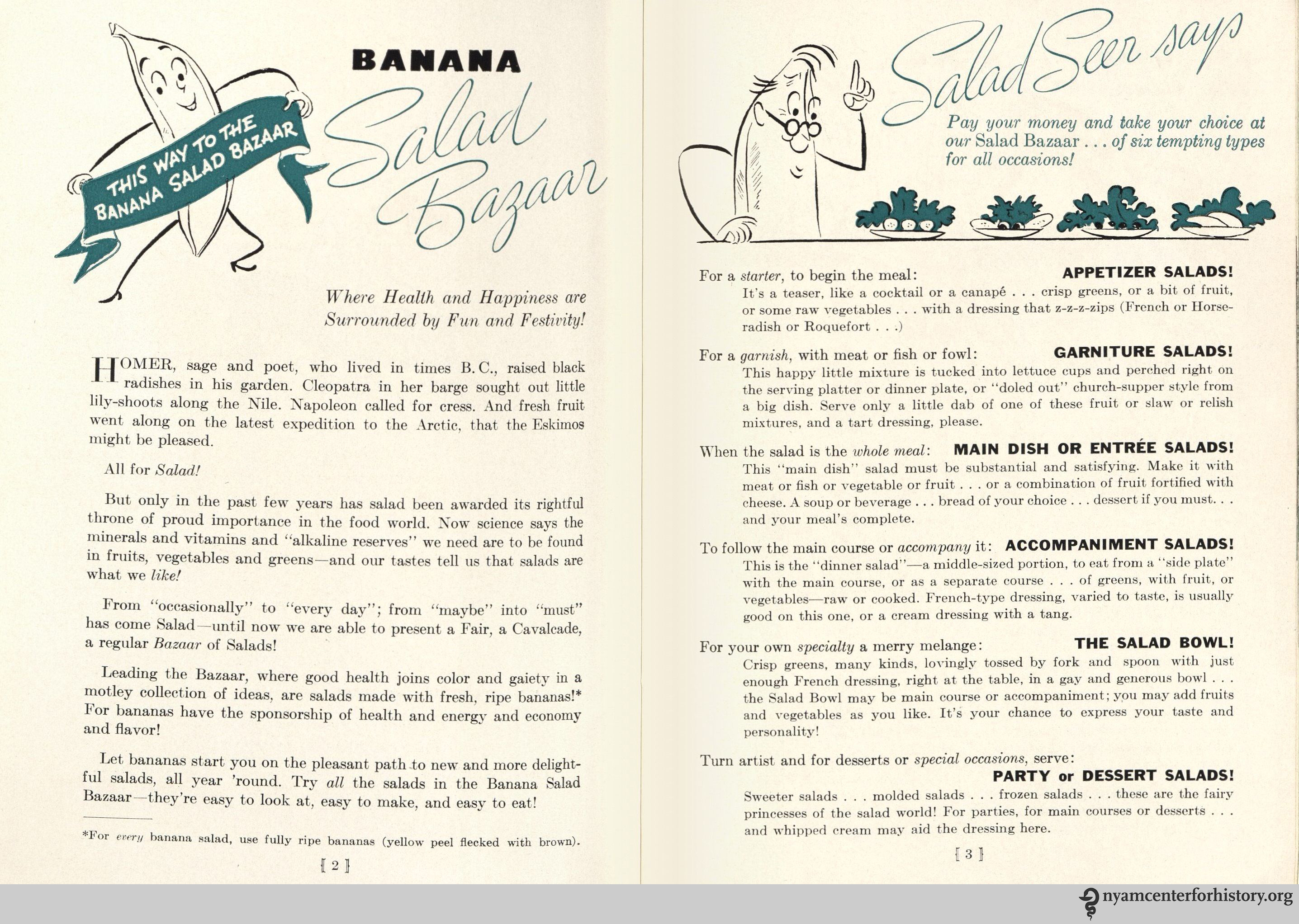
“Banana Salad Bazaar,” produced by the United Fruit Company’s Home Economics Department in 1940, is introduced by a sign-waving banana-man announcing “This Way to the Salad Bazaar.” Salad makers are encouraged to use fully ripe bananas (yellow peel flecked with brown). Recipes include banana gelatin salad and banana sardine boats.
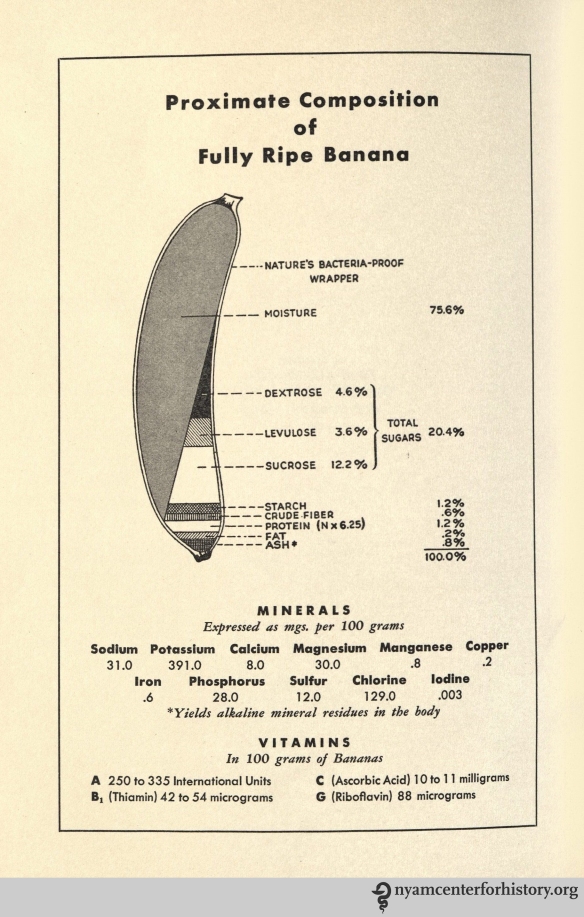
From “Nutritive and Therapeutic Values of the Banana,” 1941.

From “Nutritive and Therapeutic Values of the Banana,” 1941.

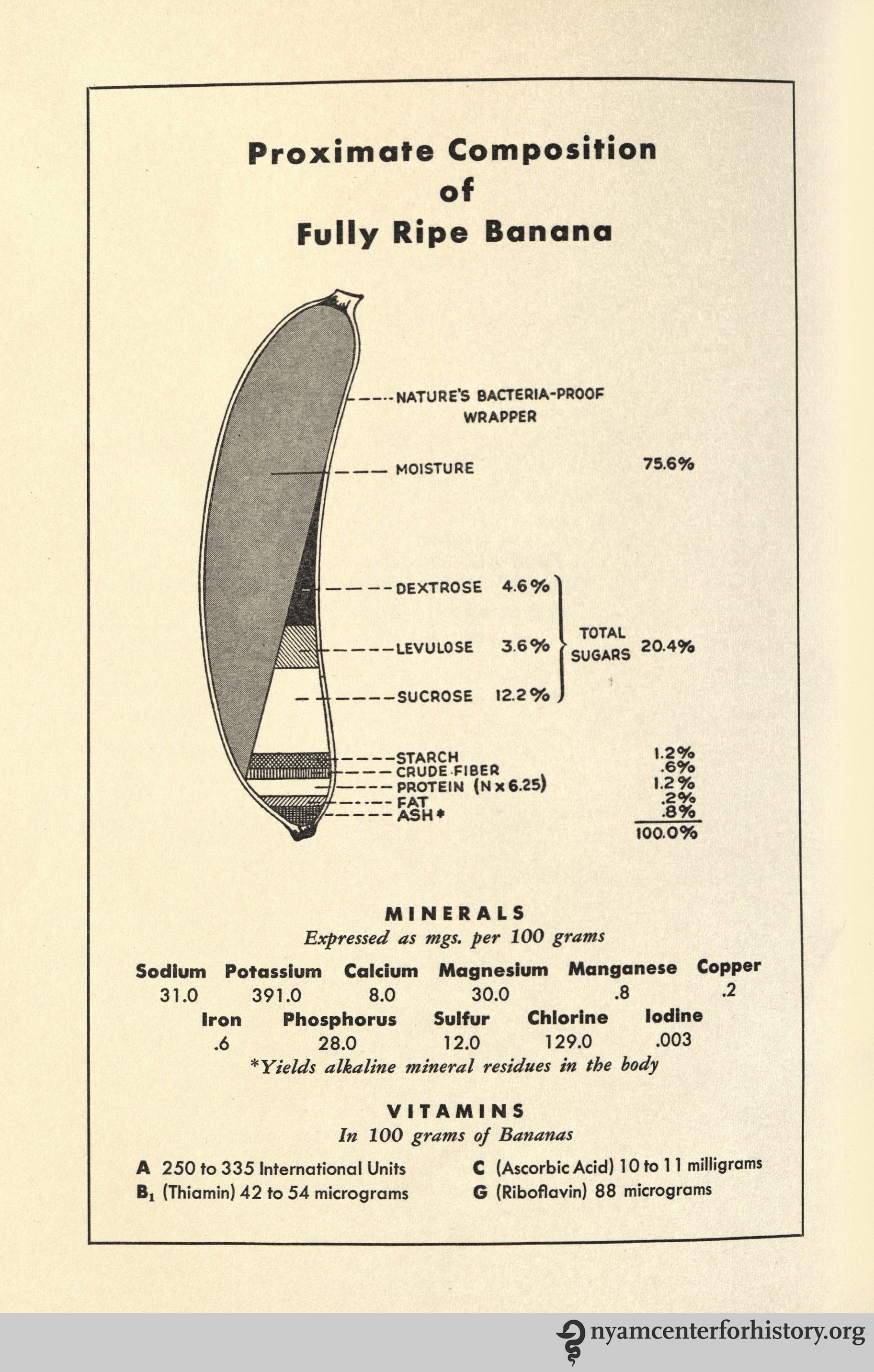
1941 was a busy year for the UFC’s presses. Here, a chart from the second addendum to “Nutritive and Therapeutic Values of the Banana,” an annotated bibliography of recent research devoted to the fruit. The forward tells us that the banana pictured is a Gros Michel, or “Big Mike” banana, imported to the U.S. since the late 1890s. The “Big Mike” was larger, with a sturdier peel, and anecdotally more flavorful. By 1960 “Big Mikes” had been almost entirely eradicated by Panama disease. On American tables it was replaced by the Cavendish.6
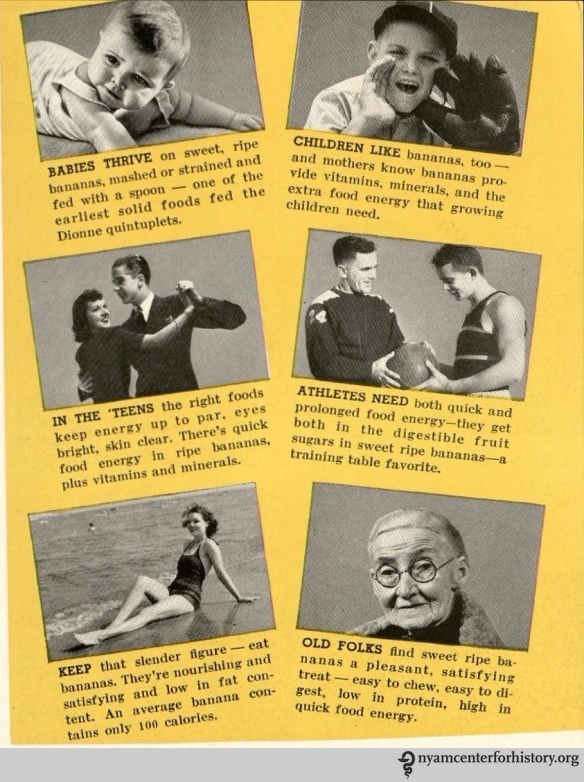
From “Bananas...How to Serve Them,” 1941.

From “Bananas…How to Serve Them,” 1941.

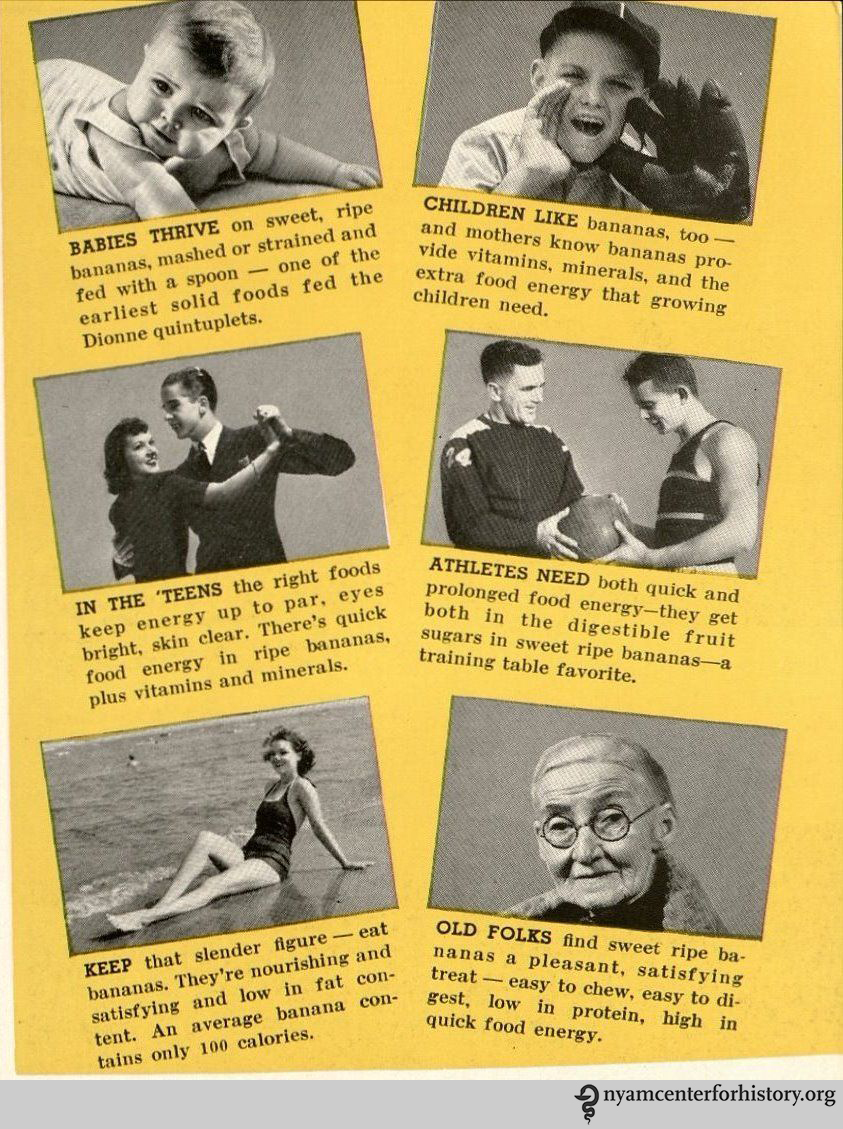
This inset from “Bananas…How to Serve Them” (1941) illustrates the health benefits of bananas at every age. We learn that the Dionne quintuplets (b. 1934), the earliest quints to survive their infancy, ate bananas. Bananas are a “training table favorite” for athletes, and they appeal to the elderly as well because they are easy to chew and digest.

From “Bananas...How to Serve Them,” 1941.

From “Bananas…How to Serve Them,” 1941.

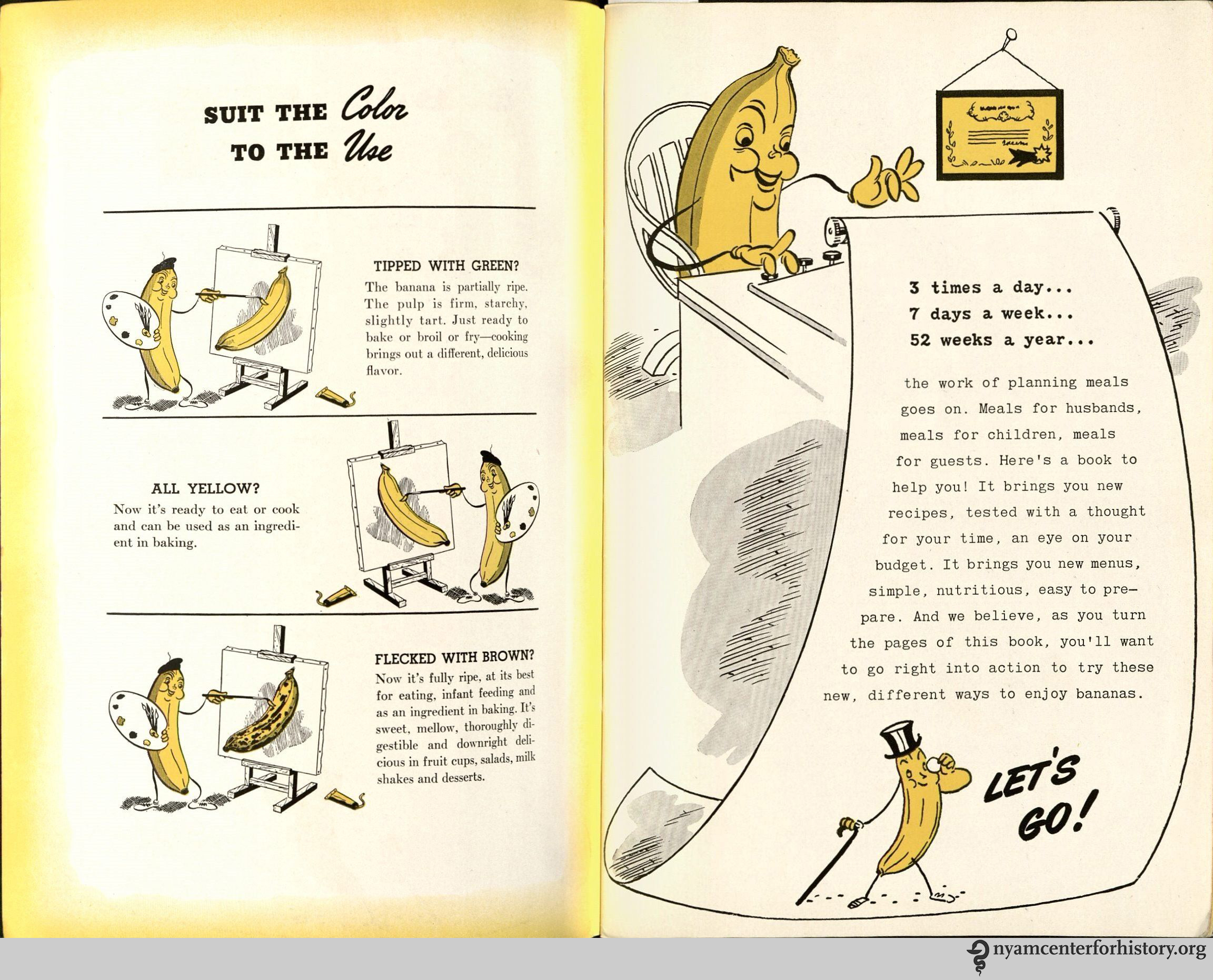
On the left, a sweet banana artist paints bananas at three stages of ripeness and explains how to prepare bananas for meals at each phase. On the right, encouragement for the housewife, with a promise of new banana recipes on the pages that followed. A monocled banana with a cane and top-hat below rips off Mr. Peanut, well-known to Americans since the early 1930s.

From “Chiquita Banana's Cookbook,

From “Chiquita Banana’s Cookbook,” 1960, page 2.

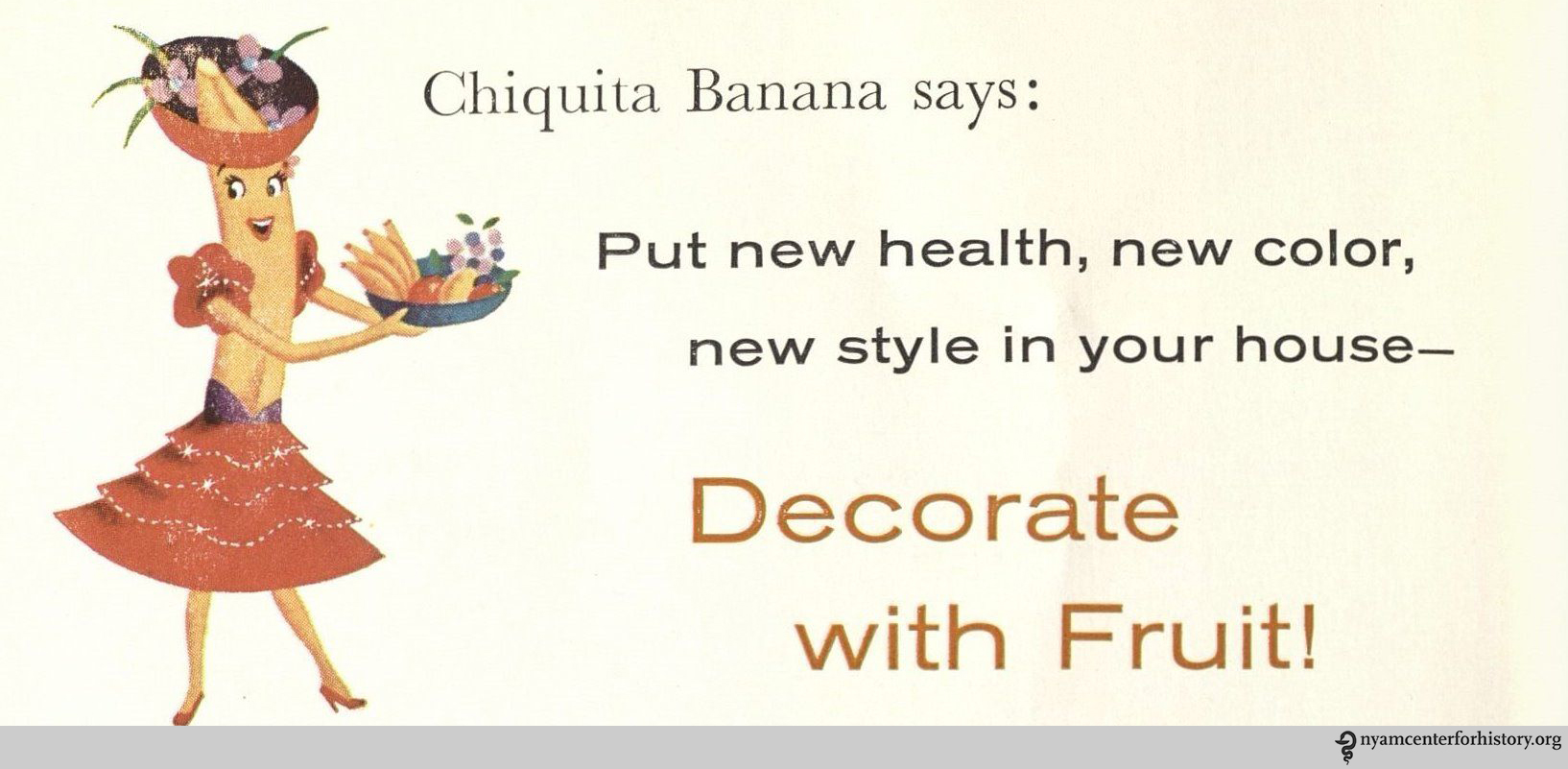
Inspired by Carmen Miranda’s character in Busby Berkeley’s The Gang’s All Here, United Fruit Company introduced Chiquita Banana in 1944 (Miranda herself was frequently called, “chiquita” in her films). Dik Brown, creator of Hagar the Horrible, drew the first Chiquita; advertising execs composed her famous song.7 Here, a 1960 iteration of Chiquita graces “Chiquita Banana’s Cookbook.”
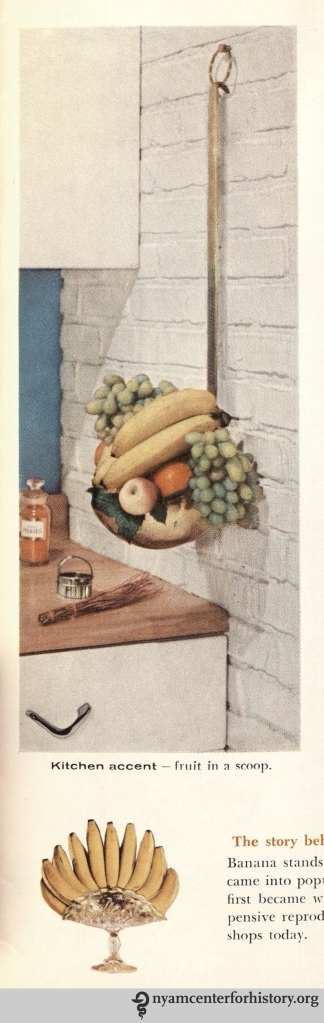
Detail in “Chiquita Banana's Cookbook,

Detail in “Chiquita Banana’s Cookbook,” 1960, page 3.

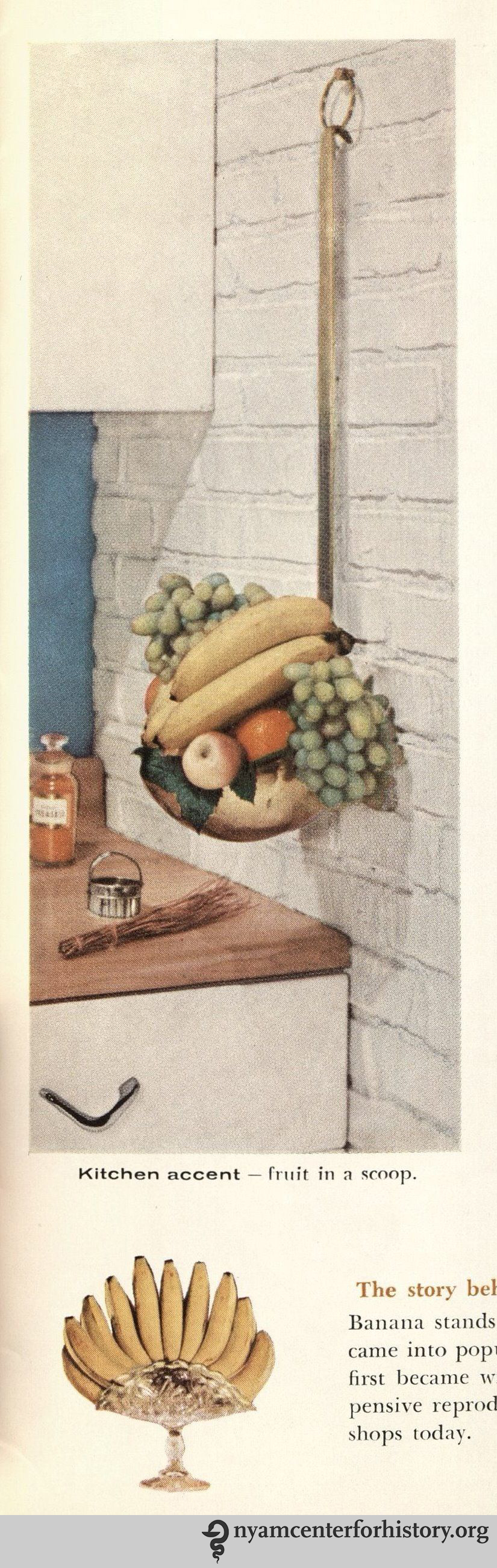
In “Chiquita Banana’s Cookbook,” Chiquita offers ideas for decorating with bananas. Here, “fruit in a scoop” and a banana bouquet, in a pressed-glass stand.

From “Chiquita Banana's Cookbook,” 1960.

From “Chiquita Banana’s Cookbook,” 1960, page 12.

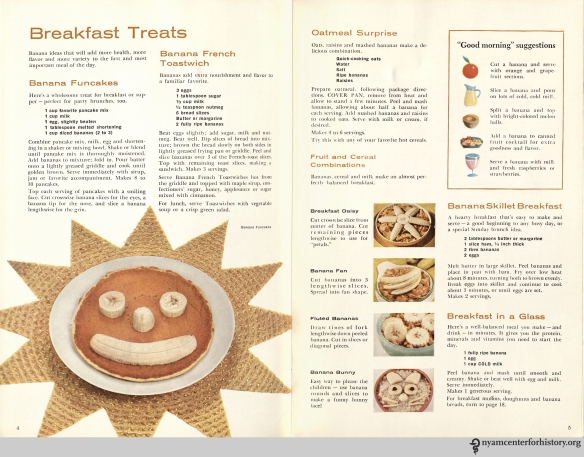
Under consideration by Betty Draper and the Mad Men set: a triptych of bananas in “Chiquita Banana’s Cookbook,” prepared with three different garnishes: a currant jelly, a curry sauce, and mint jelly.
From “Chiquita Banana's Cookbook,” 1960. Click to enlarge.

“Chiquita Banana’s Cookbook,” 1960, pages 4-5. Click to enlarge.

 “Chiquita Banana's Cookbook,” 1960, pages 6-7. Click to enlarge.

“Chiquita Banana’s Cookbook,” 1960, pages 6-7. Click to enlarge.

“Chiquita Banana’s Cookbook” offers an adorable banana bunny and a banana skillet breakfast, as well as new recipes for shakes. “Drink a banana and feel better for it,” says Chiquita, and we believe her because she’s wearing that amazing hat.

References

1. Hooker, Richard J. Food and Drink in America. Indianapolis: Bobbs-Merrill, 1981.

2. Koeppel, Dan. Banana. The Fate of the Fruit That Changed the World. New York: Hudson Press, 2008.

3. Koeppel, 75.

4. Koeppel, xv.

5. Levinovitz, Alan. “The First Superfood.” Accessed September 1, 2015 at http://www.slate.com/articles/health_and_science/science/2015/04/the_first_superfood_doctors_believed_bananas_could_cure_celiac_disease.html

6. Koeppel, Dan. Banana. The Fate of the Fruit That Changed the World. New York: Hudson Street, 2008. xiv.

7. Koeppel, 117; 253.

Physicians Discuss Aphrodisiacs

Ken Albala is Professor of History and Director of Food Studies at the University of the Pacific. He is the author or editor of 24 books on food. He conducted his dissertation research primarily at the New York Academy of Medicine. Dr. Albala will present Aphrodisiacs: The Intimate Connection Between Food and Sex in Renaissance Nutritional Theory and lead the workshop “Hands On” Early Modern Cooking at our Eating Through Time Festival on October 17.

As a scholar sometimes you have ideas that get orphaned that you come back to after many years, very randomly. Such was a paper I first delivered at a Northern California Renaissance conference in 1995 on aphrodisiacs in medical literature. In truth, I had intended to fit the topic into my dissertation and it never made it in. The paper was a way to make use of the pile of notes I had taken at the New York Academy of Medicine just a few years before. And when I say a pile of notes, I mean an entire filing cabinet full of handwritten notes taken in pencil and coded with colored crayons. There was no such thing as a laptop then.

A page of Ken Albala's notes.

A page of Ken Albala’s notes.

These notes cover about 100 books I read at the Academy between 1989 and 1993, practically every dietary text written in Europe between the mid-15th and the mid-17th century. I was a permanent fixture in what was then called the Malloch Room, now the Drs. Barry and Bobbi Coller Rare Book Reading Room. The notes became my dissertation at Columbia University and eventually morphed into my first book Eating Right in the Renaissance (UC Press, 2002). While I always kept an active interest in the history of medicine, my career since then has shifted far more toward culinary history and broader food history. Every now and then I deliver a paper or write an article involving food and medicine, and I still teach a history of medicine course, but I had completely forgotten about the topic of aphrodisiacs. In jest I have often said it would be a really interesting topic for experiential research. Alan Davidson, the late author of the Oxford Companion to food, encouraged me many times to write a serious book on aphrodisiacs, but it never came to pass.

What surprise then, when this past spring, two decades after first giving that paper, I was asked to speak in Miami on aphrodisiacs. I thought, OK, I will just go into my computer and find that paper. No evidence of it. I realized that when I wrote that paper I was still learning to type, had just sent my first email, and had still written out everything by hand. So I needed to dig through the filing cabinets to find the original paper. Then to revise and update it using my original trove of notes taken 25 years earlier. Happily the paper was a success. I also delivered it in Dublin a few weeks later, and then a publisher contacted me asking if I would like to write a book on aphrodisiacs. I think I probably will. Isn’t it funny how every stray idea eventually finds a good home?

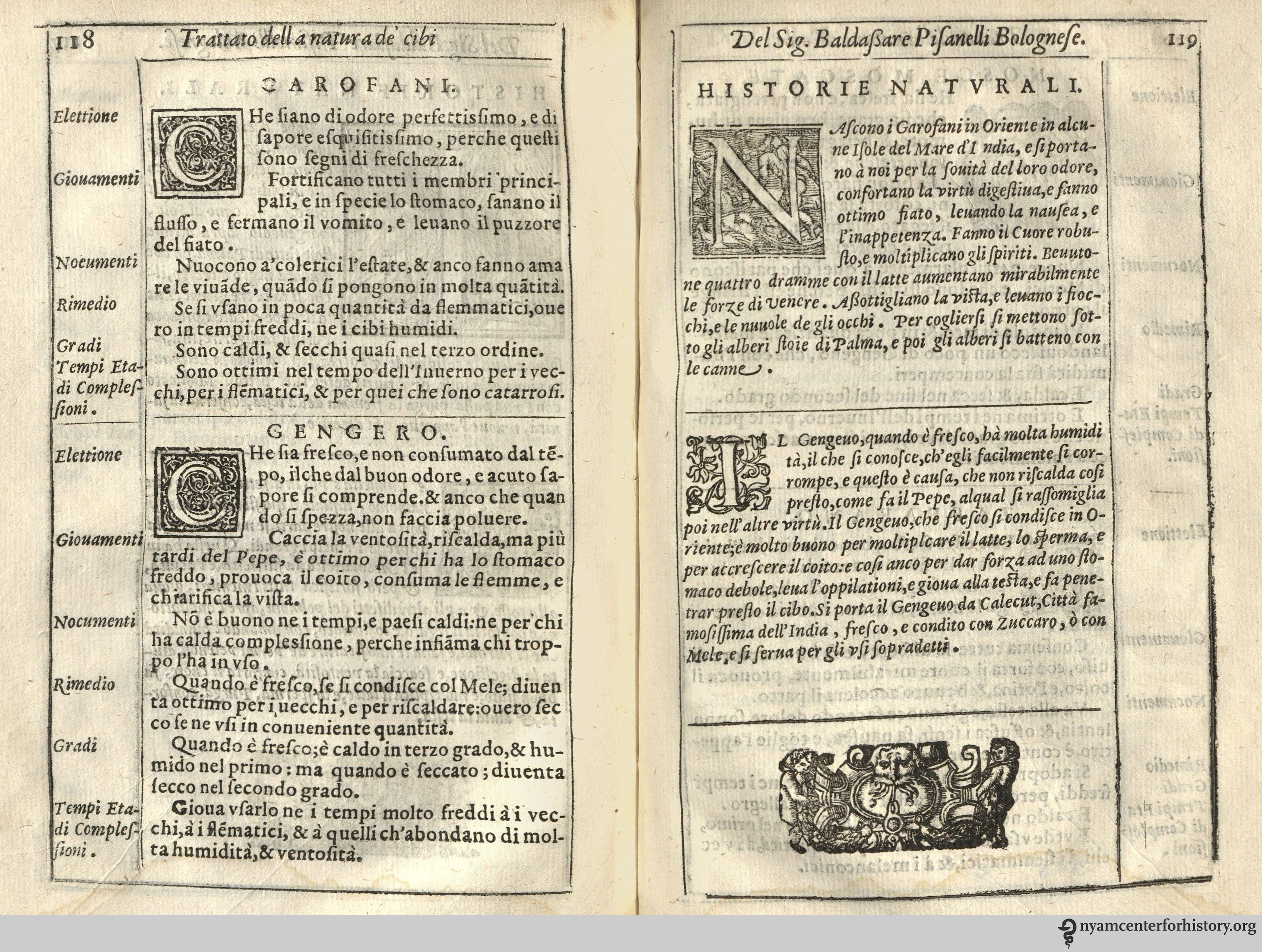
The most remarkable thing about the whole experience is that I can still hear the voices of early modern authors after all these years. I can still quote them in half a dozen languages. From the French version of Platina printed in 1507 there is “L’heure que tu sentiras ta viande estre cuite, car…l’heure est bonne pour engendrer enfans…”  (The moment you feel that your meal is digested, the time is good to produce children.) Or Girolamo Manfredi from 1474 “Imperho dicono li philosophi che chi usa molto il cohito vive poco e tosto invechia.” (Therefore philosophers say whoever has a lot of sex lives a short life and ages too soon.) Or there’s Baldassare Pisanelli who tells us that 4 drams of cloves in milk “aumento mirabilmente le forze di Venere” (greatly increase the power of Venus.) There’s also the Fleming Hugo Fridaevallis who tells us that asparagus is great for timid newlyweds “primas coniugii difficultates, et si quid minis in uxore tunc placet, dulce et amabile futurum tandem uxoris contubernium” (whoever…has conjugal difficulties at first, and if you are unable to please your wife, later she will be a sweet and loving mate).

Baldassare Pisanelli's Trattato della natura de' cibi et del bere Nel quale non solo tutte le virtù, & i vitii di quelli minutamente si palesano, 1586. His discussion of the power of cloves in milk appears top right.

Baldassare Pisanelli’s Trattato della natura de’ cibi et del bere Nel quale non solo tutte le virtù, & i vitii di quelli minutamente si palesano, 1586. His discussion of the power of cloves in milk appears top right. Click to enlarge.

Their opinions are of course very amusing, but they also give us some remarkable insights into the kinds of problems Renaissance people would have taken to their physicians. These kind of frank open discussions of sex gradually become rarer in the 16th century, no doubt under the influence of the Reformations a kind of prudery pervades the later dietaries. It took another few centuries until they discuss the topic again, in the 19th century, but all this is the subject for a book. Stay tuned.

Join us for First Mondays!

By Anne Garner, Curator, Center for the History of Medicine and Public Health

The Coller Rare Book Reading Room captured by Ardon Bar-Hama.

The Coller Rare Book Reading Room captured by Ardon Bar-Hama.

Books in open caseCome visit The Drs. Barry and Bobbi Coller Rare Book Reading Room for an hour on the first Monday of each month (excluding holidays). Library staff will show a selection of treasures from our collections. We will begin in the Academy lobby at noon (1216 Fifth Avenue at 103rd Street). No advance sign-up is required.

Our rare book room was built in 1933. A 2014 renovation restored the room’s historic windows, period cork floor, and unique light fixtures, bookishly designed to feature early modern printing devices.
Please note that The Drs. Barry and Bobbi Coller Rare Book Reading Room is also open to researchers by appointment on Tuesdays, Thursdays and Fridays from 10am– 4:45pm and Wednesdays from 10am– 6:45 pm. Email us at library@nyam.org or call 212-822-7315 to make an appointment.

The Right to Health (Item of the Month)

By Paul Theerman, Associate Director, Center for the History of Medicine and Public Health

Does one have a “right to health”? And if so, what does that right entail? Access to healthcare? Access to all healthcare? Equality of health outcomes?

The debate in this country over passage of the Affordable Care Act brought to the fore the differing assumptions over a “right to health.” Yet since at least 1946, members of the United Nations have asserted the right to health as a fundamental global human right. The constitution of the World Health Organization “enshrines the highest attainable standard of health as a fundamental right of every human being.”1 This right was further stated in the Universal Declaration of Human Rights of 1948—framed as the right to a standard of living “adequate for health and well-being.”2 The right to health remains a formative principle in global health. For example, three of the UN’s eight Millennium Development Goals are explicitly health related, and all have a health component.3

Though this right to health reached its full flower in the mid-20th century, it originated some 50 years earlier. In the late 19th century, urban and industrial ills had pushed their way onto the political agenda across the western world. Many reformers thought that supporting political rights was not enough: social and economic rights needed to be affirmed as well. One of these thinkers was the New York City-based urban researcher William Harvey Allen. In a series of books, and most notably Civics and Health (1909), Allen laid out the reasons why health was a human right.4

“Necessary to Efficient Democracy,” the way that experience in schools and other institution is brought to the public, in William Harvey Allen, Civics and Health, 1909), p. 310.

“Necessary to Efficient Democracy,” the way that experience in schools and other institutions is brought to the public, in Allen, Civics and Health, 1909, p. 310.

Allen made granting the right to health the apex of moral development, both in the individual and the society. He placed “rights” as the last and best of the seven motivations for public health action, starting with instinct and ranging through commerce to humanitarianism.5 Indeed, to promote health Allen said one could not rely on the love of money or the joy of human sympathy: “So long as those who suffer have no other protection than the self-interest or the benevolence of those better situated, disease and hardship inevitably persist.”6 By society’s affirming the right to health, it acknowledged that the citizenry’s well being had a claim on its attention and resources, and it made itself accountable to provide it. “Health administration is incomplete until its blessings are given to men, women, and children as rights that can be enforced through courts, as can the right to free speech, the freedom of the press, and trial by jury,” wrote Allen. The political rights claimed in the eighteenth century meant little if one did not have the physical means to exercise them in the twentieth. Those “permanently incapacitated . . . cannot appreciate the privilege of pursuing happiness.”7

According to Allen, it was not that people did not know what to do to secure public health—for the most part they did. It was rather that the means were often shunted aside, a problem of enforcement—and hence his argument for health as a right! Allen looked to find the most practical way to correct health deficiencies, and as co-director of the city’s newly established Bureau of Municipal Research, he looked upon all of New York as a test site.8 Here, he turned his attention to the health of school children, “the best index to community health.”9 Determining the status of children’s health was a comprehensive way of judging the health of the whole community, as children from all ranks of the community were available to reformers, and the mechanisms were already in place to examine and collect data. Allen saw children’s health as the indicator, not just to the health of the city, but to the right to health. Much of his book was devoted to measuring as well as intervening in children’s health, in such ways as enforcing milk purity laws, quarantines for communicable diseases, and vaccination for smallpox. He was concerned with controlling germs, paying attention to eye and ear health, and promoting school play and physical education. He saw the health of teachers as crucial to that of their charges. And, as detailed in our earlier blog post, he supported removal of tonsils and adenoids.

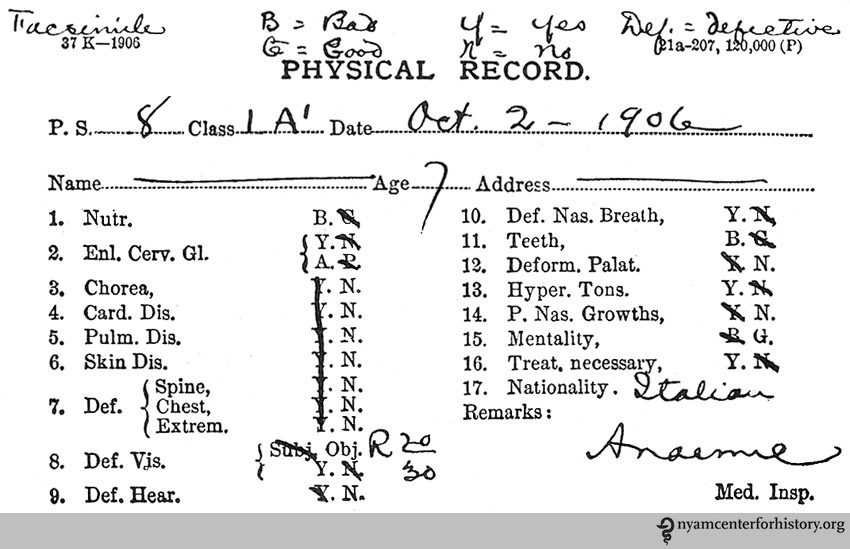
Sample record card for school physical examination, as found in Allen, Civics and Health, 1909, p. 34. As Allen noted: “Weight, height, and measurements are needed to tell the whole story.”

Sample record card for school physical examination, as found in Allen, Civics and Health, 1909, p. 34. As Allen noted: “Weight, height, and measurements are needed to tell the whole story.”

Yet, Allen did not think that the solution lay only in better school health. Society as a whole needed to address the health of its members throughout their lives. He suggested measures such as coordinating school health with other social agencies, requiring work physicals and promoting industrial hygiene, waging war on the “white plague” of tuberculosis, providing physicians with training not just in restorative medicine but also in preventive medicine, discouraging tobacco and alcohol use, and setting up institutions for large-scale information gathering and coordination through a national bureau of health.10

Many of Allen’s practical ideas today seem commonplace in the wake of the great shifts in public health that took place in the 20th century. But one thing stands out: seeing health as a right brought it out of the realm of enlightened self-interest and humanitarian relief. Health became social, health became enforceable, health became a right. That legacy, contested though it now is in American society, remains present today.

References

1. World Health Organization, Fact Sheet No. 323, “The Right to Health,” reviewed November 2013, http://www.who.int/mediacentre/factsheets/fs323/en/#, accessed September 23, 2015.

2. United Nations, “Universal Declaration of Human Rights,” Article 25, http://www.un.org/en/documents/udhr/, accessed September 23, 2015.

3. For the UN Millennium Development Goals, see http://www.un.org/millenniumgoals/, accessed September 23, 2015; for a summary of international conventions, see Mervyn Susser, “Health as a Human Right: An Epidemiologist’s Perspective on the Public Health,” American Journal of Public Health 1993 March; 83 (3): 418–26.

4. William Harvey Allen, Civics and Health, with an introduction by William T. Sedgwick (Boston, New York, Chicago, and London: Ginn and Company, 1909). For information on Allen (1874–1963), see in addition to the Recchiuti book below: “Reminiscences of William Harvey Allen: oral history, 1950,” Columbia Center for Oral History, http://oralhistoryportal.cul.columbia.edu/document.php?id=ldpd_4072329.

5. Allen, Civics and Health, pp 11–22. The seven motivations are Instinct, Display, Commerce, Anti-Nuisance, Anti-Slum, Pro-Slum [Abatement], and Rights.

6. Allen, Civics and Health, 20.

7. Allen, Civics and Health, 20.

8. For Allen and the Bureau of Municipal Research, see John Louis Recchiuti, Civic Engagement: Social Science and Progressive-Era Reform in New York City (Philadelphia: University of Pennsylvania Press, 2006), Chapter 4, pp. 98–124.

9. The phrase comes from the title of Chapter 4, “The Best Index to Community Health is the Physical Welfare of School Children,” page 33.

10. Allen, Civics and Health, Part III, “Coöperation in Meeting Health Obligations,” and Part IV, “Official Machinery for Enforcing Health Rights.” For an earlier attempt at a national bureau of health, see Jerrold M. Michael, “The National Board of Health: 1879–1883,” Public Health Reports 2011 Jan-Feb; 126(1): 123–29.

Prescription for Healthy Aging

By Danielle Aloia, Special Projects Librarian

September marks Healthy Aging® Month, a good time to evaluate your health. In the 1899 Good Health article “The Road from Life to Death,” Dr. David Paulson suggests that “the velocity with which men travel down grade toward ill health and death is largely regulated by themselves.” At any time a person can change deleterious habits and return to the road toward health. The worse your habits the harder it is to change course.1

From: Paulson D. The road from life to death. Good Health. 1899;34(8):481-482.

From: Paulson D. The road from life to death. Good Health. 1899;34(8):481-482. Click to enlarge.

In the diagram above Paulson describes certain stations as turning points. The “Business Pressure” station is marked by mental worry and sedentary habits. “Wretched Sanitation” refers to lack of fresh air and abundance of germs. The “Unnatural Demands of Modern Society” places blame on late hours and evening entertainment. The final station, “Intemperance and Dissipation,” is plagued by immorality, tobacco, and poor diet. Notice that at every station there is a “Reform” signal, a marker to let you know it’s time to make a U-turn toward health.

Even 116 years after the publication of Paulson’s article, we can still relate to the demands of each station. According to a 2013 CDC report, heart disease has been the leading cause of death since 1900, except during the influenza pandemic of 1918-1920.2 The authors offer a prescription: “Practicing healthy behaviors from an early age and getting recommended screenings can substantially reduce a person’s risk of developing chronic diseases and associated disabilities.”

It’s never too late to start living a healthier life. A list from 1954—which holds up well today—gives further specifics on how to make the switch to better health (if only we could all reside in temperate climates):3

From Walker, K. Living Your Later Years. New York: Oxford University Press; c1954.

From: Walker, K. Living Your Later Years. New York: Oxford University Press; c1954.

References

1. Paulson D. The road from life to death. Good Health. 1899;34(8):481-482.

2. The State of Aging and Health in America 2013. Atlanta: CDC; 2013:60. Available at: http://www.cdc.gov/features/agingandhealth/state_of_aging_and_health_in_america_2013.pdf.

3. Walker, K. Living Your Later Years. New York: Oxford University Press; c1954.

Beyond the Pail: The Advent of a Hot School Lunch

By Johanna Goldberg, Information Services Librarian

This is one of several posts leading up to our day-long Eating Through Time Festival on October 17, 2015, a celebration of food, cookery, and health. View the full program and register for the Festival.

It’s winter in Minnesota, 1916. You have to walk six miles to school (uphill, both ways?). By the time you get there, your lunch is frozen. “In this condition,” explained Nellie Wing Farnsworth in the pamphlet The Rural School Lunch, “it is not very appetizing and it is not much better even if it has thawed out.”1

“Packing the luncheon.” In Sandwall, The School Lunch, c1920.

The Rural School Lunch, which focuses on schools in Minnesota in 1916, and The School Lunch, which focuses on schools in Massachusetts circa 1920, both describe the challenges of feeding rural students hot meals long before the advent of the National School Lunch Program in 1946.

As the pamphlets explain, students brought cold lunches from home. The nutritional value of those lunches was a concern, especially as lunch was often the main meal for farm families—one school children missed.1 In contrast, wrote Farnsworth, “Little thought or attention is given to the school lunch in many cases. When the pail or basket is opened it is found to contain cold pancakes, salt pork, cold potatoes, pie and bottles of cold tea or coffee. None of these foods is suited to the needs of the child and, as a rule, they all prove unpalatable and indigestible.”1

A selection of lunchboxes in Farnsworth, The Rural School Lunch, 1916 (top) and Sandwall, The School Lunch, c1920 (bottom).

A selection of lunchboxes in Farnsworth, The Rural School Lunch, 1916 (top) and Sandwall, The School Lunch, c1920 (bottom).

While some schools figured out ways to heat up lunches brought from home—in Wisconsin and elsewhere, students were encouraged to bring lunch in canning jars, which teachers placed in tubs of water atop the schools heater or stove—efforts to provide nutritious hot meals made at school took hold by the 1920s.2

Supplementing the box lunch with a hot dish, wrote The School Lunch author Alzira Wentworth Sandwall, had enormous benefits. Student table manners improved, students and teachers had a forum for conversation (“current events can be discussed and helpful conversation can be encouraged”), and nutrition education became part of the school day.3

“Hot lunch, Russell Mountain School, Hampden County.” In Sandwall, The School Lunch, c1920.

But perhaps most important was that student performance improved. Afternoon discipline became easier once students had enjoyed a nutritious meal. And students who appeared to be lost causes began to shine, like this child in Holyoke, Massachusetts:

One girl in the third grade was especially anemic, and was in the habit of falling asleep every afternoon. She became a regular patron of the canteen, and after two weeks she ceased to fall asleep. She was thought to be mentally deficient until the advent of the canteen, when she began to receive 100 per cent in some of her work.3

But how could schools provide hot meals to students? Programs across the country varied greatly, and only some had public funding.4 In most places, like the schools described by Sandwall and Farnsworth, hot lunches came about through donations of time and labor. Both pamphlets contain ideas for fundraising to pay for ingredients and utensils, such as food sales or a “shower”: a teacher selected utensils at a local store, asked women connected to the school to purchase them, and turned it into an afternoon party.1,3  And both have lists of recommended recipes, a large portion of them simple soups.

“Oil stove and cupboards improvised from packing boxes.” In Farnsworth, The Rural School Lunch, 1916.

Farnsworth goes into great detail on how to create food and utensil storage areas on a budget. She also breaks down the process of meal management, recommending teachers assign four “housekeepers” each week, boys and girls who will cook, serve, set the table, wash the dishes, clean the storage areas and stove, carry in the water, sweep the floors, and take out the garbage under teacher supervision.1

“Redding up.” In Farnsworth, The Rural School Lunch, 1916.

Providing a hot lunch required enormous effort on the part of teachers, students, and the surrounding community. But as Sandwall stated, “There are very few schools where it is absolutely impossible to serve at least one hot dish, and no better work can be done for the health of the school children than making it possible for every one of them to have a hot, nourishing luncheon.”3

References

1. Farnsworth NW. The rural school lunch. St. Paul: Webb publishing company,; 1916. Available at: http://babel.hathitrust.org/cgi/pt?id=loc.ark:/13960/t9r21q72z;view=1up;seq=7. Accessed August 27, 2015.

2. Gunderson GW. National School Lunch Program (NSLP)| Early Programs by States. United States Dep Agric Food Nutr Serv. 2014. Available at: http://www.fns.usda.gov/nslp/history_2. Accessed August 26, 2015.

3. Sandwall AW. The School lunch /. s.n.,; 1920. Available at: https://archive.org/details/schoollunch00mass. Accessed August 27, 2015.

4. Levine S. School Lunch Politics: The Surprising History of America’s Favorite Welfare Program. Princeton: Princeton University Press; 2008.

Back to School! Conservation of the Academy’s 19th- and 20th-Century Medical Student Notebooks

By Erin Albritton, Head of Conservation and Arlene Shaner, Historical Collections Reference Librarian

A small sample of student notebooks from the library’s collection.

A small sample of student notebooks from the library’s collection.

The New York Academy of Medicine Library’s manuscript collections feature a number of notebooks kept by medical students while they studied to become physicians. These notebooks, which contain both class notes and clinical reports created by students as they followed professors on rounds, are fascinating repositories of information that enrich our understanding of medical education during the 19th and early 20th centuries.

Title page from Marcus Lorenzo Taft’s Notes of a Course of Lectures on Surgery by Valentine Mott, M.D., 1842–44.

Title page from Marcus Lorenzo Taft’s Notes of a Course of Lectures on Surgery by Valentine Mott, M.D., 1842–44.

In January, the New York State Discretionary Grant Program for the Conservation and Preservation of Library Research Materials awarded the Gladys Brooks Book and Paper Conservation Laboratory funding to carry out conservation treatment on 42 notebooks from the collection, all of which were created by students studying at medical colleges in New York City between 1827 and 1909. Contract conservator Jayne Hillam completed the conservation portion of the grant project in June. Following cataloging updates, the materials will soon be available for use.

An abundance of published resources can be used to research the world of 19th– and early 20th-century medical education. Circulars, annual reports, and catalogs provide scholars with detailed information about admission requirements, programs of instruction, textbooks, schedules of clinical demonstrations, faculty and student rosters, and even the addresses of boarding houses where students lived. In addition, printed copies of inaugural and valedictory addresses delivered by faculty members to student audiences offer a record of what physicians and faculty members thought medical students should know about the world of medical practice. Missing from these printed sources, however, is an intimate sense of how students actually learned to be physicians—i.e., what they studied in their classes and on clinical rounds; how they recorded that information for their own personal use; and how their understanding of the subject matter may have changed over time.

The 42 student notebooks conserved under this grant help bridge that gap, providing a window into the evolution not only of medical education, but of American higher education in general, and offering detailed evidence of the curriculum taught to medical students as medicine evolved through the 19th century. These notebooks also tell us a great deal about the students themselves, showing how they mastered the subjects they studied, what they learned from observing clinical demonstrations, and what professorial advice they deemed worth transcribing.

Harold Mixsell’s notes and charming illustration about caffeine, from the pharmacology lectures delivered by Dr. Walter Bastedo at New York’s College of Physicians and Surgeons, 1907.

Harold Mixsell’s notes and charming illustration about caffeine, from the pharmacology lectures delivered by Dr. Walter Bastedo at New York’s College of Physicians and Surgeons, 1907.

A reminder about the proper method of examining patients with scarlet fever, from Harold Mixsell’s notes from medical clinics in 1908.

A reminder about the proper method of examining patients with scarlet fever, from Harold Mixsell’s notes from medical clinics in 1908.

In addition to their content, the notebooks in this collection (which include both ready-made blank books and more finely bound presentation pieces) are also a valuable source of information about binding structures. They were produced during a pivotal moment in American bookbinding history when the traditions of the hand binding period gave way to the Industrial Era. In this case, the physical objects provide researchers with a unique opportunity to explore how the mass production and availability of blank books in the 19th century might have influenced classroom learning and the transmission of knowledge.

Three ready-made notebooks after conservation treatment.

Three ready-made notebooks after conservation treatment.

While most of these manuscripts were, quite clearly, student working copies (hastily written and illustrated, and characterized by a parsimonious use of paper), several were created as prize notebooks—the result of a 19th-century practice in which institutions and faculty members awarded cash prizes to students who demonstrated skill in note taking. As ideas about education evolved, the creation of prize notebooks came to be viewed more as a distraction than an enhancement to the learning process, and the competitions were eventually discontinued. That said, with their decorated bindings, artful title pages, expertly rendered calligraphy and hand-colored illustrations, the prize notebooks in the Academy’s collection are beautiful objects that amaze and delight any modern-day student note taker.

John Edwin Stillwell’s prize notebook of Dr. Fessenden Nott Otis’s lectures on venereal diseases, 1874–75.

John Edwin Stillwell’s prize notebook of Dr. Fessenden Nott Otis’s lectures on venereal diseases, 1874–75.

Stillwell’s prize notebook recording the gynecological clinics of Dr. T. Gaillard Thomas, 1873–74.

Stillwell’s prize notebook recording the gynecological clinics of Dr. T. Gaillard Thomas, 1873–74.

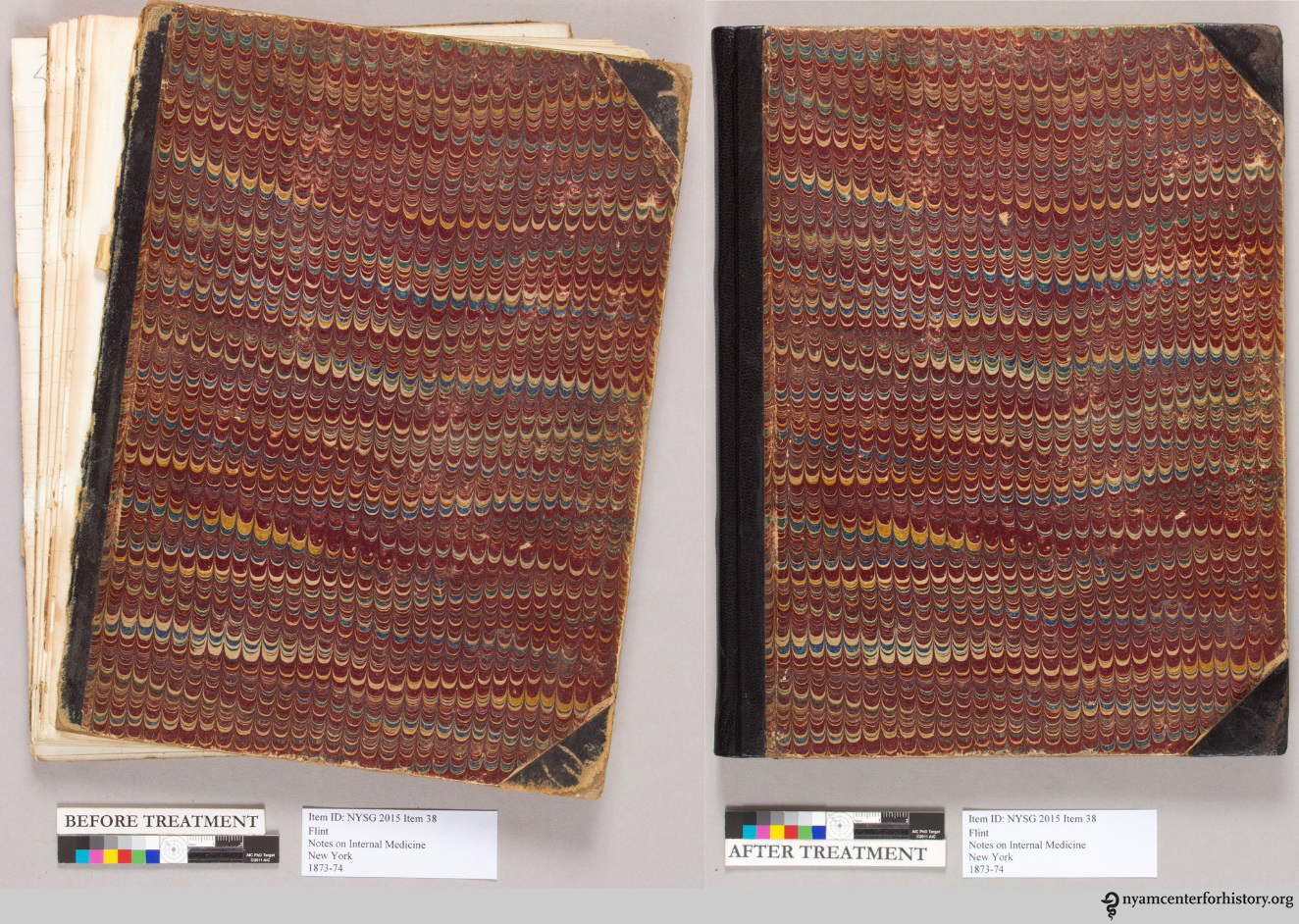
While the majority of notebooks in the collection have fared well since their creation, the 42 manuscripts selected for this grant all required some type of conservation treatment, ranging from simple cleaning to advanced paper and binding repair. Thanks to the generous financial support of the New York State Library’s Division of Library Development, these repairs are now complete and the notebooks can once again be referenced safely without fear of damage.

Before and after conservation treatment of a student notebook containing notes on internal medicine, 1873–74.

Before and after conservation treatment of a student notebook containing notes on internal medicine, 1873–74.