Stories and Heritage of Nursing in New York City

The Fellows Nursing Section at The New York Academy of Medicine and the Academy Library invite you to join us next Thursday, April 14, at 6:00 PM for an evening exploring the stories and heritage of nursing in New York City. Admission is free but advanced registration is required. Register online.

The evening’s presenters include:

Dr. Joanne Singleton, Professor at Pace University and author of White Beret: The Story of an Urban Nurse, her fictional account of life in a pediatric unit in a New York City hospital.

Lisa Mix, Head, Medical Center Archives, New York-Presbyterian Hospital Weill-Cornell Medical College.

Barbara Niss, Director, Archives & Records Management at Mount Sinai Medical Center.

Arlene Shaner, Historical Collections Librarian, New York Academy of Medicine Library who will provide insights into the nursing heritage held in libraries and archives across the city.

Two tours of the Drs. Barry and Bobbi Coller Rare Book Reading Room will be held following the evenings speakers. Tours are limited to 15 people each; email culturalevents@nyam.org to register. Other nursing-related materials will be on display in the main meeting room.

Presentations for History of Medicine Night: Intersections of Medicine, Health, and Ethnicity

The New York Academy of Medicine’s Section on the History of Medicine and Public Health invites you to join us for “Intersections of Medicine, Health, and Ethnicity” on March 9, 2016 from 6:00pm–7:30 pm at the Academy, 1216 Fifth Avenue at the corner of 103rd Street. Admission is free but advanced registration is required. Register online.

The evening’s presenters will be:

A wooden caduceus symbol shown in NYAM rare book reading room

A caduceus symbol donated to our rare book reading room

HARRIET A. WASHINGTON
Independent scholar
“The 1788 New York Doctors’ Riot: A Signal Event in the Dissection of Anatomical Ethics”

KATE BAILEY
Graduate Student, M.A. Health Advocacy Program, Expected May 2017
Sarah Lawrence College
“From Motherhood to Sisterhood: How Underground Abortion Referral Networks Worked Towards Advocacy and Solidarity”

KIRK JOHNSON
Doctoral candidate in the Medical Humanities program at Drew University
“Heart Illness: Developments of Racial Discourse”

MARLENE A. GEORGE
Graduate Student, Health Advocacy Program, Sarah Lawrence College
“Social Service Sterilization – Eugenics Of The 1950’s-1970’s”

BOB VIETROGOSKI
Head of Special Collections
George F. Smith Library of the Health Sciences
Rutgers Biomedical and Health Sciences
“‘Agitation of the Question’: James McCune Smith’s Nomination for Fellowship to the New York Academy of Medicine, 1847”

A second evening of presentations, History of Medicine Night Part II, will take place on Wednesday, May 4, and we hope that you will be able to join us for that one as well.

From Cholera to Zika: What History’s Pandemics Tell Us about the Next Contagion

By Sonia Shah

Sonia Shah, today’s guest blogger, is a science journalist and author of Pandemic: Tracking Contagions from Cholera to Ebola, and Beyond (Sarah Crichton Books/Farrar, Straus & Giroux, February 2016), from which this piece, including illustrations, is adapted.

On February 23 at 6pm, Shah will moderate the panel “Where Will the Next Pandemic Come From?,” cosponsored by the Pulitzer Center on Crisis Reporting. Register to attend.

Over the past 50 years, more than 300 infectious diseases have either newly emerged or re-emerged into territory where they’ve never been seen before. The Zika virus, a once-obscure pathogen from the forests of Uganda now rampaging across the Americas, is just the latest example. It joins a legion of other diseases that have similarly broken out of earlier constraints, including Ebola in West Africa, Middle East Respiratory Syndrome (MERS) in the Middle East, and novel avian influenzas in Asia, one of which hit the U.S poultry industry last spring, causing the biggest animal disease epidemic in U.S history.

When such pathogens spread like a wave across continents and global populations, they cause pandemics, from the Greek pan (“all”) and demos (“people”). Given the number of pathogens in our midst with pandemic-causing biological capacities, pandemics themselves are relatively rare. In modern history, only a few pathogens have been able to cause them: Yersinia pestis, which causes bubonic plague; variola, which causes smallpox; influenza A; HIV; and cholera.

Cholera is one of the history’s most successful pandemic-causing pathogens. The first cholera pandemic began in the Sundarbans in present-day Bangladesh in 1817. Since then, it has ravaged the planet in no fewer than seven pandemics, the latest of which is currently smoldering just a few hundred miles off the coast of Florida, in Haiti.

Cholera first perfected the art of pandemics by exploiting the rapid changes in transportation, trade, and demography unleashed by the dawn of the factory age. New, fast-moving transatlantic clipper ships and sailing packets, which moved millions of Europeans into North America, brought cholera to the New World in 1832. Thanks to the opening of the Erie Canal in 1825, the bacterial pathogen easily spread throughout the country, including into the canal’s southern terminus, New York City, which suffered repeated cholera epidemics over the course of decades.

The spread of cholera after the opening of the Erie Canal.

Cholera was well-poised to exploit the filth of 19th-century cities. The pathogen spreads through contaminated human waste. And outhouses, privies, and cesspools covered about 1/12 of New York City, none of which were serviced by sewer systems and few of which were ever emptied. (Those that were had their untreated contents unceremoniously dumped into the Hudson or East Rivers.) The contents of countless privies and cesspools spilled out into the streets, leaked into the city’s shallow street-corner wells, and trickled into the groundwater.

Even those who enjoyed piped water were vulnerable to the contagion. The company chartered by New York State to deliver drinking water to the city’s residents—the Manhattan Company, which started a bank now known as JPMorgan Chase—dug their well among the tenements of the notoriously crowded Five Points slum, in what is today part of Chinatown. They delivered the slum’s undoubtedly contaminated groundwater to one third of the city’s residents.

The 1832 cholera outbreak in New York City. the Manhattan Company, now JP Morgan Chase, sank its well amidst the privies and cesspools of the Five Points slum, atop the site of the Collection Pond, which had been filled in with garbage. The water was distributed to 1/3 of the city of New York.

The 1832 cholera outbreak in New York City. The Manhattan Company, now JP Morgan Chase, sank its well amidst the privies and cesspools of the Five Points slum, atop the site of the Collection Pond, which had been filled in with garbage. The water was distributed to 1/3 of the city of New York.

Just as the Zika and MERS viruses confound modern-day medicine, so too did cholera confound 19th-century medicine. Under the 2,000-year-old spell of miasmatism—the medical theory that diseases spread through stinky airs, or miasmas—doctors couldn’t bring themselves to admit that cholera spread through water, despite convincing contemporary evidence that it did.

But that doesn’t mean there was nothing that could have been done to mitigate the cholera pandemics of the 19th century.

The Manhattan Company knew the water they distributed was dirty. As a former director of the company admitted in 1810, Manhattan Company water was rich with its users’ “own evacuations, as well as that of their Horses, Cows, Dogs, Cats, and other putrid liquids so plentifully dispensed.” New Yorkers decried its smell and taste, which they variously derided as “abominable” and “nauseating.”1 They suspected, too, that the company’s water made them sick. “I have no doubt,” one letter writer opined to a local paper in 1830, “that one cause of the numerous stomach affections so common in this city is the impure, I may say poisonous nature of the pernicious Manhattan water which thousands of us daily and constantly use.”2

And New York’s physicians knew that cholera was coming down the Erie Canal and the Hudson River, heading straight for the city. Dr Lewis Beck, who collected the data mapped above admitted that the pattern of disease did “favor the idea that cholera is contagious,”3 and travelling down the waterways into New York City. So many people feared the migrants coming down the waterways during cholera outbreaks that residents of towns lining the canal refused to let passengers on passing boats disembark. In 1893, in fear of a cholera outbreak, an armed mob surrounded the cholera-infected passengers of the Normannia, a vessel recently arrived from Hamburg, Germany, trapping hundreds aboard for days.

But despite the public’s fears of contagion and contaminated water, little was done to protect the city from either. The city’s leadership refused to enact quarantines along the canal or the Hudson for fear of disrupting the lucrative shipping trade that had transformed New York from a backwater to the Empire State. The Manhattan Company retained its charter, despite public outcry about the quality of their water. The political machinations of the infamous Aaron Burr, pursuing his murderous rivalry with the now-storied founding father Alexander Hamilton, assured that.

Instead, each wave of deadly contagion was met with minor adjustments to society’s defenses against pathogens. International conferences began in 1851 to organize cross-border quarantines against cholera and other diseases. New York City opened its first independent health department, staffed by physicians rather than political appointees, in 1865, as cholera loomed (thanks in large part to the efforts of the New York Academy of Medicine). These reactive, incremental measures couldn’t stave off nearly a century of deadly cholera pandemics, but as the decades passed, they formed the foundation for the global health system we enjoy today. Following New York City’s example, independent health departments were built across the country. The international conferences to tame cholera led to the formation of the World Health Organization, in 1946.

Today, we continue to fight contagions in a similarly reactive, incremental fashion. After Ebola infected tens of thousands in West Africa and elsewhere, hospitals in the United States and other countries beefed up their investments in infection control. After mosquito-borne Zika infected millions across the Americas, public health agencies focused anew on the problem of disease-carrying insects.

Whether these measures will be sufficient to defuse the next pandemic remains to be seen. But a more comprehensive, proactive approach to defanging pandemics is now possible, too. The history of pandemics reveals the role of human activity in the emergence and spread of new pathogens. Industrial developments that disrupt wildlife habitat; rapid, ad hoc urbanization; intensive livestock farming; sanitary crises; and accelerated trade and travel all play a critical role, just as they did in cholera’s heyday. In some places, we can diminish the pathogenic threat these activities pose. In others, we can step up surveillance for new pathogens, using new microbial sleuthing techniques. And when we find the next pandemic-worthy pathogen, we can work to contain it—before it starts to spread.

References

1. Pandemic, p 64. From Koeppel, Gerard T. Water for Gotham: A history. Princeton University Press, 2001, 121, 141.

2. Pandemic, p 63. from Blake, Nelson Manfred. Water for the cities: A history of the urban water supply problem in the United States. No. 3. Syracuse University Press, 1995, 126.

3. Pandemic, p 106. from Tuite, Ashleigh R., Christina H. Chan, and David N. Fisman. “Cholera, canals, and contagion: Rediscovering Dr Beck’s report.” Journal of public health policy 32.3 (2011): 320-333.

Announcing our 2016 Programming

The brochure of our 2016 programming in medicine, history, and the humanities is now available. We are excited by the range of presenters, topics, and themes we are presenting this year; we think there’s something for everyone and hope you agree.

Click to download the 2016 Cultural Programming brochure.

Click to download the 2016 Cultural Programming brochure.

This year’s special series is “Changemakers: Activism and Advocacy for Health,” showcasing the role of activism in creating change in medicine and health. Join us to hear Alice Dreger reflect on the impact of 25 years of advocacy by the Intersex Patient Rights Movement; Merlin Chowkwanyun explore New York City health activism in the 1970s and the activities of the Lincoln Collective; Diane Kiesel describe the legacy of African American obstetrician and civil rights activist Dorothy Ferebee; and Gabriela Soto Laveaga discuss medical activism in Mexico, asking what it means to be a physician activist in a middle income or poor country.

This year’s history of medicine series includes a look at the historical and cultural context of a number of today’s urgent health challenges. Sonia Shah moderates a panel exploring the history and future of emerging diseases, and the social, political, and scientific drivers that turn these new pathogens into pandemics; Alondra Nelson examines The Social Life of DNA, looking at how the double helix has wound its way into the heart of contemporary social issues around race; and Scott Podolsky analyzes the far-reaching history of antibiotics and their use, and the implications of this history for the emerging possibility of a “post-antibiotic” era.

Other highlights include our second  “After Hours” series with Atlas Obscura featuring highlights of our rare book collections, and our annual Friends of the Rare Book Room lecture with Caroline Duroselle-Melish, who explores the illustrations of last great Renaissance encyclopedia of natural history.

Our annual Friends lecture is open to all. Our Friends of the Rare Book Room also receive invites to special lectures, programs, behind-the-scenes excursions, receptions, and visits to private collections. Join the Friends at any level before the annual Friends lecture to receive our tote bag and an invitation to the post-lecture reception on April 6.

Download our 2016 programming brochure for more details about all these events and more. Additional programming, including interactive workshops and reading groups, will be announced throughout the year. Sign up here to keep up to date with the latest news.

We look forward to seeing you throughout the year!

#ColorOurCollections Roundup

By Rebecca Pou, Archivist; Johanna Goldberg, Information Services Librarian; and Anne Garner, Curator
Social Media Team, New York Academy of Medicine Library

#ColorOurCollections-bannerfinal

#ColorOurCollections week is winding down, but it has been so much fun we want to do it again. We propose making it an annual event for the first week of February.

More than 215 libraries and cultural institutions participated, representing 7 countries (United States, Canada, United Kingdom, France, Spain, Australia, and New Zealand). We’ve been absolutely blown away by the amazing coloring sheets shared by contributors and the range of their sources; coloring selections came from incunables, natural histories, botanicals, children’s classics, anatomical atlases, university yearbooks, patents, and much more. While most of the content came from printed works, manuscripts, sketches, stained-glass windows, plates, and mosaics also provided inspiration. To more fully explore the cornucopia of coloring content, just take a look at the list below.

This document includes images shared by organizations on websites, Pinterest boards, and Flickr and Facebook albums (and is organized by these locations). Many organizations shared #ColorOurCollections images one at a time via Twitter and Instagram. While these are not listed here, they are reflected in our Pinterest board.

We apologize if we inadvertently left your #ColorOurCollections contributions off this list. Please comment below with the organization name and link to your images, and we will update the list accordingly.

Thank you to the institutions that contributed to #ColorOurCollections and to all the talented coloring enthusiasts out there who participated! We hope you enjoyed learning more about our collections. Though the week is nearly over, please keep the submissions coming. With the amount of colorable content released this week, it is safe to say we can keep coloring until next year!

#ColorOurCollections, Day 5

#ColorOurCollections-bannerfinal

It’s the final day of #ColorOurCollections, a week-long special collections coloring fest we’ve organized on social media. We are sad to see it go, and thank everyone who participated. Enjoy the final day of sharing and coloring items from nearly 200 cultural institutions from around the world (see our ever-growing list).

Every day on our blog, we’ve featured #ColorOurCollections coloring sheets from our library, along with content from participants worldwide. And don’t forget to download our full #ColorOurCollections coloring book.

Today’s coloring sheets come from Ulisse Aldrovandi (featured earlier this week) and another great naturalist, Conrad Gesner. Gesner (1516-1565) was from Switzerland and contributed to fields including medicine, linguistics, botany, and zoology. His most famous work is the Historia Animalium, an enormous five-volume encyclopedia on animals. The Academy is lucky to have a beautifully hand-colored copy of the volume on birds, Historiæ animalium liber III, which was the subject of a blog post. Fortunately for #ColorOurCollections, our copies of the 1551 Historiæ animalium Liber I, and the 1563 German translation Thierbuch are uncolored.

Lynx from Aldrovandi's De quadrupedib. digitatis viviparis, 1637. Click to download the PDF coloring sheet.

Lynx from Aldrovandi’s De quadrupedib. digitatis viviparis, 1637. Click to download the PDF coloring sheet.

Elephant from Gesner, Historiae Animalium, Liber I, 1551. Click to download the PDF coloring sheet.

Elephant from Gesner, Historiae Animalium, Liber I, 1551. Click to download the PDF coloring sheet.

This afternoon, we will post a list of all the coloring books, pages, and albums shared by #ColorOurCollections participants—keep your eyes on this space! This morning, we have three we are excited to spotlight.

Indiana University’s Lilly Library posted its coloring book yesterday. The dragon turned weapon may be one of the most astonishing illustrations we’ve seen in some time.

Roberto Valturio. De re militari. Verona, 1472. U101 .V2 vault. Courtesy of The Lilly Library, Indiana University.

Roberto Valturio. De re militari. Verona, 1472. U101 .V2 vault. Courtesy of The Lilly Library, Indiana University.

The Cooper Hewitt also posted a coloring book yesterday. If you are gung-ho about adult coloring books, this one will be right up your alley. It is full of stunning Katagami patterns.

Katagami, Water Pattern, late 19th–early 20th century; Designed by Unknown ; Japan; cut mulberry paper treated with persimmon tannin and silk thread; 41.3 x 28 cm (16 1/4 x 11 in.) Mat: 45.7 x 35.6 cm (18 x 14 in.) Frame 50.2 x 39.7 cm (19 3/4 x 15 5/8 in.) 19 x 34.2 cm (7 1/2 x 13 7/16 in.); 1976-103-111 http://cprhw.tt/o/2CLkk/. Courtesey of Cooper Hewitt.

Katagami, Water Pattern, late 19th–early 20th century; Designed by Unknown ; Japan; cut mulberry paper treated with persimmon tannin and silk thread; 41.3 x 28 cm (16 1/4 x 11 in.) Mat: 45.7 x 35.6 cm (18 x 14 in.) Frame 50.2 x 39.7 cm (19 3/4 x 15 5/8 in.) 19 x 34.2 cm (71/2 x 13 7/16 in.); 1976-103-111 http://cprhw.tt/o/2CLkk/. Courtesey of the Cooper Hewitt.

Finally, we don’t know how we’ve gotten this far into the week without featuring the coloring book from the New York Public Library. Librarians from across the library’s divisions teamed up to select public domain images from the library’s collections. We have yet to see someone color in these hieroglyphs—are you up to the challenge?

[Rappresentazione zodiacale in tre quadri consecutivi]. Image ID: 425361. Courtesy of the New York Public Library

[Rappresentazione zodiacale in tre quadri consecutivi]. Image ID: 425361. Courtesy of the New York Public Library

We thank everyone for coloring with us this week. Keep those markers and colored pencils in a safe place: we plan to bring back #ColorOurCollections the first week of February, 2017.

#ColorOurCollections, Day 4

#ColorOurCollections-bannerfinal

It’s the fourth day of #ColorOurCollections, a week-long special collections coloring fest we’ve organized on social media. We are astonished by the week’s popularity: more than 160 organizations are participating (See our growing list).

Every day on our blog, we will feature #ColorOurCollections coloring sheets from our library, along with content from participants worldwide. You can also download our full #ColorOurCollections coloring book.

Today’s coloring sheets come from Dutch anatomist Govard Bidloo and English horticulturist Elizabeth Blackwell.

The atlas of Bidloo (1649-1713), published in 1685, attempted to show the body in a quite different way from his predecessor, Andreas Vesalius. The skeleton in this image is depicted climbing out of his open grave, hourglass in hand and silky shroud tossed recklessly aside. Bidloo’s talented artist Gerard de Lairesse studied with Rembrandt but embraced a more neoclassical tone than his teacher.

Skeleton in Bidloo's Anatomia hvmani corporis..., 1685.

Skeleton in Bidloo’s Anatomia hvmani corporis…, 1685. Click to download a PDF of the coloring page.

Elizabeth Blackwell was a triple-threat: the author, artist and engraver published her Curious Herbal in 1739, which quickly became an invaluable resource for apothecaries and doctors well beyond the 18th century. Blackwell undertook the publication of the book to raise funds to release her husband from debtor’s prison. During visits at Highgate Prison where he was installed, he supplied the names of the book’s plants in Greek and Latin. Many copies of the book were hand-colored by Blackwell herself. This one is begging to be hand-colored by you!

Orange tree in Blackwell's A Curious Herbal, 1739.

Orange tree in Blackwell’s A Curious Herbal, 1739. Click to download a PDF of the coloring page.

Today, we’d like to feature the work of the colorers! There are a tremendous number of colored images to choose from—take a look at our Pinterest board for more. (We also have a board of images from participating institutions just waiting to be colored.)

If Twitter and Instagram are any indication, some of the most popular pages to color come from the Smithsonian Libraries coloring book, tied to its new exhibit “Color in a New Light.”

We’ve seen a number of takes on J. Romilly Allen’s Celtic art in pagan and Christian times (page 169):

https://twitter.com/bxknits/status/694991869743357952

And we love this painted frontispiece from Plastik; Sinfonie des Lebens by Oswald Herzog (1921).

https://www.instagram.com/p/BBS7W7SsPdN/

The Chemical Heritage Foundation’s vintage ad for DDT was too enticing for Twitter user Miss N. Thrope to pass up:

Nicole Kearney turned Biodiversity Heritage Library Australia’s image of a bearded dragon into a work of art:

The National Library of Medicine went astronomical for its first #ColorOurCollections contribution. Twitter user Michelle Ebere was up to the challenge:

Instagram user @artofstriving took her inspiration from an image from Walter de la Mare’s Down-adown-derry: A Book of Fairy Poems with illustrations by Dorothy P. Lathrop (1922), shared in the University of Missouri Libraries’ coloring book.

https://www.instagram.com/p/BBUAybxO1Ih/

Keep the coloring coming! And stay tuned: tomorrow, our final #ColorOurCollections post will include a list of all of the coloring books created and shared this week.

#ColorOurCollections, Day 3

#ColorOurCollections-bannerfinal

It’s the third day of #ColorOurCollections, a week-long special collections coloring fest we’ve organized on social media. Yesterday, we reached more than 125 participating cultural institutions! (See our growing list.)

Every day on our blog, we will feature #ColorOurCollections coloring sheets from our library, along with content from participants worldwide. You can also download our full #ColorOurCollections coloring book.

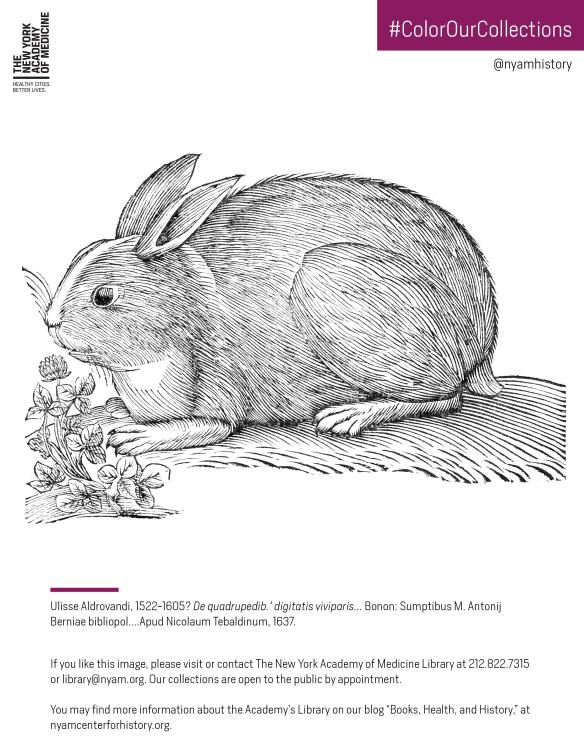
Today’s coloring sheets come from the works of the Italian naturalist Ulisse Aldrovandi, who documented living (and mythical) things of all sorts, from gentle, clover-eating rabbits to fearsome dragons. Aldrovandi (15221605) was a professor at the University of Bologna, and in 1568 he founded a botanic garden there. His interest in the natural sciences led him to gather specimens across Italy for study and inclusion in his natural history museum. Pope Gregory XIII, a relative, provided financial support for his works, but just four volumes were published before his death. Both books featured here, Serpentum et draconum historiae libri duo… and De quadrupedib.’ digitatis viviparis…, were published posthumously.

Rabbit in Ulisse Aldrovandi, De quadrupedib. digitatis viviparis, 1637. Click to download the PDF coloring sheet.

Rabbit in Ulisse Aldrovandi, De quadrupedib.’ digitatis viviparis …, 1637. Click to download the PDF coloring sheet.

Dragon from Ulisse Aldrovandi, Serpentum, et draconum historiae libri duo, 1640.

Dragon from Ulisse Aldrovandi, Serpentum, et draconum historiae libri duo, 1640.

Our featured coloring books of the day come from two institutions that, like us, focus on the history of medicine.

The Dittrick Museum’s coloring book may be the first one ever made to feature a picture of lice removal (from Hortus sanitatis, 1491). It also has other images from works of anatomical and natural history.

Lice removal. 1491. Hortus sanitatis. Mainz, Jabob Meydenbach. Courtesy of the Dittrick Museum.

Lice removal. 1491. Hortus sanitatis. Mainz, Jabob Meydenbach. Courtesy of the Dittrick Museum.

We love the coloring book from Oregon Health & Science University (OHSU)’s Historical Collections & Archives. Who can resist the skull on the cover, from Antonio Scarpa’s 1801 Saggio di osservazioni e d’esperienze sulle principali malattie degli occhi?

Scarpa, Antonio. Saggio di osservazioni e d’esperienze sulle principali malattie degli occhi.Pavia: B. Comino, 1801. Courtesy of OHSU Special Collections & Archives.

Scarpa, Antonio. Saggio di osservazioni e d’esperienze sulle principali malattie degli occhi.Pavia: B. Comino, 1801. Courtesy of OHSU Special Collections & Archives.

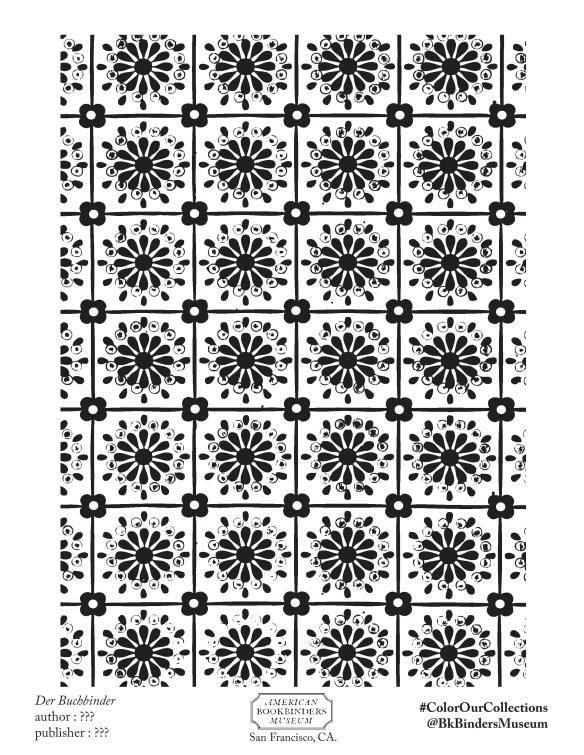
Yesterday’s shared coloring sheets also featured bookbinding and typography. The American Bookbinders Museum offered five images from its collection, including this pattern from Der Buchbinder:

From Der Buchbinder.

From Der Buchbinder.

UW-Milwaukee Special Collections featured typography on its Tumblr, historiated initials from a 1902 printing of The Psalter or Psalms of David from the Bible of Archbishop Cranmer. You can download these initials, along with another whole coloring book from the university.

Historiated R by C. R. Ashbee for his 1902 Essex House Press printing of The Psalter or Psalms of David from the Bible of Archbishop Cranmer. Courtesy of UW-Milwaukee Special Collections.

Historiated R by C. R. Ashbee for his 1902 Essex House Press printing of The Psalter or Psalms of David from the Bible of Archbishop Cranmer. Courtesy of UW-Milwaukee Special Collections.

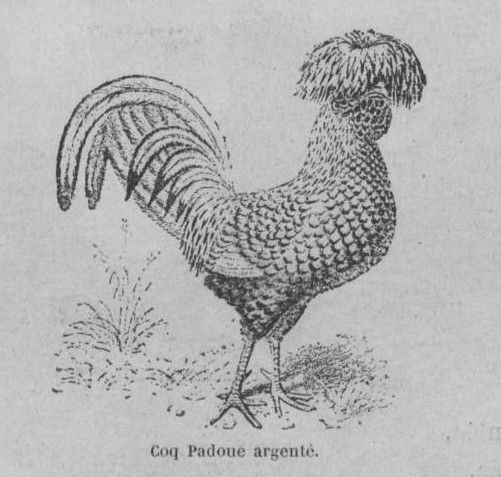
We also have to point out our only French participant thus far, Bibliothèque Bourguignonne. Their Pinterest album features some truly adorable chickens, including this one:

Coq Padoue argenté. Basse-cour, faisanderie et volière : l'élevage à la Croix-verte, Autun, par Et. Lagrange,... Nouvelle édition. 1892. Courtesy of Bibliothèque Bourguignonne.

Coq Padoue argenté. Basse-cour, faisanderie et volière : l’élevage à la Croix-verte, Autun, par Et. Lagrange,… Nouvelle édition. 1892. Courtesy of Bibliothèque Bourguignonne.

Keep following #ColorOurCollections on social media (don’t forget Facebook!), and keep an eye on our Pinterest boards, which feature images to be colored and colored-in sheets. On Friday, our final #ColorOurCollections post will include a list of all of the coloring books created and shared by participants.

#ColorOurCollections, Day 2

#ColorOurCollections-bannerfinal

It’s the second day of #ColorOurCollections, a week-long special collections coloring fest we’ve organized on social media. Yesterday, the number of participating cultural institutions grew from nearly 60 to nearly 100—thanks to all who are taking part (see our growing list)!

Every day on our blog, we will feature #ColorOurCollections coloring sheets from our library, along with content from participants worldwide. You can also download our full #ColorOurCollections coloring book.

Today’s coloring pages come from Bartolomeo Scappi’s Opera. Renaissance chef Scappi (ca. 1500–1577) cooked for six popes and was installed as chef at the Vatican while Michelangelo was completing the Sistine Chapel. His famous cookbook, first published in Venice in 1570, contains more than 1,000 recipes as well as charming and detailed illustrations showing the kitchens, implements, and culinary tools of a high-end Italian household. Here are two his illustrations; you can find three more in the full coloring book.

Scappi_Opera_cooking_1596

Coloring page from Bartolomeo Scappi’s Opera, 1596. Click to download the PDF coloring sheet.

Coloring page from Bartolomeo Scappi's <em>Opera</em>, 1596.

Coloring page from Bartolomeo Scappi’s Opera, 1596. Click to download the PDF coloring sheet.

Yesterday’s offering of #ColorOurCollections images was extraordinary. Today, we are thrilled to feature two coloring books and two image collections. The Massachusetts Historical Society’s book has fantastic images from its archives, including “Ralph Waldo Emerson’s Transparent Eyeball.”

"Ralph Waldo Emerson's Transparent Eyeball." Christopher P. Cranch journal, p. 10, 1839. Courtesy of the Massachusetts Historical Society.

“Ralph Waldo Emerson’s Transparent Eyeball.” Christopher P. Cranch journal, p. 10, 1839. Courtesy of the Massachusetts Historical Society.

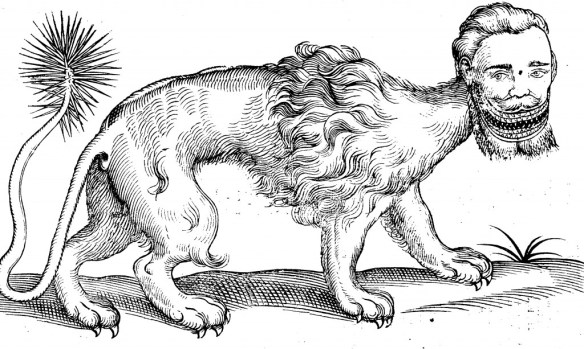
Duke University’s David M. Rubenstein Rare Book & Manuscript Library’s coloring book offers the once-in-a-lifetime opportunity to color a manticore.

Manitchora from The History of Four-Footed Beasts and Serpants by Edward Topsell. London, 1658. Courtesy of the David M. Rubenstein Rare Book & Manuscript Library.

Manitchora from The History of Four-Footed Beasts and Serpants by Edward Topsell. London, 1658. Courtesy of the David M. Rubenstein Rare Book & Manuscript Library.

We also love the image collections from DPLA and the Folger Library. Here’s a favorite DPLA offering:

Illustration from The history of the Caribby-islands , 1666. Courtesy of DPLA.

Illustration from The history of the Caribby-islands, 1666. Courtesy of DPLA.

And a Hamlet illustration from the Folger:

Illustration by John Austen for a 1922 edition of Shakespeare's Hamlet (ART Box A933 no.30). Courtesy of the Folger Library.

Illustration by John Austen for a 1922 edition of Shakespeare’s Hamlet (ART Box A933 no.30). Courtesy of the Folger Library.

In New York? Want to color with others? The New York Botanical Garden’s Mertz Library is hosting #ColorOurCollections coloring parties on Wednesday, February 3 and Friday, February 5, from 12pm–2pm.

Keep following #ColorOurCollections on your favorite social media outlets, and keep an eye on our Pinterest boards, where we are pinning images shared by participating special collections along with images colored by fans. On Friday, our final #ColorOurCollections post will include a list of all of the coloring books created and shared by participants.

#ColorOurCollections Begins!

It’s the first day of #ColorOurCollections, a week-long special collections coloring fest we’re organizing on social media. More than 50 institutions (see our growing list) will share images from their collections for you to download and color from now through Friday. You are invited to share your results using the hashtag.

Every day on our blog, we will feature two #ColorOurCollections coloring sheets from our library, along with content from participants worldwide. You can also download our full #ColorOurCollections coloring book.

Our first coloring sheet shows the five types of unicorns depicted in Pierre Pomet’s 1694 Histoire generale des drogues. The horns of these mythical creatures were believed to have medicinal properties, although, as Pomet admits, “unicorn horn” was usually the tusk of a narwhal. For more on Pomet and unicorns, read this blog post.

Click to download the PDF coloring sheet featuring the unicorns in Pomet, Histoire general des drogues, 1694.

Click to download the PDF coloring sheet featuring the unicorns in Pomet, Histoire general des drogues, 1694.

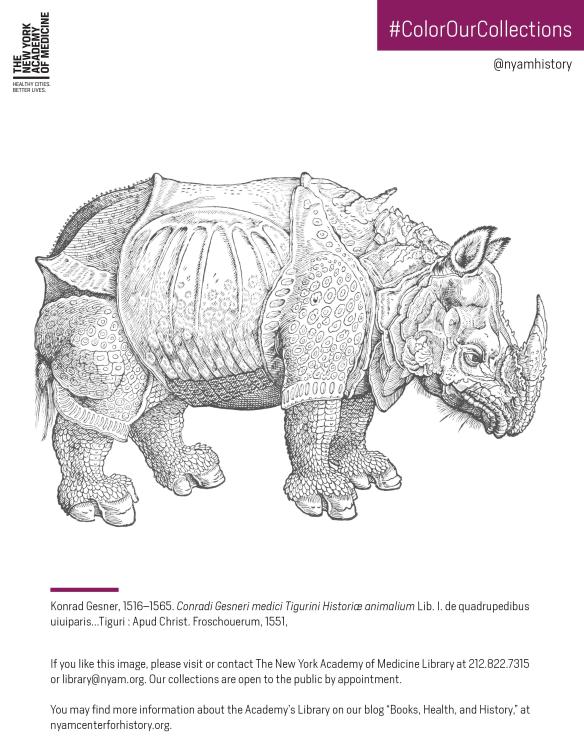
Our second coloring sheet features another horned animal, found in Gesner’s Historia animalium, Liber I. As we know, rhinoceroses do not have horns on their backs; Gesner’s rhino can be traced back to a 1515 print by Albrecht Durer, which was unsurprisingly not drawn from life. As unicorns and horned-back rhinos don’t exist, there’s no need to strive for realism. We’d love to see the most fantastically colorful beasts you can imagine! Don’t forget to tag @nyamhistory and include #ColorOurCollections.

Click to download the PDF coloring sheet featuring the rhino in Gesner, Historiae Animalium, Liber I, 1551

Click to download the PDF coloring sheet featuring the rhino in Gesner, Historiae Animalium, Liber I, 1551

We are thrilled that special collections across the pond agreed to join #ColorOurCollections, even with the Americanized spelling in the hashtag. Last week, the University of Strathclyde’s Archives and Special Collections, Europeana, and the Bodleian Libraries all released coloring books. Click on each organization to download, print, and color.

Page 4 of the coloring book from the University of Strathclyde’s Archives and Special Collections, featuring Tscep von wonders, Brussels, 1514?

Page 4 of the coloring book from the University of Strathclyde’s Archives and Special Collections, featuring Tscep von wonders, Brussels, 1514?

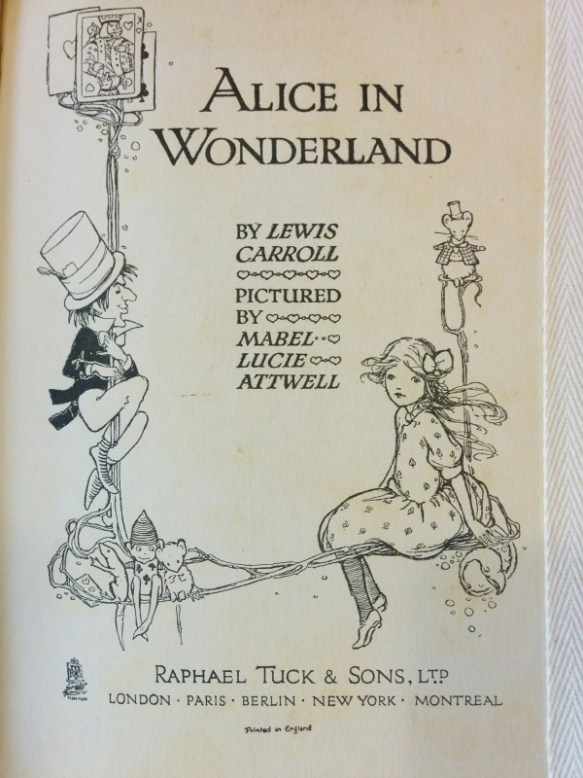
How do special collections decide which images to select for coloring? James Madison University Libraries Special Collections described their process on their blog. We especially love the Alice and Wonderland title page. Download their full coloring book.

A coloring page selected by James Madison University Libraries, featuring a 1910 illustrated copy of Alice in Wonderland.

A coloring page selected by James Madison University Libraries, featuring a 1910 illustrated copy of Alice in Wonderland.

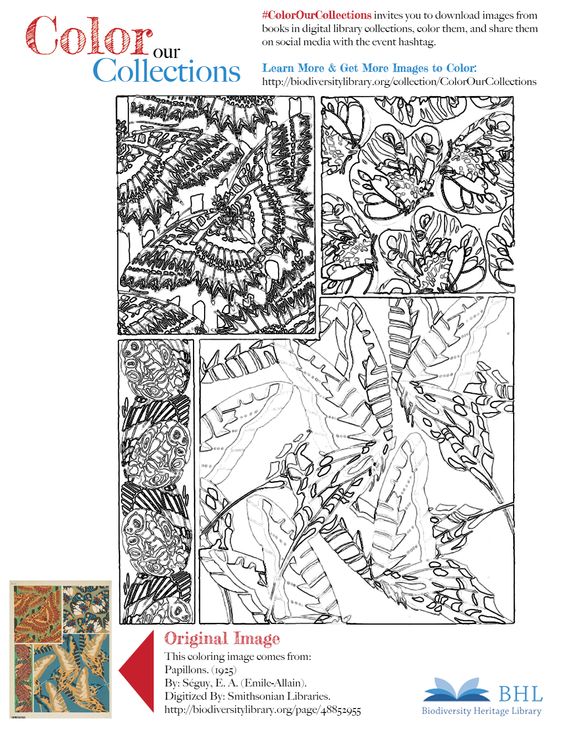
Our final feature of the day comes from the Biodiversity Heritage Library, a consortium of natural history and botanical libraries who will keep you coloring for years! Enjoy their unbelievable Flickr album with more than 1,000 images representing their member libraries. Still want more? Enjoy the coloring sheets on their Pinterest board, which you can also download in coloring book form.

A coloring sheet from the Biodiversity Heritage Library, featuring Seguy, Papillons, 1925.

A coloring sheet from the Biodiversity Heritage Library, featuring Seguy, Papillons, 1925.

Keep following #ColorOurCollections on your favorite social media outlets. And take a look at our Pinterest boards, where we are pinning images shared by participating special collections along with images colored by fans.