Fair Use at the New York Academy of Medicine Library

By Emily Miranker, Project Coordinator

As we go about our work at the library—sharing coloring pages featuring images from our collection, digitizing decades-old journal volumes, pointing people towards resources on the HathiTrust and Medical Heritage Library, among other endeavors—we keep something known as fair use in the back of our minds. It’s a legal doctrine that helps determine when it’s OK to use copyrighted material without explicit permission. This week, Fair Use/Fair Dealing Week, the doctrine moves front and center for an annual shout-out by libraries, universities, arts organizations, media groups, and other institutions. It’s a form of consciousness-raising and an opportunity to share examples of fair use in action.

Fair use isn’t particularly new—the codification of it in U.S. law is part of the 40-year old Copyright Act of 1976, with the concept of fair use going back even farther. Fair Use/Fair Dealing Week, by contrast, is just three years young. It was started by Harvard’s copyright advisor Kyle K. Courtney as a way of spotlighting and sharing the Association of Research Libraries’ Code of Best Practices in Fair Use for Academic and Research Libraries.1

Not a scholar or a librarian? Wondering if you really need to know how fair use works? Yes, you do. As a reader of this blog you’re a cultural consumer, but probably a cultural producer as well. We all routinely download, share, and often repurpose photos and videos, songs and TV clips, text, artwork, and sound bites. We create—and recreate—all the time. And we would like our creations to “reference the world around us without getting [us] into trouble” with copyright infringement. 2

This photo was shared under a Creative Commons Attribution License and was taken from the Flickr photostream of Timothy Vollmer.

This photo was shared under a Creative Commons Attribution License and was taken from the Flickr photostream of Timothy Vollmer.

Copyright law works for two constituencies, broadly speaking. It defends the interests of copyright holders, protecting the success of creators. It also protects use by cultural consumers of copyrighted materials for select purposes. Deciding when copyrighted materials can be used without permission is the subject of fair use, formally known as Section 107 of the Copyright Act of 1976. Section 107 sets out four factors for determining whether a use is fair: the purpose and character of the use; the nature of the copyrighted work; the portion of the copyrighted work used, and the effect of the use on the copyrighted work.

This very blog you’re reading is a frequent arena where we at the library have applied these fair-use tests as we share, curate, interpret, and provide access to the materials in our collections. Often our blog posts feature both images and selected quotes from copyrighted materials in our collections. Here’s a look at the doctrine’s four tests in relation to our intermittent blog series on advertisements in medical journals:

  • Purpose: The Academy Library has strong holdings in 20th-century journals, and highlighting them in online blog entries makes them more accessible to researchers and indeed anyone with an interest in medical history or Americana. Moreover, the Academy did not follow a common library practice of removing advertisements from journals. So we have a wealth of now nearly unique content we’re sharing, free, to eager historians and the public at large. Section 107 strongly favors this sort of education, transformative, and non-commercial use.
  • Nature: Typically this factor favors fair use if the underlying work is factual in nature as opposed to involving more creative expression, such as fiction or music. While advertisements take creativity to make, their relevance in our collection and to our users lies in the cultural and historical context they provide, a public benefit that goes to the heart of this factor.
  • Effect: This factor asks us to consider whether including images and quotes in posts harms the rights of the authors. Since we focus on the cultural and historical significance of these journal ads, our posts do not diminish or undermine their market.
  • Portion: The less you use, the more likely a use will be considered fair. With the short format of a blog post, images and quotes shared are always minimal in contrast to how many ads appear in a single journal.
Parke Davis ad in Hygeia Magazine, August 1945. Click to enlarge.

Parke Davis ad in Hygeia Magazine, August 1945. Click to enlarge.

What makes fair-use worthy of a week-long celebration is that “copyright law does not specify exactly how to apply fair use.3 Case law helps shape what is considered fair use, and industry standards guide everyday decision making. Best practices—not only the Association of Research Libraries’ code but also an increasing number of industry-specific standards for fields like journalism, documentary filmmakers, OpenCourseWare, poetry, and visual art—provide guidelines on fair use factors, facts, and community norms. To join the conversation on how to apply fair use, click on over to the feed of stories on Fair Use/Fair Dealing Week’s Tumblr.

References

1. Courtney, Kyle. “About Fair Use Week,” Copyright at Harvard (blog), Office for Scholarly Communication, Harvard University, 2014, https://blogs.harvard.edu/copyrightosc/about-fair-use-week/.

2. Patricia Aufderheide, Peter Jaszi, Reclaiming Fair Use: How to Put Balance Back in Copyright (Chicago, University of Chicago Press, 2011), ix.

3. “Code of Best Practices in Fair Use for Academic and Research Libraries.” Association of Research Libraries. Accessed January 20, 2016. http://www.arl.org/storage/documents/publications/code-of-best-practices-fair-use.pdf.

Special thanks to Professor Betsy Rosenblatt J.D., Director of the Center for Intellectual Property Law, Whittier Law School.

From Cholera to Zika: What History’s Pandemics Tell Us about the Next Contagion

By Sonia Shah

Sonia Shah, today’s guest blogger, is a science journalist and author of Pandemic: Tracking Contagions from Cholera to Ebola, and Beyond (Sarah Crichton Books/Farrar, Straus & Giroux, February 2016), from which this piece, including illustrations, is adapted.

On February 23 at 6pm, Shah will moderate the panel “Where Will the Next Pandemic Come From?,” cosponsored by the Pulitzer Center on Crisis Reporting. Register to attend.

Over the past 50 years, more than 300 infectious diseases have either newly emerged or re-emerged into territory where they’ve never been seen before. The Zika virus, a once-obscure pathogen from the forests of Uganda now rampaging across the Americas, is just the latest example. It joins a legion of other diseases that have similarly broken out of earlier constraints, including Ebola in West Africa, Middle East Respiratory Syndrome (MERS) in the Middle East, and novel avian influenzas in Asia, one of which hit the U.S poultry industry last spring, causing the biggest animal disease epidemic in U.S history.

When such pathogens spread like a wave across continents and global populations, they cause pandemics, from the Greek pan (“all”) and demos (“people”). Given the number of pathogens in our midst with pandemic-causing biological capacities, pandemics themselves are relatively rare. In modern history, only a few pathogens have been able to cause them: Yersinia pestis, which causes bubonic plague; variola, which causes smallpox; influenza A; HIV; and cholera.

Cholera is one of the history’s most successful pandemic-causing pathogens. The first cholera pandemic began in the Sundarbans in present-day Bangladesh in 1817. Since then, it has ravaged the planet in no fewer than seven pandemics, the latest of which is currently smoldering just a few hundred miles off the coast of Florida, in Haiti.

Cholera first perfected the art of pandemics by exploiting the rapid changes in transportation, trade, and demography unleashed by the dawn of the factory age. New, fast-moving transatlantic clipper ships and sailing packets, which moved millions of Europeans into North America, brought cholera to the New World in 1832. Thanks to the opening of the Erie Canal in 1825, the bacterial pathogen easily spread throughout the country, including into the canal’s southern terminus, New York City, which suffered repeated cholera epidemics over the course of decades.

The spread of cholera after the opening of the Erie Canal.

Cholera was well-poised to exploit the filth of 19th-century cities. The pathogen spreads through contaminated human waste. And outhouses, privies, and cesspools covered about 1/12 of New York City, none of which were serviced by sewer systems and few of which were ever emptied. (Those that were had their untreated contents unceremoniously dumped into the Hudson or East Rivers.) The contents of countless privies and cesspools spilled out into the streets, leaked into the city’s shallow street-corner wells, and trickled into the groundwater.

Even those who enjoyed piped water were vulnerable to the contagion. The company chartered by New York State to deliver drinking water to the city’s residents—the Manhattan Company, which started a bank now known as JPMorgan Chase—dug their well among the tenements of the notoriously crowded Five Points slum, in what is today part of Chinatown. They delivered the slum’s undoubtedly contaminated groundwater to one third of the city’s residents.

The 1832 cholera outbreak in New York City. the Manhattan Company, now JP Morgan Chase, sank its well amidst the privies and cesspools of the Five Points slum, atop the site of the Collection Pond, which had been filled in with garbage. The water was distributed to 1/3 of the city of New York.

The 1832 cholera outbreak in New York City. The Manhattan Company, now JP Morgan Chase, sank its well amidst the privies and cesspools of the Five Points slum, atop the site of the Collection Pond, which had been filled in with garbage. The water was distributed to 1/3 of the city of New York.

Just as the Zika and MERS viruses confound modern-day medicine, so too did cholera confound 19th-century medicine. Under the 2,000-year-old spell of miasmatism—the medical theory that diseases spread through stinky airs, or miasmas—doctors couldn’t bring themselves to admit that cholera spread through water, despite convincing contemporary evidence that it did.

But that doesn’t mean there was nothing that could have been done to mitigate the cholera pandemics of the 19th century.

The Manhattan Company knew the water they distributed was dirty. As a former director of the company admitted in 1810, Manhattan Company water was rich with its users’ “own evacuations, as well as that of their Horses, Cows, Dogs, Cats, and other putrid liquids so plentifully dispensed.” New Yorkers decried its smell and taste, which they variously derided as “abominable” and “nauseating.”1 They suspected, too, that the company’s water made them sick. “I have no doubt,” one letter writer opined to a local paper in 1830, “that one cause of the numerous stomach affections so common in this city is the impure, I may say poisonous nature of the pernicious Manhattan water which thousands of us daily and constantly use.”2

And New York’s physicians knew that cholera was coming down the Erie Canal and the Hudson River, heading straight for the city. Dr Lewis Beck, who collected the data mapped above admitted that the pattern of disease did “favor the idea that cholera is contagious,”3 and travelling down the waterways into New York City. So many people feared the migrants coming down the waterways during cholera outbreaks that residents of towns lining the canal refused to let passengers on passing boats disembark. In 1893, in fear of a cholera outbreak, an armed mob surrounded the cholera-infected passengers of the Normannia, a vessel recently arrived from Hamburg, Germany, trapping hundreds aboard for days.

But despite the public’s fears of contagion and contaminated water, little was done to protect the city from either. The city’s leadership refused to enact quarantines along the canal or the Hudson for fear of disrupting the lucrative shipping trade that had transformed New York from a backwater to the Empire State. The Manhattan Company retained its charter, despite public outcry about the quality of their water. The political machinations of the infamous Aaron Burr, pursuing his murderous rivalry with the now-storied founding father Alexander Hamilton, assured that.

Instead, each wave of deadly contagion was met with minor adjustments to society’s defenses against pathogens. International conferences began in 1851 to organize cross-border quarantines against cholera and other diseases. New York City opened its first independent health department, staffed by physicians rather than political appointees, in 1865, as cholera loomed (thanks in large part to the efforts of the New York Academy of Medicine). These reactive, incremental measures couldn’t stave off nearly a century of deadly cholera pandemics, but as the decades passed, they formed the foundation for the global health system we enjoy today. Following New York City’s example, independent health departments were built across the country. The international conferences to tame cholera led to the formation of the World Health Organization, in 1946.

Today, we continue to fight contagions in a similarly reactive, incremental fashion. After Ebola infected tens of thousands in West Africa and elsewhere, hospitals in the United States and other countries beefed up their investments in infection control. After mosquito-borne Zika infected millions across the Americas, public health agencies focused anew on the problem of disease-carrying insects.

Whether these measures will be sufficient to defuse the next pandemic remains to be seen. But a more comprehensive, proactive approach to defanging pandemics is now possible, too. The history of pandemics reveals the role of human activity in the emergence and spread of new pathogens. Industrial developments that disrupt wildlife habitat; rapid, ad hoc urbanization; intensive livestock farming; sanitary crises; and accelerated trade and travel all play a critical role, just as they did in cholera’s heyday. In some places, we can diminish the pathogenic threat these activities pose. In others, we can step up surveillance for new pathogens, using new microbial sleuthing techniques. And when we find the next pandemic-worthy pathogen, we can work to contain it—before it starts to spread.

References

1. Pandemic, p 64. From Koeppel, Gerard T. Water for Gotham: A history. Princeton University Press, 2001, 121, 141.

2. Pandemic, p 63. from Blake, Nelson Manfred. Water for the cities: A history of the urban water supply problem in the United States. No. 3. Syracuse University Press, 1995, 126.

3. Pandemic, p 106. from Tuite, Ashleigh R., Christina H. Chan, and David N. Fisman. “Cholera, canals, and contagion: Rediscovering Dr Beck’s report.” Journal of public health policy 32.3 (2011): 320-333.

Announcing our 2016 Programming

The brochure of our 2016 programming in medicine, history, and the humanities is now available. We are excited by the range of presenters, topics, and themes we are presenting this year; we think there’s something for everyone and hope you agree.

Click to download the 2016 Cultural Programming brochure.

Click to download the 2016 Cultural Programming brochure.

This year’s special series is “Changemakers: Activism and Advocacy for Health,” showcasing the role of activism in creating change in medicine and health. Join us to hear Alice Dreger reflect on the impact of 25 years of advocacy by the Intersex Patient Rights Movement; Merlin Chowkwanyun explore New York City health activism in the 1970s and the activities of the Lincoln Collective; Diane Kiesel describe the legacy of African American obstetrician and civil rights activist Dorothy Ferebee; and Gabriela Soto Laveaga discuss medical activism in Mexico, asking what it means to be a physician activist in a middle income or poor country.

This year’s history of medicine series includes a look at the historical and cultural context of a number of today’s urgent health challenges. Sonia Shah moderates a panel exploring the history and future of emerging diseases, and the social, political, and scientific drivers that turn these new pathogens into pandemics; Alondra Nelson examines The Social Life of DNA, looking at how the double helix has wound its way into the heart of contemporary social issues around race; and Scott Podolsky analyzes the far-reaching history of antibiotics and their use, and the implications of this history for the emerging possibility of a “post-antibiotic” era.

Other highlights include our second  “After Hours” series with Atlas Obscura featuring highlights of our rare book collections, and our annual Friends of the Rare Book Room lecture with Caroline Duroselle-Melish, who explores the illustrations of last great Renaissance encyclopedia of natural history.

Our annual Friends lecture is open to all. Our Friends of the Rare Book Room also receive invites to special lectures, programs, behind-the-scenes excursions, receptions, and visits to private collections. Join the Friends at any level before the annual Friends lecture to receive our tote bag and an invitation to the post-lecture reception on April 6.

Download our 2016 programming brochure for more details about all these events and more. Additional programming, including interactive workshops and reading groups, will be announced throughout the year. Sign up here to keep up to date with the latest news.

We look forward to seeing you throughout the year!

What a Boy Scout Merit Badge Tells Us About the History of Public Health

By Johanna Goldberg, Information Services Librarian

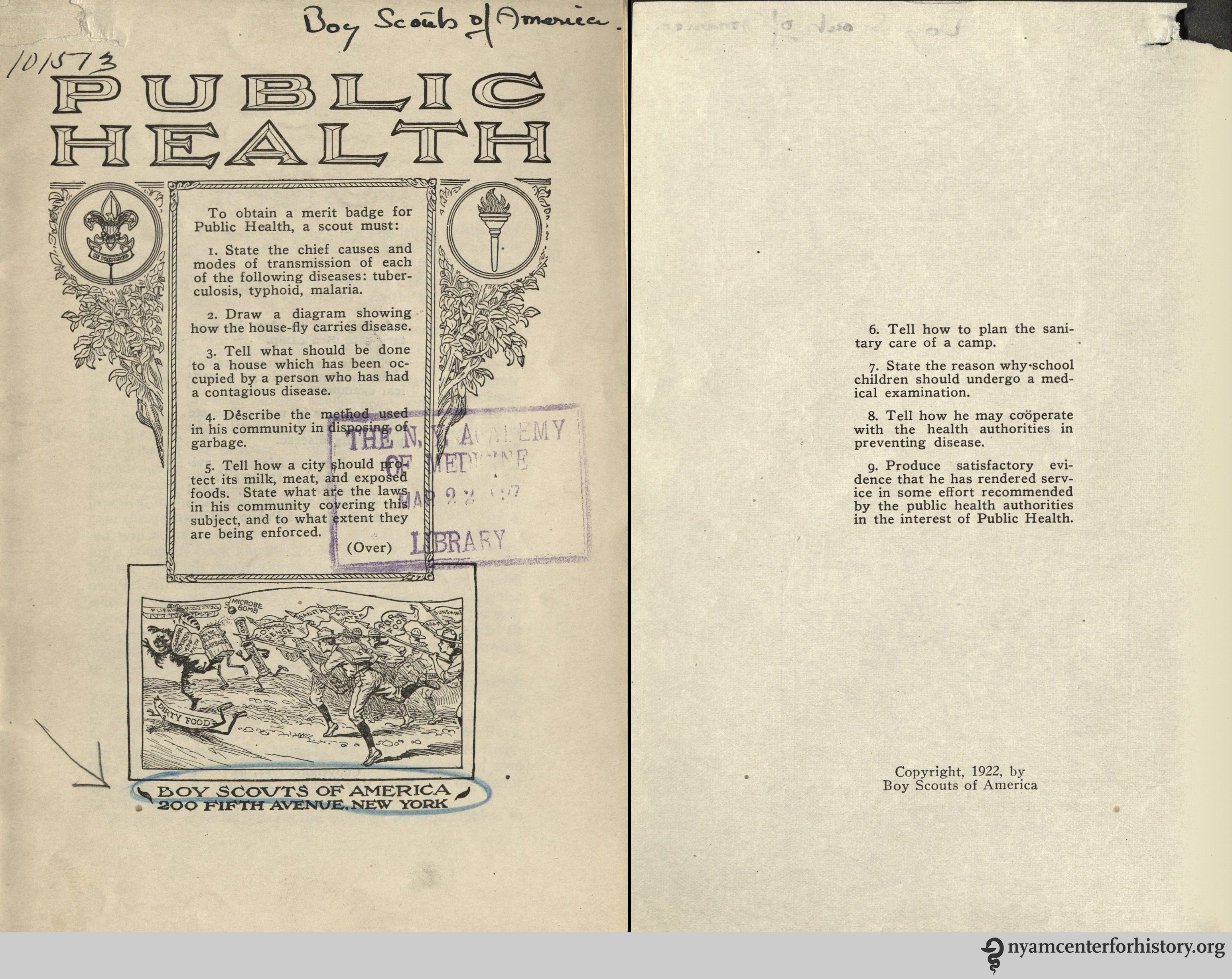
This month, the Boy Scouts of America celebrated its 106th birthday. To mark the occasion, we are featuring at a pamphlet from our collection, called simply Public Health.

In 1922, the Boy Scouts published the pamphlet as one of a series designed for scouts to study in order to receive merit badges. Though as the pamphlet states:

“It would defeat one of the purposes of these merit badge tests if any attempt were made in a pamphlet of this character to so completely cover the requirements as to remove the necessity for the boy to use his own initiative and show his resourcefulness in seeking sufficiently complete information and practical experience to enable him to successfully pass the test.”1

What was on the test? The cover explains:

The cover and inside cover of Public Health, 1922.

The cover and inside cover of Public Health, 1922. Click to enlarge.

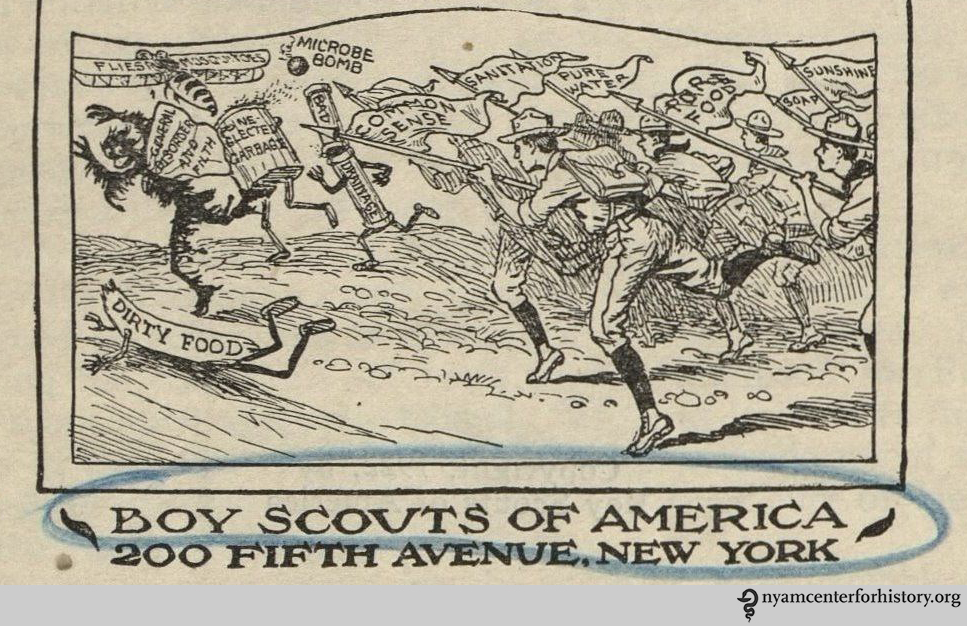
We can’t resist a close up of the cartoon at the bottom of the cover, showing how boy scouts with knowledge of public health best practices chase away causes of disease, from bad sanitation and drainage to flies and mosquitoes to “general disorder and filth.”1

A close-up of the cartoon on the cover of Public Health, 1922.

A close-up of the cartoon on the cover of Public Health, 1922.

The Boy Scouts of America still offer a merit badge in public health. Interestingly, many of the requirements are strikingly similar to their 1922 counterparts. Today’s scouts must explain disease transmission (though diseases have changed from tuberculosis, typhoid, and malaria to E. coli, tetanus, AIDS, encephalitis, salmonellosis, and Lyme disease). Instead of drawing a house-fly and showing how it carries disease, boy scouts today have to discuss how to control insects and rodents to prevent them from introducing pathogens.2

The major difference between today’s test and that of 1922 is the addition of a question about immunization. Today’s scouts must define the term and discuss diseases that can and cannot be prevented through immunization. In 1920, 7,575 Americans died of measles, 13,170 died of diphtheria, and 5,099 died of pertussis.3 In 1922, the only vaccine recommended for universal use in children was smallpox. By the end of the 1920s, diphtheria, pertussis, and tetanus joined that list, followed by polio, measles, mumps, and rubella in the 1960s and 70s.3 Today, there are 15 vaccine-preventable childhood diseases.4

While many of the same public health issues have remained at the forefront since 1922, our means of responding to them have progressed. If there is still a test for a public health merit badge in another 94 years, one hopes that the questions will reflect even more advances in prevention and control of disease.

References

1. Public Health. Boy Scouts of America; 1922.

2. Public Health. Available at: http://www.scouting.org/Home/BoyScouts/AdvancementandAwards/MeritBadges/mb-PUBH.aspx. Accessed February 10, 2016.

3. Achievements in Public Health, 1900-1999 Impact of Vaccines Universally Recommended for Children — United States, 1990-1998. MMWR Wkly. 1999;48(12):243–248. Available at: http://www.cdc.gov/mmwr/preview/mmwrhtml/00056803.htm#00003752.htm. Accessed February 10, 2016.

4. Vaccines: VPD-VAC/Childhood VPD. Available at: http://www.cdc.gov/vaccines/vpd-vac/child-vpd.htm. Accessed February 10, 2016.

#ColorOurCollections, Day 4

#ColorOurCollections-bannerfinal

It’s the fourth day of #ColorOurCollections, a week-long special collections coloring fest we’ve organized on social media. We are astonished by the week’s popularity: more than 160 organizations are participating (See our growing list).

Every day on our blog, we will feature #ColorOurCollections coloring sheets from our library, along with content from participants worldwide. You can also download our full #ColorOurCollections coloring book.

Today’s coloring sheets come from Dutch anatomist Govard Bidloo and English horticulturist Elizabeth Blackwell.

The atlas of Bidloo (1649-1713), published in 1685, attempted to show the body in a quite different way from his predecessor, Andreas Vesalius. The skeleton in this image is depicted climbing out of his open grave, hourglass in hand and silky shroud tossed recklessly aside. Bidloo’s talented artist Gerard de Lairesse studied with Rembrandt but embraced a more neoclassical tone than his teacher.

Skeleton in Bidloo's Anatomia hvmani corporis..., 1685.

Skeleton in Bidloo’s Anatomia hvmani corporis…, 1685. Click to download a PDF of the coloring page.

Elizabeth Blackwell was a triple-threat: the author, artist and engraver published her Curious Herbal in 1739, which quickly became an invaluable resource for apothecaries and doctors well beyond the 18th century. Blackwell undertook the publication of the book to raise funds to release her husband from debtor’s prison. During visits at Highgate Prison where he was installed, he supplied the names of the book’s plants in Greek and Latin. Many copies of the book were hand-colored by Blackwell herself. This one is begging to be hand-colored by you!

Orange tree in Blackwell's A Curious Herbal, 1739.

Orange tree in Blackwell’s A Curious Herbal, 1739. Click to download a PDF of the coloring page.

Today, we’d like to feature the work of the colorers! There are a tremendous number of colored images to choose from—take a look at our Pinterest board for more. (We also have a board of images from participating institutions just waiting to be colored.)

If Twitter and Instagram are any indication, some of the most popular pages to color come from the Smithsonian Libraries coloring book, tied to its new exhibit “Color in a New Light.”

We’ve seen a number of takes on J. Romilly Allen’s Celtic art in pagan and Christian times (page 169):

https://twitter.com/bxknits/status/694991869743357952

And we love this painted frontispiece from Plastik; Sinfonie des Lebens by Oswald Herzog (1921).

https://www.instagram.com/p/BBS7W7SsPdN/

The Chemical Heritage Foundation’s vintage ad for DDT was too enticing for Twitter user Miss N. Thrope to pass up:

Nicole Kearney turned Biodiversity Heritage Library Australia’s image of a bearded dragon into a work of art:

The National Library of Medicine went astronomical for its first #ColorOurCollections contribution. Twitter user Michelle Ebere was up to the challenge:

Instagram user @artofstriving took her inspiration from an image from Walter de la Mare’s Down-adown-derry: A Book of Fairy Poems with illustrations by Dorothy P. Lathrop (1922), shared in the University of Missouri Libraries’ coloring book.

https://www.instagram.com/p/BBUAybxO1Ih/

Keep the coloring coming! And stay tuned: tomorrow, our final #ColorOurCollections post will include a list of all of the coloring books created and shared this week.

#ColorOurCollections, Day 3

#ColorOurCollections-bannerfinal

It’s the third day of #ColorOurCollections, a week-long special collections coloring fest we’ve organized on social media. Yesterday, we reached more than 125 participating cultural institutions! (See our growing list.)

Every day on our blog, we will feature #ColorOurCollections coloring sheets from our library, along with content from participants worldwide. You can also download our full #ColorOurCollections coloring book.

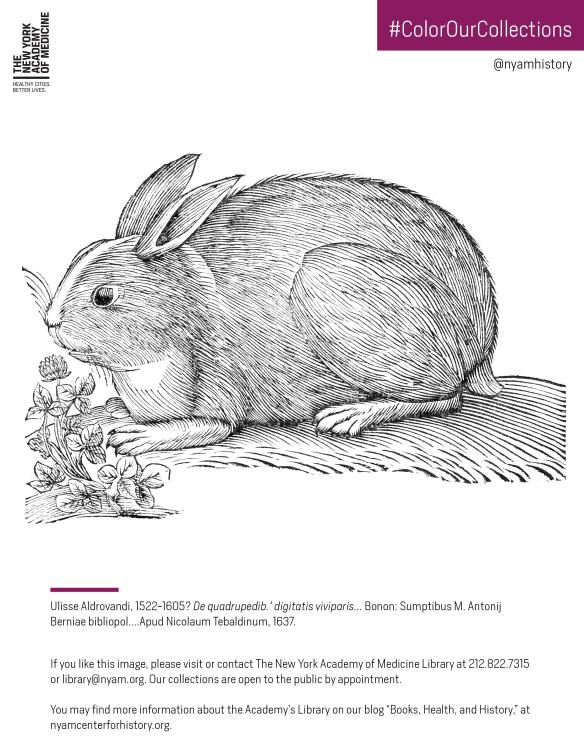
Today’s coloring sheets come from the works of the Italian naturalist Ulisse Aldrovandi, who documented living (and mythical) things of all sorts, from gentle, clover-eating rabbits to fearsome dragons. Aldrovandi (15221605) was a professor at the University of Bologna, and in 1568 he founded a botanic garden there. His interest in the natural sciences led him to gather specimens across Italy for study and inclusion in his natural history museum. Pope Gregory XIII, a relative, provided financial support for his works, but just four volumes were published before his death. Both books featured here, Serpentum et draconum historiae libri duo… and De quadrupedib.’ digitatis viviparis…, were published posthumously.

Rabbit in Ulisse Aldrovandi, De quadrupedib. digitatis viviparis, 1637. Click to download the PDF coloring sheet.

Rabbit in Ulisse Aldrovandi, De quadrupedib.’ digitatis viviparis …, 1637. Click to download the PDF coloring sheet.

Dragon from Ulisse Aldrovandi, Serpentum, et draconum historiae libri duo, 1640.

Dragon from Ulisse Aldrovandi, Serpentum, et draconum historiae libri duo, 1640.

Our featured coloring books of the day come from two institutions that, like us, focus on the history of medicine.

The Dittrick Museum’s coloring book may be the first one ever made to feature a picture of lice removal (from Hortus sanitatis, 1491). It also has other images from works of anatomical and natural history.

Lice removal. 1491. Hortus sanitatis. Mainz, Jabob Meydenbach. Courtesy of the Dittrick Museum.

Lice removal. 1491. Hortus sanitatis. Mainz, Jabob Meydenbach. Courtesy of the Dittrick Museum.

We love the coloring book from Oregon Health & Science University (OHSU)’s Historical Collections & Archives. Who can resist the skull on the cover, from Antonio Scarpa’s 1801 Saggio di osservazioni e d’esperienze sulle principali malattie degli occhi?

Scarpa, Antonio. Saggio di osservazioni e d’esperienze sulle principali malattie degli occhi.Pavia: B. Comino, 1801. Courtesy of OHSU Special Collections & Archives.

Scarpa, Antonio. Saggio di osservazioni e d’esperienze sulle principali malattie degli occhi.Pavia: B. Comino, 1801. Courtesy of OHSU Special Collections & Archives.

Yesterday’s shared coloring sheets also featured bookbinding and typography. The American Bookbinders Museum offered five images from its collection, including this pattern from Der Buchbinder:

From Der Buchbinder.

From Der Buchbinder.

UW-Milwaukee Special Collections featured typography on its Tumblr, historiated initials from a 1902 printing of The Psalter or Psalms of David from the Bible of Archbishop Cranmer. You can download these initials, along with another whole coloring book from the university.

Historiated R by C. R. Ashbee for his 1902 Essex House Press printing of The Psalter or Psalms of David from the Bible of Archbishop Cranmer. Courtesy of UW-Milwaukee Special Collections.

Historiated R by C. R. Ashbee for his 1902 Essex House Press printing of The Psalter or Psalms of David from the Bible of Archbishop Cranmer. Courtesy of UW-Milwaukee Special Collections.

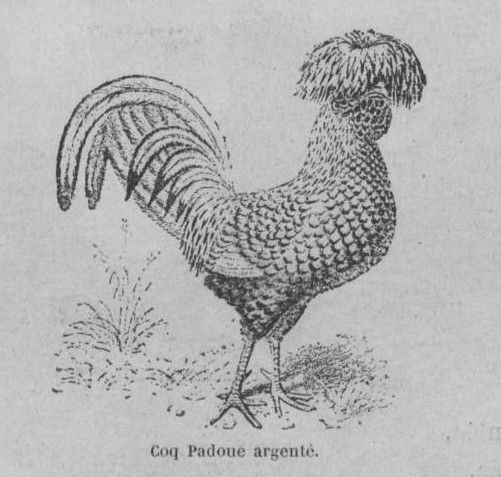
We also have to point out our only French participant thus far, Bibliothèque Bourguignonne. Their Pinterest album features some truly adorable chickens, including this one:

Coq Padoue argenté. Basse-cour, faisanderie et volière : l'élevage à la Croix-verte, Autun, par Et. Lagrange,... Nouvelle édition. 1892. Courtesy of Bibliothèque Bourguignonne.

Coq Padoue argenté. Basse-cour, faisanderie et volière : l’élevage à la Croix-verte, Autun, par Et. Lagrange,… Nouvelle édition. 1892. Courtesy of Bibliothèque Bourguignonne.

Keep following #ColorOurCollections on social media (don’t forget Facebook!), and keep an eye on our Pinterest boards, which feature images to be colored and colored-in sheets. On Friday, our final #ColorOurCollections post will include a list of all of the coloring books created and shared by participants.

#ColorOurCollections Begins!

It’s the first day of #ColorOurCollections, a week-long special collections coloring fest we’re organizing on social media. More than 50 institutions (see our growing list) will share images from their collections for you to download and color from now through Friday. You are invited to share your results using the hashtag.

Every day on our blog, we will feature two #ColorOurCollections coloring sheets from our library, along with content from participants worldwide. You can also download our full #ColorOurCollections coloring book.

Our first coloring sheet shows the five types of unicorns depicted in Pierre Pomet’s 1694 Histoire generale des drogues. The horns of these mythical creatures were believed to have medicinal properties, although, as Pomet admits, “unicorn horn” was usually the tusk of a narwhal. For more on Pomet and unicorns, read this blog post.

Click to download the PDF coloring sheet featuring the unicorns in Pomet, Histoire general des drogues, 1694.

Click to download the PDF coloring sheet featuring the unicorns in Pomet, Histoire general des drogues, 1694.

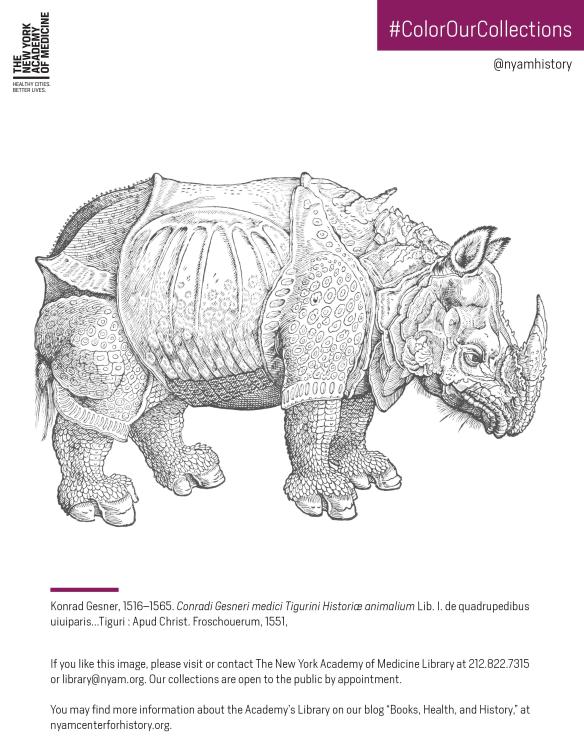
Our second coloring sheet features another horned animal, found in Gesner’s Historia animalium, Liber I. As we know, rhinoceroses do not have horns on their backs; Gesner’s rhino can be traced back to a 1515 print by Albrecht Durer, which was unsurprisingly not drawn from life. As unicorns and horned-back rhinos don’t exist, there’s no need to strive for realism. We’d love to see the most fantastically colorful beasts you can imagine! Don’t forget to tag @nyamhistory and include #ColorOurCollections.

Click to download the PDF coloring sheet featuring the rhino in Gesner, Historiae Animalium, Liber I, 1551

Click to download the PDF coloring sheet featuring the rhino in Gesner, Historiae Animalium, Liber I, 1551

We are thrilled that special collections across the pond agreed to join #ColorOurCollections, even with the Americanized spelling in the hashtag. Last week, the University of Strathclyde’s Archives and Special Collections, Europeana, and the Bodleian Libraries all released coloring books. Click on each organization to download, print, and color.

Page 4 of the coloring book from the University of Strathclyde’s Archives and Special Collections, featuring Tscep von wonders, Brussels, 1514?

Page 4 of the coloring book from the University of Strathclyde’s Archives and Special Collections, featuring Tscep von wonders, Brussels, 1514?

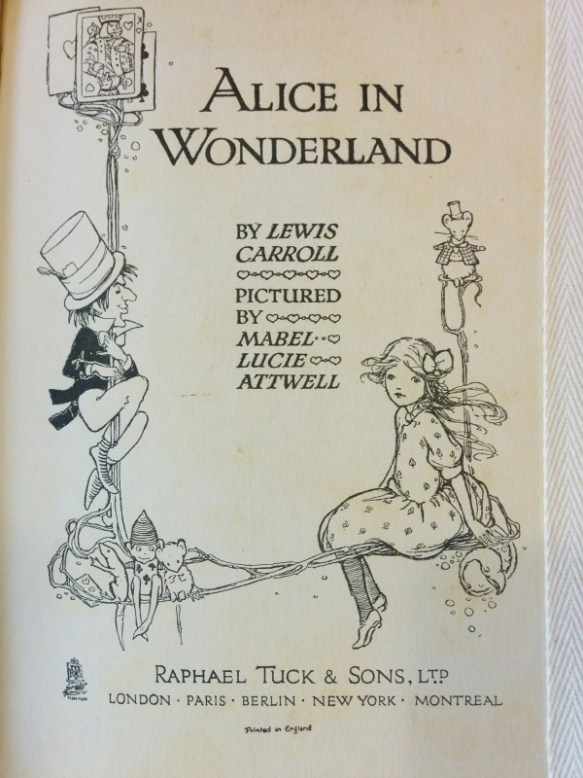
How do special collections decide which images to select for coloring? James Madison University Libraries Special Collections described their process on their blog. We especially love the Alice and Wonderland title page. Download their full coloring book.

A coloring page selected by James Madison University Libraries, featuring a 1910 illustrated copy of Alice in Wonderland.

A coloring page selected by James Madison University Libraries, featuring a 1910 illustrated copy of Alice in Wonderland.

Our final feature of the day comes from the Biodiversity Heritage Library, a consortium of natural history and botanical libraries who will keep you coloring for years! Enjoy their unbelievable Flickr album with more than 1,000 images representing their member libraries. Still want more? Enjoy the coloring sheets on their Pinterest board, which you can also download in coloring book form.

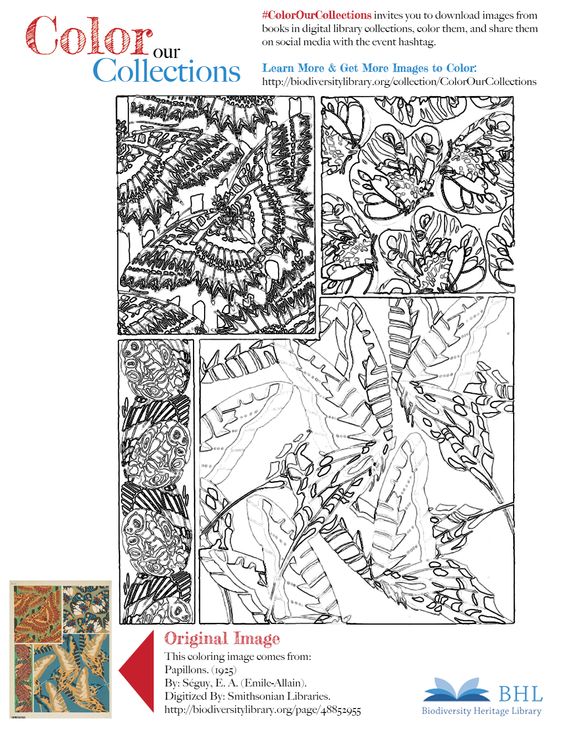
A coloring sheet from the Biodiversity Heritage Library, featuring Seguy, Papillons, 1925.

A coloring sheet from the Biodiversity Heritage Library, featuring Seguy, Papillons, 1925.

Keep following #ColorOurCollections on your favorite social media outlets. And take a look at our Pinterest boards, where we are pinning images shared by participating special collections along with images colored by fans.

Coming Soon at the Center: Gessner, Coloring, Lobotomy, Digital Humanities

The coming weeks are busy ones for the Center for the History of Medicine and Public Health. We hope you’ll join us for these upcoming events.

Ann Blair

Ann Blair

This Saturday, January 30, at 11 am, Harvard historian Ann Blair will give a free Bibliography Week lecture, Credit, thanks, and blame in the works of Conrad Gessner (1516-1565).” Blair will show how the Zürich physician and natural historian used the print medium to promote his forth-coming publications. Gessner also sought contributions of manuscripts, images, and help from scholars all over Europe. Register online.

February 1-5 is #ColorOurCollections Week, a special collections coloring fest we’ve organized on social media. More than 30 institutions will share images from their collections, and followers are invited to color the images and share their results. Email us at library@nyam.org for more details; we’ll add your institution to our Twitter list if you’d like to participate. Watch the hashtag and join in the fun! And watch this space: We’ll feature coloring content on the blog all next week.

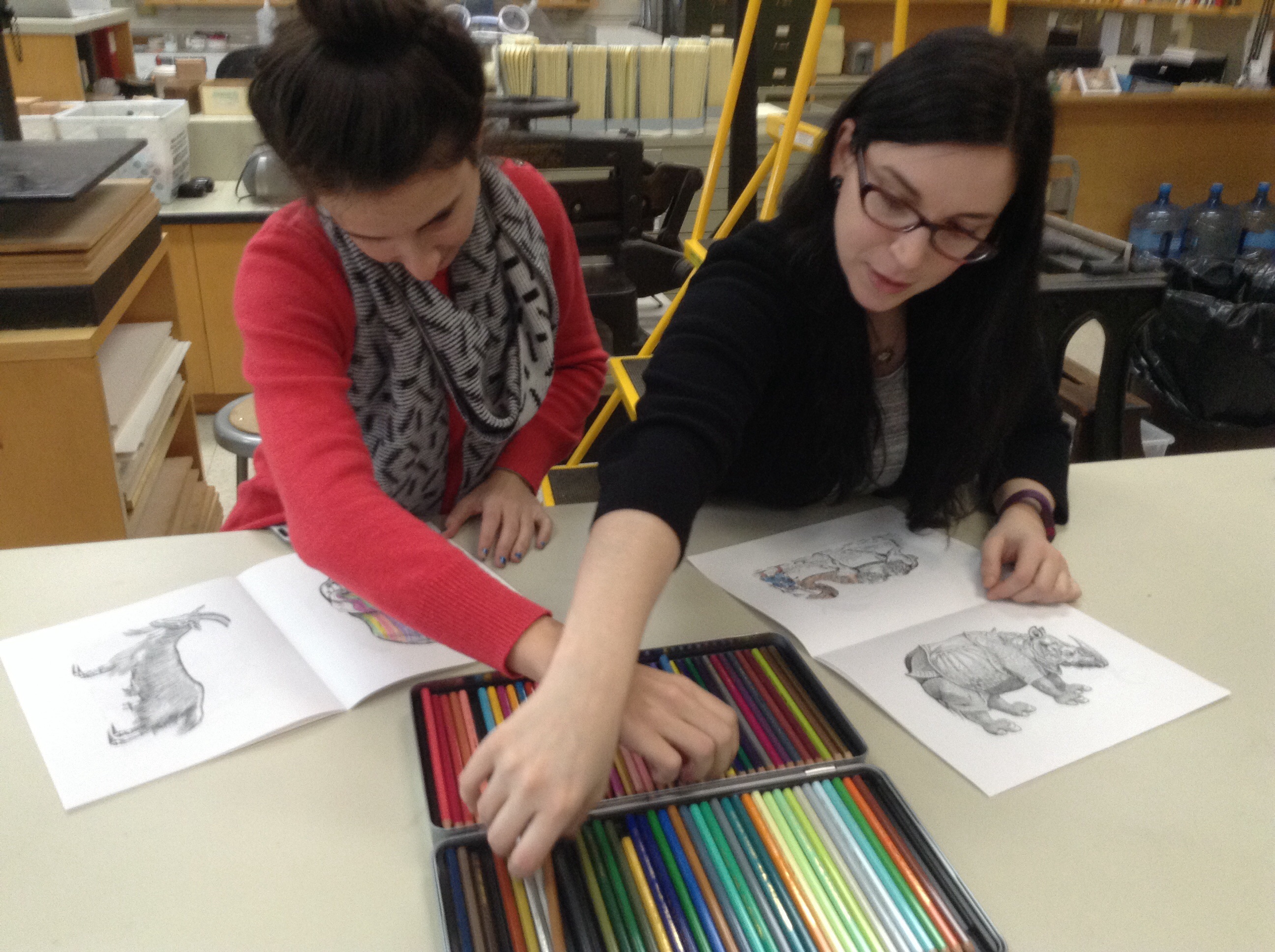
Collections Care Assistant Emily Moyer and Archivist Rebecca Pou #ColorOurCollections.

Collections Care Assistant Emily Moyer and Archivist Rebecca Pou #ColorOurCollections.

Miriam Posner

Miriam Posner

On February 9 at 6 pm, Miriam Posner, University of California, Los Angeles, will offer a free lecture Walter Freeman and the Visual Culture of Lobotomy.” Between 1936 and 1967, Freeman, a prominent neurologist, lobotomized as many as 3,500 Americans. Freeman also took patients’ photographs before their operations and years—even decades—later. Posner will detail her efforts to understand why Freeman was so devoted to photography, using computer-assisted image-mining and analysis techniques. This lecture will appeal to a wide-range of interests, including medical photography, data analysis, mid-twentieth century America, and the history of mental health. Register online.

Heidi Knoblauch

Heidi Knoblauch

The following day from 1 pm–5 pm, Posner will be joined by Heidi Knoblauch, Bard College, for a “Digital Humanities: Visualizing Data” workshop. The program will begin with a discussion of what people mean when they say “digital humanities,” followed by a hands-on section on how to find and structure data using Palladio, a tool for visualizing humanities data. The workshop costs $25 and is limited to 30 participants. Register online.

We hope to see you online and at our on-site events!

Dr. David Hosack, Physician to Hamilton and Burr

By Johanna Goldberg, Information Services Librarian

With Hamilton-mania sweeping the nation, we’re not throwing away our shot to discuss the physician present at the infamous 1804 Hamilton-Burr duel, Dr. David Hosack.

Hosack was born in New York City in 1769. Like Alexander Hamilton, he attended Kings College (now Columbia University), then transferred to Princeton. After graduating in 1789, he received his medical education from the University of Pennsylvania.1 He briefly practiced in Alexandria, Virginia and New York, then went to Edinburgh and London to further his medical education. These travels both increased his medical knowledge and nurtured his interest in botany and botanical gardens. In 1801, this life-long interest led to Hosack’s founding of the Elgin Botanical Garden, the first garden of its kind in the United States, located where Rockefeller Center stands today.1,2

By 1794, Hosack had returned to New York City. He formed a medical practice with noted physician Samuel Bard and gained a reputation for the successful treatment of yellow fever.2 As his practice grew, he counted among his patients New York’s elite. Not only did Hosack provide care for Hamilton and his family (including at the deathbeds of both Hamilton and his son, Philip, after their two deadly duels), he also served as physician to Aaron Burr and his daughter and close confidant, Theodosia Burr Alston.3 Our collection includes numerous manuscript materials from Hosack relating to his practice, including copies of a letter to Theodosia and one to her husband, Joseph Alston. These letters give a sense of Hosack’s warmth and dedication to his patients.

Theodosia Burr Alston, 1802. Portrait by John Vanderlyn. Courtesy of the New-York Historical Society.

Theodosia was an educated woman; her father supervised her rigorous studies. In 1801 at age 18, she married Joseph Alston, 22, a member of the South Carolina legislature and a future governor of the state. After the birth of their son Aaron Burr Alston in 1802, Theodosia’s health declined.4

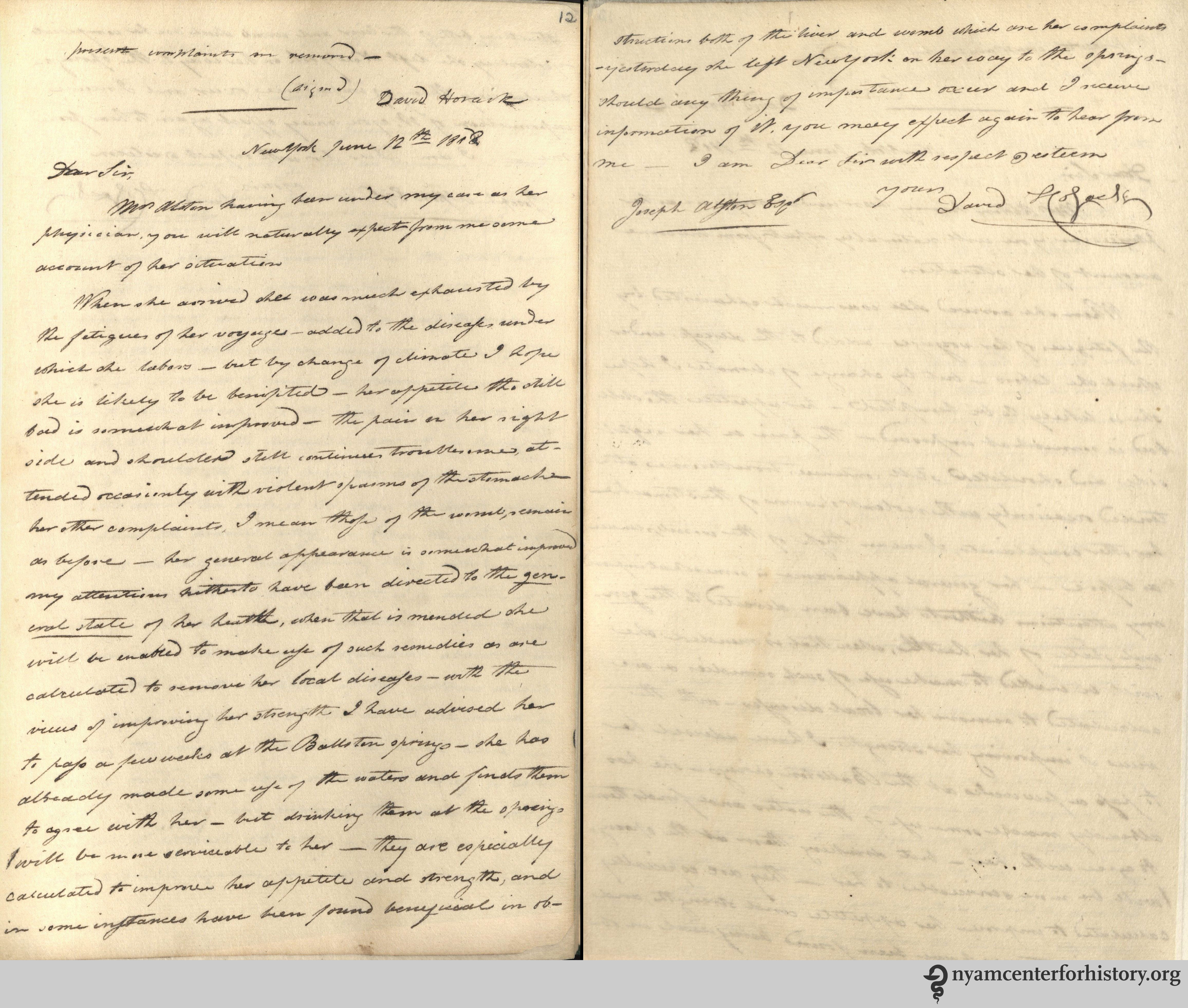
Hosack’s letter to Joseph Alston from June 12, 1808 begins: “Mrs. Alston having been under my care as her physician, you will naturally expect from me some account of her situation.” Theodosia had recently traveled to New York, and text that follows describes the effect of her journey on her health:

When she arrived she was much exhausted by the fatigue of her voyages—added to the diseases under which she labors—but by change of climate I hope she is likely to be benefited—her appetite tho still bad is somewhat improved—the pain on her right side and shoulder still continue troublesome, attended occasionally with violent spasms of the stomach and her other complaints, I mean those of the womb, remain as before—her general appearance is somewhat improved. My attentions hitherto have been directed to the general state of her health, when that is mended she will be enabled to make use of such remedies as are calculated to remove her local diseases—with the views of improving her strength. I have advised her to pass a few weeks at the Ballston Springs—she has already made some use of the waters and finds them to agree with her—but drinking them at the springs will be more serviceable to her—they are especially calculated to improve her appetite and strength, and in some instances have been found beneficial in obstructions both of the liver and womb which are her complaints—yesterday she left New York on her way to the springs—should any thing of importance occur and I receive information of it, you may expect again to her from me.

I am Dear Sir with respect and esteem

Your

David Hosack

Recto and verso of a copy of David Hosack's letter to Joseph Alston. In: D. Hosack. Copies of Letters and Documents 1801-1826.

Recto and verso of a copy of David Hosack’s June 12, 1808 letter to Joseph Alston. In: D. Hosack. Copies of Letters and Documents, 1801-1826. Click to enlarge.

By August 20, Theodosia’s health improved sufficiently that Hosack provided her with one of the remedies mentioned in his letter to her husband two months prior. The copy of the letter to Theodosia (written in a messier hand than the one to her husband) tells her what to eat and avoid while on the medication (“be careful to avoid acids and stimulant foods—lemonade, the acid fruits – spices,” instead eating “soups – milk – eggs – arrowroot – tapioca – rice – puddings etc.”). Hosack also recommended that two to three baths per week would “be useful in lessening your pain at the same time that it will give more effect to the medicine now directed.”

David Hosack’s August 20, 1808 letter to Theodosia Burr Alston. In: D. Hosack. Copies of Letters and Documents, 1801-1826. Click to enlarge.

Theodosia died young, but not due to her lingering post-partum health problems. In January 1813, just seven months after the death of her son, she was aboard the ship Patriot when it disappeared off the coast of Cape Hatteras on its way to New York. While stormy weather most likely caused the ship’s loss, some believed that pirates were to blame.4,5

Portion of page 59 of the January 12, 1913 New York Times. Click to enlarge.

Portion of page 59 of the January 12, 1913 New York Times. Click to enlarge.

David Hosack died of a stroke in 1835.1 His son, pioneering surgeon Alexander Eddy Hosack, took on much of his father’s practice, including the care of Aaron Burr.6,7 Alexander’s New York Times obituary noted:

It is said that on one occasion [Alexander Hosack] asked Mr. Burr if he did not experience contrition at times for having shot Hamilton. Burr, with an expression of stern feeling, replied with emphasis: ‘No, Sir; I could not regret it. Twice he crossed my path. He brought it on himself.’

Aside from his treatment of elite patients like Burr, Alexander Hosack (1805–1871) made a name for himself through his medical endeavors. Like his father, he received his medical degree from the University of Pennsylvania, after which he worked as a doctor in Paris for three years. He was the first doctor in New York City to use ether during surgery, and he developed a number of surgical instruments. In addition, he helped establish the Emigrants’ Hospital on Ward’s Island.6

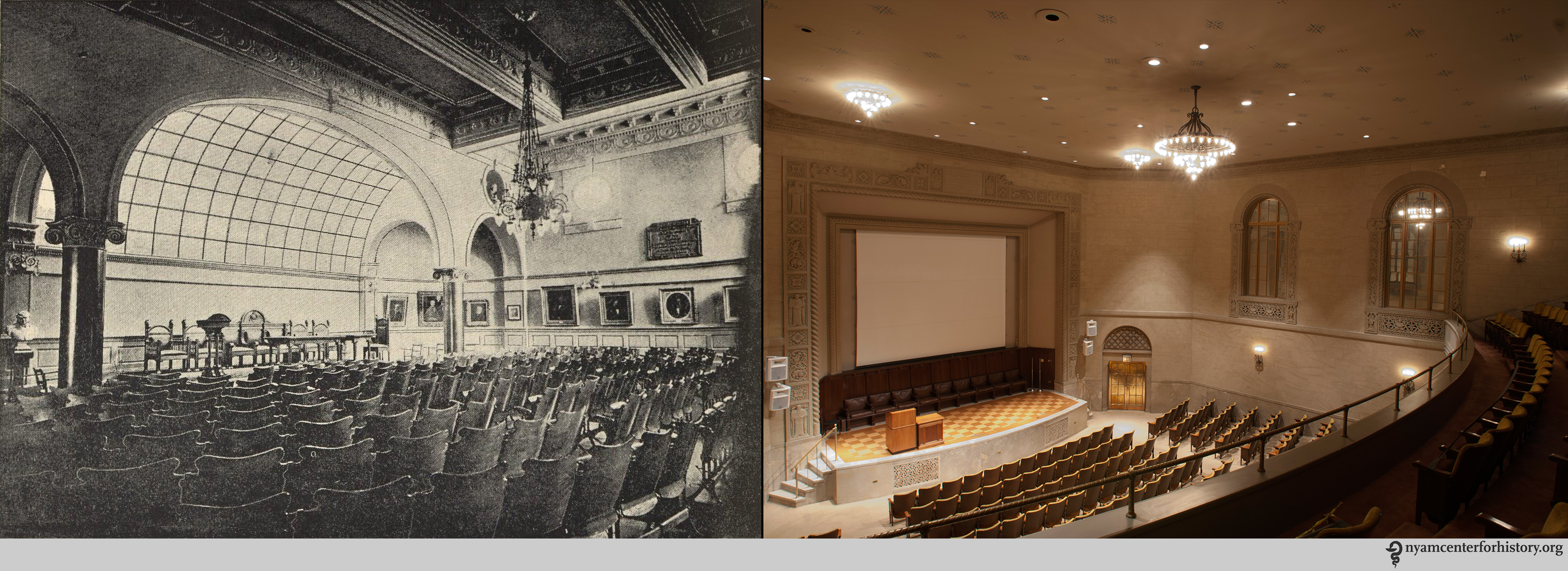
The Hosack name lives on at the Academy. In 1885, the estate of Celine B. Hosack, widow of Alexander, bequeathed $70,000 to the Academy for a new building or an auditorium within that building.8 The original Hosack Hall was on West 43rd Street, in the Academy’s home from 1890 until 1926. When the Academy moved to its current location in 1926, the new auditorium retained a name deeply embedded in American and medical history.

Left: Hosack Hall on West 43rd St. Image in Van Ingen, The New York Academy of Medicine: Its first hundred years, 1949. Right: Hosack Hall Today, at 1216 Fifth Avenue.

Left: Hosack Hall on West 43rd Street. Image in Van Ingen, The New York Academy of Medicine: Its first hundred years, 1949. Right: Hosack Hall today, at 1216 Fifth Avenue. Click to enlarge.

References

1. Jeffe ER. Hamilton’s physician: David Hosack, Renaissance man of early New York. New-York J Am History. 2004;Spring(3):54–58. Available at: http://www.alexanderhamiltonexhibition.org/about/Jeffe – Hamiltoss Physician.pdf. Accessed January 15, 2016.

2. Hosack AE. A memoir of the late David Hosack. Lindsay & Blakiston; 1861. Available at: https://books.google.com/books?id=o4A22YJI53YC&pgis=1. Accessed January 19, 2016.

3. Garrison FH. David Hosack. Bull N Y Acad Med. 1925;1(5):i4–171. Available at: http://www.pubmedcentral.nih.gov/articlerender.fcgi?artid=2387360&tool=pmcentrez&rendertype=abstract. Accessed January 15, 2016.

4. James ET. Notable American Women, 1607-1950: A Biographical Dictionary, Volume 1. Cambridge: Harvard University Press; 1971. Available at: https://books.google.com/books?id=rVLOhGt1BX0C&pgis=1. Accessed January 19, 2016.

5. Mystery of Aaron Burr’s daughter baffles a century. New York Times. http://timesmachine.nytimes.com/timesmachine/1913/01/12/100604845.html?pageNumber=59. Published January 12, 1913. Accessed January 15, 2016.

6. Alexander Eddy Hosack, M.D. New York Times. http://timesmachine.nytimes.com/timesmachine/1871/03/07/78760572.html.  Published March 7, 1871. Accessed January 15, 2016. 

7. Obituaries. Med Surg Report. 1871;24(734):262. Available at: https://books.google.com/books?id=_kKgAAAAMAAJ&pgis=1. Accessed January 19, 2016.

8. Van Ingen P. The New York Academy of Medicine: Its first hundred years. New York: Columbia University Press; 1949.

The Nightmare of Imminent Baldness

By Johanna Goldberg, Information Services Librarian

While visiting the Coney Island exhibit at the Brooklyn Museum (highly recommended), the caption of a photograph caught my eye:

“The Coney Island Polar Bear Club, the earliest organization of its kind, was founded in 1903 by Bernarr Macfadden, known as the “Father of Physical Culture.” An early advocate for outdoor exercise, Macfadden believed that taking a dip in the ocean during the winter could restore one’s immunity and stamina.”

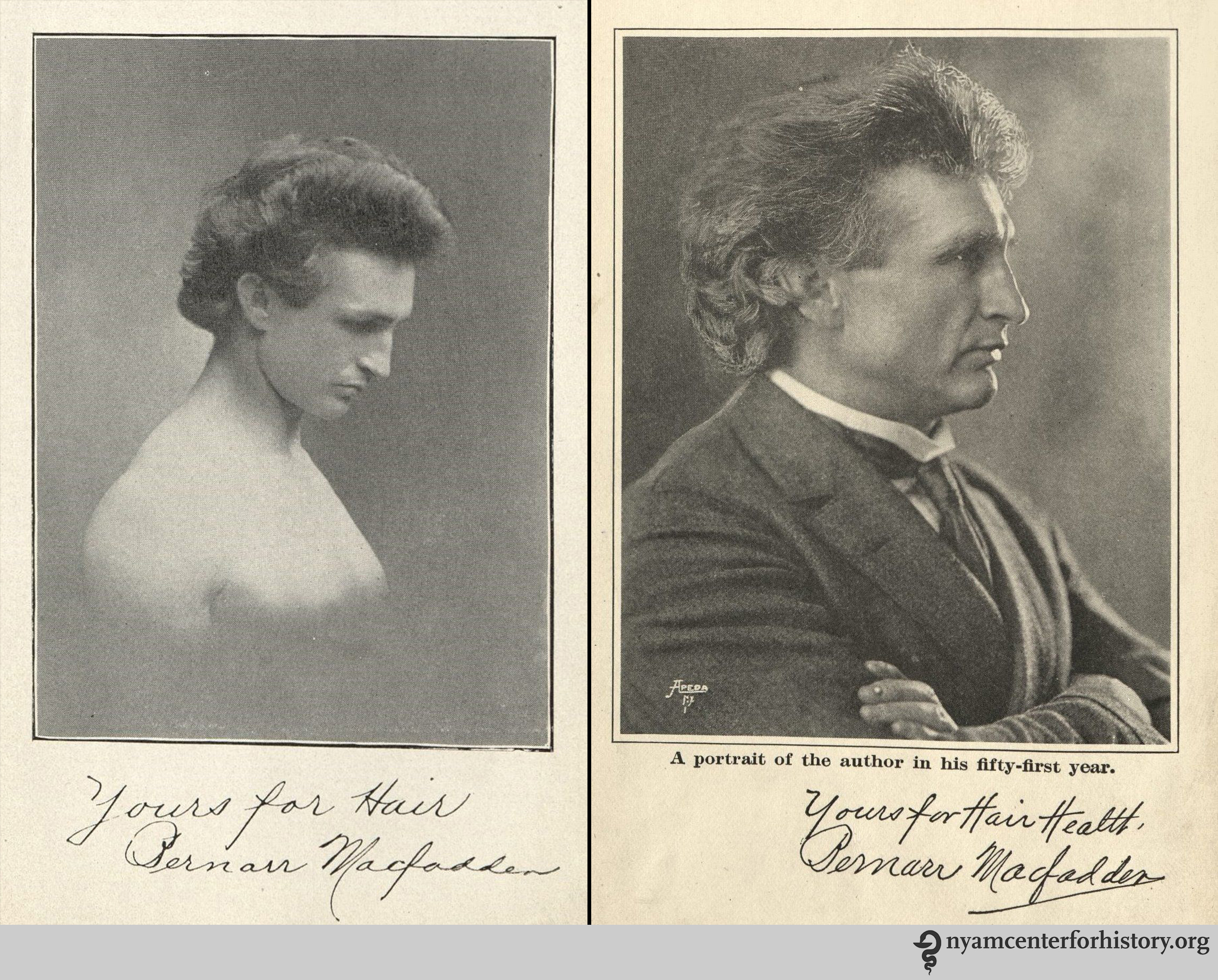
The Academy Library has a substantial collection on the history of exercise, so it’s no surprise that we have more than 20 books by Macfadden. What was surprising was that two of the books are about the wellbeing of an unexpected physical characteristic—hair.

Bernarr Macfadden in the 1901 and 1922 editions of Hair Culture.

Bernarr Macfadden in the 1901 and 1922 editions of Hair Culture.

The 1901 edition of Macfadden’s New Hair Culture: Rational Natural Methods for Cultivating Strength and Luxuriance of the Hair begins with a disclaimer that wouldn’t sound out of place in a contemporary infomercial:

Disclaimer in Macfadden's 1901 Hair Culture.

Disclaimer in Macfadden’s 1901 Hair Culture.

The 1922 volume, Hair Culture: Rational Methods for Growing the Hair and for Developing its Strength and Beauty, does not include a disclaimer. But, like any great salesman, Macfadden lets us know that he’s not just the inventor of his method, he’s also a user:

I can assure the reader that I can speak with authority on the subject, from experiences with the particular condition which I, myself, have had. Several years previous to the writing of this book my hair began to fall out at an alarming rate.

I was greatly disturbed. The nightmare of imminent baldness was with me constantly.

I was in such a desperate frame of mind that I even bought a bottle of a hair remedy that was well advertised at the time, but after one application I threw it out an open window and began to apply my intelligence to the solution of the problem that then was indeed serious in my mind. …. The method that I finally evolved forms the basis of this book, and is gone into with painstaking detail.1

To maintain hair health, Macfadden recommends such procedures as scalp massage, regular brushing, “sun baths,” exposure to fresh air, removal of dead hair, and “mechanical and electrical stimulation” through “the use of a well made mechanical vibrator, using a broad soft rubber disk” (sadly, he does not include an image of such a vibrator).1,2

"Massaging scalp with a complexion roller." From Macfadden's 1901 Hair Culture, page 33.

“Massaging scalp with a complexion roller.” From Macfadden’s 1901 Hair Culture, page 33.

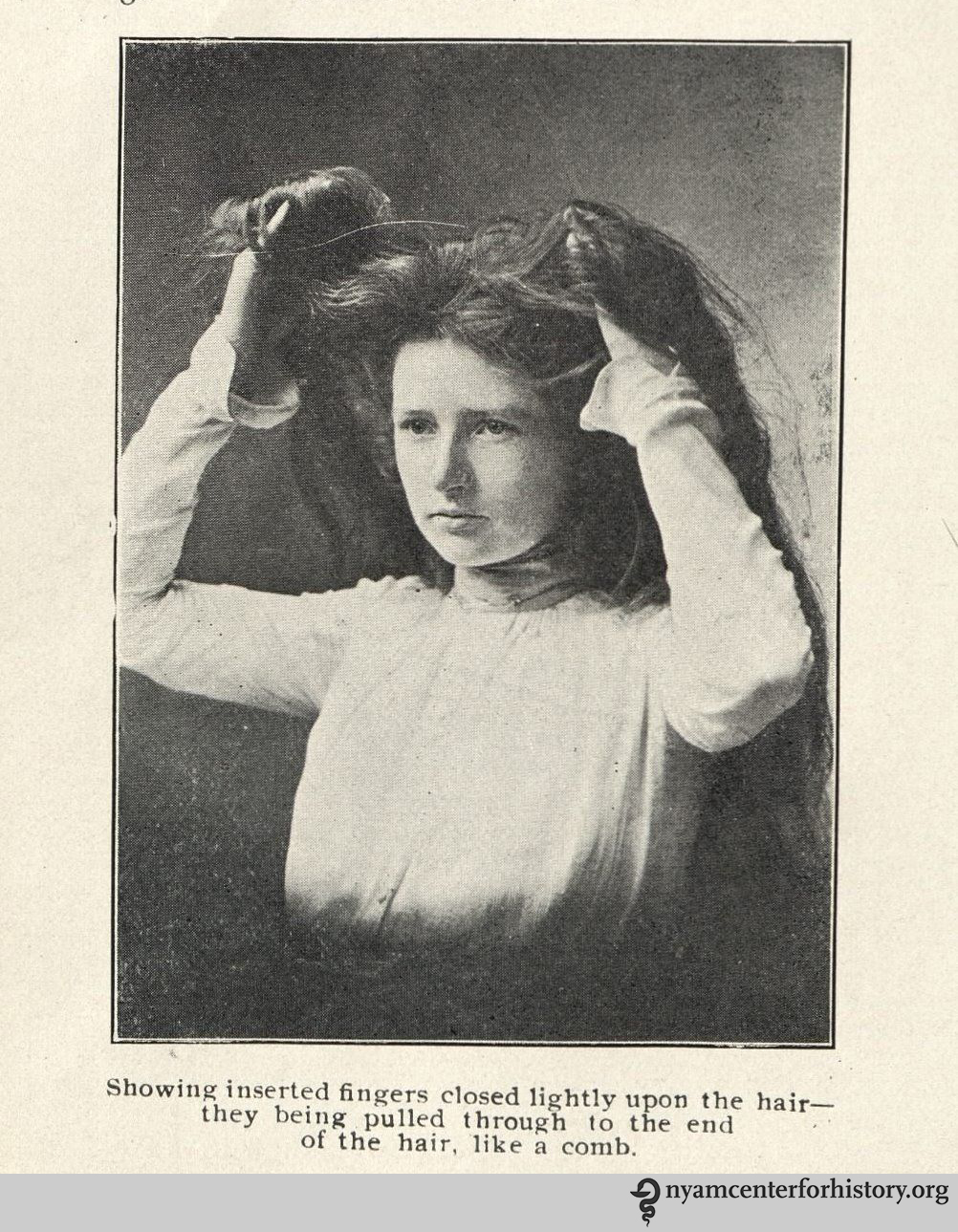
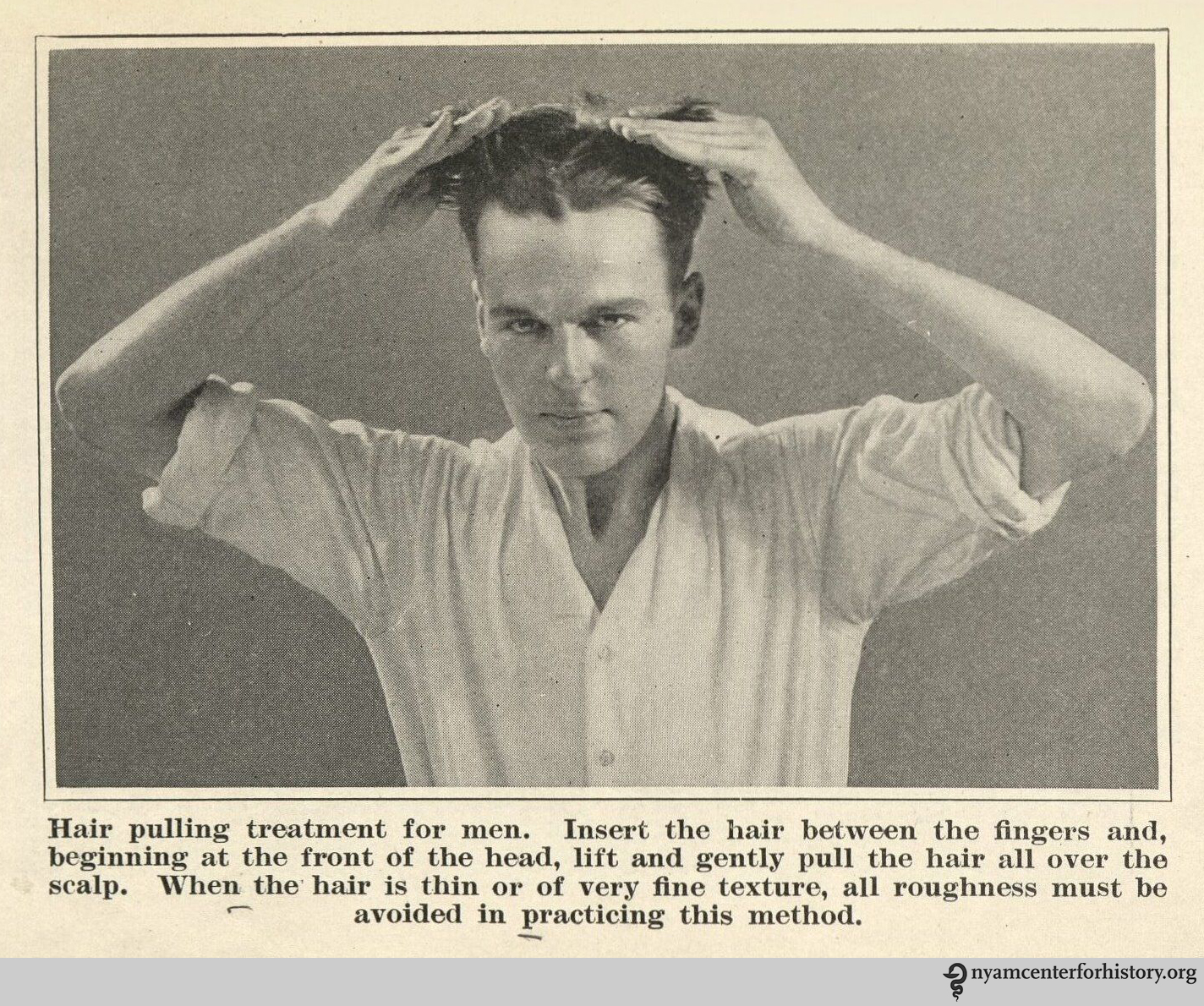
The 1901 edition includes an entire chapter on how to strengthen hair by pulling it: “Nothing gives the scalp the sensation of being so thoroughly and effectively awakened.” Inserting your spread fingers and closing them together “slightly raises the scalp from the skull, and at every point where the scalp is thus raised, the circulation is greatly accelerated.”2

"Inserted fingers closed lightly upon the hair." From page 38 of the 1901 Hair Culture.

“Inserted fingers closed lightly upon the hair.” From page 38 of the 1901 Hair Culture.

"Hair pulling treatment for men." From page 129 of the 1922 Hair Culture.

“Hair pulling treatment for men.” From page 129 of the 1922 Hair Culture.

Perhaps unsurprisingly, Macfadden did not approve of applying heat or bleach to the hair. “If Nature gave a girl dark hair, she should accept the gift gratefully, remembering that some of the greatest beauties in history were also thus blessed.” But Nature could be improved upon in non-harmful ways, as through “the little curl-papers and curling kids”: “These are harmless enough, and if they make a pretty girl any prettier than Nature made her, they are entitled to three hearty cheers.”1

Macfadden did not approve of hot-dry apparatuses like the one shown on page 168 of the 1922 Hair Culture.

Macfadden did not approve of hot-dry apparatuses like the one shown on page 168 of his 1922 Hair Culture.

Learn more about Macfadden—his fitness empire; his scandalous tabloid; his cult, “Cosmotarianism”—in this 2013 Esquire article.

References

1. Macfadden B. Hair culture: rational methods for growing the hair and for developing its strength and beauty. New York: Physical culture corporation; 1922.

2. Macfadden B. Macfadden’s new hair culture: Rational, Natural Methods for Cultivating Strength and Luxuriance of the Hair. New York: Physical Culture Publishing; 1901.