The Evolution of the Bath Room

By Johanna Goldberg, Information Services Librarian

It’s World Toilet Day, a day emphasizing the importance of sanitation to public health and reminding us that 2.4 billion people still do not have access to basic toilets.1 On this day, we look back to a historic time of toilet transformation in America and look forward to a time when disease-mitigating sanitation becomes available for all.

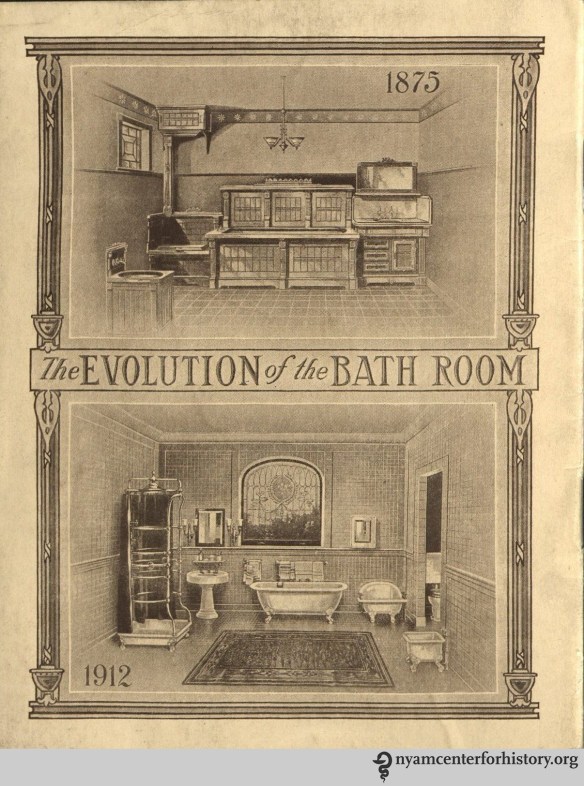
The Standard Sanitary Manufacturing Company formed in Pennsylvania in 1875.2 At that time, indoor bathrooms had only just begun to appear in urban and suburban settings, newly possible thanks to the advent of sewer systems.3 Early indoor bathrooms hid plumbing and fixtures under wooden doors and cupboards.2,4 But by the publication of Standard Sanitary’s The Evolution of the Bath Room circa 1912, open plumbing and visible commodes had taken over bathroom design: “The bathroom of today is infinitely more cleanly, durable and efficient.”2 And the public health infrastructure that allowed for them, like sewers and access to clean water, saved lives.

Back cover, The Evolution of the Bath Room, circa 1912. Cover, The Evolution of the Bath Room, circa 1912. The 1870s-style bathroom is shown on top. The 1912-era bathroom is on the bottom.

Back cover, The Evolution of the Bath Room, circa 1912. The 1870s-style bathroom is shown on top. The 1912-era bathroom is on the bottom.

The bathrooms of this pamphlet look like the ones we have in 21st century America (except, in some cases, for their cavernous size and luxurious fittings). But today we are not as excited about our commodes as Standard Sanitary would like us to be: “The bathroom is rightly considered by many as the first room in the home and is exhibited to guests with the utmost pride. Truly the comfort that may be derived from a complete and up-to-date bathroom is worthy of this appreciation.”2

Along with several other companies, including Kohler (founded in 1873),4 Standard Sanitary worked at the forefront of the plumbing industry. The company developed “the one-piece toilet, built-in tubs, combination faucets (which mix hot and cold water to deliver tempered water) and tarnish-proof, corrosion-proof chrome finishes for brass fittings.”5 By 1929, Standard Sanitation led the bathroom fixture market worldwide. It still exists today as the American Standard company.

Enjoy perusing the full pamphlet, full of memorable quips like: “There is nothing which will appeal so strongly to the fastidious and careful housewife, and be so great a source of enjoyment, as modern high-grade fixtures.”2

Click on an image to view the gallery.

References

1. World Toilet Day. Available at: http://www.worldtoiletday.info. Accessed November 10, 2015.

2. Standard Sanitary Mfg. Co. The evolution of the bath room. Pittsburgh: Standard Sanitary Mfg. Co; [1912].

3. Duncombe T. A long soak in the subject of bathrooms. Philadelphia Inquirer. http://articles.philly.com/1991-11-10/real_estate/25771962_1_bigger-bathrooms-toll-bros-spacious-bathrooms. Published October 1991. Accessed November 10, 2015.

4. Horan J. Sitting pretty: An uninhibited history of the toilet. London: Robson; 1998.

5. American Standard. Company Information. Available at: http://www.americanstandard-us.com/companyinfo/overview.aspx. Accessed November 4, 2015.

Discover the Academy Library

The Coller Rare Book Reading Room captured by Ardon Bar-Hama.

The Drs. Barry and Bobbi Coller Rare Book Reading Room captured by Ardon Bar-Hama.

The New York Academy of Medicine Library is a place of discovery. It’s where the scholarly and the curious alike turn to learn about the history of what keeps us well, and what makes us sick. It’s a place to discover the lessons learned in pursuit of individual health and well being, and the intricacies of the politics and policies of ensuring public health in cities, the nation and the world.

The Academy Library is where world-renowned writers, historians, documentary filmmakers, health professionals, and students come to learn, to be inspired, and to form the foundation of knowledge that opens the door to a future discovery. It’s a place where unique programming –open to all–integrates medicine with history, humanities, and the arts through its Center for the History of Medicine and Public Health.

Open to the general public, the Library houses over 550,000 volumes, an extensive rare book collection, and unique medical artifacts of historical importance that cannot be found anywhere else in the world. Won’t you join us in helping to safeguard the Library’s treasures to ensure that the opportunity for discovery is available to all?

Support the Library to preserve its collections and ensure ongoing support for its one-of-a-kind public programming. Thank you for your generosity and take a few minutes to discover for yourself a few of the Library’s many treasures through our digital gallery.

donate_buttondiscover_button

The Most Likely Victim…the Busy Man. Ads from Hygeia Magazine

By Johanna Goldberg, Information Services Librarian

This is part of an intermittent series of blogs featuring advertisements from medical journals. You can find the entire series here.

From 1923–1949, the American Medical Association published Hygeia, an educational health magazine for the American public.

Where today you might find Highlights Magazine, Men’s Health, or Prevention at the doctor’s office, Hygiea once filled that role. It frequently included activities to entertain youth, along with health-related articles for their parents. Schools and libraries subscribed—the magazine was a common classroom resource—as well as individuals. In 1950, the magazine became Today’s Health, which continued publication until 1976.1

Along with articles and activities, Hygeia included a wealth of advertisements. Here, we take a look at those focused on men and work. These ads often tie men’s health issues to work stresses (or, in one ad, boys’ health to school posture). One in particular, a Parke Davis and Company ad from March 1936, shows a commuting man reading a newspaper and states, “The greatest problem Medicine faces today is to get the average person to take advantage, in time, of the help it has to offer him.” This problem continues today: Men are more likely than women to smoke, drink, make other choices detrimental to health, and delay seeking medical attention.2 A series of Parke Davis ads—along with ads from other companies—shows the dangers for men who neglect medical problems, often choosing work over seeking care.

Parke Davis Ad in Hygeia Magazine, March 1936. Click to enlarge.

Parke Davis Ad in Hygeia Magazine, March 1936. Click to enlarge.

Other ads show men and boys in need of products that accentuate their manliness (like Ivory soap: “Most men don’t want to smell like ‘beauty shoppes’”) or provide them the energy needed to get through the workday or wartime (like General Mills, which offered materials on teaching nutrition to help prevent military rejections due to malnutrition).

A third stream of advertisements depicts men as trustworthy medical professionals, even in times of war. The lab coat-wearing Walgreen pharmacist is “a specialist in accuracy.” Sealtest Company doctors offer physicals “as rigid as those in the army.” Wartime doctors, says one Wyeth ad, will remain abroad once the war is done to “prevent epidemics” or return home to care “for casualties of the world’s greatest war.”

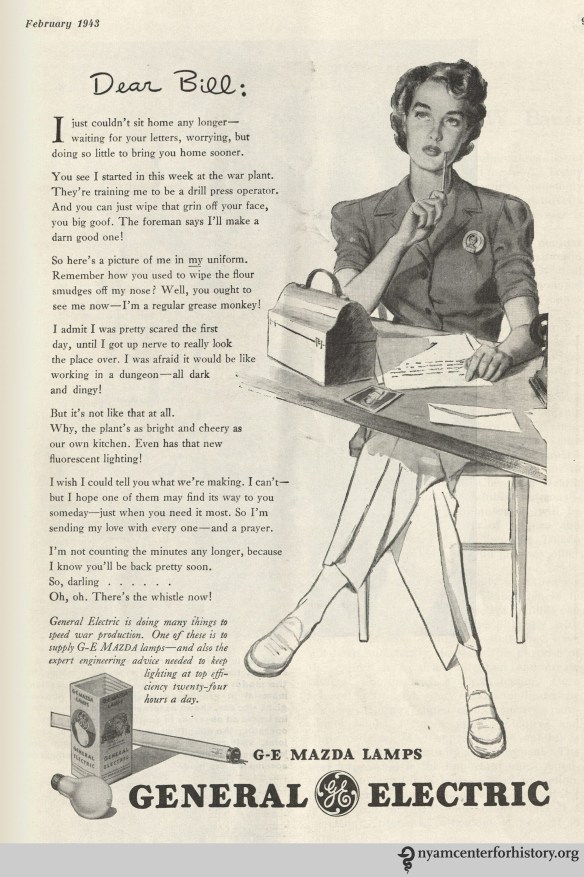
When women move into the workplace during the war years, the ads that follow show them as competent employees and a feminizing influence on the workplace. “Let’s not ration loveliness,” advises a 1943 ad from Luzier’s, a cosmetic and perfume company. “With more and more women doing the work of men in defense jobs and in the armed forces, not to mention the thousands of women in various branches of OCD, it is desirable that we cling to those nice habits of personal care…which are such an integral part of the loveliness of American womanhood.”

Click on an ad to enlarge the image.

Neglect of medical problems:

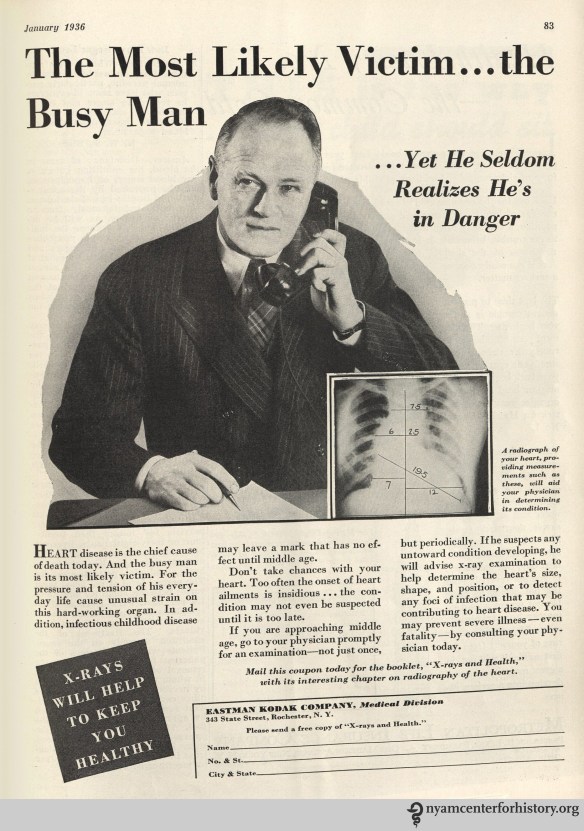
Eastman Kodak ad inHygeia Magazine, January 1936. Click to enlarge.

Eastman Kodak ad in Hygeia Magazine, January 1936. Click to enlarge.

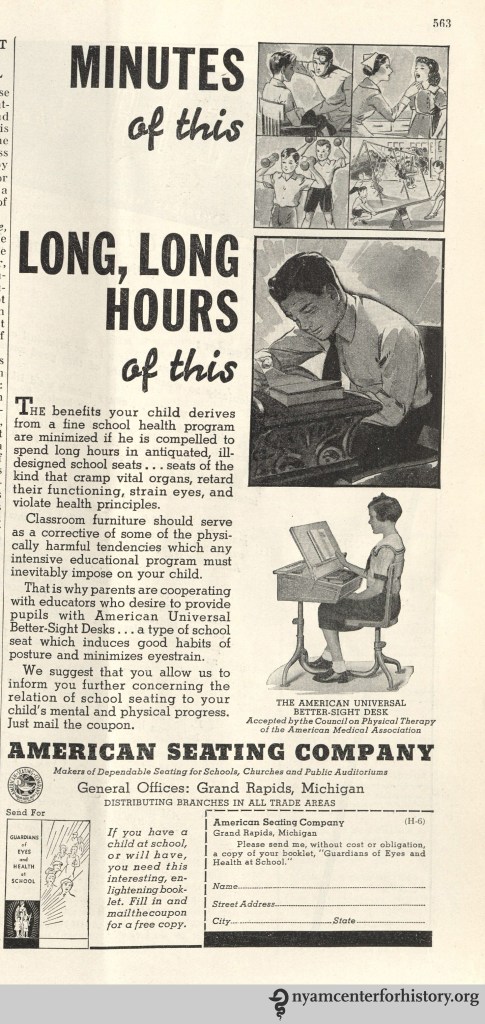
American Seating Company ad inHygeia Magazine, June 1936. Click to enlarge.

American Seating Company ad in Hygeia Magazine, June 1936. Click to enlarge.

Metropolitan Life Insurance ad in Hygeia Magazine, December 1936. Click to enlarge.

Metropolitan Life Insurance ad in Hygeia Magazine, December 1936. Click to enlarge.

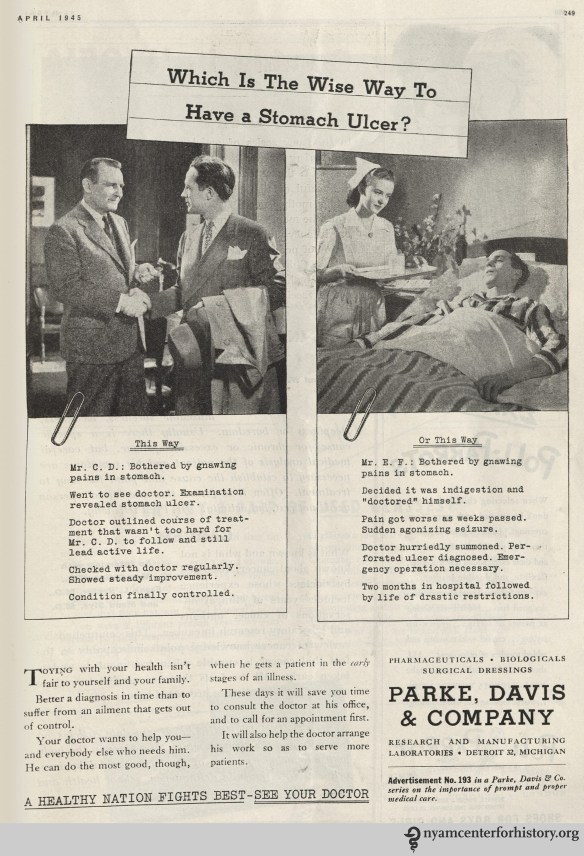
Parke Davis ad in Hygeia Magazine, April 1945. Click to enlarge.

Parke Davis ad in Hygeia Magazine, April 1945. Click to enlarge.

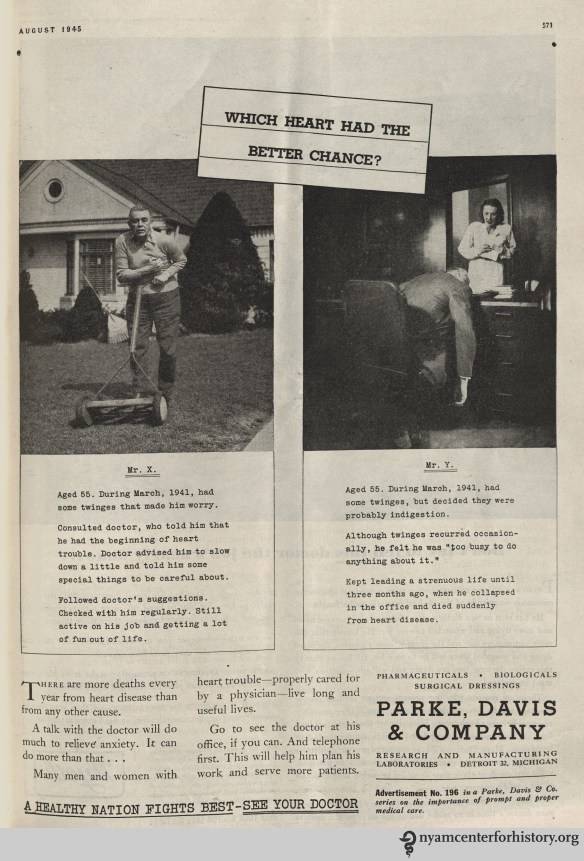
Parke Davis ad in Hygeia Magazine, August 1945. Click to enlarge.

Parke Davis ad in Hygeia Magazine, August 1945. Click to enlarge.

SoftLite Lenses ad in Hygeia Magazine, December 1945. Click to enlarge.

SoftLite Lenses ad in Hygeia Magazine, December 1945. Click to enlarge.

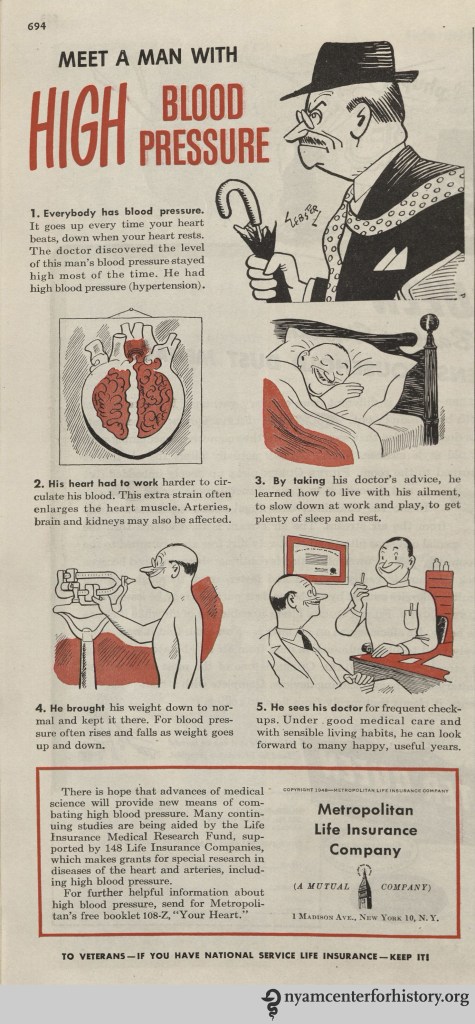
Metropolitan Life Insurance ad inHygeia Magazine, October 1948. Click to enlarge.

Finally, a man who gets medical attention and follow his doctor’s advice! Metropolitan Life Insurance ad in Hygeia Magazine, October 1948. Click to enlarge.

Accentuating “manliness”:

Ivory Soap ad in Hygeia Magazine, January 1932. Click to enlarge.

Ivory Soap ad in Hygeia Magazine, January 1932. Click to enlarge.

Lifebuoy Health Soap ad in Hygeia Magazine, May 1932. Click to enlarge.

Lifebuoy Health Soap ad in Hygeia Magazine, May 1932. Click to enlarge.

Energy boosts:

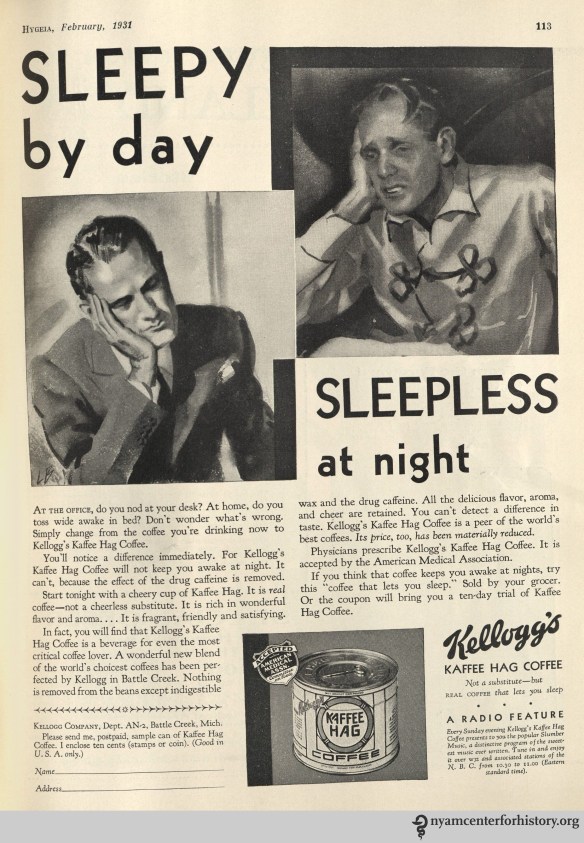
Kellogg's Kaffee Hag ad in Hygeia Magazine, February 1931. Click to enlarge.

Kellogg’s Kaffee Hag ad in Hygeia Magazine, February 1931. Click to enlarge.

General Foods ad in Hygeia Magazine, January 1932. Click to enlarge.

General Foods ad in Hygeia Magazine, January 1932. Click to enlarge.

Bordens Malted Milk ad in ad in Hygeia Magazine, December 1932. Click to enlarge.

Bordens Malted Milk ad in ad in Hygeia Magazine, December 1932. Click to enlarge.

General Mills ad in Hygeia Magazine, August 1945. Click to enlarge.

General Mills ad in Hygeia Magazine, August 1945. Click to enlarge.

Medical professionals:

Sealtest Milk Metropolitan Life Insurance ad inHygeia Magazine, September 1943. Click to enlarge.

Sealtest Milk Metropolitan Life Insurance ad inHygeia Magazine, September 1943. Click to enlarge.

Wyeth ad in Hygeia Magazine, January 1945. Click to enlarge.

Wyeth ad in Hygeia Magazine, January 1945. Click to enlarge.

Walgreen ad in Hygeia Magazine, February 1948. Click to enlarge.

Walgreen ad in Hygeia Magazine, February 1948. Click to enlarge.

Women in the workforce:

General Electric ad in Hygeia Magazine, February 1943. Click to enlarge.

General Electric ad in Hygeia Magazine, February 1943. Click to enlarge.

Luzier's ad in Hygeia Magazine, July 1943. Click to enlarge.

Luzier’s ad in Hygeia Magazine, July 1943. Click to enlarge.

References

1. Hansen K. Newsstand: 1925: Hygeia. Available at: http://uwf.edu/dearle/enewsstand/enewsstand_files/Page4115.htm. Accessed October 30, 2015.

2. Men’s Health. Available at: https://www.nlm.nih.gov/medlineplus/menshealth.html. Accessed October 30, 2015.

View our Cartes-de-Visite

By Robin Naughton, Digital Systems Manager

Through the Culture in Transit: Digitizing and Democratizing New York’s Cultural Heritage grant, the Metropolitan New York Library Council (METRO) sent a mobile scanning unit to the New York Academy of Medicine Library to digitize our collection of cartes de visite, small inexpensive photographs mounted on cards that became popular during the second part of the 19th century.

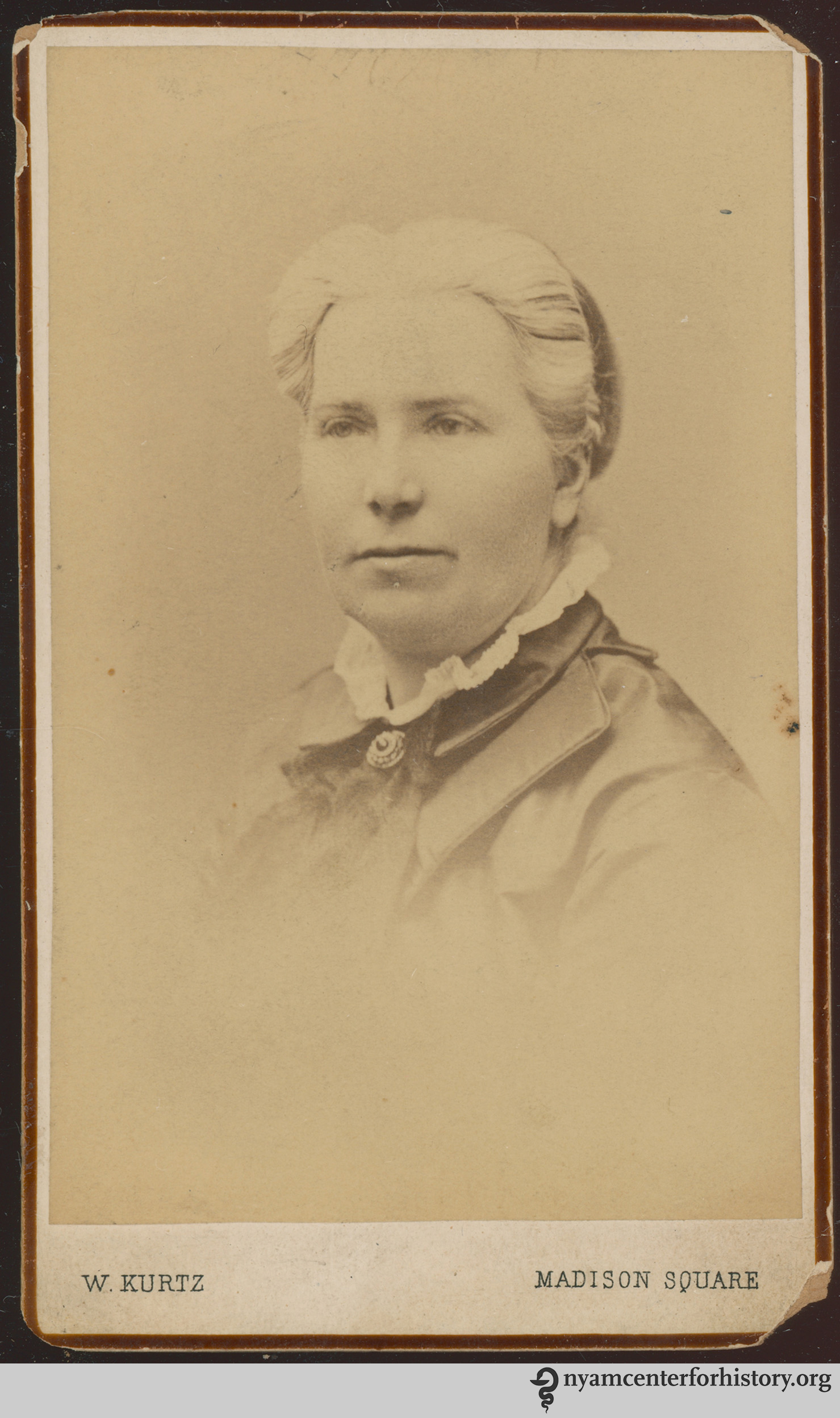
Carte-de-visite of Emily Blackwell (1826-1910), English born physician. Photograph by W. Kurtz.

Carte-de-visite of Emily Blackwell (1826-1910), English born physician. Photograph by W. Kurtz.

Our collection consists of 223 late 19th– and early 20th-century photographs of national and international figures in medicine and public health (individuals on three cartes remain unidentified).

This collection contains portraits both of lesser-known individuals and of famous New York physicians, such as Abraham Jacobi, Lewis Albert Sayre, Willard Parker, Stephen Smith, Emily Blackwell, and Valentine Mott. It also includes many with international reputations: Robert Koch, Louis Pasteur, Hermann von Helmholtz, Rudolf Virchow, and others. New York photographers took a number of the photographs; others were created by the New York offices of such establishments as Mathew Brady, as well as by photographers in Paris, Berlin, and London.

We are thrilled to share our entire collection on the Digital Culture website. You can view the front and back of each carte, and find out brief information about the physicians and scientists pictured. View all of the Library’s digitized collections.

A Little Black Book on Witchcraft (Item of the Month)

By Anne Garner, Curator, Center for the History of Medicine and Public Health

‘Tis the season for witches and warlocks, and the lure of our 122e classmark—designating books related to the occult—has proven too much to resist. Here, I found a copy of Jean Bodin’s 1593 edition of his manual for witch-hunters—the Demonomanie des Sorciers. First published in 1580 in Bodin’s native France, the Demonomanie was the most influential work on witchcraft published during the 16th century.

Cover of Demonomanie des Sorciers, 1583.

Cover of Demonomanie des Sorciers, 1593.

I was immediately drawn to the binding, fastened by a set of steeply pointed metal clasps. The book is bound in black sheep, blind-stamped and gilt, with the words “sorcery” and “magic” gilt on the spine, along with the date. In other words, it looks like one might expect any convincing book on witchcraft should (our book and paper conservator, Christina Amato, was equally enamored with it, see below).

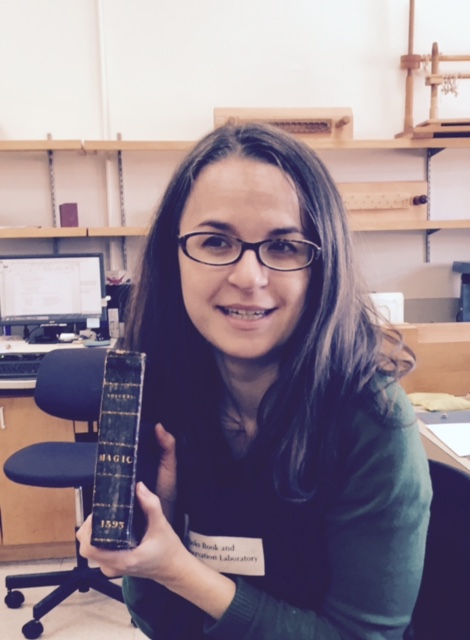
Book and Paper Conservator Christina Amato holds Demonomanie des Sorciers.

Book and Paper Conservator Christina Amato holds Demonomanie des Sorciers, 1593.

Bodin (c. 1529-1596), educated in classics, law and philosophy, served as both a Carmelite monk and a professor in Roman law. He obtained a post as a public prosecutor in Laon in 1576, where he remained until his death. His best known work is a 1576 treatise on government, Les Six livres de la République. In it, Bodin argued that it was possible for all religions to coexist within the commonwealth.

Bodin’s attitude towards witches was less forgiving. Trials for witchcraft were commonplace in France in the 15th and 16th centuries. More and more, secular courts conducted these trials, rather than courts of the Inquisition.1 In 1580, Bodin wrote the Demonomanie as a guidebook for the successful prosecution of witches.

“La definition du Sorcier.” Page 29 of Demonomanie des Sorciers, 1593.

In this text, Bodin attempted to provide one of the earliest legal definitions for a witch. A sorcier, he writes, is one “who by commerce with the Devil has a full intention of attaining his own ends…”2 This definition was sufficiently broad enough to allow for prosecution on a range of charges. Conveniently, witches could be blamed for any number of unexplained ills. In some cases, charges were brought to explain illnesses of unknown origin. Rossell Hope Robbins writes that witches were frequently blamed for the deaths of both humans and animals due to ergotism, food poisoning caused by ingesting a fungus in grain.3

Bodin was among the most rabid of the 16th-century witch hunters. He was not averse to bending the usual rules, writing that “proof of such evil is so obscure and difficult that not one out of a million witches would be accused or punished if regular prosecution were followed.”4 He suggests that torture, enlisting children to testify against their parents, and badgering the accused to confess were all fair game. Of sorcery, he says, there is no crime more worthy of burning.5

The text concludes with a refutation of De praestiigis daemonium, first published in 1563 by the Dutch physician and writer Johann Weyer. Weyer (1515-1588) argued that the evils attributed to witches were most commonly the sole work of the devil himself, and that the majority of those prosecuted for witchcraft were merely ill or mad.

Ten editions of the Demonomanie were published before 1604. The Academy has two other editions of the text: a 1587 edition published in Paris, and a copy in Latin, published in 1581.

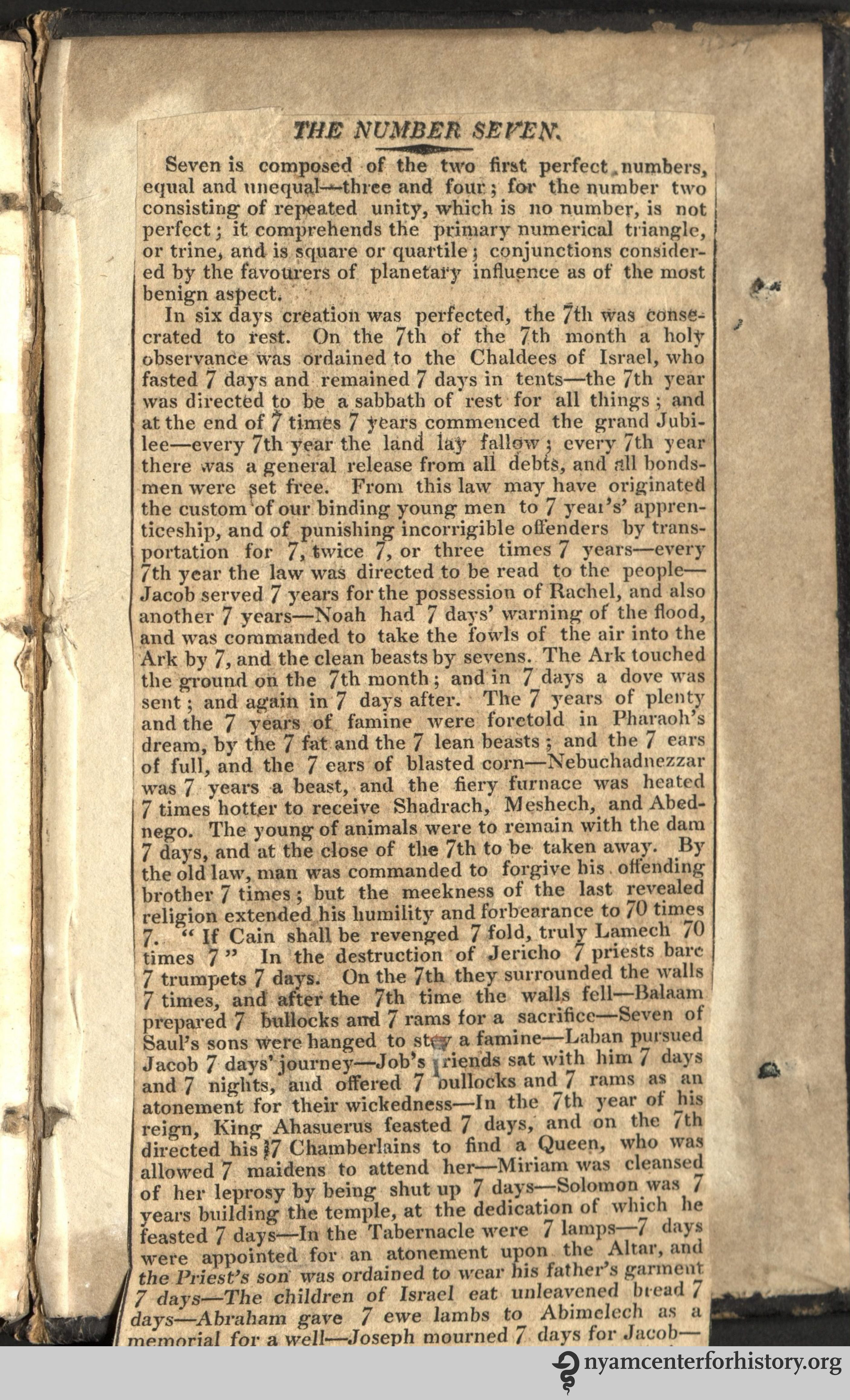
Laid-in at the rear pastedown of our 1593 edition is a clipping from a newspaper, enumerating the significance of the number seven in the Bible.

The clipping pasted into our 1583 copy of Demonomanie des Sorciers.

The clipping pasted into our 1593 copy of Demonomanie des Sorciers.

This copy’s front board is stamped with the name of G.W. Bridges. Could this book have belonged to George Wilson Bridges (1788–1863), the Anglican cleric? Bridges, a rector in Jamaica, later became acquainted with William Talbot and took photographs on his travels to the Mediterranean. This G.W. Bridges was hardly known as a bastion of tolerance. In fact, he was notorious for his criticism of other religions and for his dismissal of slave’s rights.6 The binding is in a style that is contemporary with this G.W. Bridges’ dates. Our own bookplate reads, “source unknown.”

"G. W. Bridges" on the cover of our copy of Demonomanie des Sorciers, 1583.

“G. W. Bridges” on the cover of our copy of Demonomanie des Sorciers, 1593.

References

1. Robbins, Rossell Hope. The Encyclopedia of Witchcraft and Demonology. New York: Crown, 1959, p. 209.

2. Bodin, Jean. Demonomanie… “Sorcier est celuy qui par moyes Diaboliques sciemmet s’efforce de parvenir à quelque chose.” Translation from Summers, Montague. A Popular History of Witchcraft. London: Kegan Paul, Trench, Trubner, 1937, p. 1.

3. Robbins, p. 209.

4. Translation from Robbins, p. 54-55.

5. Robbins, 55-56.

6. “George Wilson Bridges.” Accessed on University College London’s Legacies of British-Slave Ownership Profiles and Summaries, October 26th, 2015.

50 years ago: Building the Case Against Lead

This post is part of an exchange between “Books, Health, and History” at the New York Academy of Medicine and The Public’s Health, a blog of the Philadelphia Inquirer.

By Christian Warren, Associate Professor of History, Brooklyn College

Estimates of environmental lead's harms today would be far, far worse had it not been for Clair Patterson's groundbreaking research. U.S. CENTERS FOR DISEASE CONTROL AND PREVENTION

Estimates of environmental lead’s harms today would be far, far worse had it not been for Clair Patterson’s groundbreaking research. U.S. CENTERS FOR DISEASE CONTROL AND PREVENTION

The world is a lot less polluted with lead than it was a half-century ago, thanks in part to geochemist Clair Patterson. Fed up with lead contamination in his laboratory, he mounted a research campaign that overturned decades of misguided industry-sponsored science. In 1965 he published a game-changing article declaring: “the average resident of the United States is being subjected to severe chronic lead insult.” Patterson wanted to shock a nation in denial about the cost of its embrace of all things lead. Some saw his argument as darkly prophetic. Others saw it as patently absurd.

Lead’s proponents had 40 years of scientific studies to lean on—science bought and paid for by the very companies covering the earth with lead. In 1923 Standard Oil and General Motors had introduced leaded gasoline—a disastrous debut involving front page horror stories of workers driven to madness or agonizing death from lead exposure. But the lead industries minimized the fallout brilliantly. First, they finessed a federal investigation into the dangers; second, they founded a lead-friendly research institution at the University of Cincinnati. Under the direction of Robert Kehoe, the Kettering Laboratory quickly became the world’s authority on lead and health.

By the early 1960s, when the tobacco industry and others were ginning up the manufacture of doubt about their toxic products, Kehoe had a long career amassing a huge store of what passed for scientific certainty. Dozens of his studies “proved” that lead posed no public health threat. Lead, he explained, was a natural component of the environment, and humans had evolved in a leaded environment. And, Kehoe maintained, a little lead was harmless. It might pose a danger above a certain threshold, but below that level there was no need to worry. Our modern urban environment with lead spewing out of every automotive tailpipe in the country, did not, he concluded, push us above that threshold. Bottom line: the public faced no risk from lead exposure. Patterson’s 1965 research article, “Contaminated and Natural Lead Environments of Man” did not blast a mighty hole in the lead industry’s fortress of certitude but it struck a sharp blow with pinpoint accuracy. The small fissure it opened ultimately undermined the lead industry’s foundation. Initially the industry responded with dismissals and character assassination—the same playbook followed by other polluters under attack. Patterson would not surrender and kept the hard science coming. (He died in 1995 at age 73.)

Patterson’s battles with lead contamination began in the laboratory. Studying the composition of meteorites early in his career he was frustrated by laboratory lead contamination, leading him to develop new clean-room protocols. The payoff came in 1956, when Patterson calculated the age of the earth to be 4.5 billion years, a figure accepted by scientists to this day.

To understand the sources of environmental lead pollution Patterson went to sea to measure the extent of lead in the ocean’s depths. He voyaged to frigid mountaintops and then to the earth’s coldest regions following the lead trail. He proved that lead pollution had been rising since antiquity—and that it had spiked since the introduction of leaded gasoline in the middle of the 20th century. These findings drove Patterson into the thick of environmental politics, perhaps the most treacherous environment he ever braved.

Patterson’s article used the new standards of proof in medicine and public health that looked at large populations instead of individuals, finding relationships between behaviors and health outcomes. The Surgeon General’s first report on cigarette smoking, published one year earlier, used this approach.

Through a brilliant application of the kind of atomic bean counting that he’d employed in establishing the earth’s age, Patterson demonstrated that the average American’s body contained a hundred times more lead than was natural. In later publications he drove this point home with a powerful graphic: the outlines of three human torsos, each with dots representing the amount of lead in their bodies. The figure for primitive man had one dot; the second and third figures, representing the average modern American and a patient at Kehoe’s “threshold” for clinical lead poisoning, were both grey with dots, barely a shade apart. The stakes, Patterson insisted, went beyond the health of individuals. “[T]he course of history,” he asserted, “may have been and is now being altered by the effect of lead contamination upon the human mind.”

Thanks to Patterson’s scientific work and the regulations it ultimately inspired we all live in a much less heavily leaded world than the one Patterson explored. But we still have far to go. Most new uses of lead-containing products have been banned in America for a generation, but the lead left behind from centuries of relying on “the useful metal” still poisons our homes and lands. The tremendous progress since Patterson’s day revealed lingering, pervasive harms caused by the lead that remained—learning and behavior deficits as well as cardiovascular and immunological consequences. And in many parts of the world, lead pollution remains far worse than in the U.S., with even greater impact on public health. Concerned citizens must demand the regulations and clean up efforts that will eliminate every last “dot” of lead from every man, woman, and child on the earth.

Christian Warren, author of Brush With Death: A Social History of Lead Poisoning, is associate professor of history at Brooklyn College of the City University of New York, where he studies the history of health and the environment.

Merman or Mandrake? Costume Ideas From Our Collection

By Johanna Goldberg, Information Services Librarian

With Halloween just around the corner, our library is here to help with your costume planning. We’ve leafed through our collections for ideas, inspired by items from the late-15th century through the mid-20th century. If one of our images inspires your costume, please send us a picture!

Click on an image to enlarge and view the gallery:*

*Thanks to Anne Garner, Curator; Arlene Shaner, Historical Collections Librarian; Rebecca Pou, Archivist; and Emily Moyer, Collections Care Assistant, for their input and ideas.

Cook like a Roman: The New York Academy of Medicine’s Apicius Manuscript

By Anne Garner, Curator, Center for the History of Medicine and Public Health

This is one of several posts leading up to our day-long Eating Through Time Festival on October 17, 2015, a celebration of food, cookery, and health. View the full program and register for the Festival.

Ancient sources document the culinary excellence of one Marcus Gavius Apicius, a Roman gourmet who flourished during Tiberius’ reign (1st century CE). It isn’t clear from textual evidence that this Apicius ever wrote a book of cookery.1 And yet, the gem of our Library’s cookery collection—a 9th-century manuscript collection of Greek and Roman recipes—bears his name.

9th-century manuscript De re culininaria (sometimes De re coquinaria), attributed to Apicius.

9th-century manuscript De re culininaria (sometimes De re coquinaria), attributed to Apicius. Click to enlarge.

Our manuscript, transmitting a 4th– or 5th-century compendium of culinary and medical recipes compiled from a number of 2nd-century Roman sources, packs a powerful wow factor. It contains 500 Greek and Roman recipes from the Mediterranean basin. A handful may date as early as the 4th century BCE. As such, our manuscript is sometimes referred to as the oldest extant cookbook in the West.

This collection of recipes was likely compiled from multiple sources. The 2nd-century satirical writer Juvenal indicated that the name “Apicius” was frequently used to describe a foodie, not a specific person. Other sources suggest that the name conjured luxury and excessive eating.2

These recipes appear to be written by and for cooks. While some recipes called for cuts of meat that might have been beyond the means of the average Roman citizen, many others, including a number of meat, vegetable, and legume dishes, were well within the reach of Rome’s tradespeople, builders, artists, and modest farmers. Some of the recipes may have reflected popular dishes served in local popinae (street bars).

A closer look at book one reveals a wide range of useful directives applicable for the Mediterranean home cook. Called Epimeles (careful, or attentive), book one includes recipes for a spiced wine surprise, honeyed wine, and Roman absinthe. Here too are tips for preserving pork and beef rind, fried fish, blackberries, and truffles.

The dishes reflect the polyglot culture of the Mediterranean basin. The dominance of Greek culinary tradition in the early empire makes it likely that the Apicius began as a Greek collection of recipes, though mainly written in Latin, and adapted for a Roman palate.3 The cookbook incorporates a number of Greek terms, like melizomum (honey sauce) and hypotrimma (here a mixture of cheese and herbs), despite the existence of Latin glosses. Other words are hybrids of Greek and Latin, like tractogalatae, combining the Latin tractum (thin sheet of pastry) and gala, Greek for milk.

The Apicius manuscript is the gem of the Academy’s Margaret Barclay Wilson Collection of Cookery, acquired in 1929. Conservators restored and rebound it in 2006.

Our manuscript was penned in several hands in a mix of Anglo-Saxon and Carolingian scripts at the monastery at Fulda (Germany) around 830 CE. It is one of two manuscripts (the other at the Vatican) presumed to have been copied from a now lost common source.4

The gilt and illuminated Vatican manuscript of De re culininaria, as replicated in a 2013 facsimile.

The gilt and illuminated Vatican manuscript of De re culininaria, as replicated in a 2013 facsimile. Click to enlarge.

Images from both 9th-century iterations illustrate the different approaches to the text. The image above shows the gilt and illuminated Vatican manuscript, as replicated in a 2013 facsimile. Below is the Academy’s text. The number of cross-outs and the plain, unadorned style of the manuscript suggest it may have been a teaching tool for scribes.

The Academy’s unadorned 9th-century manuscript of De re culininaria. Click to enlarge.

The Academy’s unadorned 9th-century manuscript of De re culininaria. Click to enlarge.

Apicius has been a bestseller since the beginning of the print era, published in multiple editions since the 15th century. The Academy library holds many print editions, including two of the earliest.

This title page is from the earliest dated edition of the text, published in Milan in 1498. Pictured below is the device of the printer, La Signerre, who later set up shop in Rouen. Our copy is annotated by an early reader who adds the titles of the text’s ten books, grouped by type of dish.

Title page from the earliest dated edition of the De re culininaria, published in Milan in 1498.

Title page from the earliest dated edition of the De re culininaria, published in Milan in 1498. Click to enlarge.

The second earliest dated edition, printed in Venice, offers one of the earliest examples of a title page in printing history. It too is heavily annotated by an early food-lover, fluent in Greek and Latin.

Marginalia in our 1503 printed Apicius offers Greek glosses on Latin terms.

Marginalia in our 1503 printed Apicius offers Greek glosses on Latin terms.

Enthusiasts will find many other print descendants of this extraordinary manuscript in the Academy’s library.

The Apicius manuscript and a number of print editions of the text will be on display in the Academy Library’s Drs. Barry and Bobbi Coller Rare Book Reading Room during our October 17th festival, Eating through Time. A complete schedule of events can be found here.

References

1. Mayo, H. (2008). “New York Academy of Medicine MS1 and the textual tradition of Apicius”. In Coulson, F. T., & Grotans, A., eds., Classica et Beneventana: Essays Presented to Virginia Brown on the Occasion of her 65th Birthday. Turnhout: Brepols. pp. 111–135.

2. Christopher Grocock and Sally Grainger, eds. Apicius. A Critical Edition with an Introduction and an English Translation of the Latin Recipe Text Apicius. Devon: Prospect, 2006. p. 35.

3. Grockock and Grainger, p. 17-20.

4. Mayo, p. 112.

Extra, Extra, Get Your New Banana!

By Anne Garner, Curator, Center for the History of Medicine and Public Health

This is one of several posts leading up to our day-long Eating Through Time Festival on October 17, 2015, a celebration of food, cookery, and health. View the full program and register for the Festival.

Among the many attractions at the Philadelphia Centennial Exposition of 1876 were the bananas. Wrapped in foil and sold for a dime each, they were a novelty for many Americans who had never seen them before.1

In the decades that followed the Exposition, the United Fruit Company (now Chiquita) was responsible for introducing many more Americans to the fruit, promoting the banana in their literature, and distributing them throughout the country.

The story of the UFC begins in 1871, when cattle rancher Minor C. Keith first planted bananas alongside the tracks of the national railroad in Costa Rica. By the 1880s, Keith was the dominant banana trader in Central America. In the same decade, Lorenzo Dow Baker founded Boston Fruit, the first to import bananas in the U.S. Keith’s enterprise merged with Boston Fruit in 1899 to create the United Fruit Company.

During the next decade, United Fruit Company’s Great White Fleet, painted white to reflect the intense sun, carried bananas from Central America to the U.S. An increasing number of refrigerated train cars pushed bananas further inland, to places they had never gone before.

Beginning in the early 20th century, the United Fruit Company promoted the banana in a series of pamphlets and ads, taking it from a little-known novelty to a household staple. At the heart of their campaign was an endorsement of the fruit’s healthy properties. During the 1920s, the United Fruit Company hired doctors to extol the nutritional virtues of the fruit. In 1939, they offered free textbooks—decidedly pro-banana—to schoolchildren.2

The Academy Library has a number of historical pamphlets produced by the United Fruit Company and its distribution arm, The Fruit Dispatch Company. Here, we offer a selection of images from our collection.
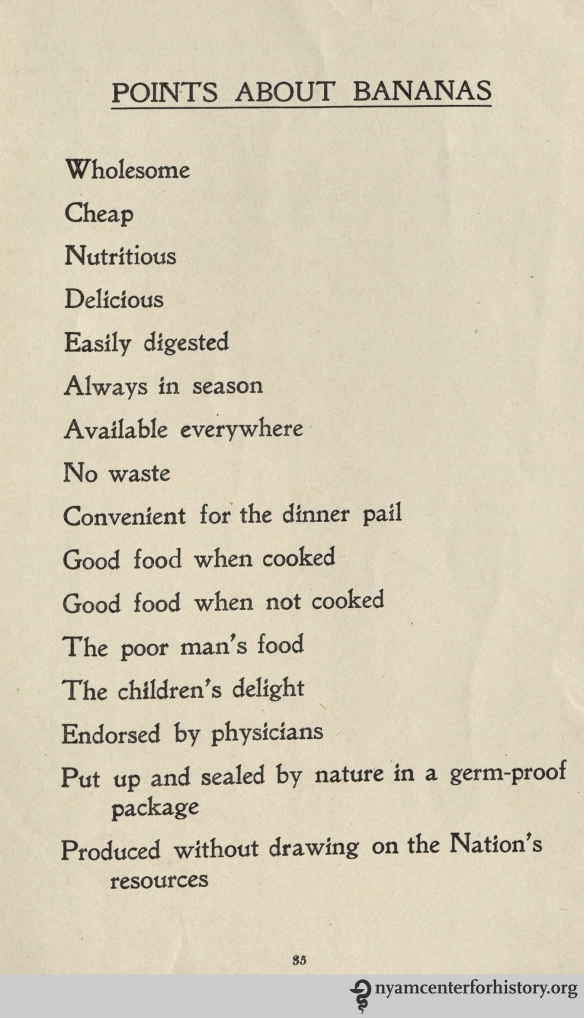
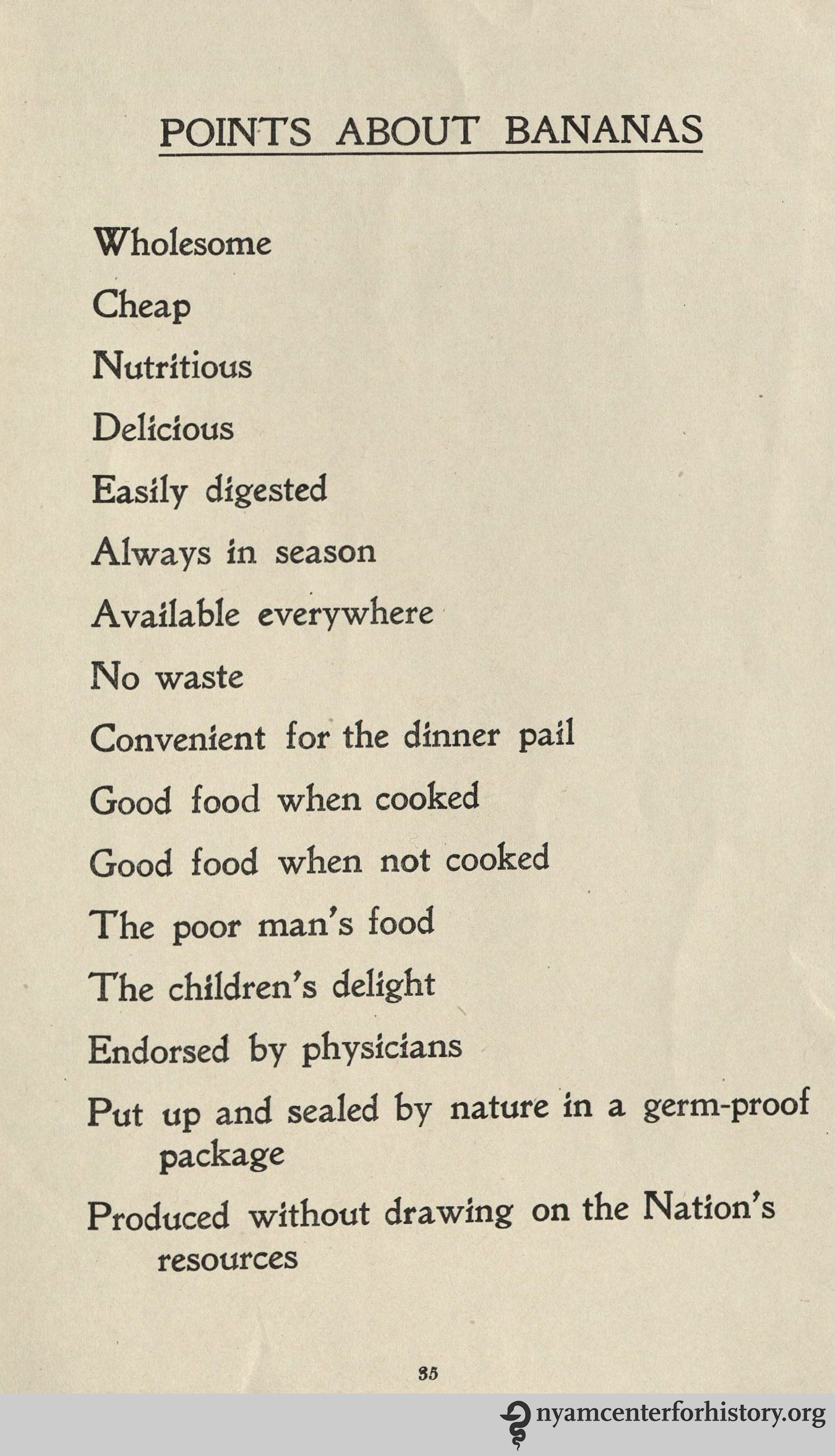
“The Food Value of the Banana,” 1917, page 35.

“The Food Value of the Banana,” 1917, page 35.

In 1917 the United Fruit Company published “The Food Value of the Banana,” a collection of 15 opinion pieces touting the virtues of the banana as a nutritious snack. “Points about Bananas” concluded the volume.

The United Fruit Company’s test kitchens reported in 1924 that bananas with corn flakes and milk made the best breakfast for families.3 The company’s subsequent publications emphasized that bananas were powerfully healthy, especially for the very young.

“The Food Value of the Banana,” 1928.

Cover of “The Food Value of the Banana,” 1928.

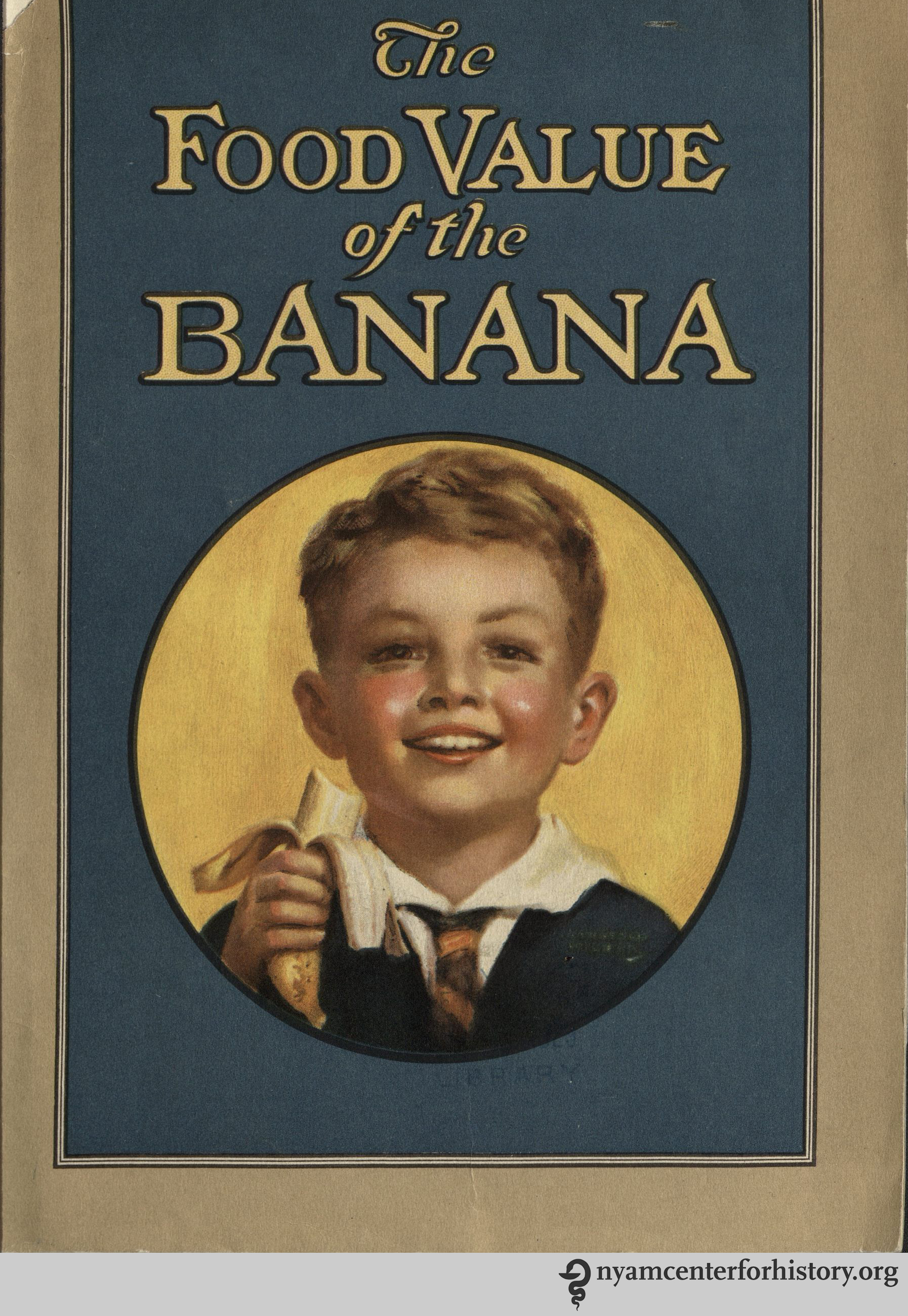
The cover of the fourth edition of “The Food Value of the Banana,” published in 1928, features a rosy-cheeked and radiant little boy, banana in hand.

 “The Food Value of the Banana,” 1928, back cover.

“The Food Value of the Banana,” 1928, back cover.

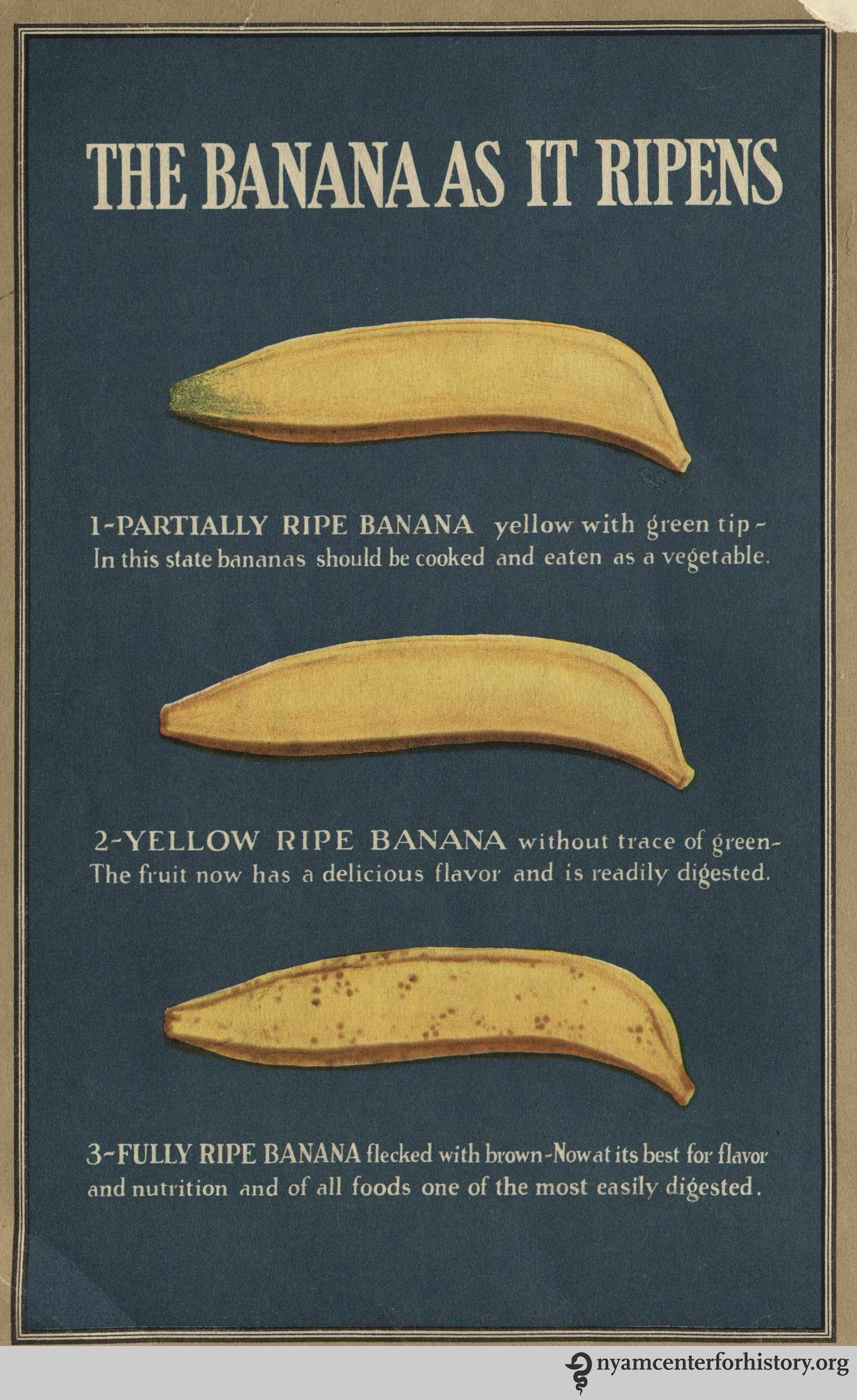
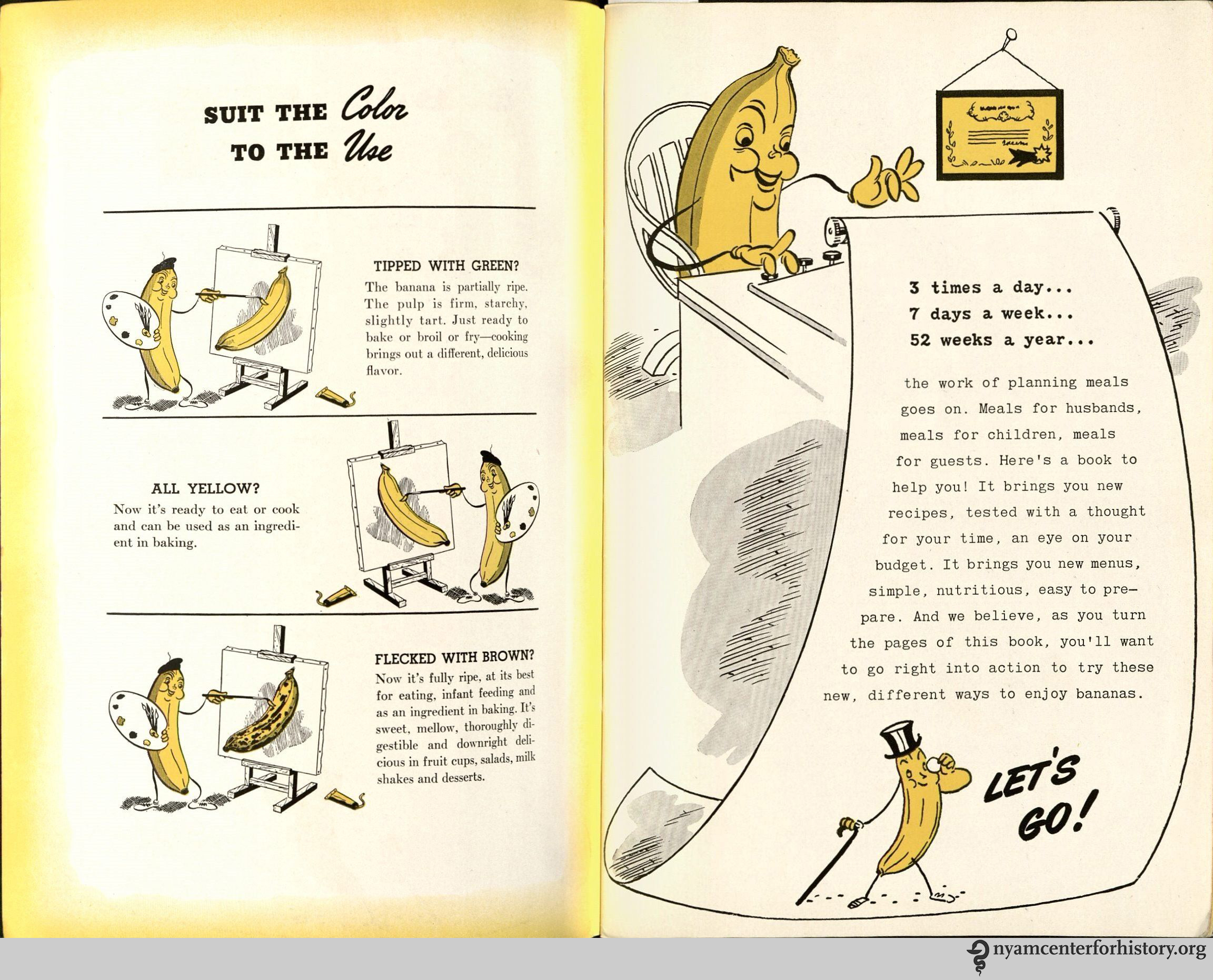
The back cover of the same 1928 pamphlet explains the ideal time to consume a banana, and how it can be eaten in each phase of ripeness. Most bananas cycle from green to yellow to yellow with brown spots in seven days.4
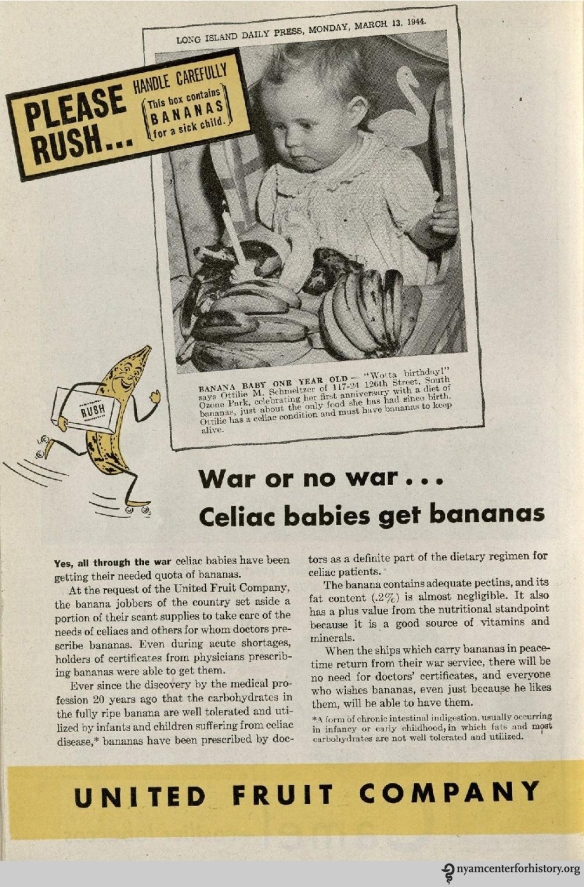
Ad in Woman's Medical Journal, vol. 52 no. 6, June 1945.

Ad in Woman’s Medical Journal, vol. 52 no. 6, June 1945.

In the 1920s, UFC hired doctors to publicly recommend that babies should consume mashed bananas. Researcher Sidney Haas found that children diagnosed with celiac disease who had been given a diet of milk and bananas dramatically improved (of course bananas are gluten free, which may have had something to do with it).5 Here, an ad from the Women’s Medical Journal from 1945 (v.52, no.6).
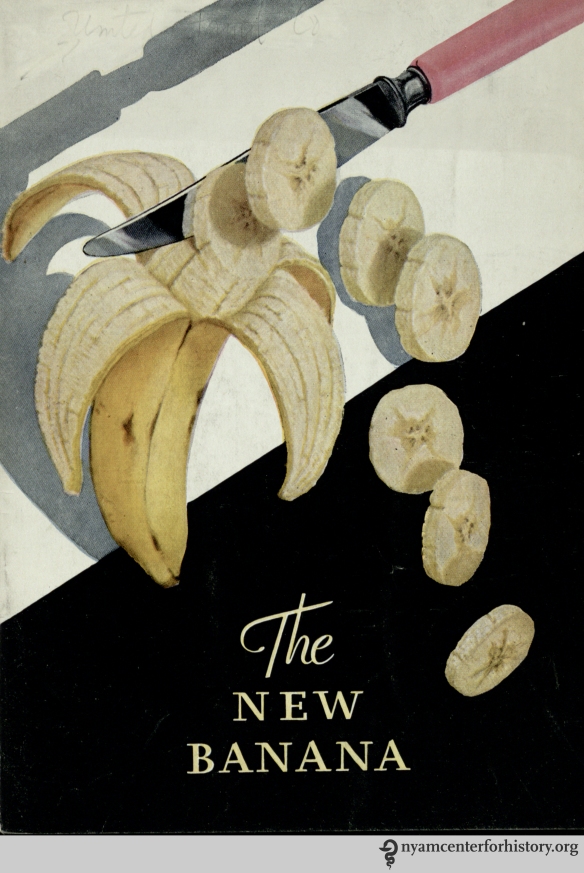
“The New Banana,” 1931.

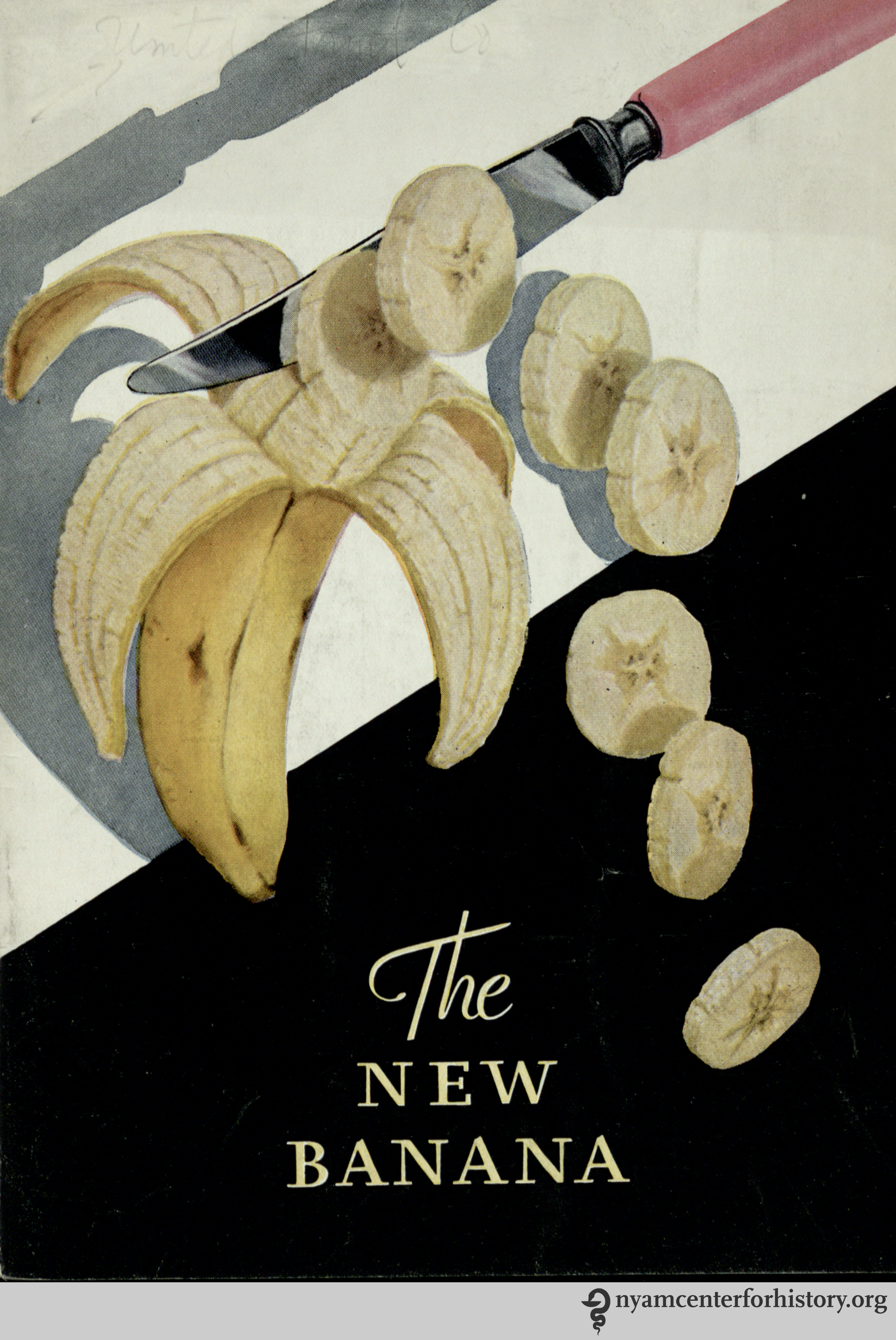
Cover of “The New Banana,” 1931.

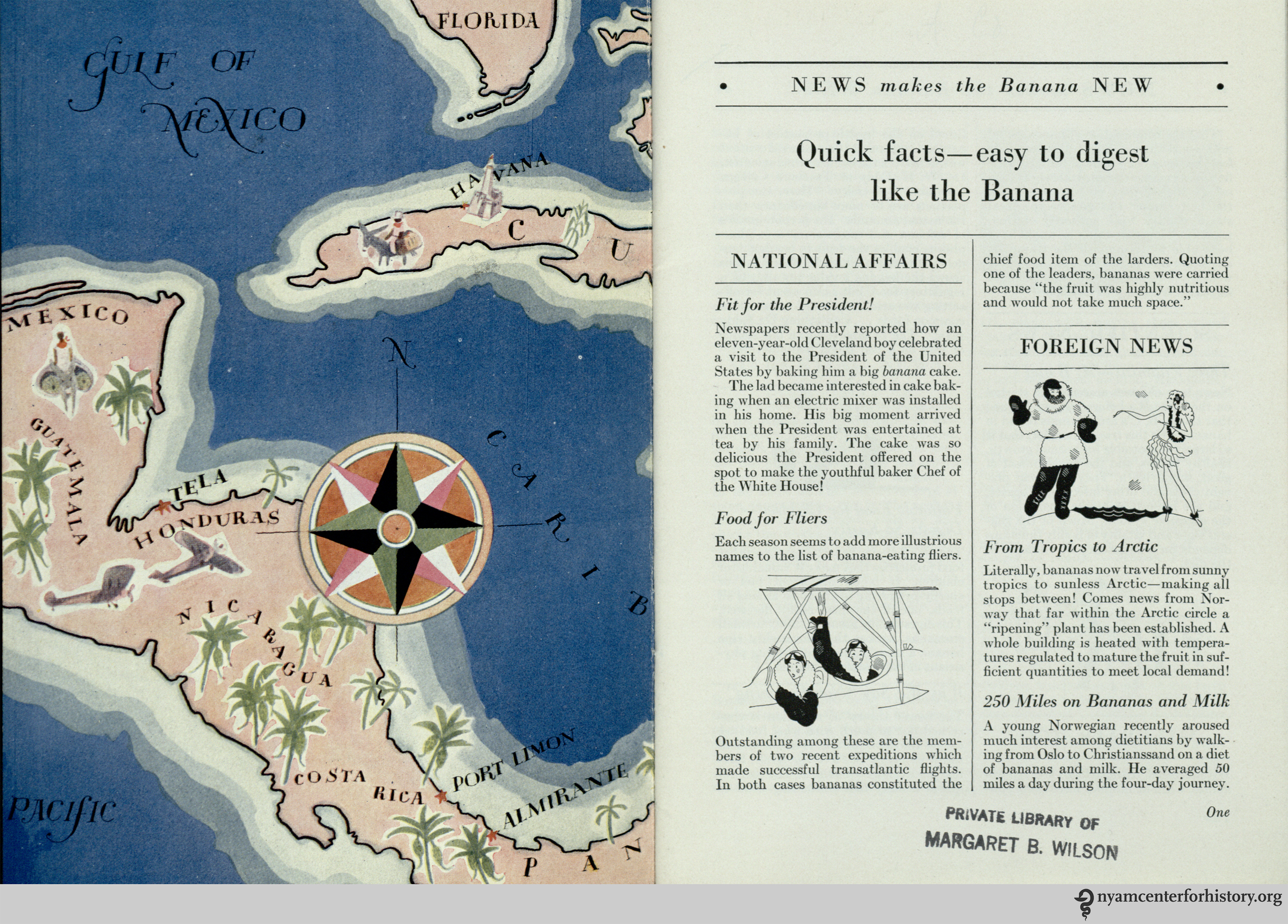
From “The New Banana,” 1931.

From “The New Banana,” 1931. Click to enlarge.

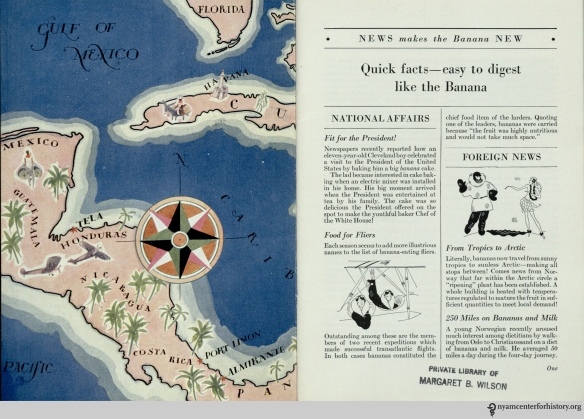
The Fruit Dispatch Company’s 1931 newspaper-format pamphlet, “The New Banana,” tells stories in which the banana’s hero status is high. In one, a Norwegian hikes from Oslo to Christianssand. Nourished by the banana, “his strength increased from day-to-day!” In another, the banana sustains two transatlantic pilots (and fits compactly into the cockpit).

From “The New Banana,” 1931.

“The New Banana,” 1931, back cover.

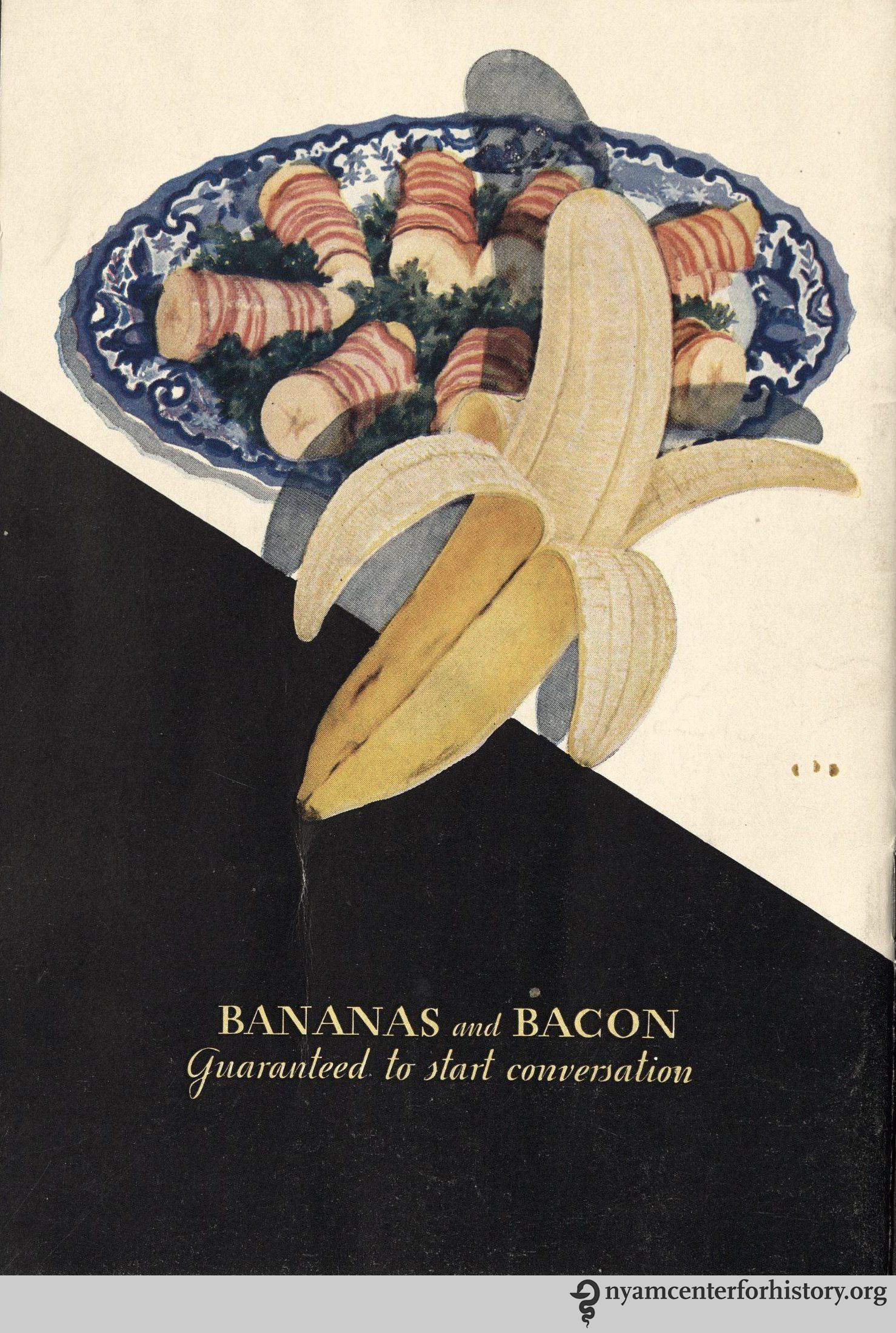
The Scientific News section of “The New Banana” reminds parents of the considerable nutrients in the banana: vitamins A, B, and C, calcium, magnesium, and iron. It’s also “non-fattening” though not especially so when paired with bacon, as on the back cover.
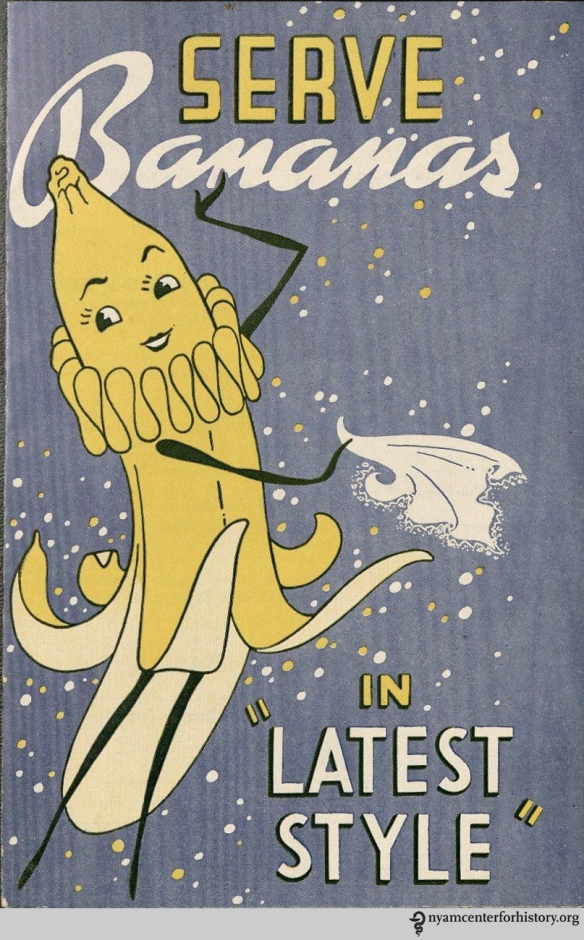
Cover of “Serve Bananas in ‘Latest Style,’” 1940.

Cover of “Serve Bananas in ‘Latest Style,’” 1940.

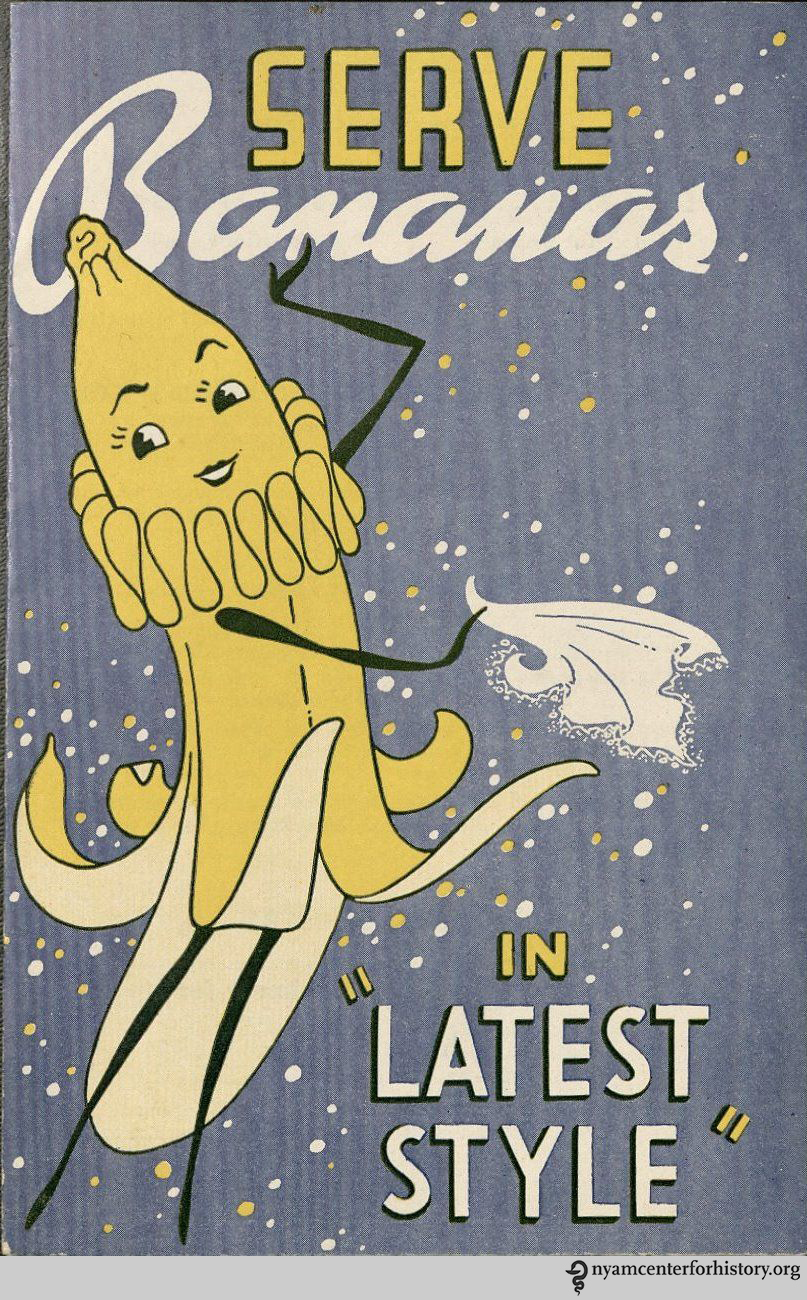
The Fruit Dispatch Company published “Serve Bananas in ‘Latest Style’” in 1940 to introduce new banana recipes to American households. Recipes included “ham banana rolls with cheese sauce” and “banana fritters” as well as a “banana sweet potato casserole.” We’re charmed by the lady banana with the Elizabethan collar waving her napkin. She predates the United Fruit Company’s Chiquita Banana by four years.
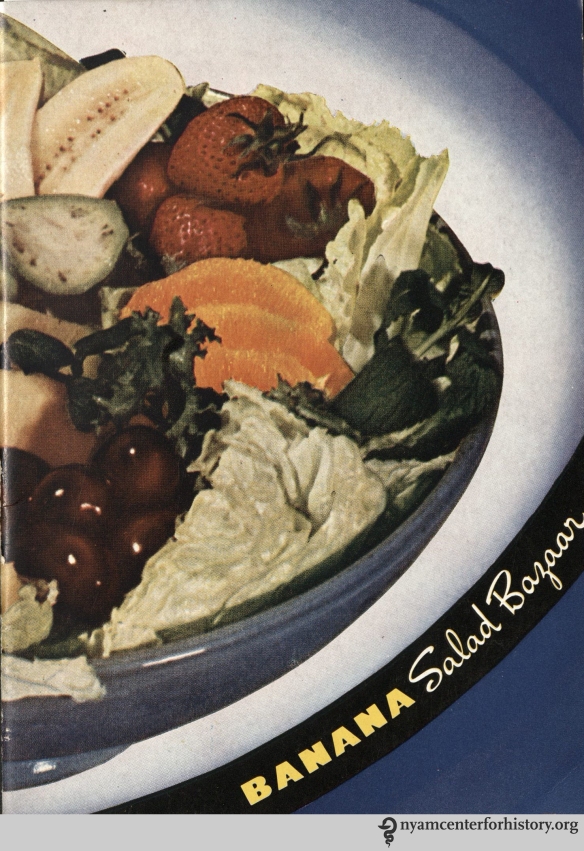
Cover of

Cover of “Banana Salad Bazaar,”1940

“Banana Salad Bazaar,”1940, pages 2 and 3. Click to enlarge.

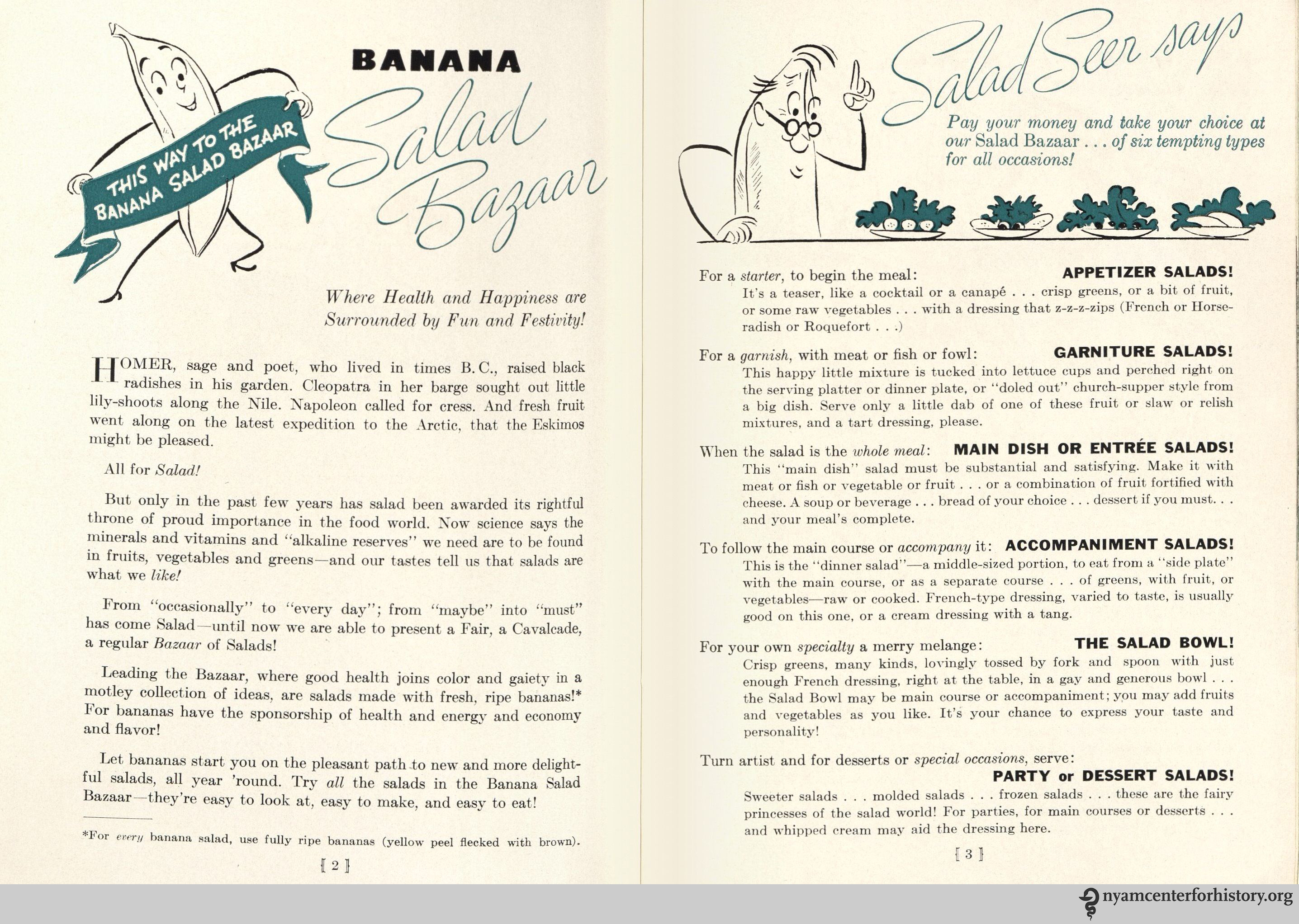
“Banana Salad Bazaar,” produced by the United Fruit Company’s Home Economics Department in 1940, is introduced by a sign-waving banana-man announcing “This Way to the Salad Bazaar.” Salad makers are encouraged to use fully ripe bananas (yellow peel flecked with brown). Recipes include banana gelatin salad and banana sardine boats.
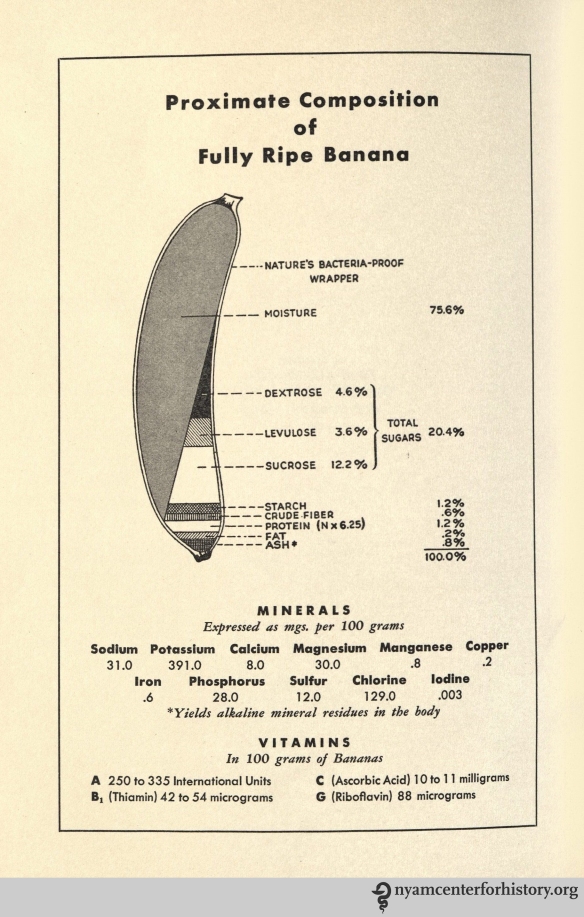
From “Nutritive and Therapeutic Values of the Banana,” 1941.

From “Nutritive and Therapeutic Values of the Banana,” 1941.

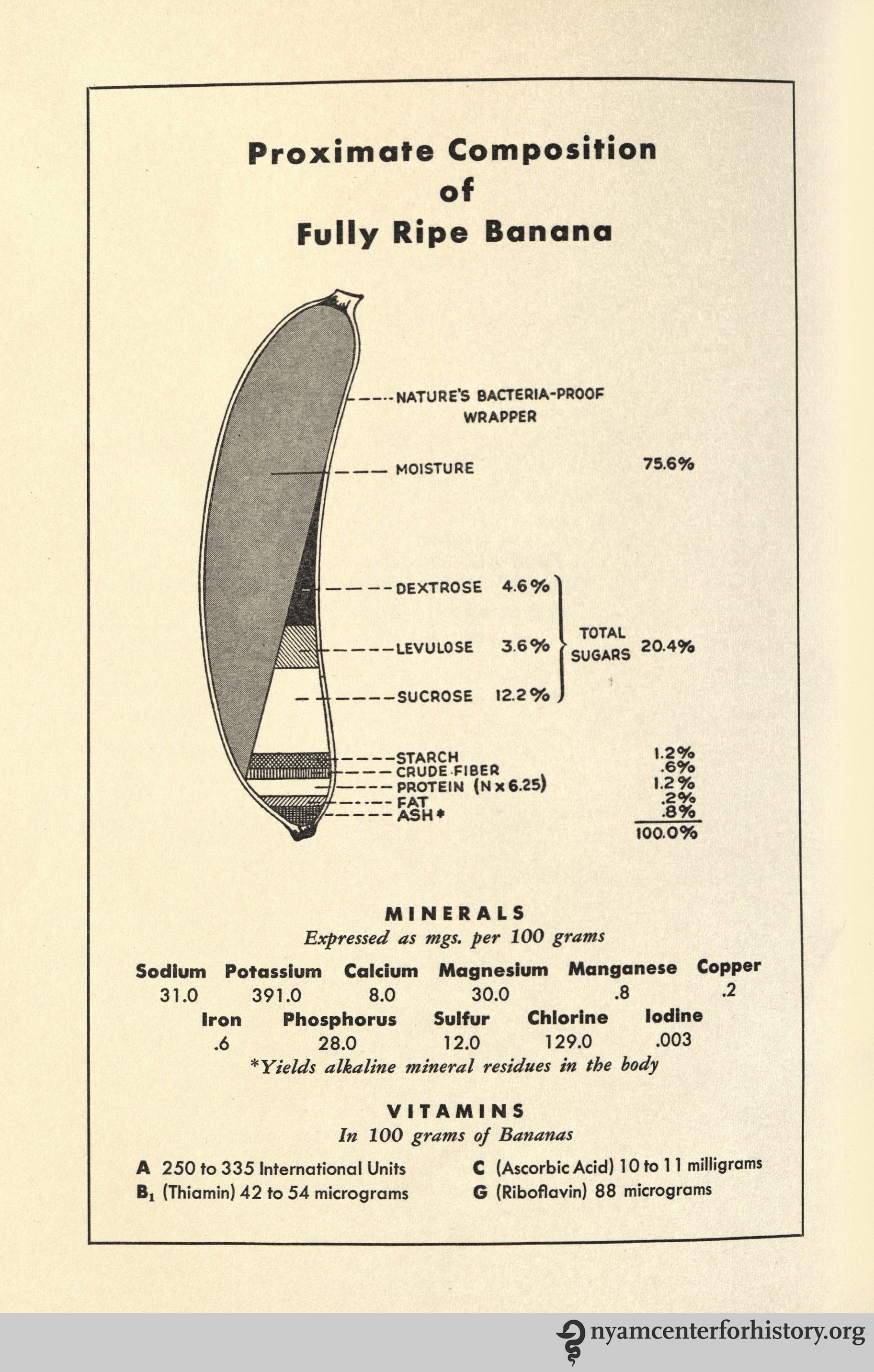
1941 was a busy year for the UFC’s presses. Here, a chart from the second addendum to “Nutritive and Therapeutic Values of the Banana,” an annotated bibliography of recent research devoted to the fruit. The forward tells us that the banana pictured is a Gros Michel, or “Big Mike” banana, imported to the U.S. since the late 1890s. The “Big Mike” was larger, with a sturdier peel, and anecdotally more flavorful. By 1960 “Big Mikes” had been almost entirely eradicated by Panama disease. On American tables it was replaced by the Cavendish.6
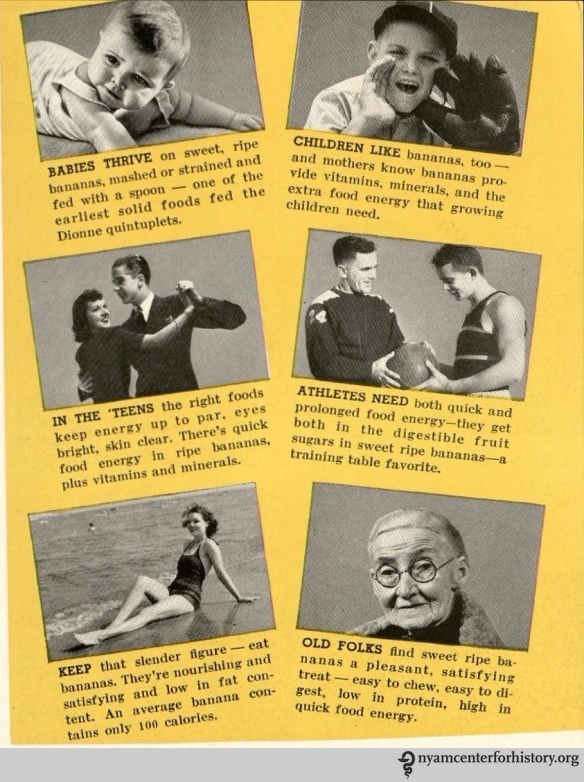
From “Bananas...How to Serve Them,” 1941.

From “Bananas…How to Serve Them,” 1941.

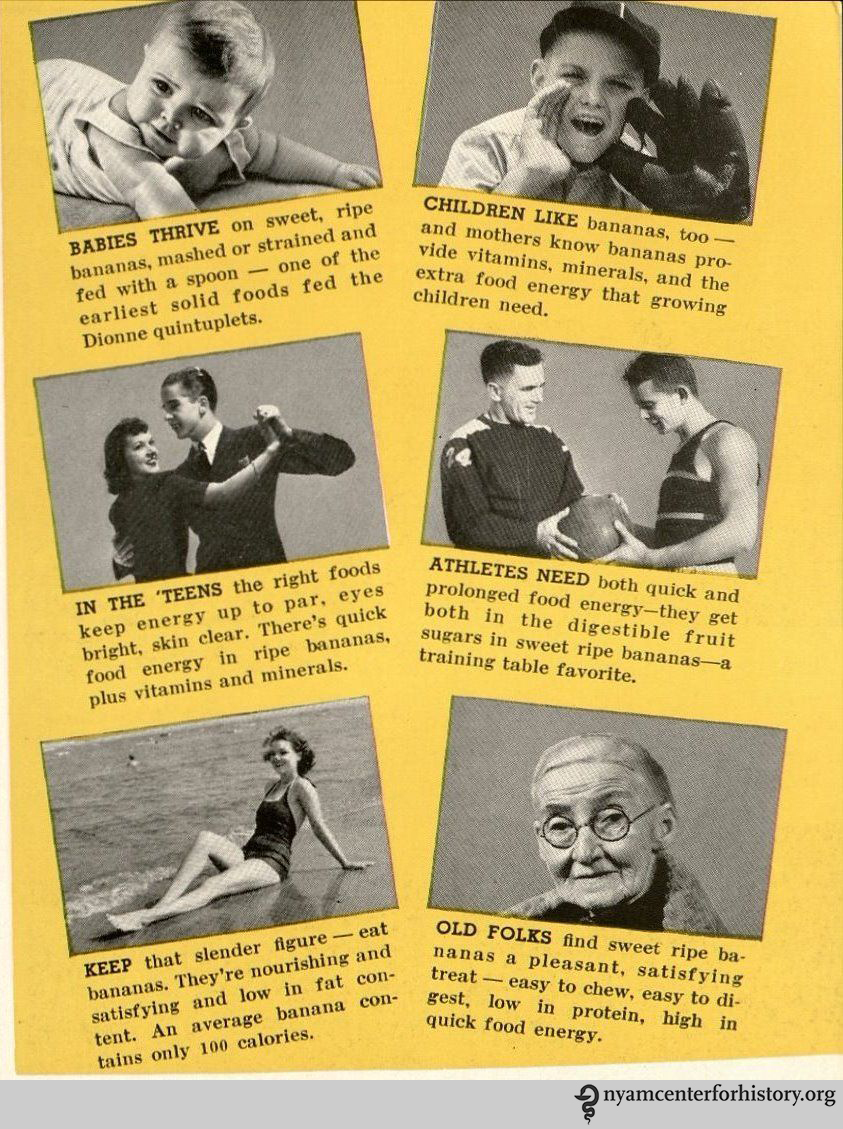
This inset from “Bananas…How to Serve Them” (1941) illustrates the health benefits of bananas at every age. We learn that the Dionne quintuplets (b. 1934), the earliest quints to survive their infancy, ate bananas. Bananas are a “training table favorite” for athletes, and they appeal to the elderly as well because they are easy to chew and digest.

From “Bananas...How to Serve Them,” 1941.

From “Bananas…How to Serve Them,” 1941.

On the left, a sweet banana artist paints bananas at three stages of ripeness and explains how to prepare bananas for meals at each phase. On the right, encouragement for the housewife, with a promise of new banana recipes on the pages that followed. A monocled banana with a cane and top-hat below rips off Mr. Peanut, well-known to Americans since the early 1930s.

From “Chiquita Banana's Cookbook,

From “Chiquita Banana’s Cookbook,” 1960, page 2.

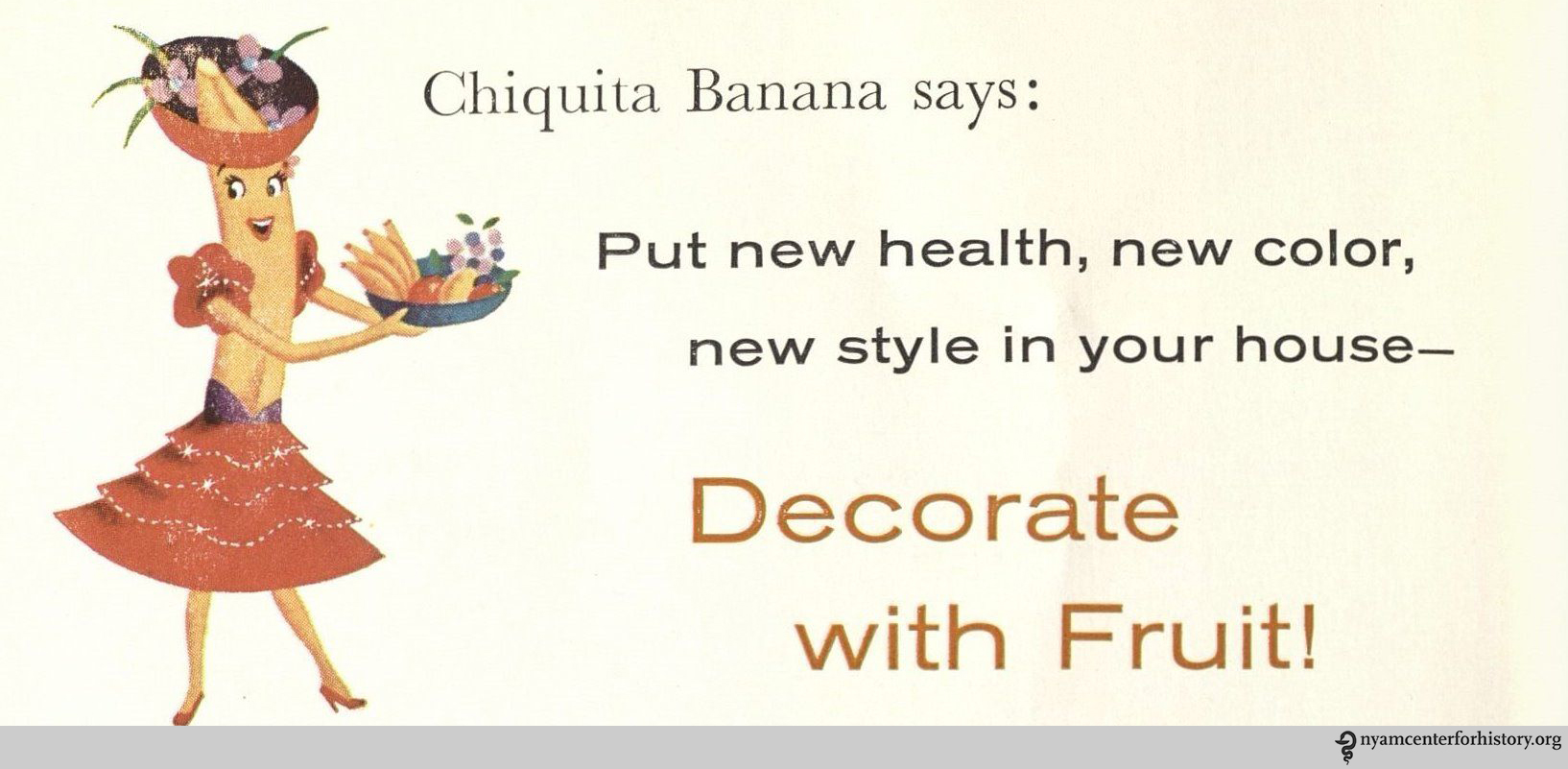
Inspired by Carmen Miranda’s character in Busby Berkeley’s The Gang’s All Here, United Fruit Company introduced Chiquita Banana in 1944 (Miranda herself was frequently called, “chiquita” in her films). Dik Brown, creator of Hagar the Horrible, drew the first Chiquita; advertising execs composed her famous song.7 Here, a 1960 iteration of Chiquita graces “Chiquita Banana’s Cookbook.”
Detail in “Chiquita Banana's Cookbook,

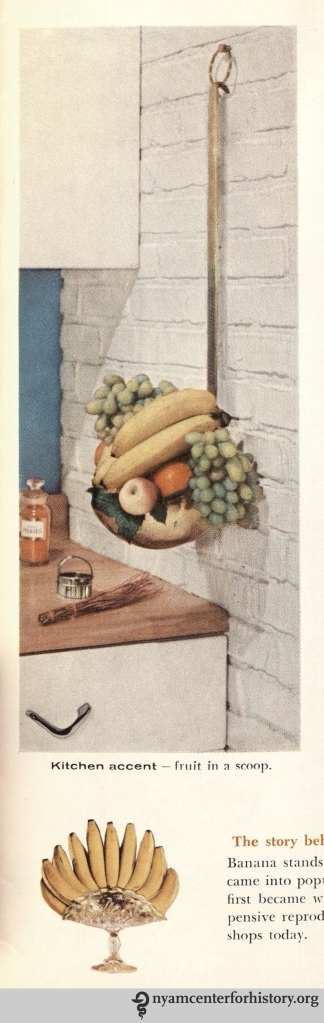
Detail in “Chiquita Banana’s Cookbook,” 1960, page 3.

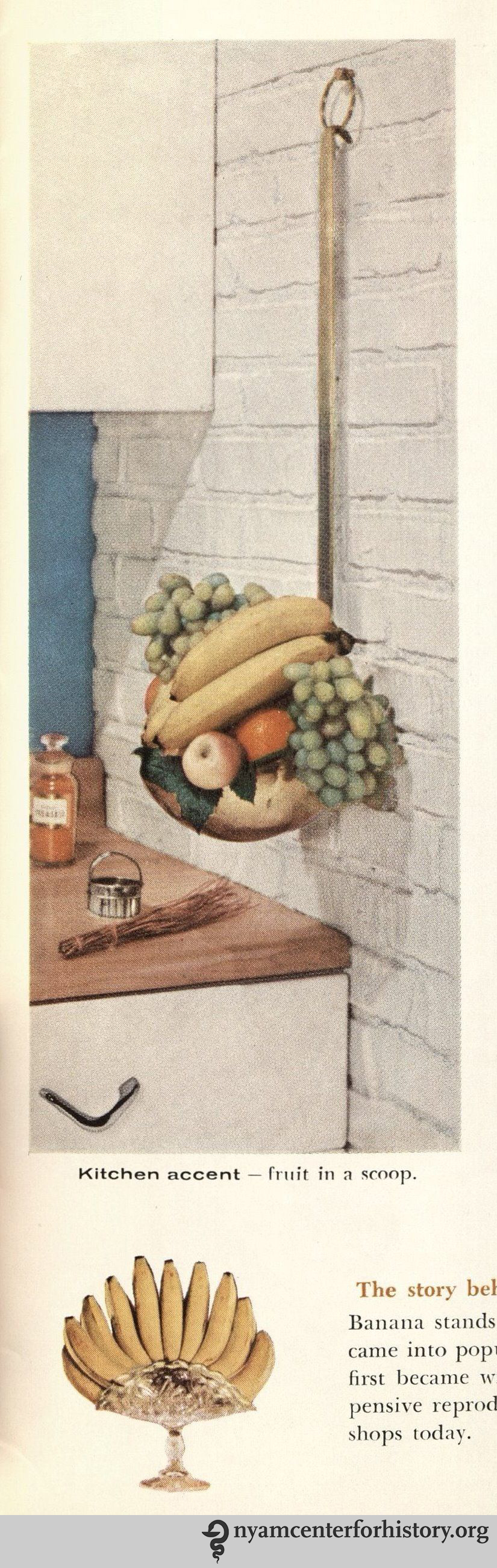
In “Chiquita Banana’s Cookbook,” Chiquita offers ideas for decorating with bananas. Here, “fruit in a scoop” and a banana bouquet, in a pressed-glass stand.

From “Chiquita Banana's Cookbook,” 1960.

From “Chiquita Banana’s Cookbook,” 1960, page 12.

Under consideration by Betty Draper and the Mad Men set: a triptych of bananas in “Chiquita Banana’s Cookbook,” prepared with three different garnishes: a currant jelly, a curry sauce, and mint jelly.
From “Chiquita Banana's Cookbook,” 1960. Click to enlarge.

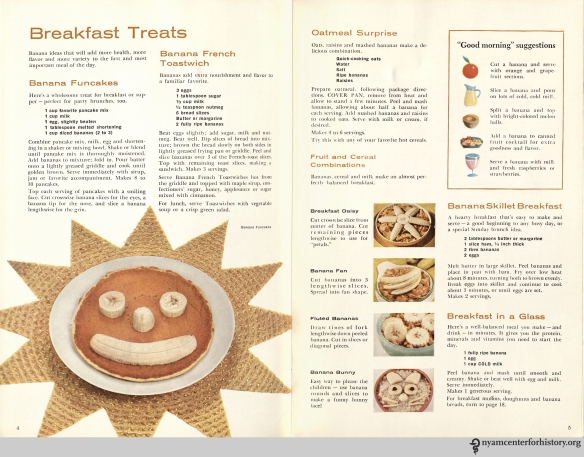
“Chiquita Banana’s Cookbook,” 1960, pages 4-5. Click to enlarge.

 “Chiquita Banana's Cookbook,” 1960, pages 6-7. Click to enlarge.

“Chiquita Banana’s Cookbook,” 1960, pages 6-7. Click to enlarge.

“Chiquita Banana’s Cookbook” offers an adorable banana bunny and a banana skillet breakfast, as well as new recipes for shakes. “Drink a banana and feel better for it,” says Chiquita, and we believe her because she’s wearing that amazing hat.

References

1. Hooker, Richard J. Food and Drink in America. Indianapolis: Bobbs-Merrill, 1981.

2. Koeppel, Dan. Banana. The Fate of the Fruit That Changed the World. New York: Hudson Press, 2008.

3. Koeppel, 75.

4. Koeppel, xv.

5. Levinovitz, Alan. “The First Superfood.” Accessed September 1, 2015 at http://www.slate.com/articles/health_and_science/science/2015/04/the_first_superfood_doctors_believed_bananas_could_cure_celiac_disease.html

6. Koeppel, Dan. Banana. The Fate of the Fruit That Changed the World. New York: Hudson Street, 2008. xiv.

7. Koeppel, 117; 253.

Physicians Discuss Aphrodisiacs

Ken Albala is Professor of History and Director of Food Studies at the University of the Pacific. He is the author or editor of 24 books on food. He conducted his dissertation research primarily at the New York Academy of Medicine. Dr. Albala will present Aphrodisiacs: The Intimate Connection Between Food and Sex in Renaissance Nutritional Theory and lead the workshop “Hands On” Early Modern Cooking at our Eating Through Time Festival on October 17.
As a scholar sometimes you have ideas that get orphaned that you come back to after many years, very randomly. Such was a paper I first delivered at a Northern California Renaissance conference in 1995 on aphrodisiacs in medical literature. In truth, I had intended to fit the topic into my dissertation and it never made it in. The paper was a way to make use of the pile of notes I had taken at the New York Academy of Medicine just a few years before. And when I say a pile of notes, I mean an entire filing cabinet full of handwritten notes taken in pencil and coded with colored crayons. There was no such thing as a laptop then.

A page of Ken Albala's notes.

A page of Ken Albala’s notes.

These notes cover about 100 books I read at the Academy between 1989 and 1993, practically every dietary text written in Europe between the mid-15th and the mid-17th century. I was a permanent fixture in what was then called the Malloch Room, now the Drs. Barry and Bobbi Coller Rare Book Reading Room. The notes became my dissertation at Columbia University and eventually morphed into my first book Eating Right in the Renaissance (UC Press, 2002). While I always kept an active interest in the history of medicine, my career since then has shifted far more toward culinary history and broader food history. Every now and then I deliver a paper or write an article involving food and medicine, and I still teach a history of medicine course, but I had completely forgotten about the topic of aphrodisiacs. In jest I have often said it would be a really interesting topic for experiential research. Alan Davidson, the late author of the Oxford Companion to food, encouraged me many times to write a serious book on aphrodisiacs, but it never came to pass.

What surprise then, when this past spring, two decades after first giving that paper, I was asked to speak in Miami on aphrodisiacs. I thought, OK, I will just go into my computer and find that paper. No evidence of it. I realized that when I wrote that paper I was still learning to type, had just sent my first email, and had still written out everything by hand. So I needed to dig through the filing cabinets to find the original paper. Then to revise and update it using my original trove of notes taken 25 years earlier. Happily the paper was a success. I also delivered it in Dublin a few weeks later, and then a publisher contacted me asking if I would like to write a book on aphrodisiacs. I think I probably will. Isn’t it funny how every stray idea eventually finds a good home?

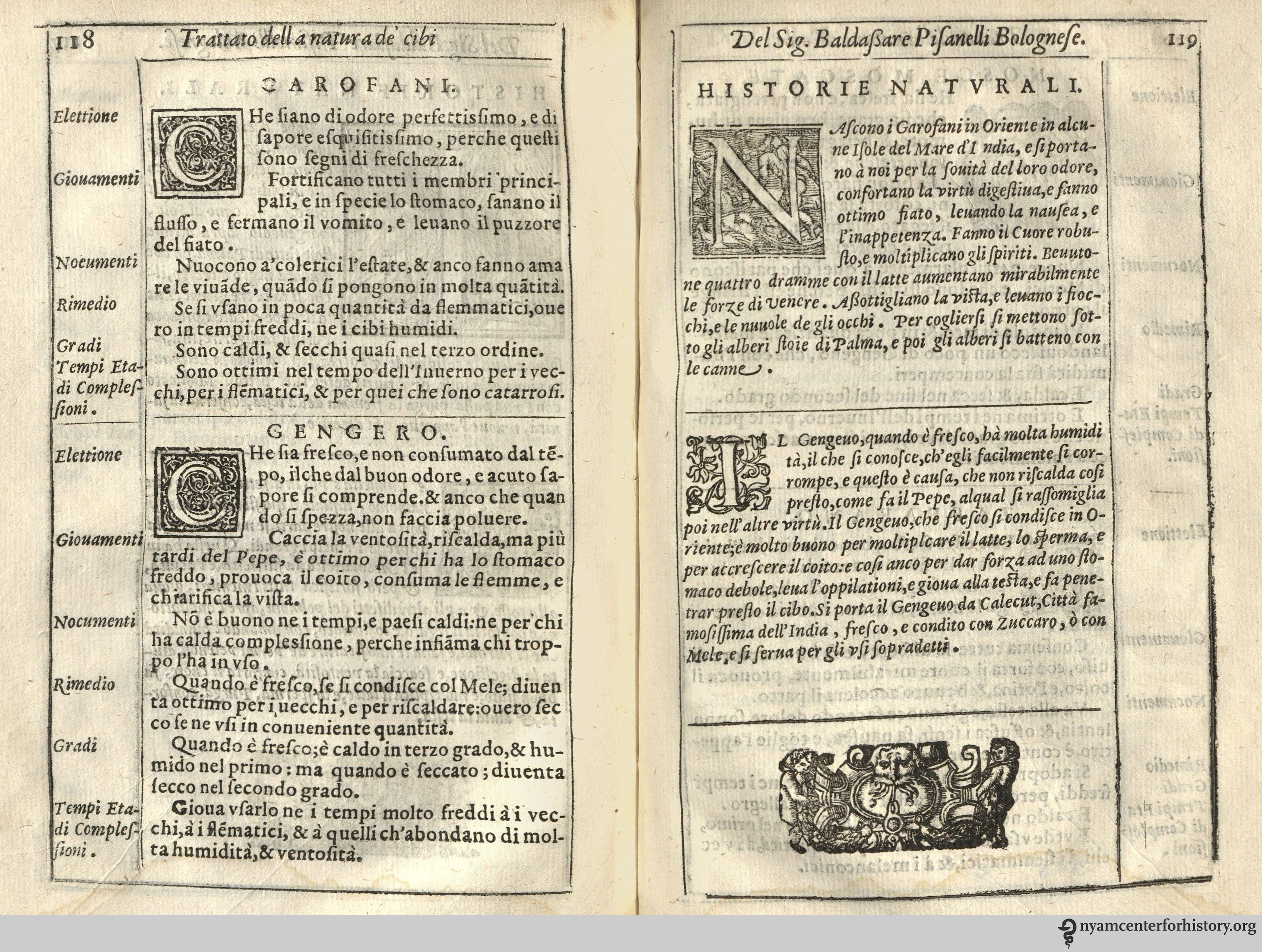
The most remarkable thing about the whole experience is that I can still hear the voices of early modern authors after all these years. I can still quote them in half a dozen languages. From the French version of Platina printed in 1507 there is “L’heure que tu sentiras ta viande estre cuite, car…l’heure est bonne pour engendrer enfans…”  (The moment you feel that your meal is digested, the time is good to produce children.) Or Girolamo Manfredi from 1474 “Imperho dicono li philosophi che chi usa molto il cohito vive poco e tosto invechia.” (Therefore philosophers say whoever has a lot of sex lives a short life and ages too soon.) Or there’s Baldassare Pisanelli who tells us that 4 drams of cloves in milk “aumento mirabilmente le forze di Venere” (greatly increase the power of Venus.) There’s also the Fleming Hugo Fridaevallis who tells us that asparagus is great for timid newlyweds “primas coniugii difficultates, et si quid minis in uxore tunc placet, dulce et amabile futurum tandem uxoris contubernium” (whoever…has conjugal difficulties at first, and if you are unable to please your wife, later she will be a sweet and loving mate).

Baldassare Pisanelli's Trattato della natura de' cibi et del bere Nel quale non solo tutte le virtù, & i vitii di quelli minutamente si palesano, 1586. His discussion of the power of cloves in milk appears top right.

Baldassare Pisanelli’s Trattato della natura de’ cibi et del bere Nel quale non solo tutte le virtù, & i vitii di quelli minutamente si palesano, 1586. His discussion of the power of cloves in milk appears top right. Click to enlarge.

Their opinions are of course very amusing, but they also give us some remarkable insights into the kinds of problems Renaissance people would have taken to their physicians. These kind of frank open discussions of sex gradually become rarer in the 16th century, no doubt under the influence of the Reformations a kind of prudery pervades the later dietaries. It took another few centuries until they discuss the topic again, in the 19th century, but all this is the subject for a book. Stay tuned.