Good eyes are your protection

By Rebecca Pou, Project Archivist
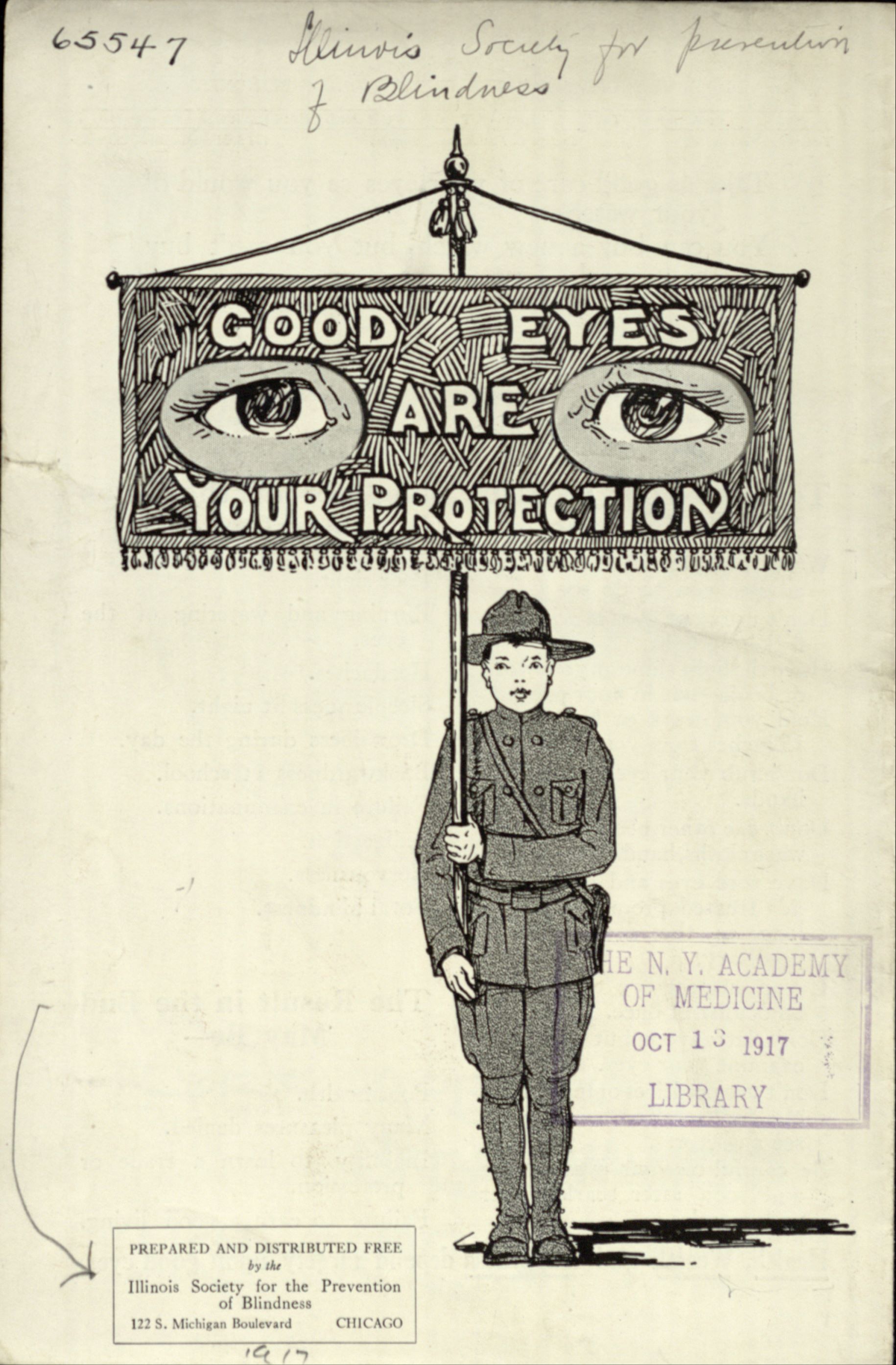
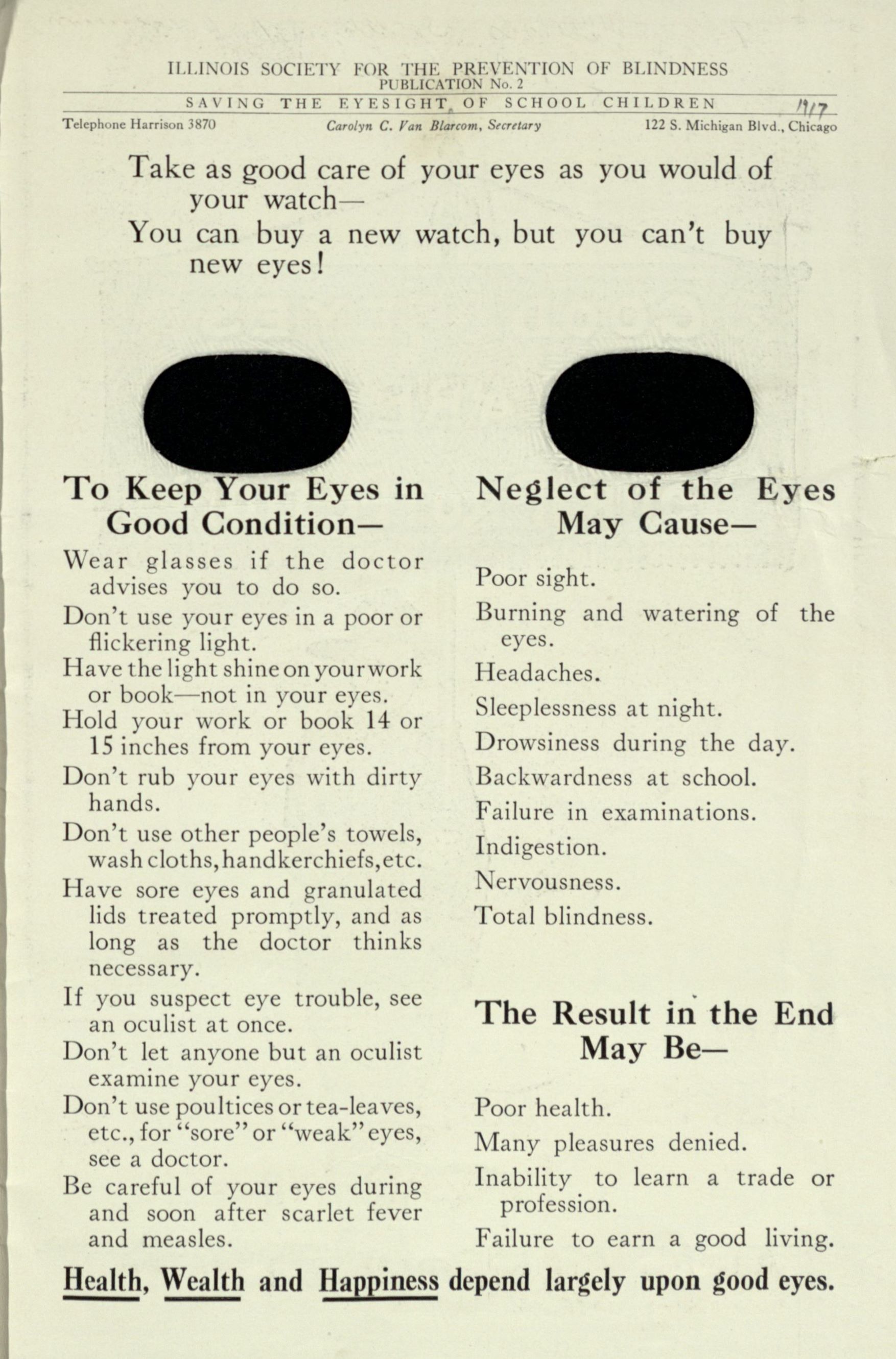
goodeyesareyourprotection“Wear glasses if the doctor advises you to do so.” “Don’t rub your eyes with dirty hands.” “If you suspect eye trouble, see an oculist at once.” This sound advice comes from a 1917 trifold leaflet aimed at school children and published by the Illinois Society for the Prevention of Blindness (ISPB), which was founded in 1916.

breadwinnersWhile the pamphlet contains helpful recommendations on eye health, the illustrations and design are particularly charming. Eyes peer out from the sign on the front cover, but we discover that those eyes belong to a boy in spectacles on the page beneath and the sign has cut outs. The eye holes must have been irresistible to children and are surrounded by guidelines for healthy eyes.
healthwealthhappiness

Click to enlarge.

The pamphlet stresses that proper eye care beginning in childhood confers life-long benefits, especially in a cartoon comparing two couples from an eye screening in childhood through old age. The pair that cares for their eyes flourishes in life, excelling in academics, extracurricular activities, and, in the case of the man, his profession. The other couple is plagued with nervousness and headaches, and both have trouble with work. While the pamphlet is aimed at children, the lesson is for parents as well. In her old age, the content woman is grateful to her mother for getting her the eye care she needed, while the unfortunate pair’s parents had dismissed the eye examiners’ recommendations.

goodcareorneglect

Click to enlarge.

And for anyone who might need further convincing, the Society contrasts good sight and bad sight in black and white.

goodsightpoorsight

In his landmark book, The Evolution and Significance of the Modern Public Health Campaign, published in 1923, C-E. A. Winslow asserts that education and changed behavior are central to modern public health efforts.  He says, “the fight must be won, not by the construction of public works, but by the conduct of the individual life.” In this pamphlet, the ISPB is clearly appealing to individuals, encouraging them to choose good care over neglect, preventing the difficulties in life caused by blindness and eye disease.

Almost a century after the publication of “Good eyes are your protection,” the ISPB still exists and maintains a website. While their efforts seem more expansive, consisting of education, research and programs, the organization remains “dedicated to the care, protection, and preservation of sight.”

Uncle Sam, M.D.

By Paul Theerman, Associate Director

Health Almanac, 1920 front cover.

Health Almanac, 1920 front cover.

How to get the word out? For the last two hundred years, health has been as much about education and prevention as intervention and response. And so an intrepid young doctor in the U.S. Public Health Service (USPHS) latched onto using the almanac as a public health vehicle. Health Almanac 1920 (Public Health Bulletin No. 98; Washington, GPO, 1920) was a 12-page almanac entwined in a 56-page public health pamphlet. Amid checking for the phases of the moon or the times of sunrise and sunset, one could find short pieces giving warning signs for cancer, means to prevent the spread of malaria, the necessity of registering births, and how to build a good latrine. These and many other topics were all presented by “Uncle Sam, M.D.”; the almanac was free for the asking.

Uncle Sam Image 4--July right page

Health Hints and Notable Events for July 1920. Click to enlarge.

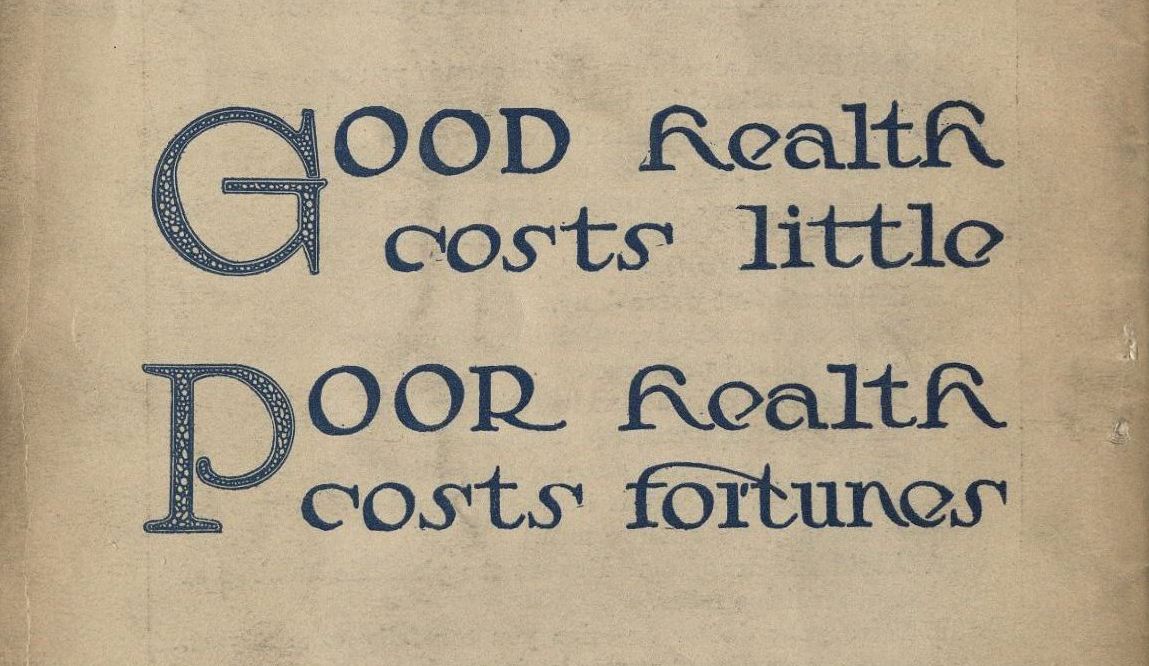
In the distant past, almanacs became linked to health through “astro-medicine” or “iatromathematics,” that is, medical astrology. Each of the signs of the zodiac was held to influence a system of the body, from Ares controlling the head to Pisces the feet, and so for everything in between. Almanacs were calendrical and astronomical, and in addition to marking sunrise and sunset, the phases of the moon, and religious holidays, they charted the day-by-day progress of the moon through the zodiac, with its supposed medical consequences. To this technical data, the most famous American almanac, Benjamin Franklin’s Poor Richard’s Almanac, added moralistic lessons and practical advice, wittily presented. Health Almanac 1920 provided these same features within the context of progressive secular government. The publication started with inspirational statements from President Woodrow Wilson, the Secretary of the Treasury, and the Surgeon General —who together formed the chain of command for the Public Health Service! Instead of a calendar of religious seasons and saints’ days, the almanac noted national days and significant events in the history of medicine and in “The Great War,” just concluded. Everywhere were health aphorisms: “Good health costs little, poor health costs fortunes” (from the back cover), and “Large fillings from little cavities grow” (April 20). Some “health hints” were quite flatly presented: “Every home should have a sewer connection or a sanitary privy” (July 20), and “Food, fingers, and flies spread typhoid fever” (July 31). Some were just to the point: “Be thrifty” (November 15) and “Wear sensible shoes” (December 18). Throughout, the almanac highlighted the role of the USPHS in promoting health.

Uncle Sam Image 2--back cover

Health Almanac, 1920 back cover.

The Health Almanac was published in 1919 and 1920—we have the 1920 edition—as was a parallel publication called the Miners’ Safety and Health Almanac, put out by the Bureau of Mines. Both were the brainchild of Dr. Ralph Chester Williams (1888–1984), then at the outset of his successful career with the Public Health Service. Born in Alabama and a 1910 graduate of the University of Alabama Medical School, Williams entered the USPHS in 1916 and was posted to the Bureau of Mines during World War I. Pulled into the Office of the Surgeon General, he edited Public Health Reports, served as Chief Medical Officer to the Farm Security Administration, as Medical Director of the USPHS’s New York City office, and starting in 1943, as Assistant Surgeon General and head of its Bureau of Medical Services. In that capacity he oversaw a third of the operations of the USPHS, including immigration inspection and USPHS hospitals. In 1951 the Commissioned Officers Association of the USPHS published his standard history, The United States Public Health Service, 1798–1950. At almost 900 pages, it dwarfs the Health Almanac 1920, but both show their author’s dedication to getting the word out about health and, not incidentally, about the agency that helped make that happen.

Looking for Health Information Online? Don’t start with Google.

By Johanna Goldberg, Information Services Librarian

This is the first of an occasional series of blogs featuring research tips from NYAM librarians.

We’ve all done it: You leave the doctor’s office and want to know more information about a new diagnosis or other health concern. So you go to your high-tech device of choice and search the Internet.

A NYAM Librarian conducts a PubMed search.

A NYAM librarian conducts a search in PubMed.


According to the latest Pew Internet research on the topic, 72% of Internet users went online to find health information in the past year. Of these people, 77% started by using a search engine.¹

But a general Internet search may not be the best way to find high quality health information online.

As we all know, anyone can put information online. Just because something is on a web page does not make it reliable. Fortunately, there are excellent sites that present a wide range of trustworthy health information.

When I look for health information online, I usually start with one of the following sites. If they link to other sources, I know the pages have been vetted:

MedlinePlus
This National Library of Medicine site provides authoritative information from government agencies and nonprofit organizations. It includes a very helpful drug and supplements guide.

HealthFinder
Health information from the U. S. Department of Health and Human Services.

Centers for Disease Control and Prevention
The CDC is especially helpful when looking for trends and statistics.

National Institutes of Health
Each NIH Institute offers a wealth of consumer health information related to its area of interest.

There are other excellent options listed on our recommended resources page under the tab “Public and Consumer Health.”

Sometimes you do need to use a search engine. As I teach my Junior Fellows students, there are questions you need to ask to assess information found online:

1. WHO wrote it? Is it an organization or an individual? What is the person or organization’s bias?

2. WHAT makes them “an expert”? What kind of organization is it? Is it written by a patient? A healthcare professional working in the field? Is there a scientific or medical advisory board assessing the information?

3. WHERE is the author located? Is the website .org, .edu, .com, .gov? Each type of site has its own reasons for sharing information.

4. WHEN was the page last updated or reviewed? Health information can change quickly. The more current, the better.

5. WHY is the information on the Internet? Is the author trying to sell a product or service or raise money? Is it there to help patients and caregivers?

6. HOW does it look? Is it easy to read? Are there lots of advertisements? Are things spelled correctly? Does it make you uncomfortable in some way?

Want to know more about evaluating online health information? MedlinePlus has you covered.

1. Pew Internet: Health (23 April 2013) Retrieved May 22, 2013, from http://www.pewinternet.org/Commentary/2011/November/Pew-Internet-Health.aspx

For your viewing pleasure

This Wednesday’s 2013 New York Academy of Medicine Gala featured the following video on the Center for the History of Medicine and Public Health. If you would like to learn more about our work or visit us in person, please email history@nyam.org and library@nyam.org.

Acne Can Be a Social Handicap

By Johanna Goldberg, Information Services Librarian

This is the second in an intermittent series of blogs featuring advertisements from medical journals. You can find the first here.

The ads below come from two dermatology journals—the first five from the Journal of Investigative Dermatology and the last from the International Journal of Dermatology—and span nearly two decades. They promise not only a better quality of life through medical intervention, but also show cultural standards of work, social interaction, and beauty.

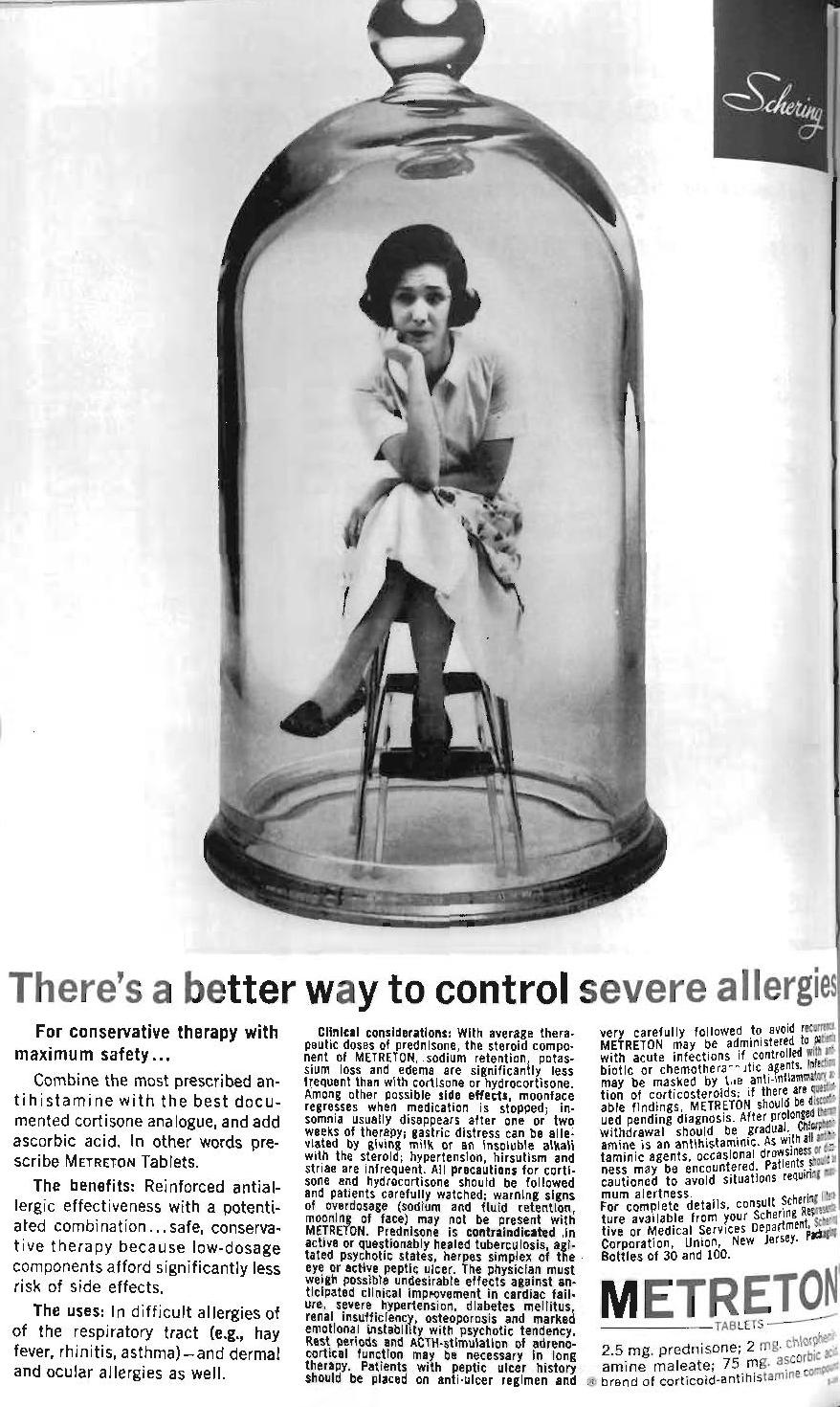
1955: We love the cartoon depictions of each gendered occupation, barefoot sailor and all.

1955: We love the cartoon depictions of each gendered occupation, barefoot sailor and all.

1955: Only people with perfect skin drink martinis.

1955: Only people with perfect skin drink martinis.

1955: Why do these “adolescents” look 40+?

1955: Why do these “adolescents” look 40+?

1963: Probably coincidentally, this ad appeared the same year The Bell Jar was published.

1963: Probably coincidentally, this ad appeared the same year The Bell Jar was published.

1963: Grenz rays are a mild form of radiation widely used from the 1940s–1970s to treat inflammatory skin diseases. While some practitioners still use Grenz rays, evidence of their efficacy remains limited.1,2

1963: Grenz rays are a mild form of radiation widely used from the 1940s–1970s to treat inflammatory skin diseases. While some practitioners still use Grenz rays, evidence of their efficacy remains limited.¹,²

1973: Nothing like nudity to convince doctors to recommend a medicated powder.

1973: Nothing like nudity to convince doctors to recommend a medicated powder.


1. Lindelöf, B., & Eklund, G. (1986). Incidence of malignant skin tumors in 14,140 patients after grenz-ray treatment for benign skin disorders. Archives of Dermatology, 122(12), 1391–1395.

2. National Institute for Health and Care Excellence (NICE). (2010, March 30). Grenz rays therapy for inflammatory skin conditions (interventional procedures consultation). Guidance/interventional procedures. Retrieved April 24, 2013 from http://www.nice.org.uk

History Night: Seeking Submissions

RBR deskThe New York Academy of Medicine (NYAM) Section on the History of Medicine and Public Health is pleased to announce its Third Annual History Night to be held on April 8, 2013, 6:00 pm – 8:00 pm. The event will take place at NYAM located at 1216 Fifth Avenue at the corner of 103rd Street.

We are inviting all those interested in presenting to submit papers on topics in the history of medicine and public health for consideration. Papers submitted previously at other educational events are eligible for submission. The time allotted for those papers chosen for presentation will be 15 minutes, with an additional 3-5 minutes for Q & A.

A panel of members of the NYAM Section on the History of Medicine and Public Health will select the papers to be presented.

The submission deadline is February 1, 2013. Papers may be submitted electronically to Donna Fingerhut at dfingerhut@nyam.org. Questions may be directed to Donna at 212-419-3645.

Symbols in a Life of Psychic Tension

Gallery

This gallery contains 5 photos.

By Johanna Goldberg, Information Services Librarian Forget the articles: Advertisements can be the most interesting part of medical journals from decades past. The ads below, published in the American Journal of Obstetrics and Gynecology between 1940 and 1970, show how … Continue reading

Putting Asthma on the Map

By Arlene Shaner, Acting Curator and Reference Librarian for Historical Collections

Southwest Map

Map from The South-west and New Mexico for phthisis, weak lungs, asthma, bronchitis, etc. Chicago: American Health Resort Association, 1891.

On Wednesday, December 12, 2012, Carla Keirns, MD, PhD, from the Stony Brook University School of Medicine will present this year’s John K. Lattimer Lecture, “Putting Asthma on the Map: Weather, Pollen, Pollution and the Geography of Risk.”

Dr Keirns will discuss how the patient’s environment has been central to the prevention and treatment of asthma since antiquity, and how, beginning in the 19th century, physicians learned to use measurements of humidity, sunlight and rainfall to predict places and seasons that would be safe for asthmatics. During the same period, indoor and outdoor risks such as pollen and dust began to mark regions and spaces as risky or dangerous, and led to efforts to escape attacks through travel or fortifying the home environment against triggers. Recent efforts to predict or create safe places have turned again to the outdoors, both through national regulation of air pollution and the efforts of minority communities and their academic and activist partners to document the disproportionate environmental risks faced by their members.

Register for the event here.

“Die Free”: Black Soldiers in the Civil War

By Lisa O’Sullivan, Director

Surgeon's Certificate for  Dick Parker Wills 1903

Surgeon’s Certificate for Dick Parker Wills 1903

More than 200,000 African men served in the Union Army’s United States Colored Troops during the Civil War. Among them were James Wills, Mack Wills, Dick (Wills) Parker, Andy Wills and Richard Wills, who fled the Tennessee plantation of Edmund Wills to join the 4th Heavy Field Artillery of Columbus, Kentucky.

In Die Free: A Heroic Family Tale acclaimed journalist Cheryl Wills explores the story of her great-great-great grandfather, Sandy Wills, and his companions. In unearthing her family history, she uncovers the discrepancies, disparities, and decisions “great and small, careless and deliberate” that impacted the treatment and care of black soldiers.

Black soldiers died from disease at a disproportionate rate to their white compatriots, and, as documented in Die Free, their higher burden of mortality continued after the end of the war. Evidence from medical records and surgeon’s certificates indicates that many black soldiers also struggled to have their conditions taken seriously and to be granted pensions.

We are delighted to be welcoming Cheryl Wills to the New York Academy of Medicine on December 10. She will appear in discussion with the renowned Lincoln scholar Harold Holzer, to explore the experiences of her family, and reflect on the ongoing legacy of the discrimination they suffered.

Discover more about Die Free here. In addition to their service as soldiers, African Americans also acted as nurses, surgeons and hospital workers during the Civil War. Some of these contributions are explored in Binding Wounds, Pushing Boundaries, an exhibition at the National Library of Medicine.

Voices from the AIDS Epidemic

By Johanna Goldberg, Information Services Librarian

State of Florida Department of Health and Rehabilitative Services, 1987.

State of Florida Department of Health and Rehabilitative Services, 1987.

Today, health care professionals can use multiple tests to detect HIV infection. Where available, drugs therapies allow people to live with HIV for many years before developing AIDS. Of course, this was not always the case. In commemoration of World AIDS Day on December 1, we are revisiting some of the voices published in the early years of the epidemic.

In 1982, 14 doctors presented their front-line experiences at an international symposium, the proceedings of which were published in book form the following year. Their frustration with their inability to successfully treat their young patients rings out clearly.

“Thirteen of 42 patients in our series have already died. Nationwide, half of the patients have died.” Half of their patients with “Pneumicystis carinii pneumonia (PCP) , the most common infection,” responded to the administered drug . “However, excluding three who are still being treated, only two patients who had PCP are presently alive, even though six recovered from their initial infection.” In the ten patients with Cytomegalovirus (CMV) infection, eight died. “Only one, a 22-year-old man with CMV pneumonia, has recovered.” As the authors go on to say, “treatment remains a knotty problem.”

At another symposium, also published in book form, Dr. Kevin M. Cahill, the senior member of the New York City Board of Health, applauded the efforts of individual doctors and nurses, in addition to the “superb work” of the Gay Men’s Health Crisis.  But he chastised the inaction of the “organized medical community.”

“When a fatal infection had struck down veterans attending an American Legion convention, health professionals across the country joined in the search for a solution. When women using tampons became ill with toxic shock syndrome, medical societies and research centers immediately focused their enormous talents on that problem. But when the victims were drug addicts and poor Haitian refugees and homosexual men, their plight did not, somehow, seem as significant to those expected to speak for the health professions. No major research programs were announced, and until it became clear that the disease could spread to the general population through blood transfusions, organized medicine seemed part of the conspiracy of silence.”

Where are we today? Even with so much knowledge about prevention, the CDC estimates that 50,000 people in the United States become newly infected with HIV each year; about 33,000 people receive AIDS diagnoses. In the United States, HIV incidence in people aged 13-29 rose 21 percent between 2006 and 2009.

Prevention education remains essential. Visit the CDC’s Act Against AIDS page or World AIDS Day’s website to find out more about current prevention and testing measures.

For a year-by-year timeline of the HIV/AIDS epidemic in the United States, visit AIDS.gov.

Sources:
Cahill, K. M. (1983). The AIDS epidemic.  New York: St. Martin’s Press.

Centers for Disease Control and Prevention. (2012). Basic Statistics. Retrieved November 28, 2012, from http://www.cdc.gov/hiv/topics/surveillance/basic.htm

Gold, J. W. M., Armstrong, D., Sears, C. L., Henry, S., Donnelly, H., Brown, A. E., …Wong, B.(1983). Acquired Immunodeficiency Syndrome: Infection and Neoplasia in Homosexual Men and Intravenous Drug Addicts. In C. S. F. Easmon & H. Gaya (Eds.), Second international symposium on infections in the immunocompromised host (pp. 105–113). London: Academic Press.