Dr. Dorothy Boulding Ferebee: Civil Rights Pioneer

Today’s guest post is written by the Honorable Diane Kiesel, an acting justice of the New York State Supreme Court. She is the author of She Can Bring us Home (2015), a biography of Dr. Dorothy Boulding Ferebee. On Wednesday, September 21st at 6pm, Kiesel will give a lecture, “Dr. Dorothy Boulding Ferebee:  Civil Rights Pioneer.” There is no charge, but please register in advance here.   

Today, when social security and Medicare address the needs of the elderly, health care programs are in place to take care of the sick and a myriad of government agencies exist to help the poor, it is hard to imagine a time when the hungry, the elderly, the sick and the poverty stricken – particularly if they were people of color – were largely forgotten.

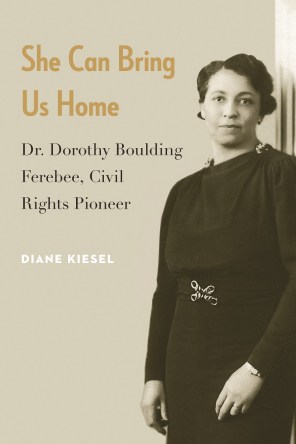
Diane Kiesel's She Can Bring Us Home, a biography of Dorothy Boulding Ferebee.

Diane Kiesel’s She Can Bring Us Home, a biography of Dorothy Boulding Ferebee.

Dr. Dorothy Boulding Ferebee (1898-1980), was a well-known African American physician in her day who focused on the health needs of the destitute early in the 20th century, providing a private safety net where none was yet put in place by the government. For seven summers during the Great Depression, Dr. Ferebee, who came from privilege and whose Washington, D.C. medical practice catered to the upper class of her race, led what came to be known as the Mississippi Health Project.  She and a team of all-volunteer doctors, nurses, schoolteachers and social workers traveled to the Mississippi Delta to bring health care to tenant farmers and sharecroppers. The women who made up the health project were graduates of some of the nation’s finest historic black colleges and members of the elite Alpha Kappa Alpha sorority. They left their comfortable homes to drive thousands of miles of unpaved roads through the Deep South to swelter in the cotton fields for their cause.

dorothy-and-car

Photo of Dorothy Boulding Ferebee, ca. 1958. Courtesy of Moorland-Spingarn Research Center, Howard University, Washington D.C.

It was a daunting task. Their sharecropper patients earned about $50 a year; they worked the most fertile ground on earth but their diets contained almost no fruits or vegetables because the landowners refused to let them use valuable cotton acreage for gardens. They suffered from diseases that had not, and should not, have been seen in the United States since the 19th century – even though it was 1935. Pellagra and rickets were common, as were outbreaks of smallpox. Tuberculosis deaths were rampant. Thirty percent of the black men in the region suffered from untreated syphilis. Dr. Ferebee’s health team not only had to face disease, but ignorance. Some mothers had no idea how old their own children were. They thought if they put tea bags on their children’s eyes, they would cure their colds and feared cutting their hair lest their children be unable to speak.  Some of them had never seen a physician and others had never used a toothbrush.

In the Jim Crow South, Dr. Ferebee’s motives were suspect – some plantation owners feared she was a Communist union organizer or civil rights agitator. But she persevered, and before World War II gasoline and rubber rationing helped put an end to the project, she and her team provided inoculations, medical and dental care as well as nutrition and hygiene lessons to 15,000 of the poorest of the poor. To this day the United States Public Health Service calls it the best volunteer health effort in history.

Ferebee Scrapbook, Box 183-30.

Dorothy and her medical team stuck in the mud in Mississippi. Photo Courtesy of Moorland-Spingarn Research Center, Howard University, Washington D.C.  From the Ferebee Scrapbook, Box 183-30.

The Mississippi Health Project propelled Dorothy Ferebee into the national spotlight. She became president of Alpha Kappa Alpha and followed the iconic Mary McLeod Bethune as the leader of the National Council of Negro Women. In that role she met with presidents and testified before Congress on major civil rights issues. She became a consultant to the State Department where she traveled to Third World countries to bring best health care practices to emerging nations.

Fifty years after the Mississippi Health Project ended one of the participants described it as the inspiration for the next generation of civil rights activists who participated in Freedom Summer and the voting rights struggles of the early 1960s.

Join us to learn more about Dr. Ferebee, this Wednesday night, at The New York Academy of Medicine (103rd St. and Fifth Avenue) for a lecture and book signing (books will be available for purchase on site). Register here; we look forward to seeing you!

Pirates, Poison, and Professors: A Look at the Skull and Crossbones Symbol

By Emily Miranker, Project Coordinator

Ahoy mateys, greetings on September 19th–National Talk Like A Pirrrrrate Day!

medstudentlectureticket_detail_watermark

Detail of student lecture ticket, for the lectures of Dr. William Darling, University of New York.  1878-1879.

Popularized in particular by Robert Louis Stevenson’s 1883 novel Treasure Island, pirates became a part of popular culture and parody pop culture beginning in the late 19th-century.  For me, more than eye patches, peg legs, parrots and treasure maps, the ultimate emblem of pirates is the skull and crossbones symbol.

I see this symbol every so often at work here in the library–which, incidentally, seldom gets attacked by pirates. As a fairly universally fearsome warning symbol, the skull and crossbones meant poison in many pharmacy books.

Take this example on a pamphlet issued by the New York City Health Department in the early 20th century on the danger of wood alcohol poisoning:

the-serious-menace-of-wood-alcohol-warning_page1_watermarked

Title page of The Serious Menace of Wood Alcohol. Warning! published by the New York City Health Department ca. 1920.

The symbol has roots in Europe in the early Christian tradition. Biblical legend holds that the bones of Adam rested at the base of Christ on the cross and so the pairing of skull and bone or skull and crossed bones was associated with funerary customs.1 Skull and crossbones decorate many catacombs and cemeteries from the Middle Ages. And you can often spot the skull and a bone or crossed bones at the bottom of Crucifixion scenes in Renaissance paintings:

fra-angelico-crucifixion-c-1420_metmuseum

Tempera painting by Fran Angelico, c. 1420-23 from the Metropolitan Museum of Art’s collections.

va-der-weyden-crucifixion-c-1460_philamuseumofart

Two companion oil paintings by Netherlandish Rogier van der Weyden from the Philadelphia Museum of Art’s collections, depict The Crucifixion and St. John c. 1460.

The symbol took to the seas as a form of shorthand for captains, who noted the sailors who died with a little skull and crossbones next to their name in the ship’s log.  In this way, seafaring folks came to associate the symbol with death–perhaps what inspired pirates to use it to terrify ships in the 18th century. Around the same time, the Catholic Church prohibited use of the symbol, now tarnished by its piratical associations.2 Not all pirates used the skull and crossbones; other flags featured hourglasses, skeletons, spears, crossed swords, and bleeding hearts. The 1720 trial of pirate Calico Jack Rackham made the symbol and its link to piracy–and by extension death–famous (funnily, his actual flag was in fact a skull and crossed swords).3

The skull and crossbones came to be associated with poisonous substances in the mid-19th century. In 1829, New York State passed a law requiring all containers with poisonous substances to be labeled. The skull and crossbones start appearing on these labels around the 1850s. The symbol was not always considered enough: bottles themselves were sometimes designed in the shape of coffins, in bright, noticeable colors, and even with raised bumps that could be felt by hand if details couldn’t be seen to alert the user.4

In the 1970s, health officials in Pittsburgh, Pennsylvania, realized that children there ingested poison far more than the national average. They surmised it was because the skull and crossbones image wasn’t a scary deterrent to them (they knew it simply as the logo for the Pittsburgh Pirates baseball team).This led to the introduction of Mr. Yuk as a poison warning icon, though he was voted out in 2001 by the American Association of Poison Control in favor of the skull and crossbones. The skull and crossbones also had the advantage of being in the public domain, while Mr. Yuk is trademarked.

poison-control-mr-yuk-duo

The American Association of Poison Control’s current logo, featuring a skull and crossbones on a prescription bottle. The emoticon-like Mr. Yuk symbol, originally created by the Children’s Hospital of Pittsburgh.

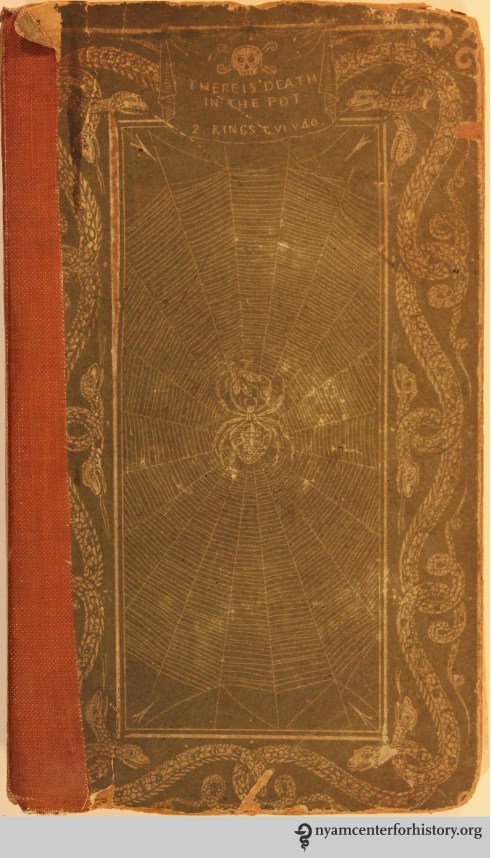
Back here in the library, the skull and crossbones adorns the cover of A Treatise on adulterations of food and culinary posions. The book was published in 1820 when food adulteration was a very serious problem in London (hence the ominous warning on the cover, “There is Death in the Pot.”) Furthermore, the government would not pass regulations for nearly four more decades. For good measure, the book cover also includes two venomous creatures to warn you off suspect food substances: a spider and snakes.

deathinthepot-cover_watermarked

Friedrich Christian Accum’s Treatise on adulterations of food and culinary poisons, published in 1820.

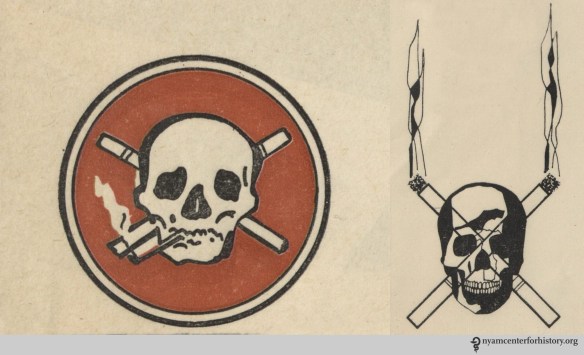
Our Abellof stamp collection has a group of stamps and envelopes related to anti-smoking campaigns in the 1980s.  Several of them feature artwork with a modified skull and crossbones design, converting crossbones into dangling cigarettes:

anti-smoking-skulls_abeloff-stamps_watermarked

On the left, a design by the U.N. WHO Anti-Smoking Campaign for Ethiopia, 1980. On the right, a postmark of a WHO Anti-Smoking campaign first day cover from 1986. Both from the Abeloff Stamp Collection.

Here’s an ad from a 1900 issue of American Druggist for cube morphine. There is something of a mixed message here with the finger pointing your way to pain relief as well as “poison, deadly, beware!”

morphine_americandruggistv36n6-mar251900_watermark

Ad published in American Druggist and Pharmaceutical Record, volume 36, number 6, March 25, 1900.

Below, the symbol is featured on a medical student lecture ticket. In the days before online registration and student ID swipe cards, students were issued a matriculation card upon paying their matriculation fees.6 Presenting that to various professors, they could then purchase a ticket or card to the professor’s class.

medical-student-lecture-ticket_watermarked

A student of the Scottish-born Dr. William Darling, George Noble Kreider was originally from Ohio, and set up practice in Illinois where he presided over the establishment of the Illinois State Medical Journal as president of the State Medical Society.

Kill you or cure you, the skull and crossbones has a checkered past and sometimes sends us mixed messages. If you do get poisoned during a pirate attack today, hurry on over to our library: we have a bezoar to cure you!

bezoar_watermark_19xx

Bezoar, ca. 1862, from our collections.  More details to come!

What is a bezoar, and how might it counter poison? Stay tuned for your answers in a future post.

References

  1. “Evolution of the Poison Label: From Skull and Crossbones to Mr. Yuk.” Meg Farmer, School of Visual Art. Accessed July 13, 2016.
  2. “Evolution of the Poison Label: From Skull and Crossbones to Mr. Yuk.” Meg Farmer, School of Visual Art. Accessed July 13, 2016.
  3.  “Calico Jack.” Wikipedia. Accessed August 1, 2016.
  4.  Griffenhagen and Bogard. History of Drug Containers and Their Labels. The American Institute of the History of Pharmacology. 1999. P 93.
  5. McCarrick and Ziaukas. Still Scary After All These Years: Mr. Yuk Nears 40. Western Pennsylvania History. Fall 2009. P 20.
  6. “Tickets to the Healing Arts.” Penn University Archives and Records Center. Accessed August, 19, 2016. 

Is Air-Conditioning Heating Up Our Environment?

Stan Cox image

The former Sackett & Wilhelm printers’ building in Brooklyn, the place where Willis Carrier first put air-conditioning into practice in 1902. Image Credit: Stan Cox.

This summer, we’re teaming up with our friends at The Museum of the City of New York to offer “Fast, Cool & Convenient: Meeting New Yorkers’ High Demands,” our free three-part talk series supported by a grant from The New York Council for the Humanities.

Tomorrow night (Thursday the 11th) the Academy will host the second of these three events, entitled COOL: Uncomfortable Truths About Our Air-Conditioned City.  The speaker will be Stan Cox, Ph.D., research coordinator and climate change expert at The Land Institute in Salina, Kansas.  The event will begin at 6:30pm; please register in advance here.

This week, Dr. Cox has guest-authored “Is Air-Conditioning Heating Up Our Environment?” for the Academy’s Urban Health Matters blog.  You’ll find a link to the post here.  Enjoy, and we hope to see you tomorrow evening!

Historical Advice on Breastfeeding in Honor of World Breastfeeding Week

By Becky Filner, Head of Cataloging

jewesbury_mothercraft_1932_53_watermark

“Mother nursing twins simultaneously.”  From Reginald Charles Jewesbury’s Mothercraft, antenatal and postnatal.

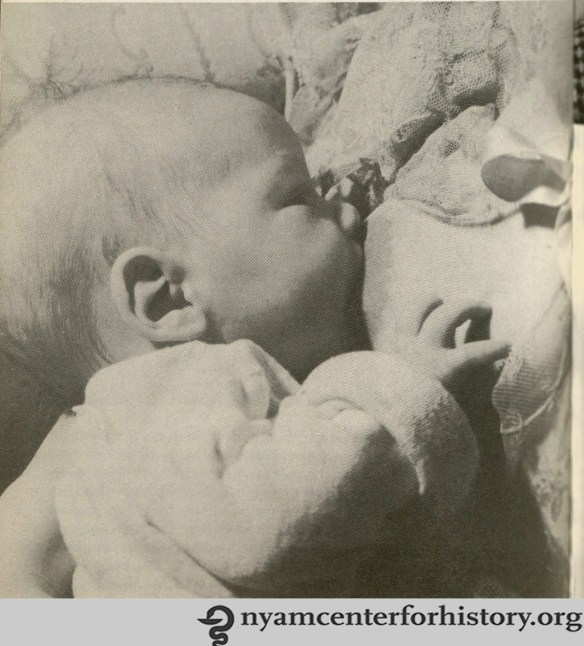
World Breastfeeding Week – August 1-7, 2016 – seeks to promote, protect, and support breastfeeding. How was breastfeeding regarded in the past? To answer this question, I consulted books on child rearing from the early 19th century to the mid-20th century.

buchan_advicetomothers_part1watermark

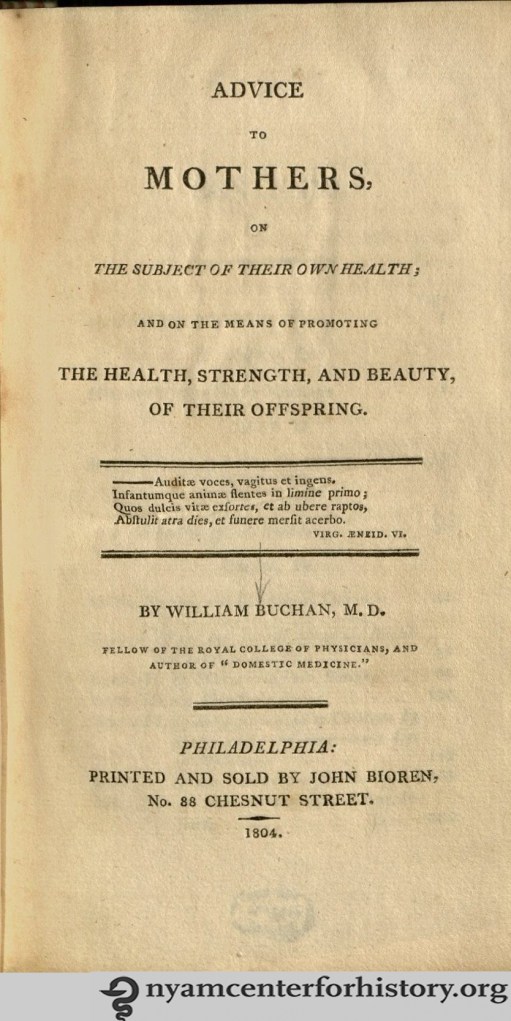
Title page, William Buchan’s 1804 Advice to Mothers.

The earliest book I looked at, Dr. William Buchan’s 1804 Advice to Mothers, on the Subject of Their Own Health; and on the Means of Promoting the Health, Strength, and Beauty, of Their Offspring, is extremely critical of women who do not breastfeed:

Unless the milk….finds the proper vent, it will not only distend and inflame the breasts, but excite a great degree of fever in the whole system… It may be said, that there are instances without number, of mothers who enjoy perfect health, though they never suckled their children. I positively deny the assertion; and maintain, on the contrary, that a mother, who is not prevented by any particular weakness or disease from discharging that duty, cannot neglect it without material injury to her constitution.1

At the end of the 19th century, Dr. Genevieve Tucker’s Mother, Baby, and Nursery: A Manual for Mothers (1896) also strongly advocates breastfeeding:

Every mother who has health sufficient to mature a living child ought, if possible, to nurse it from her own breast. Her own health requires it, as the efforts of the child to draw the milk causes the uterus to contract, and nothing else will take its place to her infant.2

Much of her other advice seems outdated now, including her claim that “nursing babies suffer from too frequent nursing” and her suggestion to nurse “as seldom as possible at night.” Perhaps strangest to modern ears is her analysis of a woman’s ability to nurse based on her physical and emotional state:

Different temperaments and constitutions in women have great influence in the quantity and quality of milk. The richest milk is secreted by brunettes with well developed muscles, fresh complexions, and moderate plumpness. Nervous, lymphatic, and fair-complexioned women, with light or auburn hair, flabby muscles, and sluggish movements, as a rule, secrete poor milk. Rheumatic women secrete acid milk, which causes colic, diarrhea, and marasmus in the child.3

Tucker also suggests that a nursing mother should be producing a whopping forty-four ounces of breast milk every twenty-four hours.

applebaum_babyamothersmanual_watermarkcrop

Breastfeeding baby, from Stella B. Applebaum’s Baby, A Mother’s Manual, published ca. 1946.

Dr. Charles Gilmore Kerley in his Short Talks with Young Mothers: On the Management of Infants and Young Children  wrote in the early 19th century that contemporary pressures on women hinder their breastfeeding abilities:

A mother, to nurse her child successfully, must be a happy, contented woman… The American women of our large cities assume the cares and responsibilities of life equally with men. Among the so-called higher classes, — those who have all that wealth and position can give, — there is a constant struggle for social pre-eminence. Among the majority of the so-called middle classes the contest for wealth and place never ceases from the moment the school days begin until death or infirmity closes the scene. Among the poor there are the ceaseless toil, the struggle for food and shelter, the care of the sick, and the frequent deaths of little ones in the family whom they are unable properly to care for. In all classes, therefore, the conditions of life are such as seriously to interfere with the normal function of nursing, no matter how excellent may be the mother’s physical condition.4

This emphasis on a woman’s mind being at rest is repeated in much of the early 20th- century literature on breastfeeding.

eldred_fortheyoungmother_part1_watermark

“Hungry!” from Myrtle M. Eldred and Helen Cowles Le Cron’s For the Young Mother, 1921. p. 31.

Most of the books from the first few decades of the 20th century contain a passage about keeping the breasts and nipples clean. Kerley and others recommend washing the nipples (and even the child’s mouth!) with a solution of boracic (boric) acid. Myrtle M. Eldred and Helen Cowles Le Cron write in For the Young Mother (1921) that “the breasts are tender and easily infected at first, so that the boric acid acts as a cleanser to protect the baby from possible germs and as a preventive of abscessed breasts.5”Boric acid, though it is sometimes used as an antiseptic, is toxic to humans if taken internally or inhaled in large quantities. Other books recommend rinsing the breasts with hot water prior to nursing.6

Many books also contain lists of foods the nursing mother should and should not eat. Dr. Anne Newton, in her Mother and Baby: Helpful Suggestions Concerning Motherhood and the Care of Children (1912), advises mothers to practice “sacrifice and self-denial” in eating meals, and to avoid rich and seasoned foods altogether.7 Newton specifies that mothers should eat “nothing about which there is any question of fermentation. Such vegetables as cabbage, turnips, cauliflower, and tomatoes should not be given until the baby is four months old at least, and even then certain things may cause discomfort and cannot be indulged until the child is weaned.8” Dr. Thomas Gray, in Common Sense and the Baby: A Book for Mothers, notes that the breastfeeding mother should “eat an abundance of wholesome, nutritious food; avoid indigestible pastries and salads. Take sparingly of tea and coffee. Drink freely cocoa and milk. Eat fruits – not acid.9”  Some more recent books are much less rigid about the mother’s diet. Dr. Dorothy Whipple, writing in 1944, is less cautious, and argues that there’s very little a mother can eat that harms a nursing baby, mentioning only certain foods like onions that may, in breast milk, deter babies with its “unusual taste.10

applebaum_babyamothersmanualcrop_watermark

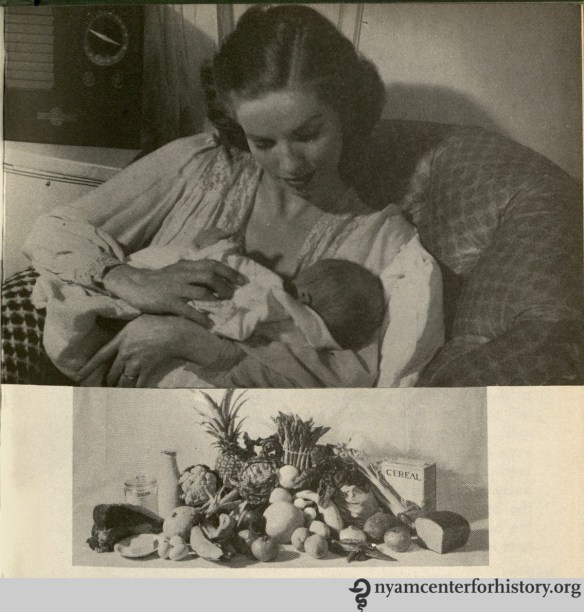
A mother breastfeeding and a selection of foods recommended for the breastfeeding mother, taken from Stella B. Applebaum’s Baby:  A Mother’s Manual (1946).

nycdeptofhealth_careofbaby_part1cover_watermark

Front cover of the New York City Health Department’s The Care of Baby, 1932.

None of the books I consulted recommended breastfeeding to two years or beyond, the WHO’s current recommendation on breastfeeding. Most books recommend weaning the baby between eight and fourteen months of age.  The New York City Department of Health warns against weaning in summer because of the risk of spoiled cow’s milk:

If possible, do not wean your baby during the hot summer months…. If you are well, it will not harm you to nurse your child until the dangerous, hot weather is over. This precaution may mean saving your child’s life.”11

whipple_ouramericanbabies_part6_)watermark

“One of life’s richest experiences,” from Dorothy Whipple’s Our American Babies, published in 1944.

Another common thread in the literature about breastfeeding is an emphasis on the pleasure and health benefits experienced by the nursing mother.  According to Tucker, “under the right conditions of lactation, … the mother should thrive and even grow stout.12” Others emphasize that breastfeeding will help the mother “get her ‘good figure’ back much more quickly than the mother who doesn’t nurse” because “nursing causes the uterus or womb to contract.13” Stella Applebaum provides this summary of the mother-baby nursing relationship:

Mother’s milk is the perfect baby food. From a healthy mother’s clean nipples, this pure, fresh, warm, nourishing, digestible food is delivered, germ-free, directly into the baby’s mouth. At the same time mother’s milk protects him against certain diseases. Suckling at the breast makes the baby feel close to his mother, happy, and secure.

Nursing benefits you, too. It stimulates the uterus to contract to normal size and contributes to your personal enjoyment and contentment. Propped in a comfortable chair or bed, you share a uniquely satisfying experience with your baby.14

Other writers underscore the vital role nursing plays in strengthening the emotional bonds between mother and child.   Buchan writes in 1804 that “the act itself is attended with sweet, thrilling, and delightful sensations of which those only who have felt them can form any idea.15” Dorothy Whipple has the last word:

…to sit in a comfortable chair and hold a little snuggling baby in your arms, to watch him grab that nipple with all the fury of his tiny might and suck and work away until he reaches that complete satisfaction that comes to a baby with a full stomach is one of the pleasantest sensations in life.16

zabriskie_motherandbabycareinpictures_part1 0004_watermark

A mother and her baby breastfeeding while lying down, from Louise Zabriskie’s Mother and Baby Care in Pictures, published in 1941.

References

1.  Buchan, William. Advice to Mothers, on the Subject of Their Own Health; and on the Means of Promoting the Health, Strength, and Beauty, of Their Offspring. Philadelphia: John Bioren, 1804, p. 75-76.

2-3. Tucker, Genevieve. Mother, Baby, and Nursery: A Manual for Mothers. Boston: Roberts Brothers, 1896, p. 85-87.

4. Kerley, Chalres Gilmore. Short Talks with Young Mothers: On the Management of Infants and Young Children. New York: G.P. Putnam’s Sons, 1904, p. 13-15.

5.  Eldred, Myrtle M. For the Young Mother. Chicago: The Reilly & Lee Co., 1921, p. 37.

6.  Kenyon, Josephine Hemenway. Healthy Babies Are Happy Babies: A Complete Handbook for Modern Mothers. Boston: Little, Brown, and Company, 1934, p. 55-56; Zabriskie, Louise. Mother and Baby Care In Pictures. Philadelphia: J.B. Lippincott Company, 1941, p. 131.

7.  Newton, Anne B. Mother and Baby: Helpful Suggestions Concerning Motherhood and the Care of Children. Boston: Lothrop, Lee & Shepard Co., 1912, p. 74.

8.  Ibid., p. 78.

9.  Gray, Thomas N. Common Sense and the Baby: A Book for Mothers. New York: the Bewick Press, 1907, p. 39.

10. Whipple, Dorothy V. Our American Babies: The Art of Baby Care. New York: M. Barrows and Company, Inc., 1944, p. 139.

11.  New York City Department of Health. The Care of Baby. New York: Department of Health, 1932, p. 10.

12. Tucker, p. 86.

13. NYC Dept. of Health. The Care of Baby, p. 5.

14. Applebaum, Stella B. Baby: A Mother’s Manual. Chicago and New York: Ziff-Davis Publishing Company, 1946.

15. Buchan, p. 79.

16. Whipple, p. 122.

Anatomical Illustrations: A Round-Up from our Visualizing Anatomy Workshop

Kriota Willberg, the author of today’s guest post, explores the intersection of body sciences with creative practice through drawing, writing, performance, and needlework.

On Mondays in June, I taught a drawing class in collaboration with staff at The New York Academy of Medicine Library.

The Visualizing and Drawing Anatomy workshop was open to artists as well as first time drawers willing to be challenged by the visual complexity of the human body in a short four-week course. Using the Academy’s historical collection as reference and instruction, artists and hobbyists learned to draw the body and found inspiration in the variety of illustrations.

Arlene

Historical Collections Librarian Arlene Shaner shared her knowledge about the collection with participating artists.

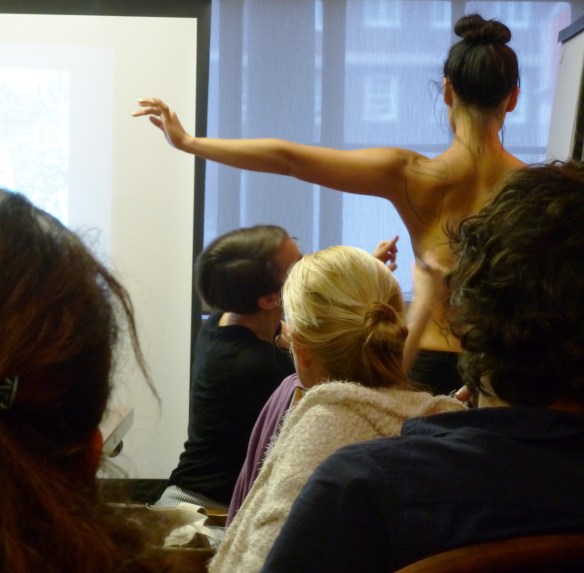
Working with rare books, a live model, and short presentations about the musculoskeletal system, workshop participants practiced looking through the skin to the model’s bony structures and large muscle groups.

In_Class2_NYAM2016

Drawing muscular anatomy on the model, we can compare a living body to images from historical texts.

Participants drew the model’s anatomy in class, and practiced during the week by doing various homework assignments.

In_Class4_NYAM2016

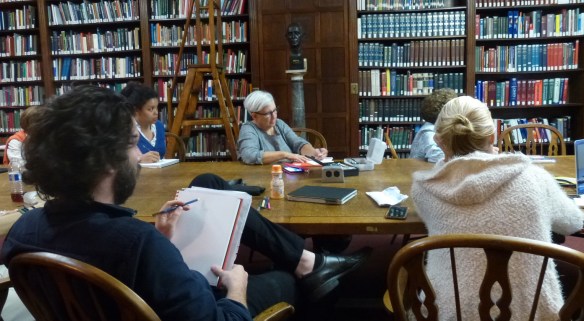
Artists drawing in our Hartwell Reading Room from our live model.

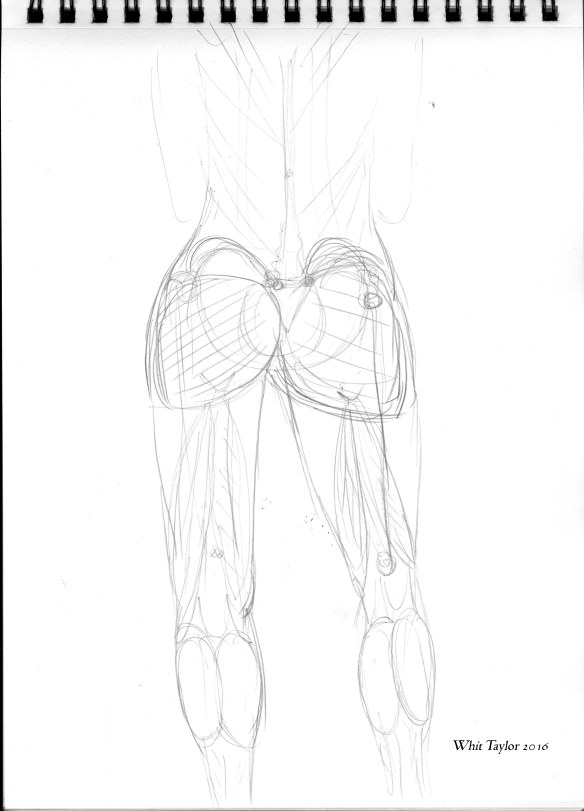
WhitTaylor2016anatomy1

Whit Taylor’s in class sketches of muscular anatomy from the live model.

WhitTaylor2016anatomy2

A second sketch by workshop participant Whit Taylor.

Debbie Rabina2016_4

Debbie Rabina’s in class sketch of the live model.

AllisonWhite4_2016

Allison White’s in class sketch of muscular anatomy from the live model.

Some homework used copied images from Vesalius and Dürer as subjects to anatomize with skeletal and muscular systems.

4Shaw_susan_Durer_Hmk2

Susan Shaw’s homework of anatomized Dürer images.

One of the participants proposed earning some extra credit, and anatomized two characters drawn by cartoonist Josh Bayer.

3Shaw_susan_Bayer2

Susan Shaw did a great job of re-configuring these skeletons to suit Josh Bayer’s iconoclastic drawing style.

Josh Bayer’s original cartoon can be viewed here.

Working with the historical collection as a teaching tool was very gratifying. I found new points of interest in familiar images, and developed a deeper appreciation for the artists and anatomists who generated so much rich material.

I love watching people draw.  As I watched this group work with the collection and the live model, I could observe and celebrate their growth during the course of the workshop. Witnessing the hard work, diligence, and growth of this group was truly inspiring!

17th Century Recipes, Fit for a Gala

By Arlene Shaner, Historical Collections Librarian

The New York Academy of Medicine hosted its annual fund-raising gala at the Mandarin Oriental on June 14th.  Gala attendees had the opportunity to sample two treats based on recipes from one of our favorite manuscript receipt books.

The Academy Library has 37 manuscript receipt books, most of which contain a mix of culinary, medicinal and household recipes. Some of them have been featured already on our blog (see earlier posts on Mother Eve’s Pudding, and English Gingerbread). The Recipes Project also featured an interview with Anne Garner, our Curator of Rare Books and Manuscripts, about the print and manuscript historical recipe books in our collection.

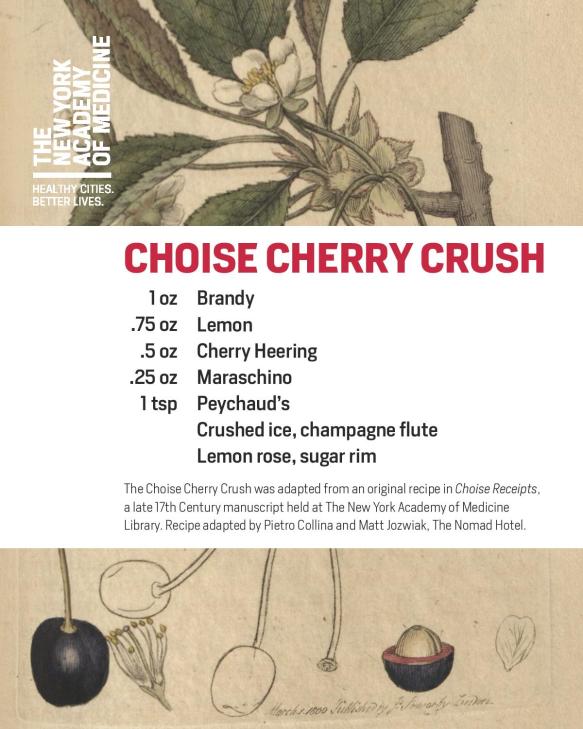
One of our favorite manuscripts is A Collection of Choise Receipts from the late seventeenth century. Inspired by a recipe for Black Cherry Water in the manuscript, Pietro Collina and Matt Jozwiak created a signature cocktail, the “Choise Cherry Crush,” for gala guests. You can try your hand at mixing one up if you are so inclined.

Gala Cocktail Flyer-page-001

The adapted recipe for the Choise Cherry Crush, adapted from A Collection of Choise Receipts (1680)

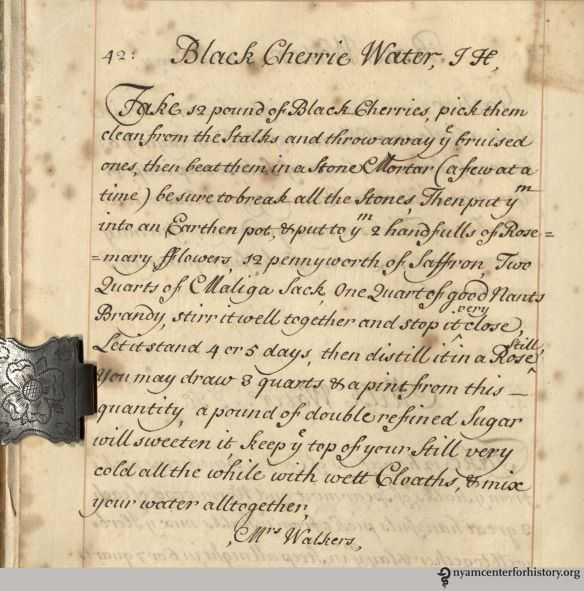
The drink was inspired by this 1680 recipe:

choise-recipe-cherry-water copy

“Black Cherrie Water,” A Collection of Choise Receipts, 1680.

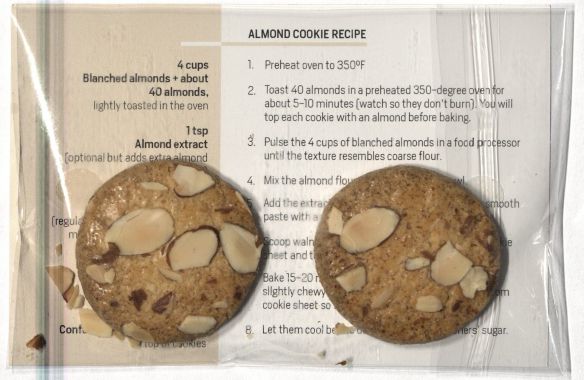
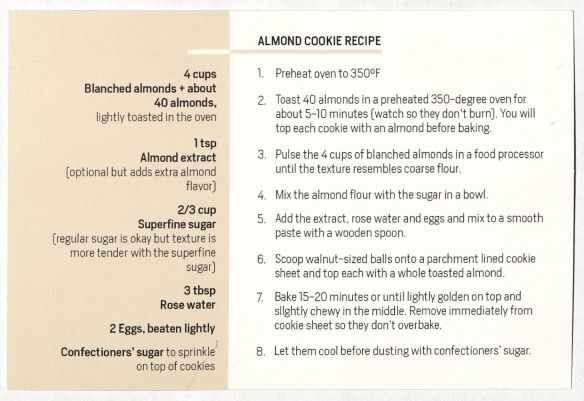
On their way out at the end of the evening, guests received bags with a pair of almond cookies also adapted from a recipe in Choise Receipts.

Postcard with cookies

The finished  give-away almond cookies, pictured with their recipe, adapted from A Collection of Choise Receipts (1680)

There are several recipes for cookies or little cakes made with almonds in the manuscript.  My favorite, “The Lady Lowthers Receipt for to make Bean Bread” a cookie that very much resembles a macaron in texture, takes its name from the slivered almonds that look like little beans that are mixed into the dough.

choise-bean-bread-0001 copy

“Lady Lowthers Receipt, for to make Bean Bread,” from A Collection of Choise Receipts, 1680.

The recipe for Almond Bisketts that we reproduced for the gala, however, seems to be missing a crucial ingredient: almonds!

Choise original almond biskett

The front of the recipe postcard produced for our give-away cookies for the gala.

Only when examining the full page of the manuscript, on which a very similar recipe for Almond Cakes appears directly above the one reproduced on the postcard, does it become clear that the “half a pound of fflower” referred to in this recipe would be made from ground almonds.  The adapted recipe printed on the back of our card makes that clear.

Choise adapted recipe

The adapted recipe, on the back of the postcard.

If you make a batch of these tasty cookies, let us know how they turn out!  Better yet, send us a picture and we’ll post it on Instagram.

Get Crafty at the Museum Mile Festival on June 14

By Emily Miranker, Project Coordinator

When my office is perfumed by the smell of crayons and stocked with boxes of jumbo-sized sidewalk chalk, I know its Museum Mile Festival time. This year’s Museum Mile Festival takes place on Tuesday, June 14 from 6:00-9:00 pm, rain or shine.

Museum Mile (New York City’s Fifth Avenue from 82nd to 105th Street, which is technically three blocks longer than a mile) is one of the densest cultural stretches in the world.1 For the last 38 years, Fifth Avenue closes to traffic for a few hours on an early June evening. The eight major museums and their neighbors–that’s us!–throw open their doors and spill out onto the street in a block party.

Museum Mile at the New York Academy of Medicine. Courtesy of the Academy's Communications Office.

Museum Mile at the New York Academy of Medicine. Courtesy of the Academy’s Communications Office.

The first festival was held in 1979, the brainchild of the Museum Mile Association, to increase cultural audiences and garner support for the arts in time of great fiscal crisis in the city. The festival has since brought many New Yorkers and tourists to upper Fifth Avenue for the first time, and total attendance over the years has surpassed one million visitors.

Besides free admission to the museums along the mile, street performers, chalk drawing, live bands, balloons, and family-friendly activities abound. Dedicated to improving the health and well-being of people living in cities, the Academy has partners from the East Harlem Asthma Center of Excellence and Shape Up NYC joining us for the evening.

Getting physical with our community partners at Museum Mile. Courtesy of the Academy's Communications Office.

Getting physical with our community partners at Museum Mile. Courtesy of the Academy’s Communications Office.

The Library has planned some special crafts for the festival. We have the perennial favorite: coloring pages based on images from our collections. Feel free to download your own pages any time from #ColorOurCollections online.

Coloring sheets fro the New York Academy of Medicine Library. Photo: Emily Miranker.

Coloring sheets from the New York Academy of Medicine Library. Photo: Emily Miranker.

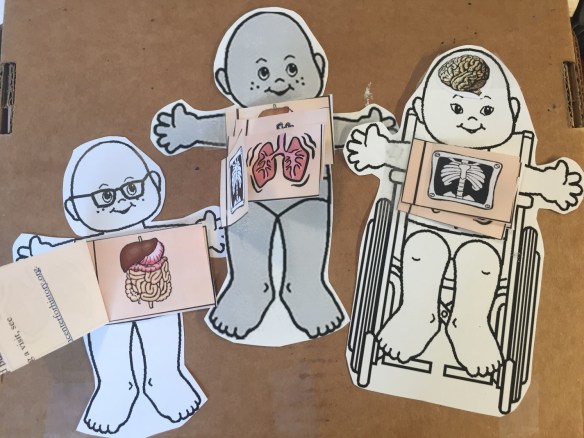
Among the treasures of our collection are the anatomical flap books. These are detailed anatomical illustrations superimposed so that lifting the sheets reveals the anatomy and systems of the body as they would appear during dissection. We created a simple DIY version of a flapbook inspired by these remarkable figures from the 1559 edition of Geminus’ Compendiosa totius anatomiae delineatio, aere exarata. The sheets are quite delicate, so it’s rare to see intact versions like this 400 years after they were made. Make your own flapbook with us during the festival.

Male flap anatomy from The Academy's copy of the 1559 English edition of Geminus’ Compendiosa.

Male flap anatomy from The Academy’s copy of the 1559 English edition of Geminus’ Compendiosa.

Female flap anatomy from The Academy's copy of the 1559 English edition of Geminus’ Compendiosa.

Female flap anatomy from The Academy’s copy of the 1559 English edition of Geminus’ Compendiosa.

Make this flap anatomy craft with us at Museum Mile! Photo: Emily Miranker.

Make this flap anatomy craft with us at Museum Mile! Photo: Emily Miranker.

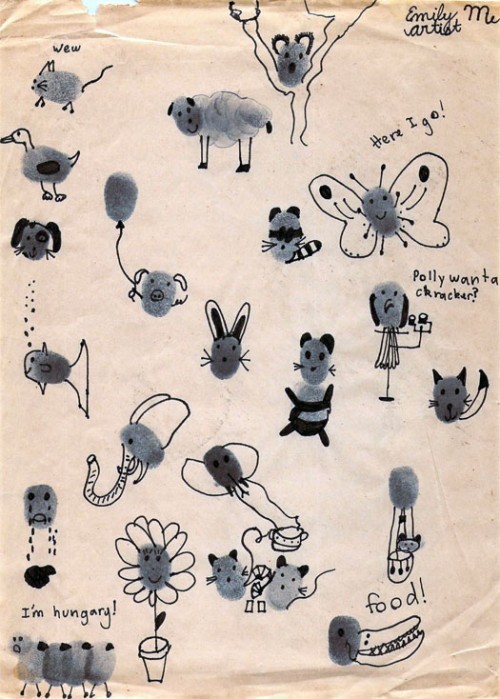
And there’s nothing like using your own body to create art—finger print art!2

Make fingerprint art with us at Museum Mile! Photo: Emily Miranker.

Make fingerprint art with us at Museum Mile! Photo and artwork: Emily Miranker.

We look forward to seeing you at Museum Mile!

References

1. “Museums on the Mile.” Internet Archive Wayback Machine (June 2011). Accessed June 3, 2016. https://web.archive.org/web/20120101013336/http://www.museummilefestival.org/museums/

2. “Fingerprint Fun.” Bookmaking with Kids (June 2010). Accessed June 6, 2016. http://www.bookmakingwithkids.com/?p=1826

Many Anatomy Lessons at the New York Academy of Medicine

Kriota Willberg, the author of today’s guest post, explores the intersection of body sciences with creative practice through drawing, writing, performance, and needlework. She is offering the workshop “Visualizing and Drawing Anatomy” beginning June 6 at the Academy. Register online.

Cheselden's Osteographia, 1733, opened to the title page and frontispiece.

Cheselden’s Osteographia, 1733, opened to the title page and frontispiece.

Different Disciplines, Same Body

I teach musculoskeletal anatomy to artists, dancers, and massage therapists. In my classes the students study the same raw material, and the set of skills each group acquires can be roughly organized around three distinct areas: representation of the body, kinesiology (the study of movement), and palpation (feeling the body).

As an anatomy teacher I am constantly on the prowl for images of the body that visually reinforce the information my students are learning. The Internet has become my most utilized source for visual teaching tools. It is full of anatomy virtual galleries, e-books, and apps. 3D media make it ever easier to understand muscle layering, attachment sites, fiber direction, and more.

In spite of the overwhelming volume of quality online cutting-edge anatomical imagery, I find myself drawn to historical 2D printed representations of the body and its components, once the cutting-edge educational technology of their respective centuries. Their precision, character, size, and even smell enhance my engagement with anatomical study. Many of these images emphasize the same principles as the apps replacing them centuries later.

The Essential Structure Of The Body

Different artists prefer different methods of rendering bodies in sketches. One method is to organize the body by its masses, outlining its surface to depict its bulk. Another method is to draw a stick figure, organizing body volume around inner scaffolding.

Plate XXXIII in Cheselden, Osteographia, 1733.

Plate XXXIII in Cheselden, Osteographia, 1733.

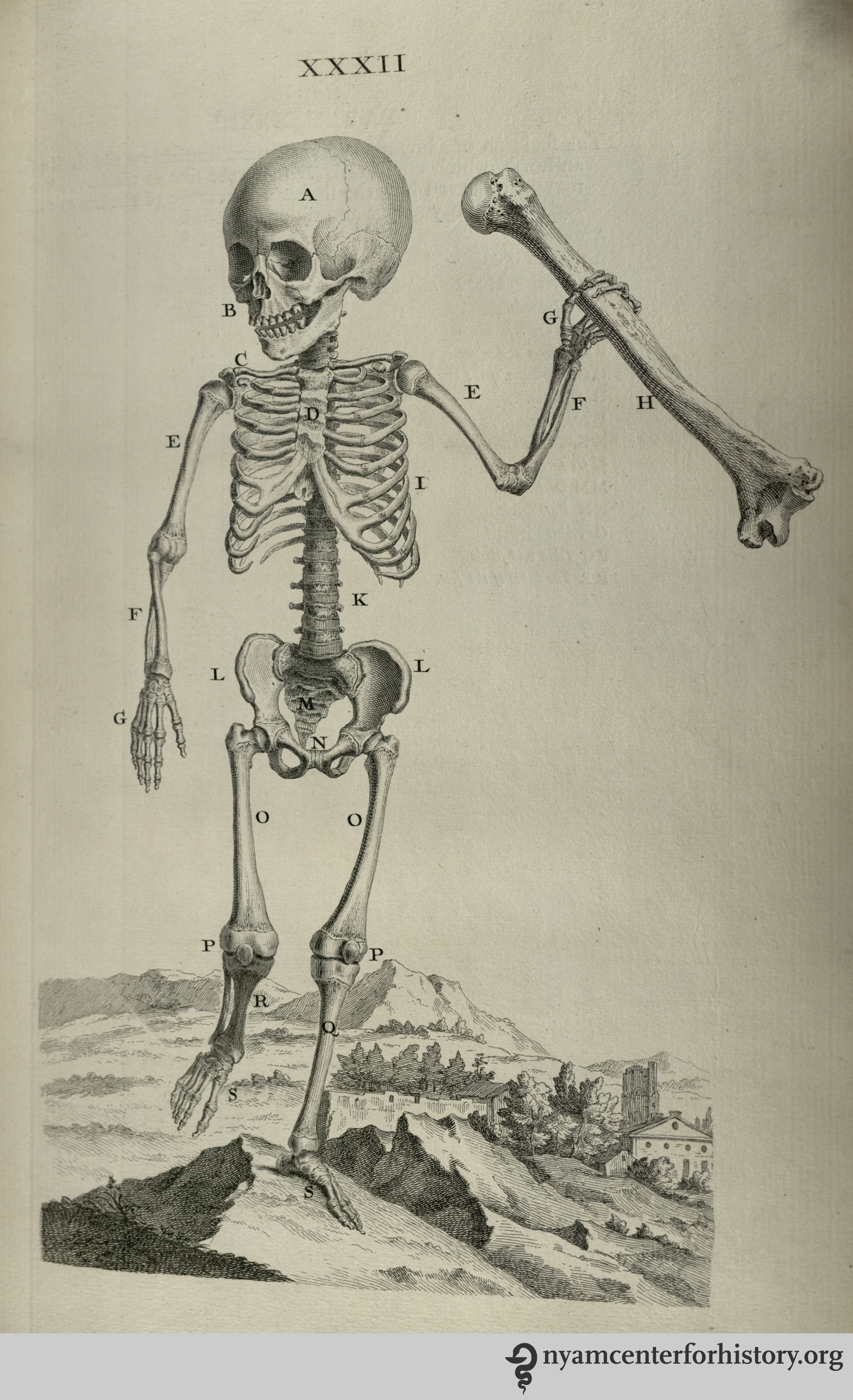
And what is a skeleton but an elaborate stick figure? William Cheselden’s Osteographia (1733) presents elegant representations of human and animal skeletons in action. These images remind us that bones are rigid and their joints are shaped to perform very specific actions. The cumulative position of the bones and joints gives the figure motion. In Cheselden’s world of skeletons, dogs and cats fight, a bird eats a fish, a man kneels in prayer, and a child holds up an adult’s humerus (upper arm bone) to give us a sense of scale while creating a rather creepy theatrical moment.

Muscle Layering

3D apps and other imaging programs facilitate the exploration of the body’s depth. One of the challenges of artists and massage therapists studying anatomy is transitioning information from the 2D image of the page into the 3D body of a sculpture or patient.

Planche 11 in Salvage, Anatomie du gladiateur combattant, 1812.

Planche 11 in Salvage, Anatomie du gladiateur combattant, 1812.

Salvage’s Anatomie du gladiateur combattant: applicable aux beaux artes… (1812) is a 2D examination of the 3D Borghese Gladiator. Salvage, an artist and military doctor, dissected cadavers and positioned them to mimic the action depicted in the statue. His highly detailed images depict muscle layering of a body in motion. The viewer can examine many layers of the anatomized body in action from multiple directions, rendered in exquisite detail. Salvage retains the outline of the body in its pose to keep the viewer oriented as he works from superficial to deeper structures.

Tab. VIII in Albinus, Tabulae sceleti et musculorum corporis humani, 1749.

Tabula VIII in Albinus, Tabulae sceleti et musculorum corporis humani, 1749 edition.

Bernhard Siegried Albinus worked with artist Jan Wandelaar to publish Tabulae sceleti et musculorum corporis humani (1749). Over their 20-year collaboration, they devised new methods for rendering the dissected body more accurately.  The finely detailed illustrations and large size of the book invite the reader to scrutinize the dissected layers of the body in all their detail. Although there is no superficial body outline, the cadaver’s consistent position helps to keep the reader oriented. On the other hand, cherubs and a rhinoceros in the backgrounds are incredibly distracting!

Fiber Direction

Familiarity with a muscle’s fiber direction can make it easier to palpate and can indicate the muscle’s line of pull (direction of action).

Figure in Berengario, Anatomia Carpi Isagoge breves, 1535.

Figure in Berengario, Anatomia Carpi Isagoge breves, 1535.

The images of Jacopo Berengario da Carpi’s Anatomia Carpi Isagoge breves, perlucide ac uberime, in anatomiam humani corporis… (1535) powerfully emphasize the fiber direction of the muscles of the waist. This picture in particular radiates the significance of our “core muscles.” Here, the external oblique muscles have been peeled away to show the lines of the internal obliques running from low lateral to high medial attachments. The continuance of this line is indicated in the central area of the abdomen. It perfectly illustrates the muscle’s direction of pull on its flattened tendon inserting at the midline of the trunk.

The Internal Body Interacting with the External World

One of the most important lessons of anatomy is that it is always with us. Gluteus maximus and quadriceps muscles climb the stairs when the elevator is broken. Trapezius burns with the effort of carrying a heavy shoulder bag. Heck, that drumstick you had for lunch was a chicken’s gastrocnemius (calf) muscle.

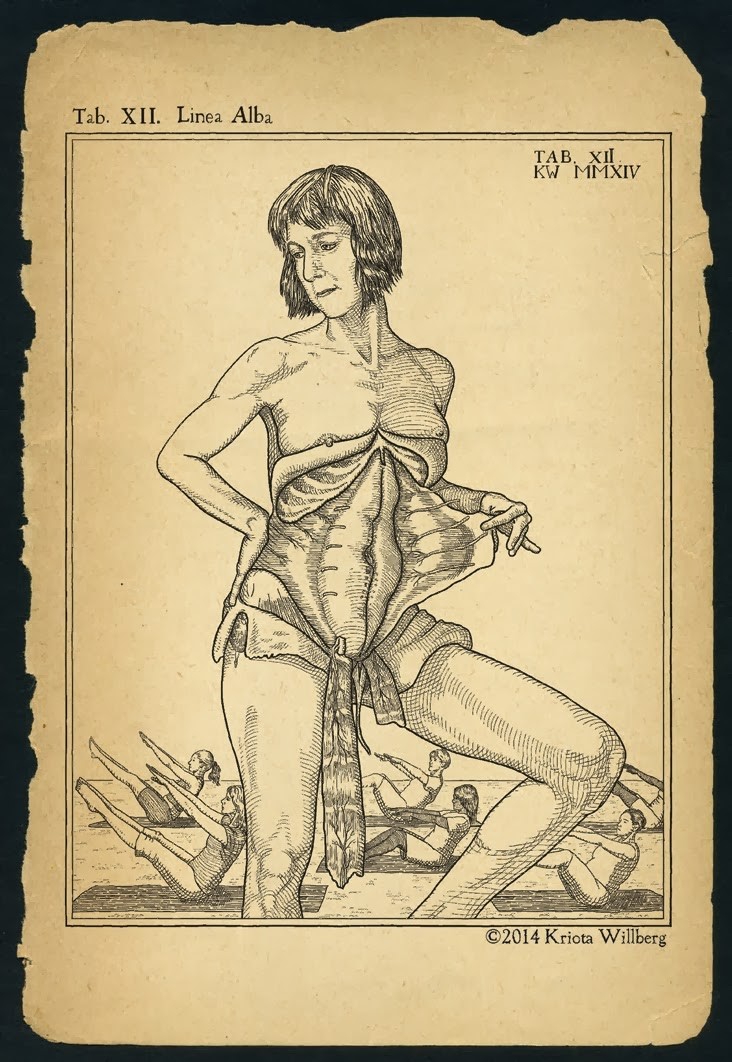
Tab. XII in Speigel, De humani corporis fabrica libri decem, 1627.

Tab. XII in Speigel, De humani corporis fabrica libri decem, 1627.

Anatomists from Albinus to Vesalius depict the anatomized body in a non-clinical environment. One of my favorites is Adriaan van de Spiegel and Giulio Casseri’s De humani corporis fabrica libri decem (1627). In this book, dissected cadavers are depicted out of doors and clearly having a good time. They demurely hold their skin or superficial musculature aside to reveal deeper structures. Some of them are downright flirtatious, reminding us that these anatomized bodies are and were people.

Kriota Willberg's self portrait. Courtesy of the artist.

Kriota Willberg’s self portrait. Courtesy of the artist.

I am so enamored of van de Spiegel and Casseri that I recreated page 24 of their book as a self-portrait. After my abdominal surgery, the image of this cadaver revealing his trunk musculature resonated with me. In my portrait I assume the same pose, but if you look closely you will see stitch marks tracing up my midline. I situate myself in a “field” of women performing a Pilates exercise that challenges abdominal musculature. And of course, I drew it in Photoshop.

Narrative, Health, and Social Justice: Stories of the Body

Annie Robinson, today’s guest blogger, holds a Master of Science in Narrative Medicine from Columbia University. As an eating disorder recovery coach, wellness educator, and workshop and retreat leader, Annie uses story to facilitate healing, self-reflection, and narrative competence. She will lead a Health and Social Justice Reading Group at the Academy six Wednesday afternoons from June 22 to July 27. Find out more and register online.

In middle school I developed a severe eating disorder that persisted into my mid-twenties. I have told this story in so many ways over the years. Initially, I subscribed to the common narrative of disorder-as-enemy: “I am battling an eating disorder.” But ultimately, this story did not serve my healing. It made me feel like I was at the mercy of my symptoms. Perceiving my eating disorder as a demon that I needed to fight against positions me as an enemy of myself, insofar as the eating disorder is inherently a part of me.

So I tried out a new story. What if my eating disorder is a wounded part trying to protect me from pain? It offers temporarily helpful—though ultimately ineffective—strategies to meet my needs for comfort and safety. It is young and naive, frantic and scared. It needs to be loved and listened to, not condemned and silenced. I took on the role of mother caring for a feisty, frightened child who needed firm but kind parenting. My mothering self and my eating disorder self engaged in frequent dialogues, both out loud and in writing, to rework the stories I’d been living for so long.

To truly enter recovery, I had to not only rewrite the story of my eating disorder, but to share it with others. As author instead of victim, I am freed from the secretiveness and shame that eating disorders thrive on. And by sharing my story, I make myself vulnerable, which allows me to connect authentically with others.

Using poetry for self-reflection and healing

Using poetry for self-reflection and healing

Renowned researcher Brené Brown studies the correlation between exposing shame, embracing vulnerability, and wellbeing. Her research also examines how the stories we tell about ourselves possess tremendous power—either to trap us, or to instigate radical change. She postulates: “When we deny the story, it defines us. When we own the story, we can write a brave new ending.”

By changing my story, I changed my behaviors, and by changing my behaviors, I changed my life. While stories can disempower, they can also generate agency. They can ascribe blame, or bestow forgiveness. At their best, I believe stories are some of our greatest tools for healing both individual pain and social injustices.

I realized the potency of language not only in recovery, but also in my role as a doula—someone trained to support individuals as they navigate pregnancy, abortion, birth, and fetal loss. In this role, I have witnessed how issues of social justice are deeply entwined with bodily experiences.

Maria, a quiet 16-year-old Hispanic girl living a foster care home for pregnant teens, was 36 weeks along when I met her. For the majority of her labor at a large hospital in the city, no one looked her in the eye. Family-less, jobless, degree-less, and soon to be responsible for a newborn, she seemed too much for her providers to bear. Her labor was blessedly short, her birth smooth, and her beautiful baby boy healthy. But no one showed up to celebrate with her. Though she spoke no words of disappointment, tears welled in her downcast eyes as she smiled down at her tiny child.

Pooja, a vibrant 30-year-old Bengali woman in her second trimester of pregnancy, came into my care at a public hospital. She had just learned that if she carried her pregnancy to term, her baby would be born with severe disabilities. She had no choice but to terminate the pregnancy, because she and her husband could not financially accommodate a child with expensive chronic medical needs. During the termination procedure, she wailed and dug her nails into my hand as I held fast, whispering soothing words in her ear. As her cries escalated, the doctors spoke louder to her in English (a language she barely understood) about what steps they were taking, as if they could extinguish her deep suffering with their voices and expertise.

The stories of Maria and Pooja, along with those of dozens of other women I have served, reflect how social injustice is so often based in the body. Their distinct cultural conditions, social vulnerabilities, and economic disparities all influenced the care they received.

In the world of medicine, the term “social justice” refers to the differences in how people experience health conditions and interface with the healthcare system. It is imperative to consider the roles these factors potentially play in the story of someone’s health experience, leading to inequities in resources, unique linguistic and cultural reference points, and distinct vulnerabilities and disadvantages.

While serving as a doula, I also was a graduate student at Columbia University studying an innovative discipline called narrative medicine. This approach endeavors to train clinicians to deeply hear and respond to their patients’ stories, not just their symptoms. Narrative medicine provides a way for patients and providers to co-create humanized stories of illness and embodied experiences, and offers strategies for studying the meaning of these experiences through telling, reading, and writing about them. I came to appreciate body-based stories as deeply vulnerable ones, as they concern both our physical selves as well as the parts of our identity that transcend biology.

I will be facilitating a six-week course at the New York Academy of Medicine from June 22-July 27, 2016 on how language can serve as a mechanism for social justice in health (register online). We will use narrative practices such as reading fiction and nonfiction texts, having group discussions, and writing self-reflectively for an in-depth exploration of how language influences our experiences of our bodies and can serve as a mechanism for enacting social justice in healthcare.

Workshop on stories and self-care led by Annie Robinson, November 2015

Workshop on stories and self-care led by Annie Robinson, November 2015.

We will use narrative depictions to unpack how health, illness, and disability are issues of social justice. How do social justice and health relate to gender, sexuality, race, trauma, caregiving, privilege, disability, age, class, and geography? How can creative expressions of embodied experiences facilitate self-realization and healing? Whose voices are most often heard, and whose are not? Where do private matters of health, illness, and disability fit in the public arena? What are the effects of how they are politicized, for better and for worse? And how can social, cultural, and political change that benefits embodied experiences be instigated by individuals?

Sources will include (among others): poems by physician-poet Rafael Campo, stories by Sherman Alexie, essays by Eve Ensler, excerpts from Illness as Metaphor by Susan Sontag, first-person perspectives about gendered embodiment from Minding the Body, and pieces from Leslie Jamison’s The Empathy Exams.

Please join us to explore what social justice, story, and embodiment mean to you!

Questions? Please email culturalevents@nyam.org.

Have You Heard of the Lincoln Collective?

Today’s guest blogger, Merlin Chowkwanyun, is an assistant professor of sociomedical sciences at Columbia University’s Mailman School of Public Health. He will present “The Lincoln Collective: The World of New York City Health Activism in the 1970s” at the Academy on May 24. Learn more and register.

I’m really looking forward to visiting the New York Academy of Medicine next week, in no small part because the health activism I’m going to discuss took place in New York City itself. My talk will focus on a couple dozen physicians, fresh out of medical school, who decided to do their residencies at Lincoln Hospital in the South Bronx in the 1970s.

They arrived in the summer of 1970 and called themselves “the Lincoln Collective,” hoping to form a critical mass of politically conscious physicians who could effect change in one institution, and in the process, provide a model for other activists across the country to follow. In its recruitment pamphlet, the Collective’s founders wrote that they intended “to become part of the solution rather than part of the problem” and “affirm[ed] that we are in training to serve the community, and that we are committed to dealing with the problems of the urban ghetto community in a long-run way.” That commitment entailed not just ephemeral service projects that lasted a few weeks, but finding ways to facilitate more permanent community input into healthcare facilities’ operations.

Cover of a Lincoln Collective Recruitment pamphlet.

Cover of a Lincoln Collective Recruitment pamphlet.

Lincoln epitomized the overtaxed, under-resourced urban hospital. One official document described it as “a hopelessly inefficient and inadequate building” with “dirt and grime and general dilapidation [that] make it a completely improper place to care for the sick…” And locals had nicknamed it “The Butcher Shop.” By conventional standards, then, Lincoln was not exactly a desirable or prestigious choice for your typical medical graduate at this time. So what was it that set the Lincoln Collective’s members apart? Who were these people? And where did their values come from? What were they hoping to get by converging on one of the most dilapidated hospitals in one of the most resource-deprived areas of the United States? And most important of all, what did it all mean in the end, when the Lincoln Collective came to a close in the mid-1970s?

To answer these questions, I’ll place the Lincoln episode in a wider story about changes that wracked the healthcare sector during the 1960s and 1970s. Many Collective members had been involved in student organizing on medical campuses, not exactly known, then and now, as cauldrons of political foment. Others had come from community organizing. And some were not particularly political and simply looking for a place to serve the most indigent and medically deprived. They came to Lincoln when the health field was undergoing what I have called a “governance revolution”—multi-pronged efforts throughout the era to decrease hierarchy within medicine and increase the participation of professionals in healthcare governance.

Article on medical student unrest in Medical World News, Oct. 13, 1967, pp. 63–67.

Article on medical student unrest in Medical World News, Oct. 13, 1967, pp. 63–67.

The Collective arrived at a time of tumult around the hospital itself. Groups like the Black Panthers and the Young Lords had made healthcare equality a major tenet of their organizing. At times, the Collective’s relationship with these groups was cooperative and fruitful, at other times, tense and ambiguous. Much of that depended on Collective members’ individual ideological inclinations, which were hardly uniform throughout the group. Tensions undergirded the encounter between mostly white physicians and mostly non-white, non-professional activists, and I’ll explore these challenges throughout the talk.

Pamphlet of Health Revolutionary Unity Movement, a health-oriented adjunct of the Young Lords that also organized around Lincoln.

Pamphlet of Health Revolutionary Unity Movement, a health-oriented adjunct of the Young Lords that also organized around Lincoln.

I’ve been thinking about the Lincoln Collective for more than a decade now. The title of my talk is an utterance I heard repeatedly when I was a college student in New York City studying activist movements in public health and medicine. “Have you heard of the Lincoln Collective?” people would ask. Some who posed the question were in it (and some claimed to be but, I’d later discover, were not). When I went off to graduate school, I put the story aside for a long time. At the confused age of 22, I didn’t feel I had the political maturity to really write about some pretty politically fraught and emotional events. Now, with more distance, I’ve returned to it.

We’re now in an era when people in the health sector—in the wake of a wave of police brutality and the Flint disaster—are asking themselves serious questions about the role political activism should play in their work. Turning back the clock and looking at a group of health activists from 50 years ago is a way of moving that conversation forward.