The Berg Brothers: Bibliophile Surgeons

By Anne Garner, Curator, Center for the History of Medicine and Public Health

New York physicians Henry W. and Albert A. Berg are well-known to students of literature. In 1940, Albert A. Berg founded the New York Public Library’s spectacular Berg Collection, endowed in his older brother Henry’s memory. It is a magical place, nestled on the third floor of NYPL’s Steven A. Schwarzman building, with endlessly deep collections in its vaults (I should know, I was lucky enough to work there). Highlights include a typescript draft of T.S. Eliot’s The Wasteland, annotated by Ezra Pound; the manuscript notebooks containing five of Virginia Woolf’s seven novels; and a map drawn by Jack Kerouac of territory covered on the cross-country trip that inspired On The Road.
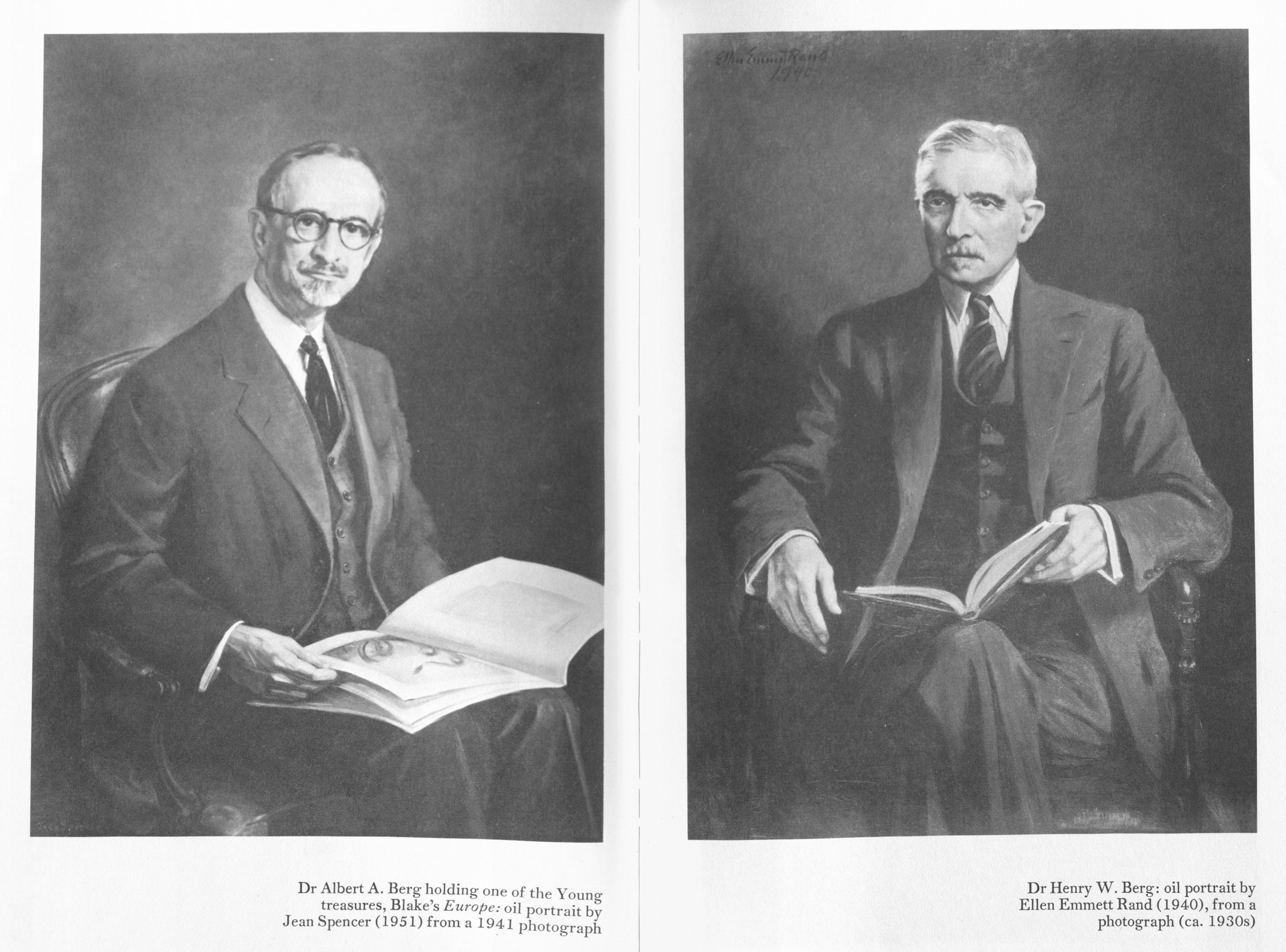
Left: Dr. Albert A. Berg, holding Blake's Europe, in an oil portrait by Jean Spencer hanging in The New York Public Library's Berg Collection. Right: Dr. Henry W. Berg in an oil portrait by Ellen Emmett Rand, also in the New York Public Library's Berg Collection. In Szladits, Brothers: The Origins of the Henry W. and Albert A. Berg Collection,1985.

Left: Dr. Albert A. Berg, holding Blake’s Europe, in an oil portrait by Jean Spencer hanging in The New York Public Library’s Berg Collection.
Right: Dr. Henry W. Berg in an oil portrait by Ellen Emmett Rand, also in the New York Public Library’s Berg Collection.
In Szladits, Brothers: The Origins of the Henry W. and Albert A. Berg Collection,1985. Click to enlarge.

Fourteen years separated the eldest and youngest Berg siblings, but they had much in common, including interests in book collecting and literature, along with an aptitude for real estate investment (a pastime that funded their library interests). The two doctors lived together until Henry’s death in 1939 in a townhouse on East 73rd Street. The story of Henry and Albert Berg’s establishment of one of the world’s great literary collections is told in Lola Szladits’ excellent book, The Brothers.

The medical legacy of the brothers, both prominent New York doctors, is less widely known. Henry and Albert’s father, Moritz Berg, immigrated to America from Hungary in 1862 with designs to work as a doctor. He found work instead as a tailor to support his family of eight children. Moritz died of cancer when Albert was young, and Henry, already interested in medicine himself, determined that Albert should follow the same career path.1
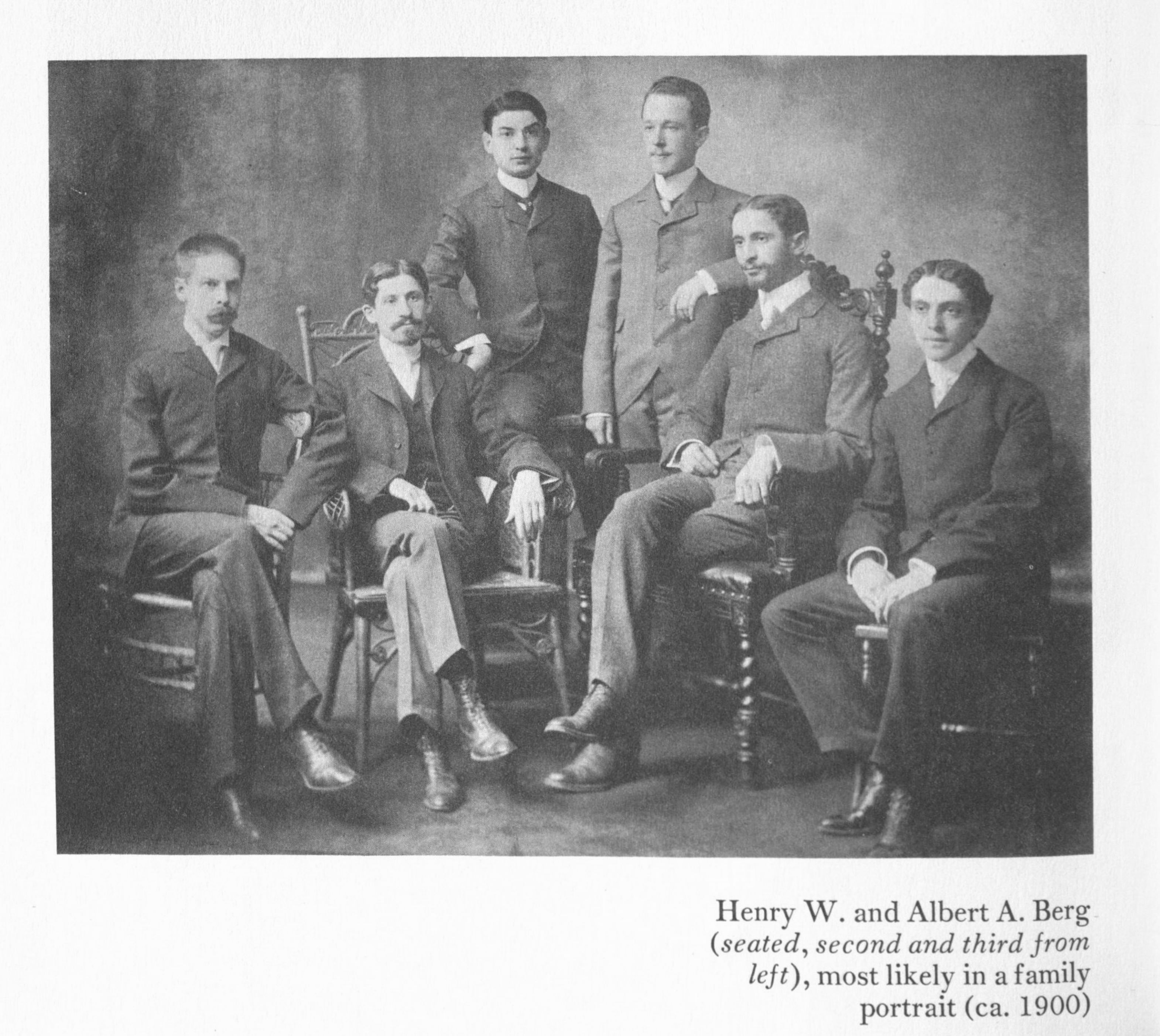
Henry W. and Albert A. Berg (seated, second and third from left), most likely in a family portrait (circa 1900). In Szladits, Brothers: The Origins of the Henry W. and Albert A. Berg Collection,1985.

Henry W. and Albert A. Berg (seated, second and third from left), most likely in a family portrait (circa 1900). In Szladits, Brothers: The Origins of the Henry W. and Albert A. Berg Collection,1985.

Henry earned his medical degree from Columbia University’s College of Physicians and Surgeons in 1878, specialized in infectious disease, and headed Mount Sinai’s isolation service. He taught both neurology and pediatrics at the College of Physicians and Surgeons.2 Henry was attending physician at Willard Parker Hospital on East 16th Street for 40 years, until his death in 1939.3 His active role on Willard Parker’s board is documented in the Academy’s collection of Willard Parker minute books.

It was Henry who mentored Albert, put him through medical school, and showed him he could be a great doctor. All early indications were to the contrary: Albert repeatedly ditched class to play pool. Their mother was skeptical that Henry could ever make a doctor out of him.4 But by graduation (also from College of Physicians and Surgeons), Albert was a decorated prizewinner.5 And as a surgeon, he proved a brilliant and visionary pioneer, a key player in the development of abdominal surgery in the United States.

Albert A. Berg as a young doctor (seated, second from left). In Szladits, Brothers: The Origins of the Henry W. and Albert A. Berg Collection,1985, page 37.

Albert A. Berg as a young doctor (seated, second from left). In Szladits, Brothers: The Origins of the Henry W. and Albert A. Berg Collection,1985, page 37.

Albert’s exceptional skill as a surgeon is attested in a tribute article by Dr. Leon Ginzberg in a festschrift volume of the Journal of the Mount Sinai Hospital devoted to Albert’s career:

[Dr. Berg’s] tremendous capacity for work, his boldness and resolution, his extraordinary operative skill and his refusal to remain on the accepted path, had brought his service to an enviable position in the field of abdominal surgery. The most significant studies from his clinic were in the fields of gastroduodenal and jejunal ulcers. Other important contributions were made to the subjects of colonic, and more particularly rectal and recto-sigmoidal carcinoma….to chronicle adequately all of Dr. Berg’s ‘labors in the vineyard’ would be to write an important chapter in the history of the development of abdominal surgery in the United States.6

Title page of Alfred A. Berg’s Surgical Diagnosis, 1905, given by the author to the New York Academy of Medicine Library.

Albert’s skill and personal style made him one of New York’s most recognizable doctors by the 1920s. In physical appearance he was “six feet tall, slender, and forbidding.”7 Katie Loucheim’s remembrance in the New Yorker compares his appearance to an “esteemed rabbi…with a Vandyke beard…his manner in speaking and his voice were reassuring.”8 He wore a red carnation in his lapel, even during surgery, until the death of his brother in 1939.9

Albert—or A.A. as his medical friends called him—observed an almost fanatical devotion to the operating room. Loucheim reports that Albert regularly scheduled surgery for a few minutes before midnight on New Year’s Eve, believing that if he began the new year in surgery he could secure for himself a happy year. Berg’s dexterity as a surgeon ensured that he could easily converse about rare books while operating on patients, including his friend, the great book collector Carl Pforzheimer. Seven days a week, the Fifth Avenue bus—“Berg’s green taxi” to his colleagues, dropped him halfway down the block in front of the canopy of Mount Sinai. Other passengers complained because it wasn’t an actual bus stop (in turn, the conductors and bus drivers relied on Berg for any surgical needs).10

Mount Sinai Hospital, circa 1913. From The Dr. Robert Matz Collection of Medical Postcards.

Mount Sinai Hospital, circa 1913. From The Dr. Robert Matz Collection of Medical Postcards.

A stone’s throw away from A.A. Berg’s beloved Guggenheim pavilion at Mount Sinai Hospital, the Berg name lives on. On the third floor of the New York Academy of Medicine in the former periodicals room is a bronze plaque commemorating the gifts of Drs. Henry W. and Albert A. Berg to the Academy. A bequest from Albert endowed the third floor room that bears their name and still supports the acquisition of library periodicals today. Both brothers were Academy Fellows (Henry beginning in 1890, Albert in 1900).

Albert seems to have recognized how vital a good set of tools were to students of surgery. A copy of his last will and testament in the Academy’s archives entrusts his surgical instruments, instrument bags, and laboratory equipment, including two microscopes and examination tables and one portable operating table, to “one or more deserving young surgeons” to be selected at the Academy’s discretion.11 The items are no longer at the Academy; perhaps they were also used by a student whose path to medicine was at first uncertain, but later found his or her way.
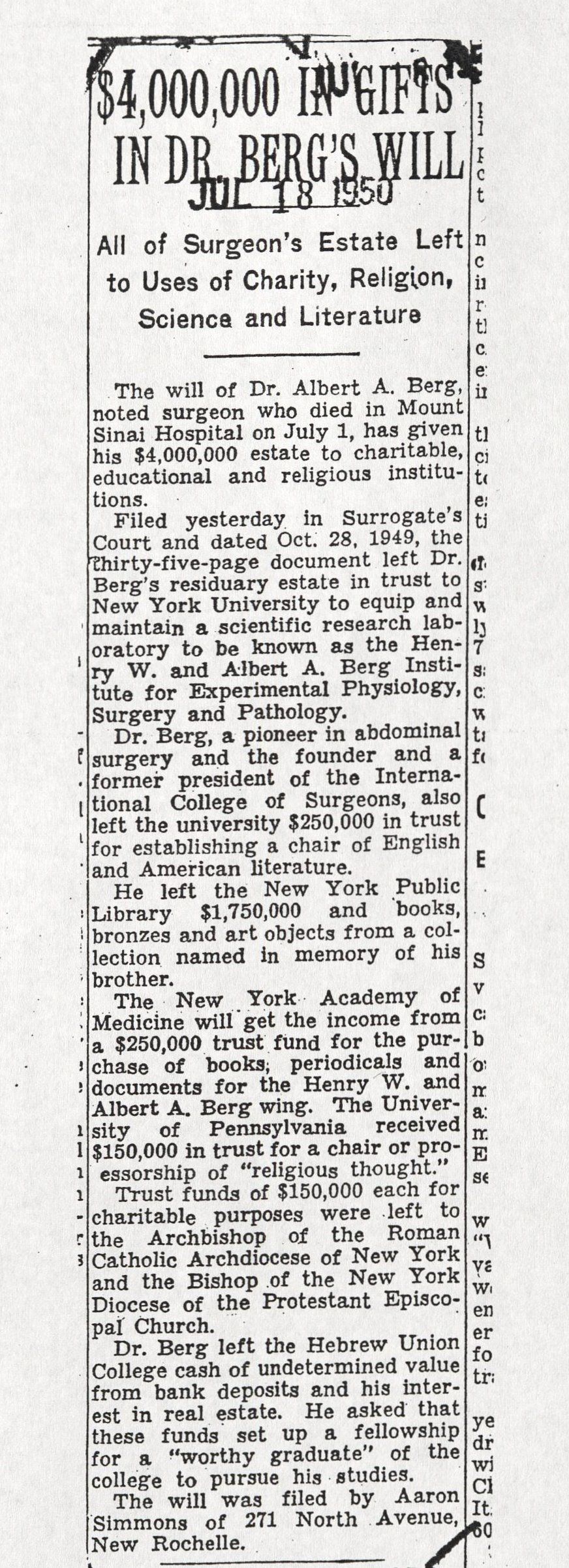
New York Times article from July 18, 1950 announcing Albert A. Berg's bequests, including to the New York Public Library and the New York Academy of Medicine.

New York Times article from July 18, 1950 announcing Albert A. Berg’s bequests, including to the New York Public Library and the New York Academy of Medicine. Click to enlarge.

References

1. Szladits, Lola. Brothers : The Origins of the Henry W. and Albert A. Berg Collection. New York: New York Public Library, 1985. pp. 9-10.

2. Szladits, pp. 10-11.

3. Medical Society of the State of New York. Medical Directory of New York, New Jersey and Connecticut. New York: 1899-1939.

4. Louchheim, Katie. “Sweeping Formalities and Offstage Flourishes.” The New Yorker 3 Nov. 1975: 40-48. Print.

5. Szladits, pp. 11.

6. Ginzburg, Leon. “Some of the Principles and Methods contributed by the service of Dr. A.A. Berg.” Journal of the Mount Sinai Hospital Volume 17.6 (1951): 356-368. The Journal of the Mount Sinai Hospital has been digitized and is available online.

7. Szladits, 39.

8. Loucheim, 41.

9. New Yorker and Szladits.

10. Szladits, 42.

11. The New York Academy of Medicine Archives. Library Correspondence, 1927-1974.

Fair Use at the New York Academy of Medicine Library

By Emily Miranker, Project Coordinator

As we go about our work at the library—sharing coloring pages featuring images from our collection, digitizing decades-old journal volumes, pointing people towards resources on the HathiTrust and Medical Heritage Library, among other endeavors—we keep something known as fair use in the back of our minds. It’s a legal doctrine that helps determine when it’s OK to use copyrighted material without explicit permission. This week, Fair Use/Fair Dealing Week, the doctrine moves front and center for an annual shout-out by libraries, universities, arts organizations, media groups, and other institutions. It’s a form of consciousness-raising and an opportunity to share examples of fair use in action.

Fair use isn’t particularly new—the codification of it in U.S. law is part of the 40-year old Copyright Act of 1976, with the concept of fair use going back even farther. Fair Use/Fair Dealing Week, by contrast, is just three years young. It was started by Harvard’s copyright advisor Kyle K. Courtney as a way of spotlighting and sharing the Association of Research Libraries’ Code of Best Practices in Fair Use for Academic and Research Libraries.1

Not a scholar or a librarian? Wondering if you really need to know how fair use works? Yes, you do. As a reader of this blog you’re a cultural consumer, but probably a cultural producer as well. We all routinely download, share, and often repurpose photos and videos, songs and TV clips, text, artwork, and sound bites. We create—and recreate—all the time. And we would like our creations to “reference the world around us without getting [us] into trouble” with copyright infringement. 2

This photo was shared under a Creative Commons Attribution License and was taken from the Flickr photostream of Timothy Vollmer.

This photo was shared under a Creative Commons Attribution License and was taken from the Flickr photostream of Timothy Vollmer.

Copyright law works for two constituencies, broadly speaking. It defends the interests of copyright holders, protecting the success of creators. It also protects use by cultural consumers of copyrighted materials for select purposes. Deciding when copyrighted materials can be used without permission is the subject of fair use, formally known as Section 107 of the Copyright Act of 1976. Section 107 sets out four factors for determining whether a use is fair: the purpose and character of the use; the nature of the copyrighted work; the portion of the copyrighted work used, and the effect of the use on the copyrighted work.

This very blog you’re reading is a frequent arena where we at the library have applied these fair-use tests as we share, curate, interpret, and provide access to the materials in our collections. Often our blog posts feature both images and selected quotes from copyrighted materials in our collections. Here’s a look at the doctrine’s four tests in relation to our intermittent blog series on advertisements in medical journals:

  • Purpose: The Academy Library has strong holdings in 20th-century journals, and highlighting them in online blog entries makes them more accessible to researchers and indeed anyone with an interest in medical history or Americana. Moreover, the Academy did not follow a common library practice of removing advertisements from journals. So we have a wealth of now nearly unique content we’re sharing, free, to eager historians and the public at large. Section 107 strongly favors this sort of education, transformative, and non-commercial use.
  • Nature: Typically this factor favors fair use if the underlying work is factual in nature as opposed to involving more creative expression, such as fiction or music. While advertisements take creativity to make, their relevance in our collection and to our users lies in the cultural and historical context they provide, a public benefit that goes to the heart of this factor.
  • Effect: This factor asks us to consider whether including images and quotes in posts harms the rights of the authors. Since we focus on the cultural and historical significance of these journal ads, our posts do not diminish or undermine their market.
  • Portion: The less you use, the more likely a use will be considered fair. With the short format of a blog post, images and quotes shared are always minimal in contrast to how many ads appear in a single journal.
Parke Davis ad in Hygeia Magazine, August 1945. Click to enlarge.

Parke Davis ad in Hygeia Magazine, August 1945. Click to enlarge.

What makes fair-use worthy of a week-long celebration is that “copyright law does not specify exactly how to apply fair use.3 Case law helps shape what is considered fair use, and industry standards guide everyday decision making. Best practices—not only the Association of Research Libraries’ code but also an increasing number of industry-specific standards for fields like journalism, documentary filmmakers, OpenCourseWare, poetry, and visual art—provide guidelines on fair use factors, facts, and community norms. To join the conversation on how to apply fair use, click on over to the feed of stories on Fair Use/Fair Dealing Week’s Tumblr.

References

1. Courtney, Kyle. “About Fair Use Week,” Copyright at Harvard (blog), Office for Scholarly Communication, Harvard University, 2014, https://blogs.harvard.edu/copyrightosc/about-fair-use-week/.

2. Patricia Aufderheide, Peter Jaszi, Reclaiming Fair Use: How to Put Balance Back in Copyright (Chicago, University of Chicago Press, 2011), ix.

3. “Code of Best Practices in Fair Use for Academic and Research Libraries.” Association of Research Libraries. Accessed January 20, 2016. http://www.arl.org/storage/documents/publications/code-of-best-practices-fair-use.pdf.

Special thanks to Professor Betsy Rosenblatt J.D., Director of the Center for Intellectual Property Law, Whittier Law School.

De Revolutionibus

By Danielle Aloia, Special Projects Librarian

Today marks the 543rd birthday of Nicolaus Copernicus, who was born February 19, 1473 at 4:48pm.1 What better way to celebrate his birth than to look at his seminal work: De revolutionibus orbium coelestium (On the Revolutions of the Heavenly Spheres). The library owns a 1566 second edition.

The work was originally published in 1543, a few months before Copernicus’ death and the same year that Vesalius published his Fabrica. That year is considered by many scholars to be “the veritable annus mirabilis of the sixteenth century.”2 This miraculous or amazing year was a culmination of late Renaissance humanistic thinking. Indeed, Copernicus was a true renaissance man; he was a scholar, physician, clergyman, and astronomer.

Cover photo: Copernicus N, Dobrzycki J. On the Revolutions. Baltimore: Johns Hopkins University Press; 1978.

Cover photo: Copernicus N, Dobrzycki J. On the Revolutions. Baltimore: Johns Hopkins University Press; 1978.

Yet Copernicus was reluctant to publish De revolutionibus; his pupil, Georg Joachim Rheticus, had to convince him to do so. Copernicus feared the controversy that would come if he published that the Sun was the center of the solar system. At the time, the Church was burning people at the stake for their views on Aristotle.3 De revolutionibus expounded upon Ptolemy’s idea of planetary motion from his treatise Almagest. As one biographer questioned: “Did Copernicus fail to see that he was pushing the dear Lord out into the infinite void?”4

Copernicus, a bishop himself, did have the support of two other bishops, Nicholas Schönberg and Tiedemann Giese, both of whom encouraged him to publish his work. Schönberg wrote an encouraging letter stating: “I had learned that you had not merely mastered the discoveries of the ancient astronomers uncommonly well but had also formulated a new cosmology … I entreat you … to communicate this discovery of yours to scholars…”5

According to historian Guy Freeland, “Copernicus was cautious about printing his treatise on the motion of the earth because the act of printing was politically and epistemologically loaded; and while he seemed to understand enough about politics of knowledge at the time to attempt to control the reception of his work, he failed to grasp the ways in which that politics was being affected by printing.”

Title page of our 1566 edition of De Revolutionibus.

Title page of our 1566 edition of De Revolutionibus.

The publication of the Revolutions caused Copernicus great anxiety. He feared that “the devoted research of great men, should not be exposed to contempt of those who either find it irksome to waste effort on anything learned, unless it is profitable, or if they are stirred by exhortations and examples of others to a high-minded enthusiasm for philosophy, are nevertheless so dull-witted that among philosophers they are like drones among bees.”6

Copernicus passed away at the time of publication, “and so he was spared the shame of the failure of his Revolutions.”7

There was no immediate backlash or threats. Really, there was no major upheaval until later scholars began unfolding its contents. First in the 1580s by Giordano Bruno, forty years after its publication. Bruno would later be burned at the stake for his heretic ideas. Then Tycho de Brahe, Johannes Kepler, Galileo Galilei, and Isaac Newton all followed suit.8 What made the work so revolutionary was the widespread interest and attention from outside the sciences and “certain embellishments contributed by other men.”9

De revolutionibus is divided into six books. Here are images taken from each section of our 1566 edition, alongside translations and explanations from Copernicus N, Dobrzycki J. On the Revolutions. Baltimore: Johns Hopkins University Press; 1978.

Click on an image to enlarge and view the gallery:

References

1. Kesten H. Copernicus and His World. New York: Roy Publishers; 1945.

2. Freeland, G. 1543 and All That. Dordrecht ; Kluwer Academic Publishers; c2000.

3. Kesten H. Copernicus and His World. New York: Roy Publishers; 1945.

4. Ibid.

5. Copernicus N, Dobrzycki J. On the Revolutions. Baltimore: Johns Hopkins University Press; 1978.

6. Freeland, G. 1543 and All That. Dordrecht ; Kluwer Academic Publishers; c2000.

7. Kesten H. Copernicus and His World. New York: Roy Publishers; 1945.

8. Armitage, A. Copernicus: The Founder of Modern Astronomy. London: George Allen & Unwin, LTD; 1938.

9. Drake, S. Copernicus philosophy and science: Bruno – Kepler – Galileo. Norwalk, CT: Burndy Library; 1973.

What a Boy Scout Merit Badge Tells Us About the History of Public Health

By Johanna Goldberg, Information Services Librarian

This month, the Boy Scouts of America celebrated its 106th birthday. To mark the occasion, we are featuring at a pamphlet from our collection, called simply Public Health.

In 1922, the Boy Scouts published the pamphlet as one of a series designed for scouts to study in order to receive merit badges. Though as the pamphlet states:

“It would defeat one of the purposes of these merit badge tests if any attempt were made in a pamphlet of this character to so completely cover the requirements as to remove the necessity for the boy to use his own initiative and show his resourcefulness in seeking sufficiently complete information and practical experience to enable him to successfully pass the test.”1

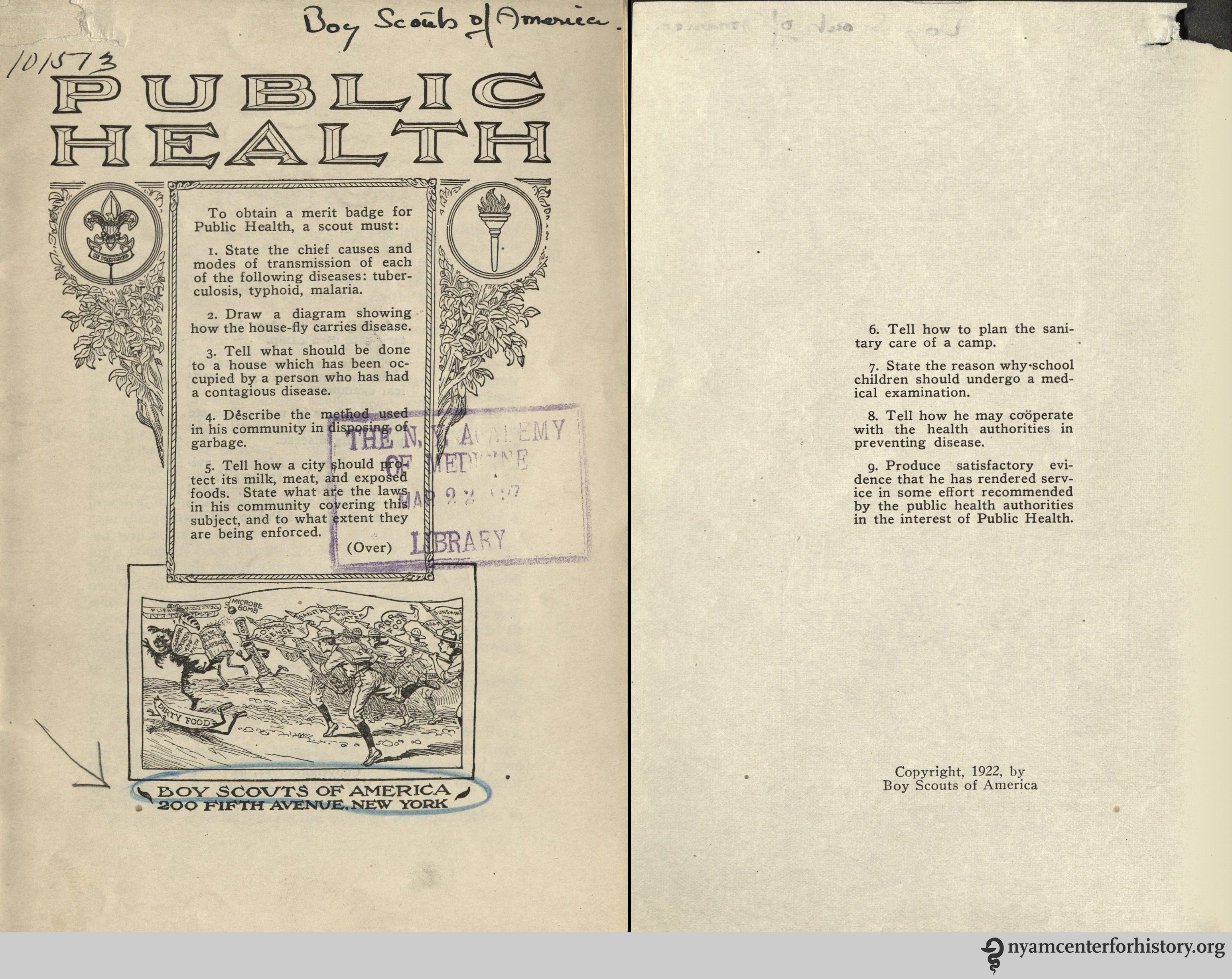
What was on the test? The cover explains:

The cover and inside cover of Public Health, 1922.

The cover and inside cover of Public Health, 1922. Click to enlarge.

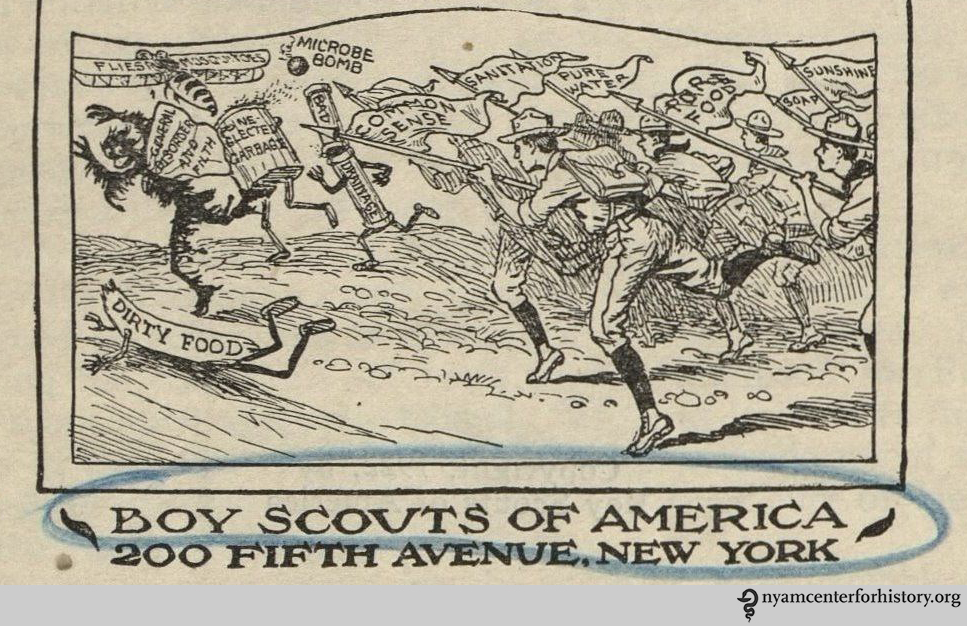
We can’t resist a close up of the cartoon at the bottom of the cover, showing how boy scouts with knowledge of public health best practices chase away causes of disease, from bad sanitation and drainage to flies and mosquitoes to “general disorder and filth.”1

A close-up of the cartoon on the cover of Public Health, 1922.

A close-up of the cartoon on the cover of Public Health, 1922.

The Boy Scouts of America still offer a merit badge in public health. Interestingly, many of the requirements are strikingly similar to their 1922 counterparts. Today’s scouts must explain disease transmission (though diseases have changed from tuberculosis, typhoid, and malaria to E. coli, tetanus, AIDS, encephalitis, salmonellosis, and Lyme disease). Instead of drawing a house-fly and showing how it carries disease, boy scouts today have to discuss how to control insects and rodents to prevent them from introducing pathogens.2

The major difference between today’s test and that of 1922 is the addition of a question about immunization. Today’s scouts must define the term and discuss diseases that can and cannot be prevented through immunization. In 1920, 7,575 Americans died of measles, 13,170 died of diphtheria, and 5,099 died of pertussis.3 In 1922, the only vaccine recommended for universal use in children was smallpox. By the end of the 1920s, diphtheria, pertussis, and tetanus joined that list, followed by polio, measles, mumps, and rubella in the 1960s and 70s.3 Today, there are 15 vaccine-preventable childhood diseases.4

While many of the same public health issues have remained at the forefront since 1922, our means of responding to them have progressed. If there is still a test for a public health merit badge in another 94 years, one hopes that the questions will reflect even more advances in prevention and control of disease.

References

1. Public Health. Boy Scouts of America; 1922.

2. Public Health. Available at: http://www.scouting.org/Home/BoyScouts/AdvancementandAwards/MeritBadges/mb-PUBH.aspx. Accessed February 10, 2016.

3. Achievements in Public Health, 1900-1999 Impact of Vaccines Universally Recommended for Children — United States, 1990-1998. MMWR Wkly. 1999;48(12):243–248. Available at: http://www.cdc.gov/mmwr/preview/mmwrhtml/00056803.htm#00003752.htm. Accessed February 10, 2016.

4. Vaccines: VPD-VAC/Childhood VPD. Available at: http://www.cdc.gov/vaccines/vpd-vac/child-vpd.htm. Accessed February 10, 2016.

#ColorOurCollections Roundup

By Rebecca Pou, Archivist; Johanna Goldberg, Information Services Librarian; and Anne Garner, Curator
Social Media Team, New York Academy of Medicine Library

#ColorOurCollections-bannerfinal

#ColorOurCollections week is winding down, but it has been so much fun we want to do it again. We propose making it an annual event for the first week of February.

More than 215 libraries and cultural institutions participated, representing 7 countries (United States, Canada, United Kingdom, France, Spain, Australia, and New Zealand). We’ve been absolutely blown away by the amazing coloring sheets shared by contributors and the range of their sources; coloring selections came from incunables, natural histories, botanicals, children’s classics, anatomical atlases, university yearbooks, patents, and much more. While most of the content came from printed works, manuscripts, sketches, stained-glass windows, plates, and mosaics also provided inspiration. To more fully explore the cornucopia of coloring content, just take a look at the list below.

This document includes images shared by organizations on websites, Pinterest boards, and Flickr and Facebook albums (and is organized by these locations). Many organizations shared #ColorOurCollections images one at a time via Twitter and Instagram. While these are not listed here, they are reflected in our Pinterest board.

We apologize if we inadvertently left your #ColorOurCollections contributions off this list. Please comment below with the organization name and link to your images, and we will update the list accordingly.

Thank you to the institutions that contributed to #ColorOurCollections and to all the talented coloring enthusiasts out there who participated! We hope you enjoyed learning more about our collections. Though the week is nearly over, please keep the submissions coming. With the amount of colorable content released this week, it is safe to say we can keep coloring until next year!

#ColorOurCollections, Day 5

#ColorOurCollections-bannerfinal

It’s the final day of #ColorOurCollections, a week-long special collections coloring fest we’ve organized on social media. We are sad to see it go, and thank everyone who participated. Enjoy the final day of sharing and coloring items from nearly 200 cultural institutions from around the world (see our ever-growing list).

Every day on our blog, we’ve featured #ColorOurCollections coloring sheets from our library, along with content from participants worldwide. And don’t forget to download our full #ColorOurCollections coloring book.

Today’s coloring sheets come from Ulisse Aldrovandi (featured earlier this week) and another great naturalist, Conrad Gesner. Gesner (1516-1565) was from Switzerland and contributed to fields including medicine, linguistics, botany, and zoology. His most famous work is the Historia Animalium, an enormous five-volume encyclopedia on animals. The Academy is lucky to have a beautifully hand-colored copy of the volume on birds, Historiæ animalium liber III, which was the subject of a blog post. Fortunately for #ColorOurCollections, our copies of the 1551 Historiæ animalium Liber I, and the 1563 German translation Thierbuch are uncolored.

Lynx from Aldrovandi's De quadrupedib. digitatis viviparis, 1637. Click to download the PDF coloring sheet.

Lynx from Aldrovandi’s De quadrupedib. digitatis viviparis, 1637. Click to download the PDF coloring sheet.

Elephant from Gesner, Historiae Animalium, Liber I, 1551. Click to download the PDF coloring sheet.

Elephant from Gesner, Historiae Animalium, Liber I, 1551. Click to download the PDF coloring sheet.

This afternoon, we will post a list of all the coloring books, pages, and albums shared by #ColorOurCollections participants—keep your eyes on this space! This morning, we have three we are excited to spotlight.

Indiana University’s Lilly Library posted its coloring book yesterday. The dragon turned weapon may be one of the most astonishing illustrations we’ve seen in some time.

Roberto Valturio. De re militari. Verona, 1472. U101 .V2 vault. Courtesy of The Lilly Library, Indiana University.

Roberto Valturio. De re militari. Verona, 1472. U101 .V2 vault. Courtesy of The Lilly Library, Indiana University.

The Cooper Hewitt also posted a coloring book yesterday. If you are gung-ho about adult coloring books, this one will be right up your alley. It is full of stunning Katagami patterns.

Katagami, Water Pattern, late 19th–early 20th century; Designed by Unknown ; Japan; cut mulberry paper treated with persimmon tannin and silk thread; 41.3 x 28 cm (16 1/4 x 11 in.) Mat: 45.7 x 35.6 cm (18 x 14 in.) Frame 50.2 x 39.7 cm (19 3/4 x 15 5/8 in.) 19 x 34.2 cm (7 1/2 x 13 7/16 in.); 1976-103-111 http://cprhw.tt/o/2CLkk/. Courtesey of Cooper Hewitt.

Katagami, Water Pattern, late 19th–early 20th century; Designed by Unknown ; Japan; cut mulberry paper treated with persimmon tannin and silk thread; 41.3 x 28 cm (16 1/4 x 11 in.) Mat: 45.7 x 35.6 cm (18 x 14 in.) Frame 50.2 x 39.7 cm (19 3/4 x 15 5/8 in.) 19 x 34.2 cm (71/2 x 13 7/16 in.); 1976-103-111 http://cprhw.tt/o/2CLkk/. Courtesey of the Cooper Hewitt.

Finally, we don’t know how we’ve gotten this far into the week without featuring the coloring book from the New York Public Library. Librarians from across the library’s divisions teamed up to select public domain images from the library’s collections. We have yet to see someone color in these hieroglyphs—are you up to the challenge?

[Rappresentazione zodiacale in tre quadri consecutivi]. Image ID: 425361. Courtesy of the New York Public Library

[Rappresentazione zodiacale in tre quadri consecutivi]. Image ID: 425361. Courtesy of the New York Public Library

We thank everyone for coloring with us this week. Keep those markers and colored pencils in a safe place: we plan to bring back #ColorOurCollections the first week of February, 2017.

#ColorOurCollections, Day 4

#ColorOurCollections-bannerfinal

It’s the fourth day of #ColorOurCollections, a week-long special collections coloring fest we’ve organized on social media. We are astonished by the week’s popularity: more than 160 organizations are participating (See our growing list).

Every day on our blog, we will feature #ColorOurCollections coloring sheets from our library, along with content from participants worldwide. You can also download our full #ColorOurCollections coloring book.

Today’s coloring sheets come from Dutch anatomist Govard Bidloo and English horticulturist Elizabeth Blackwell.

The atlas of Bidloo (1649-1713), published in 1685, attempted to show the body in a quite different way from his predecessor, Andreas Vesalius. The skeleton in this image is depicted climbing out of his open grave, hourglass in hand and silky shroud tossed recklessly aside. Bidloo’s talented artist Gerard de Lairesse studied with Rembrandt but embraced a more neoclassical tone than his teacher.

Skeleton in Bidloo's Anatomia hvmani corporis..., 1685.

Skeleton in Bidloo’s Anatomia hvmani corporis…, 1685. Click to download a PDF of the coloring page.

Elizabeth Blackwell was a triple-threat: the author, artist and engraver published her Curious Herbal in 1739, which quickly became an invaluable resource for apothecaries and doctors well beyond the 18th century. Blackwell undertook the publication of the book to raise funds to release her husband from debtor’s prison. During visits at Highgate Prison where he was installed, he supplied the names of the book’s plants in Greek and Latin. Many copies of the book were hand-colored by Blackwell herself. This one is begging to be hand-colored by you!

Orange tree in Blackwell's A Curious Herbal, 1739.

Orange tree in Blackwell’s A Curious Herbal, 1739. Click to download a PDF of the coloring page.

Today, we’d like to feature the work of the colorers! There are a tremendous number of colored images to choose from—take a look at our Pinterest board for more. (We also have a board of images from participating institutions just waiting to be colored.)

If Twitter and Instagram are any indication, some of the most popular pages to color come from the Smithsonian Libraries coloring book, tied to its new exhibit “Color in a New Light.”

We’ve seen a number of takes on J. Romilly Allen’s Celtic art in pagan and Christian times (page 169):

https://twitter.com/bxknits/status/694991869743357952

And we love this painted frontispiece from Plastik; Sinfonie des Lebens by Oswald Herzog (1921).

https://www.instagram.com/p/BBS7W7SsPdN/

The Chemical Heritage Foundation’s vintage ad for DDT was too enticing for Twitter user Miss N. Thrope to pass up:

Nicole Kearney turned Biodiversity Heritage Library Australia’s image of a bearded dragon into a work of art:

The National Library of Medicine went astronomical for its first #ColorOurCollections contribution. Twitter user Michelle Ebere was up to the challenge:

Instagram user @artofstriving took her inspiration from an image from Walter de la Mare’s Down-adown-derry: A Book of Fairy Poems with illustrations by Dorothy P. Lathrop (1922), shared in the University of Missouri Libraries’ coloring book.

https://www.instagram.com/p/BBUAybxO1Ih/

Keep the coloring coming! And stay tuned: tomorrow, our final #ColorOurCollections post will include a list of all of the coloring books created and shared this week.

#ColorOurCollections, Day 3

#ColorOurCollections-bannerfinal

It’s the third day of #ColorOurCollections, a week-long special collections coloring fest we’ve organized on social media. Yesterday, we reached more than 125 participating cultural institutions! (See our growing list.)

Every day on our blog, we will feature #ColorOurCollections coloring sheets from our library, along with content from participants worldwide. You can also download our full #ColorOurCollections coloring book.

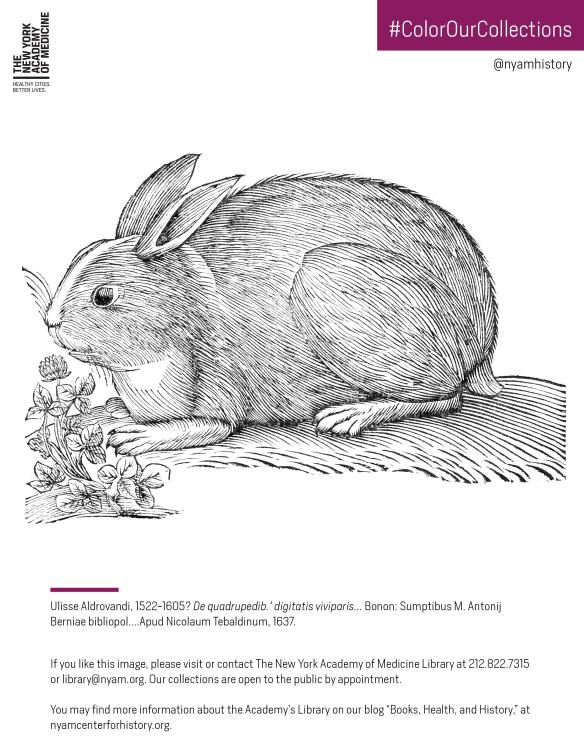
Today’s coloring sheets come from the works of the Italian naturalist Ulisse Aldrovandi, who documented living (and mythical) things of all sorts, from gentle, clover-eating rabbits to fearsome dragons. Aldrovandi (15221605) was a professor at the University of Bologna, and in 1568 he founded a botanic garden there. His interest in the natural sciences led him to gather specimens across Italy for study and inclusion in his natural history museum. Pope Gregory XIII, a relative, provided financial support for his works, but just four volumes were published before his death. Both books featured here, Serpentum et draconum historiae libri duo… and De quadrupedib.’ digitatis viviparis…, were published posthumously.

Rabbit in Ulisse Aldrovandi, De quadrupedib. digitatis viviparis, 1637. Click to download the PDF coloring sheet.

Rabbit in Ulisse Aldrovandi, De quadrupedib.’ digitatis viviparis …, 1637. Click to download the PDF coloring sheet.

Dragon from Ulisse Aldrovandi, Serpentum, et draconum historiae libri duo, 1640.

Dragon from Ulisse Aldrovandi, Serpentum, et draconum historiae libri duo, 1640.

Our featured coloring books of the day come from two institutions that, like us, focus on the history of medicine.

The Dittrick Museum’s coloring book may be the first one ever made to feature a picture of lice removal (from Hortus sanitatis, 1491). It also has other images from works of anatomical and natural history.

Lice removal. 1491. Hortus sanitatis. Mainz, Jabob Meydenbach. Courtesy of the Dittrick Museum.

Lice removal. 1491. Hortus sanitatis. Mainz, Jabob Meydenbach. Courtesy of the Dittrick Museum.

We love the coloring book from Oregon Health & Science University (OHSU)’s Historical Collections & Archives. Who can resist the skull on the cover, from Antonio Scarpa’s 1801 Saggio di osservazioni e d’esperienze sulle principali malattie degli occhi?

Scarpa, Antonio. Saggio di osservazioni e d’esperienze sulle principali malattie degli occhi.Pavia: B. Comino, 1801. Courtesy of OHSU Special Collections & Archives.

Scarpa, Antonio. Saggio di osservazioni e d’esperienze sulle principali malattie degli occhi.Pavia: B. Comino, 1801. Courtesy of OHSU Special Collections & Archives.

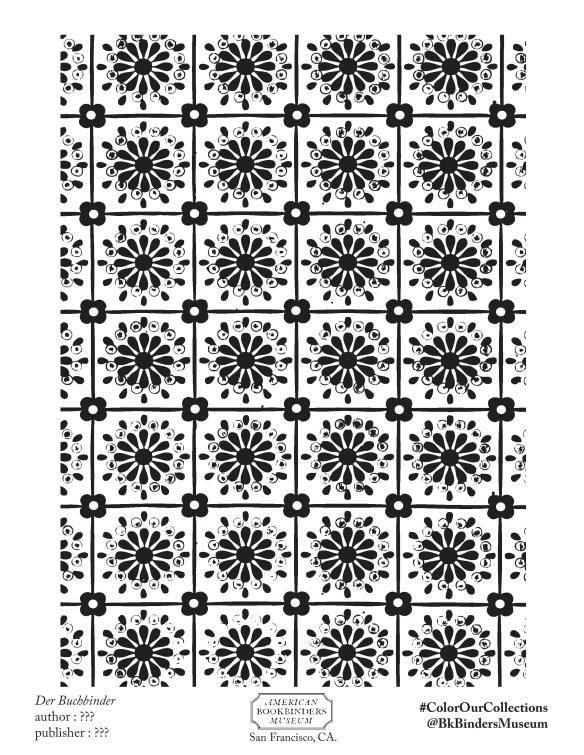
Yesterday’s shared coloring sheets also featured bookbinding and typography. The American Bookbinders Museum offered five images from its collection, including this pattern from Der Buchbinder:

From Der Buchbinder.

From Der Buchbinder.

UW-Milwaukee Special Collections featured typography on its Tumblr, historiated initials from a 1902 printing of The Psalter or Psalms of David from the Bible of Archbishop Cranmer. You can download these initials, along with another whole coloring book from the university.

Historiated R by C. R. Ashbee for his 1902 Essex House Press printing of The Psalter or Psalms of David from the Bible of Archbishop Cranmer. Courtesy of UW-Milwaukee Special Collections.

Historiated R by C. R. Ashbee for his 1902 Essex House Press printing of The Psalter or Psalms of David from the Bible of Archbishop Cranmer. Courtesy of UW-Milwaukee Special Collections.

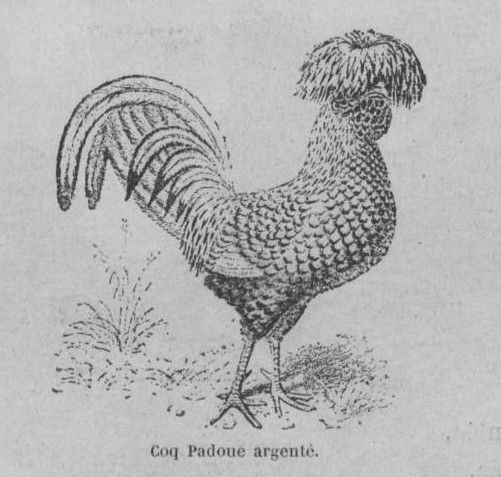
We also have to point out our only French participant thus far, Bibliothèque Bourguignonne. Their Pinterest album features some truly adorable chickens, including this one:

Coq Padoue argenté. Basse-cour, faisanderie et volière : l'élevage à la Croix-verte, Autun, par Et. Lagrange,... Nouvelle édition. 1892. Courtesy of Bibliothèque Bourguignonne.

Coq Padoue argenté. Basse-cour, faisanderie et volière : l’élevage à la Croix-verte, Autun, par Et. Lagrange,… Nouvelle édition. 1892. Courtesy of Bibliothèque Bourguignonne.

Keep following #ColorOurCollections on social media (don’t forget Facebook!), and keep an eye on our Pinterest boards, which feature images to be colored and colored-in sheets. On Friday, our final #ColorOurCollections post will include a list of all of the coloring books created and shared by participants.

#ColorOurCollections, Day 2

#ColorOurCollections-bannerfinal

It’s the second day of #ColorOurCollections, a week-long special collections coloring fest we’ve organized on social media. Yesterday, the number of participating cultural institutions grew from nearly 60 to nearly 100—thanks to all who are taking part (see our growing list)!

Every day on our blog, we will feature #ColorOurCollections coloring sheets from our library, along with content from participants worldwide. You can also download our full #ColorOurCollections coloring book.

Today’s coloring pages come from Bartolomeo Scappi’s Opera. Renaissance chef Scappi (ca. 1500–1577) cooked for six popes and was installed as chef at the Vatican while Michelangelo was completing the Sistine Chapel. His famous cookbook, first published in Venice in 1570, contains more than 1,000 recipes as well as charming and detailed illustrations showing the kitchens, implements, and culinary tools of a high-end Italian household. Here are two his illustrations; you can find three more in the full coloring book.

Scappi_Opera_cooking_1596

Coloring page from Bartolomeo Scappi’s Opera, 1596. Click to download the PDF coloring sheet.

Coloring page from Bartolomeo Scappi's <em>Opera</em>, 1596.

Coloring page from Bartolomeo Scappi’s Opera, 1596. Click to download the PDF coloring sheet.

Yesterday’s offering of #ColorOurCollections images was extraordinary. Today, we are thrilled to feature two coloring books and two image collections. The Massachusetts Historical Society’s book has fantastic images from its archives, including “Ralph Waldo Emerson’s Transparent Eyeball.”

"Ralph Waldo Emerson's Transparent Eyeball." Christopher P. Cranch journal, p. 10, 1839. Courtesy of the Massachusetts Historical Society.

“Ralph Waldo Emerson’s Transparent Eyeball.” Christopher P. Cranch journal, p. 10, 1839. Courtesy of the Massachusetts Historical Society.

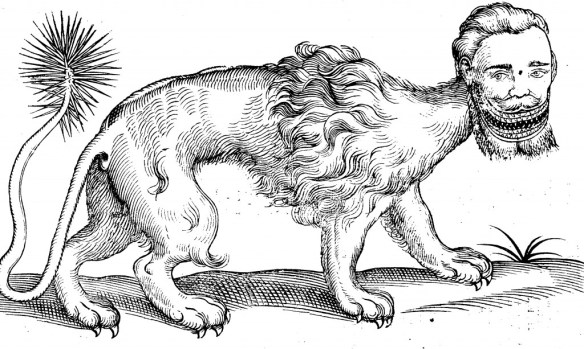
Duke University’s David M. Rubenstein Rare Book & Manuscript Library’s coloring book offers the once-in-a-lifetime opportunity to color a manticore.

Manitchora from The History of Four-Footed Beasts and Serpants by Edward Topsell. London, 1658. Courtesy of the David M. Rubenstein Rare Book & Manuscript Library.

Manitchora from The History of Four-Footed Beasts and Serpants by Edward Topsell. London, 1658. Courtesy of the David M. Rubenstein Rare Book & Manuscript Library.

We also love the image collections from DPLA and the Folger Library. Here’s a favorite DPLA offering:

Illustration from The history of the Caribby-islands , 1666. Courtesy of DPLA.

Illustration from The history of the Caribby-islands, 1666. Courtesy of DPLA.

And a Hamlet illustration from the Folger:

Illustration by John Austen for a 1922 edition of Shakespeare's Hamlet (ART Box A933 no.30). Courtesy of the Folger Library.

Illustration by John Austen for a 1922 edition of Shakespeare’s Hamlet (ART Box A933 no.30). Courtesy of the Folger Library.

In New York? Want to color with others? The New York Botanical Garden’s Mertz Library is hosting #ColorOurCollections coloring parties on Wednesday, February 3 and Friday, February 5, from 12pm–2pm.

Keep following #ColorOurCollections on your favorite social media outlets, and keep an eye on our Pinterest boards, where we are pinning images shared by participating special collections along with images colored by fans. On Friday, our final #ColorOurCollections post will include a list of all of the coloring books created and shared by participants.

#ColorOurCollections Begins!

It’s the first day of #ColorOurCollections, a week-long special collections coloring fest we’re organizing on social media. More than 50 institutions (see our growing list) will share images from their collections for you to download and color from now through Friday. You are invited to share your results using the hashtag.

Every day on our blog, we will feature two #ColorOurCollections coloring sheets from our library, along with content from participants worldwide. You can also download our full #ColorOurCollections coloring book.

Our first coloring sheet shows the five types of unicorns depicted in Pierre Pomet’s 1694 Histoire generale des drogues. The horns of these mythical creatures were believed to have medicinal properties, although, as Pomet admits, “unicorn horn” was usually the tusk of a narwhal. For more on Pomet and unicorns, read this blog post.

Click to download the PDF coloring sheet featuring the unicorns in Pomet, Histoire general des drogues, 1694.

Click to download the PDF coloring sheet featuring the unicorns in Pomet, Histoire general des drogues, 1694.

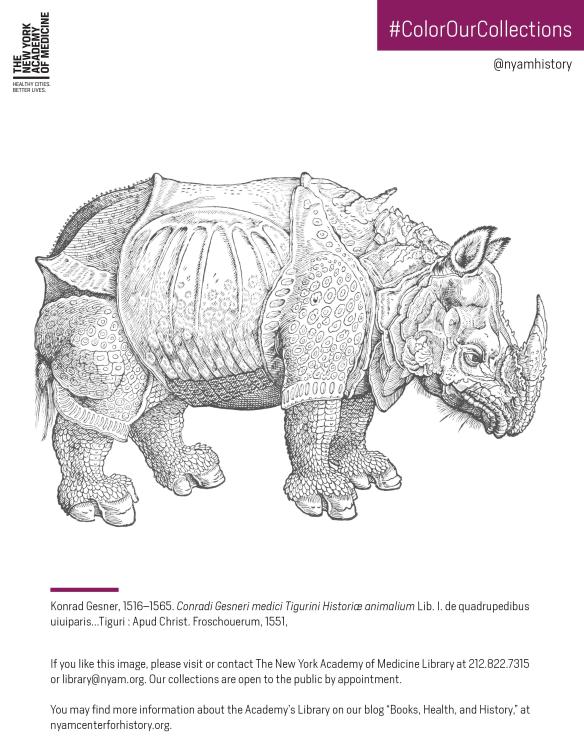
Our second coloring sheet features another horned animal, found in Gesner’s Historia animalium, Liber I. As we know, rhinoceroses do not have horns on their backs; Gesner’s rhino can be traced back to a 1515 print by Albrecht Durer, which was unsurprisingly not drawn from life. As unicorns and horned-back rhinos don’t exist, there’s no need to strive for realism. We’d love to see the most fantastically colorful beasts you can imagine! Don’t forget to tag @nyamhistory and include #ColorOurCollections.

Click to download the PDF coloring sheet featuring the rhino in Gesner, Historiae Animalium, Liber I, 1551

Click to download the PDF coloring sheet featuring the rhino in Gesner, Historiae Animalium, Liber I, 1551

We are thrilled that special collections across the pond agreed to join #ColorOurCollections, even with the Americanized spelling in the hashtag. Last week, the University of Strathclyde’s Archives and Special Collections, Europeana, and the Bodleian Libraries all released coloring books. Click on each organization to download, print, and color.

Page 4 of the coloring book from the University of Strathclyde’s Archives and Special Collections, featuring Tscep von wonders, Brussels, 1514?

Page 4 of the coloring book from the University of Strathclyde’s Archives and Special Collections, featuring Tscep von wonders, Brussels, 1514?

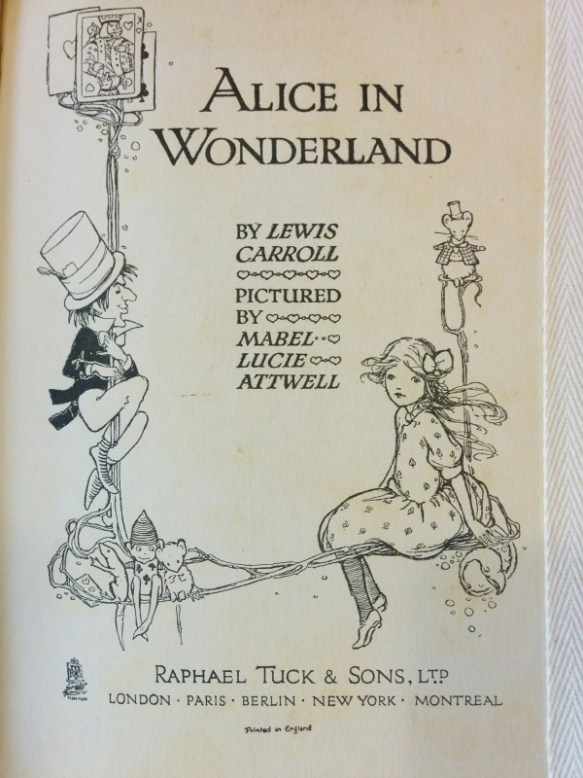
How do special collections decide which images to select for coloring? James Madison University Libraries Special Collections described their process on their blog. We especially love the Alice and Wonderland title page. Download their full coloring book.

A coloring page selected by James Madison University Libraries, featuring a 1910 illustrated copy of Alice in Wonderland.

A coloring page selected by James Madison University Libraries, featuring a 1910 illustrated copy of Alice in Wonderland.

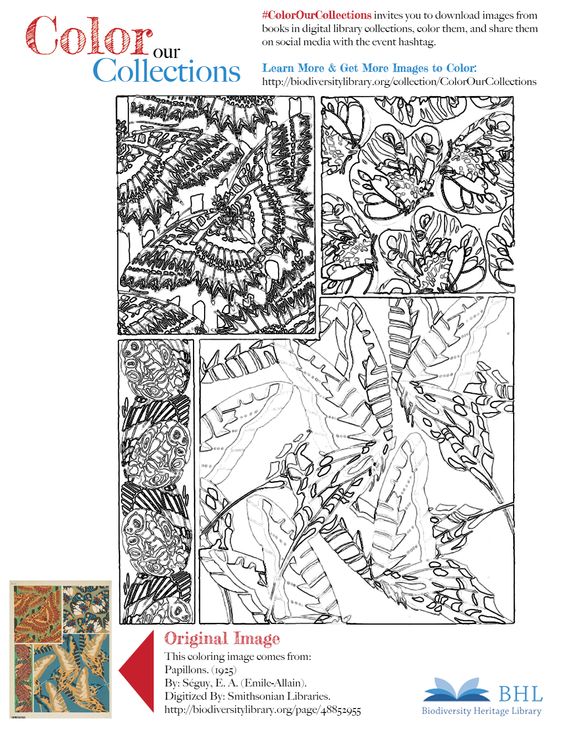
Our final feature of the day comes from the Biodiversity Heritage Library, a consortium of natural history and botanical libraries who will keep you coloring for years! Enjoy their unbelievable Flickr album with more than 1,000 images representing their member libraries. Still want more? Enjoy the coloring sheets on their Pinterest board, which you can also download in coloring book form.

A coloring sheet from the Biodiversity Heritage Library, featuring Seguy, Papillons, 1925.

A coloring sheet from the Biodiversity Heritage Library, featuring Seguy, Papillons, 1925.

Keep following #ColorOurCollections on your favorite social media outlets. And take a look at our Pinterest boards, where we are pinning images shared by participating special collections along with images colored by fans.