Fascinating Mad Men-Era Advertisements

By Anne Garner, Curator, Center for the History of Medicine and Public Health

This is part of an intermittent series of blogs featuring advertisements found in our collection. You can find the entire series here.

In American Journal of Obstetrics and Gynecology 83, no. 3 (1962).

In American Journal of Obstetrics and Gynecology 83, no. 3 (1962).

Nobody conjures the ’60s better than Matthew Weiner and the writers, designers, and stylists of AMC’s Mad Men. We’ll miss the quotidian details: the trash left behind at the Draper family picnic, that unbelievable maternity dress of Trudy’s, the choking smoke of Mohawk’s planes, Metro-North’s trains, and Don’s automobiles. When Sally Draper puts a plastic dry-cleaning bag over her head and her mother scolds her—not out of fear for her safety and only for dumping her dry-cleaning on the floor—we’re gob-smacked. These moments crystallize the seismic shifts that have occurred in cultural expectations over the last fifty years.

The Academy Library has strong holdings in the major journals of the 19th and 20th centuries. Journals were then, as they are now, the primary place of publication for innovations and discoveries. In addition, the advertisements aimed at the professional readers of these journals offer insights into changing cultural beliefs. Most libraries excised the advertisements, especially if they were gathered in a separate section of the journal. The Academy tradition was to keep the advertising, and these ads are now heavily used by historians.

The images and texts in these advertisements provide artists, writers, and historians with richly-textured cultural context. There is much to be learned, for example, from looking at the way antidepressants were marketed to women in the twentieth century, at the early advertisements for the birth control pill, and at tobacco advertising aimed directly at physicians as consumers.  Here, a look at a Flavorwire piece we wrote using ads entirely from our collections and relating them to Mad Men.

The Good Man of Religion (Part 2 of 3)

This is part two of a guest post written by Anna Weerasinghe, a graduate of Harvard Divinity School studying the history and theology of Hansen’s disease. Read part one and part three.

Our last post saw Protestants Robert Louis Stevenson and the Rev. Dr. Hyde in a pitched, public battle for religious missionary Father Damien’s reputation. But what did fellow Catholics think of Damien?

Bishop Hermann Koeckmann and Father Leonor Fouesnel. In Daws, Holy man: Father Damien of Molokai, 1973.

Bishop Hermann Koeckmann and Father Leonor Fouesnel. In Daws, Holy man: Father Damien of Molokai, 1973.

“Good man of religion, good priest,” wrote Father Fouesnel, the vice-provincial of the mission at Honolulu, “but…sometimes indiscreet zeal leads him to say, to write, and even to do things which ecclesiastical authority can only criticize.”1 Damien was constantly at loggerheads with his superiors Fouesnel and Hermann Koeckemann, bishop of the Congregation of the Sacred Hearts on Hawaii, throughout his time at the Molokai leper settlement, and this is was nothing new.

Damien, born Jozef de Veuster on January 3, 1840 to a farming family in Tremelo, Belgium, was driven, strong, and competitive from a young age. He followed his elder brother Auguste into the Congregation of the Sacred Hearts of Jesus and Mary in 1860 and quickly strove to surpass him. When Auguste fell ill and was unable to make the trip to Hawaii to begin his mission, Damien literally jumped at the chance to take his place. He even went over the head of his direct superior by writing a letter to the father-general of the Congregation, much to his superior’s annoyance. By October 1863, he was onboard a ship destined for Hawaii. He was only 23 years old and had yet to be ordained.2

Damien at twenty-three, just before he left Europe. In Daws, Holy man: Father Damien of Molokai, 1973.

Damien at twenty-three, just before he left Europe. In Daws, Holy man: Father Damien of Molokai, 1973.

This first step towards Molokai set the tone for Damien’s often-fraught relationship with his superiors throughout his life. Damien was impolitic, demanding, and at times even imperious. He did not request supplies or aid, he demanded them; when he got the desired materials or money, he used them as he saw fit without waiting for approval. His intentions were generally good: for example, Damien once took lumber intended for the chapel in Pelekunu, a town on the other side of Molokai, to perform much-needed repairs on the chapel at the leper settlement instead.

But the biggest bone of contention was Damien’s extraordinary international media presence, particularly towards the close of the 1880s when Damien’s terminal Hansen’s disease diagnosis had been confirmed and publicized. This massive surge in popularity was accompanied by an equally vast outpouring in donations, directed not towards the Congregation’s mission, but to Damien himself.

“I see with displeasure,” wrote Bishop Koeckemann in early 1887, “that the newspapers which admire you exaggerate and put things in a false light, without taking account of what the government and others do—the mission also has its share.” Koeckemann and Fouesnel were convinced that Damien was fanning the flames of publicity, writing “to the four winds” about the miserable state of the leper settlement and insinuating that the mission and the government were shirking their duties.3

Damien was taken aback by his superior’s disapproval as much as by the media attention. He believed his actions to be encouraging charity, not publicity—and in fact, only a few letters by Damien were published during his life. His circumstances, rather than his words, were what aroused public interest. The press presented Damien as a hero of self-sacrifice: losing first his freedom of movement, then his health, and finally his life.

Still, after Damien’s death, neither Koeckemann nor Fouesnel were interested in pursuing a sainthood for Damien. All agreed that, after the press had labeled Damien a “hero” and “martyr of charity,” everything had been said. “The rest,” Koeckemann concluded, delicately leaving out all mention of Damien’s personal faults, “only complicates matters.” As Koeckemann’s successor, Bishop Gulston Ropert observed, “Even the beginnings of the process of beatification would have to wait until everyone who knew Damien well was dead.”4

Indeed, the process of Damien’s canonization did not begin until 1977, when Pope Paul VI declared him to be venerable (the first step towards full sainthood). It would take another three decades and two posthumous miracles for Damien to be officially recognized as the patron saint of Hansen’s disease patients.5

The feast day chosen for the new Saint Damien was not the day of his death, as is typical for Catholic saints. Instead, Damien is venerated on May 10, the anniversary of his arrival on the island of Molokai—a moment that many regarded as a death sentence far worse than physical death.6 In the final post, we will look at Hansen’s disease on Hawaii, as well as the progression of Damien’s own illness and death.

Read part three.

References

1. Gavan Daws, Holy Man: Father Damien of Molokai (New York: Harper & Row, 1973), 136.

2. Philibert Tauvel, Rtather Damien: Apostle of the Lepers of Molokai, Priest of the Cognregation of the Sacred Hearts (London: Art and Book Co., 1904), 29-31.

3. Daws, 191.

4. Daws, 245-246. Beatification is the second of three formal steps in the process leading towards sainthood.

5. Rachel Donadio, “Benedict Canonizes 5 New Saints,” The New York Times, October 11, 2009. For more about the second miracle, which was documented in the Hawaii Medical Journal, see “Vatican Affirms Miraculous Healing Attributed to Blessed Father Damien.” Catholic News Agency. May 1, 2008.

6.In fact, at the time when Damien left for Molokai, the government of Hawaii was deliberating a law that would declare confirmed Hansen’s disease victim legally dead. Daws, 73.

Sigmund Freud on War and Death

By Paul Theerman, Associate Director, Center for the History of Medicine and Public Health

4.Sigmund Freud (1856–1939), photograph by Max Halberstadt, n.d., from NLM’s Images from the History of Medicine, Image Order Number B012346.

Sigmund Freud (1856–1939), photograph by Max Halberstadt, n.d., from NLM’s Images from the History of Medicine, Image Order Number B012346.

Sigmund Freud was born this day in 1856. Just one hundred years ago, a scant six months or so into the Great War, he set down Reflections on War and Death, his thoughts on the meaning of the war that had already spun out so violently—and that had more than three years yet to go.

Freud was at the top of his career in 1915. He started carving out the distinct field of psychoanalysis in 1895, with Studies in Hysteria, followed by The Interpretation of Dreams (1899), The Psychopathology of Everyday Life (1901), Three Essays on the Theory of Sexuality (1905), and numerous other books and articles. From 1902 he had gathered a group of physicians that became the nucleus of the psychoanalytic movement. In 1909, Freud undertook a triumphal tour of the United States. He founded The International Psychoanalytical Association in 1910; the American and New York groups came about the following year. And in 1912, Freud founded Imago: zeitschrift für anwendung der psychoanalyse auf die geisteswissenchaften, a journal that applied psychoanalysis to history, philosophy, and the social sciences. It was in Imago that the essay, “Reflections on War and Death” appeared, as “Zeitgemäßes über Krieg und Tod.”1

In his essay, Freud wished to present a worldly estimation of the carnage gripping Europe. He wrote, “The civilized world-citizen . . . may find himself helpless in a world that has grown strange to him when he sees his great fatherland disintegrated, the possessions common to mankind destroyed, and his fellow citizens debased.”2 While regretting the violence that the war had unleashed, he also professed not to be particularly surprised. European civilization was not nearly as moral as people had believed, he wrote. He contrasted two forms of moral development. One was hard won by deep psychic change: the transformation of evil and selfish impulses to beneficent social ends under the influence of “the love needs of man interpreted in the widest sense.”3

Sigmund Freud, “Zeitgemäßes über Krieg und Tod,” Imago: zeitschrift für anwendung der psychoanalyse auf die geisteswissenchaften 4(1) (1915): 1-21.

Sigmund Freud, “Zeitgemäßes über Krieg und Tod,” Imago: zeitschrift für anwendung der psychoanalyse auf die geisteswissenchaften 4(1) (1915): 1-21.

The second form, indistinguishable from the first in peacetime, was enforced by a system of rewards and punishments that elicited moral behavior: good conduct is rewarded, and bad punished. However, in the chaos of wartime, the system showed itself for the sham that it was: no shame attached to the horrendous acts perpetrated between warring states. Freud explained this with the scant consolation: “our mortification and painful disappointment on account of the uncivilized behavior of our fellow world citizens in this war were not justified. . . . In reality they have not sunk as deeply as we feared because they never rose as high as we believed.”4

Cover of Freud's Reflections on War and Death, translated by A. A. Brill and Alfred B. Kuttner (New York: Moffat, Yard, and Company, 1918).

Cover of Freud’s Reflections on War and Death, translated by A. A. Brill and Alfred B. Kuttner, 1918.

In 1918, the year after America joined the war, Abraham Arden Brill (1874–1948), one of the founders of the psychoanalytic movement here, and Alfred B. Kuttner (b. 1886), a literary figure and film critic, translated and published Freud’s work, with this introductory note:

This book is offered to the American public at the present time in the hope that it may contribute something to the cause of international understanding and good will which has become the hope of the world.

This hope was based in a clear-eyed look at the basest human instincts, and the insight that change meant resolution at a deep psychic level, not to be gained by simple moralizing or hand-wringing. The last 100 years have produced a dispiriting number of examples of the failures to which Freud pointed. And the book remains in print to this day.

References

1. Imago 4(1) (1915): 1-21.

2. Sigmund Freud, Reflections on War and Death, translated by A. A. Brill and Alfred B. Kuttner (New York: Moffat, Yard, and Company, 1918), p. 16.

3. Freud, Reflections on War and Death, 21.

4. Freud, Reflections on War and Death, 29.

The Strange Case of Father Damien (Part 1 of 3)

Today we have part one of a guest post written by Anna Weerasinghe, a graduate of Harvard Divinity School studying the history and theology of Hansen’s disease. Read part two and part three.

“The simple truth is, [Father Damien] was a coarse, dirty man, headstrong, and bigoted. He was not sent to Molokai, but went there without orders; did not stay at the leper settlement (before he became one himself), but circulated freely over the whole island. He had no hand in the reforms and improvement inaugurated, which were the work of our Board of Health…and the leprosy of which he died should be attributed to his vices and carelessness.”1   

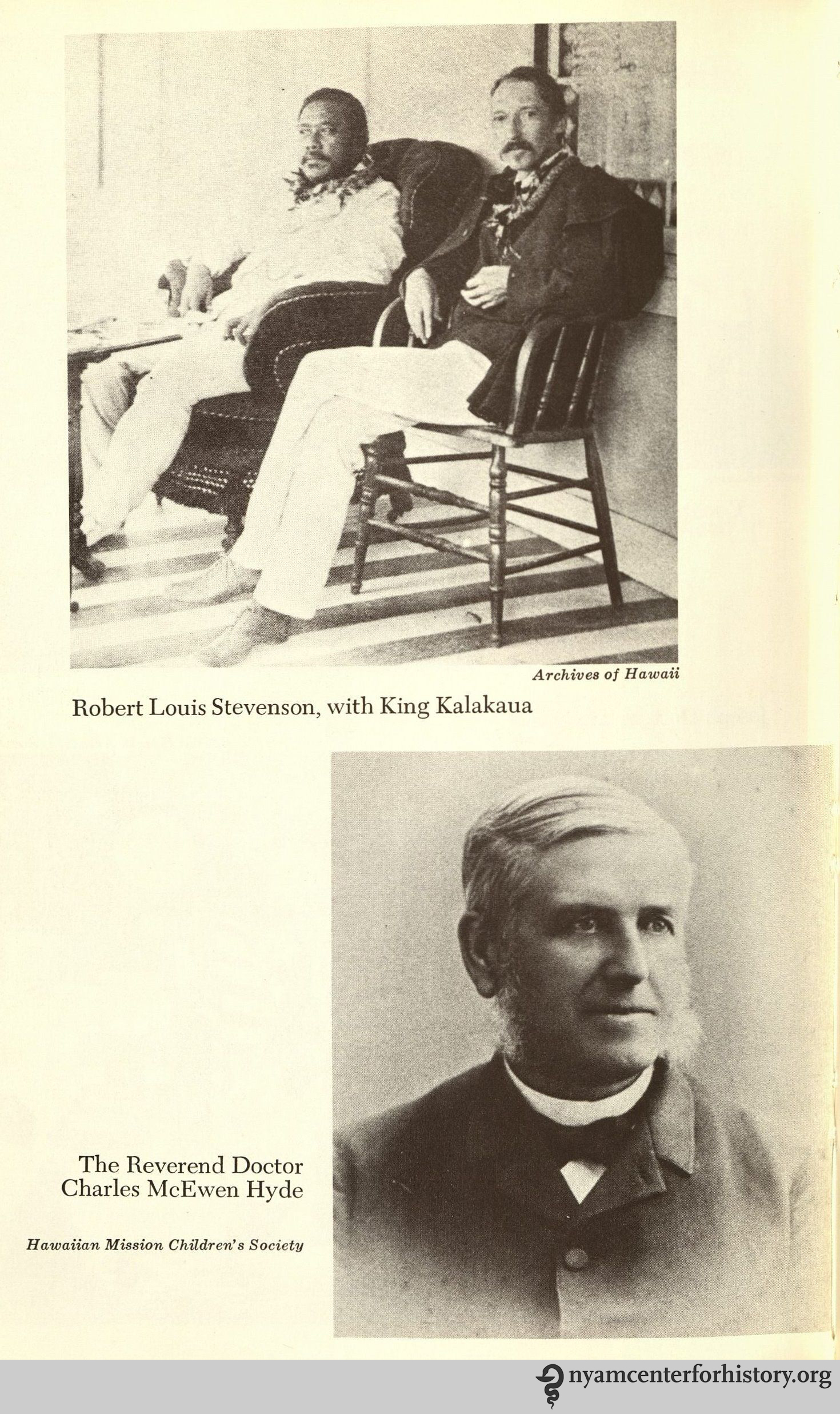
Robert Louis Stevenson and the Reverend Doctor Charles McEwen Hyde. In In Daws, Holy man: Father Damien of Molokai, 1973.

Robert Louis Stevenson and the Reverend Doctor Charles McEwen Hyde. In In Daws, Holy man: Father Damien of Molokai, 1973.

So wrote the Reverend Doctor Charles Hyde on August 2, 1889, just months after Father Damien’s death. In just a few weeks on May 11, “Father Damien Way” (33rd Street between First and Second Avenues) will join the ranks of the numerous public memorials named in Saint Damien’s honor.2 Based on Hyde’s colorful description, Damien hardly sounds like the kind of man to be sainted for his charitable work in Hawaii among sufferers of Hansen’s disease (better known as leprosy). Nor does Damien seem like the kind of celebrity whose death would ignite a firestorm of controversy, culminating in a pitched battle of wits between the Reverend Doctor Hyde and world-renowned author Robert Louis Stevenson that would help catapult its subject to enduring international fame.

So just who was Father Damien? A saint or a sinner? A hero or a victim? In this series of blog posts, we will get to know the many sides of Father Damien—the man, the saint, the Hansen’s disease victim—and the divisive forces that shaped his life and legacy.

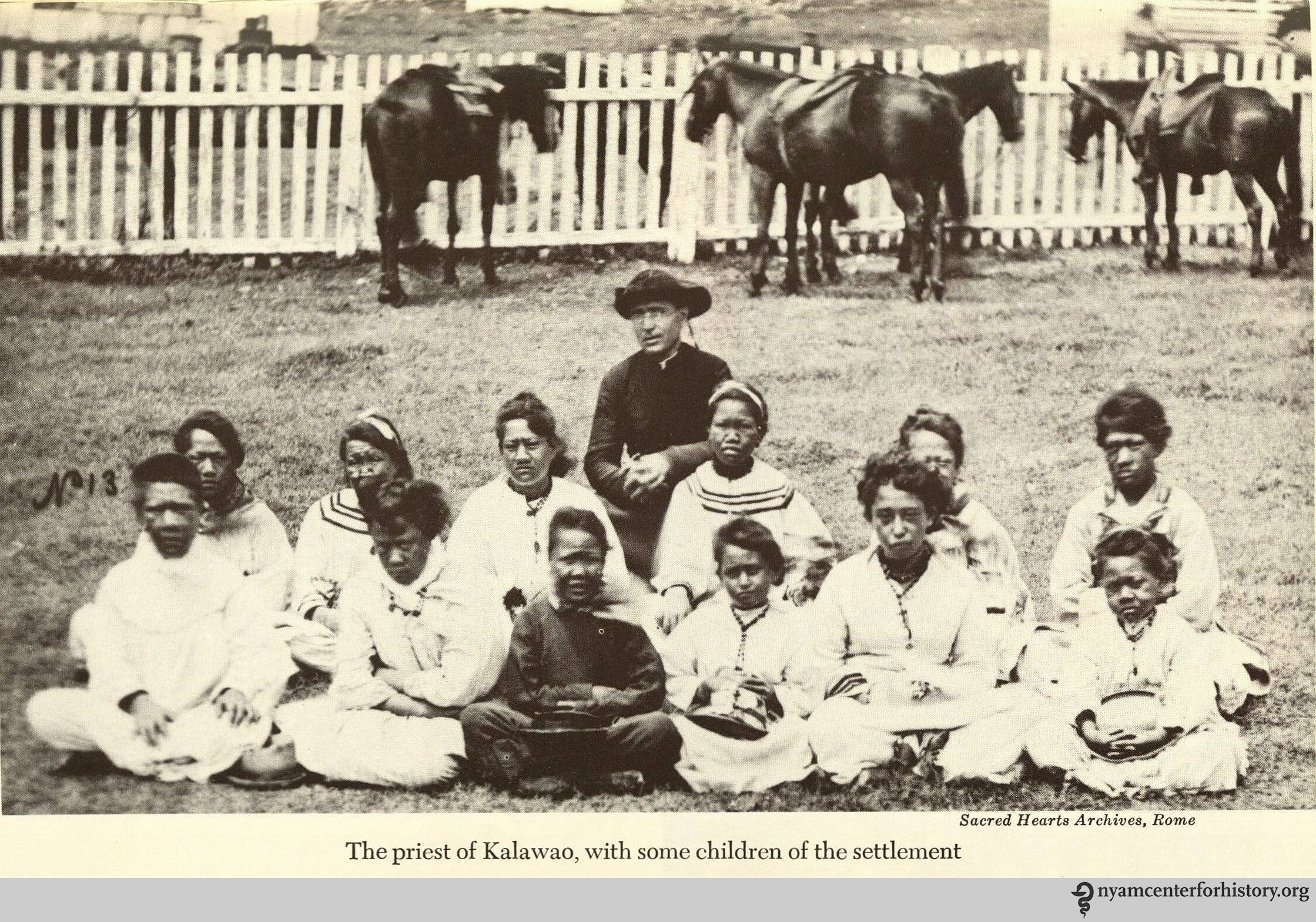
When Father Damien first arrived at the Kalawao leper settlement on the isolated Hawaiian island of Molokai in 1873, he caught the attention of the press almost immediately. As the first western religious missionary, Catholic or Protestant, to live within the leper settlement despite being free of the disease himself, Damien was something of a sensation. He was praised for his Catholic sense of self-sacrifice and even dubbed a “martyr,” particularly towards the end of his life when it became clear that he had contracted a severe and ultimately fatal form of Hansen’s disease.3

“The priest of Kalawao, with some children of the settlement.” In Daws, Holy man: Father Damien of Molokai, 1973.

So while the Reverend Doctor Hyde only met Damien once during a brief visit to Kalawao in 1885, he had already heard far too much about the priest’s saintliness for his taste. Philanthropic efforts to segregate and support those afflicted with Hansen’s disease in Hawaii were largely funded by wealthy Protestant businessmen and politicians from the United States with a view to future American annexation of the islands. Hyde, an able administrator of these charitable funds, felt that Damien was taking advantage of Protestant charity. “Others have done much for the lepers, our own ministers, the government physicians, and so forth,” Hyde complained. “But never with the Catholic idea of meriting eternal life.”4

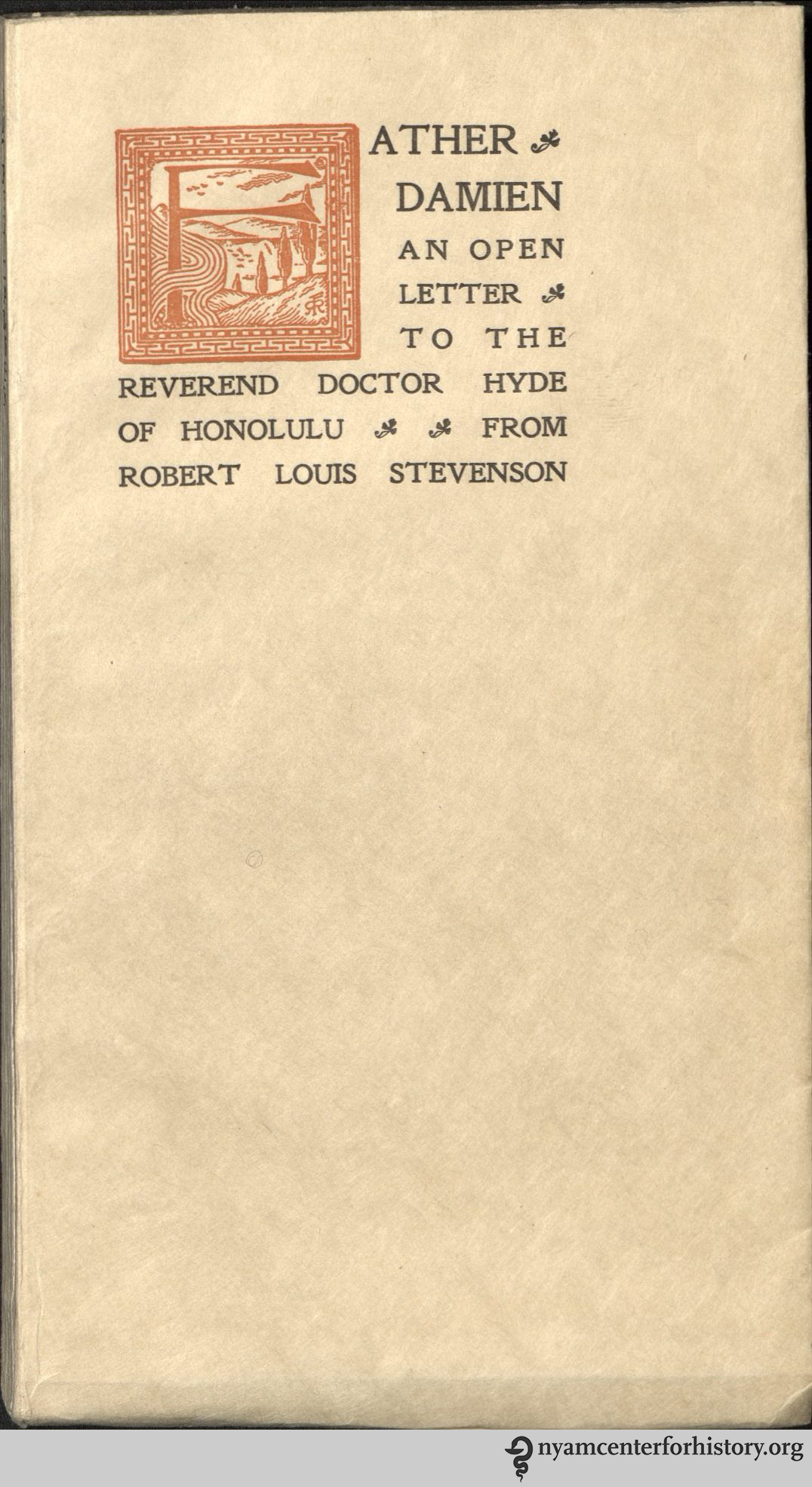
Halfway across the world in Sydney, Robert Louis Stevenson read Hyde’s criticism of Damien with mounting rage. Fresh from the success of his best-selling novel Dr. Jekyll and Mr. Hyde, Stevenson wasted no time in raising his pen against the Reverend Doctor: “With you,” he wrote with a certain viciousness, “I rejoice to feel the button off the foil and to plunge home.”5 In February of 1890, he printed his own “Open Letter to the Reverend Doctor Hyde of Honolulu,” a thirty-page rebuttal ripping apart Hyde’s short complaint.

Unlike Hyde, Stevenson had never met Damien personally. But he was a fellow invalid, terminally ill with tuberculosis, and felt a close affinity for the priest and his country despite their religious differences. Stevenson had travelled to Hawaii for his health in the summer of 1889 and visited the island of Molokai just after Damien’s death. Interviewing both Damien’s compatriots and Protestant critics, he found they “build up the image of a man, with all his weaknesses, essentially heroic, and alive with rugged honesty, generosity, and mirth.”6 Was he coarse? Dirty? Headstrong? Even bigoted? Stevenson admitted he probably was, but asserted that these faults didn’t diminish his bravery or achievements. To Stevenson, Damien’s failings simply made him a human, rather than superhuman, hero.

The response was immediate. Hawaiian newspapers were flooded with responses to Stevenson’s letter ranging from gleeful to indignant. Headlines bloomed across the United States, from San Francisco to Omaha to New York. “Damien Defended!” declared the Omaha Daily Bee. “A Reverend Gossip Rebuked,” taunted The New York Times.7 Hyde didn’t stand much of a chance in this battle of the printed word. Stevenson’s impassioned defense of Damien triggered an outpouring of charity from around the world dedicated to the deceased Damien’s cause. Hyde never backed down from his position, but he retreated from public view. “I leave it to any candid mind to judge which side lies the calumny and slander,” the beleaguered Hyde concluded. “There let it lie.”8

Damien’s greatest public critic and most famous defender have had their say, but the man himself remains a mystery Next time, we’ll hear more from those who knew the best and worst of Damien personally—his religious superiors.

Read part two and part three.

References

1. As quoted in Robert Louis Stevenson, Father Damien: an open letter to the Reverend Doctor Hyde of Honolulu from Robert Louis Stevenson (London: Chatto and Windus, 1890), 6-7.

2. Flanders House. http://www.flandershouse.org/fatherdamien

3. For examples see, “Father Damien’s Mission,” The Pacific Commercial Advertiser, November 5, 1885; “The Late Father Damien,” The Honolulu Daily Bulletin, April 29, 1889; “The Leper Martyr,” New-York Tribune, May 12, 1889.

4. Gavan Daws, Holy Man: Father Damien of Molokai (New York: Harper & Row, 1973), 12-13. Stevenson, Father Damien, 7.

5. Stevenson, Father Damien, 8.

6. Stevenson, Father Damien, 20.

7. For examples see “Letter to the Editor: Robert Louis Stevenson’s Letter,” The Hawaiian Gazette, May 27, 1890; “Letter to the Editor: Stevenson’s Letter,” The Pacific Commercial Advertiser, May 21, 1890; Mary Lambert, “Stevenson and Father Damien,” San Francisco Morning Call., June 8, 1990; “Damien Defended!,” Omaha Daily Bee, May 24, 1890; “A Reverend Gossip Rebuked,” The New York Times, January 21, 1890.

8. As quoted in Daws, Holy Man, 247.

Happy Preservation Week!

By Emily Moyer, Collections Care Assistant, Gladys Brooks Book & Paper Conservation Laboratory

PreservationWeek2015_logoSponsored by the American Library Association’s Association of Library Collections and Technical Services (ALCTS), Preservation Week aims to raise awareness of the importance of preservation and education in providing collections for future generations.

Every week is preservation week in the Gladys Brooks Book & Paper Conservation Laboratory at The New York Academy of Medicine. Preservation efforts include cleaning, stabilization, and rehousing; monitoring environmental conditions; education on the care and handling of materials; item-level treatments; and disaster preparedness. We work together to try to prevent future deterioration of materials and mitigate risks to the collection.

This behind-the-scenes video shows a day in the conservation lab here at the Academy: creating slings for our 60,000+ health pamphlet collection, shrink wrapping brittle periodicals and books, mounting facsimile images for an exhibition, refoldering and dry cleaning pamphlets, mending a manuscript cookbook, and rebacking a 19th-century medical student notebook.

Happy Preservation Week!


The Dragons of Aldrovandi

By Johanna Goldberg, Information Services Librarian

It’s St. George’s Day, and what better way to celebrate than with dragons?

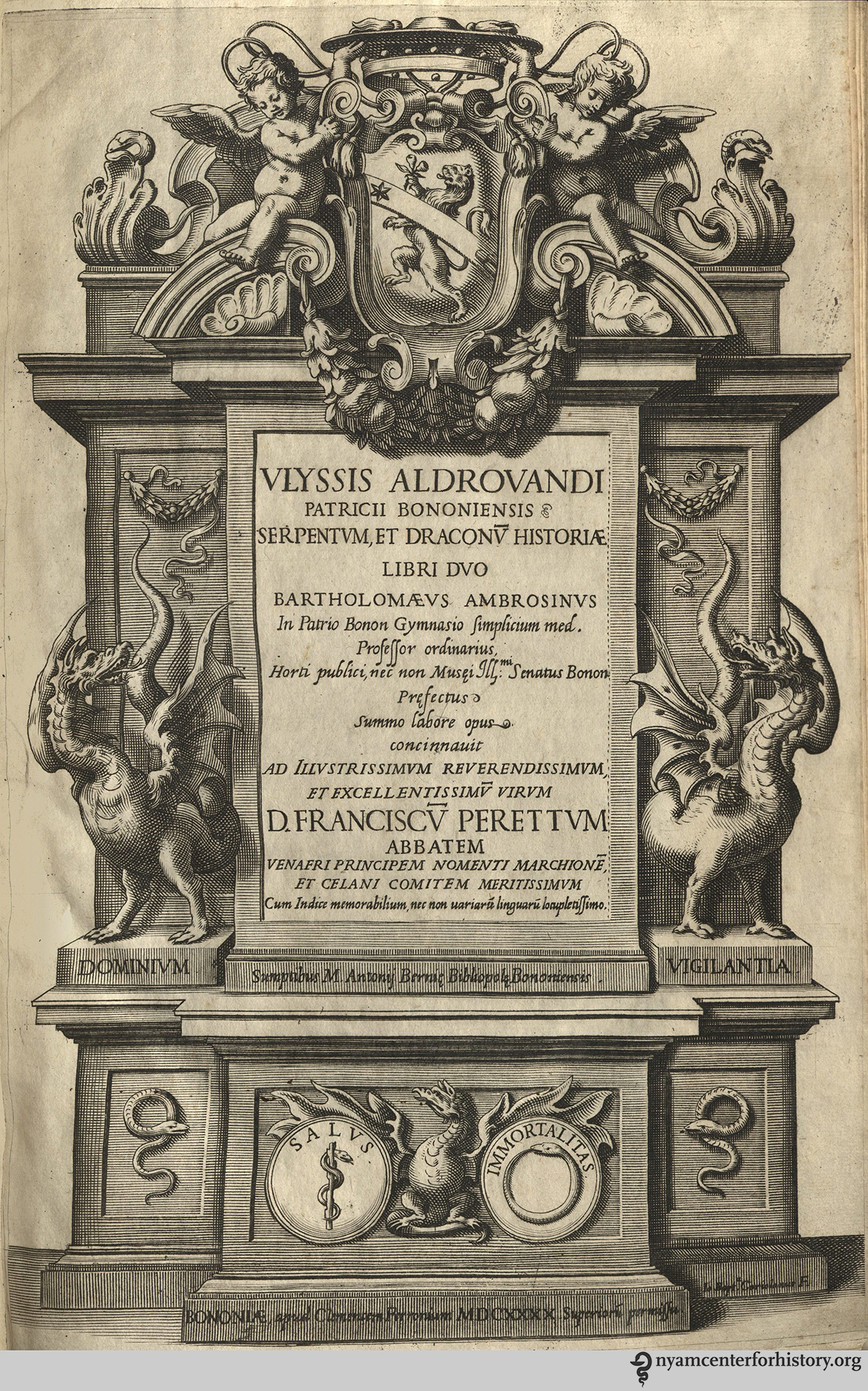
Title page of Serpentum, et draconum historiae libri duo, 1640.

Title page of Serpentum, et draconum historiae libri duo, 1640. Click to enlarge.

Perhaps the most famous illustrations of dragons in our collection come from Ulisse Aldrovandi’s posthumous Serpentum, et draconum historiae libri duo (The History of Serpents and Dragons), 1640.

Aldrovandi (1522–1605) was a physician and naturalist from a noble family in Bologna. He received a medical degree from Padua in 1553, and became a full professor at the University of Bologna in 1561.1 Pope Gregory XIII, his cousin, supported his career, appointing him as inspector of drugs and pharmacies and offering monetary aid for his many natural history works, only four of which were published during his lifetime.1,2

Aldrovandi maintained a museum of biological specimens, supervised by Bartolomeo Ambrosini, who shepherded Serpentum et draconum to publication after Aldrovandi’s death.2 The book offers descriptions and engravings of snakes, along with more legendary creatures, some drawn from descriptions given by merchants, others debunking the practice of stitching together animal parts to create “monsters.”3,4 Aldrovandi even claimed to have a dragon in his museum, collected in Bologna in 1572 at the bequest of his cousin, the pope.2

Enjoy the dragons! Click on an image to view the gallery.

References

1. Ulisse Aldrovandi: Italian Naturalist. Encycl Br. Available at: http://www.britannica.com/EBchecked/topic/13659/Ulisse-Aldrovandi. Accessed April 23, 2015.

2. Findlen P. Possessing Nature: Museums, Collecting, and Scientific Culture in Early Modern Italy. Berkeley and Los Angeles: University of California Press; 1996. Available at: https://books.google.com/books?id=MdytpHTVf1gC&pgis=1. Accessed April 23, 2015.

3. An “Ethiopian dragon” | Royal Society Picture Library. Available at: https://pictures.royalsociety.org/image-rs-10449. Accessed April 23, 2015.

4. A “dragon” made from fish parts | Royal Society Picture Library. Available at: https://pictures.royalsociety.org/image-rs-10446. Accessed April 23, 2015.

What Lies Beneath: Semi-Limp Parchment Bindings in The Academy’s Rare Book Collection (Items of the Month)

By Erin Albritton, Head of Conservation, and Christina Amato, Book Conservator, Gladys Brooks Book & Paper Conservation Laboratory

In the summer of 2013, conservators in the Gladys Brooks Book and Paper Conservation Laboratory began investigating conservation treatment options for a 17th-century Parisian imprint. As part of this process, we undertook an examination of a significant portion of The Academy’s early modern parchment volumes and became fascinated with a particular binding style—known as a semi-limp parchment binding—that has received very little attention in the published literature. For April’s item of the month, we offer a sneak peak at some of these bindings and the features that make them unique.1

A group of semi-limp parchment bindings in The Academy’s rare book collection

A group of semi-limp parchment bindings in The Academy’s rare book collection

Parchment2 bindings can be grouped into three basic categories: limp, semi-limp, and stiff. As the name implies, limp bindings are supple structures characterized by the absence of boards beneath their simple covers. Stiff board bindings, on the other hand, live up to their name through the addition of two rigid pieces of board inserted at the front and back. Semi-limp bindings—the category on which we focus here—fall somewhere in between: supple, but due to the presence of flexible boards, not quite limp.3

The most common type of semi-limp binding represented in the The Academy’s collection has two flexible boards that “float,” unadhered, beneath its parchment cover (see picture below).

Floating boards within the detached parchment cover of a  17th-century Belgium binding. Tournai, 1668.

Floating boards within the detached parchment cover of a 17th-century Belgium binding. Tournai, 1668.

During our research, however, we were excited to discover a style of semi-limp parchment binding previously unknown to us—a structure distinguished by the fact that it has a single piece of thin moldable board (rather than two floating boards) inserted beneath its cover (see picture below). The board is wrapped around the whole textblock, the outer parchment cover is folded over it, and both are attached to the textblock at the head and tail via laced endband cores. For lack of any historical name, and to distinguish it from the floating boards binding mentioned above, we have called this structure a wrapped board binding.4

Wrapped board binding with inner paper board stiffener visible through damaged outer parchment cover. Lyon, 1641

Wrapped board binding with inner paper board stiffener visible through damaged outer parchment cover. Lyon, 1641

As illustrated in the photographs below, the two styles outwardly appear very similar and can be almost impossible to tell apart without access to and close examination of the inner joints and spine.

Left: Floating boards binding, Paris, 1645. Right: Wrapped board binding, Paris, 1628.

Left: Floating boards binding, Paris, 1645. Right: Wrapped board binding, Paris, 1628.

To learn more about these structures, we undertook a two-part survey of The Academy’s rare book collection. Part one was a big-picture analysis, in which we examined approximately 20,000 volumes and collected basic information about every parchment binding we found; part two involved a detailed look at the semi-limp structures we identified during part one.

The results of our survey indicate that semi-limp bindings were much more popular in Europe during the early modern period than we suspected. Indeed, given the proportion of scholarly literature devoted to limp parchment bindings and their profile within the pantheon of historical binding structures, we were surprised to count nearly four times as many semi-limp bindings (of both the floating boards and wrapped board varieties) as limp bindings in our collection—with 194 and 48 respectively. Within our survey sample, the wrapped board structure was relatively uncommon—appearing on only 28 (or 14 percent) of all semi-limp bindings—and its use seems to have been limited to France in the late 16th and early 17th centuries.5

Title page from a Parisian wrapped board binding, 1639.

Title page from a Parisian wrapped board binding, 1639.

Almost all of the semi-limp parchment bindings we surveyed were simple structures—small in size and unornamented, featuring a number of structural shortcuts (including abbreviated sewing patterns on only two or three supports; simple endbands with minimal tie-downs; and plain endsheets of very basic construction) typical of retail (or, perhaps, less expensive bespoke) bindings of the time. While evidence indicates that these bindings were probably intended to be permanent,6 they were cheaper and easier to make (and, therefore, also likely less expensive to buy) than leather bindings. Hence, it appears that both the floating boards and wrapped board bindings were, in all probability, part of a larger strategy within the early modern book industry aimed at binding more books for a bigger audience quickly without going broke.

This slideshow requires JavaScript.

Our initial findings indicate that, like their limp parchment cousins, semi-limp bindings played a significant role in bookbinding history. This role has been both underappreciated and underexamined in the scholarly literature, however, and much research remains to be done. Consequently, we encourage readers to take a look beneath the covers of the parchment bindings that line the shelves of their collections and start documenting what they see.7

Notes

1. For definitions of some of the bookbinding terms used in this post, see Roberts, Matt and Don Etherington. Bookbinding and the Conservation of Books: A Dictionary of Descriptive Terminology. Washington, DC: Library of Congress, 1982 (accessible online at http://cool.conservation-us.org/don//) or Carter, John and Nicholas Barker. ABC for Book Collectors. 8th ed., New Castle, DE: Oak Knoll Press, 2004 (accessible online at https://www.ilab.org/eng/documentation/29-abc_for_book_collectors.html).

2. Parchment is any animal skin that has been limed, de-haired, dried under tension, and then scraped and thinned. Although definitive species identification is not possible without DNA analysis, most parchment-bound books are made from sheep, goat or calf skin.

3. From the early 16th century on, binders began replacing traditional wooden boards with a variety of different types of cheaper paper ones. Most parchment bindings with boards were made using these.

4. Although much has been written about limp parchment bindings, we have found very little scholarly literature about their semi-limp cousins. The one notable exception is Nicholas Pickwoad’s 1994 study of the Ramey collection—a group of 359 volumes at the Morgan Library, printed mostly in France between 1485 and 1601—in which he identifies (for the first and, as far as we can tell, only time in an English-language resource) 46 examples of the wrapped board structure we describe here. See Pickwoad, Nicholas. “The Interpretation of Bookbinding Structure: An Examination of Sixteenth-Century Bindings in the Ramey Collection in the Pierpont Morgan Library.” The Library 6th s., XVII, no. 3 (September 1995): 209-249.

5. In The Academy’s collection, the wrapped board binding appears most frequently on French imprints published in Paris between 1620 and 1649. Although floating boards bindings were produced in a variety of different countries throughout the 16th, 17th and 18th centuries, in The Academy’s collection they appear most often on Italian imprints published after 1640.

6. Unlike temporary bindings—which were made so that they could be removed and replaced with a more elaborate binding—these structures lack features (such as long sewing supports) that would have made rebinding easy, and are marked by others (such as trimmed and decorated textblock edges) that indicate permanence.

7. For those interested in learning more about this research project, a discussion of our survey results is anticipated to be published by The Legacy Press in 2016 as part of a collection of essays on the history of bookbinding titled Suave Mechanicals (Volume III).

The Journey of Dr. Robert Bongout and his Lady, to Bath

By Johanna Goldberg, Information Services Librarian

To celebrate National Poetry Month, we are sharing poems from our collection throughout April.

Anyone who has read a Jane Austen novel or seen an adaptation knows about taking the waters at Bath for medicinal benefit and societal gain. But Dr. Robert Bongout would not be considered decorous company for the genteel gentlemen and ladies in her works.

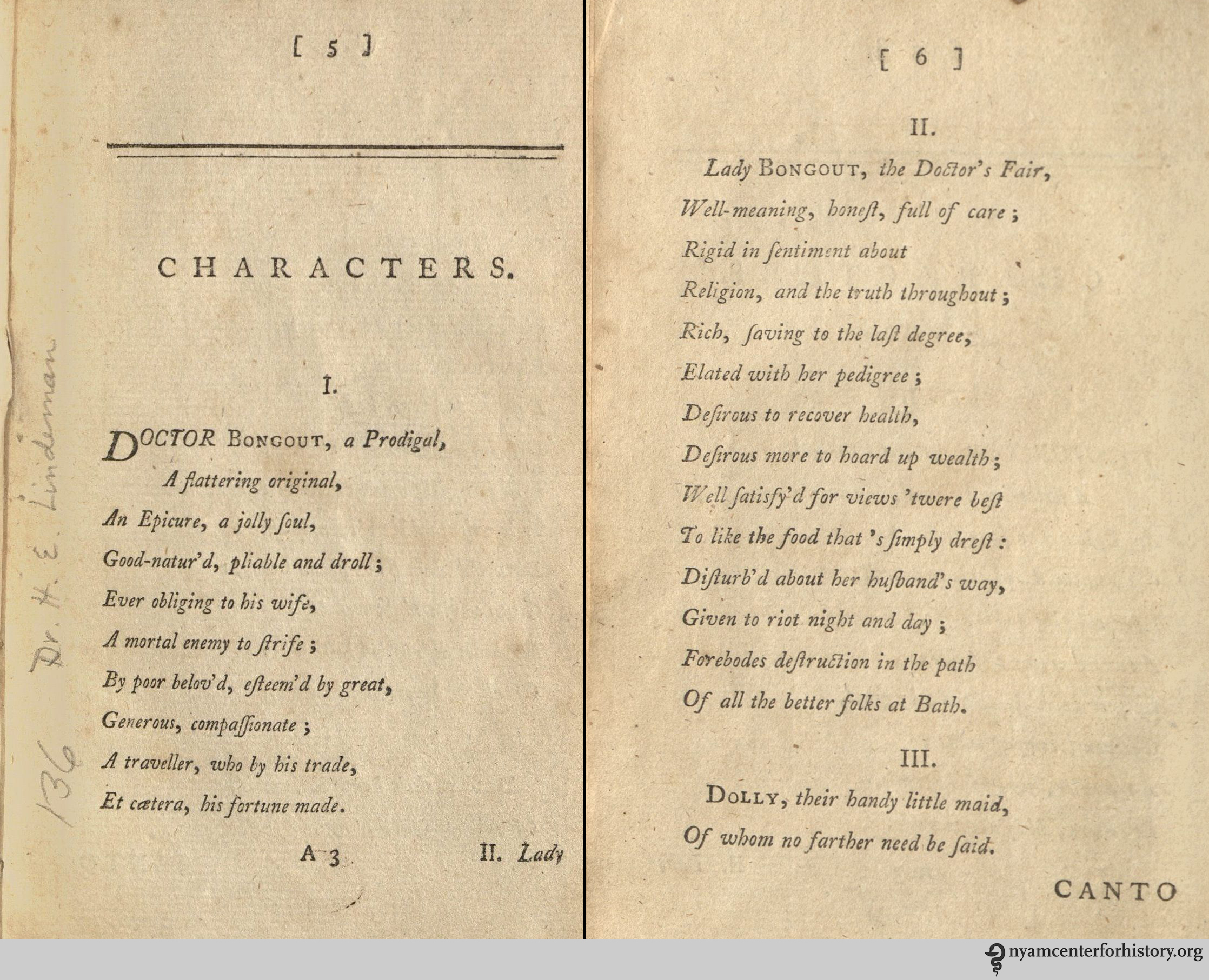
Robert Bragg’s 1778 The Journey of Dr. Robert Bongout and his Lady, to Bath. Performed in the Year 177- is a satirical poem about perhaps the most gleefully gluttonous character to ever grace the page (read it online in full). As Phillipa Bishop writes in an article for Bath History, “Dr Bongout’s exploits in the demolition of food, with all their crude natural consequences, are described with the same sort of gusto as the gluttonous orgy depicted by Thomas Rowlandson in his archetypal scene of green, ‘The Gourmet’s Dinner’”1

Comforts of Bath: Gouty Gourmands at Dinner (Thomas Rowlandson, 1756–1827). Image via Yale Center for British Art, Paul Mellon Collection, http://collections.britishart.yale.edu/vufind/Record/1669855

Comforts of Bath: Gouty Gourmands at Dinner (Thomas Rowlandson, 1756–1827). Image via Yale Center for British Art, Paul Mellon Collection, http://collections.britishart.yale.edu/vufind/Record/1669855

Bragg (not credited in print) describes the characters thus:

Over the course of their trip, Dr. Bongout spends copious funds on enormous amounts of food behind his wife, Lady Bongout’s, back. At the same time, she attempts to convince him to save money and eat less, but to no avail.

An example of his gluttony: After agreeing to a light supper at his wife’s bidding, he makes the following request to a cook once she is out of sight:

“Friend cook, quoth he, (first half a crown

Pop’d in his hand) are there in town

Such things as ducklings to be got?

The price I value not a jot.”

“Sir, quoth the cook, I have not less

Than ten fine ducklings fit to dress;”

“Then, quoth the Doctor, if you please,

Stew half a dozen down with pease;

And when enough, where I shall lie,

Be sure you send them instantly” (33-34)

He tucks in after his wife has gone to bed; half asleep, she stumbles upon him eating the stewed ducklings, thinks him a ghost, and faints (so true to life).

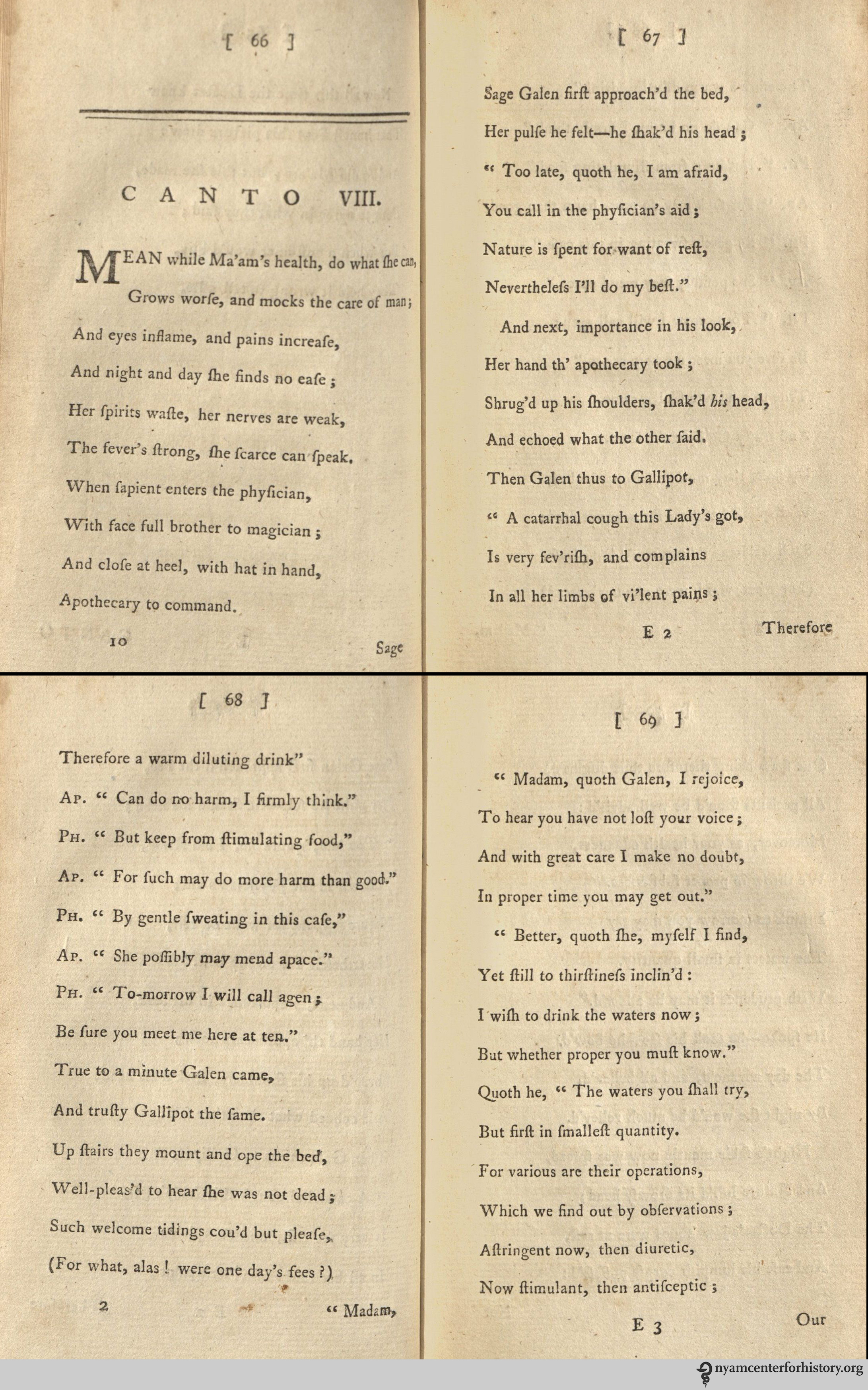
At first, it seems that Lady Bongout’s maladies—the real reason for the trip to Bath—are psychological effects of her many years of dealing with her husband. But soon after the Bongouts reach their destination, they take physical form. Her illness offers a satirical look into the services of physician and apothecary, who are “well-pleas’d to hear she was not dead; / Such welcome tidings cou’d but please, / (For what, alas! were one day’s fees).”

Her maladies lead to blindness, which does nothing to slow her charming husband: “Then while she’s blind, I wou’d know why / I may not live in jollity” (78). Despite her lack of vision, she still suffers the knowledge of his ever-increasing girth: “For tho’ she could not with her eyes / Distinguish his enormous size; / Yet she cou’d feel to what a bulk / His worship had increas’d his hulk” (80).

Dr. Bongout himself goes through a medical crisis after eating “for dinner half a stone in weight” (93). Be warned, gentle readers: these verses are not for the faint of heart.

Even this incident does nothing to slow Dr. Bongout’s appetite. At the end of the poem, news of his imminent departure from Bath brings tears to the eyes of the local pastry chef and causes him profound worry about the future of his business:

“To lose of customers the chief

Was matter of the greatest grief:

Quoth he, “And must you then depart?

The very thought will break my heart!

But if you must—I cannot stay—

My shop will fail—I’ll run away.” (136-137)

The Journey of Dr. Robert Bongout and his Lady is part of a larger tradition of satirical writings related to gout (though Bragg only refers to Dr. Bongout’s condition through the character’s name). Perhaps because gout was a disease of the wealthy, its merits “have been extolled over the centuries by physicians and laypersons. In the past, gout was regarded as a badge of nobility, a talisman against other afflictions and an aphrodisiac, and these beliefs were preserved in 16th-to 18th-century literature.”2 In addition, writers often approached the painful disease with humor. “Gout was…a diverting disease,” one that inspired new uses of language and playfully coined words.3

Bragg’s playful look at gluttony does not end with a moral, only the expectation that Dr. Bongout’s enormous gut will continue its expansion. Nor does it seem that his gluttony will have tragic consequences, only humorous ones. Clearly, he’s called Dr. Good Gout for a reason.

References
1. Bishop P. The Sentence of Momus: Satirical verse and prints in eighteenth-century Bath. Bath Hist. 1994;5:51–80. Available at: https://www.bathspa.ac.uk/Media/CHC Images/Vol 05 – 03. Bishop – The Sentence of Momus – Satirical Verse and Prints in Eighteenth-Century Bath.pdf.

2. Scholtens M. The glorification of gout in 16th- to 18th-century literature. Can Med Assoc J. 2008;179(8):804–805. doi:10.1503/cmaj.080312.

3. Porter R, Rousseau GS. Gout: The Patrician Malady. New Haven: Yale University Press; 2000.

Find Us on Instagram

Can’t get enough of images from our collection? Want a behind-the-scenes look at the library and its events? You’re in luck: we are now on Instagram.

So far, we have used Instagram to share an image from our conservation lab, photos from the Food Book Fair, and items from our collection. There’s much more to come—we may even have a hashtag challenge or two in the pipeline.

This slideshow requires JavaScript.

Curious about our collections and happenings at the Center? Our Twitter stream is the place to be. You’ll learn about our lectures and other events, and work up an appetite. As you may know, Food is our programming theme for the year, and we’re sharing many culinary delights from our collection.

Not on Twitter or Instagram? Fear not: we are also on Facebook. Plus, you can always make an appointment to visit us in person by calling 212-822-7315 or e-mailing library@nyam.org.

Brazil, Richly Illustrated

By Anne Garner, Curator, Center for the History of Medicine and Public Health

The Dutch West India Company occupied northeastern Brazil for 30 years, from 1624 to 1654. The first 10 years of occupation financially strained the Company, despite considerable profits made from sugar, Brazil-wood, and occasional loot swiped from Iberian ships.

In 1636, Johann Maurits arrived to govern, tasked with stabilizing the settlement. Under his leadership (which lasted until 1644), the colony thrived.

Among the 46 artists and scholars Maurits hired as his research staff to promote scientific studies in Brazil were physician Willem Piso and astronomer Georg Markgraf, who arrived in 1638. The Historia naturalis Brasiliae, their collaborative illustrated folio volume, in twelve books, was published in 1648. Rich in description of native life, the book contains 446 remarkable woodcuts illustrating local flora and fauna. It comprises the most important early documentation of zoology, botany, and medicine in Brazil. The woodcuts are based on an original collection of paintings and sketches, now lost; many of these original depictions were likely done by Markgraf himself.

The lushly illustrated and very beautiful frontispiece features a European traveler, presumably Dutch, reclining before two natives in a verdant green wood, teeming with wildlife. Even in black and white, the exuberant foliage coupled with the beautiful natives may remind the modern viewer of the Caribbean paintings of Paul Gaugin.

Title page of Historia naturalis Brasiliae, 1648. Click to enlarge.

Piso wrote the first four books, which deal mainly with diseases native to Brazil and their remedies. The physician, assigned as Maurits’ personal doctor, turns his clinical eye to the ways of the native populations, from whom he makes several important discoveries. He offers a vivid account of a patient in the throes of tetanus, and suggests that the root cause of the ailment may be a minor wound, of the kind that craftspeople incur while working.

Georg Markgraf wrote the remaining eight books, subtitled Historia rerum naturalium Brasiliae and mostly devoted to natural history. The books’ topics range from medical uses of plants; to fish, birds, insects, quadrupeds and reptiles; and to full descriptions of geographic regions and their inhabitants. Images from two of these books, dealing with quadrupeds and with insects, are pictured here.

Markgraf describes the appearance, habits, and environment of each animal depicted. Some of the four-legged creatures pictured have names we still use today: the armadillo, on page 231, would be recognizable as such to a child, as would a short-legged jaguar, on page 235. In other cases, it’s more difficult to link the textual description with the images—the placement of the woodcuts doesn’t always correspond with the text. Is, for example, the shaggy llama on page 244 the Peruvian sheep referenced in the text? Markgraf points out that the creature pictured has a two-toed foot on his back legs, just as a llama does.

Click on an image to enlarge and view the gallery.

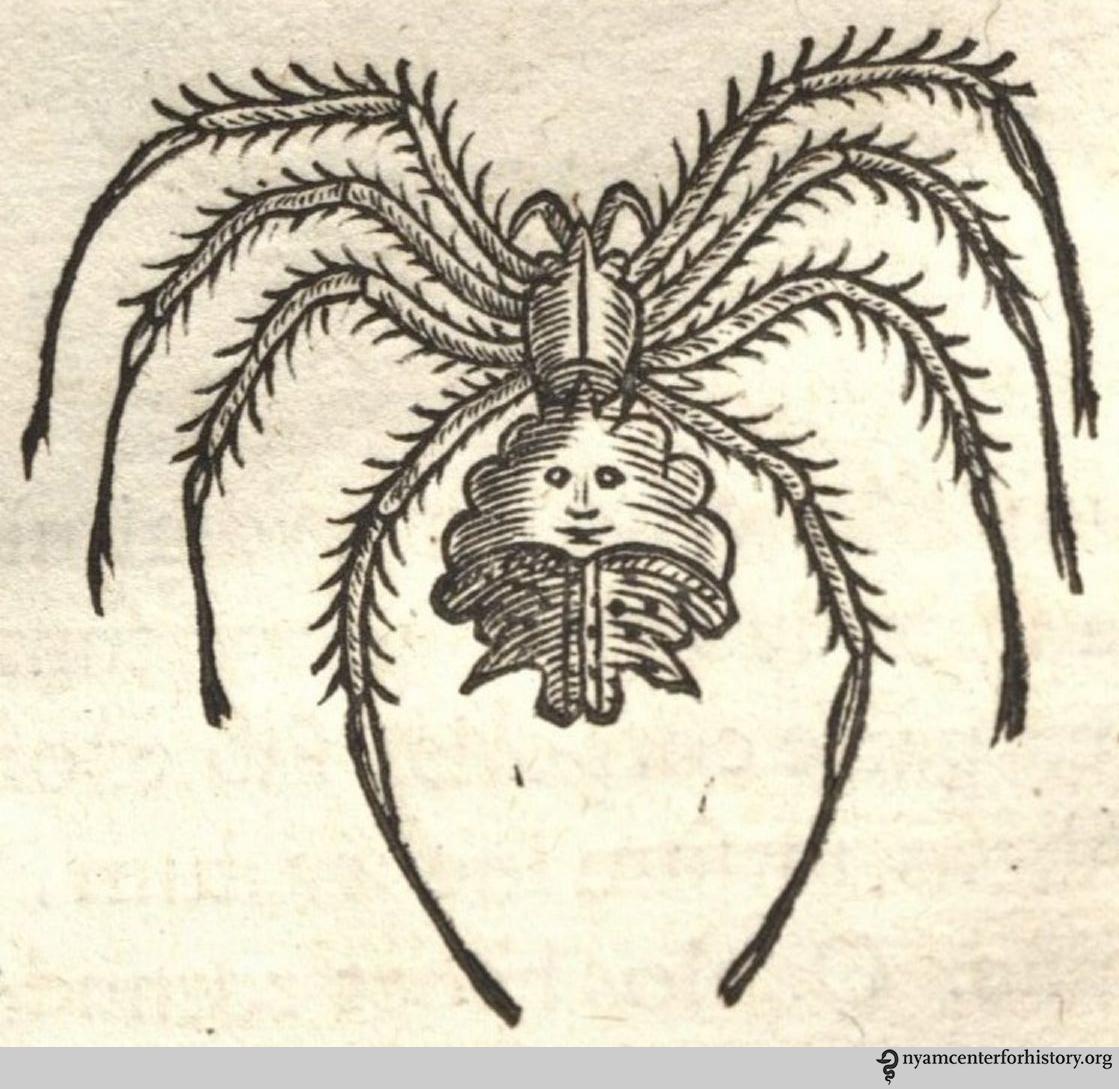
Of note in the insects section is the smiling spider on the bottom of 243, his belly almost entirely silver in color, and his mottled brown and black legs described in the text as weaving an exceedingly elegant web.

Spider on page 248 of Historia naturalis Brasiliae, 1648. Click to enlarge.

Spider on page 248 of Historia naturalis Brasiliae, 1648. Click to enlarge.