Registration Open for Vesalius 500 Workshops

Registration is now open for our hands-on art and anatomy workshops, presented as part of our Vesalius 500 celebrations on October 18, 2014. Create your own articulated anatomical figure or “exquisite corpse” at the Gladys Brooks Book & Paper Conservation Laboratory; learn Renaissance drawing techniques with medical illustrator Marie Dauenheimer; or explore the anatomy and art of the hand with physical anthropologist Sam Dunlap.

Spaces are strictly limited so register soon. Registration at one of the workshops includes free entry to the Festival. You can register for the Festival (without workshop attendance) here.

From the Cradle to the Grave: Session One: The Cradle

Moveable baby and female pelvis from one of NYAM’s 19th century obstetrics texts, Dr. K. Shibata's Geburtschülfliche Taschen-Phantom, or the Obstetrical Pocket-Phantom.

Moveable baby and female pelvis from one of NYAM’s 19th century obstetrics texts, Dr. K. Shibata’s Geburtschülfliche Taschen-Phantom (Obstetrical Pocket-Phantom).

Working with NYAM’s conservation team, celebrate Vesalius’s life with a hands-on workshop producing your own articulated anatomical figures in the Gladys Brooks Book & Paper Conservation Laboratory.

Time: 11am-1pm
Cost: $55
Includes: All materials, and free entry to the Festival.
Maximum participants: 12
Register here

During the morning’s Cradle workshop, we will construct paper facsimiles of a moveable baby and female pelvis from one of NYAM’s 19th century obstetrics texts, Geburtschülfliche Taschen-Phantom (or the Obstetrical Pocket-Phantom). The book was written by Dr. K. Shibata, a Japanese author studying in Germany, and was published first in German before being translated into English and Japanese.

Participants will have time to make at least one paper baby and pelvis, which can be produced as paper dolls or magnets.

From the Cradle to the Grave: Session Two: The Grave
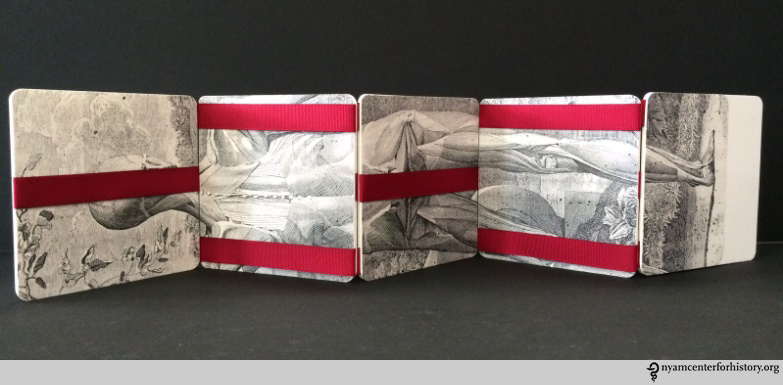
An exquisite corpse made by staff of the Gladys Brooks Book & Paper Conservation Laboratory.

An exquisite corpse made by staff of the Gladys Brooks Book & Paper Conservation Laboratory.

Working with our conservation team, celebrate Vesalius’s life with a hands-on workshop producing your own “exquisite corpse” in the Gladys Brooks Book & Paper Conservation Laboratory.

Time: 2:30pm-4:30pm
Cost: $55
Includes: All materials, and free entry to the Festival.
Maximum participants: 12
Register here

During the afternoon’s Grave workshop, we focus on producing a Vesalian-themed exquisite (or rotating) corpse. Loosely based on the surrealist parlor game in which a picture was collectively created by assembling unrelated images, this workshop will employ a special, rotating binding structure and mix-matched facsimile images from NYAM’s rare book collections to allow students to create their own unique, moveable pieces of art.

Renaissance Illustration Techniques Workshop with Marie Dauenheimer, Medical Illustrator
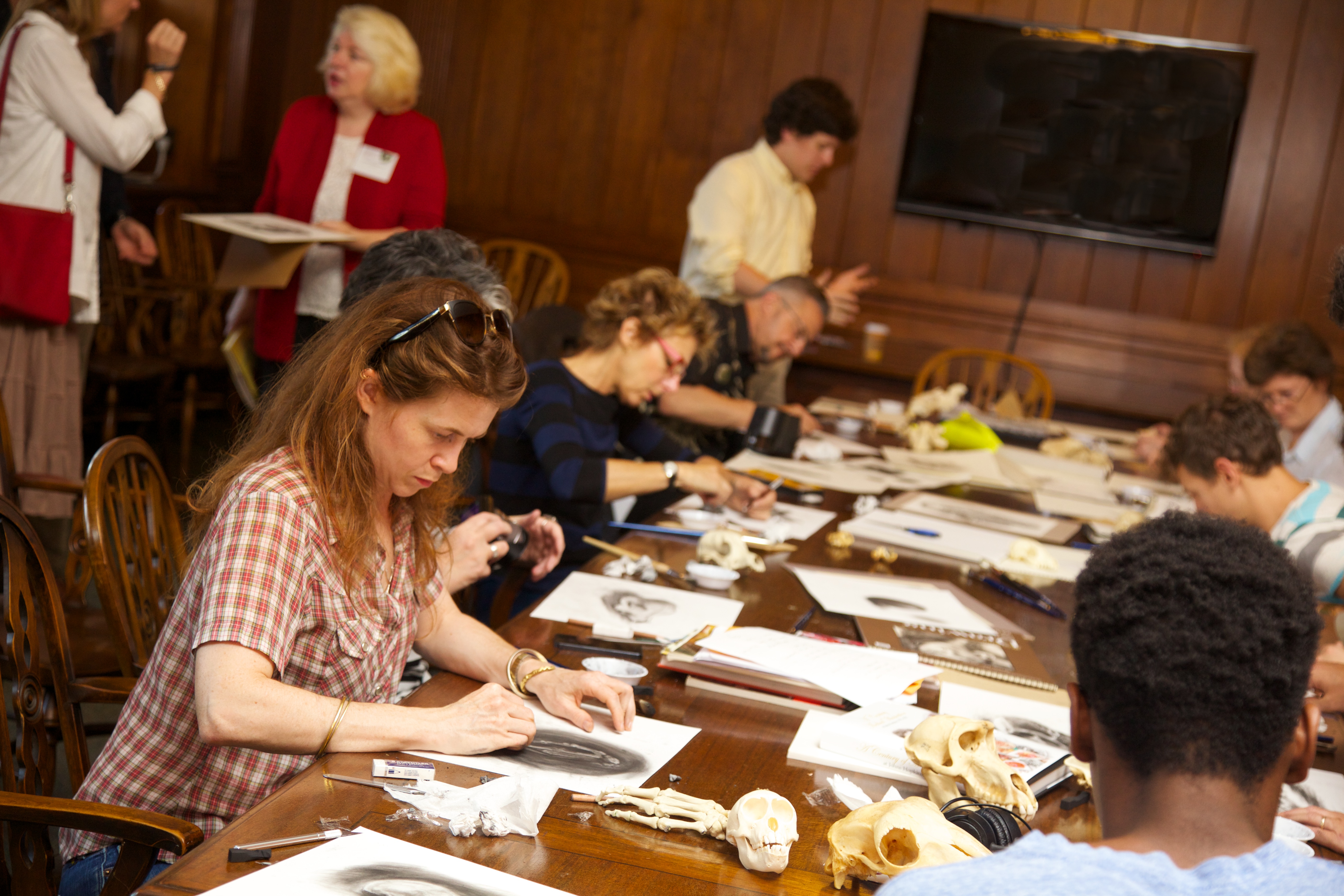
Students at medical illustrator Marie Dauenheimer's workshop at last fall's Festival.

Students at medical illustrator Marie Dauenheimer’s workshop at last fall’s Festival.

Time: 10am-1pm
Cost: $85
Includes: All materials, and free entry to the Festival.
Maximum participants: 15
Register here

Artists and anatomists passionate about unlocking the mysteries of the human body drove anatomical investigation during the Renaissance. Anatomical illustrations of startling power vividly described and represented the inner workings of the human form. Leonardo da Vinci’s notebooks were among the most magnificent, merging scientific investigation and beautifully observed drawing.

Students will have the opportunity to learn and apply the techniques used by Renaissance artists to illustrate anatomical specimens. Using dip and technical pens, various inks and prepared paper students will investigate, discover, and draw osteology, models, and dissected specimens from various views creating an anatomical plate.

Understanding the Hand, physical anthropology workshop with Sam Dunlap, Ph.D.

Dr Sam Dunlop leading a workshop at last year's Festival.

Dr Sam Dunlop leading a workshop at last year’s Festival.

Time: 2:30pm-5:30pm
Cost: $75
Includes: All materials, and free entry to the Festival.
Maximum participants: 15
Register here

The hand as an expression of the mind and personality is second only to the face in the Renaissance tradition of dissection and illustration that continues to inform both art and science. Basic anatomical dissection, illustration, and knowledge continue to be fundamental in many fields from evolutionary biology to surgery, medical training, and forensic science. This workshop will offer participants the opportunity to explore the human hand and its anatomy, which will be demonstrated with at least three dissections.  Opossum (Didelphis virginiana) and orangutan (Pongo pygmaeus) forelimbs will be available along with other comparative skeletal material. We will discuss hand evolution, embryology, and anatomy, and the artistic importance of the hand since its appearance in the upper palaeolithic cave art. We will also analyze the hand illustrations of da Vinci, Vesalius, Rembrandt, and artists up to and including the abstract expressionists.
Virtual Dissection

Kriota Willberg, the author of today’s guest post, explores the intersection of body sciences with creative practice through drawing, writing, performance, and needlework. She will present at our October 18th festival, Art, Anatomy, and the Body: Vesalius 500.

Artistic and clinical examinations of the body share many of the same processes. The artist and the clinician study the body’s mass, look for irregularities in its shape and color, locate bones, joints, and muscles, take notice of the breath. They watch the body and its parts move through space, assess joint alignment, and determine if their subject’s physical parts and relationships are assembled or functioning in a desirable form. The languages for and techniques of analysis vary by discipline but the object of exploration is the same.

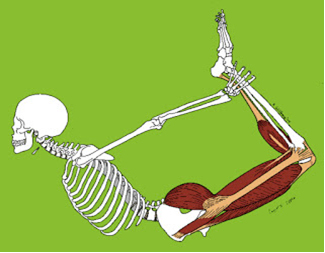
"Dhanurasana illustration" by Kriota Willberg

“Dhanurasana illustration” by Kriota Willberg. Click to enlarge.

My careers are grounded in the exploration of the body. There was a time when I would take a morning ballet class, teach anatomy in the afternoon, and in the evening either work a shift as a massage therapist or go to a dance rehearsal. To relax on the weekends I would draw musculoskeletal anatomy illustrations for my class handouts.

Drawing, dancing, and massage all require skills in postural assessment. As a massage therapist I also palpate deeper structures, locating them under skin, fat, and other layers of muscle. As a dancer I learned to feel my musculoskeletal structures via movement exercises that isolate muscle groups or coordinate the body as a whole. Through years of building experiential and objective understanding of the body, physical assessment has become second nature to me.

Friction “…Bundle of Fibers” by Kriota Willberg.

“Friction” by Kriota Willberg. Click to enlarge.

Anatomy entertains and delights me everywhere I go. I study the foot and ankle alignment of strangers as they climb the subway steps. I monitor my two amputee cats for the development of functional scoliosis. I measure and palpate the skin and adipose of my husband, or myself, or the cats, as we sit on the couch and watch the Bond film Tomorrow Never Dies. I comment on Pierce Brosnan’s resemblance in the film to a dissected human subject illustrated in an Albinus anatomy text from 1749.

Tomorrow Never Dies from “The Anatomy of 007” by Kriota Willberg. Click to enlarge

Tomorrow Never Dies from “The Anatomy of 007” by Kriota Willberg. Click to enlarge

The world is an anatomical wonderland. Anatomy is all around us and all we have to do is see it and feel it.

"Pictorial Anatomy of the Cute" by Kriota Willberg. Click to enlarge.

“Pictorial Anatomy of the Cute” by Kriota Willberg. Click to enlarge.

I’m not unique in my perspective of the world of anatomy. There are many people in arts, sciences, and health professions who are skilled at virtual dissection. We can look at you, through your clothing, and through your skin and fat to see the muscle and bone beneath. We share the same skills and sometimes we share the same sense of humor. But our cohort is somewhat rarified. I intend to bring more people into the knowledge and skills that will enable them to join our “club.”

I train others in methods of seeing the body as a clinical or artistic tool. As a part of this instruction, I draw the body on a body. Using a live model, I locate bones and joints, tracing bony landmarks in rinseable ink. Then I locate a muscle’s attachment sites, connect them, and “flesh out” the muscle’s contours and fiber direction.

Willberg anatomy drawing. Model: Wendy Chu

Willberg anatomy drawing. Model: Wendy Chu

Willberg anatomy drawing. Model: Wendy Chu

Willberg anatomy drawing. Model: Wendy Chu

We watch levator scapula lengthen with upward rotation of the scapula. Or the hamstring elongate to seemingly impossible length as the model moves through deep hip flexion. The upper pectoralis major shortens as the lower part lengthens when the model brings her arms overhead. After 27 years of teaching, I am still entranced by these simple movements.

At the Vesalius 500 celebration on October 18, we will look at the body with the double vision of the anatomist. Part live-drawing performance, part slide show/lecture, part conversation, we will explore the (kin)esthetic relationships of our anatomy. I’ll present a narrated slideshow of artworks from A(lbinus) to V(esalius) to enhance and define actual and fanciful relationships of our parts to our whole. A live model and I will create associations between these illustrations and the living body by tracing superficial and deep connections of muscle to movement. The presentation will include opportunities for you (the audience) to ask questions and comment on your own experiences with the study of anatomy.

See you there!

Guest curator Riva Lehrer on Vesalius 500

Our “Art, Anatomy, and the Body: Vesalius 500” festival guest curator, artist and anatomist Riva Lehrer, describes some of her thinking about bodies, anatomy and art.

In 1543, when Andreas Vesalius published his De humani corporis fabrica (On the fabric of the human body) many contemporaries refused to accept his results. They contradicted canonical texts passed down over millennia: belief and expectation trumped direct experience and observation.

It’s easy to smile condescendingly at such pig-headedness. Yet we can scarcely look in the mirror without being caught in a fog of distortion. Every day we’re overloaded with information about how we should look and how our bodies should work. There are still plenty of ways in which our biases form medicine, and medicine, in turn, forms us.

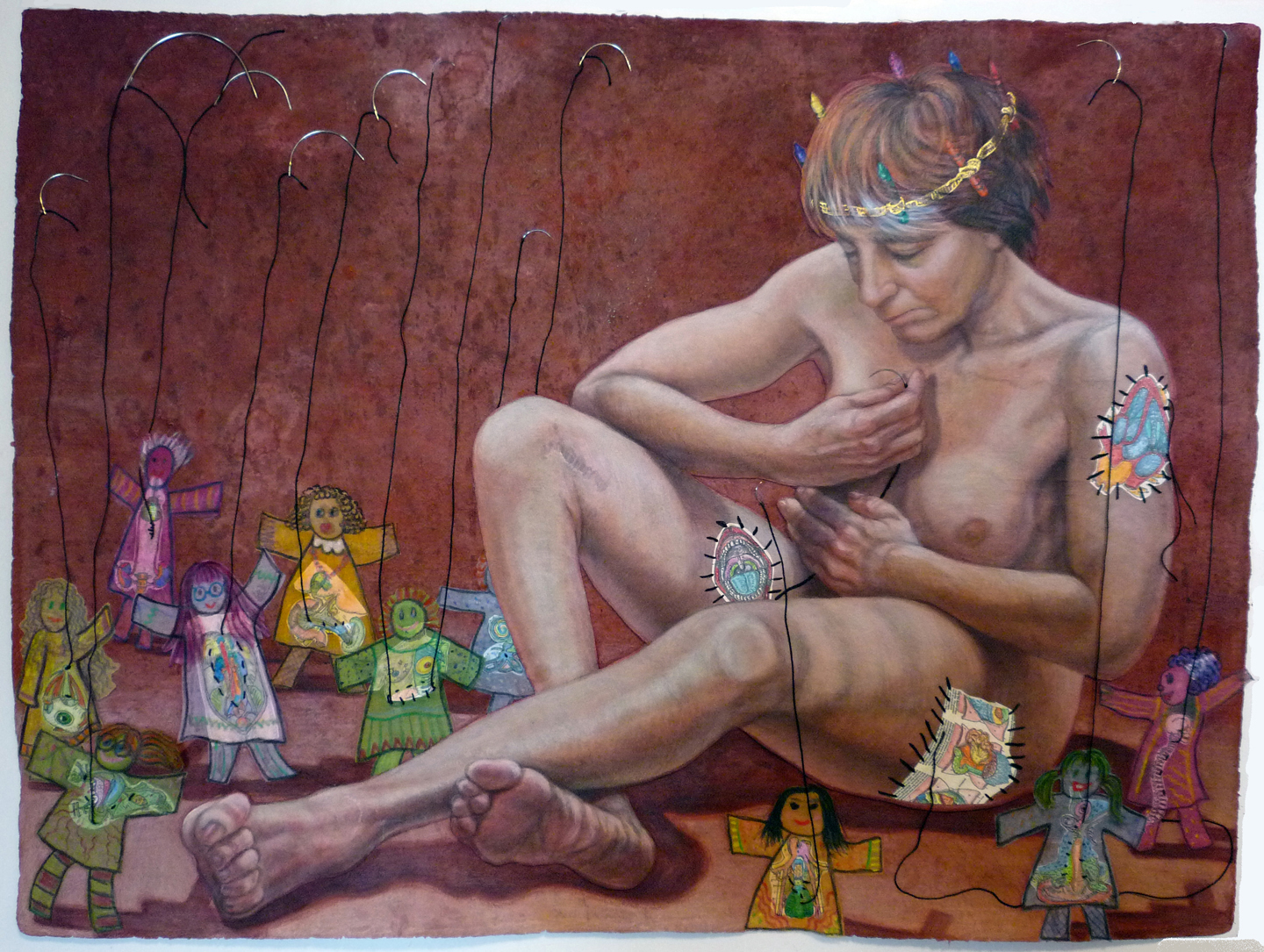
"Circle Stories #4: Riva Lehrer" 1998  self portrait

“Circle Stories #4: Riva Lehrer” (1998).

I was born with visible disabilities. My body has always been seen as lacking, in need of correction, and medically unacceptable. My parents and doctors pushed me to have countless procedures to render it more “normal” as well as more systemically functional. These were two different streams of anxiety—how I worked and how I looked— yet they became inextricably woven together. My life in the hospital gave me a tremendously intimate view of medicine, as does the fact that I come from a family of doctors, nurses, and pharmacists. It gave me an acute awareness of how medical choices control and shape our bodies.

I first studied anatomy at the School of the Art Institute of Chicago and later at the University of Illinois at Chicago, as a visiting artist in the cadaver lab. I often think about what my first anatomy professor told me, many years ago. She remarked that when she was a child, people grew into their original faces. Whatever oddities they were born with formed what they looked like, year after year. Faces were hard-won and unique. But modern dentistry, nutrition, grooming—all the large and small interventions of medicine—made people look much more alike than they did sixty years ago.

In the 21st century, medicine is not just about the “correction” of significant impairments; personal perfectibility is as much the point of modern medicine as the curing of significant diseases. We view our bodies as lifetime fixer-upper projects.

Yet, it’s that very fluidity that opens profound questions about the identities our bodies express. Technologies such as radical cosmetic surgery, cyborgian interfaces, and gender reassignment procedures raise and complicate our expectations. Medicine offers new options if the inside of our bodies does not match the appearance of the outside. We live in a state of wild restlessness, trying to see and feel who we are. We see chimeras of possibility.

"At 54" Riva Lehrer 2012 self portrait

“At 54” by Riva Lehrer (2012).

My body was not normalized through all my surgeries; yet the original body I had would not have lived. It’s been changed so many times that I can’t even guess at what it would have been. My own mutability has given me a deep interest in the two-way relationship between one’s body and the course of a life.

I teach anatomy for artists at the School of the Art Institute and am a visiting artist in Medical Humanities at Northwestern University. My studio practice focuses on the intersection of the physical self and biography. I interview people in depth about the interweaving of their bodies and their stories. These interviews become narrative portraits, as I try to understand what can be known about a life in a single portrait image.

Join us as we explore the role of anatomy in identity formation through our celebration of the 500th anniversary of Vesalius’ birth. We’ve invited artists, performers, scholars, and historians to help us ask how our imaginations form our living flesh. Let’s all look in the mirror and ask, what are we really seeing, and what do we believe we see?

Some of the issues our speakers will explore include:

""Chase Joynt" by Riva Lehrer and Chase Joynt 2014

“”Chase Joynt” by Riva Lehrer and Chase Joynt (2014).

—How do we decide what is “lifesaving” and what is “elective” surgery when it comes to identity? Transgender performer Chase Joynt questions what it means to save a life, and how his dealings with the medical establishment led him to question such choices.

—How many of us were raised with the constant imprecation to stand up straight? Sander Gilman peers into the use of posture lessons in public schools to control the American body.

—Artist Steven Assael creates dramatic portraits of New Yorkers, from street performers to elderly eccentrics. His work shows us how identity travels from the inner self to the outer shell.  Assael is a long-time professor at New York’s School of Visual Arts, one of the last bastions of serious anatomical study in the U.S.

—Famed choreographer Heidi Latsky will discuss GIMP and how she creates dance for performers with a range of movements and morphologies. A performance and film excerpt bring us into the innovative strategies used by the GIMP collective.

—Many contemporary artists use anatomy in investigations of identity and formal exploration. Curator Ann Fox will present images from an international roster of artists. She will be joined by Taiwanese artist Sandie Yi, who will show work that deals with the intense difficulties of having a physically different body in China.

"Coloring Book" Riva Lehrer 2012

“Coloring Book” by Riva Lehrer (2012).

Graphic Medicine is a consortium of comics artists who explore medicine from the standpoint of doctor, nurse, patient and family member. The founders of Graphic Medicine, MK Czerwiec and Ian Williams, will discuss how the vulnerable body is rendered in comics form. Comics allow artists to move from the inside of the body to the outside in seamless transitions, to weave together objective perspectives and highly personal, subjective experiences.

Celebrate Andreas Vesalius’s 500th Birthday With Us on October 18

On October 18, our second-annual Festival for Medical History and the Arts, “Art, Anatomy, and the Body: Vesalius 500” will celebrate the 500th birthday of anatomist Andreas Vesalius.

Vesalius’ groundbreaking De humani corporis fabrica (The Fabric of the Human Body) of 1543 is a key Renaissance text, one that profoundly changed medical training, anatomical knowledge, and artistic representations of the body, an influence that has persisted over the centuries. Our Festival is one of a global series of celebrations of his legacy.

Our day-long event will explore the intertwined histories of art and anatomy, illustration and medicine, performance and the body, body snatching and dissection, identity and intersexuality, disability and representation, and contemporary visual arts and the body. Speakers, performers, and artists will be joined by anatomical cartoonists, 3D printing demonstrations, workshops, and more. Artist and anatomist Riva Lehrer will be our guest curator. Speakers and presenters will include Daniel Garrison, Steven Assael, Sander Gilman, Brandy Schillace, Lisa Rosner, Ann Fabian, Bill HayesMichael Sappol, Chase JoyntProof X, and  Kriota Willberg (look for a full list of speakers later this summer).

Follow our blog over the summer for guest posts from Festival participants and more on the wonderful Vesalius holdings in our collection.


A Ceroplast at NYAM

In today’s guest post, the artist Sigrid Sarda tells us how historical collections inform her work. Visitors to our Festival of Medical History & the Arts may have seen her moulages in person, and be sure to visit her blog for information on exhibitions and more of her fabulous work.

Earlier this year, I began researching the collections at the Center for the History of Medicine and Public Health. I am an artist/ceroplast, which means wax modeler. The resources I discovered at the Center have been of great inspiration to my work.

Sigrid Sarda, "MRSA," 2013. Wax, Human Hair, Life-size.

Sigrid Sarda, “MRSA,” 2013. Wax, Human Hair, Life-size.

First, let me tell you about myself. For over 30 years I was a painter. Due to the death of my father and the psychological aftermath I experienced, I ceased painting. In its place, the obsession of the wax figure came into being. Since I was completely self-taught and only worked in this medium for a few years, it was necessary to learn more about its technique and history. Having always had a fascination with religious icons, the body (particularly skin), diseases, and later on death, as well as incorporating human remains such as teeth, bone, and hair in my work, I realized I needed a better understanding of the aesthetics and techniques of wax used in creating these life-size figures and medical moulages.

While exhibiting a waxwork in New York City, I met up with Lisa O’Sullivan, director of the Center for the History of Medicine and Public Health at NYAM, and Arlene Shaner, reference librarian and acting curator for historical collections. After discussing the exhibited piece and my ambitions working in wax Dr. O’Sullivan invited me to explore NYAM’s collections. This was an opportunity not to be missed!

Upon arriving at NYAM, I was directed to the 3rd floor of the massive Romanesque building where Arlene welcomed me. Delightful, funny, and knowledgeable, she made me immediately comfortable in the surroundings of the library and excited to view the books housed in the collection. She checked out my waxwork, we geeked out on ceroplasts, and spoke about other artists whose work dealt with death such as Joyce Cutler-Shaw.

On my second visit, filled with anticipation, I found myself greeted by marvelous books and an actual anatomical wax moulage of a diseased infant. After the initial perusal of my work, Arlene knew what was needed for my research: anatomical images and techniques, and had the books waiting for me in the formidable reading room. As a bonus she brought out the works of M. Gautier D’Agoty, the 18th-century French artist and anatomical illustrator. I pored over both heavily illustrated and non-illustrated books for hours, amassing information for future waxworks. There is truly nothing like the feel of a beautiful book in your hands. The library has become quite the addiction, what with the wonderful staff and superb collection!

Below are images from D’Agoty and various books consulted at NYAM, and above is one of my wax moulages.

“Physica Sacra,” Johannes Jacob Scheuchzer, 1731 : Guest Post by Morbid Anatomy’s Joanna Ebenstein

Image

Greetings.

My name is Joanna Ebenstein; I run a blog called Morbid Anatomy as well as the related Morbid Anatomy Library—an open-to-the-public research collection in Brooklyn, New York—and the Morbid Anatomy Presents series of lecture and workshops. All of these projects aim to explore the intersections of art and medicine, death and culture, with a particular focus on historical medical collections and libraries.

In the run-up to NYAM’s October 5th Wonder Cabinet and Medical History Festival (which I am co-curating), I have been invited to write a series of guest posts in which I will report on the treasures and curiosities I find in my explorations of NYAM’s excellent rare book and historical collections. In this, the first of that series, I would like to focus one of my favorite books—and one of the most enigmatic books of all time—Johannes Jacob Scheuchzer’s 4-volume high baroque extravaganza of art, science, mysticism, and all worldly knowledge, Physica Sacra.

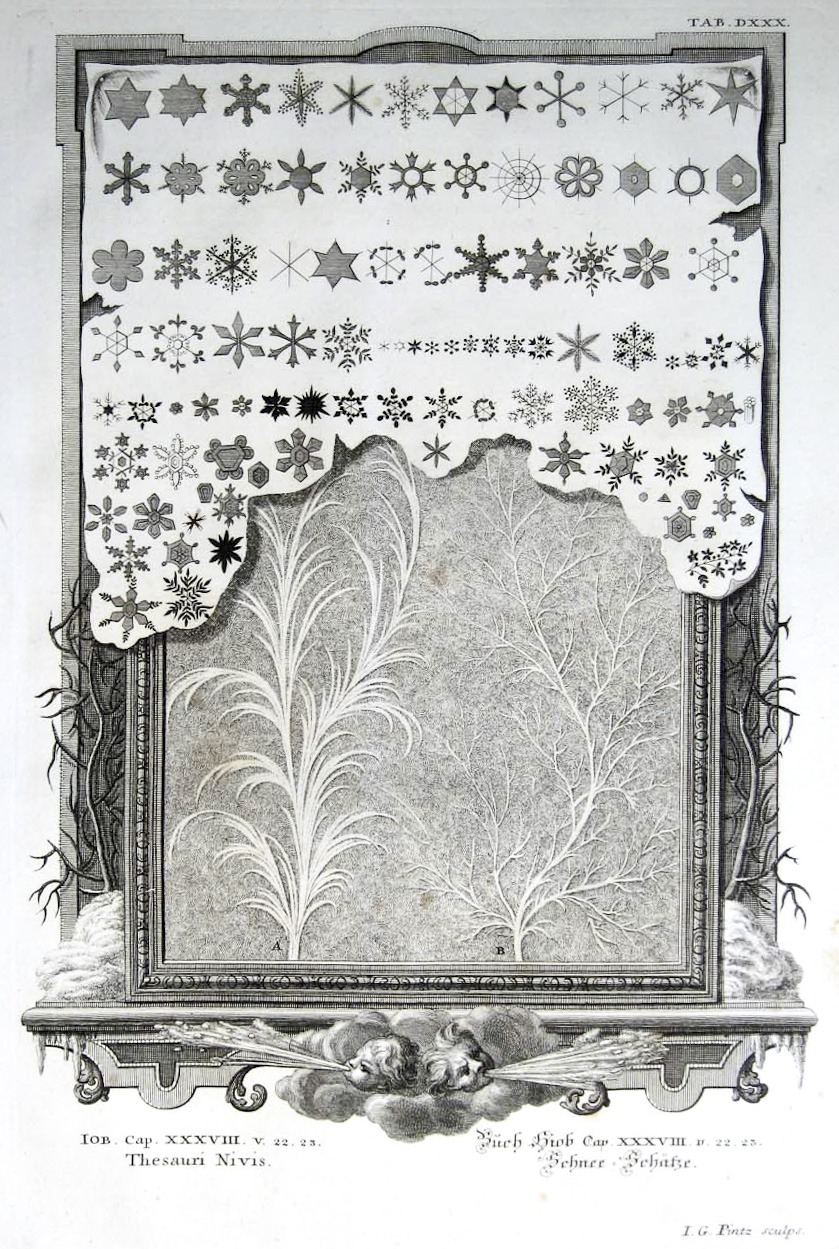
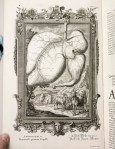
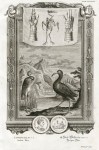
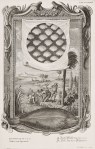
NYAMsacra7Originally published in 1731, this bizarre large-scale book features over 700 copper plate engravings. With a fine balance of careful observation and allegorical imagination, these depict—in frames each more fanciful than the last—such scenes as: lamenting fetal skeletons with the motto “homo ex humo” (‘man from the ground’, or ‘dust’); a variety of anatomical views of the human body projected on drapery or foregrounding mysterious landscapes; birds in biblical landscapes augmented by baffling cyphers; comparative snowflakes with the text “thesauri nivis” or “treasures of snow”; and much more.

These images serve as an excellent reminder that our views of science—and particularly the study of the human body—have changed over time. As explained by Martin Kemp and Marina Wallace in their book Spectacular Bodies:

The purpose of anatomical images during the period of the Renaissance to the 19th century had as much to do with what we would call aesthetic and theological understanding as with the narrower interests of medical illustrators as now understood . . . . They were not simply instructional diagrams for the doctor technician, but statements about the nature of human beings as made by God in the context of the created world as a whole . . . they are about the nature of life and death. . . .

I have not been able to find too much about this book in English, though my friend—and Wonder Cabinet speaker—Daniel Margócsy has promised a future lecture on the topic. In the mean time, Christie’s Auction House has a helpful entry on the book that explains that Johann Jakob Scheuchzer (1672–1733)—a Swiss doctor and natural scientist—”planned the Physica Sacra as an explanation of and a commentary on the Bible on natural-scientific grounds. He himself oversaw the illustrations which were largely based on his own natural history cabinet or on other famous European cabinets of rare specimens.”

Scheuchzer’s work also inspired an art exhibit at the University of Massachusetts—Dartmouth in 2007/8: “Science, Religion, Art.”  The organizers note that:

a lifelong scholar, Scheuchzer’s pursuits of knowledge were wide-ranging and diverse, from science to medicine to paleontology. Like many scientists of the late 17th and early 18th century, Scheuchzer held to the belief that the Old Testament was a factual account of the history of the earth. . . . In a period before public museums, Scheuchzer presented a seductive view of an imaginary world, viewed through lush frames depicting secondary symbols, plants, animals, heads and other objects, providing the viewer rich material for an inspired vision of the interaction between the natural and the divine powers.

Below are just a very few of my favorite images from the book, some that I photographed from the original, and others coming from the set of almost half of the 737 images from the book (!!!) so kindly provided by greyherbert’s amazing Flickr stream; you can see them all by clicking here.

Stay tuned for more posts in the days and weeks to come!

Joanna Ebenstein, Morbid Anatomy
Guest post # 1