The Journey of Dr. Robert Bongout and his Lady, to Bath

By Johanna Goldberg, Information Services Librarian

To celebrate National Poetry Month, we are sharing poems from our collection throughout April.

Anyone who has read a Jane Austen novel or seen an adaptation knows about taking the waters at Bath for medicinal benefit and societal gain. But Dr. Robert Bongout would not be considered decorous company for the genteel gentlemen and ladies in her works.

Robert Bragg’s 1778 The Journey of Dr. Robert Bongout and his Lady, to Bath. Performed in the Year 177- is a satirical poem about perhaps the most gleefully gluttonous character to ever grace the page (read it online in full). As Phillipa Bishop writes in an article for Bath History, “Dr Bongout’s exploits in the demolition of food, with all their crude natural consequences, are described with the same sort of gusto as the gluttonous orgy depicted by Thomas Rowlandson in his archetypal scene of green, ‘The Gourmet’s Dinner’”1

Comforts of Bath: Gouty Gourmands at Dinner (Thomas Rowlandson, 1756–1827). Image via Yale Center for British Art, Paul Mellon Collection, http://collections.britishart.yale.edu/vufind/Record/1669855

Comforts of Bath: Gouty Gourmands at Dinner (Thomas Rowlandson, 1756–1827). Image via Yale Center for British Art, Paul Mellon Collection, http://collections.britishart.yale.edu/vufind/Record/1669855

Bragg (not credited in print) describes the characters thus:
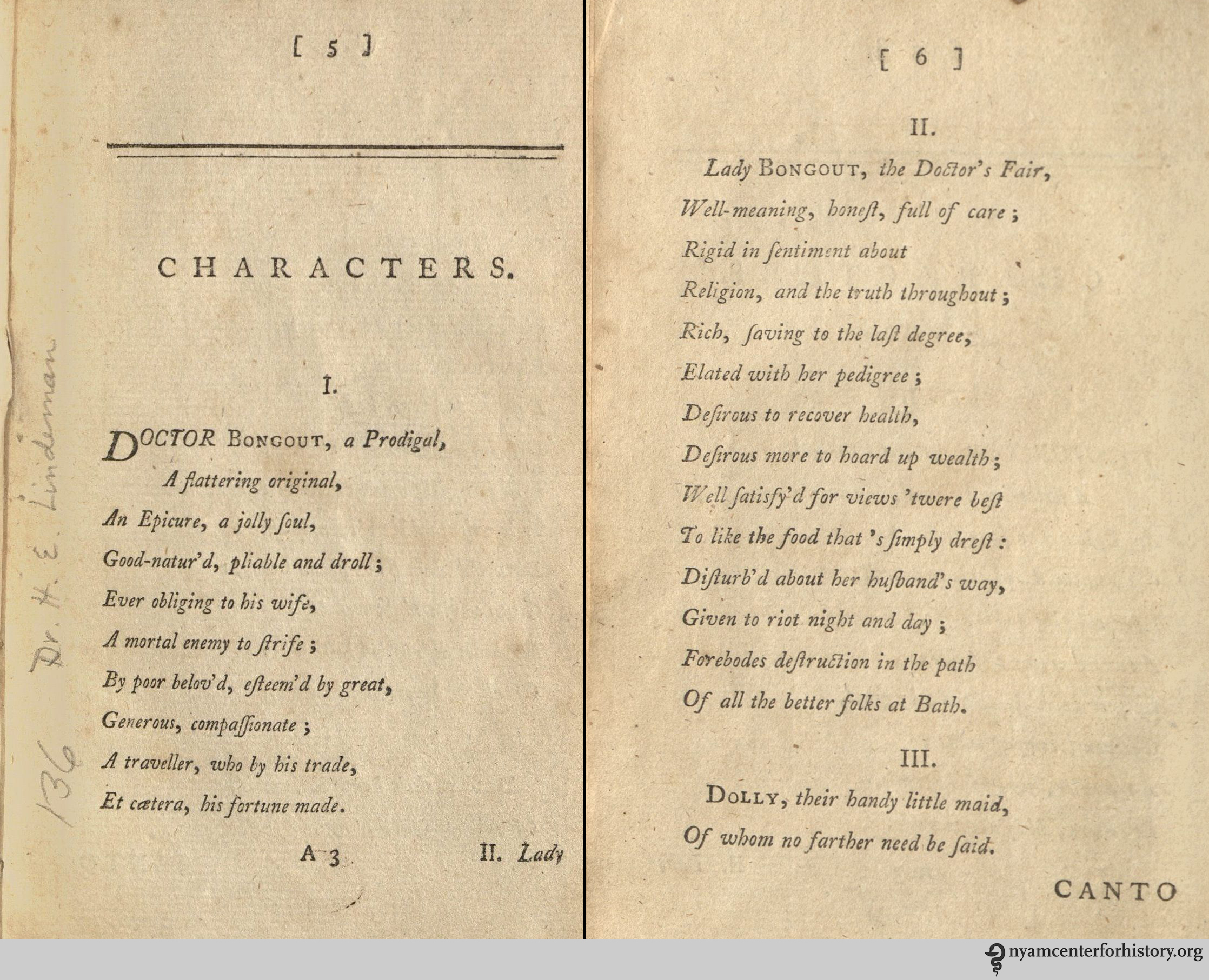
Over the course of their trip, Dr. Bongout spends copious funds on enormous amounts of food behind his wife, Lady Bongout’s, back. At the same time, she attempts to convince him to save money and eat less, but to no avail.

An example of his gluttony: After agreeing to a light supper at his wife’s bidding, he makes the following request to a cook once she is out of sight:

“Friend cook, quoth he, (first half a crown

Pop’d in his hand) are there in town

Such things as ducklings to be got?

The price I value not a jot.”

“Sir, quoth the cook, I have not less

Than ten fine ducklings fit to dress;”

“Then, quoth the Doctor, if you please,

Stew half a dozen down with pease;

And when enough, where I shall lie,

Be sure you send them instantly” (33-34)

He tucks in after his wife has gone to bed; half asleep, she stumbles upon him eating the stewed ducklings, thinks him a ghost, and faints (so true to life).

At first, it seems that Lady Bongout’s maladies—the real reason for the trip to Bath—are psychological effects of her many years of dealing with her husband. But soon after the Bongouts reach their destination, they take physical form. Her illness offers a satirical look into the services of physician and apothecary, who are “well-pleas’d to hear she was not dead; / Such welcome tidings cou’d but please, / (For what, alas! were one day’s fees).”
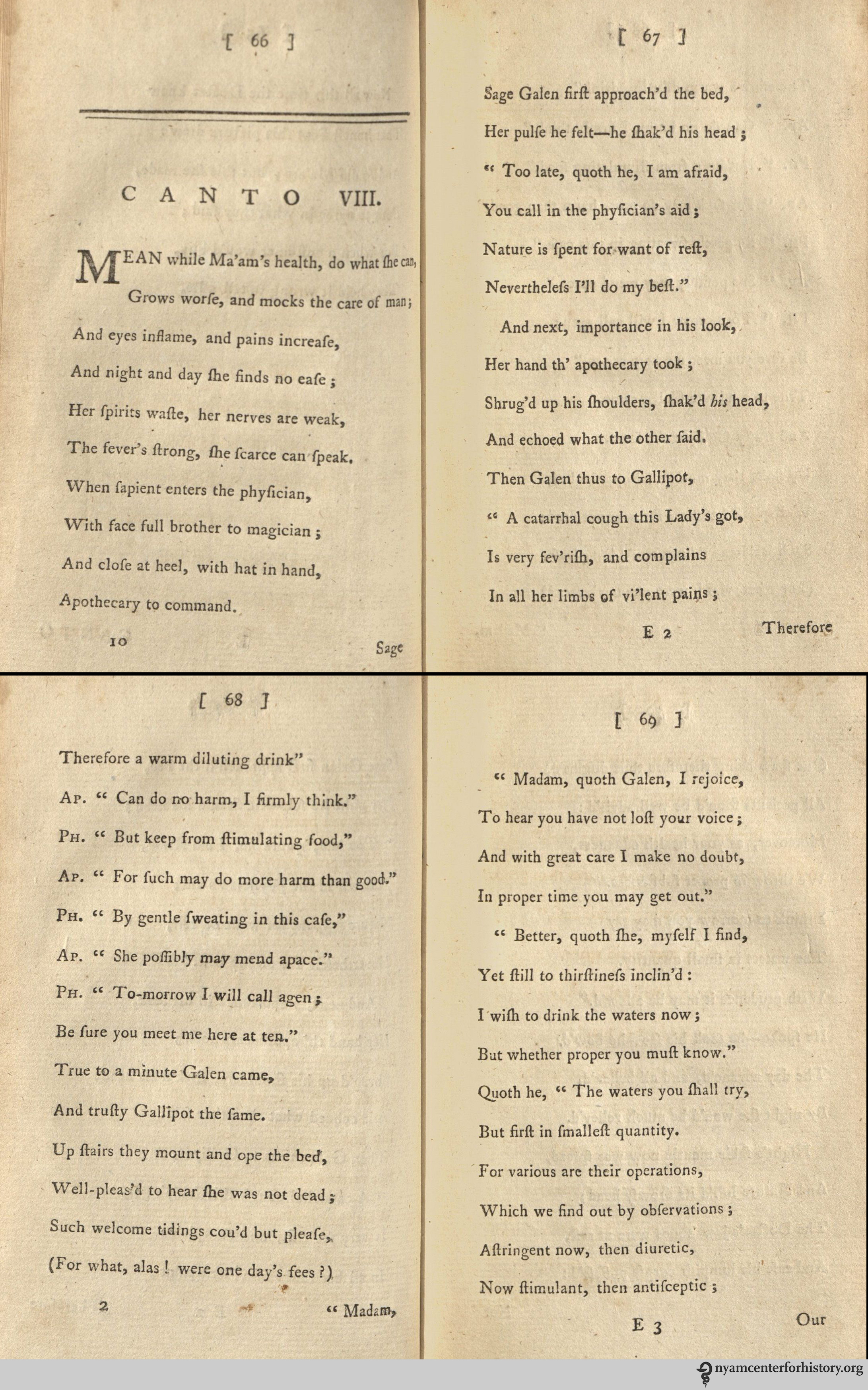
Her maladies lead to blindness, which does nothing to slow her charming husband: “Then while she’s blind, I wou’d know why / I may not live in jollity” (78). Despite her lack of vision, she still suffers the knowledge of his ever-increasing girth: “For tho’ she could not with her eyes / Distinguish his enormous size; / Yet she cou’d feel to what a bulk / His worship had increas’d his hulk” (80).

Dr. Bongout himself goes through a medical crisis after eating “for dinner half a stone in weight” (93). Be warned, gentle readers: these verses are not for the faint of heart.

Even this incident does nothing to slow Dr. Bongout’s appetite. At the end of the poem, news of his imminent departure from Bath brings tears to the eyes of the local pastry chef and causes him profound worry about the future of his business:

“To lose of customers the chief

Was matter of the greatest grief:

Quoth he, “And must you then depart?

The very thought will break my heart!

But if you must—I cannot stay—

My shop will fail—I’ll run away.” (136-137)

The Journey of Dr. Robert Bongout and his Lady is part of a larger tradition of satirical writings related to gout (though Bragg only refers to Dr. Bongout’s condition through the character’s name). Perhaps because gout was a disease of the wealthy, its merits “have been extolled over the centuries by physicians and laypersons. In the past, gout was regarded as a badge of nobility, a talisman against other afflictions and an aphrodisiac, and these beliefs were preserved in 16th-to 18th-century literature.”2 In addition, writers often approached the painful disease with humor. “Gout was…a diverting disease,” one that inspired new uses of language and playfully coined words.3

Bragg’s playful look at gluttony does not end with a moral, only the expectation that Dr. Bongout’s enormous gut will continue its expansion. Nor does it seem that his gluttony will have tragic consequences, only humorous ones. Clearly, he’s called Dr. Good Gout for a reason.

References
1. Bishop P. The Sentence of Momus: Satirical verse and prints in eighteenth-century Bath. Bath Hist. 1994;5:51–80. Available at: https://www.bathspa.ac.uk/Media/CHC Images/Vol 05 – 03. Bishop – The Sentence of Momus – Satirical Verse and Prints in Eighteenth-Century Bath.pdf.

2. Scholtens M. The glorification of gout in 16th- to 18th-century literature. Can Med Assoc J. 2008;179(8):804–805. doi:10.1503/cmaj.080312.

3. Porter R, Rousseau GS. Gout: The Patrician Malady. New Haven: Yale University Press; 2000.

Why the Beef? Empire and Cuisine

Today’s guest blogger is Dr. Rachel Laudan. Originally trained as a historian of science, Dr. Laudan has taken her historical research into food history. This blog post is inspired by Dr. Laudan’s most recent work, Cuisine and Empire: Cooking in World History (University of California Press, 2013), focusing on the movers of gastronomic change from pre-history to the present.

Dr. Laudan will discuss her work on April 12 at the Food Book Fair at Brooklyn’s Wythe Hotel. The Fair will include two panels presented by the New York Academy of Medicine, Food and Empire and Cookbooks and History. For more information and for tickets, visit foodbookfair.com.

“Where’s the beef?” asked actress Clara Peller of a rival burger in a 1984 Wendy’s advertisement. Within a matter of weeks, her words had become an American catchphrase.


Curious, though, when you think about it, that Americans were so enamored of beef. Through most of history, beef was low on the hierarchy of meats. Chinese preferred pork or fish; people in the Middle East and the Mediterranean relished lamb and goat; and Indians created cuisines in which meat played a secondary role if not avoided altogether. Most people stayed away from the tough stringy meat from old work animals or worn out dairy cattle.

Northwestern Europe and its former colonies are the exceptions. For Americans, for example, not only is beef delicious, but they and others see it as a symbol of American power, particularly when combined with white bread to make a hamburger. On January 31, 1990, 5,000 people waited in the chilly Moscow dawn for the first McDonald’s in the USSR to open its doors; by nightfall, 30,000 had been served. Many commented that the opening of McDonald’s foreshadowed the fall of the USSR.

Because McDonald’s was so symptomatic of American strength, no one took it lightly, whether they liked it or not. The Economist used the price of a Big Mac to value the world’s currencies; the sociologist George Ritzer coined the term McDonaldization to mean efficiency, predictability, and mechanization. In the 1980s, the Slow Food movement took its name as it opposed the opening of a McDonald’s in Rome. In 1999, the French farmer José Bové dismantled a McDonald’s under construction in France, rallying supporters with the call McMerde (McShit).

Beef recipes from pages 38-39 of Ann Peckham's The Complete English Cook, Leeds, 179?. Click to enlarge.

Beef recipes from pages 38-39 of Ann Peckham’s The Complete English Cook, fourth edition, Leeds, 179?. Click to enlarge.

Beef as the symbol of American power was a natural successor to beef as the symbol of British power. Beef, the flesh of the most powerful domesticated animal, its bright red color suggesting strength and masculinity, had been hallowed by the English since at least the 17th century. In song, in quips such as the “roast beef of Old England,” in clubs centered around eating steaks, and in ox roasts distributed to the poor on political occasions, beef became synonymous with Englishness. When Justus Liebig, the leading chemist of the first half of the 19th century, declared that proteins were the crucial nutrients, essential to the building and maintenance of the body, English faith in beef was confirmed.

In fact, steaks and roasts were beyond the means of most English in the 19th century. Sticky brown essence of beef provided, as hamburger offered later, an affordable alternative. Meat extract, according to Liebig, was as nutritious as beef itself. He offered to provide it neatly bottled from his factory in distant Uruguay, which extracted beef essence from cattle carcasses hitherto valuable only for their fat and hides.

Calendar blotter for December 1928 and January 1929 issued by Fairchild Brothers and Foster and their UK agents, Burroughs, Wellcome and Co. advertising 'Panopepton' beef extract, "the pure nutritious substance of beef and wheat in perfect solution". This would have been one of a series of blotters sent out to members of the medical profession every 2 months. Courtesy of Wellcome Library, London.

Calendar blotter for December 1928 and January 1929 issued by Fairchild Brothers and Foster and their UK agents, Burroughs, Wellcome and Co. advertising ‘Panopepton’ beef extract, “the pure nutritious substance of beef and wheat in perfect solution”. This would have been one of a series of blotters sent out to members of the medical profession every 2 months. Courtesy of Wellcome Library, London.

Beef essence was one of the fastest growing areas of the food-processing industry in the 19th century, with entrepreneurs from the American meat packer Armour to the chef Escoffier investing their reputation and money in extracts.

"I hear they want more Bovril. My place is at the front." 1915 advertisement. Library of Congress, Prints & Photographs Division, WWI Posters.

“I hear they want more Bovril. My place is at the front.” 1915 advertisement. Library of Congress, Prints & Photographs Division, WWI Posters.

One of the most successful companies was Bovril. Its name combined modern theories of race embodied in the bestselling novel The Coming of the Master Race (1871) by the politician Edward Bulwer Lytton, and classical antecedents of empire. The first provided “Vril,” the name for all-penetrating energy harnessed by a subterranean race of super men, and the second “bovis,” Latin for “of the ox.” According to a series of stunning advertisements, this small jar of brown syrupy stuff strengthened men at the front, built up children bursting with health, and averted influenza, no small matter when the 1918 pandemic killed three to five percent of the world’s population.

Meat extract, like hamburgers later, depended on an infrastructure that stretched from the advertising and retailing industries, through the steamships and trains that shipped carcasses to factories and gleaming bottles of extract around the world, to vast areas of land. In 1932, Bovril ran cattle on 1.3 million acres in Argentina and 9 million acres in Canada, over ten times the acreage of the King Ranch in Texas, which claimed to be the biggest in the United States.

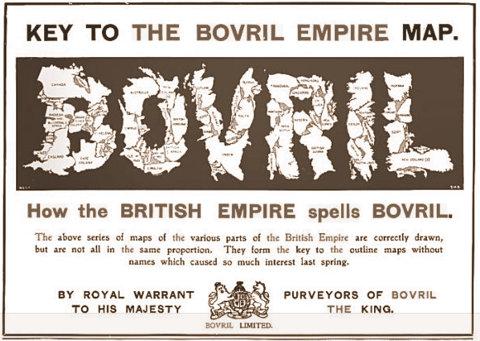
Inevitably, the power of beef came to be seen as underpinning the expanding British Empire. To mark the coronation of Edward VII, the major British weekly The Illustrated London News ran an advertisement on February 2, 1902. Titled “How the British Empire Spells Bovril,” it illustrated “the close association of this Imperial British Nourishment with the whole of King Edward’s Dominions at Home and Beyond the Seas” by fitting the national outlines (reduced or expanded as necessary) into the letters of the word Bovril.

Bovril advertisement in The Illustrated London News, February 2, 1902. Courtesy of Rachel Laudan.

Bovril advertisement in The Illustrated London News, February 2, 1902. Courtesy of Rachel Laudan.

Today, although English soccer fans still take hot Bovril broth to games, the idea that it is nourishment for Empire builders is long gone. And even McDonald’s is not the power it was a decade ago. Consumers go instead to Chipotle, Panera, and Starbucks, which offer the promise of healthier, tastier, less mass-market foods. Is this the end of empire? Or a change of direction?

Program Announcement: Interlibrary Snacking

As announced last month, our programming theme for 2015 is Eating Through Time.

We are thrilled to introduce a new pilot program, the Reciprocal Library Snack Cooperative, or Interlibrary Snacking, to go along with this theme. Our library boasts more than 10,000 volumes relating to food and cookery. For this new program, library staff will prepare recipes from the collection and send them to requesting libraries, who will in turn offer prepared recipes from their collections. All service providers will undergo thorough food safety training. In addition to white cotton gloves, cookbook users will receive hairnets.

Library snacks will focus on locally sourced, sustainable items. We are building a bespoke refrigeration unit based on the 1890 volume Mechanical Refrigeration and are taking into consideration cold storage advice from Into the Freezer—And Out (1946).

We are building a refrigeration unit based on his illustration from Mechanical Refrigeration, scheduled for completion in September 2016.

We are building a refrigeration unit, scheduled for completion in September 2016, based on this illustration from Mechanical Refrigeration.

The plan for our cold storage organization closely adheres to that shown in Into the Freezer—And Out.

The plan for our cold storage organization closely adheres to that shown in Into the Freezer—And Out.

Men Like Meat, an undated pamphlet from the American Can Company. Disclaimer on back cover: "We manufacture cans. We do no canning."

Men Like Meat, an undated pamphlet from the American Can Company. Disclaimer on back cover: “We manufacture cans – we do no canning.”

Before we tackle perishables, however, our focus will be on more shelf-stable foodstuff. Our collection includes a selection of items on canning, preserves, canned meats, food drying and dehydration, and other expiration-extending technologies.

The practice of developing new technologies to enable the safe transportation of food from one place to the next is an old story. As early as the 1850s, commercially canned goods—especially sardines, tomatoes, condensed milk, and fruits and vegetables—found an eager consumer audience in the Western United States. Cowboys bought oysters from Baltimore and canned tomatoes in bulk. In the early 20th century, canning facilitated the introduction of regional fruits like the California fig and the pineapple nationwide. Coast to coast, commercial canning introduced Americans to new foods, but often at the expense of freshness and taste.1

After the 1930s, supermarket foods were increasingly packaged: boxed, frozen, canned, dried, bottled, or combined in ready-to-eat forms. Advertisers marketed these in bright colors with catchy names that increased sales and added preservatives to ensure a longer-shelf life. Convenience usually trumped taste, and boredom at the family dinner table led many families increasingly to dine out.1

Our aim will be to use technologies like canning to enhance flavor. Along with the Reciprocal Library Snack Cooperative’s mission to include local, sustainable foods, we will also embrace more traditional methods of preservation. Goodbye chemical preservatives, hello pickling! Here is an example of a recipe currently in the works.

In addition, our program will have a secondary focus on recipes featuring new cooking technologies at the time of their publication. We have already had the soft-launch of the program: Our first item sent was inspired by this recipe from 1911.

The first recipe successfully made and sent as part of the Reciprocal Library Snack Cooperative.

The first recipe successfully made and sent as part of the Reciprocal Library Snack Cooperative.2

Want to know more about food history? Attend our Eating Through Time programming.

Reference
1. Hooker RJ. Food and drink in America: A history. Indianapolis: Bobbs-Merrill; 1981.
2. Special thanks to Juan at Sterling Affair for preparing historically accurate toast.

Got Food?

Evelyn J. Kim, today’s guest blogger, is an author and writer working on issues of food and food justice through the lens of science. Trained as a historian of science, her work has been in the The New York TimesScientific American, and The Atlantic. She is our guest curator for this year’s programming, Eating Through Time.

Les Aphorismes de Brillat-Savarin. From the Margaret Barclay Wilson Collection.

Les Aphorismes de Brillat-Savarin. From the Margaret Barclay Wilson Collection.

“Dis-moi ce que tu manges, je te dirai ce que tu es” (Tell me what you eat, and I will tell you what you are)

– Jean Anthelme Brillat-Savarin (1755-1826), Physiologie du Goût ou: Méditations de Gastronomie Transcendante

“Let food be your medicine and medicine be your food” – Attributed to Hippocrates

What do you do every day, beyond sleeping, breathing and thinking? You eat! This year, The New York Academy of Medicine is proud to announce its programming theme for 2015: Eating Through Time.

CHM-ETT-Logo1_VertTop Chef. The Salt. Lucky Peach. Grub Street. Modernist Cuisine. And thousands upon thousands of food blogs. Unless you’ve been living underneath a rock, food seems to be all around us. On television, on the web, in art, in books, in science…Food seems to be having its own “moment” as form of cultural currency. But lest anyone think that this is a new phenomenon, food has always been with us, from pre-history to the present, a basis of our bodily, social, economic, and historical selves.

To that end, we are sponsoring a whole year of activities around food, including guest lectures at the Academy and panel discussions at this year’s Food Book Fair, culminating in a full-day festival at the Academy on October 17, 2015. Based on the Academy’s collection of more than 10,000 volumes on food and health, the festival will include speakers, demonstrations, and performances centered on the topic of food. Featured speakers include our keynote speaker, famed chef Jacques Pépin, food historian Dr. Ken Albala, and Nordic Food Lab’s Joshua Evans, as well as the Culinary Institute of America and Harvard School of Public Health’s Healthy Kitchens, Healthy Lives program.

This year’s programming will encompass not only contemporary debates surrounding food, medicine, and culture, but also the historical linkages that undergird much of those discussions. We will ask chefs, historians, writers, and public health experts their perspectives on not only food’s past influence but also what’s in store in the future for us as eaters and as a society.

Marx Rumpolt, Ein new Kochbuch, 1581.

Marx Rumpolt, Ein new Kochbuch, 1581.

To kick off this year’s programming, our inaugural lecture on March 17 will feature historian of science Dr. Steven Shapin from Harvard University. Dr. Shapin has written on several topics, from Dr. Robert Boyle to the role of business in scientific research, and his current interests lie in the history of dietetics. His lecture, entitled “Beef-Eaters: A Cultural History of Food and Identity” exemplifies the complicated nexus between our dietary habits and our social identitiesand is a perfect start to this year’s theme.

We’re excited about this year’s programming and we hope to see you at any or all our events. Visit www.nyam.org/events for event details and registration, and follow this blog for more delicious tidbits on our year in food.

Recipes for Cooking by Electricity (Item of the Month)

By Johanna Goldberg, Information Services Librarian

In 2015, our programming will focus on food, including a day-long festival on October 17. This is part of a series of blogs featuring the theme.

It’s difficult to imagine a modern kitchen without electric appliances. But in the early 1900s, most people had to be persuaded to use them—often unsuccessfully.

As Doreen Yarwood explains in An Encyclopaedia of the History of Technology, electric cookers made their debuts in the 1890s and catalogs started selling them by 1900. Still, people found them difficult to use. They were unreliable and often burnt out, they weren’t aesthetically pleasing, they were difficult to clean, and it was easy to burn yourself while using them. As so few people had electric current in their homes at the turn of the century, it’s not surprising that it took three more decades for electric cooking to become commonplace.1

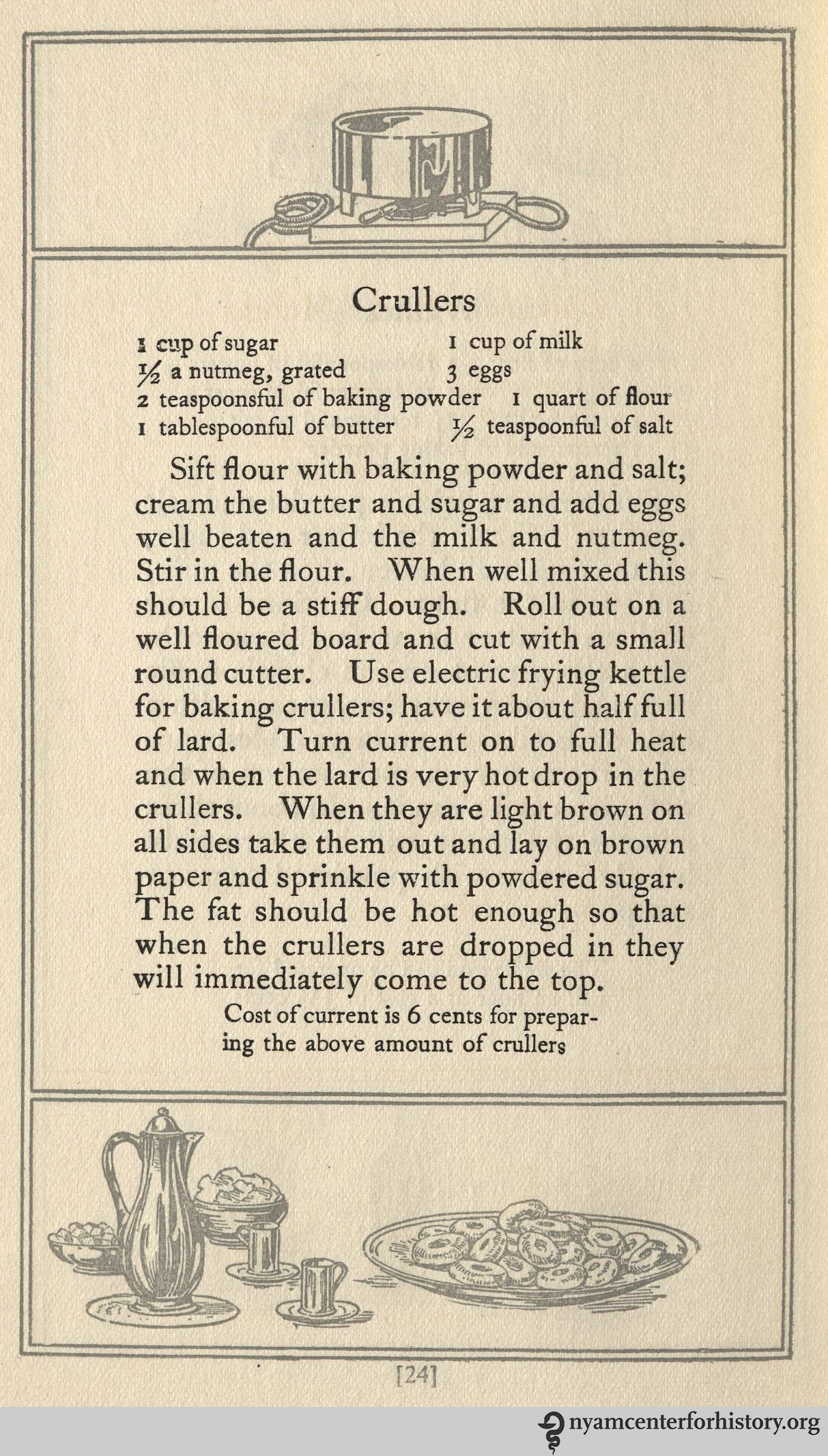
But the New York Edison Company saw an opportunity. In 1911, it published Recipes for Cooking by Electricity, a slim cookbook that not only gave recipes (ranging in cost and complexity from toast to lobster a la Newburg), but also specified the cost of the electric current used. The cookbook also included a page with tips for the care of the electric appliances, such as not immersing the heating elements in water, cleaning a warm stove top with Vaseline, and keeping a coffee percolator “sweet and clean” by rinsing it with cold water after each use and boiling water with a tablespoon of baking soda in it each week. The cookbook concludes, “It is a simple thing to cook with electricity and the cost is surprisingly small.”2

Here are some sample recipes:

Toaster_watermarkLobster_watermarkBoiledEggs_watermarkCrullers_watermarkReferences

1. Yarwood, D. (2002). The Domestic Interior: Technology and the Home. In I. McNeil (Ed.), An Encyclopaedia of the History of Technology. London: Routledge.

2. New York Edison Company. (1911). Recipes for cooking by electricity. New York: Edison Company.

NYAM’s Culinary Highlights

On Monday, The Recipes Project featured an interview with Curator Anne Garner about the print and manuscript historical recipe books in our collection. We’re delighted to republish the interview, conducted by Michelle DiMeo, on our blog.

Could you give us an overview of the print and manuscript historical recipe books in NYAM’s collection? Can you offer any search tips for finding them in your catalog?

At the heart of our culinary holdings is the Collection of Books on Foods and Cookery, presented to NYAM by Margaret Barclay Wilson in 1929. Wilson was professor of physiology and honorary librarian at Hunter College; she also advised the city of New York on food economy during wartime.

The Wilson collection includes about 10,000 items, including the Apicius manuscript (see below), menus and pamphlets that demonstrate the way cookery changed over time, and a large collection of printed books, beginning in the 16th century. Included here are works by Scappi, Platina, and Carême as well as many other milestones in culinary printing.  Especially exciting are the wide variety of everyday cookbooks we own that show what daily cooking was like in a range of households, across the world. Using our collections, you can also trace the changes that occur when people have access to new innovations—refrigeration, for example, or the gas range.

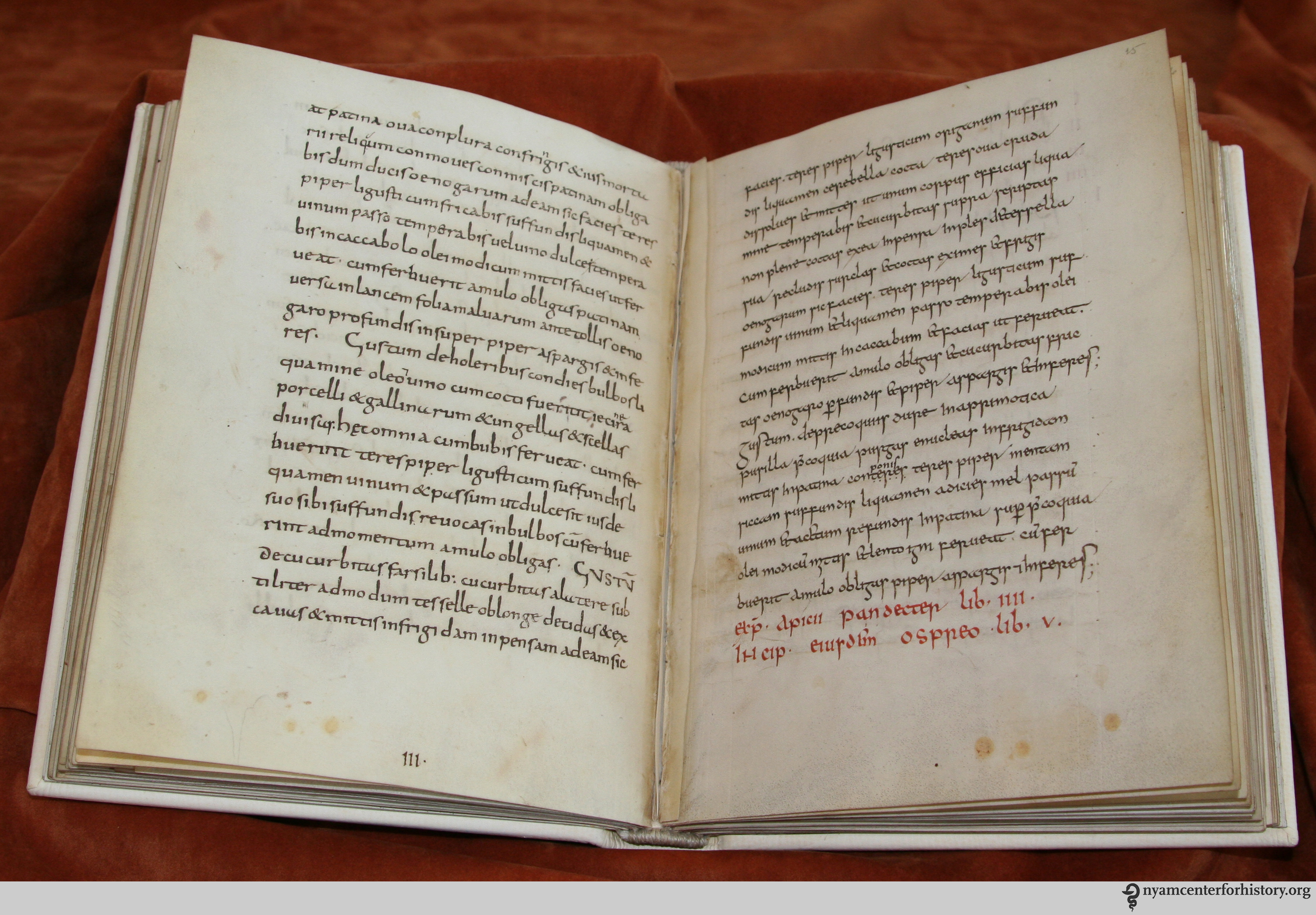
9th-century manuscript De re culininaria (sometimes De re coquinaria), attributed to Apicius.

9th-century manuscript De re culininaria (sometimes De re coquinaria), attributed to Apicius.

We have strong collections related to diet regimens and cooking for health, as well as cookbooks published during wartime when resources were scarce. More general texts on home economics and household management include much on cooking. Books on farming, viticulture and beer-making round out our strong print holdings.

The centerpiece of our food manuscripts is Apicius’ De re culinaria, one of two existing copies of an early Roman cookbook mixed with medical recipes, agronomical observations, and house-keeping advice. Our copy was penned at the monastery at Fulda (Germany) around 830 AD.

NYAM holds some significant early modern manuscript recipe books. Can you tell us more about these and give a couple of highlights?

Our library holds 36 manuscript receipt books, dating from the late 17th through the 19th century. The bulk of the manuscripts are German and English. The remaining manuscripts are American, Austrian, French, and Dutch. One of my favorites is the Choise Receipt book from 1680, which includes recipes for fruit preserves, baked goods, mead and beer, as well as hearty pudding and meat dishes. You’ll also find here a recipe ensuring a quick childbirth—central ingredient, baked eel livers!—as well as many other medical recipes. A tantalizing recipe for a “gam of cherries” is notable because the OED dates the earliest usage of “jam,” in any form, to 1736, almost sixty years after the date of this manuscript.

Index of late 17th-century manuscript A Collection of Choise Receipts.

Index of late 17th-century manuscript A Collection of Choise Receipts.

Elizabeth Duncombe’s manuscript offers recipes from a later period (1791). Food historian Stephen Schmidt has cooked several of these recipes, with delectable results! Highlights include a fish sauce more French than English in spirit (akin to today’s beurre blanc), and recipes for pigeon, hedgehog and potted mushrooms. References to milking and to cows suggest that this was the cookbook of a farm household, and not a city residence.

Could you tell us a bit more about the Pine Tree Manuscript Receipt Book Project?

The 36 early modern manuscripts described above were all in need of both conservation and cataloging. All items needed basic stabilization and dry cleaning; in some cases, the bindings needed to be replaced with historically and structurally suitable materials. All can now be used by the public without worry of further damage. They’ve also been cataloged, and can be found by searching online here.

Both the conservation work and the cataloging was funded by the Pine Tree Foundation, overseen by Szilvia Szmuk-Tanenbaum. Szilvia is a bibliophile and a culinary enthusiast, and has been wonderfully generous to us.

I heard that “Food” is NYAM’s 2015 programming theme. Do tell us more! How will recipes be included?

We’re thrilled that our 2015 programming will focus on the history of food and food systems, working with historian and writer Evelyn Kim. Throughout the year there will be food-related events, culminating in our October Festival where we will offer a mixture of talks, demonstrations, and workshops, with noted chefs and writers. In April, we will also be participating in the Food Book Fair in Brooklyn. We will be drawing on our historical cookery collection for insights into changing ideas about food and health, nutrition, diets and more. Watch our blog for images, recipes and details of lectures and workshops to come.

NYAM’s Center for the History of Medicine and Public Health (which includes the Library) hosts the blog Books, Health, and History. Could you give us an overview of some blog posts that were related to historical recipes?

Food historian Stephen Schmidt did a wonderful post for us on a recipe for bread crumb gingerbread. The recipe can be found in a manuscript cookbook from the early 18th century but is adapted from a much older recipe for a contemporary audience. Schmidt writes about the evolution of gingerbread as a stomach settler in the 17th-century to its 18th-century incarnation as a sweet dessert cake, made with molasses. Our manuscript offers recipes for both the old and the new gingerbread. Schmidt speculates that the old was probably made at Christmastime, the new, in everyday cooking.

Another highlight includes a blog featuring a staff member’s photo-documented chronicle of her experiences making Mother Eve’s Pudding, featured in this recipe book, and a post on the recipe itself, which is cleverly—and sometimes cryptically—told in verse. Other highlights include posts offering recipes for an authentic 1914 Thanksgiving dinner and on a pamphlet, the “Canape Parade,” featuring a procession of winsome vegetables.

A recipe in verse for Mother Eve’s Pudding, late 18th-century.

A recipe in verse for Mother Eve’s Pudding, late 18th-century.

Canapé Parade

By Johanna Goldberg, Information Services Librarian

Thanksgiving means many things: spending time with family, reflecting on what you’re thankful for, looking back at American history. But the essence of the holiday can be stated in three words: food, football, and parades.

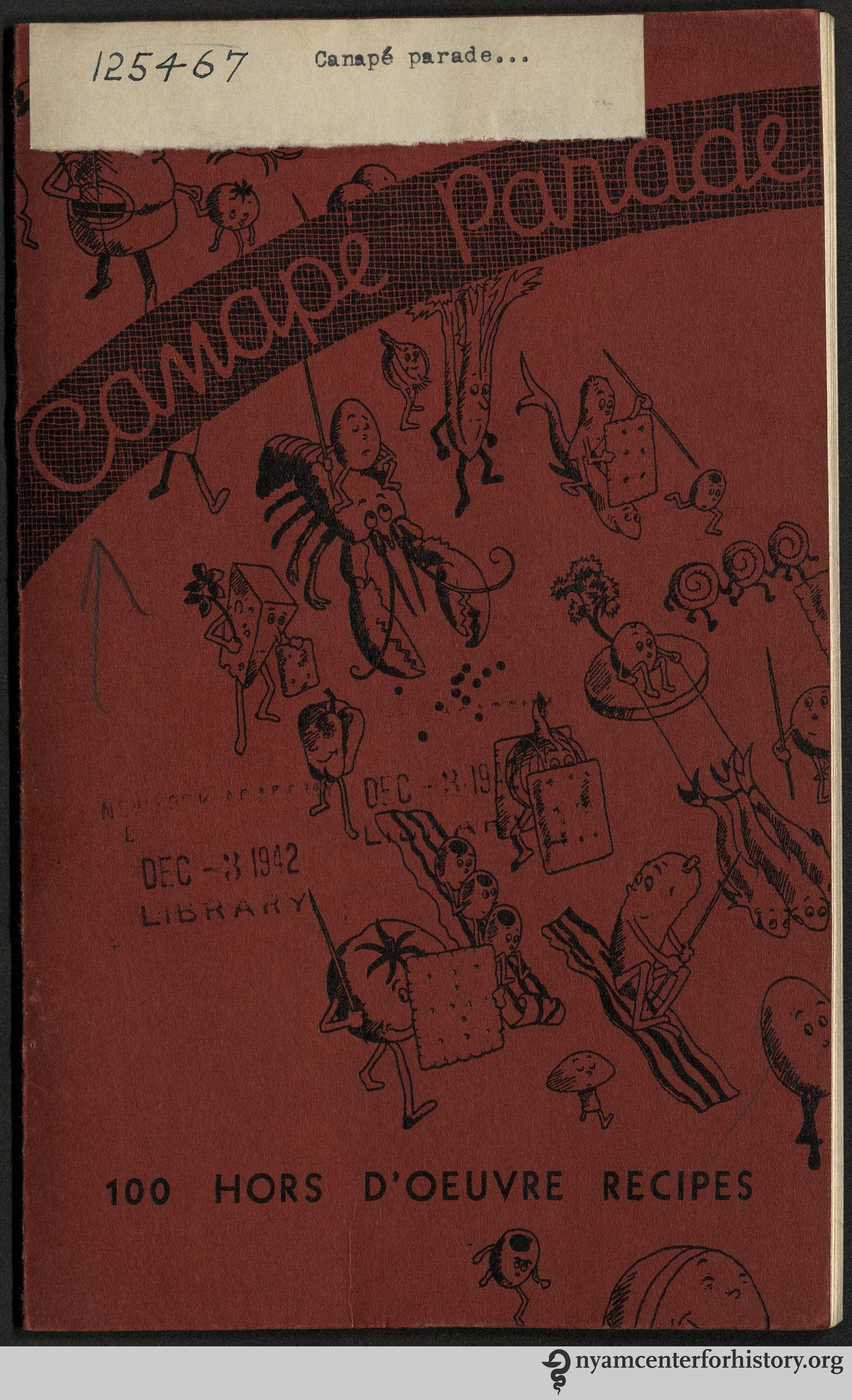
Our collection contains a whimsical pamphlet that combines two of the three (sorry, football fans): “Canapé Parade: 100 Hors d’Oeuvre Recipes,” published in 1932. (We have the fourth printing, from November of that year.)

The cover of Canapé Parade. Click to enlarge.

The cover of Canapé Parade.

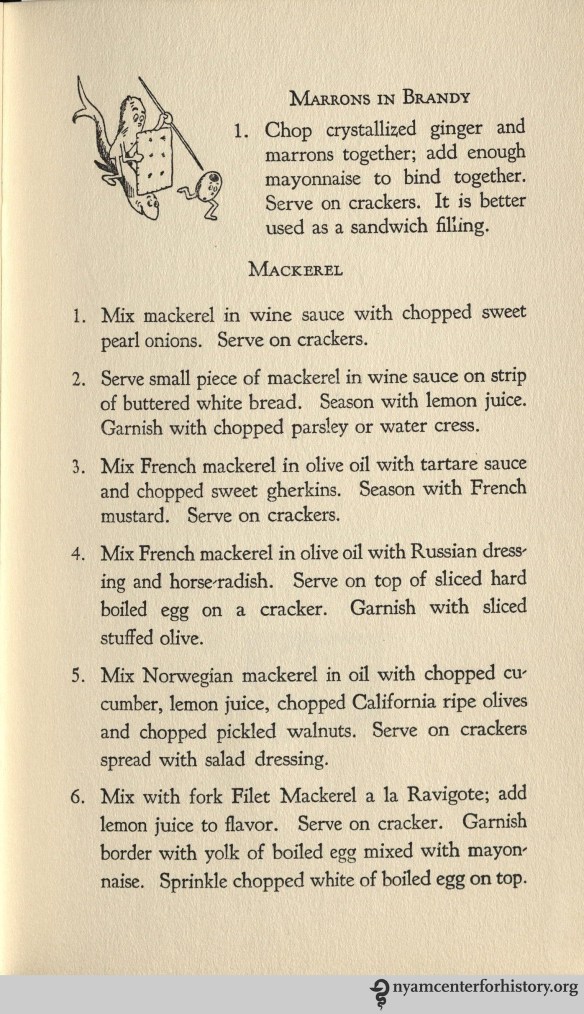
The personality-filled canapés from the cover reappear throughout the pamphlet, illustrating recipes like bloater paste, Japanese crabmeat, herring, and marrons in brandy. Unfortunately, the pamphlet does not credit the illustrator.

None of the recipes specify ingredient amounts, “as the consistency and proportion of ingredients used will vary according to the individual palate.” The recipes take a semi-homemade approach, adding minimal fresh items to packaged food before spreading on crackers. The cookbook also advises that “the majority of these hors d’oeuvres also make excellent sandwich fillings to be served between thinly sliced bread at afternoon tea or buffet suppers.”

Enjoy the recipes on parade below (click to enlarge and view the gallery):

For more traditional Thanksgiving recipes, read Thanksgiving, 1914 Style.

Brighten the Visit With Pepsi

By Johanna Goldberg, Information Services Librarian, with Jarlin Espinal, Technical Services Assistant

This is part of an intermittent series of blogs featuring advertisements from medical journals. You can find the entire series here.

From JAMA, volume 182, number 8, November 24, 1962.

From JAMA, volume 182, number 8, November 24, 1962.

Advertisements in the Journal of the American Medical Association (JAMA), have reflected food and diet trends from the start.

In the late 1930s and early 1940s, the journal normally had two pages of ads an issue, often related to food. By the late 1940s, advertising exploded. The May 3, 1947 issue of JAMA has 130 pages of ads, with food-related items amidst the publishers, medical devices, cigarettes, cosmetics, sanitariums, hospitals, and pharmaceuticals.

The advertising boom only increased—“In 1958 the industry estimated that it had turned out 3,790,809,000 pages of paid advertising in medical journals.”1 By this time, ads for pharmaceuticals far surpassed those for food- and diet-related items, a fitting trend as “between 1939 and 1959, drug sales rose from $300 million to $2.3 billion”1

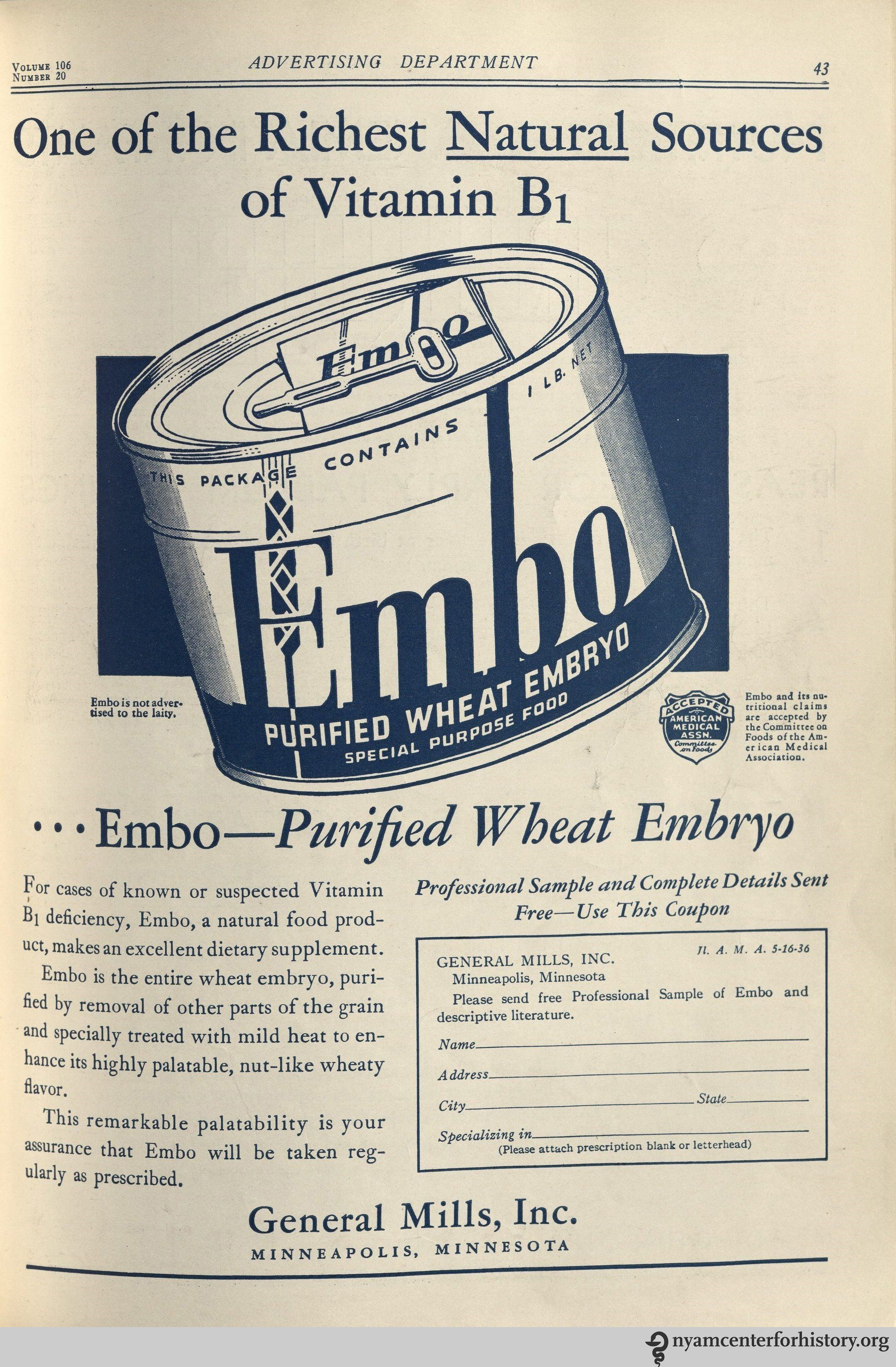
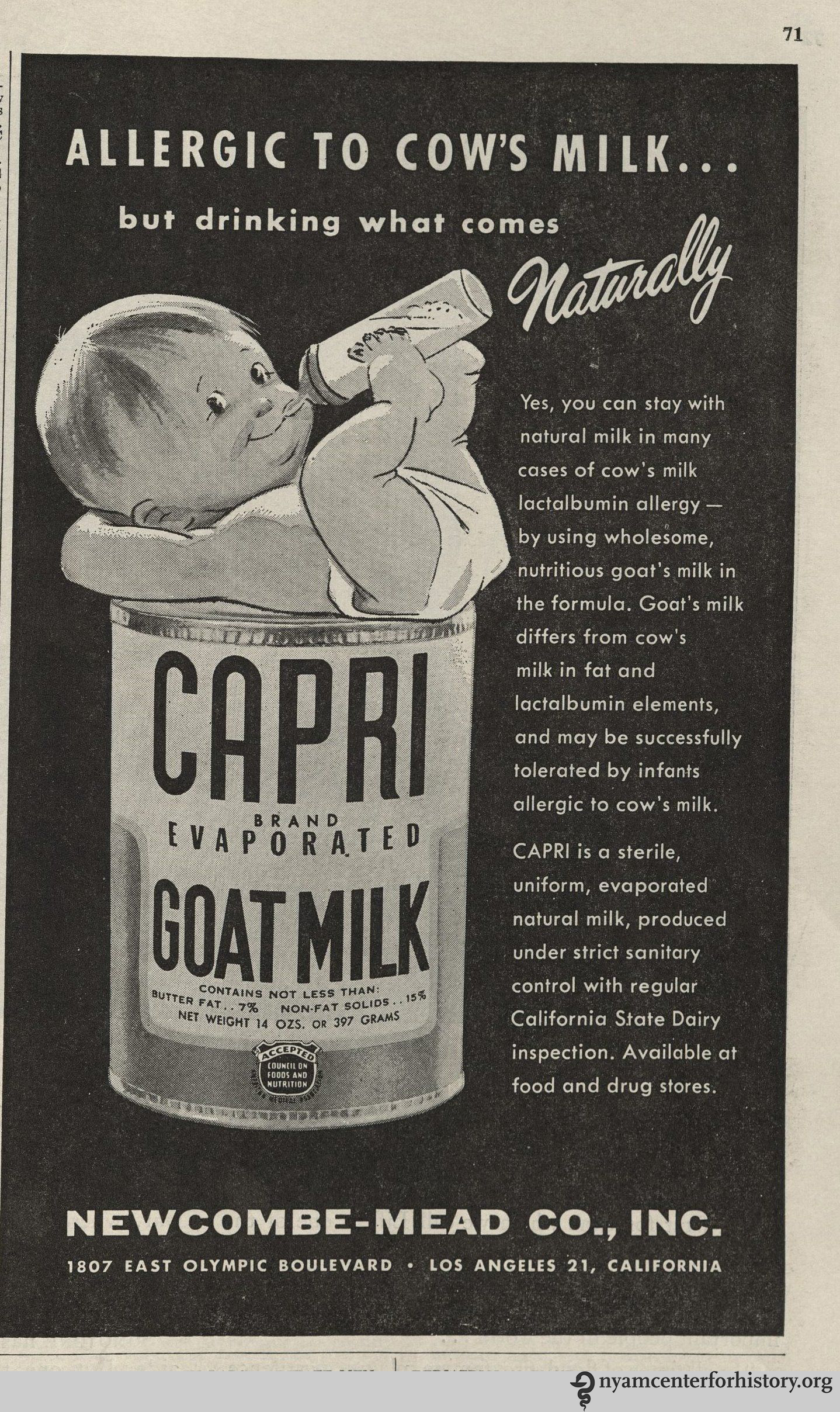
The food- and diet-related advertisements presented here fall into several categories. There are promotions from industry groups—including my favorite, in which the National Confectioners’ Association attempts to convince doctors that candy has health benefits. There are beverages, ranging from baby formula to ovaltine to soft drinks. There are items that remain familiar today and items that seem totally foreign—if someone out there has tried Embo, please let us know. And of course, there’s the intersection of pharmaceuticals and diet, as claims of appetite suppression move from ads for apples and citrus to drugs like Desoxyn.

From JAMA, volume 106, number 20, May 16, 1936.

From JAMA, volume 106, number 20, May 16, 1936. Click to enlarge.

From JAMA, volume 134, number 1, May 3, 1947.

From JAMA, volume 134, number 1, May 3, 1947. Click to enlarge.

From JAMA, volume 134, number 2, May 10, 1947. Click to enlarge.

From JAMA, volume 134, number 2, May 10, 1947. Click to enlarge.

From JAMA, volume 154, number 3, January 16, 1954. Click to enlarge.

From JAMA, volume 154, number 3, January 16, 1954. Click to enlarge.

From JAMA, volume 154, number 5, January 30, 1954. Click to enlarge.

From JAMA, volume 154, number 5, January 30, 1954. Click to enlarge.

From JAMA, volume 154, number 6, February 6, 1954. Click to enlarge.

From JAMA, volume 154, number 6, February 6, 1954. Click to enlarge.

From JAMA, volume 154, number 9, February 27, 1954. Click to enlarge.

From JAMA, volume 154, number 9, February 27, 1954. Click to enlarge.

From JAMA, volume 182, number 7, November 17, 1962. Click to enlarge.

From JAMA, volume 182, number 7, November 17, 1962. Click to enlarge.

From JAMA, volume 182, number 7, November 17, 1962. Click to enlarge.

From JAMA, volume 182, number 7, November 17, 1962. Click to enlarge.

From JAMA, volume 234, number 2, October 13, 1975. Click to enlarge.

From JAMA, volume 234, number 2, October 13, 1975. Click to enlarge.

Reference

1. Donohue J. A history of drug advertising: the evolving roles of consumers and consumer protection. Milbank Q. 2006;84(4):659–699. Available at: http://facultynh.syr.edu/bjsheeha/ADV 604/History of Drug.pdf. Accessed May 30, 2014.

There is Death in the Pot

By Johanna Goldberg, Information Services Librarian

While in the stacks recently, we came across this intriguing cover.

DeathinthePot-cover


How can you not open the book? The title page did not disappoint.

DeathinthePot-titlepageFood adulteration was a dangerous problem in 19th-century London. In 1820, chemist Fredrick Accum wrote A Treatise on Adulterations of Food and Culinary Poisons, the first book of its kind to attempt to expose the dangers of the food, water, and beverage supply.¹

Among many other practices, Accum cautioned against alum in the bread supply, used to make bread whiter; fraudulent peppercorns, made of lintseed, clay, and a small bit of Cayenne; vinegar laced with sulphuric acid; red lead used to color cheese; and beer mixed with a poisonous narcotic plant, cocculus indicus.² Forty years after the book’s publication, Parliament passed the Food Adulteration Act.¹

The Royal Society of Chemistry’s Library and Information Centre offers an excellent online exhibit on the life and times of Accum (including a career-ending scandal involving mistreatment of library books). Learn more here.

Edit: A reader recognized the artwork as that of Berkeley King and kindly provided us with the following image of the cover of Accum’s Plans of the Gas Works in London, which King also designed.

AccumPlansoftheGasWorksinLondon


1. The fight against food adulteration. (n.d.). Retrieved May 16, 2013, from http://www.rsc.org/education/eic/issues/2005mar/thefightagainstfoodadulteration.asp

2. Accum, F. (1820). A treatise on adulterations of food, and culinary poisons exhibiting the fraudulent sophistications of bread, beer, wine, spirituous liquors, tea, coffee, cream, confectionery, vinegar, mustard, pepper, cheese, olive oil, pickles, and other articles employed in domestic economy, and methods of detecting them. London: Longman, Hurst, Rees, Orme, and Brown.

Mother Eve’s Pudding Redux

Image

By Erin Albritton, Head of the Gladys Brooks Book & Paper Conservation Laboratory

Last month, we kicked off National Poetry Month by sharing a rhyming recipe for Eve’s Pudding from our manuscript collection. Although charming, the recipe lacked the level of specificity to which most modern cooks have become accustomed. To solve this problem, cooking teacher and food historian Steve Schmidt (who will be delivering NYAM’s Friends of the Rare Book Room lecture on May 23rd) was kind enough to send along the following adaptation, together with a recipe for Cold Sweet Sauce that is scrumptious when drizzled over the top:

For the pudding:
3/4 cup (3 ounces) fine dry bread crumbs, plus a handful for coating the basin or bowl
1/3 cup plus 1 tablespoon (3 ounces) sugar
1 Tbsp all-purpose flour
1 tsp grated or ground nutmeg
1/2 tsp ground cinnamon
1/2 tsp salt
3 medium (about 1 1/4 pounds) firm, dry apples, such as Golden Delicious
2/3 cup (3 ounces) currants
3 large eggs, beaten until light and frothy
6 Tbsp (3 ounces) unsalted butter, melted and cooled
1 Tbsp strained fresh lemon juice

For the Cold Sweet Sauce:
1 stick of butter
2/3 cup confectioners’ sugar
1-2 Tbsp of brandy or lemon juice
A pinch of nutmeg

Very generously grease a 5- to 6-cup heatproof bowl or pudding basin with butter or solid vegetable shortening. Sprinkle the inside of the bowl with a handful of dry bread crumbs, tilt the bowl in all directions until coated and then tap the excess crumbs out.

Mix the 3/4 cup crumbs, sugar, flour, nutmeg, cinnamon, and salt in a bowl. Peel the apples and grate on the shredding plate of a box grater down to the cores. Stir the apples and currants into the crumb mixture, then the beaten eggs, then the melted butter and lemon juice. Pack the mixture into the prepared bowl, cover tightly with foil, set an upside-down plate on top of the foil, and steam the pudding for 3 hours in sufficient simmering water to reach halfway up the sides of the bow

While the pudding is steaming, make sauce by melting butter and whisking in sugar, brandy and nutmeg. Remove the pudding from the pot and let rest 15 minutes before unmolding. Drizzle (or drench!) with sauce and enjoy.

Below is a photo essay documenting one staff member’s kitchen adventure making this recipe (click to enlarge and open photo gallery). The next time you’ve got a couple of hours and find yourself craving a delicious dessert (with a bit of history), give Eve’s Pudding a try . . . you’ll be glad you did!