Author’s Night – The AIDS Generation: Stories of Survival and Resilience

Perry N. HalkitisPlease join us on Wednesday, March 19 at 6 pm to hear NYAM Fellow Perry N. Halkitis, PhD, MS, MPH, discuss his latest book, The AIDS Generation: Stories of Survival and Resilience. The book has just been named a finalist for a 2014 Lamda Literary Award in the biography/memoir category. To RSVP, e-mail Donna Fingerhut.

Dr. Halkitis had several motivations for writing this book, as he explains:

First, I wanted to create a historical document of the unique experiences that these men—the men of the AIDS Generation—lived through—people who lived through the darkest moments of the epidemic in the first two decades of AIDS. Second, I wanted to demonstrate the resilience of my generation of gay men and move away from research that is based on deficit models that are too often evident in the literature.  In fact, somehow the men of the AIDS Generation survived and thrived. It would be simple to say it was pure luck that they remained healthy long enough for the development of antiviral therapies. But I believe what I learned from these stories is that there is something greater at work here. These men were able to attend and care for the whole selves—social, biological, and emotional selves—which empowered them to get through to 1996, the turning point of the epidemic, and which is demonstrative of resilience and not deficit. Third, the way that the men of the AIDS Generation managed the disease helps to inform how we can work with all people who are living with HIV and other people living with challenging chronic diseases.

Dr. Halkitis is professor of applied psychology and public health and population health (Steinhardt School and Langone School of Medicine), director of the Center for Health, Identity, Behavior & Prevention Studies, and associate dean for academic affairs (Global Institute of Public Health) at New York University. He is also an affiliate of NYU’s Center for AIDS Research and Center for Drug Use and HIV Research. Dr. Halkitis has conducted HIV behavior research for the last 20 years, examining HIV in relation to other health problems.

Women’s Courage: Clara Barton in Peace and War

By Paul Theerman, Associate Director, Center for the History of Medicine and Public Health

When the battleship Maine blew up in Havana Harbor, February 15, 1898, Clara Barton was within earshot:

The . . . work of that fifteenth day of February held [us] busy at our writing tables until late at night. The house had grown still; the noises on the street were dying away, when suddenly the table shook from under our hands, the great glass door opening the veranda, facing the sea, flew open; everything in the room was in motion or out of place—the deafening roar of such a burst of thunder as perhaps one never heard before, and off to the right, out over the bay, the air was filled with a blaze of light, and this in turn filled with black specks like huge spectres flying in all directions. . . . A few hours later came the terrible news of the “Maine.”1
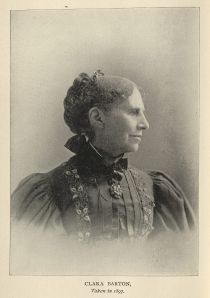
Clare Barton. From The Red Cross in Peace and War, 1899.

Clare Barton. From The Red Cross in Peace and War, 1899. Click to enlarge.

Barton (1821–1912) was doing what she did best: ministering in the midst of catastrophe, bringing aid and comfort, “always going where suffering humanity most needed her.”2 The list of her engagements is a roll call of later 19th-century history. In addition to Cuba (1898) were the battles of Second Bull Run and Antietam (1862), the Franco-Prussian War (1870–1871), the Johnstown Flood (1889), Russian famine relief (1892), the Armenian massacres (1895–1896), and the Galveston hurricane (1900), among others. What better time to remember her achievements than Women’s History Month and Red Cross Month?

During her extended stay in Europe from 1869–1873, she became acquainted with the Red Cross movement, which she brought back to the United States and formalized with a charter for the American Red Cross in 1881. Yet although she headed this organization until 1904, she remained in the field from her early 40s until she was almost 80.

Humanitarian work brought her to Cuba. Spanish policy established camps to control the discontented rural Cuban population beginning in 1895. These turned into disastrous places of human suffering, and in January 1898 President William McKinley formed a President’s Committee for Human Relief (also known as the Central Cuban Relief Committee) for the camp sufferers, or reconcentrados. The Committee included a Red Cross representative, Barton’s nephew, Stephen E. Barton. By shedding this duty, Clara was free to go to Cuba, to enter the field, in her words, “simply as a willing assistant . . . an individual helper in a work already assigned.”1 She was anything but! Barton was on the ground in Havana assessing the situation starting February 9. As part of her fact-finding mission, two days before the explosion of the Maine, she lunched aboard the ship with its captain.2 On the day after the explosion, she wired McKinley, “I am with the wounded”—as indeed she was.2

"I am with the Wounded." Originally printed in The Christian Herald and reprinted in The Red Cross at  in Peace and War. Click to enlarge.

“I am with the wounded.” Originally printed in The Christian Herald and reprinted in The Red Cross in Peace and War. Click to enlarge.

Though she was devoted to impartially aiding human suffering, Barton’s efforts in Cuba got swept into the maelstrom of politics. Spanish authorities resisted her investigations, and her reports of the reconcentrados’ suffering helped push the United States into war. Her relief efforts were then caught up by that war: back from Cuba by March, she tried to return on April 25 with relief supplies, but war had been declared two days before. Her ship, the State of Texas, was held at Tampa; providing food and medicine to Cuba was the last thing that the belligerent American government now wanted.

A photo montage of Barton's return to Cuba and time on the ship The State of Texas. From The Red Cross in Peace nad War. Click to enlarge.

A photomontage of Barton’s return to Cuba and time on the ship the State of Texas. From The Red Cross in Peace and War. Click to enlarge.
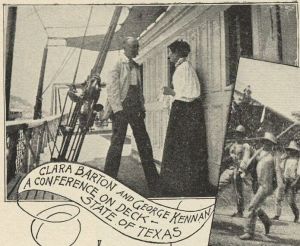
Barton with Keenan, a close-up from the State of Texas montage.

Barton with Keenan, a close-up from the State of Texas photomontage. Click to enlarge.

Only on June 20 did the ship follow the American fleet as it set out to engage the Spanish, and only in mid-July did it enter Santiago harbor, leading the American flotilla, with Barton “standing on the forward deck, . . . queenly and majestic.”2 She pushed to get her nurses access to the war wounded on both sides, organized relief aid delivery to Santiago, and established soup kitchens, clinics, and orphanages. As journalist George Kennan observed: “I did not happen to see any United States quartermaster in Cuba who, in the short space of five days, had unloaded and stored fourteen hundred tons of cargo, given hot soup daily to ten thousand soldiers, and supplied an army of thirty-two thousand men with ten days rations. It is a record, I think, of which Miss Barton had every reason to be proud.”2
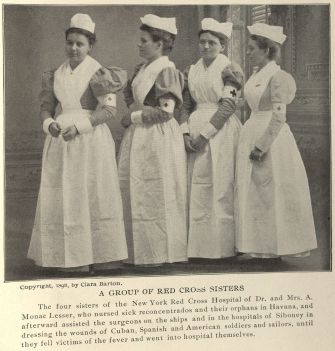
"A Group of Red Cross Sisters." Photo taken by Barton and published in The Red Cross in Peace and War. Click to enlarge.

“A group of Red Cross sisters.” Photo taken by Barton and published in The Red Cross in Peace and War. Click to enlarge.

By all accounts Barton was both a master logistician and a compassionate presence in the face of human suffering. Doing so—being so—was a point of pride and identity for her, the touchstone of her feminism. This was shown even some six years before Cuba. Barton gave voice to “women’s ministering presence” in a poem, “The Women Who Went to the Field.” Composed for a November 18, 1892 Washington banquet of the Woman’s Relief Corps (an auxiliary group of the Civil War veterans organization, the Grand Army of the Republic), Barton celebrated the female battlefield nurses of America’s terrible war. Indeed, being at the battlefield was the point, as she lifted up an ideal of women’s courage, while caustically calling into question common assumptions about women and battle:

The women who went to the field, you say,
The women who went to the field; and pray
What did they go for? Just to be in the way!
They would scream at the sight of a gun, don’t you see?

They might pick some lint, and tear up some sheets,
And make us some jellies, and send on their sweets,
And knit some soft socks for Uncle Sam’s shoes,
And write us some letters, and tell us the news.
And thus it was settled by common consent,
That husbands, or brothers, or whoever went,
That the place for the women was in their own homes,
There to patiently wait until victory comes.

But the Civil War experience put the lie to these assumptions:

But later, it chanced, just how no one knew,
That the lines slipped a bit, and some ’gan to crowd through;
And they went,—where did they go?—Ah! where did they not?
Show us the battle,—the field,—or the spot
Where the groans of the wounded rang out on the air
That her ear caught it not, and her hand was not there;

What was women’s role in battle?

And these were the women who went to the war:
The women of question; what did they go for?
Because in their hearts God had planted the seed
Of pity for woe, and help for its need;
They saw, in high purpose, a duty to do,
And the armor of right broke the barriers through.
Uninvited, unaided, unsanctioned ofttimes,
With pass, or without it, they pressed on the lines;
They pressed, they implored, till they ran the lines through,
And that was the “running” the men saw them do.

That is, women ran into battle, not away!

And then she tied women’s courage to the Red Cross movement:

And what would they do if war came again?
The scarlet cross floats where all was blank then.
They would bind on their “brassards” and march to the fray,
And the man liveth not who could say to them nay;
They would stand with you now, as they stood with you then,—
The nurses, consolers, and saviors of men.2,3

Hers was a noble vision, founded on the battlefields of Bull Run and Antietam. Barton found a nursing and consoling role for women at those battlefields. She also found a logistical role for women in relief organizations, but for her, the presence of women in battle—her own presence in battle—remained defining. That presence was contentious in her time; today, the debate continues over whether to draw the line between men’s and women’s roles in battle. Yet one wonders, with Barton, whether the issue of women’s courage lies at the bottom of this debate.

References

1. Barton, C. (1899). The Red Cross in peace and war. Washington, D.C.: American Historical Press. Retrieved from https://archive.org/details/cu31924074466842.

2. Pryor, E. B. (1987). Clara Barton: Professional angel. Philadelphia: University of Pennsylvania Press.

3. U.S. National Park Service. (n.d.). The Women Who Went to the Field – Clara Barton National Historic Site (U.S. National Park Service). Retrieved March 11, 2014, from http://www.nps.gov/clba/historyculture/fieldpoem.htm.

What Things are Good and Holesome for the Braine

By Johanna Goldberg, Information Services Librarian

It’s Brain Awareness Week, a week-long effort to increase public awareness of the progress and benefits of brain research. Which got us thinking: What kind of advice did people get about taking care of their brains hundreds of years before the advent of brain imaging?

A home remedy guide from our collection provides one answer. Like many tomes of its day, the book has a long and descriptive title: A Rich Store-House or Treasury for the Diseased: Wherein, are Many Approued Medicines for Diuers and Sundry Diseases, Which Haue Been Long Hidden, and not Come to Light Before This Time; Now Set Foorth for the Great Benefit and Comfort of the Poorer Sort of People That are not of Abillitie to Go to the Physitions.

How-to guides were very common and often reprinted during the Renaissance.1 A Rich Store-House is no exception; our library houses the first edition from 1596 (shown here), the fifth edition from 1612, and the eighth and final edition from 1650. A Rich Store-House is likely modeled after the work recognized as the first home remedy guide, Thesaurus Pauperum, a guide to medical treatments published in the 13th century written by Petrus Hispanus, or Peter of Spain, who went on to become Pope John XXI.2

So what does A Rich Store-House have to say about the brain? It offers two lists, “A Rule to knowe what things are good and holesome for the Braine” and “These Thinges are ill for the Braine.” Some of the items, like washing hands often, walking, sleeping, and eating and drinking in moderation, are still considered wise advice today. Others, like not listening to much music or singing or not eating onions and garlic, have not aged quite as well.

 References

1. Katz, W. A., & Katz, B. (1998). Cuneiform to Computer: A History of Reference Sources (Google eBook) (p. 415). Scarecrow Press. Retrieved from http://books.google.com/books?id=Q0e58w8n88MC&pgis=1

2. Geshwind, M. (1997). A rich storehouse of medicines for diverse and sundry diseases, an Elizabethan “Treasurie for the poorer sort of people”. Journal of the History of Dentistry, 45(1), 17–22.

Item of the Month: Jacques Gamelin’s Nouveau recueil d’osteologie et de myologie

By Lisa O’Sullivan, Director, Center for the History of Medicine and Public Health

This is one of several posts leading up to our day-long Performing Medicine Festival on April 5, 2014, which will explore the interrelationships of medicine, health, and the performing arts. Register for the festival here.

Skeleton Musicians from Jacques Gamelin

O Quanto ci deve dare pensiere (O, how it should give us thought). Table 5. Click to enlarge.

The musical skeletons featured in our Performing Medicine design look cheerful enough. However, the text beneath the flautist’s feet, “O Quanto ci deve dare pensiere,” or “O, how it should give us thought,” makes it clear that they are a memento mori, reminding viewers of the inevitability of death. The skeletons come from Jacques Gamelin‘s Nouveau recueil d’osteologie et de myologie (A New Collection of Bones and Muscles, Drawn from Life).

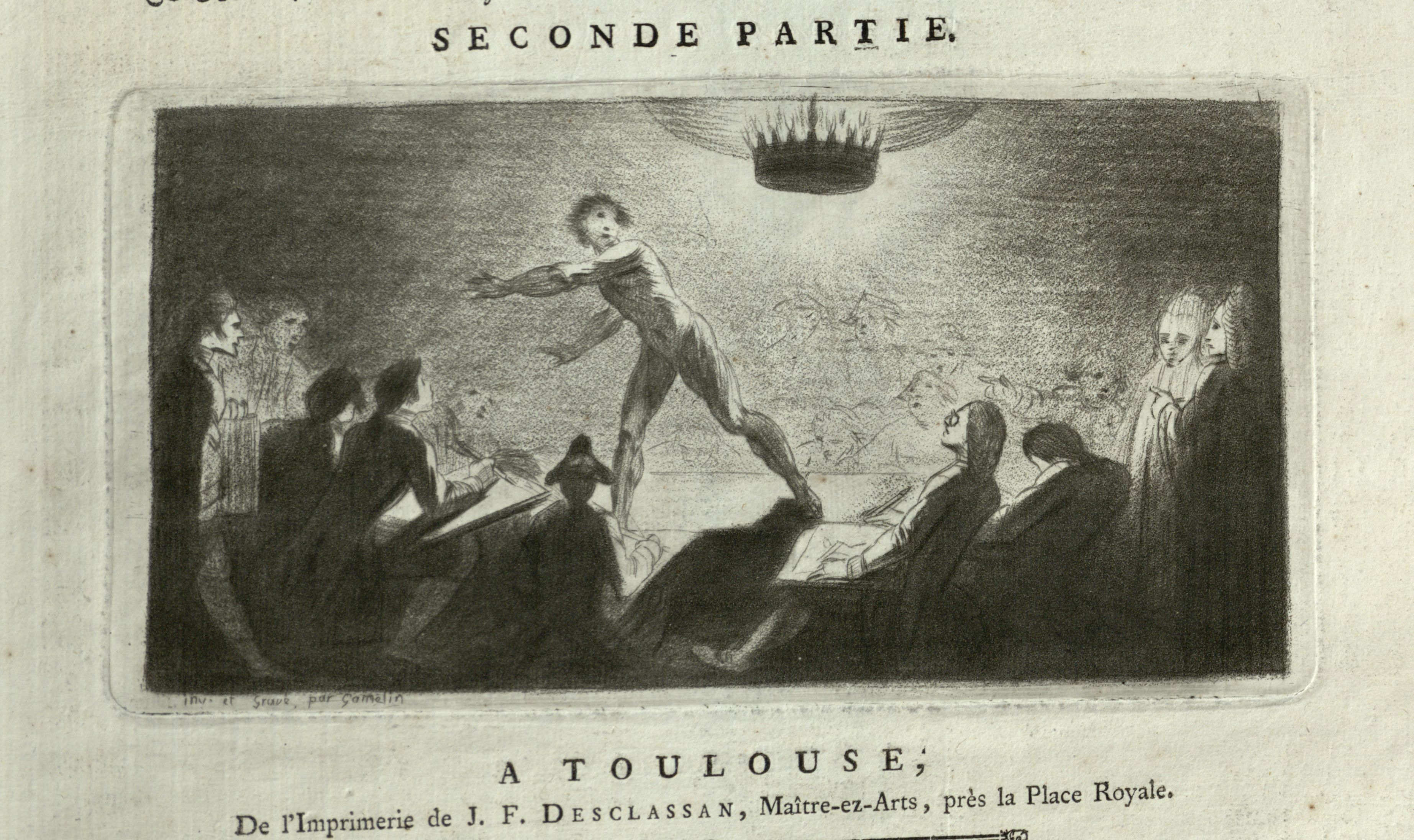
Artists studying anatomy, title page, v.2.

Artists studying anatomy, title page, v.2. Click to enlarge.

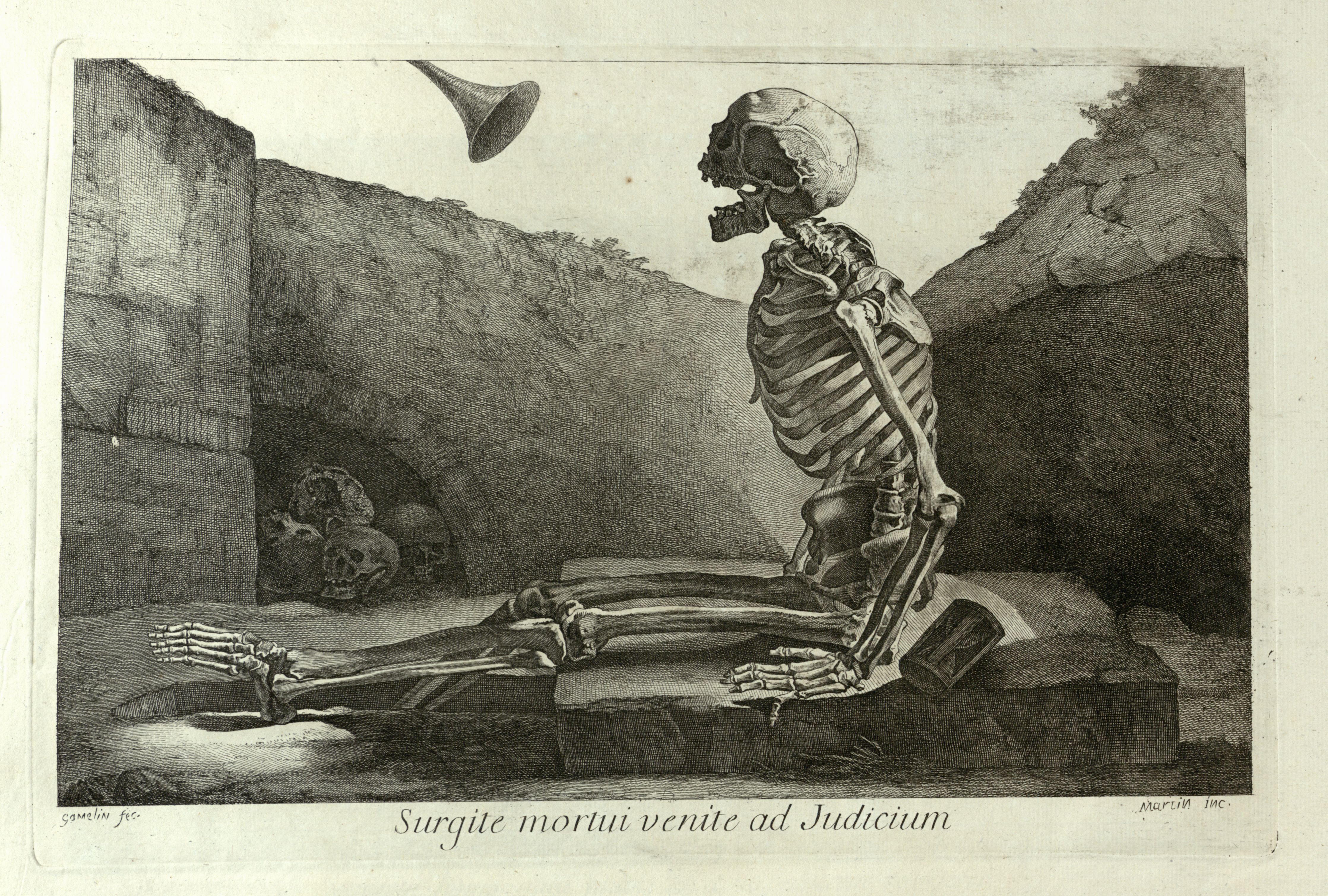
The Nouveau recueil d’osteologie et de myologie is an opulent and eccentric work, published in Toulouse in 1779 and paid for with financing from Gamelin’s patron, Baron de Puymaurin, and an inheritance from Gamelin’s father. The volume’s 41 full-page engraved plates and ten etchings are by turns witty and fantastical while maintaining a high level of accuracy and anatomical detail. Jacques Gamelin trained as a painter and engraver and designed the work to be of use to artists as well as anatomy students. The first section of the book is dedicated to bones, the second to muscles, and throughout the book allegorical scenes and tableaux highlight warfare, battles, and death.

Local authorities in Toulouse gave Gamelin access to the corpses of executed criminals, and he produced sketches based on his dissections. He then worked with two engravers, Jacques Lavalée and an artist known only as Martin, to produce prints from these drawings (“Lavalée Inc. 1778” and “Gamelin fec.” (Gamelin fec[it] – or Gamelin made it) are both found on the musical skeleton image). Production of the 200 copies of the volume, which took two years, bankrupted Gamelin, and many copies were subsequently pulped.

Skeleton figure responding to Trumpet call on day of resurrection

Surgite mortui, et venite ad judicium (Arise, ye dead, and come to the judgment). Table 6. Click to enlarge.

Find more information at Gamelin’s Marauding Skeletons and Écorché Crucifixions and Princeton’s Graphic Arts blog. More images from the book can be found on the National Library for Medicine’s Historical Anatomies on the Web.

School Breakfast Week: “Take Time for School Breakfast”

By Danielle Aloia, Special Projects Librarian

Starting the day with a hearty, healthy breakfast allows your body to maintain the physical and mental agility needed to function without fatigue during the course of the day. Today, the Food Research and Action Center recognizes that “school breakfast participation is linked with increased food security, improved health outcomes, and numerous educational benefits, particularly for low-income children.”1

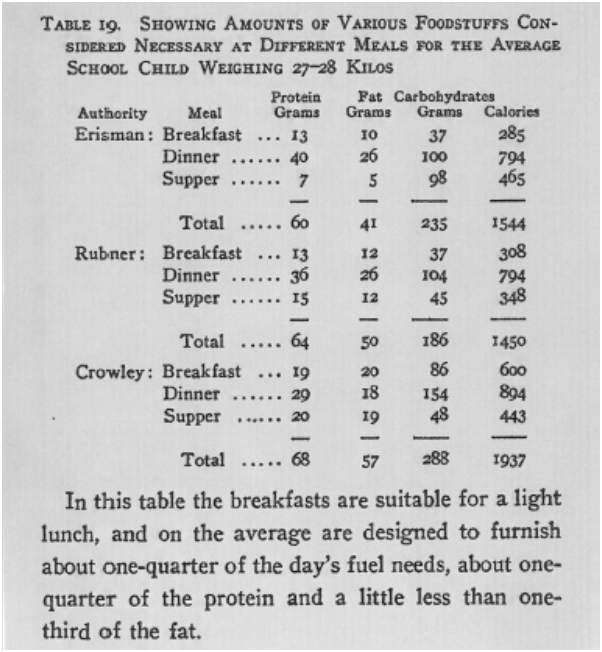
In 1790, Germany began the first school feeding program on record. In the early 1900s, the U.K. and several other European countries passed bills to enact school lunch programs. The following table shows the nutrition requirements for school children in Switzerland, Germany, and England circa 1900:2

Recommended nutritional requirements.2 Click to enlarge.

Recommended nutritional requirements.2 Click to enlarge.

The U.S. was late to follow, not passing legislation for a school lunch program until the 1940s. However, U.S. researchers had previously looked at the nutrition status of school aged children. In 1906, a Dr. Lechstecker in New York City examined 10,707 children and found that 439 had no breakfast and 998 had just coffee or coffee and bread. In 1908, of 10,090 children studied in Chicago, 825 suffered from malnutrition.2

In the 1940s, West Virginia surveyed students from various cities about their eating habits. They found that poor breakfasts were the biggest problem. By 1947 the state established the Good Breakfast for Every Man, Woman, and Child program with the slogan “Start the Day the Good Breakfast Way.”3

Some of the findings reported by West Virginia School Children’s Diet Study.3 Click to enlarge.

Some of the findings reported by West Virginia State Nutrition Committee.3 Click to enlarge.

In 1966, the Child Nutrition Act enacted The School Breakfast Program (SBP) as a pilot project. “During the first year of operation, the SBP served about 80,000 children at a federal cost of $573,000.”4 In fiscal year 2007, “the participating schools served . . . 1.7 billion breakfasts at a federal cost of $2.2 billion.”5 Current research shows that “10.8 million low-income children participated in the School Breakfast Program on an average day in school year 2012-2013, an increase of more than 310,000 children from the previous year.”6 And “for Fiscal Year 2012, the School Breakfast Program cost $3.3 billion, up from $1.9 billion in Fiscal Year 2005.”1

Today’s programs must meet the U.S. Dietary Guidelines for Americans, 2010, which provide evidence-based nutrition standards. The government will implement new guidelines in 2015 under the Federal Rule Nutrition Standards in the National School Lunch and School Breakfast Program. “This rule requires most schools to increase the availability of fruits, vegetables, whole grains, and fat- free and low-fat fluid milk in school meals; reduce the levels of sodium, saturated fat and trans-fat in meals; and meet the nutrition needs of school children within their calorie requirements.”7

ChooseMyPlateChoose MyPlate is an easy way for people to adhere to the dietary guidelines set out by the U.S. Dept. of Health and Human Services and the Dept. of Agriculture.

Breakfast is not just for school children. Remember to take time for breakfast no matter your age.

References

1. Hewins J, Burke, Mike. School Breakfast Scorecard: 2012-2013 School Year. Washington, DC: Food Research and Action Center (FRAC); 2014. http://frac.org/pdf/School_Breakfast_Scorecard_SY_2012_2013.pdf. Accessed January 31, 2014.

2. Bryant, Louise Stevens. School Feeding; Its History and Practice at Home and Abroad. Philadelphia: J. B. Lippincott Company; 1913. Access at: https://ia700505.us.archive.org/3/items/schoolfeedingits01brya/schoolfeedingits01brya.pdf

3. State of West Virginia. Start the Day the Good Breakfast Way: A Statewide Nutrition Program Sponsored by The West Virginia State Nutrition Committee September 1947-August 1948. State of West Virginia; 1948.

4. USDA Food and Nutrition Service website. http://www.fns.usda.gov/sbp/school-breakfast-program. Accessed February 10, 2014.

5. National Research Council. School Meals: Building Blocks for Healthy Children. Washington, DC: The National Academies Press; 2010. http://www.nap.edu/openbook.php?record_id=12751&page=1. Accessed on: January 31, 2014.

6. The School Breakfast Program:  Fact Sheet. Washington, DC:  USDA Food and Nutrition Service; http://www.fns.usda.gov/sites/default/files/SBPfactsheet.pdf. Accessed February 11, 2014.

7. Nutrition Standards in the National School Lunch and School Breakfast Programs. Fed Regist. 2012;77(17):4088-4167. To be codified at 7 CFR §210 and 220. http://www.gpo.gov/fdsys/pkg/FR-2012-01-26/pdf/2012-1010.pdf. Accessed on: January 31, 2014.

The Secret Surgeries of Grover Cleveland

By Arlene Shaner, Acting Curator and Reference Librarian for Historical Collections

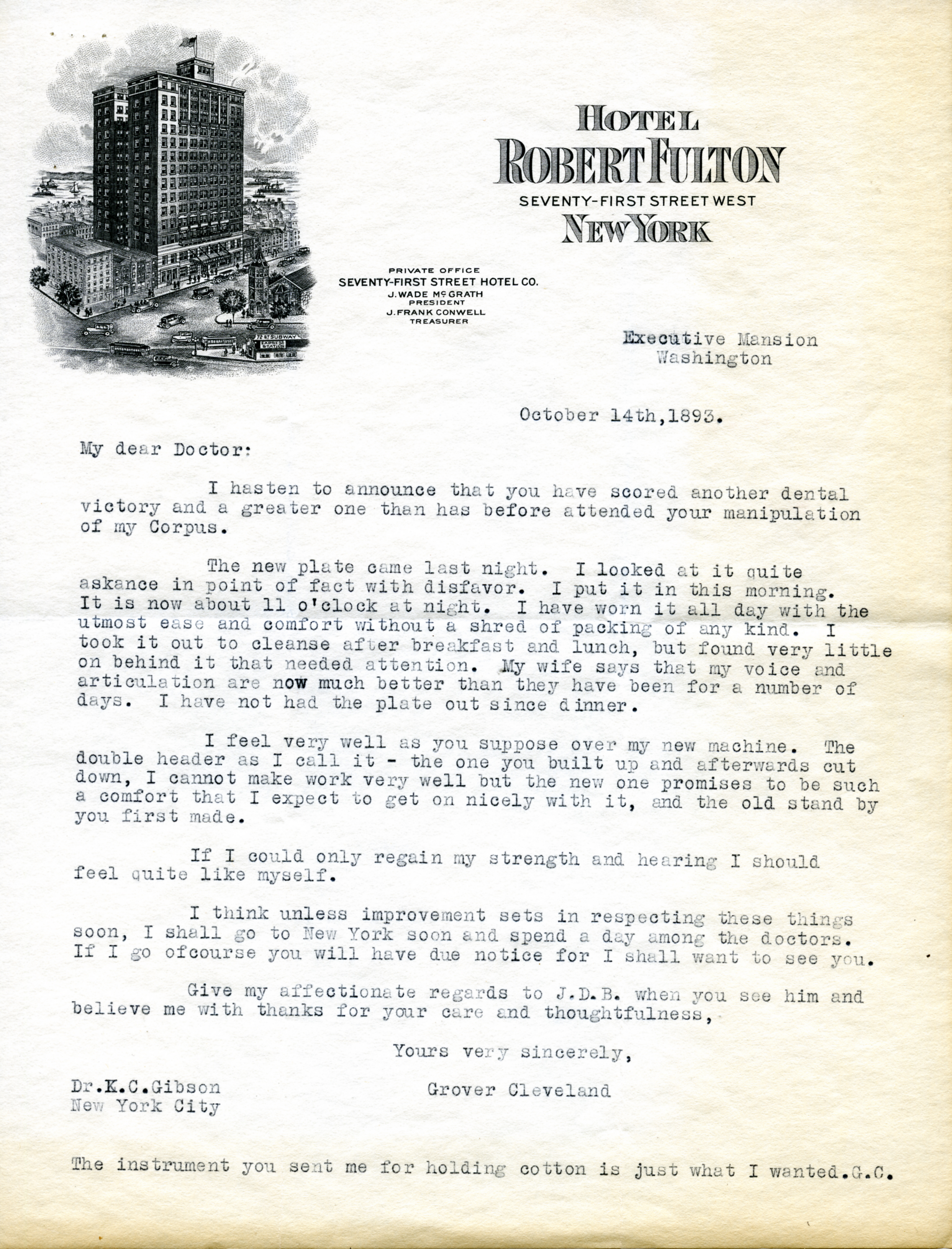
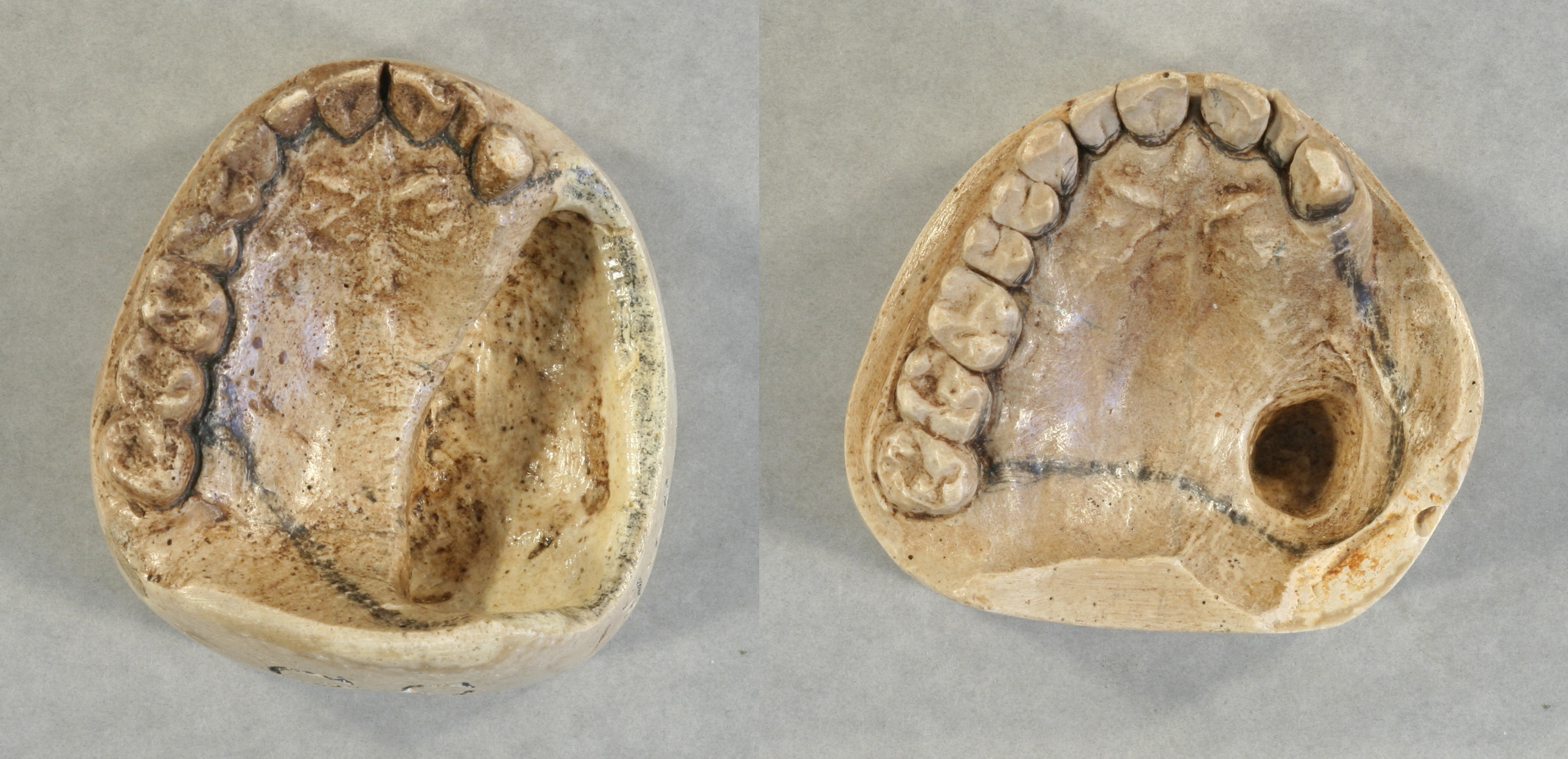
With the celebration of Presidents’ Day in February, it’s an apt time to look at what related materials can be found in our special collections. Among our dental artifacts are two casts of Grover Cleveland’s upper jaw, received in 1929 from Mrs. Kasson Gibson, the widow of Grover Cleveland’s long-time dentist. The casts came with a typescript copy of a letter from Cleveland to her husband dated October 14, 1893 reporting on his successful use of a hard rubber prosthesis Dr. Gibson had sent him the day before.

An 1893 letter from President Cleveland to his dentist, Dr. K.C. Gibson.

An 1893 letter from President Cleveland to his dentist, Dr. K.C. Gibson. Click to enlarge.

Only five months earlier, on July 1, Cleveland boarded the yacht Oneida and sailed out into the Long Island Sound with a group of physicians including Joseph D. Bryant, William W. Keen, R. M. O’Reilly, and Ferdinand Hasbrouck. In mid-June, O’Reilly discovered a suspicious rough patch on Cleveland’s upper palate and suggested that it should be removed. Dr. Bryant, Cleveland’s personal physician, performed the surgery on the yacht with the help of several assistants. By July 5, Cleveland was recuperating at his summer home, Grey Gables, until Bryant performed a second brief surgery, again on the yacht, on July 17.

The first cast of Cleveland’s jaw, made in 1893, shows the extent of the damage to his upper palate and jaw while the second cast demonstrates how much healing and regeneration of tissue took place over the course of the next several years. Bryant operated through Cleveland’s mouth in order to minimize any external signs of injury, especially since Cleveland and his physicians were determined to keep the severity of his illness as quiet as possible. Gibson was not present at the surgery, but treated Cleveland as he recovered and took care of his other dental needs.

The 1893 (left) and 1897 (right) casts of President Cleveland's top teeth.

The 1893 (left) and 1897 (right) casts of President Cleveland’s top jaw. Click to enlarge.

Cleveland’s physicians and friends released no information about the surgery to the public, telling visiting reporters at first that the President was suffering from rheumatism and then that he had only a mild dental ailment. When The Press, a Philadelphia newspaper, published a much fuller account of the operation later in the summer, it stunned the public. The country was in the middle of an economic depression and Congress held a special session on August 7 to vote on the repeal of the Sherman Act, as arguments between the advocates and opponents of free silver exacerbated the country’s economic problems in 1893. The suggestion that the President might be seriously ill could have created a serious panic.

As a manuscript letter to Gibson from 1896 in the NYAM collections shows, Cleveland was not without a sense of humor regarding his continuing dental maladies and their relationship to his political sympathies. “This morning about an hour ago there came out of a tooth on my right under jaw next to the dead tooth you fixed up a piece of gold the size of a small pin,” Cleveland wrote to Gibson on June 9, 1896. “This shows how completely I have been on the gold standard. I’ve got the gold in my possession. What shall I do with it?”

An 1896 letter from President Cleveland to his dentist, Dr. K.C. Gibson.

An 1896 letter from President Cleveland to his dentist, Dr. K.C. Gibson. Click to enlarge.

Joseph Bryant intended to publish an account of the Cleveland surgeries himself, but never completed one. After he died in 1914, Dr. William Keen, who assisted at both surgeries, wrote and published his own first-hand account of the operations, which can be read here.

More Doctors Smoke Camels

By Johanna Goldberg, Information Services Librarian, with Andrew Gordon, Systems Librarian

This is part of an intermittent series of blogs featuring advertisements from medical journals. You can find the entire series here.

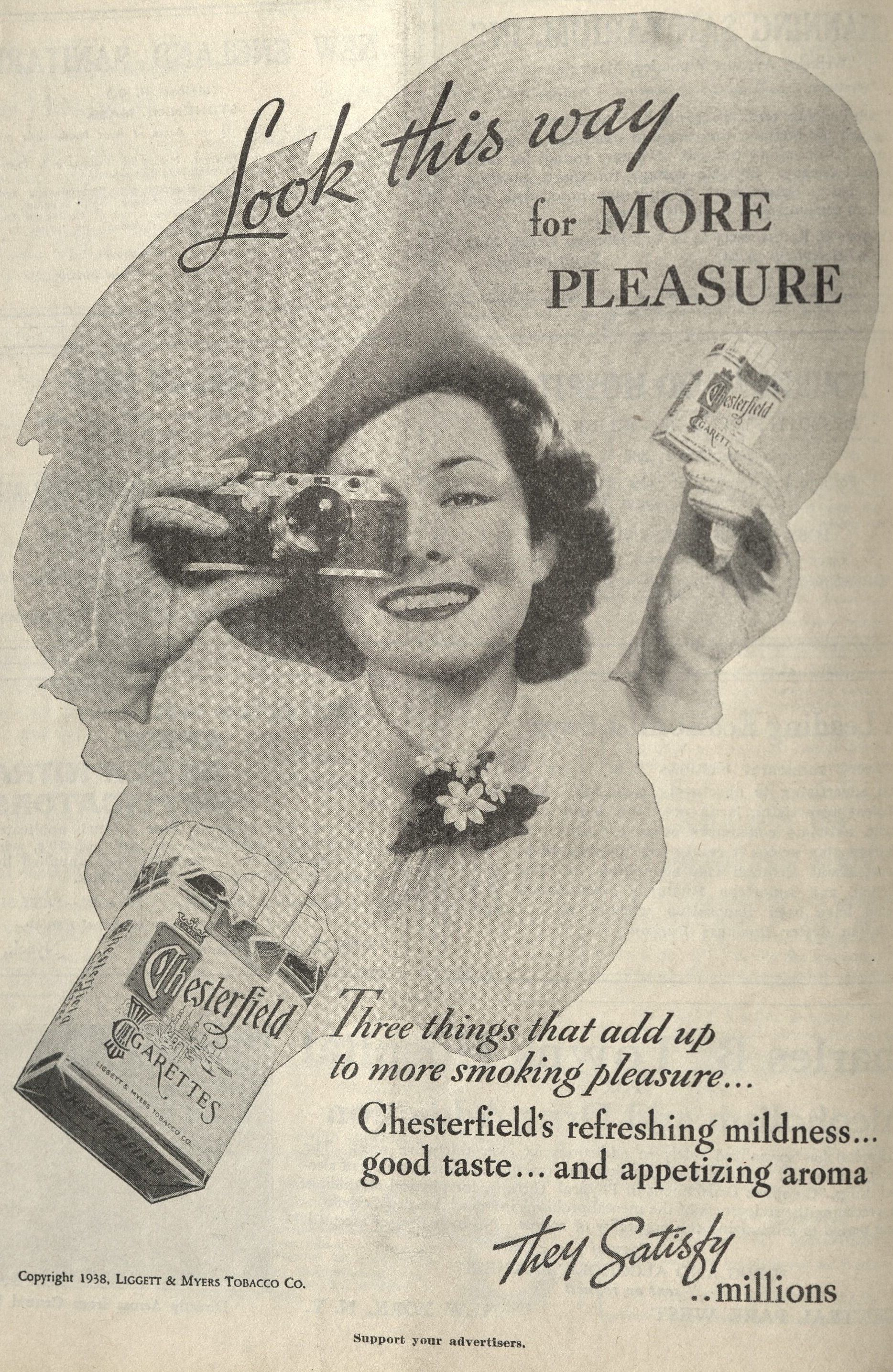
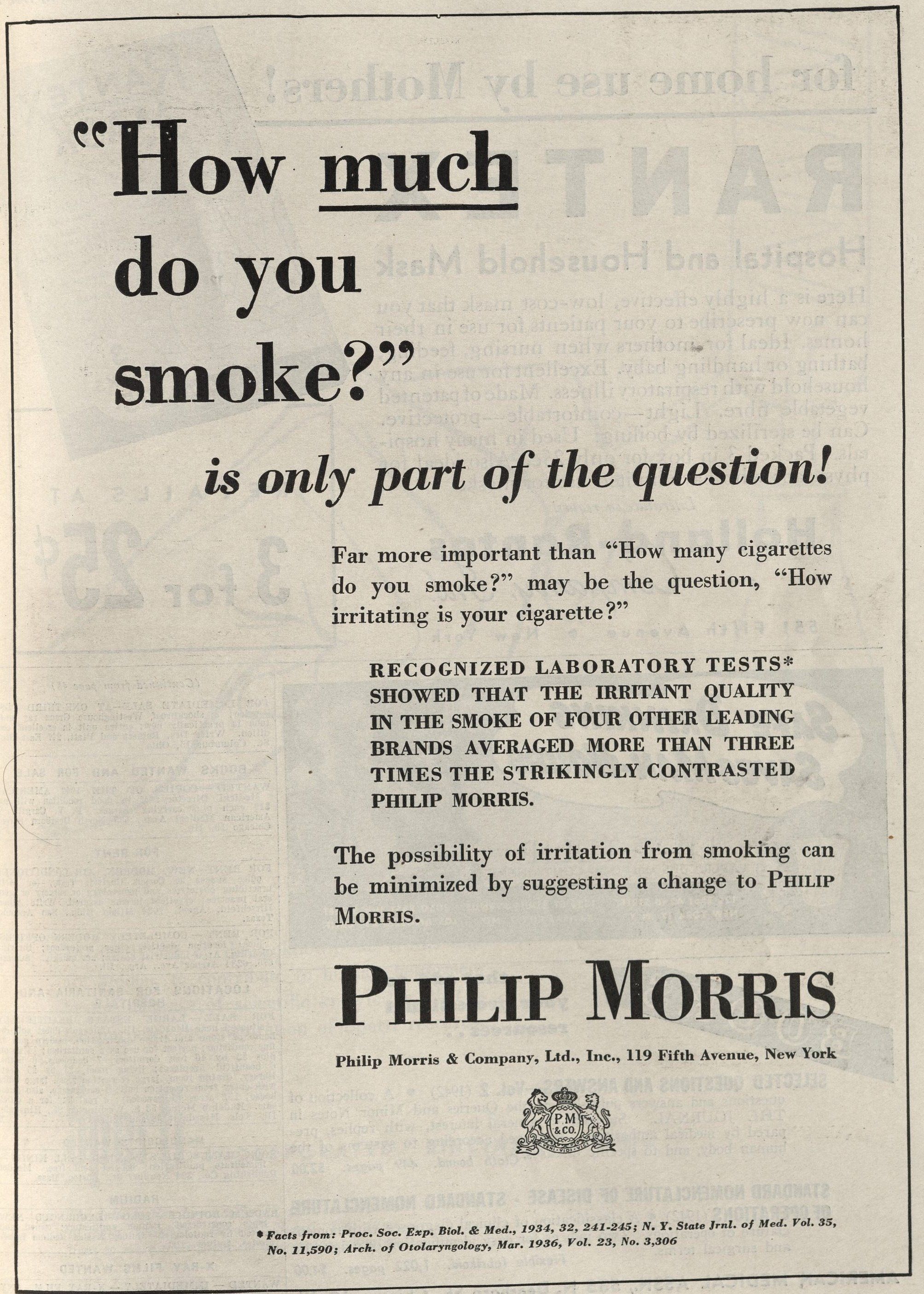
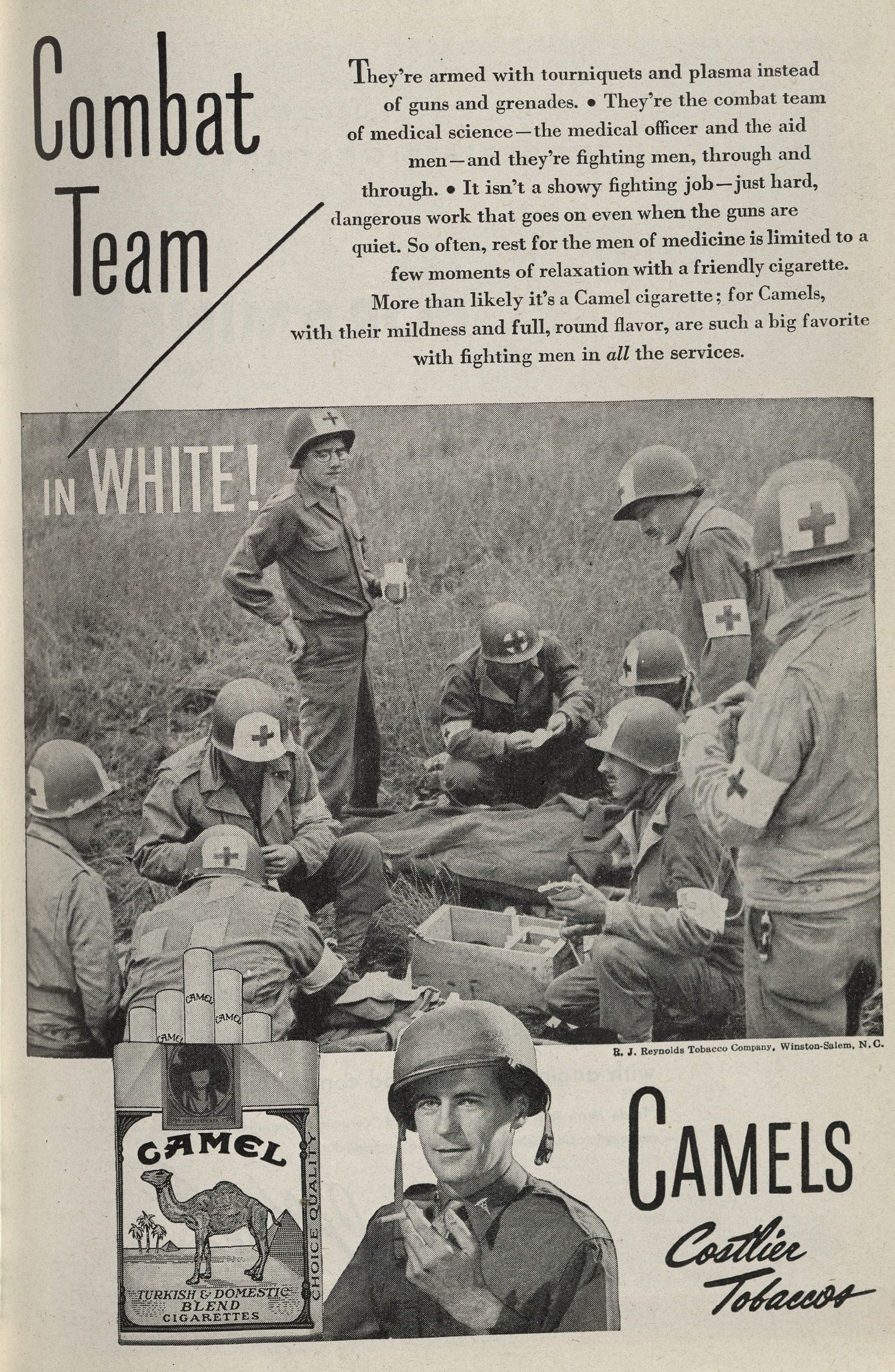
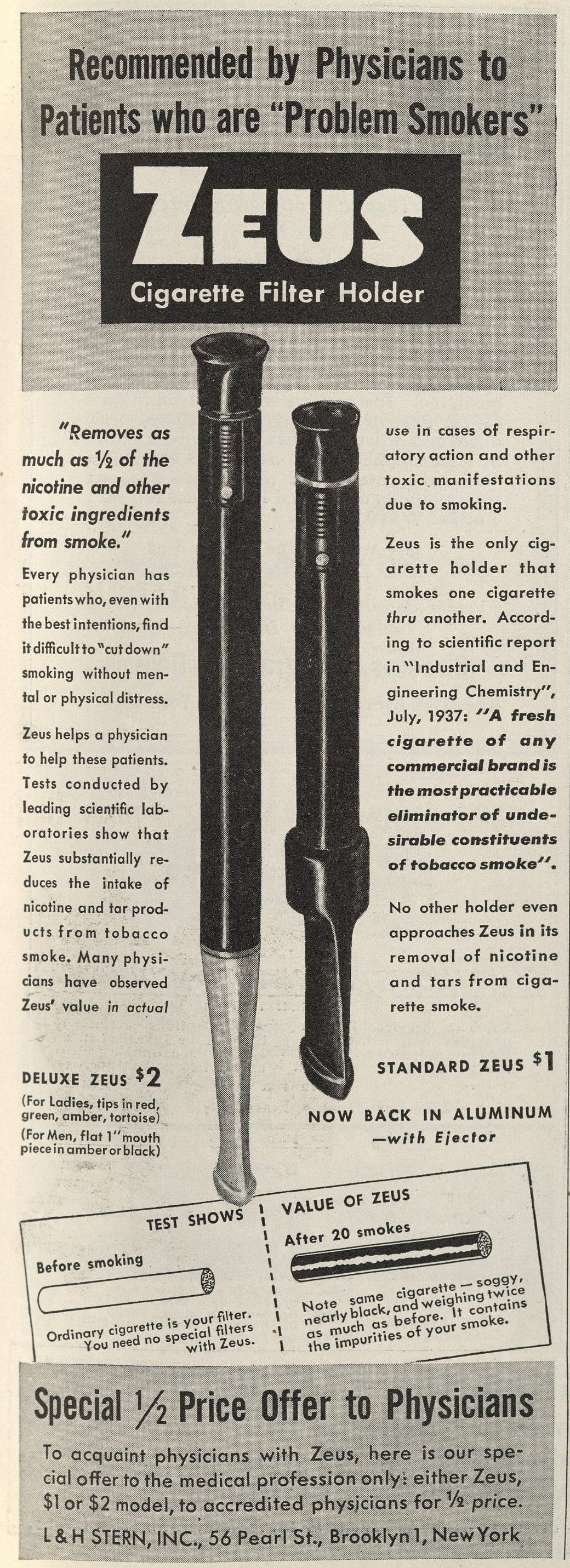
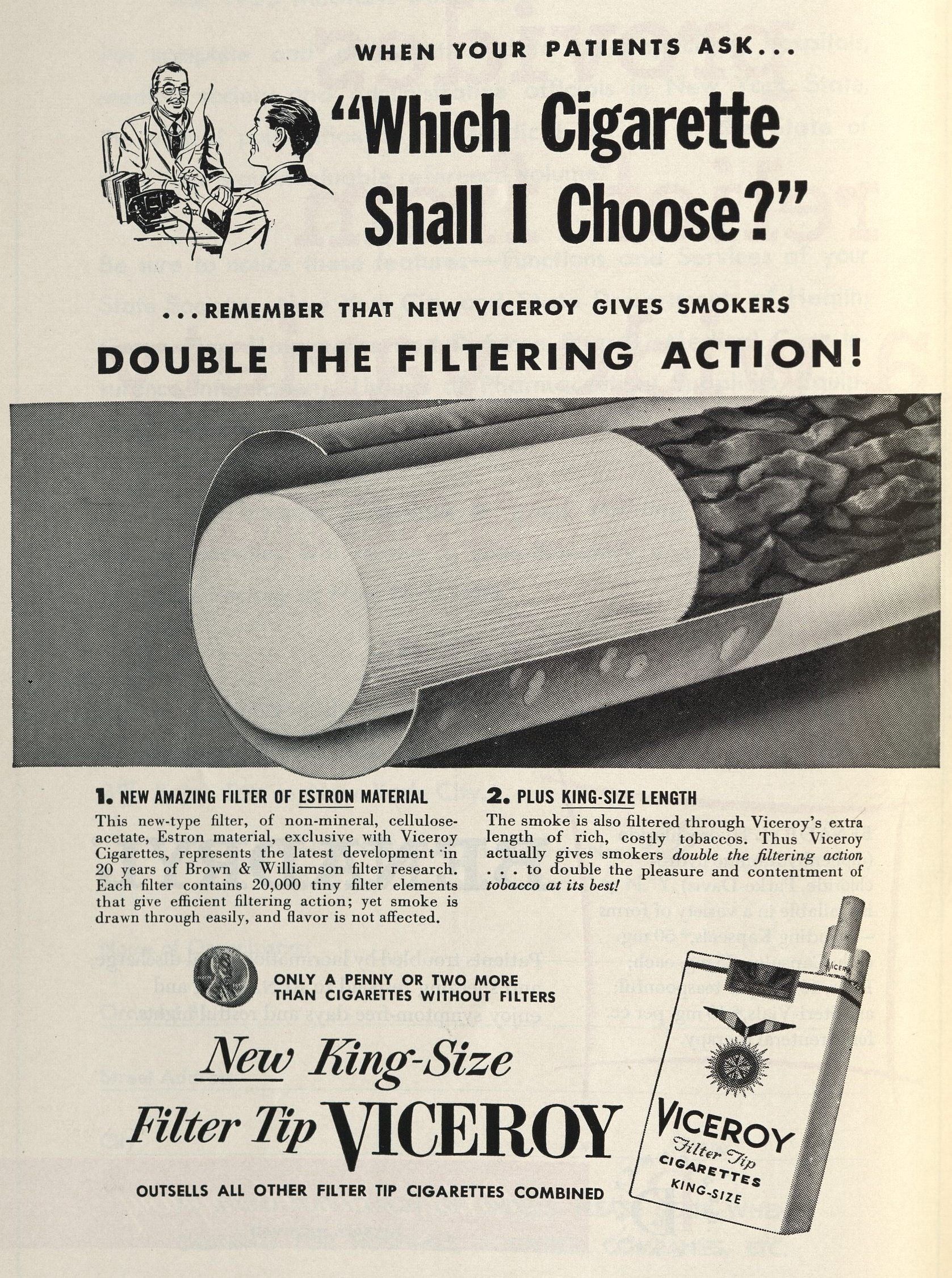
From the 1930s into the 1950s, medical journals—including the Journal of the American Medical Association and the New England Journal of Medicine—ran advertisements for cigarettes.1,2 The New York State Journal of Medicine alone published 600 pages of cigarette advertisements spanning more than two decades, starting in 1933.3 Around the same time, advertising agencies created campaigns featuring physicians; these continued until 1954, as concerns about the negative health effects of smoking grew.2

"How mild can a cigarette be?" Published in the New England Journal of Medicine, volume 240, number 17, April 28, 1949. Click to enlarge.

“How mild can a cigarette be?” Published in the New England Journal of Medicine, volume 240, number 17, April 28, 1949. Click to enlarge.

Presented chronologically below are some of the cigarette advertisements—and one cigarette paraphernalia‎ ad—that appeared in medical journals during the 20-year period. Note especially the 1945 series of ads that ran in several medical journals, including the Medical Woman’s Journal, celebrating the work of war doctors and suggesting that a Camel cigarette could be a welcome break.

Notable, too, is that the earliest ad shown here—printed in Preventive Medicine in 1937—comes from a New York Academy of Medicine publication.

For more information on the history of cigarette advertising, including the use of medical professionals in ads, visit SRITA, Stanford Research into the Impact of Tobacco Advertising.

"Let Your Own Experience Guide You." Published in Preventive Medicine, volume 7, number 1, April 1937. Click to enlarge.

“Let Your Own Experience Guide You.” Published in Preventive Medicine, volume 7, number 1, April 1937. Click to enlarge.

"Look this way for more pleasure." Published in the New England Journal of Medicine, volume 218, number 14, April 7, 1938. Click to enlarge.

“Look this way for more pleasure.” Published in the New England Journal of Medicine, volume 218, number 14, April 7, 1938. Click to enlarge.

"How much do you smoke?" Published in JAMA, volume 12, number 11, March 11, 1944. Click to enlarge.

“How much do you smoke?” Published in JAMA, volume 12, number 11, March 11, 1944. Click to enlarge.

"The Army Doctor's Call to Action!" Published in Medical Woman's Journal, volume 52, number 4, April 1945. Click to enlarge.

“The Army Doctor’s Call to Action!” Published in the Medical Woman’s Journal, volume 52, number 4, April 1945. Click to enlarge.

Combat Team in White! Published in Medical Woman's Journal, volume 52, number 5, May 1945. Click to enlarge.

Combat Team in White! Published in the Medical Woman’s Journal, volume 52, number 5, May 1945. Click to enlarge.

"The Flying Capsules." Published in Medical Woman's Journal, volume 52, number 6, June 1945. Click to enlarge.

“The Flying Capsules.” Published in the Medical Woman’s Journal, volume 52, number 6, June 1945. Click to enlarge.

"Welcome Home, Doctor!" Published in Medical Woman's Journal, volume 52, number 12, December 1945.

“Welcome Home, Doctor!” Published in the Medical Woman’s Journal, volume 52, number 12, December 1945. Click to enlarge.

"Recommended by Physicians to Patients who are 'Problem Smokers.'" Published in JAMA, volume 133, number 11, March 15, 1947.

“Recommended by Physicians to Patients who are ‘Problem Smokers.'” Published in JAMA, volume 133, number 11, March 15, 1947. Click to enlarge.

"Some questions about filter cigarettes that may have occurred to you, Doctor." Published in the New York State Journal of Medicine, volume 53, number 12, June 15, 1953.

“Some questions about filter cigarettes that may have occurred to you, Doctor.” Published in the New York State Journal of Medicine, volume 53, number 12, June 15, 1953. Click to enlarge.

"When your patients ask . . . 'Which Cigarette Shall I Choose?'" Published in the New York State Journal of Medicine, volume 54, number 12, June 15, 1954. Click to enlarge.

“When your patients ask . . . ‘Which Cigarette Shall I Choose?'” Published in the New York State Journal of Medicine, volume 54, number 12, June 15, 1954. Click to enlarge.

References

1. Healy, M. (2011, August 4). Cigarette packages in medical journals: New look for a new age. Los Angeles Times. Retrieved from http://www.latimes.com/health/boostershots/la-heb-cigarette-packages-medical-20110804,0,7658494.story#axzz2rL60QSQm.

2. Gardner, M. N., & Brandt, A. M. (2006). The Doctors’ Choice Is America’s Choice. American Journal of Public Health, 96(2), 222–232. Retrieved from http://www.ncbi.nlm.nih.gov/pmc/articles/PMC1470496.

3. Blum, A. (2010). When “More doctors smoked Camels”:  Cigarette advertising in the journal. Social Medicine, 5(2), 114–122. Retrieved from http://www.socialmedicine.info/index.php/socialmedicine/article/view/461/0.

Slings and Arrows

By Arlene Shaner, Acting Curator and Reference Librarian for Historical Collections

Commercially printed greetings for Valentine’s Day appeared in the United States in the first part of the 19th century. Although most printed valentines expressed sentimental attachment, a tradition of sending comic cards developed, especially in Great Britain and the United States. Postcards became popular early in the 20th century and offered an inexpensive way to send these greetings.

Our doctor and druggist valentine postcards. Click to enlarge.

Our doctor and druggist valentine postcards. Click to enlarge.

At first glance, these postcards with their skewering verses do not seem to be valentines at all; a look at the reverse of the card, however, demonstrates that they were meant as such. As Bill Helfand, a notable collector of medical and pharmaceutical ephemera, notes in his article “Pharmaceutical and Medical Valentines,” many of these valentines were issued in sets, and our two caricature valentines were part of a set.

The reverse side of a valentine.

The reverse side of a valentine. Click to enlarge.

Our doctor and druggist cards arrived last winter as a gift from a donor with a longstanding interest in ephemera, along with a reprint of Bill Helfand’s article, which contains a checklist on which both of these valentines appear. The short verses on the two cards malign the doctor and the druggist as potentially criminal dispensers of drugs and alcohol, rather than as professionals with the health of their patients in mind. “There is little in any of these greetings to suggest the professional role that the pharmacist or the physician played in the community at the time,” Helfand reminds us, “But, of course, that was not the intent at all.”

Reference

William H. Helfand, “Pharmaceutical and Medical Valentines,” Pharmacy in History 20:3 (1978), pp. 101-110.

New Acquisitions at the Library

By Jarlin Espinal, Technical Services Assistant

Below is a selection of some of our recently acquired secondary sources in the history of medicine, along with blurbs about each book. Make an appointment to come and use them!

Nine of the library's new acquisitions.

Nine of the library’s new acquisitions. Click to enlarge.

Making Women’s Medicine Masculine: The Rise of Male Authority in Pre-Modern GynaecologyMonica H. Green

“Green has painstakingly studied the content and circulation of medieval texts on women’s medicine…[and] disproves popular ideas of the Middle Ages as a Golden Age for women’s control over their own bodies.” – Medical History

The Sick Child in Early Modern England, 1580–1720 – Hannah Newton

The Sick Child in Early Modern England is a powerful exploration of the treatment, perception, and experience of illness in childhood from the late sixteenth to the early eighteenth century. At this time, the sickness or death of a child was a common occurrence—over a quarter of young people died before the age of fifteen—and yet this subject has received little scholarly attention.”

Vernacular Bodies: The Politics of Reproduction in Early Modern England – Mary E. Fissell

“Making babies was a mysterious process in early modern England. Mary Fissell employs a wealth of popular sources—ballads, jokes, witchcraft pamphlets, Prayer Books, popular medical manuals—to produce the first account of women’s productive bodies in early-modern cheap print.”

Headache: Through the Centuries – Mervyn J. Eadie

“Nobody is better suited to provide a history of headache than Mervyn Eadie, a distinguished neurologist, historian and established author. Here he provides a beautifully written, lucid account of headaches from the time of ancient Greece and Egypt to 2000 A.D.”– J. M. S. Pearce, MD, FRCP, Emeritus Consultant Neurologist, Hull Royal Infirmary, Yorkshire, England

The Perils of Peace: The Public Health Crisis in Occupied Germany – Jessica Reinisch

“In The Perils of Peace, Jessica Reinisch considers how the four occupiers—Britain, France, the Soviet Union, and the United States—attempted to keep their own troops and the ex-enemy population alive. While the war was still being fought, German public health was a secondary consideration for them: an unaffordable and undeserved luxury. But once fighting ceased and the occupation began, it rapidly turned into an urgent priority. Public health was then recognized as an indispensable component of creating order, keeping the population governable, and facilitating the reconstruction of German society.”

William Harvey: A Life in Circulation – Thomas Wright

“Thomas Wright’s book opens brilliantly and bloodily and continues in the same vein … a captivating, intellectually gripping journey into [England’s] scientific past.” – Druin Burch, Mail on Sunday

Medicine’s Michelangelo: The Life & Art of Frank H. Netter, MD – Francine Mary Netter

“This delightful book traces the extraordinary career of Frank Netter, who gave his gift of unparalleled medical knowledge to generations of medical student and their preceptors. This memoir, by his daughter Francine, helps us appreciate his lucid, lifelike art, from which we build our growing knowledge of the healing arts.” – Joseph B. Martin, PhD, MD, Edward R. and Anne G. Lefler Professor of Neurobiology, Harvard Medical School

Virus Hunt: The Search for the Origin of HIV – Dorothy H. Crawford

“This is not a book about AIDS as a disease. Rather, Dorothy H. Crawford gives us a scientific detective story. She tells how, over the past 20 years or so, scientists tracked down the origin of HIV, the virus that causes AIDS.”

Body and Soul: The Black Panther Party and the Fight Against Medical Discrimination – Alondra Nelson

“In Body and Soul, Alondra Nelson combines careful research, deep political insight, and passionate commitment to tell the little-known story of the Black Panther Party’s health activism in the late 1960s. In doing so, and in showing how the problems of poverty, discrimination, and access to medical care remain hauntingly similar more than forty years later, Nelson reminds us that the struggle continues, particularly for African Americans, and that social policies have profound moral implications.” Rebecca Skloot, author of The Immortal Life of Henrietta Lacks

Announcing Our Performing Medicine Festival

Header for Performing Medicine FestivalJoin us on April 5, 2014 to explore the interrelationships of medicine, health, and the performing arts with a day-long festival of actors, dancers, doctors, and musicians. Register here.

Performers will include Dr. Richard Kogan on the mental life of famous composers; Brian Lobel and his comedic adventures as a cancer patient; David Leventhal and Pamela Quinn on dance and Parkinson’s disease with DANCE FOR PD® from Mark Morris Dance Group/Brooklyn Parkinson Group; the medical musicians of Mount Sinai on the art of listening; with discussions, musical interludes from Weill Cornell’s Music and Medicine Initiative, and more.

Throughout the day there will be guided behind-the-scenes tours of our Coller Rare Book Reading Room and and Gladys Brooks Book & Paper Conservation Laboratory. Spaces are limited to 20 people per tour; make sure to get your tickets early!

This will be the first of two festivals in 2014 exploring the connections between medicine, health, and the performing and visual arts. In the fall our main festival, Vesalius 500: Art and the Body, will celebrate the 500th anniversary of the birth of Andreas Vesalius and the impact of his De Humani Corporis Fabrica or The Fabric of the Human Body. Like our 2013 Festival, the day will feature multiple strands of programs, performances, workshops and interactive events.