The Right to Health (Item of the Month)

By Paul Theerman, Associate Director, Center for the History of Medicine and Public Health

Does one have a “right to health”? And if so, what does that right entail? Access to healthcare? Access to all healthcare? Equality of health outcomes?

The debate in this country over passage of the Affordable Care Act brought to the fore the differing assumptions over a “right to health.” Yet since at least 1946, members of the United Nations have asserted the right to health as a fundamental global human right. The constitution of the World Health Organization “enshrines the highest attainable standard of health as a fundamental right of every human being.”1 This right was further stated in the Universal Declaration of Human Rights of 1948—framed as the right to a standard of living “adequate for health and well-being.”2 The right to health remains a formative principle in global health. For example, three of the UN’s eight Millennium Development Goals are explicitly health related, and all have a health component.3

Though this right to health reached its full flower in the mid-20th century, it originated some 50 years earlier. In the late 19th century, urban and industrial ills had pushed their way onto the political agenda across the western world. Many reformers thought that supporting political rights was not enough: social and economic rights needed to be affirmed as well. One of these thinkers was the New York City-based urban researcher William Harvey Allen. In a series of books, and most notably Civics and Health (1909), Allen laid out the reasons why health was a human right.4

“Necessary to Efficient Democracy,” the way that experience in schools and other institution is brought to the public, in William Harvey Allen, Civics and Health, 1909), p. 310.

“Necessary to Efficient Democracy,” the way that experience in schools and other institutions is brought to the public, in Allen, Civics and Health, 1909, p. 310.

Allen made granting the right to health the apex of moral development, both in the individual and the society. He placed “rights” as the last and best of the seven motivations for public health action, starting with instinct and ranging through commerce to humanitarianism.5 Indeed, to promote health Allen said one could not rely on the love of money or the joy of human sympathy: “So long as those who suffer have no other protection than the self-interest or the benevolence of those better situated, disease and hardship inevitably persist.”6 By society’s affirming the right to health, it acknowledged that the citizenry’s well being had a claim on its attention and resources, and it made itself accountable to provide it. “Health administration is incomplete until its blessings are given to men, women, and children as rights that can be enforced through courts, as can the right to free speech, the freedom of the press, and trial by jury,” wrote Allen. The political rights claimed in the eighteenth century meant little if one did not have the physical means to exercise them in the twentieth. Those “permanently incapacitated . . . cannot appreciate the privilege of pursuing happiness.”7

According to Allen, it was not that people did not know what to do to secure public health—for the most part they did. It was rather that the means were often shunted aside, a problem of enforcement—and hence his argument for health as a right! Allen looked to find the most practical way to correct health deficiencies, and as co-director of the city’s newly established Bureau of Municipal Research, he looked upon all of New York as a test site.8 Here, he turned his attention to the health of school children, “the best index to community health.”9 Determining the status of children’s health was a comprehensive way of judging the health of the whole community, as children from all ranks of the community were available to reformers, and the mechanisms were already in place to examine and collect data. Allen saw children’s health as the indicator, not just to the health of the city, but to the right to health. Much of his book was devoted to measuring as well as intervening in children’s health, in such ways as enforcing milk purity laws, quarantines for communicable diseases, and vaccination for smallpox. He was concerned with controlling germs, paying attention to eye and ear health, and promoting school play and physical education. He saw the health of teachers as crucial to that of their charges. And, as detailed in our earlier blog post, he supported removal of tonsils and adenoids.
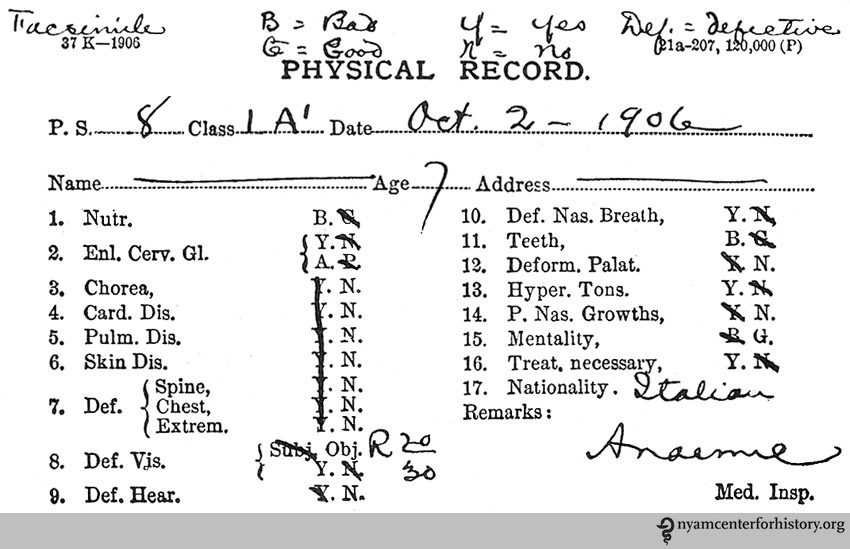
Sample record card for school physical examination, as found in Allen, Civics and Health, 1909, p. 34. As Allen noted: “Weight, height, and measurements are needed to tell the whole story.”

Sample record card for school physical examination, as found in Allen, Civics and Health, 1909, p. 34. As Allen noted: “Weight, height, and measurements are needed to tell the whole story.”

Yet, Allen did not think that the solution lay only in better school health. Society as a whole needed to address the health of its members throughout their lives. He suggested measures such as coordinating school health with other social agencies, requiring work physicals and promoting industrial hygiene, waging war on the “white plague” of tuberculosis, providing physicians with training not just in restorative medicine but also in preventive medicine, discouraging tobacco and alcohol use, and setting up institutions for large-scale information gathering and coordination through a national bureau of health.10

Many of Allen’s practical ideas today seem commonplace in the wake of the great shifts in public health that took place in the 20th century. But one thing stands out: seeing health as a right brought it out of the realm of enlightened self-interest and humanitarian relief. Health became social, health became enforceable, health became a right. That legacy, contested though it now is in American society, remains present today.

References

1. World Health Organization, Fact Sheet No. 323, “The Right to Health,” reviewed November 2013, http://www.who.int/mediacentre/factsheets/fs323/en/#, accessed September 23, 2015.

2. United Nations, “Universal Declaration of Human Rights,” Article 25, http://www.un.org/en/documents/udhr/, accessed September 23, 2015.

3. For the UN Millennium Development Goals, see http://www.un.org/millenniumgoals/, accessed September 23, 2015; for a summary of international conventions, see Mervyn Susser, “Health as a Human Right: An Epidemiologist’s Perspective on the Public Health,” American Journal of Public Health 1993 March; 83 (3): 418–26.

4. William Harvey Allen, Civics and Health, with an introduction by William T. Sedgwick (Boston, New York, Chicago, and London: Ginn and Company, 1909). For information on Allen (1874–1963), see in addition to the Recchiuti book below: “Reminiscences of William Harvey Allen: oral history, 1950,” Columbia Center for Oral History, http://oralhistoryportal.cul.columbia.edu/document.php?id=ldpd_4072329.

5. Allen, Civics and Health, pp 11–22. The seven motivations are Instinct, Display, Commerce, Anti-Nuisance, Anti-Slum, Pro-Slum [Abatement], and Rights.

6. Allen, Civics and Health, 20.

7. Allen, Civics and Health, 20.

8. For Allen and the Bureau of Municipal Research, see John Louis Recchiuti, Civic Engagement: Social Science and Progressive-Era Reform in New York City (Philadelphia: University of Pennsylvania Press, 2006), Chapter 4, pp. 98–124.

9. The phrase comes from the title of Chapter 4, “The Best Index to Community Health is the Physical Welfare of School Children,” page 33.

10. Allen, Civics and Health, Part III, “Coöperation in Meeting Health Obligations,” and Part IV, “Official Machinery for Enforcing Health Rights.” For an earlier attempt at a national bureau of health, see Jerrold M. Michael, “The National Board of Health: 1879–1883,” Public Health Reports 2011 Jan-Feb; 126(1): 123–29.

Prescription for Healthy Aging

By Danielle Aloia, Special Projects Librarian

September marks Healthy Aging® Month, a good time to evaluate your health. In the 1899 Good Health article “The Road from Life to Death,” Dr. David Paulson suggests that “the velocity with which men travel down grade toward ill health and death is largely regulated by themselves.” At any time a person can change deleterious habits and return to the road toward health. The worse your habits the harder it is to change course.1

From: Paulson D. The road from life to death. Good Health. 1899;34(8):481-482.

From: Paulson D. The road from life to death. Good Health. 1899;34(8):481-482. Click to enlarge.

In the diagram above Paulson describes certain stations as turning points. The “Business Pressure” station is marked by mental worry and sedentary habits. “Wretched Sanitation” refers to lack of fresh air and abundance of germs. The “Unnatural Demands of Modern Society” places blame on late hours and evening entertainment. The final station, “Intemperance and Dissipation,” is plagued by immorality, tobacco, and poor diet. Notice that at every station there is a “Reform” signal, a marker to let you know it’s time to make a U-turn toward health.

Even 116 years after the publication of Paulson’s article, we can still relate to the demands of each station. According to a 2013 CDC report, heart disease has been the leading cause of death since 1900, except during the influenza pandemic of 1918-1920.2 The authors offer a prescription: “Practicing healthy behaviors from an early age and getting recommended screenings can substantially reduce a person’s risk of developing chronic diseases and associated disabilities.”

It’s never too late to start living a healthier life. A list from 1954—which holds up well today—gives further specifics on how to make the switch to better health (if only we could all reside in temperate climates):3

From Walker, K. Living Your Later Years. New York: Oxford University Press; c1954.

From: Walker, K. Living Your Later Years. New York: Oxford University Press; c1954.

References

1. Paulson D. The road from life to death. Good Health. 1899;34(8):481-482.

2. The State of Aging and Health in America 2013. Atlanta: CDC; 2013:60. Available at: http://www.cdc.gov/features/agingandhealth/state_of_aging_and_health_in_america_2013.pdf.

3. Walker, K. Living Your Later Years. New York: Oxford University Press; c1954.

Back to School! Conservation of the Academy’s 19th- and 20th-Century Medical Student Notebooks

By Erin Albritton, Head of Conservation and Arlene Shaner, Historical Collections Reference Librarian

A small sample of student notebooks from the library’s collection.

A small sample of student notebooks from the library’s collection.

The New York Academy of Medicine Library’s manuscript collections feature a number of notebooks kept by medical students while they studied to become physicians. These notebooks, which contain both class notes and clinical reports created by students as they followed professors on rounds, are fascinating repositories of information that enrich our understanding of medical education during the 19th and early 20th centuries.

Title page from Marcus Lorenzo Taft’s Notes of a Course of Lectures on Surgery by Valentine Mott, M.D., 1842–44.

Title page from Marcus Lorenzo Taft’s Notes of a Course of Lectures on Surgery by Valentine Mott, M.D., 1842–44.

In January, the New York State Discretionary Grant Program for the Conservation and Preservation of Library Research Materials awarded the Gladys Brooks Book and Paper Conservation Laboratory funding to carry out conservation treatment on 42 notebooks from the collection, all of which were created by students studying at medical colleges in New York City between 1827 and 1909. Contract conservator Jayne Hillam completed the conservation portion of the grant project in June. Following cataloging updates, the materials will soon be available for use.

An abundance of published resources can be used to research the world of 19th– and early 20th-century medical education. Circulars, annual reports, and catalogs provide scholars with detailed information about admission requirements, programs of instruction, textbooks, schedules of clinical demonstrations, faculty and student rosters, and even the addresses of boarding houses where students lived. In addition, printed copies of inaugural and valedictory addresses delivered by faculty members to student audiences offer a record of what physicians and faculty members thought medical students should know about the world of medical practice. Missing from these printed sources, however, is an intimate sense of how students actually learned to be physicians—i.e., what they studied in their classes and on clinical rounds; how they recorded that information for their own personal use; and how their understanding of the subject matter may have changed over time.

The 42 student notebooks conserved under this grant help bridge that gap, providing a window into the evolution not only of medical education, but of American higher education in general, and offering detailed evidence of the curriculum taught to medical students as medicine evolved through the 19th century. These notebooks also tell us a great deal about the students themselves, showing how they mastered the subjects they studied, what they learned from observing clinical demonstrations, and what professorial advice they deemed worth transcribing.

Harold Mixsell’s notes and charming illustration about caffeine, from the pharmacology lectures delivered by Dr. Walter Bastedo at New York’s College of Physicians and Surgeons, 1907.

Harold Mixsell’s notes and charming illustration about caffeine, from the pharmacology lectures delivered by Dr. Walter Bastedo at New York’s College of Physicians and Surgeons, 1907.

A reminder about the proper method of examining patients with scarlet fever, from Harold Mixsell’s notes from medical clinics in 1908.

A reminder about the proper method of examining patients with scarlet fever, from Harold Mixsell’s notes from medical clinics in 1908.

In addition to their content, the notebooks in this collection (which include both ready-made blank books and more finely bound presentation pieces) are also a valuable source of information about binding structures. They were produced during a pivotal moment in American bookbinding history when the traditions of the hand binding period gave way to the Industrial Era. In this case, the physical objects provide researchers with a unique opportunity to explore how the mass production and availability of blank books in the 19th century might have influenced classroom learning and the transmission of knowledge.

Three ready-made notebooks after conservation treatment.

Three ready-made notebooks after conservation treatment.

While most of these manuscripts were, quite clearly, student working copies (hastily written and illustrated, and characterized by a parsimonious use of paper), several were created as prize notebooks—the result of a 19th-century practice in which institutions and faculty members awarded cash prizes to students who demonstrated skill in note taking. As ideas about education evolved, the creation of prize notebooks came to be viewed more as a distraction than an enhancement to the learning process, and the competitions were eventually discontinued. That said, with their decorated bindings, artful title pages, expertly rendered calligraphy and hand-colored illustrations, the prize notebooks in the Academy’s collection are beautiful objects that amaze and delight any modern-day student note taker.

John Edwin Stillwell’s prize notebook of Dr. Fessenden Nott Otis’s lectures on venereal diseases, 1874–75.

John Edwin Stillwell’s prize notebook of Dr. Fessenden Nott Otis’s lectures on venereal diseases, 1874–75.

Stillwell’s prize notebook recording the gynecological clinics of Dr. T. Gaillard Thomas, 1873–74.

Stillwell’s prize notebook recording the gynecological clinics of Dr. T. Gaillard Thomas, 1873–74.

While the majority of notebooks in the collection have fared well since their creation, the 42 manuscripts selected for this grant all required some type of conservation treatment, ranging from simple cleaning to advanced paper and binding repair. Thanks to the generous financial support of the New York State Library’s Division of Library Development, these repairs are now complete and the notebooks can once again be referenced safely without fear of damage.

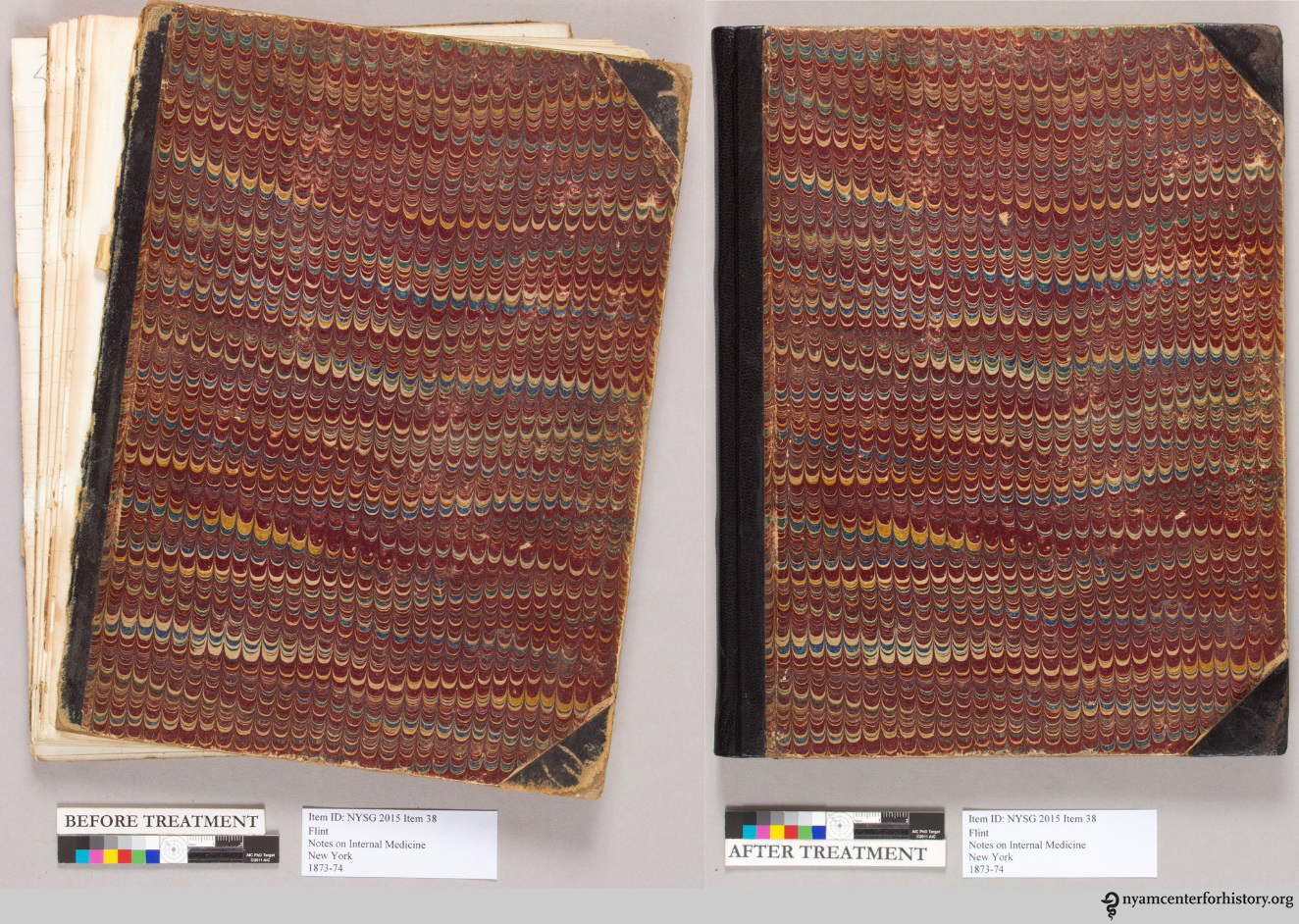
Before and after conservation treatment of a student notebook containing notes on internal medicine, 1873–74.

Before and after conservation treatment of a student notebook containing notes on internal medicine, 1873–74.

Join Us for Our Eating Through Time Festival on October 17

EatingThroughTime-pictureEvery year, our public programs explore a different aspect of our collections, culminating with an all-day Festival. This year’s Festival on October 17 is the highlight of our 2015  Eating Through Time: Food, Health and History celebration of food, cookery, and health.

Join us as we welcome chefs, community activists, historians, and food enthusiasts to discuss the past, present, and future of food in society, culture, and policy. The festival will feature talks, panels, demonstrations, tastings, performances, book signings, food trucks, a pop-up bookstore and marketplace, historic cookbooks on display in The Drs. Barry and Bobbi Coller Rare Book Reading Room, and more. Food and science writer Evelyn Kim is guest curator for the event.

The program of speakers and presenters includes:

Online registration is available here with discounts for Academy Fellows and Members, Friends of the Rare Book Room, students, and hospital house staff.

Do You Recognize These Men? Help Us Identify 19th-century Carte de Visite Photographs

By Arlene Shaner, Historical Collections Librarian, and Robin Naughton, Digital Systems Manager

The Project

Earlier this year, the Metropolitan New York Library Council (METRO), Brooklyn Public Library and Queens Library received a collaborative Knight New Challenge on Libraries grant, Culture in Transit: Digitizing and Democratizing New York’s Cultural Heritage. The grant allows METRO to send a mobile scanning unit to libraries and cultural institutions around the city to digitize small collections and make them available through METRO’s digital portal and the Digital Public Library of America.

The New York Academy of Medicine proposed to METRO that we digitize our collection of cartes de visite, small inexpensive photographs mounted on cards that became popular during the second part of the 19th century. Individuals sat for portraits and sent the cards to family members and friends, but photographs of well-known people became popular as souvenirs as well. Their standardized size and the ease with which they could be sent through the mail increased their popularity. Creating souvenir albums of cartes de visite became a popular pastime.

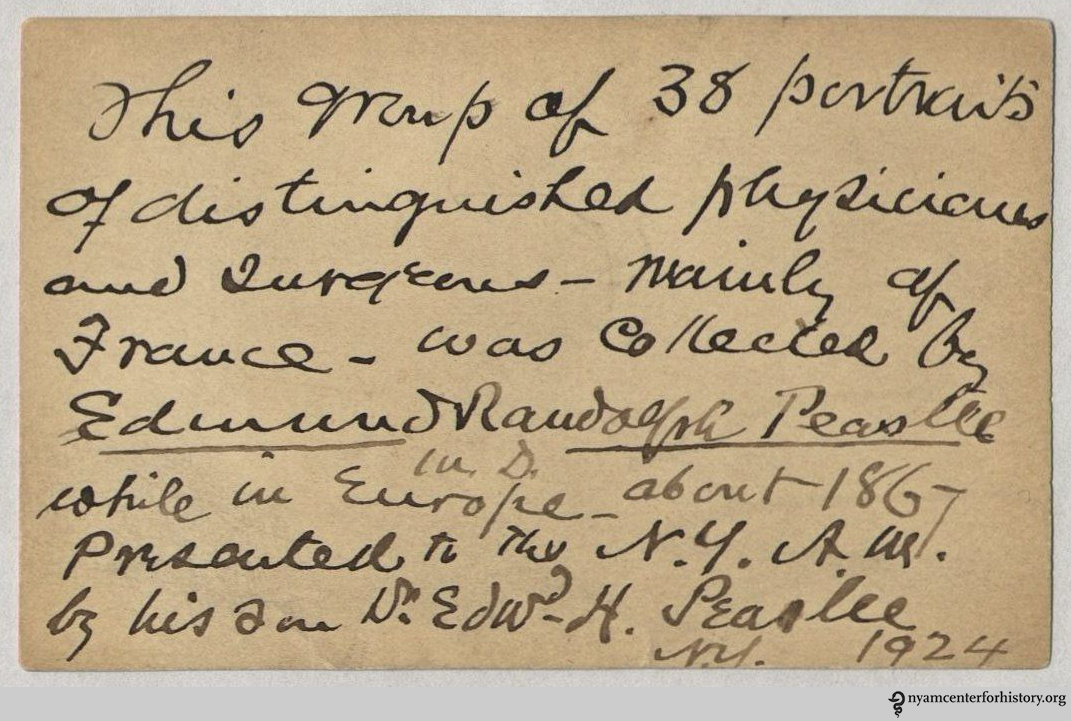
A handwritten note from the box in which our cartes are stored.

A handwritten note from the box in which our cartes are stored.

Our 223 images are portraits of physicians and scientists, both European and American. From a handwritten note in the box in which our cartes are stored, we know that Dr. Edmund Randolph Peaslee collected some of them while he was in Europe in 1867. His son, Dr. Edward Henry Peaslee, presented them to the Academy in 1924. Unfortunately, we do not know which photographs comprised the original gift. Some of the cartes came to the Academy from other donors and do have the donor information on the versos.

The Challenge

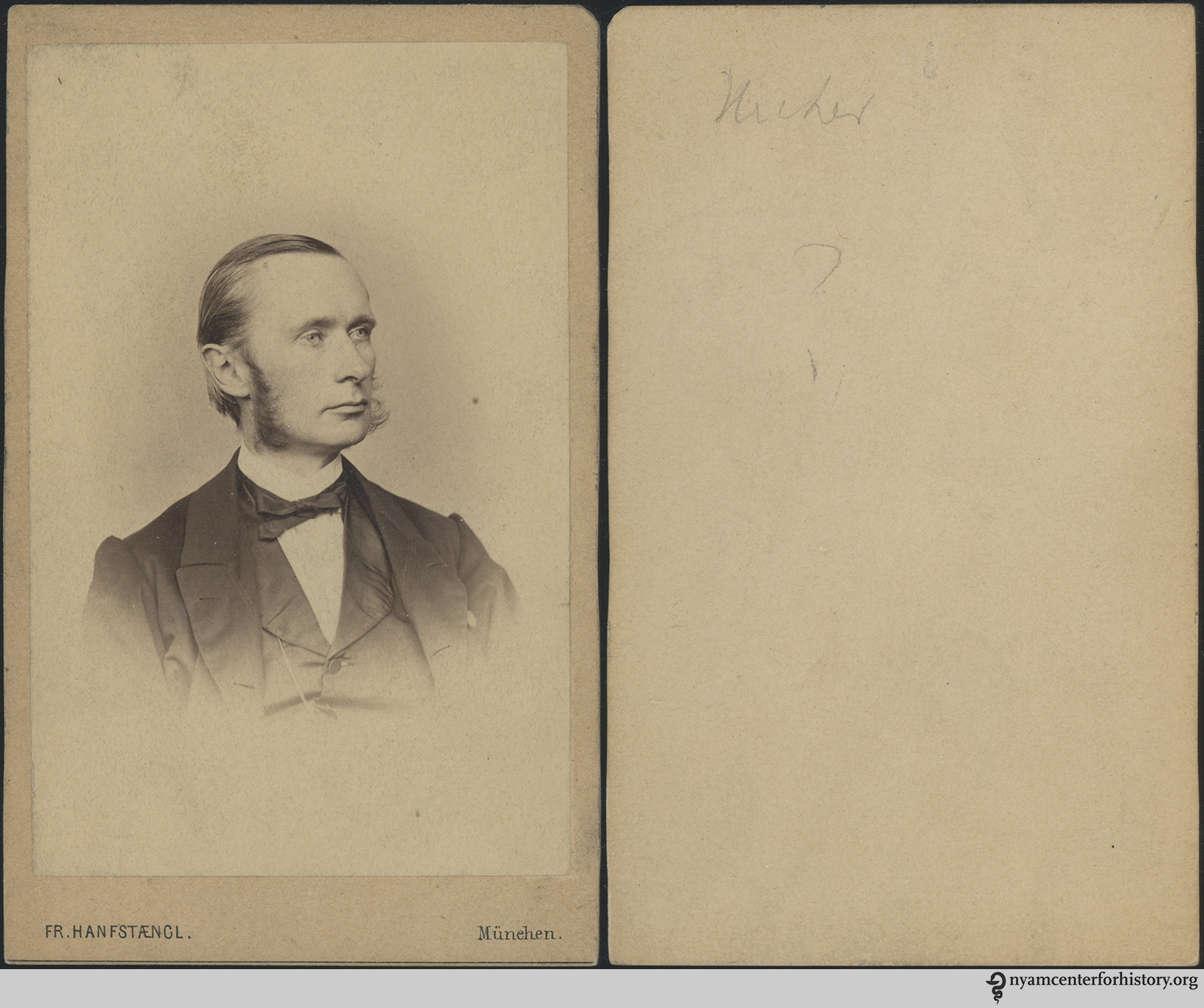
We have been able to identify almost all of the individuals pictured on the cartes, but there are four who still puzzle us. In three cases, we have a last name but have not yet found enough information to make a full identification. For one image, we have no information at all.

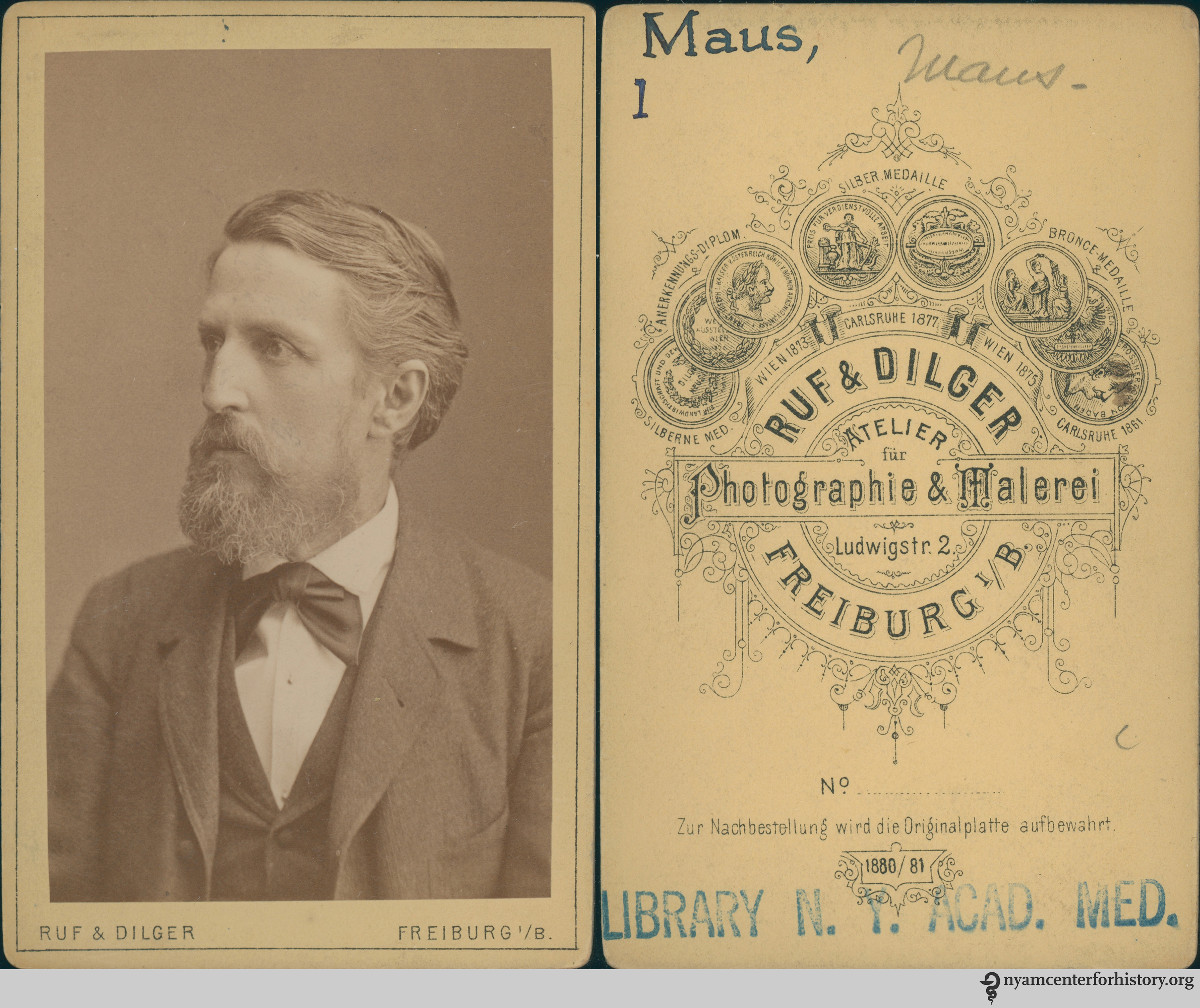
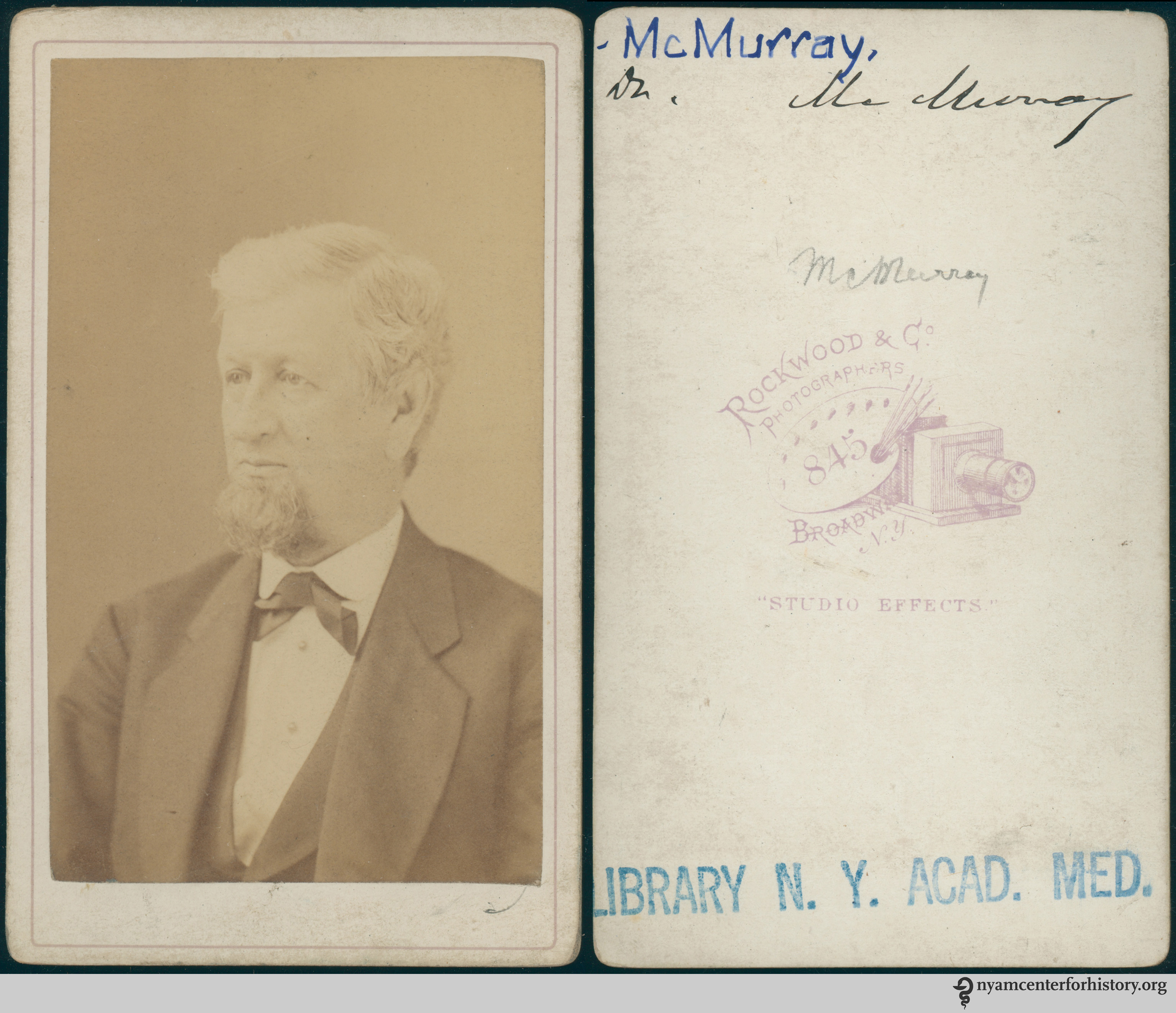
Do you recognize these men? Information on the cartes tells us that two of the portraits were taken at the same photographic studio in New York and the other two were taken by different photographers in Germany. Your challenge: if you recognize a face or surname, please help us figure out who the portraits depict.

Maus, Ruf & Dilger Atelier für Photographie & Malerei.

Maus, Ruf & Dilger Atelier für Photographie & Malerei.

Dr. McMurray, Rockwood & Co Photographers.

Dr. McMurray, Rockwood & Co Photographers.

Dr. Minor, Rockwood & Co Photographers.

Dr. Minor, Rockwood & Co Photographers.

Unknown man, studio of Franz Hanfstaengl, Munich.

Unknown man, studio of Franz Hanfstaengl, Munich.

Dr. William Edmund Aughinbaugh, Medical Adventurer (Item of the Month)

By Arlene Shaner, Historical Collections Reference Librarian

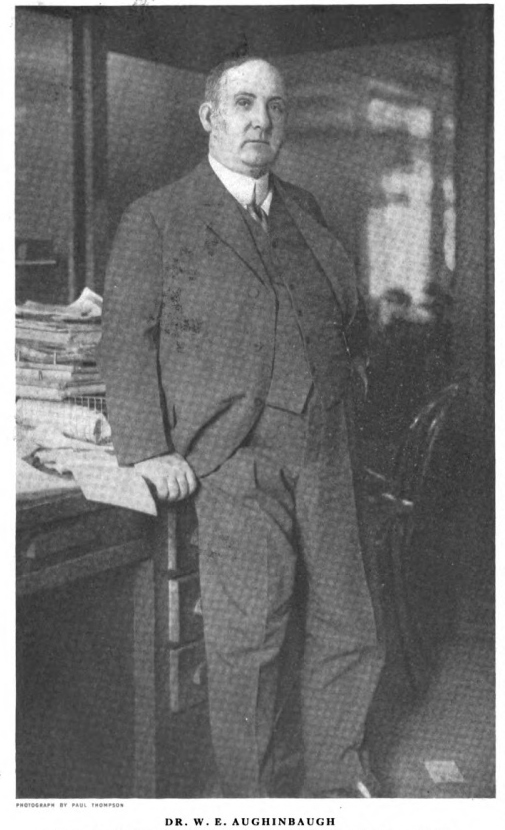
Dr. Aughinbaugh, circa 1915. In:

Dr. Aughinbaugh, circa 1915. In: “A Globe-Trotting Physician,” American Magazine, Nov. 1915, 34.

In the November 1915 issue of The American Magazine, the “Interesting People” section profiled an unusual physician. The article described Dr. William Edmund Aughinbaugh (18711940) as being “round like the earth; and he has rolled around it often. He has sawed bones and prescribed pills in every degree of latitude on both hemispheres.”1

As the article, and his autobiography, I Swear by Apollo, make clear, Aughinbaugh lived a life of adventure, traveling the globe for decades. Cuba, Venezuela, India, Peru, and Mexico were all early destinations where he treated lepers, studied the plague, and set up hospitals. He was a founder or early member of the Explorers, Adventurers, and Circumnavigators Clubs; taught courses about foreign trade at New York University and Columbia; and spent many years writing about and helping negotiate foreign trade agreements in Latin American countries and for South American natural resources.

The Academy’s manuscript collections contain a small album of photographs donated by the New York Public Library in 1952 (NYPL began sending items of medical interest that were given to them to the Academy in 1900). NYPL has a small collection of Aughinbaugh’s papers, mostly related to his work as the foreign editor of the New York Commercial. Aughinbaugh probably assembled the album between 1897 and 1906. Most of the photographs are unlabeled and trying to contextualize them has presented interesting challenges, demonstrating both the ways in which the written record helps us uncover more information and how much will probably remain forever unknowable.

It’s pretty clear that the first couple of photographs date to around 1895–97, when Aughinbaugh was a medical student at Columbian University (now George Washington) in Washington, D.C., and then an intern at Emergency Hospital there.

As both Aughinbaugh’s autobiography and his New York Times obituary attest, he helped finance his medical education by founding, with several other students, the Hippocratic Exhumation Corporation, essentially a grave-robbing operation. Aughinbaugh justified the less than savory labors of the corporation by assuring his readers that “care was always taken to undress the corpse and return the clothing to the grave…” as, according to court decree “a naked body belonged to no one—no crime would be committed by taking it.”2

Aughinbaugh insisted that he and his friends were not alone in this enterprise. Most medical students were desperate for bodies to dissect, and few legitimate ways to procure them existed. John Harley Warner and James Edmonson, in their recent book, Dissection: Photographs of a Rite of Passage in American Medicine: 1880-1930, corroborate this assertion, noting that in Washington, D.C., as well as in many states, there were no legal ways of obtaining bodies at that time, even though students were required to complete dissections to graduate. These two photographs, of Aughinbaugh (on the left) and two other students dissecting a body, and of Aughinbaugh and a fellow physician with a skeleton companion, fit right into the tradition of medical students posing with their cadavers in dissecting rooms.3

The album also contains posed portraits of patients suffering from diseases or showing the results of surgical operations. In some cases, Aughinbaugh pasted multiple photographs of the same patient into the scrapbook. The album dates from a time that witnessed the expanded use of photographs to document treatments and disease. While there is no way to be certain, these photographs may have been taken by Aughinbaugh himself.

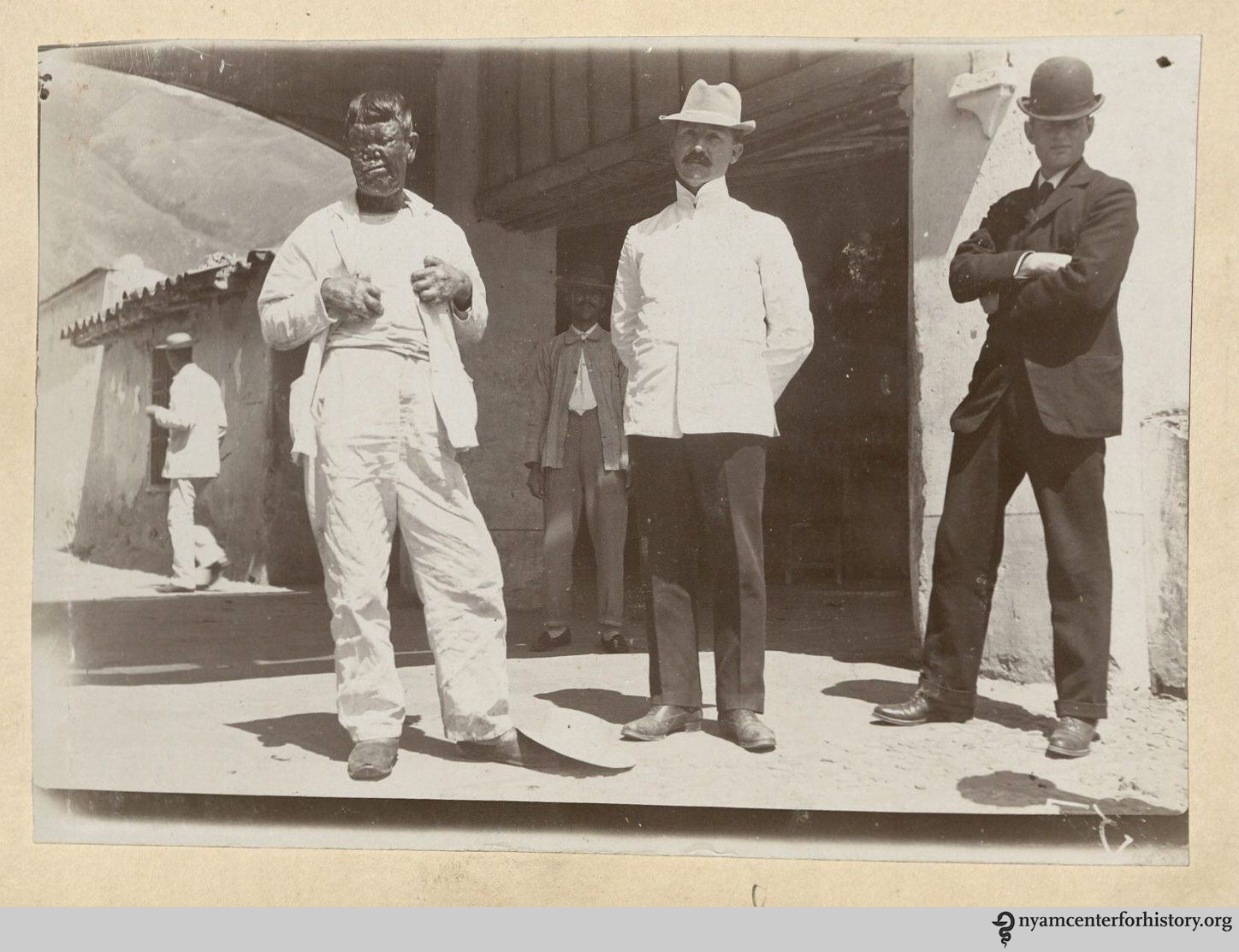
Another group of pictures shows groups of people that include Aughinbaugh himself (here in a white coat and hat). These images must date to Aughinbaugh’s years in Cuba. Having been denied the opportunity to enlist during the Spanish-American War in 1898 because of a heart condition, Aughinbaugh signed on as the ship’s surgeon for a vessel ferrying sick and wounded soldiers between Cuba and the United States. After the signing of the Treaty of Paris, he jumped ship while the boat was docked in Havana and stayed on as a civilian surgeon, working at the largest hospital in Cuba devoted to the care of leprosy patients, which, although he does not name it, must have been the hospital at San Lazaro, on the outskirts of Havana.4

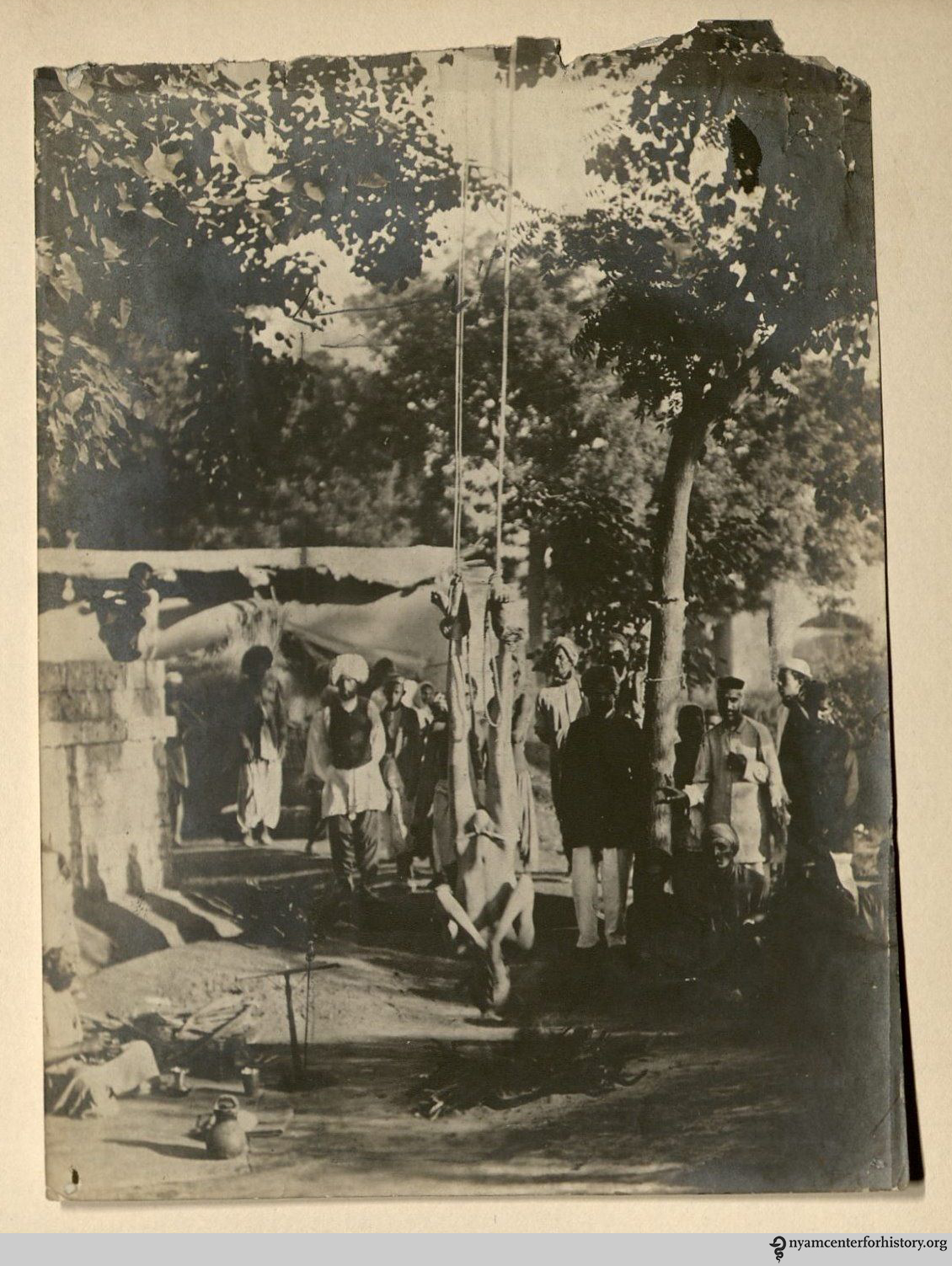
Aughinbaugh’s autobiography provides real documentation for only a single photograph in his album. Aughinbaugh spent about four years (ca. 1902–1906) in India during a bubonic plague epidemic, working for the Indian Plague Commission. The picture shows an Indian ascetic suspended upside down over a fire. “I photographed one man who hung suspended by his feet from a banyan tree, while his youthful assistant built a fire of dried cow dung within a foot of his head,” Aughinbaugh writes, “When he was lowered, I… could not detect one sign of a burn”.5 He later submitted the photograph to a contest run by the New York Herald, won a prize, and added the clipping to the album.

This album raises many questions, both about the use of photography by physicians to record information about medical practice and about the ways in which individuals choose to save images that document their own life experiences. Aughinbaugh’s choice to conflate the personal with the professional is part of what continues to make the album an intriguing part of our collections.

References

1. Barton, Bruce, “Globe Trotting Physician,” The American Magazine v.80 (Nov 1915), p. 34. Accessed online on July 29, 2015: http://hdl.handle.net/2027/coo.31924065598967?urlappend=%3Bseq=446

2. Aughinbaugh, W.E., I Swear by Apollo (New York: Farrar & Rineharrt, 1938), pp. 44-49. NYTimes obituary: http://query.nytimes.com/mem/archive/pdf?res=9C06E5D91F3CE73ABC4152DFB467838B659EDE Accessed online on July 29, 2015.

3. Warner, John Harley and James Edmonson, Dissection: photographs of a right of passage in American medicine, 1880-1930 (New York: Blast Books, 2009), pp. 17-19.

4. Aughinbaugh, pp. 103-113.

5. Aughinbaugh, p. 165.

How Air Conditioning Changed the NICU

By Johanna Goldberg, Information Services Librarian

We’ve entered the season of hot, humid, frizzy-headed misery outside and freezing temperatures from blasting office air conditioners inside. Which got me to thinking: What impact did air conditioning have on medicine?

Constantin P. Yaglou. From the Harvard School of Public Health 1955 yearbook.

Constantin P. Yaglou. From the Harvard School of Public Health 1955 yearbook.

One man did impressive work on this front. Constantin P. Yaglou (1897–1960) was not a physician, but a professor of industrial hygiene at Harvard’s School of Public Health. Born in Constantinople, he came to the United States in 1920 and earned a master’s degree from Cornell. He joined the Research Laboratory of the American Society of Heating and Ventilating Engineers in 1921, where he spent five years studying the influence of humidity, temperature, and air circulation on working and resting adults. In 1925, he joined the department of industrial hygiene at Harvard.1

His cross-disciplinary collaboration with Harvard Medical School’s pediatrics department, notably Dr. Kenneth Blackfan, proved innovative. Assisted by nurse Katherine MacKenzie Wyman, they published “The premature infant: A study of the effects of atmospheric conditions on growth and on development” in the American Journal of Diseases of Children in 1933.

The air conditioning unit in a nursery for premature infants. In “The premature infant: A study of the effects of atmospheric conditions on growth and on development,” American Journal of Diseases of Children, 1933, 46(5).

The air conditioning unit in a nursery for premature infants. In “The premature infant: A study of the effects of atmospheric conditions on growth and on development,” American Journal of Diseases of Children, 1933, 46(5).

They studied the effects of Harvard’s newly air conditioned nursery from 1926–1929, and compared their measurements to those from pre-air conditioned 1923–1925. (From 1926–1929, they controlled for variables like diet and dress.) They found that premature infants were less able to stabilize their body temperatures than infants born at term. Even among premature infants, ability to regulate temperature changed depending on birth weight. They determined the ideal temperature for premature newborns to be 75-100 degrees Fahrenheit with 65% humidity.2 These influential findings lay a foundation for the development and use of temperature-controlled incubators.3

Yaglou published a figure neatly summarizing the study’s major results in JAMA in 1938:

A summary of the results of the premature infant study. In "Hospital air conditioning," JAMA 1938, 110(24).

A summary of the results of the premature infant study. In “Hospital air conditioning,” JAMA, 1938, 110(24).

This figure comes from Yaglou’s broad-reaching “Hospital Air Conditioning,” which brought together studies on air conditioning’s effects in the operating room, recovery wards, premature nurseries (summarizing his prior work, as in the figure above), fever cabinets, allergen-free rooms, and oxygen chambers.4

According to the article, not only did air-conditioned operating rooms help those involved in surgery feel more comfortable, it also reduced “the risk of explosion of certain anesthetic gases.”4 In the post-operative recovery rooms, air conditioning reduced the risk of heat stroke and improved the body’s ability to recuperate, though Yaglou did not recommend a particularly cool temperature. “With a relative humidity of about 55 per cent,” he wrote, “a temperature of about 80 will probably prove acceptable.”

But even with the benefits of air conditioning discussed in the article, it was difficult to employ at a large scale in the late 1930s. Yaglou concluded, “High cost precludes cooling the entire hospital, but the needs of the average hospital may be satisfactorily fulfilled by the use of built-in room coolers in certain sections of the hospital and a few portable units which can be wheeled from ward to ward when needed.”4

In addition to his work in medical settings, Yaglou also performed military research on extreme climates like the Yukon, the tropics, and the Arizona desert, “working with volunteers to determine the limits of human endurance under severe heat, cold and humidity.”5 Perhaps it should come as no surprise that the UK Antarctic Place-names Committee christened Yaglou Point in his honor in 1965.6

References

1. Whittenberger JL, Fair GM. Constantin Prodromos Yaglou. Arch Environ Heal An Int J. 1961;2(2):93–94. doi:10.1080/00039896.1961.10662820.

2. Blackfan KD, Yaglou CP, Wyman KM. The premature infant: A study of the effects of atmospheric conditions on growth and on development. Am J Dis Child. 1933;46(5):1175–1236. doi:10.1001/archpedi.1933.01960060001001.

3. Rutter TL. Comfort zone. Harvard Public Heal Rev. 1997:29.

4. Yaglou CP. Hospital air conditioning. J Am Med Assoc. 1938;110(24):2003–2009. doi:10.1001/jama.1938.62790240003010.

5. Constantin Yaglou, Harvard Professor. New York Times. http://query.nytimes.com/gst/abstract.html?res=9A06E6DF123DE333A25757C0A9609C946191D6CF. Published June 4, 1960. Accessed July 21, 2015.

6. Yaglou Point, Antarctica – Geographical Names, map, geographic coordinates. Available at: http://www.geographic.org/geographic_names/antname.php?uni=16847&fid=antgeo_126. Accessed July 21, 2015.

X-raying Orphans: Fictionalizing Medical History in Orphan #8

Guest author Kim van Alkemade has a doctorate in English from the University of Wisconsin-Milwaukee and is a professor at Shippensburg University in Pennsylvania. Orphan #8 is her first novel.

“They weren’t treatments,” I interrupted, surprising both of us with my vehemence. “It was an experiment. I was experimented on, not treated.”1

The premise of my historical novel Orphan #8 is this: in 1919, four-year-old Rachel Rabinowitz is placed in a Jewish orphanage in New York where the fictional Dr. Mildred Solomon is conducting X-ray research using the children as her subjects. Years later, Rachel, who has become a nurse, is given the opportunity for a reckoning with her past when old Dr. Solomon becomes her patient. While the novel is fiction, medical research on children in orphanages was a common practice, and a child like Rachel Rabinowitz would not have been unique at the time. Not only were children “used as subjects in a number of experiments involving X-rays”2 but a “preponderance of the children subjects were poor, institutionalized, mentally ill, physically disabled, or chronically ill.”3

A dormitory in the Hebrew Infant Asylum. From Annual Report 1914 Hebrew Infant Asylum of New York.

A dormitory in the Hebrew Infant Asylum. From Annual Report 1914 Hebrew Infant Asylum of New York.

The inspiration for the novel arose from research I was doing about Jewish orphanages for a family history project. In the archives of the American Jewish Historical Society, I read that Dr. Elsie Fox, a graduate of Cornell Medical School, X-rayed a group of eight children at the Home for Hebrew Infants in New York City, resulting in persistent alopecia. Upon the transfer of these children to the Hebrew Orphan Asylum in October 1919, the Board of Trustees discussed what to do in the “matter of the children received with bald heads.” On November 9, 1919, they entered into their meeting minutes a letter from the Home for Hebrew Infants “assuming responsibility… for the condition of these children.” The letter refers to an enclosure of data about the eight children, as well as a letter from Dr. Fox detailing her X-ray treatments. Unfortunately, the enclosures were not entered into the minutes. On May 16, 1920, the matter was put to rest when the Trustees “ordered that children afflicted with alopecia should have wigs made, and be boarded out, if possible.”4

Detail of the Meeting Minutes of the Board of Trustees of the Hebrew Orphan Asylum. Courtesy of the American Jewish Historical Society.

Detail of the Meeting Minutes of the Board of Trustees of the Hebrew Orphan Asylum. Courtesy of the American Jewish Historical Society.

Dr. Solomon blinked, confused. She stared at me as if trying to focus on print too small to read. “You were one of my subjects?”

I nodded, imagining for a moment that she recognized me: her brave, good girl. She lifted her hand to my face, bent my head back to expose the underside of my chin. Her thumbnail circled the scars there, tracing the dimes of shiny skin. Then she placed her fingers against my drawn eyebrows and wiped away the pencil. Finally, she reached up to my hairline and pushed along the brow. My wig shifted. She pulled her hand back in surprise. It wasn’t tenderness I saw in her face, not even regret. Fear, maybe? No, not even that.

“So the alopecia was never resolved? I was curious about that, always meant to follow up. What number were you?”

I adjusted my wig. “Number eight.”5

Though I invented the character of Dr. Mildred Solomon before I discovered more about Dr. Elsie Fox, it turned out the real person was similar to my fictional character. Elsie Fox was born in Vienna, Austria, in 1885. When she graduated from Cornell with her medical degree in 1911, she was one of 8 women in a class of 53 graduates. She became a fellow of the New York Academy of Medicine in 1916, and was a member of the Bronx Roentgen Ray Society.6 A published medical researcher, she went on to become the Director of the Harvey School for the Training of Analytical and X-ray Technicians in Manhattan and was a Roentgenologist at City Hospital. She was 58 when she died in June 1943.

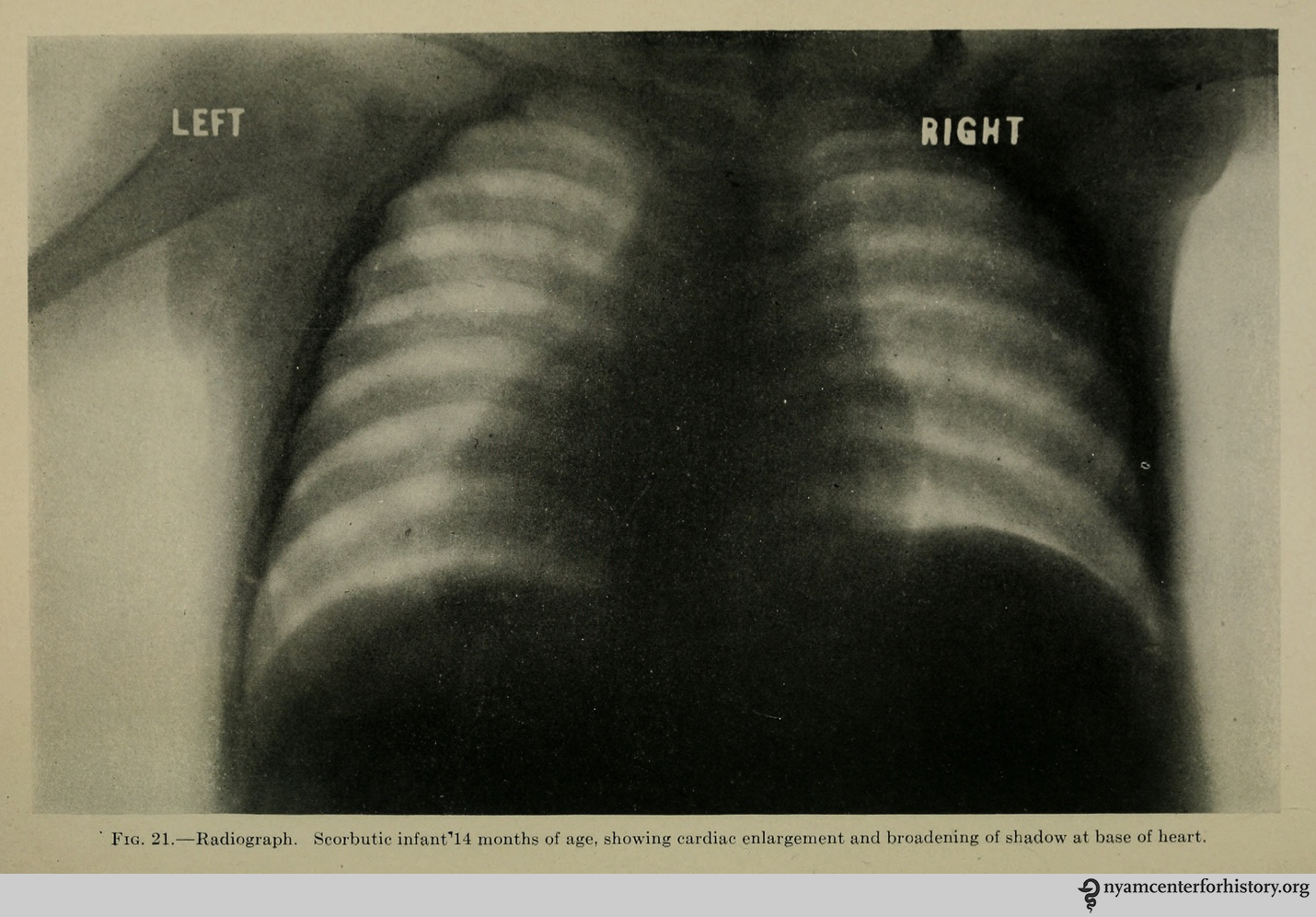
From Hess, Alfred F., M. D. Scurvy, past and present. Philadelphia, J.B. Lippincott Company, 1920.

From Hess, Alfred F., M. D. Scurvy, past and present. Philadelphia, J.B. Lippincott Company, 1920.

In my novel, I paired the fictional Dr. Solomon with a character closely based on a real orphanage pediatrician of the time. Dr. Alfred F. Hess was attending physician to the Hebrew Infant Asylum and a renowned researcher into childhood nutritional diseases. He was the innovator of an infant isolation ward at the orphanage in which babies were kept in separate glassed-in rooms to avoid the spread of disease. Hess is well-known for a quote in which he extolled the advantages of conducting research on “institutional children” who provided the advantage of belonging to “the same stratum of society,” being “reared within the same walls,” and having the “same daily routine, including similar food and an equal amount of outdoor life.” He concluded: “These are some of the conditions which are insisted on in considering the course of experimental infection among laboratory animals, but which can rarely be controlled in a study in man.”7

Glassed-in babies, from Annual Report 1914 Hebrew Infant Asylum of New York.

Glassed-in babies, from Annual Report 1914 Hebrew Infant Asylum of New York.

Dr. Hess’s approach to the study of scurvy, which involved inducing the condition in children and then experimenting with various cures, was controversial even in his lifetime. In 1921, Hess was criticized “for using ‘orphans as guinea pigs’ in studies of the dietary factors in rickets and scurvy” by “withholding orange juice from institutionalized infants until they developed the characteristic small hemorrhages associated with the disease.”8

From Hess, Alfred F., M. D. Scurvy, past and present. Philadelphia, J.B. Lippincott Company, 1920.

From Hess, Alfred F., M. D. Scurvy, past and present. Philadelphia, J.B. Lippincott Company, 1920.

“My name is Rachel, I’ve told you that. But you don’t care, do you? Even now, I’m just a number to you. All the children at the Infant Home were nothing more than numbers to you.” I thought of the tattoo on Mr. Mendelsohn’s frail arm. “Just numbers, like in the concentration camps.”

She gripped the sheets. “How can you say such a thing? You were in an orphanage, not some concentration camp. They took care of you, fed you, clothed you. Jewish charities support the best orphanages, the best hospitals. Even this Home is as good as it gets for old people like me. You have no right to even mention the camps.”

Of course the orphanage wasn’t a death camp, I knew that, but I wasn’t backing down. “You came into a place where we were powerless, you gave us numbers, subjected us to experiments in the name of science. How is that different?”9

When I would tell people about the medical experimentation on children depicted in my novel, they would often say it sounded like something the Nazis would do. As first I was impatient with the comparison: these experiments were conducted well before the rise Hitler in Germany, and the doctors conducting the research, many of them Jewish themselves, intended to advance medicine for the benefit of all children. Yet, as I thought about it from the point of view of one of the child subjects, I wondered if that distinction would matter.

It is easy for contemporary readers to conflate all medical experimentation on children with the atrocities of the Holocaust, but even after “the world was outraged at the murders carried out in the name of science by Nazi physicians during World War II,”10 some American doctors continued to use orphans, prisoners, and other disenfranchised populations in medical research without their consent. In my novel Orphan #8, I bring this aspect of medical history to general readers through the use of narrative and story. Medical students and physicians may also find that fiction provides an opportunity to explore these complex issues with empathy and imagination and to engage a wider community in the discussion of medical ethics.

References

1. van Alkemade, Kim. Orphan #8 (New York: William Morrow, 2015), 232.

2. Lederer, Susan E. and Michael A. Grodin. “Historical Overview: Pediatric Experimentation.” In Grodin, Michael A. and Leonard H. Glantz. Children as Research Subjects: Science, Ethics, and Law (New York: Oxford University Press, 1994), 10.

3. Lederer and Grodin, 19-20.

4. Executive Committee Minutes 1909-1930. Hebrew Orphan Asylum Collection, Archives of the American Jewish Historical Society, Center for Jewish History, 15 West 16th Street, New York, NY.

5. van Alkemade, 173.

6. The Bulletin of the New York Academy of Medicine. September 19 (1943): 676.

7. Lederer, Susan E. “Orphans as Guinea Pigs: American Children and Medical Experimenters, 1890-1930.” In Roger Cooter, ed. In The Name of the Child: Health and Welfare, 1880-1940 (New York: Routledge, 1992), 115.

8. Lederer and Grodin, 13.

9. van Alkemade, 282.

10. Lederer and Grodin, 16.

Adventures in Rare Book Cataloging

By Tatyana Pakhladzhyan, Rare Book Cataloguer

At the October festival celebrating the 500th birthday of anatomist Andreas Vesalius, The Drs. Barry and Bobbi Coller Rare Book Reading Room exhibited seven anatomical works drawn from the library’s extensive rare book holdings. Anatomy is one of the library’s major collecting strengths, including works by and related to Andreas Vesalius.

Visitors looking at books on display at 2014's Vesalius 500 festival.

Visitors looking at books on display at 2014’s Vesalius 500 festival. Photograph by Charles Manley.

Since the exhibited materials have been in the library’s collection for decades, I was curious to see how their online bibliographic records looked. As card catalogs turned into online catalogs at the end of last century, collection holdings became increasingly findable from far away. But in the process of converting card catalog records into online records, some items ended up with incomplete or incorrect information reflected in the online catalog. I found that the records of the seven anatomical holdings required some attention.

The purpose of rare book cataloging is to create elaborate catalog records for books printed during the hand-press period (c.1455c.1830) and to describe and record copy-specific information that would uniquely identify the library’s holding from other copies of the same title. Descriptive cataloging should be sufficiently detailed to represent the work.

Female flap anatomy from The Academy's copy of the 1559 English edition of Geminus’ Compendiosa.

Female flap anatomy from The Academy’s copy of the 1559 English edition of Geminus’ Compendiosa.

Rare book cataloging requires complete and faithful transcription of the title page in its original language, greater detail in the physical description area, and careful and thorough recording of various distinguishing points in the note area, including signature statements, identification of bibliographic format, annotations, pagination errors, illustration techniques and creators, printing method, binding style, and provenance. Full and accurate descriptions allow researchers to find materials in online catalogs. Adding images or links to digital copies is another catalog feature that allows for more sophisticated experience for rare material users.

I was particularly delighted to update the catalog record for the 1559 edition of Geminus’ Compendiosa totius anatomiae delineatio, aere exarata (A complete delineation of the entire anatomy engraved on copper). This beautiful folio is simply a work of art! Read more about the work in a recent blog post.

Male flap anatomy from The Academy's copy of the 1559 English edition of Geminus’ Compendiosa.

Male flap anatomy from The Academy’s copy of the 1559 English edition of Geminus’ Compendiosa.

The title page is an engraved plate, with a hand-colored portrait of Queen Elizabeth at center and the royal motto “Dieu et mon droit” under the portrait. Facing the title is the leaf with arms of the Order of the Garter “Honi soit qui mal y pense,” decorated with jewels. (Thanks to my library colleagues for helping me prove that “Honi soit qui mal y pense” motto is, in fact, the motto of the Order of the Garter.)

The coat of arms, left, and title page, right, of the Academy's copy of the 1559 English edition of Geminus’ Compendiosa.

The coat of arms, left, and title page, right, of the Academy’s copy of the 1559 English edition of Geminus’ Compendiosa.

Checking standard bibliographies for corresponding period and making identifying references is an essential step to rare book cataloging. While consulting A Bio-Bibliography of Andreas Vesalius by Harvey Cushing, (1943, no. VI.C-4, p. 128), I found his comment about known copies at that time, stating that the “leaf before title bearing royal arms and ‘Honi soit qui mal y pense,’ is missing in all copies but London (BM [British Museum]).” Our copy has this leaf, seen above left.

Rare book cataloging also requires pointing out differences between printings, or manifestations, of a particular work. While consulting the English Short Title Catalogue (ESTC) that lists more than 480,000 items published between 1473 and 1800, I found that the entry for this work has a note, “a variant state has B7 unsigned.” In the hand-press era, books were printed as sheets with varying numbers of pages per side, with signature marks as letters, numbers, or symbols at the bottom of each leaf to help binders assemble the sheets of a book into the right order. I was curious to find out if the NYAM copy was a variation with signature B7 unsigned, but it is signed, although not on the bottom of the page.

Note "B.vii" hiding at the bottom right of the page. The Academy's copy of the 1559 English edition of Geminus’ Compendiosa.

Note “B.vii” hiding under the text at the right of the page. The Academy’s copy of the 1559 English edition of Geminus’ Compendiosa.

The library’s 1559 edition, the English translation by Nicholas Udall, is a reissue of the 1553 edition, with a slightly different title page, a dedication, and a colophon leaf. Bookseller information from the colophon at foot of last leaf reads: “Imprinted at London within the blacke fryars: by Thomas Gemini. Anno Salutis. 1559. Mense Septemb.”

Final leaf with colophon. The Academy's copy of the 1559 English edition of Geminus’ Compendiosa.

Final leaf with colophon. The Academy’s copy of the 1559 English edition of Geminus’ Compendiosa.

Cataloging rare books is an exciting process and sometimes even an adventure, as older books are unique and carry impressions of their formal owners. Our copy’s provenance includes bookplate of bibliophile George Dunn, “From the Library of George Dunn of Woolley Hall near Maidenhead.” It was a generous gift to the Academy library from Mrs. George S. Huntington, the wife of a prominent anatomist.

The Long Road to Medicare

By Danielle Aloia, Special Projects Librarian

July 30 marks the 50th anniversary of the establishment of Medicare. But getting to the signing of the Social Security Amendment of 1965, which created Medicare, was a long road.

In the 1910s and 1920s, numerous reports, recommendations, and programs advocated the development of a national health system, especially after the United Kingdom adopted National Health Insurance in 1911. Due to opposition from the American Medical Association (AMA), labor unions, and insurance companies these recommendations were never fully accepted. However, there was consensus that something needed to do be done to protect the poor from the burden of healthcare costs.

As the charts below show, in 1929 citizens spent over three billion dollars on health care. The next chart shows where that money was spent. As noted by William Foster, chairman of the Committee on Public Health of the National Advisory Council on Radio in Education, “We now spend every year for medical care over three billion dollars, yet only one dollar out of every thirty goes to public health services for the prevention of disease.”1

From: Foster, William Trufant, U.S. Public Health Service. Doctors, dollars, and disease. [New York]: Public Affairs Committee, Inc.; 1937.

From: Foster WT, U.S. Public Health Service. Doctors, dollars, and disease. [New York]: Public Affairs Committee, Inc.; 1937.

From: Foster, William Trufant, U.S. Public Health Service. Doctors, dollars, and disease. [New York]: Public Affairs Committee, Inc.; 1937.

From: Foster WT, U.S. Public Health Service. Doctors, dollars, and disease. [New York]: Public Affairs Committee, Inc.; 1937.

In the 1930s, Roosevelt established the Committee on Economic Security to study social insurance and public assistance needs and programs to help combat the economic effects of the Great Depression. The Committee did not put forth any legislative proposals in regard to health insurance because, among other controversies, of the “possibility that any such a proposal would be declared unconstitutional….”2 (How telling in light of the debates at the Supreme Court in 2012 on the constitutionality of the U.S. Patient Protection and Affordable Care Act!) The Committee did put in their report that more research and investigation was needed in the health insurance area. Franklin D. Roosevelt signed the Social Security Act (SSA) in 1935 with clear understanding that it was just the beginning of a more extensive program, one that would include a healthcare component.3

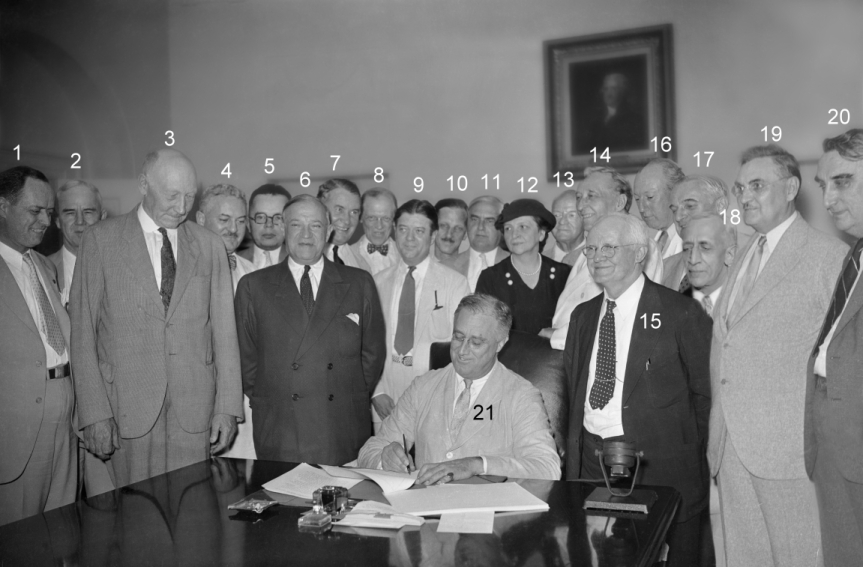
Roosevelt signing the Social Security Act, 1935. See here for names of participants. Courtesy of the Social Security Administration.

Roosevelt signing the Social Security Act, 1935. See here for names of participants. Courtesy of the Social Security Administration.

After the SSA was passed, Roosevelt quickly formed the Interdepartmental Committee to Coordinate Health and Welfare Activities. This committee held The National Health Conference in 1938, to “present and discuss the needs of the people of this country for preventive and curative service in illness and for the reduction of the economic burdens caused by illness.”4

The conference laid out five recommendations from a commissioned report of the Technical Committee on Medical Care, entitled the Need for a National Health Program:

From: Ratliff Beulah Amidon, U.S. Public Health Service. Who Can Afford Health? [New York]: Public Affairs Committee, Inc.; 1939.

From: Ratliff BA, U.S. Public Health Service. Who Can Afford Health? [New York]: Public Affairs Committee, Inc.; 1939.

Ultimately, the Committee adopted four of the five recommendations, all but recommendation four.5 The remaining recommendations were to be a “gradual expansion along well-planned lines with a view to achieving operation on a full scale within 10 years.”6

The recommendations were then embodied in the Wagner Bill in 1939, which outlined a broad federal health program. Not surprisingly, the bill was not brought to vote because of the opposition of the AMA and others.7 Subsequent legislative proposals were put forth, but none took hold.

In Marmor TR, Marmor JS. The Politics of Medicare. [Rev. American ed.]. Chicago : Aldine Pub.; 1973.

In Marmor TR, Marmor JS. The Politics of Medicare. [Rev. American ed.]. Chicago : Aldine Pub.; 1973.

In the early 1950s, the Truman Administration found “the right people” to move a health program forward—older Americans. The aged were sicker, poorer, less insured, and comprised the most hospitalizations. By focusing on this population, the administration hoped it could curb opposition.8 The focus of the program would be on hospitalization rather than on general health insurance.

But it would take the next 25 years for the passage of a health law. The Kennedy Administration led the charge in 1961 with the introduction of Medicare legislation, but the majority voted against it. The 1964 election brought a shift in the majority to the Democrats, allowing for further consideration of the bill. In 1965, with the backing of the AMA and insurance companies, Congress was ready to make a deal. They split Medicare into mandatory Part A: hospitalization, and voluntary Part B: medical insurance. This split helped appease opponents of a national health care system, or what some viewed as “socialized medicine.” Hospital costs were an easy target because hospital bills were large, costs were easier for actuaries to calculate, and patients were more likely to accept help. A portion of the Social Security taxes established by FDR were earmarked to cover the costs of the program and the elderly would pay extra if they opted into Part B.

LBJ signs the Medicare Act (Social Security Amendments) with Harry Truman looking on, 07/30/1965. Courtesy of OurDocuments.gov.

LBJ signs the Medicare Act (Social Security Amendments) with Harry Truman looking on, 07/30/1965. Courtesy of OurDocuments.gov.

In 1967, 19.36 million were enrolled in Part A and 17.87 million took advantage of Part B.9 Today, 55 million people are enrolled in Medicare.10 As the population ages, the economics of the program may need alteration—indeed, the Affordable Care Act has provisions for reforming physician payments and health care delivery. Medicare may need additional modernization in the future to support the population and remain economically viable. But as the history of Medicare shows, life-changing legislation takes time and patience.

References

1. Foster WT, U.S. Public Health Service. Doctors, dollars, and disease. [New York]: Public Affairs Committee, Inc.; 1937.

2. Ibid.

3. Myers RJ, McCahan Foundation. Medicare. Homewood, Ill.: Published for McCahan Foundation, Bryn Mawr, Pa., by R. D. Irwin; 1970.

4. U.S. National Health Conference. Proceedings of the National Health Conference. Washington : U. S. Govt. print. off.; 1938.

5. Ratliff BA, U.S. Public Health Service. Who Can Afford Health? [New York]: Public Affairs Committee, Inc.; 1939.

6. U.S. National Health Conference. Proceedings of the National Health Conference. Washington : U. S. Govt. print. off.; 1938.

7. Myers RJ, McCahan Foundation. Medicare. Homewood, Ill.: Published for McCahan Foundation, Bryn Mawr, Pa., by R. D. Irwin; 1970.

8. Marmor TR, Marmor JS. The Politics of Medicare. [Rev. American ed.]. Chicago: Aldine Pub.; 1973.

9. Witkin, E. The Impact of Medicare. Springfield, Ill.: C. C. Thomas; 1971.

10. Davis K, Schoen C, Bandeali F. Medicare: 50 Years of Ensuring Coverage and Care. New York: Commonwealth Fund; 2015. Available at: http://www.commonwealthfund.org/~/media/files/publications/fund-report/2015/apr/1812_davis_medicare_50_years_coverage_care.pdf